Published 9 Oct 2026
Red Kite Call: What Red Kites Sound Like, with Recordings
By the Birdfact teamChecked by Nathan Cope
A Red Kite's call is a whistled mew, often a long whistle and then a run of quick notes that swing up and down. It is the commonest call between the two birds of a pair. A Buzzard's main call is a single falling mew. Hear both, recorded in Britain, and see them drawn as spectrograms.
On this page7 sections
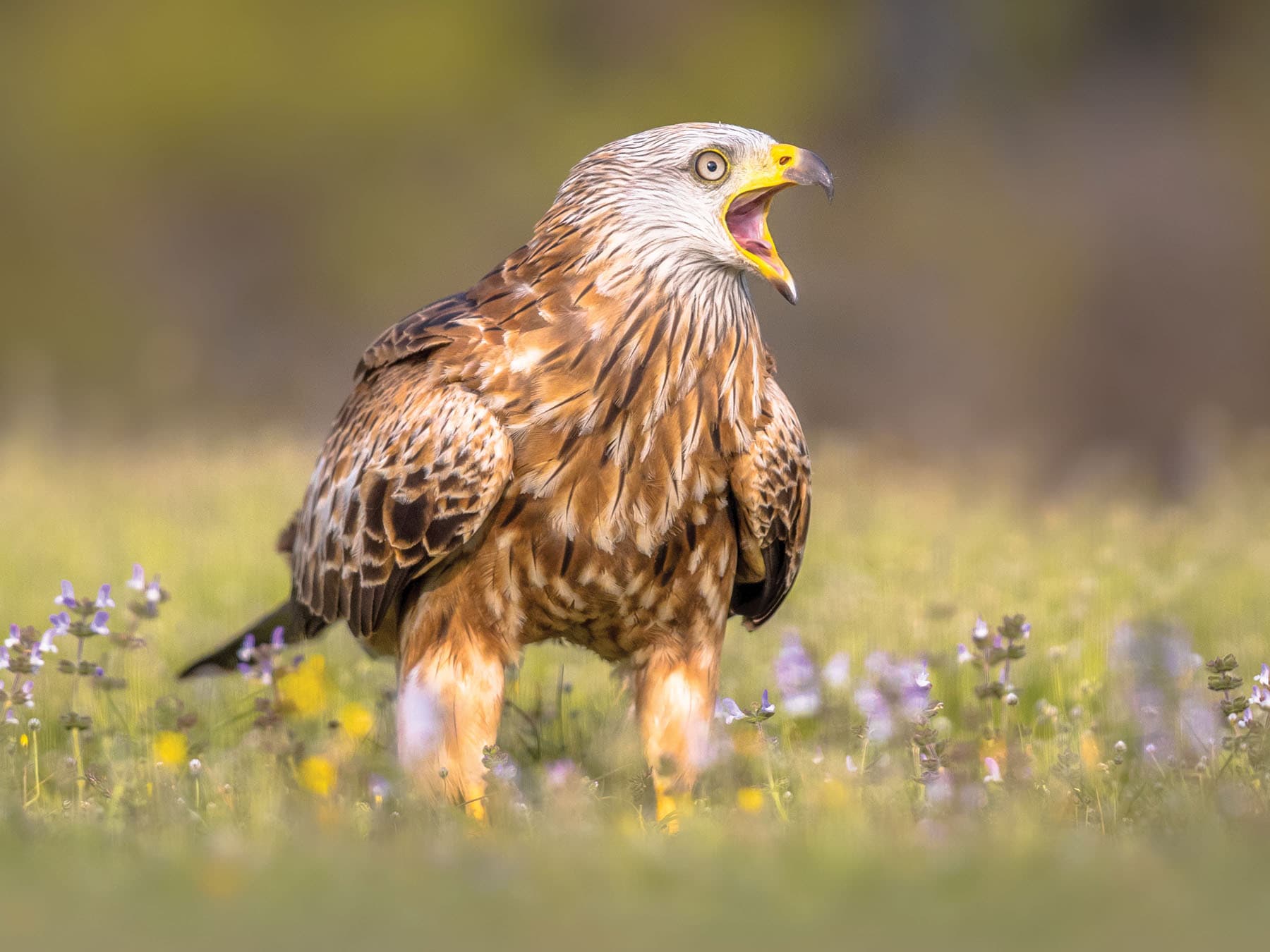
What a Red Kite sounds like, with calls recorded in Britain and drawn as spectrograms: how the call is built, when kites call, and how to tell a kite from a Buzzard by ear. For the bird itself, see Red Kite identification and facts.
What does a Red Kite sound like?
A whistled mew. The RSPB writes it as "peee eooo eooo".1 Birds of the World gives it as "weee-oo", like a Buzzard's call but higher and perhaps shriller, and often repeated several times in a short, fast series.2 The Chilterns Conservation Board describes a mew-like "weoo-weoo-weoo", rapidly repeated.3
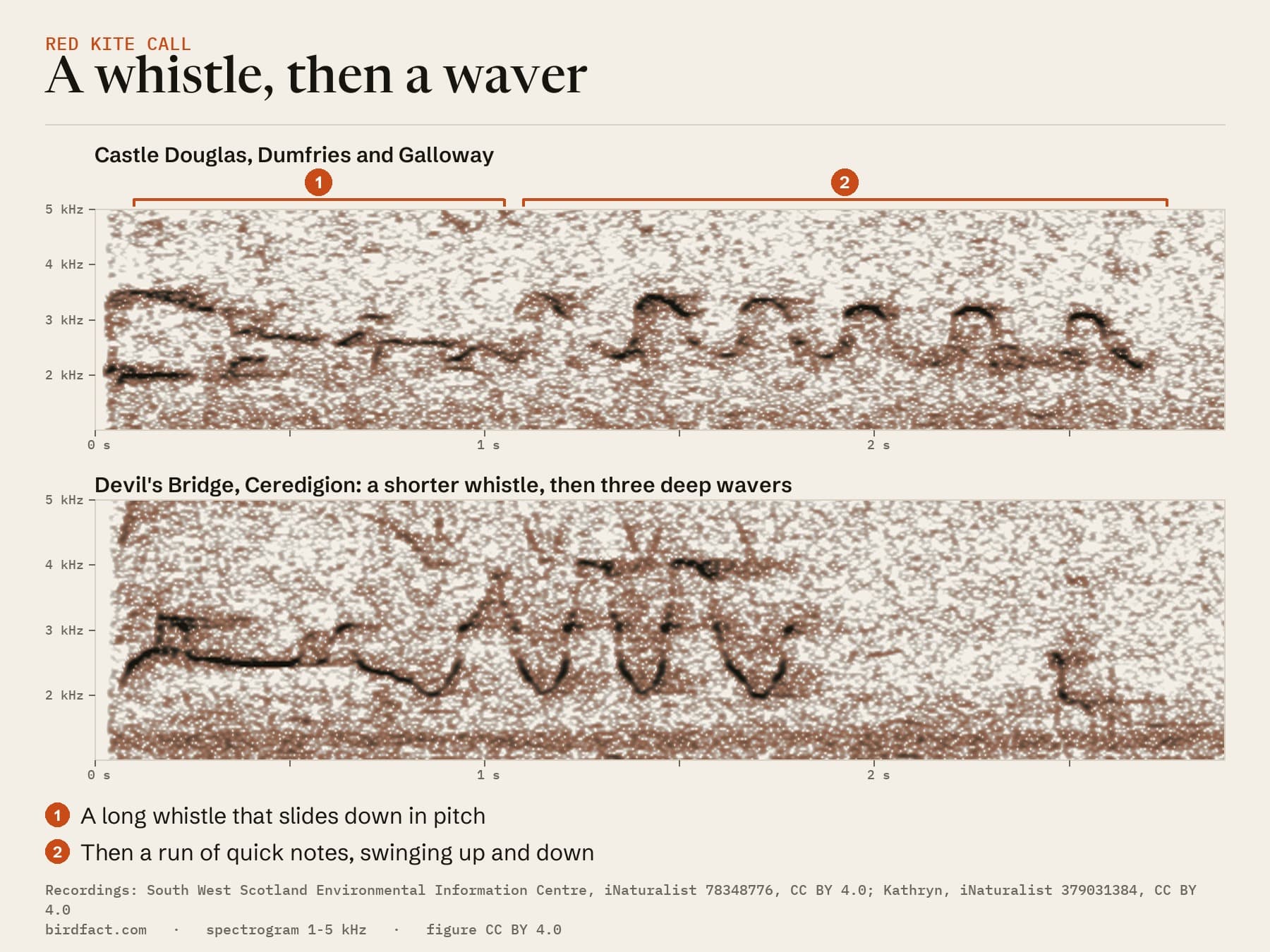
Listen for two parts: a long whistle first, then a run of quicker notes that swing up and down. In this recording, made at Castle Douglas in Dumfries and Galloway by an observer who saw the kite overhead, both parts come through clearly from about five seconds in.
How the call is built
Seen on a spectrogram, the pattern is easy to follow. In the Castle Douglas recording, the whistle starts near 3.5 kHz and slides down to about 2.6 kHz over about a second. Then come six quick notes, each swinging between about 2.2 and 3.4 kHz, about four a second. A kite recorded at Devil's Bridge in mid Wales follows the same plan with a shorter whistle, about half a second, then three deep wavers between about 2 and 3 kHz or a little higher; the whole call lasts under two seconds.
Not every call is the same
The call varies. A kite recorded in Hertfordshire called twice, about seven seconds apart, each time with a lower whistle of under a second that dropped from about 2.8-3 kHz to 2.5 kHz, followed by six or seven quick wavers. A kite at Henley-on-Thames gave about four gentle wavers in a second; that recording starts part-way through the call, so it does not show whether a whistle came first.
Why do Red Kites call?
Often to each other. Birds of the World describes the "weee-oo" as the commonest call between the two birds of a pair, and notes that kites are often silent away from the nest.2
The Henley recording catches one kite answering another. The recordist notes that the bird was answering another kite, and that the loud note at the end of the clip is the other bird.
Red Kite or Buzzard by ear
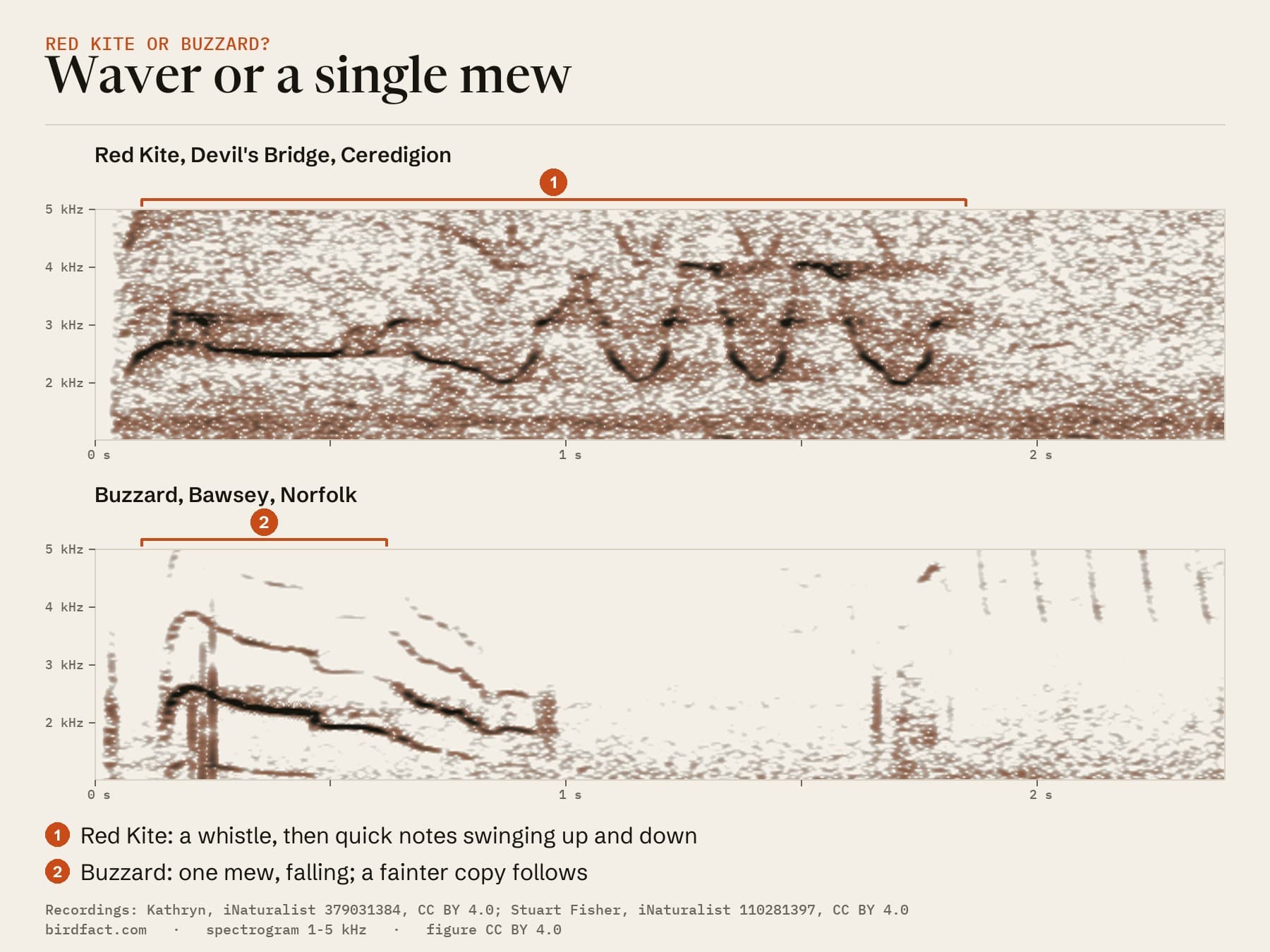
The two birds share the same skies and both mew, so the call is worth learning. A Buzzard's main call is a loud, plaintive mewing squeal, "kyaaah", about half a second to a second long, which drops quickly in pitch and sometimes wavers. It has many variations, which may each have their own use: sharper and more ringing in a dispute, shorter in alarm. Buzzards also give a faster series of yelping squeals.4 The RSPB says the Buzzard's mournful mew could be mistaken for a cat.5
Put side by side, the difference is the shape. In the Norfolk recording below, each Buzzard call is a single mew of under a second, its strongest band falling from about 2.6 to about 1.8 kHz, with a gap of a few seconds before the next; a fainter copy follows each one, probably an echo or a second bird. Most of the kite calls on this page start with a whistle and break into a run of quick wavers.
When and where to hear them
Red Kites are in Britain all year,6 and they are active by day,7 but they are often silent away from the nest. See where Red Kites live for the best places to see them, and Buzzard or Red Kite? to tell the two apart by sight.
Sources
- RSPB. Red Kite. RSPB Birds A-Z. Accessed 9 October 2026. Source
- David, T. S., Orta, J., Christie, D. A., Garcia, E. (2021). Red Kite (Milvus milvus), version 1.1. Birds of the World (S. M. Billerman, editor). Cornell Lab of Ornithology. doi:10.2173/bow.redkit1.01.1
- Chilterns Conservation Board. Red kites. Chilterns National Landscape. Accessed 9 October 2026. Source
- Orta, J., Boesman, P. F. D., Marks, J. S., Garcia, E. (2022). Common Buzzard (Buteo buteo), version 1.1. Birds of the World (P. G. Rodewald, S. M. Billerman and P. Pyle, editors). Cornell Lab of Ornithology. doi:10.2173/bow.combuz1.01.1
- RSPB. Buzzard. RSPB Birds A-Z. Accessed 9 October 2026. Source
- BTO. Red Kite (Milvus milvus). BTO BirdFacts. Accessed 9 October 2026. Source
- Woodland Trust. Red kite (Milvus milvus). Woodland Trust, Animals. Accessed 9 October 2026. Source
- iNaturalist contributors. Recordings of Red Kites and a Buzzard used on the call page. iNaturalist. Accessed 9 October 2026. Source