Published 12 Oct 2026
Mourning Dove Meaning and Symbolism: The Name, Folklore and History
By the Birdfact teamChecked by Nathan Cope
Why the Mourning Dove is called that, what American folk beliefs said about its call (rain, love, luck and death), its names in Cherokee, Navajo and Nahuatl, the doves of the Bible, and what modern spiritual sites claim, all from dated sources.
On this page9 sections
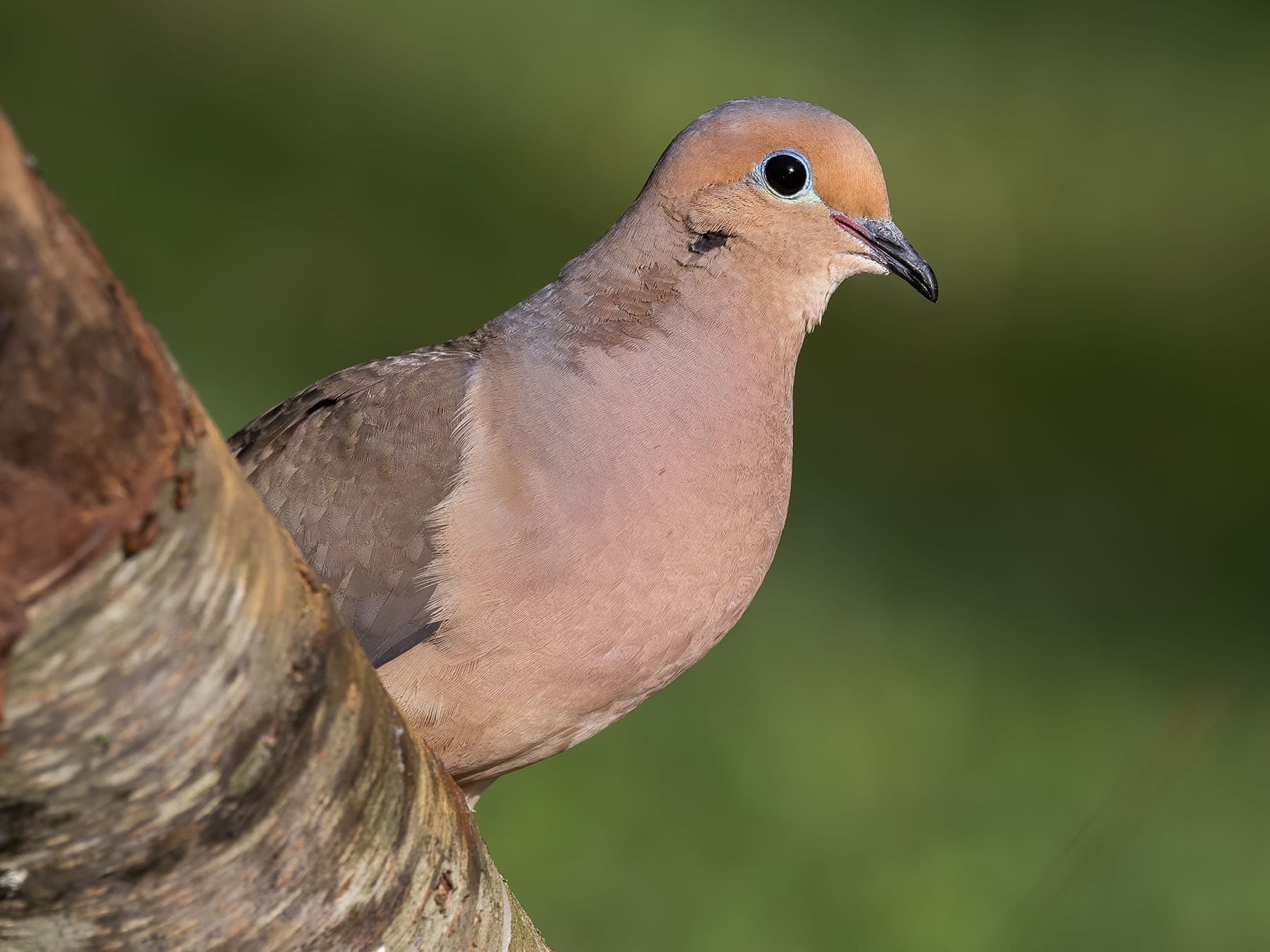
What the Mourning Dove has meant to people, from the old records rather than the guesswork: where its name comes from, the beliefs folklorists actually wrote down about it, its names in Cherokee, Navajo and Nahuatl, the doves of the Bible, and what modern spiritual sites claim. For the bird itself, see Mourning Dove identification and facts.
What does a Mourning Dove symbolize?
It depends on whose tradition you ask. The name itself comes from the sound: the 1839 Massachusetts state report on birds said people in western Massachusetts called it the Mourning Dove "from the plaintiveness of its call", adding that "the bird that makes it is very happy".1 In American folk belief, the dated collections record its call as a sign of rain, of spring, of luck, of a future sweetheart and of a death in the house.2, 3, 4 In the Bible, whose doves are Old World species, a dove brings Noah an olive leaf, a lover is called "my dove" and the Spirit descends "like a dove".5 Modern spiritual websites add that a dove may be a message from a loved one who has died.6 Older records do tie doves to the dead: Puckett in 1926 was told that good spirits appear as white doves;3 but as a comforting visit, the earliest dated record we found is a 2012 folklore-archive entry.7
Why is it called a Mourning Dove?
For its call. The Massachusetts report of 1839 gives the reason in so many words: the bird was "called the Mourning Dove, from the plaintiveness of its call".1 The name was in popular use before the naturalists took it up. The earliest printings of it for this bird that we found are a geography of 1808, whose list of New England birds includes "mourning doves" (its first edition, with a preface dated 1795, we could not check);8 a guide for emigrants to Upper Canada in 1820;9 and Noah Webster's dictionary of 1828, which defines "Mourning-dove" as a species found in the United States.10 The earliest scientific list we found to use it is Kirtland's Ohio report of 1838,11 followed by Linsley's catalogue of Connecticut birds in 1843.12
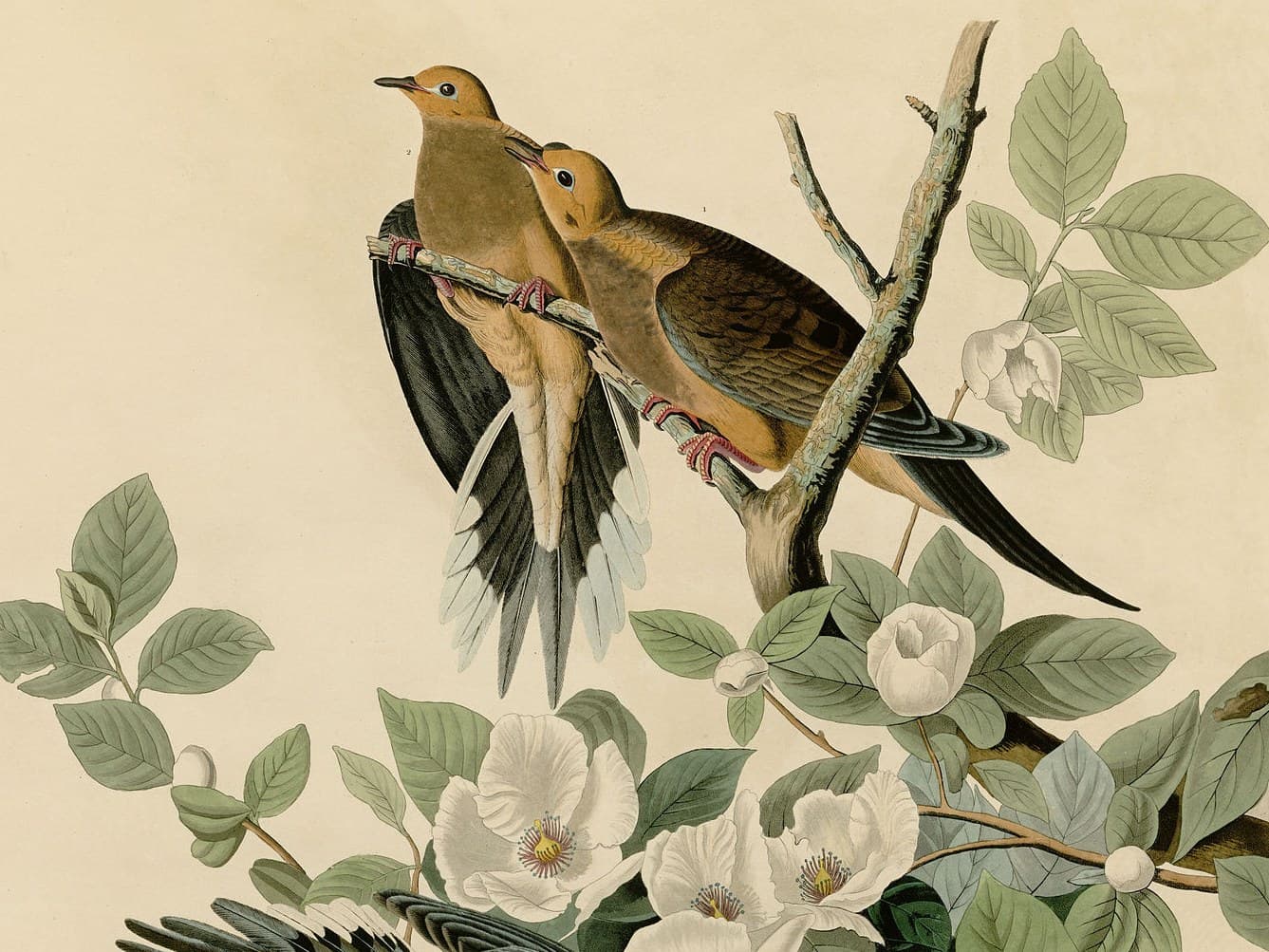
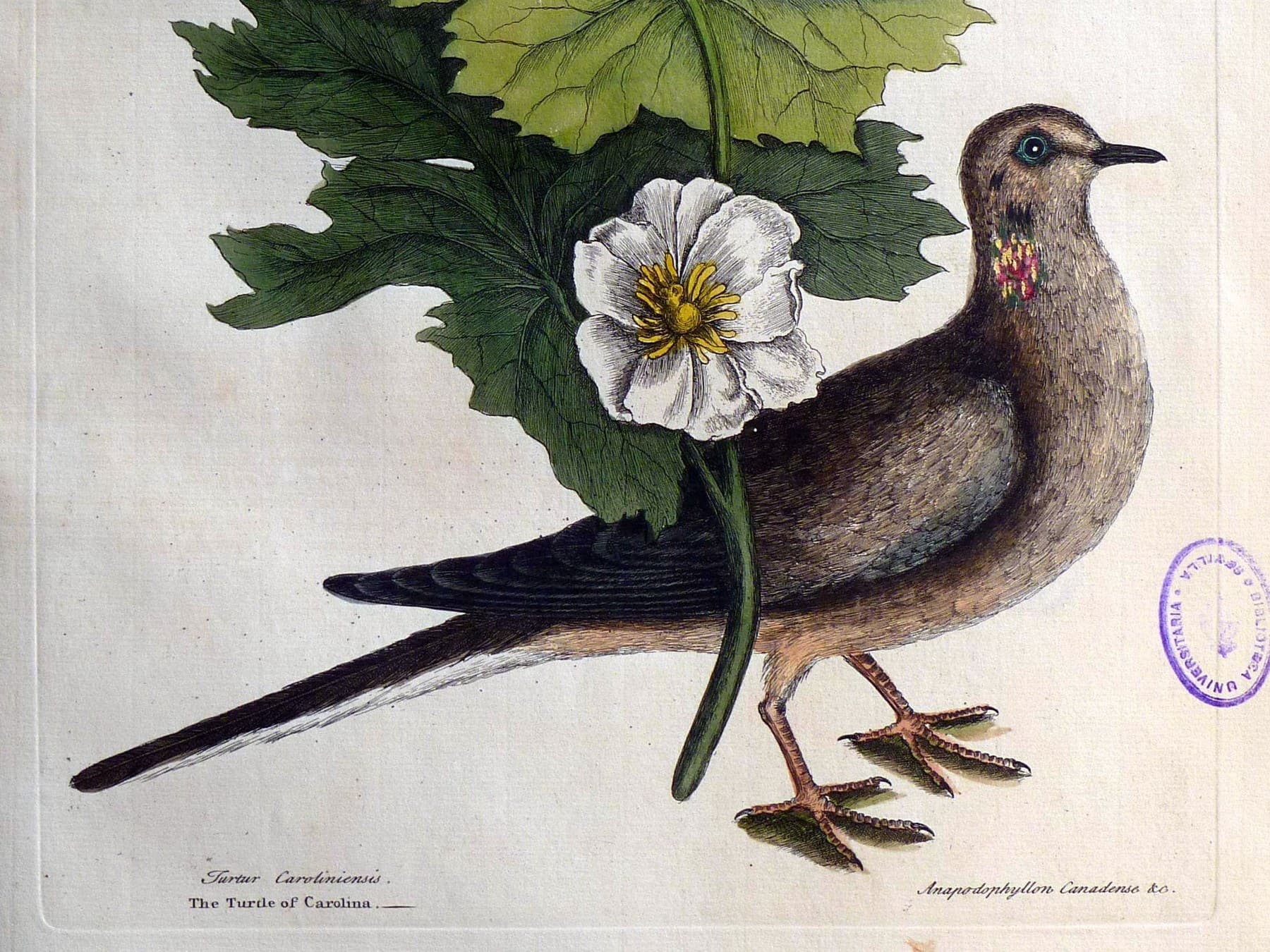
The naturalists took longer. Mark Catesby called it "The Turtle of Carolina" in the first volume of his Natural History (dated 1731),13 Alexander Wilson the "Carolina Pigeon, or Turtle Dove" in 1812,14 Audubon the Carolina Turtle Dove,15 Nuttall the "Carolina Pigeon, or Turtle Dove" (1832),16 and Elliott Coues the "Carolina Dove" (1872).17 Robert Ridgway used "Mourning Dove" in his national list of 1881,18 and the American Ornithologists' Union's first Check-list fixed it in 1886.19 Other names in the old books include Carolina Dove, Turtle Dove and Long-tailed Dove;20, 21 in the old books we read, "rain dove" and "rain crow" are names for cuckoos (Yellow-billed and Black-billed); we found no early source that calls the Mourning Dove a rain dove, though some modern websites do.21
Is it "mourning" or "morning"? Mourning, for the sad-sounding coo, though the birds do coo most around dawn.22 The scientific name is less poetic: Zenaida honors Zénaïde Bonaparte, the wife of the naturalist Charles Lucien Bonaparte, and macroura means "long-tailed".23 "Turtle", as in turtle dove, comes from the Latin turtur, an imitation of a dove's coo.24 More on the sound itself: Mourning Dove sounds.
What the old folk beliefs said
Folklorists in the late 1800s and 1900s wrote down what people believed about the dove, usually under its folk name, the turtle dove. These are records of belief, not facts about the bird, and one collector noted that American dove lore was very meager next to Europe's.2 Grouped by theme, in no order of importance:
- Love. On hearing the first dove of spring, pull off a shoe and stocking; any hair you find inside shows the shade of your future spouse's hair. This was recorded in Tennessee in 1896,25 among Black Southerners in 1926 (Puckett noted that in England and Scotland the cuckoo plays this part),3 in Adams County, Illinois (1935), and in North Carolina (1961).26 In Illinois, the direction of the first call showed where a new sweetheart would come from.4
- Luck and health. In the mountains of western North Carolina in 1889, hearing the first dove of the year above you meant prosperity at the year's end, below you a year going "constantly down hill".27 In Kansas, walking or standing when you heard the first dove of spring meant health, sitting meant sickness and lying down meant death, and you could make a wish on it.2 In the South, people rolled over at the first call to keep off backache (Puckett, 1926),3 and in Adams County, Illinois (1935), it was bad luck to shoot a dove.4
- Rain and spring. Puckett (1926) recorded that "the mourning of the dove is a sign of rain";3 in Illinois, a dove cooing in a tree meant rain within three days, and the first call meant spring and no more frost.4 North Carolina believers said the same of cooing before sunup.28
- Death. In Salem, Massachusetts, and in Alabama, a mourning dove cooing near the house meant a death in the household within the year.2 In the South, a dove that "mourns around your house" meant a death within a few days, unless you tied a knot in each corner of your apron.3 In Illinois, one cooing near a sick person's house meant death within 36 hours,4 and North Carolina collectors recorded the dove's cry as a death omen too.28
- Heaven. A Black informant in Chestertown, Maryland, said that "the dove and the eagle are the only two birds that go to heaven".2
Native American and Nahuatl records
- Cherokee. James Mooney recorded the turtledove's name as gule'-diska`nihi', "it cries, or mourns, for acorns", because its call sounds like gule', acorn. He also noted that the ancient Turtle-dove and Raven clans had joined into a single Bird clan.29
- Navajo. The 1910 Navajo dictionary gives hasbídi, from its cry "bid, bid", for the mourning dove, and notes that most water and shore birds were held sacred and not eaten, except the turtledove. A spring and a plant were named for it: hasbídi tqo, "turtledove spring", and hasbídi da, "turtle-dove food".30
- Tewa. At San Ildefonso Pueblo, when a man imitated the dove's call, an old man broke into a rain song, and the ethnologists suspected he linked the bird with rain.31
- Nahuatl and Mexican Spanish. The Mexican name huilota comes from the Nahuatl huilotl, dove.32 In the 16th century, Bernardino de Sahagún described the uilotl (printed Vilotl) as like a pigeon with a long tail, a foolish ("boba") bird that builds a careless nest of straws.33
The "Native American" meanings on spiritual sites (for example, that doves bring messages from ancestors) name no people and cite no source;6 we found none in the dated records above.
Doves in the Bible
The doves of the Bible are Old World birds, not the Mourning Dove. Noah's dove came back with an olive leaf (Genesis 8:11); the Song of Solomon has "the voice of the turtle is heard in our land" (2:12) and "my dove, my undefiled" (5:2, 6:9); in Isaiah, King Hezekiah says "I did mourn as a dove" (38:14); and at Jesus' baptism "the Spirit of God" descended "like a dove" (Matthew 3:16).5 The naturalist John Burroughs matched "our turtle, or mourning dove" with Solomon's "voice of the turtle", though he found its call too "vague, and soft, and mournful" to stand out among the sounds of an April day.34
In books and poems
Alexander Wilson heard in the coo "the voice of love, of faithful connubial affection".14 Thoreau, at Walden, watched turtle-doves sitting over the spring or fluttering from bough to bough of the white pines.35 Neltje Blanchan called the coo "more like a dirge than a love-song" and repeated the story that a captive dove whose mate dies "grieves its life away".20 No study we found supports that. Mourning Doves pair for a season,22 and in one Texas study a female whose mate was removed apparently took a new male the next day.36 More: do Mourning Doves mate for life?
A symbol of peace
What does it mean when a Mourning Dove visits you?
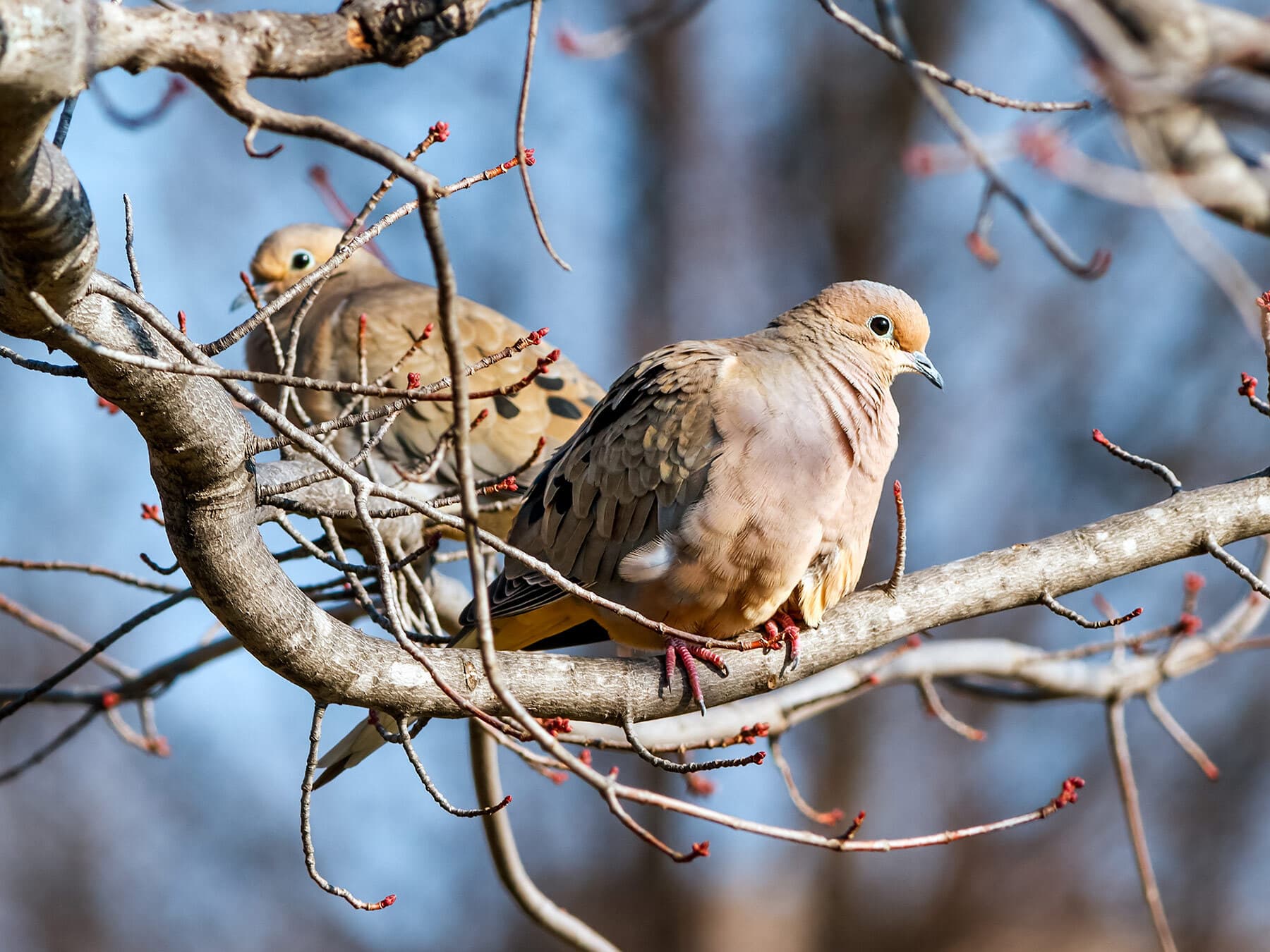
Biologically, a visit most likely means food, water or a nest site nearby: few land birds in North America are as abundant or as widespread, and they are at home in towns and suburbs.22 Spiritually, there is no answer a source can give. Modern spiritual websites read a visit as a message from a loved one who has died, or from angels or God, or as a sign of peace and hope;6 a 2012 entry in a university folklore archive records one family's belief that when a person dies, they become a dove.7 The older American records often read it the other way: a dove cooing near a house as a warning of death.2, 3
Sources
- Peabody, W. B. O. (1839). Report on the Birds of Massachusetts (in Reports on the Fishes, Reptiles and Birds of Massachusetts). Boston. Accessed 12 October 2026. Source
- Bergen, F. D. (1899). Animal and Plant Lore (Memoirs of the American Folk-Lore Society 7). Houghton, Mifflin (for the American Folk-Lore Society), Boston and New York. Accessed 12 October 2026. Source
- Puckett, N. N. (1926). Folk Beliefs of the Southern Negro. University of North Carolina Press, Chapel Hill. Accessed 12 October 2026. Source
- Hyatt, H. M. (1935). Folk-Lore from Adams County, Illinois. Memoirs of the Alma Egan Hyatt Foundation. Accessed 12 October 2026. Source
- King James Version (1611). The Holy Bible. Accessed 12 October 2026. Source
- Goulet, Brianna (2023). Are Mourning Doves Divine Messengers? Birdzilla. Accessed 12 October 2026. Source
- Ramirez, M. (collector) (2012). Dove Signs. USC Digital Folklore Archive. Accessed 12 October 2026. Source
- Dwight, N. (1808). A Short but Comprehensive System of the Geography of the World. Evert Duyckinck, New-York. Accessed 12 October 2026. Source
- Stuart, C. (1820). The Emigrant's Guide to Upper Canada. London. Accessed 12 October 2026. Source
- Webster, N. (1828). An American Dictionary of the English Language, vol. 2. New York. Accessed 12 October 2026. Source
- Kirtland, J. P. (1838). Report on the Zoology of Ohio (in W. W. Mather, Second Annual Report on the Geological Survey of the State of Ohio). Columbus. Accessed 12 October 2026. Source
- Linsley, J. H. (1843). A catalogue of the birds of Connecticut. American Journal of Science and Arts 44: 249-274. Accessed 12 October 2026. Source
- Catesby, M. (1731). The Natural History of Carolina, Florida and the Bahama Islands, vol. 1: The Turtle of Carolina. London. Accessed 12 October 2026. Source
- Wilson, A. (1812). American Ornithology, vol. 5: Carolina Pigeon, or Turtle Dove. Bradford and Inskeep, Philadelphia. Accessed 12 October 2026. Source
- Audubon, J. J. (1831). Ornithological Biography, vol. 1: The Carolina Turtle Dove. Adam Black, Edinburgh. Accessed 12 October 2026. Source
- Nuttall, T. (1832). A Manual of the Ornithology of the United States and of Canada: The Land Birds. Cambridge. Accessed 12 October 2026. Source
- Coues, E. (1872). Key to North American Birds. Salem. Accessed 12 October 2026. Source
- Ridgway, R. (1881). Nomenclature of North American Birds (Bulletin of the U.S. National Museum 21). Washington. Accessed 12 October 2026. Source
- American Ornithologists' Union (1886). The Code of Nomenclature and Check-List of North American Birds. AOU, New York. Accessed 12 October 2026. Source
- Blanchan, N. (1897). Bird Neighbors. New York. Accessed 12 October 2026. Source
- Allen, G. M. (1909). Fauna of New England. 11. List of the Aves. Occasional Papers of the Boston Society of Natural History 7. Accessed 12 October 2026. Source
- Otis, D. L., Schulz, J. H., Miller, D., Mirarchi, R. E., Baskett, T. S. (2020). Mourning Dove (Zenaida macroura), version 1.0. Birds of the World (A. F. Poole, editor). Cornell Lab of Ornithology. doi:10.2173/bow.moudov.01
- Jobling, J. A. The Key to Scientific Names: Zenaida; macroura. Birds of the World, Cornell Lab of Ornithology. Accessed 12 October 2026. Source
- Skeat, W. W. (1910). An Etymological Dictionary of the English Language. Clarendon Press, Oxford. Accessed 12 October 2026. Source
- Bergen, F. D. (1896). Current Superstitions (Memoirs of the American Folk-Lore Society 4). Houghton, Mifflin (for the American Folk-Lore Society), Boston and New York. Accessed 12 October 2026. Source
- Hand, W. D. (editor) (1961). The Frank C. Brown Collection of North Carolina Folklore, vol. 6: Popular Beliefs and Superstitions from North Carolina, 1-4783. Duke University Press, Durham. Accessed 12 October 2026. Source
- Mooney, J. (1889). Folk-lore of the Carolina mountains. Journal of American Folklore 2(5): 95-104. doi:10.2307/533317
- Hand, W. D. (editor) (1964). The Frank C. Brown Collection of North Carolina Folklore, vol. 7: Popular Beliefs and Superstitions from North Carolina, 4784-8569. Duke University Press, Durham. Accessed 12 October 2026. Source
- Mooney, J. (1900). Myths of the Cherokee (19th Annual Report of the Bureau of American Ethnology, part 1). Washington. Accessed 12 October 2026. Source
- Henderson, J., Harrington, J. P. (1914). Ethnozoology of the Tewa Indians (Bureau of American Ethnology Bulletin 56). Washington. Accessed 12 October 2026. Source
- Robelo, C. A. (1904). Diccionario de aztequismos. Cuernavaca. Accessed 12 October 2026. Source
- Sahagún, B. de (1831). Historia general de las cosas de Nueva España, book 11 (in Lord Kingsborough, Antiquities of Mexico, vol. 7). London. Accessed 12 October 2026. Source
- Burroughs, J. (1877). Birds and Poets. Boston. Accessed 12 October 2026. Source
- Thoreau, H. D. (1854). Walden; or, Life in the Woods. Ticknor & Fields, Boston. Accessed 12 October 2026. Source
- Bivings, A. E. IV, Silvy, N. J. (1994). Success of single-parent mourning dove nests in September. Proceedings of the Annual Conference of the Southeastern Association of Fish and Wildlife Agencies 48: 236-239. Accessed 12 October 2026. Source
- Wisconsin Legislature (1971). Chapter 129, Laws of 1971; Wisconsin Statutes 1.10(3)(a). Wisconsin State Legislature. Accessed 12 October 2026. Source
- Michigan Senate (2003). Senate Resolution 192 of 2003: recognizing the mourning dove as the Michigan bird of peace. MichiganVotes.org. Accessed 12 October 2026. Source