Published 7 Oct 2026
Greenfinch Disease and Decline: Why Greenfinches Are Dying
By the Birdfact teamChecked by Nathan Cope
UK Greenfinch numbers have fallen by about two-thirds, mostly since a parasite disease, trichomonosis, reached British finches in 2005. What the disease is, how it spreads at bird feeders, the signs of a sick bird, the latest counts, and what you can do.
On this page13 sections
- Are Greenfinches rare?
- What happened to the Greenfinch?
- What is trichomonosis?
- How does trichomonosis spread?
- Symptoms: how to recognise a sick Greenfinch
- Why Greenfinches?
- Is the Greenfinch declining across Europe?
- Are Greenfinches recovering?
- Greenfinch decline by country
- What you can do
- Should I stop feeding birds altogether?
- Questions
- Sources
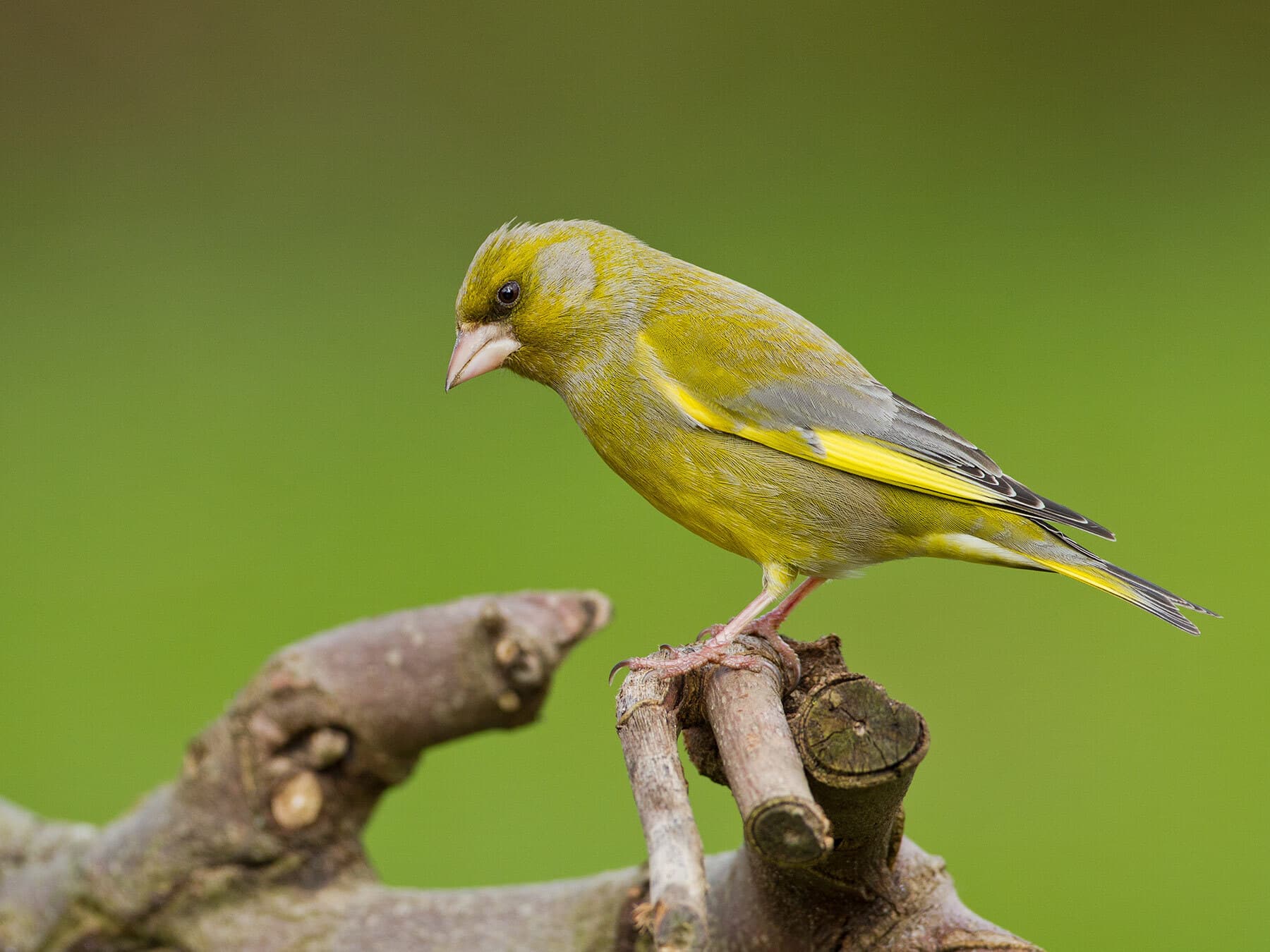
Greenfinches used to be among the commonest birds in British gardens. This page explains what happened to them: the disease trichomonosis, how it spreads, how to recognise a sick bird, what the latest counts show, and what you can do. For the bird itself, see Greenfinch identification, song and facts.
Are Greenfinches rare?
Not rare, but far fewer than they were. There were about 785,000 pairs in the UK in 2016, and they still breed across almost the whole country. But the UK breeding population has fallen by 66% since 1967, and in 2021 the Greenfinch was added to the UK Red List of birds of conservation concern.1
You may have noticed it yourself. In the RSPB's Big Garden Birdwatch the Greenfinch was the seventh most-seen garden bird in 1979; in 2026 it was eighteenth.2 Worldwide it is still of Least Concern.
What happened to the Greenfinch?
Until the mid-2000s, Greenfinches were doing well: after a dip in the late 1970s and early 1980s, numbers rose sharply through the 1990s.3 Then, in 2005, a disease called trichomonosis appeared in British finches. The next summer it became an epidemic, mostly in Greenfinches. By 2007, breeding Greenfinches had fallen by 35% in the region where the disease was worst, and more than half a million Greenfinches and Chaffinches had died.4
Large die-offs went on in the following years, moving across the country. The breeding population of Great Britain fell from about 4.3 million to about 2.8 million birds within a few years of the outbreak, falling by more than 7% a year in England, and the size of Greenfinch flocks visiting gardens halved.5 By 2021 the UK breeding population was about 1 million birds, 77% fewer than before the disease. Garden Wildlife Health, the disease-monitoring partnership of ZSL, BTO, Froglife and the RSPB, calls it the largest die-off of British birds from an infectious disease on record.6
What is trichomonosis?
Trichomonosis is caused by a microscopic, single-celled parasite, Trichomonas gallinae. It has long been known in pigeons and doves, where it is called canker, and in birds of prey, which catch it from the birds they eat and in which it is called frounce.7 The parasite attacks the back of the throat and the gullet, so an infected bird finds it harder and harder to swallow; the disease can take days or weeks, and many sick birds become very thin.
In finches it is a single strain of the parasite, first found in Britain, that has spread to continental Europe.8 It probably jumped to finches from pigeons and doves.
How does trichomonosis spread?
Through food and water. A sick bird that cannot swallow brings its food back up, and another bird that eats it can be infected. Birds also pass it on when they feed each other in the breeding season, and through shared drinking water. The parasite does not survive long once it dries out.
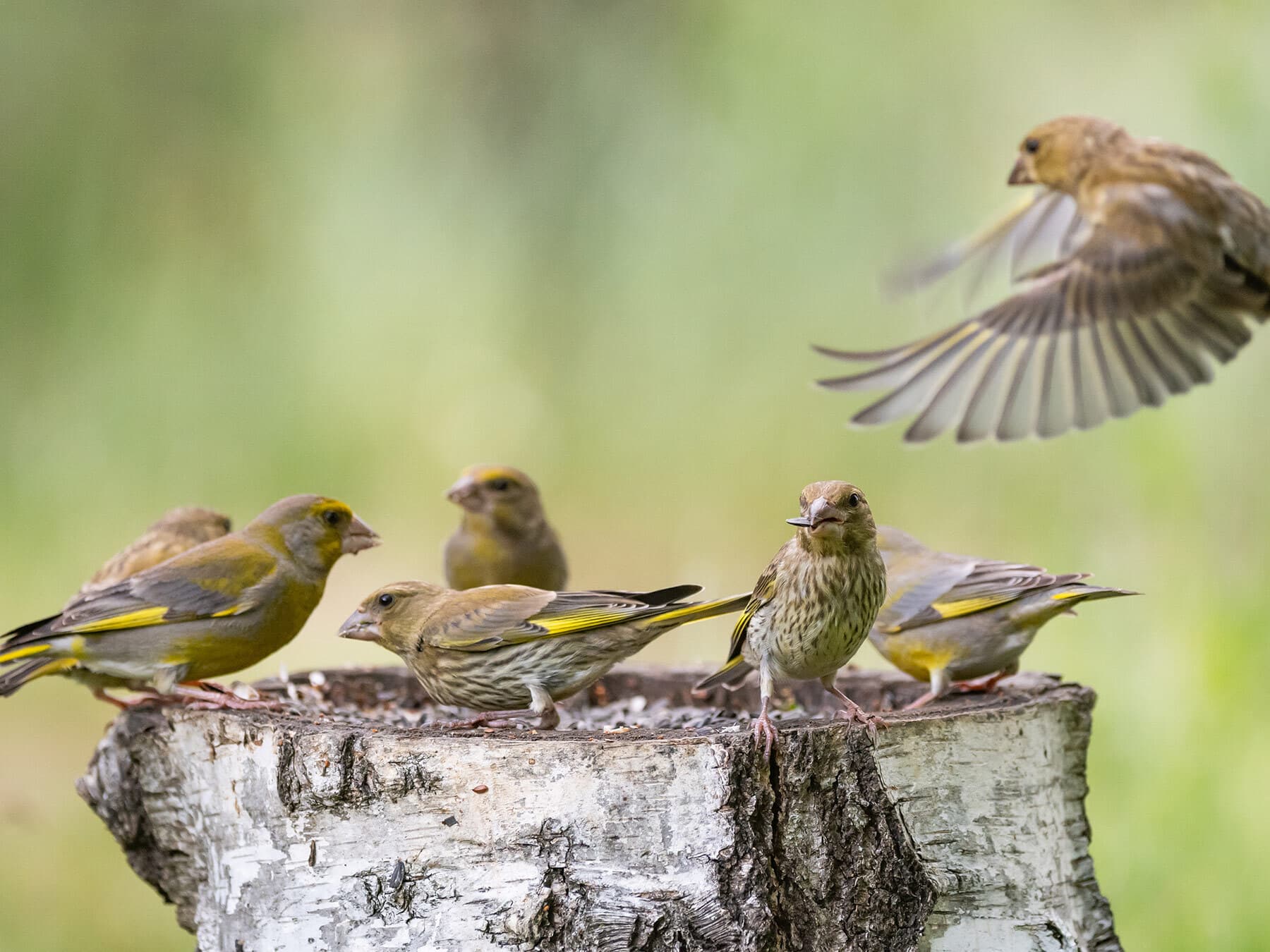
That makes garden feeding stations a risk: they bring many birds together in one place. A study of garden feeding sites, cited by the RSPB, found no parasite on the feeders themselves, but did find it on food in feeders, in the trays beneath them and on the ground below.
Symptoms: how to recognise a sick Greenfinch
A Greenfinch with trichomonosis looks unwell: fluffed up and sluggish. It may drool, bring up food, struggle to swallow or breathe heavily, and the feathers around its face and bill are often wet and matted.
Outbreaks happen all year, but most often from June to September. There is no way to treat wild birds: medicines exist for cage birds, but they cannot be given to wild ones in the right doses.
Why Greenfinches?
Greenfinches and Chaffinches are the species most often affected, Greenfinches most of all. Part of the reason may be where Greenfinches live: they are birds of villages and towns, and often use garden feeders. A study of the two species' declines found that both were driven mainly by adults dying, and that adult Greenfinch survival fell more at sites near houses, where food is put out, than in the countryside. Chaffinches, which are less tied to houses, declined later.9
Is the Greenfinch declining across Europe?
The disease reached Norway, Sweden and Finland in 2008 and northern Germany in 2009, probably carried by migrating Chaffinches rather than Greenfinches.7 In southern Finland, breeding Greenfinches fell by 47% and wintering ones by 65% between 2006 and 2010.10
Not everywhere has seen the same crash. In the Netherlands, where the disease was found in 2009, the breeding population kept growing, even though post-mortems of dead Greenfinches found fatal trichomonosis as often as in Britain.11 In northern France, ringers recorded an outbreak among wintering Greenfinches and Goldfinches in early 2017, with 105 dead or sick birds at 12 sites.12
Are Greenfinches recovering?
There are early signs that the fall has stopped, at least in England. The latest Breeding Bird Survey report, published in April 2026, says the Greenfinch appears to have stabilised in England, with even a hint of an increase in the South West and in Yorkshire and the Humber, both with five-year trends of +28%. Across the UK there was no clear change between 2024 and 2025. But England's ten-year trend is still a fall of 40%.13
The long-term losses are large everywhere, and the Greenfinch has had the biggest long-term fall of any bird counted in Scotland and in Northern Ireland.
Greenfinch decline by country
Changes in breeding numbers in the Breeding Bird Survey.
| Area | Change | Period |
|---|---|---|
| UK | -65% | 1995-2024 |
| England | -62% | 1995-2024 |
| Scotland | -69% | 1995-2024 |
| Wales | -73% | 1995-2024 |
| Northern Ireland | -89% | 1997-2024 |
| UK, last ten years | -42% | 2014-2024 |
| UK, last year | -1% (no clear change) | 2024-2025 |
What you can do
If you see a sick bird in your garden, empty the bird bath and stop feeding for at least 2 to 4 weeks, so the birds spread out and stop passing the parasite on. Start again slowly, and only when you no longer see sick birds. If the disease keeps coming back, stop for 3 to 6 months. You can report sick or dead garden birds to Garden Wildlife Health.
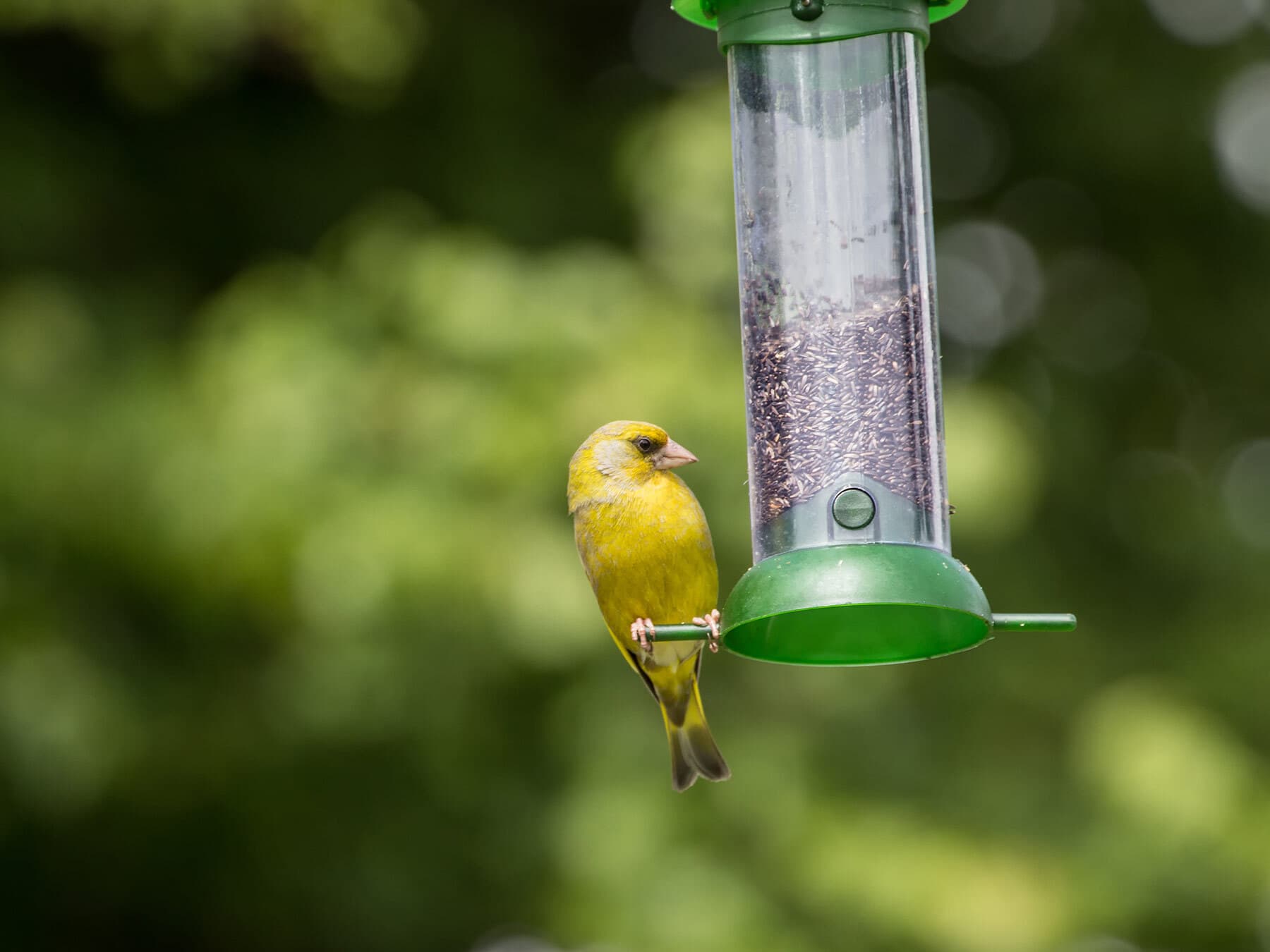
Every year, feed in the way the RSPB now advises: the full range of bird food, seed and peanuts included, from November to April; from 1 May to 31 October, when the disease spreads most, a pause on seed and peanuts, with only small amounts of mealworms, fat or suet; hanging feeders rather than bird tables or trays, feeders and baths cleaned every week, and water only if you can change it every day. More: feeding Greenfinches safely.
Should I stop feeding birds altogether?
Not necessarily. The RSPB's review found that feeding helps birds in winter, especially in cold weather, and in March and April, the "hungry gap" when seeds are scarce. The parasite is killed by cold, and outbreaks are less likely in winter, which is why its advice is to feed seed in winter and spring and pause it in summer and autumn.
Questions
Are Greenfinches endangered?
Not globally: the Greenfinch is of Least Concern worldwide. In the UK it is on the Red List, after numbers fell by about two-thirds.
When was the Greenfinch put on the Red List?
In 2021, in the fifth review of Birds of Conservation Concern.
Can people or pets catch trichomonosis from birds?
No. It is a parasite of birds, and no risk to people, dogs or cats. Wear gloves when cleaning feeders anyway: birds can carry other diseases that do affect people.
Can trichomonosis be treated?
Not in wild birds. Medicines for cage birds cannot be given to wild birds in the right doses.
Does it affect other birds?
Yes. Chaffinches have declined too, and the disease has been found in House Sparrows, Dunnocks, Great Tits and Siskins, as well as in pigeons, doves and birds of prey.
Is it the same as trichomoniasis in people?
No. Trichomoniasis in people is a sexually transmitted infection caused by a different parasite, Trichomonas vaginalis.
Sources
- BTO. Greenfinch (Chloris chloris). BTO BirdFacts. Accessed 7 October 2026. Source
- RSPB (2026). Our latest guidance on feeding garden birds. RSPB news. Accessed 7 October 2026. Source
- RSPB. Greenfinch. RSPB Birds A-Z. Accessed 7 October 2026. Source
- Robinson, R. A., Lawson, B., Toms, M. P., Peck, K. M., Kirkwood, J. K., Chantrey, J. et al. (2010). Emerging infectious disease leads to rapid population declines of common British birds. PLoS ONE 5: e12215. doi:10.1371/journal.pone.0012215
- Lawson, B., Robinson, R. A., Colvile, K. M., Peck, K. M., Chantrey, J., Pennycott, T. W. et al. (2012). The emergence and spread of finch trichomonosis in the British Isles. Philosophical Transactions of the Royal Society B 367: 2852-2863. doi:10.1098/rstb.2012.0130
- Garden Wildlife Health. Trichomonosis in garden birds. Garden Wildlife Health (ZSL, BTO, Froglife, RSPB). Accessed 7 October 2026. Source
- BTO. Trichomonosis. BTO, Helping birds: disease. Accessed 7 October 2026. Source
- Alrefaei, A. F., Low, R. S., Hall, N., Jardim, R., Dávila, A. M. R. et al. (2019). Multilocus analysis resolves the European finch epidemic strain of Trichomonas gallinae and suggests introgression from divergent trichomonads. Genome Biology and Evolution 11: 2391-2402. doi:10.1093/gbe/evz164
- Hanmer, H. J., Cunningham, A. A., John, S. K., Magregor, S. K., Robinson, R. A., Seilern-Moy, K. et al. (2022). Habitat-use influences severe disease-mediated population declines in two of the most common garden bird species in Great Britain. Scientific Reports 12: 15055. doi:10.1038/s41598-022-18880-8
- Lehikoinen, A. S., Lehikoinen, E., Valkama, J., Väisänen, R. A., Isomursu, M. (2013). Impacts of trichomonosis epidemics on Greenfinch Chloris chloris and Chaffinch Fringilla coelebs populations in Finland. Ibis 155: 357-366. doi:10.1111/ibi.12028
- Rijks, J. M., Laumen, A. A. G., Slaterus, R., Stahl, J., Gröne, A. et al. (2019). Trichomonosis in Greenfinches (Chloris chloris) in the Netherlands 2009-2017: a concealed threat. Frontiers in Veterinary Science 6: 425. doi:10.3389/fvets.2019.00425
- Chavatte, J.-M., Giraud, P., Esperet, D., Place, G., Cavalier, F. et al. (2019). An outbreak of trichomonosis in European greenfinches Chloris chloris and European goldfinches Carduelis carduelis wintering in Northern France. Parasite 26: 21. doi:10.1051/parasite/2019022
- Heywood, J. J. N., Massimino, D., Baker, L., Balmer, D. E. et al. (2026). The Breeding Bird Survey 2025. BTO Research Report 802. British Trust for Ornithology, Thetford. Accessed 7 October 2026. Source
- World Health Organization. Trichomoniasis. WHO fact sheets. Accessed 7 October 2026. Source
- Stanbury, A. J. et al. (2021). The status of our bird populations: the fifth Birds of Conservation Concern in the United Kingdom, Channel Islands and Isle of Man and second IUCN Red List assessment of extinction risk for Great Britain. British Birds 114: 723-747. Accessed 7 October 2026.
- Lawson, B., Robinson, R. A., Toms, M. P., Risely, K., MacDonald, S., Cunningham, A. A. (2018). Health hazards to wild birds and risk factors associated with anthropogenic food provisioning. Philosophical Transactions of the Royal Society B 373: 20170091. doi:10.1098/rstb.2017.0091
- BirdLife International (2018). Chloris chloris. The IUCN Red List of Threatened Species 2018: e.T22720330A132000123. doi:10.2305/IUCN.UK.2018-2.RLTS.T22720330A132000123.en