Published 23 Oct 2026
Blackbird Symbolism and Meaning: What the Old Records Say
By the Birdfact teamChecked by Nathan Cope
In the old records of Britain and Ireland the Blackbird stands for song in the woods (early Irish poems), a saint's gentleness (St Kevin), temptation (St Benedict), great age (the Welsh Blackbird of Cilgwri), an exiled prince (a Jacobite song) and coming rain. We found no old British or Irish belief that it brings luck or death, and no blackbird in the Bibles we searched.
On this page15 sections
- What does a blackbird symbolise?
- Early Irish poetry
- The Belfast Lough poem
- St Kevin and the blackbird
- St Benedict's tempter
- Is the blackbird in the Bible?
- The Blackbird of Cilgwri
- Weather sayings
- Is it lucky to see a blackbird?
- What does it mean when a blackbird visits?
- Ousels, merles and colly birds
- Sing a Song of Sixpence
- A Jacobite song
- Stevens's blackbirds
- Sources
What the Blackbird has meant to people in Britain and Ireland, traced through the texts that record it: medieval Irish poems, the lives of two saints, a Welsh tale, Shakespeare, nursery rhymes, a Jacobite song and 19th-century collections of folklore. Each is dated and named, and where a popular claim has no old source that we found, we say so. For the bird itself, see Blackbird identification, song and facts.
What does a blackbird symbolise?
In the old records of Britain and Ireland, mostly song and the wild: the Blackbird is the voice in the woods around Irish scribes and poets, and is itself likened to a hermit; it is the bird that nested in a saint's hand, a tempter in the life of St Benedict, an ancient creature in a Welsh tale, a code for an exiled prince in a Jacobite song, and a sign of rain in an Irish belief. The table sets the main records out by date.
Just as telling is what is missing. In the British and Irish folklore collections we read, the Blackbird is not an omen of death or of luck, and none of them calls it a messenger between worlds.1, 2, 3, 4, 5, 6
| Record | Date | Where | What the blackbird stands for |
|---|---|---|---|
| Gregory the Great, Dialogues, life of St Benedict | 593 | Italy | A tempter |
| Irish poem in the margin of a Latin grammar (St Gall) | Probably a mid-ninth-century manuscript | Irish scribes; the manuscript is now at St Gall, Switzerland | Song in the woods around a writer |
| Other early Irish poems (Kuno Meyer's translations) | Ninth to eleventh centuries by Meyer's dating (the hermit poem undated) | Ireland | Summer, a hermit's life, a lost nest |
| Gerald of Wales, Topography of Ireland, St Kevin | First issued around 1188 | Ireland (St Kevin of Glendalough) | A saint's patience and gentleness |
| Culhwch and Olwen, the Blackbird of Cilgwri | Medieval Welsh tale | Wales | Great age |
| Shakespeare, A Midsummer Night's Dream | Shakespeare's lifetime | England | A garden bird in a comic song |
| "The Black Bird", in Allan Ramsay's Tea-Table Miscellany | 1730 | Scottish songs, printed in London | An exiled royal prince |
| "Sing a Song of Sixpence" | 1795 (earliest copy we saw) | England | Four and twenty birds in a pie fit for a king |
| Irish sayings, in Charles Swainson's collection | 1886 | Ireland | Rain to come |
Early Irish poetry
The Blackbird sings through early Irish verse. In the margin of a Latin grammar copied by Irish scribes, a manuscript now at St Gall in Switzerland and probably written about the middle of the ninth century, a short poem begins, in the editors' translation, "A hedge of trees surrounds me: a blackbird's lay sings to me".7
Kuno Meyer's translations of 1911 hold several more. In "Song of Summer", which Meyer dated to the ninth century ("I think"), "Blackbirds sing a full lay / If there be a slender shaft of day". "The Deserted Home", probably 11th-century by his dating, opens "Sadly talks the blackbird here", grieving for a nest that has been destroyed. And a short, undated poem from the margin of the Leabhar Breac calls the Blackbird a "Hermit that clinkest no bell": a hermit, content in its bush, with no bell to ring.8
The Belfast Lough poem
A quatrain often quoted today begins "Int én bec". Our rough rendering, using Kuno Meyer's glossary for the harder words: a little bird has whistled from the tip of its bright-yellow beak, a blackbird calling from a yellow branch over Loch Laig, which Meyer identifies as Belfast Lough.9 It is often said to be written in the margin of the St Gall manuscript, but the St Gall Blackbird poem is the one above; this quatrain is not among the marginal verses printed from it in 1903.7
It survives instead as an example of a metre in a medieval Irish treatise on verse,10 and the earliest copy we found is in the Book of Ballymote, a manuscript written mainly in the late 14th century.11 The poem is often dated to the ninth century; we did not find that date in any source we could read, so we give the manuscript date and leave the poem's age to the specialists.
St Kevin and the blackbird
St Kevin's Blackbird is an Irish story, and the earliest record of it that we found is in Gerald of Wales's Topography of Ireland, first issued around 1188 and revised for years afterwards.12 In Thomas Forester's translation, Gerald tells how Kevin, keeping Lent in a little cabin in the wilderness, held his hand up to heaven through the window, and a blackbird "laid her eggs in his palm". The saint kept his hand open "until the young brood was entirely hatched", and in Gerald's day "all the images of St. Keiwin throughout Ireland" showed him with a blackbird in his outstretched hand.13
Gerald's Latin word for the bird is merula,12 still the second half of the Blackbird's scientific name, Turdus merula. Later retellings change the details: Charles Swainson's version of 1886 sets it in the "Temple of the Rock" at Glendalough.1
St Benedict's tempter
Not every early Christian Blackbird is a friendly one. In his life of St Benedict, written in 593, Gregory the Great tells how Benedict, alone one day, was pestered by "a little black bird, commonly called a merle or an ousel", in the words of an English translation printed in 1608 (the spelling modernised in its 1911 reissue). The bird flew so close to his face that he could have caught it; he made the sign of the cross, it flew off, and a great temptation followed. In the story the bird is the tempter's work.14 Gregory's Latin calls it "merula".15 The story is set in Italy, not Britain.
Is the blackbird in the Bible?
No. A search of the King James Bible finds no blackbird and no ousel,16 and searches of the Latin Vulgate (for merula), the Douay-Rheims and a modern-English Wycliffe Bible find none either, though sparrows and turtle doves turn up readily.17 The Blackbird's place in Christian tradition comes through the lives of saints, Kevin and Benedict above, not through scripture.
The Blackbird of Cilgwri
In the medieval Welsh tale Culhwch and Olwen, Arthur's men search for Mabon by asking the oldest animals in turn. The first is the Blackbird of Cilgwri, Mwyalch Kilgwri in the index to the Red Book of Hergest text, mwyalch being Welsh for blackbird.18 In Lady Charlotte Guest's translation, the Ousel of Cilgwri says that when she came there was a smith's anvil, and she has pecked at it every evening until not even a nut's size of it is left; yet she has never heard of Mabon, and offers to guide them to a race of animals formed before her.19
In the tale, then, the Welsh Blackbird stands for great age, a measure of time, not a messenger. And the "birds of Rhiannon" in the same collection of tales, sometimes called blackbirds today, are tri ederyn, "three birds", in the Welsh, with no kind named.18
Weather sayings
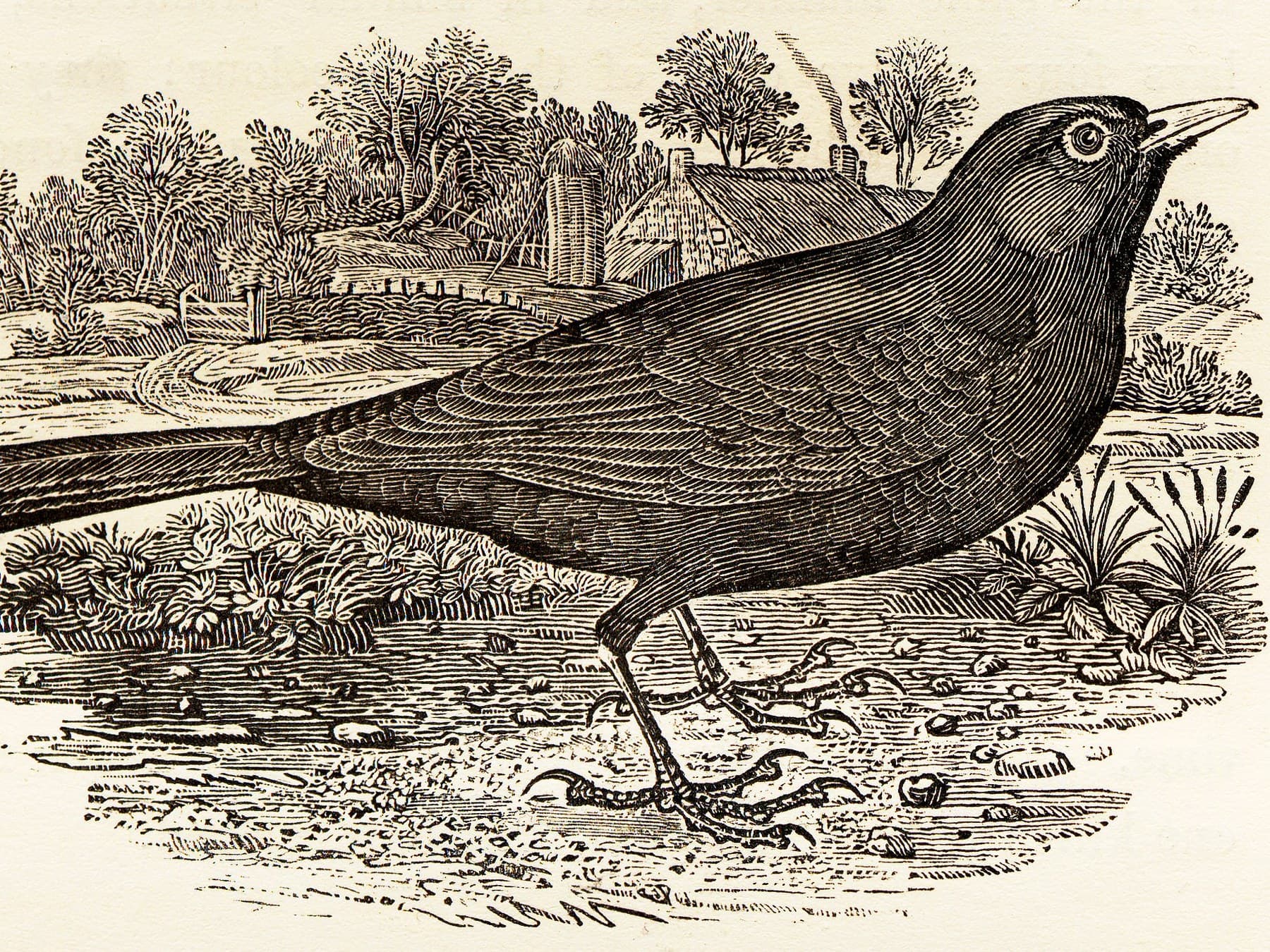
Charles Swainson's collection of 1886 gives an Irish belief that when the Blackbird sings loud and shrill, rain will follow, and a saying from County Meath, "When the blackbird sings before Christmas, she will cry before Candlemas", which Swainson leaves unexplained.1

Is it lucky to see a blackbird?
We found no old tradition that says so, or the opposite. Swainson's collection of British bird lore has an Irish rain belief for the Blackbird but no British or Irish luck or death omens, and a search of the scanned text of five regional collections of 1867 to 1904 (Lancashire, Northumberland, the North of England and the Borders, north-east Scotland, and the second volume of Lady Wilde's Irish legends) found no Blackbird beliefs at all.2, 3, 4, 5, 6 We have not yet searched the Schools' Collection of Ireland's National Folklore Collection, and will add what it holds.
What does it mean when a blackbird visits?
Often that it lives there. In a study of a garden population, older male Blackbirds held their territories all year round,20 so a Blackbird in your garden through the winter may well be the one that holds it in spring, though winter also brings Blackbirds from northern Europe (see do Blackbirds migrate?). For why one might be singing at night, see Blackbird song and calls.
Ousels, merles and colly birds
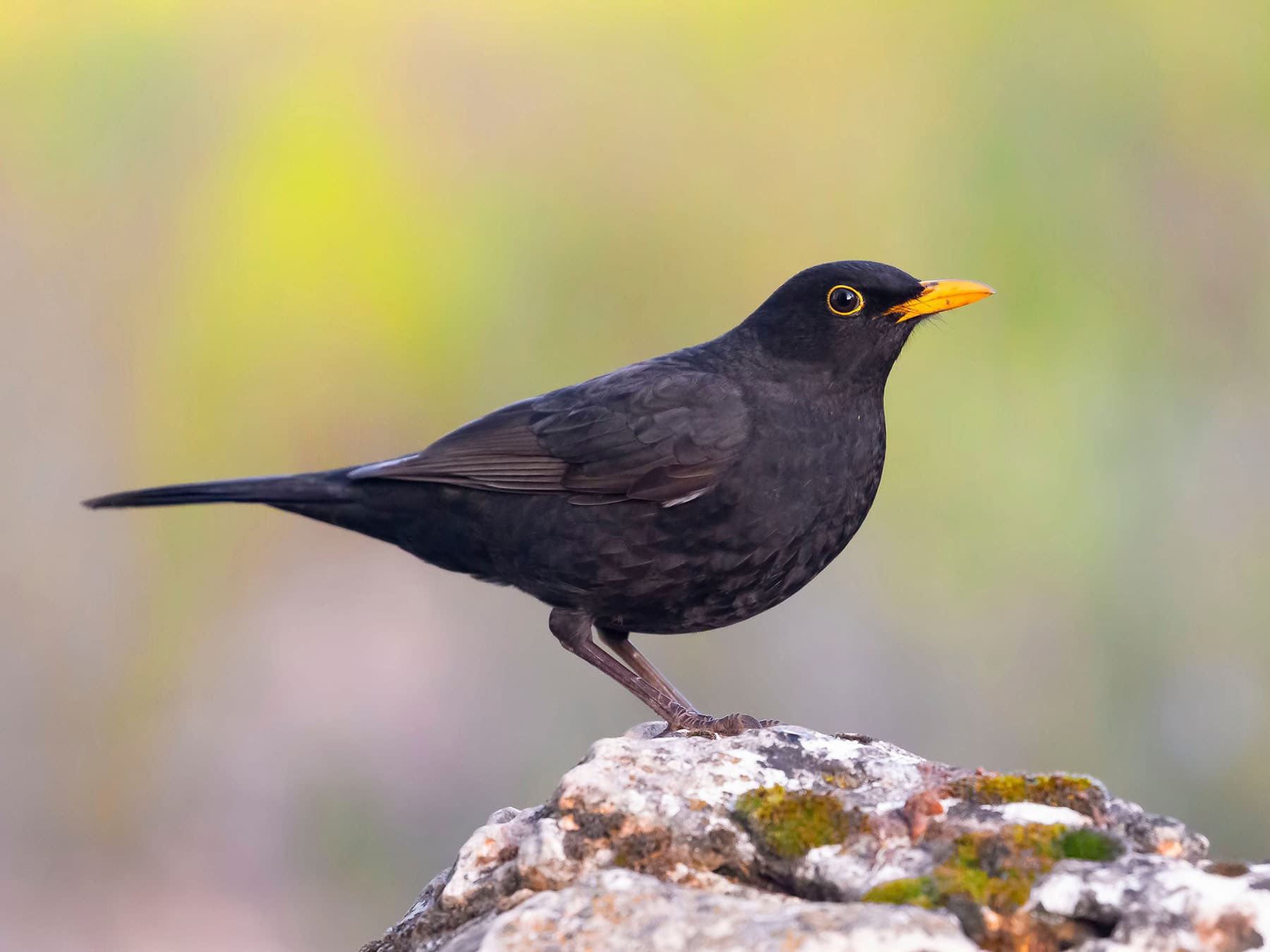
Old names show how familiar the bird was. Swainson lists Black uzzle (from Craven), Blackie (the North Riding and Scotland), Ousel, Ousel cock and Garden ousel, and Merle (Ireland and Scotland), from the Latin merula.1 In A Midsummer Night's Dream, Bottom sings of "The ousel cock so black of hue, / With orange-tawny bill", which is the adult male to the life.21 The Welsh is mwyalchen, the Irish lon dubh.22
In the dialect of Gloucestershire, Somerset and Devon, a Blackbird was a colly or colley-bird; Joseph Wright's English Dialect Dictionary of 1898 links the name to colly, black or sooty, and cites the "Four colly birds" of the Twelve Days.23 They are there on the fourth day of "The Twelve Days of Christmas" in an edition printed around 1800.24
Sing a Song of Sixpence
The earliest printing with blackbirds that we saw is in Gammer Gurton's Garland of 1795: "Four and twenty Blackbirds bak'd in a pye", which sing when the pie is opened, a dish to set before a king.25 An earlier printing of 1744 is often mentioned, but we could not see a copy. James Orchard Halliwell's collection of 1843 gives a version in which "There came a little blackbird, / And snapt off her nose".26
A Jacobite song
In the song "The Black Bird", printed in Allan Ramsay's Tea-Table Miscellany in London in 1730, a lady laments that "my black bird most royal is flown": her Blackbird "was the true Son of a King", and she will "seek out my Black Bird, wherever he be".27 The song does not name him. James Hogg printed a version in his Jacobite Relics of Scotland in 1821, noting that it seemed to have been "one of the street songs of the day",28 and George Petrie's 1855 collection of Irish music lists "The Blackbird" among the allegorical impersonations in Irish Jacobite songs.29 Swainson guessed the song meant Charles II;1 the texts themselves leave it open.
A tune called "The Black Bird, very Old" appears in O'Farrell's Pocket Companion for the Irish or Union Pipes, catalogued as 1806,30 and Francis O'Neill wrote in 1910 of an air "so universally known as the Blackbird", printing Sergeant James O'Neill's traditional version, as played by his father in County Down.31
Stevens's blackbirds
Wallace Stevens's "Thirteen Ways of Looking at a Blackbird", published in 1917, mentions Haddam and Connecticut and names no species,32 so its blackbirds are almost certainly American birds, not this one. The Blackbird of Britain and Ireland is a thrush, Turdus merula.
Sources
- Swainson, C. (1886). The Folk Lore and Provincial Names of British Birds. Elliot Stock, London, for the Folk Lore Society. Accessed 23 October 2026. Source
- Henderson, W. (1879). Notes on the Folk-Lore of the Northern Counties of England and the Borders. W. Satchell, Peyton & Co. for the Folk-Lore Society, London. Accessed 23 October 2026. Source
- Gregor, W. (1881). Notes on the Folk-Lore of the North-East of Scotland. Elliot Stock for the Folk-Lore Society, London. Accessed 23 October 2026. Source
- Wilde, J. F. (Lady Wilde) (1887). Ancient Legends, Mystic Charms, and Superstitions of Ireland, vol. II. Ticknor, Boston. Accessed 23 October 2026. Source
- Balfour, M. C., Thomas, N. W. (1904). County Folk-Lore, vol. IV: Northumberland. David Nutt for the Folk-Lore Society, London. Accessed 23 October 2026. Source
- Harland, J., Wilkinson, T. T. (1867). Lancashire Folk-Lore. Frederick Warne, London. Accessed 23 October 2026. Source
- Stokes, W., Strachan, J. (eds) (1903). Thesaurus Palaeohibernicus, vol. II. Cambridge University Press. Accessed 23 October 2026. Source
- Meyer, K. (trans.) (1911). Selections from Ancient Irish Poetry. Constable & Company, London. Accessed 23 October 2026. Source
- Meyer, K. (1909). A Primer of Irish Metrics. School of Irish Learning, Dublin. Accessed 23 October 2026. Source
- Thurneysen, R. (1891). Mittelirische Verslehren. Irische Texte, Dritte Serie, 1. Heft (ed. W. Stokes and E. Windisch). S. Hirzel, Leipzig. Accessed 23 October 2026. Source
- Irish Script on Screen (DIAS). Royal Irish Academy MS 23 P 12 (Book of Ballymote). Accessed 23 October 2026. Source
- Gerald of Wales, Dimock, J. F. (ed.) (1867). Giraldi Cambrensis Opera, vol. V: Topographia Hibernica. Longmans (Rolls Series), London. Accessed 23 October 2026. Source
- Gerald of Wales, Forester, T. (trans.), Wright, T. (ed.) (1863). The Historical Works of Giraldus Cambrensis: The Topography of Ireland. H. G. Bohn, London. Accessed 23 October 2026. Source
- Gregory the Great, P. W. (trans., 1608), Gardner, E. G. (ed.) (1911). The Dialogues of Saint Gregory, surnamed the Great. Philip Lee Warner, London. Accessed 23 October 2026. Source
- Gregory the Great (1880). Dialogorum liber secundus (Vita et Regula SS. P. Benedicti, I). F. Pustet, Regensburg. Accessed 23 October 2026. Source
- The King James Bible. Project Gutenberg eBook #10. Accessed 23 October 2026. Source
- BibleGateway. Keyword searches: Vulgate, Douay-Rheims, Wycliffe, King James. Accessed 23 October 2026. Source
- Rhys, J., Evans, J. G. (eds) (1887). The Text of the Mabinogion and other Welsh tales from the Red Book of Hergest. J. G. Evans, Oxford. Accessed 23 October 2026. Source
- Guest, C. (trans.). The Mabinogion. Project Gutenberg eBook #5160. Accessed 23 October 2026. Source
- Snow, D. W. (1956). Territory in the Blackbird Turdus merula. Ibis 98(3): 438-447. doi:10.1111/j.1474-919X.1956.tb01428.x
- Shakespeare, W., Clark, W. G., Wright, W. A. (eds) (1866). The Works of William Shakespeare (The Globe edition). Macmillan, Cambridge and London. Accessed 23 October 2026. Source
- BTO. Blackbird (Turdus merula). BTO BirdFacts. Accessed 6 October 2026. Source
- Wright, J. (ed.) (1898). The English Dialect Dictionary, vol. I. Henry Frowde, London. Accessed 23 October 2026. Source
- (1800). Mirth without Mischief. J. Davenport for C. Sheppard, London. Accessed 23 October 2026. Source
- (1795). Gammer Gurton's Garland: or, the Nursery Parnassus. R. Christopher, Stockton. Accessed 23 October 2026. Source
- Halliwell, J. O. (1843). The Nursery Rhymes of England (3rd edition). Munroe & Francis, Boston (reprint). Accessed 23 October 2026. Source
- Ramsay, A. (1730). The Tea-Table Miscellany. J. Watson, London. Accessed 23 October 2026. Source
- Hogg, J. (1821). The Jacobite Relics of Scotland, Second Series. William Blackwood, Edinburgh. Accessed 23 October 2026. Source
- Petrie, G. (ed.) (1855). The Petrie Collection of the Ancient Music of Ireland. Society for the Preservation and Publication of the Melodies of Ireland, Dublin. Accessed 23 October 2026. Source
- (1806). O'Farrell's Pocket Companion for the Irish or Union Pipes. Goulding & Company, London. Accessed 23 October 2026. Source
- O'Neill, F. (1910). Irish Folk Music: a fascinating hobby. The Regan Printing House, Chicago. Accessed 23 October 2026. Source
- Kreymborg, A. (ed.) (1917). Others: An Anthology of the New Verse (1917). Alfred A. Knopf, New York. Accessed 23 October 2026. Source