Facts · Updated 8 Oct 2026
Blackbird Nesting: When and Where Blackbirds Nest, Nests and Eggs
By the Birdfact teamChecked by Nathan Cope
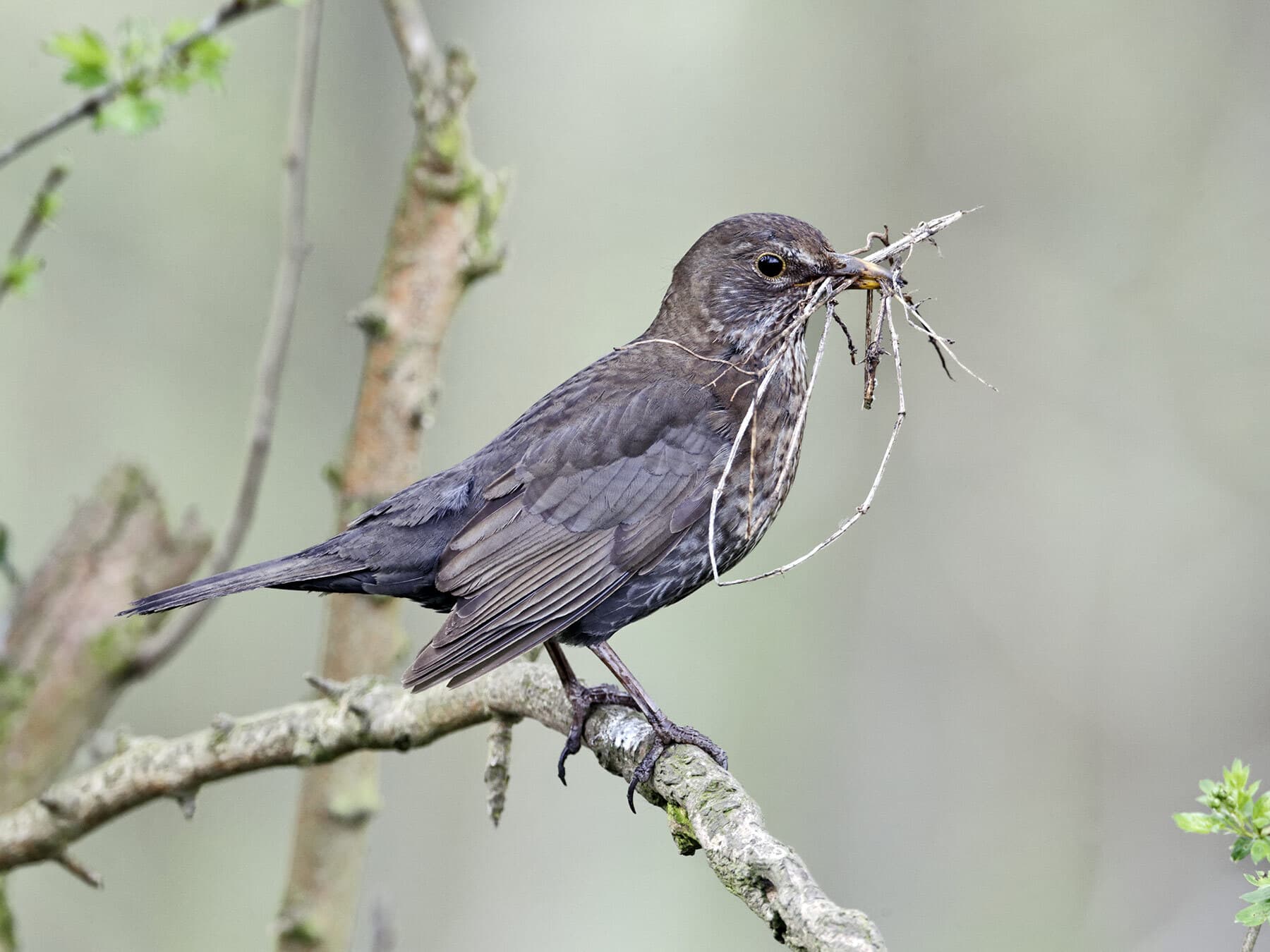
In Britain the first Blackbird eggs are laid around 22 April on average. The female builds a mud-lined cup in a hedge, shrub or climber, lays 3 or 4 greenish-blue eggs and incubates them for 12 to 14 days; most pairs nest 2 or 3 times a year.
On this page11 sections
This page covers Blackbird nests and eggs: when and where Blackbirds nest, what the nest and eggs look like, incubation, broods and nest boxes. What happens after hatching is on baby Blackbirds.
When do Blackbirds nest?
Where do Blackbirds nest?
Usually in a hedge, shrub, tree or a climber against a wall, and sometimes on a ledge or inside a building. Nests can be from about half a metre to 15 m up, but most are low: in one large Czech sample the average height was 1.9 m and 94% were below 4 m.2
Do Blackbirds nest on the ground? Not usually: nests are typically placed from about half a metre up.
The nest
A large, rather scruffy cup of grass and other plant material, with a layer of mud between the outer grass and a lining of finer grass. The female builds it almost on her own.
It is sturdy. Many nests survive the winter and show up when the leaves fall, and some last into the next breeding season.

Eggs
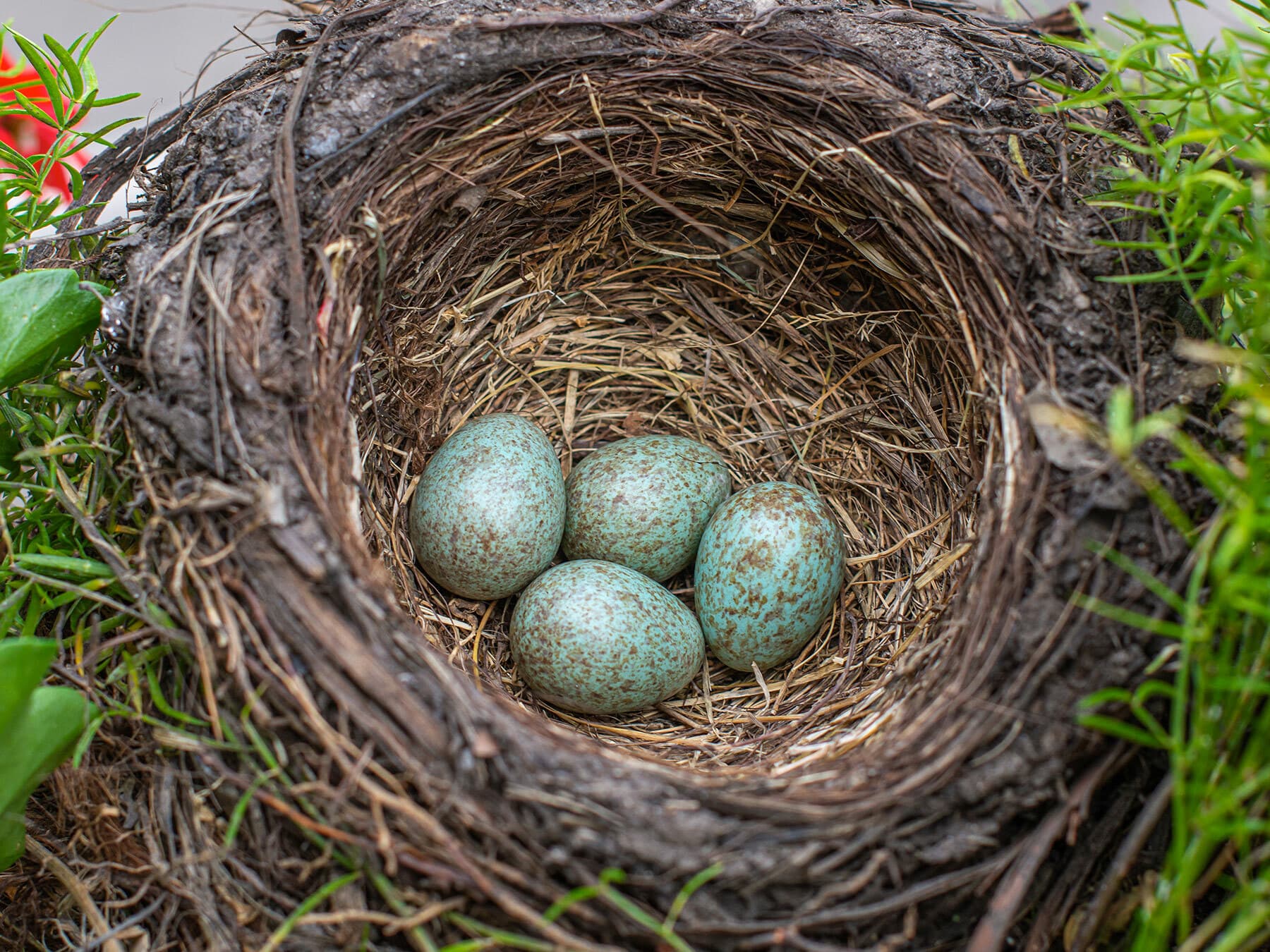
A female usually lays 3 or 4 eggs; British nest records average 3.86, with anything from 2 to 7 recorded. The eggs are about 29 x 21 mm and weigh 7.2 g.1 They are pale greenish-blue with pale reddish-brown spots.
Incubation
Only the female incubates, for 12 to 14 days; the average in British nest records is 12.97 days. The chicks leave the nest at 13.5 to 16 days old. See baby Blackbirds.
Broods
Most pairs raise 2 or 3 broods a year, exceptionally up to 5. The female builds a new nest for each clutch.
Do Blackbirds use the same nest every year?
Not the same nest: a new one is built for each clutch. But garden pairs hold traditional territories year after year, so the same pair can nest in a garden for more than one year.
Nest boxes
Neither the BTO's nor the RSPB's nest-box guide lists a box for Blackbirds. They build an open cup in thick cover, so dense shrubs, hedges and climbers on walls are what help them.
Nest success
Many fail. Of 1,428 British nests in one sample, at least one chick hatched in 56% and at least one young bird left the nest in 41%. Success is generally lower in towns, where there is more disturbance and there are more cats, and wherever Magpies and other crows are numerous; well-hidden nests do better.2 Damp soil may matter too: soil moisture in the breeding season can affect how well Blackbirds breed.1
Helping nesting Blackbirds
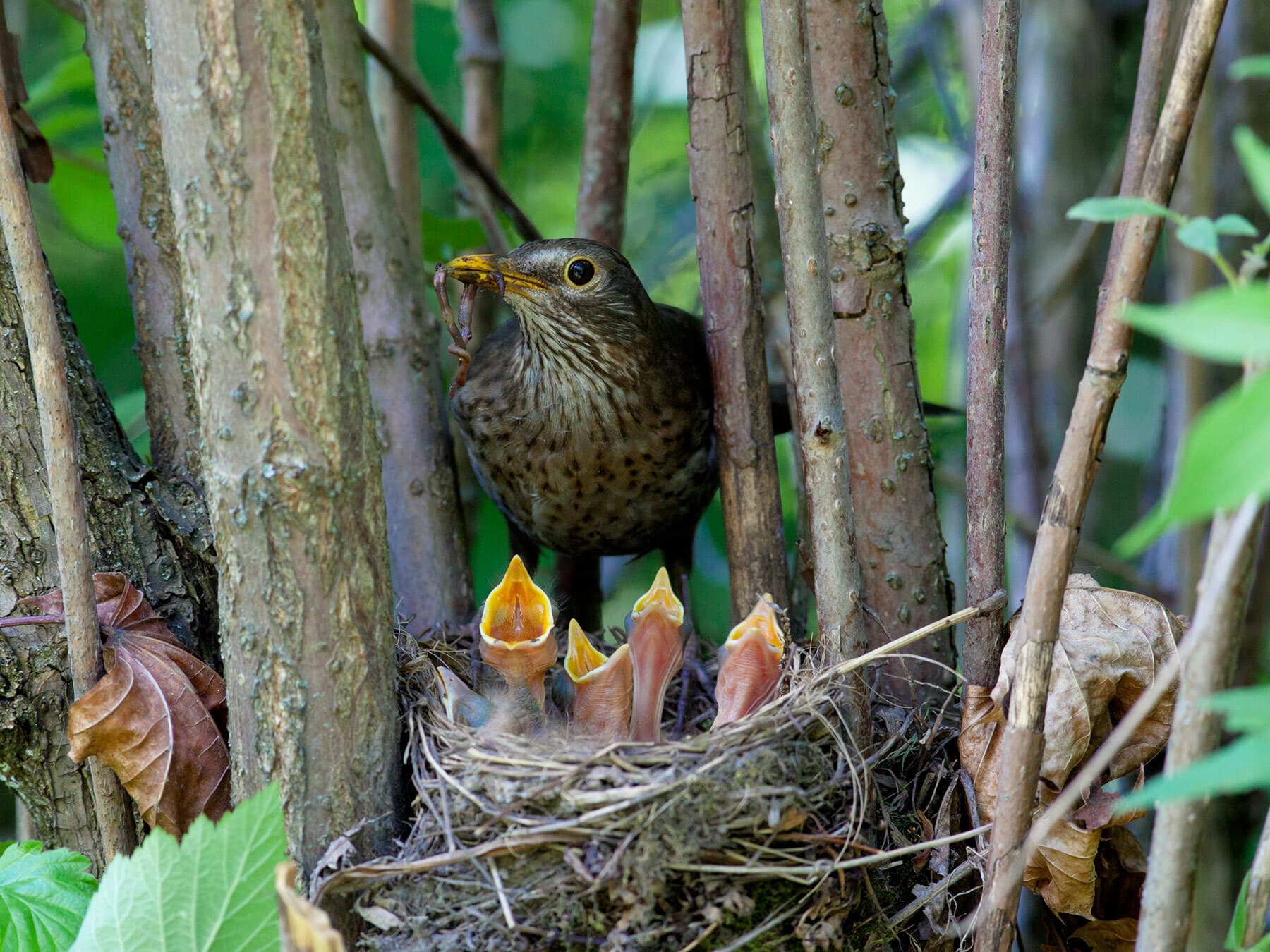
Blackbirds do best in larger, greener, wilder gardens, especially ones with a pond.3 In spring and summer you can put out mealworms soaked in water, which are easier for chicks to eat; avoid bread and dry, hard food, which chicks can choke on.
Sources
- BTO. Blackbird (Turdus merula). BTO BirdFacts. Accessed 6 October 2026. Source
- Collar, N., Christie, D. A. (2020). Eurasian Blackbird (Turdus merula), version 1.0. Birds of the World (J. del Hoyo, A. Elliott, J. Sargatal, D. A. Christie and E. de Juana, editors). Cornell Lab of Ornithology. doi:10.2173/bow.eurbla.01
- Hanmer, H. (2025). Blackbirds in Gardens. Bird Table (BTO Garden BirdWatch magazine) 121: 20-22. Accessed 6 October 2026. Source
- RSPB. Blackbird. RSPB Birds A-Z. Accessed 6 October 2026. Source
- Toms, M. (2013). Blackbird: species focus. Bird Table (BTO Garden BirdWatch magazine) 76: 18-20. Accessed 6 October 2026. Source
- RSPB. How and what to feed your garden birds. RSPB. Accessed 6 October 2026. Source
- BTO. Nest boxes for birds. BTO. Accessed 6 October 2026. Source
- RSPB. Our ultimate guide to nestboxes. RSPB. Accessed 6 October 2026. Source