


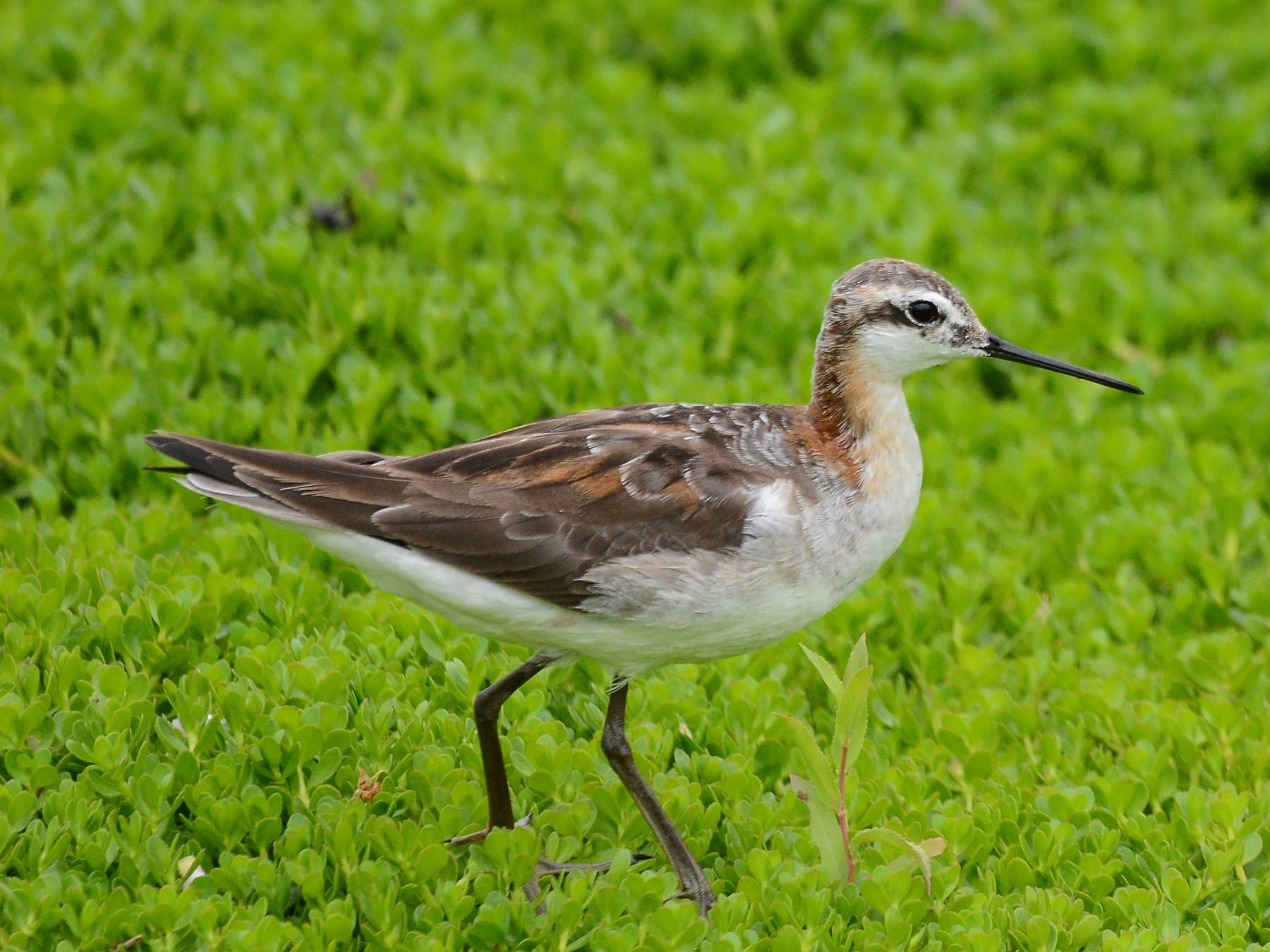
Wilson's Phalarope
Phalaropus tricolor
By the Birdfact teamChecked by Nathan Cope
Wilson's Phalarope turns the rules of bird biology on their head: the female is larger, more vividly coloured, and courts the male — who then incubates the eggs and raises the chicks alone while she moves on to find another mate. The largest of the three phalarope species, it is also the only one that never ventures onto the open ocean, spending its entire life between prairie marshes and Andean salt lakes.
On this page13 sections
How to recognise it
Wilson's Phalarope is the largest of the three phalarope species — a slender, elegant shorebird with notably long legs, a slim neck, and pointed wings. Its most distinctive feature is the bill: extraordinarily thin, straight, and needle-like, longer than in either the Red Phalarope or Red-necked Phalarope, and perfectly suited for plucking tiny invertebrates from the surface of shallow water.
In breeding plumage, the female is the showier sex — a reversal of the typical avian pattern. She has a pearl-grey crown and back, with chestnut and black patterning on the wings. A bold black stripe runs from the bill, through the eye, and sweeps dramatically down the side of the neck, where it transitions into a rich salmon-pink to peachy-orange wash on the foreneck. The face and throat are white, the underparts and rump pure white. Legs are black in breeding plumage.
The breeding male is a noticeably duller version. He is grey-brown above and white below, with a white face and throat. The dark eye-stripe is present but less bold and does not extend as far down the neck. In non-breeding (winter) plumage, both sexes converge on a similar appearance: pale grey above, white below, with a plain white face, yellowish legs, and just a faint dark patch through the eye — the one feature retained year-round.
Juveniles show brownish-grey upperparts with broad buff or yellowish fringes to the feathers, giving a scaly appearance. This juvenile plumage is moulted very quickly, so birds caught mid-moult show a patchwork of brownish juvenile feathers mixed with grey winter-type feathers. In flight, the wings are plain grey with no white wing-bar, and the white rump is conspicuous. The lobed (but not fully webbed) toes — an adaptation shared with coots — are visible at close range.
Not sure it’s a Wilson's Phalarope? Check your photo: Birdfact names the bird and shows the look-alike side by side.
Its size
Adults- Length
- 22–24 cm
- Wingspan
- 35–43 cm
- Weight
- 30–128 g
Its song and calls
Wilson's Phalarope is not a particularly vocal species outside the breeding season. The most frequently heard call is a soft, repeated quoit-quoit-quoit — a low, flat, nasal note that carries well across open water. A similar call is rendered as coin-coin, sometimes likened to a distant, muffled dog's bark. A raucous wourk or wunk is also noted, typically given when alarmed. The contact call in flight is a brief, nasal vittt.
During courtship on the breeding grounds, females produce a deep, chugging call while stretching the neck and puffing out the neck feathers — a display directed at prospective mates. Both sexes use brief nasal calls to maintain contact at close range. Over longer distances, females produce deeper, more carrying calls. Females are consistently the more vocal sex during the breeding season, consistent with their role as the active courting sex — another reversal of the typical avian pattern.
During migration, birds in flocks use a delicate gurgling to communicate with one another. The overall call repertoire is described as flat in tone, encompassing chirp, rattle, and raucous note types. The calls are generally quiet and unobtrusive compared to many other shorebirds of similar size, such as the Common Sandpiper, which produces a much more piercing piping call in flight. Wilson's Phalarope rarely draws attention to itself by sound alone — it is a bird most often found by sight, either by its distinctive spinning behaviour or its bold breeding plumage.
Heard one and not sure? Let the bird song identifier listen.
When and where to see it
OctoberLeaving
Most recorded in October
- 1. Hampshire0.12%
- 2. Wexfordunder 0.1%
- 3. Norfolkunder 0.1%
- 4. Lancashireunder 0.1%
Each dot is a county, state or province: the bigger and darker, the larger the bird’s share of that place’s bird records that month. Grey dots: no regular records. The ringed point is the centre of the bird’s records this month; the arrow shows how it moved since last month, and the dashed loop its path through the year. “Arrivals” colours places where it becomes regular this month (orange) or is in its last regular month (grey). GBIF eBird Observation Dataset, 2019–2024. Map data: Natural Earth, US Census Bureau; place centres © OpenStreetMap contributors.
In your area
See when the Wilson's Phalarope is recorded in your county, state or province.
How often the Wilson's Phalarope turns up in the UK, the United States and Canada through the year, from birdwatchers' records.
United Kingdom
Passage migrant · regularly Sep · most records in September
United States
Summer visitor · regularly Apr–Sep · most records in August
Canada
Summer visitor · regularly May–Sep · most records in June
Show as a table
| Month | United Kingdom | United States | Canada |
|---|---|---|---|
| January | – | <0.001% | – |
| February | – | <0.001% | – |
| March | – | 0.001% | – |
| April | – | 0.030% (regular) | 0.001% |
| May | – | 0.066% (regular) | 0.072% (regular) |
| June | – | 0.039% (regular) | 0.077% (regular) |
| July | – | 0.047% (regular) | 0.055% (regular) |
| August | – | 0.081% (regular) | 0.057% (regular) |
| September | 0.007% (regular) | 0.028% (regular) | 0.018% (regular) |
| October | 0.005% | 0.004% | 0.001% |
| November | 0.001% | 0.001% | – |
| December | – | <0.001% | – |
Recorded regularly in
Worldwide: recorded regularly in 26 countries
Countries where it was recorded in at least 3 of the 6 years 2019–2024. Linked countries have their own bird list.
Europe (1)
North America (15)
- Belize
- Bermuda
- Canada
- Cayman Islands
- Costa Rica
- Dominican Republic
- El Salvador
- Guadeloupe
- Guatemala
- Honduras
- Mexico
- Nicaragua
- Panama
- Puerto Rico
- United States
Data: EOD – eBird Observation Dataset (Cornell Lab of Ornithology), accessed via GBIF.org, CC BY 4.0. Records from 2019–2024, aggregated and filtered by Birdfact. How these lists are made
Tips for seeing it
In North America, the best time to see Wilson's Phalarope in numbers is during the southward staging period from late June through August, when birds congregate in their tens of thousands on hypersaline lakes in the western interior. The Great Salt Lake in Utah, Mono Lake in California, and Lake Abert in Oregon are the premier sites. At these locations, large flocks can be watched spinning and feeding from the shore — binoculars or a telescope are useful for picking out individual birds in the dense aggregations.
On the breeding grounds, look for Wilson's Phalarope in shallow prairie marshes, wet meadows, and flooded fields across the Great Plains from May through early July. The female's bold black neck stripe and salmon-pink foreneck make her straightforward to identify in breeding plumage. The male is duller but shares the same needle-thin bill and white rump — both useful features at any season.
In the UK and Ireland, Wilson's Phalarope is an annual vagrant most likely to be encountered between August and October. Juvenile birds — which show brownish-grey upperparts with buff feather fringes — make up the majority of records. Check coastal wetlands, sewage lagoons, and reservoir margins. The species is often confiding and approachable, feeding actively at the water's edge. In winter plumage, separate it from the Red-necked Phalarope by its larger size, longer and thinner bill, plain grey wings (no white wing-bar), and yellowish (not dark) legs. The white rump is conspicuous in flight.
Year-round, the spinning feeding behaviour is the most reliable behavioural clue: no other shorebird regularly swims in tight circles to create a feeding vortex. If you see a small wader spinning on the water, Wilson's Phalarope should be your first thought.
What it eats
During the breeding season, Wilson's Phalarope feeds mainly on aquatic insects: midges, flies and their larvae, beetles, true bugs, and other invertebrates found in shallow prairie wetlands. It also takes small crustaceans, copepods, spiders, and occasionally seeds of marsh plants. Foraging birds pick prey from the water surface, probe in soft mud, or spin to create the characteristic feeding vortex.
At migratory staging sites on hypersaline lakes, the diet shifts almost entirely to brine shrimp (Artemia spp.) and brine flies — including alkali flies (Ephydra hians and E. gracilis) — which are extraordinarily abundant and energy-dense. This superabundant food source fuels one of the most dramatic pre-migration fattening events documented in any bird. Staging birds can more than double their body weight in a matter of weeks, gorging so intensively that some individuals temporarily become too fat to fly. Researchers have caught birds by hand during this period.
The spinning feeding technique is most commonly used in open water, where the vortex created by the bird's rotation draws invertebrates up from the substrate. On land and in very shallow water, Wilson's Phalarope relies more on direct picking and probing. It is a more flexible forager than the other phalaropes, using a wider range of microhabitats and techniques across the annual cycle.
On the wintering grounds in South America — primarily Andean saline lakes and lagoons — the diet is again dominated by small crustaceans and aquatic invertebrates, with brine shrimp remaining a key food source at sites such as Laguna Mar Chiquita in Argentina.
Nesting and breeding
Wilson's Phalarope operates a polyandrous mating system in which sex roles are reversed compared to most birds. Females arrive on the breeding grounds before males and actively compete for mates, sometimes engaging in physical fights with rival females. A single female may mate with multiple males in one season, laying a clutch for each and leaving the male to handle all incubation and chick-rearing while she seeks the next partner.
Courtship is initiated by the female. She pursues males with aggressive postures, whipping her head back and forth, and uses bowing and upright displays to initiate copulation. Aerial chases and water-surface displays are also part of the repertoire, with the female swimming towards the male with neck held erect to show off her bold plumage. DNA studies have found no evidence of extra-pair fertilisations — despite the polyandrous system, each clutch belongs to a single pair.
The female selects the nest site, typically on the ground near water, sometimes slightly elevated in marsh vegetation. The male then tidies the scrape and arranges surrounding grasses or sedges to conceal it. The nest is a shallow depression lined with grass. Clutch size is almost invariably four eggs, laid at approximately 24-hour intervals between early May and late June. Eggs are buff-coloured, blotched and spotted with brown and black, measuring approximately 3.2–3.5 cm long by 2.3–2.4 cm wide.
Incubation is performed by the male alone and lasts 18–27 days, typically around 23 days. Chicks hatch with eyes open and are fully feathered and mobile within one day. They are precocial, finding all their own food from the start. The male broods the chicks while they are small and performs a broken-wing distraction display if a predator approaches. Young are capable of flight at approximately 19 days of age — an unusually rapid development. The species can produce one or two broods per season, and young reach breeding age at one year old.
Behaviour
Wilson's Phalarope flies with rapid, shallow wingbeats on pointed wings — a flight style that is swift and direct, more reminiscent of a stint or small stint than a typical wader of its size. In direct flight it moves quickly and purposefully, without the undulating pattern of some shorebirds. When flushed from the water's edge, it typically rises steeply before levelling off.
The key flight identification features are the plain grey upperwings — no white wing-bar at any age or season — and the bright white rump, which is conspicuous from a distance. The underparts are pure white in flight. The combination of plain wings and white rump separates Wilson's Phalarope from most other small waders, though the white rump is shared with several Calidris sandpipers and the Wood Sandpiper.
On migration, Wilson's Phalaropes are capable of sustained long-distance flights. After completing their moult and fattening at staging sites, birds undertake non-stop flights of over 54 hours to reach South American wintering grounds — a crossing that requires the extraordinary fuel reserves built up during the staging period. The southward migration is largely overland through the Great Plains and Central America, while the spring return is more diffuse, with birds using a wider range of stopover sites. In the UK, vagrant birds are typically seen in active feeding flight low over water or settling on open wetland margins.
Lifespan and predators
Wilson's Phalarope typically lives between 5 and 10 years in the wild, with a maximum recorded age of around 10 years. This is broadly comparable to other small shorebirds of similar size, such as the Dunlin and Wood Sandpiper, though the long-distance migratory lifestyle imposes significant annual mortality risks.
The most dangerous periods of the annual cycle are the migration itself — particularly the long overland and transoceanic flights between North and South America — and the staging period on hypersaline lakes, where the entire population is concentrated and vulnerable to sudden environmental changes. The near-total desiccation of Lake Abert in 2021–22 and the record-low water levels at the Great Salt Lake in 2022 illustrate how rapidly conditions at these critical sites can deteriorate.
Predation on the breeding grounds is managed partly by the male's broken-wing distraction display and partly by the cryptic colouring of the nest and eggs. Known predators include birds of prey, foxes, and mustelids. Young birds, which fledge at just 19 days old, face the highest mortality rates — as in most shorebirds, first-year survival is substantially lower than adult survival. Birds that survive to adulthood and successfully navigate the annual migration cycle can reach the upper end of the typical lifespan range.
Conservation
Wilson's Phalarope is currently listed as Least Concern on the IUCN Red List, with a global population estimated at 1–1.5 million mature individuals. However, this status is increasingly contested. International Shorebird Survey data indicate a population decline of approximately 70% since the 1980s — a trajectory that prompted a formal petition in March 2024, led by the Center for Biological Diversity, to list the species as Threatened under the US Endangered Species Act. The species is already listed as Threatened in Minnesota and is a US Fish and Wildlife Service Bird of Conservation Concern.
The most acute threat is the desiccation of the three hypersaline staging lakes on which up to 90% of the world's adult population depends simultaneously. The Great Salt Lake — used by up to 60% of the global population — fell to its lowest recorded level in 2022, temporarily becoming too saline for brine shrimp reproduction. Lake Abert in Oregon has nearly dried up twice in recent years (2014–15 and 2021–22). Mono Lake in California remains chronically below its legally mandated minimum water level. The collapse of any one of these lakes would be catastrophic for the species.
Drainage and conversion of prairie wetland breeding habitat — primarily for agriculture — continues to reduce available nesting sites across the Great Plains. Water diversion for irrigation reduces inflows to saline staging lakes. Climate change is exacerbating drought conditions across the western United States, accelerating the decline of these critical water bodies. On the wintering grounds in the Andes, lithium mining operations pose an emerging pollution threat to the saline lakes that support wintering populations.
The Migratory Bird Treaty Act provides some legal protection, but conservation advocates argue that without formal Endangered Species Act listing, the pace of habitat loss will outstrip the species' ability to recover. The contradiction between the IUCN's 'Least Concern' designation and the documented 70% decline reflects a lag in the assessment process rather than genuine stability.
Courtship & Display
The courtship system of Wilson's Phalarope is one of the most thoroughly reversed in the bird world. Females arrive on the breeding grounds before males and immediately begin competing for mates. A female will pursue a male with aggressive postures — whipping her head back and forth, puffing out her neck feathers, and occasionally engaging in physical fights with rival females. The female's bold black neck stripe and salmon-pink foreneck are not merely decorative: they are signals of competitive quality directed at both rival females and prospective mates.
Once a female has secured a male's attention, she uses bowing and upright postures to initiate copulation. Aerial chases are common, with the female pursuing the male in low, rapid flights over the marsh. On the water, she swims towards the male with neck held erect, displaying her plumage and uttering repeated low calls. The male's role during this phase is largely passive — he is the choosy sex, assessing female quality before committing to a pair bond.
After mating, the female selects the nest site and the male tidies and lines the scrape. Once the clutch of four eggs is complete, the female typically departs within days to seek a new mate, leaving the male as the sole incubator. A productive female may secure two or even three mates in a single season. DNA analysis has confirmed that despite this system, there is no evidence of extra-pair fertilisations — each clutch is the genetic offspring of the pair that formed it, suggesting that females invest their competitive energy in securing exclusive access to high-quality males rather than in promiscuous mating.
Staging Sites And Molt Migration
Wilson's Phalarope undertakes what biologists call a 'molt migration' — a phenomenon documented in only two shorebird species worldwide. Rather than moulting on the breeding grounds or the wintering grounds, birds travel to specific intermediate staging sites where they simultaneously undergo a complete body moult and build the fat reserves needed for the final leg of their journey to South America. The staging period lasts approximately 35–40 days, during which birds replace all body feathers — one of the fastest complete body moults recorded in any bird.
The three critical staging sites are the Great Salt Lake in Utah, Lake Abert in Oregon, and Mono Lake in California. These hypersaline lakes support extraordinary densities of brine shrimp (Artemia spp.) and brine flies (Ephydra spp.) — invertebrates that thrive in water too salty for fish, eliminating predation pressure and allowing prey populations to reach astronomical numbers. Up to 90% of the world's adult Wilson's Phalaropes can be present at these three lakes simultaneously between late June and early September.
The southward migration is staggered by sex and age. Females depart the breeding grounds first — as early as late June, immediately after laying — followed by males once the chicks are independent, and finally juveniles in late summer. At the staging lakes, birds gorge so intensively that they can more than double their body weight, accumulating the fat reserves needed for non-stop flights of over 54 hours to reach South America. The vulnerability of this system is stark: the near-total desiccation of Lake Abert in 2021–22 and the record-low Great Salt Lake levels of 2022 temporarily eliminated the food supply at two of the three sites, with potentially severe consequences for the global population.
Quick facts
- Length
- 22–24 cm
- Wingspan
- 35–43 cm
- Weight
- 30–128 g
- Lifespan
- 5–10 years · oldest recorded 10 years
- Family
- Sandpipers & Snipes
- Migration
- Long-distance Migrant
- Global status (IUCN)
- Least Concern
- World population
- 1,000,000 – 1,500,000 mature individuals
- Population trend
- Declining — estimated 70% reduction since the 1980s based on International Shorebird Survey data, though the IUCN currently lists the trend as stable. A 2024 ESA petition argues the species may qualify as Threatened or Endangered.
- Scientific name
- Phalaropus tricolor
Sources
12- 1Wilson's phalarope - Wikipedia Source (opens in a new tab)
- 2Wilson's Phalarope Species Factsheet | BirdLife DataZone Source (opens in a new tab)
- 3Wilson's Phalarope | Audubon Field Guide Source (opens in a new tab)
- 4Wilson's Phalarope - eBird Source (opens in a new tab)
- 5Wilson's Phalarope Life History | Cornell Lab of Ornithology Source (opens in a new tab)
- 6Wilson's Phalarope | BTO BirdFacts Source (opens in a new tab)
- 7The science behind the petition: Mono Lake and the Wilson's Phalarope | Mono Lake Committee (2024) Source (opens in a new tab)
- 8Endangered Species Protections Sought for Wilson's Phalarope | Center for Biological Diversity (2024) Source (opens in a new tab)
- 9Phalaropus tricolor (Wilson's phalarope) | Animal Diversity Web Source (opens in a new tab)
- 10Wilson's Phalarope | Oiseaux-Birds Source (opens in a new tab)
- 11Wilson's Phalarope | Bird Spot UK Source (opens in a new tab)
- 12Bird of the Week: Wilson's Phalarope | Travis Audubon Source (opens in a new tab)

Checked by
Nathan Cope, founder and editor
Nathan founded Birdfact and leads its writers and contributors in the UK, the US and Canada. He has watched and studied birds for more than ten years, and checks every article and species guide before it’s published.