


Northern Pintail
Pintail, Sprigtail · Anas acuta
By the Birdfact teamChecked by Nathan Cope
On this page14 sections
How to recognise it
What do Pintails look like?
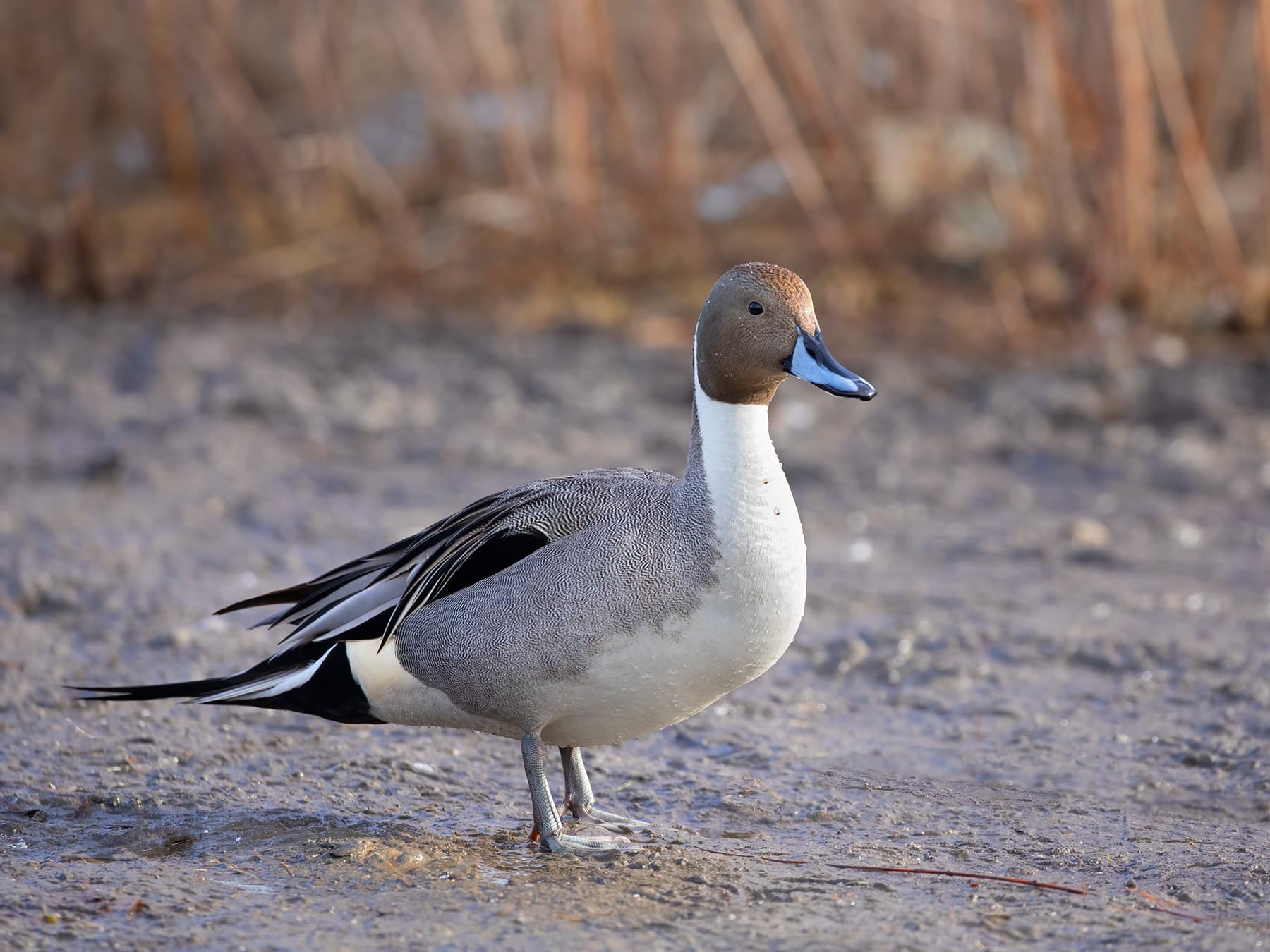
The Northern Pintail is an attractive wildfowl species, most easily identified by its long neck, pointed tail and wings, and characteristic hunched back in flight. They are a sexually dimorphic species, and males (drakes) have separate breeding and non-breeding plumages, both of which are distinct from females (hens).
Drakes
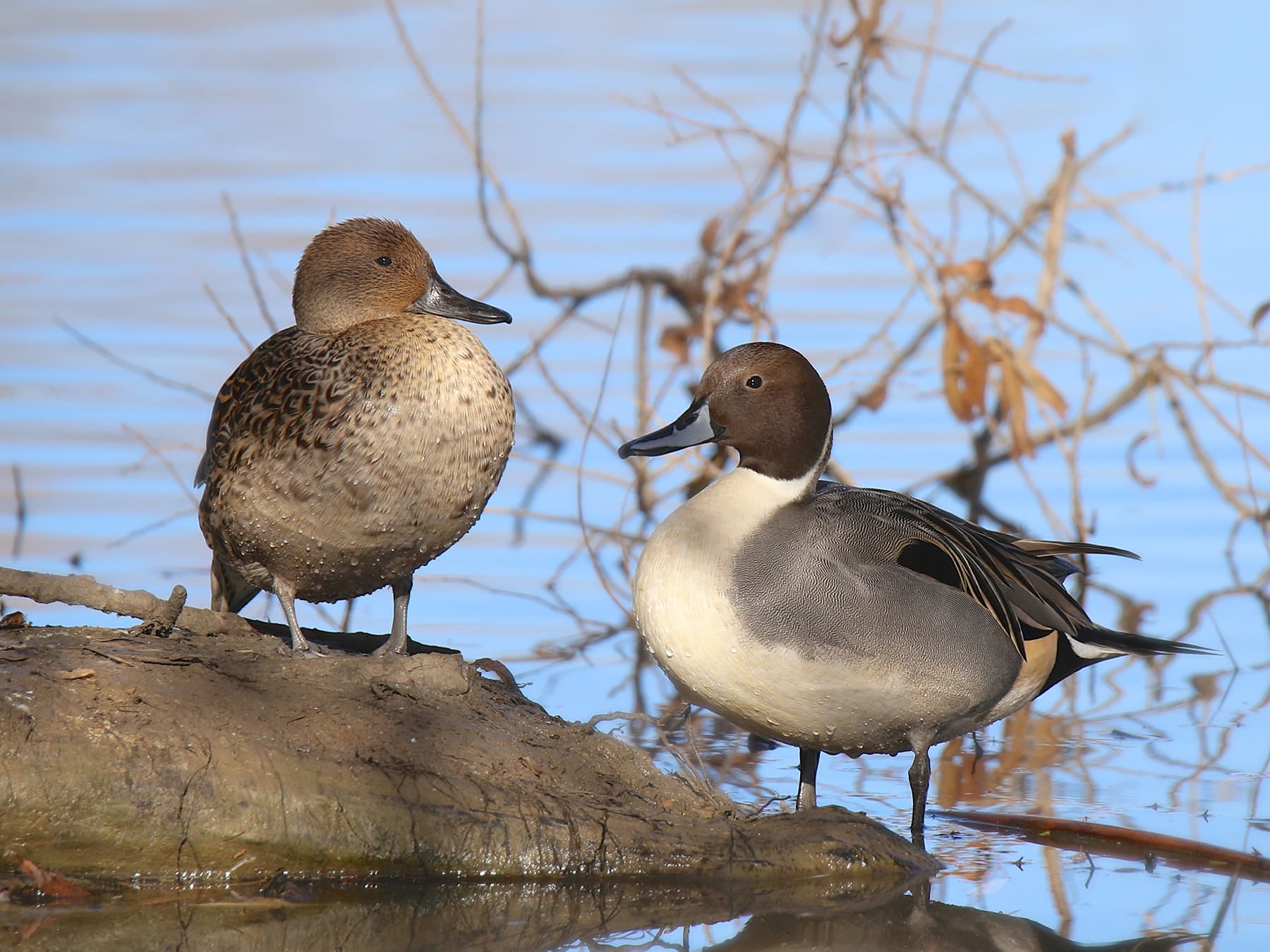
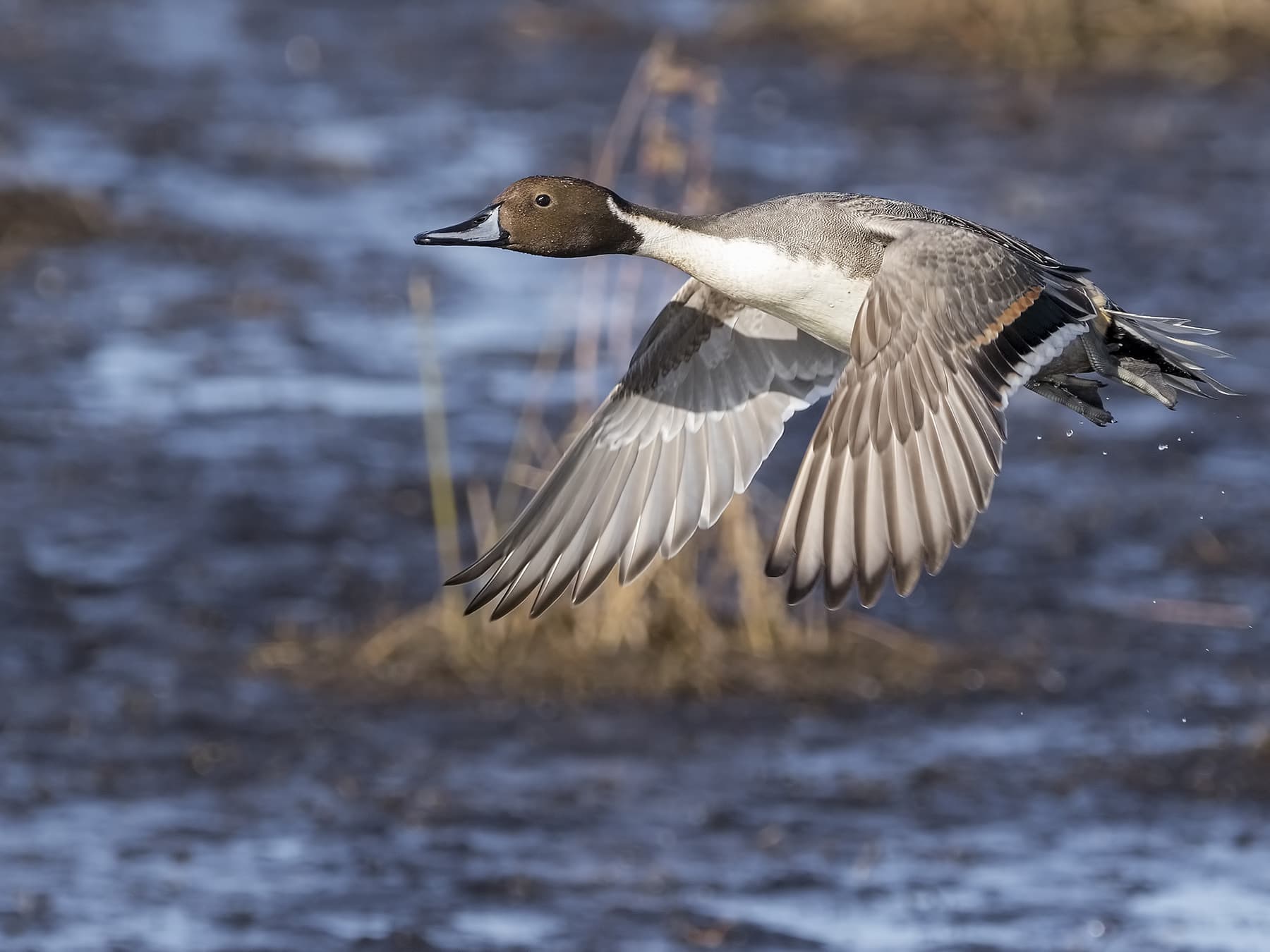
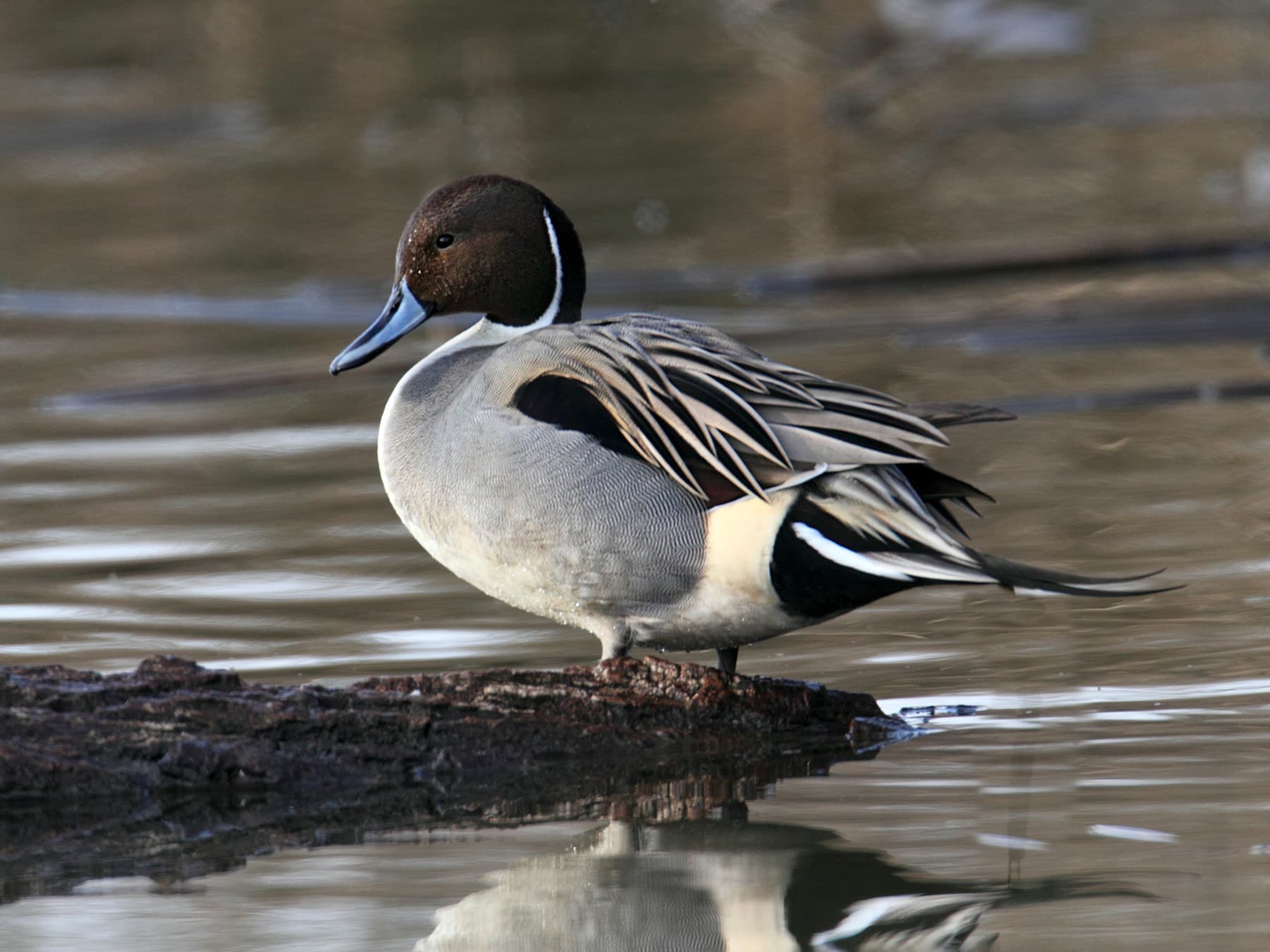
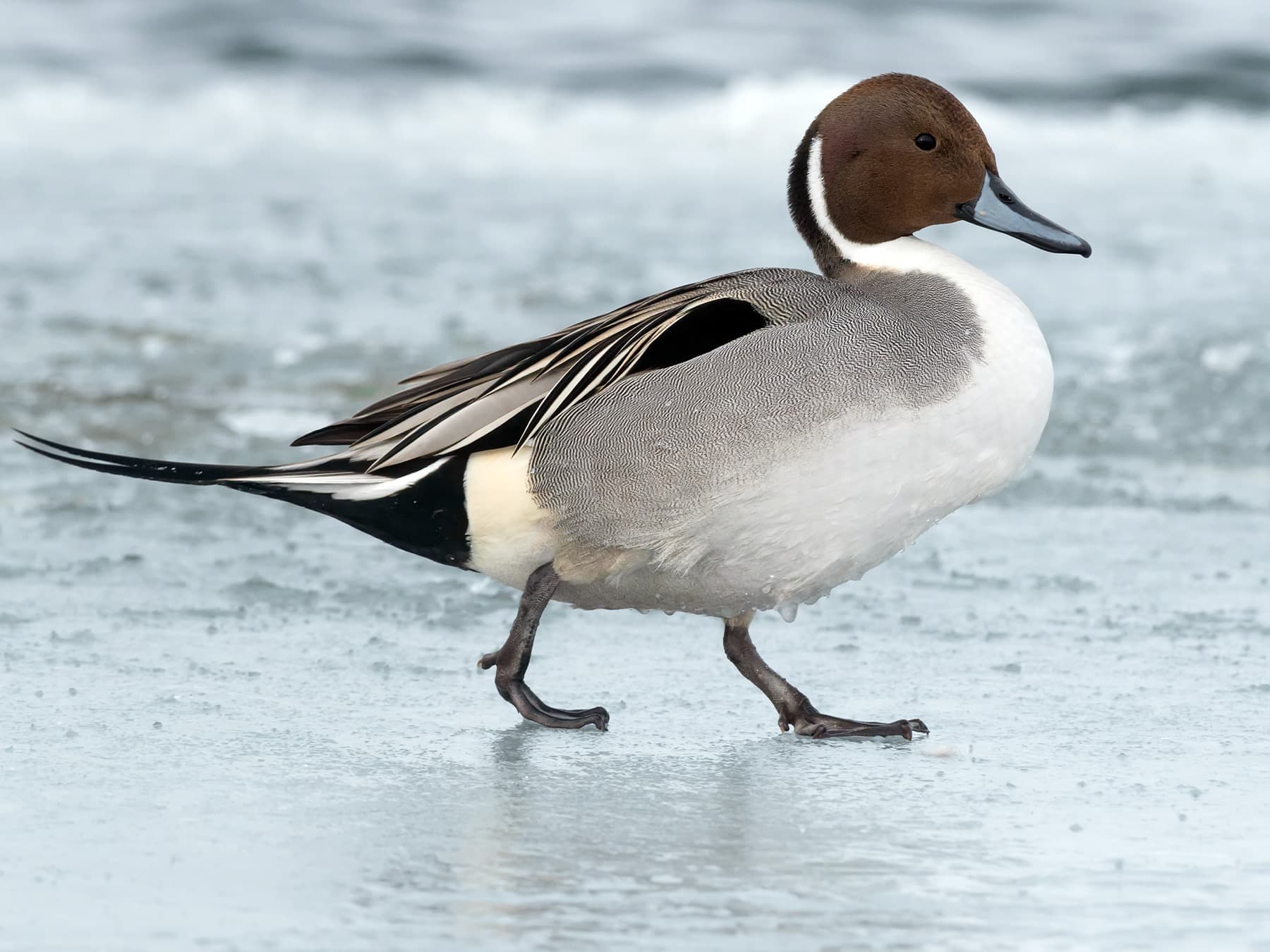
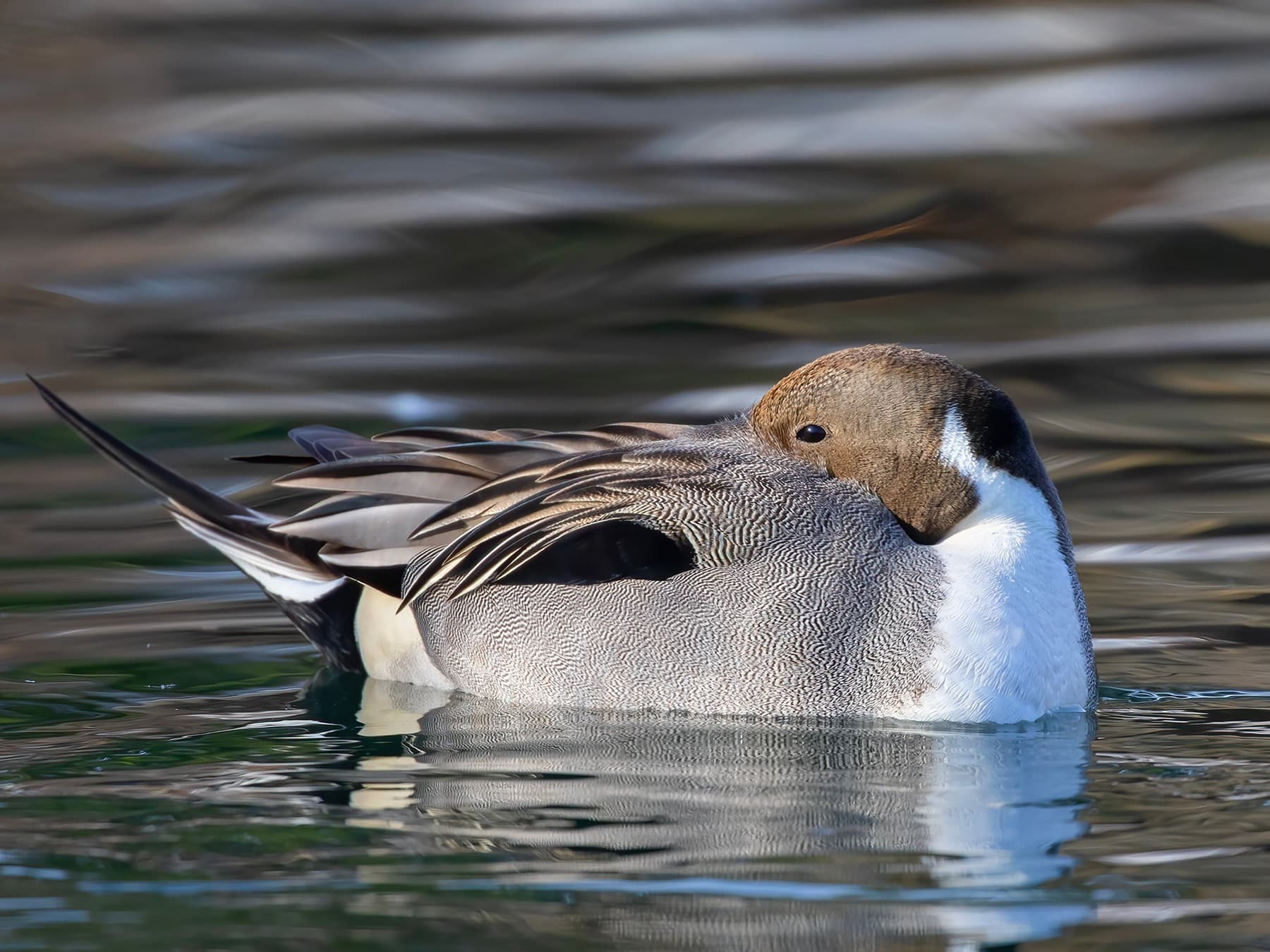
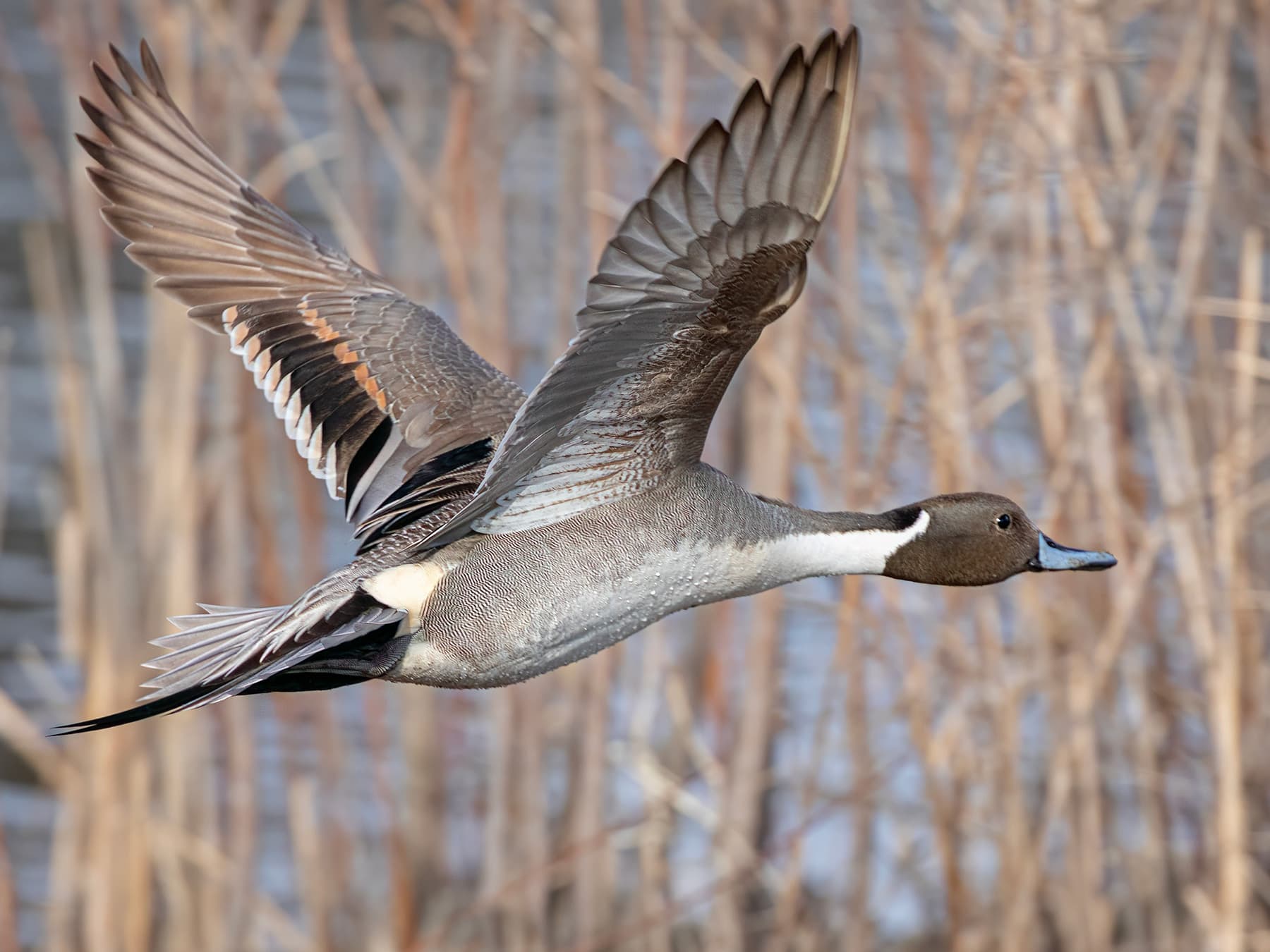
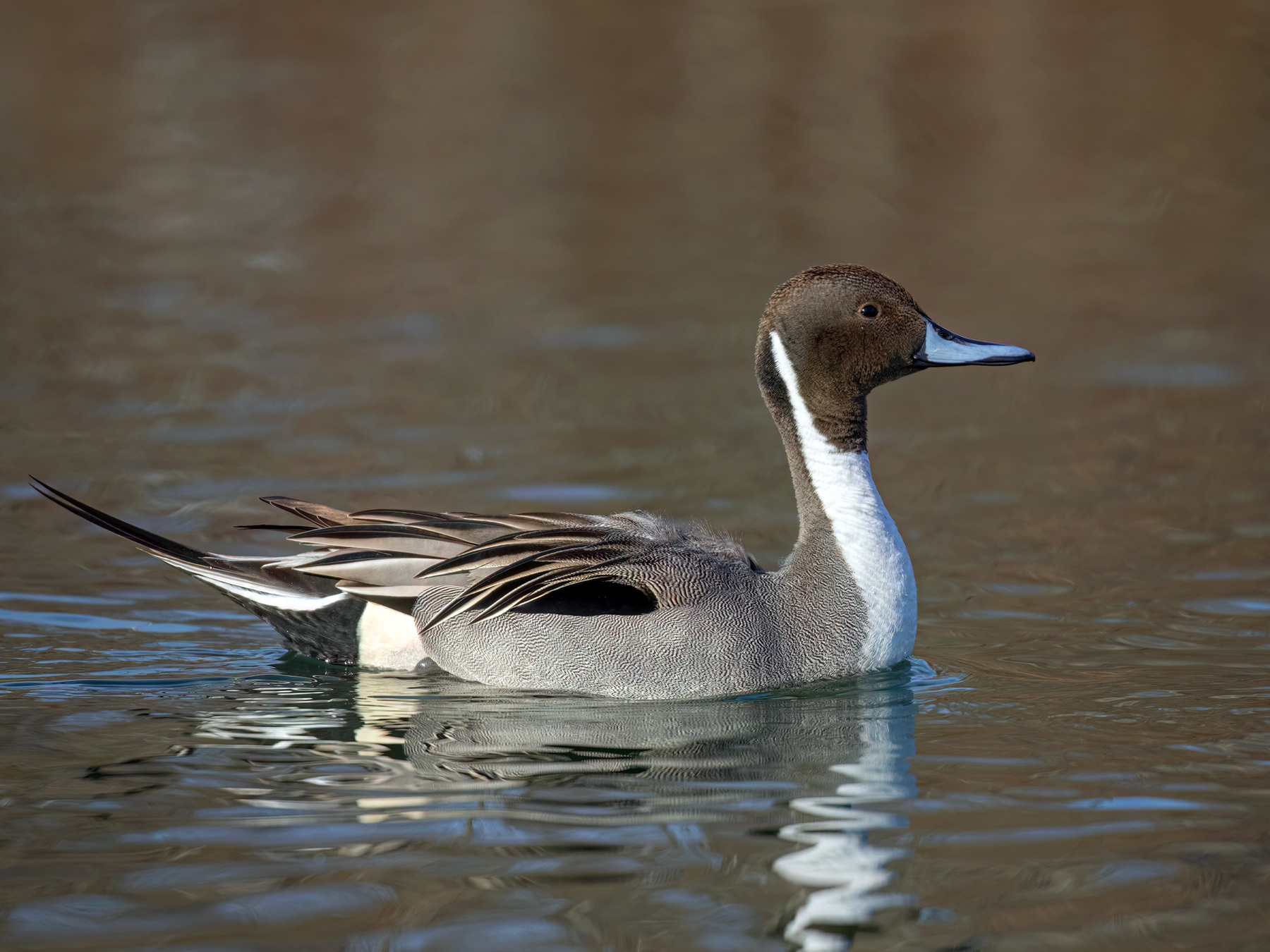
Males in breeding plumage have a chocolate brown head and white plumage on the belly and neck, extending as a narrow stripe up to the back of the head. Their long black tail contrasts with a yellowish rump. Resting birds show gray upper parts and flanks with black streaks on the wings and back, and flying birds show a green speculum (wing bar).
Non-breeding drakes in eclipse plumage are relatively dull, with a gray-brown body and a paler breast. Their tail is still pointed, although much shorter, and they have gray bills and legs.
Hens
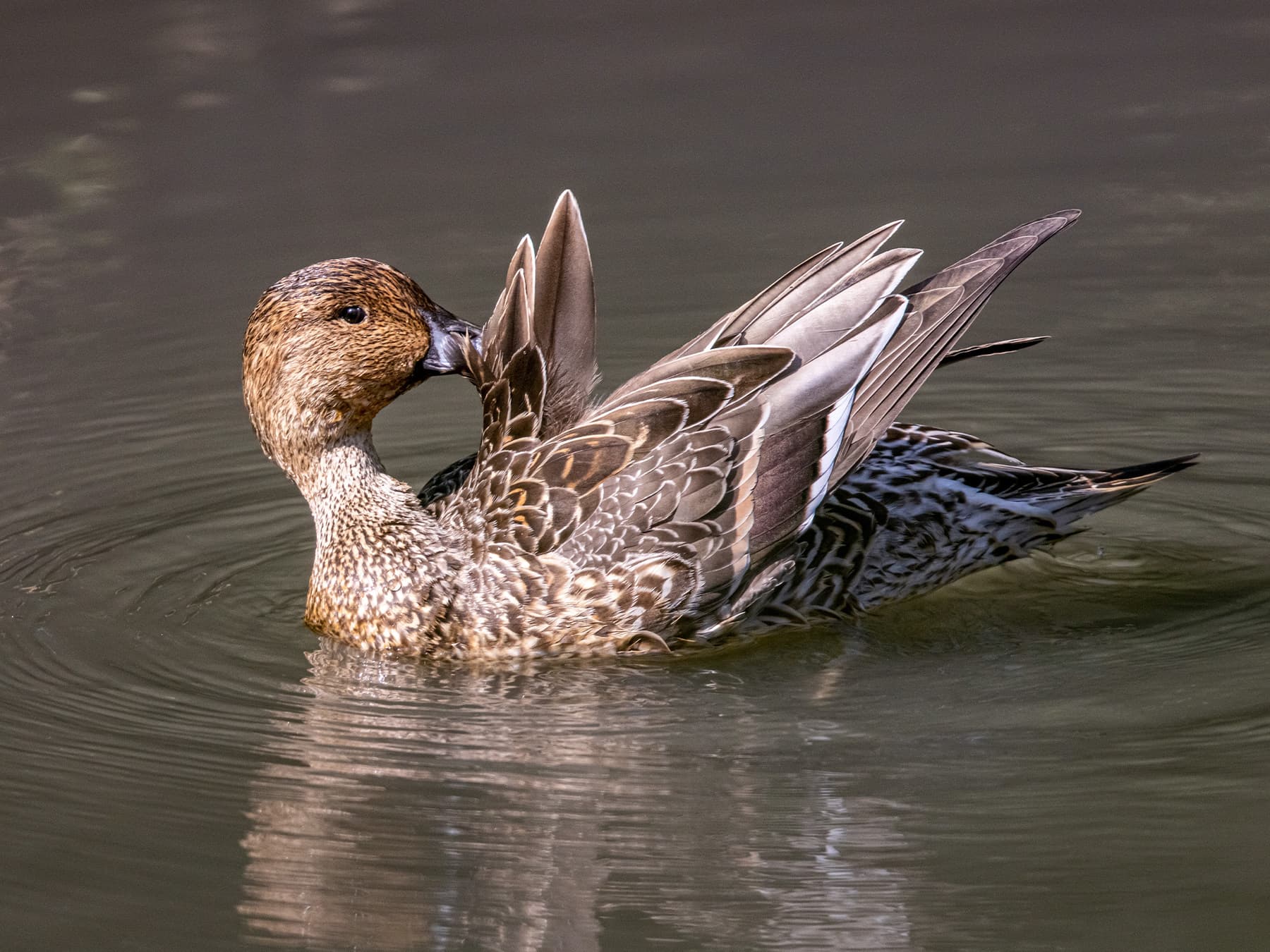
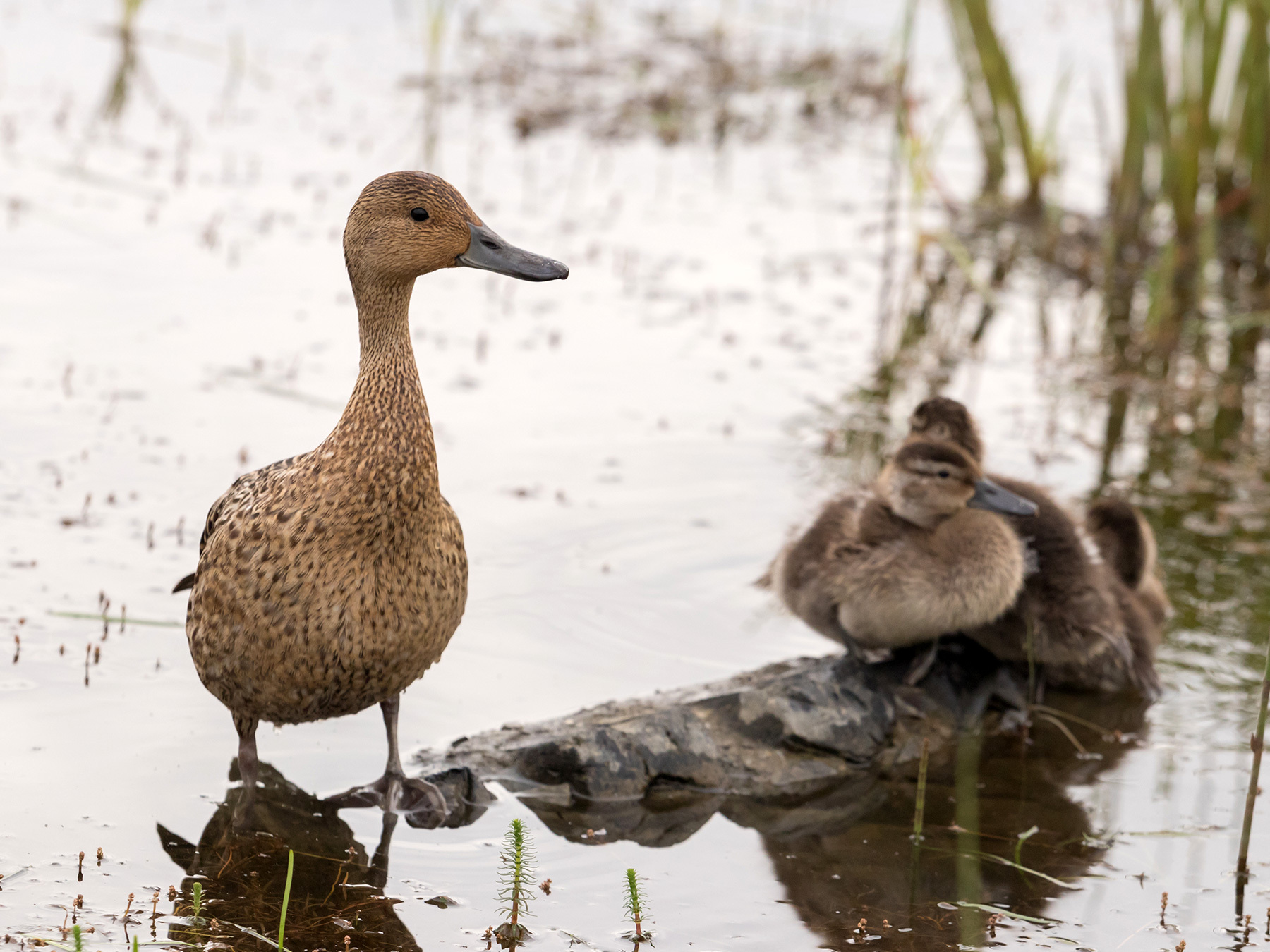
Pintail hens look similar to summer plumage males but have warmer brown plumage with a heavily mottled body. The head and neck are a paler buff shade, and they show bronzey brown speculums with white trailing edges in flight. Their bill and legs are dark gray.
Juveniles
Pintail ducklings have dark downy feathers with whitish stripes on their sides. Their face is pale, with a dark line through each eye and a dark crown. Later in the summer and fall/autumn, juveniles appear similar to adult females but have darker crowns and less mottling on the flanks and upper parts. The speculum is duller brown and has a smaller white edge.
How big are Pintails?
Pintails are large dabbling ducks, longer but with a lighter build than the Mallard.
Length
Most adult Pintails measure 20 to 27½ inches or 50 to 70 centimeters long.
Weight
Males are the heavier sex at 28 to 44 ounces or 790 to 1250 grams. Females weigh 22 to 37 ounces or 620 to 1050 grams.
Wingspan
Typical wingspans range between 31½ and 37 inches or 80 to 95 centimeters.
Its size
Adults- Length
- 59–76 cm
- Wingspan
- 80–95 cm
- Weight
- 450–1360 g
Its song and calls
What sound does a Pintail make?
Pintails are vocal throughout the year. Hens produce soft single or stuttered ‘kuk’ quacks and loud crow-like ‘gaak’ alarm calls. Males have a short whistled call, reminiscent of a steam train.
- Song and calls0:00 / 0:11
Recorded in Bretagne, France · March 2022
- Call0:00 / 0:18
Recorded in Sachsen, Germany · March 2021
When and where to see it
OctoberIn season
Most recorded in October
- 1. Rutland1.3%
- 2. Stockton-on-Tees0.84%
- 3. Wexford0.67%
- 4. Perthshire and Kinross0.66%
- 5. Lincolnshire0.64%
Each dot is a county, state or province: the bigger and darker, the larger the bird’s share of that place’s bird records that month. Grey dots: no regular records. The ringed point is the centre of the bird’s records this month; the arrow shows how it moved since last month, and the dashed loop its path through the year. “Arrivals” colours places where it becomes regular this month (orange) or is in its last regular month (grey). GBIF eBird Observation Dataset, 2019–2024. Map data: Natural Earth, US Census Bureau; place centres © OpenStreetMap contributors.
In your area
See when the Northern Pintail is recorded in your county, state or province.
How often the Northern Pintail turns up in the UK, Ireland, the United States and Canada through the year, from birdwatchers' records.
United Kingdom
Winter visitor · regularly Aug–May · most records in January
Ireland
Winter visitor · regularly Sep–Apr · most records in November
United States
Winter visitor · all year · most records in January
Canada
Winter visitor · all year · most records in March
Show as a table
| Month | United Kingdom | Ireland | United States | Canada |
|---|---|---|---|---|
| January | 0.31% (regular) | 0.21% (regular) | 0.30% (regular) | 0.27% (regular) |
| February | 0.28% (regular) | 0.18% (regular) | 0.29% (regular) | 0.26% (regular) |
| March | 0.22% (regular) | 0.11% (regular) | 0.24% (regular) | 0.48% (regular) |
| April | 0.093% (regular) | 0.042% (regular) | 0.089% (regular) | 0.42% (regular) |
| May | 0.026% (regular) | 0.006% | 0.047% (regular) | 0.13% (regular) |
| June | 0.011% | 0.002% | 0.059% (regular) | 0.096% (regular) |
| July | 0.011% | 0.004% | 0.017% (regular) | 0.058% (regular) |
| August | 0.036% (regular) | 0.010% | 0.050% (regular) | 0.12% (regular) |
| September | 0.21% (regular) | 0.12% (regular) | 0.11% (regular) | 0.27% (regular) |
| October | 0.26% (regular) | 0.18% (regular) | 0.20% (regular) | 0.39% (regular) |
| November | 0.27% (regular) | 0.23% (regular) | 0.29% (regular) | 0.33% (regular) |
| December | 0.28% (regular) | 0.19% (regular) | 0.26% (regular) | 0.22% (regular) |
Recorded regularly in
Worldwide: recorded regularly in 120 countries
Countries where it was recorded in at least 3 of the 6 years 2019–2024. Linked countries have their own bird list.
Europe (44)
- Åland Islands
- Albania
- Austria
- Belarus
- Belgium
- Bosnia & Herzegovina
- Bulgaria
- Croatia
- Czechia
- Denmark
- Estonia
- Faroe Islands
- Finland
- France
- Germany
- Greece
- Hungary
- Iceland
- Ireland
- Isle of Man
- Italy
- Jersey
- Kosovo
- Latvia
- Lithuania
- Luxembourg
- Malta
- Moldova
- Montenegro
- Netherlands
- North Macedonia
- Norway
- Poland
- Portugal
- Romania
- Russia
- Serbia
- Slovakia
- Slovenia
- Spain
- Sweden
- Switzerland
- Ukraine
- United Kingdom
Asia (38)
- Armenia
- Azerbaijan
- Bahrain
- Bangladesh
- Bhutan
- Cambodia
- China
- Cyprus
- Georgia
- Hong Kong SAR China
- India
- Iran
- Israel
- Japan
- Jordan
- Kazakhstan
- Kuwait
- Kyrgyzstan
- Lebanon
- Malaysia
- Mongolia
- Myanmar (Burma)
- Nepal
- Oman
- Pakistan
- Palestinian Territories
- Philippines
- Qatar
- Saudi Arabia
- South Korea
- Sri Lanka
- Taiwan
- Tajikistan
- Thailand
- Turkey
- United Arab Emirates
- Uzbekistan
- Vietnam
North America (20)
- Bahamas
- Barbados
- Belize
- Bermuda
- Canada
- Cayman Islands
- Costa Rica
- Cuba
- Dominican Republic
- El Salvador
- Greenland
- Guadeloupe
- Guatemala
- Honduras
- Mexico
- Nicaragua
- Puerto Rico
- St Pierre & Miquelon
- United States
- US Virgin Islands
Oceania (7)
- Cocos (Keeling) Islands
- Guam
- Marshall Islands
- New Zealand
- Northern Mariana Islands
- Palau
- US Outlying Islands
Data: EOD – eBird Observation Dataset (Cornell Lab of Ornithology), accessed via GBIF.org, CC BY 4.0. Records from 2019–2024, aggregated and filtered by Birdfact. How these lists are made
What is the habitat of a Pintail?
Pintails prefer shallow (4 - 12 inches / 10 - 30 cm), nutrient-rich wetlands, although they visit a variety of water bodies, including rivers, lakes, seasonal ponds, estuaries, and saltwater lagoons. They also forage in flooded grasslands and dry grain fields.
What is the range of a Pintail?
Pintails occur on five of the world’s seven continents, absent only from Australia and Antarctica. They are largely confined to the Northern Hemisphere in North America, Europe, and Asia. However, they reach their southern limits in equatorial Africa and South America in the non-breeding season.
Where do Pintails live?
Pintails live in shallow water habitats and open fields. These waterfowl are quite comfortable on land and walk and run with ease. Like most ducks, they are fast and agile in flight, and they swim well, diving under the water for several seconds to feed or escape predators.
How rare are Pintails?
Pintails can be very common in suitable habitats, although these migratory wildfowl may be absent for many months of the year. They have a large world population, estimated at 7.1 to 7.2 million individuals.
Where can you see Pintails in the US?
Pintails can turn up practically anywhere in the United States, including Hawaii. They breed in Alaska and the Great Plains of the West and Midwest, particularly in the Prairie Potholes Region. Isolated breeding populations occur as far as southern California, although Pintails are mainly winter visitors to the southern half of the Lower 48. Central California and the Gulf Coast are major wintering areas.
Where can you see Pintails in Canada?
Pintails are widespread in Canada, breeding across most of the western and central regions but more localized in the east. They are most numerous in the Prairie Pothole Region of Alberta, Saskatchewan, and Manitoba.
Where can you see Pintails in the UK?
Pintails are widespread winter visitors to the United Kingdom, especially in major estuaries and sheltered coastal wetlands. They are most numerous in Lancashire and Wales’s north and south coasts. Birdwatchers might spot Pintails from the rare and localized breeding populations in East Anglia and western Scotland in the spring and summer.
Migration
Do Pintails migrate?
Pintails are annual migrants that move between spring and summer nesting grounds in the north and overwintering grounds in the south. Far northern nesters may migrate several thousand miles, while southern populations are short-distance migrants, and some are sedentary.
These birds are capable of impressive long-distance flights, even crossing the Pacific Ocean to overwinter in Hawaii, far from the North American and Asian mainland. Flocks migrate at night, traveling at speeds of nearly 50 miles an hour and covering as much as 1800 miles non-stop.
Why do Pintails migrate?
Pintails find ideal nesting grounds in the prairies, tundra, and other open areas with short vegetation and shallow waterbodies. These habitats are unsuitable in the winter when open water freezes to ice and snow blankets the ground, covering food sources. They depart in the fall/autumn after nesting and molting and head to coastal areas and lower latitudes with milder winters, where they can find food and suitable habitats until the following spring.
Are Pintails native to North America?
Pintails are native to North America. These birds nest from Alaska to the Upper- Midwest and overwinter from the south of the Lower 48 to Central America.
Are Pintails native to the UK?
Pintails are native to the United Kingdom. Most of the 20,000-strong population are winter visitors, although small numbers stay to breed.
Tips for seeing it
- Look for pintails in shallow wetlands and coastal areas
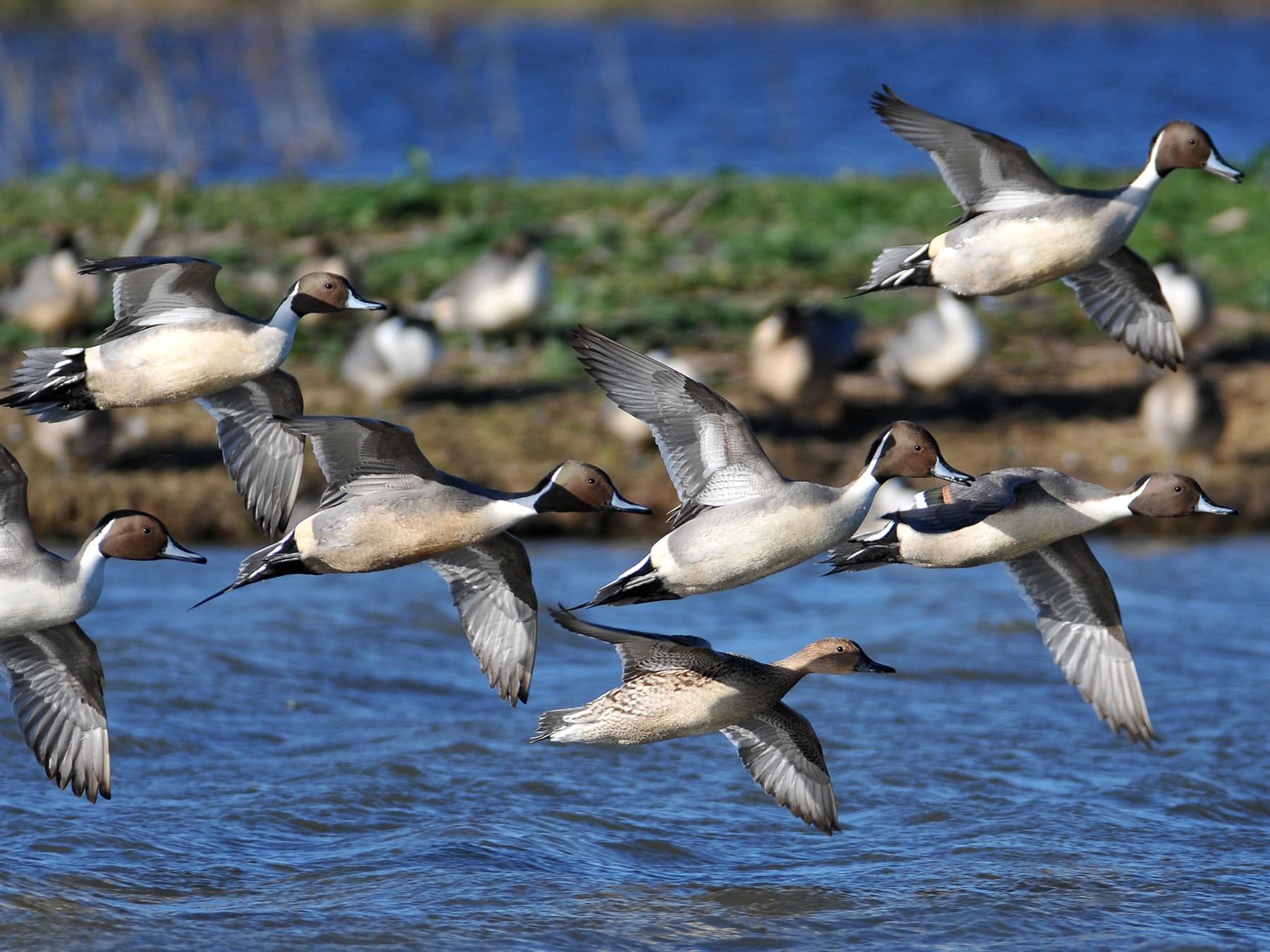
- Observe their unique, elongated silhouette in flight
- Listen for the male's soft whistle during the breeding season
- In North America, watch for large flocks during spring and fall migrations
What it eats
What do Pintails eat?
Pintails are adaptable, omnivorous waterfowl that vary their diet throughout the year. Aquatic plants, grain, tubers, and algae are major food sources, although insects and other animal foods make up as much as half of their summer diet.
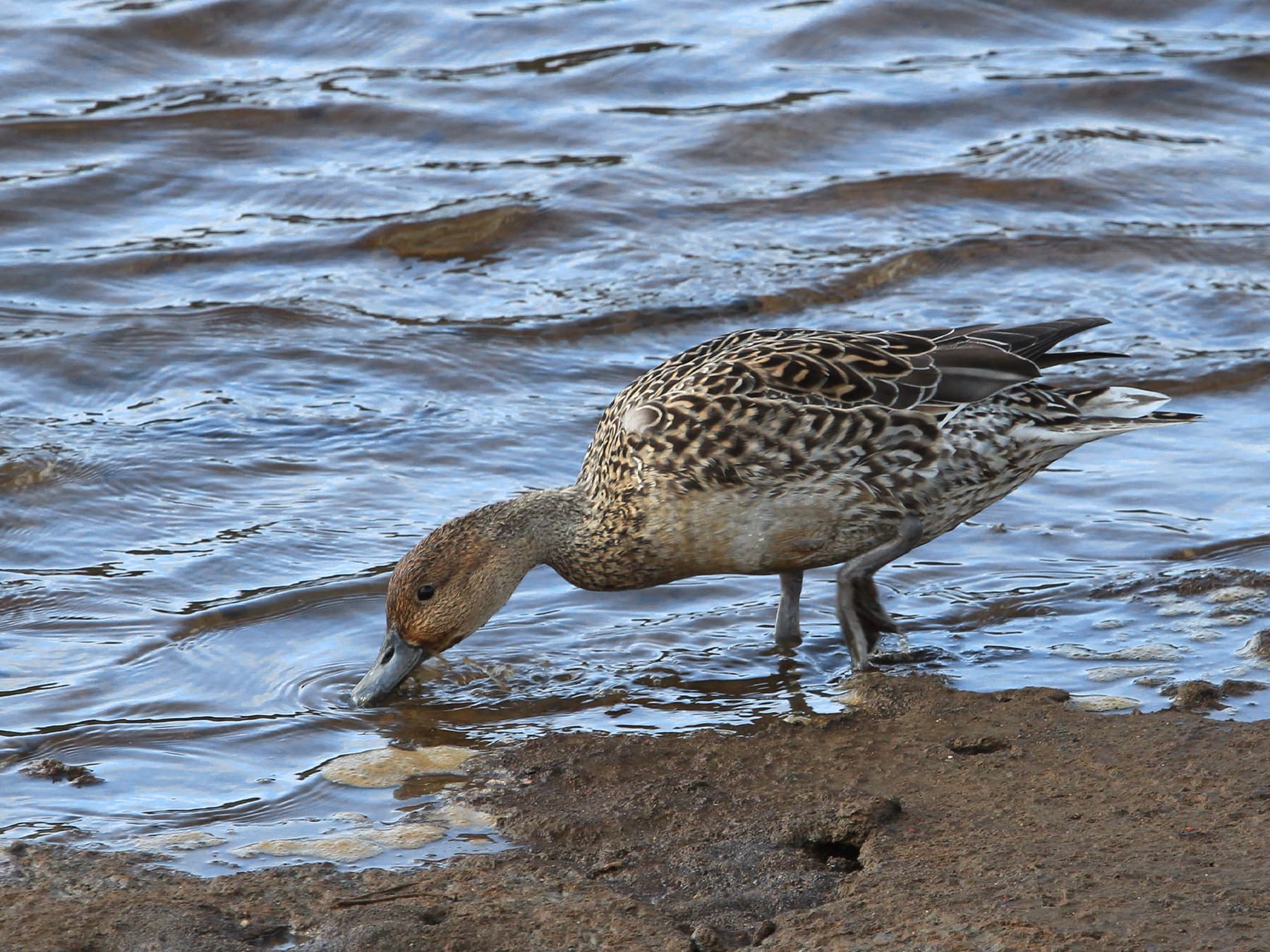
Pintails often visit arable farmland at night to feed on rice, corn, and wheat. They can also use their bill to dig out potatoes and other underground plant material. On the water, they feed by filtering at the surface, up-ending, or diving down to collect food from the bottom.
What do Pintail chicks eat?
Pintail ducklings feed themselves without any help from their parents. They feed primarily on insect larvae at first, gradually including grass seeds and other plant material as they mature.
Nesting and breeding
Where do Pintails nest?
Pintails nest on the ground among vegetation in open habitats up to about 1.8 miles or 3 kilometers from water. The nest is a scrape, made by the female and lined with down feathers and soft vegetation found nearby.
Most populations nest in the north of their range, as far as Alaska, Iceland, and Siberia, although some breed at much lower latitudes in California, Central Europe, and the Middle East.
When do Pintails nest?
Pintails nest early, beginning nest construction just days before females lay their eggs in April or May. Pairs break up around this time, and the female incubates alone for three weeks or a little longer. Pintail ducklings leave the nest within a day after hatching but remain with their mother for four to six weeks.
What do Pintail eggs look like?
Females lay a single clutch of 3 to 12 pale grayish, greenish, or buff-colored eggs, each measuring about 54 millimeters long and 38 millimeters wide.
Do Pintails mate for life?
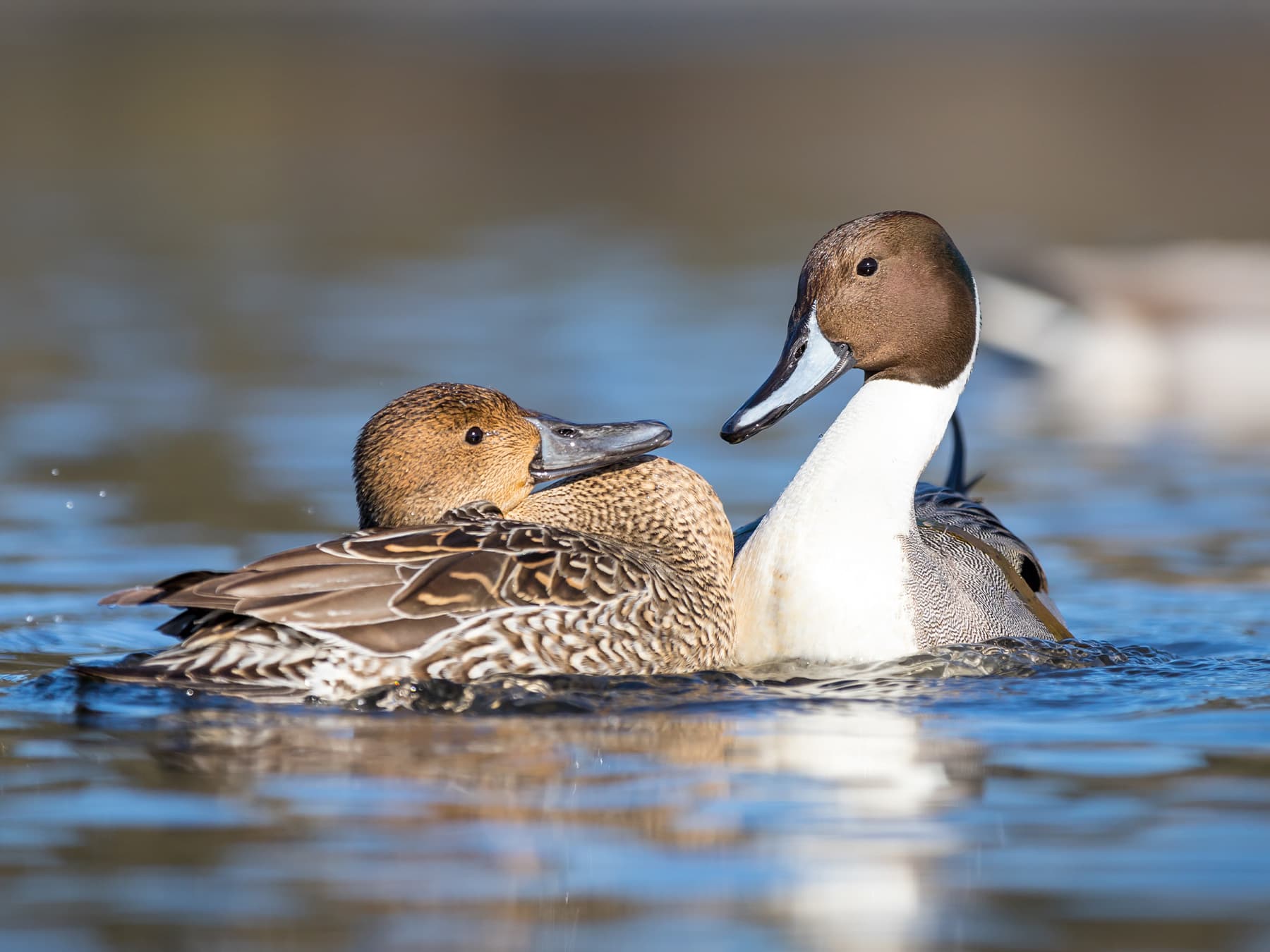
Pintails form monogamous pairs in the fall/autumn or winter that last just one breeding season. Males separate from females after egg-laying is complete.
Behaviour
Are Pintails aggressive?
Pintails are passive, gregarious waterfowl that rarely fight. They are non-territorial, and pairs may nest within a few yards of each other.
Where do Pintails sleep at night?
Pintails forage during the day and night, although they usually feed on land after dark. They sleep on open water.
Lifespan and predators
How long do Pintails live?
Pintails can live for over 20 years in the wild. The oldest known North American specimen lived for 21 years and four months, while in the Old World, the record stands at 15 years and 11 months for a bird banded in the United Kingdom.
What are the predators of Pintails?
Pintails are prey for many predatory birds and mammals, particularly when hens are incubating their eggs. The following species are known Pintail predators:
- Canids like Coyotes, Red Foxes, and Arctic Foxes
- Mink
- Skunks
- Raccoons
- Great-horned Owl
- Peregrine Falcon
- Various Hawks, Gulls, Jaegers/Skuas, and Ravens
Are Pintails protected?
Pintails are protected by the Migratory Bird Treaty Act in the United States, the Migratory Birds Convention Act in Canada, and the Wildlife and Countryside Act in the United Kingdom.
Are Pintails endangered?
Pintails are a ‘Least Concern’ species on the IUCN Red List. However, they are in decline, and their numbers have dropped considerably (77%) in North America over the last four decades. United Kingdom numbers have also decreased by about a quarter in recent times.
Conservation
While currently listed as Least Concern, Northern Pintail populations have declined in North America due to habitat loss and degradation.
Conservation efforts focus on protecting and restoring wetland habitats, particularly in breeding areas and along migration routes.
More photos
3 photos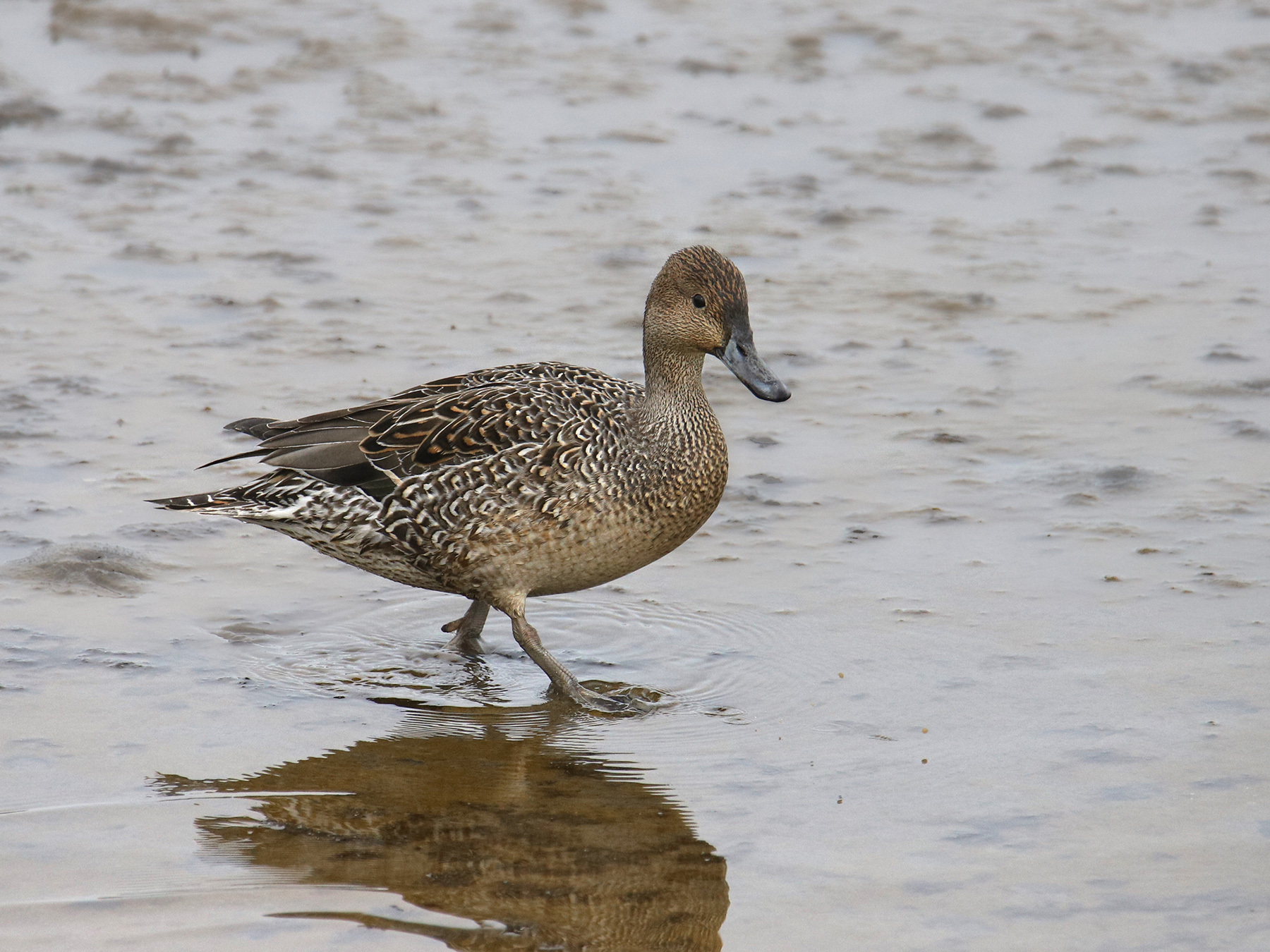
Northern Pintail guides
4 guidesQuick facts
- Length
- 59–76 cm
- Wingspan
- 80–95 cm
- Weight
- 450–1360 g
- Lifespan
- 20 years · oldest recorded 27 years
- Family
- Ducks, Geese & Swans
- Migration
- Long-distance Migrant
- Global status (IUCN)
- Least Concern
- World population
- 4,700,000 - 4,800,000 mature individuals
- Population trend
- Decreasing
- Also called
- Pintail, Sprigtail
- Scientific name
- Anas acuta
Questions
2Why are they called Pintails?
Pintails are named for their long, pointed tails. Breeding males, in particular, grow distinctive black central tail feathers up to about 8⅔ inches or 22 centimeters long.
What is the difference between a Gadwall hen and a Pintail hen?
At first impression, female Gadwalls and Pintails appear very similar. However, there are three identifying features that birdwatchers can look for to separate these wildfowl. The Pintail hen has a blackish bill and a longer neck than the Gadwall hen. Female Gadwalls differ by having orange bills and white wing patches.
Sources
4- 1BirdLife International. 2019. Anas acuta. The IUCN Red List of Threatened Species 2019: e.T22680301A153882797. Source (opens in a new tab)
- 2Wetlands International (2006)
- 3Wetlands International (2015)
- 4Fransson et al., EURING list of longevity records for European birds (2010) Source (opens in a new tab)

Checked by
Nathan Cope, founder and editor
Nathan founded Birdfact and leads its writers and contributors in the UK, the US and Canada. He has watched and studied birds for more than ten years, and checks every article and species guide before it’s published.