


Kestrel
Common Kestrel, European Kestrel · Falco tinnunculus
By the Birdfact teamChecked by Nathan Cope
On this page15 sections
How to recognise it
The Kestrel is a small, streamlined bird of prey with pointed wings and rich plumage.
What do Kestrels look like?
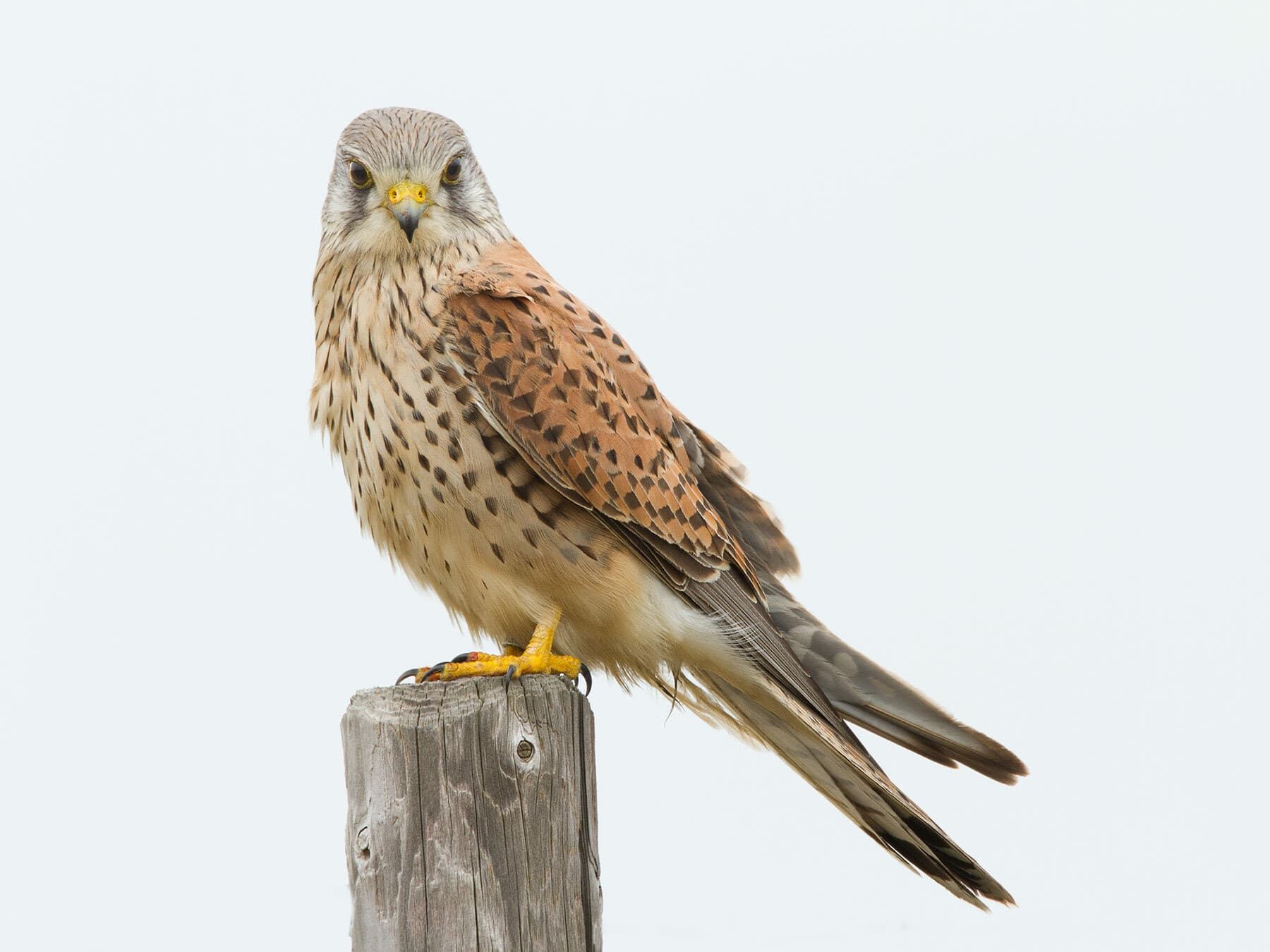
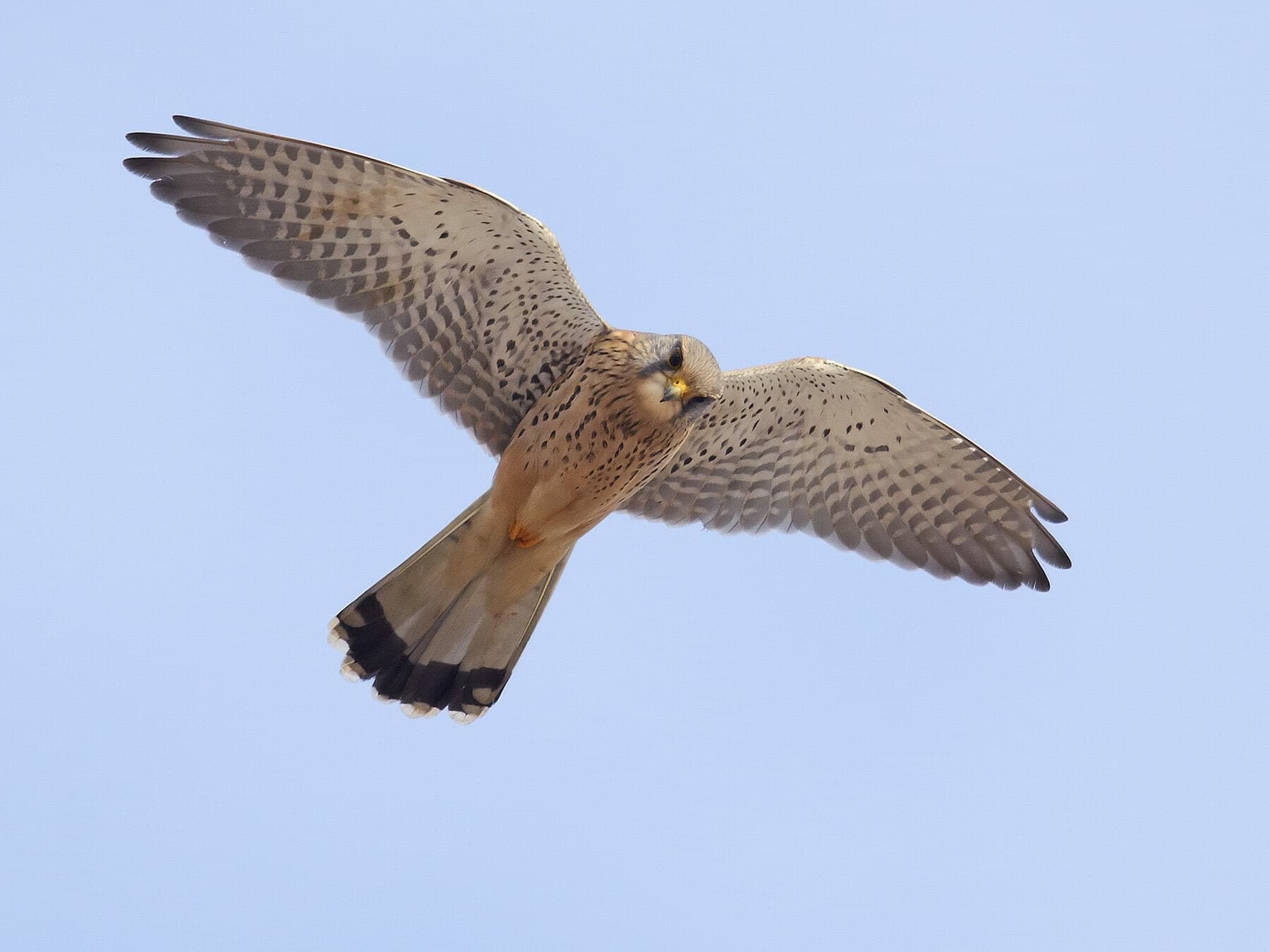
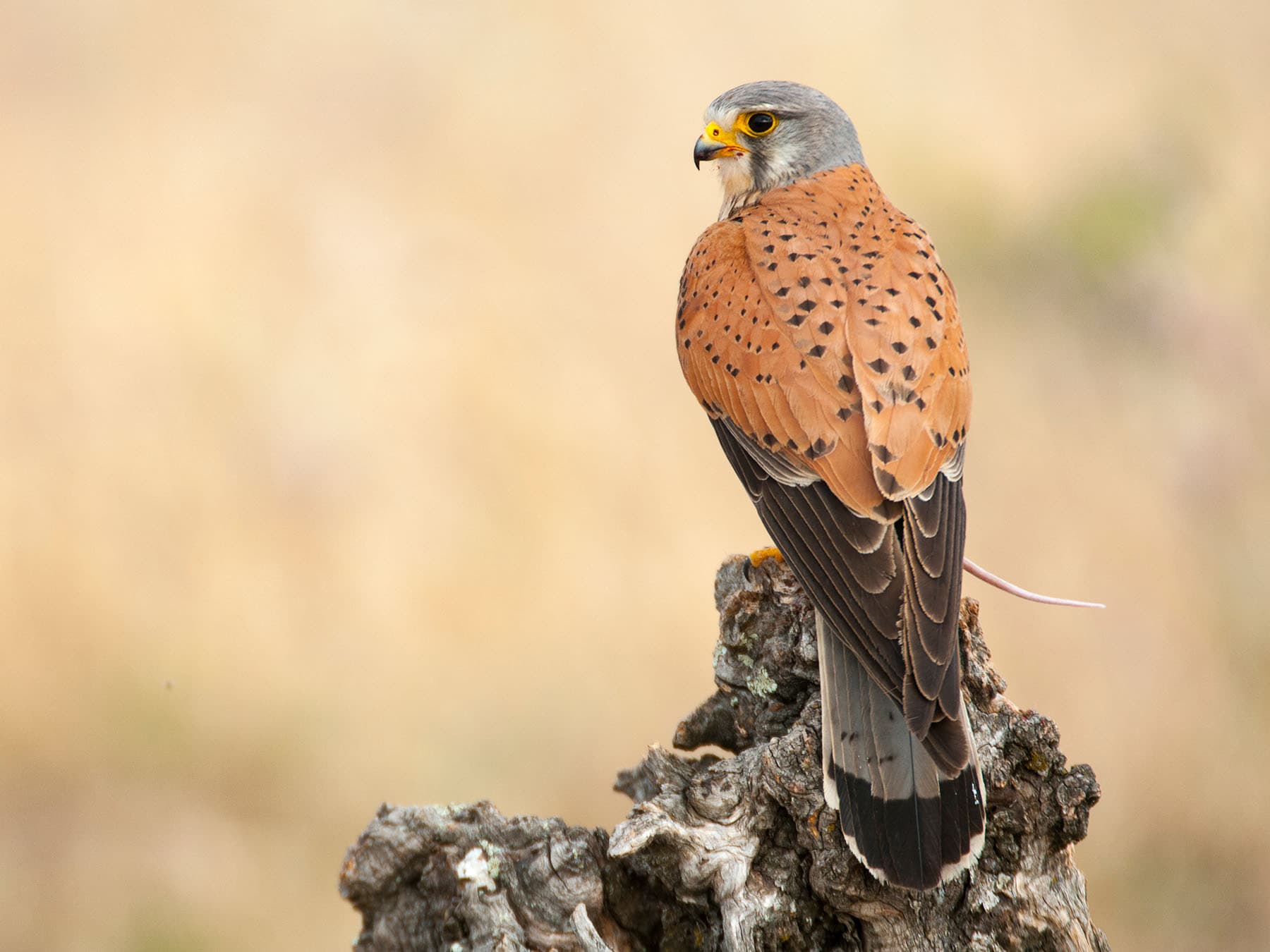
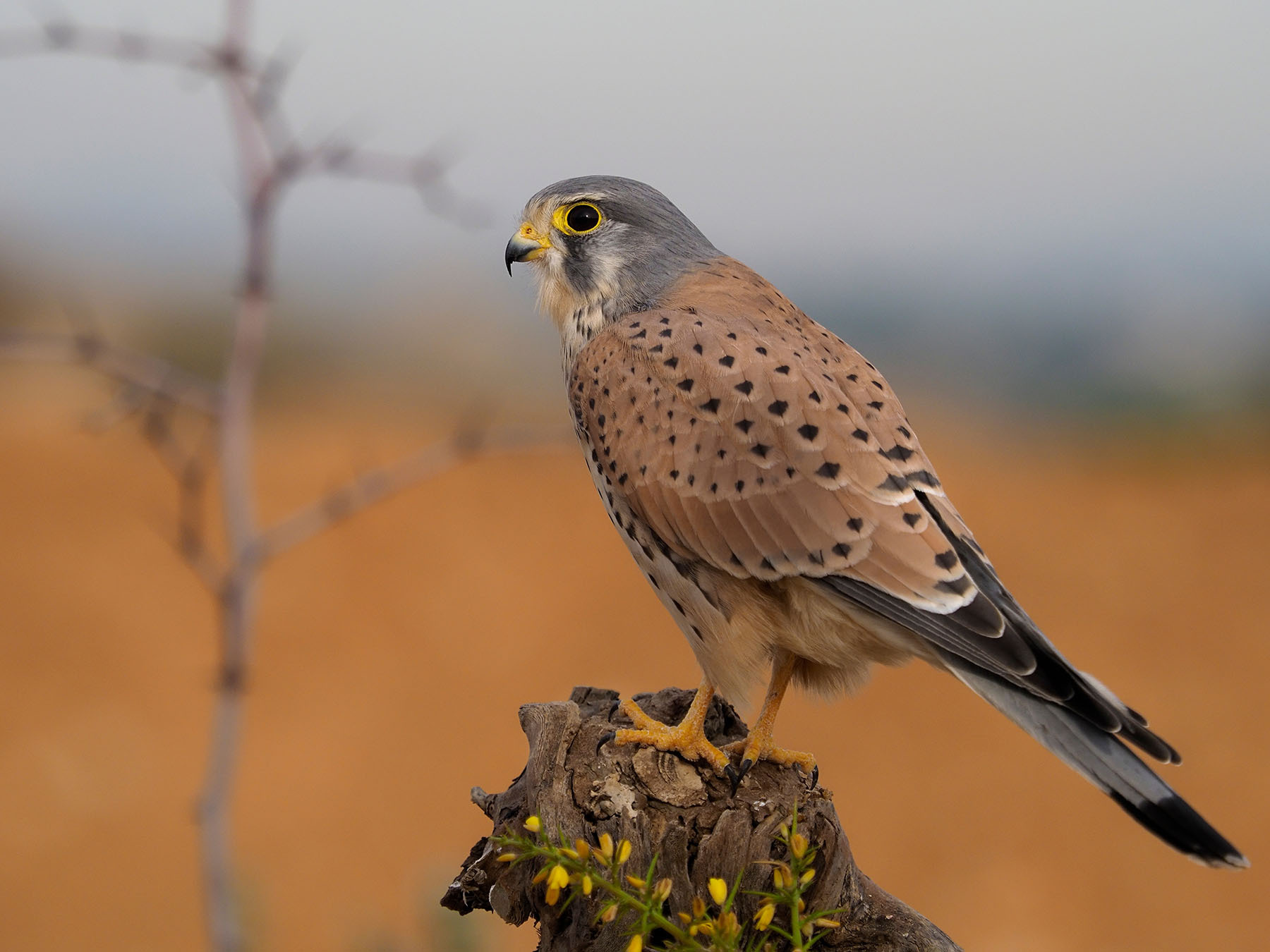
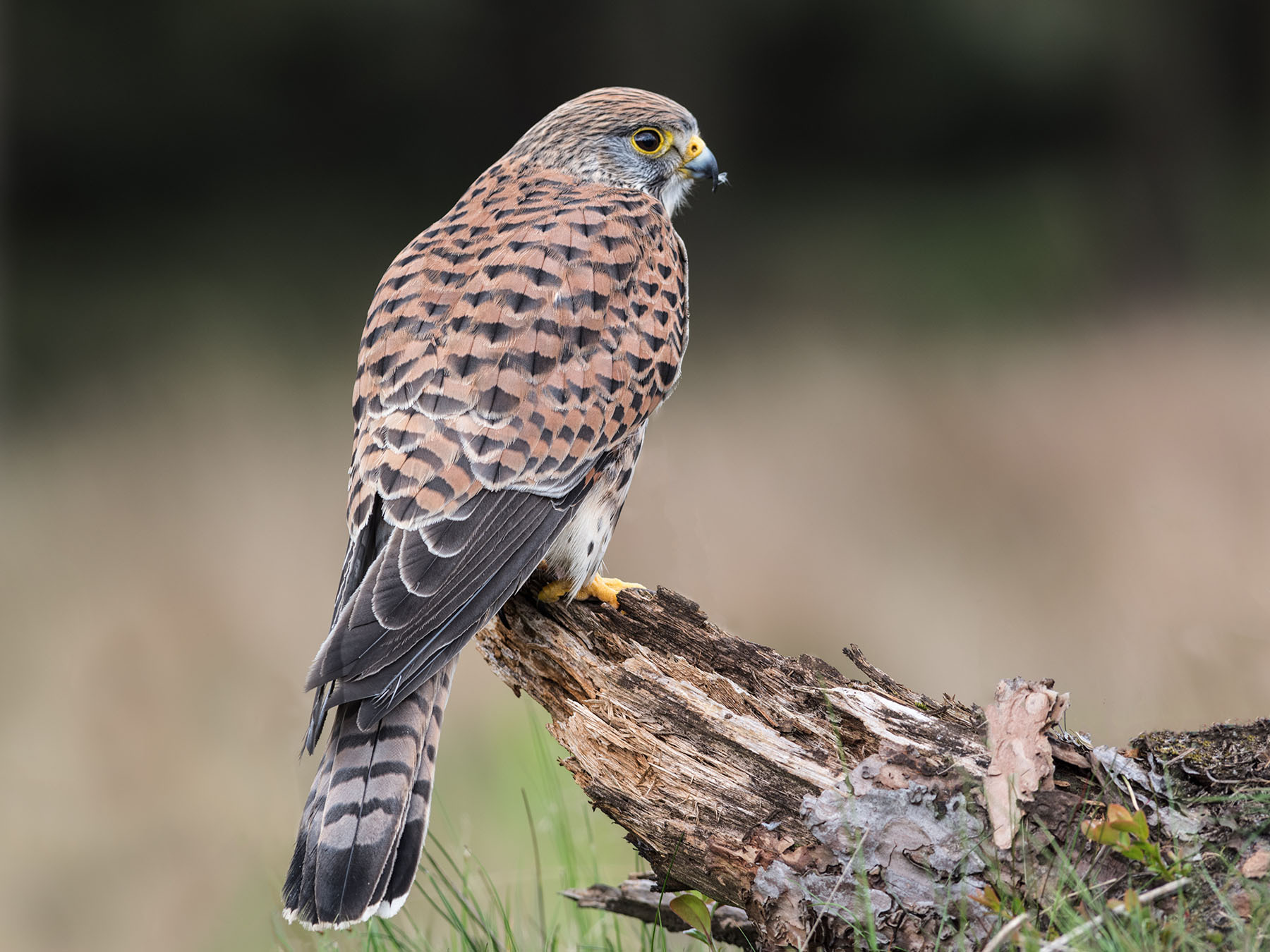
The Kestrel is an elegant bird, both in flight and when perched. The male has a distinctive grey head and grey tail with a dark tip. The wing and back are a warm, brick-red shade, and the underparts are paler and spotted.
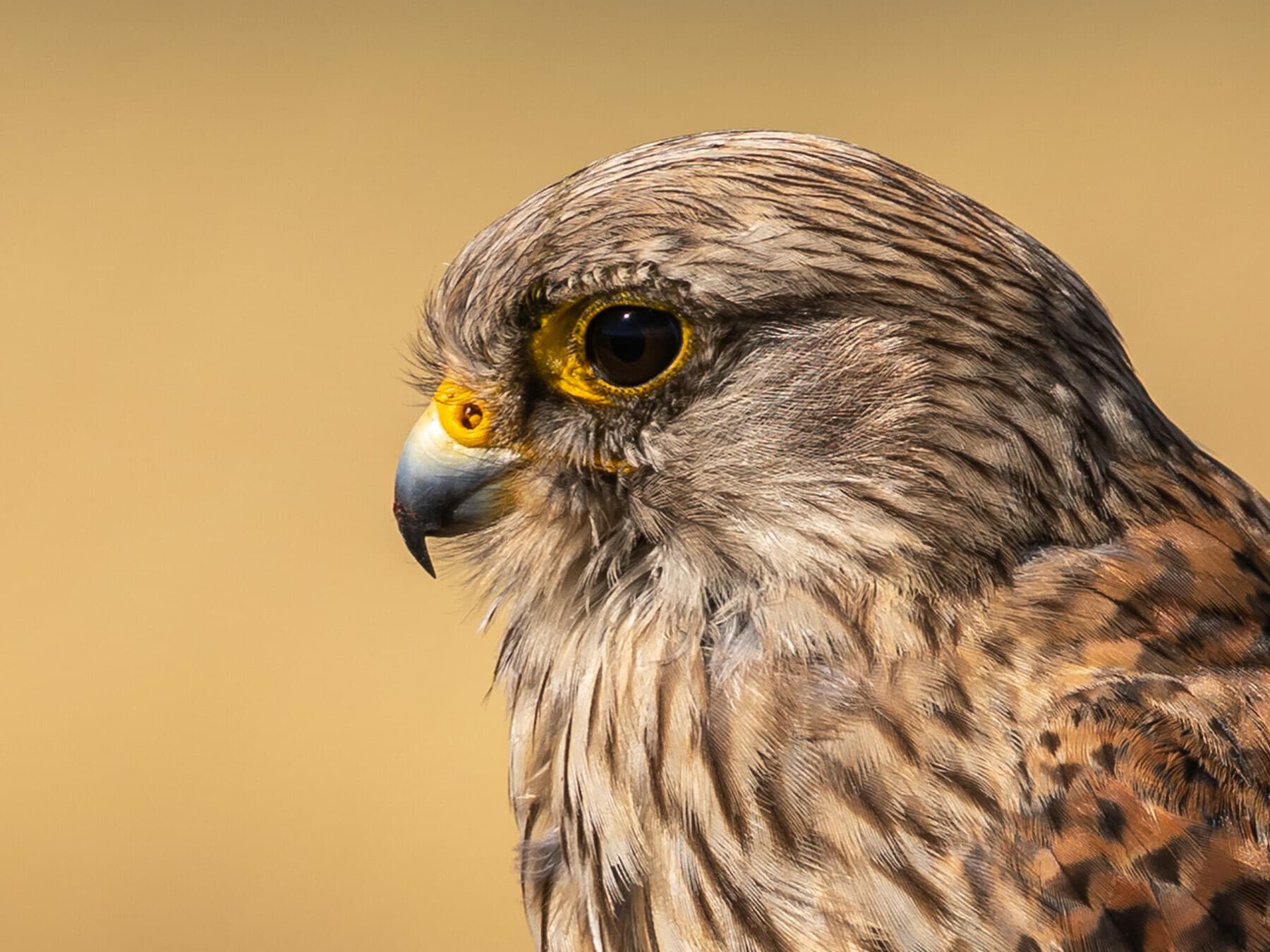
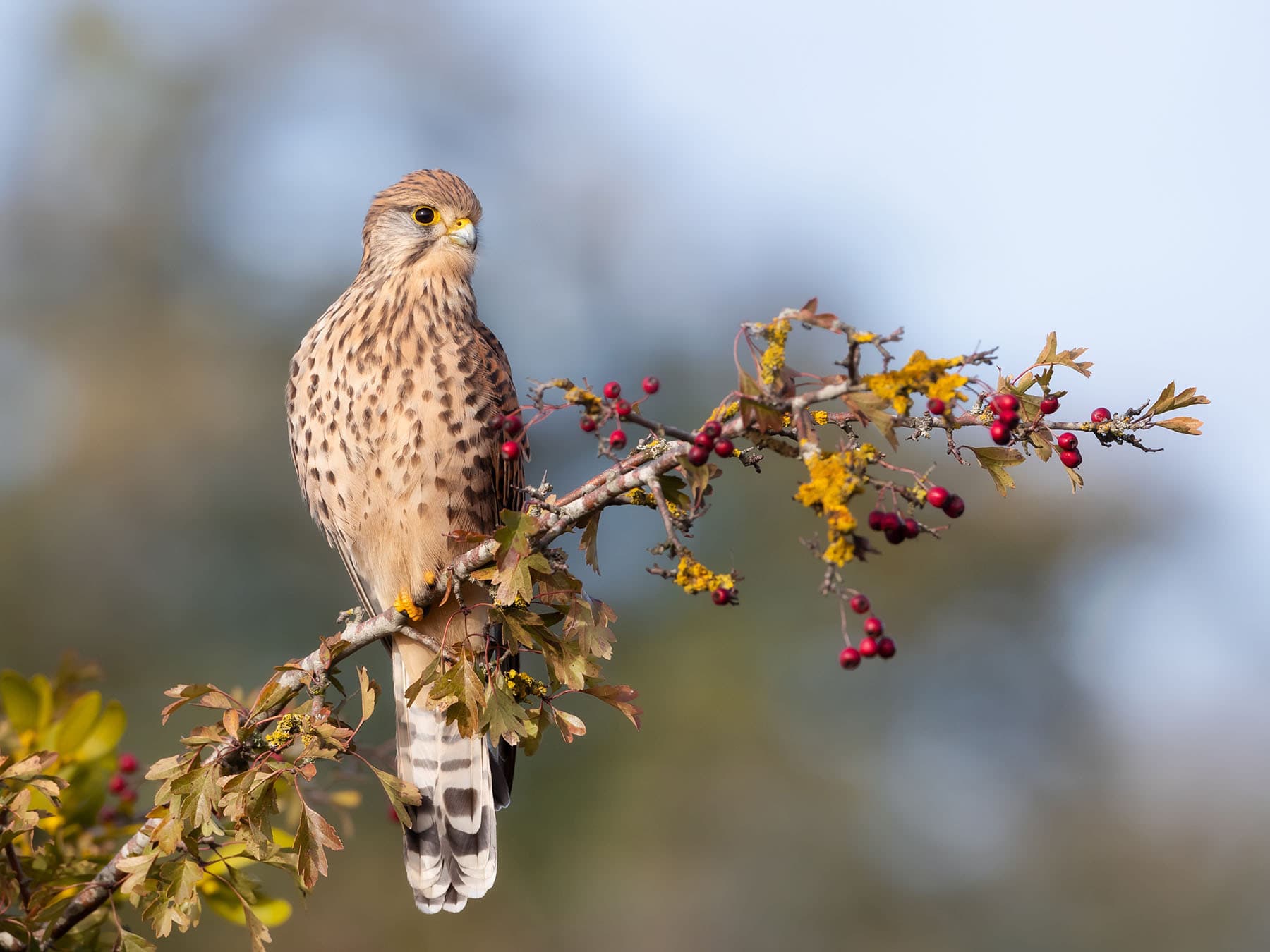
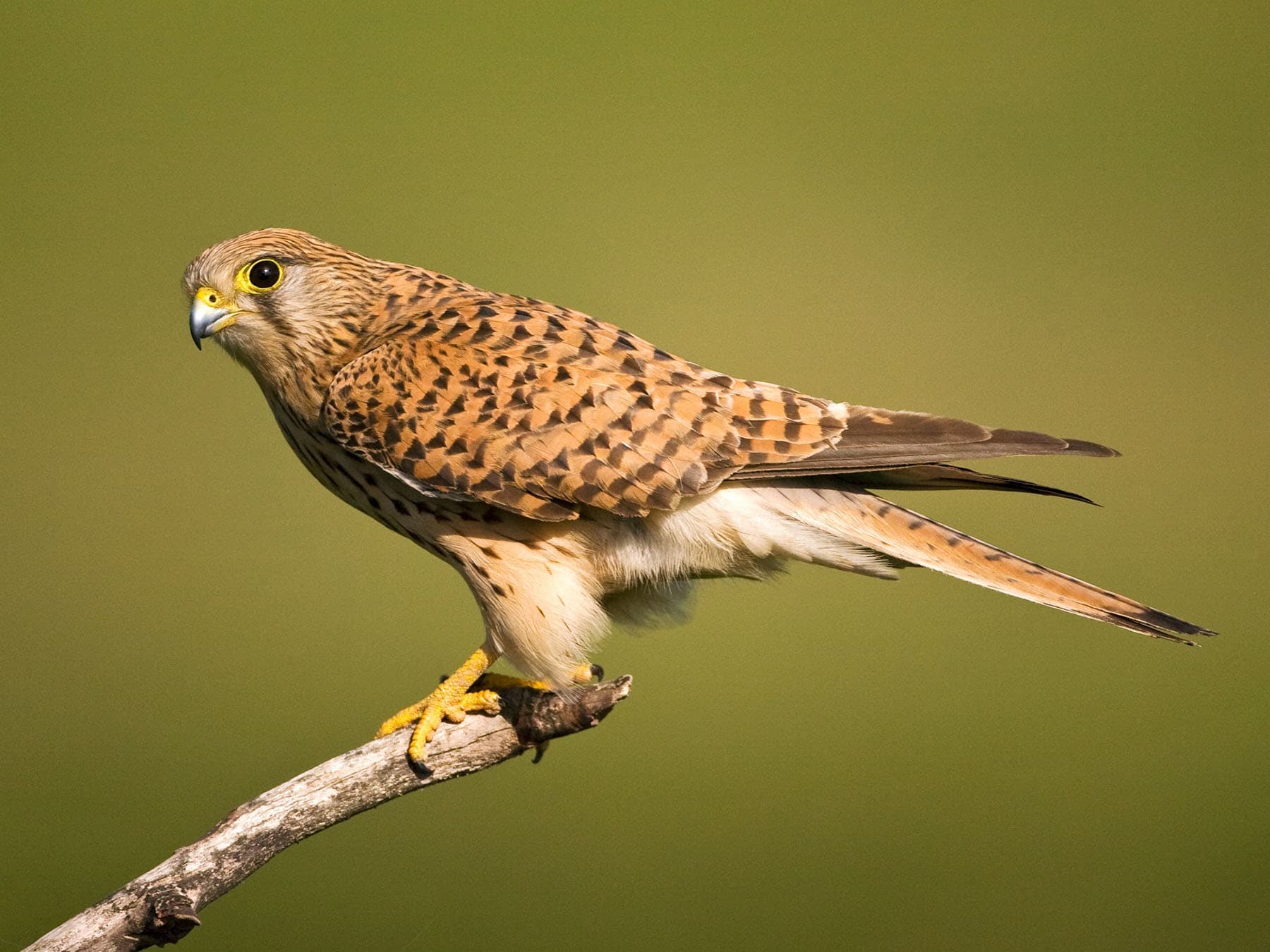
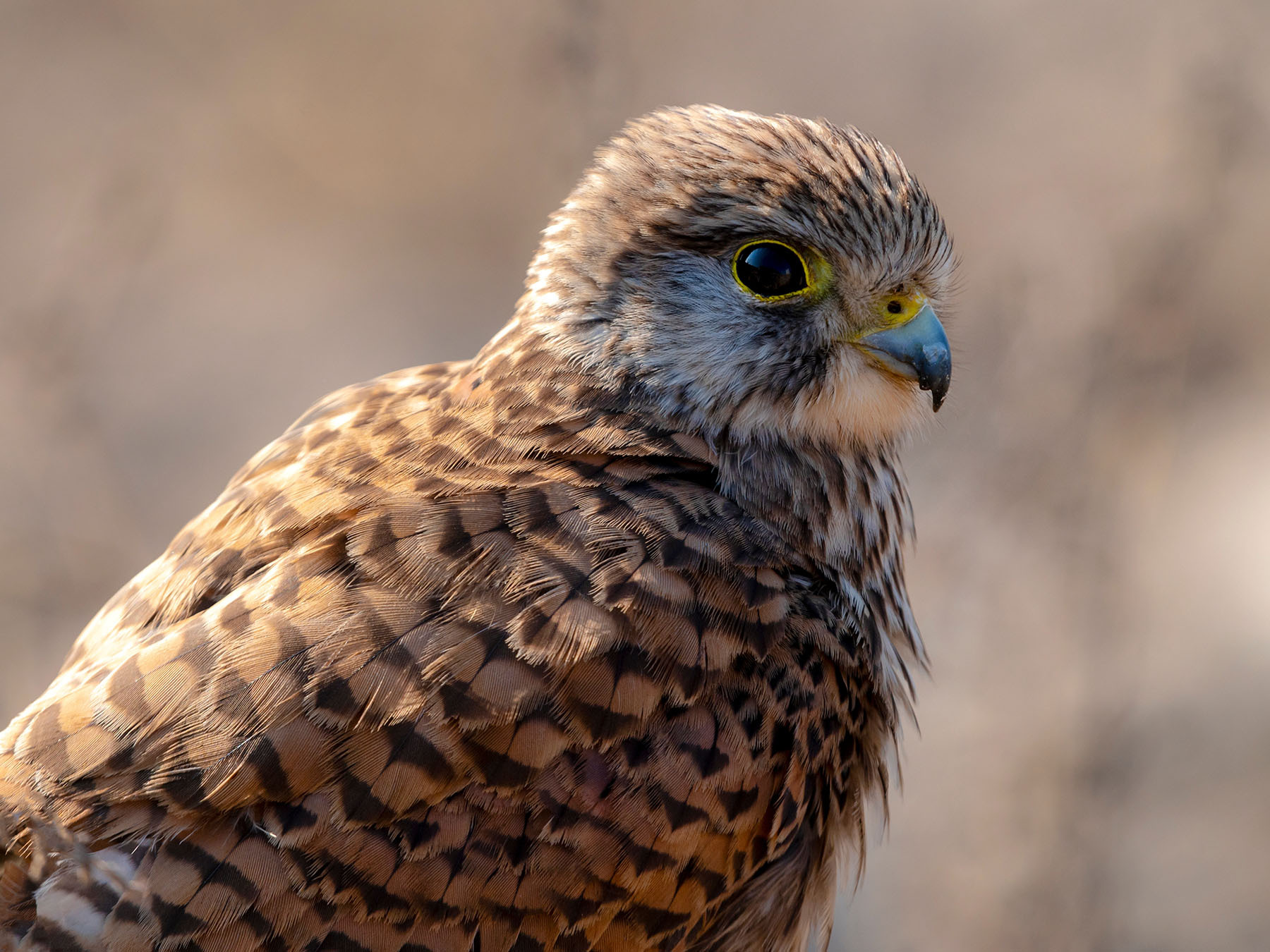
Female Kestrels are distinct from males. They are red-brown throughout with a more heavily spotted back and barred tail. Both sexes have black facial stripes and yellow legs, ceres (bill base), and eye-rings.
Juveniles are similar to adult females but have paler legs and bills, and more prominent streaking below.
How big are Kestrels?
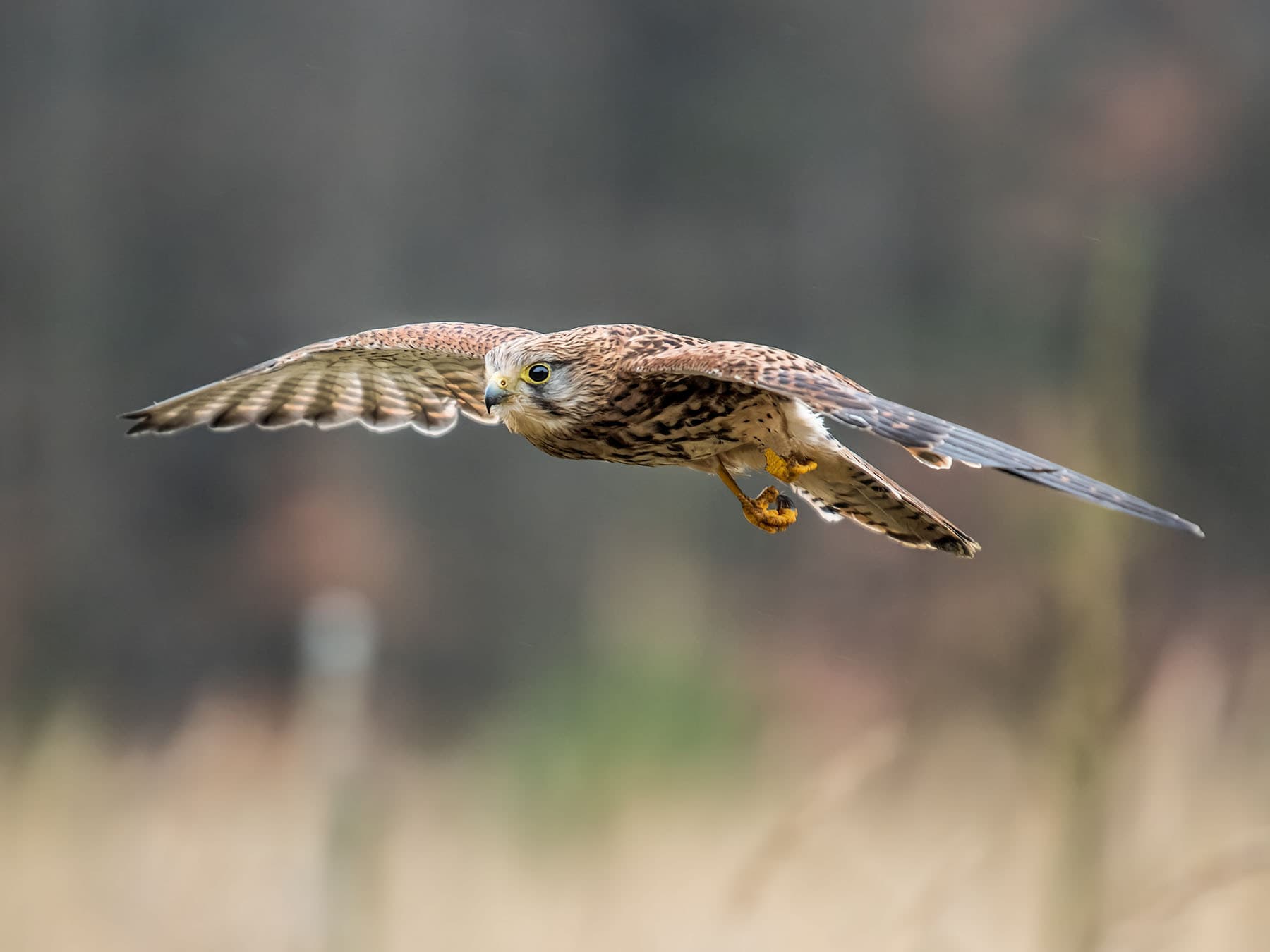
The Kestrel is a dove-sized bird of prey with a large, broad tail and long, narrow wings.
Length
Kestrels measure between 27 and 35 centimetres from their bill tip to the end of their tail.
Weight
Kestrels, like many birds of prey, are sexually dimorphic. Males weigh 136 to 253 grams, and females are significantly heavier at 154 to 314 grams.
Wingspan
Most Kestrels have a wingspan of 71 to 80 centimetres.
Its size
Adults- Length
- 32–39 cm
- Wingspan
- 65–82 cm
- Weight
- 136–252 g
Its song and calls
Kestrels are generally silent, although they become more vocal in the breeding season.
What sound does a Kestrel make?
The most commonly heard Kestrel call is a rapid ‘ki-ki-ki-ki’, although they also produce a slower ‘kee-kee-kee’ call.
Why do Kestrels call?
Kestrels typically produce alarm calls in defence of their nest. They vocalise when humans or predators approach too closely. Adults also call to maintain contact with their partners and their young.
- Flight call0:00 / 0:30
Recorded in Auvergne-Rhône-Alpes, France · April 2019
When and where to see it
OctoberPeak season
Most recorded in October
- 1. Isle of Wight1.9%
- 2. Tipperary1.7%
- 3. Kent1.6%
- 4. Stockton-on-Tees1.6%
- 5. Suffolk1.6%
Each dot is a county, state or province: the bigger and darker, the larger the bird’s share of that place’s bird records that month. Grey dots: no regular records. The ringed point is the centre of the bird’s records this month; the arrow shows how it moved since last month, and the dashed loop its path through the year. “Arrivals” colours places where it becomes regular this month (orange) or is in its last regular month (grey). GBIF eBird Observation Dataset, 2019–2024. Map data: Natural Earth, US Census Bureau; place centres © OpenStreetMap contributors.
In your area
See when the Kestrel is recorded in your county, state or province.
How often the Kestrel turns up in the UK and Ireland through the year, from birdwatchers' records.
United Kingdom
Resident · all year · most records in October
Ireland
Resident · all year · most records in October
Show as a table
| Month | United Kingdom | Ireland |
|---|---|---|
| January | 0.88% (regular) | 0.33% (regular) |
| February | 0.73% (regular) | 0.30% (regular) |
| March | 0.69% (regular) | 0.33% (regular) |
| April | 0.71% (regular) | 0.36% (regular) |
| May | 0.65% (regular) | 0.31% (regular) |
| June | 0.73% (regular) | 0.36% (regular) |
| July | 0.83% (regular) | 0.39% (regular) |
| August | 0.92% (regular) | 0.43% (regular) |
| September | 1.0% (regular) | 0.53% (regular) |
| October | 1.1% (regular) | 0.66% (regular) |
| November | 0.90% (regular) | 0.49% (regular) |
| December | 0.85% (regular) | 0.37% (regular) |
Recorded regularly in
Worldwide: recorded regularly in 123 countries
Countries where it was recorded in at least 3 of the 6 years 2019–2024. Linked countries have their own bird list.
Europe (49)
- Åland Islands
- Albania
- Andorra
- Austria
- Belarus
- Belgium
- Bosnia & Herzegovina
- Bulgaria
- Croatia
- Czechia
- Denmark
- Estonia
- Finland
- France
- Germany
- Gibraltar
- Greece
- Guernsey
- Hungary
- Ireland
- Isle of Man
- Italy
- Jersey
- Kosovo
- Latvia
- Liechtenstein
- Lithuania
- Luxembourg
- Malta
- Moldova
- Monaco
- Montenegro
- Netherlands
- North Macedonia
- Norway
- Poland
- Portugal
- Romania
- Russia
- San Marino
- Serbia
- Slovakia
- Slovenia
- Spain
- Sweden
- Switzerland
- Ukraine
- United Kingdom
- Vatican City
Africa (29)
Asia (45)
- Afghanistan
- Armenia
- Azerbaijan
- Bahrain
- Bangladesh
- Bhutan
- Cambodia
- China
- Cyprus
- Georgia
- Hong Kong SAR China
- India
- Iran
- Iraq
- Israel
- Japan
- Jordan
- Kazakhstan
- Kuwait
- Kyrgyzstan
- Laos
- Lebanon
- Macao SAR China
- Malaysia
- Mongolia
- Myanmar (Burma)
- Nepal
- Oman
- Pakistan
- Palestinian Territories
- Philippines
- Qatar
- Saudi Arabia
- Singapore
- South Korea
- Sri Lanka
- Syria
- Taiwan
- Tajikistan
- Thailand
- Turkey
- United Arab Emirates
- Uzbekistan
- Vietnam
- Yemen
Data: EOD – eBird Observation Dataset (Cornell Lab of Ornithology), accessed via GBIF.org, CC BY 4.0. Records from 2019–2024, aggregated and filtered by Birdfact. How these lists are made
Kestrels are widespread and common in many habitats in the UK. Read on to learn where you might spot these adaptable birds of prey.
What is the habitat of a Kestrel?
Kestrels occur in just about any open or lightly wooded habitat, including farmland and even urban areas. Their only specific requirement is tall, safe places to perch like trees, cliffs, buildings, and pylons.
What is the range of a Kestrel?
The Kestrel is a very widespread species in the United Kingdom. They occur practically everywhere except parts of northwestern Scotland. Elsewhere they are found throughout Europe and across the southern half of Asia to Japan in the east. They also migrate through North Africa to Tanzania.
Where do Kestrels live?
Kestrels spend most of their time perched in prominent positions like poles, large trees, and rooftops. They also spend long periods in the air, remaining almost motionless as they hover above the ground in search of prey.
Check out our in-depth guide on Kestrel hovering.
How rare are Kestrels?
The Kestrel is a common bird of prey in the United Kingdom. They have declined significantly since the 1970s, although they remain numerous, with an estimated population of over 30,000 pairs in 2016.
Where can you see Kestrels in the UK?
Look out for Kestrels along woodland edges, roadsides, and farmlands, or wherever there are suitable perches and grassy areas. They are easy to spot on telegraph poles or when hovering in flight.
Signs and spotting tips
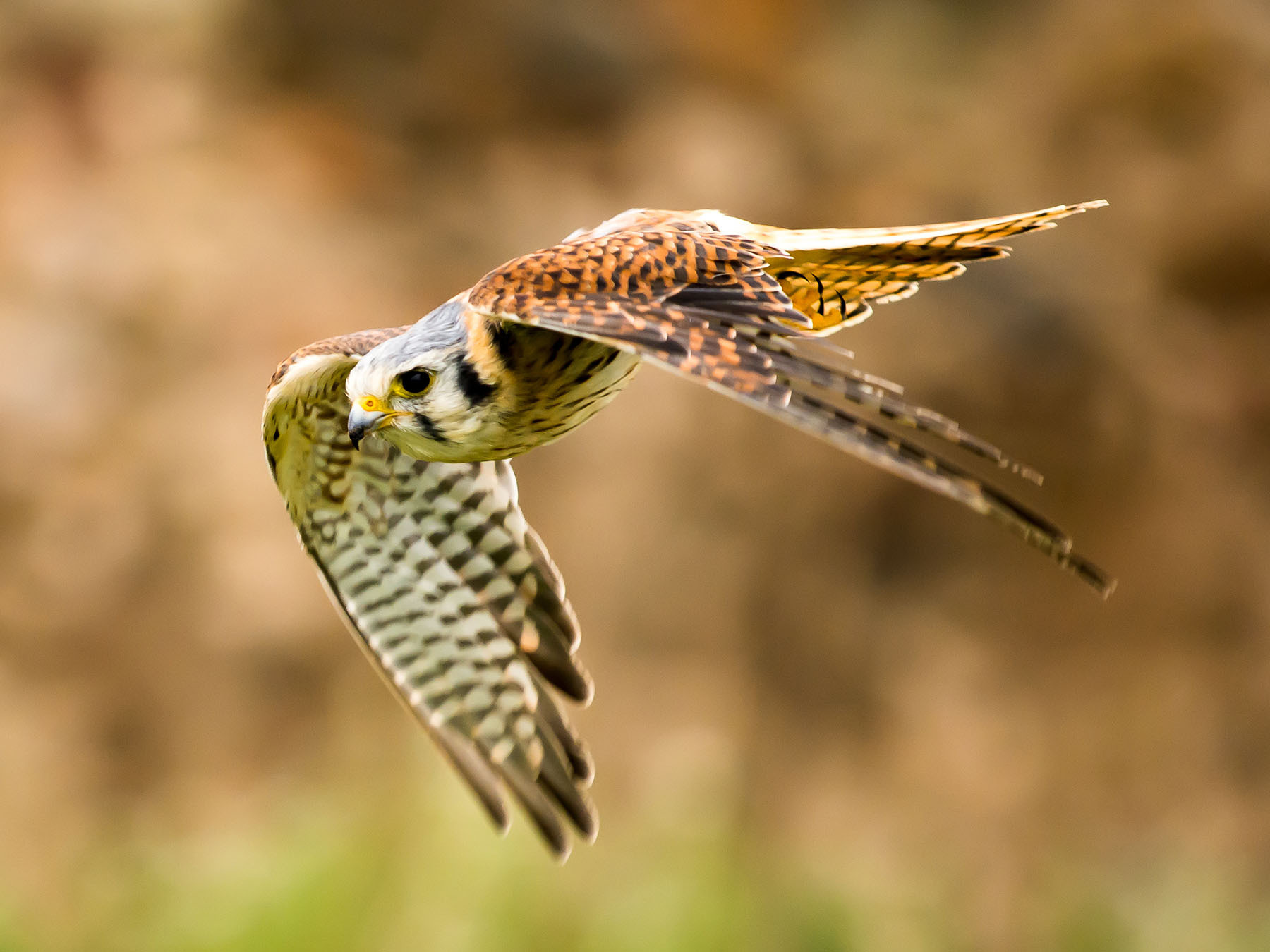
Perched kestrels have a noticeably upright posture. When in direct flight, the kestrel’s wingbeats are fast and shallow with a few glides.
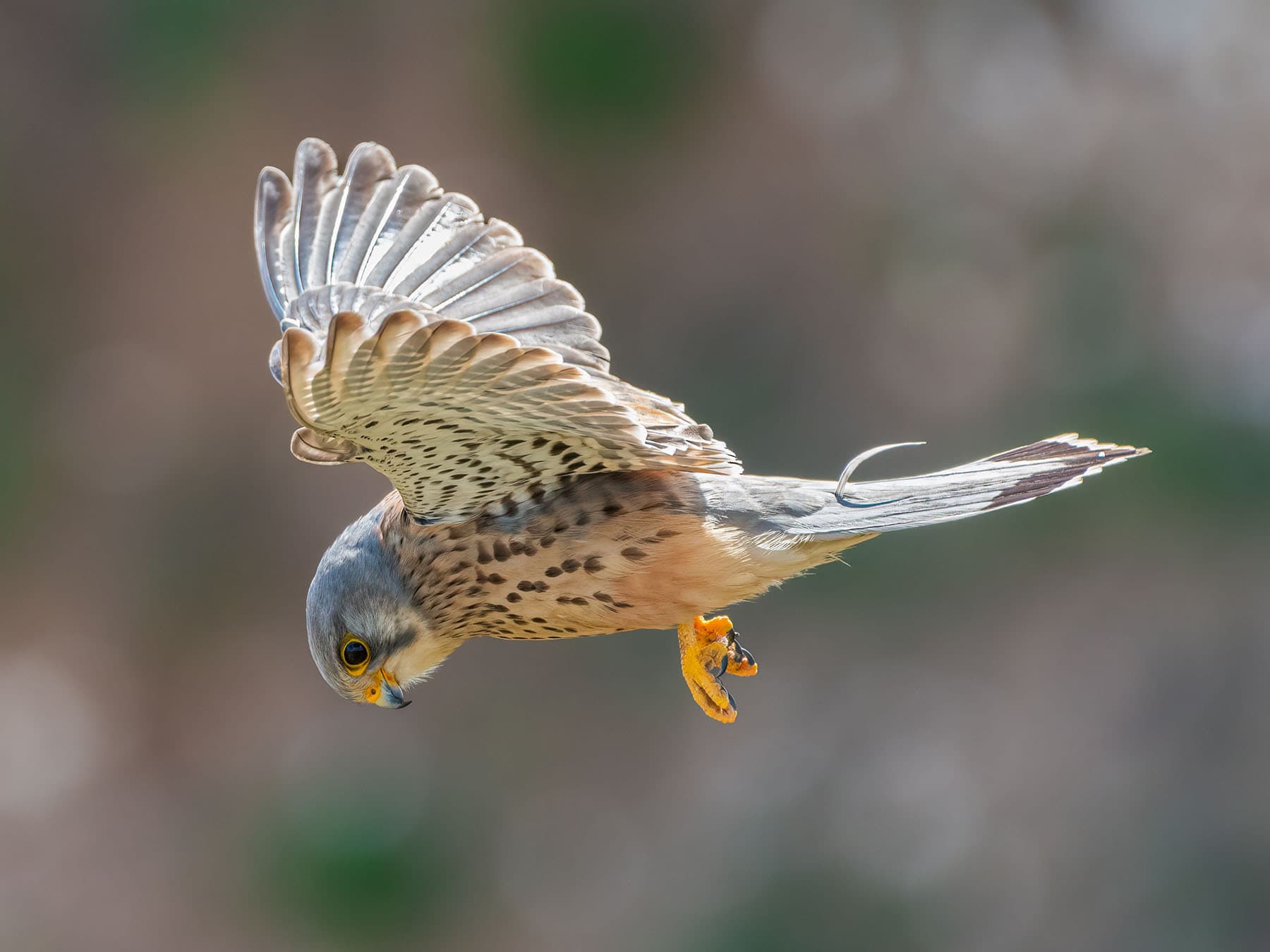
Its most distinctive behaviour is the ability to hover in a fixed position on rapidly beating wings, with its head remaining unerringly still, or remain motionless on an updraught. It drops vertically on to prey, which is then usually carried away to be eaten on a perch.
Kestrels will also hunt by sitting on wires and posts and can sometimes be seen stalking earthworms on the ground. Its hovering flight distinguishes it immediately from that of the other common raptor: the sparrowhawk. It also flies on straight wings, rather than flexed.
Migration
The Eurasian Kestrel is a partial migrant, although you can see them in the UK at any time of year.
Do Kestrels migrate?
Kestrels are resident in the United Kingdom, although birds that breed in uplands tend to migrate south to lower altitudes for the winter.
Elsewhere, the species undertakes medium to long-distance annual migrations, and the UK population is also joined by some Scandinavian birds that visit to escape the harsh northern winter.
Are Kestrels native to the UK?
Kestrels are native to the United Kingdom. They are the only common Kestrel species in the region, although the odd Lesser Kestrel (F. naumanni) turns up from further south from time to time.
What it eats
Kestrels are expert hunters that find their prey from a perch or while hovering.
What do Kestrels eat?
The field vole is the Kestrel's major prey source, although they will feed on many other small animals. Amazingly, these birds can identify potential hunting grounds by locating ultra-violet urine trails left by rodents.
Kestrels also feed on the following prey items:
- Mice and shrews
- Small passerine birds
- Lizards
- Insects and worms
Check out our comprehensive guide on the diet and feeding habits of Kestrels.
What do Kestrel chicks eat?
Baby Kestrels rely on their mother to tear bite-size strips of meat for them until they are strong enough to feed themselves. Males bring in food but do not directly feed the chicks.
How far can a Kestrel see its prey?
Kestrels have remarkable eyesight that may be as much as eight times stronger than our own. These birds can spot prey from about 50 meters away, more than twice the length of a tennis court.
Nesting and breeding
Kestrels nest in the spring. Their eggs hatch after 27 to 30 days, and the young birds take their first flight after about a month.
Where do Kestrels nest?
Kestrels nest virtually throughout the UK. They do not build their own nests, preferring to use old nests from other birds like crows. They also nest on buildings, in rock or tree cavities, and in purpose-made nest boxes.
Would you like to learn more about Kestrel nesting? Read this guide to learn all about their breeding behaviour in the UK.
What do Kestrel eggs look like?
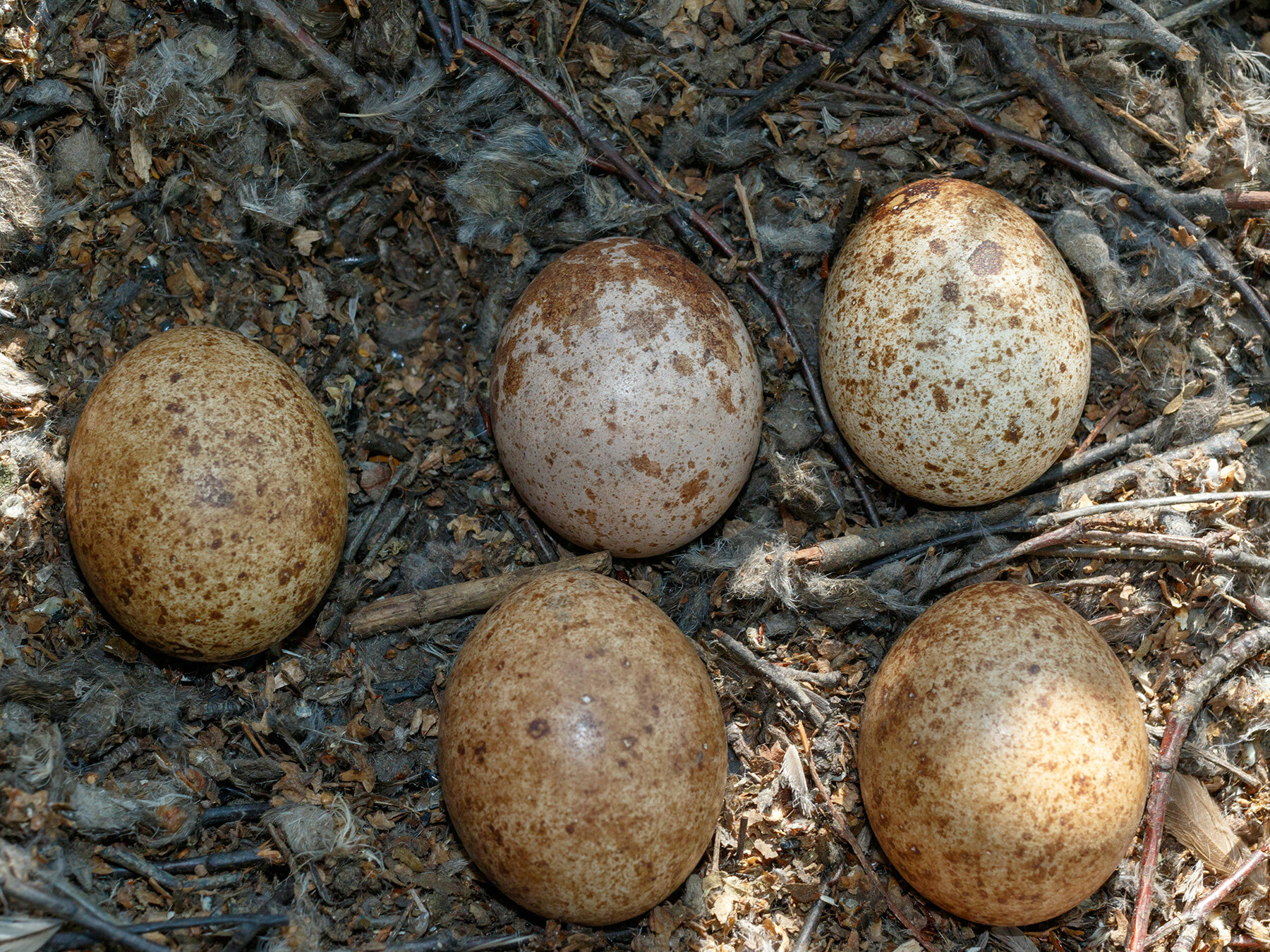
Kestrels usually lay a clutch of three to six eggs that measure about 40 millimetres long and 31 millimetres wide on average. Each egg has a buff ground colour and a covering of reddish spots.
Do Kestrels mate for life?
Kestrels are a monogamous species. Pairs work together closely to raise their young, and they may well partner for life in the United Kingdom, as evidenced by some pairs remaining in their territory throughout the year.
Behaviour
Are Kestrels aggressive?
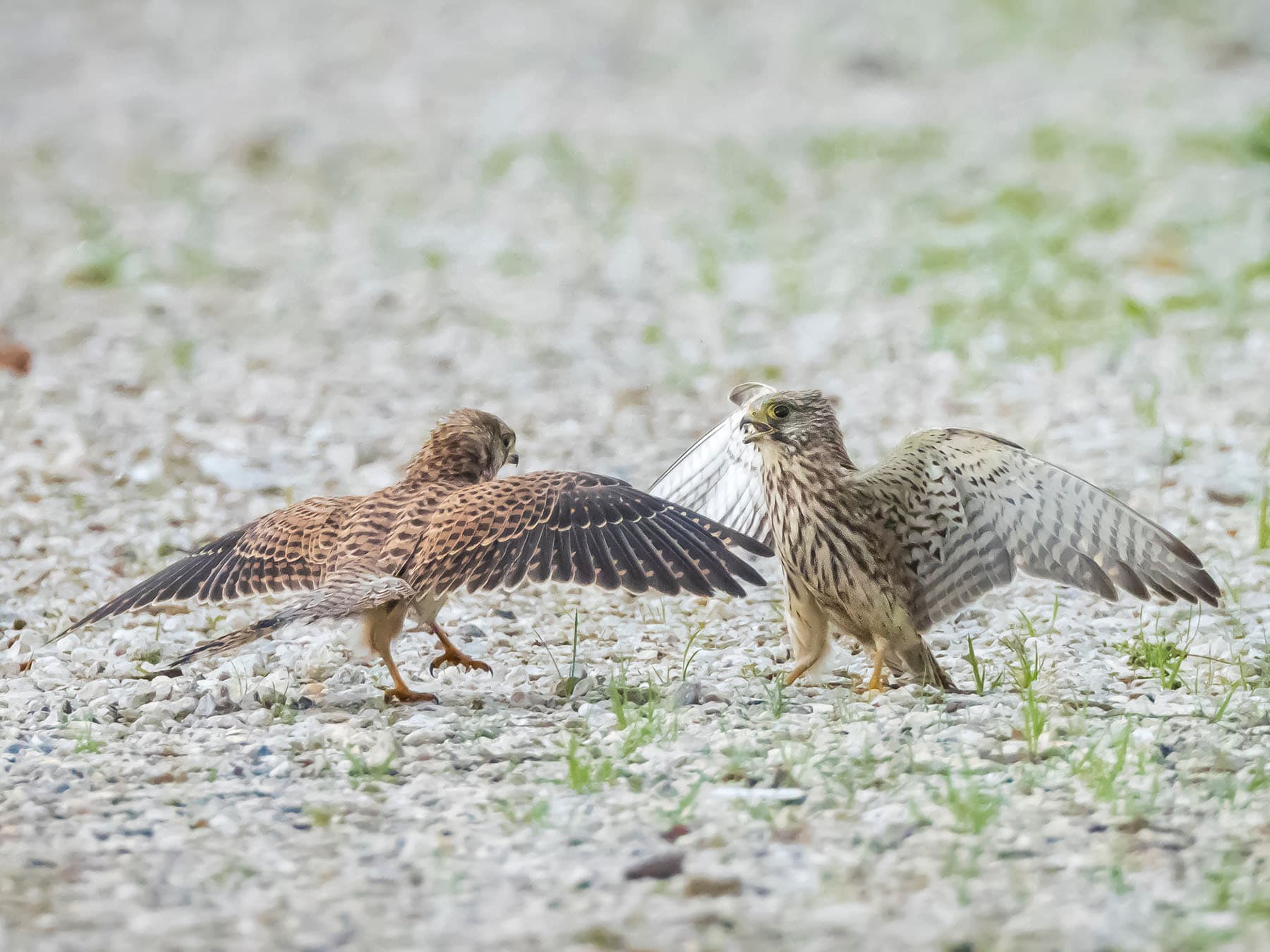
Kestrels are not particularly aggressive. They will defend their nest against predators like crows but show little aggression towards other birds. Their nesting territory is relatively small, and they may share feeding areas with neighbouring pairs.
Where do Kestrels sleep at night?
Kestrels usually roost on stable perches like utility poles, large trees, and cliffs, although they may use sheltered cavities like nest boxes in cold weather.
Why do Kestrels sit in fields?
Kestrels usually hunt from a high perch or while in flight. However, they may descend to the ground to hunt earthworms, particularly after rain.
Lifespan and predators
Kestrels were once the UK’s most common bird of prey, although that honour now goes to the Buzzard. Continue reading to learn about the Kestrel’s lifespan, predators and conservation status.
How long do Kestrels live?
Most Kestrels do not survive to adulthood, although those that do can live for over ten years. The oldest recorded specimen lived for an impressive 24 years.
What are the predators of Kestrels?
Adult Kestrels have few predators, although they are vulnerable to larger raptors like the Goshawk. Corvids, like the Hooded Crow, are a threat to their eggs and chicks.
Are Kestrels protected?
Kestrels are protected by the Wildlife and Countryside Act of 1981.
Are Kestrels endangered?
Kestrels are not endangered, although they have an amber conservation status due to significant declines in the late 20th Century.
Conservation
While listed as Least Concern globally, Kestrel populations have declined in parts of Europe due to agricultural intensification and habitat loss.
Conservation efforts focus on maintaining suitable hunting grounds and providing nesting boxes in areas where natural sites are scarce.
Similar birds
Often mistaken for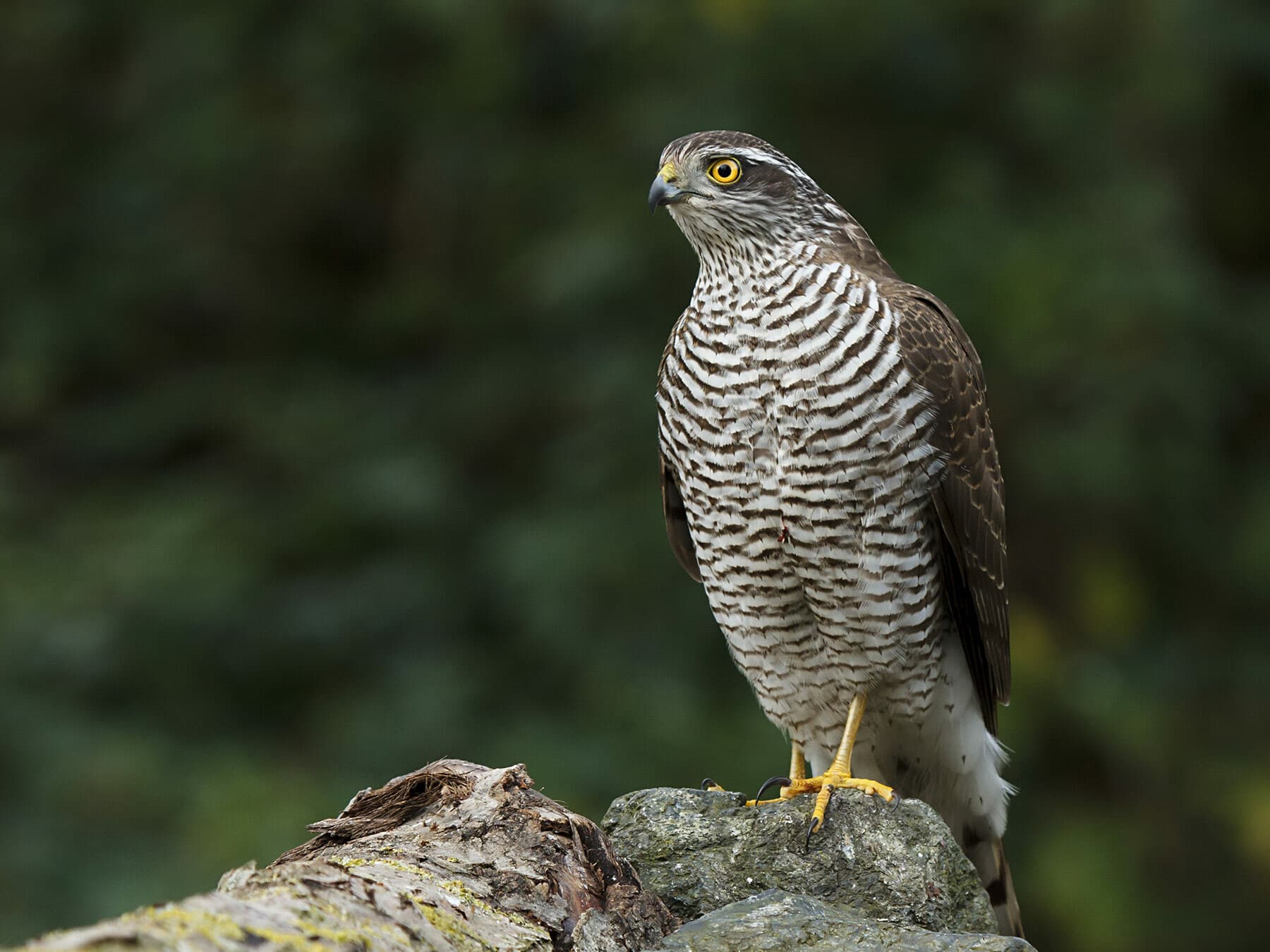
More photos
7 photos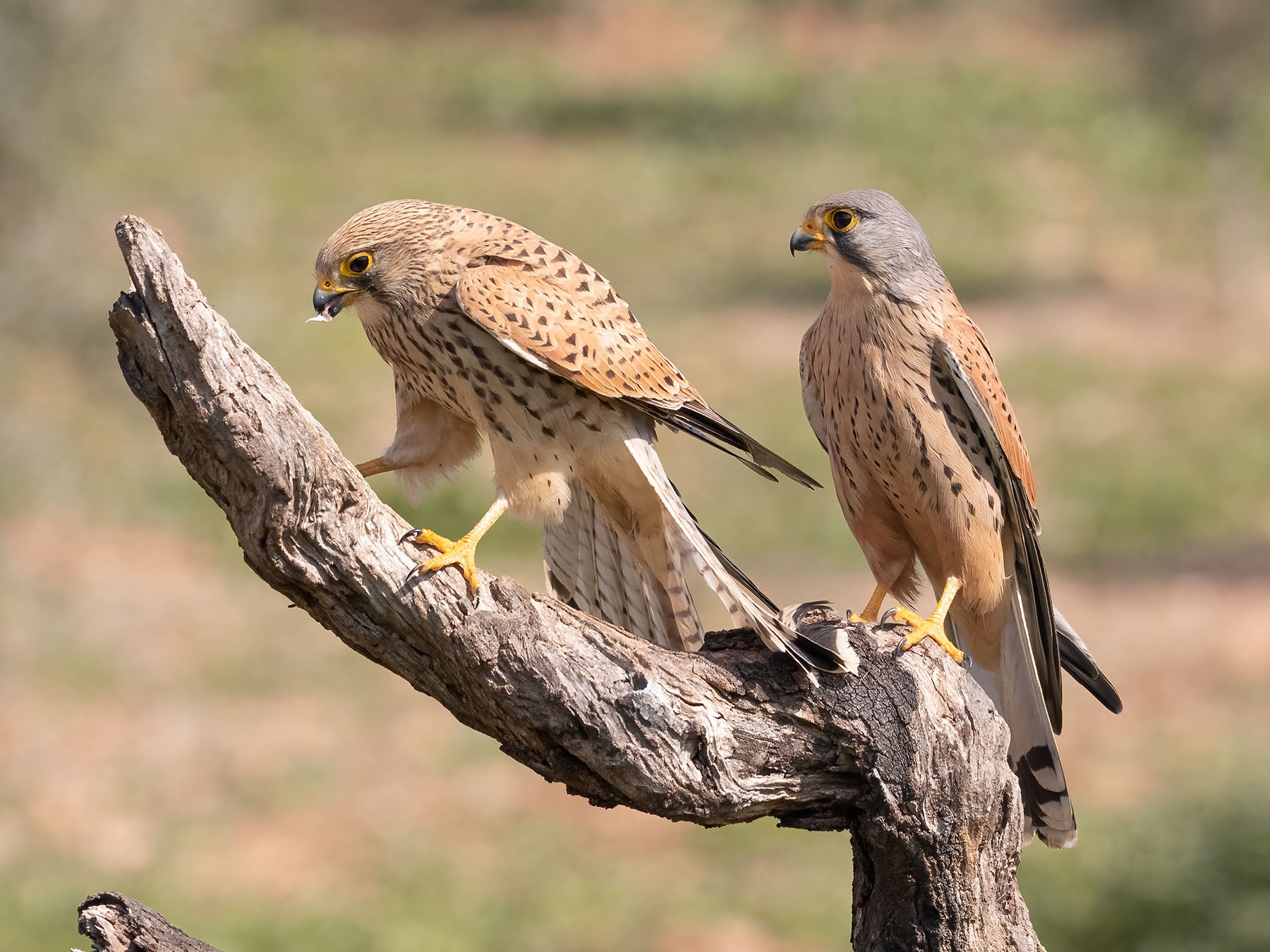

Kestrel guides
6 guidesQuick facts
- Length
- 32–39 cm
- Wingspan
- 65–82 cm
- Weight
- 136–252 g
- Lifespan
- 4–6 years
- Family
- Falcons
- Migration
- Partial migrant
- Global status (IUCN)
- Least Concern
- World population
- 4,300,000 - 6,700,000 mature individuals
- Population trend
- Decreasing
- Also called
- Common Kestrel, European Kestrel
- Scientific name
- Falco tinnunculus
Questions
2How fast can Kestrels fly?
Kestrels are better known for their deft hovering abilities than their speed, despite belonging to the fastest bird family on Earth.
Data is lacking on Eurasian Kestrel flight speeds, although migrating Lesser Kestrels can fly at 31 miles per hour (50km/h) in level flight, and the American Kestrel is said to reach 39 miles per hour (63 km/h).
Are Kestrels the smallest bird of prey in the UK?
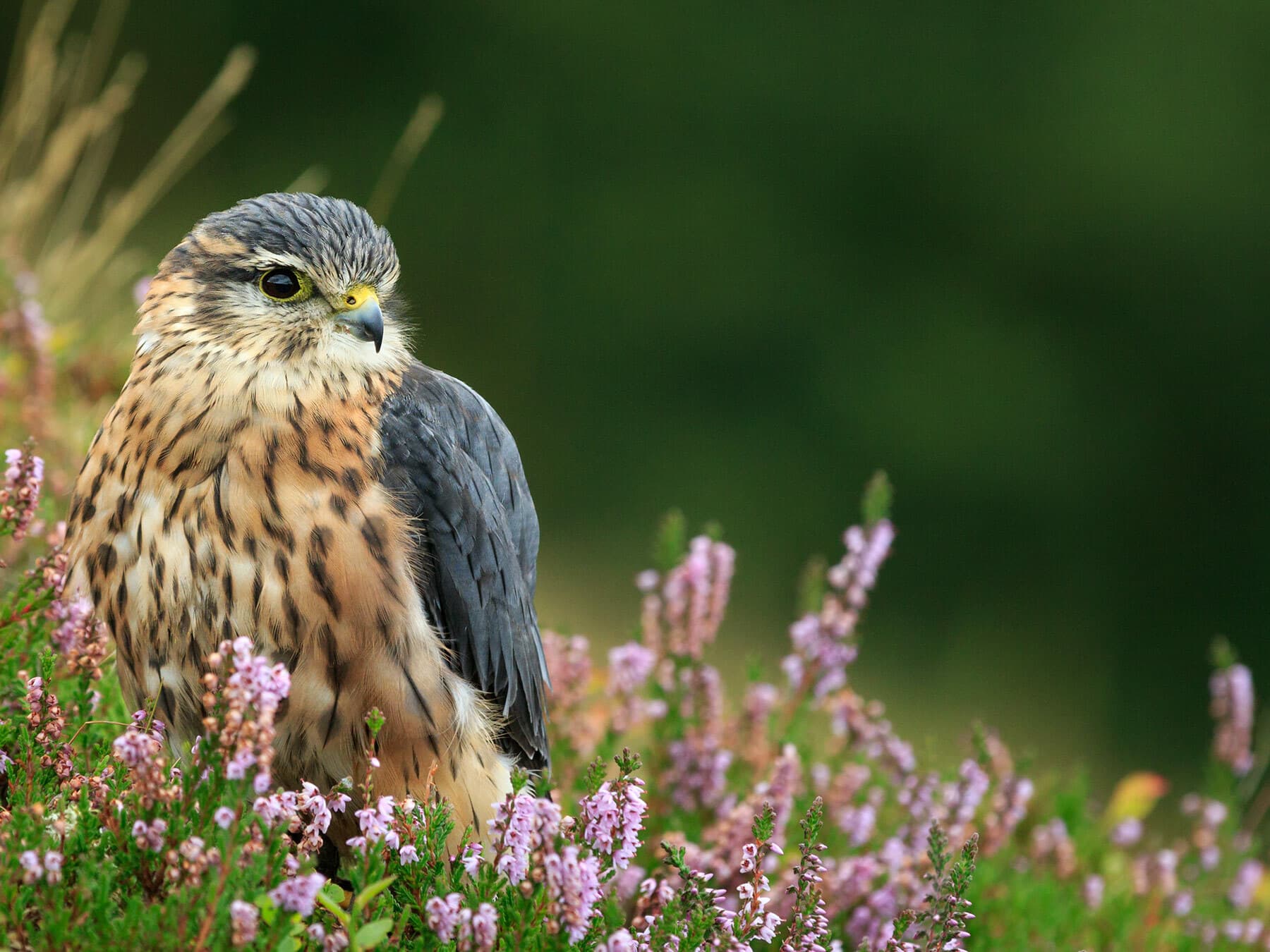
The Kestrel is one of the smallest birds of prey in the United Kingdom, but the true honour goes to the Merlin, another small raptor from the falcon family. If you consider owls birds of prey, the introduced Little Owl trumps them both with a maximum weight of just 206 grams.
Sources
3- 1BirdLife International. 2021. Falco tinnunculus. The IUCN Red List of Threatened Species 2021: e.T22696362A206316110. Source (opens in a new tab)
- 2BirdLife International. 2021. Falco tinnunculus. The IUCN Red List of Threatened Species 2021: e.T22696362A206316110. Source (opens in a new tab)
- 3BirdLife International. 2021. Falco tinnunculus. The IUCN Red List of Threatened Species 2021: e.T22696362A206316110. Source (opens in a new tab)

Checked by
Nathan Cope, founder and editor
Nathan founded Birdfact and leads its writers and contributors in the UK, the US and Canada. He has watched and studied birds for more than ten years, and checks every article and species guide before it’s published.