


Hobby
Eurasian Hobby · Falco subbuteo
By the Birdfact teamChecked by Nathan Cope
On this page14 sections
How to recognise it
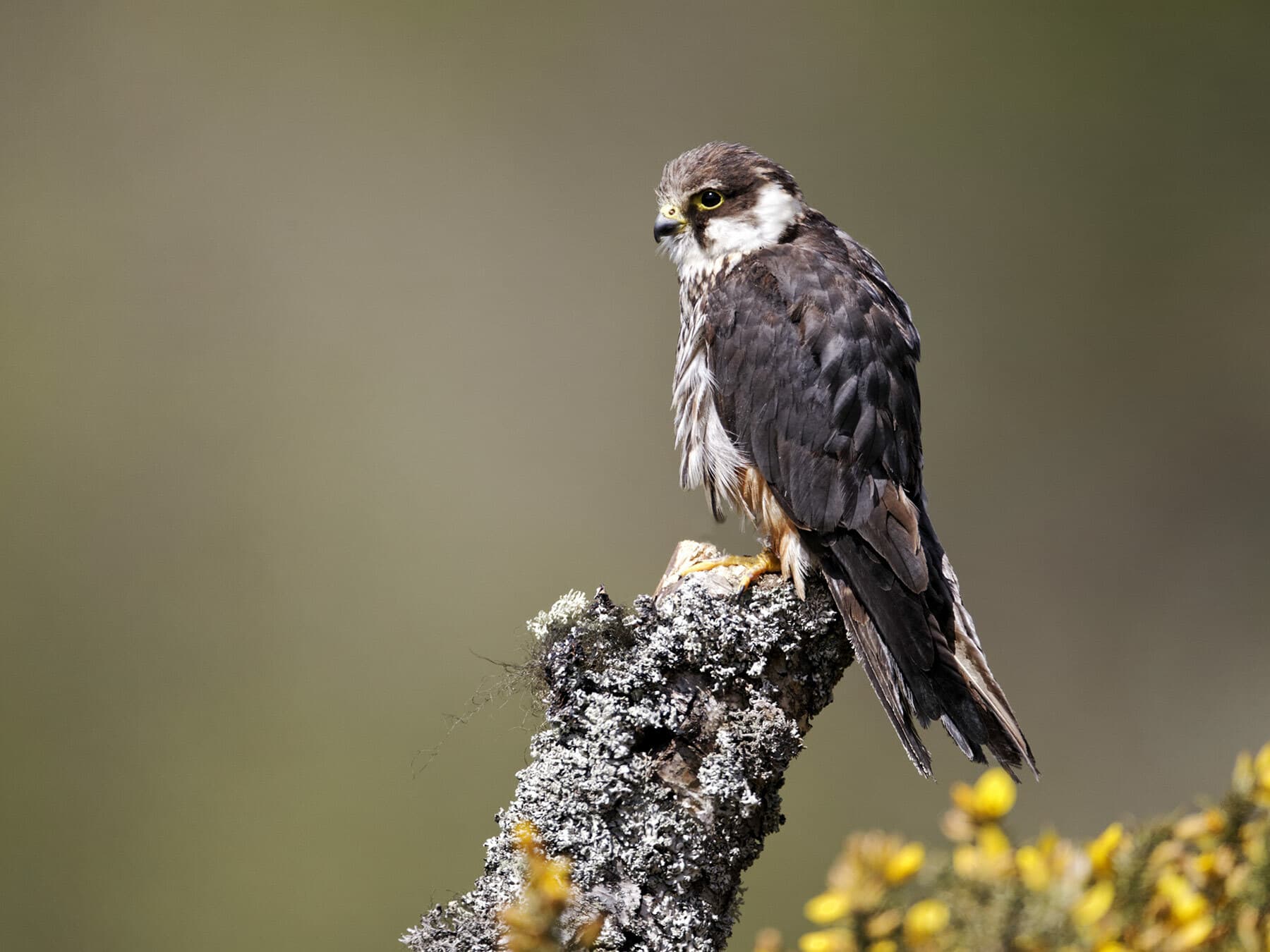
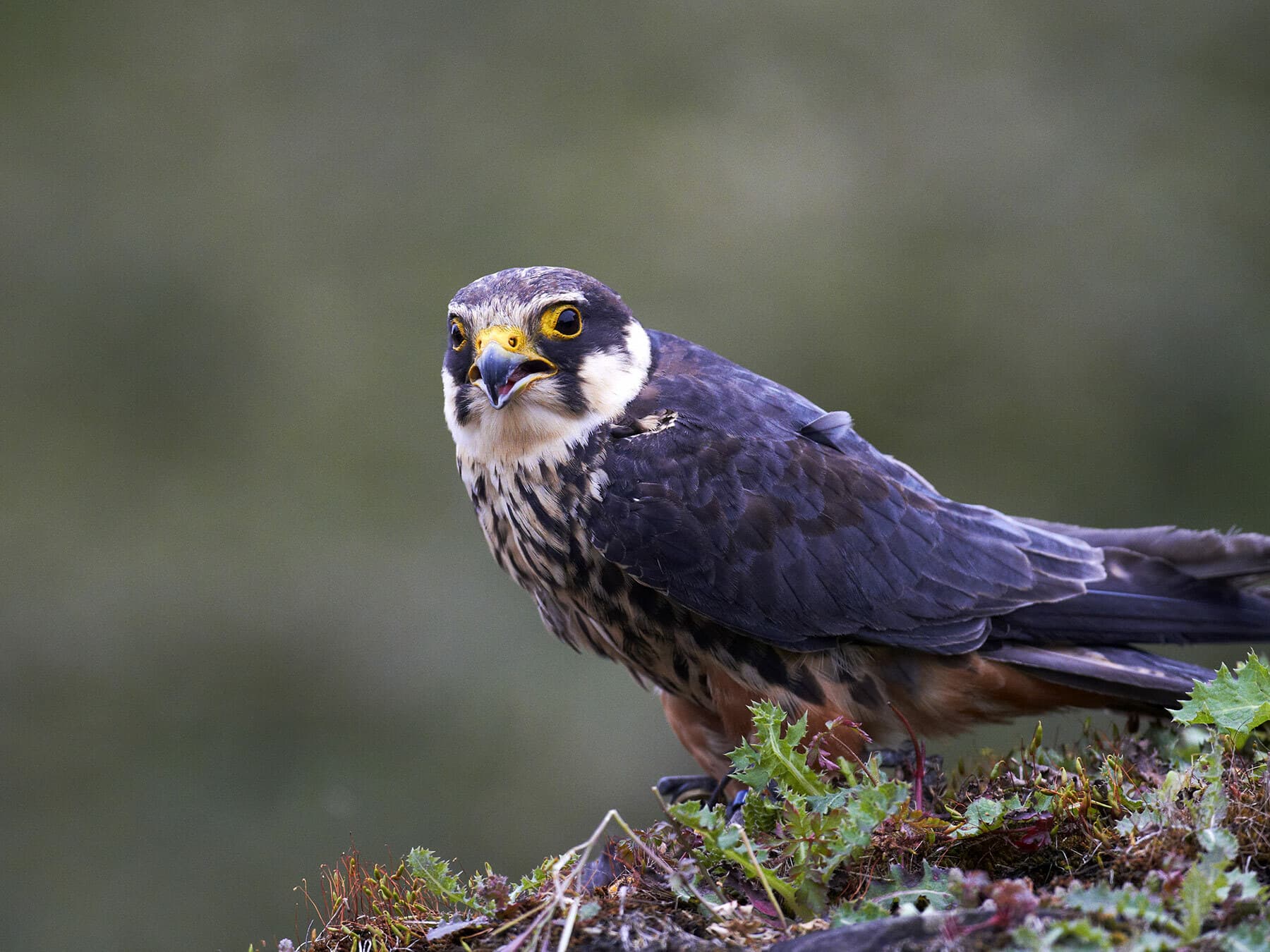
The Hobby is a small, sleek falcon with long, pointed wings and a relatively short tail. Its upperparts are slate-grey, contrasting with a white throat and dark 'moustache' streaks. The underparts are white with bold black streaks. Eyes are brown with a yellow eye ring and white eyebrow, and legs are yellow.
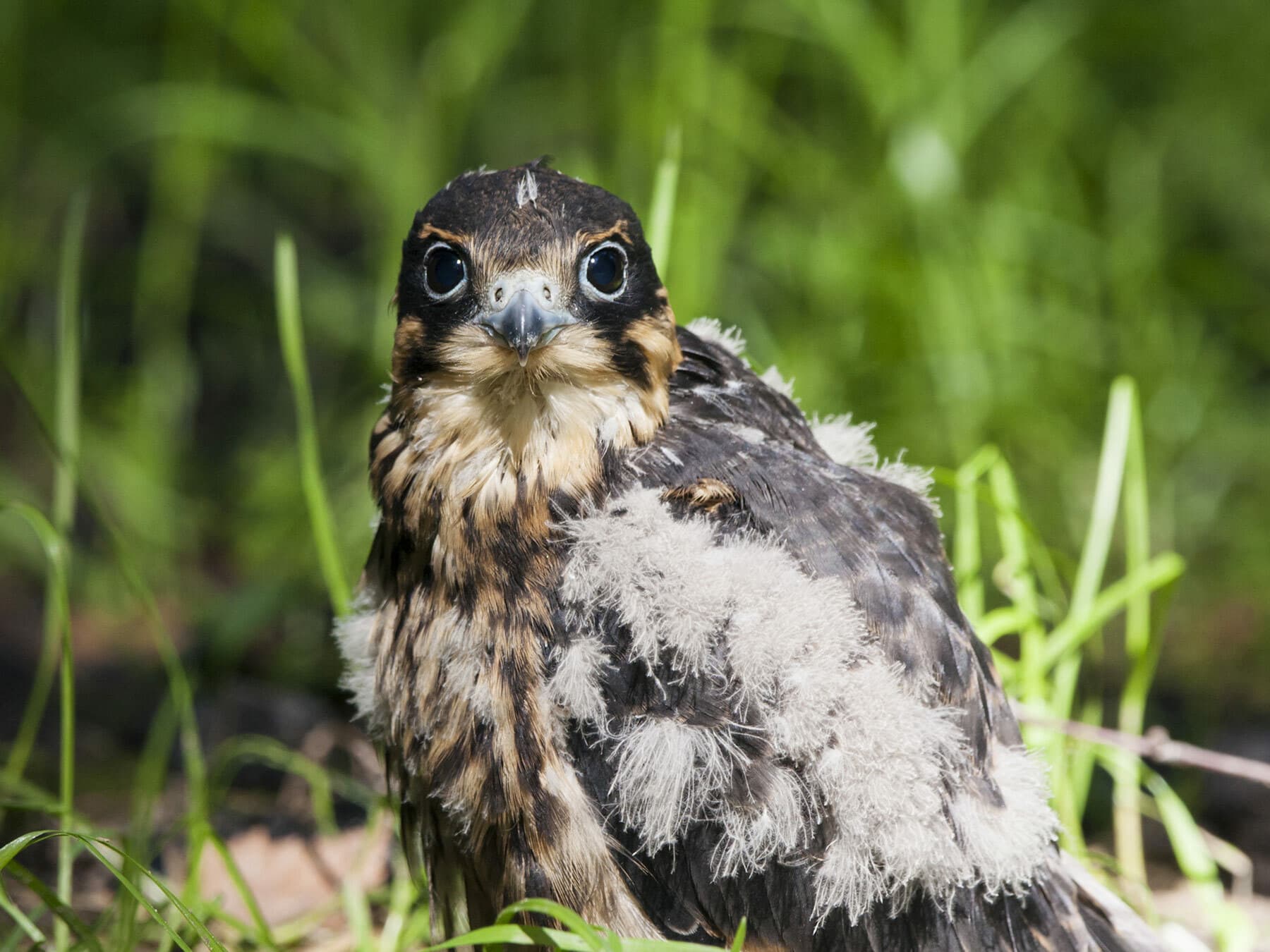
Both sexes look similar, with females being slightly larger. Juveniles show a buffy wash on the underparts and less distinct streaking. In flight, the Hobby's silhouette resembles a large swift, with its streamlined body and sickle-shaped wings.
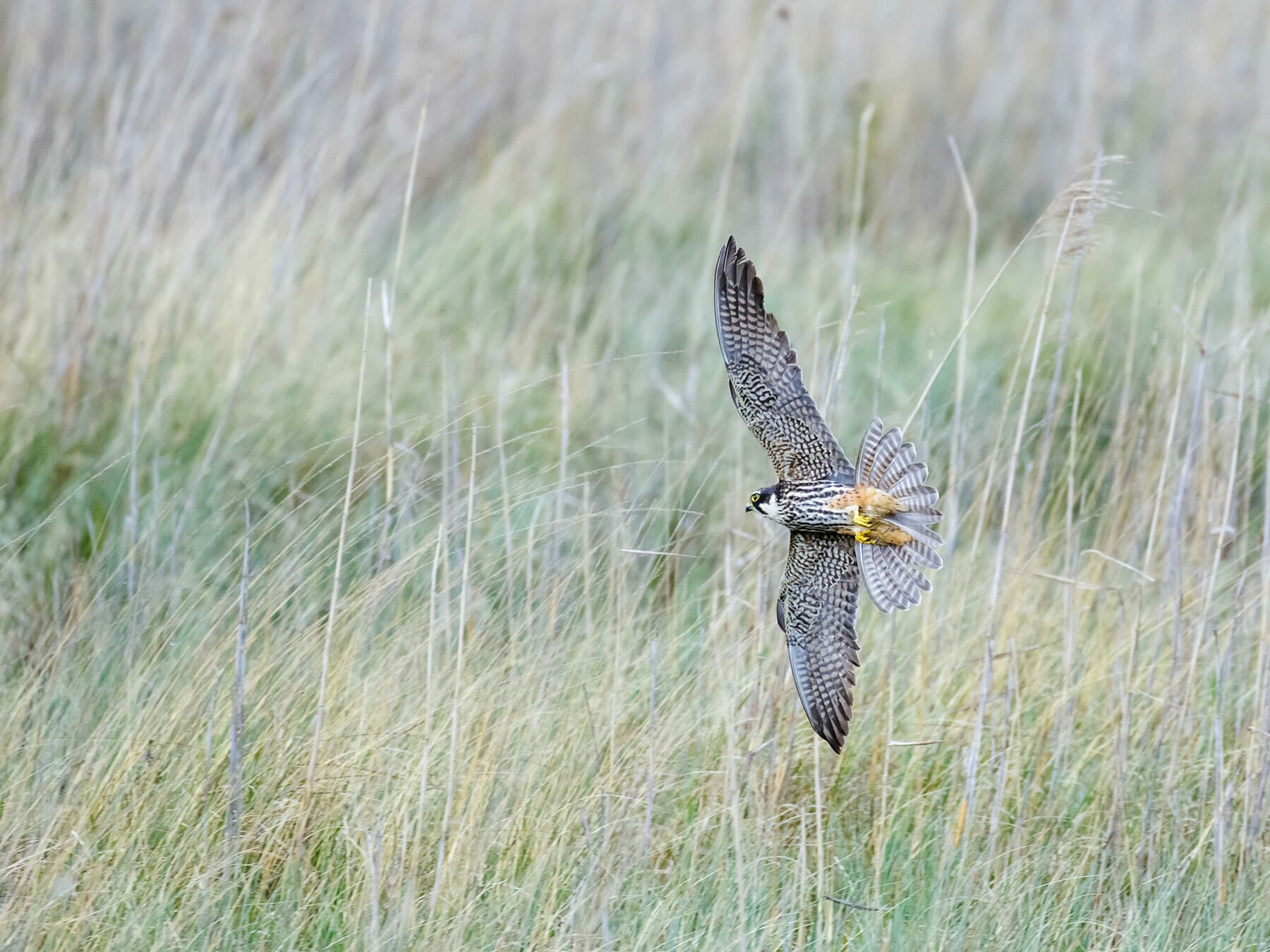
A useful identification feature is the reddish brown-coloured thighs and undertail coverts (the feathers that overlap the belly and tail), easily visible in flight or when the bird is perching on a branch or pole.
Its size
Adults- Length
- 28–35 cm
- Wingspan
- 70–84 cm
- Weight
- 130–340 g
Its song and calls
Generally a silent bird the hobby vocalises during courtship when its calls are similar to a ‘kyu – kyu – kyu’ or ‘kree – kree – kree – kree’.
- Flight call0:00 / 0:17
Recorded in Normandie, France · April 2024
When and where to see it
OctoberLeaving
Most recorded in October
- 1. Suffolk0.17%
- 2. South Yorkshireunder 0.1%
- 3. Isle of Wightunder 0.1%
- 4. Oxfordshireunder 0.1%
- 5. East Sussexunder 0.1%
Each dot is a county, state or province: the bigger and darker, the larger the bird’s share of that place’s bird records that month. Grey dots: no regular records. The ringed point is the centre of the bird’s records this month; the arrow shows how it moved since last month, and the dashed loop its path through the year. “Arrivals” colours places where it becomes regular this month (orange) or is in its last regular month (grey). GBIF eBird Observation Dataset, 2019–2024. Map data: Natural Earth, US Census Bureau; place centres © OpenStreetMap contributors.
In your area
See when the Hobby is recorded in your county, state or province.
How often the Hobby turns up in the UK and Ireland through the year, from birdwatchers' records.
United Kingdom
Summer visitor · regularly Apr–Oct · most records in May
Ireland
Summer visitor · regularly May–Jul · most records in May
Show as a table
| Month | United Kingdom | Ireland |
|---|---|---|
| January | – | – |
| February | – | – |
| March | <0.001% | – |
| April | 0.045% (regular) | <0.001% |
| May | 0.26% (regular) | 0.022% (regular) |
| June | 0.22% (regular) | 0.012% (regular) |
| July | 0.18% (regular) | 0.004% (regular) |
| August | 0.25% (regular) | 0.002% |
| September | 0.24% (regular) | – |
| October | 0.030% (regular) | 0.004% |
| November | <0.001% | – |
| December | – | – |
Recorded regularly in
Worldwide: recorded regularly in 98 countries
Countries where it was recorded in at least 3 of the 6 years 2019–2024. Linked countries have their own bird list.
Europe (42)
- Åland Islands
- Albania
- Austria
- Belarus
- Belgium
- Bosnia & Herzegovina
- Bulgaria
- Croatia
- Czechia
- Denmark
- Estonia
- Finland
- France
- Germany
- Gibraltar
- Greece
- Hungary
- Ireland
- Italy
- Kosovo
- Latvia
- Liechtenstein
- Lithuania
- Luxembourg
- Malta
- Moldova
- Montenegro
- Netherlands
- North Macedonia
- Norway
- Poland
- Portugal
- Romania
- Russia
- Serbia
- Slovakia
- Slovenia
- Spain
- Sweden
- Switzerland
- Ukraine
- United Kingdom
Africa (19)
Asia (36)
- Armenia
- Azerbaijan
- Bahrain
- Bangladesh
- Bhutan
- China
- Cyprus
- Georgia
- Hong Kong SAR China
- India
- Iran
- Iraq
- Israel
- Japan
- Jordan
- Kazakhstan
- Kuwait
- Kyrgyzstan
- Lebanon
- Macao SAR China
- Mongolia
- Myanmar (Burma)
- Nepal
- Oman
- Pakistan
- Palestinian Territories
- Qatar
- Saudi Arabia
- South Korea
- Taiwan
- Tajikistan
- Thailand
- Turkey
- United Arab Emirates
- Uzbekistan
- Vietnam
Oceania (1)
Data: EOD – eBird Observation Dataset (Cornell Lab of Ornithology), accessed via GBIF.org, CC BY 4.0. Records from 2019–2024, aggregated and filtered by Birdfact. How these lists are made
At home over grassland, heathland, wetlands and woodland areas the hobby can be found across England, most of Wales and more recently in small numbers in southern Scotland, generally appearing between April and October.
Signs and Spotting tips
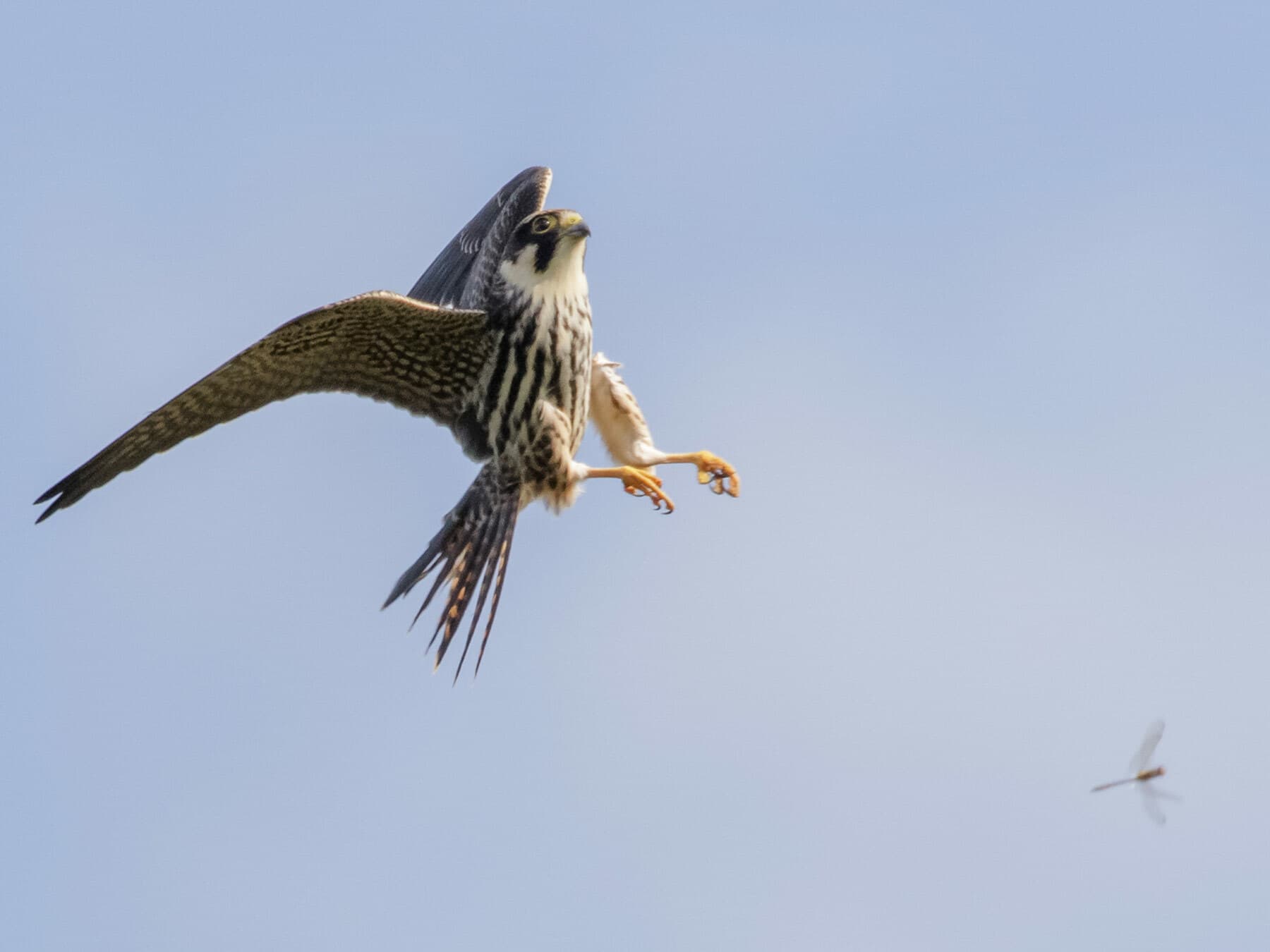
A graceful bird to watch in flight, the hobby hunts in swooping and gliding movements able to change height and direction of travel extremely quickly. Its wingbeats are smooth and relaxed although it can accelerate or dive in an instant. The bright white cheek patternation and red brown undertail colouration provide an easy reference for the positive identification of this bird.
What it eats
The diet of the hobby consists of larger flying insects and small birds such as swallows which is catches on the wing in its talons and will often consume whilst in flight.
Nesting and breeding
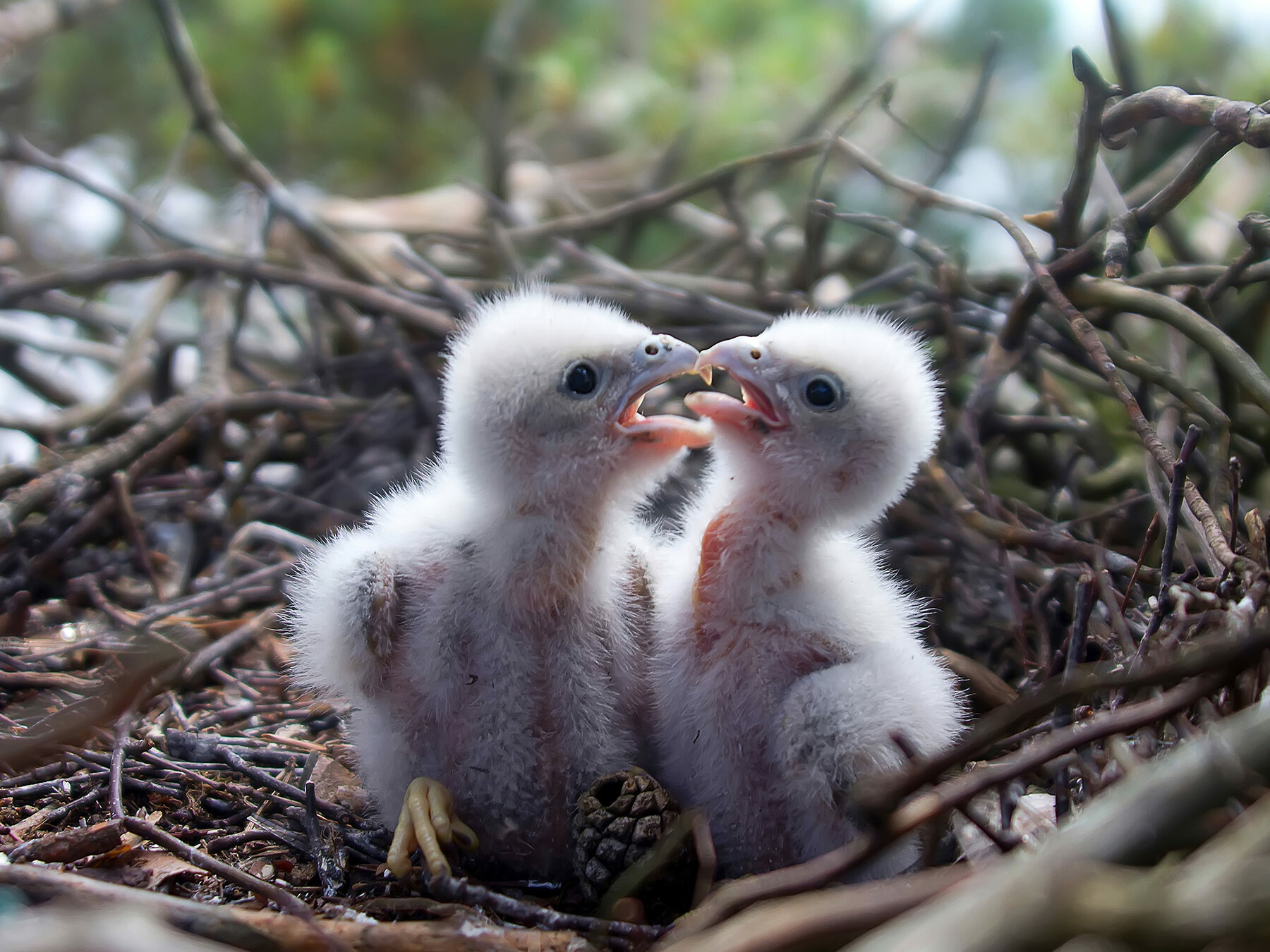
Hobbies use abandoned nests of other birds in which to lay their eggs, commonly choosing old crows or magpie nests high in the tree tops. One clutch of 2 – 3 yellowy buff eggs with brown markings is laid between June to August and incubated mainly by the female for a month.
Behaviour
Hobbies are known for their incredible aerial agility. They are often seen chasing insects and small birds in mid-air. They frequently hunt in pairs, with one bird flushing prey while the other pursues.
During courtship, males perform spectacular sky-dancing displays, showcasing their speed and manoeuvrability.
Lifespan and predators
The lifespan of the hobby is ten years maximum although usually a lot less.
Conservation
While the Hobby is currently listed as Least Concern, it faces threats from habitat loss and agricultural intensification. Climate change may affect its prey availability and migration patterns. Conservation efforts focus on protecting breeding habitats and maintaining insect-rich environments.
What does a Hobby look like?
Male and female hobbies look identical although the female is the slightly larger bird. Adults have pale creamy underparts with black streaks and long tapered wings, the underparts of which are cream in colour and marked with dark bars and spots, as is the undertail. A useful identification feature are the reddish brown coloured thighs and undertail coverts (the feathers that overlap the belly and tail) easily visible in flight or when the bird is perching on a branch or pole. They particularly stand out surrounded by the paler underparts. The upper parts and upperwing area are a plain slate grey. The head of the hobby is dark with a white chin, cheeks, throat and side of the neck which is split by a black moustache starting below the eye close to the top of the bill, passing in front of the cheek and behind the throat. Hobbies eyes are brown with a yellow eye ring and white eyebrow. The membrane covering the base of the upper mandible, otherwise known as the cere, is bright yellow with the rest of the hooked bill being black. The birds’ legs and feet are yellow with an orange hue and are prominent amongst the red brown coloured thighs. Juveniles have more brown colouration than the adults but lack the rufous colour under the tail.
Similar birds
Often mistaken for
More photos
2 photos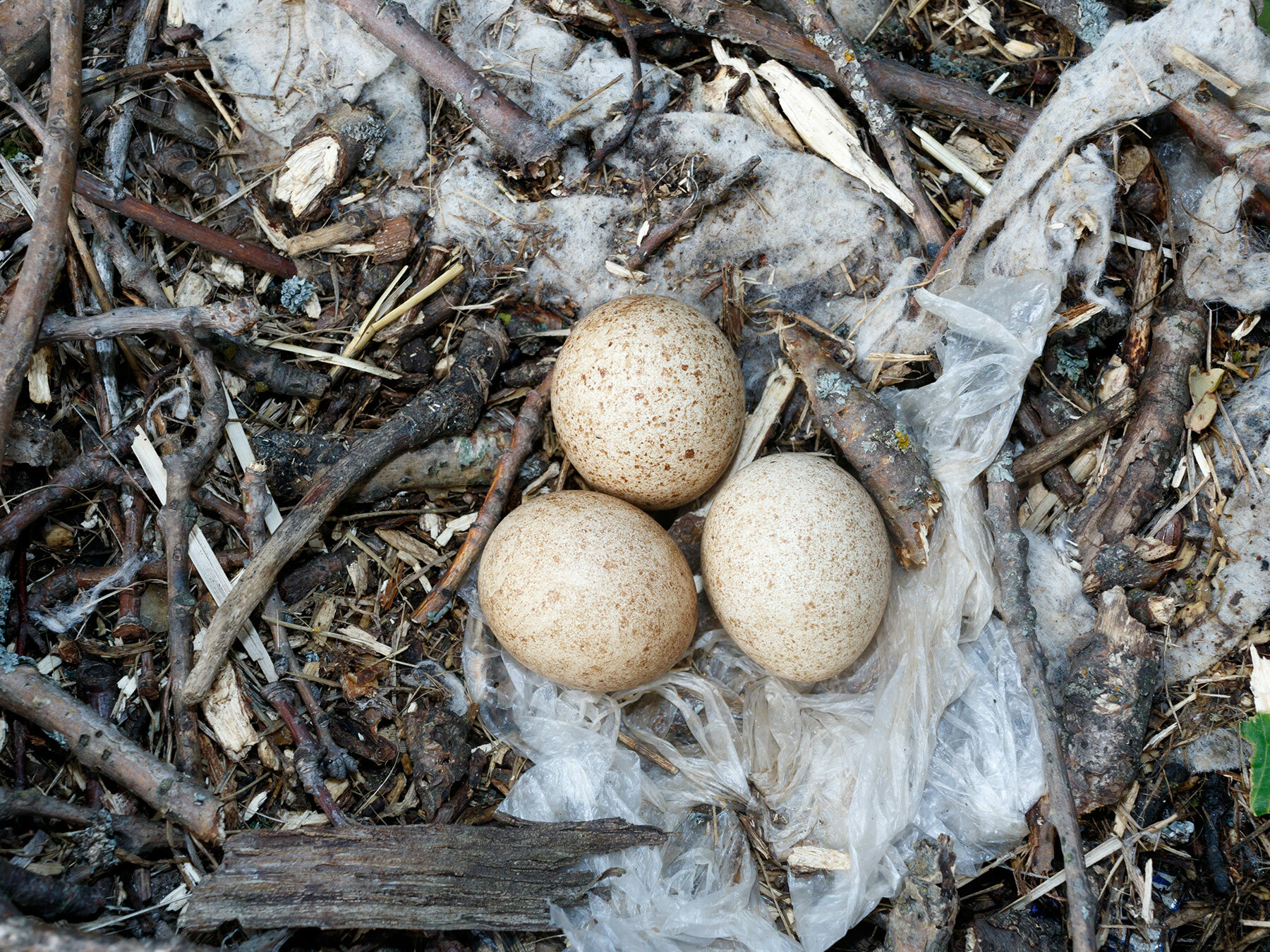
Quick facts
- Length
- 28–35 cm
- Wingspan
- 70–84 cm
- Weight
- 130–340 g
- Lifespan
- 7–10 years · oldest recorded 14.8 years
- Family
- Falcons
- Migration
- Long-distance Migrant
- Global status (IUCN)
- Least Concern
- World population
- 900,000 - 1,500,000 mature individuals
- Population trend
- Decreasing
- Also called
- Eurasian Hobby
- Scientific name
- Falco subbuteo
Sources
4- 1BirdLife International. 2021. Falco subbuteo. The IUCN Red List of Threatened Species 2021: e.T22696460A206270514. Source (opens in a new tab)
- 2del Hoyo et al. (1994)
- 3BirdLife International. 2021. Falco subbuteo. The IUCN Red List of Threatened Species 2021: e.T22696460A206270514. Source (opens in a new tab)
- 4BTO longevity records: maximum age from a ringed bird, 14 years, 10 months, 19 days (set in 2007), BirdFacts: Hobby (2007) Source (opens in a new tab)

Checked by
Nathan Cope, founder and editor
Nathan founded Birdfact and leads its writers and contributors in the UK, the US and Canada. He has watched and studied birds for more than ten years, and checks every article and species guide before it’s published.