


Northern Gannet
North Atlantic Gannet, Gannet · Morus bassanus
By the Birdfact teamChecked by Nathan Cope
On this page13 sections
How to recognise it
What do Gannets look like?
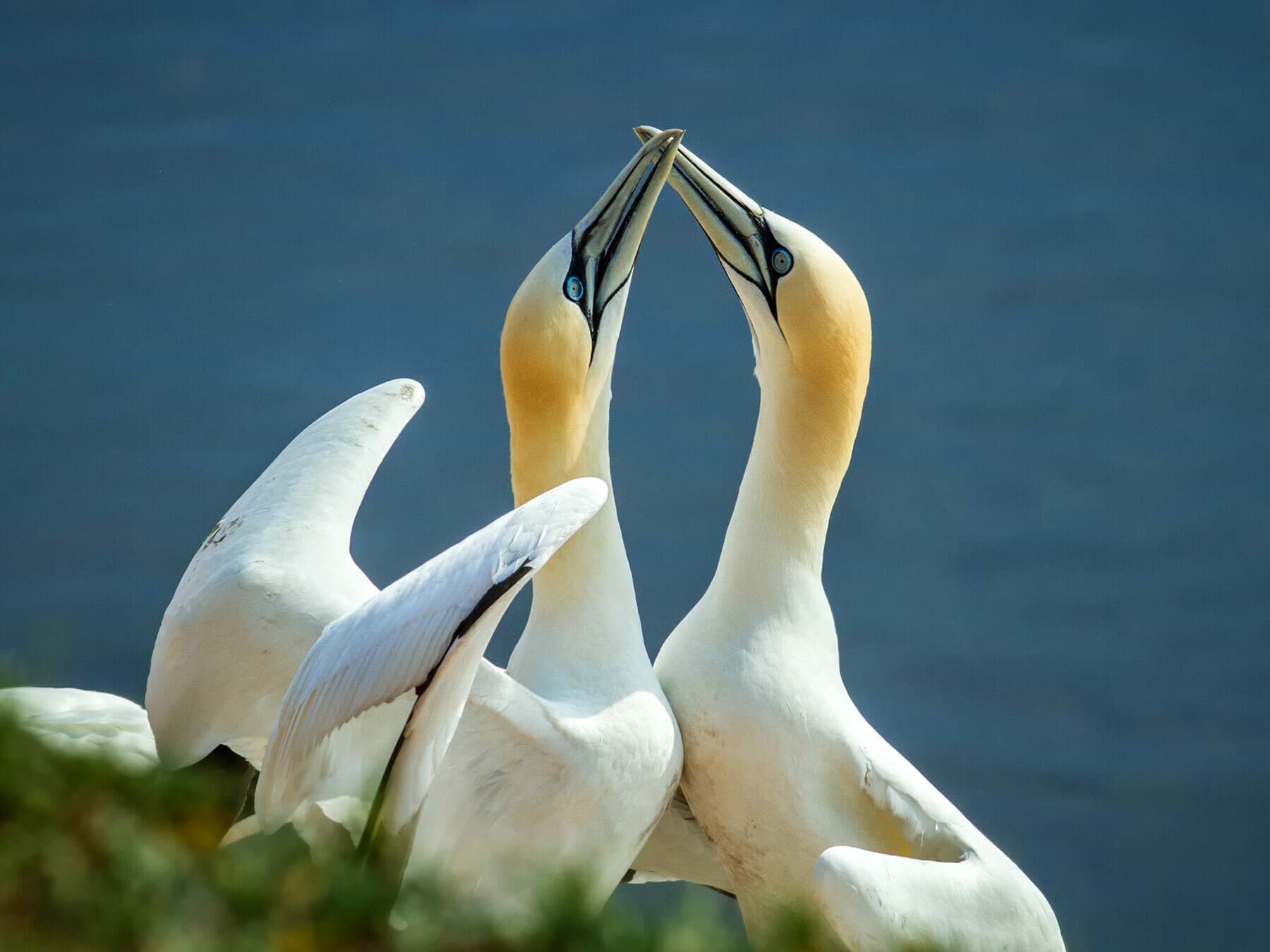
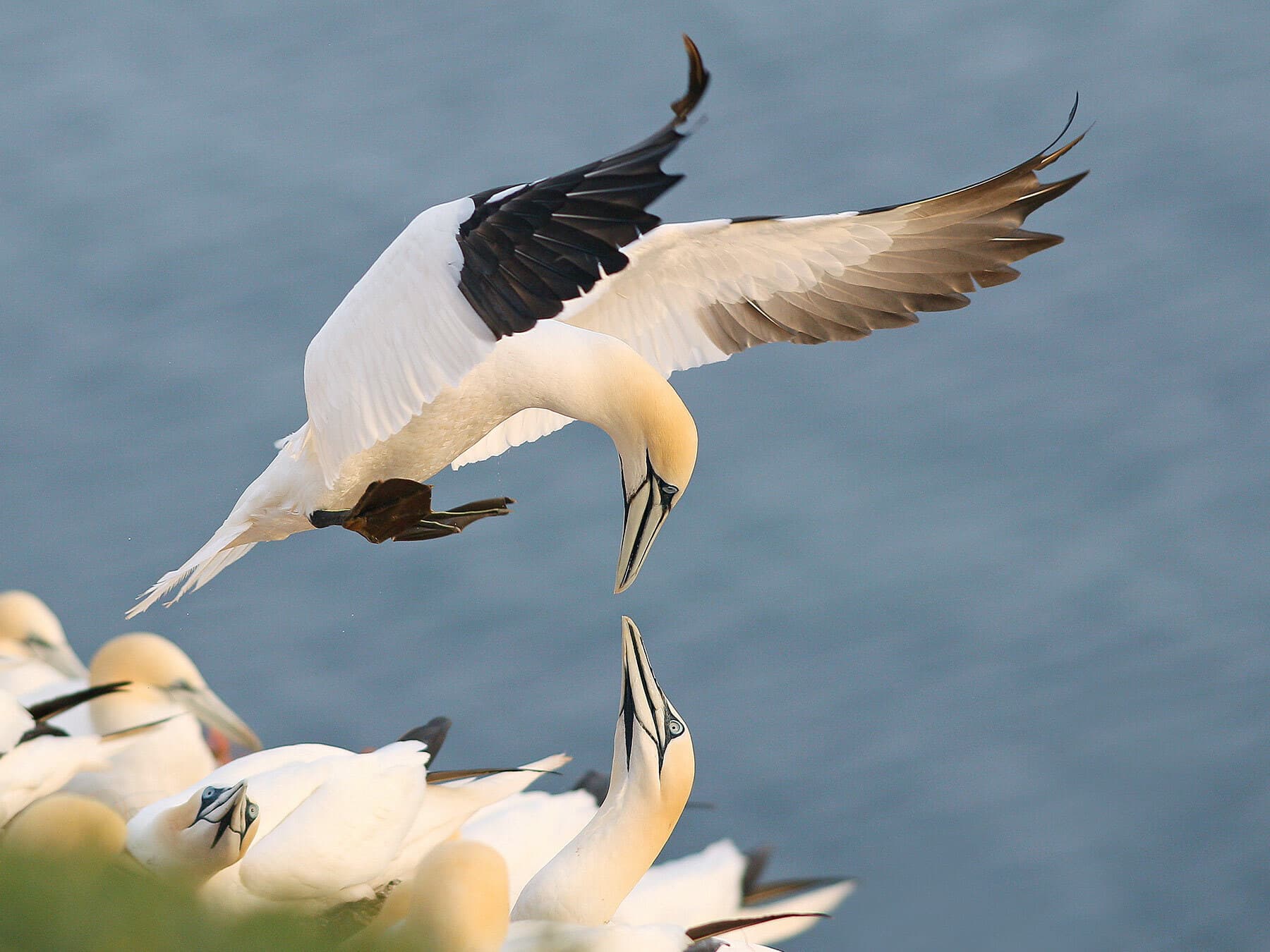
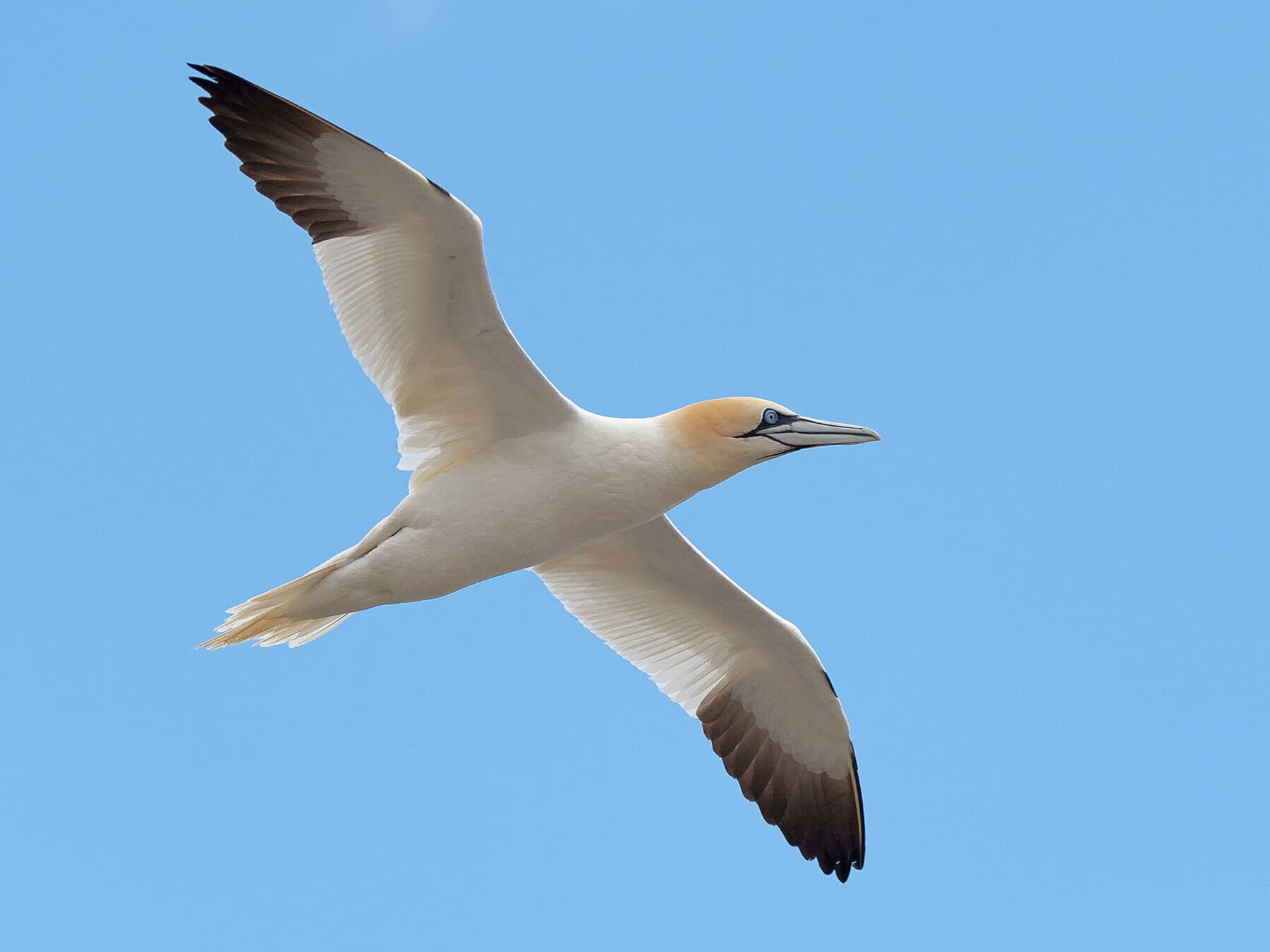
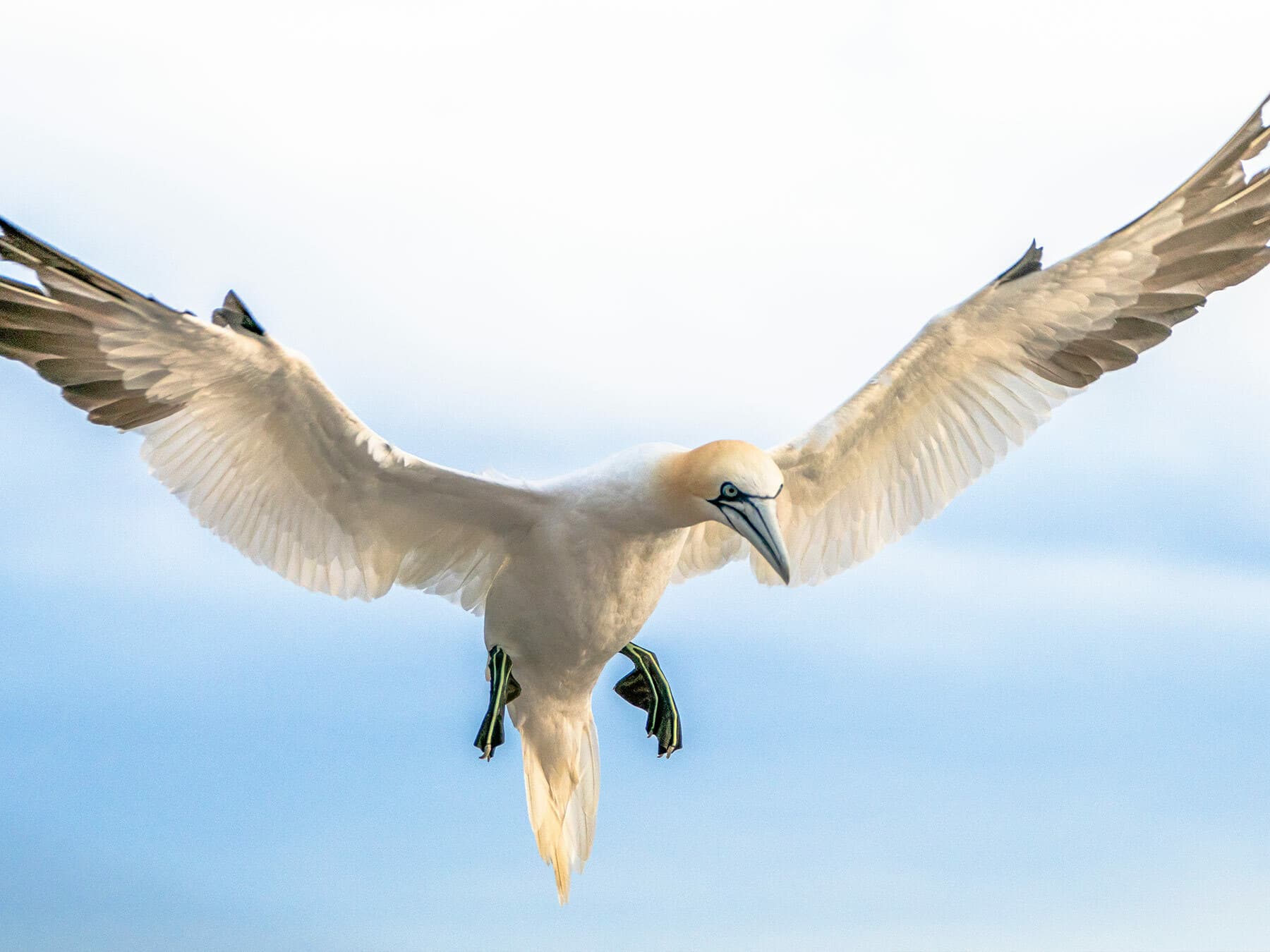
Gannets do not show obvious sexual dimorphism, so males and females are very similar in size and appearance. Adults are large white seabirds, with their wings tipped in black above and below. The crown, nape, and sides of the head have a rich yellowish wash which is most intense during the breeding season.
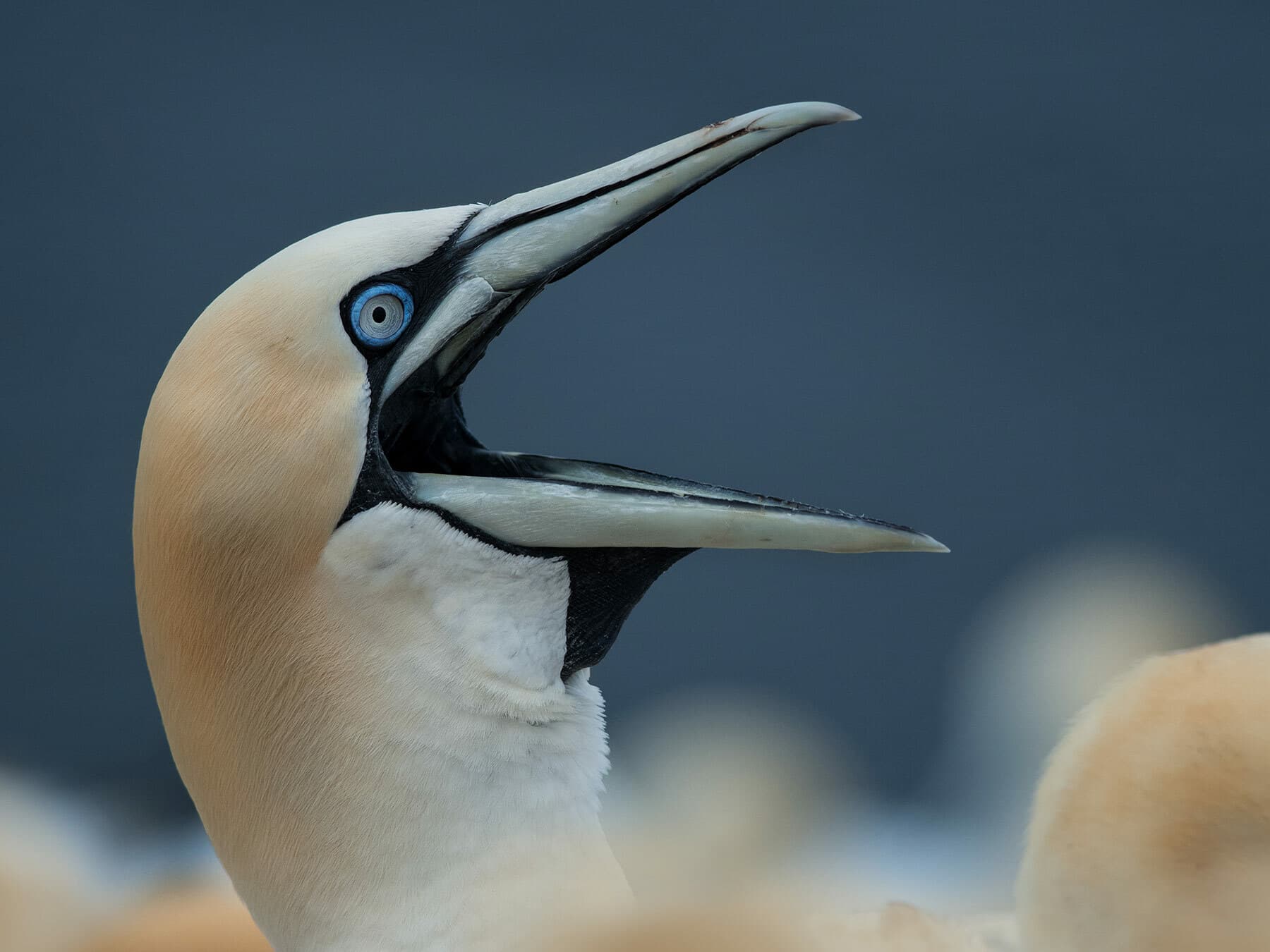
The webbing of their large feet is black, although close inspection reveals blueish or greening colouration on the shins and along the length of the toes. Gannets have large blue-grey bills that are outlined in black and striking bright blue skin surrounding their silvery eyes.
Juvenile gannets take 4-5 years to develop their white adult plumage. They appear much darker overall, with fine white speckling apparent when seen at close range. The bill and legs are black and the eyes are blue-grey.
How big are Gannets?
Gannets are the largest seabirds in the United Kingdom and the northern Atlantic. Adult gannets generally measure between 93.5 cm and 110 cm (36.8 and 43.3 in) from bill tip to tail, with males marginally longer than females.
Gannets are relatively heavy birds, with adult weights of between 2470 and 3470 grams (87.1 - 122.4 oz). Females tend to be slightly heavier than males, and juveniles are even heavier than their parents around fledging time.
Most Gannets measure 180 cm -184 cm (70.9 to 72.4 in) from wingtip to wingtip. Some birds have wingspans approaching 2 m (6.5 ft), however.
Its size
Adults- Length
- 87–100 cm
- Wingspan
- 165–180 cm
- Weight
- 2300–3600 g
Its song and calls
What sound does a Gannet make?
Gannets can be very noisy birds, particularly at their breeding colonies. The typical call is a rather raucous Arrrr Arrrr Arrrr sound that is repeated a varying number of times depending on whether the bird is interacting with a rival or landing at the colony. Gannets also produce a softer raven-like call while away from the colony out at sea.
- Song and calls0:00 / 0:10
Recorded in Brittany, France · May 2026
- Call0:00 / 0:29
Recorded in Alderney, France · July 2025
When and where to see it
OctoberLeaving
Most recorded in October
- 1. Derry2.5%
- 2. Moray2.0%
- 3. Orkney Islands1.9%
- 4. Donegal1.7%
- 5. Cornwall1.6%
Each dot is a county, state or province: the bigger and darker, the larger the bird’s share of that place’s bird records that month. Grey dots: no regular records. The ringed point is the centre of the bird’s records this month; the arrow shows how it moved since last month, and the dashed loop its path through the year. “Arrivals” colours places where it becomes regular this month (orange) or is in its last regular month (grey). GBIF eBird Observation Dataset, 2019–2024. Map data: Natural Earth, US Census Bureau; place centres © OpenStreetMap contributors.
In your area
See when the Northern Gannet is recorded in your county, state or province.
How often the Northern Gannet turns up in the UK, Ireland, the United States and Canada through the year, from birdwatchers' records.
United Kingdom
Summer visitor · all year · most records in September
Ireland
Summer visitor · all year · most records in August
United States
Winter visitor · all year · most records in November
Canada
Summer visitor · regularly Apr–Dec · most records in August
Show as a table
| Month | United Kingdom | Ireland | United States | Canada |
|---|---|---|---|---|
| January | 0.088% (regular) | 0.18% (regular) | 0.049% (regular) | 0.002% |
| February | 0.093% (regular) | 0.34% (regular) | 0.043% (regular) | <0.001% |
| March | 0.12% (regular) | 0.50% (regular) | 0.034% (regular) | 0.004% |
| April | 0.17% (regular) | 0.70% (regular) | 0.019% (regular) | 0.028% (regular) |
| May | 0.24% (regular) | 0.85% (regular) | 0.011% (regular) | 0.024% (regular) |
| June | 0.31% (regular) | 0.93% (regular) | 0.010% (regular) | 0.062% (regular) |
| July | 0.39% (regular) | 1.1% (regular) | 0.011% (regular) | 0.14% (regular) |
| August | 0.47% (regular) | 1.3% (regular) | 0.015% (regular) | 0.20% (regular) |
| September | 0.47% (regular) | 1.0% (regular) | 0.022% (regular) | 0.17% (regular) |
| October | 0.42% (regular) | 0.75% (regular) | 0.036% (regular) | 0.096% (regular) |
| November | 0.21% (regular) | 0.30% (regular) | 0.076% (regular) | 0.043% (regular) |
| December | 0.12% (regular) | 0.22% (regular) | 0.054% (regular) | 0.011% (regular) |
Recorded regularly in
Worldwide: recorded regularly in 38 countries
Countries where it was recorded in at least 3 of the 6 years 2019–2024. Linked countries have their own bird list.
Europe (24)
Africa (7)
- Algeria
- Gambia
- Mauritania
- Morocco
- Senegal
- Tunisia
- Western Sahara
Asia (2)
- Israel
- Turkey
North America (5)
- Bahamas
- Canada
- Greenland
- St Pierre & Miquelon
- United States
Data: EOD – eBird Observation Dataset (Cornell Lab of Ornithology), accessed via GBIF.org, CC BY 4.0. Records from 2019–2024, aggregated and filtered by Birdfact. How these lists are made
What is the habitat of a Gannet?
Gannets are seabirds that occur in coastal areas, usually as far offshore as the continental shelf. They range from cold, temperate oceans to the subtropics and are not often seen over deep oceanic waters.
What is the range of a Gannet?
Gannets range across the northern Atlantic Ocean from Northern Europe and North Africa in the east, to The United States and Canada in the west.
Where do Gannets live?
Gannets spend much of their lives out at sea. They even sleep on the open water when not breeding. Adult Gannets spend the breeding season in the vicinity of the colony. These birds usually forage within about 60 km (37 mi) of the nest site each day and return each night, although they will travel much further if necessary.
How rare are Gannets?
Gannets are common seabirds within their range. They can be seen reliably and in great numbers in the vicinity of their breeding colonies in spring and summer.
Where to see Gannets in the US
Gannets do not breed in the United States but they do fly south from their breeding colonies around Newfoundland in the fall. In the winter, Gannets can be seen off the east coast of the USA from the New England coast all the way to the Gulf of Mexico
Where to see Gannets in the UK
Gannets can be seen just about anywhere off the UK coast. Their breeding colonies are the best place to see these birds on land, however. A visit to reserves like Bempton Cliffs in the northeast of England, Troup Head in Scotland or, for the more adventurous, Noup Cliffs in Orkney is recommended.
Migration
Do Gannets migrate?
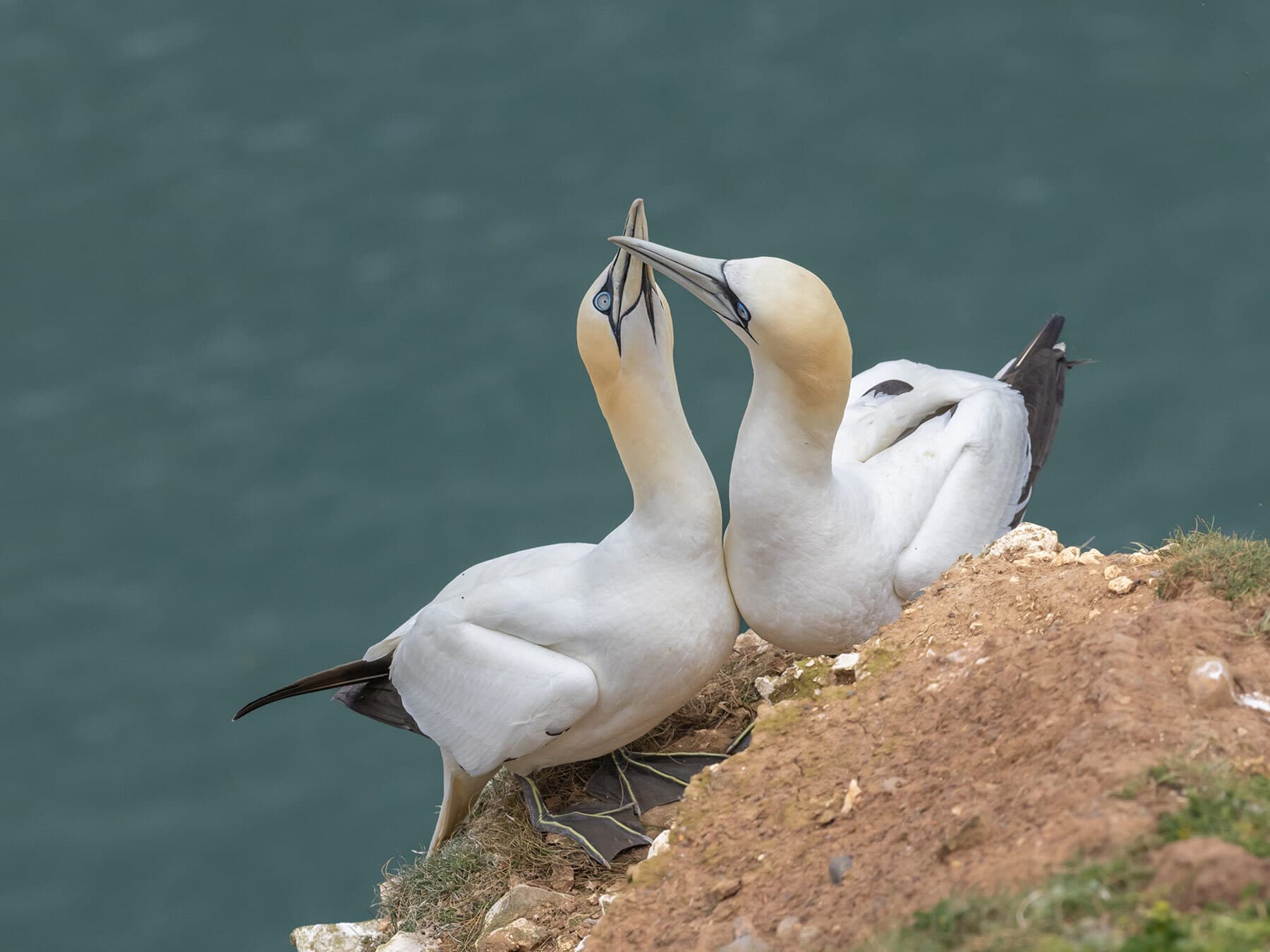
Gannets migrate south in the autumn and return in the spring. Juveniles begin migrating even before they can properly fly, and may swim for as much as the first 70 km (40 mi) of the southward journey. They may not return to the grounds where they were born for their first 3 or 4 years, although adults show strong fidelity to their nest sites and return to the same place each year.
Juveniles travel the furthest, even moving as far south as the equator off West Africa. Many adults enter the Mediterranean during their southward migration, but most do not travel further east than Italy.
Young Gannets off the coast of the United States spend the winter as far south as the warm waters off Florida and the Gulf of Mexico. Many adults spend the winter off the coast of Massachusetts and North Carolina.
Tips for seeing it
- Look for large white seabirds with black wingtips along coastal areas
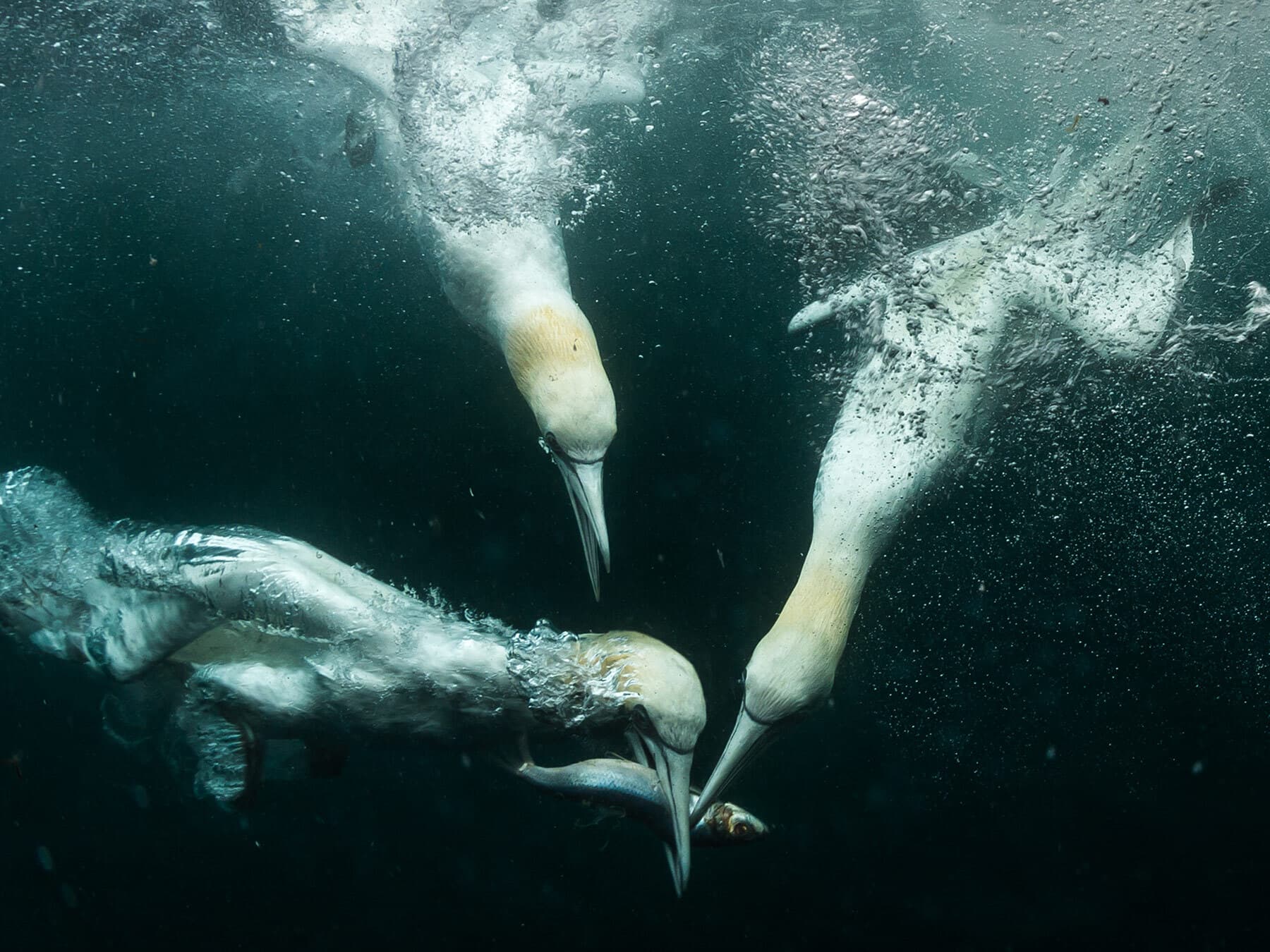
- Observe their distinctive plunge-diving behaviour from coastal vantage points
- Visit known breeding colonies in the UK, such as Bass Rock or Bempton Cliffs, during the summer months
- Use a spotting scope to watch their social interactions in the colony
What it eats
What do Gannets eat?
Gannets are specialist feeders of surface schooling pelagic fish and squid. Their prey size varies between about 2.5 - 30 cm (1 and 12 in).
Their most important prey items include:
- Mackerel
- Herring
- Capelin
- Cod
- Coalfish
- Atlantic Salmon
- Menhaden
- Sandlance
- Smelt
- Whiting
- Haddock
- Pilchards
What do baby Gannets eat?
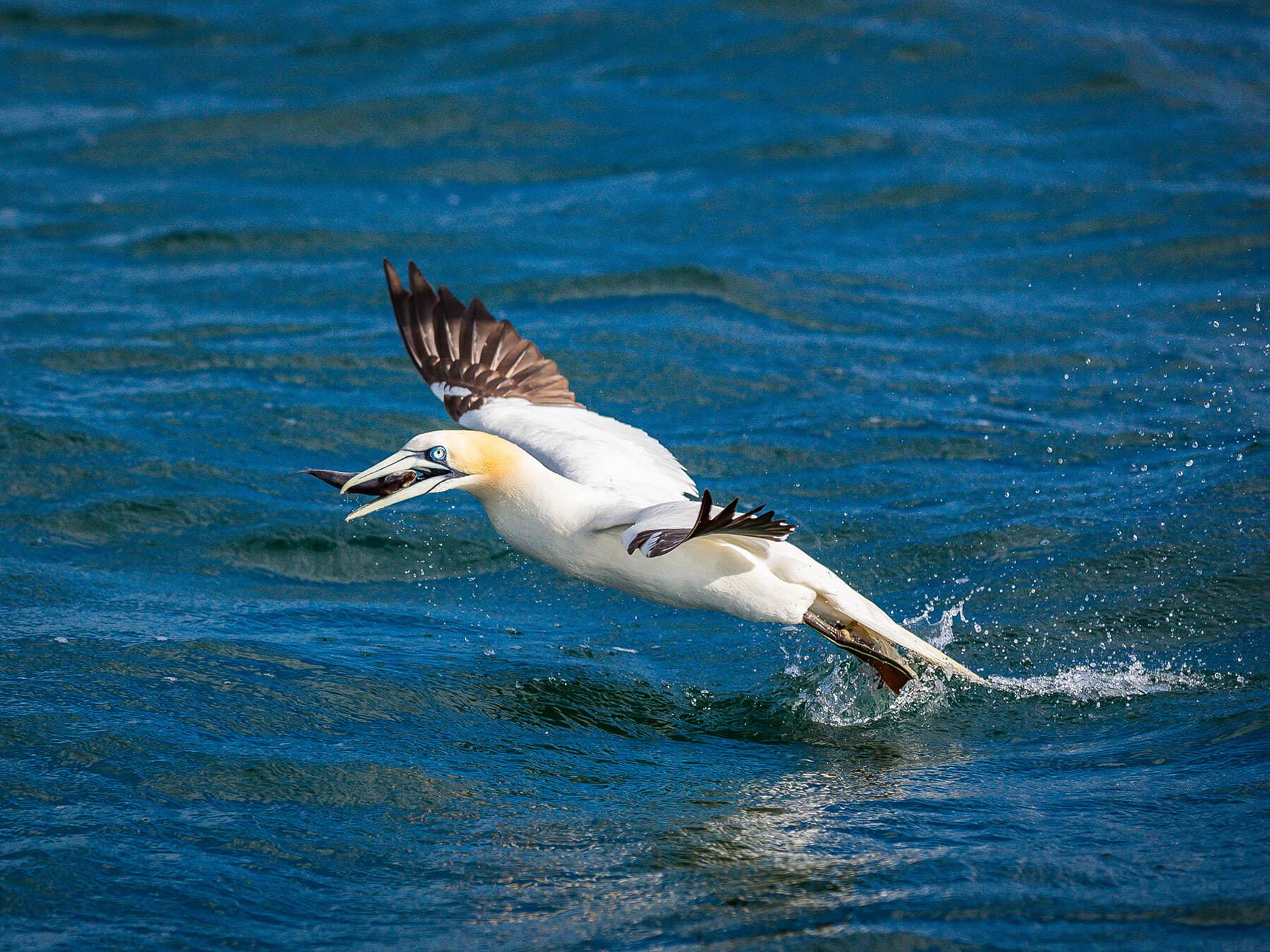
Baby Gannets are fed a diet of regurgitated fish. They stick their heads into the beak of their parent to beg for food, although this is not always successful. The young birds grow quickly on this rich, oily food and weigh as much as 50% more than their parents by the age of ten weeks. They lose some of this excess fat by the time they fledge and while learning to fly after leaving the nest.
Are Gannets greedy?
Gannets are well known for their voracious appetites. Food intake reaches a peak in the breeding season when adult Gannets are feeding their baby as much as 650 grams (1.4 lb) of regurgitated fish per day.
Nesting and breeding
Where do Gannets nest?
Gannets nest on the ground in dense colonies known as gannetries. There are 38 known gannetries, including 21 around the coast of Britain and Ireland, and 6 on the Canadian coastline.
Their nests are evenly spaced and usually set on ledges and cliffs, although they will use more level ground in some locations. The nest itself is constructed of a variety of materials, including feathers, seaweed, grass, mud, and their own excrement.
What do Gannet eggs look like?
Gannets produce a single blueish or greenish egg each year. The egg is large, weighing just over 100 grams (3.5 oz) on average and measuring approximately 80 mm x 49 mm (3.1 x 1.9 in). Average egg size varies marginally between different breeding colonies.
Do Gannets mate for life?
Gannets form strong, lifelong pair bonds and both are involved in rearing their chick. Males do not usually breed until they reach 5 or 6 years of age. Pairing begins when a male acquires a nest site and attracts a female, which is usually a year younger than himself. The pair will breed every year at the same nest site thereafter.
Behaviour
Are Gannets aggressive?
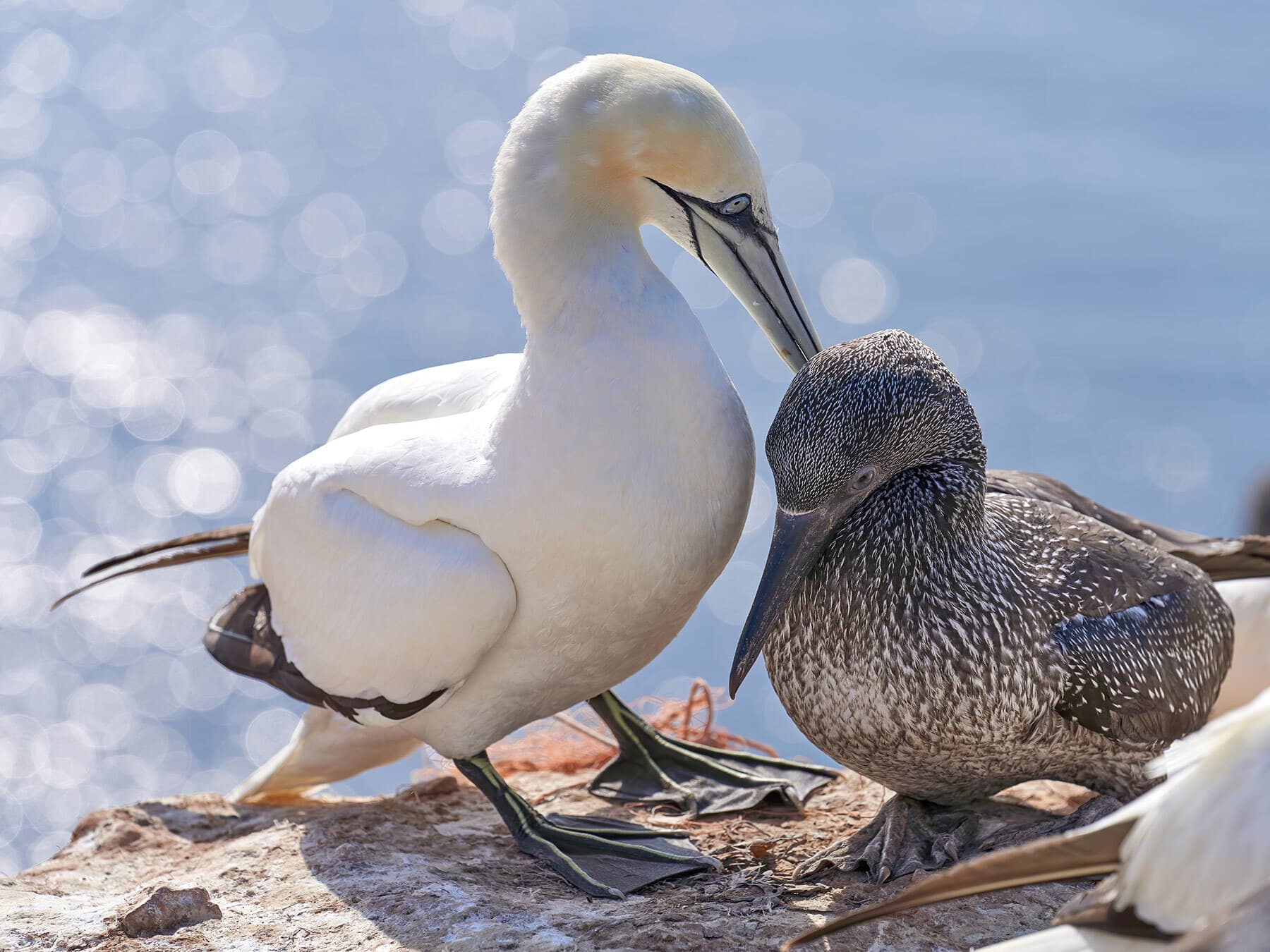
The Gannets’ behaviour at their densely packed breeding colony involves much aggression. This is important for maintaining order and individual spacing in such a crowded environment. Gannets threaten each other by jabbing with their sharp bills, twisting their heads, and with head-bowing displays.
Lifespan and predators
How long do Gannets live?
The oldest recorded Gannet lived to 26 years, although data collected in the 1960s and 70s indicates that the average lifespan of birds that reach adulthood is a little over 16 years.
What are the predators of Gannets?
Gannets do not have many predators. Seals and Bald and White-Tailed Eagles occasionally kill adult gannets. Eggs and hatchlings are more vulnerable, however, and may fall prey to large gulls, ravens, foxes, and weasels.
Are Gannets protected?
Gannets are protected by the Wildlife and Countryside Act of 1981 in the United Kingdom. In the USA, Northern Gannets are protected under the Migratory Bird Treaty Act.
Are Gannets endangered?
Gannets are not endangered. These birds are classified as a Least Concern species by the IUCN, with an increasing population of between 1.5 and 1.8 million individuals.
Conservation
While currently listed as Least Concern, Northern Gannets face threats from overfishing, which reduces their food supply, and marine pollution, particularly plastic ingestion. Climate change may also affect their breeding success and distribution.
Conservation efforts focus on protecting breeding colonies and marine habitats.
Similar birds
Often mistaken for
Quick facts
- Length
- 87–100 cm
- Wingspan
- 165–180 cm
- Weight
- 2300–3600 g
- Lifespan
- 15–17 years · oldest recorded 37 years
- Family
- Gannets & Boobies
- Migration
- Partial migrant
- Global status (IUCN)
- Least Concern
- World population
- 1,500,000 - 1,800,000 mature individuals
- Population trend
- Increasing
- Also called
- North Atlantic Gannet, Gannet
- Scientific name
- Morus bassanus
Questions
6How did the Gannet get its name?
The word Gannet probably stems from the old germanic word for a male goose. Their generic name, Morus, means foolish, a reference to their lack of fear for humans while nesting.
How many Gannets are in the wild?
According to the International Union for Conservation of Nature, the world population of Northern Gannets stands between 1.5 and 1.8 million individuals. There are an estimated 293,000 breeding pairs around the United Kingdom and about 116,000 pairs that breed on the east coast of North America.
What does it mean to call someone a Gannet?
Gannets may be wonderful seabirds, but calling someone a Gannet is, in fact, an insult. Someone with a particularly healthy (read gluttonous) appetite could be referred to as a Gannet.
Do Gannets go blind from diving?
Gannets do not go blind from diving. They have a transparent membrane that covers the eye during dives to protect them from trauma. Their nostrils open on the inside of their bills as a further adaptation. This prevents water from being forced into the nostrils while diving.
How deep can Gannets dive?
Gannets dive from a height of 10 - 40 meters (33 to 130 ft) above the water. They usually dive to depths of about 5 meters (16 ft) but they can dive to about 24 meters (80 ft) by flapping their wings and swimming down through the water.
How long can Gannets dive for?
Gannets typically spend less than 10 seconds under the water, although they have been recorded staying down for up to half a minute on deep dives.
Sources
4- 1BirdLife International. 2018. Morus bassanus. The IUCN Red List of Threatened Species 2018: e.T22696657A132587285. Source (opens in a new tab)
- 2BirdLife International. 2018. Morus bassanus. The IUCN Red List of Threatened Species 2018: e.T22696657A132587285. Source (opens in a new tab)
- 3BirdLife International. 2018. Morus bassanus. The IUCN Red List of Threatened Species 2018: e.T22696657A132587285. Source (opens in a new tab)
- 4BTO Ringing Data (1998) Source (opens in a new tab)

Checked by
Nathan Cope, founder and editor
Nathan founded Birdfact and leads its writers and contributors in the UK, the US and Canada. He has watched and studied birds for more than ten years, and checks every article and species guide before it’s published.