Species Profile
Chestnut-sided Warbler
Setophaga pensylvanica
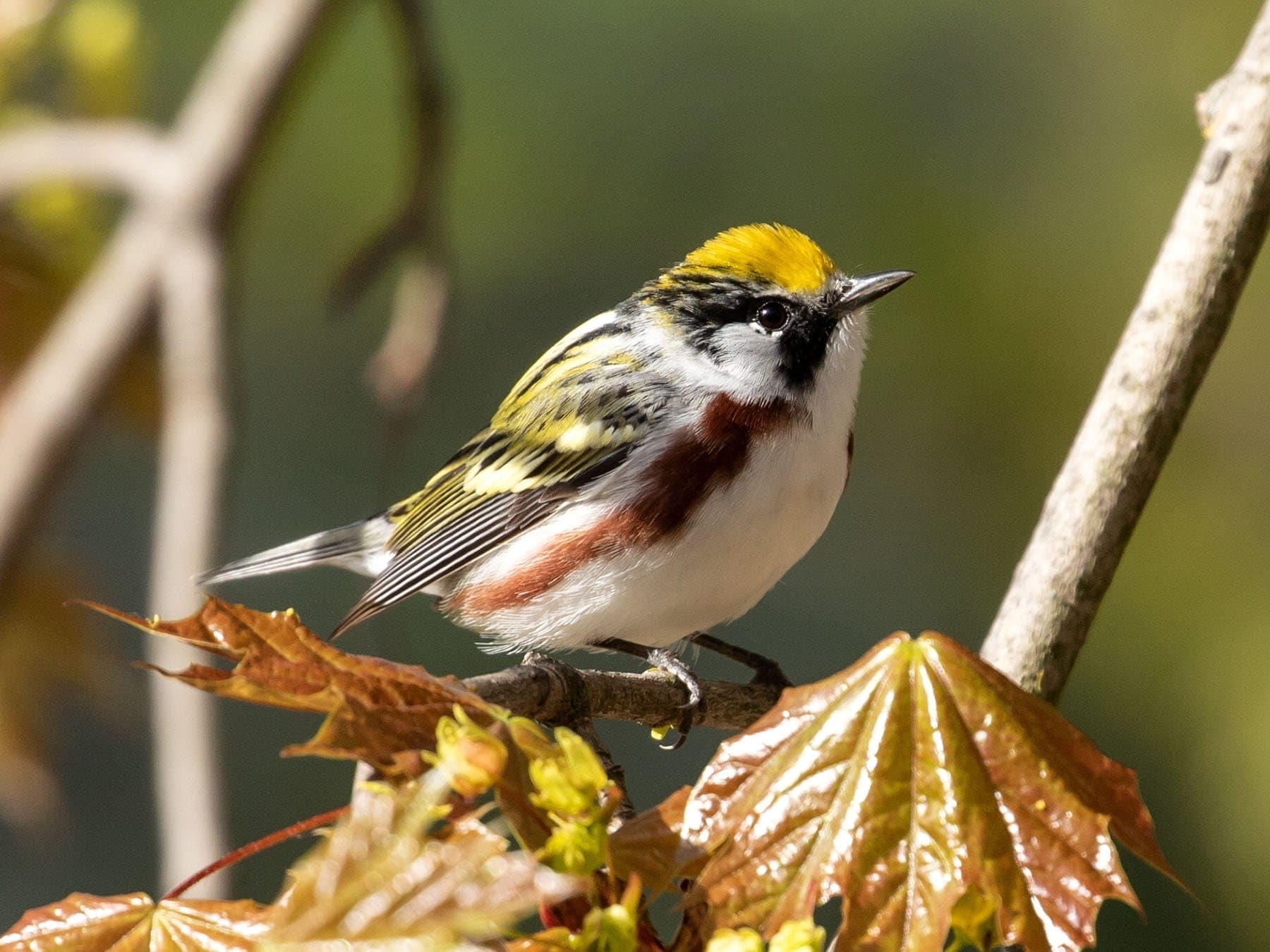
Chestnut-sided Warbler perched on a branch with reddish-brown leaves. Features yellow crown, black eye-line, white underparts, and chestnut flanks.
Quick Facts
Conservation
LCLeast ConcernLifespan
2–5 years
Length
10–14 cm
Weight
8–13.1 g
Wingspan
16–21 cm
Migration
Long-distance Migrant
Few North American warblers undergo as dramatic a seasonal transformation as the Chestnut-sided Warbler — a breeding male in May, with his yellow crown, bold black mask, and rich chestnut flanks, looks almost nothing like the lime-green, white-eyed bird he becomes by autumn. Equally striking is the species' history: John James Audubon saw it only once or twice in his entire life, yet today roughly 18 million individuals breed across eastern North America, making it one of the very few birds to have genuinely thrived because of large-scale deforestation.
Think you've spotted a Chestnut-sided Warbler?
Upload a photo and we'll confirm it instantly
Confirm with a PhotoAppearance
The Chestnut-sided Warbler is a slender, moderately sized New World warbler — 10–14 cm long and weighing 8–13 g — with one immediately distinctive habit: it holds its tail cocked upward above the body line while simultaneously drooping its wings, a posture so consistent that it identifies the bird at a glance even when colour is hard to judge.
Breeding males are unmistakable. The crown is bright yellow, the face white, and a bold black eyestripe runs back from the bill while a separate black malar stripe frames the throat below. The back is grey-green with dark streaking; the underparts are clean white. Running along each flank from the breast to the undertail coverts is a ragged, rich chestnut stripe — the feature that gives the species its name. Two yellowish-white wing bars are always present. The bill is short, stout, and dark slate-black; the legs and feet are similarly dark.
Non-breeding plumage is so different that autumn birds can puzzle even experienced observers. Both sexes transform into bright lime-green above, with a pale grey face, a neat white eye-ring, and pale grey-white underparts. The bold black mask disappears entirely. Some non-breeding males retain a trace of chestnut on the flanks, but this is reduced or absent in females and first-year birds.
Breeding females closely resemble males but are noticeably duller: the yellow crown is less vivid, the black eyestripe is replaced by a dull slate-grey line, the wing bars are broader and more yellowish, and the chestnut flank streaking is less extensive. First-fall females are the drabbest of all, often showing minimal or no chestnut whatsoever. Despite the dramatic seasonal difference, the species is thought to be most closely related to the Yellow Warbler (Setophaga petechia).
Identification & Characteristics
Male Colors
- Primary
- Yellow
- Secondary
- White
- Beak
- Black
- Legs
- Dark Grey
Female Colors
- Primary
- Green
- Secondary
- Grey
- Beak
- Black
- Legs
- Dark Grey
Male Markings
Bright yellow crown, bold black eyestripe and malar stripe, rich chestnut flank stripes, white underparts, two yellowish-white wing bars; characteristic cocked-tail posture with drooped wings
Tail: Moderately long tail, characteristically held cocked upward above the body line; white outer tail feathers visible in flight
Female Markings
Duller yellow crown, slate-grey eyestripe (not bold black), reduced chestnut on flanks, broader yellowish wing bars; non-breeding females lime-green above with white eye-ring and little or no chestnut
Tail: Same structure as male; cocked-tail posture maintained year-round in both sexes
Attributes
Understanding Attributes
Rated 0–100 based on research and observation. A score of 50 is average across all bird species. These attributes are relative and don't necessarily indicate superiority.
Habitat & Distribution
The Chestnut-sided Warbler is a specialist of early successional deciduous habitats — young, regrowing woodland that has been disturbed by logging, fire, flooding, wind damage, or agricultural abandonment. It thrives in dense thickets of shrubs and saplings, overgrown fields, brushy pastures, power-line corridors, and forest edges where small trees have been regenerating for a few years after disturbance. Numbers increase as soon as one year after clear-cuts, peak seven to eight years after disturbance, then decline as the forest matures and the canopy closes. Because such habitats are ephemeral, the species is typically present for fewer than 10 years in any given patch before moving on.
An exception is stunted highland oak forest at higher elevations in the southern Appalachians, where the species can persist longer as the slow-growing canopy takes decades to close. The species does not typically nest in urban or suburban areas. During migration, birds can be found in virtually any wooded or shrubby habitat, including mature forests far from their preferred breeding scrub.
The breeding range spans eastern North America, from Saskatchewan and the Canadian Prairies eastward to the Maritime Provinces — New Brunswick, Nova Scotia, and Prince Edward Island — and south through New England, the Great Lakes states, the Mid-Atlantic states, and along the Appalachian Mountains to northwestern Georgia. The range generally lies south of 50°N latitude. In the United States, the species is a common summer breeder across New England and the Great Lakes region; birders in states such as Vermont, New Hampshire, Massachusetts, Pennsylvania, and New York can expect to find it readily in appropriate scrubby habitats from May through August.
The species winters primarily in Central America, with the highest concentrations in Costa Rica and Panama. It also winters in southern Mexico, Belize, Guatemala, Honduras, Nicaragua, and into northwestern South America as far as northern Colombia, with a confirmed record from Ecuador. Migration occurs east of the Rocky Mountains, passing through the Bahamas, the Greater Antilles, and eastern Mexico. Strays appear regularly in the western United States in autumn, particularly in California.
In Great Britain, the Chestnut-sided Warbler holds "Mega" rarity status (BOU Category A), with only two confirmed autumn records. It has also been recorded three times in Greenland and once in the Azores (on Corvo). For British and Irish birders, any sighting would represent an exceptional transatlantic vagrant.
Where to See This Bird
Explore regional guides for locations where this bird has been recorded.
Georgia
Illinois
Massachusetts
Maryland
Maine
Michigan
Minnesota
Alabama
North Carolina
District of Columbia
Connecticut
New Hampshire
New York
Pennsylvania
Tennessee
Vermont
West Virginia
Wisconsin
Canada
Manitoba
New Brunswick
Nova Scotia
Ontario
Prince Edward Island
Quebec
Diet
Insects make up over 90% of the Chestnut-sided Warbler's diet, even on the wintering grounds. The principal prey items are lepidopteran larvae — caterpillars, including cankerworms and small moths — along with dipteran larvae, spiders, leafhoppers, small grasshoppers, and beetles. The genus name Setophaga, from the Greek for "moth-eating," reflects this preference for moth caterpillars, which can be abundant in the shrubby second-growth habitats the species favours.
The primary foraging method is gleaning: the bird hops rapidly through the outer foliage of shrubs and small trees, picking prey — especially caterpillars — from the undersides of deciduous leaves. It occasionally hovers momentarily to take items from foliage just out of reach, and will dart out to catch flying insects in mid-air, though aerial sallying is less frequent than in flycatcher-like warblers such as the American Redstart.
Seeds and fruit make up a small but measurable part of the diet, becoming slightly more important in winter. On the Central American wintering grounds, birds eat berries from plants in the melastome family, the mahogany family, and other tropical genera — including Cymbopetalum mayanum, a mahogany-relative whose berries have been recorded as a food source in Costa Rica. This dietary flexibility likely helps birds maintain condition during the non-breeding season when insect availability fluctuates.
Foraging height varies with habitat: on the breeding grounds, birds typically work shrubs and saplings at 1–3 m above ground; on the wintering grounds, they move higher into the mid- and upper canopy of mature tropical forest, tracking the mixed-species flocks they associate with.
Behaviour
The cocked tail and drooped wings are not just a field mark — they are an active social signal. During aggressive encounters between rival males, the tail is deliberately lowered and straightened, while the chestnut flank feathers are fluffed outward, making the bird look broader and more imposing. The contrast between the relaxed posture and the threat posture is sharp enough to function as a clear visual communication system.
Chestnut-sided Warblers forage actively and restlessly, hopping quickly from perch to perch among the outer branches of shrubs and small trees. They rarely stay still for long. Unlike some warblers that creep along trunks or probe bark, this species works the foliage — particularly the undersides of leaves — and tends to stay in the outer canopy of shrubs rather than near trunks or large branches. They forage alone rather than in conspecific groups during the breeding season.
On the wintering grounds in Central America, behaviour shifts considerably. Individual birds join mixed-species foraging flocks composed of resident antwrens and tropical warblers, and studies on Barro Colorado Island, Panama, have shown that wintering Chestnut-sided Warblers can be highly territorial against other members of their own species, actively defending feeding areas within those flocks. More strikingly, individuals show strong site-fidelity: they return to the same small area year after year and rejoin the same mixed-species flock they associated with in previous winters — a level of winter-ground loyalty rarely documented in migratory warblers.
Males sing at dawn and again in the evening, with overall singing rates declining as the breeding cycle progresses. After pairing, males switch to singing mostly unaccented territorial songs before sunrise, then switch back to accented mate-attraction songs for 20–40 minutes after dawn — a daily routine that shifts predictably with the stage of the nesting cycle.
Calls & Sounds
Male Chestnut-sided Warblers sing two functionally distinct song types, and understanding the difference between them reveals a great deal about how the species organises its social life. The first — and most famous — is the accented-ending song, a bright, musical, high-pitched whistle universally rendered as "pleased, pleased, pleased to MEETCHA!" or "see-see-see-Miss-BeeCHER!" The final syllable is strongly emphasised and rises in pitch. This song is used primarily to attract females and maintain the pair bond early in the nesting cycle, and it shows remarkably little geographic variation across the entire breeding range — a male from Georgia sounds essentially identical to one from Saskatchewan.
The second type is the unaccented-ending song, which lacks the emphatic concluding note and sounds more warbling and meandering. It is easily confused with the songs of Yellow Warblers and American Redstarts. This song is used primarily in territory defence and aggressive encounters with rival males, and unlike the accented song, it shows strong regional dialects. Researchers attribute this pattern to the dispersal behaviour of females: because females move long distances between breeding seasons, they exert selection pressure for a uniform, easily recognised mate-attraction song across the range. The territorial song, heard mainly by local rival males, faces no such pressure for uniformity, allowing local dialects to develop and persist.
Males that sing only unaccented songs are less successful at securing mates than males that sing both types. After pairing, males switch to singing mostly unaccented songs before sunrise, then revert to accented songs for 20–40 minutes after dawn. As the breeding cycle advances, the proportion of unaccented songs increases and overall singing rates decline. Singing peaks at dawn and again in the evening.
Only males sing regularly. The call note, used by both sexes year-round, is a sharp, husky "tchip" — sometimes described as a burry "breeet" or rough "zeet." It is a useful contact call during migration, when birds moving through unfamiliar habitats use it frequently.
Flight
In flight, the Chestnut-sided Warbler shows the typical warbler profile: short, rounded wings, a moderately long tail, and a slender body. Flight is direct and slightly undulating over short distances, with rapid wingbeats interspersed with brief glides — a pattern common to small passerines crossing open ground between patches of scrub. Over longer distances during migration, flight becomes more sustained and direct.
The white outer tail feathers are visible in flight and provide a useful field mark, flashing briefly as the bird lands or takes off. The cocked-tail posture is resumed almost immediately on landing, making the bird's silhouette distinctive even when colour is hard to assess in poor light.
During migration, Chestnut-sided Warblers travel primarily at night, navigating by the stars and Earth's magnetic field. They move east of the Rocky Mountains in both spring and autumn, with spring migration more concentrated through Mexico and the eastern US interior, and autumn migration slightly broader, with some birds crossing the Caribbean. Strays that overshoot or are displaced by weather systems regularly appear on the California coast in autumn, and the two British records almost certainly involved birds caught up in transatlantic weather systems during their southward migration.
Wingspan measures 16–21 cm — on the smaller end for the genus — and the relatively short wing chord (5.7–6.8 cm) gives the species a somewhat fluttery, buoyant quality in flight compared to longer-winged migrants. This wing shape suits the dense scrubby habitats the bird navigates on its breeding grounds, where manoeuvrability among tangled branches matters more than aerodynamic efficiency.
Nesting & Breeding
Males arrive on the breeding grounds a few days to a week before females in May, immediately beginning to sing to establish territories. Courtship displays are elaborate: the male fluffs his plumage, raises and spreads his yellow crown feathers, spreads and vibrates his wings and tail, and raises and lowers them repeatedly — a performance that showcases both the yellow crown and the chestnut flanks simultaneously. Despite the male's territorial role, it is the female who selects the precise nest site.
Nests are placed low in dense shrubs or tangles — blackberry, rhododendron, alder, or maple saplings are favoured — usually no more than 2 m above the ground, often in the crotch of several small branches or a vertical tangle of vines. The female builds the nest alone: a loosely constructed open cup of cedar or grapevine bark strips, fibrous weeds, grasses, roots, and fine plant down, lined with fine grass, hair, sedges, and rootlets, and sometimes bound with spider silk. Nests average 7.1 cm in diameter and 6.6 cm in height, with an interior cup approximately 5 cm across and 3.8 cm deep.
Clutch size is 3–5 eggs, usually 4, which are creamy white or greenish with brown speckles. Incubation lasts 11–12 days and is performed by the female alone. Both parents feed the nestlings, which fledge after approximately 10–12 days. The species typically raises one brood per season but may attempt a second if the first clutch fails. Breeding begins in the first year of life.
Brown-headed Cowbird (Molothrus ater) brood parasitism is a significant threat to nesting success. Cowbirds lay their eggs in Chestnut-sided Warbler nests, and the warbler typically raises the cowbird chick at the expense of its own young. After the eggs hatch, females actively chase other females that approach the territory — a behaviour that may help reduce the risk of further parasitism or nest interference.
Lifespan
The typical lifespan of a Chestnut-sided Warbler in the wild is 2–5 years, reflecting the high annual mortality rates common to small migratory passerines. The maximum recorded lifespan is 6 years and 11 months — a bird banded in Rhode Island in 1973 and recovered in the same state in 1980, a record held in the USGS Bird Banding Laboratory. This figure is a minimum estimate, since banding records can only confirm the time between banding and recapture; the bird may have been older when first banded.
Annual survival rates are difficult to measure precisely in a species that breeds in ephemeral habitats and winters in Central America, but are broadly consistent with other long-distance migratory warblers in the genus Setophaga. The Prothonotary Warbler, a close ecological counterpart in the same family, has a recorded maximum lifespan of around 8–9 years, suggesting the Chestnut-sided Warbler's longevity record may not represent the true biological maximum.
The principal mortality factors are predation during the breeding season (nest predators include snakes, raccoons, and corvids), collision with communication towers and illuminated buildings during nocturnal migration, and the energetic demands of twice-yearly long-distance migration between eastern North America and Central America. Brown-headed Cowbird parasitism reduces reproductive output but does not directly kill adults. Climate change is projected to compress the available breeding range significantly by 2080, which may increase competition for suitable habitat and reduce overall population resilience.
Breeding begins in the first year of life, which means even short-lived individuals can contribute to population recruitment — an important buffer against the species' ongoing population decline.
Conservation
The Chestnut-sided Warbler is listed as Least Concern on the IUCN Red List, with an estimated global population of approximately 18 million mature individuals. However, the population trend is clearly downward: the North American Breeding Bird Survey recorded a cumulative decline of approximately 45% between 1966 and 2015, equivalent to roughly 1.2% per year. The species rates 12 out of 20 on the Continental Concern Score, indicating low overall conservation concern, but several states have recognised localised declines — it is listed as a Species of Greatest Conservation Need in Delaware, Massachusetts, New Hampshire, Pennsylvania, and Rhode Island, and as High Priority by the Vermont Department of Fish and Wildlife. NatureServe lists it as Secure at the global level.
The primary long-term threat is habitat loss through forest maturation. As second-growth forests in the eastern United States continue to mature and canopy cover closes, the early successional scrub the species depends on for breeding shrinks. This is an ironic reversal: the species expanded dramatically during the 19th and 20th centuries as forests were cleared for agriculture, but now faces pressure as those same lands reforest naturally or through active conservation planting.
Additional threats include nocturnal collisions with communication towers and illuminated buildings during migration — the species has been identified as one for which greater than 1% of the population may suffer mortality at communication towers annually. Brown-headed Cowbird parasitism continues to reduce nesting success across the breeding range.
Climate change poses a longer-term structural threat. Audubon's climate models project that only 12% of the current core breeding range will remain climatically stable by 2080, with the species' climate space shifting rapidly northward and westward. Audubon classifies the Chestnut-sided Warbler as "climate threatened" — a designation that underscores the need for proactive habitat management, particularly the maintenance of early successional scrub through targeted logging, controlled burning, and power-line corridor management.
Population
Estimated: Approximately 18 million mature individuals
Trend: Decreasing
Decreasing. The North American Breeding Bird Survey recorded a cumulative decline of approximately 45% between 1966 and 2015 (about 1.2% per year).
Elevation
Breeding: lowlands to montane elevations in the Appalachians; higher-elevation stunted oak forest in the southern Appalachians supports persistent populations
Additional Details
- Predators:
- Nest predators include snakes, raccoons, and corvids. Adults are taken by small raptors including Sharp-shinned Hawks and Cooper's Hawks during migration. Brown-headed Cowbird brood parasitism significantly reduces nesting success.
Hybridisation
The Chestnut-sided Warbler occupies a fascinating position in the web of warbler hybridisation. In 2018, a bird found near Roaring Spring, Pennsylvania, by citizen scientist Lowell Burket was subjected to genetic, morphometric, and bioacoustic analysis by Cornell Lab researcher David Toews and colleagues, who published their findings in Biology Letters. The bird proved to be the offspring of a male Chestnut-sided Warbler (Setophaga pensylvanica) and a female "Brewster's Warbler" — which is itself a first-generation hybrid between a Golden-winged Warbler (Vermivora chrysoptera) and a Blue-winged Warbler (V. cyanoptera). This made the bird a triple hybrid, and the first documented case of intergeneric hybridisation between Setophaga and Vermivora.
The bird, christened "Burket's Warbler" in honour of its finder, sang like a Chestnut-sided Warbler but had the body proportions of a Vermivora warbler — a combination that reflects the mosaic nature of hybrid genomes, where different traits can be inherited independently from each parent lineage. Its existence demonstrates that reproductive barriers between these warbler genera are not absolute, at least under field conditions.
The discovery has broader conservation implications. Golden-winged Warblers are in steep decline across much of their range, and hybridisation with the more numerous Blue-winged Warbler is already considered a significant threat to Golden-winged Warbler genetic integrity. The Burket's Warbler case shows that the genetic consequences of this hybridisation can extend beyond the two primary species involved, potentially drawing in members of other genera. Understanding the frequency and fitness consequences of such intergeneric hybrids is an active area of warbler research.
Courtship & Display
Courtship in the Chestnut-sided Warbler is a multi-sensory performance that makes full use of the male's breeding plumage. When a female enters a male's territory, he responds by fluffing his entire plumage, raising and spreading the bright yellow crown feathers into a conspicuous crest, and simultaneously spreading and vibrating his wings and tail. The wings are lowered and raised repeatedly in a shivering motion, and the tail — normally held cocked upward — is fanned to display the white outer feathers. The chestnut flank patches, already visible at rest, become even more prominent as the flanks are puffed outward.
This display serves a dual function: it advertises the male's quality to the female while also signalling his identity as a Chestnut-sided Warbler rather than a rival of another species. The yellow crown and chestnut flanks are the two most species-specific visual signals the male possesses, and the display is structured to present both simultaneously and at maximum intensity.
Despite the male's energetic territorial and courtship behaviour, nest-site selection rests entirely with the female. She inspects multiple potential sites within the territory before committing to one, typically choosing a low position in dense shrubs where the nest will be concealed from above. The male accompanies her during site inspection but does not influence the final choice. Once the female begins building — a process she undertakes alone — the male's role shifts to guarding the territory and continuing to sing, with the balance between accented and unaccented songs shifting as the pair bond consolidates.
Birdwatching Tips
The breeding season — May through July — offers the best views of Chestnut-sided Warblers in their unmistakable alternate plumage. Focus on early successional habitats: overgrown fields, forest edges, power-line corridors, and areas of young regrowth 3–10 years after logging or disturbance. The bird's habit of holding its tail cocked upward is visible even at a distance and helps separate it from other warblers working similar scrubby habitats.
Listen for the accented song — the familiar "pleased, pleased, pleased to MEETCHA!" with its emphatic rising final note — which carries well through dense shrubs. Males sing most persistently at dawn and in the early morning, so arriving at a known site just after first light in May gives the best chance of locating birds by ear before tracking them visually.
In the United States, reliable breeding sites include the Adirondacks of New York, the Green Mountains of Vermont, the White Mountains of New Hampshire, and the Pocono Plateau of Pennsylvania. In Canada, the species is common in appropriate scrub habitats across New Brunswick, Nova Scotia, and southern Ontario. During spring migration (peak: mid-May), birds pass through the eastern US interior and can turn up in any wooded park or garden, often foraging low in shrubs — a good opportunity for close views.
In autumn (peak: September), non-breeding birds in lime-green plumage can be tricky. Look for the white eye-ring on a plain grey face, the yellowish wing bars, and — crucially — the cocked tail posture, which persists year-round. The Yellow Warbler is the most likely confusion species in autumn, but lacks the eye-ring and the cocked-tail habit. American Redstarts share similar scrubby habitats but have a very different body shape and foraging style.
For British and Irish birders, the species is a "Mega" rarity — only two autumn records exist for Great Britain. Any small warbler with a cocked tail and lime-green upperparts turning up on a headland in October deserves very careful scrutiny.
Did You Know?
- John James Audubon — who spent decades roaming eastern North America — reportedly saw the Chestnut-sided Warbler only once or twice in his entire life. The species was genuinely rare when mature forests dominated the landscape. The widespread clearing of those forests for agriculture from the 19th century onward created vast areas of second-growth scrub, and the Chestnut-sided Warbler's population exploded — making it one of the very few bird species to have dramatically benefited from large-scale deforestation.
- In 2018, a puzzling warbler found near Roaring Spring, Pennsylvania, by citizen scientist Lowell Burket was identified by Cornell Lab researcher David Toews and colleagues as the world's first documented "triple hybrid" warbler: the offspring of a male Chestnut-sided Warbler and a female "Brewster's Warbler" — which is itself a hybrid of a Golden-winged Warbler (Vermivora chrysoptera) and a Blue-winged Warbler (V. cyanoptera). The bird sang like a Chestnut-sided Warbler but had the body proportions of a Vermivora warbler. It was christened "Burket's Warbler" in honour of its finder, and represents the first known intergeneric hybridisation in this warbler group.
- Wintering Chestnut-sided Warblers on Barro Colorado Island, Panama, return to the same small feeding area year after year and rejoin the same mixed-species foraging flock they associated with in previous winters — a degree of winter-ground site-fidelity that rivals the territorial loyalty of resident tropical birds.
- The male's mate-attraction song ("pleased to MEETCHA!") is virtually identical across the entire breeding range from Saskatchewan to Georgia, while the territorial song shows strong regional dialects — a pattern driven by female dispersal behaviour, which selects for a uniform recognition signal but allows local variation in the aggression-context song.
- The oldest recorded Chestnut-sided Warbler was at least 6 years and 11 months old when found in Rhode Island in 1980 — it had been banded in the same state in 1973, providing a minimum estimate of the species' potential lifespan.
Records & Accolades
Two-Song Singer
2 distinct song types
Males sing two functionally different songs: a uniform mate-attraction song heard identically from Saskatchewan to Georgia, and a territorial song with strong regional dialects.
Triple Hybrid Parent
First intergeneric warbler hybrid
A Chestnut-sided Warbler fathered 'Burket's Warbler' in 2018 — the world's first documented triple hybrid warbler and first known intergeneric cross between Setophaga and Vermivora.
Deforestation Beneficiary
Population exploded post-1800s
So rare in Audubon's time that he saw it only once or twice in decades of fieldwork; large-scale forest clearing created the scrubby second-growth habitat the species thrives in.
Community Photos
Be the first to share a photo of the Chestnut-sided Warbler
Upload a PhotoIdentify Any Bird Instantly
- Upload a photo from your phone or camera
- Get an instant AI identification
- Ask follow-up questions about the bird
Monthly Birds in Your Area
- Personalised for your location
- Seasonal tips and garden advice
- Updated every month with new species