


Belted Kingfisher
Megaceryle alcyon
By the Birdfact teamChecked by Nathan Cope
See it in 3D
4 plumages
A Belted Kingfisher (Adult male) is 11–14 in (28–35 cm) long, bill to tail.
Adult male
© 2026 NC Digital Limited (Birdfact). All rights reserved. This 3D model may be viewed on this page and shared by link only. Downloading, extracting, copying or reusing it, or using it to train machine-learning models, is not permitted without our written permission. Using our models
On this page14 sections
How to recognise it
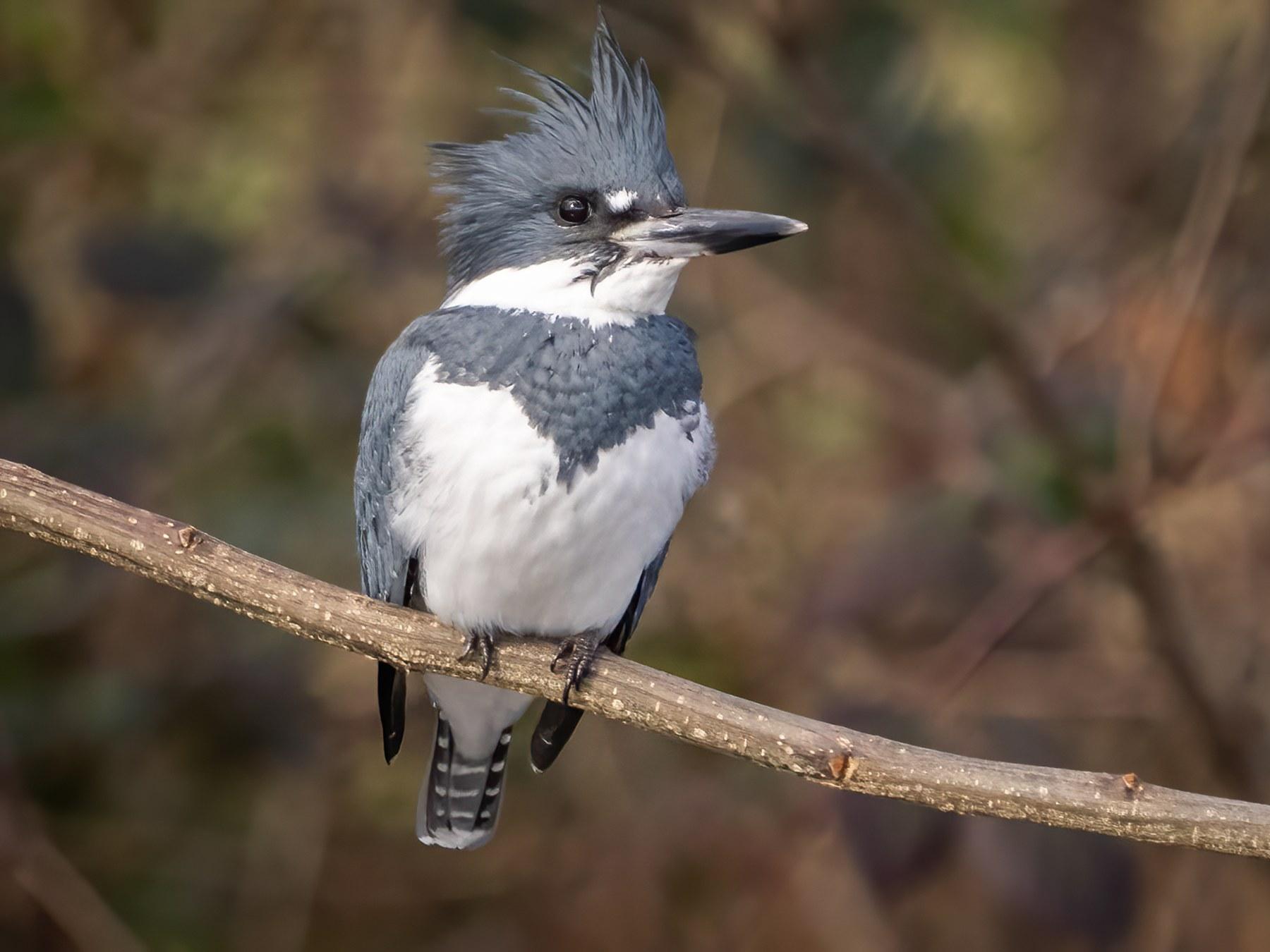
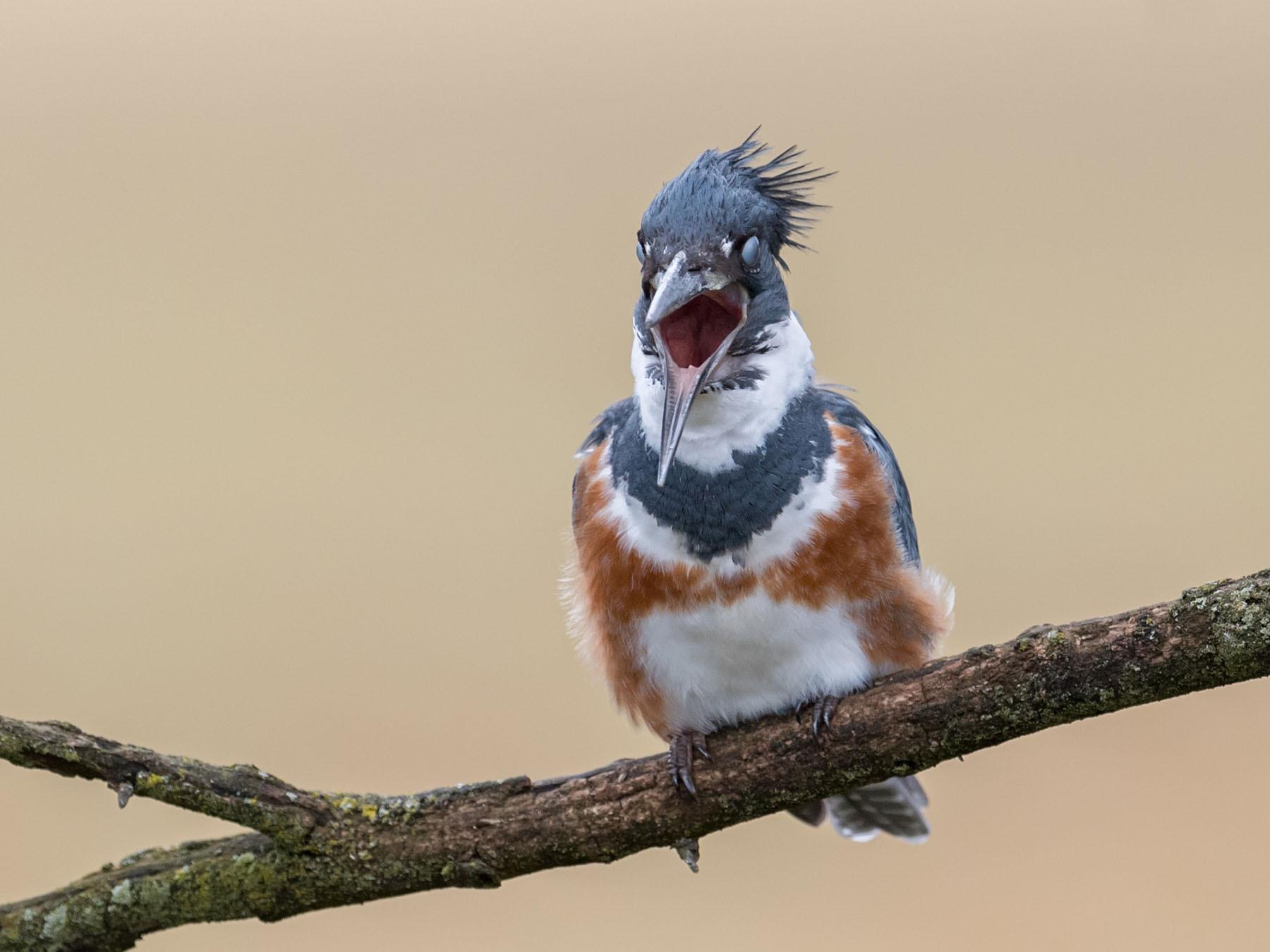
The Belted Kingfisher is a stocky, big-headed bird of rivers, lakes and coasts, blue-gray above and white below, with a ragged, double-pointed crest, a white collar and a heavy, straight, pointed bill. Across Canada and nearly all of the US it is the only kingfisher, so a big blue-gray bird perched on a branch or wire over water, or diving headfirst into it, is almost certainly this one.
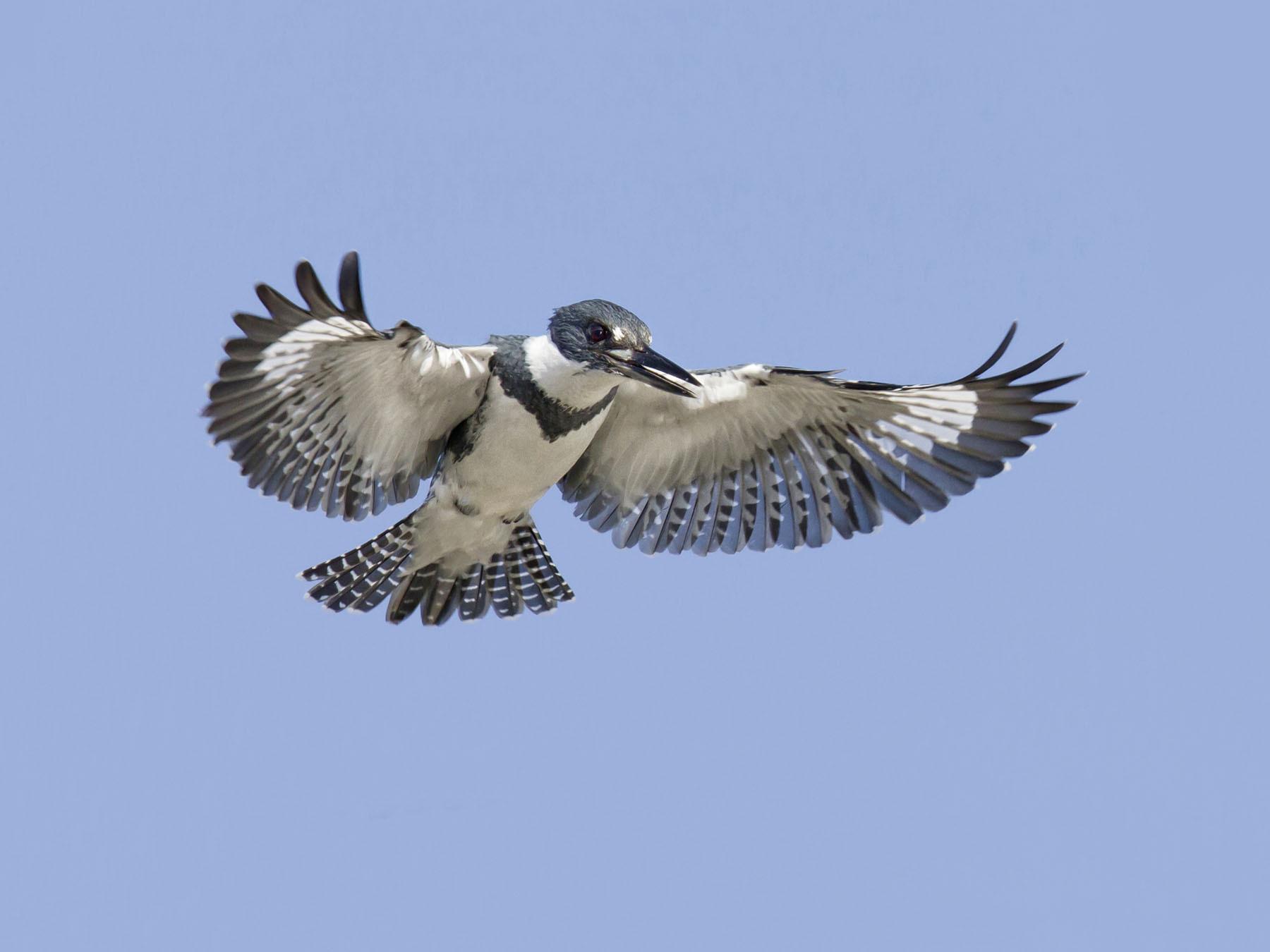
You will often hear it before you see it: a loud, dry, mechanical rattle as it flies low along a stream or shoreline. Look for a small white spot in front of each eye, small white spots on the dark wings and tail, and, in flight, a big white flash across the outer wing and a big head on a short-tailed body.
Size
A Belted Kingfisher is 11-13.8 in (28-35 cm) long, with a wingspan of 19-22.8 in (48-58 cm), and weighs about 4.9-6.0 oz (140-170 g). That makes it larger than a Hairy Woodpecker and smaller than an American Crow. Males and females overlap in weight, and within a pair either bird may be the heavier.
Male and female
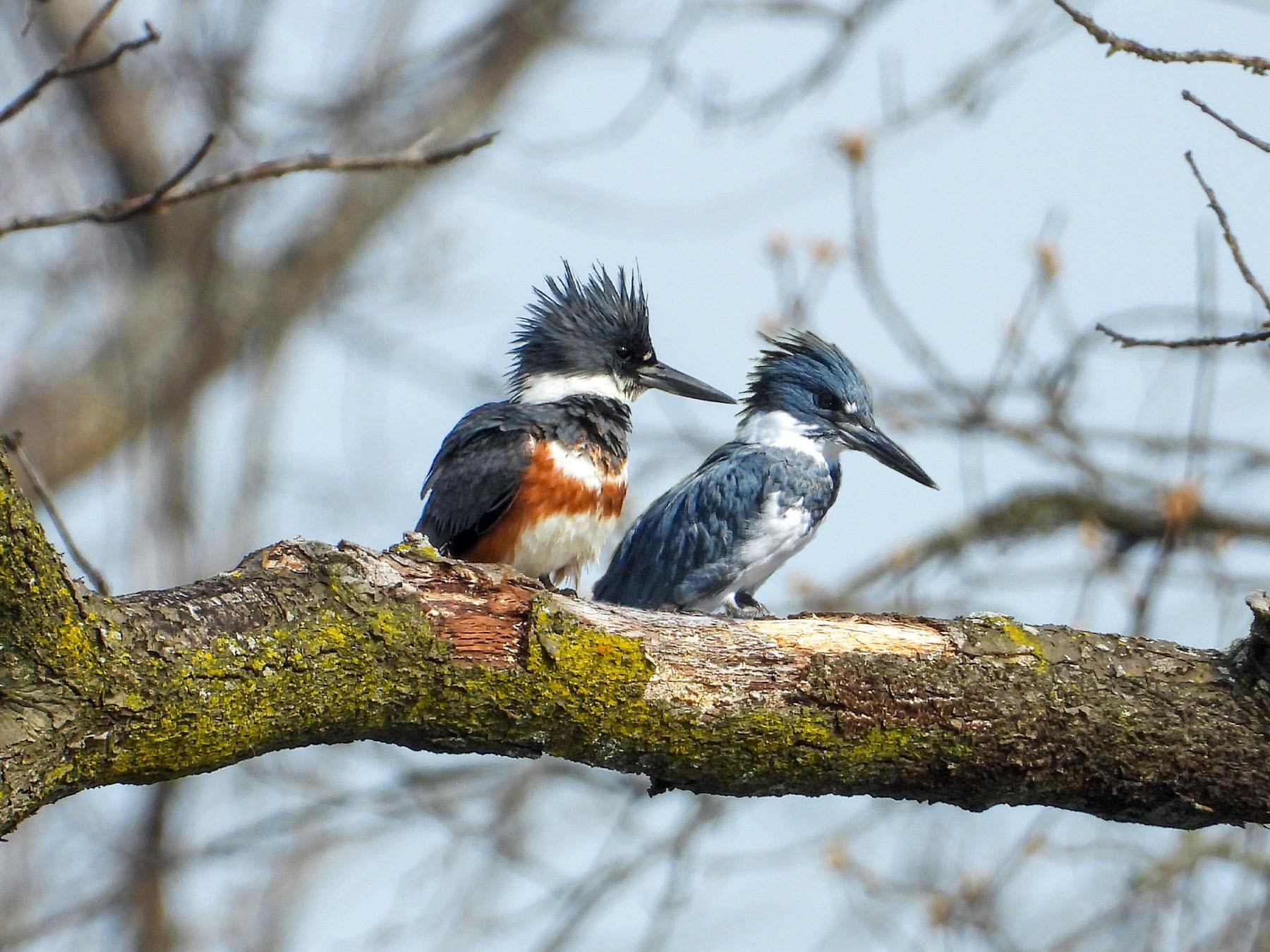
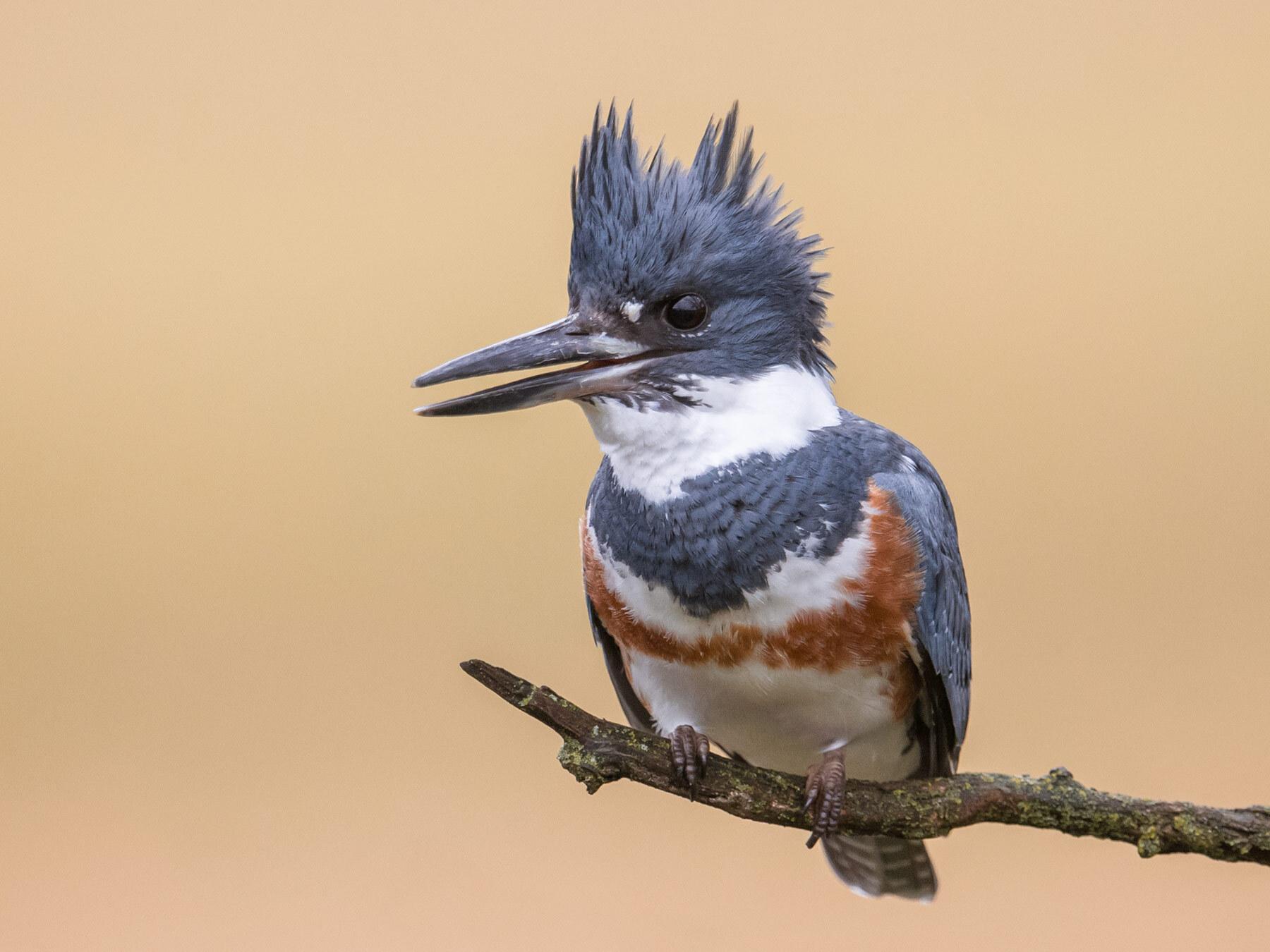
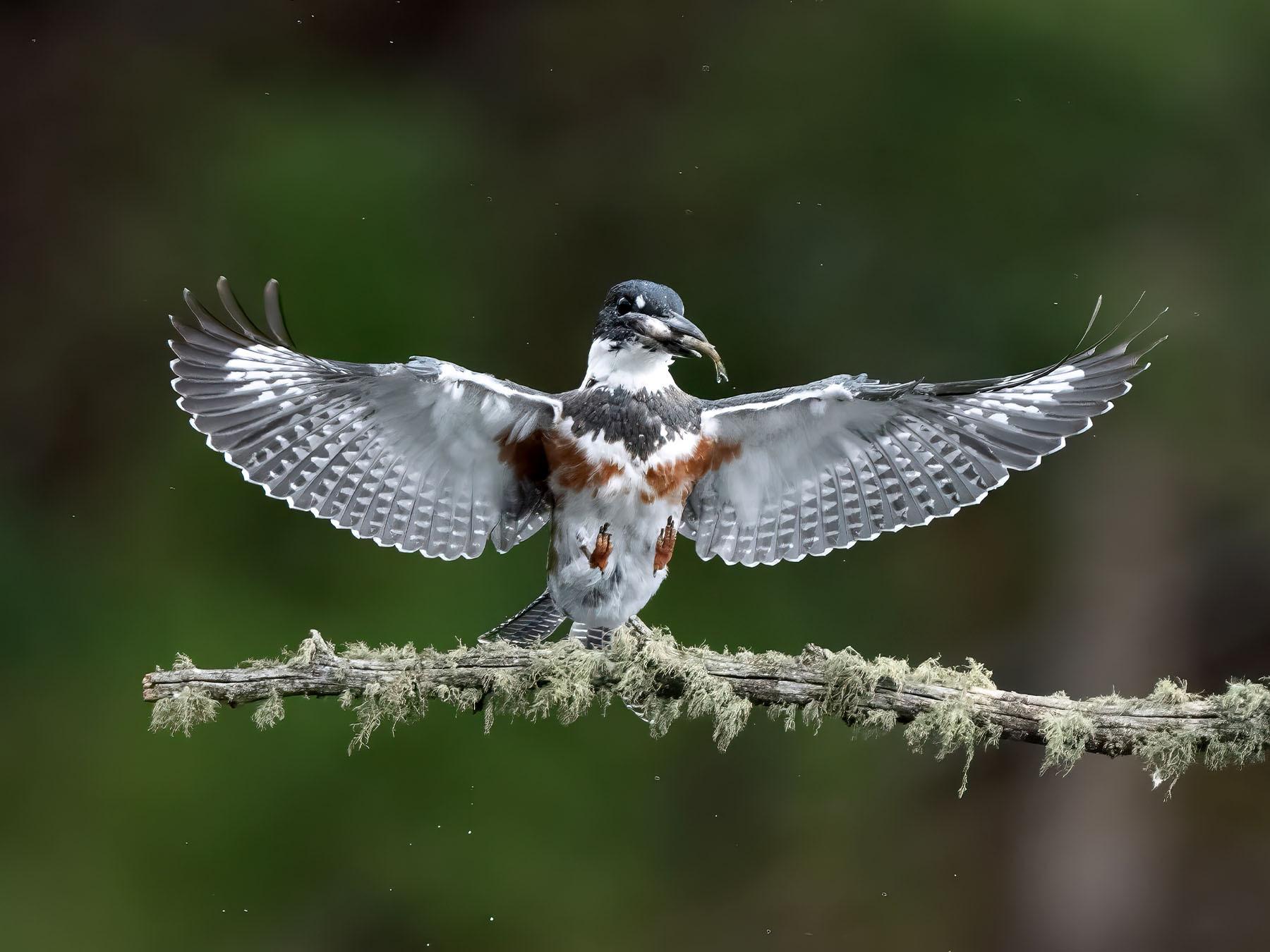
This is one of the few birds in which the female is the more colorful sex. Both have a blue-gray band across the breast, but the female also has a rufous band lower down and rufous flanks; the male is white below his single blue-gray band, with at most a little rufous on the flanks. Among the nearly 100 kingfisher species the sexes often look alike, and in some the male is the brighter one.
Why the female is the brighter one is not settled. One idea comes from a study of kingfisher plumage on Virginia rivers: in the closest relative, the Ringed Kingfisher, both sexes are rufous below, which raises the possibility that the rufous belly is the older state and the male's white belly the novelty, shaped by sexual selection. The same study found that the blue breast bands of the two sexes differ subtly in color too.1
Juveniles
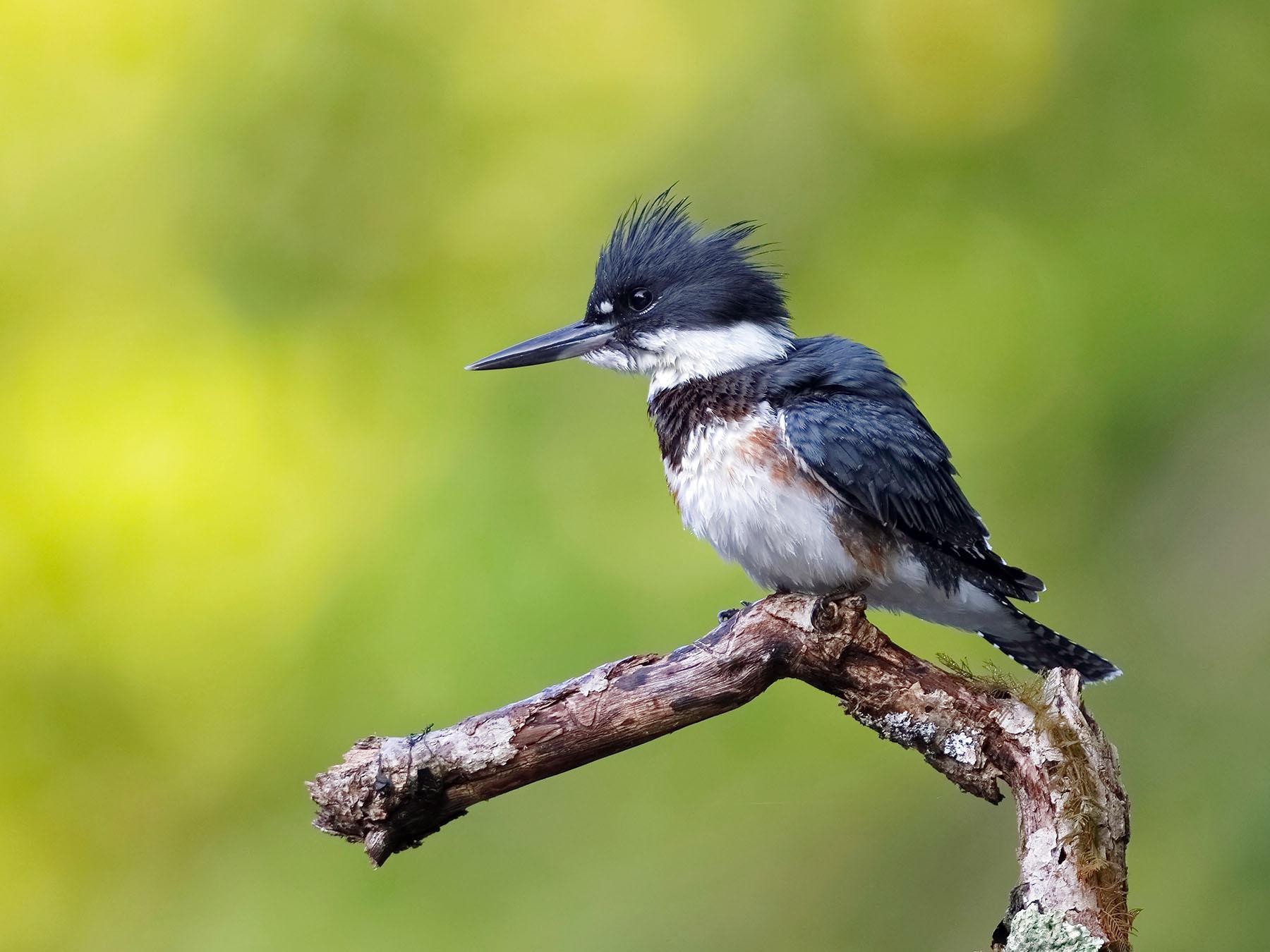
Young birds out of the nest from summer into fall look much like adults, but the breast band is edged or mixed with cinnamon, rufous or brown, more so in young females, though young males show some too. They have more white in the wing, and for a while after leaving the nest a noticeably short bill. They keep this plumage until October or November and molt into adult-like plumage over the winter and spring.
Identification: other kingfishers
Only in the far south does another kingfisher turn up. The Ringed Kingfisher, found along the lower Rio Grande and in southern Texas, is bigger, 15-17 in (38-43 cm) long, with rufous underparts below its white collar (crossed by a blue-gray band on the female). The Green Kingfisher of streams near the Mexican border is much smaller, 7-8 in (17-20 cm), darker above with a less obvious crest and white outer tail feathers that show in flight.
The kingfisher of Europe and Asia, the Common Kingfisher, is one of the small kingfishers of the Old World, a different branch of the family; the Belted Kingfisher belongs with the large kingfishers, and its closest relative is the Ringed Kingfisher.
Not sure it’s a Belted Kingfisher? Check your photo: Birdfact names the bird and shows the look-alike side by side.
Its size
Adults- Length
- 28–35 cm
- Wingspan
- 48–58 cm
- Weight
- 140–170 g
Its song and calls
The Belted Kingfisher has no song. Its call is a loud, dry, mechanical rattle, given all year by both sexes, in short bursts or long runs, at the slightest disturbance: in territory disputes, when a person walks into its territory, and as it flies up and down a stream. A disturbed bird often flies along the water rattling until the intruder has gone.
Adults usually rattle as they reach the nest: in one study they rattled on 93% of 109 approaches to their burrow and 56% of 105 departures, males and females alike.2
The rattle is probably a graded signal, with different volleys meaning different things. One study of the species' calls described three others: screams, given in retreat and defensive threat; harsh calls, which males use in disputes with other males and, mixed with screams, to attract females; and a softer warbling call, given by females soliciting mating.3 Pairs also give mews after mating.
Each bird's calls seem to carry its identity. In playback tests at five nests in southern Ohio that measured the heart rate of birds sitting on eggs, the birds reacted differently to familiar and unfamiliar calls.4
- Rattle calls0:00 / 0:14
Recorded in Virginia, United States · February 2022
- Rattle call in flight0:00 / 0:07
Recorded in Alabama, United States · November 2021
Heard one and not sure? Let the bird song identifier listen.
When and where to see it
Look for Belted Kingfishers wherever there is clear water with small fish and somewhere to perch: streams, rivers, ponds, lakes, estuaries and calm coastal water. They are rarely found on muddy water, masses of water plants may put them off, and on lakes they favor sheltered coves and shallow bays. To breed they also seem to need a bare, near-vertical earth bank to dig into.
They breed across North America, from southern Alaska and Canada south through most of the United States, but thinly in dry country, the central grasslands and deserts, and they are absent from the high Rockies above about 9,000 ft (2,750 m). In Florida they are scarce and local as breeders south of the Panhandle, probably for lack of nest sites. Even where common they are thinly spread along the water, with almost no concentrations.
Do they migrate?
Some do and some don't. Most US populations are partial migrants: birds stay through the winter wherever open water lets them keep fishing, and the rest move south, as far as Mexico, Central America, the Caribbean and northern South America. Birds from the interior of Alaska and Canada leave entirely; they stay the winter along the coast of British Columbia and in the Aleutians, and a few stay wherever water stays open. Ice cover, which stops them fishing, is a key factor in where they go.
Spring migrants move north mainly from late March through April, following lake shores and river valleys; fall migration is more drawn out, from mid-September through November. Males seem either less likely to migrate or to travel shorter distances than females: more males stay at high latitudes in fall and winter.5 More females reach southern Florida.6 Even on migration they defend their patch: on the Lake Huron shore in fall 2003, three males split a bay into territories and held them for 11 days before moving on.7
Wanderers have turned up as far away as the Galapagos, Hawaii, Greenland, Iceland, the Azores, the Netherlands, and Britain and Ireland.
Tips for seeing it
What it eats
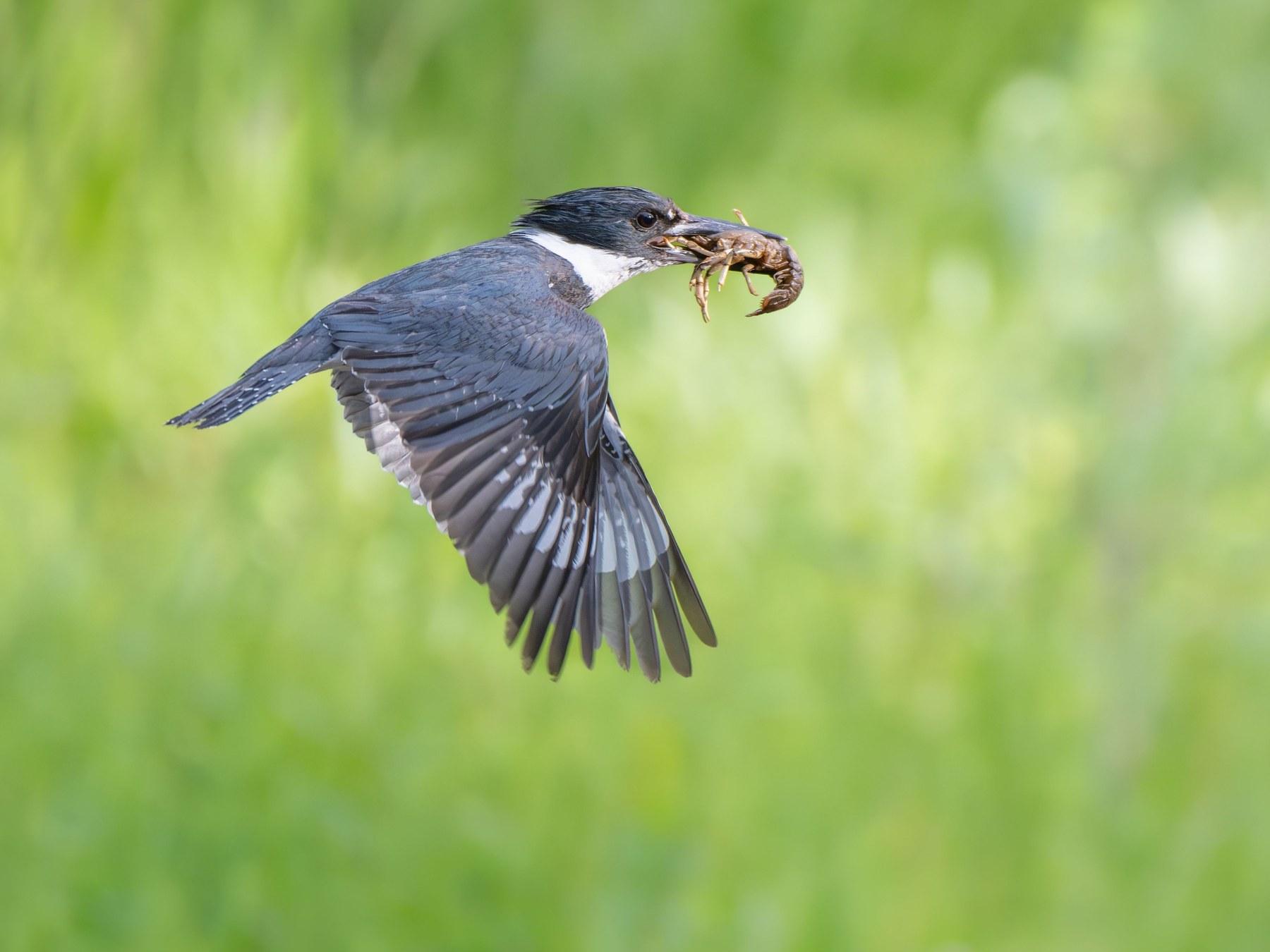
Mostly small fish caught near the surface, usually whichever kinds are most common and easiest to catch in clear, shallow water: trout and stonerollers in streams, sticklebacks and mummichogs in salt water. In Michigan the fish eaten averaged about 2.3 in (6 cm) long.8 Bigger fish are not out of reach: in trials with 12 wild kingfishers, the birds preferred fish of 4.3-5.1 in (11-13 cm), though a cluttered stream bed made those fish harder to get.9 Crayfish are the other main prey, especially when high water turns the stream muddy, and kingfishers also take frogs and tadpoles, aquatic insects and other invertebrates, and now and then young birds, small mammals, lizards and even berries.
Many diet studies were made on trout waters. In Michigan, trout made up 29-80% of the fish taken by kingfishers on trout streams, but on lakes trout were in only 17% of the diet, and on Canadian rivers more than 1,300 pellets and stomachs showed kingfishers taking whichever fish were most abundant in shallow water.6

Hunting and feeding
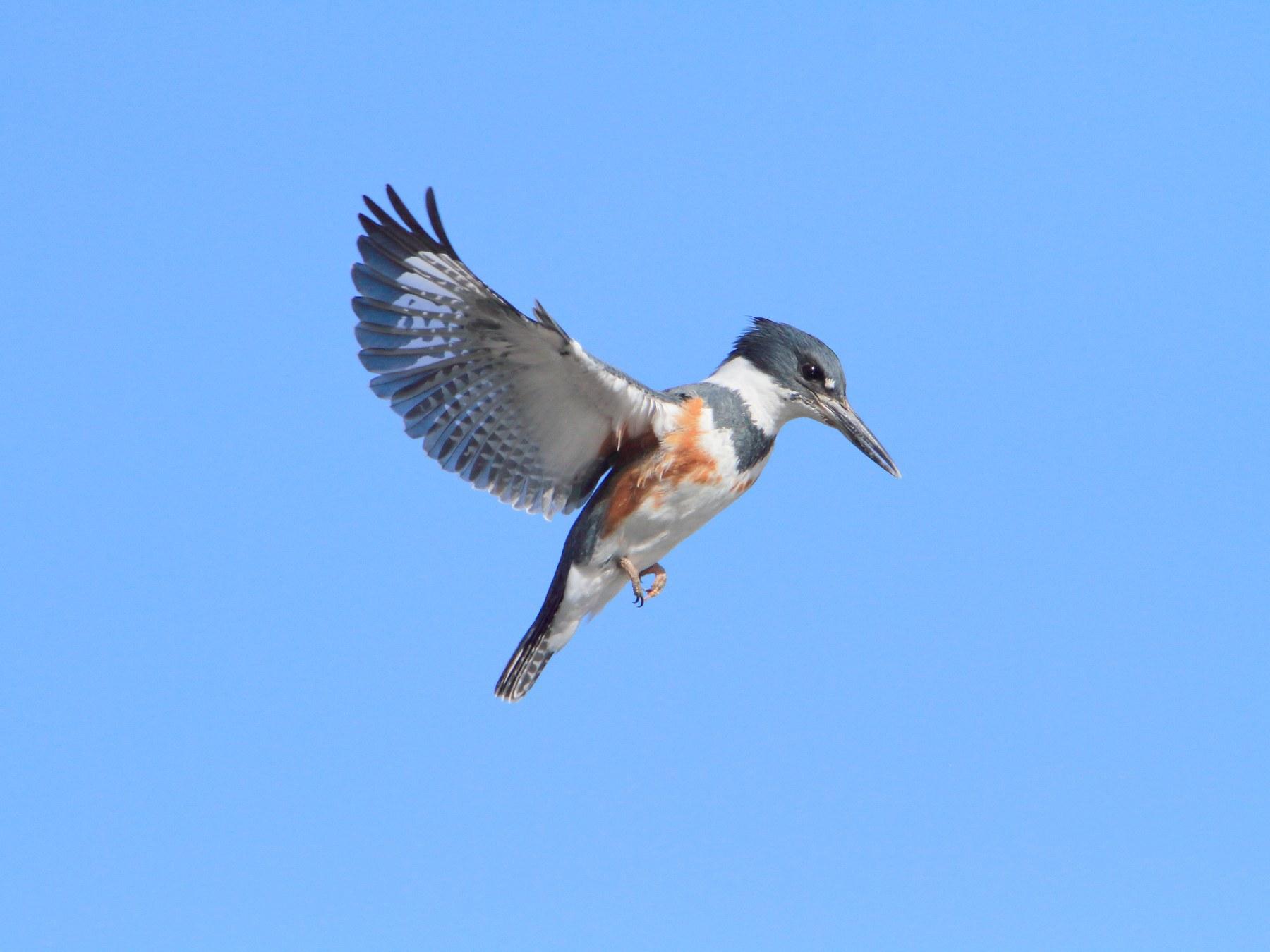
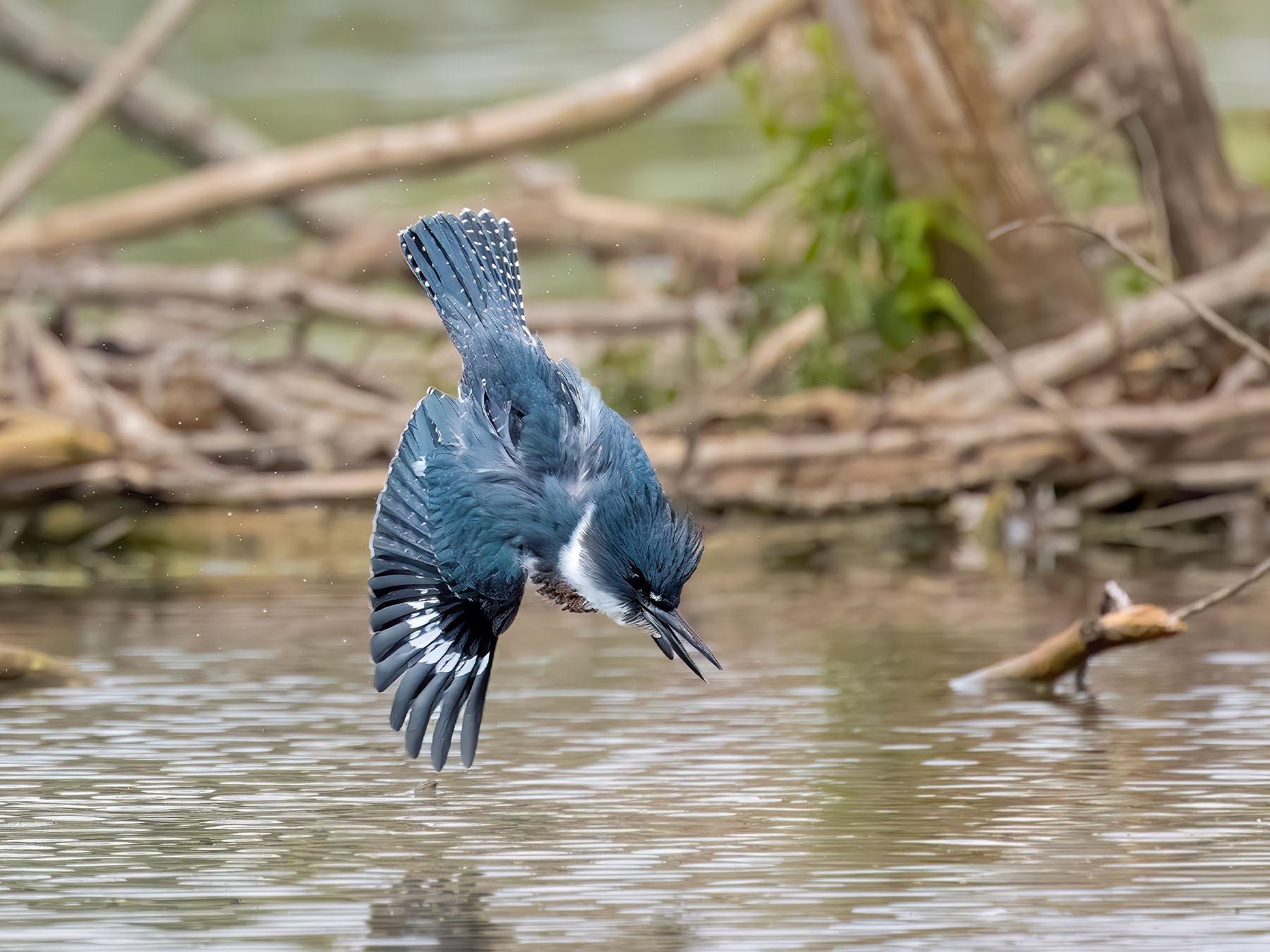
A kingfisher watches from a bare branch, a wire or a piling over the water, or hovers on fast wingbeats above it, then plunges headfirst and seizes the fish in its bill like a pair of pincers, usually without going right under. Most fish are caught within about 2 ft (60 cm) of the surface. Back on a perch, it beats the fish against the branch with sideways swings of the head to stun it and turn it, then swallows it headfirst. Bones and scales it cannot digest come back up later as pellets beneath its favorite perches.
On streams they favor riffles, where fish are easier to see and catch: on an Ohio creek in fall, kingfishers were fishing riffles in 71% of 80 observations, though riffles made up only 36% of the stream.10 In Florida one was watched hovering over a Snowy Egret that was chasing fish up from the shallows; it dived three times and caught two fish.11
Nesting and breeding
Belted Kingfishers nest underground. A pair digs a burrow into a bare, near-vertical earth bank, usually beside water but sometimes in a road cut, ditch, landfill or sand or gravel pit some way from it. Both birds dig, the male about twice as long as the female; one digs while the other rattles from a nearby perch and soil sprays out of the entrance behind the digger's feet. A burrow usually takes 3-7 days, sometimes as long as three weeks.
The finished tunnel runs 3.3-6.6 ft (1-2 m) into the bank, usually sloping upward from the entrance, and ends in an unlined, roughly round chamber. In Ontario, 71 tunnels ranged from 1 to 8 ft (0.3-2.5 m).6 A burrow that hits a big rock or root is often abandoned. Fish bones and scales coughed up by the sitting birds may build up beneath the eggs.
Suitable banks can be scarce, and in places digging by people has helped: sand and gravel pits and road cuts have given kingfishers new nest sites and let them increase and spread in some regions.
In north-central Minnesota, where natural banks are few, 21 of 25 nests (84%) were in sites created by people.12 Soil matters too, though studies differ: in Ohio and Pennsylvania breeding birds chose high, vertical banks of sandy soil, while in Colorado they dug into soils with less sand than the banks around them.13, 14 To start a burrow, a Montana pair flew at the bank and struck it bill-first, 176 times in three hours of watching over three mornings, the male and female alike.15
Eggs and young
Eggs are laid from March or April in the south to May and June farther north. The eggs are pure white and glossy. Bent's 1940 summary gave clutches of 5-8, most often 6 or 7, and clutches of 4-6 have been reported in Washington.6 Incubation starts with the last egg and lasts about 22 days. Both parents sit, the female through the night and the male from early morning, though studies disagree on how large the male's share is.
The chicks hatch naked, pink and blind, and huddle together for warmth. For the first few days the parents feed them regurgitated, partly digested fish, then whole fish, one per trip, the male bringing food at least twice as often as the female. The young leave the burrow 27-29 days after hatching, and the parents go on feeding them for about three weeks; they do not catch live fish for at least a week after leaving.
There is one brood a year in the north, perhaps two in the south. Nest success can be high: in northern Minnesota nearly 87% of 92 eggs hatched and 97% of the chicks fledged over four seasons, leaving out deaths caused by the researcher.6 Food can affect the timing: in Colorado, in two of three years, pairs given extra fish from early March started nesting earlier, and early nesters raised heavier chicks and were more likely to try again after a failure.16, 6
Learning to fish takes time. On San Juan Island, Washington, young birds after fledging fished less successfully than adults, which caught fish almost twice as large.17
Behaviour
Outside the breeding season Belted Kingfishers live alone. Both members of a pair defend a stretch of stream or shoreline with loud rattles and aerial chases; on an Ohio creek breeding territories averaged about 0.6 mile (1,030 m) of stream.10 Birds that stay north for the winter often hold a smaller feeding territory then too, in some populations mostly males, until the water freezes.
An alarmed kingfisher raises its crest and bobs up and down on its perch. In courtship the male brings the female a fish: the two shuffle along the perch, turning, until side by side, and she swallows it. After mating the male may fly a display over the water, spiraling up, stalling and tumbling down before gliding off with the white in his wings flashing.
Their short legs and partly joined front toes make walking hard; they shuffle in and out of the burrow. In flight they flap two or three times, glide, and often fly so low that their wingtips brush the water. Males that stay the winter in Massachusetts commonly dig burrows to roost in, which appear to save 10-30% of their energy in freezing weather.6
Lifespan and predators
Survival is little studied. Few birds banded as nestlings are found again: in Massachusetts only 2 of 188 came back to breed. Death rates, especially of young birds, appear high, but it is hard to separate dying from moving away: in the same study 21 young birds moved an average of 37 miles (60 km) after fledging.6
The USGS Bird Banding Laboratory's longevity list holds a single Belted Kingfisher: a female banded as a young bird in Maryland in August 2017 and caught and released alive there in August 2021, at least 4 years 2 months old.18 With so few kingfishers banded, that is a minimum, not a sign of how long they can live.
Predators and other dangers
Hawks are a danger. Young birds fly weakly in their first weeks and appear especially vulnerable to hawks such as the Cooper's Hawk, while adults escape by diving into the water. Mink, raccoons, skunks and snakes sometimes raid burrows, but predators rarely get in; most nests that fail are lost to floods or collapsing banks, or the chicks starve after a parent dies or leaves.
Conservation
The Belted Kingfisher is common and widespread, listed as Least Concern.19 Partners in Flight estimates about 1.8 million birds, all breeding in the US and Canada, and rates it of fairly low conservation concern, 10 out of 20.20, 21
But numbers have fallen over the long term. The North American Breeding Bird Survey shows a decline of 0.87% a year from 1966 to 2025 (95% credible interval -1.10 to -0.66), in both the US and Canada, and the survey's index is about 40% lower than in 1966; no state or province shows a clear increase. Over the last ten years, 2015-2025, the trend is close to flat and not significant.22 Roadside counts like this survey monitor waterside birds poorly,6 and the survey itself marks its kingfisher results as having a deficiency.22
It seems less affected by pollutants than other fish-eating birds, possibly because the small fish it eats hold fewer toxins. It is sensitive to disturbance, though, and may leave places people visit often, especially in the breeding season.
Status, the law and fish hatcheries
Before migratory bird laws protected them, kingfishers were shot and trapped, especially at fish hatcheries and on trout streams where they were seen as serious predators; more than 400 were taken at one private hatchery near Lake Michigan in a single spring migration.6 There is no sign the shooting ever put the population at risk.
A 1946 study of kingfishers and fish management in Michigan found that at hatcheries kingfishers ate mostly the fish being raised, while on natural waters they took mostly fish of no food or game value, and crayfish; it judged kingfishers undesirable at hatcheries but general control on natural waters not biologically justified.8 Fish-eating birds together can change stream fish: when Great Blue Herons and kingfishers were kept off stretches of two Midwestern streams with netting, medium-sized striped shiners and stonerollers increased.23
In the US the Belted Kingfisher is protected under the Migratory Bird Treaty Act, which makes it unlawful to take, kill or possess the bird, its nest or eggs without a permit; it is on the federal list of protected species.24, 25 Killing one, for example at a fish farm, needs an individual federal depredation permit, while no federal permit is needed simply to scare birds away; federal policy treats such permits as short-term relief, issued only when other deterrents have failed.26, 27 In Canada kingfishers fall outside the Migratory Birds Convention Act, 1994, though they may be protected by other laws, including provincial and territorial ones.28
Belted Kingfisher guides
1 guidesQuick facts
- Length
- 28–35 cm
- Wingspan
- 48–58 cm
- Weight
- 140–170 g
- Lifespan
- oldest recorded 4 years 2 months
- Family
- Kingfishers
- Migration
- Partial migrant
- Global status (IUCN)
- Least Concern
- World population
- 1,800,000 (Partners in Flight, about 2010)
- Population trend
- Declining over the long term (1966-2025), about 40% fewer on the survey's routes; no clear change in the last ten years
- Scientific name
- Megaceryle alcyon
Questions
2Is a Belted Kingfisher a woodpecker?
No. It is a kingfisher. Like a woodpecker it digs its own nest hole, but usually into an earth bank rather than a tree.
Do Belted Kingfishers mate for life?
Not as far as is known. Pairs are monogamous for the breeding season, and outside it the birds live alone.
Sources
32- 1White, A. E. and Cristol, D. A. (2014). Plumage coloration in Belted Kingfishers (Megaceryle alcyon) at a mercury-contaminated river. Waterbirds 37: 144-152. doi:10.1675/063.037.0203 (opens in a new tab)
- 2Hendricks, P. and Hendricks, L. M. (2021). Context of rattle-call use by adult Belted Kingfishers (Megaceryle alcyon) near their nests. Wilson Journal of Ornithology 133: 629-634. doi:10.1676/19-00099 (opens in a new tab)
- 3Davis, W. J. (1988). Acoustic communication in the Belted Kingfisher: an example of temporal coding. Behaviour 106: 1-23. doi:10.1163/156853988X00061 (opens in a new tab)
- 4Davis, W. J. (1986). Acoustic recognition in the Belted Kingfisher: cardiac response to playback vocalizations. The Condor 88: 505-512. doi:10.2307/1368279 (opens in a new tab)
- 5Kelly, J. F. (1998). Latitudinal variation in sex ratios of Belted Kingfishers. Journal of Field Ornithology 69: 386-390. Accessed 10 November 2026. Source (opens in a new tab)
- 6Kelly, J. F., Bridge, E. S. and Hamas, M. J. (2020). Belted Kingfisher (Megaceryle alcyon), version 1.0. Birds of the World (A. F. Poole, editor). Cornell Lab of Ornithology. doi:10.2173/bow.belkin1.01 (opens in a new tab)
- 7Hamas, M. J. (2005). Territorial behavior in Belted Kingfishers, Ceryle alcyon, during fall migration. Canadian Field-Naturalist 119: 293-294. doi:10.22621/cfn.v119i2.117 (opens in a new tab)
- 8Salyer, J. C. and Lagler, K. F. (1946). The Eastern Belted Kingfisher, Megaceryle alcyon alcyon (Linnaeus), in relation to fish management. Transactions of the American Fisheries Society 76: 97-117. doi:10.1577/1548-8659(1946)76[97:TEBKMA]2.0.CO;2 (opens in a new tab)
- 9Kelly, J. F. (1996). Effects of substrate on prey use by belted kingfishers (Ceryle alcyon): a test of the prey abundance-availability assumption. Canadian Journal of Zoology 74: 693-697. doi:10.1139/z96-078 (opens in a new tab)
- 10Davis, W. J. (1982). Territory size in Megaceryle alcyon along a stream habitat. The Auk 99: 353-362. doi:10.1093/auk/99.2.353 (opens in a new tab)
- 11Meyerriecks, A. J. and Nellis, D. W. (1967). Egrets serving as 'beaters' for Belted Kingfishers. Wilson Bulletin 79: 236-237. Accessed 10 November 2026. Source (opens in a new tab)
- 12Hamas, M. J. (1974). Human incursion and nesting sites of the Belted Kingfisher. The Auk 91: 835-836. doi:10.2307/4084743 (opens in a new tab)
- 13Brooks, R. P. and Davis, W. J. (1987). Habitat selection by breeding Belted Kingfishers (Ceryle alcyon). American Midland Naturalist 117: 63-70. doi:10.2307/2425708 (opens in a new tab)
- 14Shields, S. J. and Kelly, J. F. (1997). Nest-site selection by Belted Kingfishers (Ceryle alcyon) in Colorado. American Midland Naturalist 137: 401-403. doi:10.2307/2426860 (opens in a new tab)
- 15Hendricks, P., Richie, D. and Hendricks, L. M. (2013). Aerial ramming, a burrow excavation behavior by Belted Kingfishers, with a review of its occurrence among the Alcedinidae. Wilson Journal of Ornithology 125: 197-201. doi:10.1676/12-075.1 (opens in a new tab)
- 16Kelly, J. F. and Van Horne, B. (1997). Effects of food supplementation on the timing of nest initiation in Belted Kingfishers. Ecology 78: 2504-2511. doi:10.1890/0012-9658(1997)078[2504:EOFSOT]2.0.CO;2 (opens in a new tab)
- 17Booth, H., Yruretagoyena, L., Kuruvilla, M. and Slager, D. L. (2021). On the marine feeding behavior and activity budgets of Belted Kingfishers (Megaceryle alcyon) during the post-fledging period. Wilson Journal of Ornithology 133: 291-295. doi:10.1676/19-00023 (opens in a new tab)
- 18USGS Bird Banding Laboratory. Longevity records of North American birds: Belted Kingfisher. USGS Patuxent Wildlife Research Center. Accessed 10 November 2026. Source (opens in a new tab)
- 19AviList Core Team (2025). AviList: The Global Avian Checklist, v2025b. AviList. doi:10.2173/avilist.v2025b (opens in a new tab)
- 20Partners in Flight (2024). Avian Conservation Assessment Database, version 2024.05.23 (global). Bird Conservancy of the Rockies. Accessed 10 November 2026. Source (opens in a new tab)
- 21Partners in Flight (2020). Population Estimates Database, version 2020.04.29 (global). Bird Conservancy of the Rockies. Accessed 10 November 2026. Source (opens in a new tab)
- 22Hostetler, J. A. et al. (2026). The North American Breeding Bird Survey, Analysis Results 1966 - 2025. U.S. Geological Survey. doi:10.5066/P1OSNSFC (opens in a new tab)
- 23Steinmetz, J., Kohler, S. L. and Soluk, D. A. (2003). Birds are overlooked top predators in aquatic food webs. Ecology 84: 1324-1328. doi:10.1890/0012-9658(2003)084[1324:BAOTPI]2.0.CO;2 (opens in a new tab)
- 24United States Congress (1918). Migratory Bird Treaty Act, 16 U.S.C. 703. United States Code (govinfo, 2023 edition). Accessed 10 November 2026. Source (opens in a new tab)
- 25U.S. Fish and Wildlife Service (2023). 50 CFR 10.13, List of Birds Protected by the Migratory Bird Treaty Act. Electronic Code of Federal Regulations. Accessed 10 November 2026. Source (opens in a new tab)
- 26U.S. Fish and Wildlife Service (2022). 50 CFR 21.100, Depredation permits. Electronic Code of Federal Regulations. Accessed 10 November 2026. Source (opens in a new tab)
- 27U.S. Fish and Wildlife Service (2005). Depredating Birds at Fish Culture Facilities (724 FW 6). USFWS Policy Library. Accessed 10 November 2026. Source (opens in a new tab)
- 28Environment and Climate Change Canada. Birds protected in Canada. Government of Canada (page modified 10 Feb 2025). Accessed 10 November 2026. Source (opens in a new tab)
- 29Cornell Lab of Ornithology. Belted Kingfisher: overview, identification and life history. All About Birds. Accessed 10 November 2026. Source (opens in a new tab)
- 30National Audubon Society. Belted Kingfisher. Guide to North American Birds (text adapted from Kaufman 1996). Accessed 10 November 2026. Source (opens in a new tab)
- 31National Audubon Society. Ringed Kingfisher. Guide to North American Birds (text adapted from Kaufman 1996). Accessed 10 November 2026. Source (opens in a new tab)
- 32National Audubon Society. Green Kingfisher. Guide to North American Birds (text adapted from Kaufman 1996). Accessed 10 November 2026. Source (opens in a new tab)

Checked by
Nathan Cope, founder and editor
Nathan founded Birdfact and leads its writers and contributors in the UK, the US and Canada. He has watched and studied birds for more than ten years, and checks every article and species guide before it’s published.