


Common Kingfisher
Eurasian Kingfisher, River Kingfisher · Alcedo atthis
By the Birdfact teamChecked by Nathan Cope
On this page14 sections
How to recognise it
Kingfishers are small, brightly coloured birds with outsized bills and barely a tail to speak of. Read on to learn more about Kingfisher size and appearance.
What do Kingfishers look like?
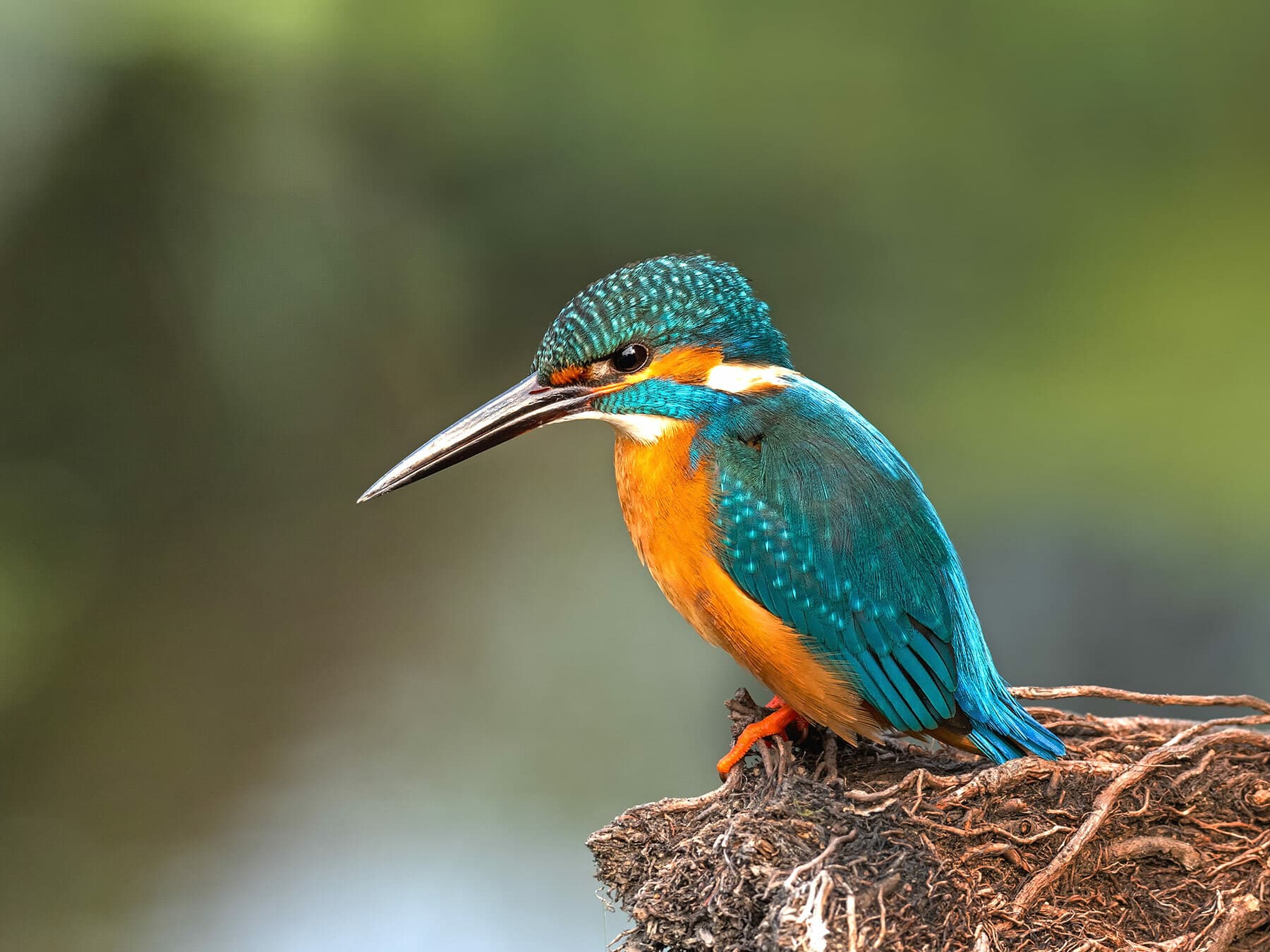
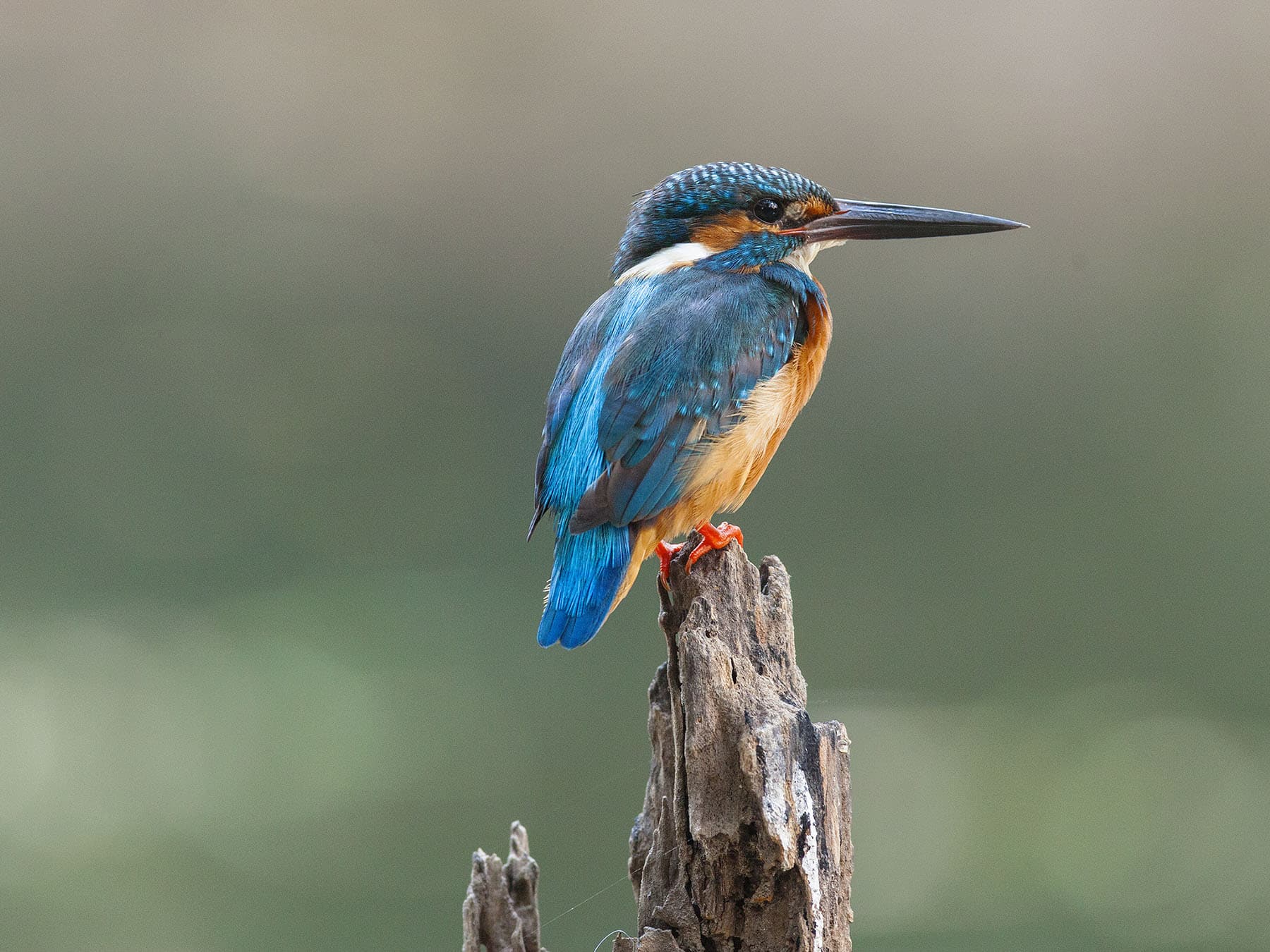
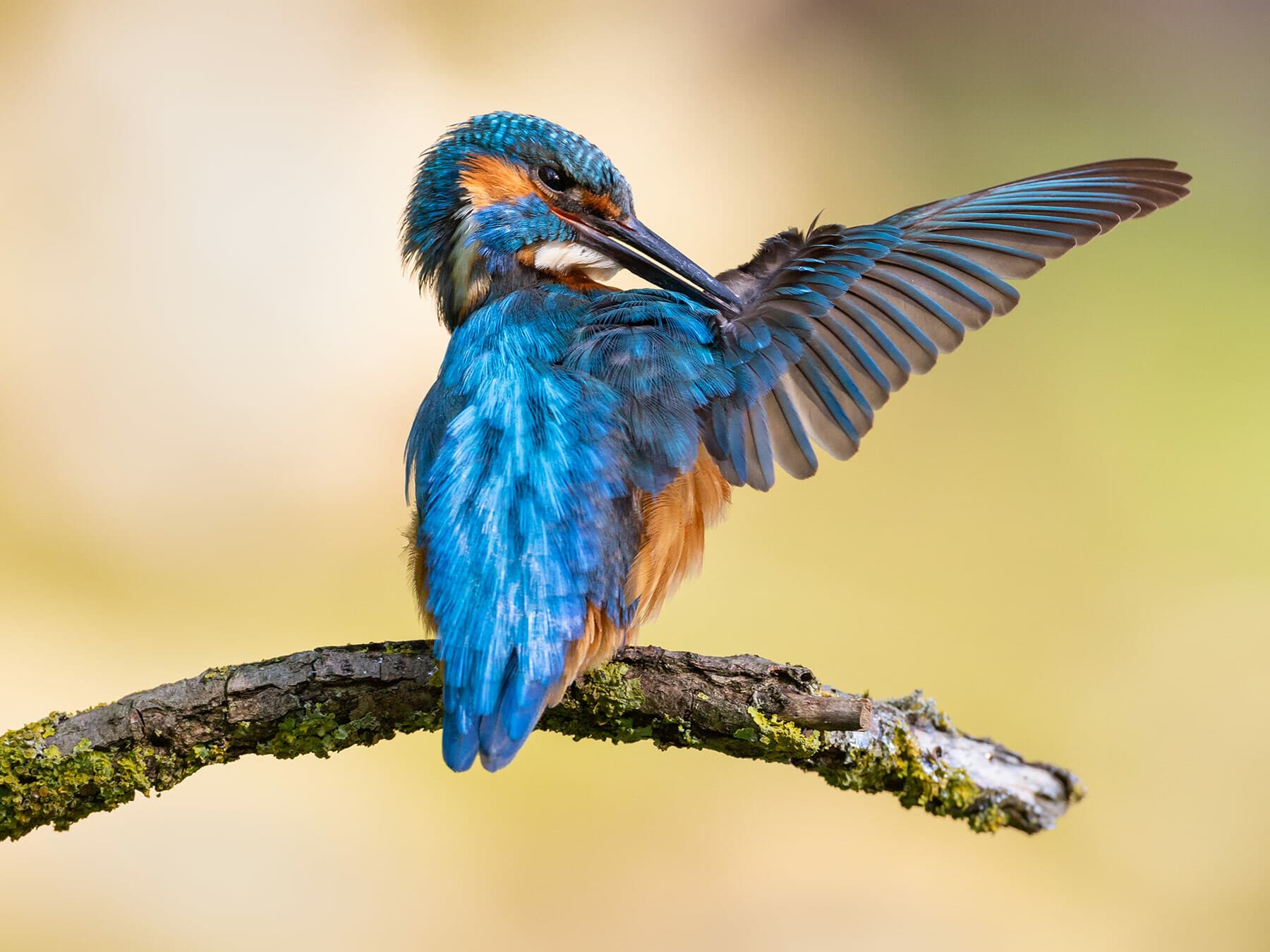
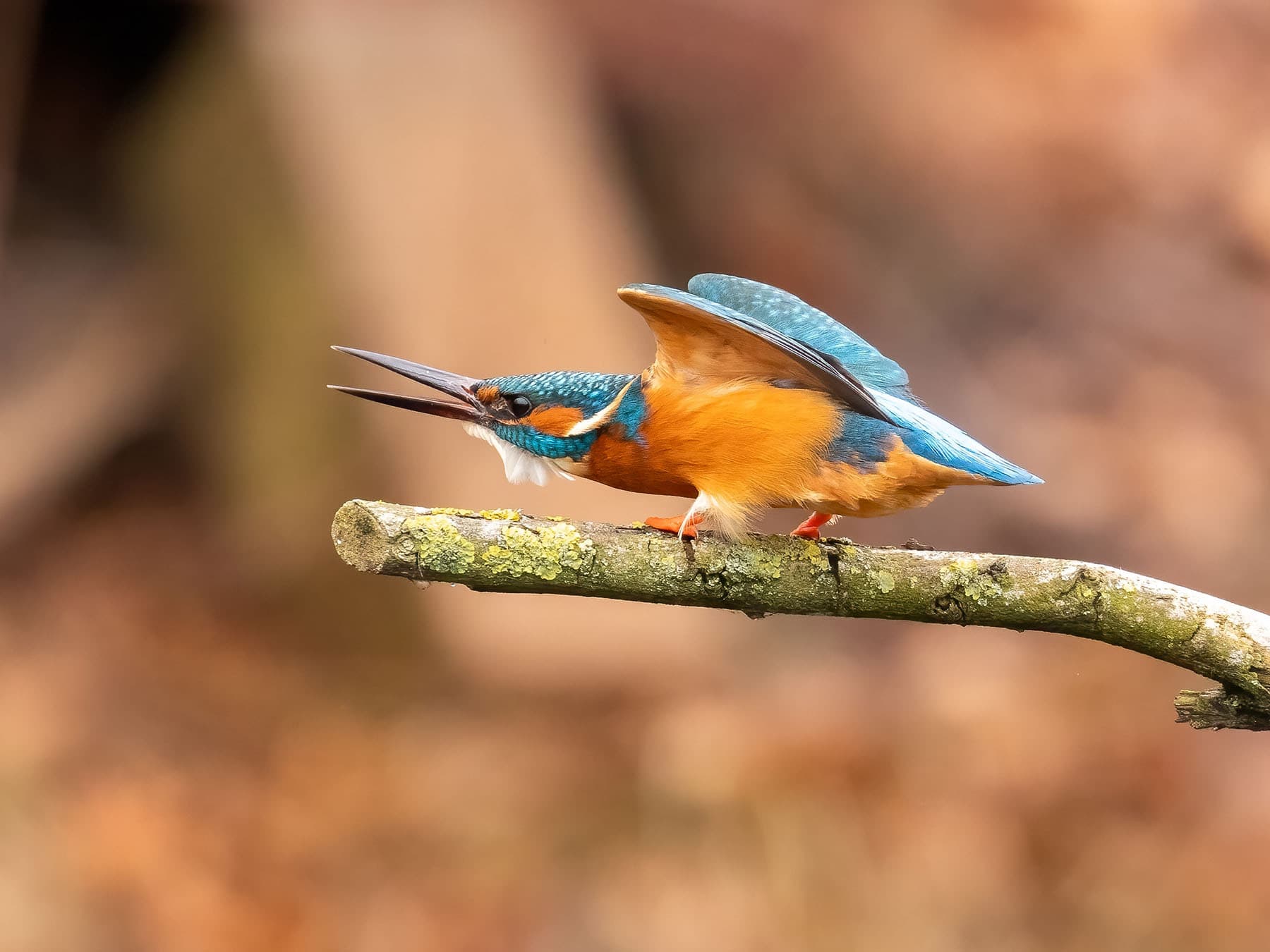
Adult Kingfishers are blue above and rusty orange below. Their plumage is electric blue from the top of their tails to the crown of their heads. Their wings are a similar but darker shade, and they have a broad blue moustache stripe from the base of their bill to their shoulder.
They have orange undersides and a small orange patch on either side of their face. These patches contrast with a white marking on either side of the nape and a white chin spot. Kingfishers have deep orange legs.
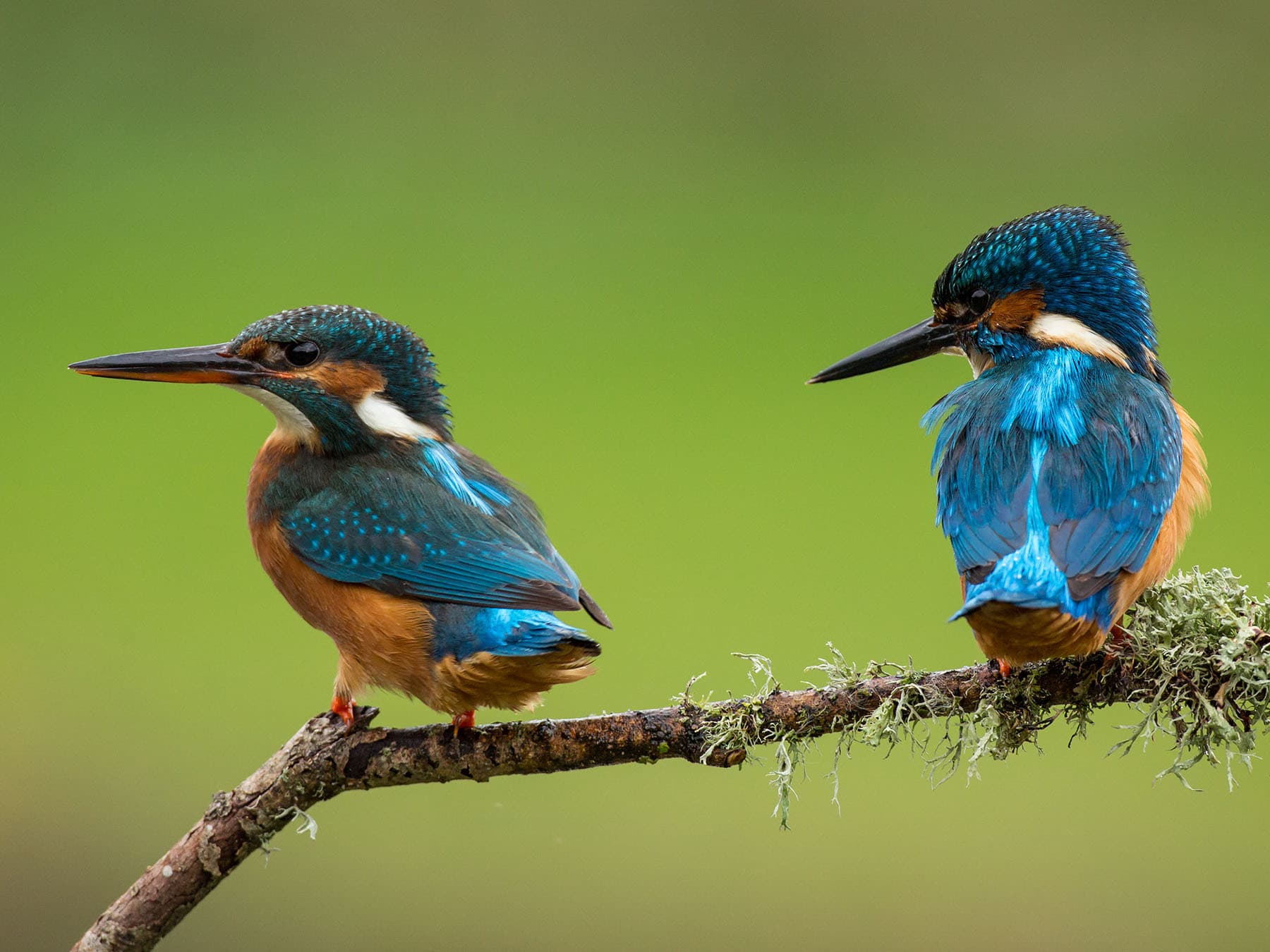
Female Kingfishers are almost identical to males, although the sexes can be distinguished by their bill colour. Males have all-black bills, while the lower half of the female’s bill (mandible) is red.
Juveniles are similar to adults but appear duller overall. They have shorter, black bills, dark feet, and greener upper parts.
How big are Kingfishers?
Kingfishers are small birds with a compact appearance. However, their dagger-like bills are conspicuous at up to four centimetres long.
Length
Kingfishers measure 16 to 18 centimetres in length.
Weight
They are stocky little birds that weigh 25 to 35 grams. Males are usually heavier than females.
Wingspan
These fast-flying birds have a wingspan of 24 to 26 centimetres.
Its size
Adults- Length
- 16–17 cm
- Wingspan
- 24–26 cm
- Weight
- 34–46 g
Its song and calls
Kingfishers are not exactly known for their song, although these birds are often heard before they are seen.
What sound does a Kingfisher make?
The Kingfisher’s song consists of high-pitched whistles. You may also hear their sharp ‘chee chee’ call as they take flight.
- Song and calls0:00 / 0:15
Recorded in Kerala, India · October 2022
- Flight call0:00 / 0:39
Recorded in Hauts-de-France, France · April 2025
When and where to see it
OctoberIn season
Most recorded in October
- 1. Kildare1.3%
- 2. Rhondda, Cynon, Taff1.2%
- 3. Carlow1.0%
- 4. Meath0.96%
- 5. Monmouthshire0.84%
Each dot is a county, state or province: the bigger and darker, the larger the bird’s share of that place’s bird records that month. Grey dots: no regular records. The ringed point is the centre of the bird’s records this month; the arrow shows how it moved since last month, and the dashed loop its path through the year. “Arrivals” colours places where it becomes regular this month (orange) or is in its last regular month (grey). GBIF eBird Observation Dataset, 2019–2024. Map data: Natural Earth, US Census Bureau; place centres © OpenStreetMap contributors.
In your area
See when the Common Kingfisher is recorded in your county, state or province.
How often the Common Kingfisher turns up in the UK and Ireland through the year, from birdwatchers' records.
United Kingdom
Resident · all year · most records in September
Ireland
Resident · all year · most records in November
Show as a table
| Month | United Kingdom | Ireland |
|---|---|---|
| January | 0.25% (regular) | 0.21% (regular) |
| February | 0.19% (regular) | 0.14% (regular) |
| March | 0.18% (regular) | 0.13% (regular) |
| April | 0.12% (regular) | 0.10% (regular) |
| May | 0.13% (regular) | 0.092% (regular) |
| June | 0.14% (regular) | 0.10% (regular) |
| July | 0.23% (regular) | 0.15% (regular) |
| August | 0.34% (regular) | 0.21% (regular) |
| September | 0.41% (regular) | 0.21% (regular) |
| October | 0.37% (regular) | 0.20% (regular) |
| November | 0.37% (regular) | 0.25% (regular) |
| December | 0.33% (regular) | 0.21% (regular) |
Recorded regularly in
Worldwide: recorded regularly in 97 countries
Countries where it was recorded in at least 3 of the 6 years 2019–2024. Linked countries have their own bird list.
Europe (46)
- Albania
- Andorra
- Austria
- Belarus
- Belgium
- Bosnia & Herzegovina
- Bulgaria
- Croatia
- Czechia
- Denmark
- Estonia
- Finland
- France
- Germany
- Gibraltar
- Greece
- Guernsey
- Hungary
- Ireland
- Isle of Man
- Italy
- Jersey
- Kosovo
- Latvia
- Liechtenstein
- Lithuania
- Luxembourg
- Malta
- Moldova
- Monaco
- Montenegro
- Netherlands
- North Macedonia
- Norway
- Poland
- Portugal
- Romania
- Russia
- Serbia
- Slovakia
- Slovenia
- Spain
- Sweden
- Switzerland
- Ukraine
- United Kingdom
Asia (45)
- Armenia
- Azerbaijan
- Bahrain
- Bangladesh
- Bhutan
- Brunei
- Cambodia
- China
- Cyprus
- Georgia
- Hong Kong SAR China
- India
- Indonesia
- Iran
- Iraq
- Israel
- Japan
- Jordan
- Kazakhstan
- Kuwait
- Kyrgyzstan
- Laos
- Lebanon
- Macao SAR China
- Malaysia
- Mongolia
- Myanmar (Burma)
- Nepal
- Oman
- Pakistan
- Palestinian Territories
- Philippines
- Qatar
- Saudi Arabia
- Singapore
- South Korea
- Sri Lanka
- Taiwan
- Tajikistan
- Thailand
- Timor-Leste
- Turkey
- United Arab Emirates
- Uzbekistan
- Vietnam
Oceania (2)
- Papua New Guinea
- Solomon Islands
Data: EOD – eBird Observation Dataset (Cornell Lab of Ornithology), accessed via GBIF.org, CC BY 4.0. Records from 2019–2024, aggregated and filtered by Birdfact. How these lists are made
Kingfishers are closely associated with freshwater ecosystems across their extensive Northern Hemisphere range. Read on to learn where you might spot these dazzling little birds.
What is the habitat of a Kingfisher?
Kingfishers hunt along the margins of rivers, lakes, ponds, canals, and gravel pits. They prefer still or gently flowing water, and require bankside vegetation for hunting perches. Coastal habitats are important in cold winters.
What is the range of a Kingfisher?
In the United Kingdom, Kingfishers are most widespread in England and Wales, although they also occur in low-lying areas of Scotland. They are fairly widespread in the Republic of Ireland.
The Kingfisher’s range extends through much of Central and Southern Europe and across Asia to Japan in the East. They also occur in North Africa, throughout the Indian Subcontinent and much of Southeast Asia
Where do Kingfishers live?
Kingfishers spend almost all their time perched vegetation along the margins of freshwater bodies. They usually perch just a meter or two above the water’s surface.
How rare are Kingfishers?
Kingfishers are not rare, although you are not likely to spot these colourful birds unless you know where to look. They can be quite common wherever they can find small fish and vegetated margins, sometimes occurring at densities of over six individuals per kilometre in ideal habitats.
Where can you see Kingfishers in the UK?
Birdwatchers in the UK can spot Kingfishers at most still or slow-flowing water bodies in the countryside and sometimes even in well-managed urban areas. These birds are rare in gardens, although they may visit larger ponds.
Strolling along the banks of canals, lakes, and rivers may produce fleeting sightings of these fast-flying birds as they flush from reeds and other bankside vegetation.
However, sitting quietly in such areas might reward the patient birdwatcher with a view of their exciting fishing technique.
Signs and spotting tips
Kingfishers are pretty secretive, wary birds, and can be difficult to spot despite their bright plumage. They will usually be perched motionless on a branch on the lookout for prey.
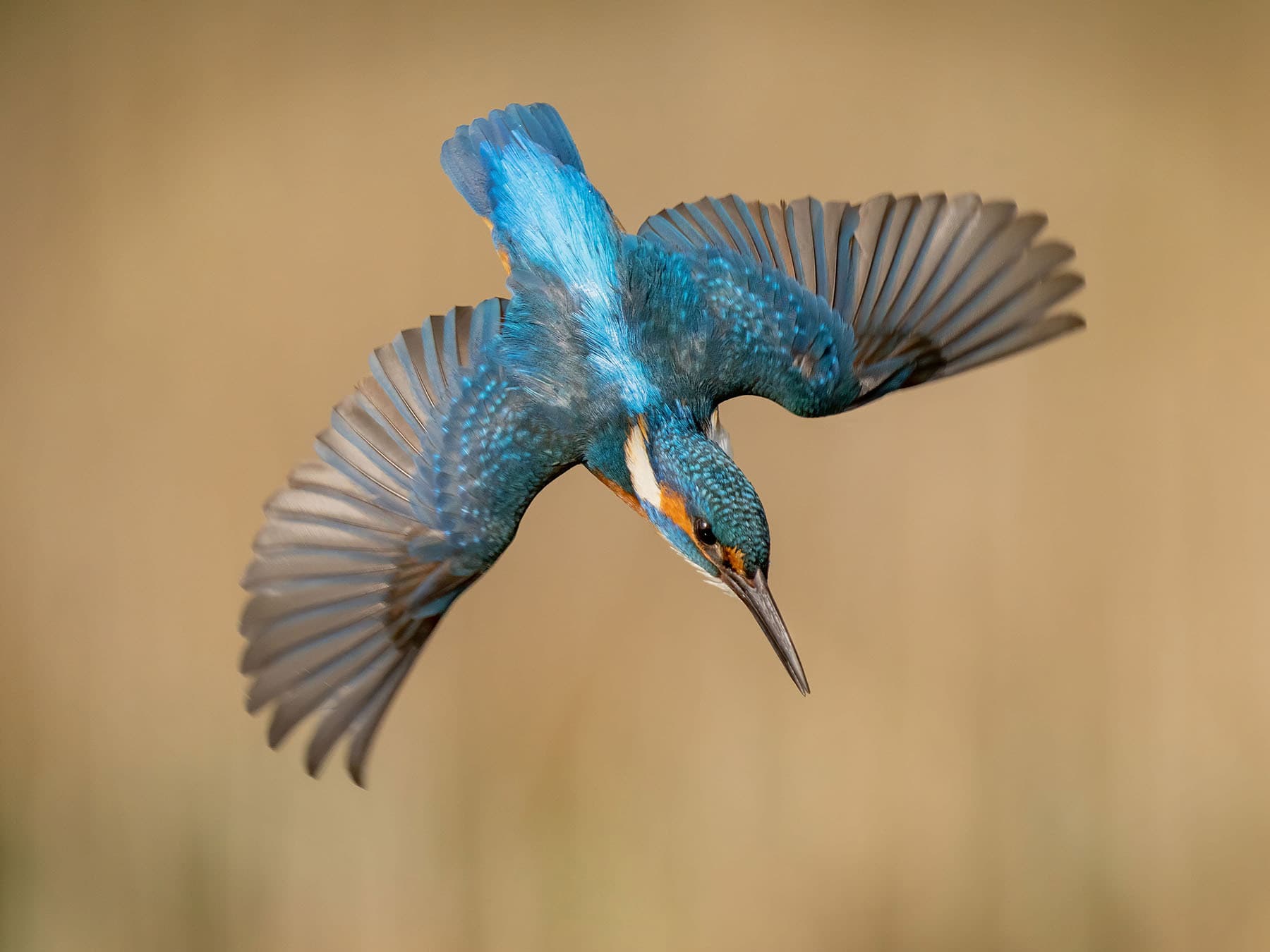
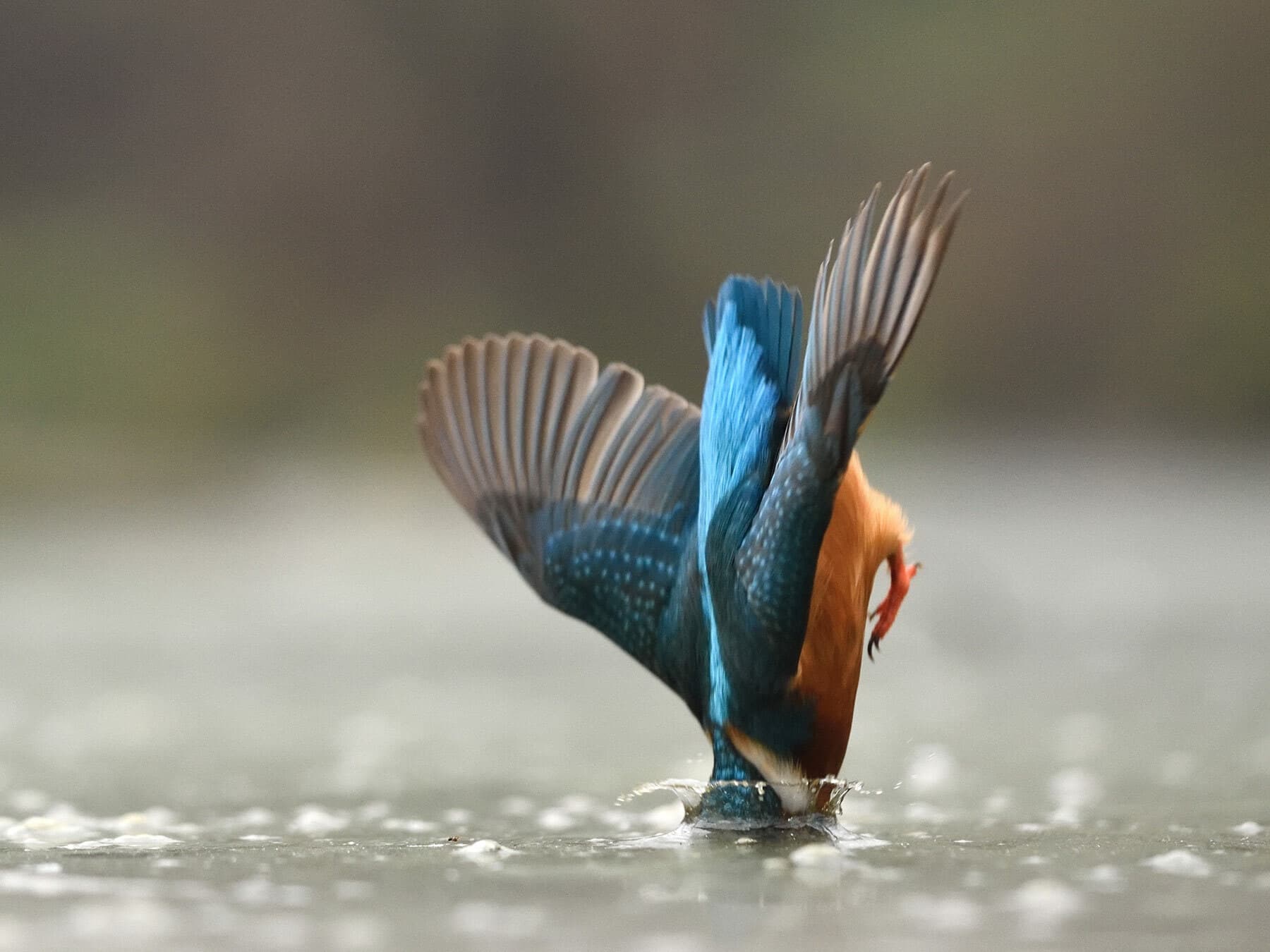
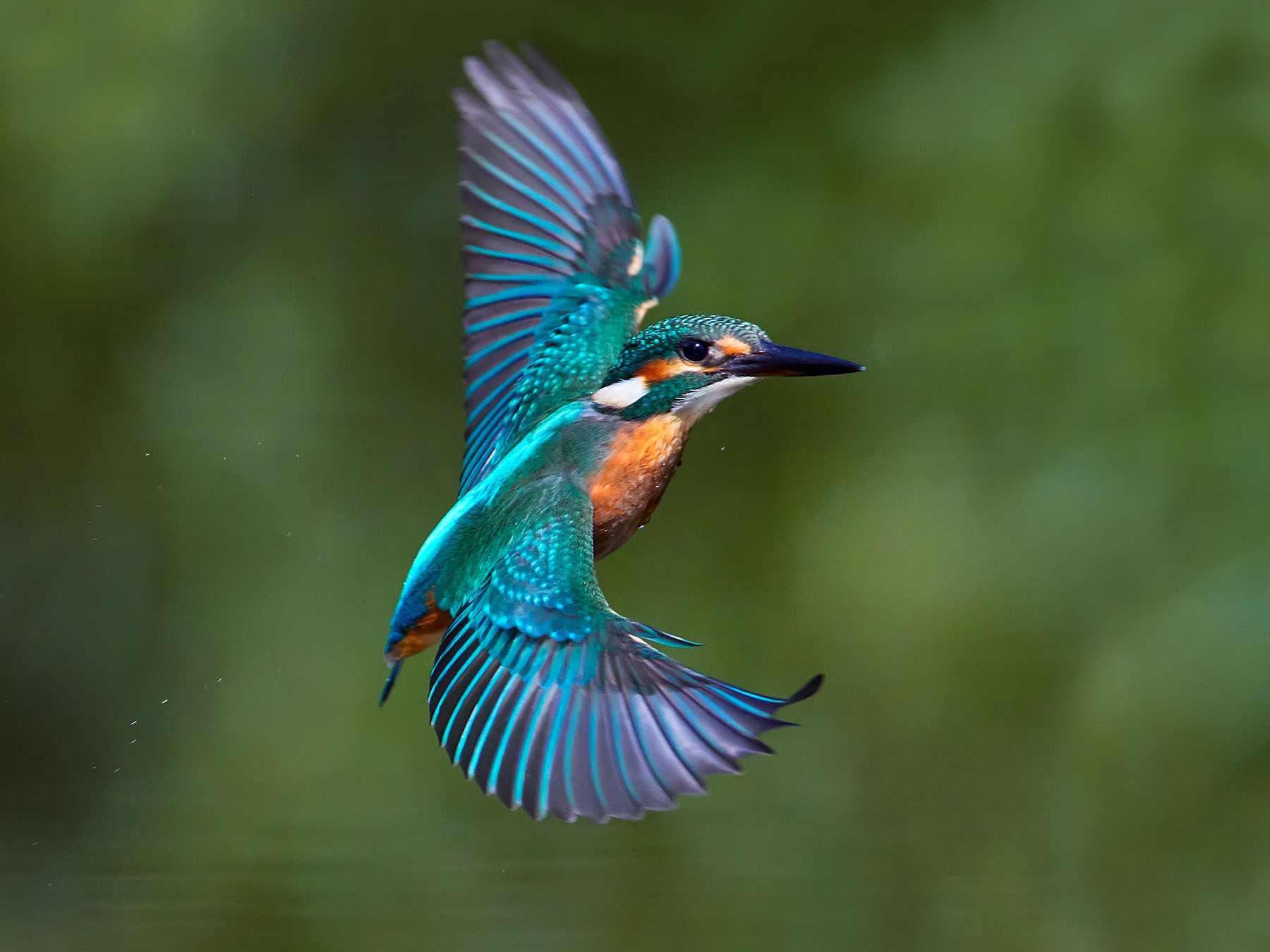
If there is no suitable perch, the kingfisher will hover for several seconds before plunging into the water. The kingfisher’s back and tail are the palest parts during flight, which straight and fast, and usually seen low over the surface of the water.
Migration
Birdwatchers can usually enjoy Kingfisher sightings throughout the year in the right habitats. However, harsh winters may necessitate local movements.
Do Kingfishers migrate?
Kingfishers do not usually migrate in the United Kingdom, although they will undergo short movements to the coast in cold winters. They do this to find fish when freshwater hunting grounds freeze over.
Elsewhere in the world, Kingfishers undertake short, medium, and long-distance annual migrations.
What it eats
As their name suggests, Kingfishers usually hunt prey that swims below the water. Read on to learn more about their diet.
What do Kingfishers eat?
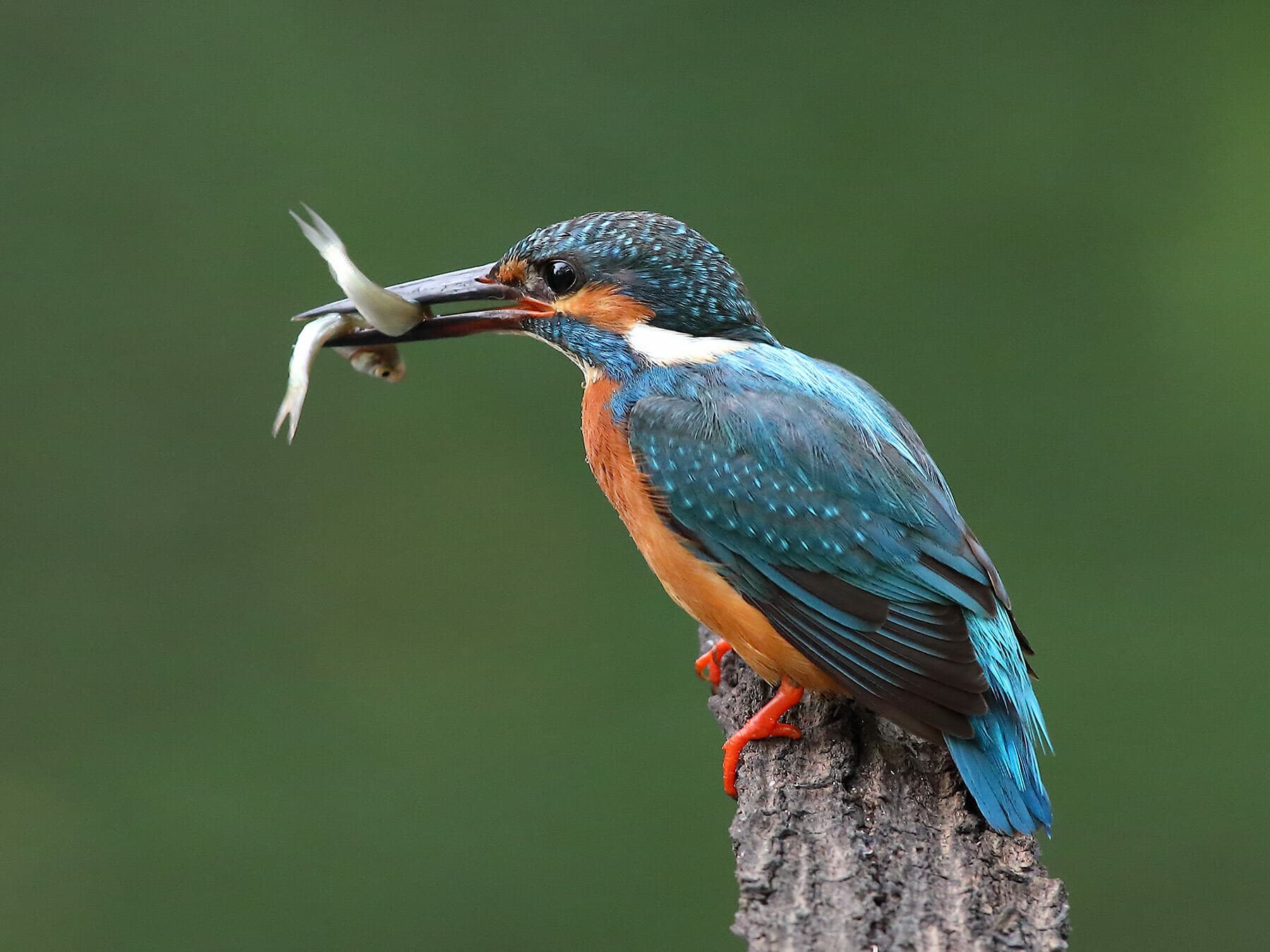
Unsurprisingly, fish are the favourite food source for Kingfishers. They also eat invertebrates like insects and crustaceans and small vertebrates like frogs and tadpoles.
These birds hunt many fish species, from Sticklebacks to Pike, and their maximum prey size is about 12 centimetres. Such large prey is impressive, considering that Kingfishers measure just 16 centimetres themselves!
How many fish does a Kingfisher eat a day?
Kingfishers may eat more than twenty fish in a single day, although the total number depends on the size of the prey. These birds typically eat half (or more) of their own body weight in fish each day.
They hunt by diving into the water up to about a meter deep. They use their impressive beak to catch the hapless fish and then flap their wings to rise to the surface and fly up to their perch to feed. Prey is stunned by dashing it against a hard surface and then swallowed whole.
What do Kingfisher chicks eat?
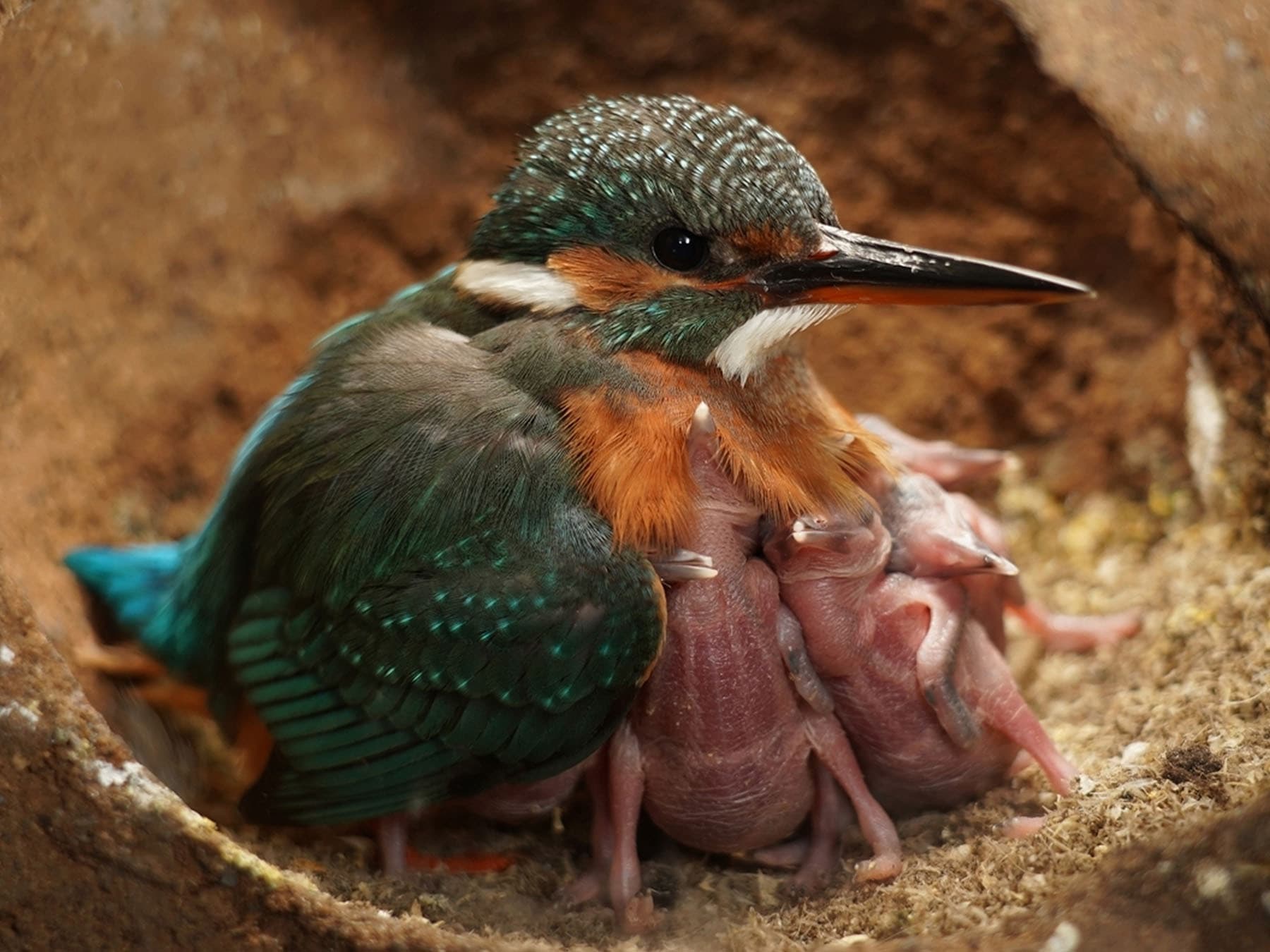
Kingfisher chicks eat whole small fish delivered by both parents. Their first meals are tiny, although the adults provide progressively larger meals as their young grow.

Nesting and breeding
Kingfishers are breeding residents in the UK, producing one or two broods in the spring and summer. Read on to learn more about their nesting habits.
Where do Kingfishers nest?
Kingfishers build their nests in vertical banks near their hunting grounds. Both sexes work together to excavate a tunnel that can be over a meter deep. The nesting tunnel ends in a larger unlined chamber where the female lays her eggs.
What do Kingfisher eggs look like?
Kingfishers lay six or seven (up to ten) small white eggs. They are almost spherical in shape, each measuring approximately 2.2 centimetres long and 1.9 centimetres wide.
Do Kingfishers mate for life?
Few adult Kingfishers survive to breed more than once in their lifetime. Those that do will usually mate with a different partner each year, although pairs may reunite from one year to the next.
Behaviour
Kingfishers are generally solitary creatures, although pairs come together during the breeding season to build a nest and raise their young.
Are Kingfishers aggressive?
Kingfishers are aggressive towards neighbours that enter their territory since nesting space, and foraging opportunities are limited. They will use calls and displays to deter intruders and chase unwanted visitors from their patch when necessary.
Are Kingfishers friendly?
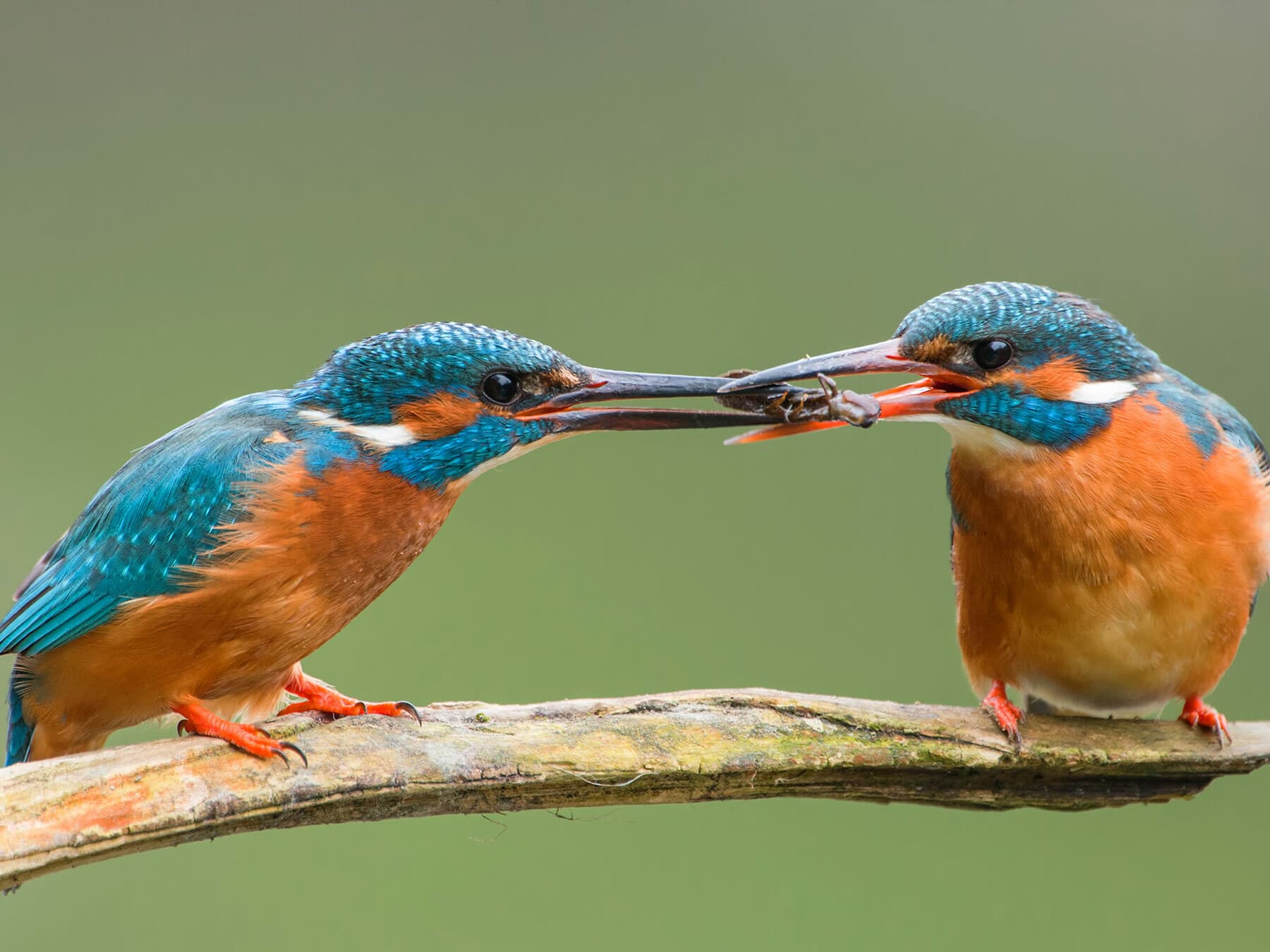
Kingfishers are shy and flighty birds. They could not be described as friendly towards humans, although they are capable of tender moments, like when males present their partners with food.
Where do Kingfishers sleep at night?
Kingfishers sleep alone in vegetation along the margins of watercourses. They spend the night perched on a small branch with their bill tucked behind their back.
Lifespan and predators
Kingfishers are relatively short-lived birds. Despite being vulnerable to many predators, pollution and cold winters remain their greatest threats.
How long do Kingfishers live?
Kingfishers have a short lifespan, surviving just two years on average. The oldest known specimen lived to just seven and a half years.
What are the predators of Kingfishers?
Stoats, weasels, rats, and mink are all potential Kingfisher predators. Birds of prey like Sparrowhawks also pose a risk.
Are Kingfishers protected?
Kingfishers are protected by the Wildlife and Countryside Act of 1981. They are also a Schedule 1 species in the UK, which makes it illegal to disturb them when nesting.
Are Kingfishers endangered?
Kingfishers are not endangered. Their populations have largely recovered, and they are back on the green list, although they remain vulnerable to harsh weather, flooding, pollution and the degradation of their natural habitat.
Conservation
While listed as Least Concern globally, Common Kingfishers face localised threats from water pollution, habitat loss, and severe winters. Conservation efforts focus on maintaining clean waterways and preserving natural riverbanks.
In the UK, they are protected under the Wildlife and Countryside Act.
More photos
3 photos

Common Kingfisher guides
1 guidesQuick facts
- Length
- 16–17 cm
- Wingspan
- 24–26 cm
- Weight
- 34–46 g
- Lifespan
- 2–7 years · oldest recorded 4.5 years
- Family
- Kingfishers
- Migration
- Partial migrant
- Global status (IUCN)
- Least Concern
- World population
- 780,000 - 1,340,000 mature individuals
- Population trend
- Unknown
- Also called
- Eurasian Kingfisher, River Kingfisher
- Scientific name
- Alcedo atthis
Questions
2Do Kingfishers visit gardens?
Kingfishers rarely visit gardens. However, they may turn up at larger garden ponds where they can be unwelcome visitors for fish keepers.
How many Kingfishers are in the UK?
There are an estimated 3,800 to 6,400 pairs of Kingfishers in the United Kingdom.
Sources
3- 1BirdLife International. 2016. Alcedo atthis. The IUCN Red List of Threatened Species 2016: e.T22683027A89575948. Source (opens in a new tab)
- 2BirdLife International. 2016. Alcedo atthis. The IUCN Red List of Threatened Species 2016: e.T22683027A89575948. Source (opens in a new tab)
- 3BTO longevity records: maximum age from a ringed bird, 4 years, 6 months, 29 days (set in 2012), BirdFacts: Kingfisher (2012) Source (opens in a new tab)

Checked by
Nathan Cope, founder and editor
Nathan founded Birdfact and leads its writers and contributors in the UK, the US and Canada. He has watched and studied birds for more than ten years, and checks every article and species guide before it’s published.