Published 11 Oct 2026
Shima Enaga: Hokkaido's White-Headed 'Snow Fairy' Bird
By the Birdfact teamChecked by Nathan Cope
The shima enaga is a real wild bird: the white-headed Long-tailed Tit of Hokkaido, about 14 cm (5.5 in) long and 7 to 8 g, nicknamed the "snow fairy". See how to tell it from other Long-tailed Tits, where and when to see it, why it looks like a snowball, and how it became famous.
On this page12 sections
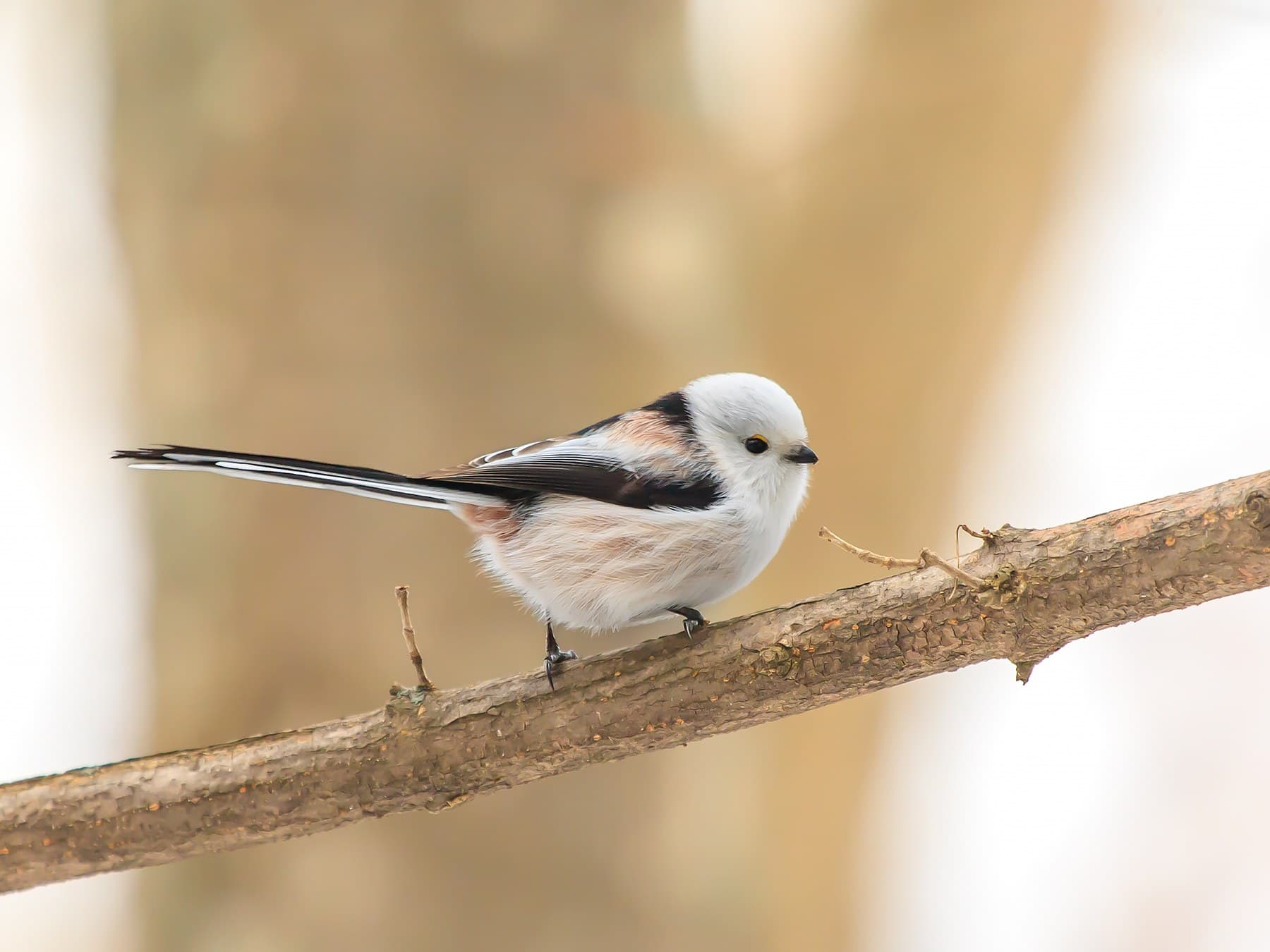
The shima enaga (シマエナガ) is the white-headed Long-tailed Tit of Hokkaido, Japan's northern island: a real wild bird about 14 cm (5.5 in) long, much of it tail, that weighs 7 to 8 g, about a quarter of an ounce.12 Its white, fluffy look has made it a popular wild bird across Japan, nicknamed the "snow fairy". This page covers what it is, how to tell it from other Long-tailed Tits, where to see it and how it became famous. For the species as a whole, see Long-tailed Tit identification and facts.
Is the shima enaga real?
Yes. It is a wild form of the Long-tailed Tit (Aegithalos caudatus), a species found from Britain and Ireland across Europe and Asia to Japan. In Japan it lives only in Hokkaido. The same form also breeds on Sakhalin and the southern Kuril Islands, in the lower Amur basin and Ussuriland, and in northern Korea.3 The photos that look too round to be real show birds puffed up against the cold: in the coldest weeks of the year they fluff air into their feathers.1
The name
Enaga (柄長) means "long handle": the Japanese name for the Long-tailed Tit comes from its shape, a small round body with a long tail like the handle of a ladle, and it is recorded as the bird's name as early as 1697.4 Canon's bird guide explains shima as 島, "island", for Hokkaido, as in shima-fukurō, Blakiston's Fish Owl, and not 縞, "stripe".5 Adults have no stripes on the head.
The nickname yuki no yōsei, "snow fairy", appears in the description of the first photobook of the bird, published in November 2016,6 and is used today by everyone from Hokkaido's main newspaper to Canon's bird guide.
How to recognize it
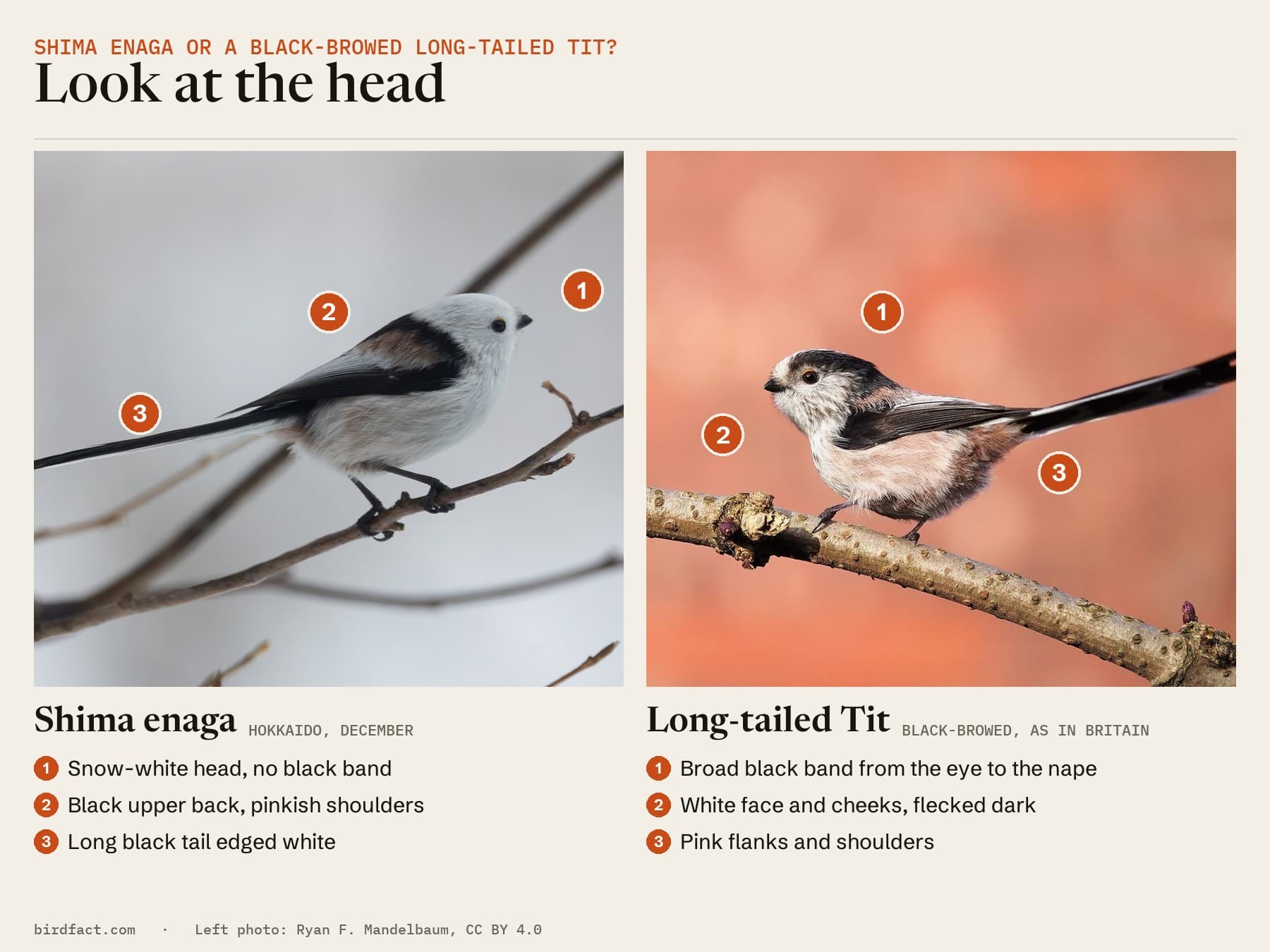
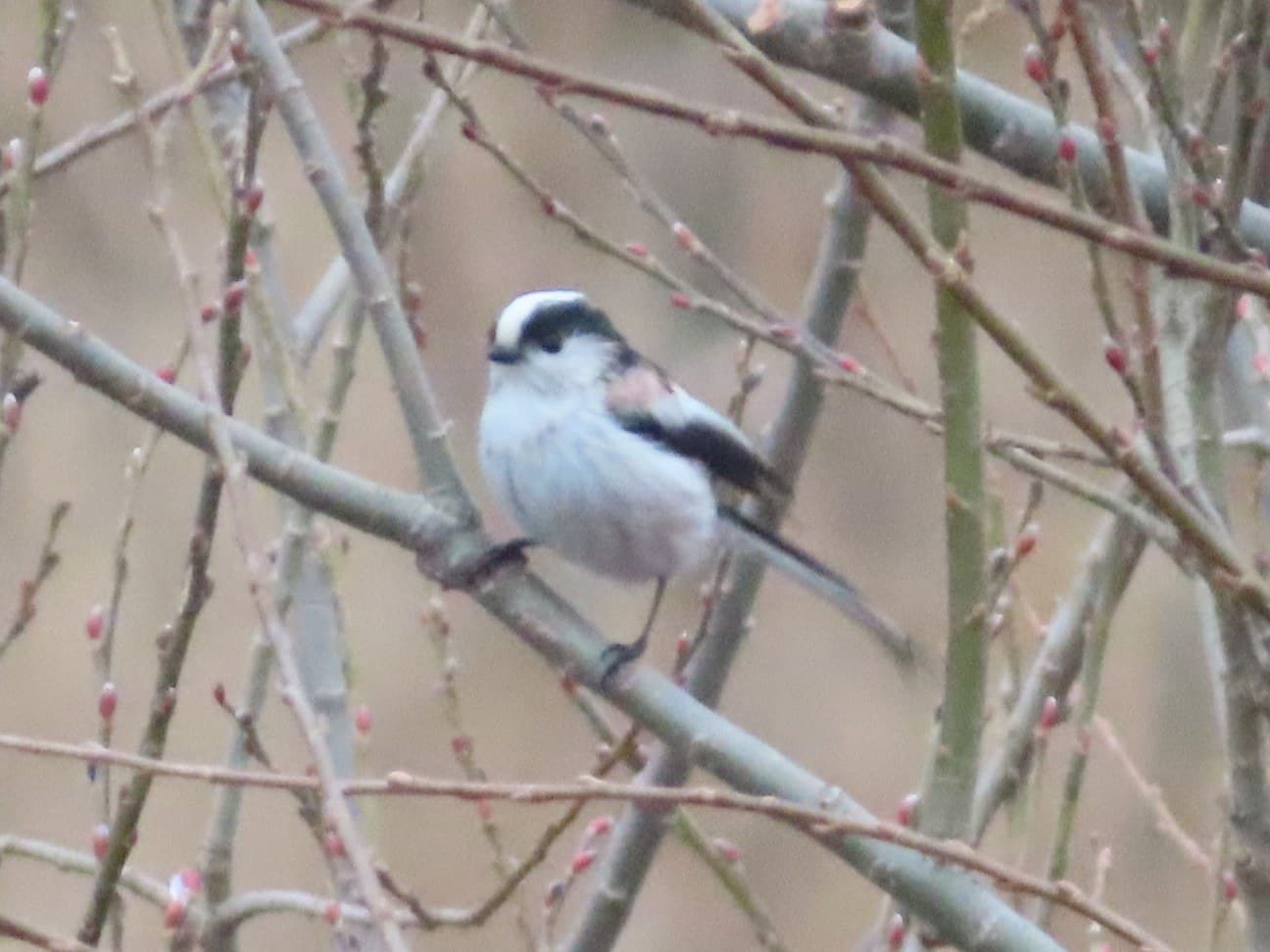
A shima enaga has a snow-white head with no black band, a small black bill and a long black tail edged with white. The upper back is black, the shoulders a pale, pinkish white mottled with black, and the flanks clean pink. The ring of bare skin around the eye is usually yellow, but can be red.7
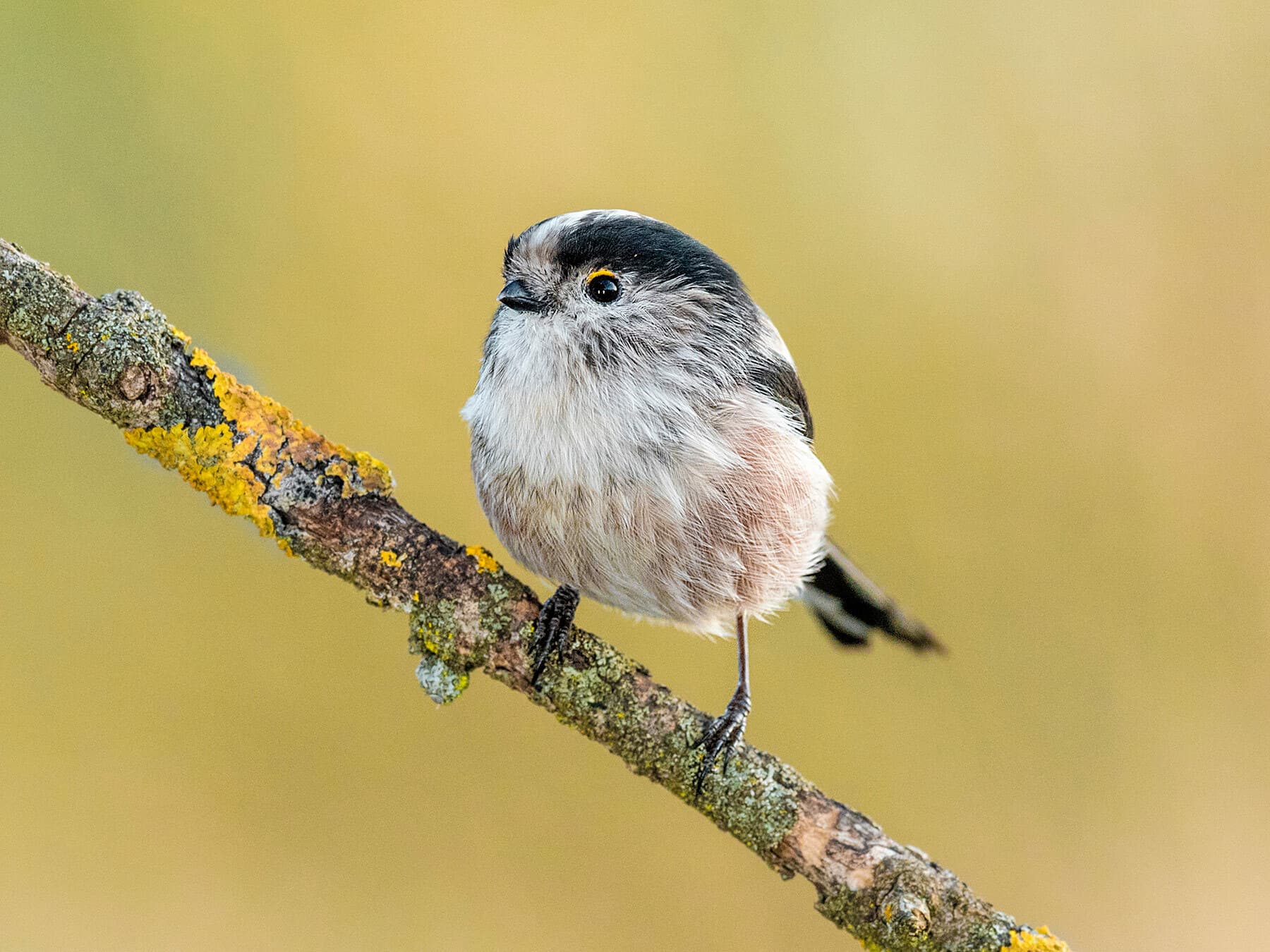
That white head is the mark. The Long-tailed Tits of the rest of Japan, the enaga of Honshu, Sado and Oki, the Kyushu enaga of Shikoku and Kyushu and the Korean enaga of Tsushima, all have a black band from above the eye backward.5 So do the birds of Britain and most of western Europe.7 Young shima enaga have a dusky smudge on the head and can be taken for one of the black-browed forms.5
Subspecies
Japan's own checklist, from the Ornithological Society of Japan, treats the shima enaga as a separate subspecies, Aegithalos caudatus japonicus, named in 1897. The 2012 edition does, and so does the 2024 edition.38 Most world lists do not. Birds of the World calls it poorly differentiated and folds it into the nominate race, caudatus: the white-headed Long-tailed Tits that live from Scandinavia across Siberia to Kamchatka, Sakhalin and Hokkaido.7 The Howard and Moore checklist and the IOC list did the same,9 and AviList, the joint world list of 2025, has no separate shima enaga.10
A 2016 review by researchers at the Yamashina Institute for Ornithology and the Abiko City Museum of Birds points out that the paper the Howard and Moore checklist cites for the merger says nothing about it, and that the main DNA study of the species included no birds from Hokkaido, so in their view the merger has not been shown.9
Why it looks like a snowball
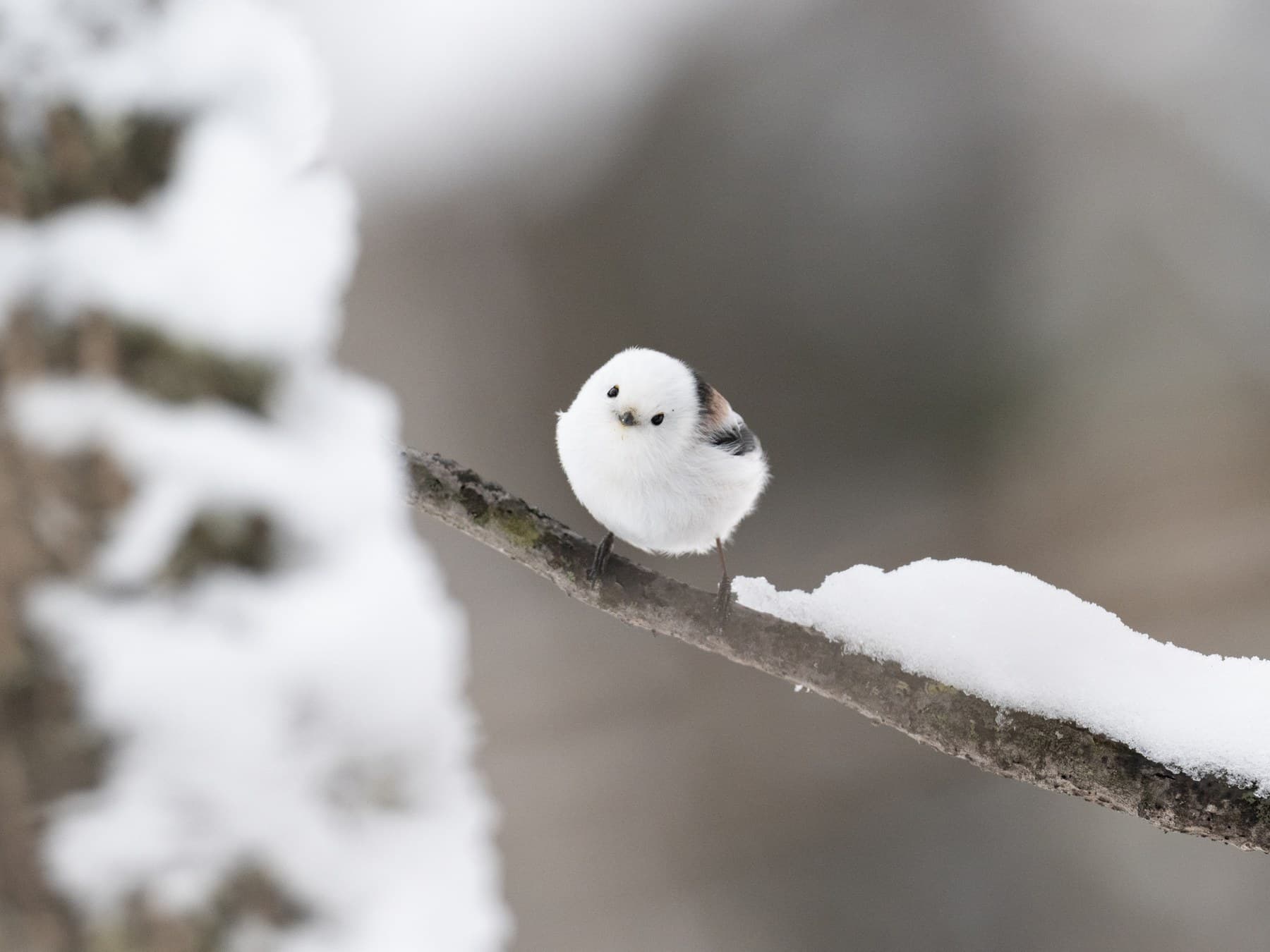
A shima enaga in a Hokkaido winter keeps warm by fluffing air into its feathers until it looks like a ball. Japan's Shima Enaga Day, January 20, falls at the coldest time of the year, when the birds look roundest.1 Like other Long-tailed Tits, a flock sleeps together at night, lined up along a twig in a bush.11
What it eats
Mostly insects and other small invertebrates picked from twigs, buds and leaves, like other Long-tailed Tits, and it has been recorded drinking sap.7 In winter, photographers in Hokkaido have pictured shima enaga licking icicles of frozen sap.12 In a magazine column, Princess Takamado has written that it drinks the sap of sawtooth oaks and maples, and sometimes hovers at sap icicles to drink the drips.2
Where can you see a shima enaga?
In woods and parks across Hokkaido, all year. Sapporo City lists it in forests and parks, and notes that it is easier to see in winter, when the leaves are down and it travels in mixed flocks with tits.13 The Wild Bird Society of Japan names it among the birds anyone can see close by at its Utonai-ko sanctuary near Tomakomai, and its Kushiro branch recommends Harutori-ko, where it joins winter flocks of tits.14 Pairs nest in spring, and the young usually leave the nest from late May to early June.15
A few wander south in some winters. From December 2023 to March 2024 shima enaga spent the winter at Izunuma-Uchinuma in Miyagi, up to 20 at once: the first detailed record of them wintering on Honshu. Photographers crowded in, neighbors complained about lenses pointed at their homes, and caution signs went up.16
How it became famous
Shima enaga goods were already selling well by mid-2016, when a retailer called it a hugely popular "snow fairy".17 That November the photographer Rei Ohara published Shima Enaga-chan, the first photobook devoted to the bird, with sequels in 2017 and 2018.6 In 2018 the Hokkaido University Museum called it a bird that represents Hokkaido.18 Shima Enaga Day, registered in 2019 by the Japan Anniversary Association, falls on January 20, and photobooks, calendars, souvenirs sold across Hokkaido and social media have kept the boom going.1
White-headed birds outside Japan
The shima enaga looks almost exactly like the white-headed Long-tailed Tits of northern Europe and Siberia. Those birds sometimes move west in large numbers in autumn: a flock of 200 reached the Netherlands in December 1971. Because they avoid crossing the sea, they are very rarely recorded in Britain.7 One white-headed bird found dead at Tynemouth, Northumberland, in November 1852, was catalogued in the Hancock collection in Newcastle in 1899.19
They also sound the same. The two main calls are about identical from Britain to Japan,20 so a flock of shima enaga sounds like any other Long-tailed Tits calling.
Status and protection
The Long-tailed Tit is listed as Least Concern worldwide,21 and the shima enaga is on neither Japan's national Red List nor Hokkaido's.2223 Like almost all wild birds in Japan, it is protected: under Japan's wildlife law, wild birds may not be caught without a permit, and the Long-tailed Tit is not a game species.24
About the photos
Photos: Asahikawa, Hokkaido, November 2014 (Craft GIN, public domain); Kitami, Hokkaido, December 2025 (Saryu Mae, CC BY 4.0); Tsurui, Hokkaido, December 2025 (Ryan F. Mandelbaum, CC BY 4.0, on the comparison card); and Sendai, Honshu, February 2026 (Timur Kalininsky, CC BY 4.0). The black-browed bird on the comparison card is from the Birdfact library.
Sources
- Hokkaido Shimbun. 1月20日は「シマエナガの日」 (20 January is Shima Enaga Day). Hokkaido Shimbun Digital, 18 January 2025. Accessed 11 October 2026. Source
- Princess Takamado. 雪の妖精 (Snow fairy), in the series レンズを通して (Through the lens). Fujingaho, February 2023, pp. 13-15 (BirdLife Tokyo copy). Accessed 11 October 2026. Source
- Ornithological Society of Japan (2012). Check-List of Japanese Birds, 7th revised edition. Ornithological Society of Japan, Sanda. ISBN 9784930975003. Source
- Shogakukan. 柄長 (えなが). Nihon Kokugo Daijiten (via Kotobank). Accessed 11 October 2026. Source
- Canon. シマエナガ (Shima enaga) and エナガ (Enaga). Canon Bird Branch Project photo guide. Accessed 11 October 2026. Source
- Ohara, R. (2016). シマエナガちゃん (Shima Enaga-chan). Kodansha, Tokyo. ISBN 9784062203401.
- Harrap, S. (2020). Long-tailed Tit (Aegithalos caudatus), version 1.0. Birds of the World (J. del Hoyo, A. Elliott, J. Sargatal, D. A. Christie and E. de Juana, editors). Cornell Lab of Ornithology. doi:10.2173/bow.lottit1.01
- Ornithological Society of Japan (2024). Check-List of Japanese Birds, 8th revised edition (2024): official name list and errata (9 Jun 2025). Ornithological Society of Japan. Accessed 11 October 2026. Source
- Asai, S., Iwami, Y., Saitoh, Y., Kameya, T. (2016). A review of the scientific names and taxonomy for 15 families in the order Passeriformes adopted by the Check-List of Japanese Birds, 7th revised edition. Japanese Journal of Ornithology 65: 105-128. doi:10.3838/jjo.65.105
- AviList Core Team (2025). AviList: The Global Avian Checklist, v2025b. doi:10.2173/avilist.v2025b
- Nakamura, T. エナガ. Kaitei Shinpan Sekai Daihyakka Jiten (Heibonsha) and Nihon Daihyakka Zensho (Nipponica, Shogakukan), via Kotobank. Accessed 11 October 2026. Source
- Ohara, R. (2017). もっとシマエナガちゃん (Motto Shima Enaga-chan). Kodansha, Tokyo. ISBN 9784062208659.
- Sapporo City. Mini zukan: wild birds of Sapporo. Sapporo City. Accessed 11 October 2026. Source
- Wild Bird Society of Japan. Utonai-ko (Tomakomai) page, and Harutori-ko (Kushiro) page by the Kushiro branch (mobile.wbsj.org/about-us/90th/future-site/kushiro/). Wild Bird Society of Japan. Accessed 11 October 2026. Source
- Takahashi, C., Hokkaido Shimbun. シマエナガ、異例の遅い巣立ち ヘルパー支え、小さな2羽も無事に 釧路管内 (Shima enaga fledge unusually late, helped by helpers, Kushiro area). Hokkaido Shimbun Digital, 27 July 2026. Accessed 11 October 2026. Source
- Shimada, T., Shiratori, A. (2024). 伊豆沼・内沼におけるシマエナガの詳細な越冬記録 (A detailed wintering record of shima enaga at Izunuma-Uchinuma). Izunuma-Uchinuma Wetland Researches (伊豆沼・内沼研究報告) 18: 87-92. doi:10.20745/izu.18.0_87
- Village Vanguard. シマエナガ goods feature (press release, PR TIMES, 1 June 2016). ReseMom (PR TIMES release). Accessed 11 October 2026. Source
- Hokkaido University Museum. Photo panel exhibition 'シマエナガさんの12ヶ月' (press release, 9 January 2018). Hokkaido University. Accessed 11 October 2026. Source
- Howse, R. (1899). Index-catalogue of the birds in the Hancock collection. Natural History Society of Northumberland, Durham and Newcastle upon Tyne. Accessed 11 October 2026. Source
- Boesman, P. (2016). 259. Notes on the vocalizations of Long-tailed Tit (Aegithalos caudatus). Ornithological Notes (HBW Alive / Birds of the World). doi:10.2173/bow-on.100259
- BirdLife International (2025). Aegithalos caudatus. IUCN Red List (via AviList v2025b and BTO BirdFacts). Accessed 10 October 2026.
- Ministry of the Environment, Japan. The 5th Red List: birds (17 March 2026). Ministry of the Environment. Accessed 11 October 2026. Source
- Hokkaido Government. Hokkaido Red List: birds (revised 2017). Hokkaido Government. Accessed 11 October 2026. Source
- Government of Japan (2002). Act on the Protection and Management of Wildlife, and the Optimization of Hunting (Act No. 88 of 2002), Articles 2(1) and 8; official English translation, version as amended by Act No. 46 of 2014. Accessed 11 October 2026. Source
- iNaturalist and Wikimedia Commons photographers. Photos of Long-tailed Tits in Japan used on the shima enaga page. iNaturalist; Wikimedia Commons. Accessed 11 October 2026. Source