Published 11 Oct 2026
Long-tailed Tit Call and Song: What They Sound Like
By the Birdfact teamChecked by Nathan Cope
Long-tailed Tits have no territorial song: what you hear is a flock's thin, high "see-see-see" notes and short, dry rattles. Listen to British recordings, see them drawn as spectrograms, and find out how two contact calls, learned in the nest, help the birds tell relatives from strangers.
On this page11 sections
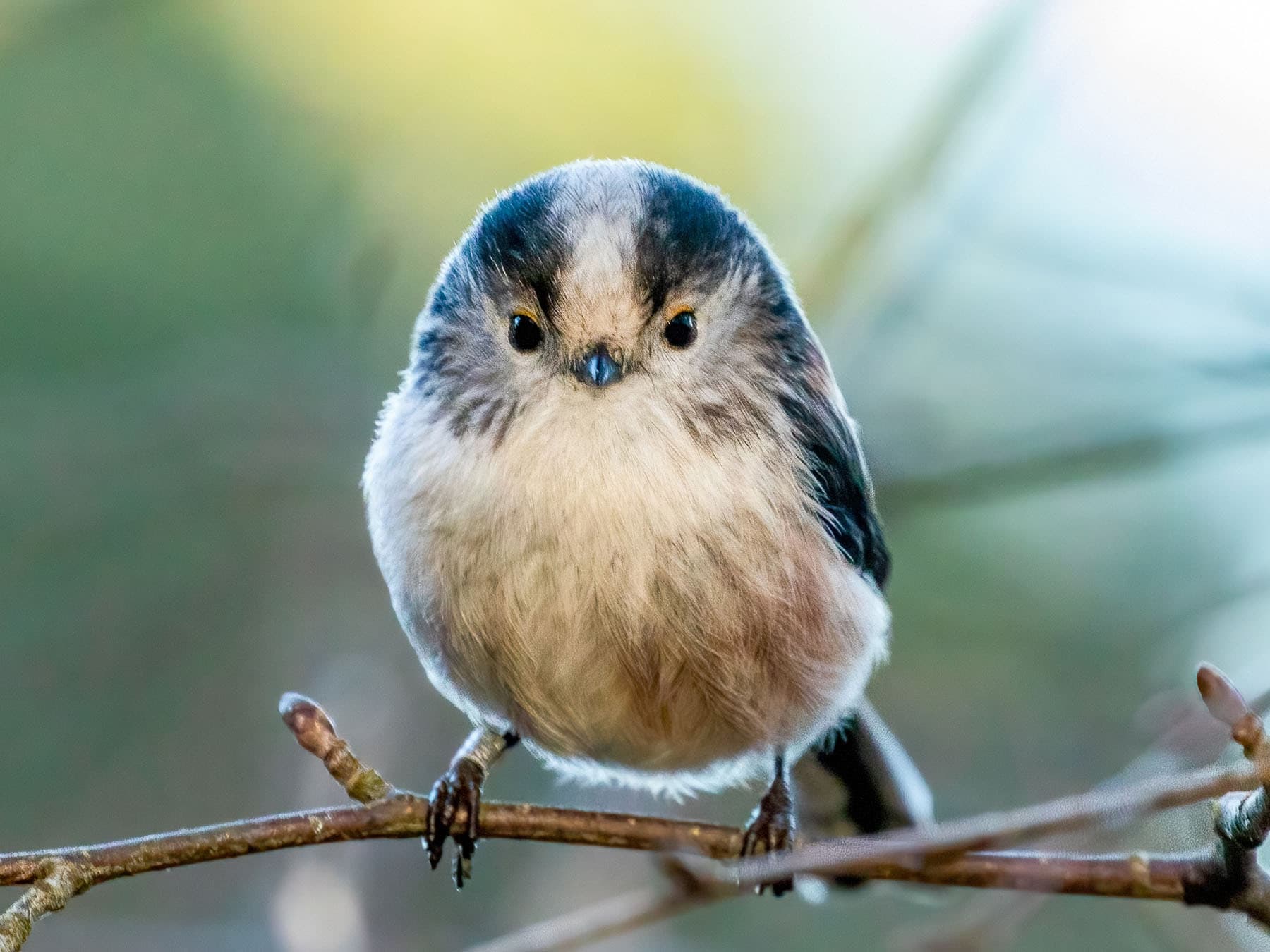
What a Long-tailed Tit sounds like, with British recordings drawn as spectrograms: the thin high notes and short rattles that a passing flock keeps up, what each call is for, and how researchers in Sheffield found that two of their contact calls help them tell relatives apart. For the bird itself, see Long-tailed Tit identification and facts.
What does a long-tailed tit sound like?
Mostly calls: Long-tailed Tits have no territorial song.1 A flock moving through the trees keeps up a stream of thin, high notes, broken by short, dry rattles. Those are the two calls you will hear most, a short series of high-pitched notes and a short rattle that falls in pitch, and they sound almost the same wherever the species lives, from Britain to Japan.2
The high notes
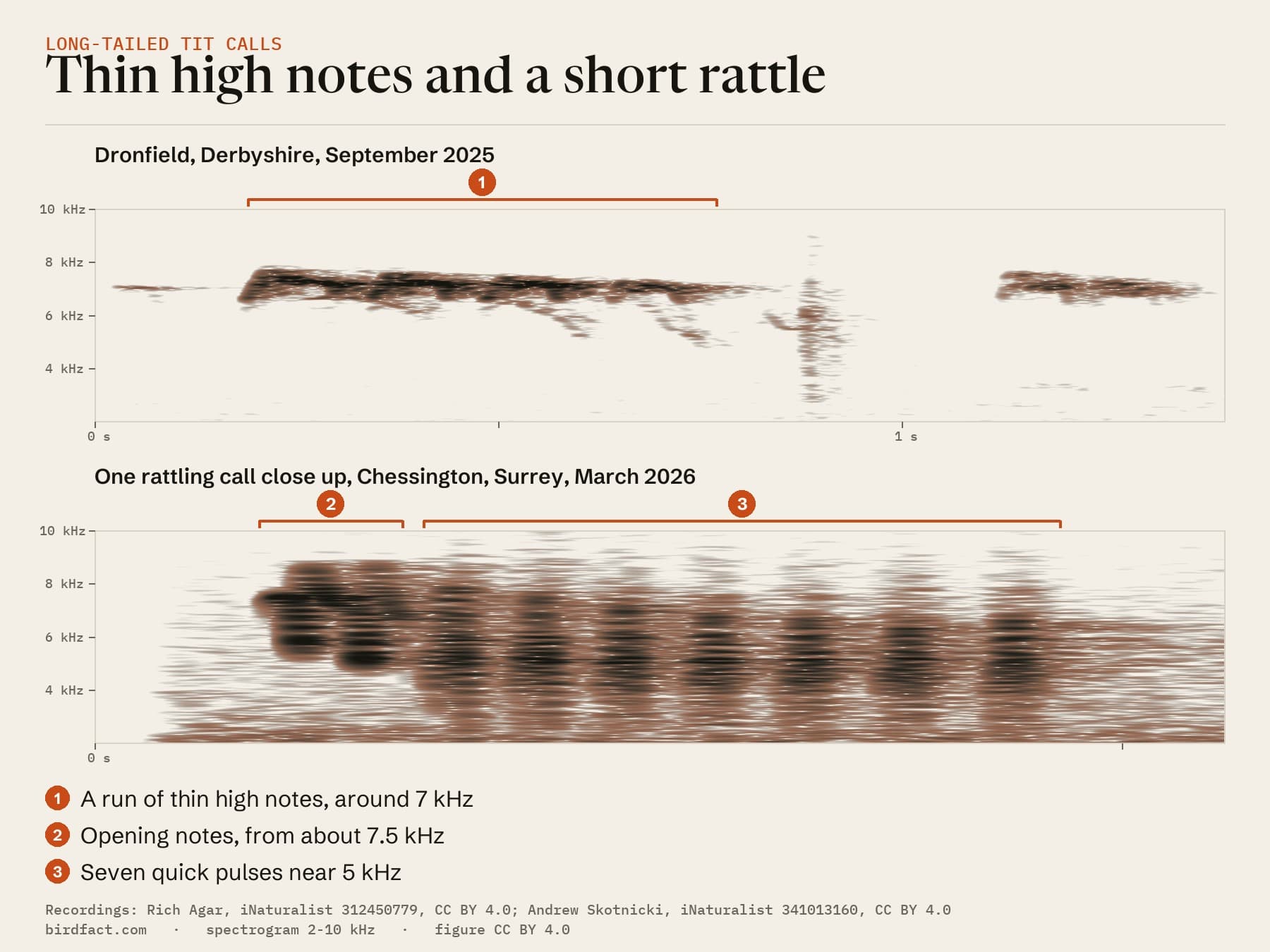
The high notes, written "see-see-see" or "tsee", are pure and quiet but carry. Birds give them especially in flight, when the flock moves on quickly, and when one has become separated from the others.1 In our Dronfield recording they run together into a thin band around 7 kHz that lasts about half a second. The standard British handbook of 1920 wrote the call as a feeble "tsee, tsee",3 and T. A. Coward wrote that after the breeding season it usually roams in family parties, "advertising itself by constant thin calls, zi, zi, zi".4
The Sheffield researchers, who have studied colour-ringed Long-tailed Tits in the Rivelin Valley since the 1990s, use the name "triple" for one longer-range contact call, a single note that may be repeated. Birds use it more while feeding as a group, and incubating females use it to tell the male that they are leaving the nest or coming back.5
The rattle
The rattle, written "tsirrup" or "tsirr", is a short, explosive trill that drops in pitch at the end. Birds give it when alarmed or excited, often with no obvious cause, and louder, harder versions when two flocks squabble.1 Andrew Skotnicki recorded the calls below in a wood at Chessington, Surrey, from a bird he noted was anxious about a Kestrel nearby. In the call drawn above, two quick opening notes, starting at about 7.5 kHz, are followed by seven quick pulses near 5 kHz, the whole call lasting about a third of a second.
The Sheffield team call a two-part call the "churr": an opening of one or two notes, then a single note repeated several times. It is a short-range call that breeding adults and their helpers use at the nest,5 and birds give it when they meet a strange flock or bird.6 The Chessington calls have that shape, but no source we have read matches the two sets of names one to one, so we keep each source's own words.
Other calls
Birds of the World also describes a fuller, flatter, clipped "tup", usually mixed with single thin "tseet" notes.1 The 1920 handbook found its low "tchup" very distinctive. Earlier observers wrote down still more. Writing from East Lothian, Mr Hepburn described "a harsh note resembling chur-chur, and a shrill one very like twit-twit"; and at Boghead in West Lothian in April 1839, Mr Weir found that a nest-building pair, apparently displeased at being watched, "set up a strong clicking noise not unlike that of the Stonechat".7
Do long-tailed tits sing?
Not in the usual sense: they have no territorial song. Now and then they give a soft, twittering run of "tup" and "tsirrup" notes, sometimes ordered like a reed warbler's song and sometimes jumbled. Both sexes give it, especially in disputes with other Long-tailed Tits, at mating, while building the nest and when feeding young.1
The German naturalist Johann Friedrich Naumann, writing in 1824, heard the male sing a few short, quiet, chirping phrases ending on a falling, plaintive note, and thought them very slight.8
Calls that tell relatives apart
Some Long-tailed Tits that lose their own nest go on to help feed the chicks at another pair's nest, often a relative's, and their calls are part of how they choose (more on helpers at the nest). Each bird's churr and triple calls are its own.9 Both calls develop in the nest and show some family likeness, but no difference between the sexes.10 Young birds learn their contact calls from the adults that feed them, and adults use those calls to tell relatives from strangers.11
In a playback test published in 2001, the researchers played eight breeding males the contact calls of a close male relative and of an unrelated male nesting nearby: the birds came closer to the loudspeaker and churred more for the stranger. In the same study, chicks swapped between nests later treated their foster nest-mates as family: all seven failed breeders whose only nest-mates were foster siblings went on to help them, and none of the three with no nest-mates helped at all.12
Later work found that failed breeders tended to help males whose churrs were more like their own, although how hard a helper then works follows how closely related it really is, not how alike the calls sound, so the voice is probably one cue among several.13 Similar calls may also help birds avoid pairing with close kin: only 1 of 609 Sheffield pairs was a parent and offspring or a brother and sister, and partners' churrs were less alike than those of close relatives (parents, offspring, brothers and sisters) living close enough to pair.14
In winter flocks
Winter flocks in the Sheffield study averaged about 16 ringed birds. When the researchers played the churr of a bird from another flock, the birds came straight in, churred more and gave fewer triple calls, then soon went back to feeding. In winter they reacted the same way whether the caller was a relative or not.6
How far the calls carry
Not far. In a Polish study that played recordings of 31 forest birds through woodland, the Long-tailed Tit's was the hardest to pick up: it was detected on the recordings half the time at 98 m and nine times in ten at 22 m.15 The calls the Sheffield team measured range from 2 to 9 kHz,13 and the thin notes in our recordings sit near 7 kHz.
The same calls from Britain to Japan
A comparison of recordings from across the species' range found the two main calls about identical in the birds of western Europe, British birds included, the white-headed birds of northern Europe and Asia, the grey-backed birds of the Mediterranean and the black-browed birds of Japan and Korea.2 In Japan, the white-headed birds of Hokkaido, the shima enaga, sound almost the same as the other Japanese birds.16
About the recordings
The recordings are from Rich Agar at Unstone, near Dronfield, Derbyshire, in September 2025; Andrew Skotnicki at Great Oaks, Chessington, Surrey, in March 2026; and Alison JC Brown in Queen's Park, Glasgow, in May 2026, where she noted a family, the parents feeding two young; a Great Tit sings in the background of that clip from about 13 seconds. The Chessington clip also has a run of higher notes at about 6 seconds, and the recordist noted a Ring-necked Parakeet nearby. Each was identified by the recordist and at least one other iNaturalist user. We looked at 101 of the 240 openly licensed British recordings on iNaturalist as spectrograms before choosing these. Birdfact drew the figure from two of them and measured the calls; the figure credits its recordings.
Sources
- Harrap, S. (2020). Long-tailed Tit (Aegithalos caudatus), version 1.0. Birds of the World (J. del Hoyo, A. Elliott, J. Sargatal, D. A. Christie and E. de Juana, editors). Cornell Lab of Ornithology. doi:10.2173/bow.lottit1.01
- Boesman, P. (2016). 259. Notes on the vocalizations of Long-tailed Tit (Aegithalos caudatus). Ornithological Notes (HBW Alive / Birds of the World). doi:10.2173/bow-on.100259
- Witherby, H. F., Jourdain, F. C. R., Ticehurst, N. F., Bonhote, J. L. (1920). A Practical Handbook of British Birds, vol. 1. Witherby, London. Accessed 11 October 2026. Source
- Coward, T. A. (1920). The Birds of the British Isles and their Eggs, first series. F. Warne, London. Accessed 11 October 2026. Source
- Leedale, A. E. (2018). Functions and mechanisms of kin recognition in long-tailed tits, Aegithalos caudatus. PhD thesis, University of Sheffield (White Rose eTheses 22124). Accessed 11 October 2026. Source
- Napper, C. J., Hatchwell, B. J. (2016). Social dynamics in nonbreeding flocks of a cooperatively breeding bird: causes and consequences of kin associations. Animal Behaviour 122: 23-35. doi:10.1016/j.anbehav.2016.09.008
- Macgillivray, W. (1839). A History of British Birds, vol. 2. Scott, Webster and Geary, London. Accessed 11 October 2026. Source
- Naumann, J. F. (1824). Naturgeschichte der Vögel Deutschlands, Theil 4. Fleischer, Leipzig. Accessed 11 October 2026. Source
- Sharp, S. P., Hatchwell, B. J. (2005). Individuality in the contact calls of cooperatively breeding long-tailed tits (Aegithalos caudatus). Behaviour 142: 1559-1575. doi:10.1163/156853905774831918
- Sharp, S. P., Hatchwell, B. J. (2006). Development of family specific contact calls in the Long-tailed Tit Aegithalos caudatus. Ibis 148: 649-656. doi:10.1111/j.1474-919x.2006.00568.x
- Sharp, S. P., McGowan, A., Wood, M. J. A., Hatchwell, B. J. (2005). Learned kin recognition cues in a social bird. Nature 434: 1127-1130. doi:10.1038/nature03522
- Hatchwell, B. J., Ross, D. J., Fowlie, M. K., McGowan, A. (2001). Kin discrimination in cooperatively breeding long-tailed tits. Proceedings of the Royal Society B 268: 885-890. doi:10.1098/rspb.2001.1598
- Leedale, A. E., Lachlan, R. F., Robinson, E. J. H., Hatchwell, B. J. (2020). Helping decisions and kin recognition in long-tailed tits: is call similarity used to direct help towards kin? Philosophical Transactions of the Royal Society B 375: 20190565. doi:10.1098/rstb.2019.0565
- Leedale, A. E., Simeoni, M., Sharp, S. P., Green, J. P., Slate, J., Lachlan, R. F., Robinson, E. J. H., Hatchwell, B. J. (2020). Cost, risk, and avoidance of inbreeding in a cooperatively breeding bird. Proceedings of the National Academy of Sciences 117: 15724-15730. doi:10.1073/pnas.1918726117
- Winiarska, D., Szymański, P., Osiejuk, T. S. (2024). Detection ranges of forest bird vocalisations: guidelines for passive acoustic monitoring. Scientific Reports 14: 894. doi:10.1038/s41598-024-51297-z
- Canon. シマエナガ (Shima enaga) and エナガ (Enaga). Canon Bird Branch Project photo guide. Accessed 11 October 2026. Source
- iNaturalist recordists. Recordings of Long-tailed Tits used on the call page. iNaturalist. Accessed 11 October 2026. Source