Published 31 Oct 2026
Cooper's Hawk Sounds: Calls and What They Mean
By the Birdfact teamChecked by Nathan Cope
A Cooper's Hawk has no song and is silent much of the year. Near a nest in spring and summer it gives a loud, rapid cak-cak-cak alarm call. The male announces himself with a short kik, the female calls a long whaaa when she flies to him for food, and fledglings beg with high, squealing calls. This page has recordings of all but the kik.
On this page11 sections
A Cooper's Hawk has no song, and for much of the year it is silent. The sound people notice is a loud cak-cak-cak, given near a nest in spring and summer when something threatens it. Pairs also keep in touch with a few other calls: the male's short kik and the female's long whaaa. In summer, the young add their squealing begging calls.1, 2 This page plays recordings of all but the kik, shows what the calls look like, and covers the birds that sound like a Cooper's Hawk. For the bird in full, see the Cooper's Hawk guide.
What does a Cooper's Hawk sound like?
Like a run of short, loud notes, cak-cak-cak-cak, lasting 2 to 5 seconds and often repeated many times. It is the call you are most likely to hear, and it is typically given when a nest is threatened.1, 2 The other calls are easier to miss.
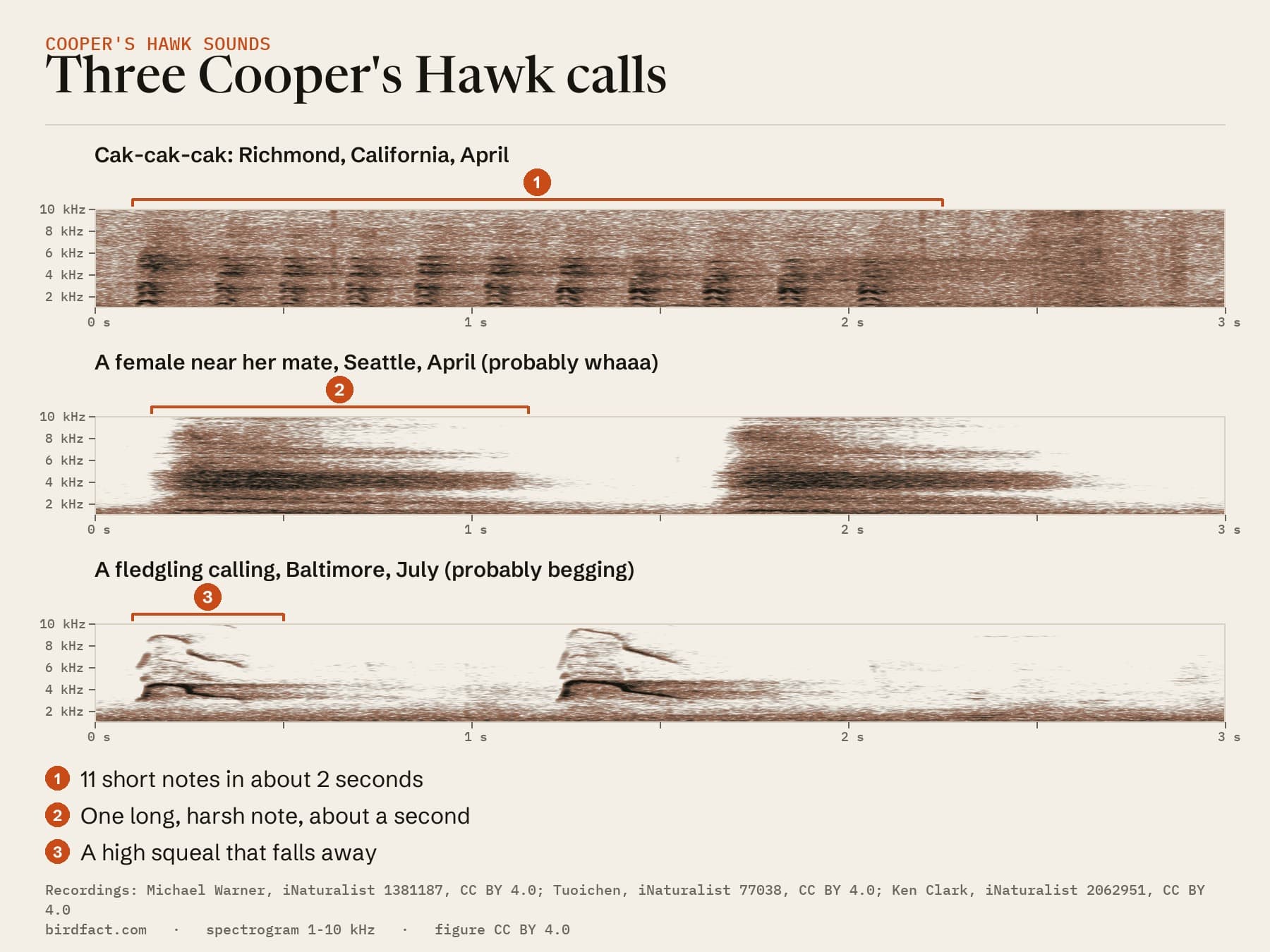
The figure below shows three of the calls side by side. Their recordings follow, each in its own section.
Researchers have described the calls in very different detail. One early study named 42 adult calls from females and 22 from males, plus 14 from young birds; a long Wisconsin study grouped the adult calls into just 4 types.1
The cak-cak-cak alarm call
This is the alarm call. Either parent gives it when the nest is threatened, many times in a row, from a perch near the nest or in flight.1 In courtship, females mix kik notes into it, especially at dawn, when the pair start the day's mating. It may remind the smaller male each day who is in charge. Males rarely give it then: in Wisconsin, only 1 of 50 did.1
The recording below was made in April by a recordist who photographed a pair that day, the male gathering nest material. The notes come about five a second.3
The kik call
The kik is the male's most frequent call. He gives it to tell his mate where he is when he comes back to within about 330 feet (100 m) of the nest with food for her or the chicks, and at dawn in courtship. In woods she probably cannot see him arrive. He also calls kik while building the nest, in his courtship flight and in a bowing display that may show he is ready to build and means no harm. Females give it less often, sometimes when looking for the male.1 In Wisconsin, color-marked males gave kik calls on their territories in autumn and winter, when they seemed to be alone.1
We have not yet found a recording of a kik call that we could check and use, so none is on this page.
The whaaa call
The whaaa is mostly the female's. She gives it flying to the male for food, during the food pass, while plucking prey he has brought, and when taking food back to the chicks, though not while feeding them. Before the eggs are laid, she gives it in clusters of one to four notes near the male while he builds. It may tell her smaller mate that she will not attack him, or ask him for food.1 During mating she gives a run of whaaa notes lasting 2 to 6 seconds; males sometimes join in. Breeding females in Tucson gave fewer whaaa calls at city nests than at rural ones, perhaps because food was easier to find.1
In the recording below, a female calls near her mate in Seattle in late April; the recordist watched the pair mate. Females give the whaaa during mating, so these long, harsh notes are probably whaaa calls, though the recordist did not name the call.4
Juvenile Cooper's Hawk calls
Chicks cheep as they break out of the egg. From about a week old they give a chip call, apparently when something bothers them, such as direct sun, and they stop by 3 weeks. From about 3 weeks they also give weak versions of the adults' cak and kik.1
After leaving the nest, the young beg for food with a long, high, squealing eeeeeeee or speeeeeeeeoo. Fledglings in Florida also gave a whistled weee-tear and fast cuck notes as they grew more excited.1 In the first recording below, a fledgling the recordist photographed gives two calls in July, probably begging.5 In the second, a young bird in its first winter, seen by the recordist, gives a run of cak calls.6 More on young birds in Juvenile Cooper's Hawks.
Why do Cooper's Hawks screech?
Mostly because something is near their nest. The loud, repeated cak-cak-cak is an alarm call, given by either parent at anything that threatens the nest, people included.1 In summer, the squealing usually comes from fledglings begging for food, and in spring a pair can be noisy at dawn as they start the day's courtship.1 They also use threat postures and chases, but they rarely strike people, and many pairs slip away quietly.1 More in Cooper's Hawk nesting.
Male and female voices
The male's voice is generally higher, a little faster and less harsh than the female's, though some of his calls are lower. In one early study, females nesting as yearlings called higher than older females, but no difference with age was noticed in Wisconsin.1 Females have the bigger repertoire, perhaps because the larger female runs most of the pair's dealings.1 More in Male vs female Cooper's Hawk.
When they call
Cooper's Hawks are silent much of the year and fairly vocal in the nesting season. Little is known about their daily pattern, but before the eggs are laid, females call more when their mates are near, especially early in the morning. They call from inside cover or in flight.1 Calls are probably the main way a pair keep in touch, since in thick woods they often cannot see each other. No regional differences in their calls have been reported.1
Birds that sound like a Cooper's Hawk
Sharp-shinned Hawk. Its alarm call, kek-kek-kek or kik-kik-kik, is higher, thinner and possibly faster than a Cooper's Hawk's. It also gives single chip notes much like a songbird's, and like a Cooper's it is silent most of the year.7 More in Cooper's Hawk or Sharp-shinned Hawk?
American Goshawk. Its calls are like a Cooper's Hawk's but louder and fuller. The alarm is a rapid series of about 10 to 20 ki-ki-ki or kak notes, and both sexes give a wailing kree-ah lasting a second or two.8
Red-tailed Hawk. The long, hoarse scream, kee-eeee-arrr, falling at the end, is a Red-tail's, usually from a bird soaring overhead.9 Films often use it as the voice of eagles and other hawks.10 More in Cooper's Hawk or Red-tailed Hawk?
Jays. Blue Jays and Steller's Jays often mimic Cooper's Hawk calls, even near the hawks' nests.1
About the recordings
The recordings on this page are research-grade iNaturalist observations shared under CC BY 4.0. We chose each one after reading the observation and checking its spectrogram, and the figure above is drawn from three of them.
Sources
- Rosenfield, R. N., Madden, K. K., Bielefeldt, J., Curtis-Scott, O. E. (2025). Cooper's Hawk (Astur cooperii), version 1.2. Birds of the World (P. G. Rodewald, editor). Cornell Lab of Ornithology. doi:10.2173/bow.coohaw.01.2
- National Audubon Society. Cooper's Hawk. Guide to North American Birds. Accessed 30 October 2026. Source
- Michael Warner (2025). Cooper's Hawk cak-cak-cak calls, Richmond, California, 18 April 2025. iNaturalist sound 1381187. Accessed 31 October 2026. Source
- Tuoichen (2020). Cooper's Hawk calls, Discovery Park, Seattle, Washington, 26 April 2020. iNaturalist sound 77038. Accessed 30 October 2026. Source
- Ken Clark (2026). Cooper's Hawk fledgling calls, Federal Hill Park, Baltimore, Maryland, 6 July 2026. iNaturalist sound 2062951. Accessed 31 October 2026. Source
- bungelina (2020). Cooper's Hawk calls, Farm Hills, Redwood City, California, 15 February 2020. iNaturalist sound 57880. Accessed 30 October 2026. Source
- Bildstein, K. L., Meyer, K. D., White, C. M., Marks, J. S., Kirwan, G. M. (2020). Sharp-shinned Hawk (Accipiter striatus), version 1.0. Birds of the World (S. M. Billerman et al., editors). Cornell Lab of Ornithology. doi:10.2173/bow.shshaw.01
- Squires, J. R., Reynolds, R. T. (2024). American Goshawk (Astur atricapillus), version 1.2. Birds of the World (N. D. Sly, editor). Cornell Lab of Ornithology. doi:10.2173/bow.norgos.01.2
- Preston, C. R., Beane, R. D. (2024). Red-tailed Hawk (Buteo jamaicensis), version 1.1. Birds of the World (A. F. Poole and M. G. Smith, editors). Cornell Lab of Ornithology. doi:10.2173/bow.rethaw.01.1
- Cornell Lab of Ornithology. Red-tailed Hawk overview. All About Birds. Accessed 30 October 2026. Source