Facts · Updated 8 Oct 2026
Coal Tit Nesting: Nests, Eggs and Baby Coal Tits
By the Birdfact teamChecked by Nathan Cope
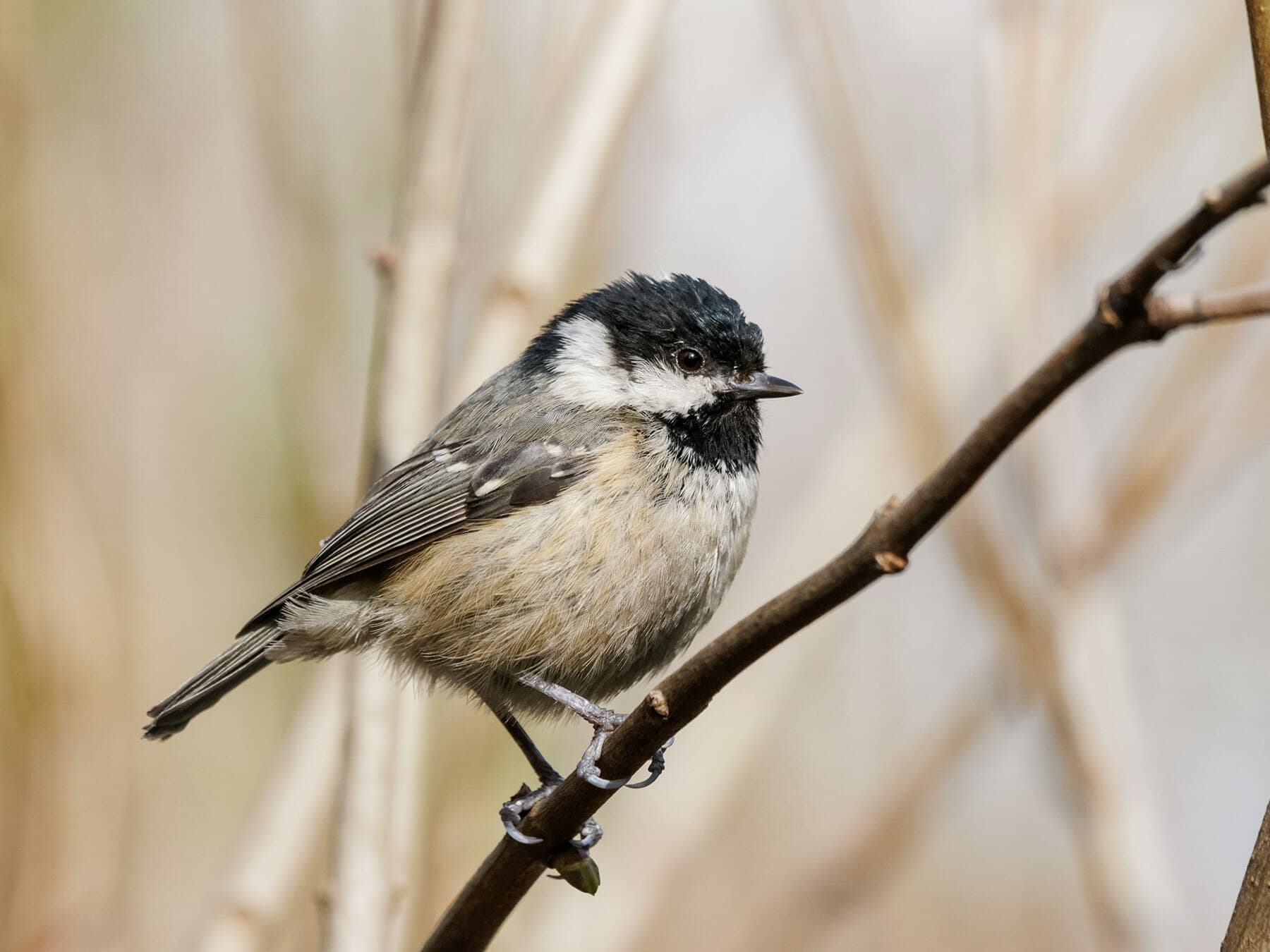
Coal Tits nest in holes with narrow entrances, sometimes low down in stumps, walls or even the ground, and in small nest boxes. The female builds a mossy cup and lays usually 9 or 10 eggs; the chicks leave the nest at 16 to 19 days.
On this page12 sections
Everything about Coal Tit nests: where and when they nest, the nest and eggs, the chicks and fledglings, nest boxes and the law. For the bird itself, see Coal Tit identification, song and facts.
Where do Coal Tits nest?
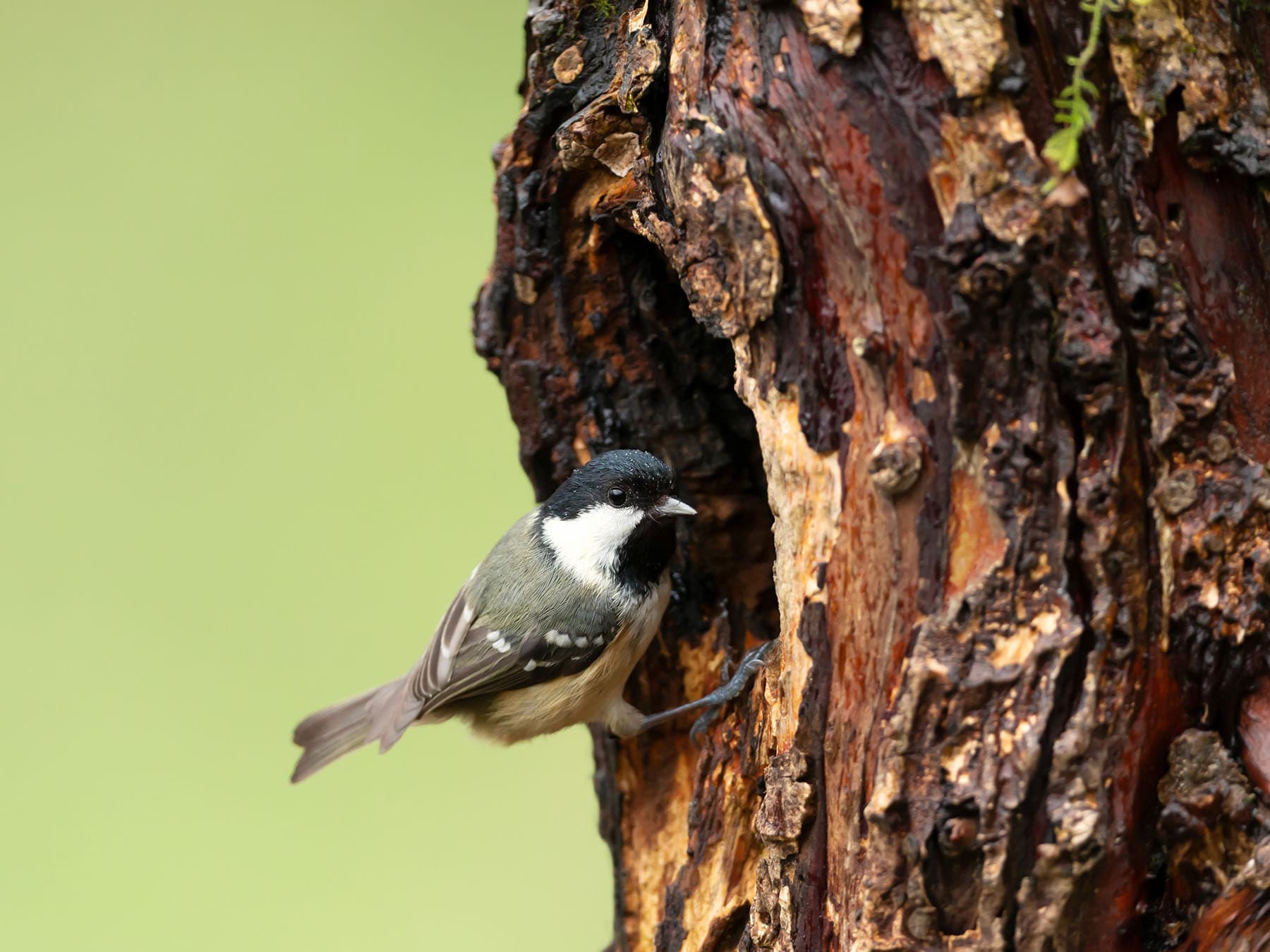
In holes, sometimes very low down. A Coal Tit chooses a hole or cavity, usually with a very narrow entrance: in a tree trunk or an old stump, including old woodpecker and rodent holes, a hole or crevice in a wall or among rocks, among the roots of a fallen tree, or in the ground itself, under stones or down a mouse hole. They do not usually dig their own hole, but they may enlarge one.1 Coal Tits also use small hole-fronted nest boxes (see below).
When do Coal Tits nest?
Across its range the breeding season runs from the end of March to late July, later in the north than in the south. In Britain, BTO nest records show that laying dates have advanced by almost two weeks in recent decades.2
Courtship
Courtship involves long bouts of wing-shivering with wheezing calls, and the male glides slowly past the female with his wings and tail spread. A long spell of courtship feeding follows. Pairs are monogamous; Birds of the World describes the bond as lifelong, and one pair was recorded together for six years.
The nest
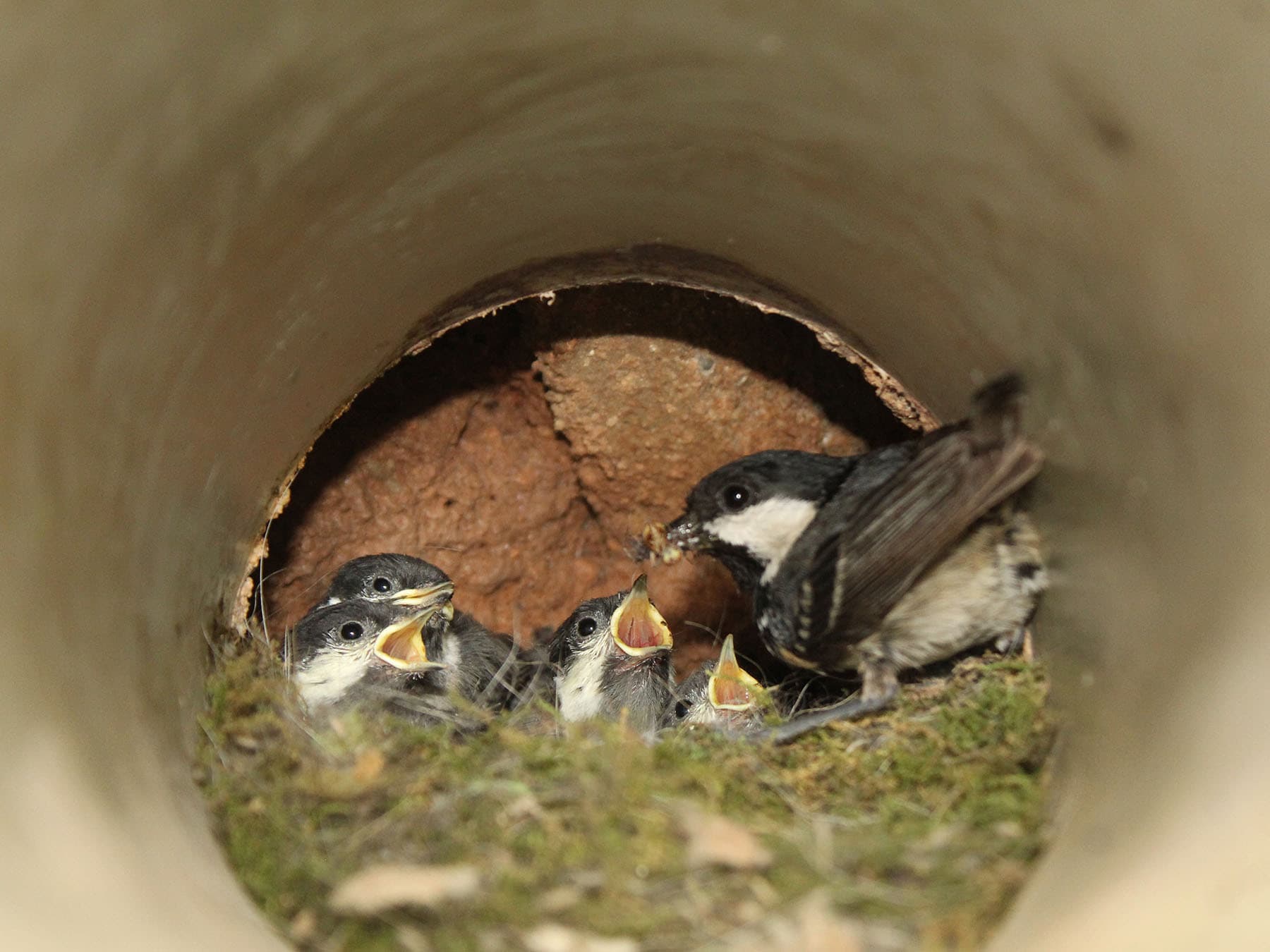
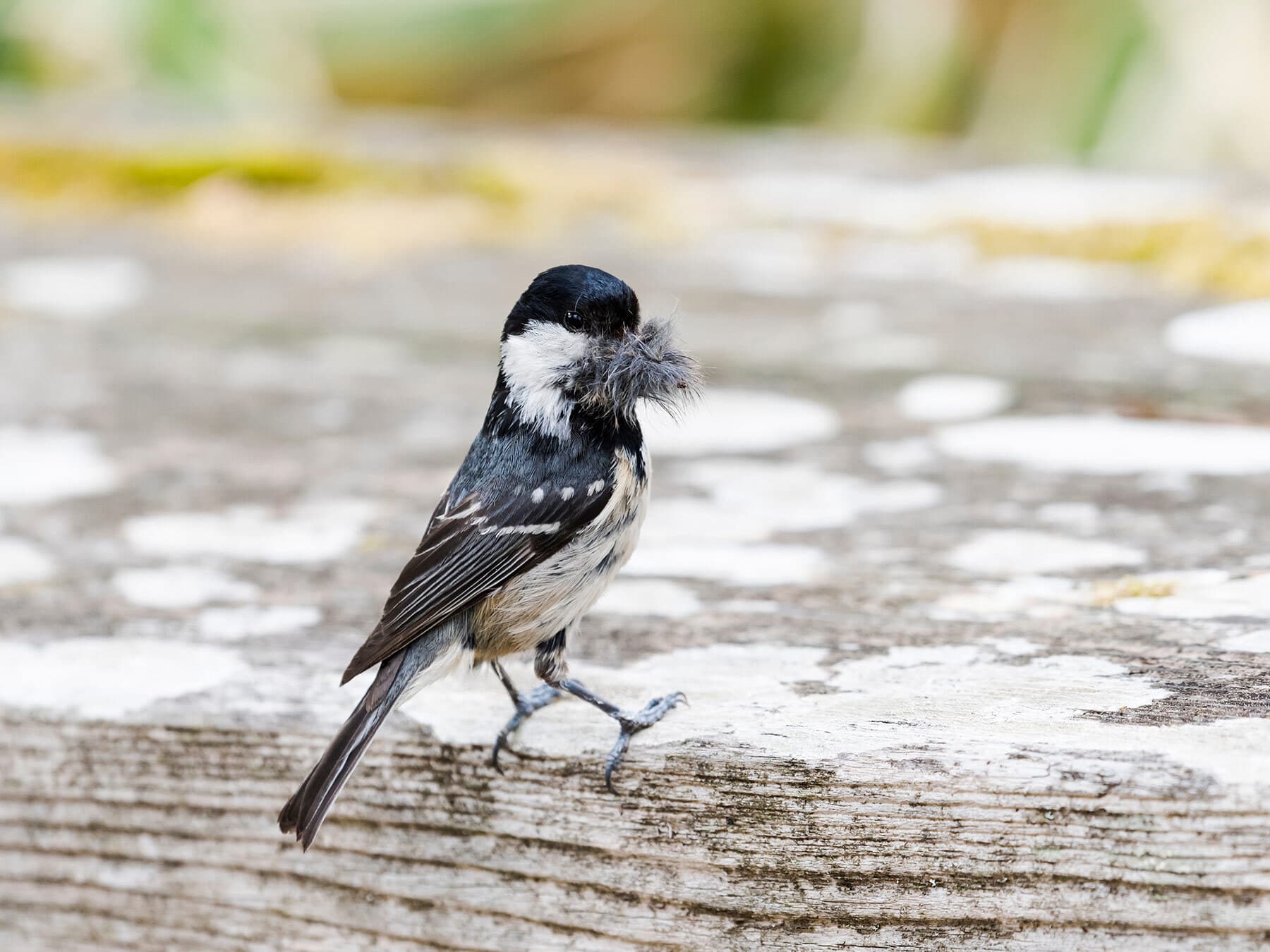
The female builds the nest on her own. It is a cup made almost entirely of moss, with some animal hair, wool and feathers worked in.
Eggs
In British nests a clutch is usually 9 or 10 eggs, and anything from 7 to 11. The eggs are tiny, about 15 by 12 mm and about 1 g each. Second clutches are smaller than first ones.
Incubation
Only the female incubates, for 14 to 16 days.
Baby Coal Tits
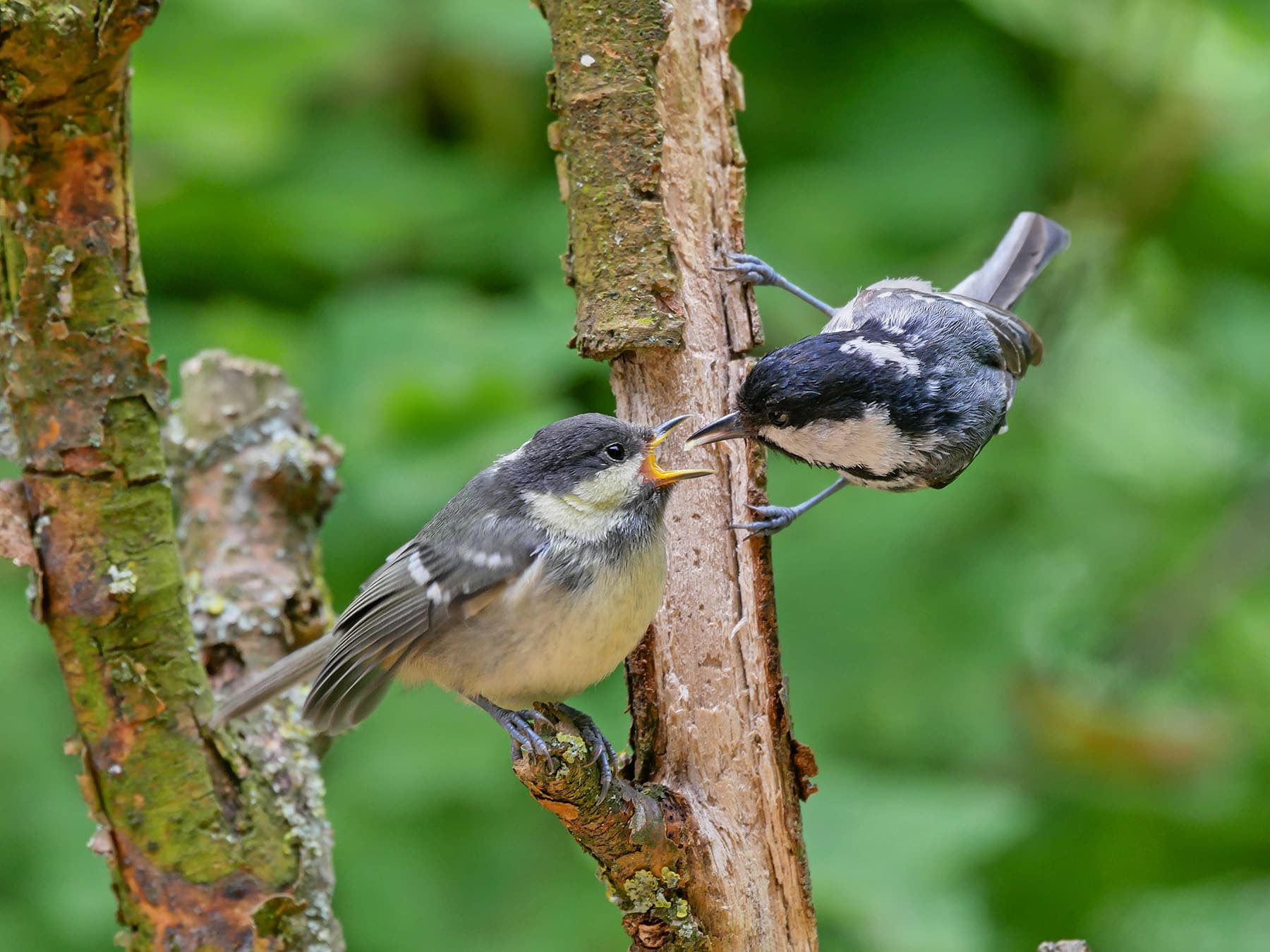
The chicks hatch helpless, with a little down. The female broods them and both parents feed them, mostly on small insects, caterpillars and spiders: in years when caterpillars are plentiful they can be the entire diet, while in pine forests the chicks get mainly spiders. The young leave the nest at 16 to 19 days old.
Coal Tits usually raise a high share of their young: in studies in Europe and Türkiye, 57% (evergreen oak) to 88.5% (spruce forest) of the eggs laid produced a fledgling.1 Apart from predation, fewer chicks die than in Great and Blue Tit broods.
Fledglings
Once out of the nest, young Coal Tits stay together in thick cover for the first few days. That is unusual: the young of most other tits follow their parents about. A fledgling has a sooty grey cap and yellowish cheeks.
If you find a fully feathered fledgling on the ground, it is usually best left alone: its parents are usually nearby and still caring for it. Keep people and pets away, and move it only if it is in danger, a short way into cover.3
Broods
One or two a year in Britain. Across the range second broods are frequent, except in broadleaved woods, and a few pairs manage three.
Do Coal Tits use nest boxes?
Yes. The BTO lists the Coal Tit among the birds that use small hole-fronted nest boxes,4 though Birds of the World describes boxes as only occasionally used. For tits the BTO recommends a 32 mm entrance hole, walls at least 15 mm thick and a floor of at least 130 square centimetres, since birds may lay fewer eggs in a cramped box.5
Fix the box 1 to 3 m up on a tree trunk, with a clear flight path to the hole, sheltered from the prevailing wind, rain and strong sunlight.6
Coal Tit nests and the law
The nests of all wild birds are protected while in use or being built. In England and Wales it is an offence intentionally to take, damage or destroy the nest of any wild bird while it is in use or being built. In Scotland the offence also covers doing so recklessly, and interfering with the nest.7 In Northern Ireland it covers doing so intentionally or recklessly.8 Coal Tits can nest low, in walls, stumps and even the ground, so take care when clearing or rebuilding in spring and summer.
Sources
- Gosler, A., Clement, P. (2023). Coal Tit (Periparus ater), version 1.1. Birds of the World (B. K. Keeney and S. M. Billerman, editors). Cornell Lab of Ornithology. doi:10.2173/bow.coatit2.01.1
- BTO. Coal Tit (Periparus ater). BTO BirdFacts. Accessed 8 October 2026. Source
- RSPB. Injured and baby birds. RSPB advice. Accessed 8 October 2026. Source
- BTO. Nest boxes for birds. BTO, Helping birds. Accessed 8 October 2026. Source
- BTO. Buying a nest box. BTO, Helping birds. Accessed 8 October 2026. Source
- BTO. Putting up a nest box. BTO, Helping birds. Accessed 8 October 2026. Source
- UK Parliament (1981). Wildlife and Countryside Act 1981, section 1. Accessed 7 October 2026. Source
- UK (1985). The Wildlife (Northern Ireland) Order 1985, article 4. Accessed 7 October 2026. Source