Published 10 Oct 2026
Bullfinch Call and Song: What a Bullfinch Sounds Like
By the Birdfact teamChecked by Nathan Cope
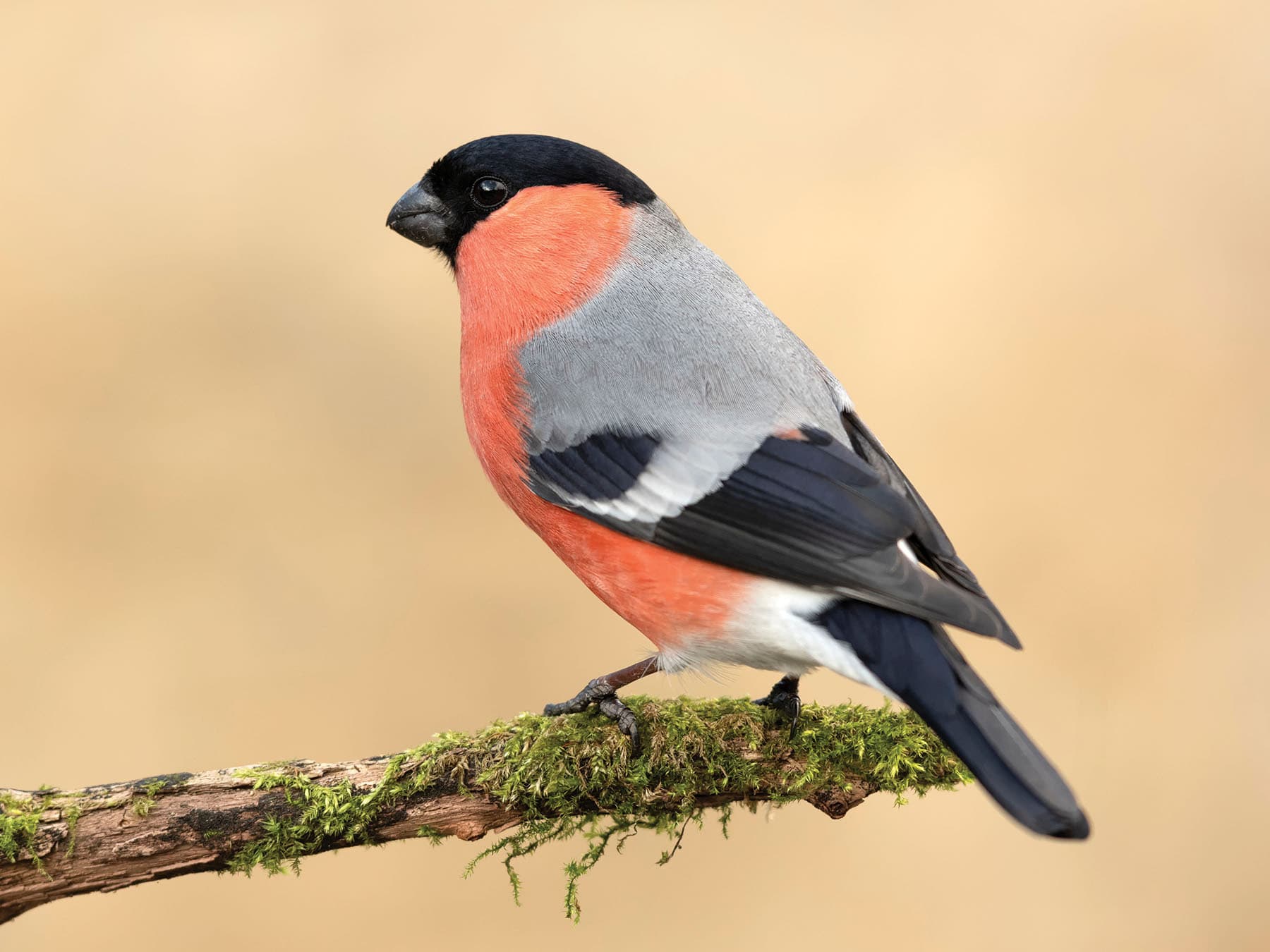
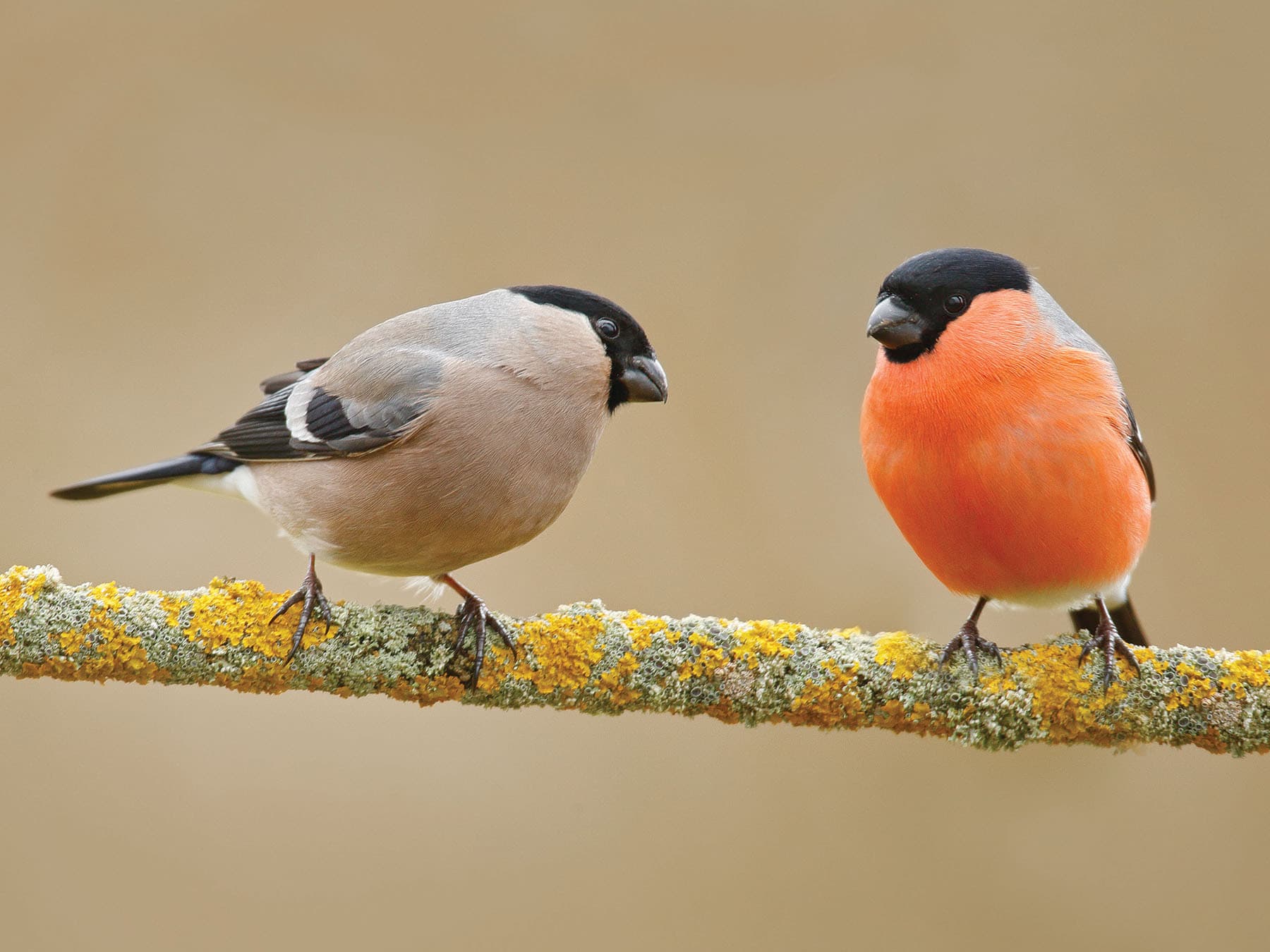
A Bullfinch's call is a soft, low, piping whistle that falls in pitch, often the first sign one is near. Its song is quiet, sung by both sexes, and learned mainly from the father. Listen to British recordings, see them drawn as spectrograms, and hear the trumpet call of the Northern Bullfinches that reach Britain in some autumns.
On this page11 sections
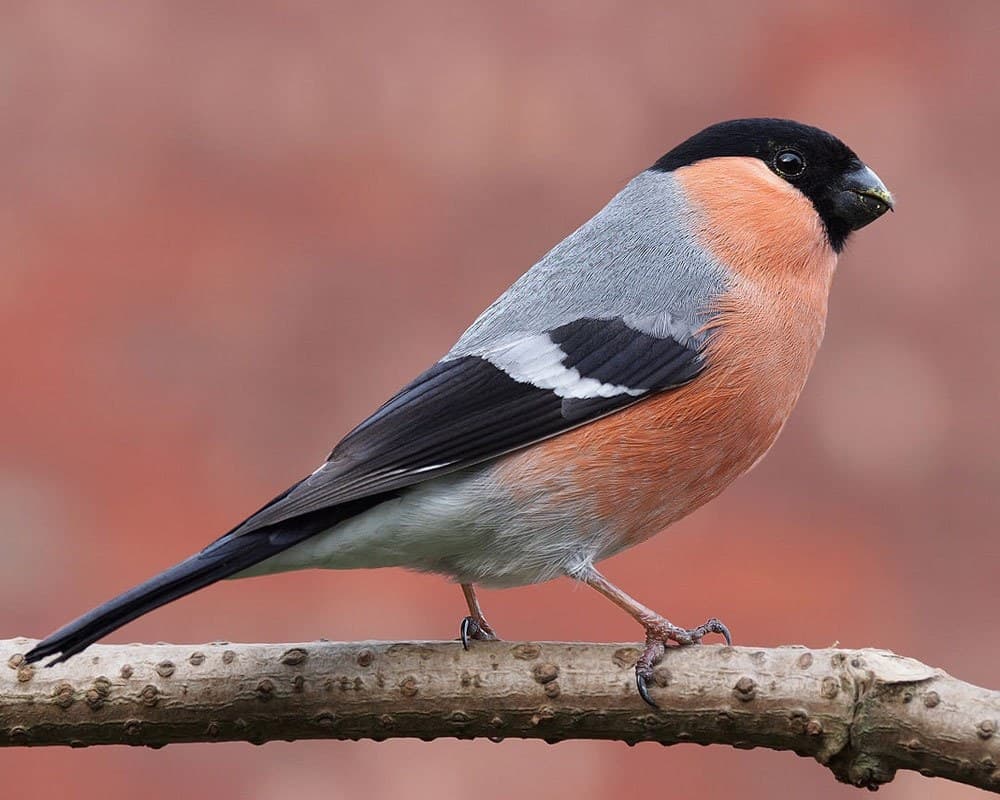
What a Bullfinch sounds like, with recordings from Britain and Europe drawn as spectrograms: the soft piping call you are most likely to hear, the quiet song that both sexes sing, how young Bullfinches learn their song, and the "trumpet call" of the Northern Bullfinches that reach Britain in some autumns. For the bird itself, see Bullfinch identification and facts.
What does a bullfinch sound like?
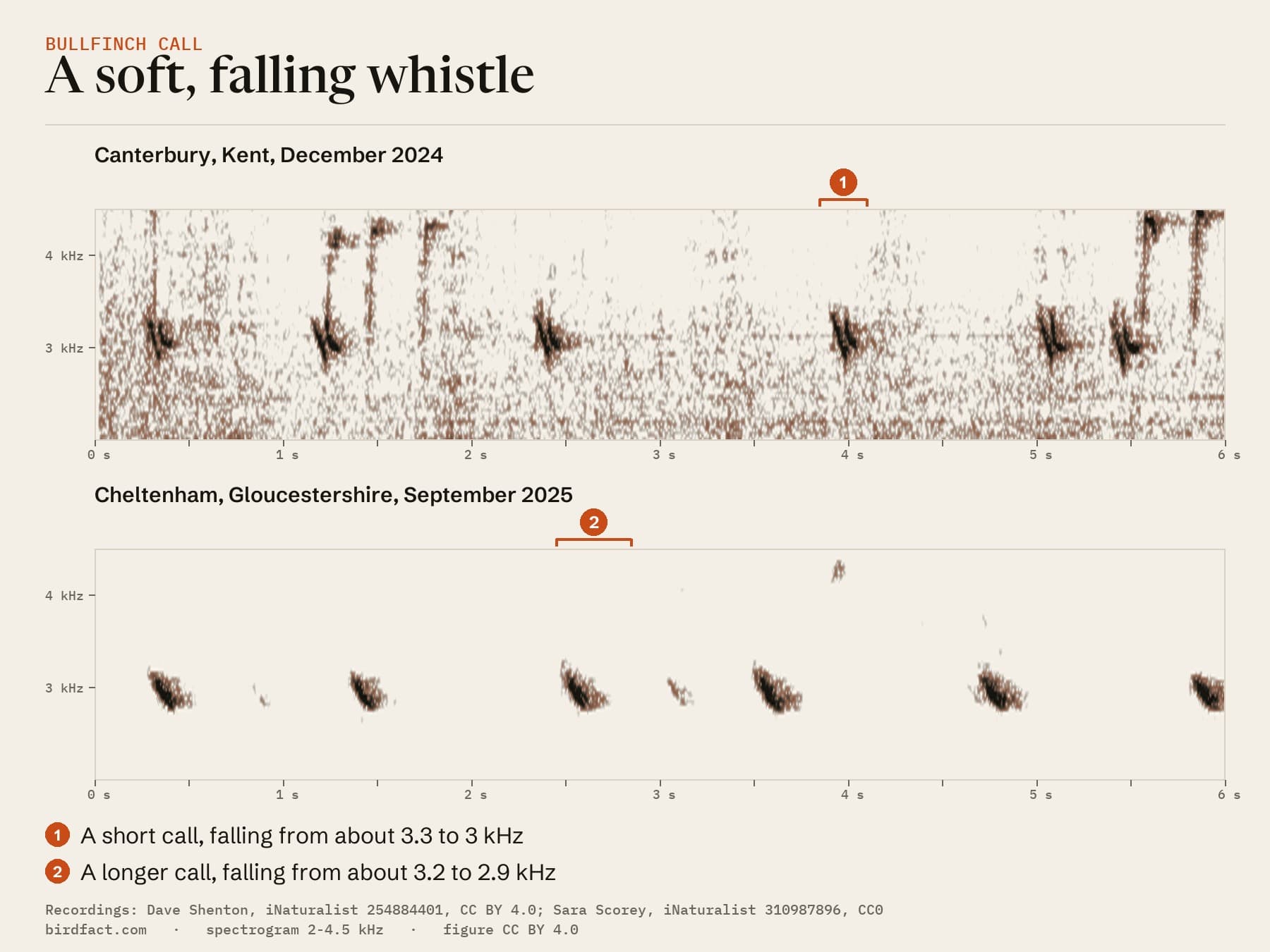
A soft, rather sad piping whistle that falls in pitch: "peu", "teu" or "deu".1 It is often the first sign that Bullfinches are about, and the RSPB notes that a Bullfinch is usually found by this mournful call, the "pew pew" of its species page.2 The BTO describes it as a soft single whistle.3 A century ago the standard British handbook said much the same: a Bullfinch's presence is "often first revealed by call-note, a soft, low, piping 'whib'".4
The call
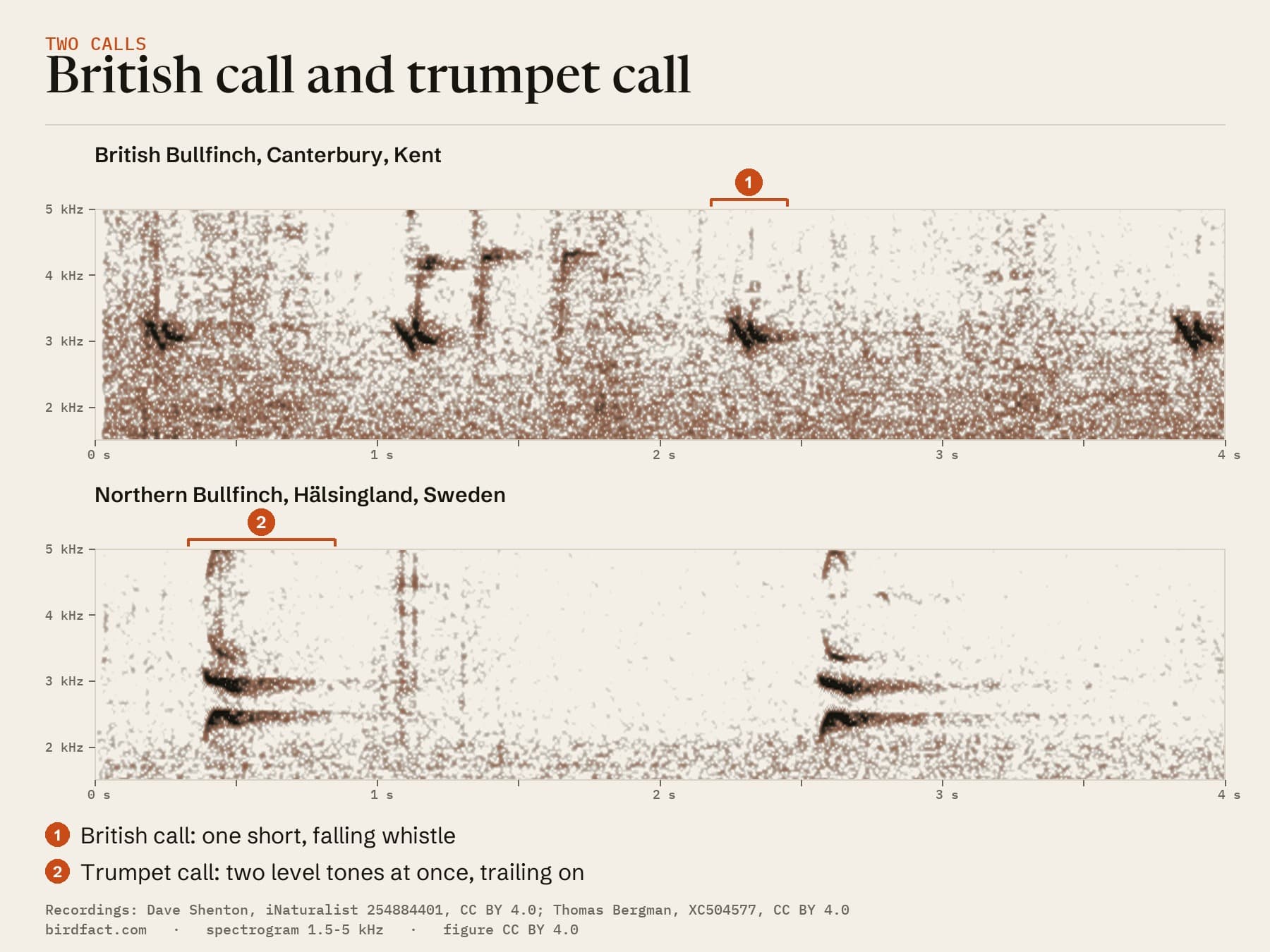
In our recordings each call lasts about 0.1 to 0.35 seconds and slides down from about 3.2 or 3.3 kHz to about 2.9 or 3 kHz: a short downward stroke on a spectrogram. Partners use the call to keep in touch, and it can be heard some distance away; given repeatedly, it serves as an alarm. Young birds' calls are similar but louder or harsher.1 An early 19th-century German account notes that it is heard most often in flight, as a bird lands, or just before it flies off.5
In a study of captive Bullfinches, each bird's contact calls had their own length.6 Altogether Bullfinches have 14 to 17 kinds of call and song, more than most of their relatives, and most of them are given by both sexes.7
Do bullfinches sing?
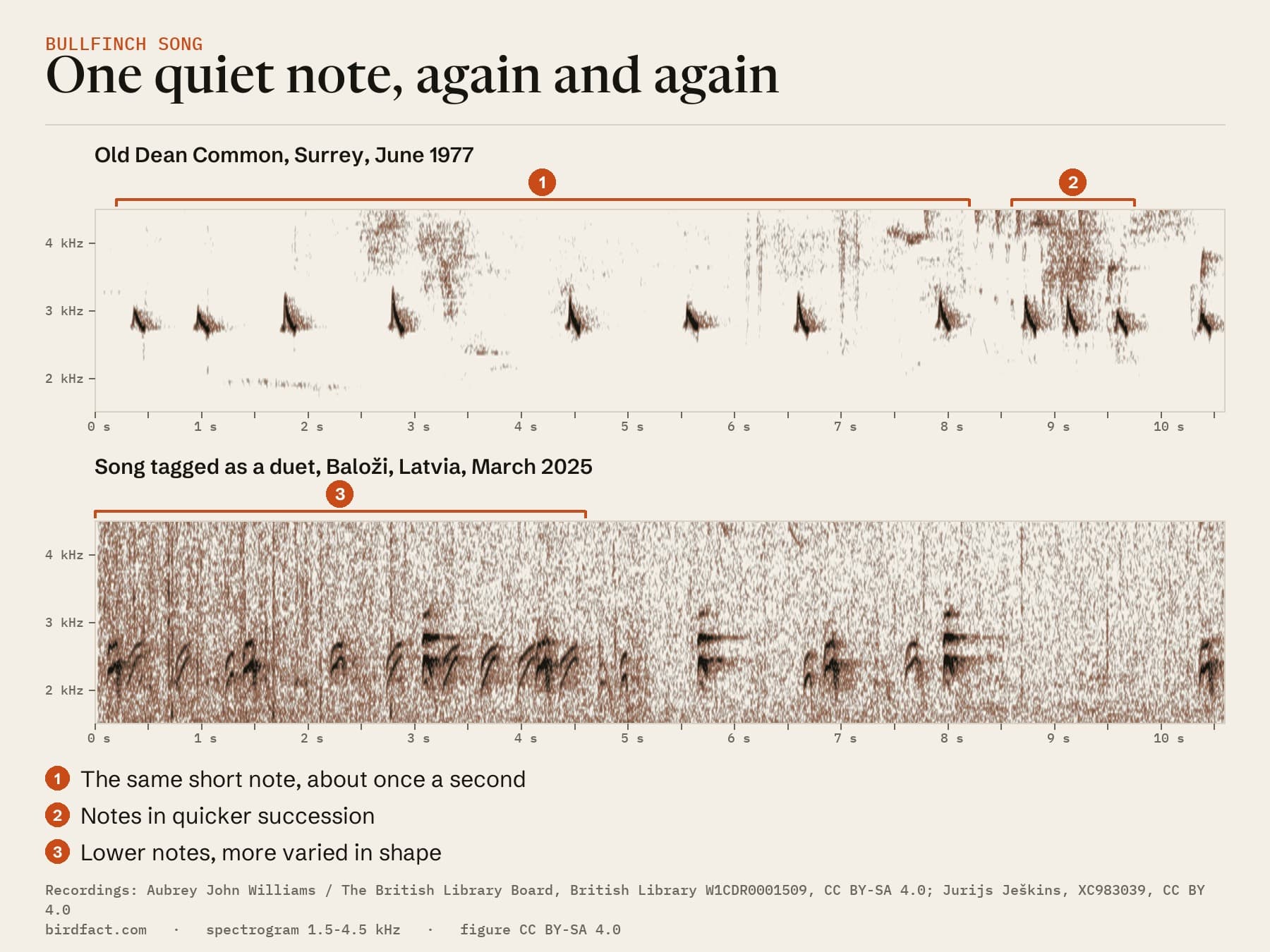
Yes, but quietly. The song is built from the call note itself, given singly or two at a time with short gaps between, and now and then a higher, longer piping note.1 The German naturalists of around 1800 found it creaking and muffled, so soft that it is heard clearly only close by, and compared it to an unoiled door hinge, cartwheel or wheelbarrow.58
A recording made by Aubrey John Williams on Old Dean Common, Surrey, in June 1977 shows the pattern: the same short note about once a second, each one rising briefly to about 3 to 3.2 kHz and falling back to about 2.75 kHz, then a few notes in quicker succession.
Do female bullfinches sing?
Yes. Both sexes sing, though males sing more often.1 Naumann's account of 1824 says the same: the male sings more often, a little better and louder.5 In Jürgen Nicolai's studies of captive Bullfinches, a female kept the song motifs she had learned from her father and, after pairing, added motifs from her mate's song; only her first mate had that influence.9
The recording below, made by an automatic recorder near a bird feeder in Baloži, Latvia, is tagged by its recordist as a duet; the sexes of the birds are not recorded.
When they sing
How they learn their song
A young Bullfinch learns its song, and even its call, from the bird that raises it, above all its father, during its time in the nest and the weeks until it becomes independent. Whatever the father's song is like, quirks included, the young bird learns it and keeps it for life. Jürgen Nicolai showed this with captive birds in a study published in 1959.
One of his birds was a young male raised by Canaries. It learned the song of the one male Canary present and passed it on to its own sons; four years later, its great-grandsons were still singing the Canary phrases unchanged.9
Later work found that a Bullfinch raised by a Canary had copied 13 different types of Canary syllable from its foster parent.11
Birds that learned human tunes
Of all birds, Bullfinches are the most famous for picking up tunes from people. In Nicolai's studies, fifteen birds hand-raised by three human tutors between 1967 and 1975 each learned a folk tune of 20 to 50 notes, and all fifteen learned to take turns with him, singing alternate phrases.12 When one bird skipped notes it carried on from the right place, and it ended one human tune with a Bullfinch call.
That bird's 45-note tune was "Im tiefen Böhmerwald",12 and it sang the tune a semitone higher than its tutor, very consistently.11 And in 1903 a letter to Nature described an old Bullfinch in Brunswick, which piped "God Save the King": a Canary in the next room learned the tune and, when the Bullfinch paused too long, finished it.13
A history of piping bullfinches
In the 1800s, people in Germany taught young Bullfinches to pipe tunes. In 1800 the naturalist Johann Bechstein wrote that young birds were taught in Hesse and around Fulda, often by weavers and other craftsmen who worked at home, and that a dealer in his home town of Waltershausen sent hundreds of trained birds a year to Berlin and England.8 The English edition of his book speaks of "schools of these little musicians, for all Germany, Holland, and England", and adds that the dealer's son came to London every April or May with birds for sale.14 A century later Brehm's encyclopaedia recalled that the Thuringian Forest had once raised hundreds of young Bullfinches a year for cities from Berlin and London to St Petersburg, and even America.10
Bechstein advised against teaching them with small bird organs, which he found out of tune and shrill; a flute or a person whistling was better.8 Today, in Great Britain, it is an offence to intentionally kill, injure or take any wild bird (in Scotland, also recklessly), and a Bullfinch may be sold alive only if it was bred in captivity and is ringed or marked under the regulations.15
The trumpet call
Bullfinches from northern Europe and Russia, the larger Northern Bullfinches, reach Britain in some autumns.1 In autumn 2004 a record invasion reached Britain, with birds turning up from Iceland and Ireland to Italy and Bulgaria, and some of them gave an unfamiliar call that became known as the "trumpet call".16 It was the largest invasion of Northern Bullfinches into western Europe on record, and while some birds gave the normal piping call, others gave the trumpet call, previously unknown to most observers there.17
In our Swedish recording, the trumpet call is two level tones at once that trail on, where a British Bullfinch gives one short falling whistle; birdwatchers in 2004 likened it to "a far-away train horn".18 Whether it identifies a Northern Bullfinch depends on what you mean. The British Birds account of the invasion says it is not diagnostic, because most Northern Bullfinches give a call hardly different from a British bird's.16 The Sound Approach agrees that not every Northern Bullfinch gives it, but has never found it in any other race, so a bird giving it is a Northern Bullfinch; it adds that other Bullfinches can probably learn it, and that in some parts of Finland and Lapland it is used all year.18 In Denmark, ringers heard it from some of the large northern birds but never from the smaller local race.19
About the recordings
The British calls were recorded by Dave Shenton in Canterbury, Kent, in December 2024, and by Sara Scorey in Cheltenham, Gloucestershire, in September 2025, and identified by them and other iNaturalist users. The British song is a British Library recording made by Aubrey John Williams in Surrey in 1977. No openly licensed British recording of two Bullfinches singing together could be found, so the duet is from Jurijs Ješkins in Latvia; the trumpet call is from Thomas Bergman in Sweden, who labels it a contact or trumpet call. Neither recordist saw the birds. Birdfact drew the spectrograms from these files and measured the calls and notes from them; each figure credits its recordings.
Sources
- Clement, P., Christie, D. A. (2020). Eurasian Bullfinch (Pyrrhula pyrrhula), version 1.0. Birds of the World (J. del Hoyo, A. Elliott, J. Sargatal, D. A. Christie and E. de Juana, editors). Cornell Lab of Ornithology. doi:10.2173/bow.eurbul.01
- RSPB. Bullfinch. RSPB Birds A-Z. Accessed 9 October 2026. Source
- BTO. Bullfinch (Pyrrhula pyrrhula). BTO BirdFacts. Accessed 9 October 2026. Source
- Witherby, H. F. et al. (1920). A Practical Handbook of British Birds, vol. 1. Witherby, London. Accessed 10 October 2026. Source
- Naumann, J. F. (1900). Naturgeschichte der Vögel Mitteleuropas, Bd. III (new edition, ed. C. R. Hennicke; Naumann's text of 1824). Köhler, Gera-Untermhaus. Accessed 10 October 2026. Source
- Wilkinson, R., Howse, P. E. (1975). Variation in the temporal characteristics of the vocalizations of bullfinches, Pyrrhula pyrrhula. Zeitschrift für Tierpsychologie 38: 200-211. doi:10.1111/j.1439-0310.1975.tb01999.x
- Wilkinson, R. (1990). Vocal behaviour and call development in the bullfinch (Pyrrhula pyrrhula). Bioacoustics 2: 179-197. doi:10.1080/09524622.1990.9753131
- Bechstein, J. M. (1800). Naturgeschichte der Stubenthiere, Bd. 1: Die Stubenvögel. C. W. Ettinger, Gotha. Accessed 10 October 2026. Source
- Nicolai, J. (1959). Familientradition in der Gesangsentwicklung des Gimpels (Pyrrhula pyrrhula L.). Journal für Ornithologie 100: 39-46. doi:10.1007/bf01671312
- Brehm, A. E. (1913). Brehms Tierleben, 4th edition, Vögel Bd. 4. Bibliographisches Institut, Leipzig and Vienna. Accessed 10 October 2026. Source
- Güttinger, H. R., Turner, T., Dobmeyer, S., Nicolai, J. (2002). Melodiewahrnehmung und Wiedergabe beim Gimpel: Untersuchungen an liederpfeifenden und Kanariengesang imitierenden Gimpeln (Pyrrhula pyrrhula). Journal für Ornithologie 143: 303-318. doi:10.1007/bf02465481
- Nicolai, J., Gundacker, C., Teeselink, K., Güttinger, H. R. (2014). Human melody singing by bullfinches (Pyrrhula pyrrula) gives hints about a cognitive note sequence processing. Animal Cognition 17: 143-155. doi:10.1007/s10071-013-0647-6
- Henschel, G. (1903). Bullfinch and canary. Nature 67: 609-610. doi:10.1038/067609e0
- Bechstein, J. M. (n.d.). The Natural History of Cage Birds (new edition, English translation). Groombridge and Sons, London. Accessed 10 October 2026. Source
- UK Parliament (1981). Wildlife and Countryside Act 1981, sections 1 and 6 and Schedule 3. Accessed 9 October 2026. Source
- Pennington, M. G., Meek, E. R. (2006). The Northern Bullfinch invasion of autumn 2004. British Birds 99: 2-24. Accessed 9 October 2026. Source
- Newton, I., Hobson, K. A., Fox, A. D., Marquiss, M. (2006). An investigation into the provenance of northern bullfinches Pyrrhula p. pyrrhula found in winter in Scotland and Denmark. Journal of Avian Biology 37: 431-435. doi:10.1111/j.0908-8857.2006.03840.x
- Constantine, M., The Sound Approach (2006). The Sound Approach to Birding (web-book edition), Part 10. The Sound Approach. Accessed 9 October 2026. Source
- Fox, A. D. (2006). Invasion of Bullfinches Pyrrhula pyrrhula in western Europe in 2004: a mix of local, 'trumpeting' birds and others of unknown origin. Bird Study 53: 294-302. doi:10.1080/00063650609461445
- iNaturalist, xeno-canto and British Library recordists. Recordings of Bullfinches used on the call page. iNaturalist; xeno-canto; Wikimedia Commons (British Library). Accessed 10 October 2026. Source