


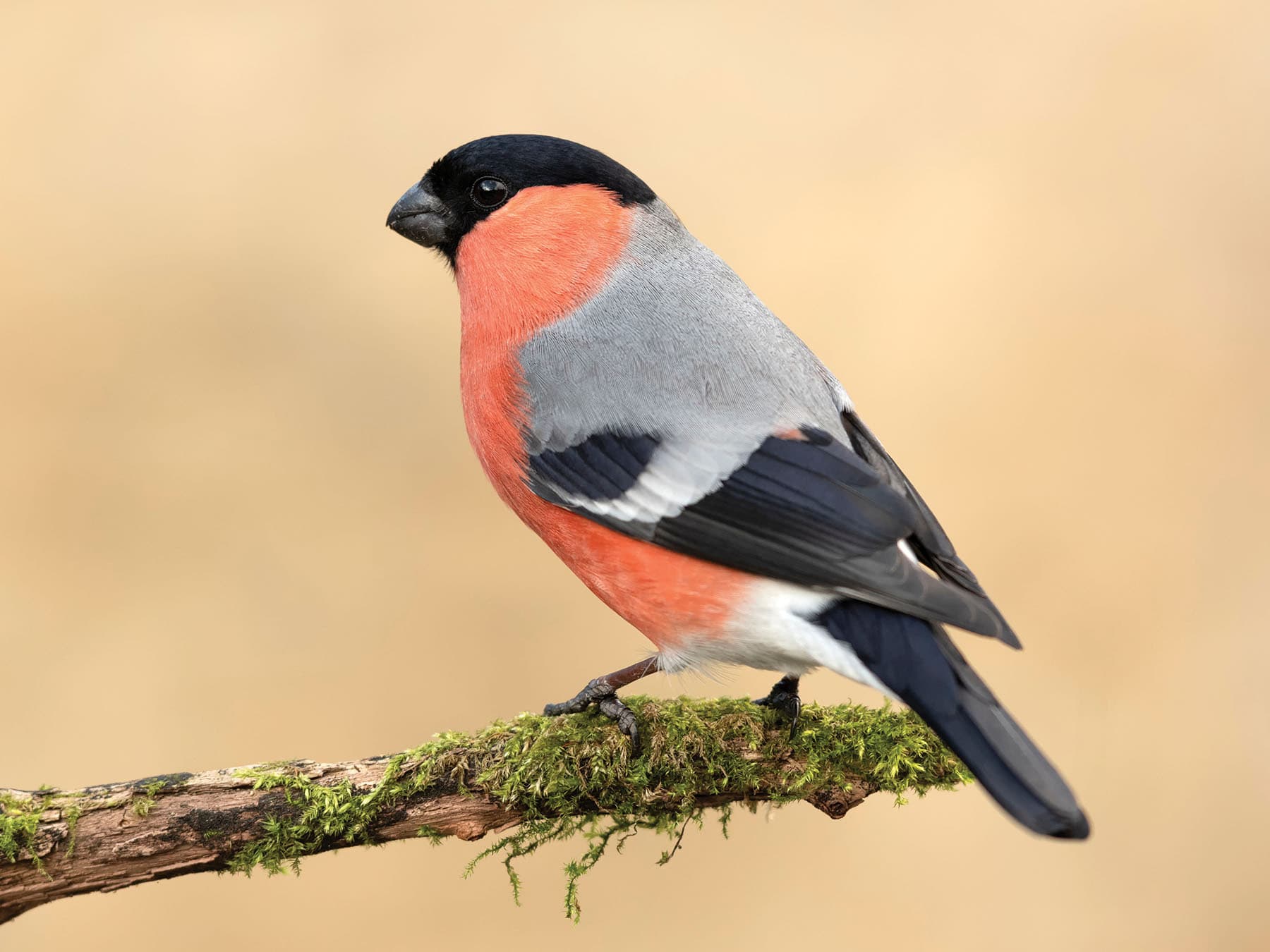
Bullfinch
Eurasian Bullfinch · Pyrrhula pyrrhula
By the Birdfact teamChecked by Nathan Cope
See it in 3D
2 plumages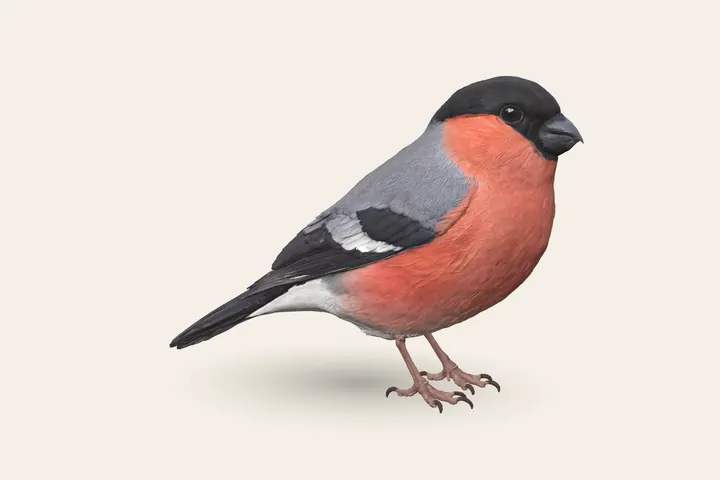 3D model
A Bullfinch is 14.5–16.5 cm (5.5–6.5 in) long, bill to tail.
3D model · Male · Length 14.5–16.5 cm (5.5–6.5 in) · How we make our birds · Report a problem
© 2026 NC Digital Limited (Birdfact). All rights reserved. This 3D model may be viewed on this page and shared by link only. Downloading, extracting, copying or reusing it, or using it to train machine-learning models, is not permitted without our written permission. Using our models
On this page16 sections
How to recognise it
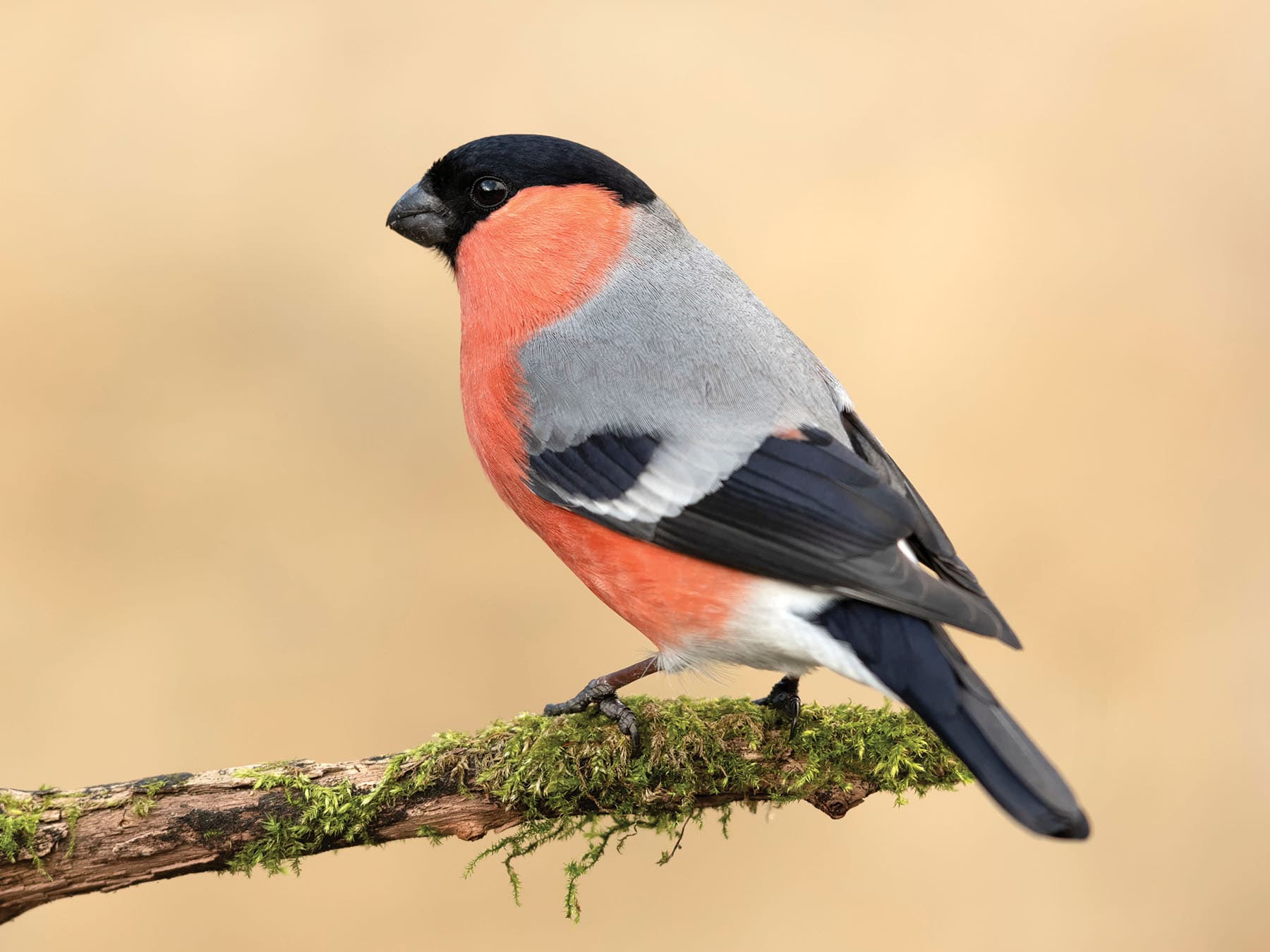
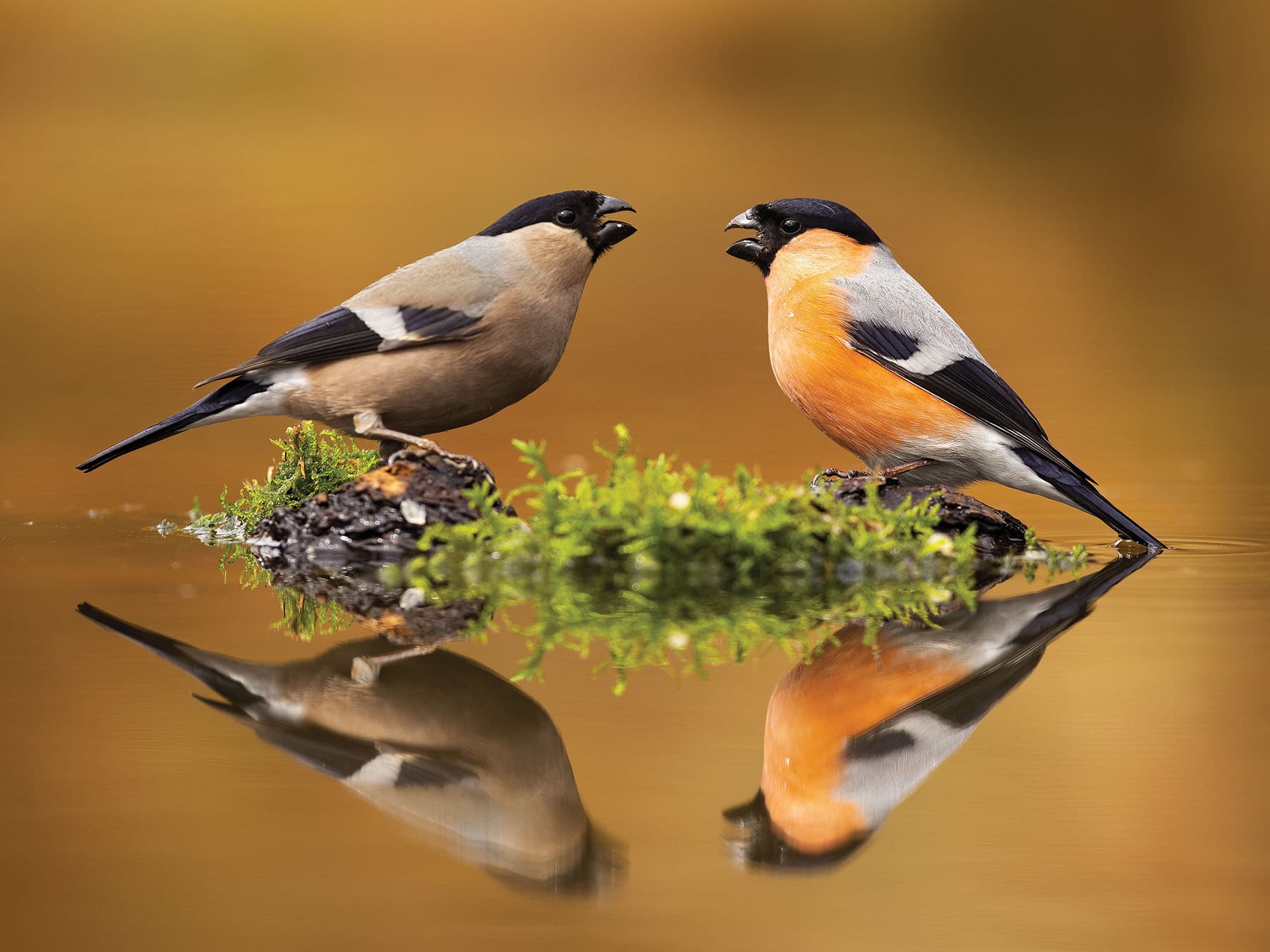
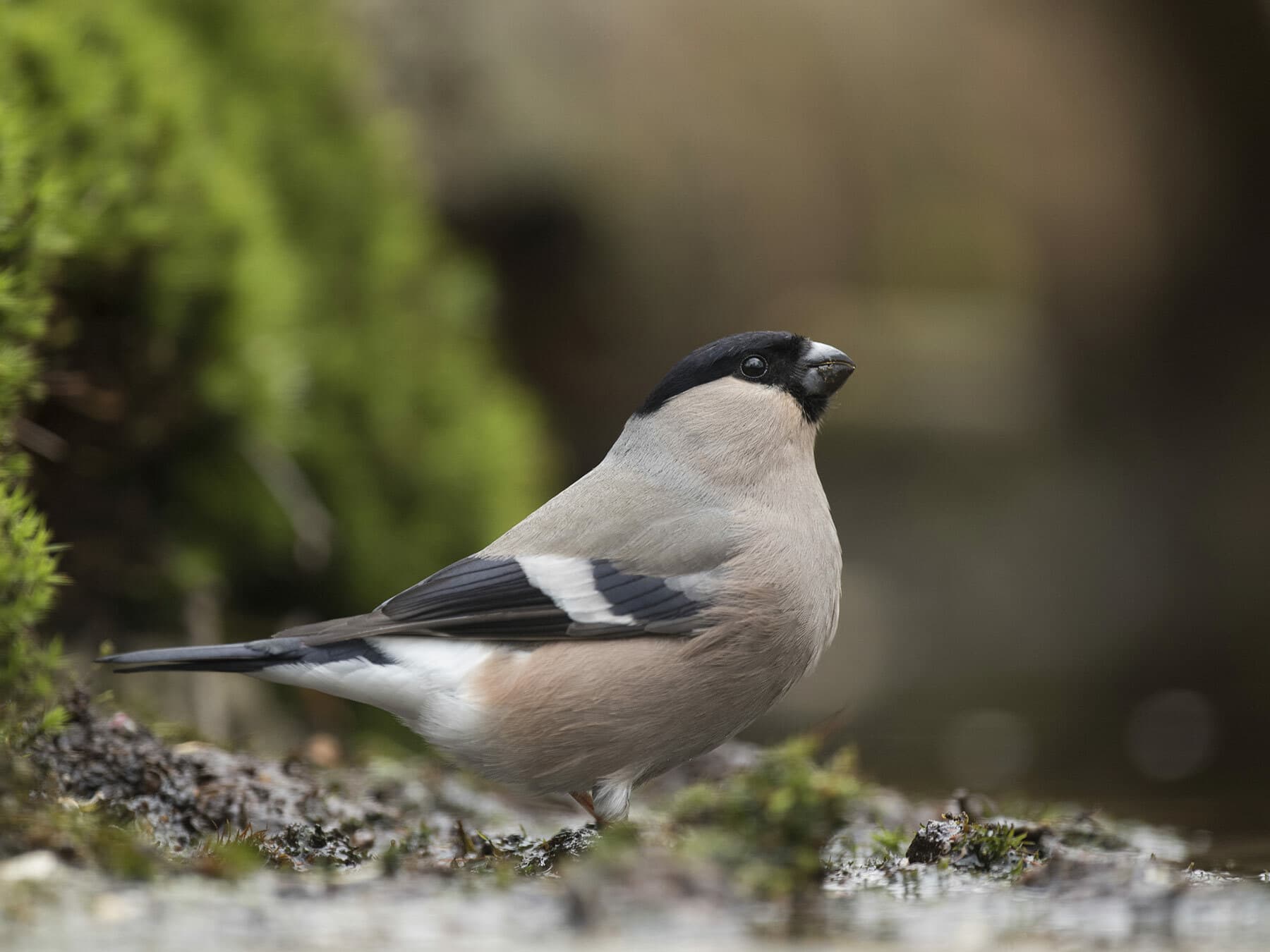
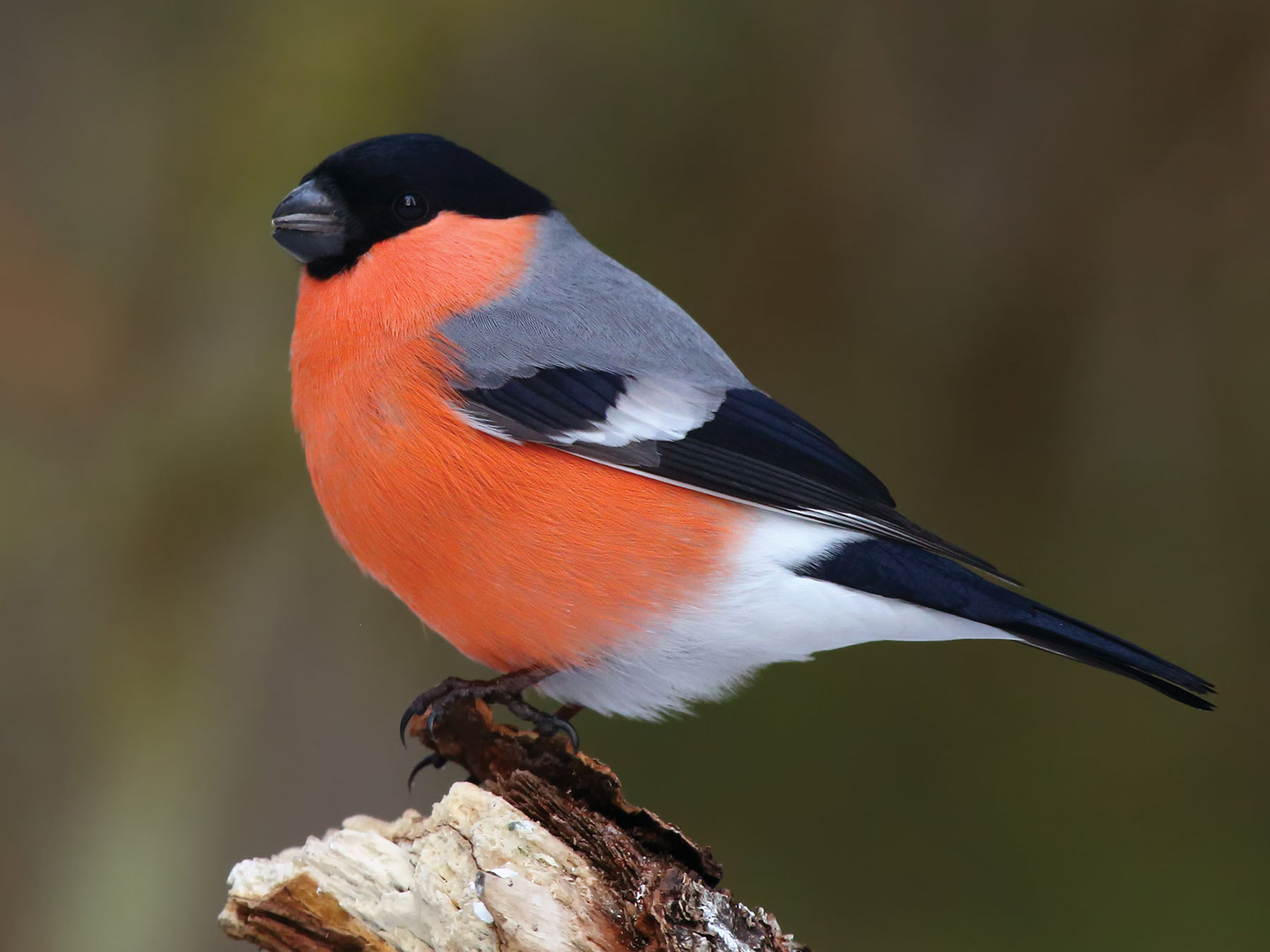
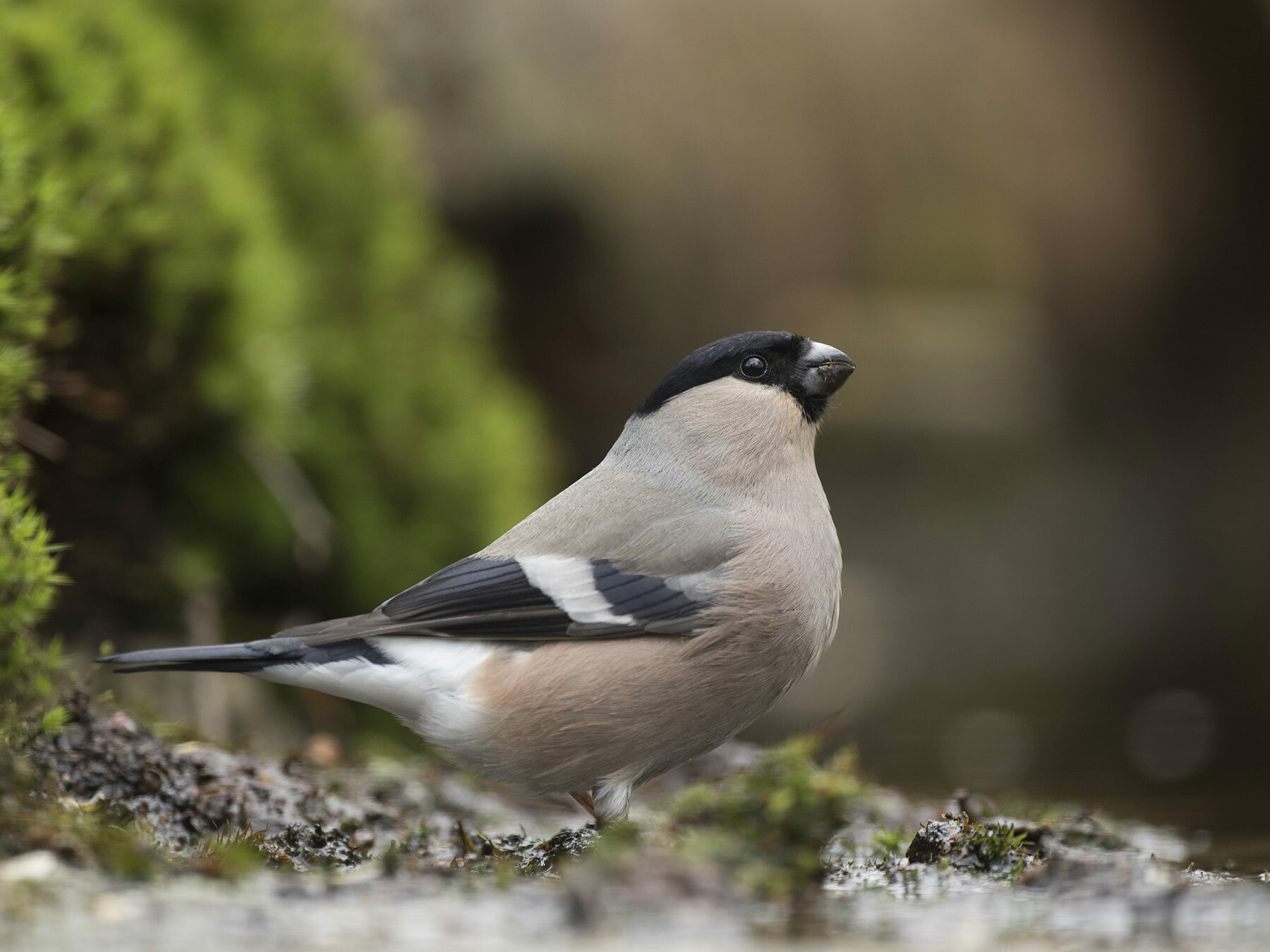
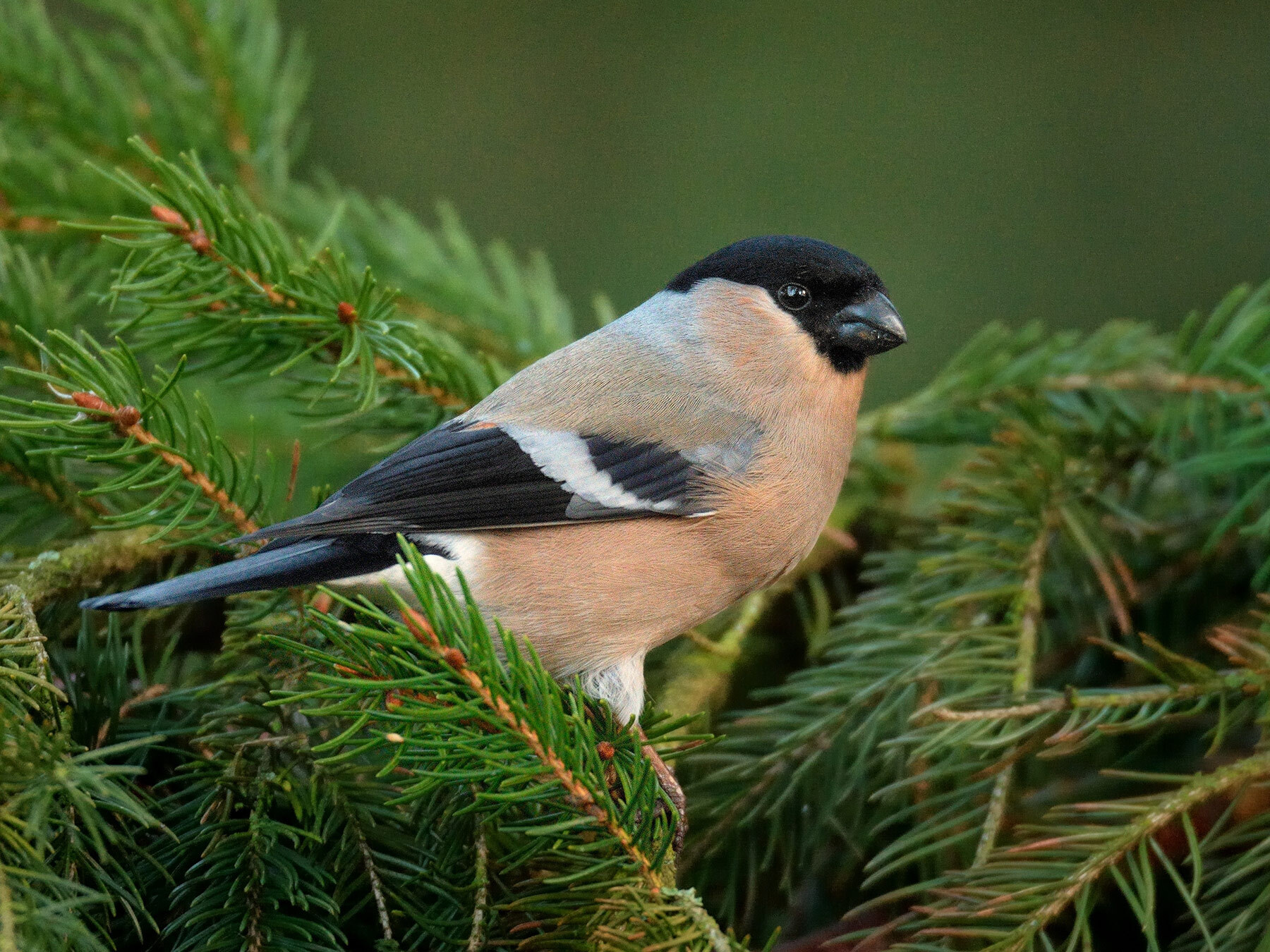
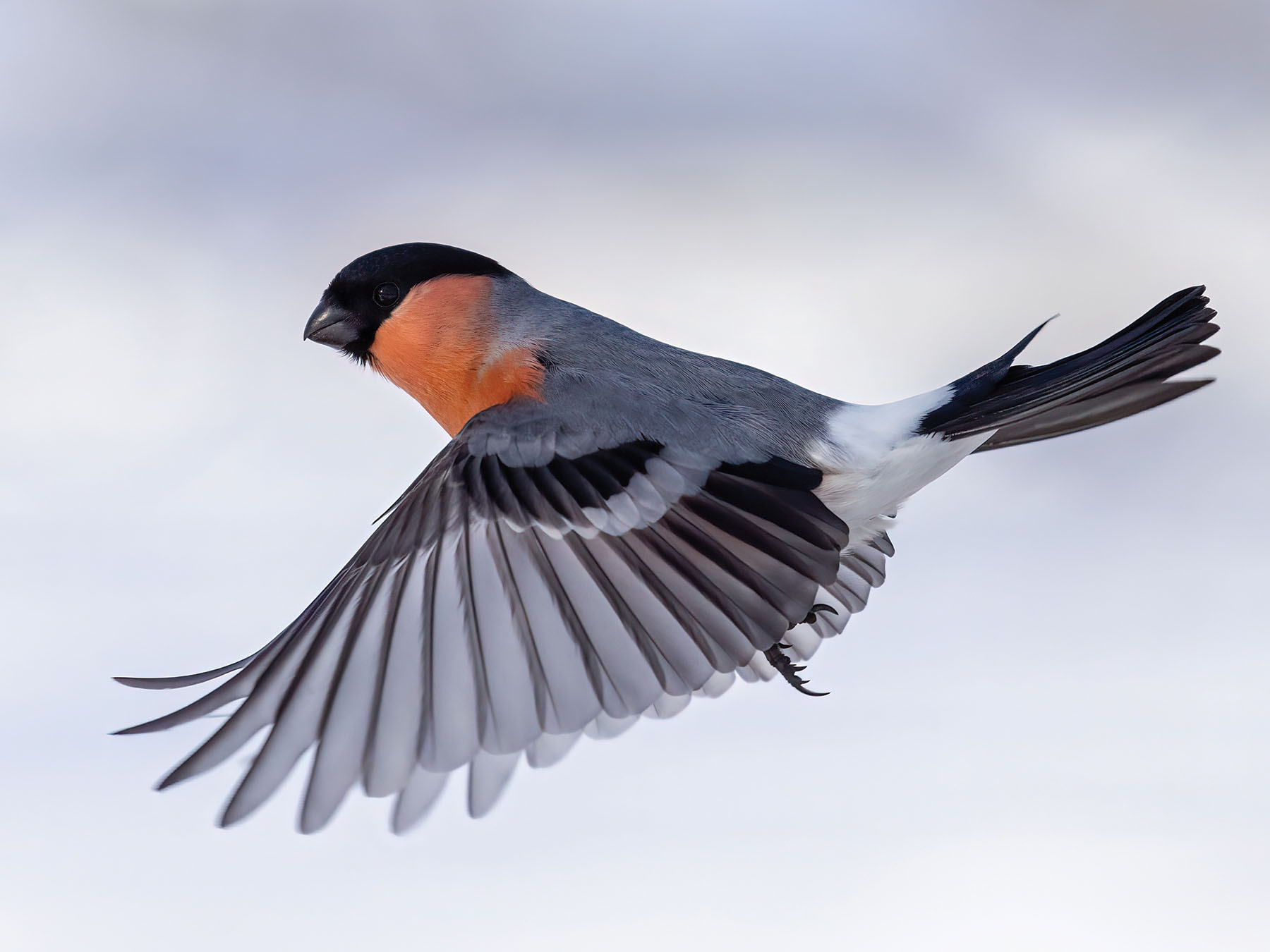
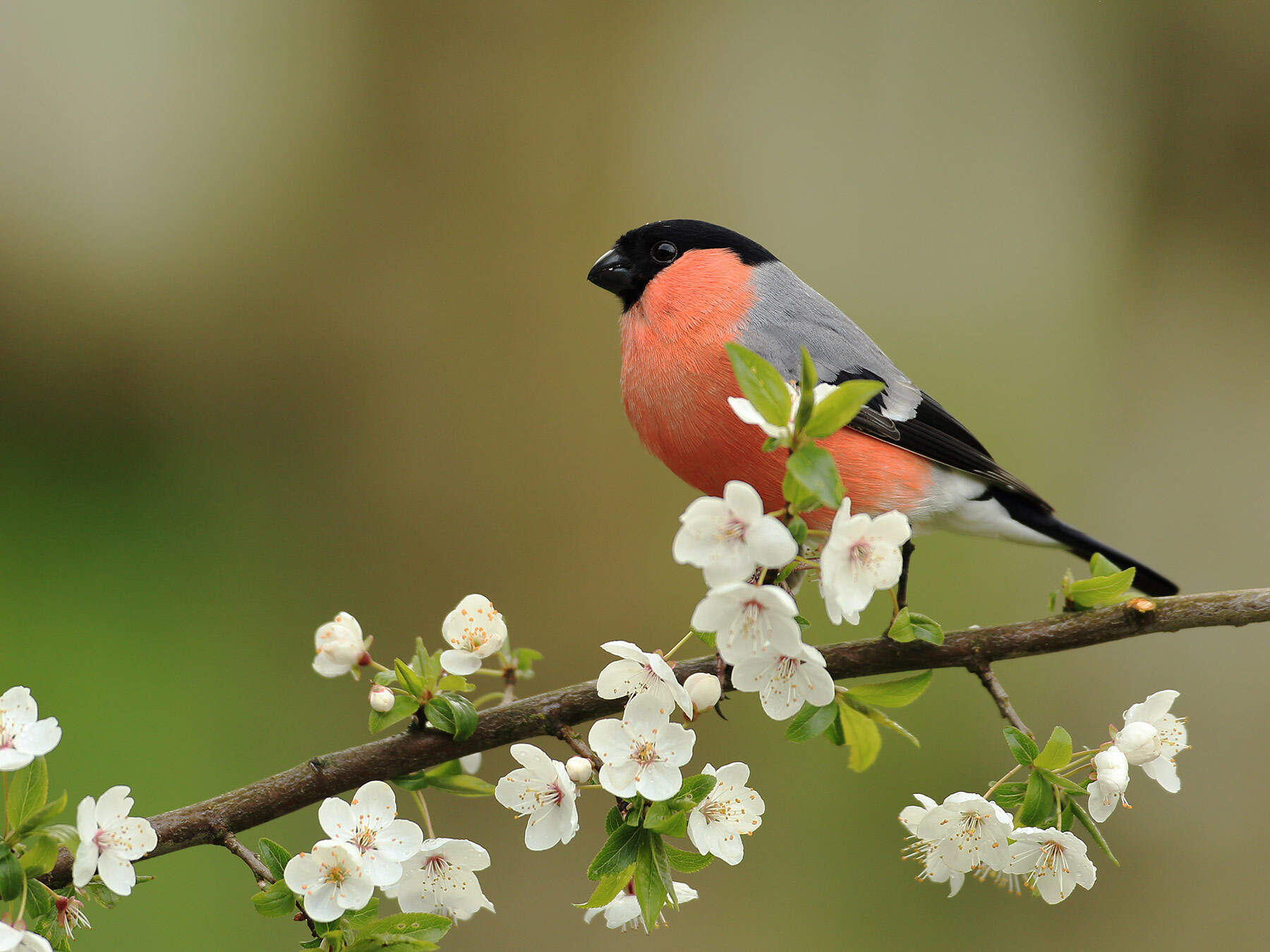
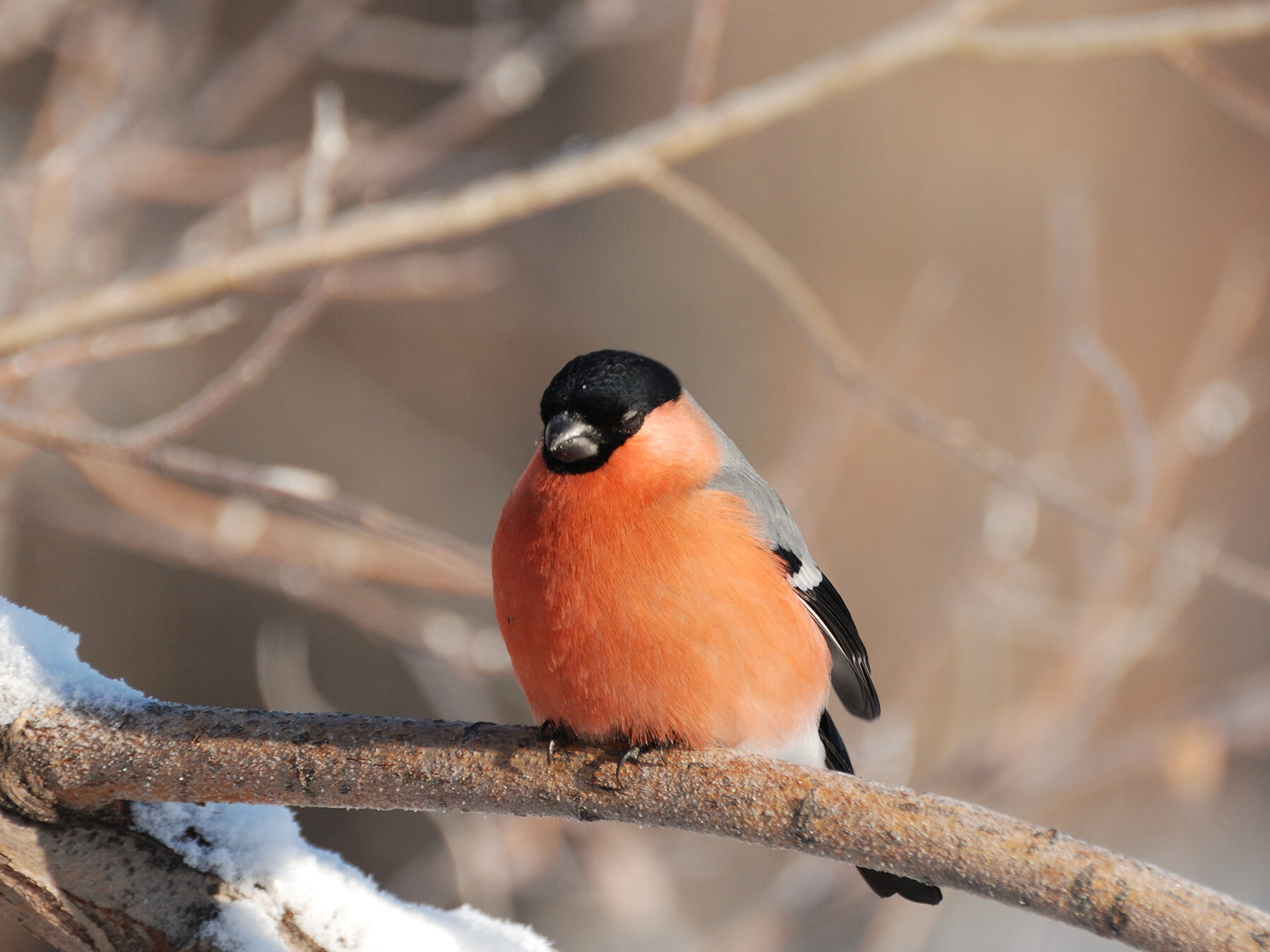
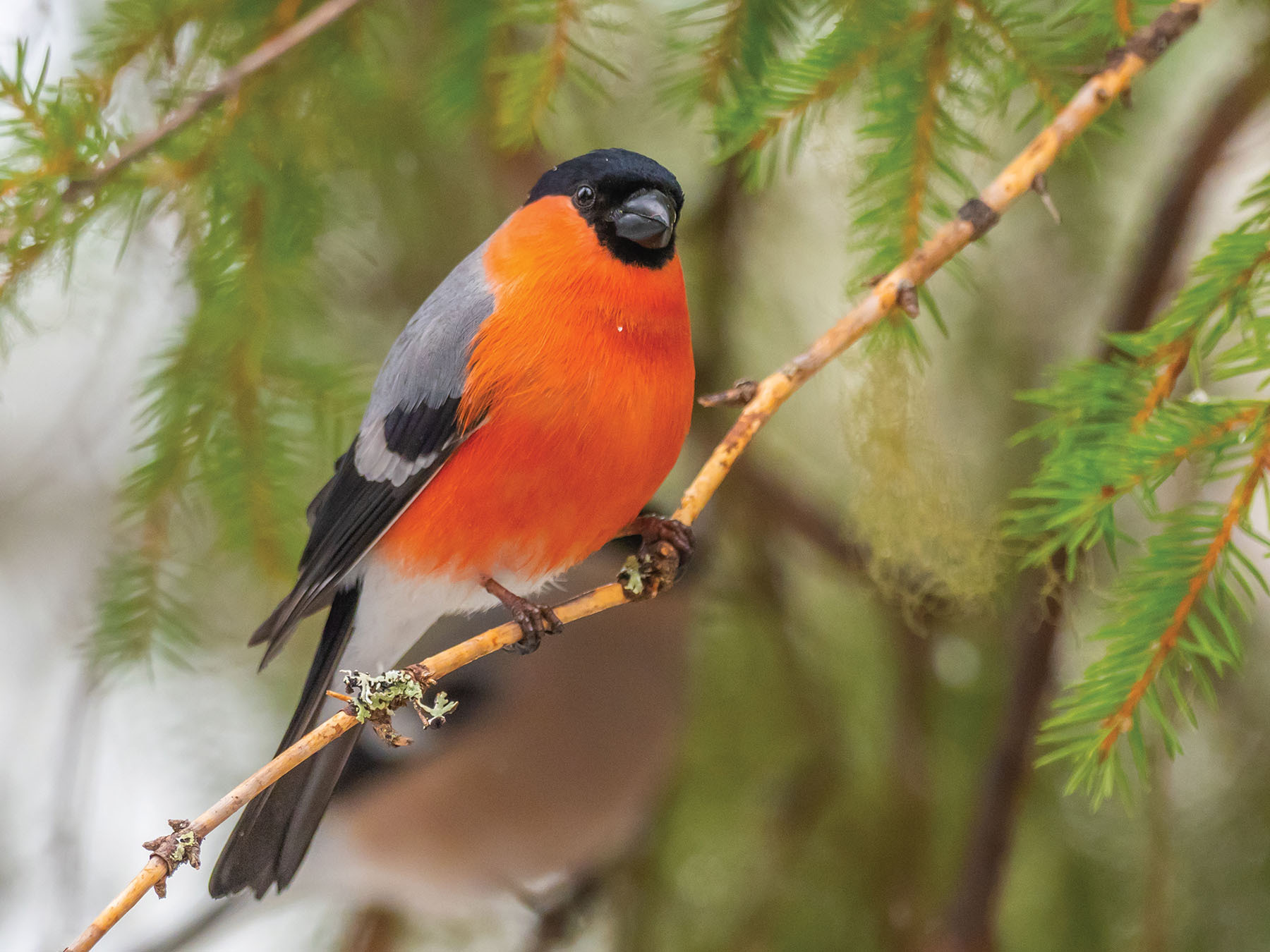
A Bullfinch is a stocky, round-headed finch with a short, thick black bill. The male is hard to mistake: a black cap and tail, pinkish-red breast and cheeks, a grey back and a bright white rump.1 The female has the same black cap, but her back is grey-brown and her underparts a soft greyish brown.2
Look for the wings and rump too. Both sexes have black wings crossed by one broad, pale grey bar, a white patch under the tail, and the white rump, which shows as the bird flies off. British and Irish birds belong to their own race, pileata, and males here are a little less bright pink than those in northern and eastern Europe.
Size
A Bullfinch is 14.5 to 16.5 cm (about 6 in) long, with a wingspan of 22 to 26 cm.1 Adults weighed by BTO ringers average 22.5 g (about 0.8 oz), and most weigh between 20 and 25.6 g. Females are slightly the heavier on average, at 23.0 g against 22.2 g for males, though males have the longer wings.3
British birds are slightly smaller and smaller-billed than those of northern and eastern Europe; across its whole range the species weighs 21 to 38 g.2
Male, female and young
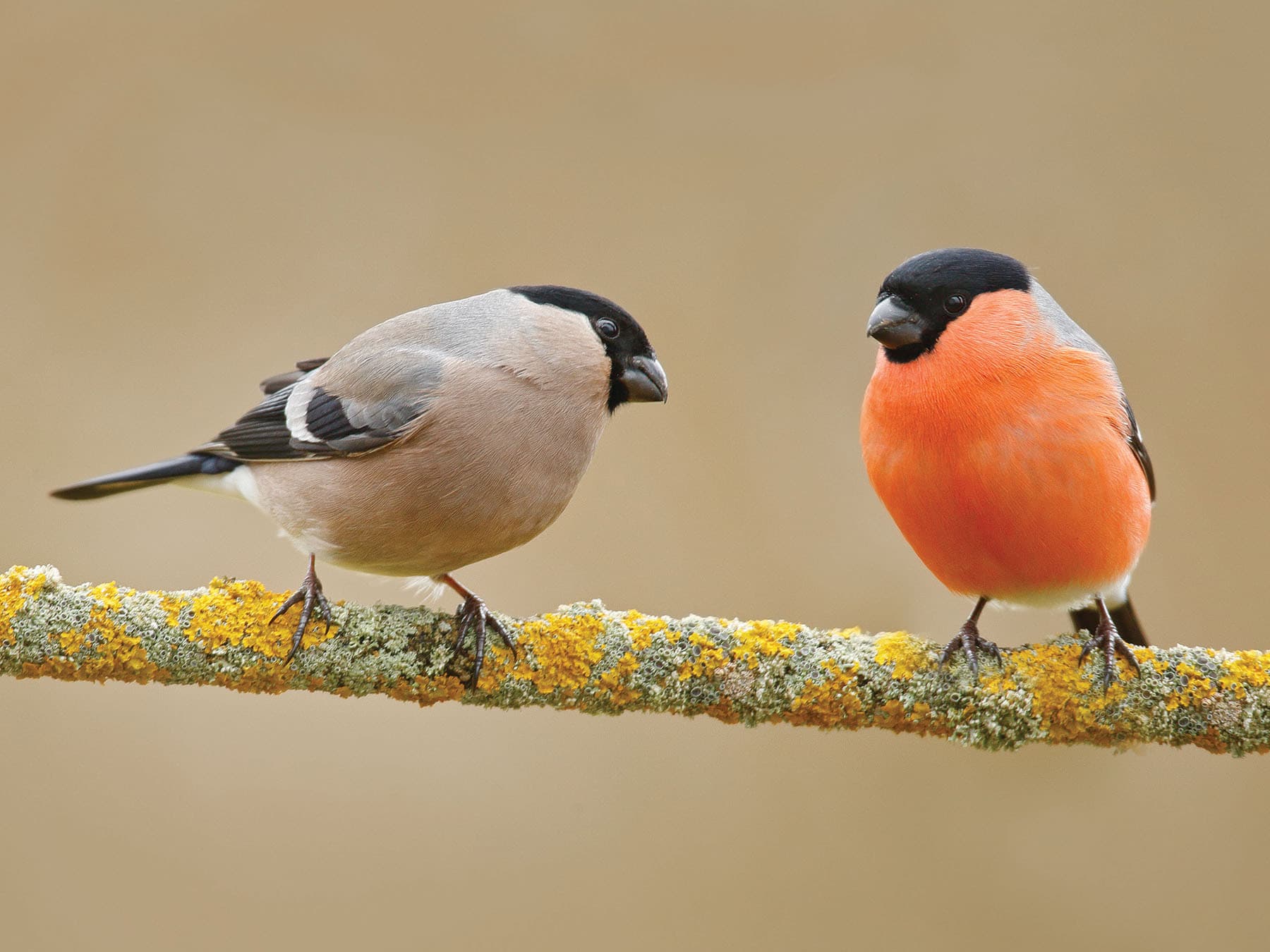
The sexes are easy to tell apart. The male's face and breast are deep pink; the female's are light brown or grey-brown, sometimes with a faint lavender-pink tinge, and her back is browner. Both have the black cap, the pale wing bar and the white rump.
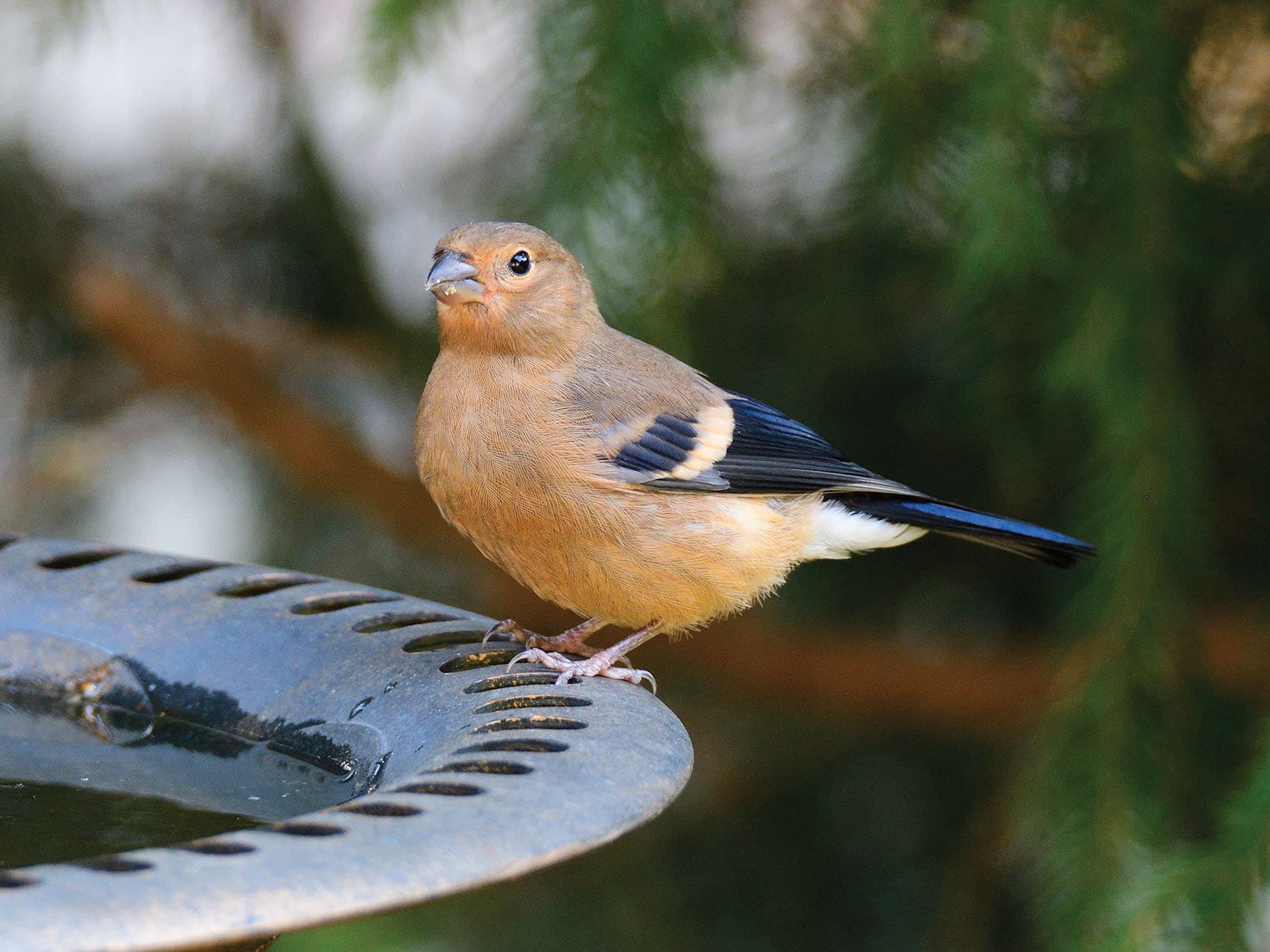
Young Bullfinches have no black cap at all: the head is plain brown, the body buff-brown and the wing bar buff, but they already show the white or buffish-white rump. Birds in their first summer look like adults but have a pale horn-coloured bill.2
Identification: similar birds
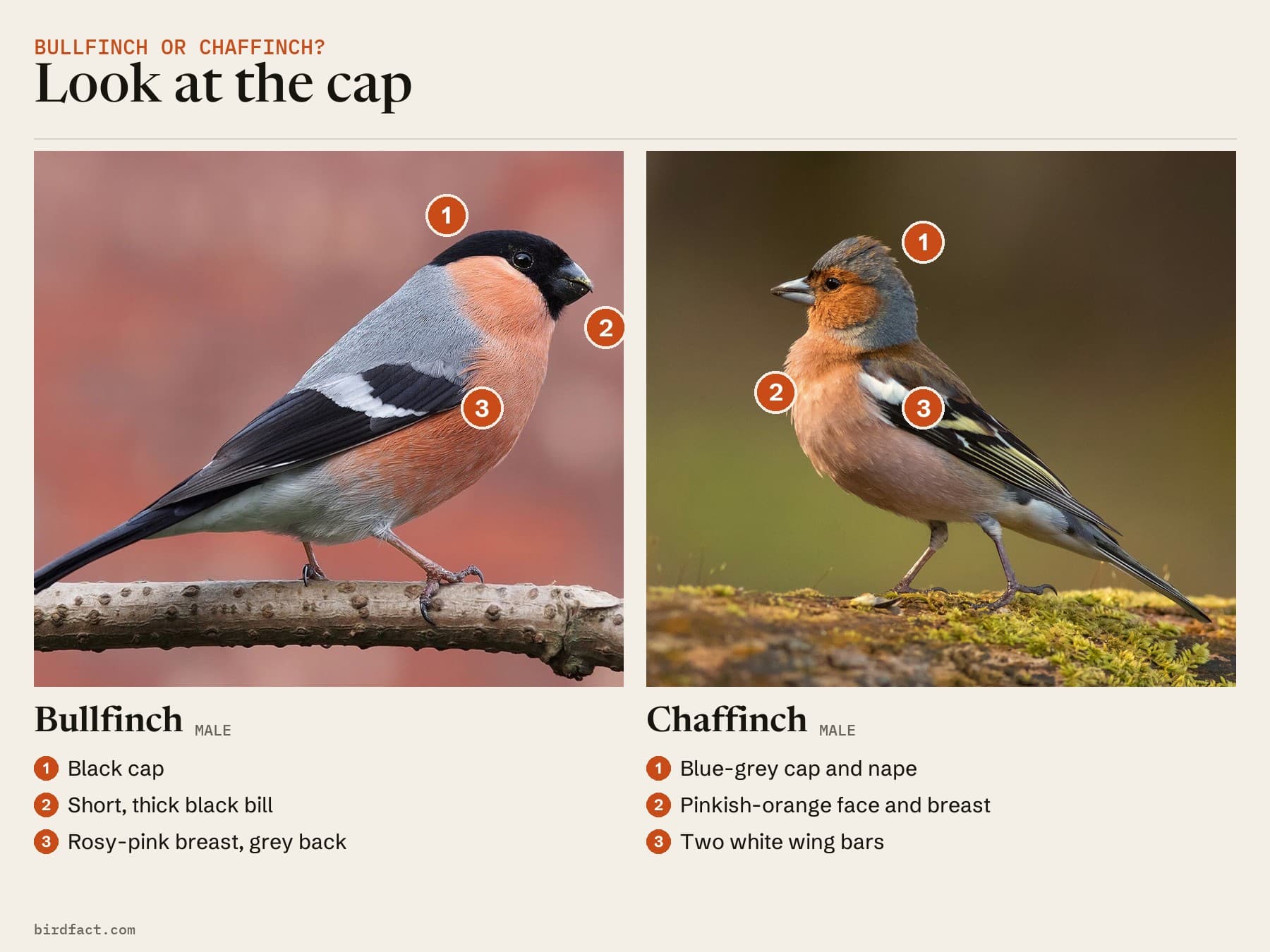
A male Chaffinch also has a pinkish breast, and the two are often confused. Look at the cap and the back: a male Chaffinch has a blue-grey cap, a chestnut back and a bold white shoulder patch; a Bullfinch has a black cap and a grey back. In flight, a Bullfinch's rump is white and a Chaffinch's green. A female Chaffinch has no cap at all. Side by side, with photos: Bullfinch or Chaffinch?
Its size
Adults- Length
- 14.5–16.5 cm
- Wingspan
- 22–26 cm
- Weight
- 21–27 g
Its song and calls
Bullfinches are quiet birds, and the call is often the first sign of one: a soft, low, slightly sad piping whistle, written "peu" or "deu", that falls in pitch. Partners use it to keep in touch, and it can be heard some distance away.2 The RSPB notes that a Bullfinch is usually found by this mournful call.
The song is rarely noticed. It is quiet and varies from bird to bird, built from the call note itself, given singly or two at a time, and now and then a higher, longer piping note. Both sexes sing, though the male sings more often. Given in alarm, the call is repeated more insistently, and young birds' calls are louder and harsher.
Hear British recordings and see them drawn as spectrograms, with the song, how it is learned and the trumpet call of Northern Bullfinches: Bullfinch call and song.
- Song and calls0:00 / 0:47
Recorded in Surrey, England · June 1977
Aubrey John Williams / The British Library Board · Wikimedia Commons · CC BY-SA 4.0
- Call0:00 / 0:07
Recorded in Kent, England · December 2024
When and where to see it
OctoberArriving
Most recorded in October
- 1. Edinburgh1.7%
- 2. Neath Port Talbot1.6%
- 3. South Lanarkshire1.4%
- 4. Midlothian1.4%
- 5. Kildare1.4%
Each dot is a county, state or province: the bigger and darker, the larger the bird’s share of that place’s bird records that month. Grey dots: no regular records. The ringed point is the centre of the bird’s records this month; the arrow shows how it moved since last month, and the dashed loop its path through the year. “Arrivals” colours places where it becomes regular this month (orange) or is in its last regular month (grey). GBIF eBird Observation Dataset, 2019–2024. Map data: Natural Earth, US Census Bureau; place centres © OpenStreetMap contributors.
In your area
See when the Bullfinch is recorded in your county, state or province.
How often the Bullfinch turns up in the UK and Ireland through the year, from birdwatchers' records.
United Kingdom
Resident · all year · most records in December
Ireland
Resident · all year · most records in December
Show as a table
| Month | United Kingdom | Ireland |
|---|---|---|
| January | 0.52% (regular) | 0.66% (regular) |
| February | 0.42% (regular) | 0.53% (regular) |
| March | 0.37% (regular) | 0.49% (regular) |
| April | 0.33% (regular) | 0.51% (regular) |
| May | 0.31% (regular) | 0.60% (regular) |
| June | 0.35% (regular) | 0.58% (regular) |
| July | 0.36% (regular) | 0.41% (regular) |
| August | 0.33% (regular) | 0.28% (regular) |
| September | 0.23% (regular) | 0.17% (regular) |
| October | 0.30% (regular) | 0.28% (regular) |
| November | 0.45% (regular) | 0.54% (regular) |
| December | 0.52% (regular) | 0.70% (regular) |
Recorded regularly in
Worldwide: recorded regularly in 50 countries
Countries where it was recorded in at least 3 of the 6 years 2019–2024. Linked countries have their own bird list.
Europe (40)
- Åland Islands
- Andorra
- Austria
- Belarus
- Belgium
- Bosnia & Herzegovina
- Bulgaria
- Croatia
- Czechia
- Denmark
- Estonia
- Finland
- France
- Germany
- Greece
- Guernsey
- Hungary
- Ireland
- Italy
- Jersey
- Kosovo
- Latvia
- Lithuania
- Luxembourg
- Moldova
- Montenegro
- Netherlands
- Norway
- Poland
- Portugal
- Romania
- Russia
- Serbia
- Slovakia
- Slovenia
- Spain
- Sweden
- Switzerland
- Ukraine
- United Kingdom
Asia (10)
- Armenia
- Azerbaijan
- China
- Georgia
- Iran
- Japan
- Kazakhstan
- Mongolia
- South Korea
- Turkey
Data: EOD – eBird Observation Dataset (Cornell Lab of Ornithology), accessed via GBIF.org, CC BY 4.0. Records from 2019–2024, aggregated and filtered by Birdfact. How these lists are made
Bullfinches live across Britain and Ireland all year. In the last national atlas they were found in 82% of the UK's 10-km squares in the breeding season and 84% in winter. They are commonest in lowland country with plenty of trees, especially in Ireland, and scarcest in big towns and the uplands. Treeless places are the gaps: the country around the Wash, the exposed western coasts of Ireland and many Scottish islands.3
Look in scrub, thickets, hedgerows and the edges of deciduous woods, and in orchards, mostly in spring. They also come into parks and gardens, to feeders and, in spring, to fruit trees, where they nibble the buds.
Spotting tips
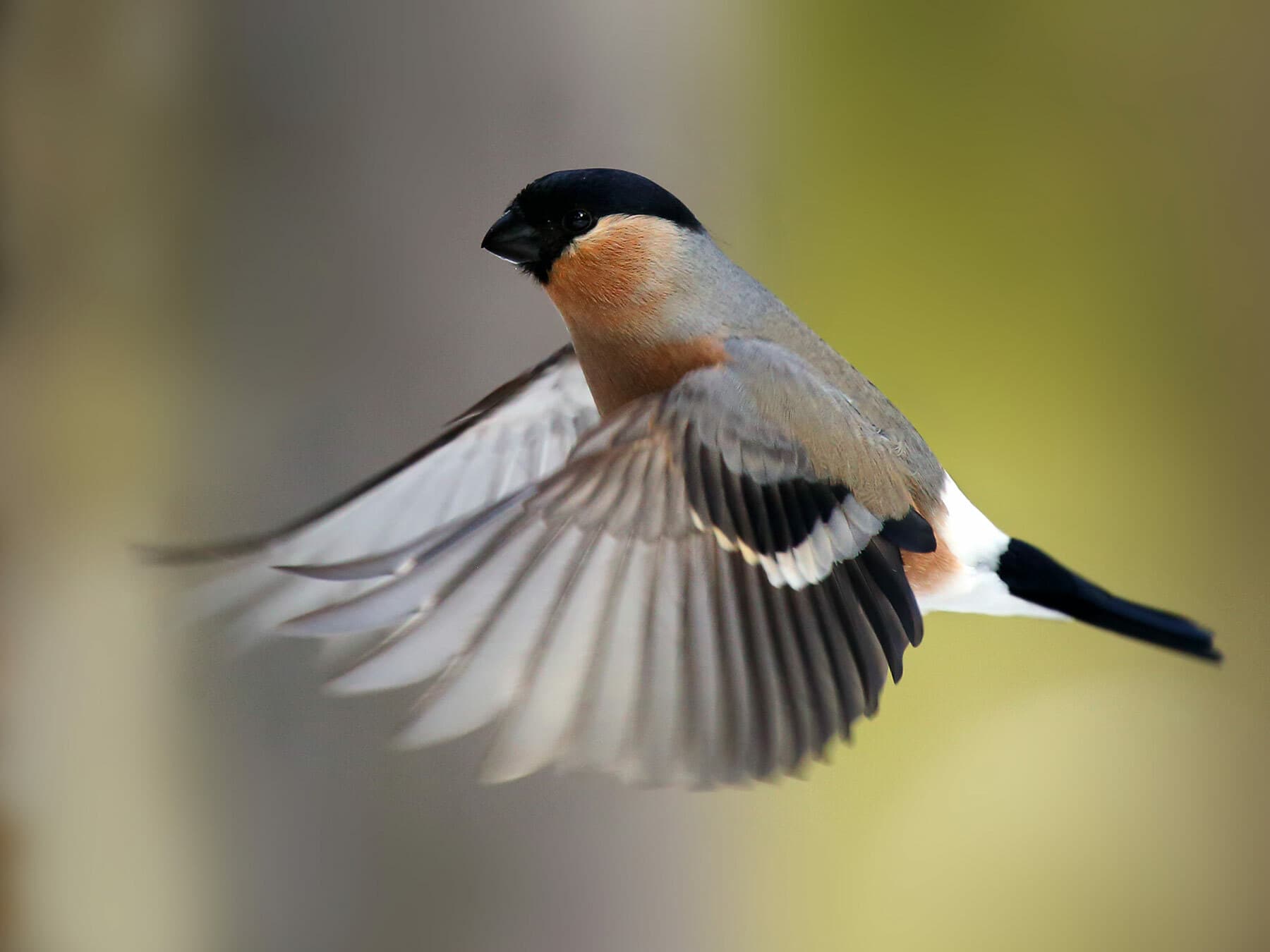
Listen for the soft, piping call, then search the edge of a wood or a thick hedge: Bullfinches are shy, easily disturbed and often keep to cover. They often feed in pairs, so look for a second bird. If one slips away from you, watch for the white rump.
Do they migrate?
Not in Britain and Ireland. Bullfinches here are resident and mostly move no more than about 20 km, though some may move up to 200 km in autumn and back in early spring.2 Only a handful of British-ringed Bullfinches have been found abroad, in France, Belgium and Sweden; the longest move within Britain and Ireland on the BTO's records is 517 km, from Thetford in Norfolk to Bridge of Allan near Stirling.4
Northern Europe's Bullfinches are another matter: in some years they move far south and west, and some reach northern Britain. A young female ringed in northern Sweden on 22 September 2004 was caught on Fair Isle 26 days later, 1,283 km away. That autumn brought a record invasion of these Northern Bullfinches into Britain, many of them giving a distinctive call that became known as the trumpet call.5
What it eats
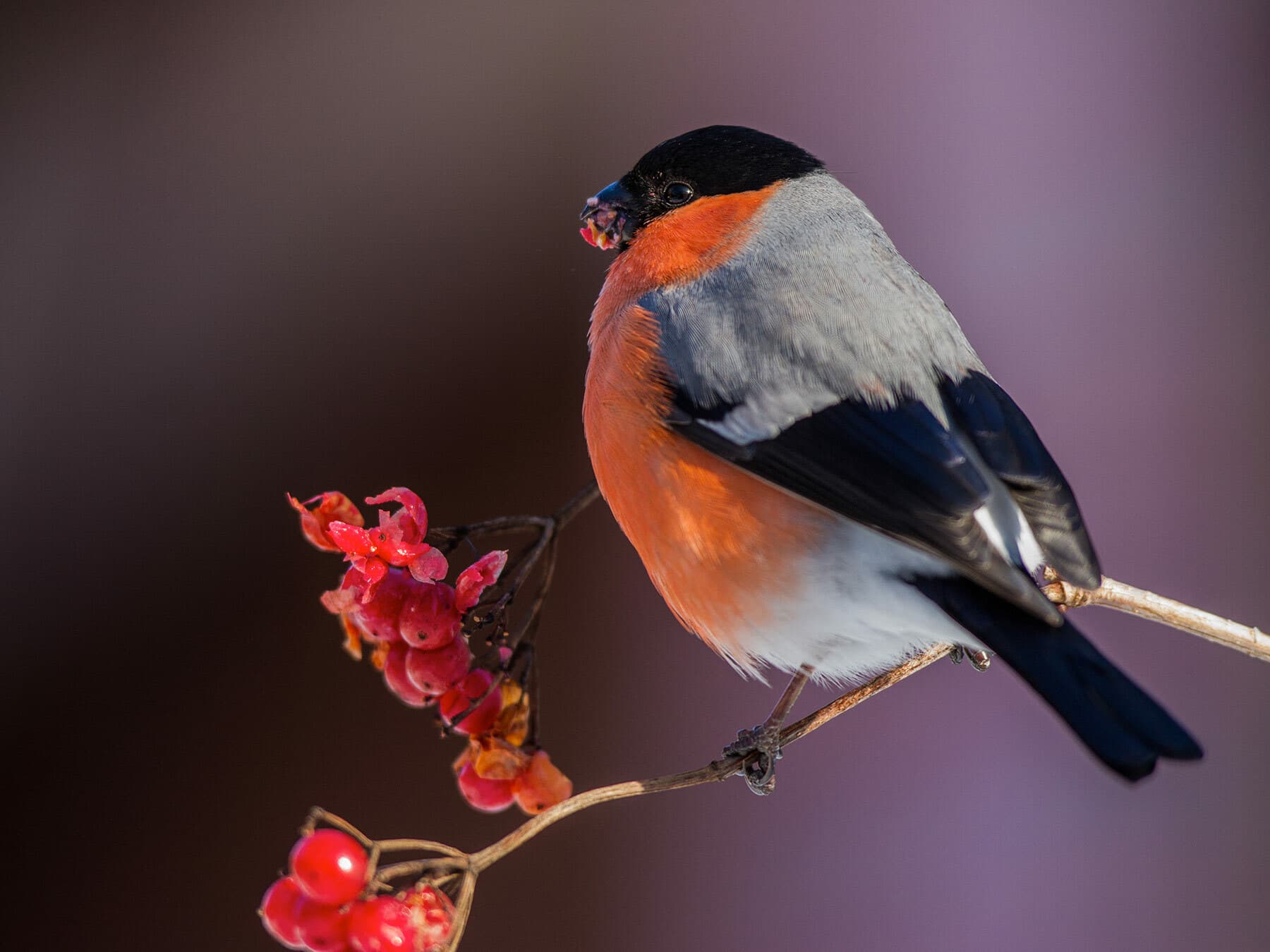
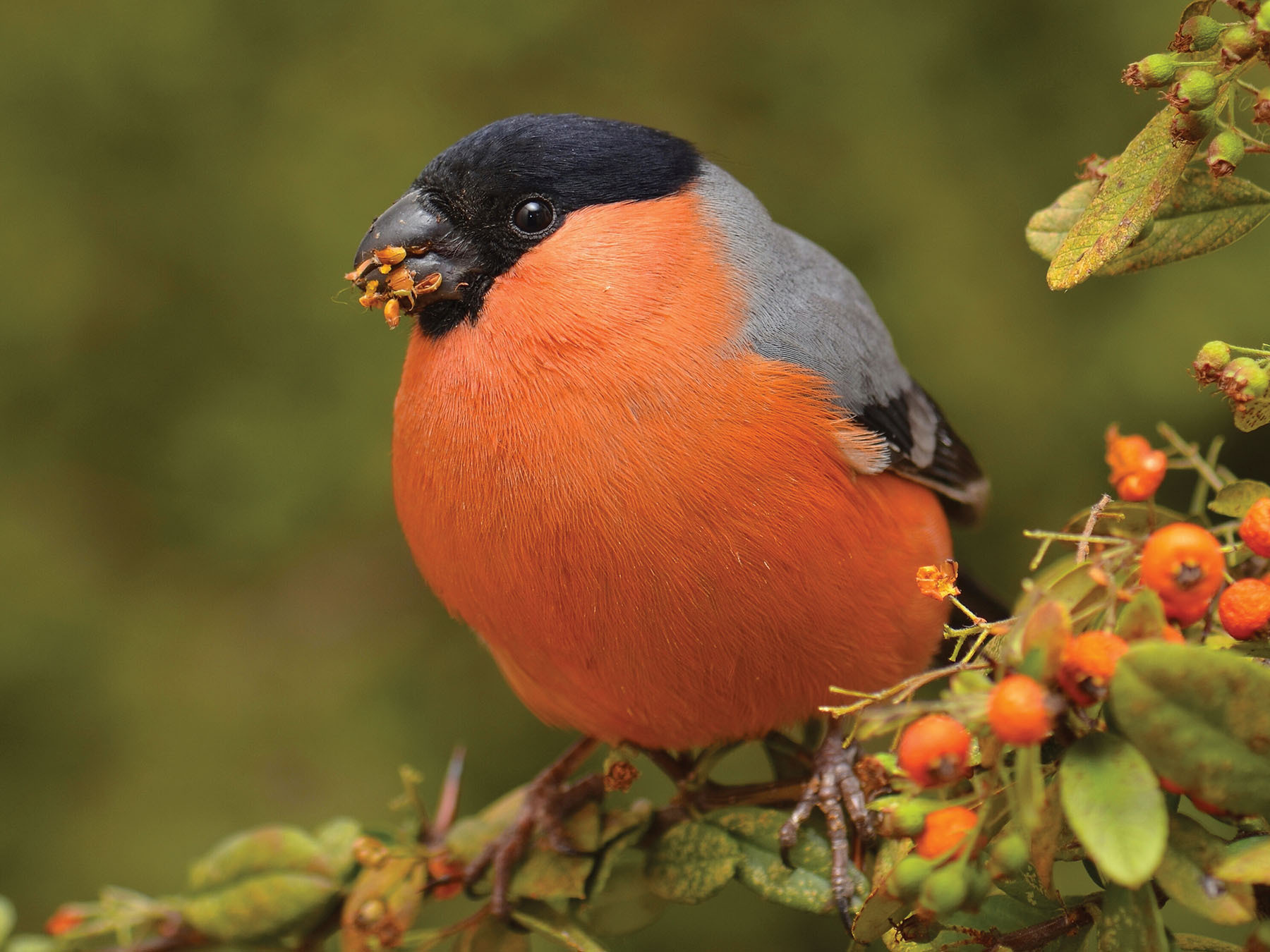
Mostly seeds and buds. Bullfinches eat the seeds of trees such as ash, birch and elm, and of many wild plants, from docks and nettles to dandelions, chickweed and grasses. In spring they turn to buds and shoots, and are known for the buds of fruit trees. They also take berries such as rowan, blackthorn and blackberries, usually crushing the fruit for the seeds inside and dropping the pulp; with hawthorn they eat the flesh instead. Small insects, spiders and snails are a minor part of an adult's diet.2 In Britain the chicks are fed a mix of seeds and small animals such as caterpillars, snails and spiders, with more of the animals while they are small.6
They feed in trees, bushes and tall plants, only now and then on the ground, perching sideways on a seedhead or a slender twig. An ash seed takes them 20 to 50 seconds to eat, and they can strip buds at up to 30 a minute.
More on the seasons, the buds and feeding them: What do Bullfinches eat?
Gardens and feeders
The BTO says Bullfinches can often be seen at garden feeders. There they take sunflower and other seeds.2 The Woodland Trust suggests offering seed and, if you have room, planting a fruiting tree.7
Feed with care. The RSPB warns that trichomonosis, the disease behind the fall in Greenfinches and Chaffinches, may now be causing a rapid decline in Bullfinches. It currently advises hanging feeders rather than bird tables or trays, pausing seed and peanuts from May to October and cleaning feeders weekly.8 More: feeding Bullfinches and attracting them to your garden.
Nesting and breeding
Bullfinches nest in thick cover: a dense bush or hedge, often hawthorn, a tangle of bramble or honeysuckle, or a flat, low branch of a conifer such as a yew or spruce, at most about 5 m up. The male often picks the site and the female builds a loose platform of dry twigs with a cup of roots, grass, moss and lichen inside, building a new nest for each brood.2 They are one of 15 songbirds that the BTO lists as likely to nest in farmland hedges.9
In Britain the first eggs are laid between late April and late July, on average around 17 May, and second broods follow. A clutch is usually 4 or 5 pale blue eggs speckled with dark brown and purple. The female incubates them for 14 to 16 days, both parents feed the chicks, and the young leave the nest at about 15 to 16 days old. Pairs raise two broods, sometimes three.3 In the breeding season the adults grow pouches under the lower jaw, in which they carry food back to the chicks.6 Bullfinches rarely use nest boxes, and are not on any of the BTO's nest-box lists.10
An active nest is protected by law: in England and Wales it is an offence to intentionally take, damage or destroy the nest of any wild bird while it is in use or being built,11 and in Scotland and Northern Ireland12 the law also covers reckless damage. Check hedges before cutting them in spring and summer.
Behaviour
Bullfinches are often seen in pairs, and the pair bond usually lasts more than one season. Partners keep in touch with soft calls and court each other all year, touching bills, and the male feeds the female. According to Birds of the World, the female is dominant over the male. They also gather in small groups of up to about 20, sometimes more.2
Pairs tend to match by age. A 51-year study of Bullfinches at Treswell Wood in Nottinghamshire found adults paired with adults, and first-year birds with first-year birds, more often than chance would give.13
Lifespan and predators
A Bullfinch that survives to breed typically lives about 2 years, and breeds when a year old. Each year about 42% of adults survive to the next.3 The oldest on the BTO's ringing list was an adult male ringed at Childwall, Liverpool, in November 1965 and found dead nearby in January 1975, 9 years 2 months 9 days later.14 The European longevity list, which estimates age rather than time since ringing, has a German Bullfinch that a ringer caught alive at 18 years 1 month.15
Predators
The Sparrowhawk is the main predator of adult Bullfinches. Nests are raided by Jays, Carrion Crows, weasels and stoats, and small rodents.2
Conservation
The Bullfinch is on the UK Amber List and is of Least Concern worldwide. The BTO estimated 265,000 territories in the UK in 2016, and UK numbers fell by 55% between 1967 and 2024. It was Red-listed until 2009.3
The fall began in the mid-1970s and was steepest on farmland. The BTO says the reasons are unclear: changes in adult survival may be important, and the loss of food and nesting cover, as farming intensified and woodland lost structure and plant variety, is suspected. Birds of the World puts the decline down mainly to fewer weed seeds as farming changed.2 A 2001 review put the decline at 65% on farmland against 28% in woodland,16 and the steepest fall, a third, came between 1977 and 1982. Rising numbers of Sparrowhawks may also limit where Bullfinches can feed,17 and in north-east Scotland they rarely fed far from cover.18
The fall has not ended. Breeding Bird Survey numbers fell 21% across the UK between 1995 and 2024, 27% in the last ten years and 12% between 2024 and 2025; in England they fell 43% since 1995, while in Scotland they rose 55%.19 The RSPB warns that trichomonosis may now be causing a rapid decline.
Similar birds
Often mistaken for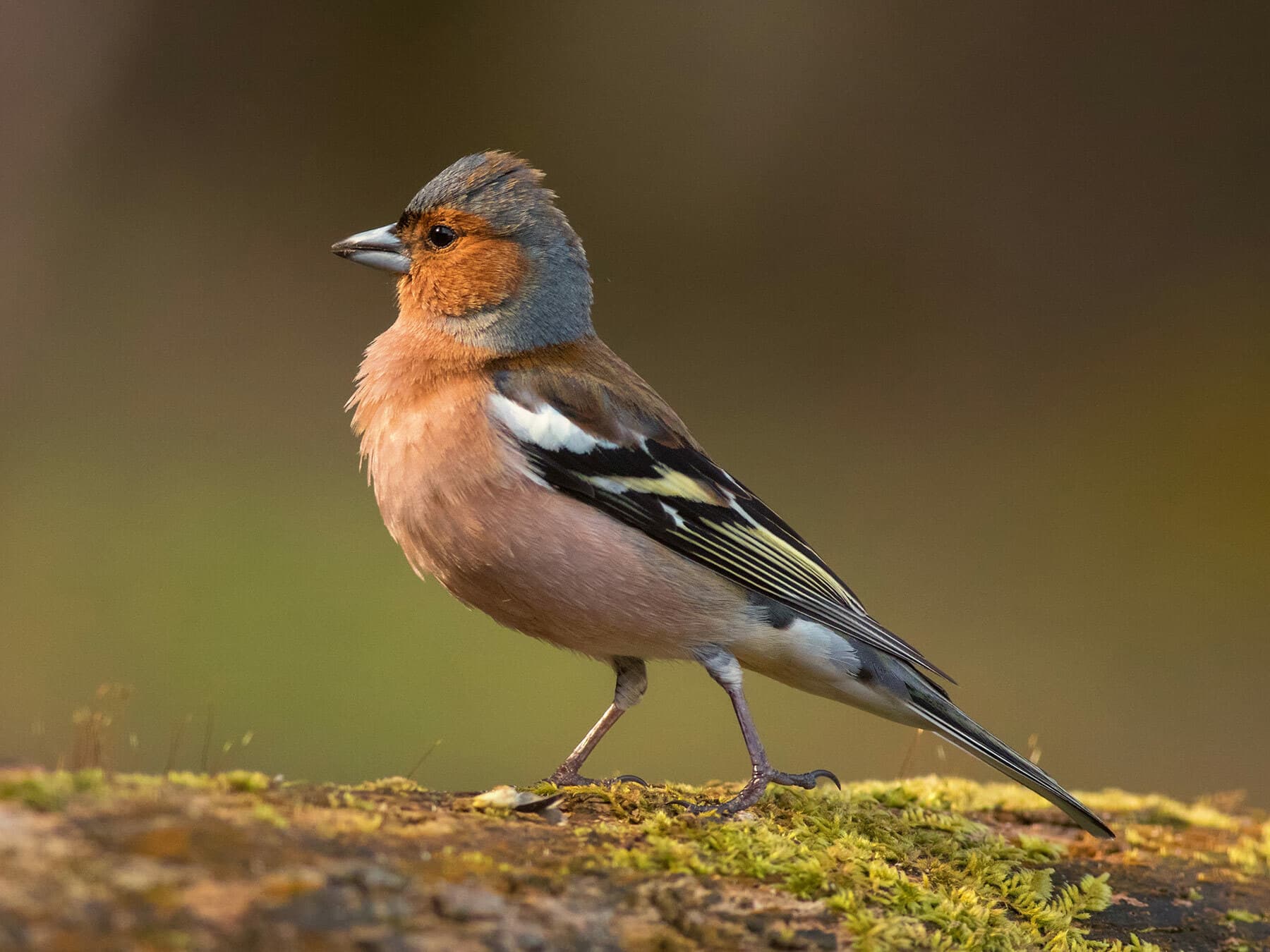
More photos
8 photos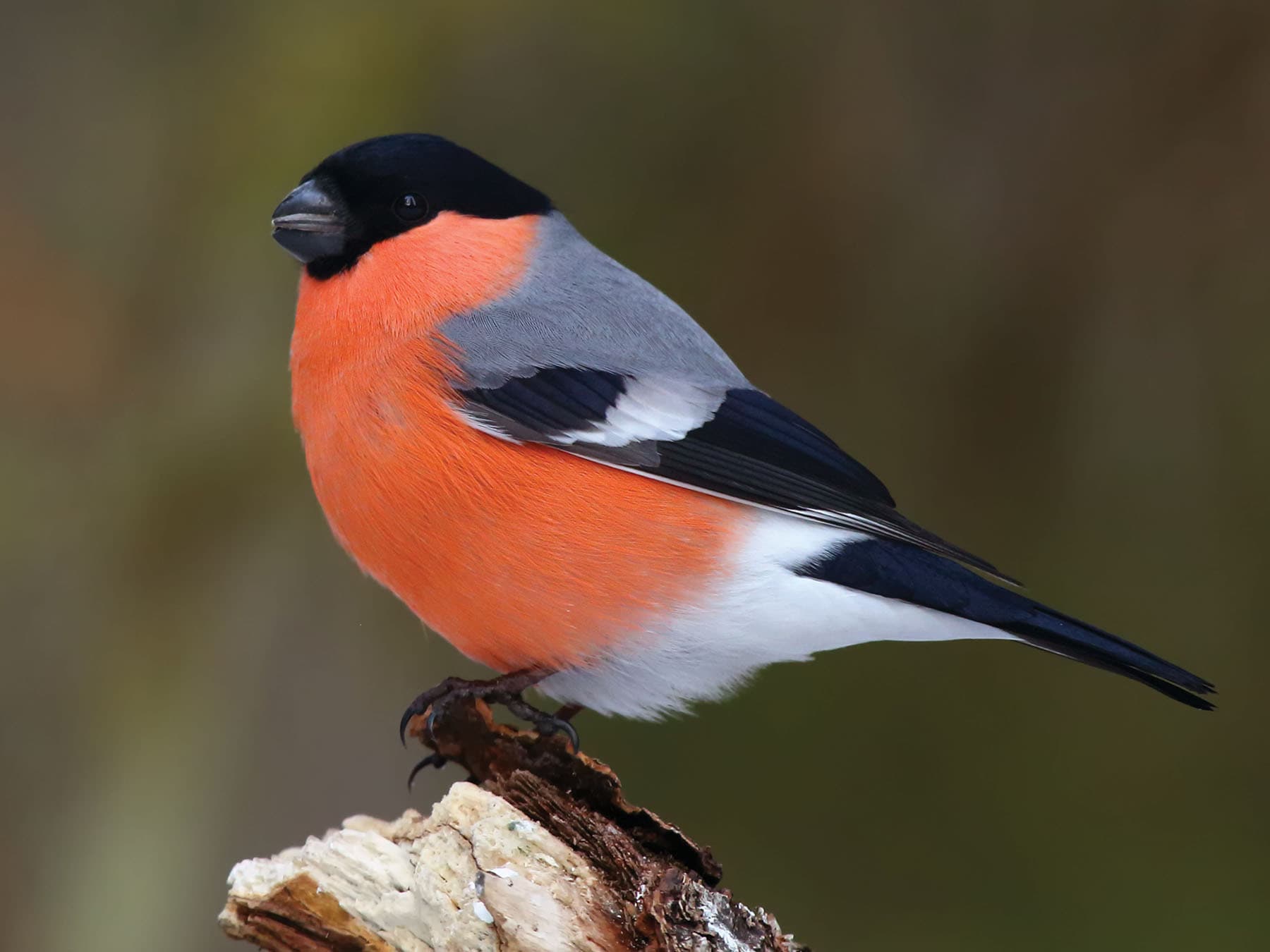 A male Bullfinch on a broken branch
 A female Bullfinch: black cap, grey-brown back and white under the tail
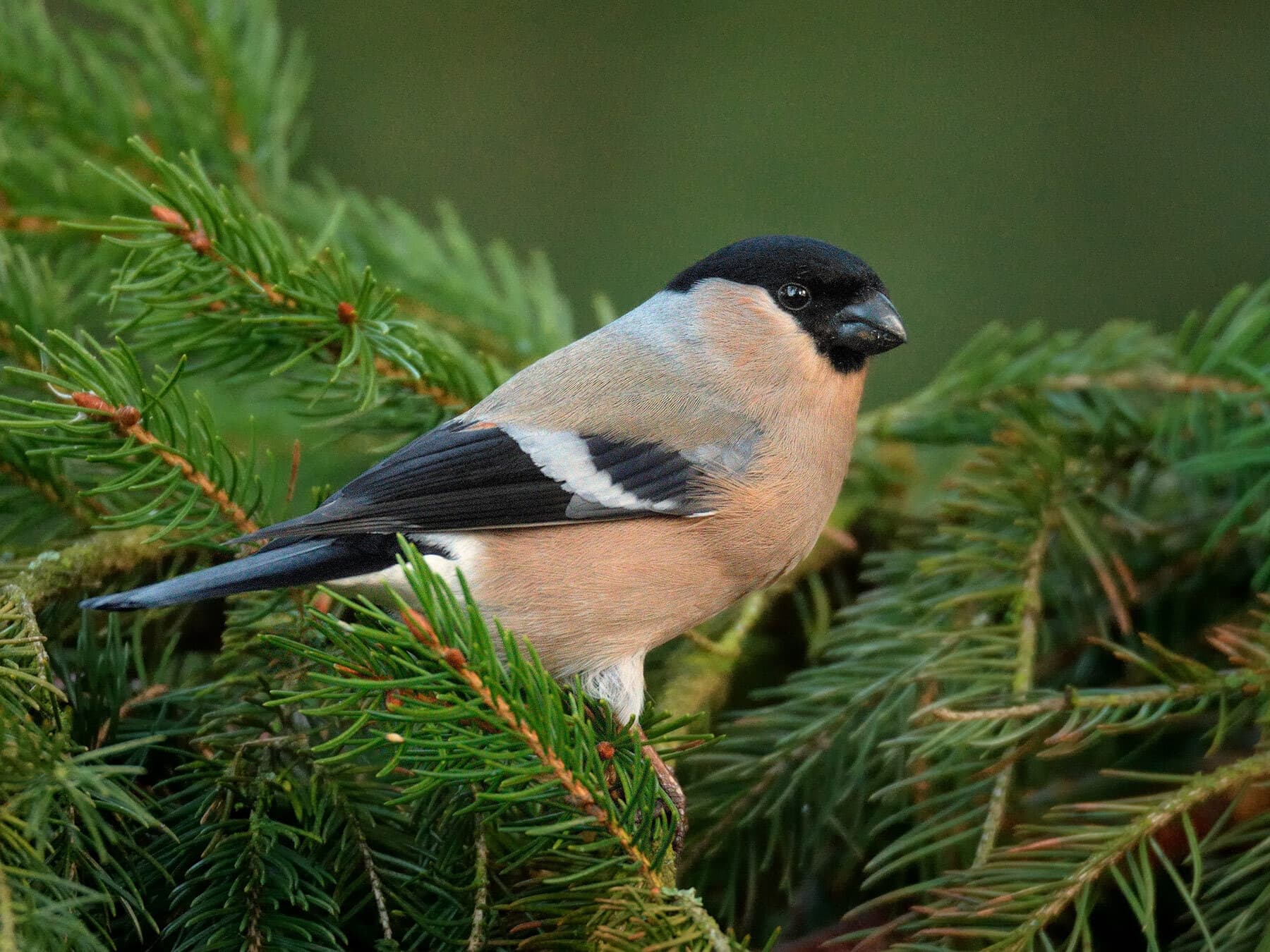 A female Bullfinch in a spruce, with a warm pinkish-buff wash below
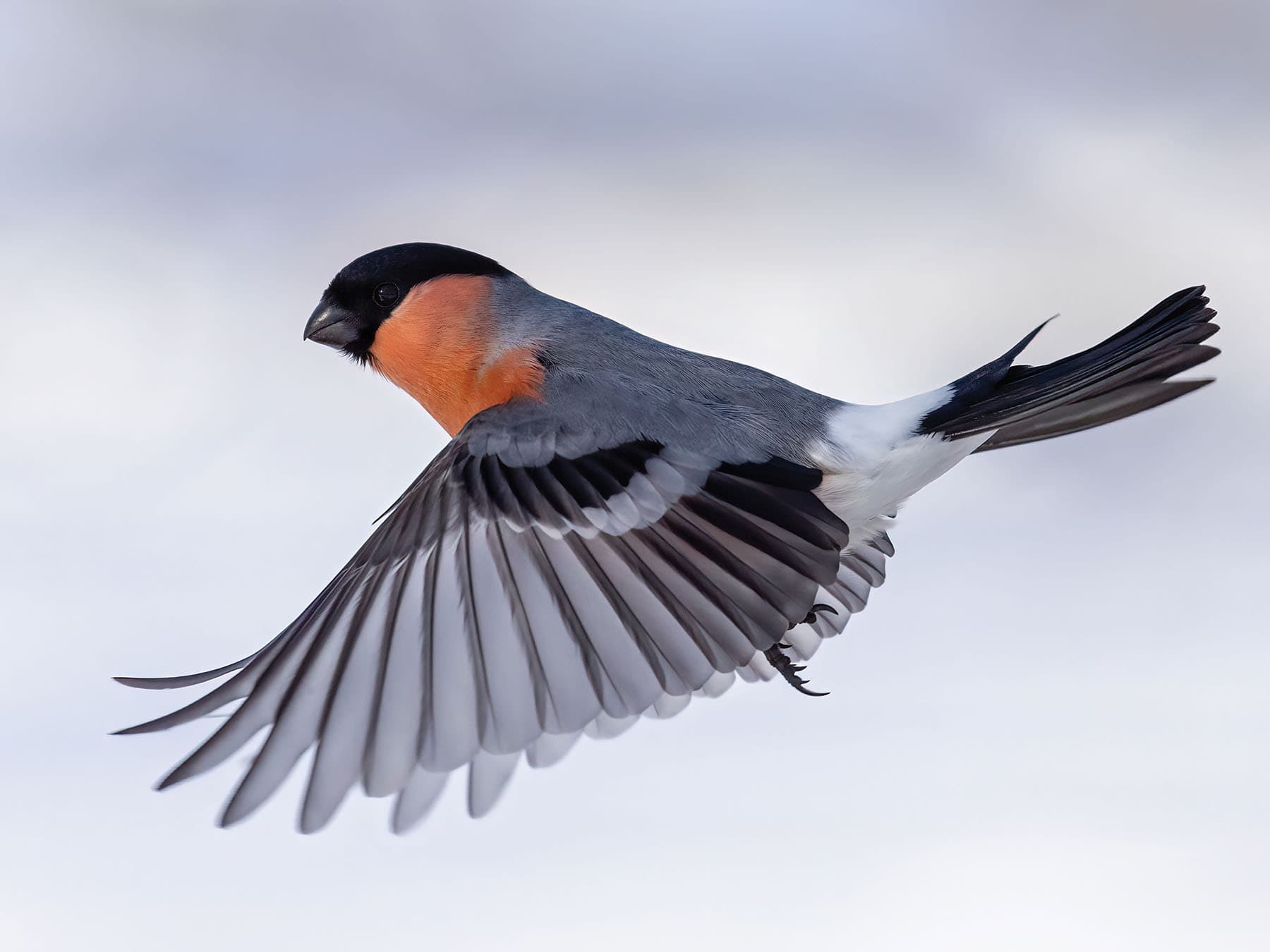 A male Bullfinch in flight, showing its white rump
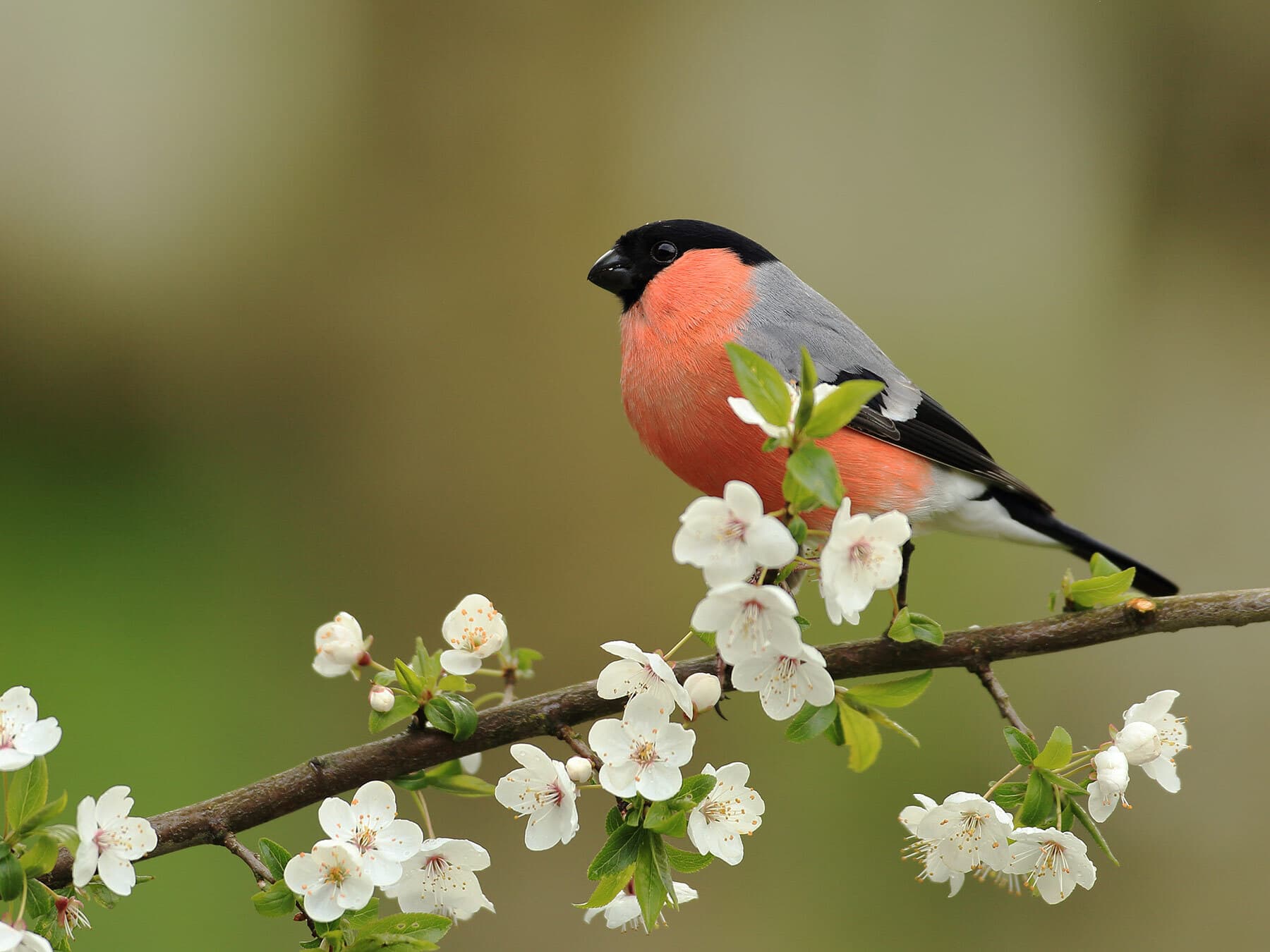 A male Bullfinch among white blossom in spring
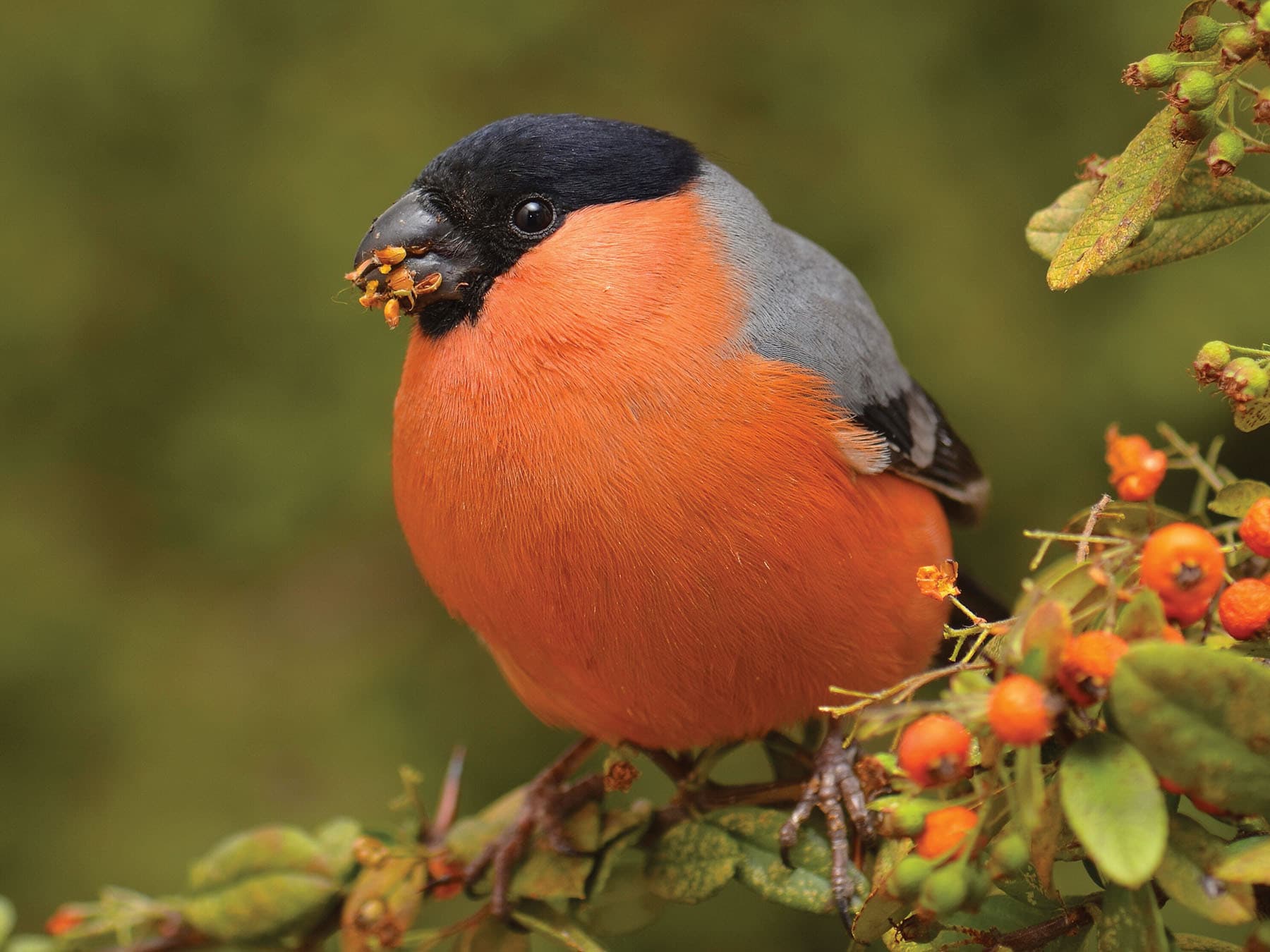 A male Bullfinch eating orange berries
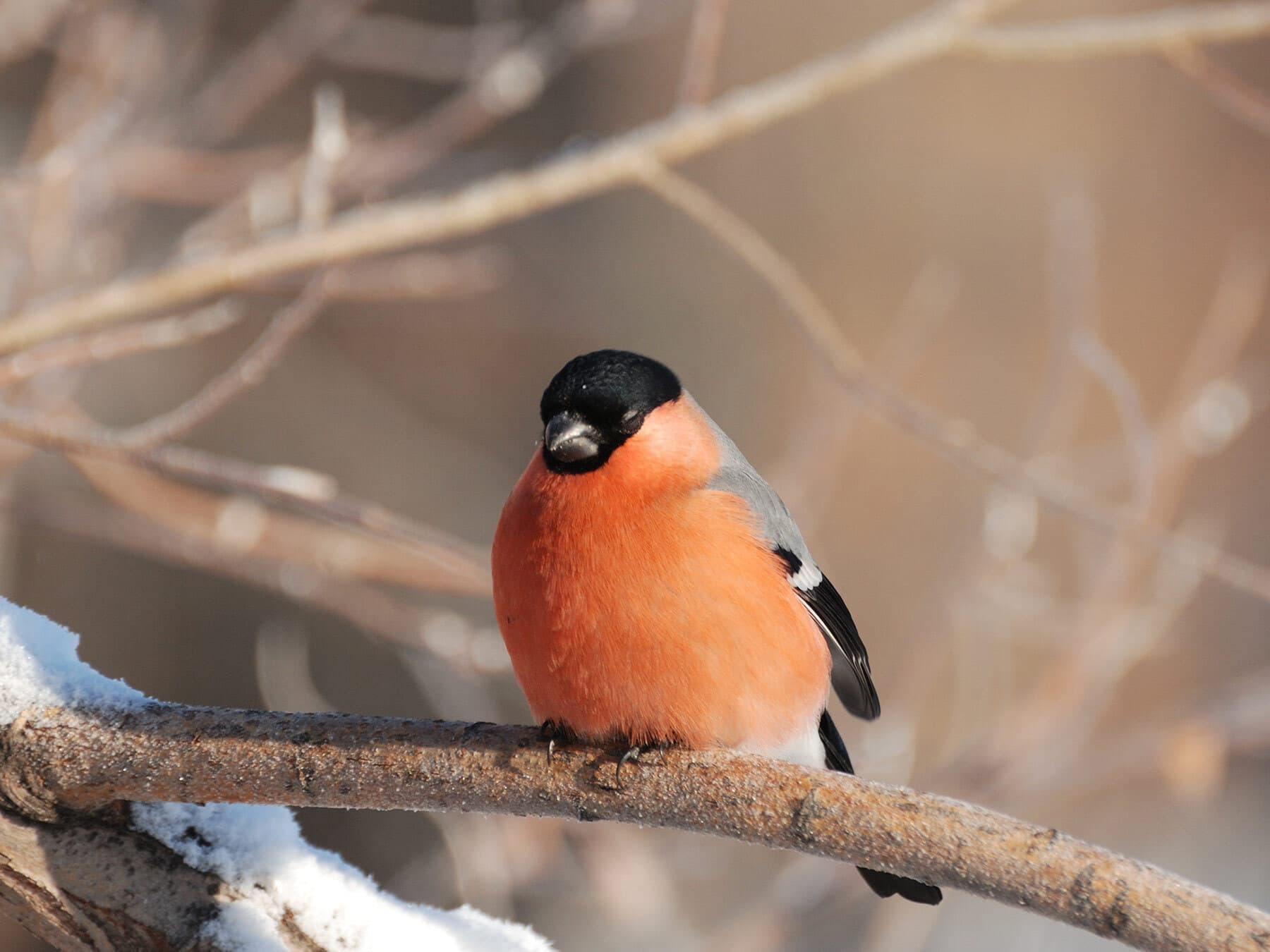 A male Bullfinch in a snowy tree
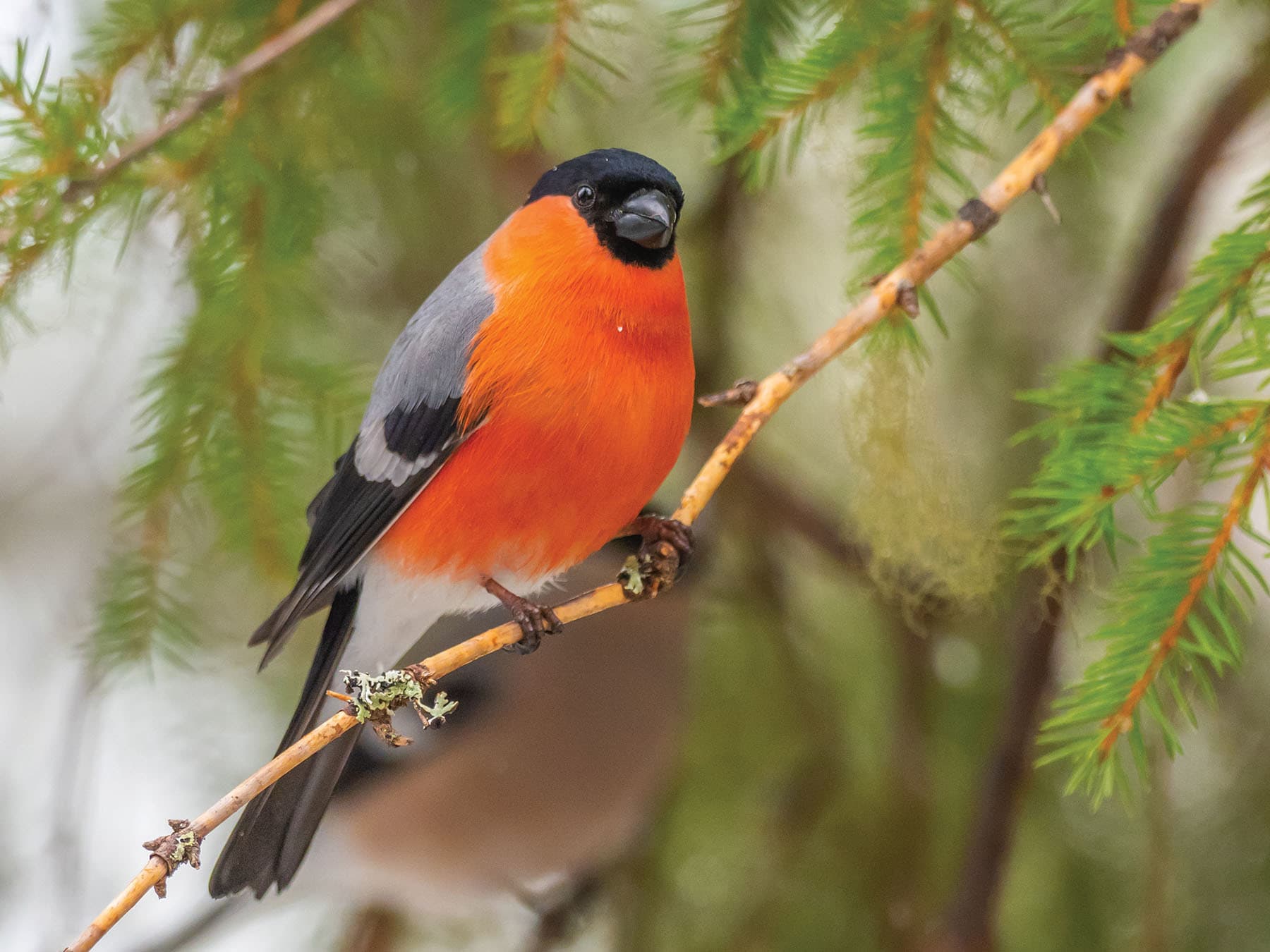 A male Bullfinch on a twig among spruce
Bullfinch guides
4 guidesQuick facts
- Length
- 14.5–16.5 cm
- Wingspan
- 22–26 cm
- Weight
- 21–27 g
- Lifespan
- 2 years · oldest recorded 18.1 years · UK record 9 years 2 months
- Family
- Finches
- Migration
- Resident
- Global status (IUCN)
- Least Concern
- Population trend
- UK numbers fell 55% between 1967 and 2024 (BTO); falling in England, rising in Scotland
- Also called
- Eurasian Bullfinch
- Scientific name
- Pyrrhula pyrrhula
Questions
2Are Bullfinches rare in the UK?
No, though they are much scarcer than they were. They are found in most of the UK where there are trees and hedges, with about 265,000 territories in 2016, but they are shy and quiet, so they are easy to miss. See conservation status.
Why is it called a bullfinch?
Probably for its build: dictionaries link the "bull" to the shape of its head and neck, or its stocky shape, and the name has been in use since at least the 16th century.20, 21 In 1885 Charles Swainson put it down to its large head and thick, compact shape, and recorded older country names such as Hoop, Nope, Coal hood and Bud picker.22
Sources
25- 1RSPB. Bullfinch. RSPB Birds A-Z. Accessed 9 October 2026. Source (opens in a new tab)
- 2Clement, P. and Christie, D. A. (2020). Eurasian Bullfinch (Pyrrhula pyrrhula), version 1.0. Birds of the World (J. del Hoyo, A. Elliott, J. Sargatal, D. A. Christie and E. de Juana, editors). Cornell Lab of Ornithology. doi:10.2173/bow.eurbul.01 (opens in a new tab)
- 3BTO. Bullfinch (Pyrrhula pyrrhula). BTO BirdFacts. Accessed 9 October 2026. Source (opens in a new tab)
- 4Robinson, R. A., Leech, D. I. and Clark, J. A. (2025). Summary of all recoveries for Bullfinch (Pyrrhula pyrrhula). The Online Demography Report: bird ringing and nest recording in Britain & Ireland in 2024 (BTO). Accessed 9 October 2026. Source (opens in a new tab)
- 5(2006). The Northern Bullfinch invasion of autumn 2004. British Birds 99: 2-24. Accessed 9 October 2026. Source (opens in a new tab)
- 6Newton, I. (1967). The feeding ecology of the Bullfinch (Pyrrhula pyrrhula L.) in southern England. Journal of Animal Ecology 36: 721-744. doi:10.2307/2822 (opens in a new tab)
- 7Martin, J.. How to attract bullfinches to your garden. Woodland Trust blog (18 February 2020). Accessed 9 October 2026. Source (opens in a new tab)
- 8RSPB (2026). Our latest guidance on feeding garden birds. RSPB news. Accessed 9 October 2026. Source (opens in a new tab)
- 9Hanmer, H. J. and Leech, D. I. (2024). Breeding periods of hedgerow-nesting birds in England. BTO Research Report 762. British Trust for Ornithology, Thetford. Accessed 7 October 2026. Source (opens in a new tab)
- 10BTO. Nest boxes for birds. BTO, Helping birds. Accessed 9 October 2026. Source (opens in a new tab)
- 11UK Parliament (1981). Wildlife and Countryside Act 1981, section 1. Accessed 7 October 2026. Source (opens in a new tab)
- 12UK (1985). The Wildlife (Northern Ireland) Order 1985, article 4. Accessed 7 October 2026. Source (opens in a new tab)
- 13Newton, I. (2026). A 51-year study of Eurasian Bullfinches Pyrrhula pyrrhula in Treswell Wood (UK). Bird Study: 1-12. doi:10.1080/00063657.2026.2727682 (opens in a new tab)
- 14BTO. Longevity records for Britain & Ireland in 2024. BTO Online Ringing and Nest Recording Report. Accessed 9 October 2026. Source (opens in a new tab)
- 15Fransson, T., Kolehmainen, T., Moss, D. and Robinson, R. (2023). EURING list of longevity records for European birds (1 September 2023). EURING. Accessed 9 October 2026. Source (opens in a new tab)
- 16Siriwardena, G. M., Freeman, S. N. and Crick, H. Q. P. (2001). The decline of the Bullfinch Pyrrhula pyrrhula in Britain: is the mechanism known?. Acta Ornithologica 36: 143-152. doi:10.3161/068.036.0207 (opens in a new tab)
- 17Proffitt, F. M., Newton, I., Wilson, J. D. and Siriwardena, G. M. (2004). Bullfinch Pyrrhula pyrrhula breeding ecology in lowland farmland and woodland: comparisons across time and habitat. Ibis 146 (Suppl. 2): 78-86. doi:10.1111/j.1474-919x.2004.00363.x (opens in a new tab)
- 18Marquiss, M. (2007). Seasonal pattern in hawk predation on Common Bullfinches Pyrrhula pyrrhula: evidence of an interaction with habitat affecting food availability. Bird Study 54: 1-11. doi:10.1080/00063650709461451 (opens in a new tab)
- 19Heywood, J. J. N., Massimino, D., Baker, L., Balmer, D. E. et al. (2026). The Breeding Bird Survey 2025. BTO Research Report 802. British Trust for Ornithology, Thetford. Accessed 9 October 2026. Source (opens in a new tab)
- 20Harper, D.. bullfinch. Online Etymology Dictionary. Accessed 9 October 2026. Source (opens in a new tab)
- 21Collins. bullfinch. Collins English Dictionary. Accessed 9 October 2026. Source (opens in a new tab)
- 22Swainson, C. (1885). The Provincial Names and Folk Lore of British Birds. English Dialect Society / Trübner, London. Accessed 9 October 2026. Source (opens in a new tab)
- 23Clement, P. et al. (2026). Common Chaffinch (Fringilla coelebs), version 1.3. Birds of the World (R. Ahmed, B. K. Keeney, N. D. Sly and S. M. Billerman, editors). Cornell Lab of Ornithology. doi:10.2173/bow.comcha.01.3 (opens in a new tab)
- 24RSPB. Chaffinch. RSPB Birds A-Z. Accessed 6 October 2026. Source (opens in a new tab)
- 25BirdLife International (2018). Pyrrhula pyrrhula. The IUCN Red List of Threatened Species 2018: e.T22720671A132141969. doi:10.2305/IUCN.UK.2018-2.RLTS.T22720671A132141969.en (opens in a new tab)

Checked by
Nathan Cope, founder and editor
Nathan founded Birdfact and leads its writers and contributors in the UK, the US and Canada. He has watched and studied birds for more than ten years, and checks every article and species guide before it’s published.