


Turquoise-browed Motmot
Torogoz, Guardabarranco · Eumomota superciliosa
By the Birdfact teamChecked by Nathan Cope
On this page14 sections
How to recognise it
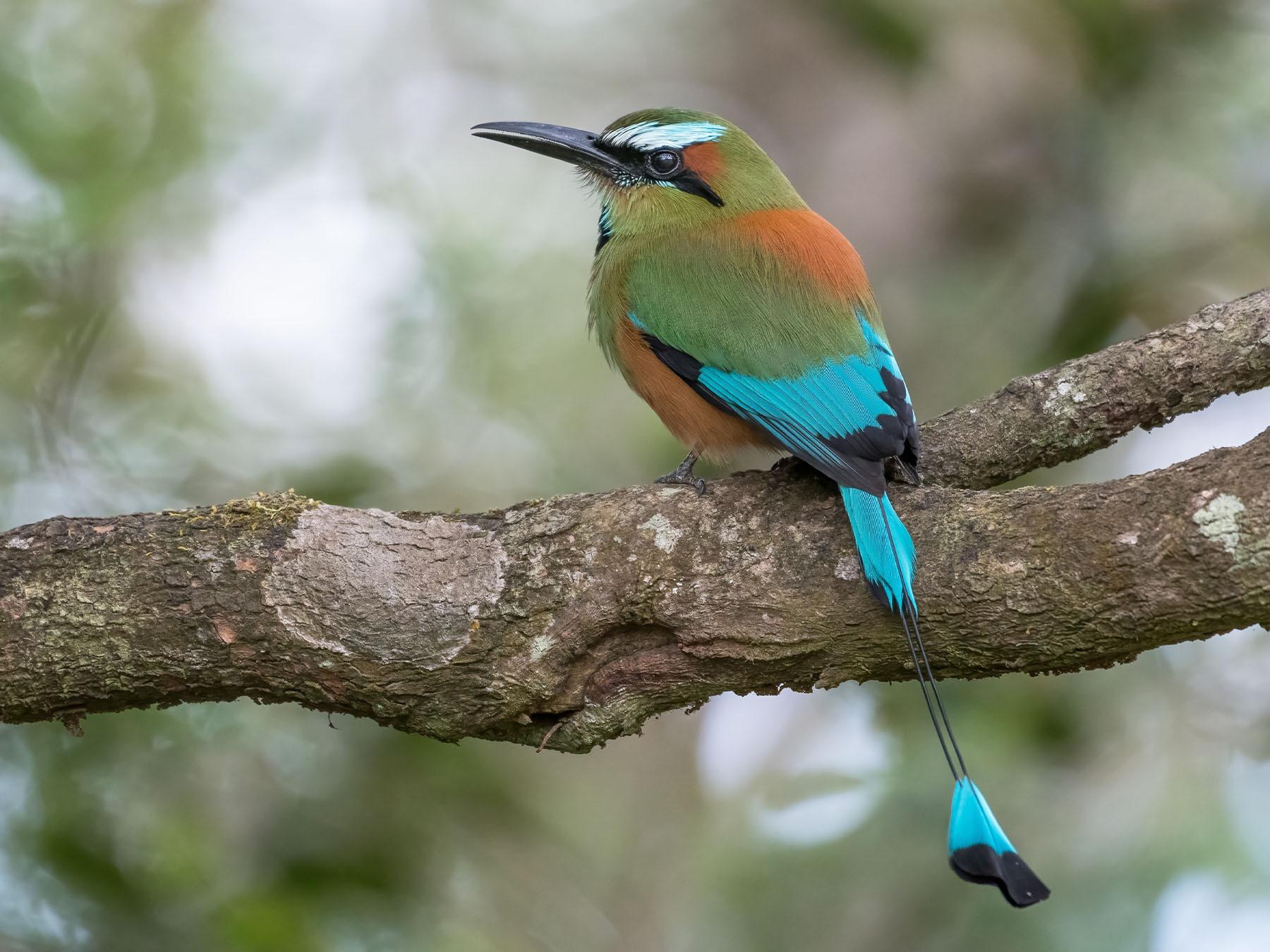
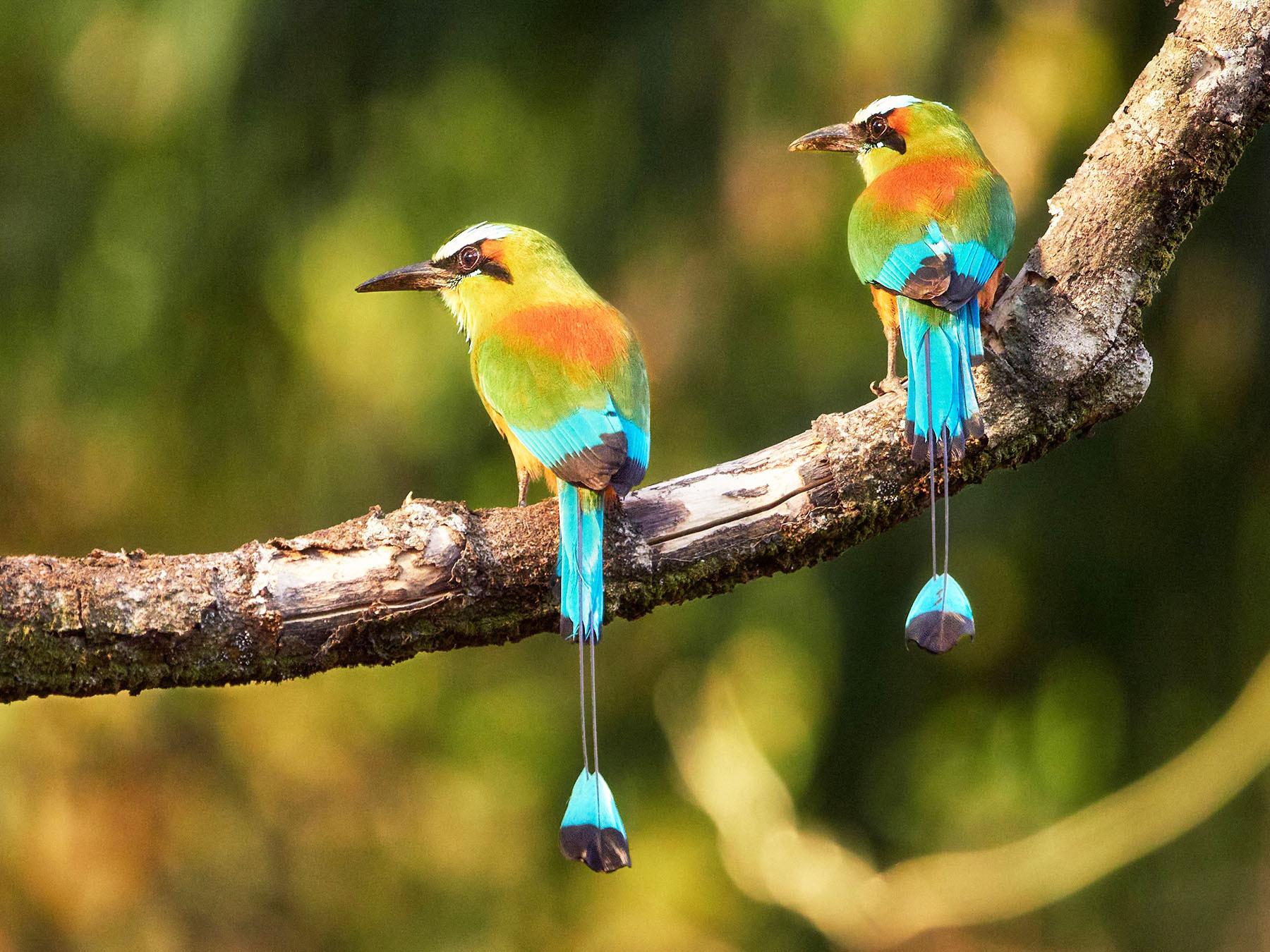
Seen well, it is mainly green with a cinnamon or rufous belly, a turquoise eyebrow over a black mask and a long blue tail. The tail is the mark to look for: its two central feathers run out to bare shafts, each tipped with a racket like a small flag.
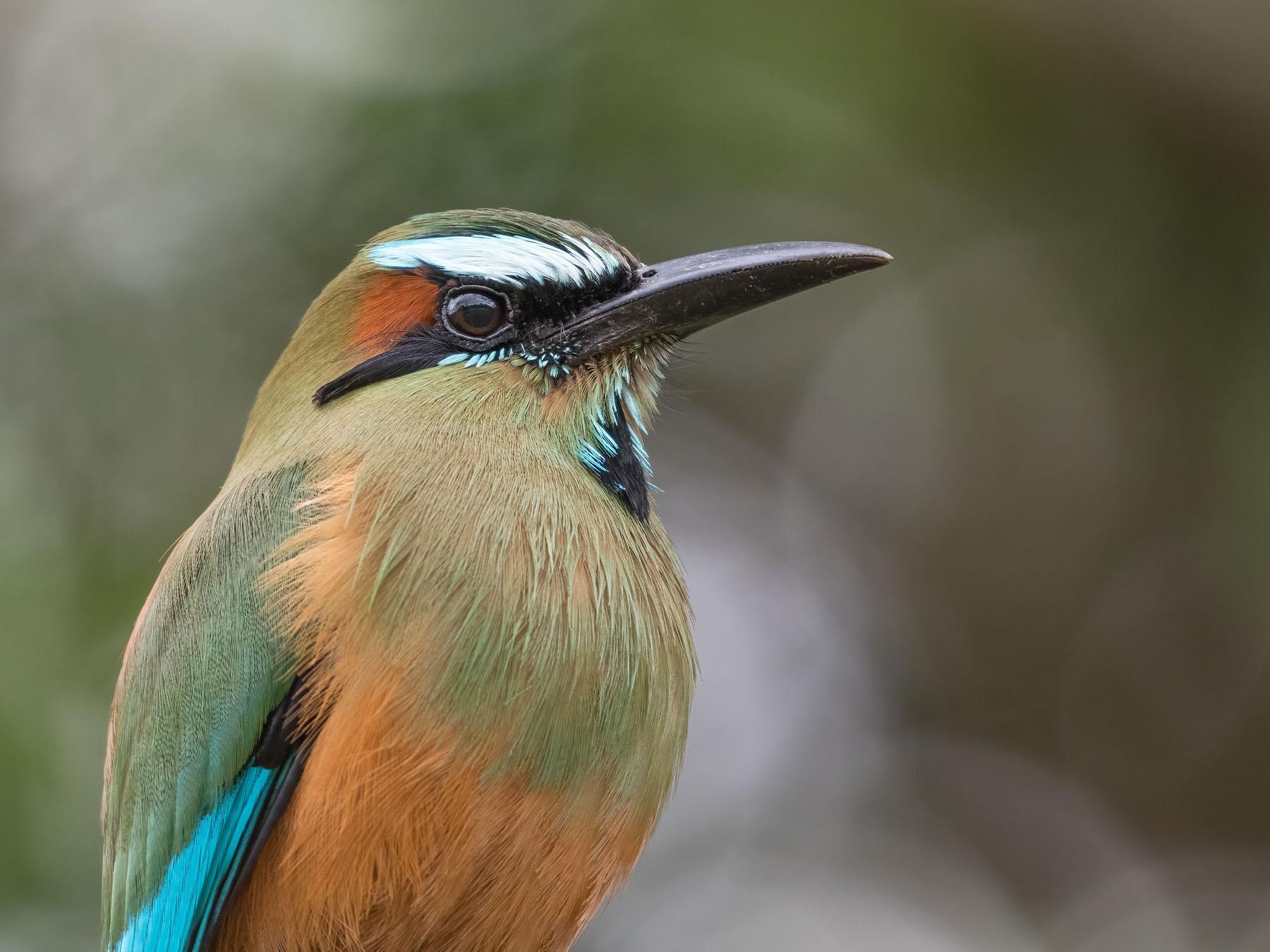
Up close, both sexes of the nominate race, from south-east Mexico, show a pale, slightly iridescent turquoise-blue brow, with a turquoise line under the black mask. The back is green with a chestnut-rufous patch, and the turquoise-blue flight feathers have black tips. Down the olive-green throat and breast runs a shaggy black stripe edged with turquoise, and the belly is cinnamon. The bill is black, fairly long, narrow and slightly downcurved, with fine serrations along most of its edges, and the legs are grey.
It is the sole member of the genus Eumomota and has no very close relatives. Seven subspecies are recognised, and they differ mainly in how dark they are: the darkest live in more humid areas, while australis of north-western Costa Rica is small and pale. Birds in El Salvador, western and southern Honduras and north-western Nicaragua belong to the race apiaster, which is paler green and less tawny than the nominate race.
Tail plumage and rackets
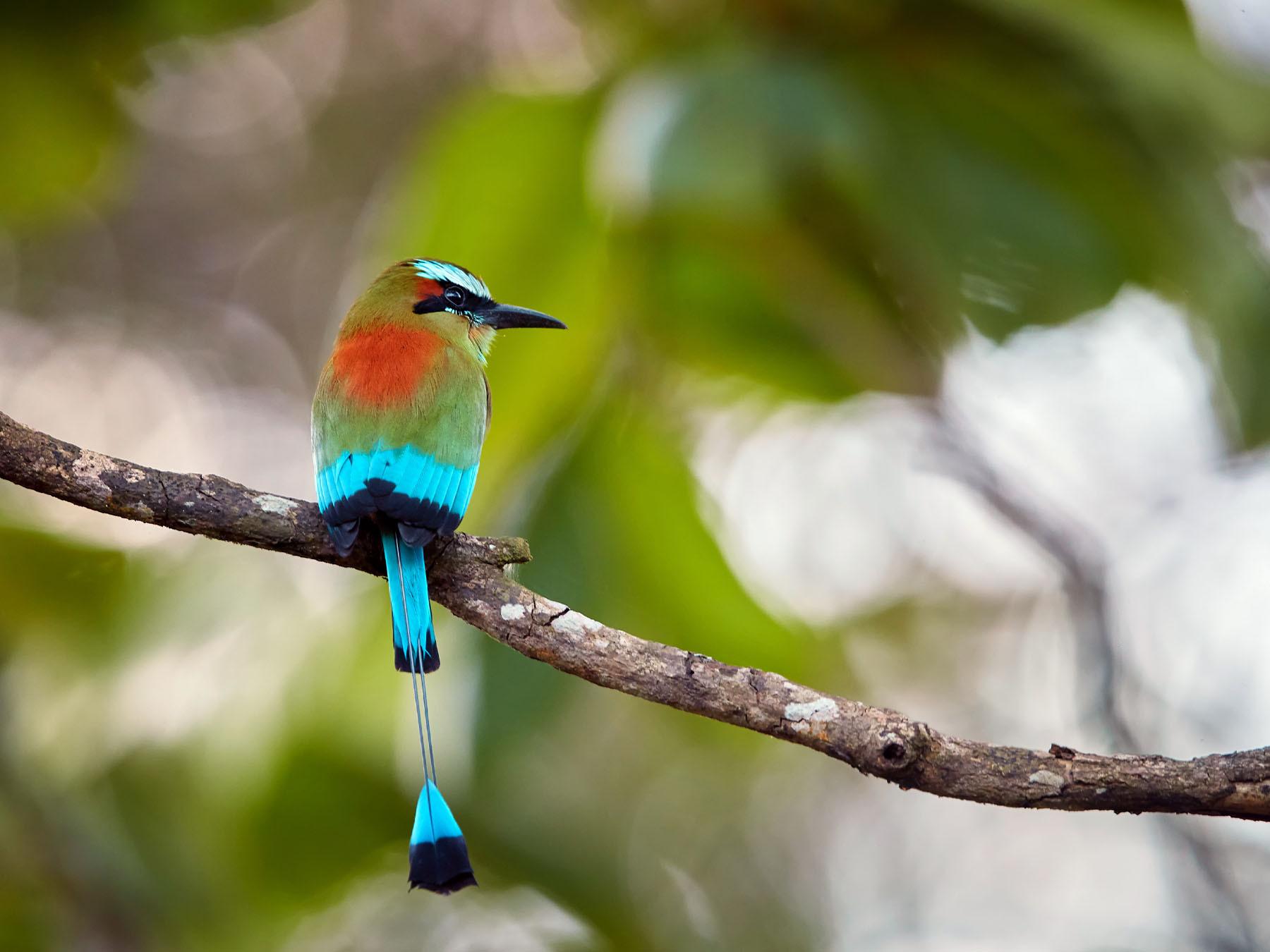
No other motmot has such a strongly graduated tail. The central pair of feathers is about twice as long as the next pair, with very long bare shafts of about 75 mm. Each ends in a racket that is blue on the half nearer the body and black on the half towards the tip.
The rackets form because the barbs along the bare stretch of each central feather are only weakly attached and are shed soon after the feather grows. A microscope study of regrown feathers from seven birds whose central tail feathers had been plucked suggests the weakness comes from a smaller anchoring flange and a lack of the melanin that strengthens feather barbs.1 Unlike the tails of many birds with pin-like tips, its central shafts are reinforced towards the tip.2
Size and weight
It is 33-38 cm (13-15 in) long and weighs 44-74 g (1.6-2.6 oz). In one study males averaged 67.6 g and females 66 g.2 None of the sources we read gives a wingspan.
Male, female and young
Males and females look alike. The male is a little larger in most body measurements, including the tail. His rackets are also slightly brighter: a study of the tail colour found a moderate but statistically significant difference between the sexes.3
Young birds are duller than adults, with little or no rufous on the back and little of the black-and-turquoise stripe below.
Identification: similar species
Three other motmots can be mistaken for it. Lesson's Motmot is bigger, with a blue ring round a black crown instead of a turquoise eyebrow, shorter bare tail shafts and smaller rackets. The Mexican and Guatemalan Motmots are larger-bodied, with a solid russet crown and only a narrow blue edge to the black mask. The Keel-billed Motmot also has a turquoise eyebrow, but it has a very broad bill, a rufous forehead and less well-developed rackets.
On a Turquoise-browed, check for the broad turquoise eyebrow, the black throat stripe edged turquoise, the long bare tail shafts with bold rackets and the rufous patch on the back.
Not sure it’s a Turquoise-browed Motmot? Check your photo: Birdfact names the bird and shows the look-alike side by side.
Its size
Adults- Length
- 33–38 cm
- Weight
- 44–74 g
Its song and calls
Its usual call is a hollow, nasal, ringing 'wohh' or 'owhh', repeated about once every 3.5-4.5 seconds. It sounds higher and less resonant than the calls of the Keel-billed and Broad-billed Motmots.
It also makes hollow, slightly hoarse clucking calls: a rhythmic series of repeated clucks and a longer series, the longer one perhaps given as a duet. The account we read describes calls only, no song.
- Calls (heard, not seen)0:00 / 0:06
Recorded in Quintana Roo, Mexico · May 2022
Heard one and not sure? Let the bird song identifier listen.
When and where to see it
The Turquoise-browed Motmot lives all year from south-east Mexico through Central America to north-western Costa Rica, in dry woodland, scrub and semi-open country.
Its range covers the Yucatán Peninsula, including the far north of Guatemala, and the Gulf slope of southern Mexico, then runs along Central America's Pacific side from southern Mexico to north-western Costa Rica. Some races live on the Caribbean side in Guatemala and northern Honduras. It uses dry deciduous woodland and its edges, evergreen forest along rivers, low scrub and open country with scattered trees, and locally plantations and gardens, from sea level to 1,400 m (about 4,600 ft). BirdLife rates tropical dry forest as its main habitat and lists it as a native resident of six countries: Mexico, Guatemala, El Salvador, Honduras, Nicaragua and Costa Rica.4
It is not a migrant, but it does move locally. In the Yucatán birds come back to their breeding colonies in late February or March; how far they go outside the breeding season is unknown, though probably not far. Some seasonal movement is likely in Costa Rica, where drier habitats are used mainly in the wet season.2
The handbook account, last revised in 2012, describes it as well suited to secondary growth and to semi-open country much changed by people, and as using nest sites that people create, where breeding adults grow used to visitors.
Spotting tips
It is one of the easier motmots to find. Look along roads, above all in spring, when it often sits in the open on wires and bare branches. In the Yucatán, check Maya ruins and cenotes, where it nests.
What it eats
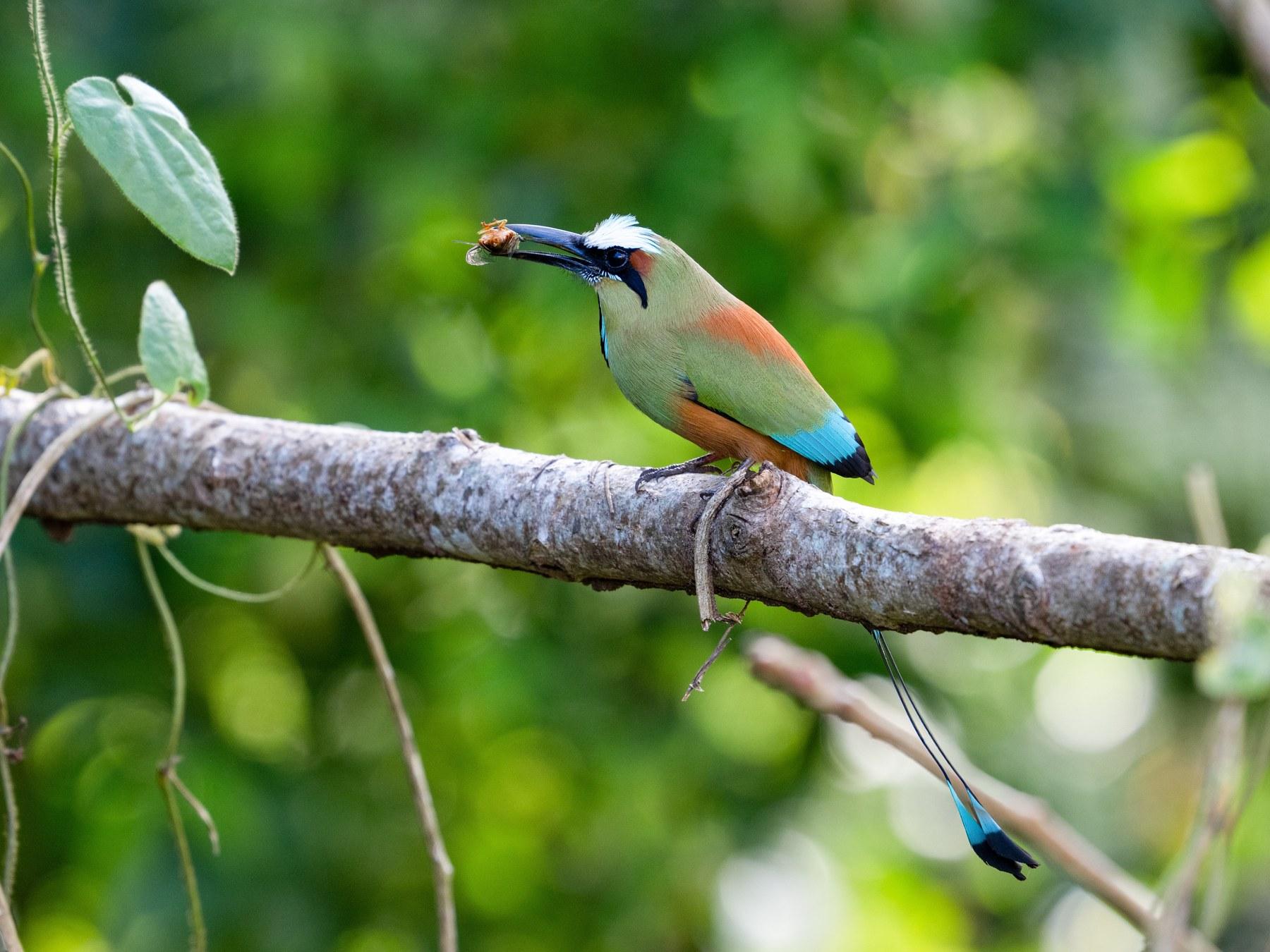
It eats mainly insects, especially beetles, grasshoppers and their relatives, and bees, wasps and ants. It also takes spiders, millipedes, small snails, earthworms and small lizards and snakes, and a little fruit.
Reptiles are only a small share: just 0.9% of the diet by volume in a 1993 review of what Neotropical trogons, motmots, barbets and toucans eat. Fruit made up 3.4% of stomach contents by volume in the Yucatán.2 Fruits recorded include figs, Bursera, Stemmadenia, Ehretia and Guaiacum.
Hunting and feeding
It hunts from a perch, darting out to seize prey from leaves or the ground, or sallying into the air after butterflies, bees, dragonflies and smaller insects.
One short published note records two habits: larger prey struck against the perch up to eight times before it is eaten, and, in El Salvador, birds catching flying insects around street lights almost an hour after sunset.2
In tests with model prey, nine hand-reared young responded most strongly to movement, and they strongly avoided a pattern like a coral snake's.5
Nesting and breeding
Turquoise-browed Motmots nest in burrows dug into earth banks or low cliffs, either alone or in colonies.
The burrow is often curved and ends in a chamber about 20-23 cm wide and 10 cm high. In a Yucatán study the burrows were 40-244 cm long, 130 cm on average.2 In the Yucatán it also nests in the beam sockets and ventilation holes of Maya ruins, in sinkholes (cenotes) and in freshwater wells.
Whether birds nest alone or together depends on how many good sites there are. Some colonies hold over 100 pairs, but in the Yucatán they ranged from 2 to 60 pairs, most often 10-20.2
Laying runs from the second week of May to mid-July in Mexico, with most clutches in the first half of June; in April and May in Guatemala and Honduras; and from late March to mid-April in north-western Costa Rica. A pair may lay again if an early nest fails.
The handbook account, last revised in 2012, says pairs stay together over successive years and come back to the same nest sites. A Yucatán study found no sign that birds pair by tail size, body size or condition, though there was some evidence that birds over two years old choose partners of similar age and condition.2
Eggs and young
The 2-6 eggs, most often four, are laid about 48 hours apart. Incubation takes 18-20 days, and the young leave the nest at 24-31 days. We found no study that says which parent incubates or feeds the young.
In a Yucatán population followed over three years, clutches of four made up 64-73% of all clutches and clutches of three 11-33%. Four-egg clutches raised more young than three-egg clutches in two of the three years (2.02 against 1.71 on average), but the difference was not statistically significant.6
Behaviour
Studies have looked closely at its long tail and at an odd habit of holding up a leaf.
Both sexes carry the racket tail. In one study, yearling males with longer bare tail wires paired more successfully, and older males with longer wires had mates that laid larger clutches, hatched a higher share of their eggs and fledged more young, while no such link was found for female tails.7 The author reads this as the male tail working as a signal of status or in mate choice.
When the rackets were removed from some males in a field experiment, their haematocrit, the share of red cells in the blood and a measure of condition, rose more over the breeding season than in males left intact.8 The author reads this either as the males' condition improving once freed of a costly ornament, or as a social cost of losing a signal; whether the tail makes flying harder was not measured.
The blue-green of the rackets is a structural colour. In males, but not females, feathers that grew faster were brighter, so the authors say male racket colour could signal quality; the study did not test whether birds use it that way.3
Both sexes sometimes hold a leaf horizontally at the bill tip for long spells. In 61 displays by 27 birds, the display often went with a chase or fight with a bird of the same sex, and sometimes with an aggressive display at nest sites; it was seen in paired and unpaired birds through the breeding season.9 The author says it may work as a signal of aggression or status, and it does not seem to be about attracting a mate.
Lifespan and predators
We cannot give a lifespan. We found no ringing record or lifespan figure for this bird, and no ringing scheme that covers its range.
Predators and parasites
At archaeological sites in the Yucatán, 36% of all nesting attempts failed through predation, probably by a rat snake (Elaphe phaescens).2
In the three-year Yucatán study of clutch size, about 40% of nestling deaths in nests that escaped predators were from starvation; others came from falls from the nest and from parasitic maggots.6 Larvae of the fly Philornis fasciventris were collected from one of its nests in the Yucatán, the first record of this motmot as a host of any Philornis fly.10
Conservation
The Turquoise-browed Motmot is listed as Least Concern on the IUCN Red List, in BirdLife International's 2020 assessment, as at every assessment since 2004.4
The assessment suspects a small decline, too slow to come near the threshold for Vulnerable, but lists no monitoring scheme that measures it.4 It gives 500,000-4,999,999 mature individuals, a broad band dated 2016 that it rates as poor-quality data.4
Partners in Flight's own expert score notes that the bird tolerates some clearing and asks whether there is evidence of a decline.11 The handbook account, last revised in 2012, ranks it among the most numerous motmots, common or fairly common across its range.
Legal status
It is not listed on the CITES appendices (text valid from 7 February 2025).12 It is not on Mexico's list of species at risk (NOM-059-SEMARNAT-2010, as modified in 2019), which names three other motmots.13 Nor is it on El Salvador's official list of threatened or endangered wildlife (2015), which names two other motmots.14 We did not read the laws of the other countries in its range or any later lists.
It is the national bird of two countries. El Salvador's Legislative Assembly declared the torogoz its national bird by Decree No. 735, dated 21 October 1999 and published in the Diario Oficial on 19 November 1999.15 Nicaragua made it its national bird, as the guardabarranco, by Law No. 795 of 13 June 2012.16 There is more in our guide to the national bird of El Salvador.
More photos
1 photos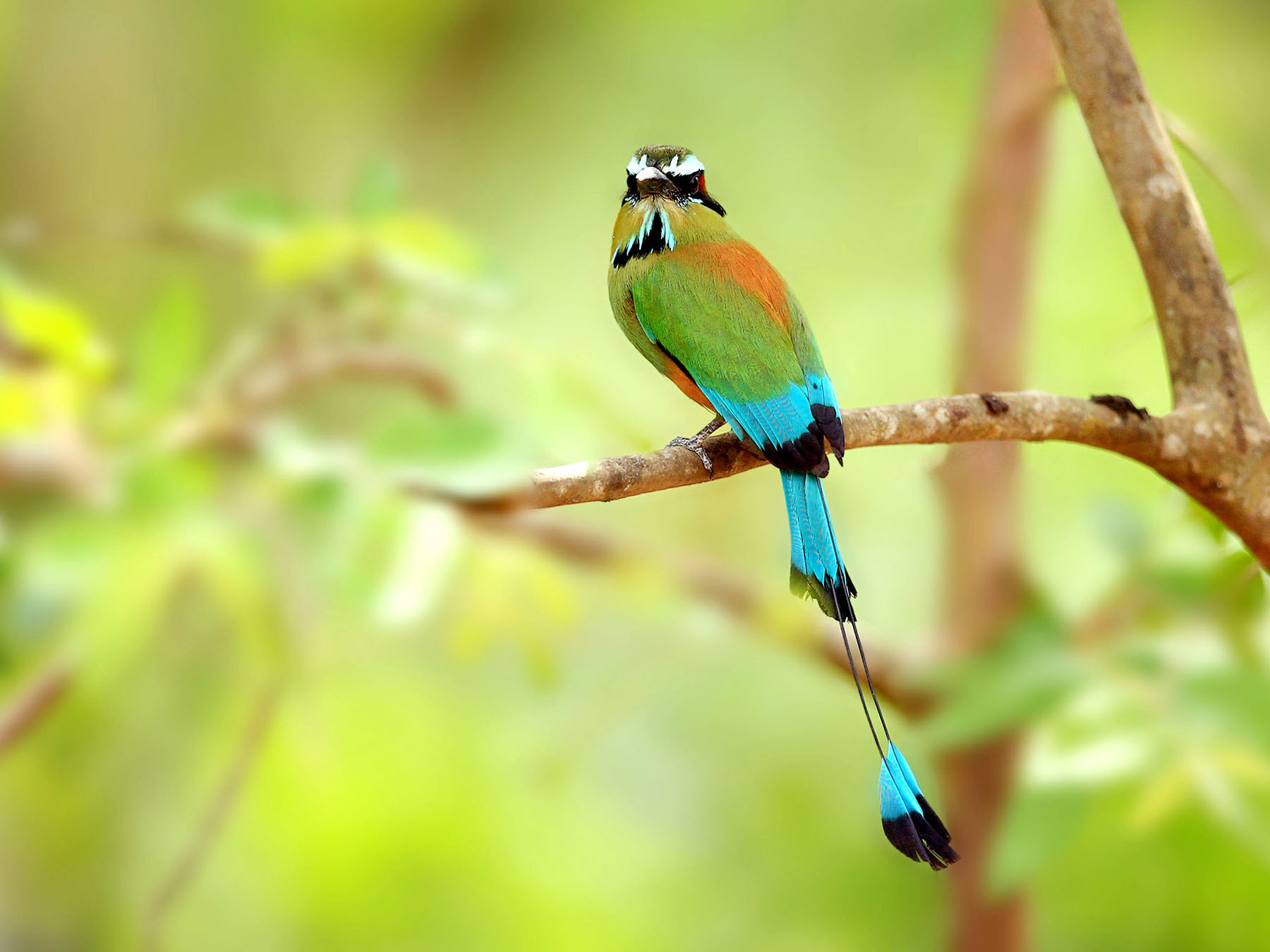
Turquoise-browed Motmot guides
1 guidesQuick facts
- Length
- 33–38 cm
- Weight
- 44–74 g
- Family
- Motmots
- Migration
- Resident
- Global status (IUCN)
- Least Concern
- World population
- 500,000-4,999,999 mature individuals (BirdLife estimate, 2016; data quality poor)
- Population trend
- Decreasing (suspected small decline; BirdLife)
- Also called
- Torogoz, Guardabarranco
- Scientific name
- Eumomota superciliosa
Questions
2Why is the torogoz the national bird of El Salvador?
The 1999 decree gives its reasons: the bird's beauty and many-coloured plumage, that it does not adapt to captivity, and that it is a symbol of family unity because pairs share the care of their chicks.15 Those are the decree's reasons, not findings from a study.
What is the torogoz called in English?
The torogoz is the Turquoise-browed Motmot, Eumomota superciliosa. Torogoz is its name in El Salvador, and in Nicaragua it is the guardabarranco, the name Nicaragua's 2012 law gives it alongside the scientific name.16
Sources
25- 1Murphy, T. G. (2007). Lack of melanized keratin and barbs that fall off: how the racketed tail of the turquoise-browed motmot Eumomota superciliosa is formed. Journal of Avian Biology 38: 139-143. doi:10.1111/j.2007.0908-8857.04055.x (opens in a new tab)
- 2Snow, D. and Kirwan, G. M. (2020). Turquoise-browed Motmot (Eumomota superciliosa), version 1.0. Birds of the World (Cornell Lab of Ornithology). doi:10.2173/bow.tubmot1.01 (opens in a new tab)
- 3Murphy, T. G. and Pham, T. T. (2012). Condition and brightness of structural blue-green: motmot tail-racket brightness is related to speed of feather growth in males, but not in females. Biological Journal of the Linnean Society 106: 673-681. doi:10.1111/j.1095-8312.2012.01891.x (opens in a new tab)
- 4BirdLife International (2020). Species factsheet: Turquoise-browed Motmot Eumomota superciliosa. BirdLife DataZone. Accessed 20 November 2026. Source (opens in a new tab)
- 5Smith, S. M. (1976). Predatory Behaviour of Young Turquoise-Browed Motmots, Eumomota Superciliosa. Behaviour 56: 309-320. doi:10.1163/156853976x00082 (opens in a new tab)
- 6Scott, P. E. and Martin, R. F. (1986). Clutch Size and Fledging Success in the Turquoise-Browed Motmot. The Auk 103: 8-13. doi:10.1093/auk/103.1.8 (opens in a new tab)
- 7Murphy, T. G. (2006). Racketed tail of the male and female turquoise-browed motmot: male but not female tail length correlates with pairing success, performance, and reproductive success. Behavioral Ecology and Sociobiology 61: 911-918. doi:10.1007/s00265-006-0320-z (opens in a new tab)
- 8Murphy, T. G. (2009). Tail-racket removal increases hematocrit in male Turquoise-browed Motmots (Eumomota superciliosa). Journal of Ornithology 151: 241-245. doi:10.1007/s10336-009-0449-4 (opens in a new tab)
- 9Murphy, T. G. (2008). Display of an Inedible Prop as a Signal of Aggression? Adaptive Significance of Leaf-Display by the Turquoise-Browed Motmot, Eumomota superciliosa. Ethology 114: 16-21. doi:10.1111/j.1439-0310.2007.01421.x (opens in a new tab)
- 10Couri, M. S., Murphy, T. G. and Hoebeke, R. (2007). Philornis fasciventris (Wulp) (Diptera: Muscidae): description of the male, larva and puparium, with notes on biology and host association. Neotropical Entomology 36: 889-893. doi:10.1590/s1519-566x2007000600009 (opens in a new tab)
- 11Partners in Flight (2024). Avian Conservation Assessment Database, version 2024.05.23 (global). Accessed 20 November 2026. Source (opens in a new tab)
- 12CITES Appendices I, II and III, valid from 7 February 2025. Accessed 20 November 2026.
- 13Modificación del Anexo Normativo III, Lista de especies en riesgo, de la NOM-059-SEMARNAT-2010 (DOF 14/11/2019). Accessed 20 November 2026. Source (opens in a new tab)
- 14MARN Acuerdo No. 74 (23 Mar 2015), Listado Oficial de Especies de Vida Silvestre Amenazadas o en Peligro de Extinción. Accessed 20 November 2026. Source (opens in a new tab)
- 15Decreto No. 735, Asamblea Legislativa de El Salvador (21 Oct 1999): Ave Nacional de El Salvador, el Torogoz. Accessed 20 November 2026. Source (opens in a new tab)
- 16Ley No. 795, Ley que declara al Guardabarranco, Ave Nacional de Nicaragua (La Gaceta No. 118, 25 Jun 2012). Accessed 20 November 2026. Source (opens in a new tab)
- 17Snow, D., Kirwan, G. M. and Sharpe, C. J. (2020). Keel-billed Motmot (Electron carinatum), version 1.0. Birds of the World (Cornell Lab of Ornithology). doi:10.2173/bow.kebmot1.01 (opens in a new tab)
- 18del Hoyo, J., Collar, N. and Kirwan, G. M. (2020). Lesson's Motmot (Momotus lessonii), version 1.0. Birds of the World (Cornell Lab of Ornithology). doi:10.2173/bow.bucmot2.01 (opens in a new tab)
- 19Chan, P. T. et al. (2026). Mexican Motmot (Momotus mexicanus), version 3.0. Birds of the World (Cornell Lab of Ornithology). Accessed 20 November 2026. Source (opens in a new tab)
- 20van Dort, J. et al. (2026). Guatemalan Motmot (Momotus castaneiceps), version 1.0. Birds of the World (Cornell Lab of Ornithology). Accessed 20 November 2026. Source (opens in a new tab)
- 21eBird (2026). Turquoise-browed Motmot (Eumomota superciliosa). Accessed 20 November 2026. Source (opens in a new tab)
- 22AviList Core Team (2026). AviList: The Global Avian Checklist, v2025b. doi:10.2173/avilist.v2025b (opens in a new tab)
- 23McCullough, J. M., Moyle, R. G., Smith, B. T. and Andersen, M. J. (2019). A Laurasian origin for a pantropical bird radiation is supported by genomic and fossil data (Aves: Coraciiformes). Proceedings of the Royal Society B 286. doi:10.1098/rspb.2019.0122 (opens in a new tab)
- 24BirdLife International (2020). Eumomota superciliosa. The IUCN Red List of Threatened Species 2020-3 (Crossref record). doi:10.2305/iucn.uk.2020-3.rlts.t22682992a163630124.en (opens in a new tab)
- 25GBIF / Catalogue of Life (2026). Eumomota superciliosa vernacular names. Accessed 20 November 2026. Source (opens in a new tab)

Checked by
Nathan Cope, founder and editor
Nathan founded Birdfact and leads its writers and contributors in the UK, the US and Canada. He has watched and studied birds for more than ten years, and checks every article and species guide before it’s published.