
Tawny Frogmouth
Podargus strigoides
By the Birdfact teamChecked by Nathan Cope
On this page13 sections
How to recognise it
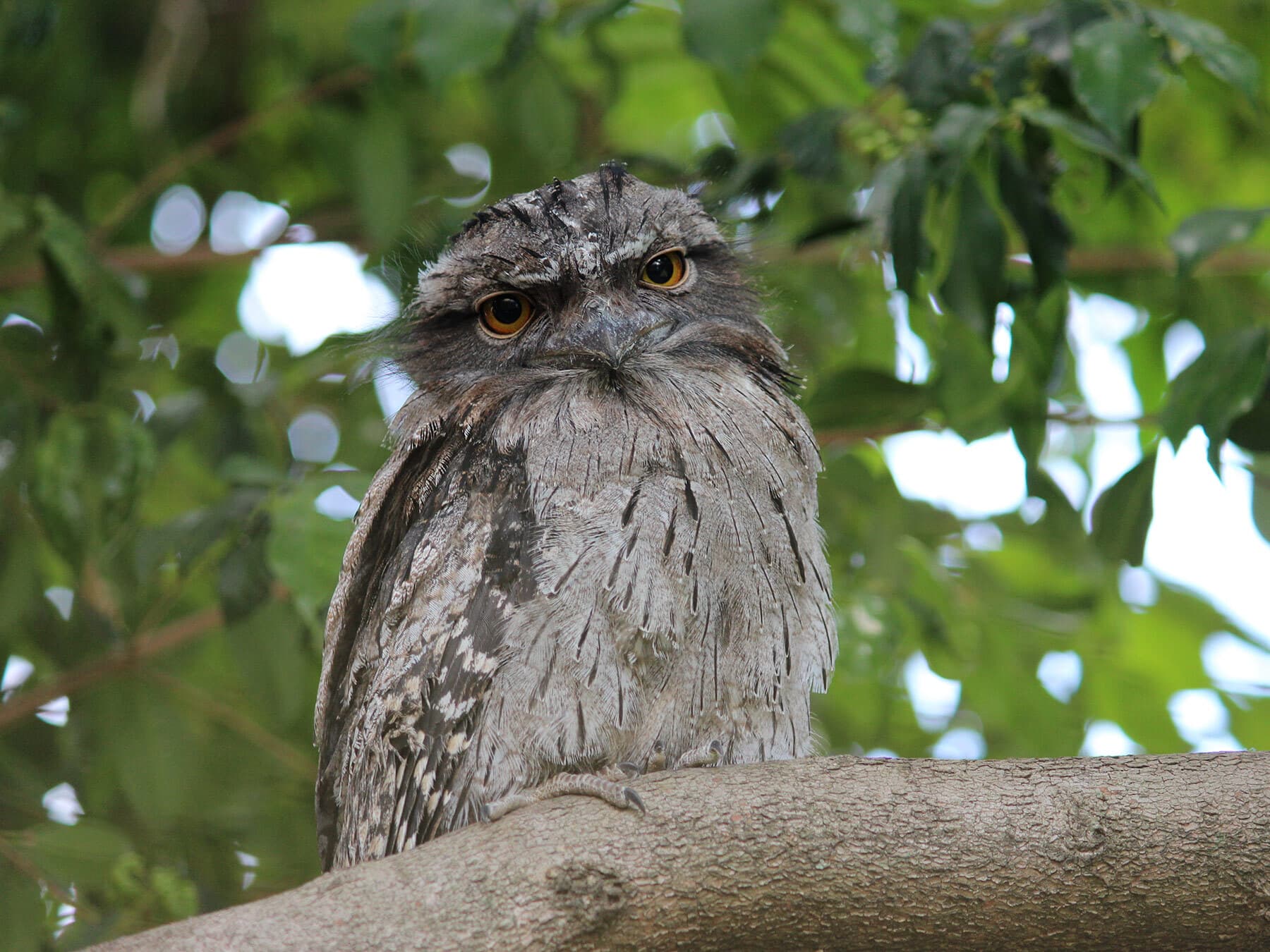
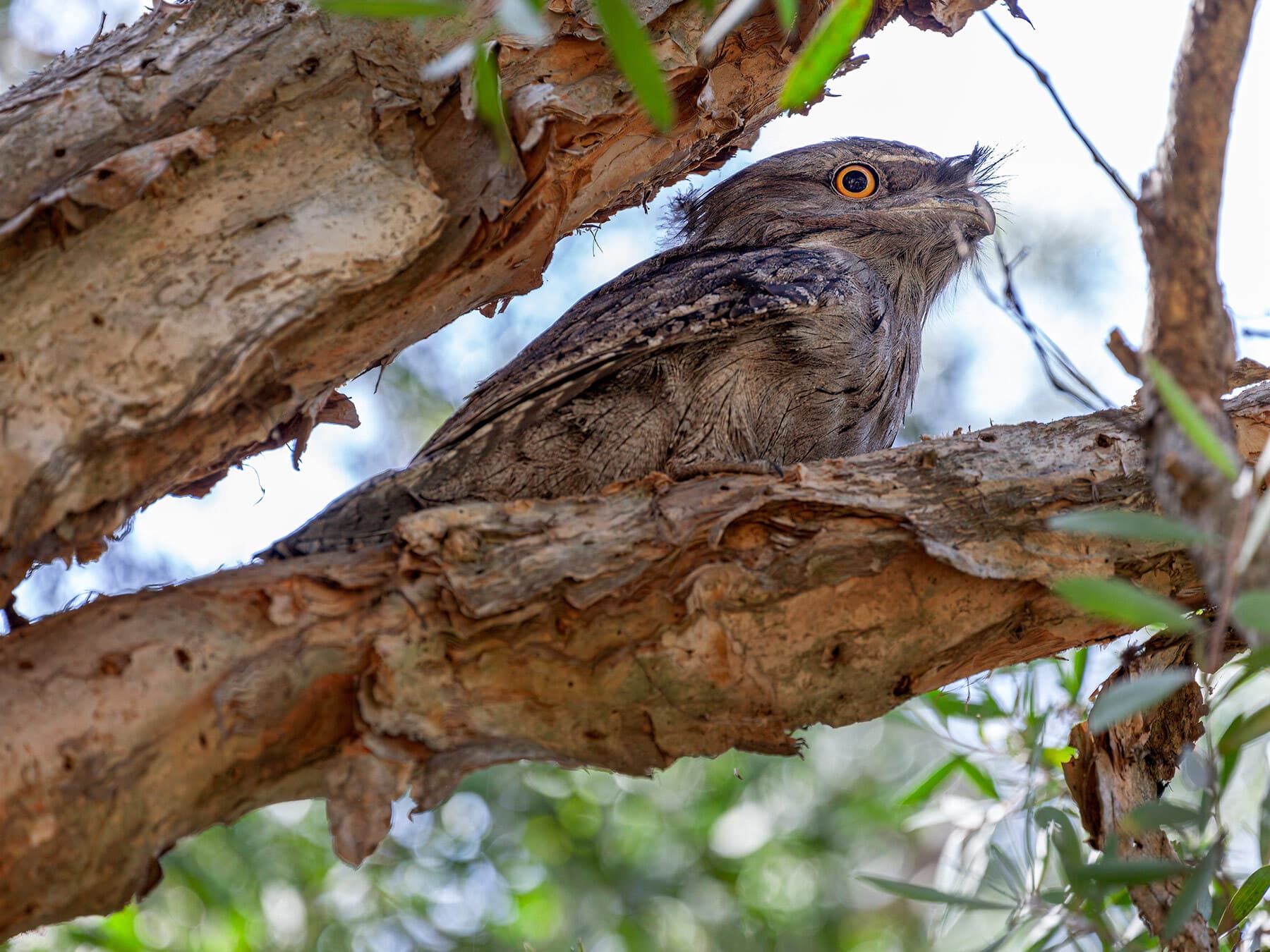
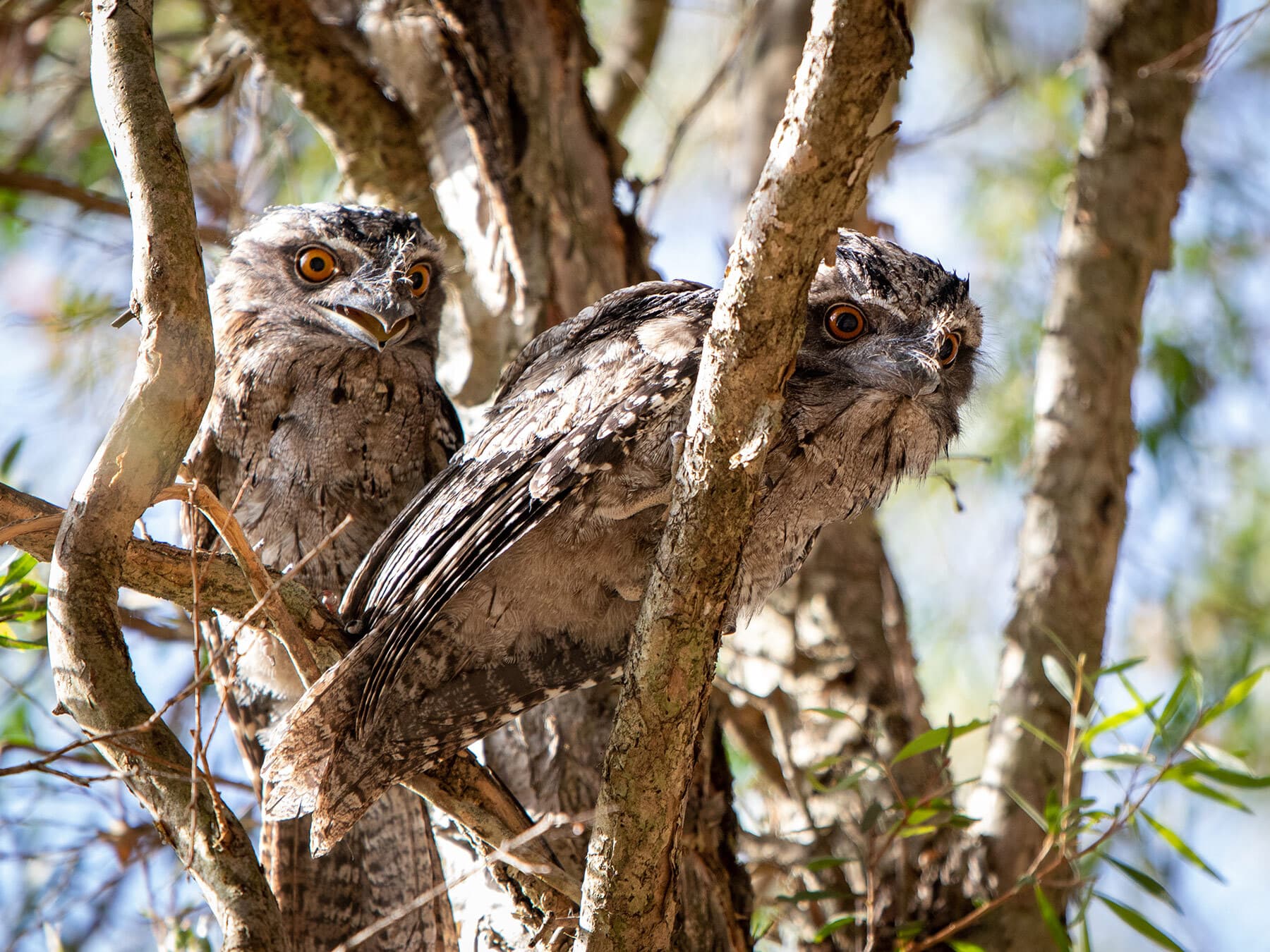
Most Tawny Frogmouths are silver-grey, a shade paler below, with bold black streaks and fine barring and mottling, often washed with brown or rufous. The bill is wide and heavy, olive-grey to blackish, with a tuft of bristles at its base, and the eye is usually yellow. A rarer rufous or chestnut form also occurs.
Eye colour varies: some birds have light orange eyes.1
The bristles are thick-based and branched. In one anatomy study, the Tawny Frogmouth specimens averaged about 21 bristles on one side of the face, with touch receptors around their bases.2
Identification: is it an owl?
It is not an owl, though it is often taken for one because it is active at night and looks owl-like. It is more closely related to the nightjars, and its feet lack the curved talons of owls.
Frogmouths make up their own family, Podargidae, which the AviList checklist places in an order of its own, Podargiformes.3 The family has three living genera: Batrachostomus in Asia, Podargus in Australia and New Guinea, and Rigidipenna in the Solomon Islands. A study of their mitochondrial genomes suggests the three split between about 30 and 40 million years ago.4
Size and weight
A Tawny Frogmouth is 34–53 cm long, and birds in the south-east are larger than those in the north.
The Australian Bird Study Association's Bird in the Hand guide, compiled from the national handbook, gives adult weights of 123–555 g across the subspecies and sexes. Eastern males weigh 178–520 g and eastern females 157–555 g. Western birds weigh 205–416 g (males) and 185–327 g (females), and the small northern birds 123–283 g.5 The guide gives no sample sizes, and we found no wingspan in the sources we read.
Male, female and young
Males and females differ, sometimes clearly and sometimes only slightly. Males are always grey. Females are browner, even grey ones, with a chestnut-brown, usually broken stripe running down the side of the neck and round a plainer throat. They also have chestnut shoulder patches that contrast with the scapulars beside them.
Every rufous or chestnut bird is a female. Males may be slightly larger and bigger-billed, but measurements overlap a great deal, and the plumage clues are known to hold at least in eastern birds.
By day, the bird on the nest is the male. A 2003 note on sexing called it a common misconception that this larger, greyer bird is the female: every day-sitter sexed by dissection, or caught and radio-tracked, had been a male.6
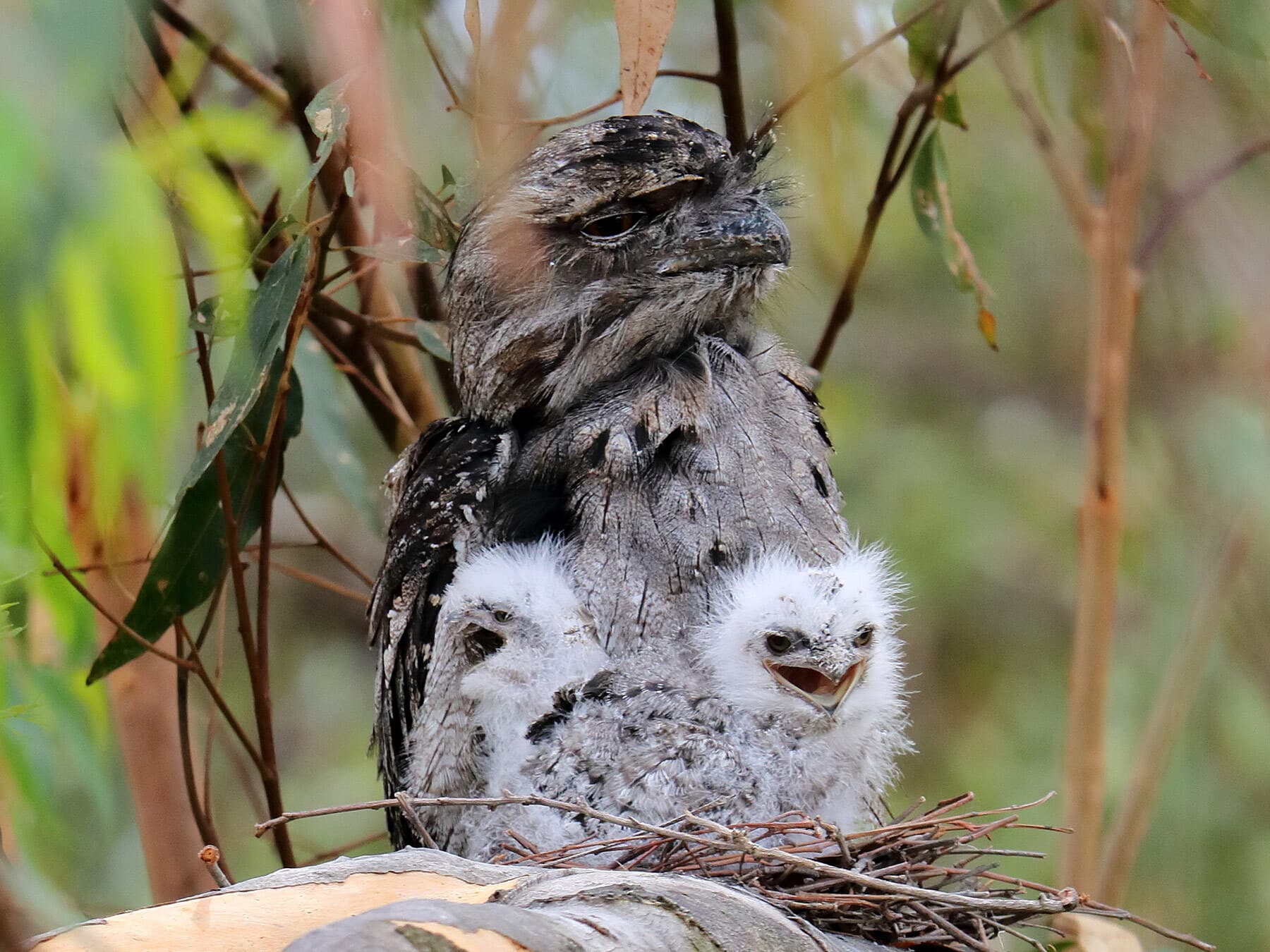
Juveniles have fluffy body feathers and softer, fainter markings than adults, and start moulting towards adult-like plumage almost as soon as they leave the nest. Chicks hatch in white down, and their second down is grey, flecked and barred with white and paler below. In the hand, immatures still carry tufts of down on the tips of the tail feathers until their first full moult, at about a year old.5
Identifying it from its Australian relatives
Two other frogmouths of the same genus occur in Australia. The Papuan Frogmouth is larger, 45–60 cm, with a long tail. Its eye is often red, which marks it out, but it can also be orange, yellow or brown. In Australia it lives only in north-east Queensland, from Cape York south to the Paluma Range. A Tawny Frogmouth's eye is usually yellow, sometimes light orange.
The Marbled Frogmouth is best told by its longer, graduated tail and its different calls. In Australia it is confined to rainforest, in the far north of Queensland and along the border between Queensland and New South Wales. Its throat and upper breast are unstreaked, where a Tawny Frogmouth's are streaked, and a Tawny Frogmouth's tail is short and square-ended.
Eye colour, size and habitat do not separate the two. On the New South Wales north coast, Tawny Frogmouths can have orange-yellow or light orange eyes and be quite small, and they are common in rainforest there. In 1980–81, two of five chestnut or brown Tawny Frogmouths recorded there were first taken for Marbled Frogmouths.1
Not sure it’s a Tawny Frogmouth? Check your photo: Birdfact names the bird and shows the look-alike side by side.
Its size
Adults- Length
- 34–53 cm
- Weight
- 123–555 g
Its song and calls
- Repeated low 'oom' (heard, not seen)0:00 / 0:09
Recorded in Brisbane, Australia · July 2025
- Long run of low 'oom' notes (heard, not seen)0:00 / 0:28
Recorded in Lal Lal, Australia · January 2024
Heard one and not sure? Let the bird song identifier listen.
When and where to see it
Tawny Frogmouths live throughout Australia, including Tasmania, all year round. They need trees or scrub to roost and nest in, with open ground nearby to hunt over.
That takes in eucalypt forest and woodland, mulga and mallee, trees along creeks and rivers, coastal scrub and heath, roadside trees in farmland, and city parks, street trees and large gardens. They avoid treeless desert and usually keep out of the heart of rainforest, though they use road edges in rainforest country.
They have done well in farmland and in many towns, where they are often seen in parks, gardens and street trees. By day, look for a grey shape on a branch, often not far off the ground.
Range, movements and subspecies
Adults appear to stay on their territories all year. Seasonal movements have been suggested but are unconfirmed and seem unlikely, and how far young birds disperse is not known. Outside Australia there is a single unconfirmed sight record, from near Morehead in southern New Guinea.7
There are three subspecies. The small phalaenoides lives across northern Australia, and brachypterus from Western Australia south of the Great Sandy Desert east to the Channel Country of western Queensland and the Murray mallee of north-western Victoria. The nominate strigoides lives in the east and south-east, from north of Cooktown to south-eastern South Australia, Victoria and Tasmania. The Atlas of Living Australia calls them the Northern, Western and Eastern Tawny Frogmouth.9
Northern birds are smaller, paler and more finely marked, and rufous females are commoner among them. Western birds tend to look plainer and perhaps greyer, and no rufous female is known from that subspecies. Because the variation is largely gradual, authors have recognised anything from five subspecies to none.7
Tips for seeing it
What it eats
Tawny Frogmouths eat mostly large insects and other invertebrates taken on the ground, such as spiders, centipedes and scorpions, and they also take frogs. Lizards, crustaceans, millipedes, small birds and small mammals are eaten now and then.
Sources differ on worms, slugs and snails. Birds of the World counts them as occasional prey, while BirdLife Australia puts them, with insects active at night, in the bulk of the diet.7, 10
We found no source that names possums, mice or rats in its diet: the references we read mention only small mammals.
Feeding methods
It usually hunts from a perch with a view of open ground, such as a branch or a fence post. When it spots moving prey it glides down and takes it from the ground, or less often from a branch. It bashes large or tough prey against the perch, then swallows it.
It also catches some prey, moths for instance, in the air. It often hunts along roadsides at night.
Nesting and breeding
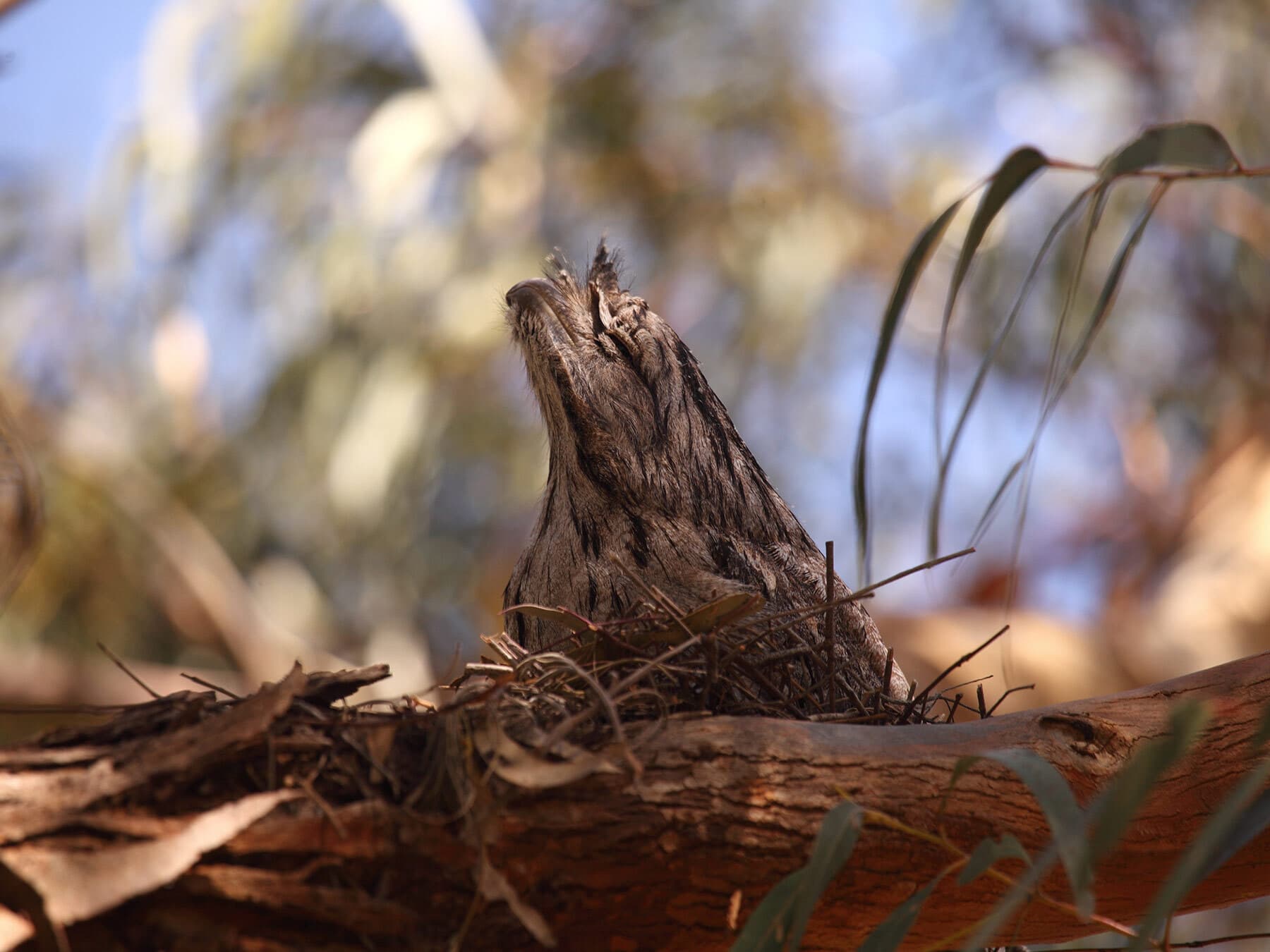
The nest is a loose, flimsy and almost flat platform of thin sticks and twigs, usually laid across a horizontal fork in a tree. It is generally 3–10 m up, though nests have been found from 2 m to more than 20 m up. Less often it sits on another bird's old nest or on an epiphyte.
The two main references differ on a few details. Birds of the World gives the season as mostly August to December, with laying peaking in September and October. It says the female is thought to incubate at night, and calls reports of a second brood unconfirmed.7 BirdLife Australia gives August to January in temperate southern Australia, and says birds in arid areas may breed after heavy rain. It also says both parents share the night shift, and that southern birds may raise two broods.10
In the Australian Capital Territory, a survey of 253 nests found them 9.2 m up on average. Most were on forks of the lowest branches of trees with rough or flaky bark, and faced north-east, towards the morning sun. The authors say such sites likely help the birds keep warm, stay hidden and watch for predators.11
We found no source saying that pairs reuse their own nest. One pair studied near Rockhampton, Queensland, nested in a different tree each year.12 There is more in Tawny Frogmouth nesting.
Eggs and young
A clutch is usually 2 eggs, sometimes 1 or 3 and rarely as many as 5; Australian guides give 2–3. We found no description of the eggs in the sources we read.
Incubation takes 28–32 days. Both parents sit, the male by day, and the pair feed each other at the nest at night. The young leave the nest at 25–35 days old. Both parents brood and feed them, and after they fledge they are fed for another 1–2 weeks and may stay with their parents for several months.
The Rockhampton pair, followed from 2018 to 2021, raised 8 of its 10 nestlings. Its eggs hatched after 28–30 days and the young fledged at 27–31 days. The parents fed the nestlings more often as they grew, especially early in the night, and looked after the fledglings for 1–3 months.12
In nine zoo-reared chicks in Seattle (2017–2019), the eyes opened at about 6–7 days, grey and brown feathers had replaced the white down by about day 15, and the bill bristles grew from about day 23 to day 35.13 There is more on chicks in Tawny Frogmouth chicks.
Behaviour
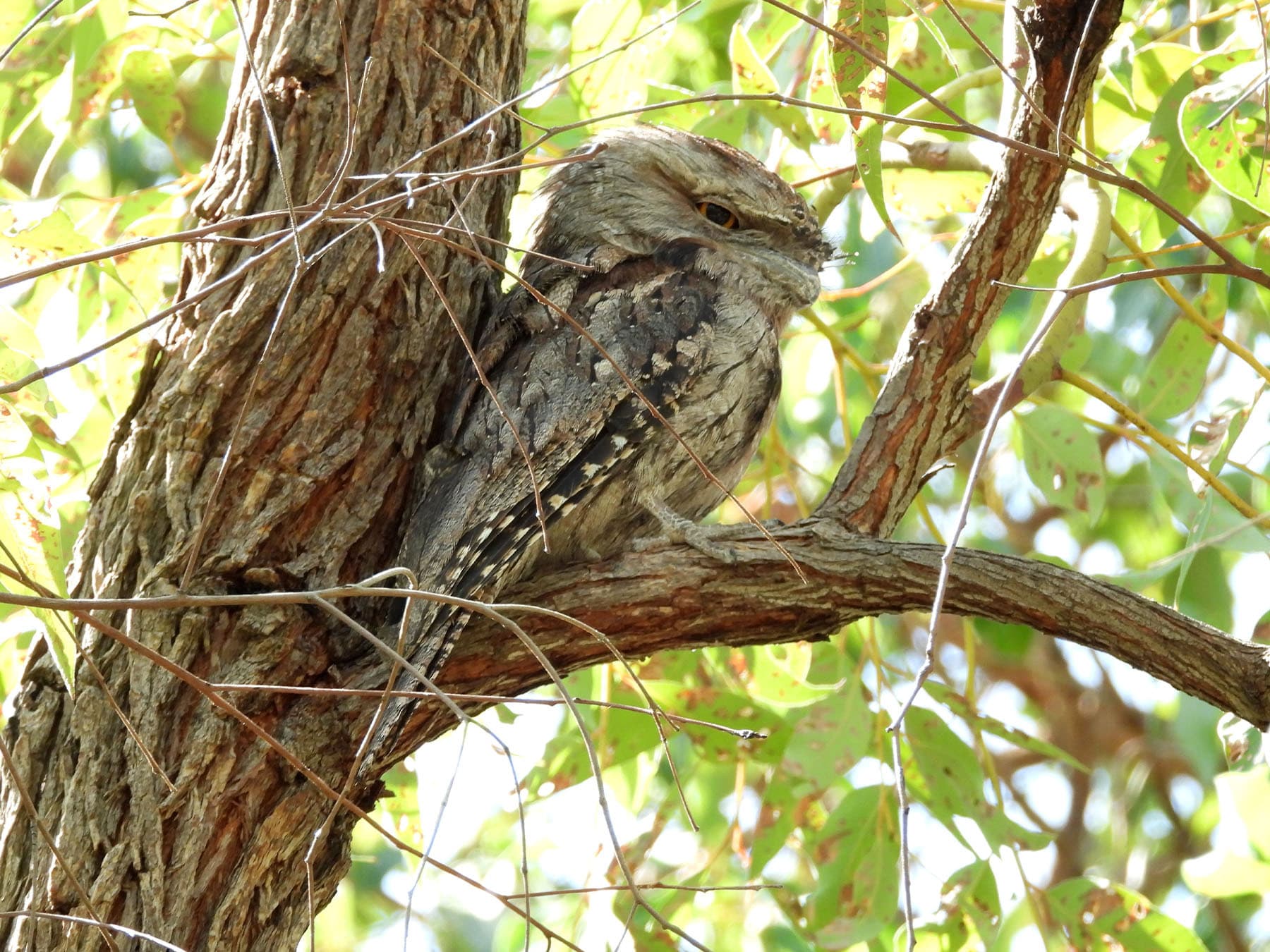
Tawny Frogmouths are active at night. By day they perch on a branch, often low down, where their streaked grey plumage makes them look like part of the tree.
In a radio-tracking study in south-eastern Australia, roosting birds chose mature trees with coarse, dark bark, or dead branches on smooth-barked gums, presumably because these looked rougher and hid them better.14
Roosting behaviour
How faithful birds are to a roost differs between studies. In the south-eastern study, birds sat on the northern side of the tree in winter, presumably for the sun, and pairs used up to 71 day roosts, most of them for less than three days.
The Rockhampton pair put 90% of its roosts in four trees within a home range of 1.6 ha, mostly inside the leafy canopy about 9 m up and out of the daytime heat; it used low, sunny perches only on very cool winter mornings.12
Behaviour in winter: torpor
On cold nights it can save energy by letting its body temperature fall into shallow torpor, a resting state with a lowered metabolism. In a study of eight radio-tagged wild birds in open woodland at about 1,000 m, torpor was frequent in June–August. In the three fitted with core-temperature transmitters, body temperature fell as low as 29.1 °C.15
Night-time bouts lasted about 7 hours and always ended before sunrise, and that study recorded no torpor in spring or summer. A 2020 review notes rare torpor in autumn and spring, and calls the Tawny Frogmouth the largest bird known to use torpor.16
Its everyday energy use is low too. In a laboratory study, its resting metabolic rate was only 61% of that expected for a non-passerine (a bird outside the perching-bird order) of its size, and its breathing rate about half.17
Lifespan and predators
We found no typical lifespan and no longevity record for the Tawny Frogmouth in the sources we read.
Predators, roads and poisons
Introduced cats and foxes take Tawny Frogmouths, and many are killed on roads, some while chasing insects lit up by headlights. Birds of the World's account, whose text dates from 2013, judged it evidently able to withstand considerable losses on the roads and to cats and foxes. Other human-related harms on record include pesticide poisoning, disturbance at nests and birds flying into wire fences.7
In one observation in the Colo Wilderness, New South Wales, in November 1978, a Lace Monitor swallowed two half-grown chicks from a nest 20–25 m up a eucalypt.18
Frogmouths do not mainly eat rodents, yet in a study of dead nocturnal birds, 68% of the Tawny Frogmouths analysed had liver levels of second-generation rat poisons high enough that the authors say toxic or lethal effects could potentially have occurred.19
Of 100 Sydney Tawny Frogmouths brought in with disease of the nervous system between 1998 and 2010, rat lungworm infection was judged responsible in 80, with cases peaking in late summer and autumn.20 At Byron Bay Wildlife Hospital, New South Wales, it was the second most often admitted bird from April 2021 to December 2022, at 7.9% of 1,580 birds.21
Conservation
The Tawny Frogmouth is rated Least Concern on the IUCN Red List.22 We found no population count or survey trend for it.
Birds of the World's 2013 account says it was then common over much of Australia but had declined in some areas, such as the southern Mount Lofty Ranges, south-eastern South Australia and the Western Australian Wheatbelt.
It says wholesale tree clearing for farming harms it, though partly clearing dense forest may help it. It also notes that the number killed on roads in northern Sydney had dropped notably since the early 1970s, which it says possibly reflects a fall in numbers there.7
Tawny Frogmouth guides
2 guidesQuick facts
- Length
- 34–53 cm
- Weight
- 123–555 g
- Family
- Frogmouths
- Order
- Podargiformes
- Migration
- Resident
- Global status (IUCN)
- Least Concern
- Population trend
- No survey trend found. Birds of the World's 2013 text says it was then common over much of Australia, with declines in some areas, such as the southern Mount Lofty Ranges, south-eastern South Australia and the Western Australian Wheatbelt.
- Scientific name
- Podargus strigoides
Questions
2What is its scientific name?
Podargus strigoides. Latham described it in 1801 as Caprimulgus strigoides, from 'New Holland', later taken to mean Sydney.
Does it have Aboriginal names?
Yes. The Atlas of Living Australia lists several traditional names for it, among them Kombaarny, a Noongar name.9
Sources
27- 1Milledge, D. and Clancy, G. (1982). Chestnut and brown phases of the Tawny Frogmouth on the north coast of New South Wales. Corella 6(2): 40-42. Accessed 20 November 2026. Source (opens in a new tab)
- 2Delaunay, M. G. et al. (2020). Anatomy of avian rictal bristles in Caprimulgiformes reveals reduced tactile function in open-habitat, partially diurnal foraging species. Journal of Anatomy 237(2). doi:10.1111/joa.13188 (opens in a new tab)
- 3AviList Core Team (2026). AviList: The Global Avian Checklist, v2025b. AviList. doi:10.2173/avilist.v2025b (opens in a new tab)
- 4Oliver, P. M. et al. (2020). Oligocene divergence of frogmouth birds (Podargidae) across Wallace's Line. Biology Letters 16(5): 20200040. doi:10.1098/rsbl.2020.0040 (opens in a new tab)
- 5Hardy, J. W. (compiler) and Australian Bird Study Association (2020). Bird in the Hand, 2nd edition: Tawny Frogmouth (species no. 313), revised June 2020. Australian Bird Study Association. Accessed 20 November 2026. Source (opens in a new tab)
- 6Debus, S. J. S. (2003). Sexing of Tawny Frogmouths: a comment on Smith (2002). Corella 27(4): 120. Accessed 20 November 2026. Source (opens in a new tab)
- 7Holyoak, D. T. (2020). Tawny Frogmouth (Podargus strigoides), version 1.0. Birds of the World (J. del Hoyo, A. Elliott, J. Sargatal, D. A. Christie and E. de Juana, editors). Cornell Lab of Ornithology. doi:10.2173/bow.tawfro1.01 (opens in a new tab)
- 8Australian Museum (2025). Tawny Frogmouth (animal factsheet), updated 10/12/25. Australian Museum. Accessed 20 November 2026. Source (opens in a new tab)
- 9Atlas of Living Australia (2026). Podargus strigoides species record, name search and occurrence count. Atlas of Living Australia. Accessed 20 November 2026. Source (opens in a new tab)
- 10BirdLife Australia. Tawny Frogmouth (bird profile). BirdLife Australia. Accessed 20 November 2026. Source (opens in a new tab)
- 11Rae, S. and Rae, D. (2014). Orientation of tawny frogmouth (Podargus strigoides) nests and their position on branches optimises thermoregulation and cryptic concealment. Australian Journal of Zoology 61(6): 469-474. doi:10.1071/zo13090 (opens in a new tab)
- 12Briggs, A. (2023). Roosting and breeding behaviour of Tawny Frogmouths Podargus strigoides in central-coastal Queensland. Australian Field Ornithology 40: 70-76. doi:10.20938/afo40070076 (opens in a new tab)
- 13Delaunay, M. G., Myers, M., Larsen, C. and Grant, R. A. (2025). The Development of Facial Bristles in Tawny Frogmouths (Podargus strigoides). Developmental Psychobiology 67(4): e70063. doi:10.1002/dev.70063 (opens in a new tab)
- 14Körtner, G. and Geiser, F. (1999). Roosting behaviour of the tawny frogmouth (Podargus strigoides). Journal of Zoology 248(4): 501-507. doi:10.1111/j.1469-7998.1999.tb01049.x (opens in a new tab)
- 15Körtner, G., Brigham, R. M. and Geiser, F. (2001). Torpor in free-ranging tawny frogmouths (Podargus strigoides). Physiological and Biochemical Zoology 74(6): 789-797. doi:10.1086/324097 (opens in a new tab)
- 16Geiser, F. (2020). Seasonal Expression of Avian and Mammalian Daily Torpor and Hibernation: Not a Simple Summer-Winter Affair. Frontiers in Physiology 11: 436. doi:10.3389/fphys.2020.00436 (opens in a new tab)
- 17Bech, C. and Nicol, S. C. (1999). Thermoregulation and ventilation in the tawny frogmouth, Podargus strigoides: a low-metabolic avian species. Australian Journal of Zoology 47(2): 143-153. doi:10.1071/zo98058 (opens in a new tab)
- 18Kingston, T. J. (1980). Predation by the Lace Monitor on chicks of the Tawny Frogmouth. Corella 4(1): 20. Accessed 20 November 2026. Source (opens in a new tab)
- 19Cooke, R. et al. (2023). Silent killers? The widespread exposure of predatory nocturnal birds to anticoagulant rodenticides. Science of The Total Environment 904: 166293. doi:10.1016/j.scitotenv.2023.166293 (opens in a new tab)
- 20Ma, G. et al. (2013). Tawny frogmouths and brushtail possums as sentinels for Angiostrongylus cantonensis, the rat lungworm. Veterinary Parasitology 192(1-3): 158-165. doi:10.1016/j.vetpar.2012.11.009 (opens in a new tab)
- 21Gårdebäck, A., Joäng, M. and Andersson, M. (2024). Common Causes for Veterinary Visits among Australian Wildlife. Animals 14(18): 2662. doi:10.3390/ani14182662 (opens in a new tab)
- 22IUCN (2026). The IUCN Red List of Threatened Species, as published in GBIF's IUCN checklist (dataset 19491596-35ae-4a91-9a98-85cf505f1bd3). GBIF. Accessed 20 November 2026. Source (opens in a new tab)
- 23Holyoak, D. T. (2020). Papuan Frogmouth (Podargus papuensis), version 1.0. Birds of the World (J. del Hoyo, A. Elliott, J. Sargatal, D. A. Christie and E. de Juana, editors). Cornell Lab of Ornithology. doi:10.2173/bow.papfro1.01 (opens in a new tab)
- 24Holyoak, D. T. and Garcia, E. (2020). Marbled Frogmouth (Podargus ocellatus), version 1.0. Birds of the World (J. del Hoyo, A. Elliott, J. Sargatal, D. A. Christie and E. de Juana, editors). Cornell Lab of Ornithology. doi:10.2173/bow.marfro1.01 (opens in a new tab)
- 25BirdLife Australia (Birds in Backyards). Tawny Frogmouth (species page). Birds in Backyards. Accessed 20 November 2026. Source (opens in a new tab)
- 26Cleere, N. (2005). An example of melanistic plumage in the Tawny Frogmouth Podargus strigoides. Corella 29(1): 22. Accessed 20 November 2026. Source (opens in a new tab)
- 27Stulberg, A., Myers, M. and Brigham, R. M. (2017). Seasonal body mass fluctuations of captive Tawny Frogmouths (Podargus strigoides) are consistent with seasonal heterothermy. Journal of Ornithology 159(1): 303-306. doi:10.1007/s10336-017-1489-9 (opens in a new tab)

Checked by
Nathan Cope, founder and editor
Nathan founded Birdfact and leads its writers and contributors in the UK, the US and Canada. He has watched and studied birds for more than ten years, and checks every article and species guide before it’s published.