


Reed Bunting
Common Reed Bunting · Emberiza schoeniclus
By the Birdfact teamChecked by Nathan Cope
On this page14 sections
How to recognise it
What do Reed Buntings look like?
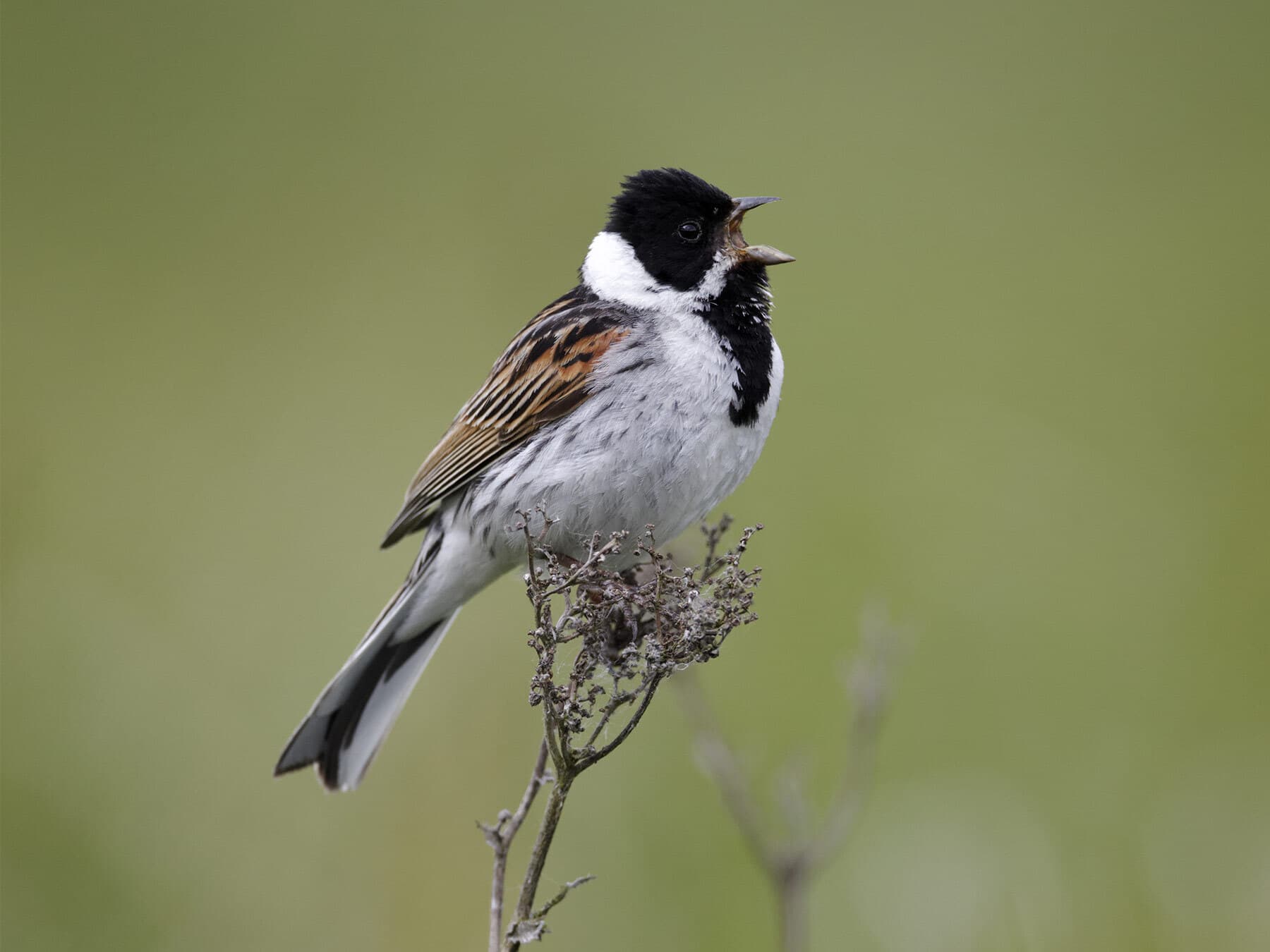
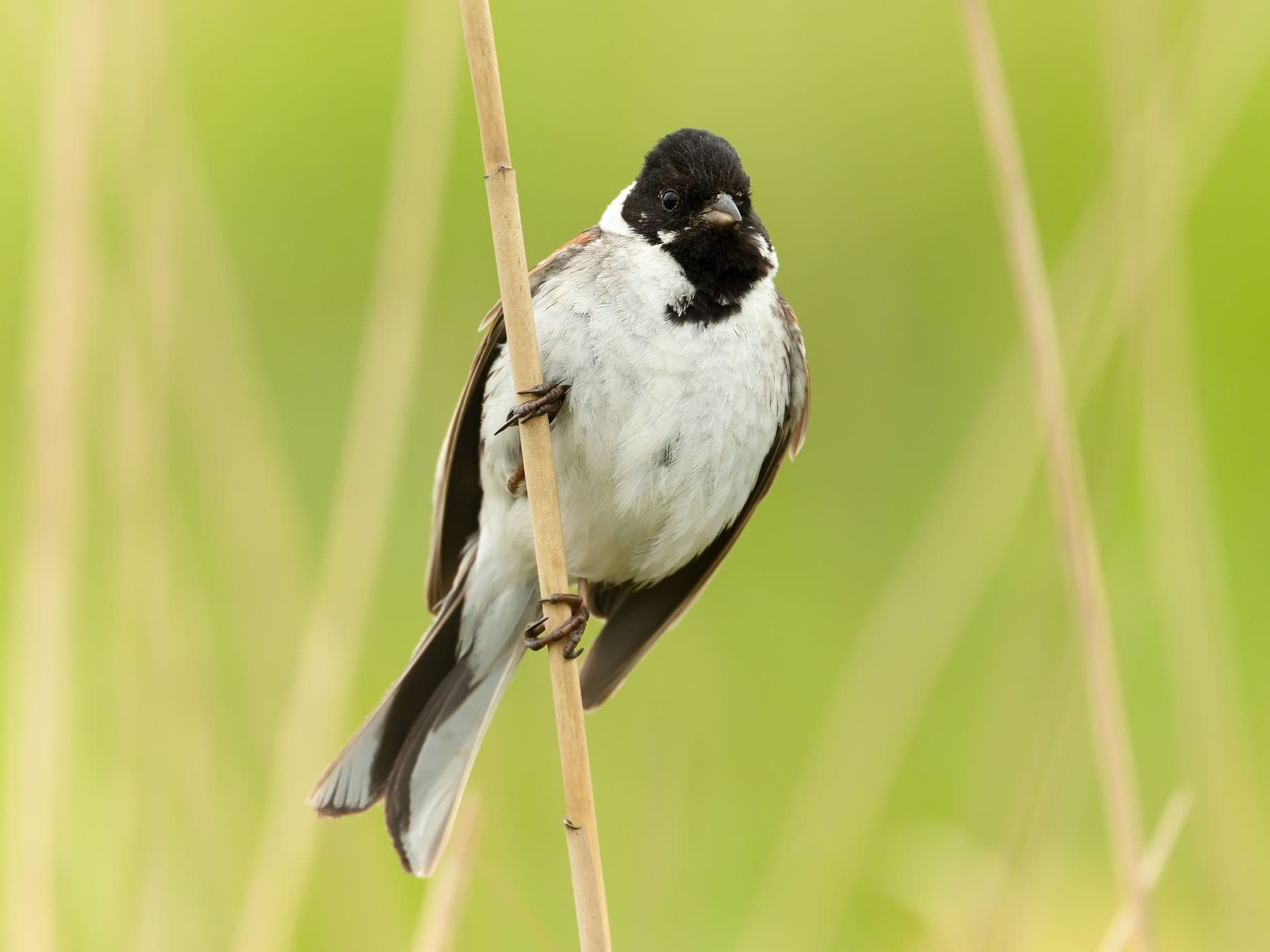
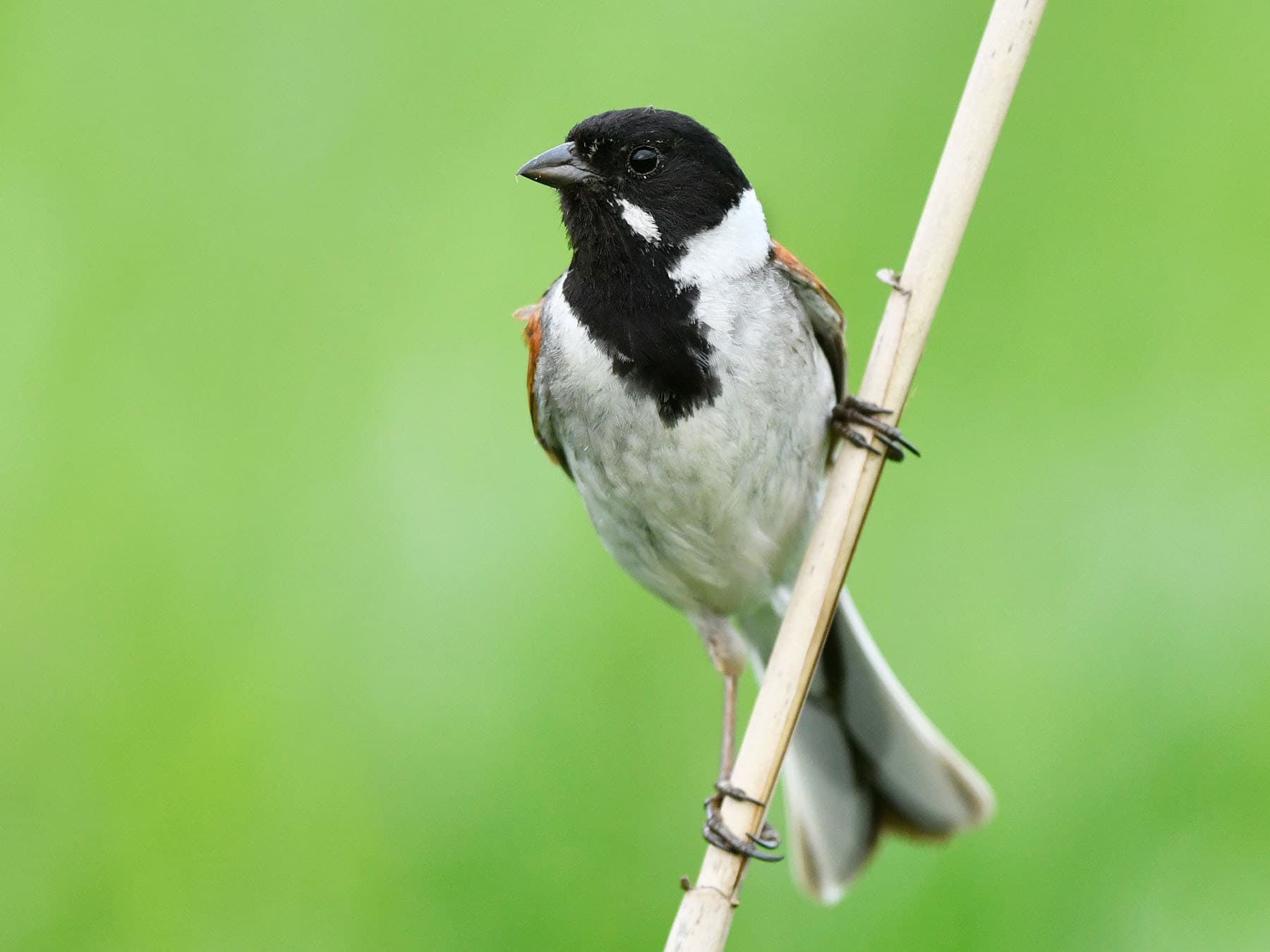
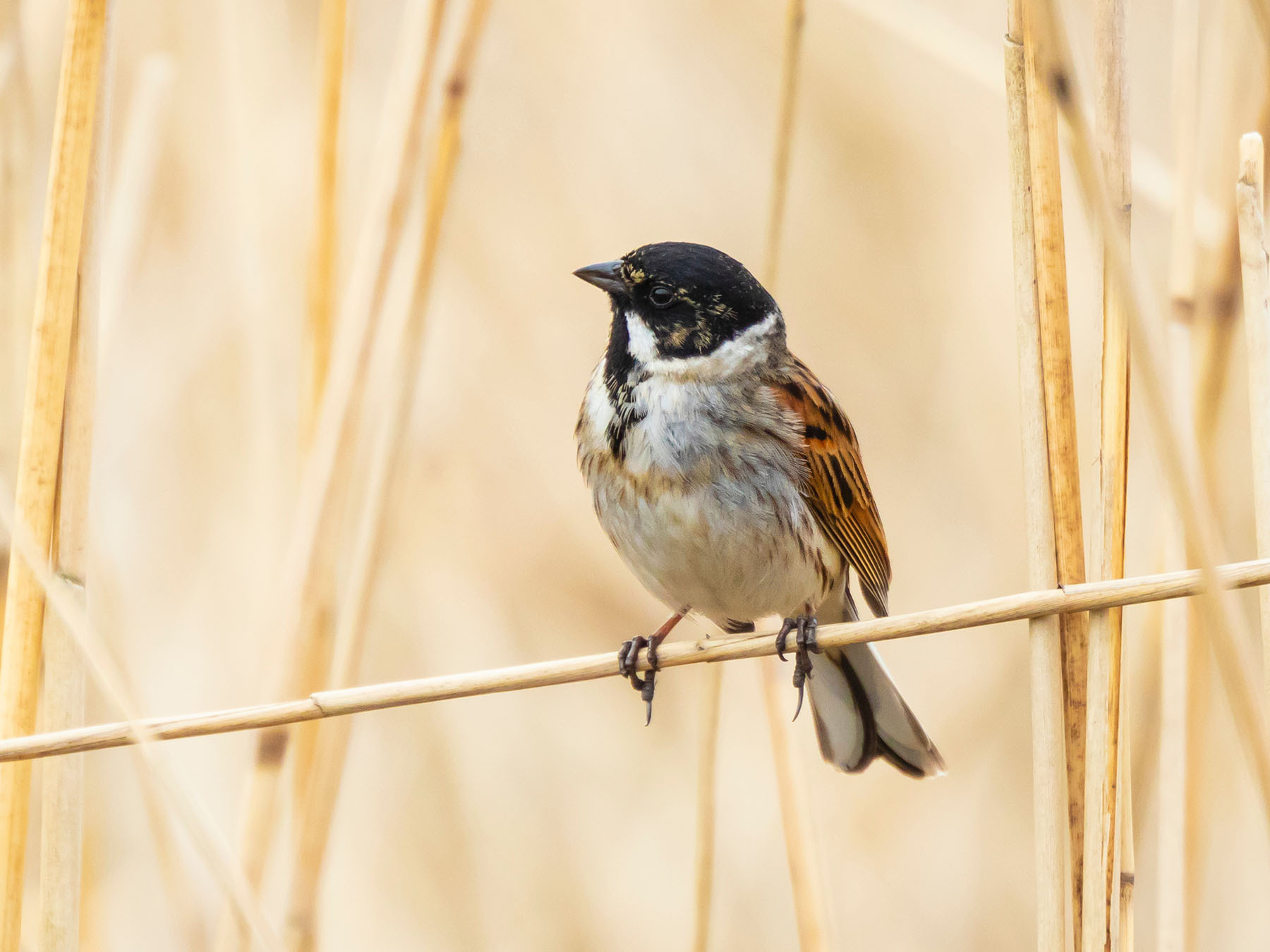
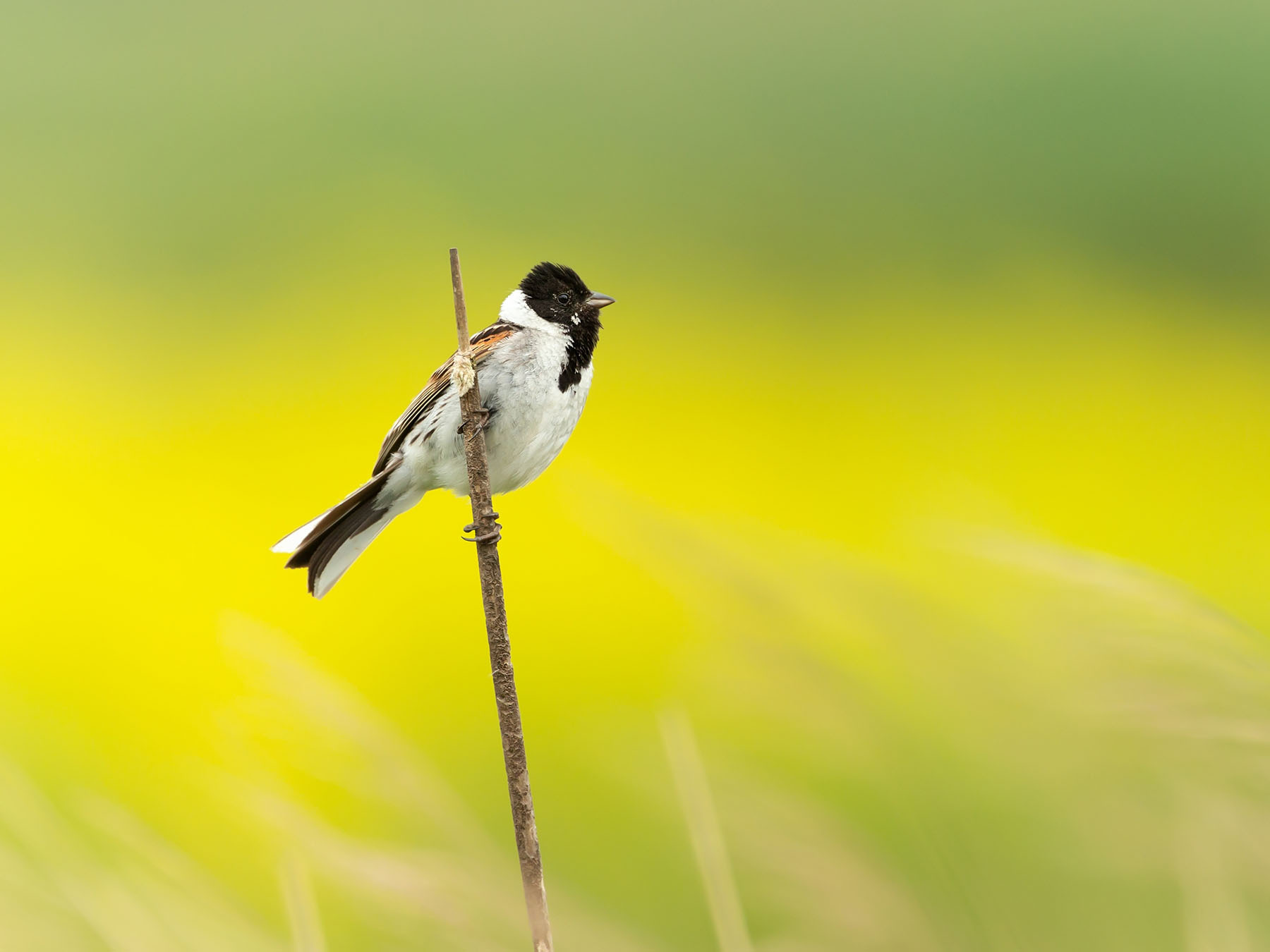
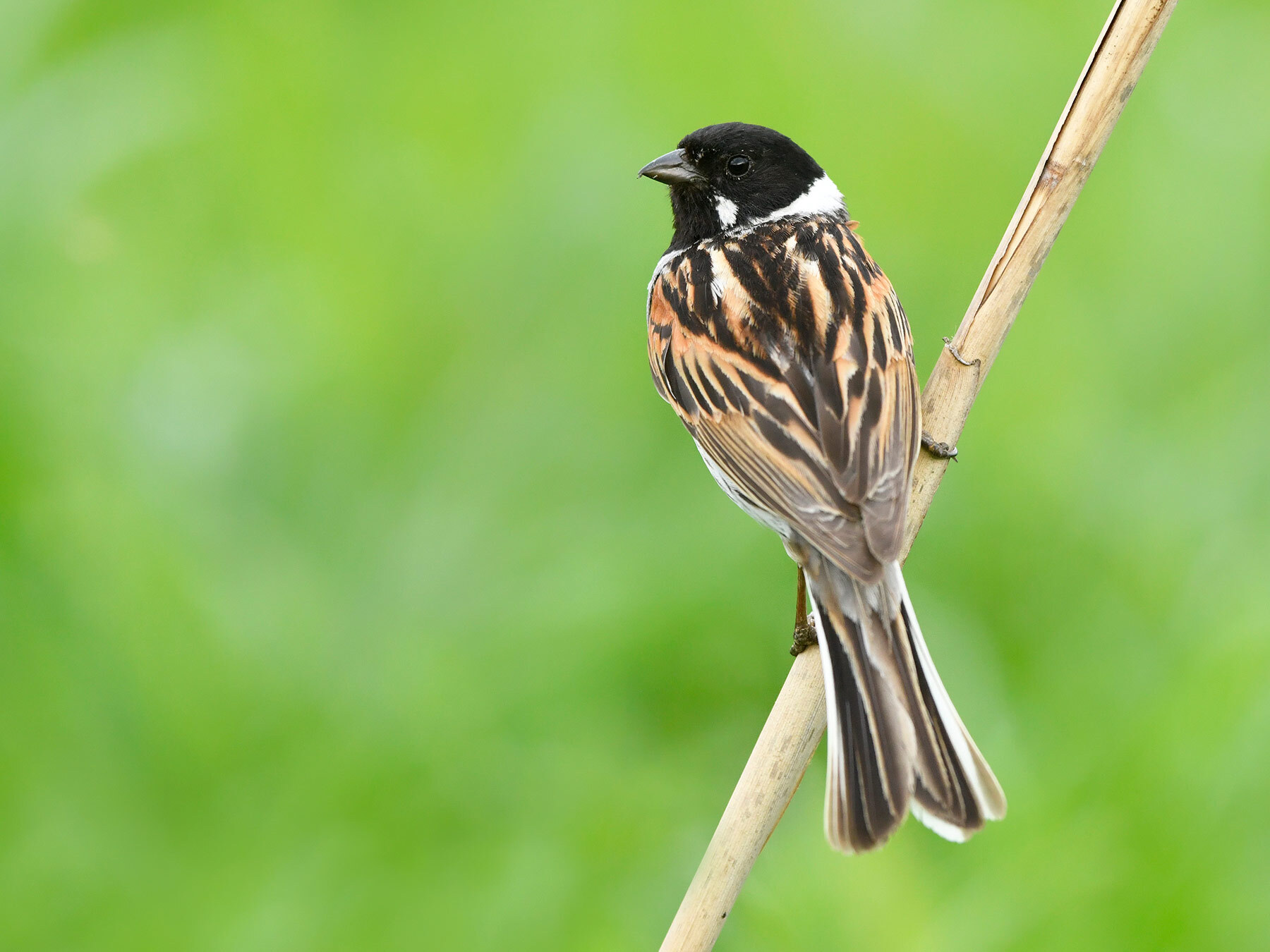
During the breeding season, male reed buntings have a distinctive black head, which makes them fairly easy to give a confident positive identification. They are sparrow-sized birds, and have mid-brown upperparts, and a lighter breast and belly, streaked along the flanks with brown speckles.
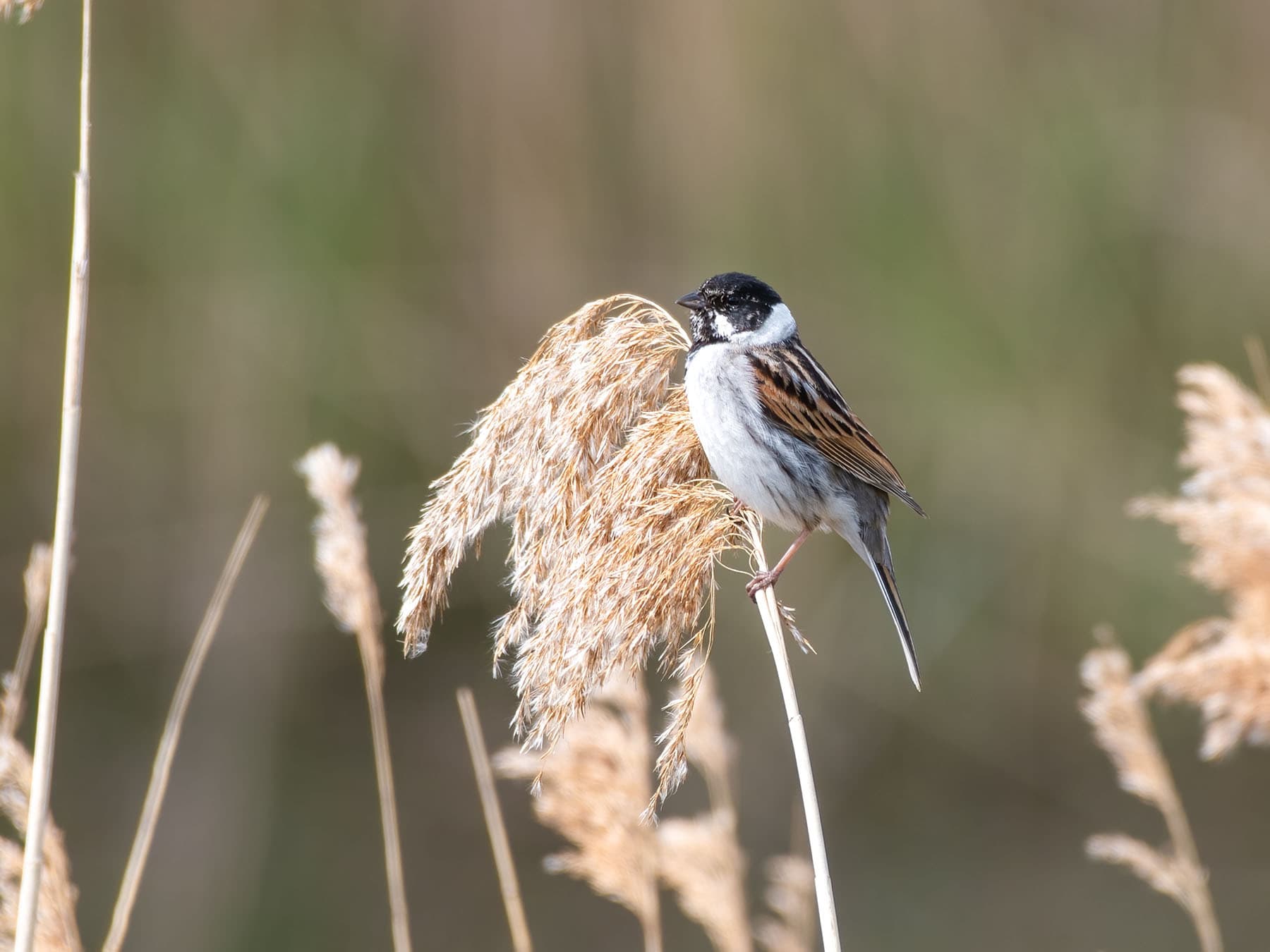
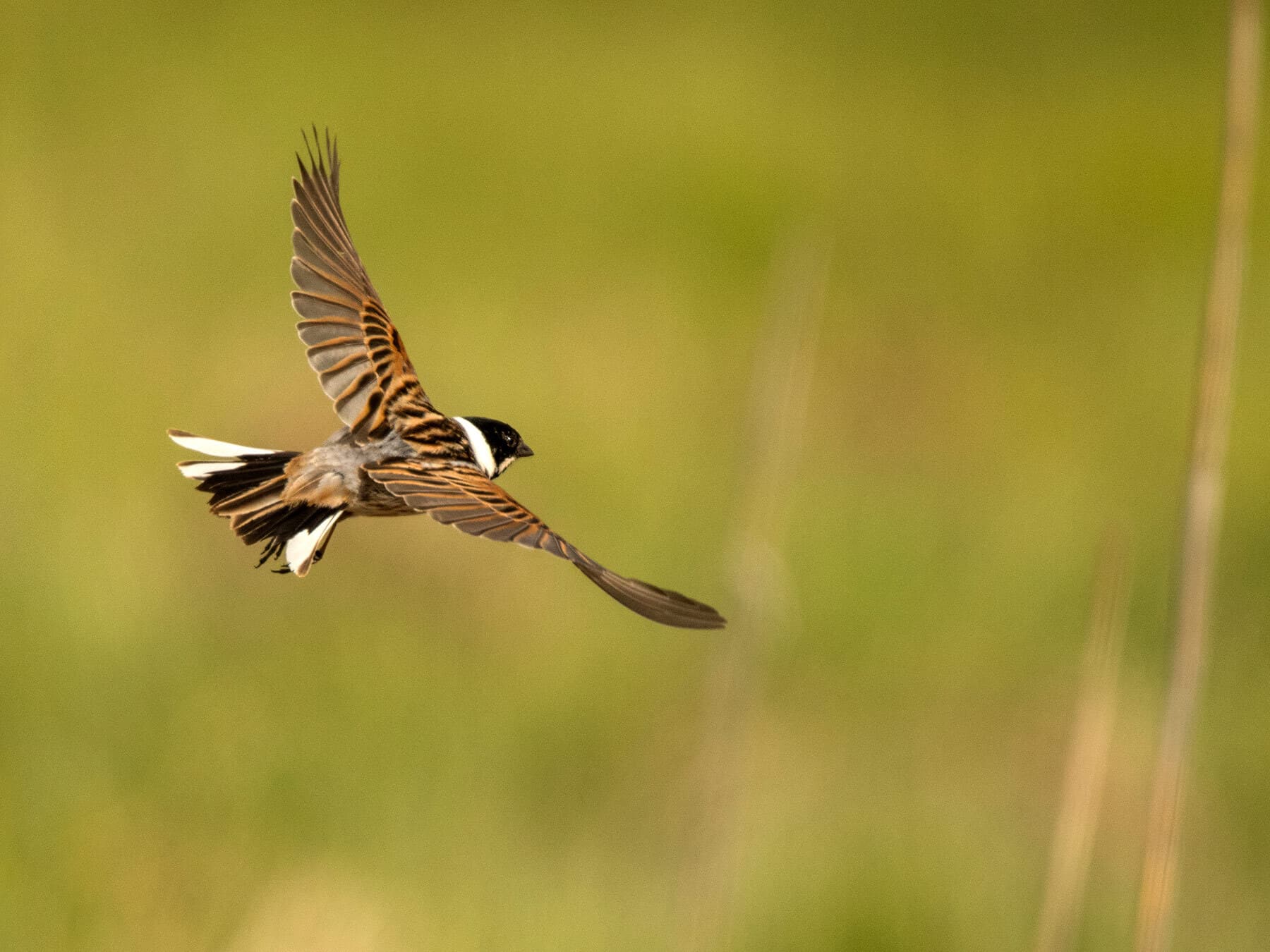
The breeding male reed bunting’s black head is punctuated by a bold, white moustache stripe, and a partial white band is visible between the black head markings and the brown nape and back. A small black bib is present below the black bill. The tail is black with white edges visible in flight.
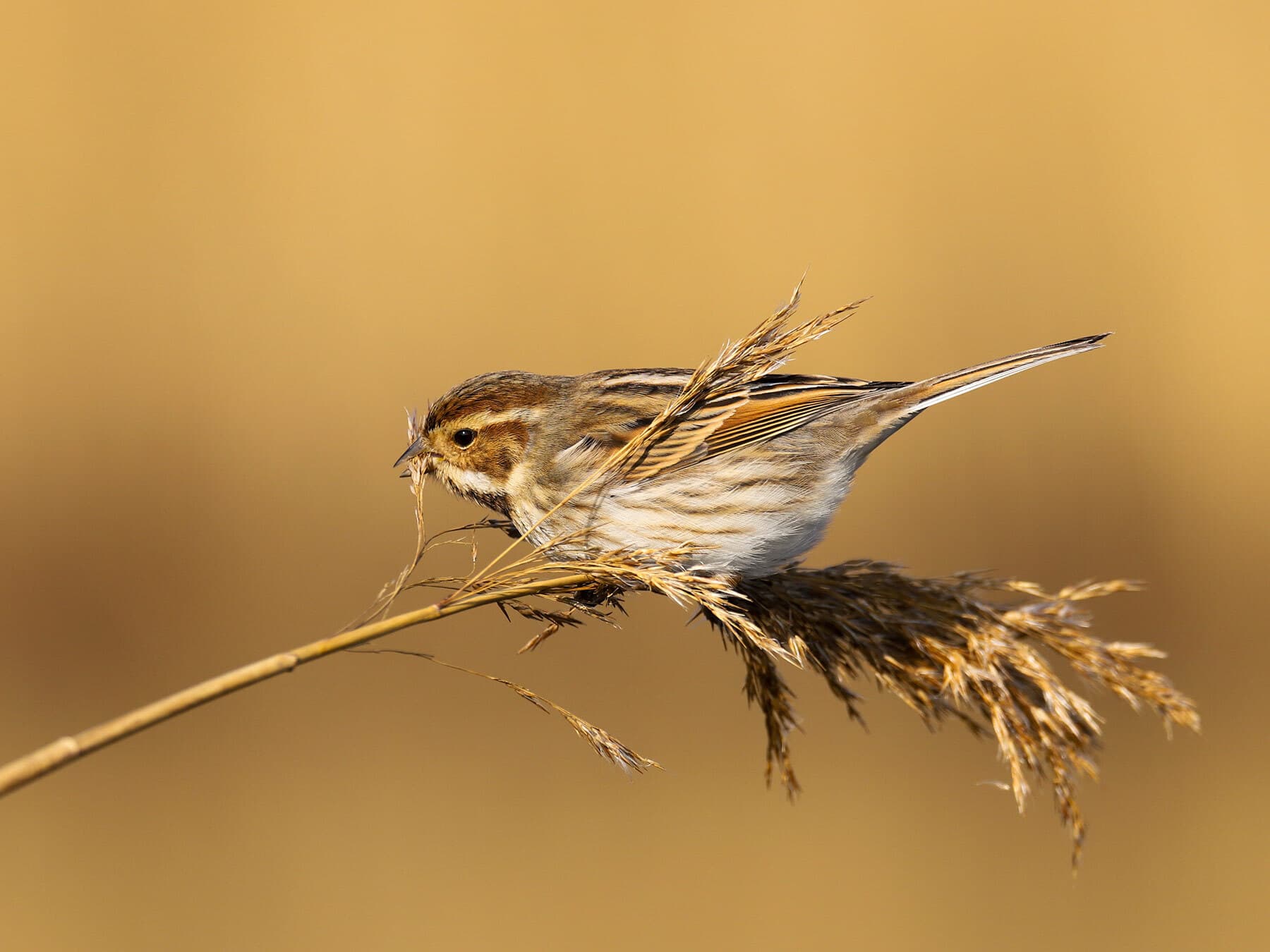
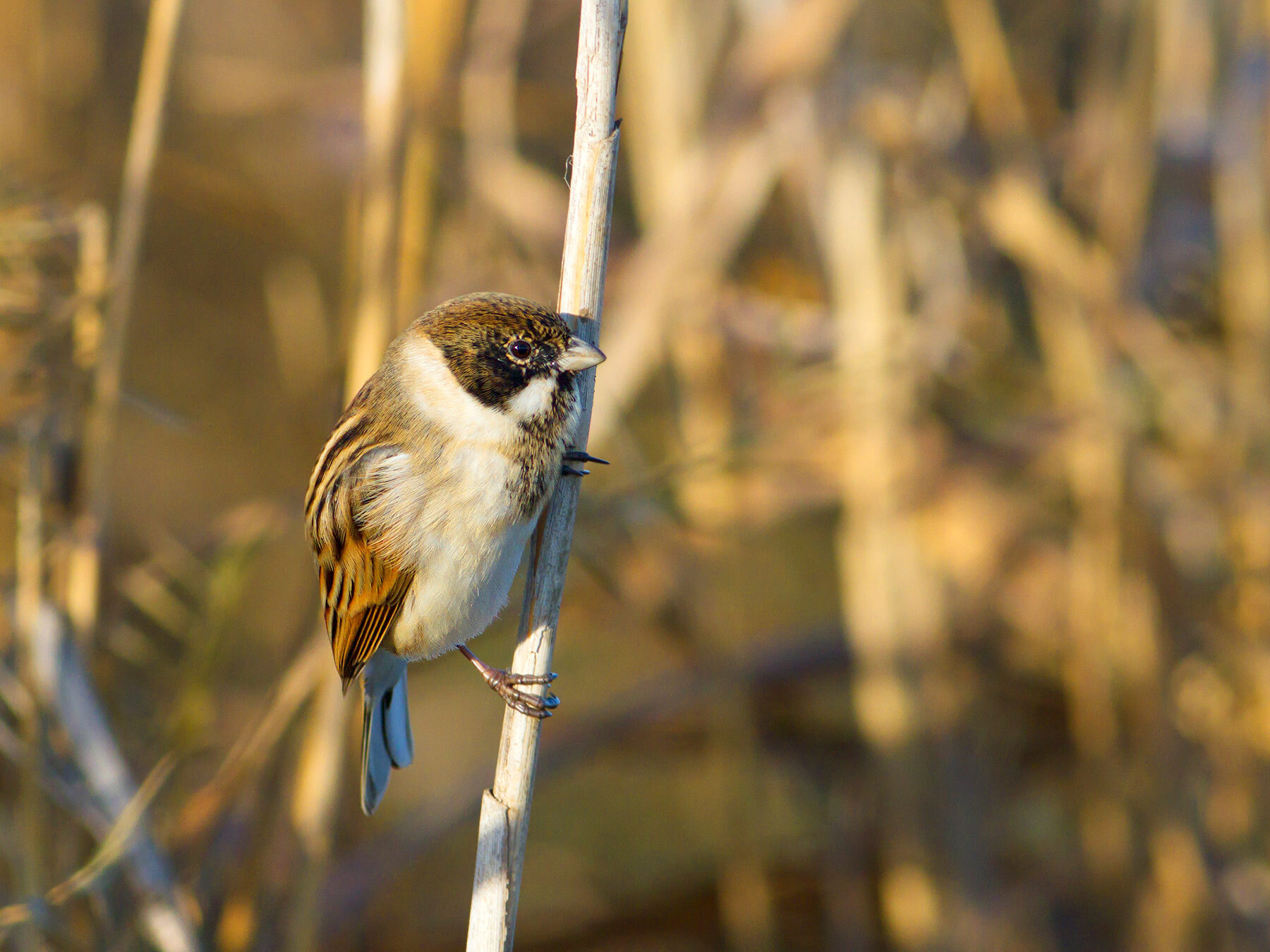
Outside of the breeding season, males become less conspicuous, with their glossy black head feathers replaced with a streaky grey-brown plumage, with some dark facial stripes, a grey-brown nape, and an altogether paler overall appearance.
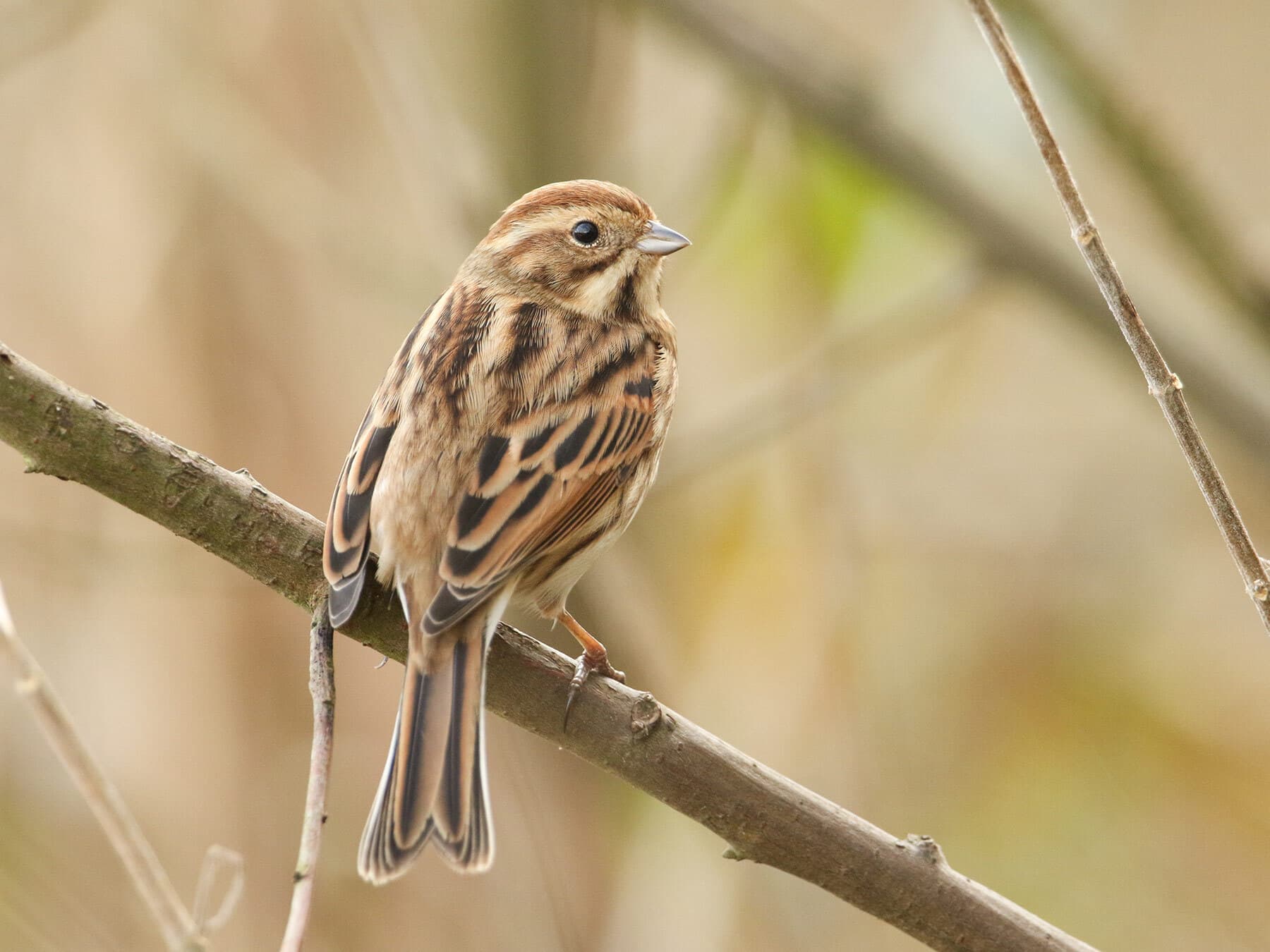
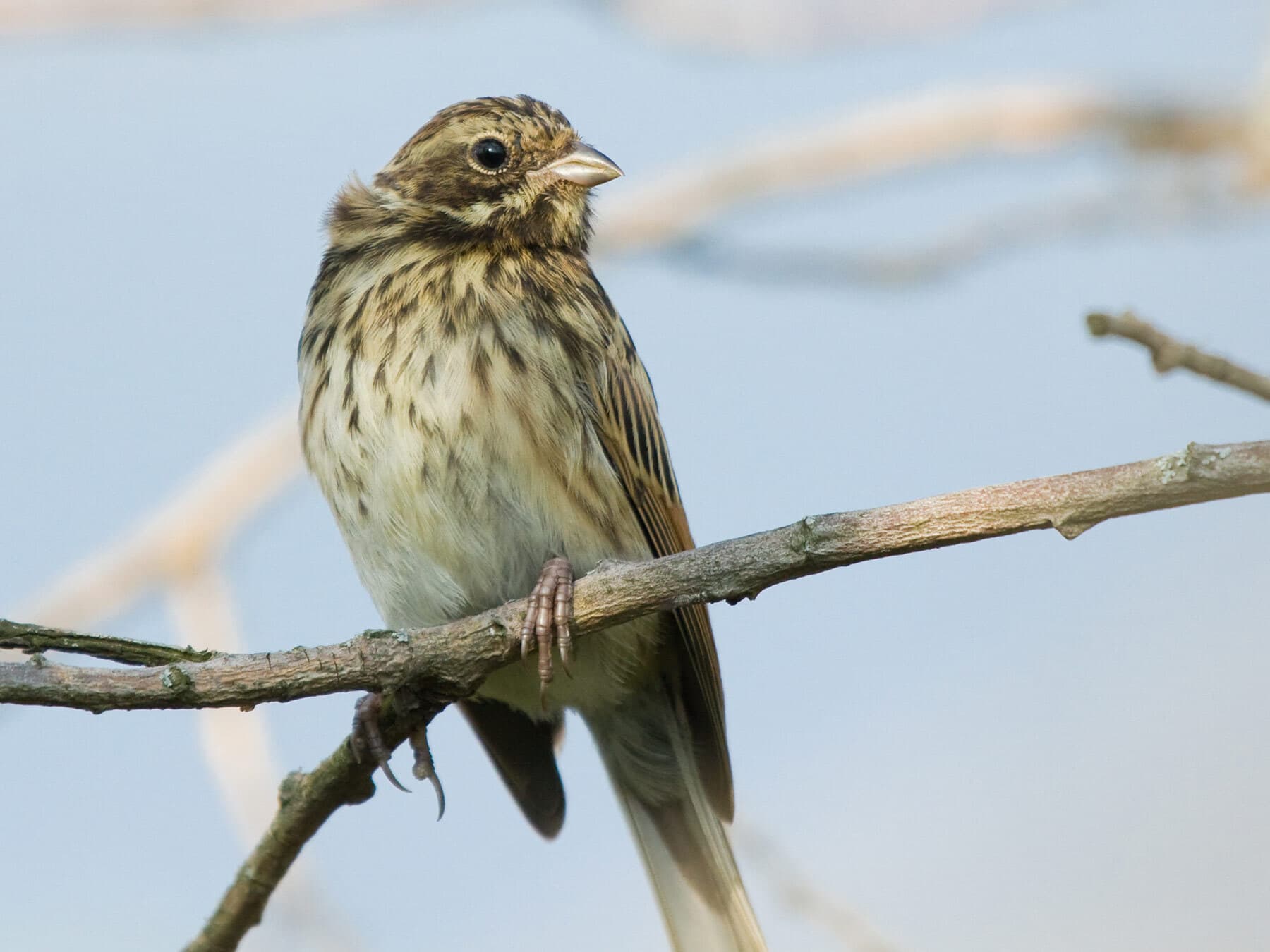
Female Reed Buntings resemble non-breeding males all year round, but have a white-grey nape, a broader, pale eye-stripe and dark cheek stripe, and are more heavily streaked on their breast and belly.
Juvenile reed buntings are similar to adult females, but have a chestnut-brown crown that is marked by wide dark streaking and a dark facial stripe. Their upperparts are mottled shades of yellow and buff, streaked with darker markings. Their breast, belly and flanks are paler, and spotted heavily with dark brown.
How big are Reed Buntings?
Reed buntings are roughly the same size as house sparrows, and there is little or no difference between the average measurement range for males and females for this species.
- Length: 15 cm to 16.5 cm (5.9 in to 6.5 in)
- Wingspan: 21 cm to 28 cm (8.3 in to 11 in)
- Weight: 16 g to 25g (0.6 oz to 0.9 oz)
Its size
Adults- Length
- 13.5–15.5 cm
- Wingspan
- 21–28 cm
- Weight
- 15–23 g
Its song and calls
What sound does a Reed Bunting make?
Male reed buntings can be heard in song, perched at the top of reeds or bushes. Songs consist of a series of repeated simple buzzing notes that sound like “srrit srrit srrit srrururu”.
- Song0:00 / 0:18
Recorded in Volyn Oblast, Ukraine · June 2025
- Call0:00 / 0:12
Recorded in Hauts-de-France, France · September 2025
When and where to see it
OctoberIn season
Most recorded in October
- 1. Offaly2.0%
- 2. Clackmannanshire1.6%
- 3. East Riding of Yorkshire1.4%
- 4. Vale of Glamorgan1.2%
- 5. Lincolnshire1.1%
Each dot is a county, state or province: the bigger and darker, the larger the bird’s share of that place’s bird records that month. Grey dots: no regular records. The ringed point is the centre of the bird’s records this month; the arrow shows how it moved since last month, and the dashed loop its path through the year. “Arrivals” colours places where it becomes regular this month (orange) or is in its last regular month (grey). GBIF eBird Observation Dataset, 2019–2024. Map data: Natural Earth, US Census Bureau; place centres © OpenStreetMap contributors.
In your area
See when the Reed Bunting is recorded in your county, state or province.
How often the Reed Bunting turns up in the UK and Ireland through the year, from birdwatchers' records.
United Kingdom
Resident · all year · most records in June
Ireland
Resident · all year · most records in June
Show as a table
| Month | United Kingdom | Ireland |
|---|---|---|
| January | 0.53% (regular) | 0.38% (regular) |
| February | 0.59% (regular) | 0.30% (regular) |
| March | 0.76% (regular) | 0.40% (regular) |
| April | 0.81% (regular) | 0.62% (regular) |
| May | 0.89% (regular) | 0.68% (regular) |
| June | 0.92% (regular) | 0.71% (regular) |
| July | 0.72% (regular) | 0.49% (regular) |
| August | 0.42% (regular) | 0.24% (regular) |
| September | 0.50% (regular) | 0.32% (regular) |
| October | 0.62% (regular) | 0.42% (regular) |
| November | 0.54% (regular) | 0.38% (regular) |
| December | 0.50% (regular) | 0.33% (regular) |
Recorded regularly in
Worldwide: recorded regularly in 65 countries
Countries where it was recorded in at least 3 of the 6 years 2019–2024. Linked countries have their own bird list.
Europe (43)
- Åland Islands
- Albania
- Austria
- Belarus
- Belgium
- Bosnia & Herzegovina
- Bulgaria
- Croatia
- Czechia
- Denmark
- Estonia
- Finland
- France
- Germany
- Greece
- Hungary
- Ireland
- Isle of Man
- Italy
- Jersey
- Kosovo
- Latvia
- Liechtenstein
- Lithuania
- Luxembourg
- Malta
- Moldova
- Montenegro
- Netherlands
- North Macedonia
- Norway
- Poland
- Portugal
- Romania
- Russia
- Serbia
- Slovakia
- Slovenia
- Spain
- Sweden
- Switzerland
- Ukraine
- United Kingdom
Asia (20)
- Armenia
- Azerbaijan
- China
- Cyprus
- Georgia
- Hong Kong SAR China
- Iran
- Israel
- Japan
- Kazakhstan
- Kyrgyzstan
- Lebanon
- Mongolia
- Nepal
- Pakistan
- South Korea
- Taiwan
- Tajikistan
- Turkey
- Uzbekistan
Data: EOD – eBird Observation Dataset (Cornell Lab of Ornithology), accessed via GBIF.org, CC BY 4.0. Records from 2019–2024, aggregated and filtered by Birdfact. How these lists are made
What is the habitat of a Reed Bunting?
Reed buntings are mostly found in lowland areas, breeding at marshlands, wetlands, bogs, riverbanks, and floodplains. They nest in wetland landscapes with rich and dense vegetation.
In winter months, close proximity to water is less of a necessity, and reed buntings spread to farmlands, cultivated fields, open pastures and weedy scrubland. They may also occasionally visit gardens in winter.
What is the range of a Reed Bunting?
There are 19 recognized subspecies of reed bunting, and their collective distribution range spreads across the whole of northern and central Europe and much of Asia, except extreme north-eastern Russia and South Asia.
Wintering grounds for migratory reed buntings that breed in the far north, for example Norway, Sweden and Finland, are located along the coast of North Africa and into south-west Turkey.
Where do Reed Buntings live?
The European population of reed buntings was estimated at nearly 5 million pairs at the end of the 20th century. Countries with the largest numbers of reed buntings include Sweden, Poland, Norway, Germany and European Russia. Up to 275,000 pairs are estimated to live in the UK.
How rare are Reed Buntings?
Reed bunting numbers have declined in the UK since the 1970s, although there are around 275,000 breeding pairs resident all year round.
Sightings in wetland landscapes, particularly in southern lowland regions, are not especially rare, and their distinctive black head markings makes them easier to pick out among the marshland vegetation than many other bird species that share their habitat.
Where can you see Reed Buntings in the UK?
Reed buntings are present throughout the UK all year round, with the exception of the most remote Scottish highlands, where they are occasional spring and summer visitors.
Open farmlands offer a good chance of a sighting in winter months, where reed buntings can be seen foraging for seeds on the ground of cultivated and overgrown fields.
Migration
Do Reed Buntings migrate?
Reed buntings that breed in the northernmost regions of their range are likely to migrate further south once they have raised their broods, returning to the same nesting territories the following year.
In regions where temperatures fall below 0 degrees, it’s likely that migration will occur in the autumn. Where a region’s minimum average temperatures are 5 degrees C or above, most populations of reed buntings remain there all year round.
Are Reed Buntings native to the UK?
With the exception of the extreme rocky highlands of northern Scotland, reed buntings are a resident species across the UK and can be seen all year round. In winter, resident populations may be joined by migrant reed buntings from northern Norway, Sweden, Finland and Russia.
Tips for seeing it
- Look for Reed Buntings near wetlands, reedbeds, and damp meadows
- Listen for the male's simple, repetitive song, often delivered from a prominent perch
- Observe their distinctive undulating flight pattern
- In the UK, check farmland hedgerows during the winter months
What it eats
What do Reed Buntings eat?
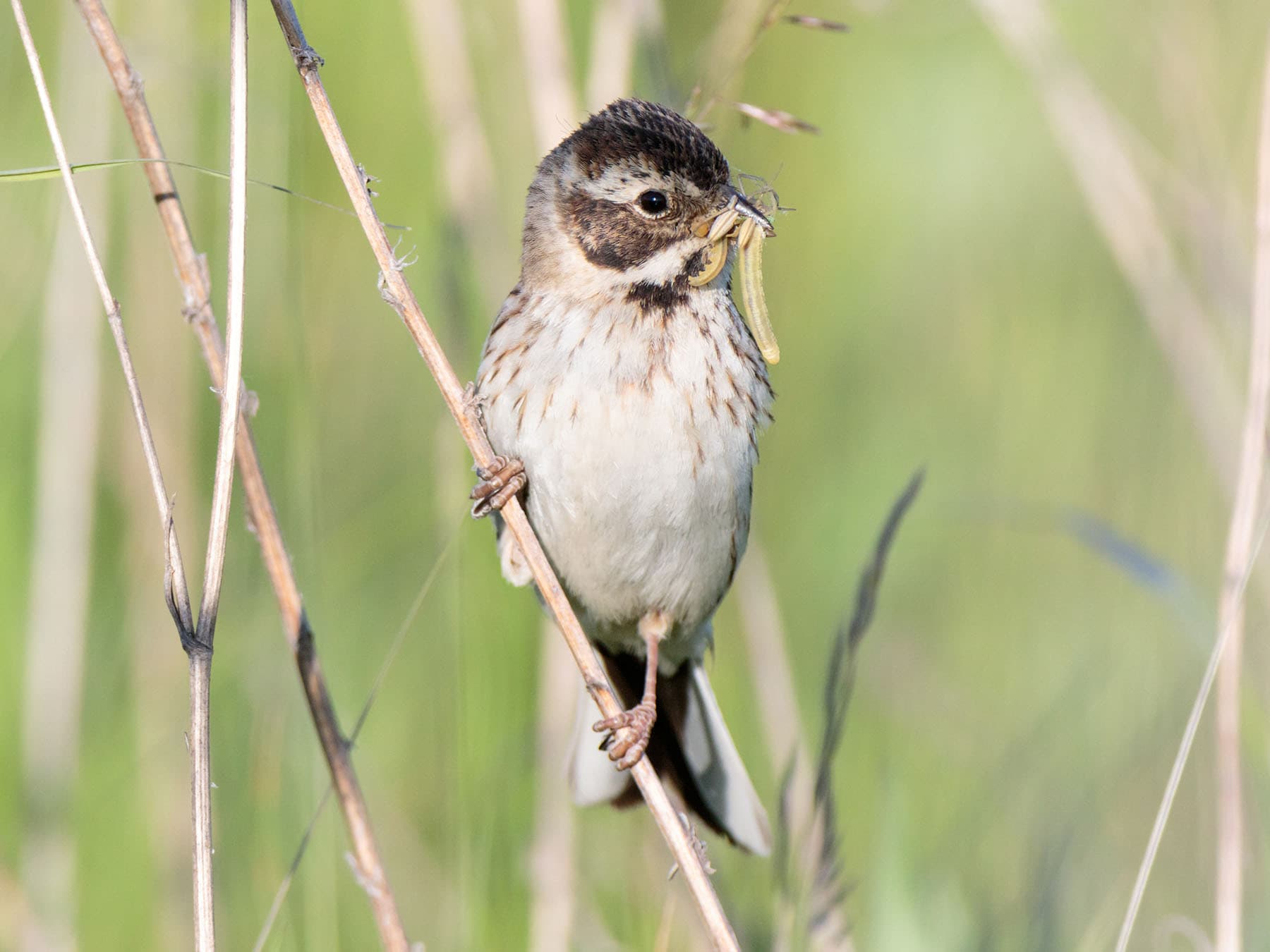
Reed buntings forage on the ground and also in low vegetation. Their diet varies according to the season, with insects and invertebrates being of chief importance when breeding, and seeds and other plant matter dominating for the rest of the year.
Invertebrates commonly foraged for include spiders, caterpillars, beetles, larvae, dragonflies, mayflies, ticks and crustaceans.Most popular seeds are those from birch, spruce, alder and nettle.
What do Reed Bunting chicks eat?
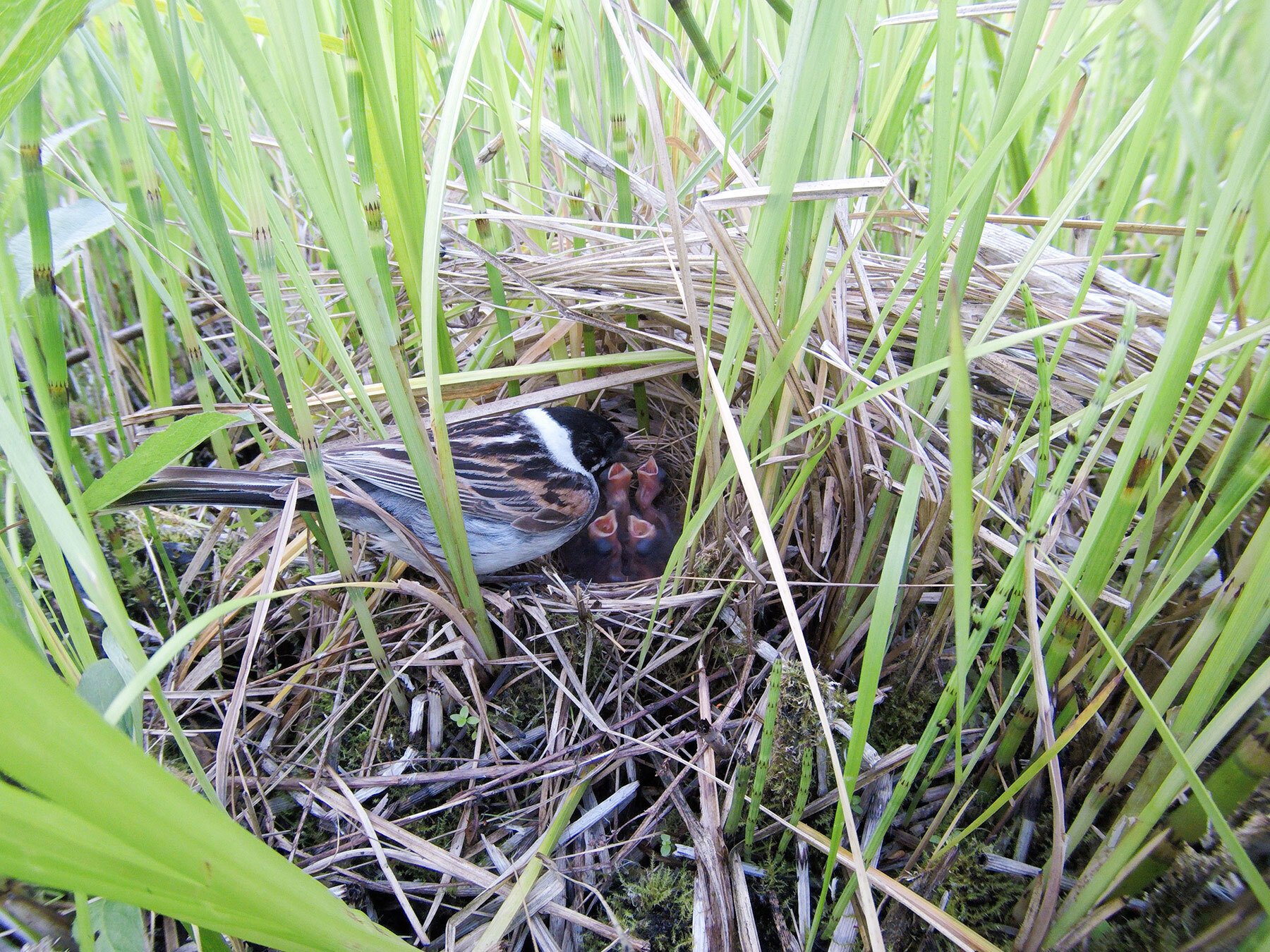
Until they fledge, the diet of a young reed bunting is solely made up of spiders and small insects. Both parents feed young until they leave the nest, between 9 and 12 days after hatching.
Nesting and breeding
Where do Reed Buntings nest?
Female reed buntings build neatly woven cup-shaped nests close to or on the ground, using grasses, twigs, sedge, mosses, and lined with softer grasses and sometimes animal fur.
Nests are concealed at the bases of a clump of vegetation, shrubbery or behind a reedy tussock, or less frequently off the ground in a bush or shrub.
What do Reed Bunting eggs look like?
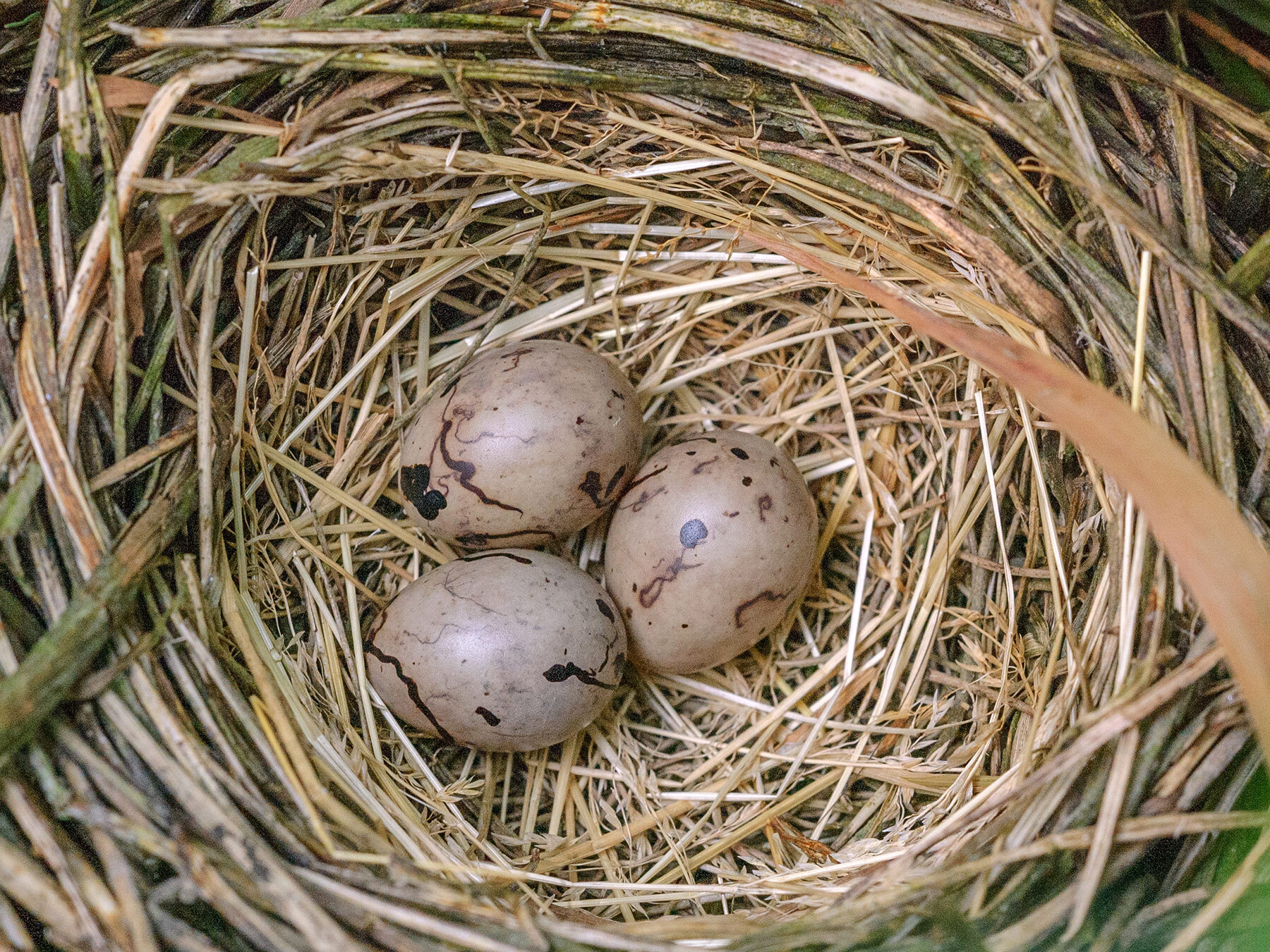
Reed buntings raise up to two broods per season, each consisting of 4 to 5 olive-grey eggs, marked with dark brown scrawlings. Eggs measure around 20 mm to 15 mm (0.7 in to 0.6 in) and are incubated by both the male and the female for between 12 and 15 days.
Do Reed Buntings mate for life?
Observations indicate that most reed buntings are monogamous for the duration of a breeding season, but find a new mate each year. However, some evidence of polygamous pairings do exist.
Behaviour
Are Reed Buntings aggressive?
Rather than being physically aggressive, reed buntings rely on vocally defending their territories and nest sites from intruders, using a three-note call to assert their claim to a particular patch.
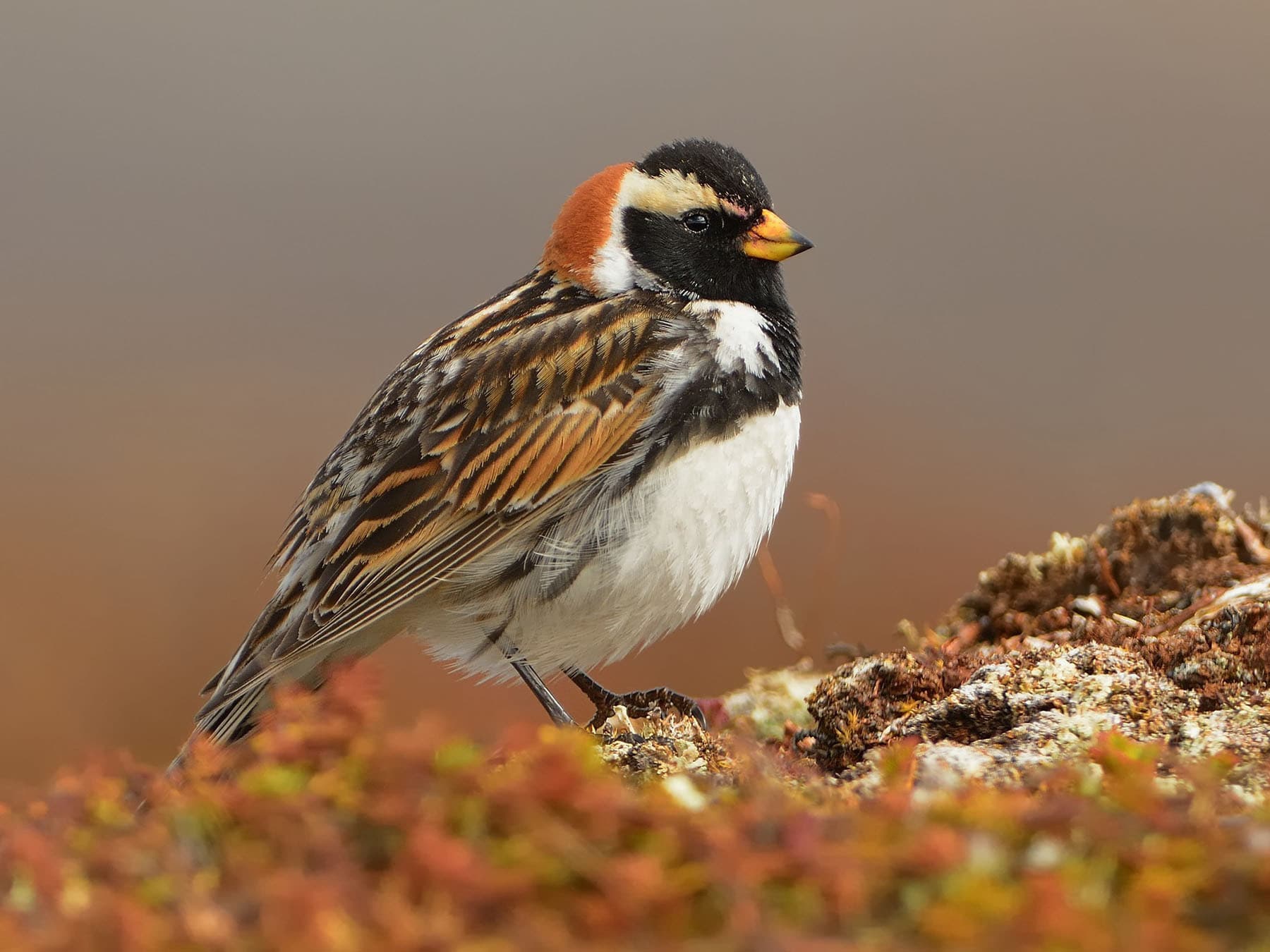
During winter months, large communal roosts of reed buntings may gather in some areas and also forage as part of mixed species flocks, which also may include yellowhammers and corn buntings.
Lifespan and predators
How long do Reed Buntings live?
Reed buntings have a typical life expectancy of around 3 years, breeding for the first time at one year. The oldest recorded reed bunting was a ringed individual of 9 years 11 months.
What are the predators of Reed Buntings?
The low-level nest sites used by breeding reed buntings leave them vulnerable to predation by crows, magpies, jays, foxes, sparrowhawks and marsh harriers.
Are Reed Buntings protected?
The Wildlife and Countryside Act, 1981, offers protection to wild reed buntings, meaning it’s an offence to knowingly kill, injure or capture one. Reed buntings have also been named as a priority species in the UK Post-2010 Biodiversity Framework legislation.
Are Reed Buntings endangered?
The UK population of reed buntings fell by over 30 percent between 1970 and 2007, but has since experienced a slight recovery.
This decline, caused by loss of wetland habitats and a decline in the availability of farmland food sources, led to the species being added to the Amber category on the British Birds of Conservation Concern list.
Across the wider European distribution range of the species, further decline has been noted, but reed buntings continue to be rated as Least Concern species.
Conservation
While listed as Least Concern globally, Reed Bunting populations have declined in some areas due to habitat loss and agricultural intensification.
Conservation efforts focus on preserving wetlands and promoting wildlife-friendly farming practices to maintain suitable breeding habitats.
Similar birds
Often mistaken for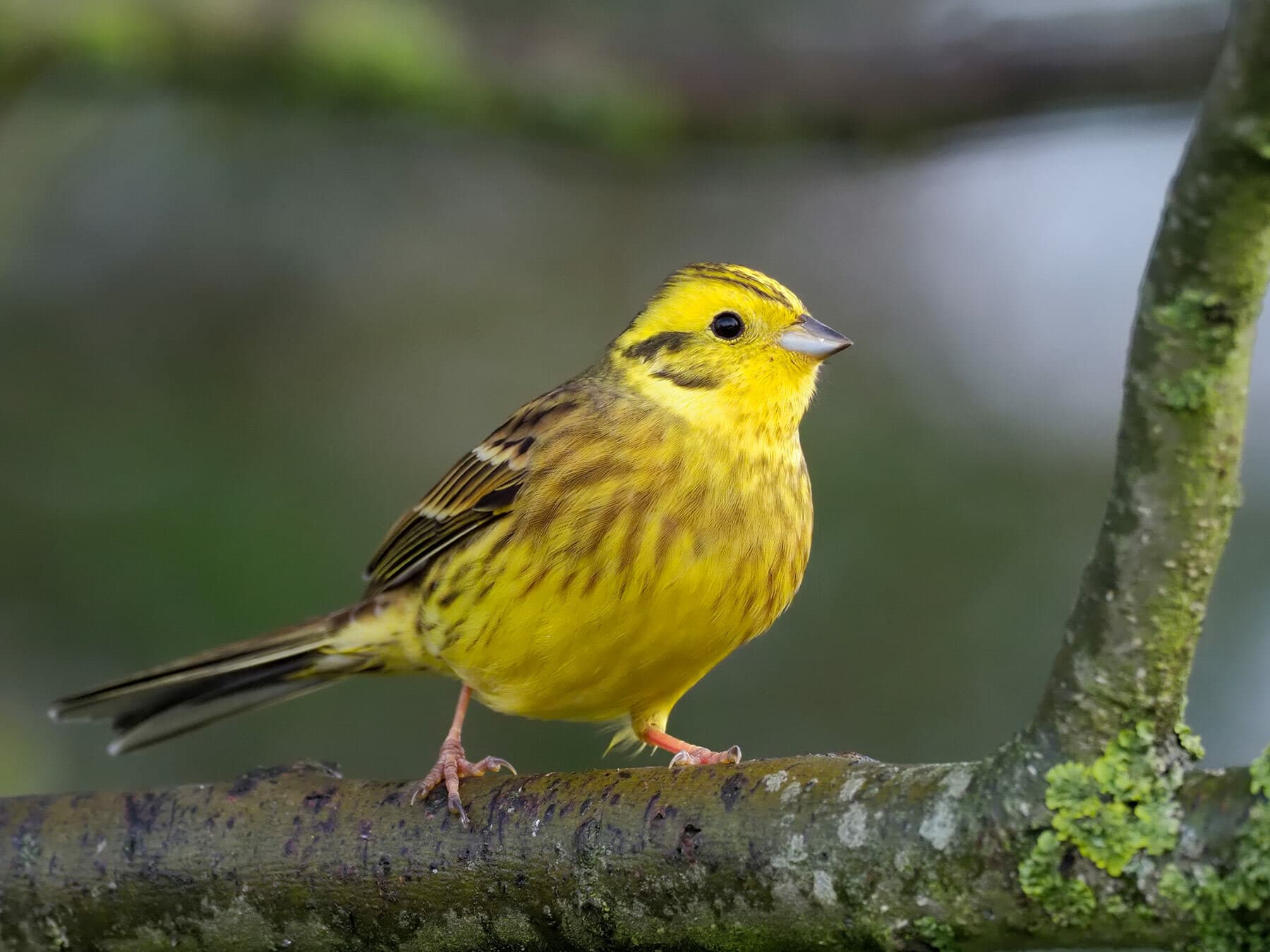
More photos
7 photos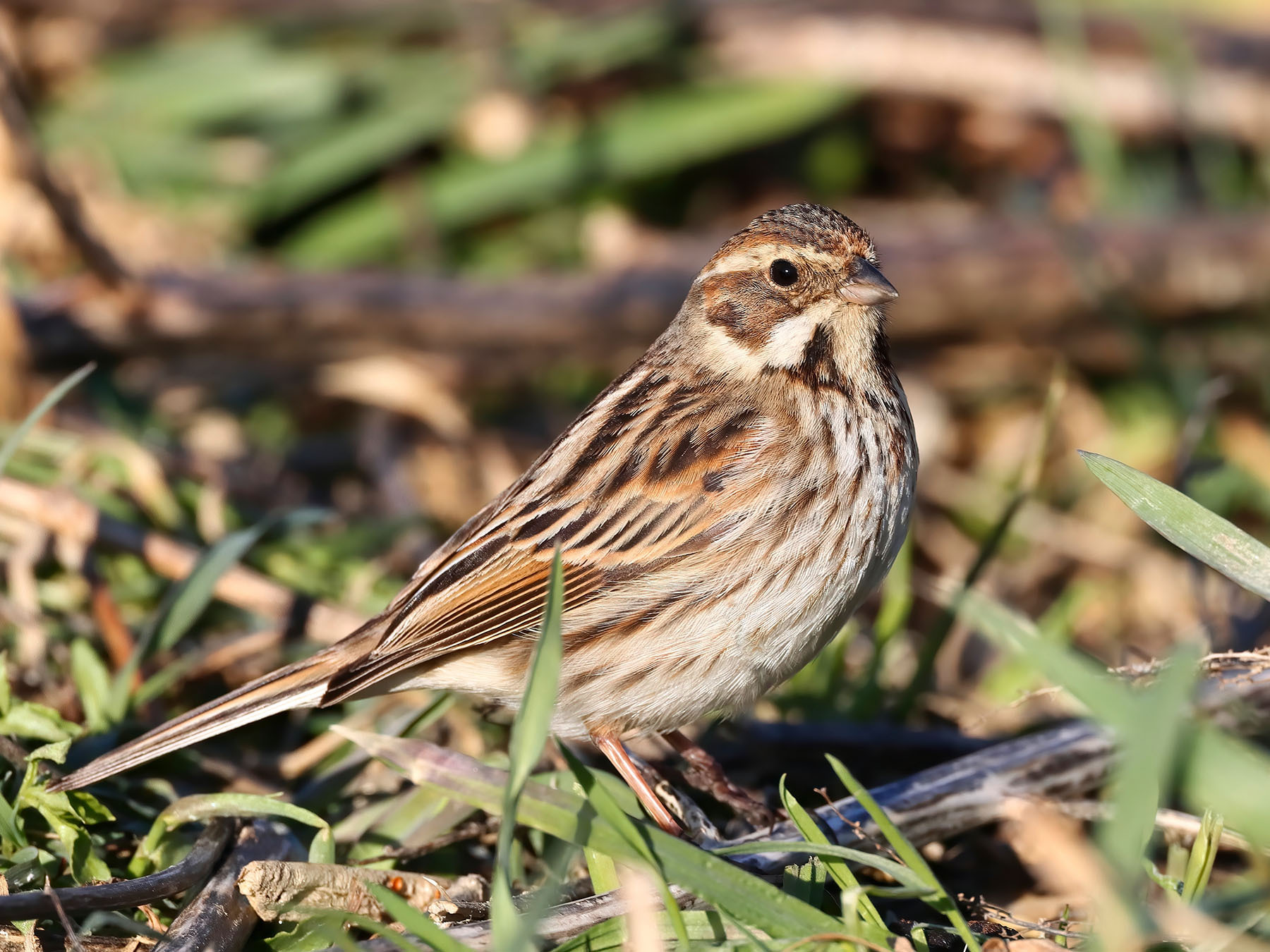
Quick facts
- Length
- 13.5–15.5 cm
- Wingspan
- 21–28 cm
- Weight
- 15–23 g
- Lifespan
- 3–5 years · oldest recorded 12.2 years
- Family
- Buntings
- Migration
- Partial migrant
- Global status (IUCN)
- Least Concern
- World population
- 23,000,000 - 40,000,000 mature individuals
- Population trend
- Decreasing
- Also called
- Common Reed Bunting
- Scientific name
- Emberiza schoeniclus
Questions
4Do Reed Buntings visit gardens?
Reed Buntings are relatively rare visitors to gardens, but still do visit them from time to time, particularly towards the end of March.
Once arable fields have been prepared for the season ahead, they become less important as a food source for foraging reed buntings, who need to find alternative feeding grounds and some back gardens stocked with a variety of seeds temporarily become an attractive prospect.
How to attract Reed Buntings?
Farmland with crops such as oilseed rape, kale and quinoa will attract foraging reed buntings during winter months. A diverse range of insect life is also important, particularly during the breeding season.
Reed buntings may occasionally show up in a back garden, particularly in spring, where they will take black sunflower seeds and white millet.
Do Reed Buntings only live in reedbeds?
Although the name would suggest otherwise, reed buntings can be found across a whole host of habitats. These birds have recently utilised drier habitats like farm hedgerows and grassy sand dunes, and it's thought to be potentially down to the loss of some of their more ideal damper habitats.
What is the scientific name of a Reed Bunting?
The full scientific name given is Emberiza schoeniclus.
The specific part of the name, schoeniclus, is derived from the ancient Greek word skhoiniklos, which was a word used by Greek authors for an unidentified bird.
The genus, Emberiza, which has more than 40 different seed-eating species is confined to the Old World.
Sources
4- 1BirdLife International. 2019. Emberiza schoeniclus (amended version of 2018 assessment). The IUCN Red List of Threatened Species 2019: e.T22721012A155430396. Source (opens in a new tab)
- 2EBCC (2015)
- 3BirdLife International. 2019. Emberiza schoeniclus (amended version of 2018 assessment). The IUCN Red List of Threatened Species 2019: e.T22721012A155430396. Source (opens in a new tab)
- 4Fransson et al., EURING list of longevity records for European birds (2010) Source (opens in a new tab)

Checked by
Nathan Cope, founder and editor
Nathan founded Birdfact and leads its writers and contributors in the UK, the US and Canada. He has watched and studied birds for more than ten years, and checks every article and species guide before it’s published.