Species Profile
Franklin's Gull
Leucophaeus pipixcan
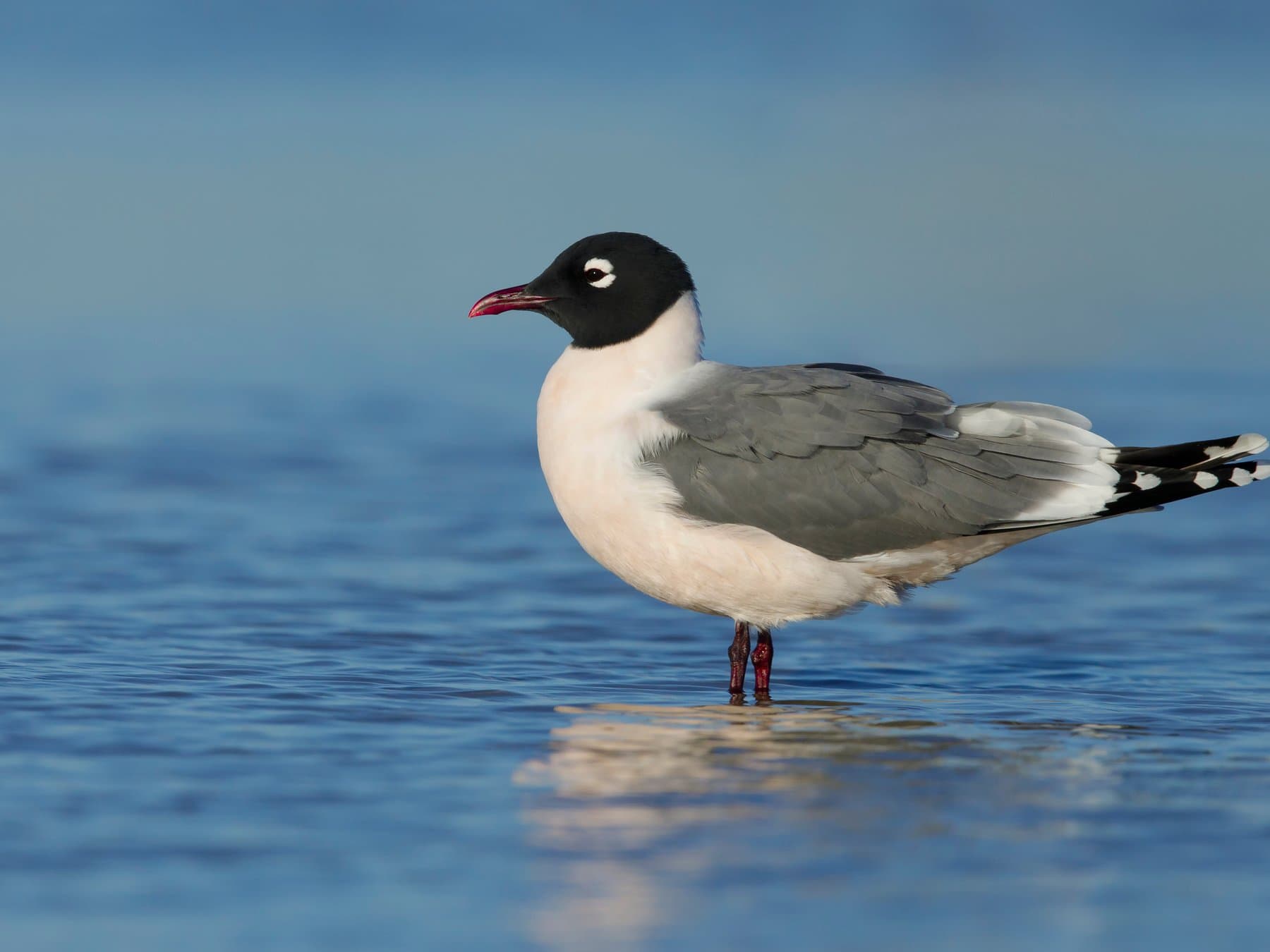
Franklin's Gull in breeding plumage, standing in shallow blue water. Features a black head, white eye-arcs, red beak, grey back, and red legs.
Quick Facts
Conservation
LCLeast ConcernLifespan
5–10 years
Length
32–36 cm
Weight
230–300 g
Wingspan
85–95 cm
Migration
Full migrant
A glossy black hood, a delicate rosy-pink flush on the breast, and a migration that spans the length of two continents — Franklin's Gull is one of North America's most striking small gulls. Breeding on vast prairie marshes in the Canadian interior, it winters along the Pacific coast of Peru and Chile, covering up to 15,000 km each way. It is also the only gull in the world known to undergo two complete moults every year.
Think you've spotted a Franklin's Gull?
Upload a photo and we'll confirm it instantly
Confirm with a PhotoAppearance
Franklin's Gull is a small, elegant bird — noticeably more compact than the closely related Laughing Gull and slightly larger than Bonaparte's Gull. It has a rounded head, a slim dainty bill, and a buoyant, graceful flight that sets it apart from heavier-bodied gulls at a glance.
In breeding plumage, the adult sports a full, glossy black hood covering the entire head, offset by a broad white crescent above and below each eye — one of the species' most reliable field marks at any season. The back and wings are dark grey (approximately Kodak Grey Scale 6–9, slightly paler than the Laughing Gull). The underparts are white, often washed with a delicate rosy-pink blush on the breast and belly — a feature that earned the bird its folk names 'Prairie Dove' and 'rosy dove'. This pink flush is produced by a pigment that sunlight gradually breaks down, so it fades as the breeding season progresses. The bill is deep red with a thin black subterminal ring; the legs and feet are dark red.
In flight, the wingtips show a striking three-banded pattern: a band of white, then black, then white again at the very tip. This white terminal band is the key distinction from the Laughing Gull, which lacks white primary tips entirely. A white band also separates the black wingtip from the grey upperwing.
In non-breeding plumage, the full hood is replaced by a dark half-mask covering the rear crown and ear coverts, leaving the forehead and throat white. The bill and legs darken to blackish, though the bill may retain a reddish tip. Juvenile and first-winter birds are browner above, with a smudgy half-hood, a black tail band, and dark primaries, but notably paler and crisper overall than first-winter Laughing Gulls. The species takes three years to reach full adult plumage. Males and females are identical in plumage; males average slightly larger in body and bill dimensions but cannot be reliably distinguished in the field.
Identification & Characteristics
Colors
- Primary
- Grey
- Secondary
- White
- Beak
- Red
- Legs
- Red
Markings
Full glossy black hood in breeding plumage; broad white eye crescents above and below each eye; white band separating black wingtip from grey upperwing; white primary tips; rosy-pink breast flush in breeding plumage
Tail: White tail; first-winter birds show a black subterminal tail band that does not extend across the full tail
Attributes
Understanding Attributes
Rated 0–100 based on research and observation. A score of 50 is average across all bird species. These attributes are relative and don't necessarily indicate superiority.
Habitat & Distribution
Franklin's Gull breeds in the interior of North America, with the core range spanning the Canadian Prairie Provinces — central Saskatchewan, eastern Alberta, and southwestern Manitoba — and extending south into the northern United States: Montana, North and South Dakota, western Minnesota, northwestern Iowa, Idaho, Wyoming, and Oregon (notably at Malheur National Wildlife Refuge). The largest colonies are found in the Canadian prairies.
Breeding habitat is highly specific: large, extensive freshwater prairie marshes with abundant emergent vegetation (cattails, bulrushes) and patches of open water at least 80 cm deep. The water depth requirement is critical — nests must be inaccessible to terrestrial predators. Because prairie wetlands fluctuate with rainfall, the species is a nomadic breeder, and entire colonies may relocate from year to year.
During migration, Franklin's Gulls are far more adaptable, using agricultural fields, flooded pastures, inland lakes, reservoirs, estuaries, mudflats, river mouths, and sewage ponds. They are a regular sight following tractors across the Great Plains. Flocks have been recorded at altitudes exceeding 4,300 m (14,000 ft) in the Rocky Mountains during post-breeding dispersal.
The wintering grounds lie primarily along the Pacific coast of South America — Peru and Chile — where birds are present from approximately December to March. Some also winter in Argentina and the Caribbean. On the wintering grounds, birds forage along ocean beaches, in bays and estuaries, and up to around 50 km offshore, as well as at high-elevation Andean lakes.
In the United States, the species is locally abundant in the interior during migration, particularly across the Great Plains. In the UK and Ireland, Franklin's Gull is a scarce but near-annual vagrant, with approximately 120 accepted British records by the mid-2020s and around 50 Irish records. The first British record came from Langstone Harbour, Hampshire, in 1970. Most records fall south of a line from the Severn Estuary to the Humber, with two peak windows: May–August and October–January. A bird at Crossness on the Thames in 2024 was only the second London record.
Where to See This Bird
Explore regional guides for locations where this bird has been recorded.
Montana
Nebraska
Iowa
Kansas
North Dakota
Oklahoma
Utah
South Dakota
Alberta
Manitoba
Saskatchewan
Diet
Franklin's Gull is omnivorous, and its diet shifts markedly between seasons. During the breeding season on the prairies, invertebrates dominate: beetles, grasshoppers, crickets, locusts, flies, midges, dragonflies, damselflies, and their larvae are all taken, along with earthworms, leeches, snails, crayfish, and aquatic insect larvae. Small amounts of plant material — sunflower seeds, wheat, oats — are also consumed, and occasionally small fish, mice, or crabs supplement the diet.
Foraging methods are impressively varied. Birds hawk insects aerially, pick prey from the water surface while swimming, wade and walk on the ground, and follow tractors to exploit disturbed soil. The phalarope-like spinning behaviour — circling rapidly on the water surface to create an upwelling vortex — draws invertebrates within reach without the bird needing to dive. Young chicks are fed predominantly earthworms in the early days after hatching.
On the wintering grounds in South America, the diet shifts toward more aquatic prey: small fish including anchovies and jacks, crabs (especially hermit and mole crabs), isopods, and other marine invertebrates. Birds scavenge fish scraps from fishing operations and fish-processing factories, and associate with other gulls at landfills and refuse sites. Franklin's Gulls also visit irrigated agricultural fields and high-elevation Andean lakes in Peru, demonstrating the dietary flexibility that allows the species to exploit very different food sources across its vast annual range.
Behaviour
Franklin's Gulls are highly social birds, breeding in dense colonies of hundreds to tens of thousands of pairs and migrating in large, often tightly packed flocks. Outside the breeding season they associate readily with other gull species at foraging sites, though they tend to form their own sub-groups within mixed flocks.
One of the most striking colony behaviours is the 'panic flight'. When a predator or human approaches the nesting marsh, hundreds or thousands of normally noisy birds simultaneously rise from their nests and fly silently over the colony for several minutes — an eerie, sudden hush from a species that is otherwise among the most vocal at its nesting site. Normal calling resumes only once the threat has passed.
Foraging behaviour is varied and opportunistic. Birds catch insects aerially in sallying flight, pick prey from the water surface while swimming, wade through shallow water, and walk across agricultural fields. A particularly distinctive technique involves spinning in tight circles on the water surface — similar to the behaviour of phalaropes — creating a vortex that draws invertebrate prey upward. Franklin's Gulls also follow farm tractors during ploughing operations, dropping into freshly turned furrows to snatch exposed earthworms and grubs.
Colony sites are not fixed from year to year. Because prairie marsh conditions fluctuate with rainfall and drought, entire colonies may shift location between seasons, relocating to wherever water levels and emergent vegetation are most suitable. This nomadic colony behaviour is unusual among gulls and reflects the unpredictable nature of the prairie wetland environment.
Calls & Sounds
Franklin's Gull is a vocal species, particularly at breeding colonies, where the noise of thousands of calling birds can be heard from a considerable distance. Its calls are distinctly high-pitched and nasal — quite different from the lower, harsher calls of larger gulls such as the Herring Gull — and this nasal quality is one of the most reliable ways to pick the species out of a mixed gull flock.
The most commonly described call is a strident, repeated 'ha-ha-ha-ha-ha-ha', similar to the Laughing Gull's call but consistently higher-pitched and more nasal. The two species were recently reclassified together into the genus Leucophaeus, partly reflecting this vocal similarity.
The 'long call' — the most complex vocalisation in gulls, used as an aggressive signal and for individual recognition — is structurally unusual in Franklin's Gull. Unlike most gulls, which follow an 'intro > squeal > terminal series' pattern, Franklin's Gull typically gives a simple, slow series of rising nasal notes at a single speed. Any fast notes, if present at all, usually come at the end rather than the beginning. This rising, nasal structure is shared with the Laughing Gull but is consistently higher in pitch in Franklin's.
During courtship, males call repeatedly from display sites to attract females overhead, and the male calls continuously during copulation. One of the most striking vocal phenomena at the colony is its sudden absence: during 'panic flights' triggered by predators or human disturbance, hundreds or thousands of birds rise simultaneously and fly in complete silence for several minutes before resuming normal calling — a sudden, eerie quiet that experienced observers find deeply unsettling.
Flight
In flight, Franklin's Gull is noticeably buoyant and graceful — lighter on the wing than the Laughing Gull and more tern-like in its easy, floating action. The wings are relatively long and pointed, and the wingbeats are fluid and unhurried in normal travel flight, though the bird is capable of rapid, agile manoeuvring when hawking insects aerially.
The wingtip pattern is the single most important flight identification feature. From above, the dark grey upperwing is separated from the black wingtip by a clean white band — a feature absent in the Laughing Gull. From below, the wingtip shows the same three-banded arrangement: white, then black, then white again at the very tip. In non-breeding and immature plumages, the black in the wingtip is reduced, but the white primary tips remain visible.
During migration, Franklin's Gulls travel in large, often dense flocks, sometimes mixed with other species. Post-breeding flocks have been recorded at altitudes exceeding 4,300 m (14,000 ft) over the Rocky Mountains — remarkable for a bird that typically forages at or near ground level. At the Isthmus of Tehuantepec migration bottleneck, the species characteristically flies at low altitudes under 80 m, with an erratic, wandering flight path that increases collision risk with wind turbines.
When foraging over water, the bird dips gracefully to the surface without fully landing, picking prey with a precise, tern-like stoop. Aerial insect-hawking involves quick, darting sallies with sharp directional changes — a level of agility unusual for a gull of this size.
Nesting & Breeding
Franklin's Gulls arrive at breeding marshes in late April or early May, and colony activity is highly synchronous — all pairs within a colony breed at roughly the same time, compressing the entire nesting cycle into the short northern summer. Colonies are monospecific and can range from a few hundred to tens of thousands of pairs.
Courtship begins shortly after arrival. Males establish display territories on floating vegetation and call repeatedly to attract females flying overhead. When a female lands nearby, the male turns away and erects his neck feathers, concealing his black hood. The female mirrors the display, and the pair alternately turn toward and away from each other in a ritualised exchange. Once paired, the female solicits food by hunching and raising her bill like a begging chick; the male regurgitates food in response — a behaviour that typically precedes copulation. The species is monogamous within each breeding season, with birds probably first breeding at age two.
Both sexes build the nest — a large floating platform of wet bulrushes, cattails, and grasses, often with material pilfered from neighbouring nests, anchored to standing emergent vegetation. Nests begin at around 43 cm across and may grow to 100 cm as material is added throughout incubation. Both parents add fresh vegetation daily as the structure decays and sinks. Even older chicks contribute nest material from the immediate vicinity.
Clutch size is typically 2–3 eggs (range 1–4), laid in mid-May in Minnesota. Eggs are greenish-brown to buff or olive, blotched with dark brown or black, measuring approximately 5.1–5.3 cm × 3.6–3.7 cm. Both parents share incubation for 23–26 days. Chicks hatch semiprecocially — eyes open, covered in cryptic brown-and-tan down — and remain in the nest for approximately 20–30 days. First flight occurs at around 32–35 days, and young become fully independent at approximately 40–45 days. Only one brood is raised per year.
Lifespan
Franklin's Gull is a relatively short-lived gull compared to larger species in the family. Typical lifespan in the wild falls between 5 and 10 years, though the oldest recorded individual reached 9.4 years. For comparison, the larger Herring Gull regularly exceeds 20 years, and the Ring-billed Gull has been recorded at over 31 years — reflecting the general pattern that larger gulls live considerably longer than smaller ones.
The species reaches sexual maturity at approximately two years of age, earlier than many larger gulls, which typically take three to five years. This earlier maturity partly compensates for a shorter lifespan in terms of lifetime reproductive output.
Annual survival rates are not well documented for this species, but the main mortality causes are likely predation (particularly at the nest — Great Horned Owls, Mink, and Raccoons are significant predators), starvation during the long transequatorial migration, and collision with structures. The wind turbines at the Tehuantepec migration bottleneck represent an emerging mortality source that has not yet been fully quantified. Nest flooding and drought-induced nest failure also reduce recruitment in poor water-level years, affecting population recovery rates.
Conservation
Franklin's Gull is classified as Least Concern on the IUCN Red List (2018), with a global population estimated at 1,000,000–1,490,000 individuals (Wetlands International, 2018) and a Partners in Flight estimate of 830,000 breeding birds. The large overall range and population size underpin the Least Concern rating — but the population trend tells a more troubling story.
According to the North American Breeding Bird Survey, Franklin's Gull populations declined by approximately 3% per year across the species' range between 1968 and 2015 — a cumulative decline of around 76%. In the United States specifically, declines exceeded 6% per year, amounting to a 95% reduction over the same period. Partners in Flight rates the species 14/20 on its Continental Concern Score and places it on the Yellow Watch List. The North American Bird Conservation Initiative identifies it as a Common Species in Steep Decline, and Minnesota lists it as a Special Concern Species.
The primary threats are wetland loss and degradation — approximately half of US breeding-range wetlands were drained during the 19th and 20th centuries — and ongoing water level fluctuations that either flood nests or expose them to terrestrial predators. Human disturbance is particularly damaging: early-season intrusion can cause complete colony abandonment. Predators including Great Horned Owls, Northern Harriers, Mink, Raccoons, foxes, and skunks take eggs, chicks, and adults.
An emerging threat is wind energy development at the Isthmus of Tehuantepec in southern Mexico — the narrow land bridge where the entire population funnels during migration. Franklin's Gulls typically fly at low altitudes (under 80 m) with erratic flight paths, making them particularly vulnerable to turbine collisions at this bottleneck. Climate change adds further pressure: predicted increases in drought frequency in the Prairie Pothole Region threaten nesting habitat, while stronger storms risk flooding nests.
Population
Estimated: 1,000,000–1,490,000 individuals
Trend: Declining
Declining — approximately 3% per year range-wide (1968–2015), representing a cumulative decline of ~76%. In the United States, declines exceeded 6% per year (~95% cumulative). Listed on the Partners in Flight Yellow Watch List and identified as a Common Species in Steep Decline by the North American Bird Conservation Initiative.
Elevation
Sea level to over 4,300 m (recorded in Rocky Mountains during migration); breeds at prairie elevations; winters at sea level to high-elevation Andean lakes in Peru
Additional Details
- Predators:
- Great Horned Owl, Northern Harrier, Mink, Raccoon, fox, skunk — all prey on eggs, chicks, or adults at breeding colonies
Naming And Etymology
Franklin's Gull takes its English name from Sir John Franklin, the British Arctic explorer who led an overland expedition to the Canadian Arctic in 1825–27. A specimen was collected during that expedition, but the bird was initially misidentified as a Laughing Gull — an understandable error given the two species' similar black hoods and dark grey upperparts. It was only on a subsequent expedition that the Scottish naturalist Dr. John Richardson examined the specimen more carefully, recognised it as a distinct species, and formally named it Larus pipixcan, with the English name 'Franklin's Rosy Gull' in honour of the expedition leader.
The specific epithet pipixcan derives from the Nahuatl (Aztec) word for the species, recorded by the 16th-century Spanish friar Bernardino de Sahagún in his encyclopaedic survey of New World natural history — making it one of relatively few bird scientific names with a pre-Columbian indigenous American origin. The genus name Leucophaeus, to which Franklin's Gull was reassigned along with the Laughing Gull in recent taxonomic revisions, comes from the Greek for 'whitish dusky' — a reasonable description of the pale grey and white plumage shared by both species.
The folk names 'Prairie Dove' and 'rosy dove' reflect the bird's gentle appearance on the breeding grounds: the rounded head, slim bill, and delicate pink breast flush give it a distinctly dove-like quality quite unlike the aggressive, scavenging image associated with many larger gulls. Sir John Franklin himself, of course, is best remembered for his ill-fated 1845 Northwest Passage expedition, from which neither he nor any of his 128 men returned — giving the gull that bears his name an unexpectedly poignant historical connection.
Courtship & Display
Courtship in Franklin's Gull begins shortly after the colony arrives at the breeding marsh in late April or early May, provided snow and ice have cleared. Males establish small display territories on floating vegetation and call repeatedly — a persistent, nasal 'ha-ha-ha' — to attract females flying overhead. The display is conspicuous and energetic, with males competing for the attention of passing birds.
When a female lands near a displaying male, the pair engage in a ritualised mutual display that is distinctive among gulls. The male turns away from the female and erects his neck feathers, effectively hiding his black hood — a counter-intuitive gesture that signals non-aggression. The female mirrors the display, and the two birds alternately turn toward and away from each other in a slow, synchronised exchange. This 'head-flagging' behaviour is thought to reduce the aggressive response that a direct face-to-face encounter would otherwise trigger.
Once a pair bond is established, the female solicits food by crouching and raising her bill in the posture of a begging chick. The male regurgitates food directly into her bill — a behaviour known as courtship feeding that reinforces the pair bond and provides the female with additional energy for egg production. Copulation typically follows, with the male calling continuously throughout. The species is monogamous within each breeding season, and pairs probably do not reunite in subsequent years given the nomadic nature of colony sites.
Birdwatching Tips
In the United States, the Great Plains offer the best opportunities. During spring migration (April–May), large flocks pass through Kansas, Nebraska, Oklahoma, and Texas — often following ploughed fields or gathering on flooded agricultural land. In central Texas, birds are frequently heard before they are seen, their high nasal calls carrying across open water. During post-breeding dispersal (July–September), Franklin's Gulls can appear almost anywhere in the interior, including at high-elevation reservoirs in the Rocky Mountain states.
For birdwatchers in the UK and Ireland, Franklin's Gull is a genuine rarity — but a findable one. Most records come from southern England, Wales, and Ireland, with peak windows in May–August and October–January. Coastal reservoirs, estuaries, and gull roosts are the most productive sites. Storm-driven influxes following Atlantic hurricanes in autumn have produced multiple birds in a single event, as happened after Hurricane Wilma in late 2005.
Identification is straightforward once you know what to look for. The key distinction from the similar Laughing Gull is the white band separating the black wingtip from the grey upperwing, and the white primary tips — features absent in Laughing Gull. The white eye crescents are bold and prominent at all ages and seasons. In breeding plumage, the rosy-pink breast flush is unique among European vagrant gulls. In winter plumage, the half-hood leaves the forehead white, giving the bird a cleaner-faced look than the Laughing Gull. Size is also useful: Franklin's is noticeably smaller and more compact, with a rounder head and slimmer bill.
At breeding colonies in the Canadian prairies, approach quietly and from a distance — the species is highly sensitive to disturbance, and early-season intrusion can trigger complete colony abandonment.
Did You Know?
- Franklin's Gull is the only gull species in the world known to undergo two complete moults every year — once after breeding in autumn, and again upon reaching its South American wintering grounds. All other gulls moult completely only once per year. This means Franklin's Gull always arrives on its wintering grounds in fresh, crisp plumage.
- More than one million Franklin's Gulls have been counted in a single day on the wintering grounds in Peru — one of the largest gull aggregations ever recorded anywhere on Earth.
- The species was first collected on Sir John Franklin's 1825 Arctic expedition, but ornithologists initially misidentified it as a Laughing Gull. It was only on a subsequent expedition that Dr. John Richardson recognised it as a distinct species and named it 'Franklin's Rosy Gull' in honour of the expedition leader — the same Sir John Franklin who later vanished on his ill-fated 1845 Northwest Passage expedition.
- The rosy-pink breast flush that gives the bird its folk name 'rosy dove' is not permanent: it is produced by a pigment that sunlight gradually destroys, so the blush fades progressively through the breeding season as the feathers are bleached.
- The entire world population funnels through a single narrow land crossing — the Isthmus of Tehuantepec in southern Mexico — during migration. This bottleneck, now home to numerous wind farms, poses a significant collision risk to low-flying birds and has been identified as a priority conservation concern.
Records & Accolades
World's Only Double-Moulting Gull
2 complete moults per year
Franklin's Gull is the only gull species known to undergo two full moults annually — shedding and replacing every feather twice each year, once after breeding and once on the wintering grounds.
Marathon Migrant
Up to 15,000 km each way
One of the longest migrations of any gull, Franklin's Gull travels from the Canadian prairies to the Pacific coast of Peru and Chile — and back — every year.
Million-Bird Wintering Flocks
1,000,000+ birds in a single day
More than one million Franklin's Gulls have been counted in a single day on the Peruvian coast — one of the largest gull aggregations ever recorded on Earth.
Community Photos
Be the first to share a photo of the Franklin's Gull
Upload a PhotoIdentify Any Bird Instantly
- Upload a photo from your phone or camera
- Get an instant AI identification
- Ask follow-up questions about the bird
Monthly Birds in Your Area
- Personalised for your location
- Seasonal tips and garden advice
- Updated every month with new species