


Eider
Common Eider · Somateria mollissima
By the Birdfact teamChecked by Nathan Cope
On this page14 sections
How to recognise it
What do eiders look like?
Eiders are large, solidly built sea ducks that vary tremendously in appearance depending on their age, sex, and the time of year.
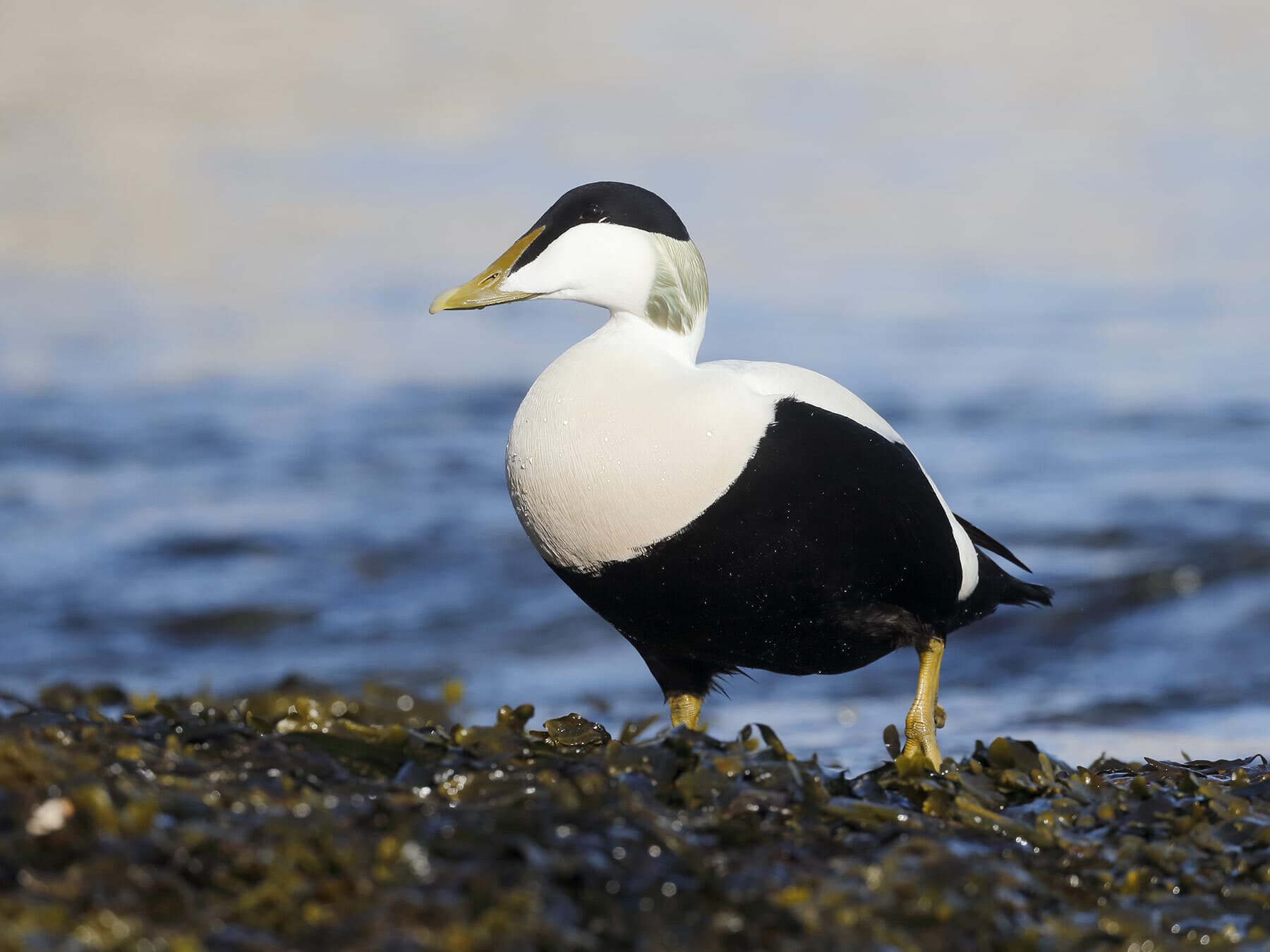
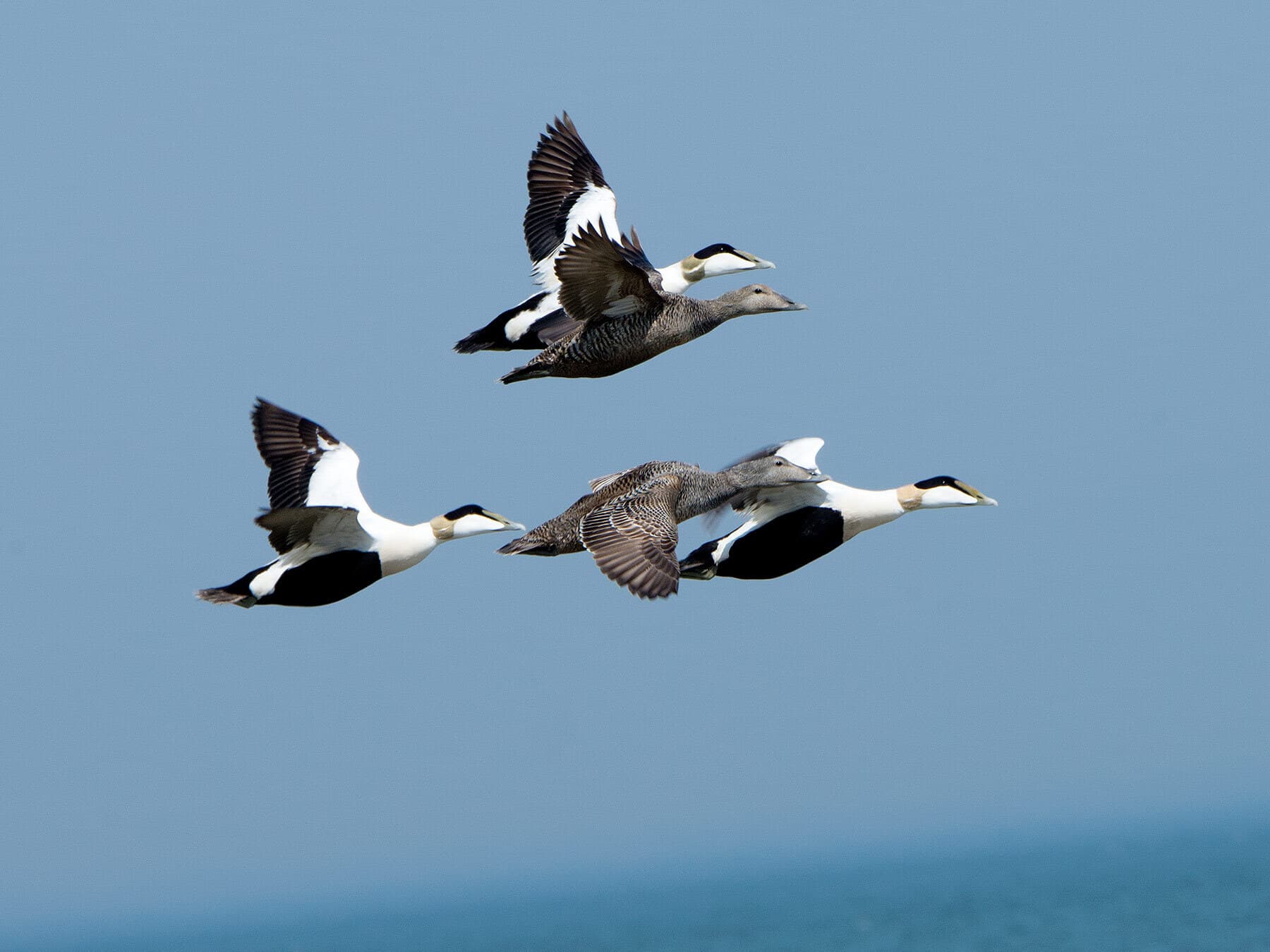
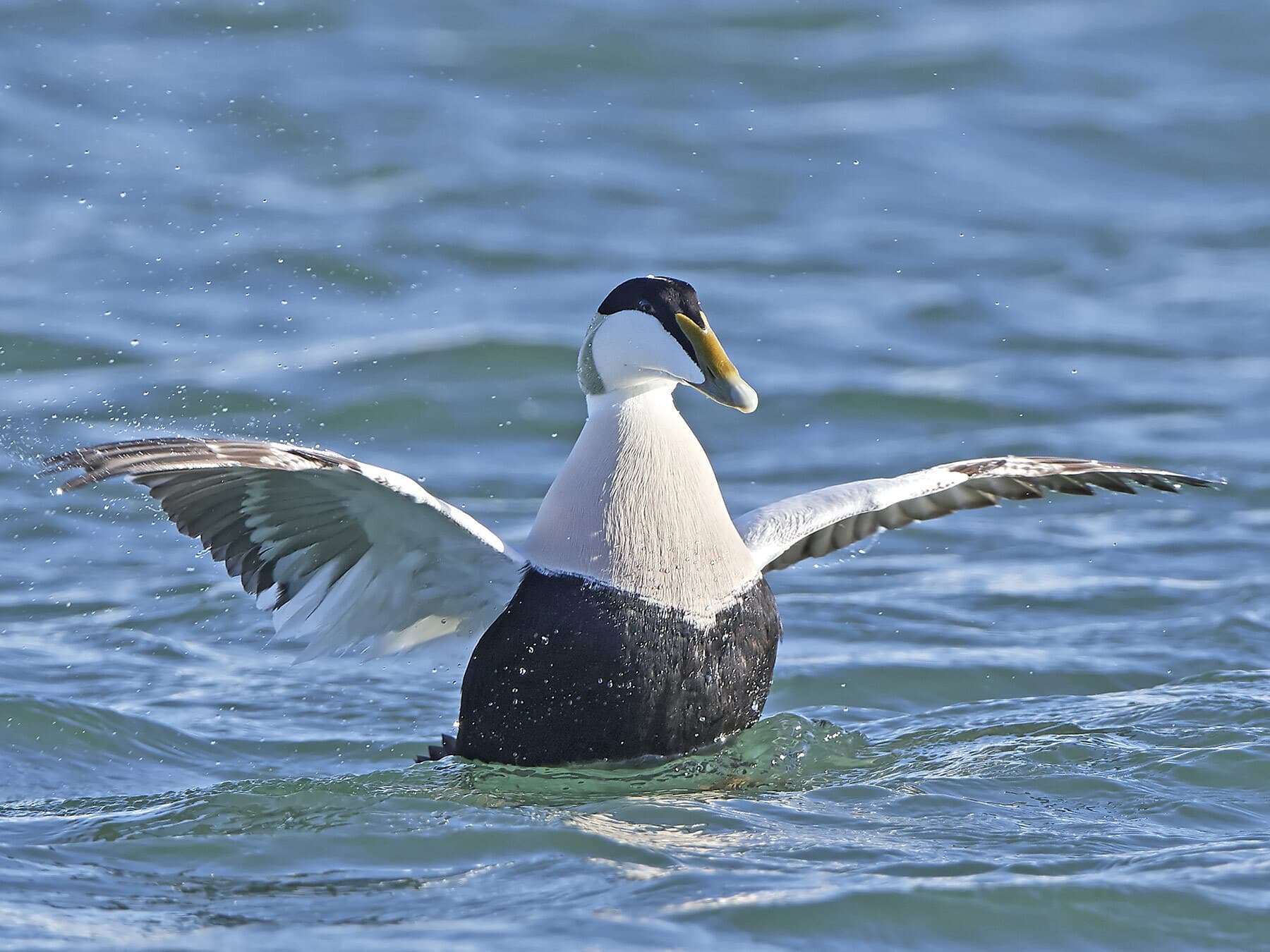
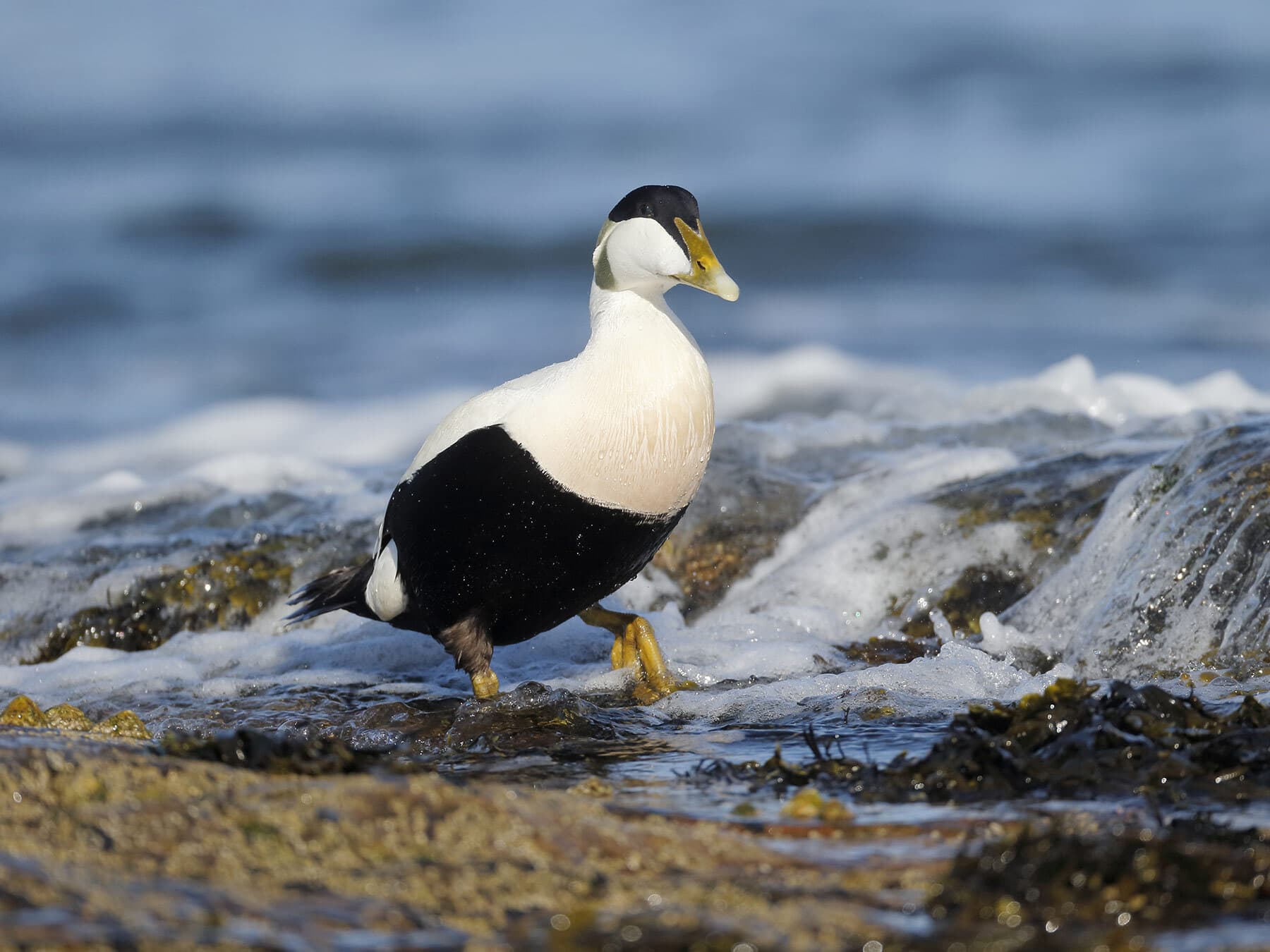
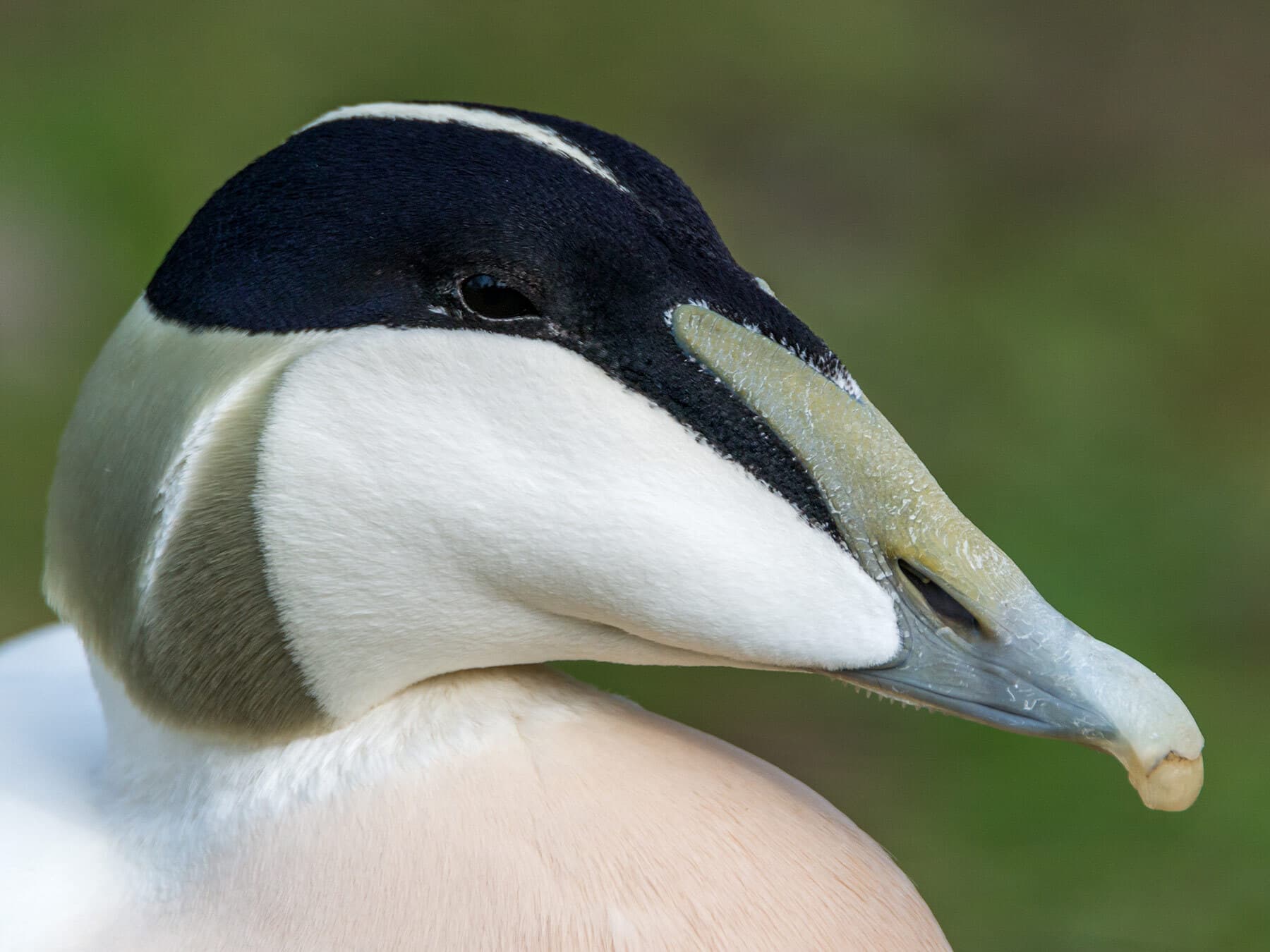
Male eiders are boldly marked birds in the winter once they have moulted into pied plumage. At this time, the adult males develop a black belly, rump, tail and cap. The bill becomes an olive green to orange colour, and the rest of the body is white, except for the nape which takes an olive green hue. During the summer, male eiders have dark brown plumage and pale bills.
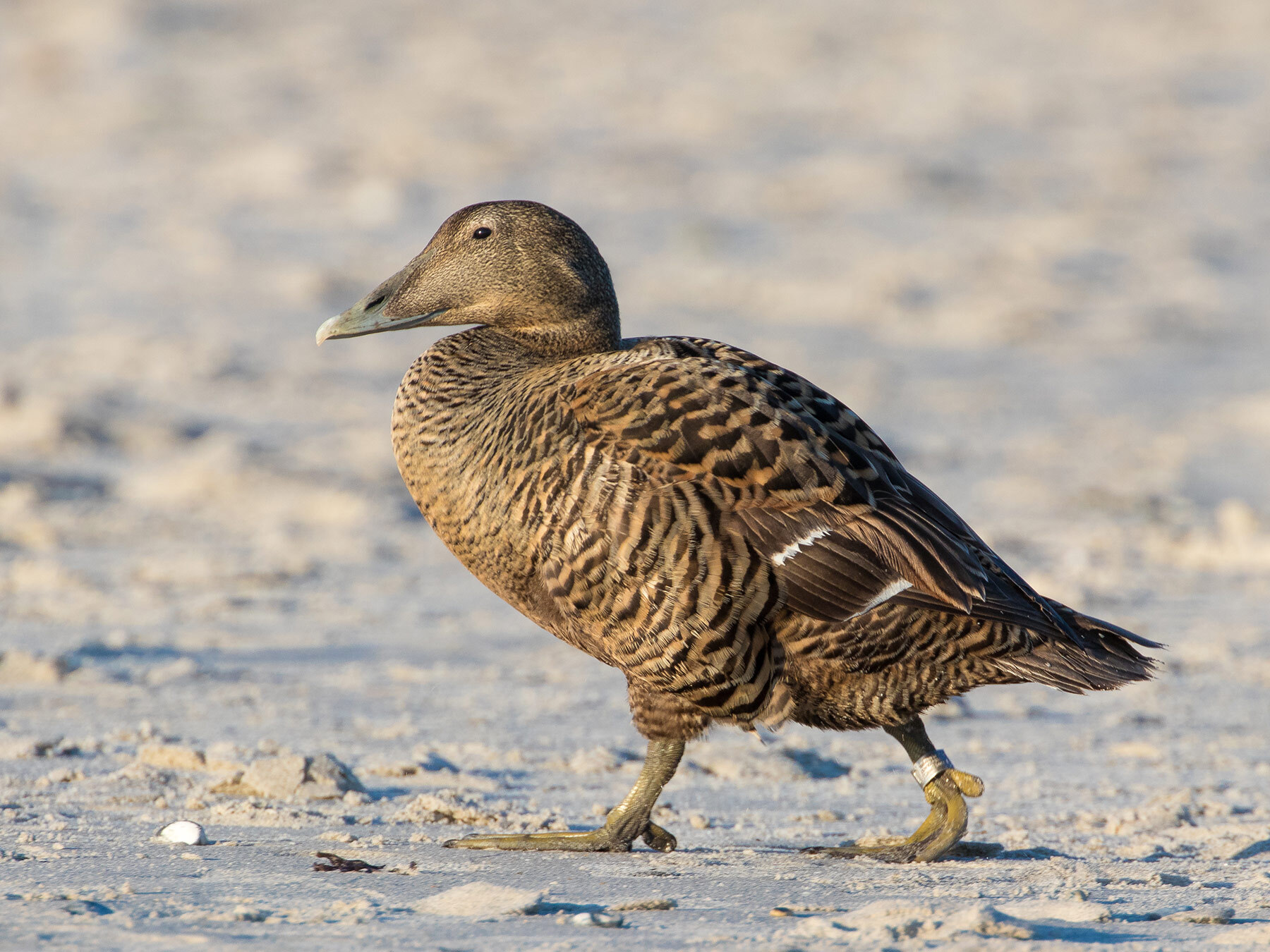
Female eiders retain a rich mottled brown and black colour throughout the year. Their bills are grey-brown in colour and their wings are whitish when seen from below in flight.
Juvenile male eiders only develop their bold winter plumage at three years of age, although they show progressively more white colouration during their first and second years.
How big are eiders?
Common eiders usually measure 50-71cm (19.5-28 in) in length. This makes them the largest duck species in the Northern hemisphere. Males are larger than females on average, but the difference is barely noticeable.
Eiders have a wingspan of 80-108cm (31-42 in). Their size varies across their circumpolar distribution, although the largest individuals have been recorded in Canada’s Hudson Bay.
Most eiders weigh between 1.2kg and 2.6kg (2.75-5.75lb). Egg-laden females can surpass 3kg (6.6lb), however. Male eiders tend to maintain similar body weights throughout the year.
Its size
Adults- Length
- 50–71 cm
- Wingspan
- 80–108 cm
- Weight
- 1200–3000 g
Its song and calls
What sound does an eider make?
Male eider ducks produce a dove-like call that is best described as a-hoo or woo-oo. A chorus of calling males produces a very pleasant sound indeed. Female eiders do not produce the same coo-ing call but a rather more duck-like croaking. Both sexes make a similar alarm call when threatened.
- Song0:00 / 0:37
Recorded in Kalmar län, Sweden · May 2024
- Call0:00 / 1:04
Recorded in Loch Beag, Scotland
Aubrey John Williams / The British Library Board · Wikimedia Commons · CC BY-SA 4.0
When and where to see it
OctoberHere all year
Most recorded in October
- 1. Moray2.1%
- 2. Orkney Islands1.9%
- 3. Aberdeen1.8%
- 4. East Lothian1.8%
- 5. Aberdeenshire1.5%
Each dot is a county, state or province: the bigger and darker, the larger the bird’s share of that place’s bird records that month. Grey dots: no regular records. The ringed point is the centre of the bird’s records this month; the arrow shows how it moved since last month, and the dashed loop its path through the year. “Arrivals” colours places where it becomes regular this month (orange) or is in its last regular month (grey). GBIF eBird Observation Dataset, 2019–2024. Map data: Natural Earth, US Census Bureau; place centres © OpenStreetMap contributors.
In your area
See when the Eider is recorded in your county, state or province.
How often the Eider turns up in the UK, Ireland, the United States and Canada through the year, from birdwatchers' records.
United Kingdom
Resident · all year · most records in June
Ireland
Resident · all year · most records in March
United States
Resident · all year · most records in January
Canada
Resident · all year · most records in September
Show as a table
| Month | United Kingdom | Ireland | United States | Canada |
|---|---|---|---|---|
| January | 0.14% (regular) | 0.048% (regular) | 0.099% (regular) | 0.14% (regular) |
| February | 0.14% (regular) | 0.044% (regular) | 0.074% (regular) | 0.11% (regular) |
| March | 0.12% (regular) | 0.060% (regular) | 0.043% (regular) | 0.10% (regular) |
| April | 0.11% (regular) | 0.035% (regular) | 0.020% (regular) | 0.11% (regular) |
| May | 0.16% (regular) | 0.032% (regular) | 0.026% (regular) | 0.082% (regular) |
| June | 0.21% (regular) | 0.022% (regular) | 0.053% (regular) | 0.14% (regular) |
| July | 0.18% (regular) | 0.030% (regular) | 0.049% (regular) | 0.20% (regular) |
| August | 0.16% (regular) | 0.031% (regular) | 0.048% (regular) | 0.24% (regular) |
| September | 0.18% (regular) | 0.023% (regular) | 0.046% (regular) | 0.29% (regular) |
| October | 0.18% (regular) | 0.023% (regular) | 0.044% (regular) | 0.21% (regular) |
| November | 0.16% (regular) | 0.030% (regular) | 0.065% (regular) | 0.18% (regular) |
| December | 0.14% (regular) | 0.036% (regular) | 0.081% (regular) | 0.16% (regular) |
Recorded regularly in
Worldwide: recorded regularly in 35 countries
Countries where it was recorded in at least 3 of the 6 years 2019–2024. Linked countries have their own bird list.
Europe (30)
Asia (1)
North America (4)
Data: EOD – eBird Observation Dataset (Cornell Lab of Ornithology), accessed via GBIF.org, CC BY 4.0. Records from 2019–2024, aggregated and filtered by Birdfact. How these lists are made
What is the habitat of an eider?
Eiders are marine birds that rarely venture inland. They usually occur in shallow coastal waters, often where there is a rocky shoreline. Eiders can persist in areas that are mostly covered with sea ice but only if there is enough open water in between for them to forage.
What is the range of an eider?
Common eiders have a circumpolar distribution, which means they occur right around the world in coastal areas of Europe, Asia, and North America. They are absent from some regions of northern Asia, however.
Where do eiders live?
Eiders are true sea ducks that spend most of their lives in shallow coastal waters. When not diving for food, these birds spend much of their time sleeping and resting on the water's surface. At night, eiders may roost on the shore or on floating ice floes.
How rare are eiders?
While eiders are declining in parts of their range, they still have a very large global population and can even be locally abundant in some areas.
Where to see eiders in the UK
During the summer, eiders can be seen all along the Scottish coast and south to Northumberland in the east. They are more widespread in the winter, occurring as far south as Cornwall.
Where to see eiders in the US
Common eiders are known to nest as far south as Massachusetts in the contiguous United States. They are a common coastal bird throughout the year to the north in Maine as well as in Canada and Alaska.

Migration
Do eiders migrate?
Eiders are partial migrants, with some populations remaining in the same areas throughout the year. Populations that breed the furthest north tend to make the longest migrations to escape the thick winter ice.
Tips for seeing it
- Look for Eiders in coastal areas, especially rocky shores and islands
- Listen for the male's distinctive cooing call during breeding season
- Observe large flocks in winter months in northern coastal regions
- Use a spotting scope to view distant rafts of birds on the water
What it eats
What do eiders eat?
Eiders are diving ducks. They swim to depths of 10m (33ft) or more in search of marine molluscs, crustaceans, and urchins. Large prey is brought to the surface to be processed and swallowed.
What do baby eiders eat?
Baby eiders are precocial, which means they are fully mobile and fully covered in down feathers when they hatch. The ducklings leave the nest after about a day and feed themselves on insects and small molluscs like periwinkles.

Nesting and breeding
Where do eiders nest?
Eiders are ground-nesting birds. They build their nests on gently sloping areas that are close to the water’s edge. The nest is usually built alongside some structure such as driftwood, rock, or living vegetation like trees and shrubs. Eider nests consist of a shallow scrape of about 25cm (10in) across and 7cm (2.7in) deep.
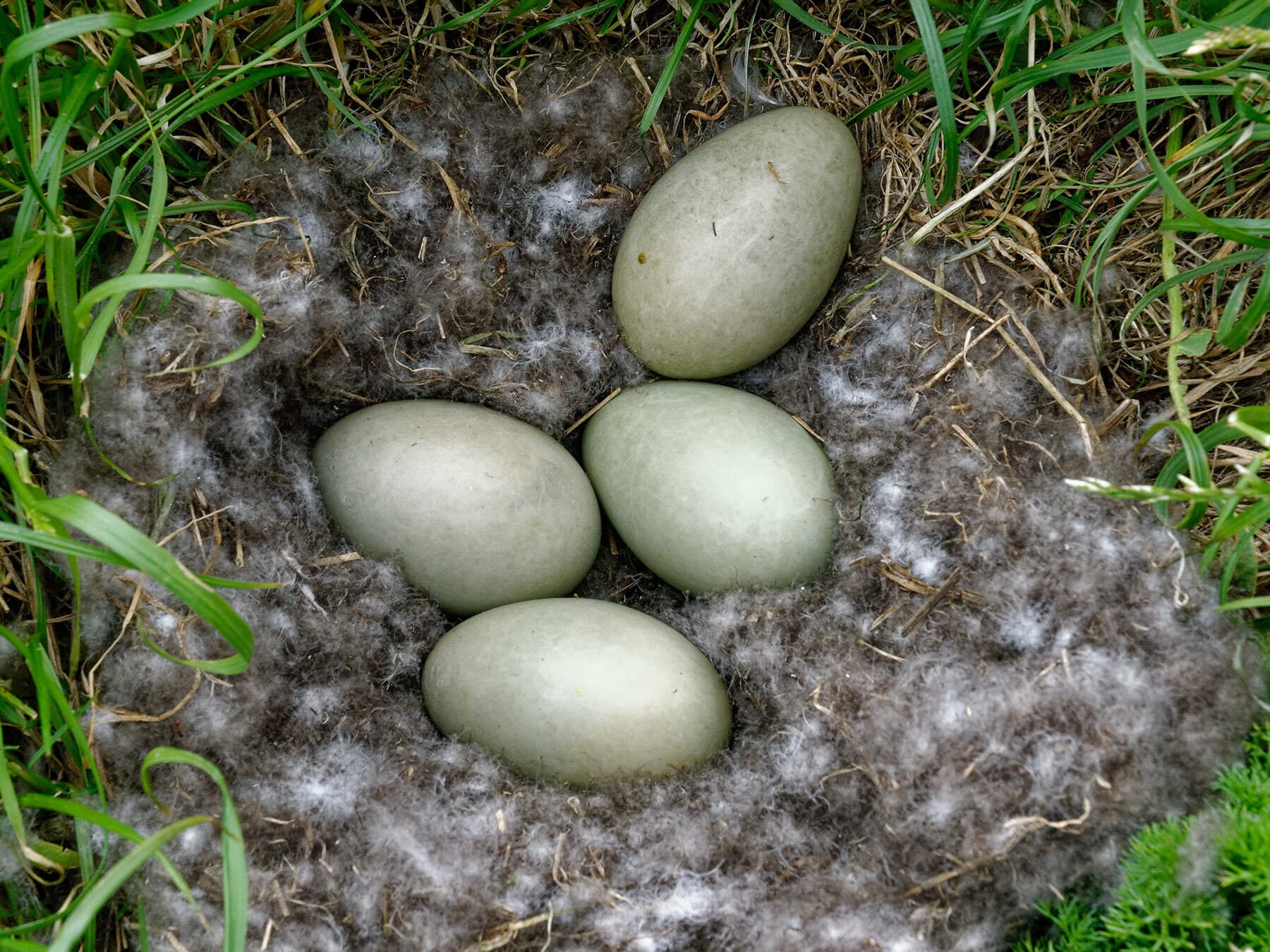
Female eiders line their nests with their own down feathers. The down provides excellent insulation to the eggs, and humans have been gathering these soft feathers from eider nests for centuries for use in blankets and clothing.
What do eider eggs look like?
Female eider ducks lay a single brood of 3-8 green, olive, or brownish eggs. Each egg measures 63-88mm (2.5-3.5in) in length, 47-56mm (1.9-2.2 in) in width, and 72-136g (2.5-4.8oz).
Do eiders mate for life?
Eiders do not usually mate for life, although they are monogamous for the duration of each breeding season and often for several consecutive seasons thereafter.
Behaviour
Are eiders aggressive?
Eiders are generally peaceful and rarely show any serious aggression outside of the breeding season. They usually resolve their issues using body language like lifting the chin or extending the neck. When fights do occur, the wings are the weapons of choice, and males may strike each other to establish dominance.
Lifespan and predators
How long do eiders live?
The oldest eider on record lived to 35.5 years, and the next oldest bird was a male from eastern Canada that lived to nearly 23 years. Most eiders will not live quite as long, however. The estimated lifespan of adult females in North America is approximately 7 years.
What are the predators of eiders?
Eider eggs and ducklings are vulnerable to several bird and mammal species. The following species commonly raid their nests:
- Corvids like crows and ravens
- Large gulls
- Red fox
- Arctic fox
Adult eider ducks have fewer natural enemies, although they can be particularly vulnerable when nesting and moulting. The following predators have been known to prey on adult eiders:
- Bald eagles
- Gyrfalcons
- Arctic fox
- Harbour seal
- Killer whale
Are eiders protected?
Eiders enjoy official protection in many parts of their range. They are protected by The Wildlife and Countryside Act of 1981 In the United Kingdom. In the United States of America, common eiders are protected under the 1918 Migratory Bird Treaty Act.
Are eiders endangered?
Common eiders have a global conservation status of ‘Near Threatened’. This means they are not officially endangered but are a species of concern due to declines in certain populations.
Conservation
Currently listed as Near Threatened globally, Eider populations face threats from oil spills, over-harvesting of eggs and down, and climate change impacts on Arctic breeding grounds. Conservation efforts focus on protecting breeding colonies and managing hunting practices.
More photos
2 photos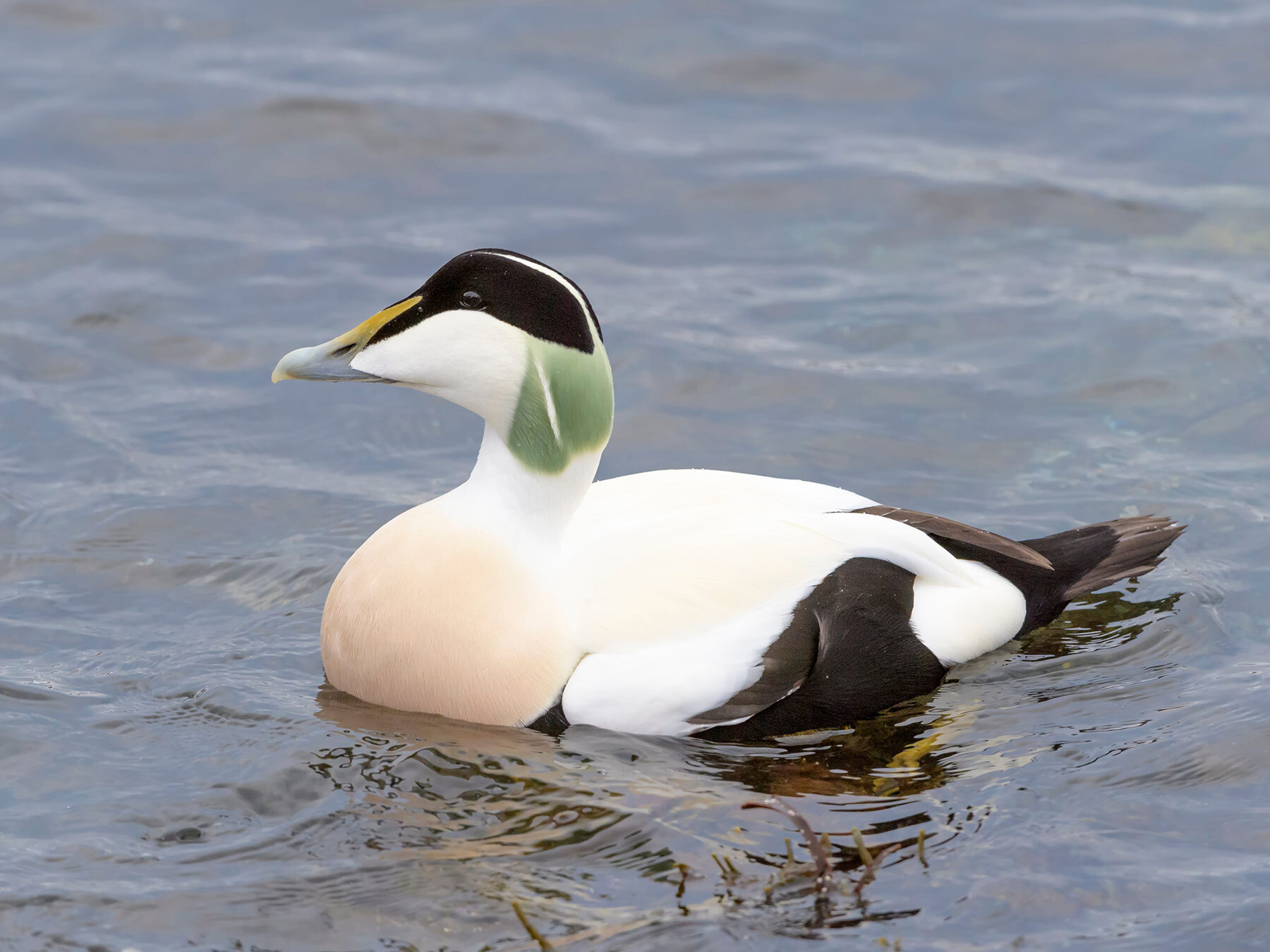
Eider guides
5 guidesQuick facts
- Length
- 50–71 cm
- Wingspan
- 80–108 cm
- Weight
- 1200–3000 g
- Lifespan
- 15–20 years
- Family
- Ducks, Geese & Swans
- Migration
- Partial migrant
- Global status (IUCN)
- Near Threatened
- World population
- 3,300,000 - 4,000,000 mature individuals
- Population trend
- Decreasing
- Also called
- Common Eider
- Scientific name
- Somateria mollissima
Questions
4How did the eider get its name?
The derivation of the eider's common name is obscure, but their scientific name is certainly appropriate. Somateria mollissima translates loosely as ‘very soft woolly body’.
Is eider a duck or goose?
They may be large but eiders are officially known as ducks and not geese.
How deep can eiders dive?
Adult eiders usually dive to depths of between 10m and 20m (33-66ft), although they have been recorded to reach depths of up to 42m (138ft).
How many eiders are in the wild?
The global population of eiders probably stands between three and four million individuals. There are an estimated 26,000 pairs of breeding eiders in the United Kingdom and a total of 60,000 individuals that overwinter each year.
About 40,000 common eiders breed in Maine and about 25,500 in Alaska, although the species breeds in much larger numbers in neighbouring Canada. About 181,000 individuals overwinter between Maine and Massachusetts.
Sources
3- 1BirdLife International. 2018. Somateria mollissima. The IUCN Red List of Threatened Species 2018: e.T22680405A132525971. Source (opens in a new tab)
- 2BirdLife International (2015) Source (opens in a new tab)
- 3Wetlands International (2012)

Checked by
Nathan Cope, founder and editor
Nathan founded Birdfact and leads its writers and contributors in the UK, the US and Canada. He has watched and studied birds for more than ten years, and checks every article and species guide before it’s published.