


California Quail
Valley Quail · Callipepla californica
By the Birdfact teamChecked by Nathan Cope
On this page15 sections
How to recognise it
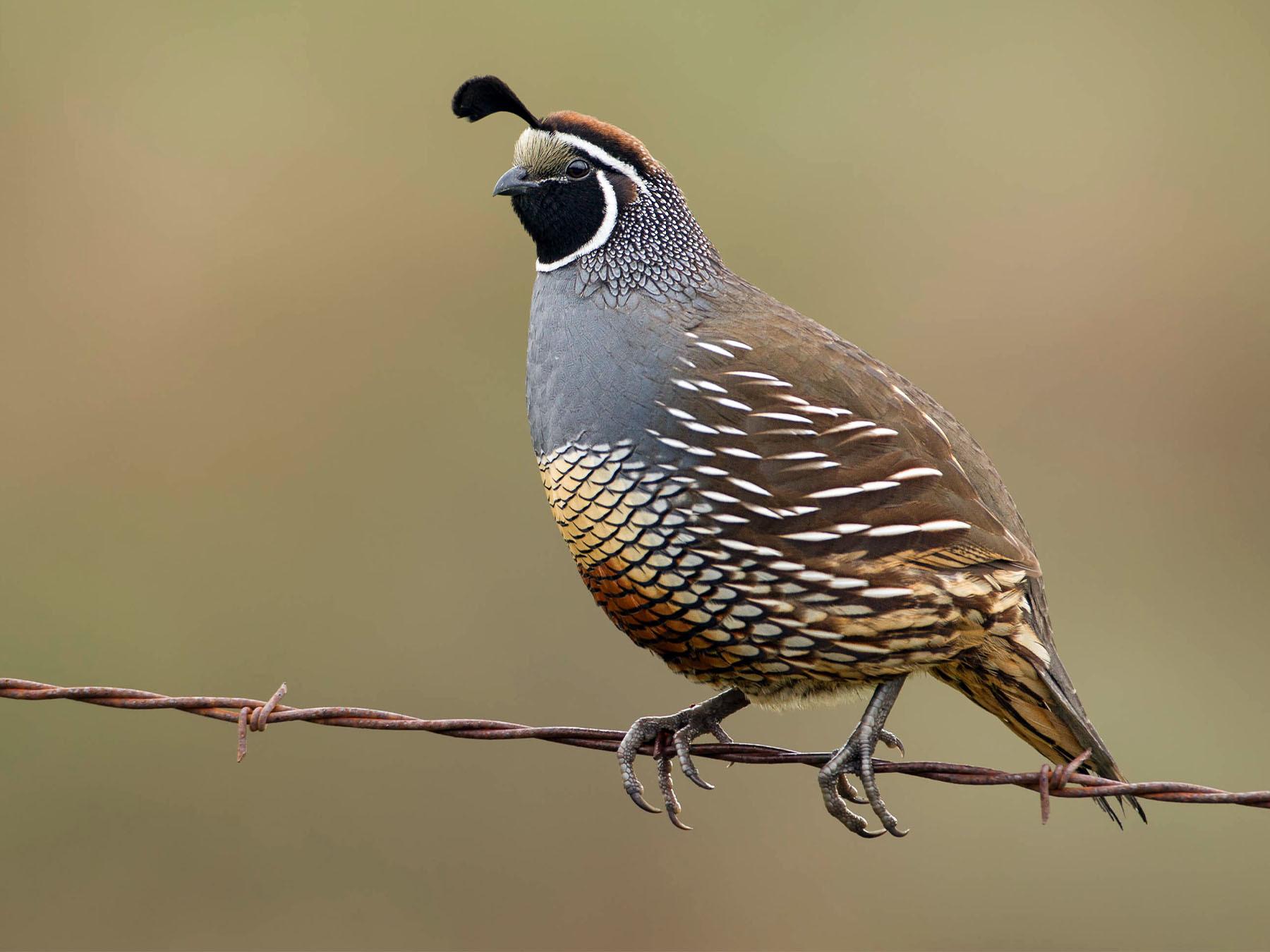
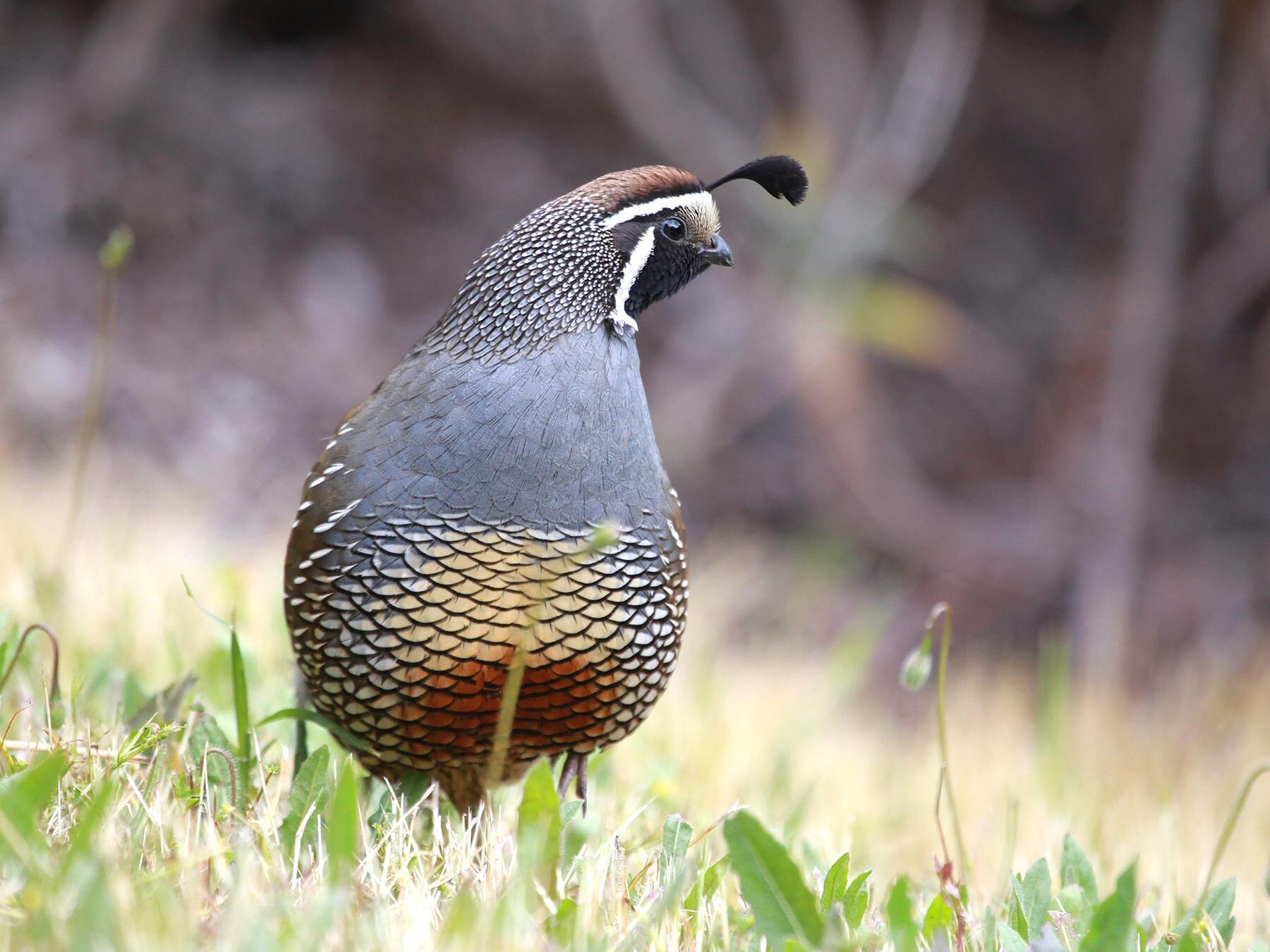
The California Quail is a plump, round-bodied quail of the western United States, about the size of a Northern Bobwhite, with a short neck, a small head and bill, short broad wings and a fairly long, square tail. Its signature is a teardrop-shaped plume that curls forward over the bill. It looks like one feather but is a stiff cluster of six overlapping black ones in the male.
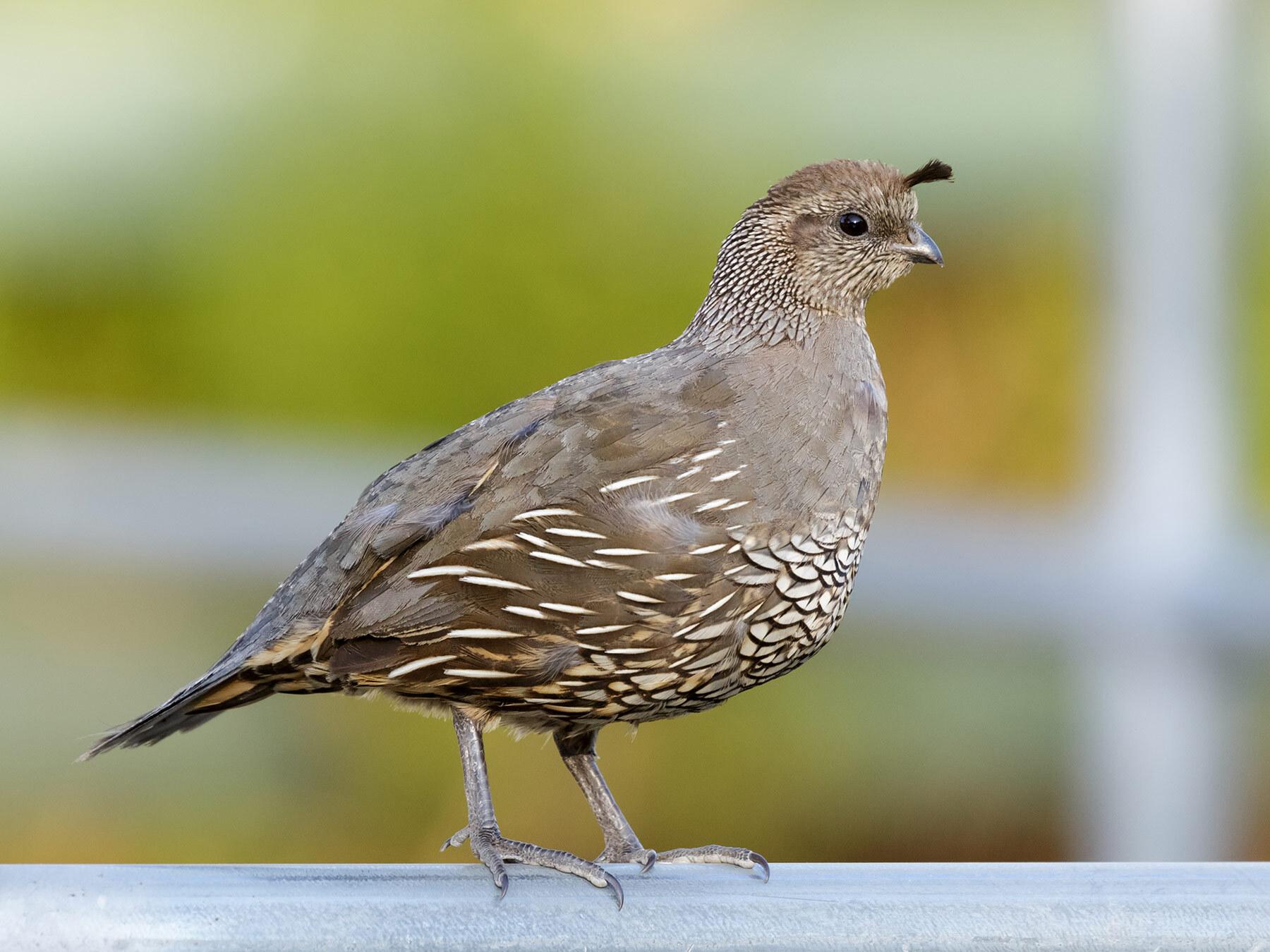
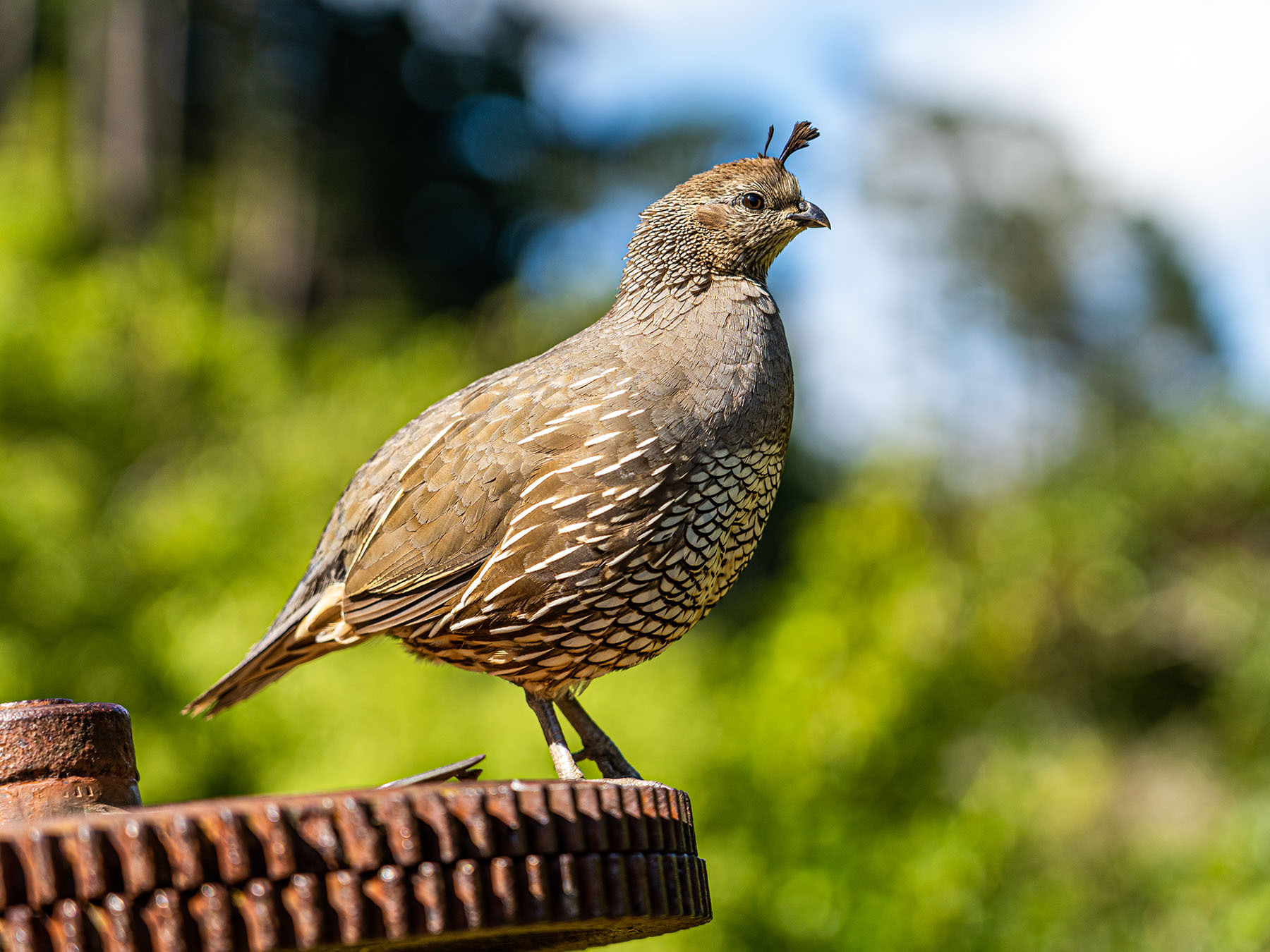
The male has a black face and throat outlined by a bold white stripe, a buff-yellow forehead and a brown patch on the back of the crown. His breast is bluish gray, his flanks are brown with white streaks, and his buffy belly is scaled by black feather edges, with a chestnut patch in the middle. The female is plainer: a gray-brown head with no black or white, a smaller plume, and the same scaled belly without the chestnut patch. Both sexes have gray bills, dark eyes and dark gray legs, look gray and brown at a distance, and are usually seen in groups running over open ground.
Size and weight
A California Quail is 9.4-10.6 in (24-27 cm) long, with a wingspan of 12.6-14.6 in (32-37 cm), and weighs 4.9-8.1 oz (140-230 g). Those are the field guides' ranges, and measured birds add detail. Museum specimens were 10.2-10.6 in (260-270 mm) long for males and 9.5-10.5 in (241-266 mm) for females; live quail caught in San Diego County averaged 6.6 oz (186.4 g) for 166 males and 5.7 oz (162 g) for 102 females; weight also swings with the season, since males lose at least a tenth of their peak weight by the end of breeding and females at least a fifth during incubation and brood care.1
Male, female and young birds
Once you know the male's face, the sexes are easy to tell. The female's plume is shorter as well as plainer: when fully grown, her longest plume is typically about 0.5-0.7 in (13-18 mm), a male's 1.1-1.5 in (28-38 mm).1
Chicks hatch in buffy-white down tinged with rust above, with a dark spot over each ear, a broad dark-brown patch on the back of the head and two black stripes down the back. Juveniles, seen from about May to September, look like the adult female but with a shorter, lighter brown plume, a gray-brown back mottled with white shaft streaks, and dull white bars on a pale gray-brown underside. The sexes show at about seven weeks, when black feathers appear below the eye of young males and brown ones below the eye of young females, and by fall most look like adults of their own sex.
Identification: telling it from other quail
Gambel's Quail is the one quail that looks much like it, and the two ranges may overlap in southeastern California, Utah and northwestern Mexico. In both sexes the California Quail has black scaling on the belly, brownish-gray rather than chestnut flanks and fine black markings on the neck. A male's crown is dull brown where a Gambel's is bright cinnamon, his belly patch is chestnut where a Gambel's is black, and his plume is shorter. Range often settles it: birders usually separate the two by where they are.
Higher in the hills is the Mountain Quail, whose reddish flanks carry broad white bars; the California Quail's flanks are gray-brown with white streaks, and its belly is scaled. The two share the lower slopes and thick chaparral west of the deserts, and the Mountain Quail moves uphill in summer.
Not sure it’s a California Quail? Check your photo: Birdfact names the bird and shows the look-alike side by side.
Its size
Adults- Length
- 24–27 cm
- Wingspan
- 32–37 cm
- Weight
- 140–230 g
Its song and calls
The California Quail has calls but no song. The one everybody learns is the assembly call, a loud three-syllable “cu-CA-cow” with the stress on the second note, which field guides often write as “Chi-ca-go.” Both sexes give it all year, mostly on spring and fall mornings and late in the afternoon, when a bird has lost touch with its group or mate, or when the covey is about to move. It can be repeated ten or more times, and an undisturbed covey answers an outside caller, even a person imitating it.
A male has a second call, a single “cow,” a longer version of the assembly call's final note, given from a high perch with his head thrown back at each note, one to ten times a minute in the early morning and late afternoon. In a dispute he gives a series of “squill” notes, and a mated male often overlays them on his mate's assembly call when they are apart. Soft contact calls (“ut-ut” within the covey, “mo-mo” from a parent to its chicks), a fast “pit-pit” alarm and the whirr of wings on flushing are among the others.
The calls are thought to be inherited rather than learned. Where California and Gambel's Quail meet, hybrids give calls in between, and males answered a calling female of the other type as readily as one of their own.2
Our player holds two recordings from California. “Calls” is a short run from Riverside County on March 4, 2020, which shows about a dozen arched notes, mostly in threes, on the spectrogram, the pattern the books call the assembly call. “Call” is a longer clip from El Cajon on May 16, 2024, with three single loud notes, which the recordist logged as a solo male.
- Calls0:00 / 0:06
Recorded in California, United States · March 2020
- Call0:00 / 0:21
Recorded in California, United States · May 2024
Heard one and not sure? Let the bird song identifier listen.
When and where to see it
November
Here all year
The year across North America
Choose a place on the map to see its year, or find yours.
Most recorded in November
Up to 1.3% of a place’s bird records that monthHere in other months
How this map is made
Each county, state or province is shaded by the California Quail’s share of all the bird records there that month: the darker, the larger the share. A place with only a trace of records in a month is left unshaded. Shades compare places on this map with each other, not one bird with another. Records: GBIF eBird Observation Dataset, 2019–2024. Map: Natural Earth; place centres © OpenStreetMap contributors.
How often the California Quail turns up in the United States and Canada through the year, from birdwatchers' records.
United States
Resident · all year · most records in June
Canada
Resident · all year · most records in December
Show as a table
| Month | United States | Canada |
|---|---|---|
| January | 0.087% (regular) | 0.077% (regular) |
| February | 0.083% (regular) | 0.078% (regular) |
| March | 0.093% (regular) | 0.084% (regular) |
| April | 0.11% (regular) | 0.080% (regular) |
| May | 0.11% (regular) | 0.062% (regular) |
| June | 0.14% (regular) | 0.078% (regular) |
| July | 0.12% (regular) | 0.076% (regular) |
| August | 0.11% (regular) | 0.075% (regular) |
| September | 0.11% (regular) | 0.068% (regular) |
| October | 0.100% (regular) | 0.068% (regular) |
| November | 0.096% (regular) | 0.076% (regular) |
| December | 0.11% (regular) | 0.11% (regular) |
Worldwide: recorded regularly in 8 countries
Countries where it was recorded in at least 3 of the 6 years 2019–2024. Linked countries have their own bird list.
Data: EOD – eBird Observation Dataset (Cornell Lab of Ornithology), accessed via GBIF.org, CC BY 4.0. Records from 2019–2024, aggregated and filtered by Birdfact. How these lists are made
This is a bird of brushy country with open ground nearby. Its home runs from southern Oregon through most of California, apart from the deserts and the high mountains, to the tip of Baja California, from sea level up to about 8,500 ft (2,590 m). Chaparral, sagebrush and coastal scrub, oak woodland edges, grassland and streamside growth all suit it, as long as there is cover to roost, hide and rest in, water, and bare or broken ground to feed on. It is missing from the intensively farmed Central Valley, the higher Sierra Nevada and the southeastern deserts, where Gambel's Quail takes over.1
It can do well around people where shrubs and open ground remain. Backyards, city parks, golf courses and lightly farmed land all hold coveys where shrubs are close by. In a study that modeled eBird records for urban parks across the native range, a park had a 0.23 chance of holding quail, higher in larger parks that were less cut off, with more shrub and less paving.3 The best times to look are morning and late afternoon, when coveys feed in the open, and a male is often posted on a fence, a roof or a bush top.

Where else it lives
It has been released widely, in North America and abroad. Bent quoted a second-hand account of shipments turned out near Puget Sound as early as 1857.4 Other releases came in Nevada in 1862, near Victoria, British Columbia, in 1860-61, in Utah from 1869 and in Idaho in 1879, while Oregon's Willamette Valley has no authenticated record before the release of 1914.1, 5 Attempts in Texas, New York and Maryland, among other places, did not take hold.
Overseas it was released in Hawaii before 1855, in New Zealand in 1862 and in Chile in 1864; it is established in Argentina too, and the Chilean stock has since been taken back to California.1, 6 In New Zealand, where it is called tikaokao, coveys of more than 100 were frequent in 1920s Canterbury, whereas a covey of more than 20 is now unusual.7
Do they migrate?
No. It is resident, and most birds stay within a home range, though banding returns have come from up to 11 mi (18 km) away, and a move of up to 5 mi (8 km) in a year is not unusual. Pairs or small groups sometimes shift up or down a slope before nesting if conditions are poor, and in southern California quail moved uphill and eastward over 26 years, perhaps as the climate warmed.1
Tips for seeing it
What it eats
Mostly plants. On average about 70% of the food is the seeds and green leaves of legumes such as lotus, clover and lupines, and of annual grasses, with fruit and seeds of redberry, manzanita, buckbrush, poison oak and California buckwheat, grain, flowers, buds and some acorns. Seeds dominate outside the rainy season and leaves during it. Animal food is only a few percent, 1-6%, including ants, beetles, true bugs, snails and millipedes; chicks under three weeks eat much more of it, and by 13-16 weeks a young bird eats what an adult does.1 In a Biological Survey examination of 619 stomachs, 97% of the food was plant matter and 62.5% was seeds, and in western Oregon crops legumes were 67% of the diet by dry weight and invertebrates 1%.4, 5
It feeds mostly on the ground, scratching up seeds, hopping up at flowers and buds, and cracking acorns, and it climbs into shrubs and trees for berries. Birds outside the breeding season feed twice a day, for about an hour just after dawn and again from late afternoon to dusk, and spend the middle of the day in shade.
Water matters in sustained heat and drought, but in cool weather a quail can go without drinking if insects and succulent plants are available. Thousands of artificial water stations, called guzzlers, have been installed in California, and they have extended the range locally.1
Feeders and yards
Quail visit ground and platform feeders in winter for cracked corn, millet, sunflower seed, oats, nyjer and milo.8 To attract them, scatter seed on the ground with dense shrubs close by, where the birds can run for cover.

Nesting and breeding
Coveys begin to break up in late winter, and pairs form inside the covey; it can take about two months before every bird is paired. Courtship includes feeding: a bird picks up a morsel, sometimes calling “tu-tu,” and offers it to a bird of the other sex. Laying starts in early April in southern California and in late May or early June in northern California and the Great Basin, and hatching runs from late May to August.1 Rain sets the pace. Over 25 years on unhunted Santa Cruz Island, where the quail were introduced, January-March rainfall explained 76% of the variation in breeding success.1 A 1976 study found that in a dry year the leaves of small desert annuals carry plant chemicals that apparently suppress breeding, while in a wet year they are largely absent and quail breed prolifically.9
The nest and eggs
The female chooses the site and builds the nest, a scrape lined with grass and weed stems on the ground, well hidden under grass, shrubs, brush, rocks or logs. Of 96 California nests in one study, 52% were in dry grass, weeds and dead brush.1 The nest is about 5.1-7.1 in (13-18 cm) across and 0.8-1.6 in (2-4 cm) deep, and now and then a bulkier one is built in a brush pile or a tree. More about the site, the eggs and the young is in our California Quail nesting guide.
The eggs are white to off-white with brown splotches, about 1.2 in (31 mm) long. In one California population clutches averaged 10.97 eggs (1-21, from 40 nests) and in British Columbia's introduced birds 11.96 (1-26, from 76 nests), and the largest may come from dump nests, where several females lay in one nest. Field guides give higher typical clutches, 12-16 or 13-14 eggs.1, 10, 4 A female lays about three eggs every four days, and laying a full clutch takes about 20 days. She starts incubating when it is complete, for 22-23 days, usually doing all of it herself while the male stands sentinel. The chicks click and call from inside the eggs, and the clutch hatches almost at once.
Chicks and young
Chicks hatch covered in down and follow their parents away from the nest soon after, pecking at food at once. For the first two weeks they cannot keep themselves warm, so the female broods them at night and early in the morning. Short flights come by about two weeks, though one field guide says 10 days.1, 10 Young birds are fully independent at about three months, when families merge into coveys.


Broods sometimes mix: the young of two or more females and their mates can end up in one group, and in the hybrid zone with Gambel's Quail such mixed broods appear to form the core of the winter covey. One brood a year is usual. In productive years a female may leave her first brood with one male and hatch a second with another, though the handbook's population section calls double-brooding rare.1 Not every young bird in a group is the offspring of the adults with it. In a preliminary three-marker study, both males and females were excluded as parents of some young, more often females in groups with more than one female.11
Many nests fail. In one year of nest-watching on foothill rangeland in Madera County, 17 of 96 nests were successful, predators destroyed 54 of them (30 to ground squirrels), and a quarter or more of the chicks are gone within two weeks.12, 1
Behaviour
A California Quail tends to run rather than fly. When it does fly, the flight is short and fast, a whirr of wings that carries the bird into cover, and a longer flight can exhaust it. A day runs from a feed just after dawn through a midday rest in shade, with dust-bathing, to a second feed and the roost. At dusk assembly calls draw the covey together, and it roosts in a group above the ground, in oaks, junipers, conifers, cacti, orange trees, blackberry or eucalyptus.

Coveys post a sentinel. One bird, usually a male, sits on a high perch above the group giving contact and alarm calls, and while the female incubates he keeps watch from a perch. A 1903 observer in Placer County, California, watched a flock of 37 in the spring of 1901 and saw one bird stand on a low branch while the others fed, then another take over about a quarter of an hour later; he preferred to “leave the question open.”13
Social life: coveys and pairs
Outside the breeding season coveys average 27 to 73 birds, and one grain-supplemented site held 800 to 1,400. Small groups forage by day and rejoin the larger covey at dusk. A bird that has been away up to 7 days is readmitted at once, but one away for 38 days or more is at first driven off.1
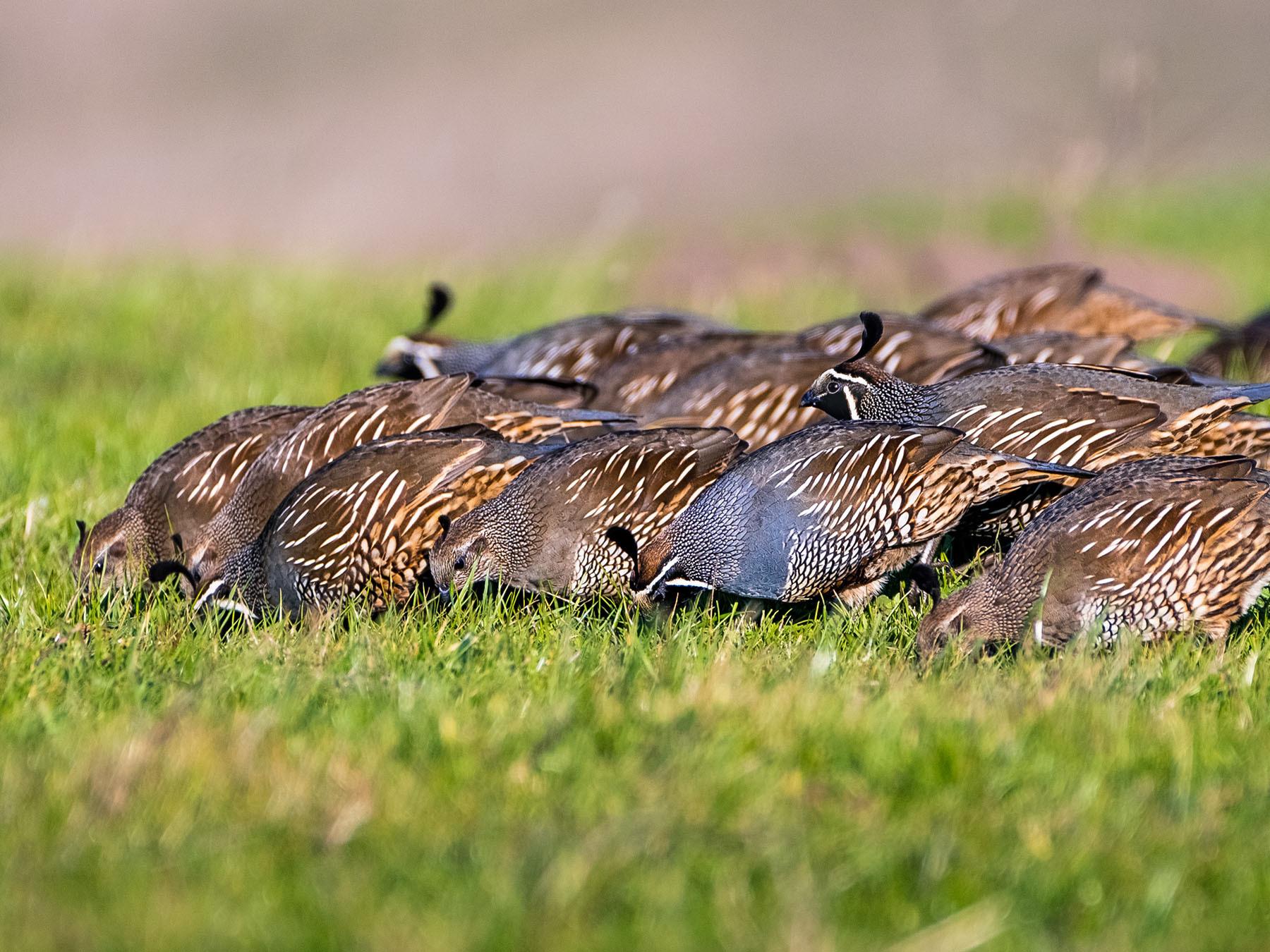
Pairing is flexible. Adult males outnumber females, at 54-65% of adults. In a San Diego study, most birds were socially monogamous in a year when 55% of adults were male, while in a year with 65%, some females had several mates in turn or at once, and solo males that called to advertise sired none of the young that season.1

Social life across the Gambel's Quail zone
Where the two ranges meet in southeastern California, California and Gambel's Quail interbreed often. In 1885 H. W. Henshaw recorded two shot birds from the San Gorgonio Pass area as hybrids, the first record in the papers we read.14 Wild pairing in the zone is random with respect to species, inside coveys made of several families, even though captive birds can tell the two apart, and pairs formed inside the home covey bred earlier and more successfully.15 The zone stayed put over five years of study, tied to a band of vegetation, rainfall and temperature, with genes, plumage and body size all changing together across it.16 Social ties matter more than ancestry: in a hybrid population, how strongly birds associated, rather than how closely they were related, predicted who raised young together.17 It has also hybridized with the Mountain Quail in its native range, and with Scaled Quail and Northern Bobwhite where it has been introduced.1
Lifespan and predators
In one study of an unhunted population, the oldest bird caught was 6.5 years old, and life tables give a mean annual mortality of about 74%.1 The Bird Banding Lab's longevity tables, checked in November 2026, return no California Quail record, so we quote none; a figure of 6 years 11 months printed elsewhere is not in them.18 Two researchers worked the arithmetic in 1945 for one population they watched: with adult winter mortality of about 7% a month, a covey of 30 adults in October would hold about 12 of them a year later, with young birds making up the numbers.12
Predators and other dangers
Predation is thought to be the main cause of death at every stage. The Cooper's Hawk is the likely key predator: quail were in 12% of 25 Cooper's Hawk stomachs and 17% of 41 prey items counted at nests.1 Sharp-shinned Hawks hunt quail too, and so do Northern Harriers, American Kestrels and ravens (mostly taking chicks and young); coyotes, bobcats, rattlesnakes and weasels take some. Quail answer with a sentinel, alarm calls, a run or a flush into cover, or by freezing silent for up to an hour.
Weather and disease matter too. A British Columbia population lost 70% of its birds in an unusually snowy winter, and chicks are sensitive to damp and cold in their first week; blood parasites infected between none and 97% of birds, depending on the place, and coccidia, a gut parasite, infect most birds and can kill chicks.1 Quail infected with West Nile virus tend not to die of it. In a study of California and Gambel's Quail together, quail were less competent hosts for West Nile virus and may act as dead-end hosts for it.19
Conservation
The California Quail is rated Least Concern, and Partners in Flight put the population at about 5.8 million for around 2010, 3.4 million of them in the United States and Canada.20, 21 Which way numbers are heading depends on the window. The Breeding Bird Survey, which also counts introduced populations in Washington, Idaho, Utah and British Columbia, shows that: from 1968 to 2025 the survey-wide index rose by 0.60% a year (95% credible interval +0.05 to +1.16), a small rise that only just excludes zero. From 2005 to 2025 it fell by 1.01% a year (-1.84 to -0.14), from an index peak near 8.9 birds a route in 2005, and from 2015 to 2025 it rose by 1.59% a year (+0.03 to +3.19). California's own long-term trend, +0.54% a year (-0.18 to +1.25), spans zero.22 California's wildlife department, reviewing survey data to 2013, described a boom-and-bust bird whose numbers peaked in the early 1990s, fell in the early 2000s, rebounded and were falling again.23
Quail were trapped for food and sold in city markets through the 1800s. A 1918 account that Bent quotes says that in 1881 and 1882 more than 32,000 dozen quail reached San Francisco from the Los Angeles and San Bernardino county areas, and that by 1885 the hunting no longer paid because quail had become scarce.4 Genetic data suggest that this left little lasting mark: whole-genome sequences show no decline in the birds' effective population size until late in the 20th century, and point to climate and landscape change.24 Habitat change has mattered too: the Central Valley lost 89-99% of its suitable habitat, and of 34 habitat fragments in San Diego County, 9 lost their quail between 1987 and 1997 while none gained any; predator control, private refuges and restocking were all unsuccessful, while habitat work helps.1
Hunters' reports are one more gauge, with limits. California's survey of hunters estimated 221,633 California quail taken in 2023-2024 (161,432 to 281,834), 57% below the 24-year average, but only 4.9% of surveyed hunters replied, the report says it may be overestimating, and license sales keep falling.25
Legal status
The Migratory Bird Treaty Act's federal list of covered species leaves out the California Quail, so the Act's rules do not apply to it.26 It is a resident game bird, hunted under state licenses and seasons that each state sets.1 Oregon's harvest estimate shows it is hunted there too.27 British Columbia designates it a game bird, and in New Zealand it is a game bird in Schedule 1 of the Wildlife Act, hunted in an open season by license holders.28, 29
Names and history
In 1798 George Shaw named it Tetrao californicus, working from specimens brought home by Archibald Menzies on Captain Vancouver's voyage. Monterey is the likely place and December 1792 the likely date, and the two original specimens, long believed lost, resurfaced in a Nottingham museum in 2004.30 Callipepla means “beautifully clad.”
Bent used two names for two races, “California Quail” for the coastal type and “Valley Quail” for the widespread inland form.4 California's state code still calls it the “California valley quail” and names it the official state bird, in the Government Code of 1943; the Secretary of State dates the designation to 1931.31, 32 In July 2000 San Francisco made it the city's official bird, by which time development and brush clearing had left only a few small populations of a bird that was plentiful across the city in the 1920s.33
More photos
2 photos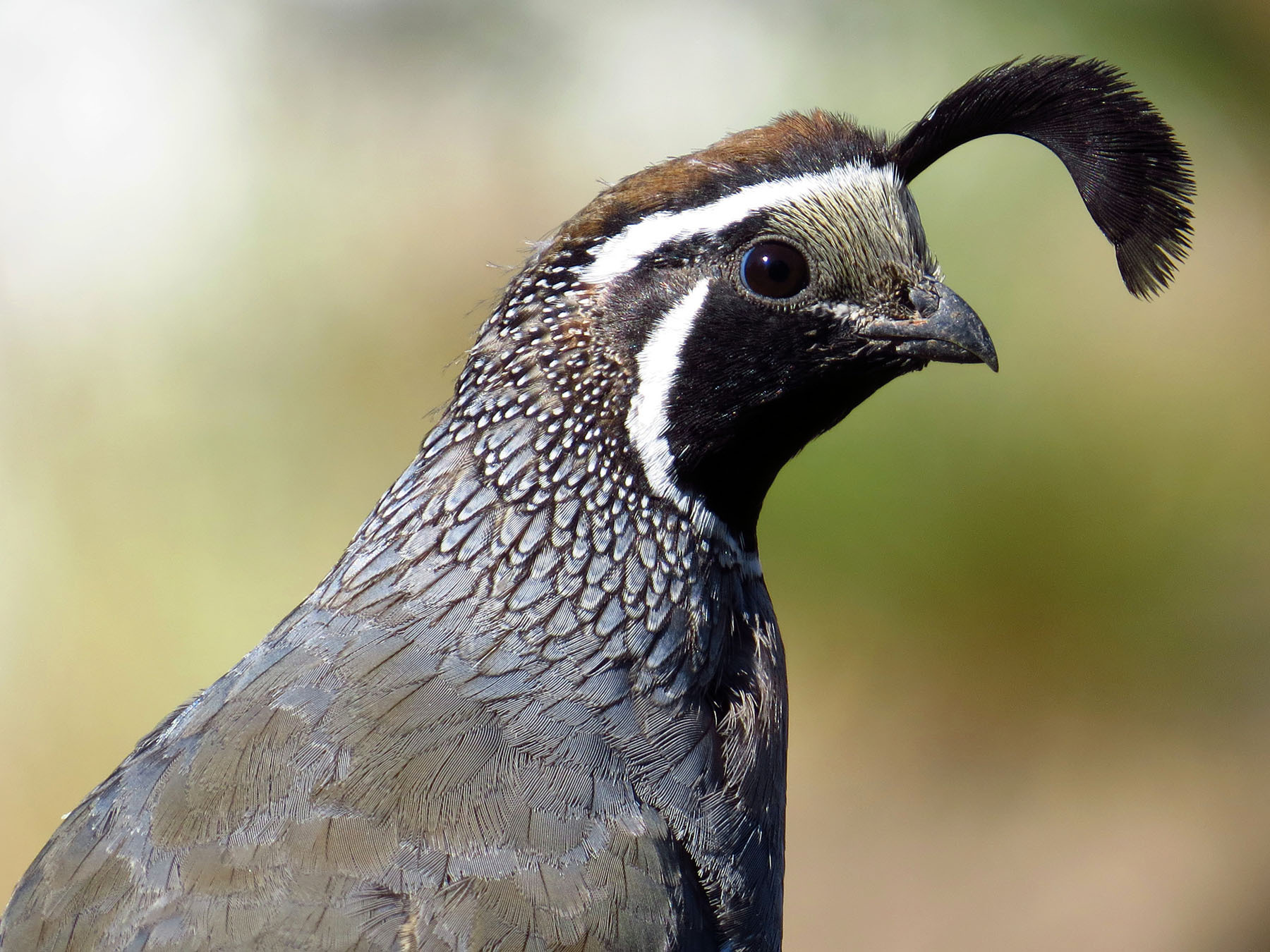
California Quail guides
1 guidesQuick facts
- Length
- 24–27 cm
- Wingspan
- 32–37 cm
- Weight
- 140–230 g
- Family
- New World Quails
- Migration
- Resident
- Global status (IUCN)
- Least Concern
- World population
- About 5.8 million (Partners in Flight, around 2010)
- Population trend
- A small long-term rise in Breeding Bird Survey counts since 1968; counts fell from the 2005 peak and have risen since 2015; the survey also counts introduced populations
- Also called
- Valley Quail
- Scientific name
- Callipepla californica
Questions
2Do California Quail mate for life?
Not necessarily. Pairs tend to remate if both birds survive, but a bird may lose its mate, and females sometimes pair with more than one male in a season.
What is the plume for?
Probably a signal. A male holds his plume erect while giving aggressive calls and flat against his head in a chase, and in captive tests females preferred males with longer plumes.
Sources
36- 1Calkins, J. D., Gee, J. M., Hagelin, J. C. and Lott, D. F. (2020). California Quail (Callipepla californica), version 1.0. Birds of the World (A. F. Poole, editor). Cornell Lab of Ornithology. doi:10.2173/bow.calqua.01 (opens in a new tab)
- 2Gee, J. M. (2005). No species barrier by call in an avian hybrid zone between California and Gambel's Quail. Biological Journal of the Linnean Society 86(2): 253-264. doi:10.1111/j.1095-8312.2005.00538.x (opens in a new tab)
- 3Iknayan, K. J. et al. (2022). What makes urban parks good for California quail? Evaluating park suitability, species persistence, and the potential for reintroduction into a large urban national park. Journal of Applied Ecology 59(1): 199-209. doi:10.1111/1365-2664.14045 (opens in a new tab)
- 4Bent, A. C. (1932). Life histories of North American gallinaceous birds. U.S. National Museum Bulletin 162. Accessed 17 November 2026. Source (opens in a new tab)
- 5Crawford, J. A. (1993). California quail in western Oregon: a review. Quail III: National Quail Symposium (Kansas Department of Wildlife and Parks). doi:10.7290/nqsp0391z3 (opens in a new tab)
- 6Andrews, B., Zurita, C. and Jaksic, F. M. (2023). The California Quail (Callipepla californica) in Chile and Argentina: introduction history, current distribution, and biological features. Revista Chilena de Historia Natural 96(1): 2. doi:10.1186/s40693-023-00115-3 (opens in a new tab)
- 7Leary, S. (2013). California quail. New Zealand Birds Online. Accessed 17 November 2026. Source (opens in a new tab)
- 8Cornell Lab of Ornithology. Common Feeder Birds: California Quail. Project FeederWatch. Accessed 17 November 2026. Source (opens in a new tab)
- 9Leopold, A. S., Erwin, M., Oh, J. and Browning, B. (1976). Phytoestrogens: adverse effects on reproduction in California Quail. Science 191(4222): 98-100. doi:10.1126/science.1246602 (opens in a new tab)
- 10National Audubon Society. California Quail. Guide to North American Birds. Accessed 17 November 2026. Source (opens in a new tab)
- 11Calkins, J. D. (2007). The family behavior of California Quail: a molecular analysis. The Condor 109(4): 962-967. doi:10.1093/condor/109.4.962 (opens in a new tab)
- 12Emlen, J. T., Jr. and Glading, B. (1945). Increasing Valley Quail in California. University of California Agricultural Experiment Station Bulletin 695. Accessed 17 November 2026. Source (opens in a new tab)
- 13Williams, J. J. (1903). On the use of sentinels by Valley Quail. The Condor 5(6): 146-148. doi:10.2307/1361220 (opens in a new tab)
- 14Henshaw, H. W. (1885). Hybrid quail (Lophortyx gambeli x L. californicus). The Auk 2(3): 247-249. doi:10.2307/4625253 (opens in a new tab)
- 15Gee, J. M. (2003). How a hybrid zone is maintained: behavioral mechanisms of interbreeding between California and Gambel's Quail (Callipepla californica and C. gambelii). Evolution 57(10): 2407-2415. doi:10.1111/j.0014-3820.2003.tb00252.x (opens in a new tab)
- 16Gee, J. M. (2004). Gene flow across a climatic barrier between hybridizing avian species, California and Gambel's Quail. Evolution 58(5): 1108-1121. doi:10.1111/j.0014-3820.2004.tb00444.x (opens in a new tab)
- 17Zonana, D. M., Gee, J. M., Breed, M. D. and Doak, D. F. (2021). Dynamic shifts in social network structure and composition within a breeding hybrid population. Journal of Animal Ecology 90(1): 197-211. doi:10.1111/1365-2656.13314 (opens in a new tab)
- 18USGS Bird Banding Laboratory. Longevity records of North American birds: California Quail (AOU 2940). Bird Banding Laboratory, Bander Portal longevity tables. Accessed 17 November 2026. Source (opens in a new tab)
- 19Reisen, W. K., Martinez, V. M., Fang, Y., Garcia, S., Ashtari, S., Wheeler, S. S. et al. (2006). Role of California (Callipepla californica) and Gambel's (C. gambelii) quail in the ecology of mosquito-borne encephalitis viruses in California, USA. Vector-Borne and Zoonotic Diseases 6(3): 248-260. doi:10.1089/vbz.2006.6.248 (opens in a new tab)
- 20BirdLife International (2021). Callipepla californica (Shaw, 1798). The IUCN Red List of Threatened Species 2021: e.T22679603A138739529. doi:10.2305/IUCN.UK.2021-3.RLTS.T22679603A138739529.en (opens in a new tab)
- 21Partners in Flight (2024). Avian Conservation Assessment Database, version 2024.05.23 (global). Partners in Flight. Accessed 17 November 2026. Source (opens in a new tab)
- 22Hostetler, J. A. et al. (2026). The North American Breeding Bird Survey, Analysis Results 1966-2025. U.S. Geological Survey data release. doi:10.5066/P1OSNSFC (opens in a new tab)
- 23Miller, K. S., Meshriy, M. G. and Gardner, S. S. (2017). Population trends and a revised management plan for quail in California. National Quail Symposium Proceedings 8. Accessed 17 November 2026.
- 24Benham, P. M., Cicero, C., Davila, M. M., Enbody, E. D., Miller, K. S., Shultz, A. J. et al. (2025). Patterns of genetic diversity within three California quail species are best explained by climate and landscape changes. Molecular Ecology 34(20): e70093. doi:10.1111/mec.70093 (opens in a new tab)
- 25Dwight, S. et al. (2024). Upland Game Bird Harvest Survey 2023-2024. California Department of Fish and Wildlife. Accessed 17 November 2026. Source (opens in a new tab)
- 26U.S. Government (2026). 50 CFR 10.12 and 10.13: Migratory Bird Treaty Act definitions and list of protected birds. Electronic Code of Federal Regulations. Accessed 17 November 2026. Source (opens in a new tab)
- 27Oregon Department of Fish and Wildlife (2025). 2024-25 Upland Game Bird Harvest by Area. ODFW. Accessed 17 November 2026. Source (opens in a new tab)
- 28Province of British Columbia (2026). Wildlife Act, Designation and Exemption Regulation, B.C. Reg. 168/90, section 14. BC Laws. Accessed 17 November 2026. Source (opens in a new tab)
- 29Department of Conservation (New Zealand). Wildlife Act 1953. doc.govt.nz. Accessed 17 November 2026. Source (opens in a new tab)
- 30Prys-Jones, R. P., Russell, D. G. D. and Wright, S. (2014). Rediscovery of the syntypes of California Quail Tetrao californicus Shaw, 1798, and comments on the current labelling of the holotype of California Condor Vultur californianus Shaw, 1797. Bulletin of the British Ornithologists' Club 134(4): 286-290. Accessed 17 November 2026. Source (opens in a new tab)
- 31State of California (1943). Government Code section 423 (State Seal, Flag and Emblems). California Legislative Information (Internet Archive copy taken 6 Jan 2026). Accessed 17 November 2026. Source (opens in a new tab)
- 32California Secretary of State. State Emblems. ca.gov. Accessed 17 November 2026. Source (opens in a new tab)
- 33City and County of San Francisco (2004). Quail Recovery Plan for the City of San Francisco, final. San Francisco Department of the Environment. Accessed 17 November 2026. Source (opens in a new tab)
- 34Cornell Lab of Ornithology. California Quail. All About Birds. Accessed 17 November 2026. Source (opens in a new tab)
- 35eBird. California Quail. eBird species page. Accessed 17 November 2026. Source (opens in a new tab)
- 36AviList Core Team (2025). AviList: the global avian checklist, v2025b. AviList. Accessed 17 November 2026. Source (opens in a new tab)

Checked by
Nathan Cope, founder and editor
Nathan founded Birdfact and leads its writers and contributors in the UK, the US and Canada. He has watched and studied birds for more than ten years, and checks every article and species guide before it’s published.