


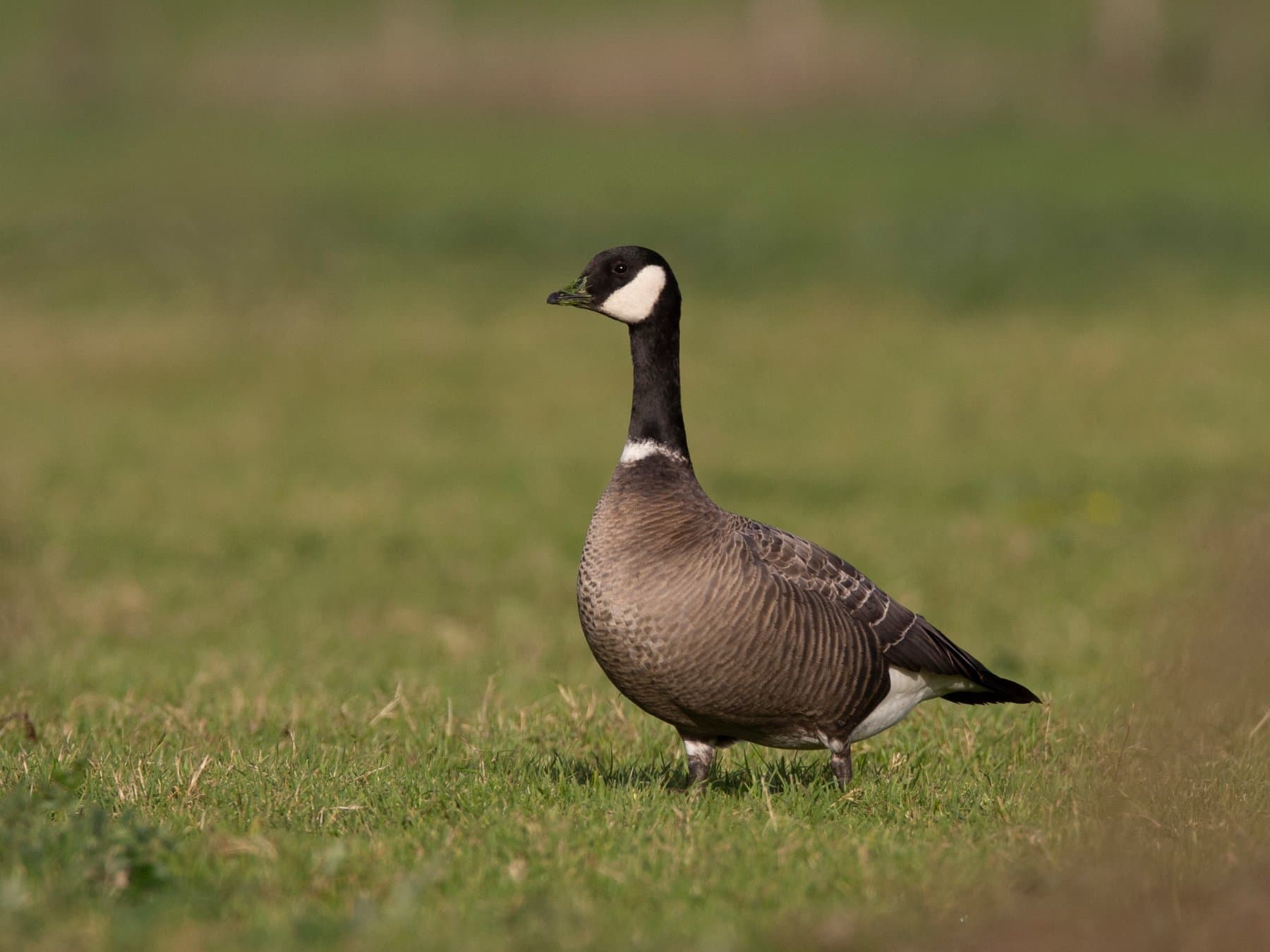
Cackling Goose
Branta hutchinsii
By the Birdfact teamChecked by Nathan Cope
Barely larger than a Mallard in its smallest form, the Cackling Goose is the pint-sized doppelgänger of the Canada Goose — so similar that ornithologists lumped the two together for over a century before the American Ornithologists' Union finally split them as separate species in 2004. Named for its distinctive high-pitched, yelping cackle, this compact tundra breeder migrates in flocks of thousands across North America, and turns up as a sought-after vagrant on the western shores of Britain and Ireland.
On this page13 sections
How to recognise it
Stubby-billed, steep-foreheaded, and noticeably short in the neck, the Cackling Goose wears its differences from the Canada Goose on its face — if you know what to look for. These three features together are the quickest way to separate it from its larger cousin in the field. Body plumage is greyish-brown, with individual feathers tipped in pale tan to give a scalloped effect across the upperparts. The breast, belly, sides, and flanks are grey-brown; the rump is blackish; the upper tail coverts are white; and the tail itself is black. The undertail coverts are white.
The head and neck are jet black, broken by a bold white chinstrap — a cheek patch that extends upward on each side to behind the eye. The bill, legs, and feet are uniformly black. There is no seasonal variation in plumage; the bird looks the same in January as it does in July.
Considerable variation exists across the four subspecies. Darkest of the four, minima often shows a purplish cast to the breast and usually lacks a white neck collar entirely. A bold, usually complete white neck collar marks leucopareia (Aleutian), which also has a somewhat square head profile. The hutchinsii (Richardson's) subspecies is small and pale, sometimes with a silvery cast to the upperparts and a narrow or diffuse white neck collar. Largest and palest of all, taverneri (Taverner's) is the most similar to the Lesser Canada Goose, with a rounder head. Juveniles resemble adults but may show duller, less distinct white cheek patches.
Females are virtually identical in plumage to males and cannot be reliably distinguished in the field by appearance alone — though females are slightly lighter in weight and have a distinctly higher-pitched voice.
Not sure it’s a Cackling Goose? Check your photo: Birdfact names the bird and shows the look-alike side by side.
Its size
Adults- Length
- 53–76 cm
- Wingspan
- 108–111 cm
- Weight
- 1130–2860 g
Its song and calls
The Cackling Goose is named for its voice, and the name is apt. In the smaller subspecies — leucopareia and minima — the call is a rapid, high-pitched yelping that sounds utterly unlike the deep resonant honk of the Canada Goose. Audubon's field guide describes it as a higher "alto" honk compared to the Canada Goose's "tenor" — a useful musical analogy. In the larger subspecies — hutchinsii and taverneri — the call is also higher-pitched than the Canada Goose's, but less dramatically so, which can make identification by ear alone more challenging for these birds.
Females have a distinctly higher-pitched voice than males, a difference audible at close range and useful for sexing birds in the field. Both sexes call frequently, and the species is highly vocal in flight and when large flocks are settling or taking off. Flocks of hundreds or thousands of birds produce a continuous, loud cackling chorus that carries a great distance — quite different from the deeper clamour of a Canada Goose flock.
Calls serve multiple functions: maintaining cohesion within flying flocks, communication between family members, alarm signalling when a predator is detected, and territorial defence at the nest. The "triumph ceremony" display involves both members of a pair calling in unison with necks outstretched and wings partly open. Threat displays are accompanied by hissing — a low, sustained sound produced with the bill open and tongue raised, used against both predators and rival geese.
Heard one and not sure? Let the bird song identifier listen.
When and where to see it
OctoberArriving
Most recorded in October
- 1. Argyll and Buteunder 0.1%
- 2. Sligounder 0.1%
- 3. Falkirkunder 0.1%
- 4. Stirlingunder 0.1%
- 5. Eilean Siarunder 0.1%
Each dot is a county, state or province: the bigger and darker, the larger the bird’s share of that place’s bird records that month. Grey dots: no regular records. The ringed point is the centre of the bird’s records this month; the arrow shows how it moved since last month, and the dashed loop its path through the year. “Arrivals” colours places where it becomes regular this month (orange) or is in its last regular month (grey). GBIF eBird Observation Dataset, 2019–2024. Map data: Natural Earth, US Census Bureau; place centres © OpenStreetMap contributors.
In your area
See when the Cackling Goose is recorded in your county, state or province.
How often the Cackling Goose turns up in the UK, Ireland, the United States and Canada through the year, from birdwatchers' records.
United Kingdom
Winter visitor · regularly Oct–Apr · most records in January
Ireland
Passage migrant · regularly Nov–Mar · most records in February
United States
Winter visitor · regularly Sep–Jun · most records in December
Canada
Winter visitor · regularly Sep–May · most records in November
Show as a table
| Month | United Kingdom | Ireland | United States | Canada |
|---|---|---|---|---|
| January | 0.004% (regular) | 0.009% (regular) | 0.17% (regular) | 0.091% (regular) |
| February | 0.001% (regular) | 0.015% | 0.13% (regular) | 0.063% (regular) |
| March | 0.002% (regular) | 0.011% (regular) | 0.099% (regular) | 0.12% (regular) |
| April | <0.001% (regular) | <0.001% | 0.037% (regular) | 0.072% (regular) |
| May | <0.001% | – | 0.009% (regular) | 0.013% (regular) |
| June | <0.001% | – | 0.010% (regular) | 0.007% |
| July | <0.001% | – | 0.003% | 0.011% |
| August | – | – | 0.003% | 0.003% |
| September | – | – | 0.021% (regular) | 0.052% (regular) |
| October | <0.001% (regular) | <0.001% | 0.098% (regular) | 0.22% (regular) |
| November | <0.001% (regular) | 0.004% (regular) | 0.17% (regular) | 0.23% (regular) |
| December | 0.001% (regular) | 0.015% (regular) | 0.17% (regular) | 0.13% (regular) |
Recorded regularly in
Worldwide: recorded regularly in 16 countries
Countries where it was recorded in at least 3 of the 6 years 2019–2024. Linked countries have their own bird list.
Asia (2)
- Japan
- South Korea
North America (3)
Data: EOD – eBird Observation Dataset (Cornell Lab of Ornithology), accessed via GBIF.org, CC BY 4.0. Records from 2019–2024, aggregated and filtered by Birdfact. How these lists are made
Tips for seeing it
In North America, the best strategy for finding Cackling Geese is to scan large flocks of Canada Geese carefully. In the Pacific Northwest — particularly the Willamette Valley of Oregon and Washington — mixed flocks in agricultural fields from October through March regularly contain minima and taverneri Cackling Geese alongside Canada Geese. California's Central Valley is the place to look for leucopareia (Aleutian) birds, identifiable by their bold white neck collar. On the Southern Great Plains from Nebraska south to Texas, hutchinsii (Richardson's) birds are the expected subspecies in winter flocks.
The key identification features to focus on are the short, stubby bill, steep rounded forehead, and short neck — all most apparent when a Cackling Goose is standing next to a Canada Goose for direct size comparison. In flight, the wingbeats are noticeably faster and the body looks more compact. The call is the most reliable cue at a distance: listen for a high-pitched yelping or cackling rather than the deep resonant honk of the Canada Goose.
In the UK and Ireland, Cackling Goose is a genuine rarity but one that turns up annually. The best approach is to check flocks of Barnacle Geese on Islay (Argyll) and other sites in north-west Scotland from October onwards, and to scan flocks of Pink-footed Geese in eastern England. The hutchinsii subspecies is the one most likely to be encountered in Britain. Look for a noticeably smaller bird with a shorter neck and stubbier bill than the surrounding geese, and listen for a higher-pitched call.
What it eats
Cackling Geese eat almost exclusively plant material throughout the year, with the precise menu shifting dramatically between seasons. On the tundra breeding grounds, they graze on sedges, grasses, rushes, and spike-rushes, supplementing these with seeds and berries — cranberry, crowberry, and blueberry are all taken. The leucopareia subspecies on the Aleutian Islands also forages on flowering plants including angelica, cow parsnip, buttercup, spring beauty, willow-herb, wild geranium, and violets.
During migration and on the wintering grounds, agricultural crops dominate the diet. Wheat, rye, oats, corn, rice, alfalfa, sorghum, barley, soy, and clover are all consumed, with waste grain gleaned from harvested fields providing a particularly reliable energy source. Native wetland plants — burreed, hornwort, knotweed, and rushes — are also eaten, and birds foraging in saltmarshes take saltmeadow hay and eelgrass. In parks and suburban areas, planted lawn grasses are grazed readily.
Foraging methods include slow walking and grazing (the serrated bill edges cut plant material efficiently), digging up rhizomes and roots with the bill, submerging the head and neck in shallow water, and occasionally tipping forward like a dabbling duck to reach submerged vegetation. Small amounts of insects, molluscs, and crustaceans are taken during the breeding season, particularly when protein demands are high. Feeding typically occurs in flocks, with family groups foraging together and sentinel birds watching for danger while others eat.
Nesting and breeding
Cackling Geese are monogamous and typically pair for life, re-pairing only after the death of a mate. Most birds do not breed until they are two or three years old. The female selects the nest site — usually a dry, elevated patch of tundra such as a hummock, or a small island in a tundra lake, almost always close to water. The hutchinsii subspecies also nests on cliffs and steep rocky slopes, sometimes in colonies of several hundred pairs. The leucopareia subspecies forms dense nesting colonies on the Aleutian Islands, where suitable habitat is limited.
The female builds the nest alone: a shallow scrape filled with grasses, sedges, twigs, leaves, lichens, and mosses, with the inner bowl — typically around 15 cm across — lined with down feathers plucked from her own breast as laying progresses. Clutch size is 2–8 eggs, typically 3–6, which are creamy white and quickly become stained by the nest material. Incubation is performed solely by the female for 25–28 days, while the male stands guard nearby. During incubation breaks, the female covers the eggs with her own down to retain heat and conceal them from predators.
Goslings hatch covered in down with eyes open and leave the nest within 24 hours, immediately able to swim and feed themselves. Both parents protect the goslings vigorously. First flight occurs at approximately 6–7 weeks of age. Young birds remain with their parents for the following 12 months or longer, migrating south with the family in autumn and staying together through the winter. This prolonged parental investment is characteristic of geese. Breeding season timing varies by latitude; high-arctic nesters typically begin incubation in late May or early June.
Behaviour
In flight, the Cackling Goose's compact proportions are immediately apparent. The body looks noticeably shorter and rounder than a Canada Goose, the neck is stubbier, and the wingbeats are faster — a useful cue when the two species are flying together. The wings are broad and pointed, typical of geese built for sustained long-distance travel. A white V- or U-shaped band is visible above the black tail, contrasting with the dark rump — a feature shared with the Canada Goose but useful for confirming identification.
Like all geese, Cackling Geese fly in V-shaped or diagonal formations during migration. The aerodynamic benefit is well established: birds flying in the slipstream of the bird ahead save energy, and flock members rotate through the lead position. Flocks can number in the thousands during peak migration, and the combined sound of their high-pitched cackling calls is audible from a considerable distance.
Migration routes follow the four major North American flyways. Alaska-breeding populations (minima, leucopareia, taverneri) use the Pacific Flyway, while the hutchinsii subspecies uses the Central and Mississippi Flyways. Cackling Geese regularly form mixed flocks with Canada Geese, Snow Geese, and other waterfowl during migration, and the faster wingbeat of the Cackling Goose can sometimes be picked out even within a mixed flock in flight.
Lifespan and predators
A male banded in Alaska in 1987 and shot in Oregon in 2010 — at least 22 years and 8 months old — holds the longevity record for the species, having completed at least 22 round-trip migrations in his lifetime. Typical lifespans in the wild fall in the range of 10–20 years, but that record hints at what is possible for a bird that survives its early years.
Survival rates are highest once birds reach adulthood. The main causes of mortality are hunting, predation — particularly of eggs and goslings by Arctic foxes, large gulls, skuas, and raptors — and starvation during severe winters or failed migrations. Goslings face the highest mortality in their first weeks of life, before they can fly and escape predators.
Compared to related species, the Cackling Goose's lifespan is broadly similar to that of the Canada Goose, which has a comparable maximum recorded age of around 24 years in the wild. The lifelong pair bond and extended parental care of goslings — which remain with their parents for up to 12 months — likely contribute to higher juvenile survival rates than would be achieved by less attentive parents.
Conservation
The Cackling Goose is listed as Least Concern on the IUCN Red List, with a global population estimated at approximately 4.5 million mature individuals (BirdLife International / Partners in Flight, 2020–2021). The overall population trend is increasing, though the picture varies by subspecies. The hutchinsii subspecies is the most numerous at around 2,499,000 birds; the leucopareia subspecies numbers approximately 215,000 (2022 survey); the minima subspecies approximately 205,000 (2022 Alaska survey), slightly below its management goal of 250,000; and the taverneri subspecies approximately 59,000.
Primary threats include wetland and tundra habitat loss and degradation, pollution and pesticides, and hunting pressure — an estimated 157,863 birds were harvested in the US during the 2021–2022 seasons, with approximately 85,000 per year taken in Canada. Climate change poses a growing long-term threat by altering tundra breeding habitats and disrupting the timing of spring migration and breeding.
The species was long confused with the Canada Goose in survey data, meaning population trends are not fully known for the period before the 2004 taxonomic split. The now-extinct Bering subspecies (B. h. asiatica) disappeared around 1929, likely through a combination of hunting and habitat loss. A formerly established non-breeding winter population in Japan is now considered extirpated by the IUCN, though reintroduction efforts have been undertaken in Japan and Siberia.
Subspecies Guide
Four subspecies of Cackling Goose are currently recognised, each with a distinct breeding range, wintering area, and set of identification features. Getting to grips with the subspecies is essential for anyone hoping to identify Cackling Geese reliably, since the largest subspecies overlaps in size with the smallest Canada Goose.
Richardson's Cackling Goose (B. h. hutchinsii) is the subspecies most likely to be encountered in the UK. Small and pale, sometimes with a silvery cast to the upperparts, it breeds in the high Arctic from the Mackenzie River Delta east to Baffin Island and winters on the Southern Great Plains. It typically shows a narrow or diffuse white neck collar, a short stubby bill, and a steep forehead.
Aleutian Cackling Goose (B. h. leucopareia) is perhaps the most striking of the four, with a bold, usually complete white neck collar and a somewhat square head profile. Its recovery from a low of 790 birds in 1975 to over 215,000 by 2022 — following the systematic removal of introduced foxes from the Aleutian Islands — is one of North American conservation's great success stories. It breeds on the western and central Aleutian Islands and winters in California's Central Valley.
Cackling Goose (B. h. minima) is the identification challenge at the other end of the size scale. At 1.1–1.5 kg — barely larger than a Mallard — it is the smallest and darkest subspecies, often with a purplish cast to the breast and usually lacking a white neck collar entirely. It breeds on the Yukon-Kuskokwim Delta and winters in the Pacific Northwest.
Taverner's Cackling Goose (B. h. taverneri) is the largest subspecies and the one most likely to cause confusion with the Lesser Canada Goose, sharing its pale plumage and rounder head. Even experienced observers can find the separation genuinely difficult. It breeds across northern and western Alaska and winters in the Pacific Northwest and Southern Great Plains.
Conservation Recovery Story
From 790 birds in 1975 to approximately 215,000 by 2022, the Aleutian Cackling Goose's recovery stands as one of the most documented successes of the US Endangered Species Act. From around 1750 onwards, Arctic foxes were introduced to approximately 190 Aleutian Islands by Russian and later American fur traders. The foxes proved catastrophic for ground-nesting birds: by 1975, the entire Aleutian Cackling Goose population had been reduced to just 790 individuals, confined to a handful of fox-free islands. The subspecies was listed under the US Endangered Species Act as endangered in 1967.
Recovery required a multi-decade effort. Foxes were systematically removed from island after island — a logistically demanding programme that ultimately cleared introduced predators from all 190 Aleutian Islands where they had been introduced. Hunting was banned. Translocation programmes moved birds to newly fox-free islands to accelerate recolonisation. By 2001, the population had recovered sufficiently for the subspecies to be delisted from the Endangered Species Act. By 2022, the population stood at approximately 215,000 birds — nearly four times the Pacific Flyway management goal of 60,000.
The story carries a cautionary footnote. The Bering subspecies (B. h. asiatica), which bred on Bering Island and Copper Island in the Commander Islands, was not so fortunate. It disappeared around 1929, almost certainly through a combination of hunting and the same fox introductions that devastated leucopareia. It is now extinct. The contrast between the two subspecies — one saved by timely intervention, one lost before action was taken — underlines how quickly island-breeding birds can be driven to extinction, and how much difference targeted conservation can make.
Quick facts
- Length
- 53–76 cm
- Wingspan
- 108–111 cm
- Weight
- 1130–2860 g
- Lifespan
- 10–20 years · oldest recorded 22.67 years
- Family
- Ducks, Geese & Swans
- Migration
- Long-distance Migrant
- Global status (IUCN)
- Least Concern
- World population
- Approximately 4.5 million mature individuals (BirdLife International / Partners in Flight, 2020–2021)
- Population trend
- Increasing overall. Subspecies breakdown (2022): B. h. hutchinsii ~2,499,000; B. h. leucopareia ~215,000; B. h. minima ~205,000 (slightly below management goal of 250,000); B. h. taverneri ~59,000.
- Scientific name
- Branta hutchinsii
Sources
16- 1Cackling goose - Wikipedia Source (opens in a new tab)
- 2Cackling Goose Branta hutchinsii Species Factsheet | BirdLife DataZone Source (opens in a new tab)
- 3Cackling Goose - eBird Source (opens in a new tab)
- 4Cackling Goose | Audubon Field Guide Source (opens in a new tab)
- 5Cackling Goose | BTO BirdFacts Source (opens in a new tab)
- 6Cackling Goose Life History, All About Birds, Cornell Lab of Ornithology Source (opens in a new tab)
- 7Cackling Goose Overview, All About Birds, Cornell Lab of Ornithology Source (opens in a new tab)
- 8Cackling Goose Sounds, All About Birds, Cornell Lab of Ornithology Source (opens in a new tab)
- 9Cackling Goose | Ducks Unlimited Source (opens in a new tab)
- 10Aleutian Geese: Back from the Brink | Ducks Unlimited Source (opens in a new tab)
- 11Aleutian Canada Goose | U.S. Fish & Wildlife Service Source (opens in a new tab)
- 12Cackling Goose added to BOU's British List - BirdGuides Source (opens in a new tab)
- 13Changes to the British List (13 March 2019) - British Ornithologists' Union Source (opens in a new tab)
- 14Distinguishing Cackling and Canada Goose – Sibley Guides Source (opens in a new tab)
- 15Temperature and stopover duration carry-over to affect Arctic arrival timing and breeding success in the cackling goose (Branta hutchinsii) (2025) Source (opens in a new tab)
- 16Cackling goose (Branta hutchinsii) longevity, ageing, and life history - AnAge Source (opens in a new tab)

Checked by
Nathan Cope, founder and editor
Nathan founded Birdfact and leads its writers and contributors in the UK, the US and Canada. He has watched and studied birds for more than ten years, and checks every article and species guide before it’s published.