Species Profile
Blue-headed Vireo
Vireo solitarius
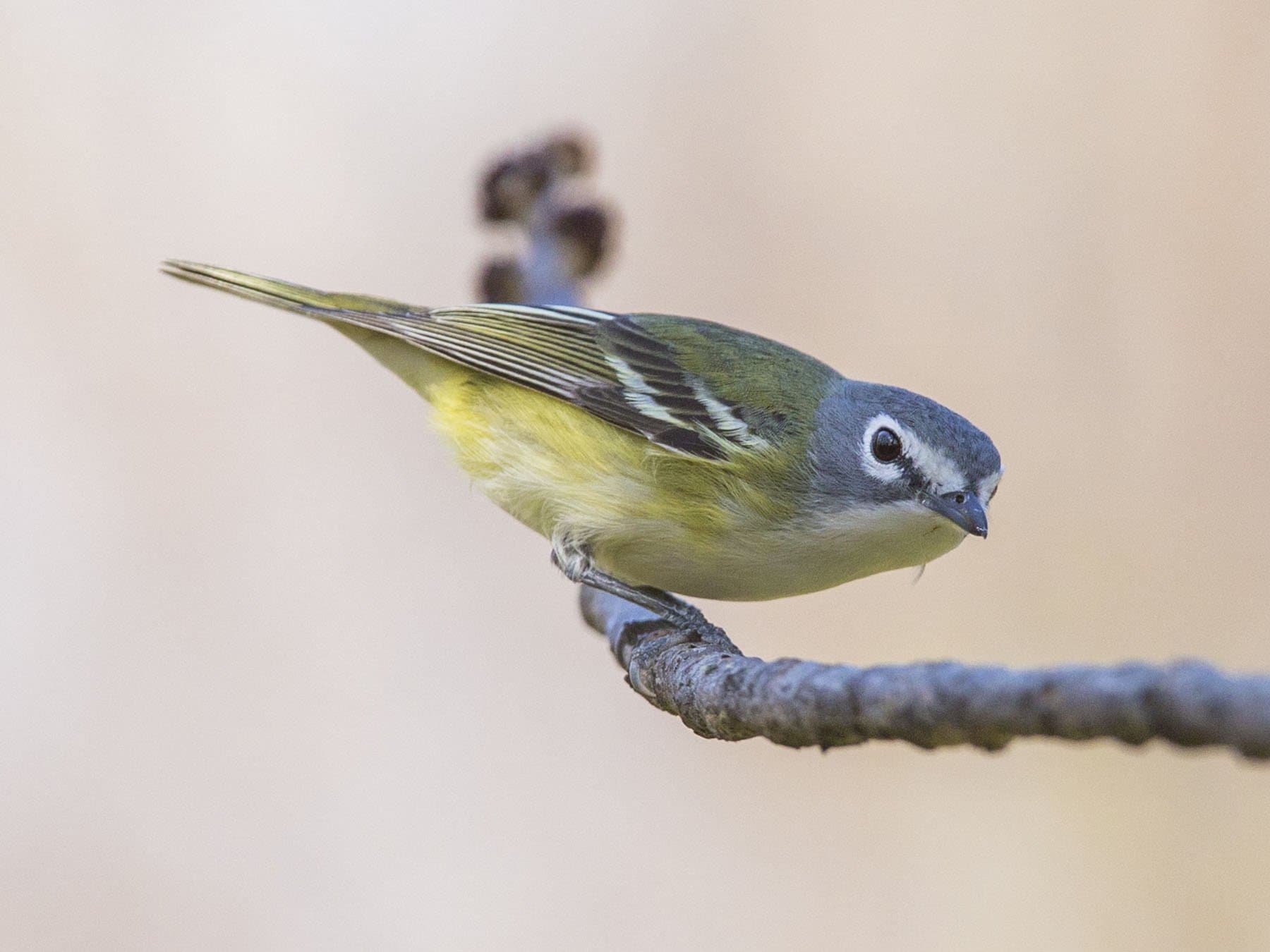
Blue-headed Vireo perched on a bare branch, looking down. Features a grey head, white spectacles, olive-green back, yellow flanks, and white wing bars.
Quick Facts
Conservation
LCLeast ConcernLifespan
3–7 years
Length
12–15 cm
Weight
13–19 g
Wingspan
22.2–24.2 cm
Migration
Partial migrant
Bold white "spectacles" framing a blue-grey head make the Blue-headed Vireo one of the most cleanly marked songbirds in eastern North America — and one of the easiest vireos to identify at a glance. Stocky, deliberate, and surprisingly tame at the nest, this small forest bird carries a disproportionately loud, musical song through the cool conifer stands it calls home. It is also, as genetic studies have confirmed, one of the most faithful songbirds ever studied.
Think you've spotted a Blue-headed Vireo?
Upload a photo and we'll confirm it instantly
Confirm with a PhotoAppearance
The Blue-headed Vireo is a compact, large-headed songbird measuring 12–15 cm in length with a wingspan of 22–24 cm. Its most immediately striking feature is the bold blue-grey head, which contrasts sharply with a clean white throat and an olive-green back. Framing the face are distinctive white "spectacles" — a white eye-ring connected to a white loral spot between the eye and bill — that give the bird an alert, wide-eyed expression and set it apart from every other eastern vireo at a glance.
The underparts are white, with bright yellow-green washes on the flanks and sides. The wings and tail are blackish, offset by two bold white wingbars that are broader and more prominent than those of most other vireos. The bill is thick and slightly hooked at the tip — a vireo hallmark well suited to processing tough-bodied insects — and the legs are bluish-grey.
Two subspecies show consistent, measurable differences. The nominate subspecies (V. s. solitarius), which breeds across Canada and the northern US, has a brighter greenish back and more extensive yellow on the sides. The Appalachian subspecies (V. s. alticola), breeding from Maryland south to northern Georgia, is noticeably larger, with a darker, slatier grey back that reduces the contrast between head and back, and yellow typically confined to the flanks rather than the sides. The alticola subspecies also has a longer wing (76–83.5 mm vs 69.2–77.8 mm) and a longer bill (11–12 mm vs 8.9–11 mm).
The species shows little seasonal plumage change and looks broadly similar year-round. Juveniles of both sexes are slightly duller and more brownish than adults, but the white spectacles and wingbars are already evident. There is minimal sexual dimorphism — females may appear very marginally duller on the head, but the difference is too subtle for reliable field use.
Identification & Characteristics
Colors
- Primary
- Blue-grey
- Secondary
- Olive
- Beak
- Black
- Legs
- Blue-grey
Markings
Bold white "spectacles" (white eye-ring connected to white loral spot); blue-grey head contrasting with olive-green back and white throat; two broad white wingbars; yellow-green flanks.
Tail: Blackish tail, medium length, slightly notched; contrasts with olive-green back and white underparts.
Attributes
Understanding Attributes
Rated 0–100 based on research and observation. A score of 50 is average across all bird species. These attributes are relative and don't necessarily indicate superiority.
Habitat & Distribution
The Blue-headed Vireo is the only vireo within its eastern range that makes extensive use of coniferous forests — a habitat no other eastern vireo occupies for nesting. During the breeding season it favours cool temperate forests dominated by spruce, fir, hemlock, and pine, often with a deciduous understorey of alder, birch, maple, or poplar. In the northern part of its range, pure coniferous stands are used; in the Appalachians, it also occupies deciduous woodlands with beech, oak, hickory, and maple. Breeding elevation ranges from sea level to approximately 1,200 m.
The breeding range spans a broad arc across Canada and the eastern United States. The nominate subspecies (V. s. solitarius) breeds from northeastern British Columbia east across Alberta, Saskatchewan, Manitoba, Ontario, and Quebec, south through the Great Lakes region to southern Pennsylvania and New Jersey, and as far north as the Great Slave Lake in the Northwest Territories. An estimated 55% of the global population breeds in Canada's boreal forest, and Canada holds approximately 81% of the global breeding population — making this one of the most Canada-dependent songbirds in North America. The Appalachian subspecies (V. s. alticola) has a separate breeding range from western Maryland south through the Appalachian Mountains to northern Georgia.
In the United States, the species breeds across New England (Maine, Vermont, New Hampshire, Massachusetts, Connecticut), the Mid-Atlantic states, the Great Lakes region, and the Appalachians. It is an uncommon to fairly common passage migrant across much of the eastern US, including the Midwest. It winters from southeastern Virginia and the Gulf States (Louisiana, Mississippi, Alabama, Florida) west to Texas — the alticola subspecies — while the nominate subspecies undertakes a longer migration to eastern and southern Mexico and northern Central America (Guatemala, Honduras, Nicaragua, Costa Rica), at elevations from sea level to 2,700 m.
The Blue-headed Vireo and the White-eyed Vireo are the only two eastern vireo species that do not completely vacate the United States in winter, with good numbers remaining in the southeastern states. The species has been expanding its breeding range southward in recent decades, recolonising areas in the Midwest where reforestation of conifers has taken place. During migration, it can be found in almost any wooded setting, including suburban parks, forest edges, and vine tangles.
Where to See This Bird
Explore regional guides for locations where this bird has been recorded.
Massachusetts
Louisiana
Maine
North Carolina
New Hampshire
Florida
New York
Pennsylvania
South Carolina
Vermont
West Virginia
Canada
New Brunswick
Nova Scotia
Ontario
Prince Edward Island
Quebec
Diet
Caterpillars — the larvae of moths and butterflies — form the backbone of the Blue-headed Vireo's diet during the breeding season, when the species is almost entirely insectivorous. The thick, hooked bill is well adapted for processing prey with tough exoskeletons: beetles (including ladybird beetles, wood borers, click beetles, and weevils), stinkbugs, bees, wasps, ants, flies, dragonflies, stoneflies, grasshoppers, and crickets are all taken regularly. Spiders are a consistent supplement, and snails are occasionally consumed.
Foraging typically occurs at mid-level in the canopy, though birds also work the upper storey. The Blue-headed Vireo moves along branches with deliberate, methodical hops, tilting its head to inspect the interior of branches and live foliage before striking. It gleans prey primarily from branch interiors rather than tips — a subtly different technique from many warblers — and occasionally sallies out to catch insects in mid-air in flycatcher fashion, or searches bark surfaces on major limbs.
Fruit enters the diet primarily during migration and on the wintering grounds, particularly in tropical regions where insect populations fluctuate seasonally. Fruits of sumac, wild grape, dogwood, elder, and wax myrtle are all recorded. In winter, fruit can account for more than a quarter of the total diet — a significant shift from the near-exclusive insectivory of the breeding season.
On the breeding grounds, mated pairs forage together and communicate constantly while doing so, making them easier to locate than many other forest songbirds of similar size. The male's persistent singing while foraging also serves as a territorial signal to neighbouring males.
Behaviour
Blue-headed Vireos move slowly and deliberately through the mid-canopy, tilting their large heads to peer carefully in all directions before hopping or flying to seize prey. This methodical hunting style is characteristic of the vireo family and contrasts with the frenetic gleaning of warblers that often share the same forest.
During the breeding season, mated pairs forage together and maintain near-constant contact through a series of high-pitched chirping calls — a behaviour unusual among songbirds and thought to help coordinate territory defence. Males establish territories of up to 15 acres and defend them vigorously, typically resolving boundary disputes through countersinging (each male singing in turn) before resorting to physical confrontations involving ruffled feathers, threat postures, and aerial chases.
One of the most striking behavioural traits of this species is its extraordinary tameness at the nest. Historical naturalists documented being able to lift incubating birds off the nest and replace them without the bird attempting to flee. Birds have been known to accept food from a human hand while sitting on eggs. This is not passivity — it reflects a strong nest-site fidelity that is thought to be linked to the male's unusually high contribution to daytime incubation, which keeps both sexes closely bonded to the nest site.
During autumn migration, Blue-headed Vireos regularly join mixed-species flocks with warblers, chickadees, and sparrows, but rarely associate with members of their own species. They are readily attracted to "pishing" sounds — a useful trait for birdwatchers. When confronting a predator at close range, birds ruffle their feathers, adopt threat postures, and make loud snapping noises with their bills.
Calls & Sounds
The Blue-headed Vireo's primary song is a slow, deliberate series of sweet, slurred, two- to three-note whistled phrases — often rendered mnemonically as "hear me, see me, here I am" or transcribed as "teeyay, tayah, taweeto, teeaytoay, toowip." Each phrase is separated by roughly a second of silence, giving the song a measured, almost conversational quality. It is similar to the song of the Red-eyed Vireo but distinctly slower, sweeter, and more musical — less burry than the Yellow-throated Vireo and less relentlessly repetitive than the Philadelphia Vireo.
Only males sing the primary song, and it is most frequent before mating, decreasing after copulation. Males sing throughout the day to defend their nesting territory — not just at dawn — and wintering birds also sing, especially late in winter, though without apparent territorial function. The song carries well through dense forest and is often the only clue to the species' presence in thick foliage.
The most distinctive call is a harsh, raspy chatter — sometimes described as an "evil laugh" — given during aggressive encounters and when alarmed by predators. This call is loud enough to be audible at some distance and is often the first indication of a mixed-species flock during autumn migration, as the vireo's alarm draws attention to the group. Mated pairs foraging together during the breeding season communicate constantly with a series of high-pitched chirping calls — an unusual degree of vocal coordination between partners.
During territorial disputes, males typically engage in countersinging to resolve boundary conflicts before escalating to physical confrontations. When confronting a predator at close range, birds ruffle their feathers and make loud bill-snapping sounds. Both sexes share the call repertoire used in nest defence and interspecific competition.
Flight
In flight, the Blue-headed Vireo appears compact and slightly heavy-headed — the large head and short neck give it a front-loaded silhouette that distinguishes it from the slimmer warblers it often accompanies in mixed flocks. The wings are relatively broad and rounded for a small songbird, reflecting the vireo family's preference for slow, deliberate movement through dense forest rather than sustained open-air flight.
Direct flight between perches is typically undulating — a series of quick wingbeats followed by a brief glide — but less pronounced than the deep undulations of woodpeckers or finches. When moving through the canopy, the bird tends to make short, direct hops and flights between branches rather than long aerial sallies. It does occasionally launch into brief flycatcher-style sallies to catch insects in mid-air, but these are short and targeted rather than acrobatic.
During migration, the species travels at night like most small passerines, making it vulnerable to collisions with illuminated communications towers and glass buildings. The two bold white wingbars are visible in flight and can help confirm identification when a bird flushes from cover. The blackish wings and tail contrast with the olive back and white underparts, creating a distinctive pattern even in brief views.
The wingspan of 22–24 cm is typical for a small vireo, providing enough wing area for the sustained migratory flights undertaken by the nominate subspecies, which travels from Canadian boreal forest to Central America — a journey of several thousand kilometres each way.
Nesting & Breeding
Males arrive on the breeding grounds before females and immediately begin establishing territories of up to 15 acres. Unmated males engage in a behaviour sometimes called "demo nesting" — selecting multiple potential nest sites within their territory and beginning to gather nesting materials at a favoured spot to attract arriving females. Females tend to favour males holding the largest and best-quality territories.
Once a female enters a male's territory, she signals receptivity by crouching and quivering her wings. The male responds by singing with wings aquiver, then stiffens his body upward, draws in his head, and erects the yellowish feathers of his flanks and his white spectacles. He then sways rhythmically from side to side while marching toward the female — a display that is both visual and acoustic. Copulation typically occurs 15–50 metres from the nest site.
Both sexes build the nest, with the male taking on most of the early foundation work and the female completing the lining. Construction takes approximately eight days. The finished nest is a substantial suspended open cup held in a horizontal fork of a branch, typically 1.8–4.6 m above the ground (occasionally as high as 10–12 m). Northern birds favour conifers — hemlock, fir, spruce — for nest placement; birds from Virginia southward more often use deciduous saplings and shrubs. The nest is composed of bark strips, lichens, grasses, plant down, twigs, moss, leaves, fur, feathers, and spiderweb, and the exterior may be decorated with spider egg cases, lichen, or pine needles. Interior dimensions are approximately 5 cm across and 4 cm deep.
Clutch size is 3–5 eggs, usually 4. Eggs are creamy white with sparse dark spots concentrated at the larger end, measuring 1.7–2.2 cm long × 1.3–1.6 cm wide. Both parents share daytime incubation, with the male covering approximately twice as much as the female; the female incubates alone at night. The incubation period is 13–15 days. Chicks hatch helpless with tufts of down and are fed by both parents; the nestling period is 12–13 days. Strikingly, females may desert the brood 1–4 days before fledging to seek a new mate in a different territory, leaving the male to complete all parental duties. Fledglings remain dependent on the male for at least one month after leaving the nest.
The Blue-headed Vireo is a frequent host of the Brown-headed Cowbird (Molothrus ater). When cowbird eggs are found in the nest, vireo parents may build a new layer of nesting material over the parasitic eggs and lay a fresh clutch, or abandon the nest entirely and start over. If a brood fails early in the season, the pair typically re-nests; later failures often result in the pair separating.
Lifespan
The maximum recorded lifespan for a Blue-headed Vireo is 7 years and 5 months, established by a bird banded in Ontario and later recovered in Guatemala — a record that also illustrates the long-distance nature of the nominate subspecies' migration. Typical lifespan in the wild is estimated at 3–7 years, with most individuals not reaching the upper end of that range due to predation and the hazards of migration.
Annual survival rates for small migratory songbirds are generally lower than for resident species of similar size, and the Blue-headed Vireo faces mortality from a range of sources: predation by owls, crows, and jays at the nest and roost; collisions with glass and communications towers during nocturnal migration; and nest failure from cowbird parasitism and forest fragmentation. The species reaches sexual maturity by the following spring after hatching — approximately one year old.
Compared to the closely related Red-eyed Vireo, the Blue-headed Vireo's lifespan data is less extensively documented, but the two species are broadly similar in size and life-history strategy. The Blue-headed Vireo's unusually high male investment in incubation — covering approximately twice as much daytime incubation as the female — may carry a survival cost for males, though this has not been formally quantified. The species' increasing population trend suggests that current survival rates are sufficient to sustain and grow the population across most of its range.
Conservation
The Blue-headed Vireo is classified as Least Concern on the IUCN Red List (assessed 2016), with a global population estimated at approximately 13 million individuals (Partners in Flight / Audubon, 2017). Populations have roughly doubled since 1970, and the North American Breeding Bird Survey shows a significantly increasing trend, with a mean annual growth rate of around 4.5% for 1992–2006. In Minnesota, the BBS recorded a 3.57% annual increase from 1966 to 2015. The species rates just 7 out of 20 on the Continental Concern Score, indicating low conservation concern overall.
The most specific and quantified threat is the Hemlock Woolly Adelgid (Adelges tsugae), an invasive Asian insect that has killed large numbers of eastern hemlock trees across the eastern US. A 2018 study found up to 30% declines in hemlock-dependent birds — including Blue-headed Vireos — in adelgid-stricken stands in New Jersey and Pennsylvania. The Blue-headed Vireo and the Black-throated Green Warbler are considered hemlock obligates in parts of their Appalachian range. Climate change is expected to allow the adelgid to expand northward, threatening hemlock habitat further.
Forest fragmentation and clearcutting reduce nesting success and increase nest vulnerability to predation and cowbird parasitism — cowbirds penetrate forest interiors more easily in fragmented landscapes. Acid rain can kill conifers, reducing available breeding habitat. Deforestation on the wintering grounds in Mexico and Central America poses an additional long-term risk. Collisions with glass and communications towers along migratory pathways also cause mortality.
The species is listed as a Species of Special Concern in New Jersey, reflecting localised pressure from hemlock loss and habitat fragmentation. Given that approximately 81% of the global breeding population nests in Canada, the long-term health of Canada's boreal forest is the single most important factor in this species' future.
Population
Estimated: 13,000,000
Trend: Increasing
Populations have roughly doubled since 1970. The North American Breeding Bird Survey shows a significantly increasing trend, with a mean annual growth rate of around 4.5% for 1992–2006. In Minnesota, the BBS recorded a 3.57% annual increase from 1966 to 2015. The species has been expanding its breeding range southward as conifer reforestation takes place in the Midwest.
Elevation
Sea level to 2,700 m (wintering); sea level to 1,200 m (breeding)
Additional Details
- Family:
- Vireonidae (Vireos)
- Diet type:
- Insectivorous; fruit supplement during migration and winter
- Subspecies:
- V. s. solitarius (nominate); V. s. alticola (Appalachian)
- Clutch size:
- 3–5 eggs (usually 4)
- Territory size:
- Up to 15 acres
- Breeding season:
- April to August
- Nestling period:
- 12–13 days
- Scientific name:
- Vireo solitarius
- Number of broods:
- 1–2 (2 possible at lower elevations)
- Incubation period:
- 13–15 days
Courtship & Display
The Blue-headed Vireo's courtship sequence is one of the more elaborate among small North American songbirds, and it begins before the female even arrives. Unmated males engage in "demo nesting" — selecting multiple potential nest sites within their territory and beginning to gather nesting materials at a favoured spot. This behaviour appears to function as a signal of territory quality and male investment, with females favouring males that hold the largest and best-structured territories.
Once a female enters the territory, she signals receptivity by crouching low on a branch and quivering her wings. The male's response is a precisely choreographed display: he begins singing with wings aquiver, then stiffens his body upward, draws in his head, and erects the yellowish feathers of his flanks alongside his white spectacles — making both colour patches as prominent as possible. He then sways rhythmically from side to side while marching toward the female in a slow, deliberate approach. The combination of acoustic and visual signals in this display is more structured than the courtship of many vireos.
Copulation typically occurs 15–50 metres from the chosen nest site. The species is genetically monogamous to a degree that is exceptional among songbirds: a landmark 1998 study published in Behavioral Ecology found extra-pair fertilisations in only 1 out of 37 Blue-headed Vireo nestlings, compared with 11 out of 19 nestlings in the Red-eyed Vireo studied at the same site. The researchers linked this genetic fidelity directly to the male's high daytime incubation contribution — by spending so much time at the nest, males both guard their mate and reduce their own opportunities for extra-pair mating, creating a feedback loop that reinforces monogamy.
Taxonomy And Subspecies
The Blue-headed Vireo has a layered taxonomic history that reflects how much our understanding of bird species has changed with the advent of molecular genetics. John James Audubon first described the bird in 1840 in The Birds of America under the name "Solitary Vireo" — a reference to its tendency to forage alone rather than in flocks. For most of the twentieth century, the "Solitary Vireo" was treated as a single wide-ranging species encompassing populations from Canada to Central America.
In the 1950s, the American Ornithological Society lumped several visually similar western forms with the eastern birds, creating a single polytypic species (Vireo solitarius) that spanned the continent. This arrangement persisted until 1997, when molecular genetic analysis revealed that the eastern, Cassin's, and Plumbeous populations were sufficiently distinct to warrant recognition as three separate species. The Blue-headed Vireo (V. solitarius) retained the original scientific name and is the most colourful of the three, and the only one found in eastern North America. Cassin's Vireo (V. cassinii) occupies the Pacific coast and western mountains, while the Plumbeous Vireo (V. plumbeus) breeds in the interior West.
Within the Blue-headed Vireo, two subspecies are currently recognised. The nominate V. s. solitarius breeds across Canada and the northern US, with a brighter olive-green back and more extensive yellow on the sides. The Appalachian V. s. alticola is larger, darker-backed, and has yellow confined mainly to the flanks. The two subspecies also differ measurably in wing and bill length, and their wintering ranges are largely separate — alticola winters in the southeastern US, while solitarius migrates to Mexico and Central America.
Birdwatching Tips
The Blue-headed Vireo's song is usually the first indication of its presence — the bird forages high in dense foliage and can be difficult to spot even when singing persistently. Learn the song: a slow, sweet series of slurred two- to three-note whistled phrases, often rendered as "hear me, see me, here I am," delivered at a more leisurely pace than the similar Red-eyed Vireo. Once you have the song, scan the mid-canopy of mixed coniferous-deciduous forest for a large-headed, stocky bird moving slowly along branches.
In the United States, the best time to find breeding birds is May through July in mature hemlock, spruce, or mixed forest in New England, the Great Lakes states, and the Appalachians from Maryland to northern Georgia. In Canada, the species is widespread in boreal forest from British Columbia to Newfoundland, with peak activity from mid-May onward. During spring migration, the Blue-headed Vireo is notably early — one of the first vireos to arrive, often before deciduous trees have fully leafed out, which makes it easier to spot.
During autumn migration (September to early November), the species joins mixed flocks with warblers and chickadees and responds readily to "pishing" — a reliable way to draw it into view. It lingers later in autumn than most other vireos, so check mixed flocks well into October. In the southeastern US (Florida, the Gulf States, the Carolinas), wintering birds can be found in pine-hardwood forests and coastal scrub from November through March.
The white spectacles are the key identification feature — no other eastern vireo has such a bold, complete eye-ring combined with a blue-grey head. The Yellow-throated Vireo has spectacles too, but a bright yellow throat and breast immediately separate it. The two subspecies are worth noting: alticola birds in the Appalachians are larger and greyer-backed, while solitarius birds are brighter and more olive-backed.
Did You Know?
- A 1998 genetic study found extra-pair fertilisations in only 1 out of 37 Blue-headed Vireo nestlings — compared with 11 out of 19 nestlings in the closely related Red-eyed Vireo studied simultaneously. Researchers linked this near-total genetic fidelity to the male's unusually high contribution to daytime incubation, which keeps him close to the nest and reduces opportunities for extra-pair mating.
- Incubating Blue-headed Vireos are famously tame: historical naturalists documented being able to lift birds off the nest and replace them without the bird attempting to flee. Some individuals have accepted food directly from a human hand while sitting on eggs — a level of nest-site fidelity almost unmatched among North American songbirds.
- What was once called the "Solitary Vireo" (Vireo solitarius) was split into three separate species in 1997 following molecular genetic analysis — the Blue-headed, Cassin's, and Plumbeous Vireos. The three had been lumped as one species since the 1950s. John James Audubon first described the original "Solitary Vireo" in 1840 in The Birds of America.
- Approximately 81% of the global Blue-headed Vireo breeding population nests in Canada, with an estimated 55% in the boreal forest alone — making Canada's forest policy one of the most consequential factors in this species' long-term survival.
- The Blue-headed Vireo is considered a hemlock obligate in parts of its Appalachian range. A 2018 study recorded up to 30% population declines in hemlock-dependent Blue-headed Vireos in stands infested by the Hemlock Woolly Adelgid, an invasive Asian insect that has killed vast numbers of eastern hemlock trees across the US.
Records & Accolades
Most Faithful Songbird
1 in 37 extra-pair offspring
A 1998 genetic study found extra-pair fertilisations in only 1 out of 37 nestlings — one of the lowest rates of infidelity ever recorded in a songbird.
Canada's Vireo
81% of global breeding population
An estimated 81% of the world's Blue-headed Vireos breed in Canada, with 55% in the boreal forest alone — making it one of the most Canada-dependent songbirds in North America.
Hemlock Specialist
Only eastern vireo in conifers
The Blue-headed Vireo is the only vireo within its eastern range that nests extensively in coniferous forest, making it uniquely vulnerable to the Hemlock Woolly Adelgid.
Community Photos
Be the first to share a photo of the Blue-headed Vireo
Upload a PhotoIdentify Any Bird Instantly
- Upload a photo from your phone or camera
- Get an instant AI identification
- Ask follow-up questions about the bird
Monthly Birds in Your Area
- Personalised for your location
- Seasonal tips and garden advice
- Updated every month with new species