Species Profile
American Black Duck
Anas rubripes
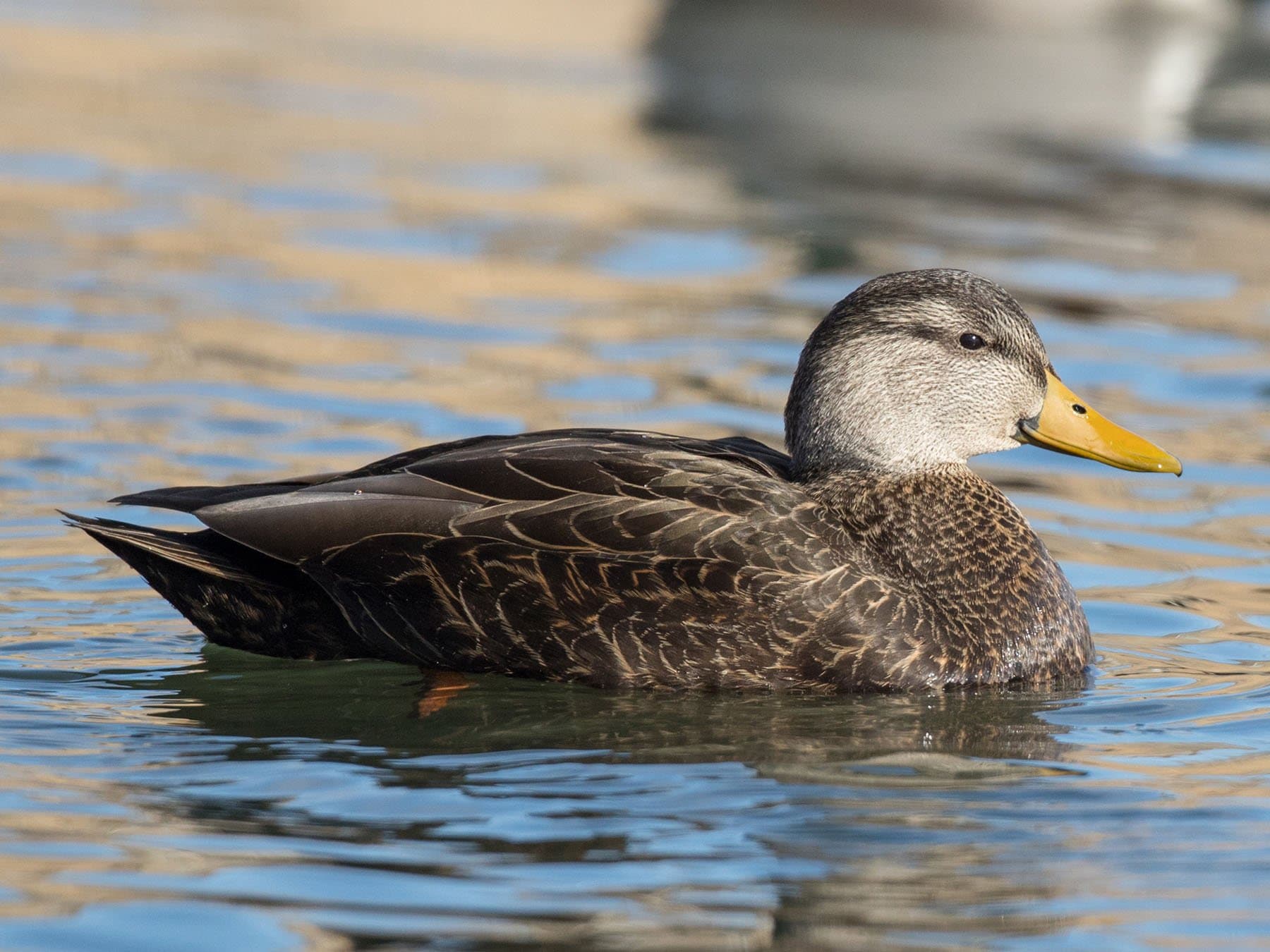
American Black Duck swimming in calm water, showing dark body plumage, a pale head, and a yellow bill.
Quick Facts
Conservation
LCLeast ConcernLifespan
2–5 years
Length
54–59 cm
Weight
720–1640 g
Wingspan
88–95 cm
Migration
Partial migrant
Despite its name, the American Black Duck isn't truly black — up close, its plumage is a rich, dark sooty-brown, scalloped with pale buff margins and crowned by a noticeably paler head. What gives it away in flight is unmistakable: brilliant white underwing coverts that flash against the dark body like a signal flag. Endemic to eastern North America, this large dabbling duck has a longer history on the continent than almost any other waterfowl — Pleistocene fossils at least 11,000 years old have been found in Florida and Georgia.
Think you've spotted a American Black Duck?
Upload a photo and we'll confirm it instantly
Confirm with a PhotoAppearance
The American Black Duck is a large, stocky dabbling duck built along the same lines as a Mallard — and the two are often confused. Despite its name, the plumage is not truly black. Up close, the body is a rich, dark sooty-brown, with each feather edged in pale reddish-buff, producing a subtly scalloped texture. At any distance, the bird looks almost uniformly dark, which is where the name comes from. Historically, it was also called the 'Dusky Duck' — arguably a more accurate description.
The head is distinctly paler than the body: a warm buffy-brown with a dark crown and a bold dark streak running through the eye. The cheeks and throat are finely streaked. The speculum — the iridescent wing patch — is a vivid violet-blue to bluish-purple, bordered predominantly by black. This is the single most reliable field mark separating the American Black Duck from the Mallard: the Mallard's speculum is framed by bold white bars, while the Black Duck's has little or no white edging.
The male's bill is olive-green to bright yellow with a black nail at the tip. His legs and feet are fleshy orange-red with dark webbing. The species does not undergo the dramatic eclipse moult seen in male Mallards — the male American Black Duck remains dark throughout the year, showing no conspicuous seasonal change in plumage. Juvenile birds resemble adult females but are generally browner overall, with broader buff feather margins giving a more streaked appearance. Juvenile males have brownish-orange feet; juvenile females have brownish feet and a dusky greyish-green bill.
Identification & Characteristics
Male Colors
- Primary
- Dark Brown
- Secondary
- Buff
- Beak
- Olive
- Legs
- Orange
Female Colors
- Primary
- Dark Brown
- Secondary
- Buff
- Beak
- Grey
- Legs
- Orange
Male Markings
Dark sooty-brown body with pale buffy-brown head; iridescent violet-blue speculum bordered by black with little or no white; brilliant white underwing coverts conspicuous in flight; olive-yellow bill (male)
Tail: Short, dark brown tail with pale buff feather margins; tail held flat on water; white undertail coverts visible at rest
Female Markings
Near-identical to male in body plumage; distinguished by dull greenish-grey bill with variable black mottling or saddle on upper mandible; marginally paler overall; shares white underwing lining in flight
Tail: As male — short, dark brown tail with pale buff margins; white undertail coverts visible at rest
Attributes
Understanding Attributes
Rated 0–100 based on research and observation. A score of 50 is average across all bird species. These attributes are relative and don't necessarily indicate superiority.
Habitat & Distribution
The American Black Duck is endemic to eastern North America. Its breeding range stretches from northeastern Saskatchewan east across Canada to Newfoundland and Labrador, taking in the Maritime Provinces, Quebec, Ontario, and Manitoba. In the United States, breeding birds are found in the Great Lakes region, the Adirondacks of New York, all six New England states, and south along the Atlantic coast to coastal North Carolina. The highest breeding densities are in Maine and Nova Scotia.
In winter, the species concentrates along the Atlantic seaboard from New England to the Carolinas. The largest wintering aggregations occur in the coastal saltmarshes and estuaries of Maryland, Virginia, New Jersey, and New York. Smaller numbers winter inland on the Great Lakes and in the Ohio Valley. A small, non-migratory population occupies coastal wetlands from New Jersey south to North Carolina year-round.
Across all seasons, the species favours wetlands in forested landscapes: beaver ponds, shallow lakes fringed with reeds and sedges, boreal bogs, wooded swamps, stream margins lined with speckled alder, and tidal marshes. It is one of the few dabbling ducks to breed regularly in saltmarsh habitats. In winter, brackish and saltwater marshes bordering bays and estuaries are the primary habitat, though inland birds use flooded timber, agricultural fields, and riverine areas. The species is more tolerant of tidal and marine conditions than almost any other dabbling duck.
In the UK and Ireland, the American Black Duck is a rare but regular vagrant — see the dedicated section below for the full story of its Western Palearctic records.
Where to See This Bird
Explore regional guides for locations where this bird has been recorded.
Indiana
Massachusetts
Michigan
Maryland
Maine
New Hampshire
Delaware
Connecticut
New Jersey
New York
Ohio
Virginia
Pennsylvania
Rhode Island
Vermont
West Virginia
Canada
New Brunswick
Nova Scotia
Newfoundland and Labrador
Ontario
Prince Edward Island
Quebec
Diet
Plant matter dominates the American Black Duck's diet for most of the year. Seeds, leaves, stems, roots, and tubers of aquatic and emergent plants — eelgrass, pondweed, smartweed, wetland grasses, and sedges — form the bulk of what it eats in freshwater habitats. In coastal and tidal environments, the diet shifts substantially towards animal matter: mussels, clams, snails, amphipods, small crustaceans, and aquatic arthropods can make up the majority of intake in saltmarsh and estuarine settings.
During the breeding season, adults and ducklings ramp up their protein intake considerably. Aquatic insect larvae — mayflies, caddisflies, dragonflies, midges, and beetles — along with crustaceans, molluscs, and occasionally small fish and amphibians, become important food sources. Ducklings feed almost exclusively on invertebrates in their first weeks of life, switching gradually to plant matter as they grow.
One of the more unusual aspects of this species' foraging behaviour is its willingness to dive. Although classified as a dabbling duck, the American Black Duck can submerge to depths of more than 12 feet (3.7 m) to retrieve plant tubers and other submerged food — a behaviour rarely seen in surface-feeding ducks. More typically, it forages by dabbling and up-ending in shallow water, or by grazing on land. On migration, the diet broadens to include agricultural grains and the seeds and fruits of wild terrestrial plants. Wintering birds in marine habitats also take mussels, zooplankton, and small fish.
Behaviour
American Black Ducks are wary birds — noticeably more alert and harder to approach than Mallards, a trait likely shaped by centuries of hunting pressure. They tend to flush earlier and at greater distances than most dabbling ducks, and on heavily hunted marshes they quickly learn to distinguish between decoys and the real thing. Outside the breeding season, they gather in flocks of varying size, often mixing with Mallards and other dabbling ducks on shared feeding and roosting areas.
Pair bonds begin forming in late September and October on staging and wintering grounds, with formation peaking through midwinter. By April, nearly all females have paired. Older females may bond as early as early autumn and remain with the same male until the following summer — and pairs sometimes reunite in subsequent years. Courtship involves a suite of displays typical of dabbling ducks: males perform head-pumping, wing-flapping, and short pursuit flights, often in groups competing for a single female.
Daily activity follows a crepuscular pattern, with peak feeding in the early morning and late evening. During the day, birds often loaf on sandbars, mudflats, or sheltered coves. In winter, flocks move between freshwater roosts and coastal saltmarshes on a tidal schedule, timing their foraging to coincide with falling tides that expose invertebrate-rich mudflats. The species is notably tolerant of marine conditions — small groups are regularly seen riding rough coastal swells in ways that most dabbling ducks would avoid.
Calls & Sounds
American Black Duck vocalisations closely parallel those of the Mallard, and the two species are difficult to distinguish by ear alone. The female produces the classic loud duck quack, typically delivered as a decrescendo series of approximately six syllables — rendered phonetically as quaegeageageageag — with the accent on the second syllable and each successive note slightly softer than the last. This call functions to attract mates and conspecifics, and is given most frequently in the early morning and evening. It is the sound most people think of when they imagine a duck.
The male's call is quite different: a soft, reedy reab or kwek-kwek, similar to the raspy, nasal call of the male Mallard. During courtship displays, males may produce additional soft whistling notes alongside the standard calls. Both sexes give alarm calls when disturbed, typically sharper and more urgent in tone than the contact calls. The species is generally considered less vocal than the Mallard overall.
One visual communication signal worth noting: the brilliant white underwing lining, which flashes conspicuously in flight, is thought to serve as a social signal — helping birds in a flock coordinate movements and stay together, particularly during low-light crepuscular flights between roost and feeding areas. The species is most vocal during the pair-formation period from October through February, when calling activity peaks on wintering grounds.
Flight
In flight, the American Black Duck is instantly recognisable by the contrast between its dark body and brilliant white underwing coverts. As the wings open, the white lining flashes against the sooty-brown upperparts and flanks — a field mark visible at considerable distance and far more striking than anything seen in the female Mallard. The iridescent violet-blue speculum, bordered by black with little or no white, is visible on the upperwing when the bird banks or lands.
The wingbeat is powerful and relatively rapid for a duck of this size, producing an audible rushing sound at close range. The bird takes off steeply and directly from the water — a typical dabbling duck launch — rather than needing a running take-off like diving ducks. Once airborne, flight is direct and purposeful, with the neck extended and feet tucked back. Flocks often fly in loose, irregular formations rather than the tight lines typical of diving ducks.
Migration flights are believed to occur predominantly at night. Tracking studies have shown that birds departing wintering areas between mid-March and early June average approximately 3–4 stopovers during spring migration, spending around 6–7 days at each stopover, and covering a total distance of approximately 1,126 km (700 miles) to reach breeding areas. The species migrates almost entirely within the Atlantic Flyway, with around 80% of the US harvest occurring in that corridor.
Nesting & Breeding
Nesting begins as early as February in the southern part of the range and may not start until late May in northern Canada. The female selects the nest site alone, typically choosing a well-concealed spot on the ground among dense vegetation: wooded or grassy islands, upland areas, marshes, cropland borders, shrubby areas, brush piles, or rock crevices. Some birds nest in tree crotches, hollows, or cavities of large trees, and a proportion use artificial nest cylinders where these are provided.
The female builds the nest without assistance from the male, digging a shallow basin roughly 18–20 cm across and about 4 cm deep in leaf litter or soil, then lining it with grass, twigs, leaves, stems, and conifer needles. From the fourth or fifth egg onwards, she adds down feathers plucked from her own breast until the clutch is fully covered. Clutch size ranges from 6 to 14 eggs, typically 7–11, with smaller clutches laid by first-year females. The eggs are white, cream-coloured, or pale greenish-buff, measuring approximately 5.5–6.4 cm long and 4.1–4.5 cm wide, and weighing around 56.6 g each.
Incubation is performed by the female and lasts 23–33 days, typically 26–29 days. The male defends the territory during early incubation but becomes progressively less attentive around the midpoint and eventually abandons the nest entirely. All eggs typically hatch within a few hours of each other. Ducklings are precocial — mobile within 1–3 hours of hatching and finding their own food from the start. The female leads the brood to rearing areas with abundant invertebrates and cover, often travelling after dark. The female-brood bond lasts 6–7 weeks, and young fledge at approximately 58–60 days. The species is single-brooded. Nest predators include crows, raccoons, gulls, foxes, skunks, opossums, and snakes.
Lifespan
In the wild, American Black Ducks typically live 2–5 years, though survival rates vary considerably with hunting pressure, habitat quality, and predation. The maximum recorded lifespan is 26 years and 5 months — an individual banded in Pennsylvania in 1952 and recovered in Delaware in 1978, making it one of the longest-lived dabbling ducks on record for any species. This figure is exceptional; most birds in hunted populations do not survive beyond their third or fourth year.
Annual survival rates for adults are estimated at around 55–65%, with first-year birds facing higher mortality. Nest predation is a significant source of early mortality: crows, raccoons, gulls, foxes, skunks, opossums, and snakes all take eggs and ducklings. Adult birds face predation from raptors, particularly Peregrine Falcons and large hawks, as well as from mink and other mammalian predators in wetland habitats.
Historically, hunting was the dominant cause of adult mortality — an estimated 800,000 birds were shot annually in the 1960s and 1970s. Regulatory changes from 1983 onwards dramatically reduced harvest pressure, and annual US harvest now stands at approximately 78,000–80,000 birds. Lead poisoning from ingested spent shot, water pollution, and habitat degradation remain background mortality factors. Compared to the closely related Mallard, the American Black Duck appears to have similar potential longevity but lower average survival in heavily hunted populations.
Conservation
The American Black Duck is listed as Least Concern on the IUCN Red List, but its population trajectory tells a more complicated story. The species declined by more than 50% between the 1950s and 1980s, and the North American Breeding Bird Survey recorded a further decline of approximately 87% in the United States between 1966 and 2019. The Chesapeake Bay wintering population fell from over 200,000 birds to fewer than 52,000. The current global population is estimated at approximately 862,000 individuals (USFWS Waterfowl Population Status, 2024), with Partners in Flight estimating the global breeding population at 700,000.
Habitat loss is the primary driver of decline. Coastal wetlands along the Atlantic seaboard — the species' core wintering habitat — have been lost and degraded through urbanisation, agricultural drainage, and rising sea levels. Water pollution and pesticide runoff further reduce wetland quality. Lead poisoning from ingested spent shot remains a concern in areas where lead ammunition was historically used. DDT contributed to eggshell thinning in the mid-20th century before its ban.
Hunting pressure was historically severe: an estimated 800,000 birds were shot annually in the 1960s and 1970s. A 1982 lawsuit by the Humane Society of the United States led to a 30-day season with a one-bird daily limit from 1983 onwards. Annual US harvest has since fallen to approximately 78,000–80,000 birds per year. Conservation programmes include habitat acquisition by the US Fish and Wildlife Service and the Atlantic Coast Joint Venture, which has implemented over 106 acres of critical wetland restoration on private lands and aims to restore or enhance approximately 400,000 acres of black duck wintering habitat on the US Atlantic Coast.
Population
Estimated: Approximately 862,000 individuals (USFWS, 2024)
Trend: Decreasing
Declining overall; down approximately 87% in the United States between 1966 and 2019 (BBS); Canadian population roughly stable over the same period. Chesapeake Bay wintering population fell from over 200,000 to fewer than 52,000 birds.
Elevation
Sea level to approximately 600 m; primarily a lowland wetland species
Additional Details
- Family:
- Anatidae (Ducks, Geese & Swans)
- Predators:
- Crows, raccoons, gulls, foxes, skunks, opossums, and snakes (eggs and ducklings); Peregrine Falcons, large hawks, and mink (adults)
Uk And European Records
The American Black Duck is a rare but genuine vagrant to Britain and Ireland, with a history stretching back to 1954, when a female was shot in Co. Kilkenny, Ireland — the first accepted Western Palearctic record. Since then, the species has been recorded in Britain and Ireland in 35 of the subsequent 47 years, with records from Cornwall, Devon, Hampshire, Wales, Scotland, and numerous Irish counties.
Several individuals have stayed for extraordinary lengths of time, often pairing with local Mallards. A drake at Achill Island, Co. Mayo, Ireland, was present from January 2001 to at least January 2014 — a residency of over 13 years and the longest-staying individual in the British Isles. A drake at Loch Sunart, Highland, Scotland, was present intermittently from June 2007. Some long-staying birds have bred with Mallards, producing hybrid offspring that have themselves been recorded and identified by birders.
The transatlantic origin of these birds is not merely assumed — it is confirmed by ringing data. A female banded in New Brunswick, Canada, was later recovered in France, demonstrating that wild birds do cross the Atlantic under their own power. This rules out the possibility that all European records involve escaped captive birds, though the identification of genuine wild individuals versus escapes requires careful assessment of plumage wear, condition, and behaviour. Vagrant records have also come from continental Europe and, more distantly, from Korea and Puerto Rico.
Hybridisation And Genetics
Hybridisation between American Black Ducks and Mallards has been a source of scientific concern since the 1950s, when Mallard populations began expanding eastward into Black Duck territory — partly through natural range expansion and partly through the release of farm-reared Mallards for hunting. By the late 20th century, some researchers feared that hybridisation could eventually swamp the Black Duck genetically, effectively absorbing it into the Mallard population.
The picture painted by recent genomic research is considerably more reassuring. A landmark study by Lavretsky and colleagues, published in 2019, analysed the genetics of large numbers of wild Black Ducks and found that approximately 75% were genetically pure — despite an observed hybridisation rate of around 25%. The explanation lies in what happens to the hybrids: they rarely breed back into the Black Duck population. Instead, hybrid individuals tend to pair with Mallards, effectively removing hybrid genes from the Black Duck gene pool rather than diluting it further.
The same research identified a separate problem: game-farm Mallards released for hunting carry a distinct genetic signature from wild Mallards, and their genes are detectable in wild populations. This suggests that stocking programmes may pose a greater long-term genetic risk than natural hybridisation. The findings have shifted conservation thinking — rather than treating hybridisation as an existential threat to the Black Duck, managers are now focusing on habitat quality and hunting regulation as the primary levers for population recovery.
Birdwatching Tips
The Atlantic coast of the United States offers the best opportunities to see American Black Ducks in numbers. From October through March, coastal saltmarshes and estuaries from Maine to Virginia hold large concentrations — the marshes of Chesapeake Bay, the New Jersey shore, and the tidal creeks of coastal New England are all reliable sites. Inland, the Great Lakes and major river systems of the northeast hold smaller numbers through winter. In summer, canoe trips through boreal wetlands in Maine, Nova Scotia, or Quebec offer chances to encounter breeding birds.
The key identification challenge is separating the American Black Duck from the female Mallard and from hybrids between the two species. The Black Duck is darker overall — the body is a uniform sooty-brown rather than the streaked brown-and-buff of a female Mallard. The speculum is the clincher: look for the violet-blue wing patch bordered by black with little or no white edging. The Mallard's speculum has bold white borders on both sides. In flight, the brilliant white underwing lining contrasting against the dark body is the most striking and reliable feature.
Bill colour helps with sexing: males have a clean olive-yellow bill; females show a dull greenish-grey bill with variable black mottling. Both sexes share the pale buffy-brown head contrasting with the dark body. Hybrids with Mallards are common and can show intermediate features — a partial white speculum border, a slightly paler body, or a greenish head tinge in males. The species is wary; approach slowly and use cover, as Black Ducks flush at greater distances than most dabbling ducks.
Did You Know?
- The longevity record for the species stands at 26 years and 5 months — the individual was banded in Pennsylvania in 1952 and recovered in Delaware in 1978, making it one of the longest-lived dabbling ducks ever recorded.
- Although classified as a dabbling duck, the American Black Duck can dive to depths of more than 12 feet (3.7 m) to retrieve plant tubers — a behaviour almost unheard of in surface-feeding ducks.
- Pleistocene fossils of American Black Ducks at least 11,000 years old have been unearthed in Florida and Georgia, placing the species in eastern North America since the last Ice Age.
- A female banded in New Brunswick, Canada, was later recovered in France — one of several documented cases confirming that some European vagrant records involve genuine transatlantic travellers, not escaped captive birds.
- Despite a hybridisation rate of roughly 25% with Mallards in eastern North America, a 2019 genomic study found that 75% of sampled black ducks were genetically pure — because hybrids rarely breed back into the black duck population, the species' genetic integrity is far better preserved than scientists had feared.
Records & Accolades
Longevity Record
26 years 5 months
The oldest recorded American Black Duck was banded in Pennsylvania in 1952 and recovered in Delaware in 1978 — one of the longest-lived dabbling ducks on record.
Deepest Diver
12+ feet (3.7 m)
Despite being classified as a dabbling duck, the American Black Duck can dive to depths exceeding 12 feet to retrieve submerged plant tubers — highly unusual for a surface-feeding duck.
Genetic Resilience
75% genetically pure
Despite a 25% hybridisation rate with Mallards, genomic research (Lavretsky et al. 2019) found that 75% of wild American Black Ducks are genetically pure, because hybrids rarely breed back into the black duck population.
Community Photos
Be the first to share a photo of the American Black Duck
Upload a PhotoIdentify Any Bird Instantly
- Upload a photo from your phone or camera
- Get an instant AI identification
- Ask follow-up questions about the bird
Monthly Birds in Your Area
- Personalised for your location
- Seasonal tips and garden advice
- Updated every month with new species