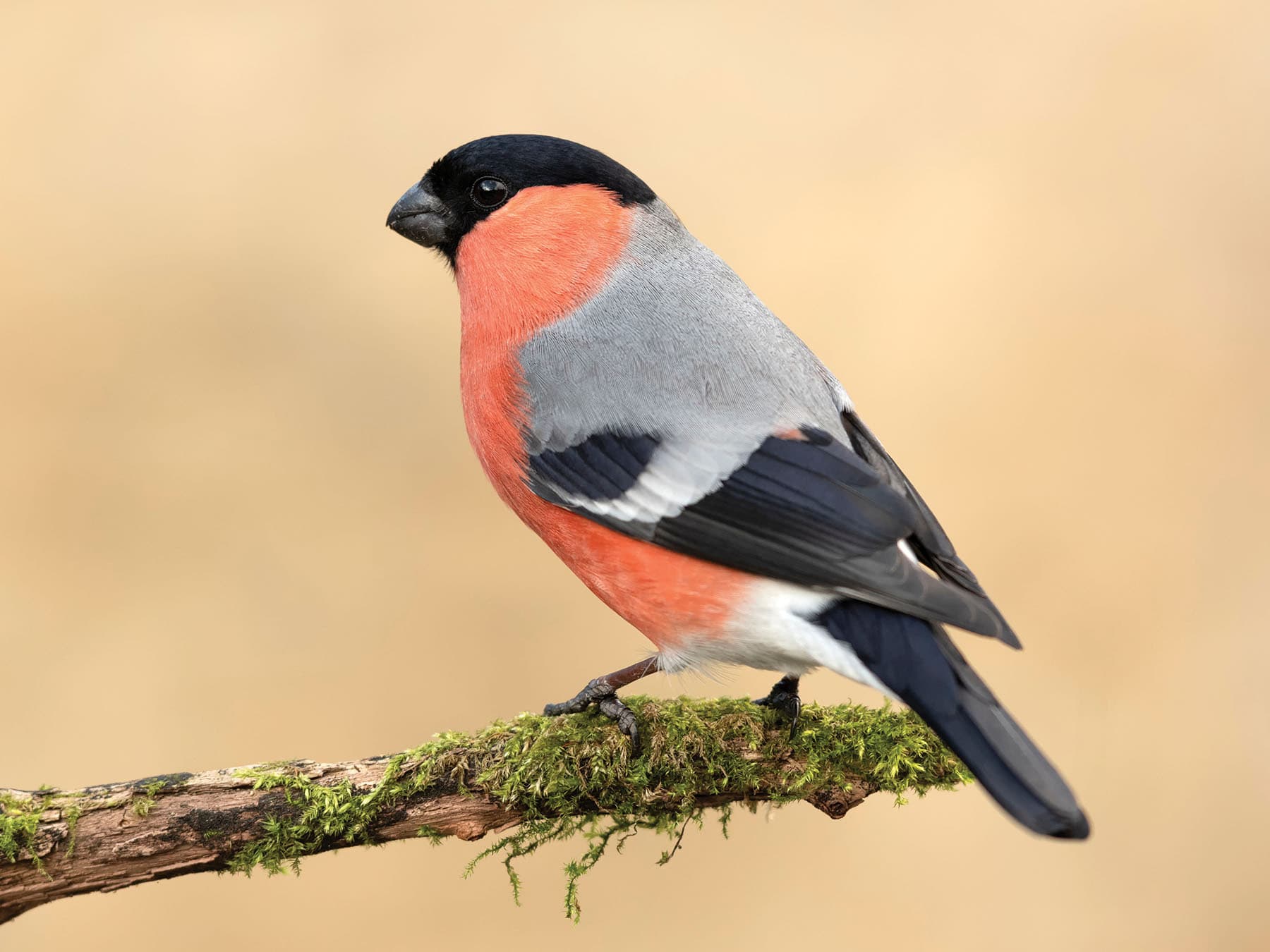
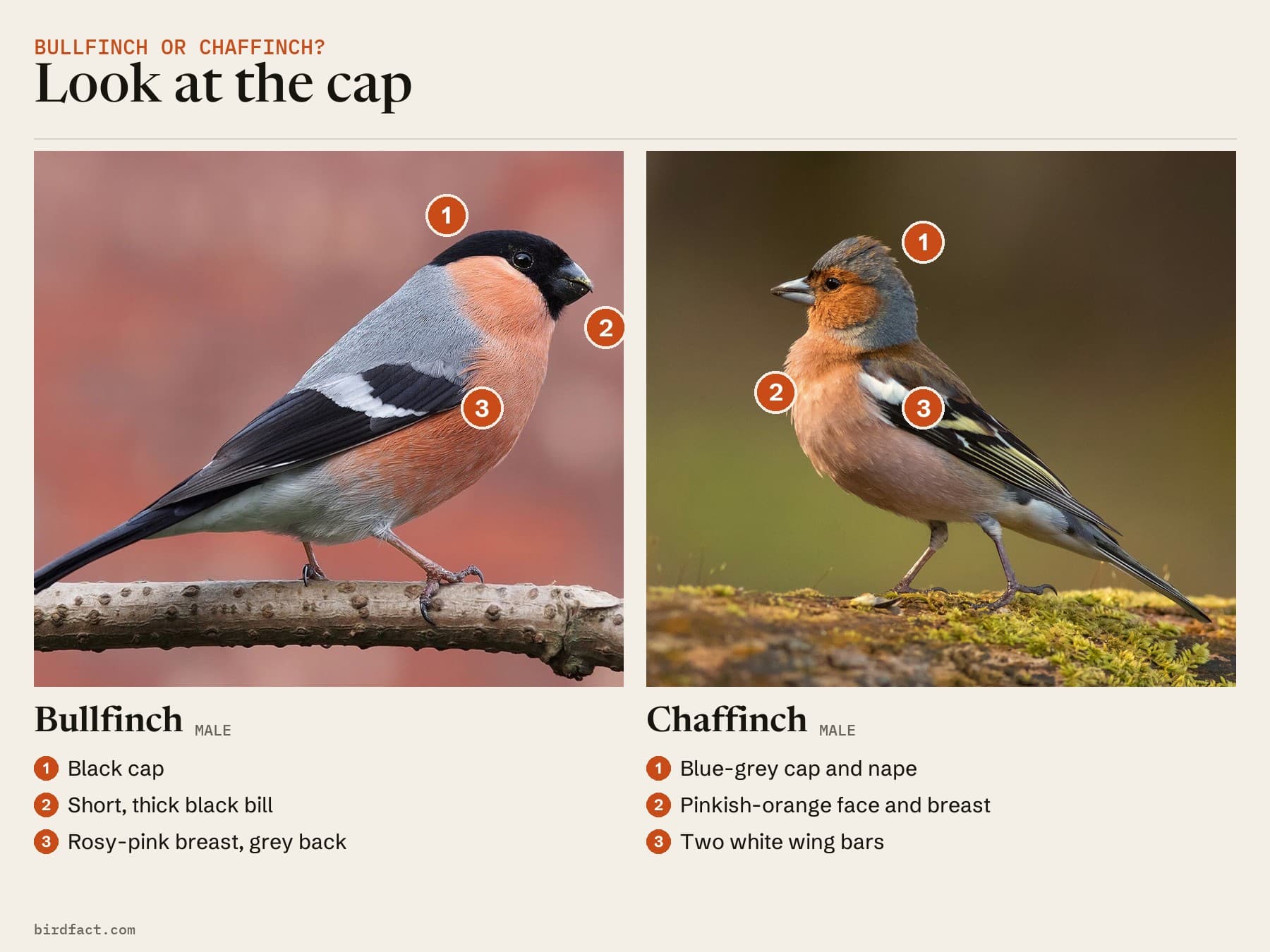
Facts · Updated 9 Oct 2026
What Do Bullfinches Eat? Seeds, Buds and Feeders
By the Birdfact teamChecked by Nathan Cope
Bullfinches live mostly on seeds, turning to buds in spring and berries in autumn; their chicks are fed seeds with caterpillars, snails and spiders. How the ash crop largely decides when they turn to fruit buds, what they take at feeders and how to attract them to a garden.
On this page10 sections
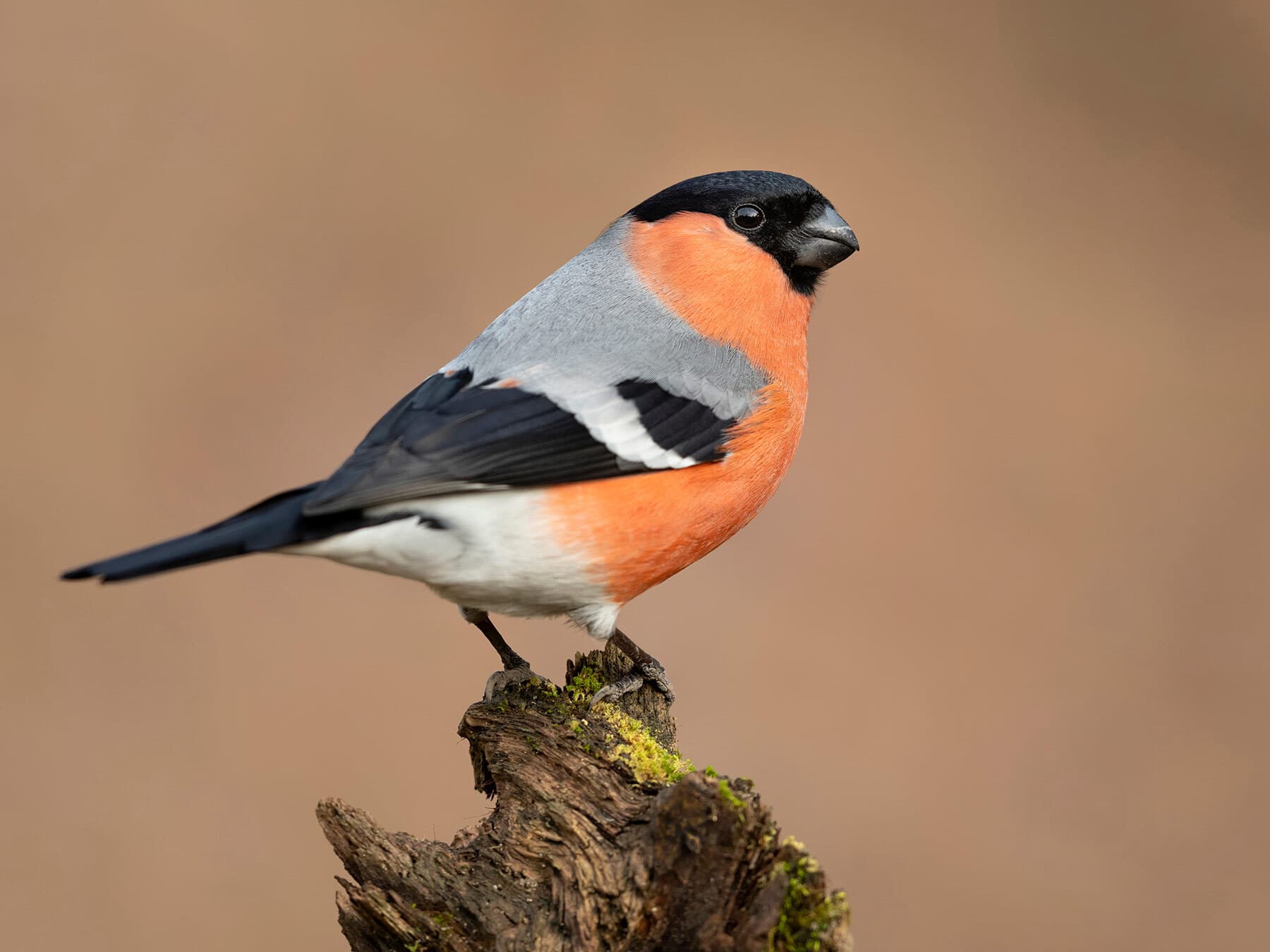
This page covers what Bullfinches eat through the year, why they eat buds, what they feed their chicks, their long history with fruit growers, and how to feed and attract them in a garden. For identification, song and nesting, see the Bullfinch guide.
What do bullfinches eat?
Through the year
Studies near Oxford in the 1960s give a detailed picture of a Bullfinch's year. In autumn the seeds of berries, especially rowan, are preferred to anything else. In winter come the seeds of maple, birch and ash; in spring, buds; and in summer, the seeds of low-growing plants, many of them farmland weeds.3 Earlier observations in Derbyshire and Somerset found much the same pattern, with insects taken in early summer, and the seeds of birch, ash and meadowsweet as the commonest foods of all.
Seeds
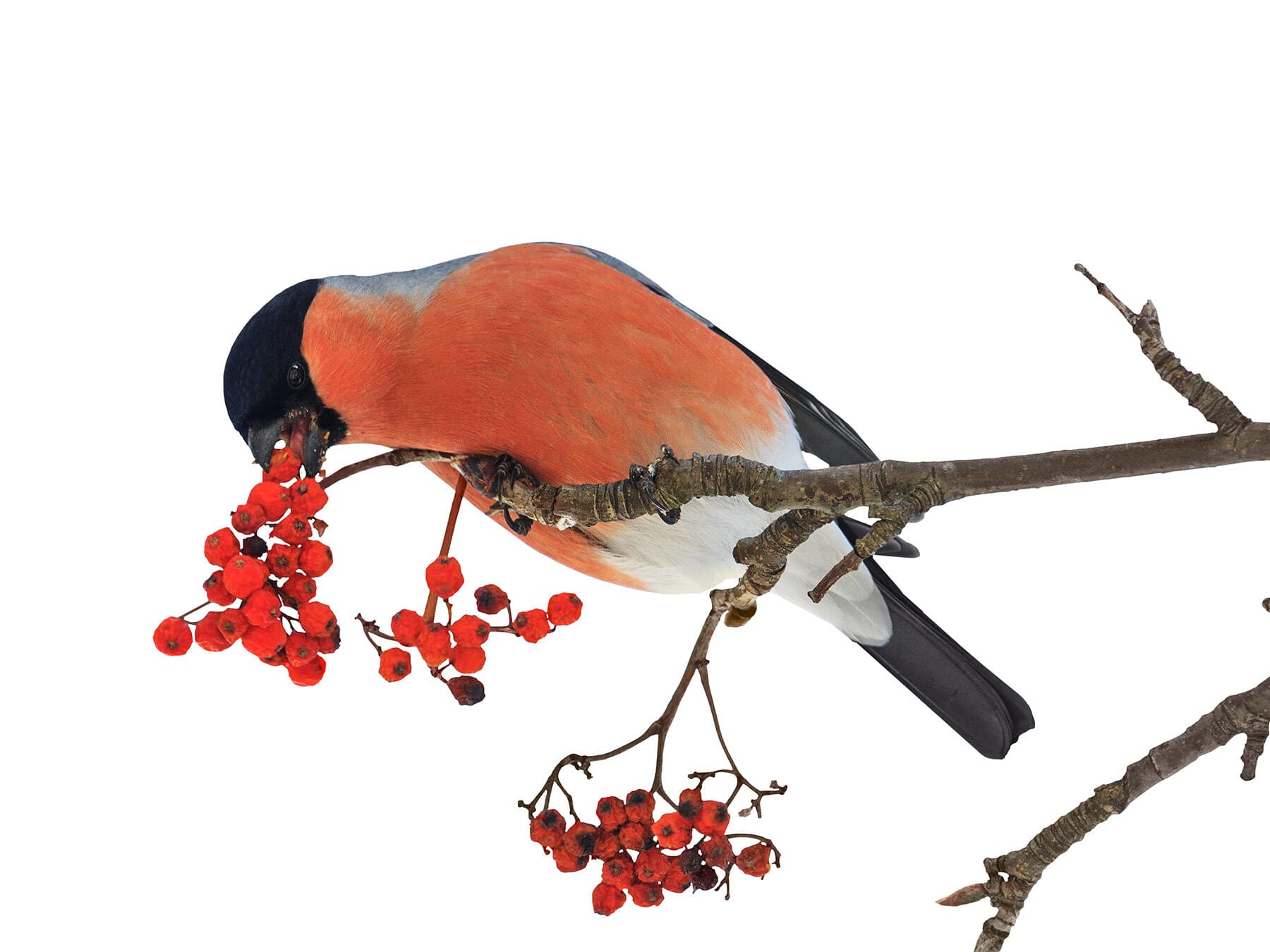
In woodland, the main seeds are those of elm, dog's mercury, garlic mustard, meadowsweet, nettle, bramble, birch and ash. On farmland they are dandelion, chickweed, buttercups, sow-thistle and fat-hen.3 Across their whole range Bullfinches eat the seeds of dozens of plants, from yew and spruce to docks and grasses, seeds between 0.5 and 14 mm long.
The short, thick bill is a seed-cracking tool. A Bullfinch crushes a fruit or seedhead in its bill and peels off the outer layer to get at the seed.4 It feeds perched sideways on a seedhead or a slender twig, and sometimes bites off a grass or thistle head to take the seeds in a bundle. An ash seed takes it 20 to 50 seconds, about 10 of them spent removing the husk.1
Buds
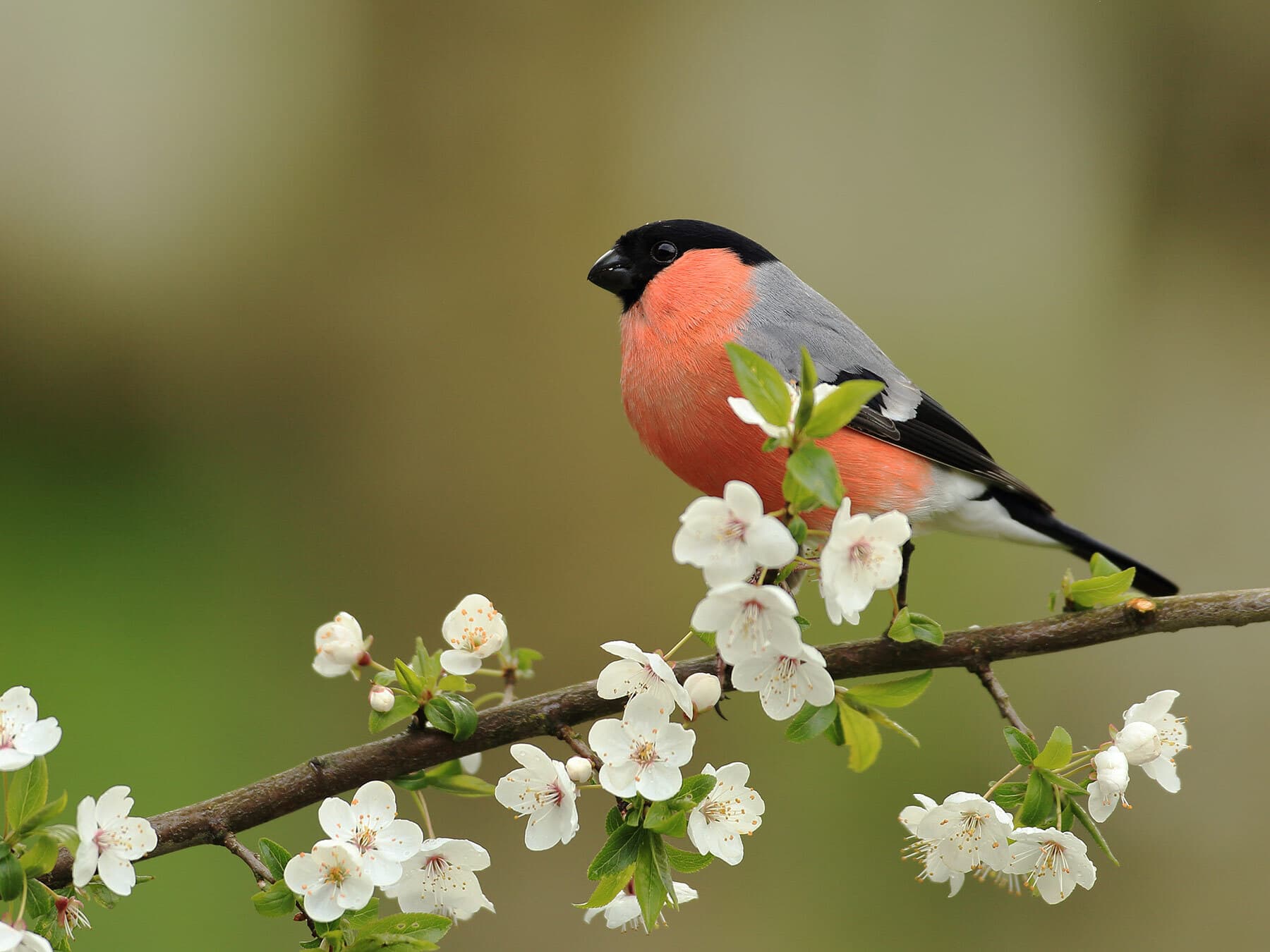
For up to a third of the year a Bullfinch lives mainly on buds. It eats only the centre of each bud, the part that would become a flower and then a fruit, and drops the rest, which is why so many buds seem to be thrown away.3 It can work through buds at up to 30 a minute.
Buds are not a first choice. Given the option, Bullfinches prefer seeds to the buds of fruit trees, and fruit buds to hawthorn buds, and captive birds could not keep themselves going on buds alone.5 In a later experiment, captive Bullfinches lost up to 8.7% of their weight overnight whatever they were fed; birds on seeds regained it during the day, but birds on pear buds kept losing weight.6
The seed crop, above all ash, largely decides when they start. Near Oxford, in the winter of 1962-63, ash trees seeded heavily: Bullfinches survived well and did almost no damage to the buds on a nearby fruit farm. In the two winters with no ash crop, damage was severe.5 In poor ash years the winter seeds ran out by the end of December or in January and buds became the main food; in good years the birds did not make buds their staple food until March.3
Berries
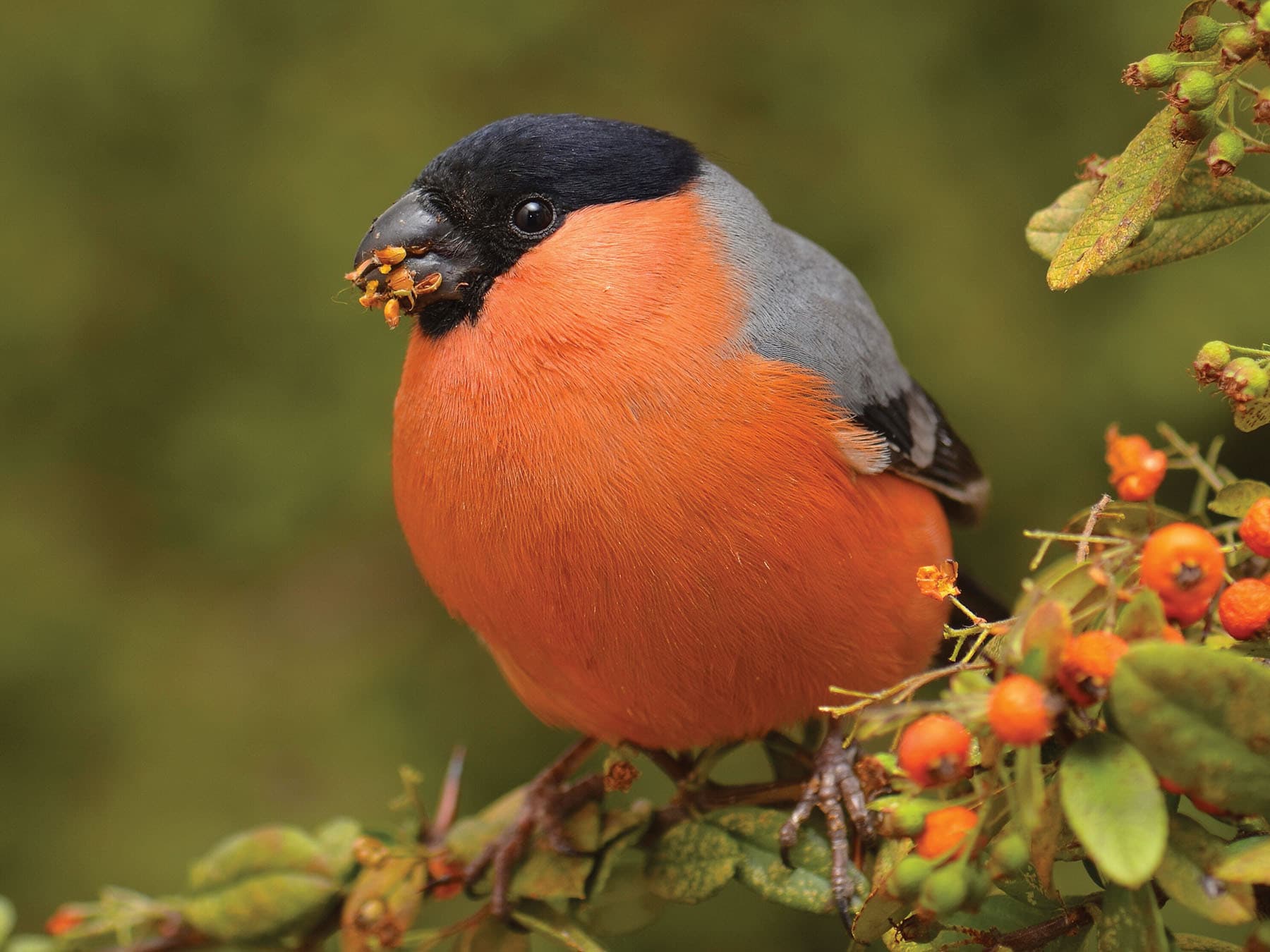
Bullfinches take berries such as rowan, buckthorn, hawthorn, blackthorn and blackberries. They usually crush the fruit to get at the seeds and drop the pulp, or take the seeds and leave the fruit on the plant; small fruits are swallowed whole, and with hawthorn they eat the flesh, apparently because the seed is too hard.1
What do baby bullfinches eat?
Seeds and small animals. Bullfinch chicks are fed seeds together with caterpillars, snails and spiders, and the share of small animals falls as they grow. Chicks in woodland get more of them than chicks on farmland.3
To carry the food home, adult Bullfinches grow special pouches under the lower jaw during the breeding season, and hold the food there until they reach the nest. Like other finches of their group, they feed the chicks by regurgitation.
Fruit growers
Because they take the buds of fruit trees, Bullfinches have a long history with fruit growers. Bud-eating has been recorded in England since the 16th century, and it increased greatly in the two decades before 1967, as Bullfinches spread into more open, farmed country; by then, Newton wrote, whole fruit crops were commonly lost in this way.3 The RSPB notes that they "were once considered a pest of fruit crops".7
The law has changed with that view. In 1953 the House of Lords removed the Bullfinch from its bill's list of birds that authorised persons could kill or take at any time,8 and the Protection of Birds Act 1954 did not list it,9 though an order in 1955 added it to that list in certain areas. In 1981 the government left it off the new list of pest birds, on advice that it "is not a nationwide pest", its damage being mainly to fruit buds in southern England.10 Since then, killing Bullfinches to protect fruit has needed a licence, which the law allows for preventing serious damage to crops, vegetables or fruit, among other things.11
Studies of the damage cut both ways. It is worst when the birds' wild seeds fail, as the ash studies show. In trials on Conference pears, with buds removed by hand to imitate Bullfinch damage, the next crop fell in proportion to the buds lost and the one after was larger, so over two years yields were lower, though not significantly; but trees damaged every year for five years cropped less every year.12 In a 1981 study of pear orchards, damage was concentrated on trees near woodland.13 Bullfinches are now Amber-listed, after UK numbers fell by 55% between 1967 and 2024: see conservation status.14
Do bullfinches come to feeders?
Yes. The BTO says Bullfinches can often be seen at garden feeders, and that in spring they also visit garden fruit trees to nibble the buds. At feeders they take sunflower and other seeds. The Woodland Trust says they will sometimes visit feeders containing seeds and suggests offering them.15
Feed with care. The RSPB warns that trichomonosis, which has caused serious declines in Greenfinches and Chaffinches, may now be causing a rapid decline in Bullfinches, and that the risk of outbreaks is linked to where birds gather to feed. It currently advises using hanging feeders rather than bird tables, trays or window feeders; pausing seed and peanuts from 1 May to 31 October; putting out only what is eaten in a day or two; and cleaning feeders weekly.16
How to attract bullfinches to your garden
Offer seed in a hanging feeder, from November to April, and if there is room, plant a fruiting tree: it gives them a natural food source and helps other wildlife too.15
Bullfinches are shy and rarely nest in gardens or use nest boxes, preferring thick cover, but a garden with areas of dense vegetation close to woodland might be used as a nesting site.
Sources
- Clement, P., Christie, D. A. (2020). Eurasian Bullfinch (Pyrrhula pyrrhula), version 1.0. Birds of the World (J. del Hoyo, A. Elliott, J. Sargatal, D. A. Christie and E. de Juana, editors). Cornell Lab of Ornithology. doi:10.2173/bow.eurbul.01
- Newton, I. (1960). The diet and feeding habits of the Bullfinch. Bird Study 7: 1-9. doi:10.1080/00063656009475955
- Newton, I. (1967). The feeding ecology of the Bullfinch (Pyrrhula pyrrhula L.) in southern England. Journal of Animal Ecology 36: 721-744. doi:10.2307/2822
- Newton, I. (1967). The adaptive radiation and feeding ecology of some British finches. Ibis 109: 33-96. doi:10.1111/j.1474-919x.1967.tb00005.x
- Newton, I. (1964). Bud-eating by Bullfinches in relation to the natural food-supply. Journal of Applied Ecology 1: 265-279. doi:10.2307/2401312
- Summers, D. D. B. (1982). The survival of Bullfinches on cultivated fruit buds. Journal of Applied Ecology 19: 813-819. doi:10.2307/2403284
- RSPB. Bullfinch. RSPB Birds A-Z. Accessed 9 October 2026. Source
- House of Lords (1953). Protection of Birds Bill [HL], Committee, 10 December 1953, col. 1224. Hansard (House of Lords). Accessed 9 October 2026. Source
- UK Parliament (1954). Protection of Birds Act 1954 (as enacted). Accessed 9 October 2026. Source
- House of Lords (1981). Wildlife and Countryside Bill [HL], Committee, 2 February 1981. Hansard (House of Lords). Accessed 9 October 2026. Source
- UK Parliament (1981). Wildlife and Countryside Act 1981, section 16 and Schedule 2 (as enacted). Accessed 9 October 2026. Source
- Summers, D. D. B. (1982). Short and long term effects of simulated bullfinch damage on the cropping of Conference pear trees. Annals of Applied Biology 100: 403-410. doi:10.1111/j.1744-7348.1982.tb01955.x
- Greig-Smith, P. W., Wilson, M. F., Blunden, C. A., Wilson, G. M. (1983). Bud-eating by bullfinches, Pyrrhula pyrrhula, in relation to the chemical constituents of two pear cultivars. Annals of Applied Biology 103: 335-343. doi:10.1111/j.1744-7348.1983.tb02772.x
- BTO. Bullfinch (Pyrrhula pyrrhula). BTO BirdFacts. Accessed 9 October 2026. Source
- Martin, J. How to attract bullfinches to your garden. Woodland Trust blog (18 February 2020). Accessed 9 October 2026. Source
- RSPB (2026). Our latest guidance on feeding garden birds. RSPB news. Accessed 9 October 2026. Source