Species Profile
Surf Scoter
Melanitta perspicillata
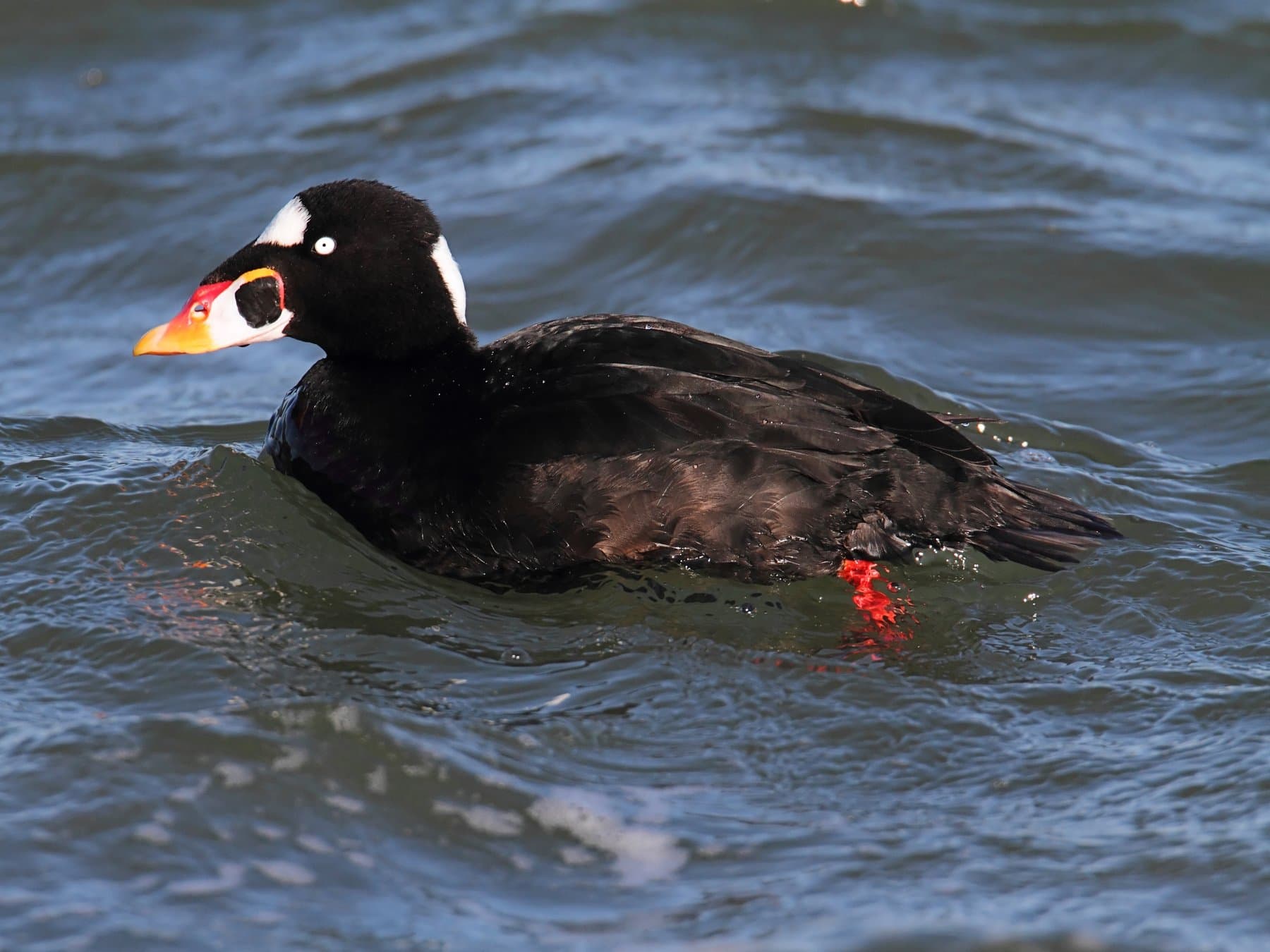
Surf Scoter floating on water, showing black plumage, white patches on its head, and a prominent orange, white, and black bill.
Quick Facts
Conservation
LCLeast ConcernLifespan
10–15 years
Length
48–60 cm
Weight
900–1293 g
Wingspan
76–77 cm
Migration
Long-distance Migrant
Velvety black from crown to tail, with a bill patterned in orange-red, yellow, white, and black — the male Surf Scoter carries the most ornate bill of any North American duck. Hunters nicknamed it the "skunk-head coot" for the bold white patches on its forehead and nape, and the scientific name perspicillata (Latin for "spectacled") nods to the same feature.
Think you've spotted a Surf Scoter?
Upload a photo and we'll confirm it instantly
Confirm with a PhotoAppearance
Adult male Surf Scoters are velvety black overall — the darkest of the three North American scoters, with little of the glossy sheen seen in the other two species. Despite their imposing look, they are also the smallest of the three scoters on average, with males averaging 1,050 g and 48 cm in length. Two white patches break the black: a smaller one on the forehead and a larger triangular patch on the nape.
The bill is the most eye-catching feature of any North American duck: broad, swollen at the base, and patterned with orange-red on top, yellow towards the tip, white on the sides, and a square black spot near the base. At distance it reads as mostly orange. The eyes are grey-white to yellow-white, and the feet are orange-red with dusky webs.
In flight, the male is entirely dark — including both the upper and lower wing surfaces — making it the only scoter with completely dark wings on both sides. This is a key identification feature when birds are moving fast over the water. Males reach full adult plumage at around three years of age. Second-year birds resemble adults but may show brownish feathers and often lack the white forehead patch. In non-breeding (basic) plumage, males appear dull black with a faint bluish-green gloss, retaining the white head markings and a slightly duller bill.
Adult females are dark brown overall, slightly darker above than below. They show two indistinct whitish patches on the side of the head — a smaller one in front of the eye and a larger one behind and below it. Some females also show a variably distinct whitish patch on the nape, a feature unique among female scoters and useful for separating them from female Common Scoter or Velvet Scoter. The bill is green-black or greyish-blue, shaped like the male's but slightly smaller. Legs are yellow-orange with dusky webs. Females average around 900 g and 44 cm in length, noticeably smaller than males.
Juveniles and first-winter birds resemble adult females but are generally paler and browner, with whitish or almost white underparts. The white facial patches may be less well-defined or run together, and the white nape patch is never present in juveniles.
First-winter males begin showing variable black feathers from November onwards, sometimes becoming wholly black early in the new year, with a small white nape patch appearing before the forehead patch develops in spring. Both sexes have white eyes as adults; juveniles have dark eyes.
Identification & Characteristics
Male Colors
- Primary
- Black
- Secondary
- White
- Beak
- Orange
- Legs
- Orange
Female Colors
- Primary
- Brown
- Secondary
- White
- Beak
- Grey
- Legs
- Yellow
Male Markings
Two white patches on head (forehead and nape); large multicoloured bill (orange-red, yellow, white, and black square spot); entirely black plumage including wings
Tail: Short, rounded black tail; males sometimes cock tail upward during display
Female Markings
Two indistinct whitish patches on side of head (before and behind eye); some females show faint white nape patch; large swollen grey-black bill
Tail: Short, rounded dark brown tail
Attributes
Understanding Attributes
Rated 0–100 based on research and observation. A score of 50 is average across all bird species. These attributes are relative and don't necessarily indicate superiority.
Habitat & Distribution
The Surf Scoter breeds exclusively in North America — the only scoter to do so — across northern Canada and Alaska. The largest breeding concentrations are in the Northwest Territories, Nunavut, and Labrador, in the taiga shield ecotone: the transition zone where boreal forest blends with open tundra in a patchwork of wetlands, lakes, shrublands, and meadows. Surf Scoters favour medium-sized, shallow freshwater lakes of roughly 10 hectares (about 25 acres), with few large predatory fish, shelter from wind, and abundant invertebrate food for ducklings. Nests tend to be near spruce cover, slightly upland from wetland areas.
Outside the breeding season, Surf Scoters are birds of the ocean coast, found in shallow marine waters close to land — particularly in bays, estuaries, harbours, and inlets with rocky substrates. The Pacific coast hosts the highest wintering numbers, with the range extending over 5,000 km from the Aleutian Islands in Alaska south to the Baja Peninsula in Mexico. Puget Sound in Washington State is a particularly important wintering site. On the Atlantic coast, birds winter from Newfoundland and Labrador south to Virginia, with some reaching Florida and the Gulf Coast. Small numbers also winter on the Great Lakes.
In the UK, the Surf Scoter is a scarce but regular vagrant, recorded in small numbers most years at coastal sites — most likely between October and March. The majority of UK records come from Scotland and northern England, though birds have been found as far south as Cornwall. Occasional inland records occur during severe weather; a first-winter bird spent the winter of 2016–17 at Rutland Water, Leicestershire, providing an unusually prolonged inland view. Birdwatchers in Ireland also encounter the species occasionally, particularly along the west coast. Immature birds and non-breeders may remain on coastal wintering grounds year-round, as far south as Baja California or New Jersey.
Where to See This Bird
Explore regional guides for locations where this bird has been recorded.
Alaska
Massachusetts
Maine
California
Delaware
New Jersey
Oregon
Rhode Island
Washington
British Columbia
New Brunswick
Nova Scotia
Northwest Territories
Yukon Territory
Diet
Surf Scoters are diving ducks that feed primarily on benthic invertebrates — creatures living at or near the sea floor. On winter coasts, the diet centres on small molluscs, especially mussels and clams, along with marine snails, small crabs, sea squirts, hydrozoans, marine worms, echinoderms, and occasional small fish. In Puget Sound, wintering birds regularly dive to depths of up to 20 m (66 ft) to reach mussel and clam beds. They also take mussels from man-made structures such as piers and harbour pilings.
In late winter and spring, Surf Scoters make a critical dietary shift. Large flocks gather at Pacific herring spawning sites — including well-known aggregations off Saltspring Island, British Columbia — to gorge on lipid-rich herring roe. This seasonal feast is thought to be essential for restoring body reserves depleted over winter and for fuelling egg production in females. The link between herring population health and Surf Scoter breeding success is direct: a poor spawn year can compromise the condition of females arriving on the breeding grounds.
During the breeding season, adults and ducklings switch entirely to freshwater invertebrates. Adults take aquatic insect larvae — particularly caddisfly and mayfly — along with small molluscs, crustaceans, and some plant matter including sedges, pondweeds, and crowberries. Young ducklings eat mostly aquatic insects at first, gradually incorporating molluscs and plant material as they grow.
Foraging is by diving and swimming underwater, propelled mainly by the feet with the wings typically held half-open. Surf Scoters do not surface-dip or upend like dabbling ducks — all food is obtained by full submersion dives, typically lasting 20–30 seconds.
Behaviour
Surf Scoters are highly gregarious outside the breeding season, gathering in large rafts on coastal bays and estuaries — sometimes numbering in the thousands. Puget Sound in Washington State alone holds around 50,000 scoters in winter, approximately 80% of which are Surf Scoters. Within these flocks, birds dive repeatedly for benthic prey, often synchronising their dives so that large sections of the raft disappear and resurface together.
Courtship takes place on wintering and staging grounds from late winter through spring. Males perform a sequence of ritualised displays: a sentinel posture with the neck stretched upward, breast-scooping movements where the bill is dragged across the chest, and rapid head-shaking or preening. A female inclined to respond tilts her head upward in a chin-lift display, giving a raspy crowing call. Pair bonds are typically established before birds arrive on the breeding grounds, and some evidence suggests bonds may persist across multiple years.
On the breeding grounds, males depart soon after incubation begins, leaving females to raise the brood alone. On crowded lakes, ducklings routinely switch between family groups, joining a different female's brood. Because mothers guard rather than actively feed their chicks, there is little cost to either female when a duckling strays. Brood amalgamation is therefore a regular feature of Surf Scoter breeding biology, and as the season progresses, multiple broods often merge into crèches after the female abandons the chicks before they can fly.
Outside the breeding season, Surf Scoters associate loosely with other scoter species, particularly White-winged Scoters, but tend to form their own sub-flocks within mixed groups. They are not strongly territorial on wintering grounds and show little aggression towards conspecifics except during active courtship.
Calls & Sounds
Surf Scoters are among the quieter sea ducks for most of the year, and their vocalisations remain less well-documented than those of many other wildfowl. The most frequently heard sound is not a call at all: in flight, the wings of all scoter species produce a strong, pleasant whistling that carries for considerable distances on calm days.
During courtship, males produce a low, liquid gurgling call and an explosive popping sound often transcribed as "puk-puk," typically delivered during head-shaking or breast-scooping display sequences. Males also give a guttural croaking described as "kraaaakfrraaak." When alarmed — for example, when a predator approaches or when the flock is about to take flight en masse — Surf Scoters produce a sharp "guk" sound, somewhere between a cluck and a tok, while rapidly scanning their surroundings.
Females are generally more vocal than males in the context of brood defence. A female with ducklings gives a harsh, crow-like "craah" or "crahh" as an alarm call. During courtship, a female receptive to a displaying male performs a chin-lift display — tilting her head upward — accompanied by a raspy crowing call. Vocalisations are most frequent during the courtship period on wintering and staging grounds, from late winter through spring migration, and then largely cease once birds reach the breeding grounds.
Flight
Surf Scoters fly low and fast over the water, typically in loose, straggling lines or small groups rather than tight formations. The wingbeat is rapid and continuous — scoters do not glide between beats the way larger wildfowl do — giving the bird a purposeful, slightly heavy-looking flight action. On longer overland crossings during migration, flocks gain altitude considerably, but over coastal waters birds rarely rise more than a few metres above the surface.
The most useful in-flight identification feature is the wing pattern. Male Surf Scoters are entirely dark on both the upper and lower wing surfaces — no white speculum, no pale panel, nothing. This distinguishes them immediately from the White-winged Scoter, which shows a prominent white secondary patch visible from considerable distance, and from the Common Scoter, which shows a pale silvery panel on the underside of the flight feathers. Female Surf Scoters are also entirely dark-winged, though the brown tones can be harder to assess in poor light.
Migrating flocks can number in the hundreds, moving purposefully along the coastline in long, low streams. Spring migration flocks sometimes include birds in active courtship display, with males performing aerial chases around females.
Nesting & Breeding
Pair bonds form on wintering and staging grounds, with most pairs established before birds arrive on the breeding grounds in May. The species is considered monogamous, and some observations suggest bonds may persist across multiple years, though this is not confirmed. Males do not breed until around three years of age.
Nest building typically begins in mid-May to early June. The nest is on the ground, well concealed under low tree branches, fallen logs, or in dense grass clumps — often some distance from water but generally upland from marsh vegetation. The female constructs a shallow depression lined with her own down feathers and plant matter: mosses, grasses, spruce and fir needles, twigs, and bark. In one Quebec study, nests averaged 30 cm across, with an interior bowl 17 cm wide and 6 cm deep.
Clutch size is 5–9 eggs, usually around 7. Eggs are creamy white or pale buff, measuring approximately 6.4–6.8 cm long and 4.5–4.8 cm wide. Incubation is by the female only and lasts approximately 28–30 days. The male leaves soon after incubation begins, departing to dedicated moulting sites on the coast.
Ducklings are precocial — downy, with open eyes at hatching — and leave the nest shortly after drying, feeding themselves immediately. The female tends and guards the brood but provides no direct feeding assistance. Because mothers guard rather than actively feed their young, there is little evolutionary pressure against ducklings straying between broods — making brood amalgamation a regular and apparently adaptive behaviour in this species. The female abandons the chicks before they can fly, at approximately 55 days, after which multiple broods often join to form crèches. The species does not renest if a clutch is lost, and studies show strong fidelity to nesting areas across years.
Lifespan
In 2025, a male shot in coastal New Jersey was confirmed to be at least 22 years old — a new longevity record for the species. The bird had been banded as an adult by the Canadian Wildlife Service in Labrador in 2004, meaning it had survived for over two decades while completing annual migrations of more than 3,000 km between breeding and wintering grounds. Surf Scoters typically live for 10–15 years in the wild, with survival rates improving after the first year, when inexperienced birds face the highest mortality.
Mortality causes include hunting (approximately 20,000–25,000 birds shot annually in the US alone), oil spills on wintering grounds, predation (particularly of eggs and ducklings by foxes, ravens, and large gulls), and starvation during severe winters when prey becomes inaccessible. First-year birds are disproportionately vulnerable, particularly during their first southward migration and first winter on coastal foraging grounds.
Compared to other sea ducks, Surf Scoter longevity is broadly similar to that of the Common Eider, which regularly reaches 20+ years in the wild, and somewhat shorter than the Long-tailed Duck, for which records of 28 years exist. The remote breeding range of the Surf Scoter means that survival data are sparser than for many other wildfowl, and true average lifespan in the wild remains incompletely known.
Conservation
The Surf Scoter is listed as Least Concern on the IUCN Red List, but this status masks a troubling population trajectory. The global breeding population is estimated at 470,000 individuals by Partners in Flight, with Ducks Unlimited placing the total population (including non-breeders) at 600,000–1,000,000. Population size is poorly known due to the species' remote breeding range in the Canadian boreal zone.
Limited survey data suggests a decline of 50–70% since the 1950s–1980s. In Puget Sound — one of the most important and well-monitored wintering sites — the scoter population index has declined by more than 50% since 1994–96, and possibly as much as 78% since 1978–79. Climate modelling projects a further 31% decline by 2080 compared to 1980 levels. Washington State has designated the Surf Scoter as a Species of Greatest Conservation Need.
Primary threats fall into several categories. Oil spills on wintering grounds pose an acute risk, where large concentrations of birds are highly vulnerable; heavy metal and organochlorine contamination compounds this. Coastal habitat is under pressure from loss and degradation of both boreal breeding areas and marine wintering grounds. Commercial shellfish operations overharvest mussel prey, and aquaculture practices actively exclude sea ducks from key foraging areas. Hunting accounts for approximately 20,000–25,000 Surf Scoters shot annually in the US, with the Atlantic Flyway accounting for roughly 80% of the harvest.
Climate change poses a compounding threat through trophic mismatch — altering the timing of snowmelt and prey emergence on breeding grounds — and by shifting herring spawn timing and degrading subtidal foraging habitats. Offshore wind farm development in key Atlantic migration corridors is an emerging concern identified by the Sea Duck Joint Venture's satellite telemetry studies.
The paradox of Least Concern status alongside a 50–70% decline reflects the species' still-broad range and large absolute numbers. Conservation efforts focus on protecting key moulting and wintering sites, monitoring boreal breeding populations, and reducing bycatch and pollution in coastal wintering areas.
Population
Estimated: 470,000–1,000,000
Trend: Decreasing
Decreasing. Survey data suggests a decline of 50–70% since the 1950s–1980s. Puget Sound wintering numbers have fallen by more than 50% since 1994–96, and possibly 78% since 1978–79. Climate modelling projects a further 31% decline by 2080.
Elevation
Sea level to boreal lowlands (breeding); sea level (wintering)
Additional Details
- Family:
- Anatidae (Ducks, Geese & Swans)
- Predators:
- Eggs and ducklings are vulnerable to Arctic foxes, ravens, large gulls (particularly Herring and Glaucous Gulls), and birds of prey including Peregrine Falcons and Bald Eagles. Adults face few natural predators but are taken occasionally by large raptors and, on wintering grounds, by Great Black-backed Gulls targeting weakened individuals.
- Also known as:
- Skunk-head coot
Identification Tips
In a mixed scoter raft at distance, the male Surf Scoter's head shape is the first thing to fix on: the swollen bill base gives the forehead a steep, wedge-like profile quite unlike the flatter head of a Common Scoter. Once you've picked out that silhouette, the white forehead and nape patches confirm the identification — no other North American scoter shows both. At closer range, the multicoloured bill (orange-red, yellow, white, and a black square spot) is unmistakable.
Separating Surf from White-winged Scoter is straightforward in flight: Surf Scoters are entirely dark-winged on both surfaces, while White-winged shows a bold white secondary patch. On the water, White-winged Scoters are noticeably bulkier, with a more rounded head and a small but visible white eye-patch.
Female and immature Surf Scoters are the trickier proposition. In a flock of female Common Scoters, look for the two whitish face patches (one before the eye, one behind) and the distinctively swollen grey-black bill — both absent in female Common Scoters. Some adult female Surf Scoters also show a faint white nape patch, a feature unique among female scoters. Female Velvet (White-winged) Scoters show a white wing patch in flight, which female Surf Scoters lack entirely. Juveniles are paler below than adults, with less well-defined facial patches, but the bill shape remains a reliable pointer at any age.
Courtship & Display
Courtship aggregations form on wintering and staging grounds from late winter, often weeks or months before birds depart for the breeding areas. This extended window means that males from across the wintering range compete for females at the same coastal bays and estuaries — a very different dynamic from species that pair up only on arrival at breeding sites. On the Pacific coast, major staging areas such as the Strait of Georgia and Puget Sound host some of the largest and most accessible courtship gatherings of any North American sea duck.
Within these groups, males perform a sequence of ritualised displays more elaborate than those of most other scoters. The sentinel posture — neck stretched vertically upward, bill pointed skyward — advertises the white head patches and colourful bill. This is followed by breast-scooping, in which the male drags his bill rapidly across his chest in a sweeping arc, and by lateral head-shaking that catches the light on the bill's multicoloured surface. Competing males may chase each other across the water in short, splashing rushes, and aerial pursuits of females also occur.
Females signal receptivity through the chin-lift display: head tilted sharply upward, throat exposed, accompanied by a raspy crowing call. Most pair bonds are established before birds arrive on the breeding grounds in May. Once there, the male's role ends quickly — he departs for moulting sites soon after the female begins incubation, taking no part in chick-rearing. The elaborate courtship investment is therefore the male's entire reproductive contribution beyond fertilisation, which may explain why the displays are so visually striking compared to those of other scoter species.
Birdwatching Tips
On the Pacific coast of North America, Surf Scoters are among the most reliably seen sea ducks from October through April. Puget Sound, the Strait of Georgia, and the bays of coastal California are all excellent sites; scan mixed scoter rafts carefully, as Surf Scoters often associate with White-winged Scoters. The male's all-black plumage with the colourful bill and white head patches is unmistakable at close range. At distance, look for the entirely dark wings — both above and below — which distinguish it from the White-winged Scoter, which shows a white wing patch.
On the Atlantic coast, birds winter from Newfoundland south to Virginia. Rocky headlands, harbour mouths, and sheltered bays are the best spots. Early morning, when birds are actively diving and displaying, gives the best views.
In the UK and Ireland, Surf Scoters are scarce but annual vagrants. Check flocks of Common Scoters carefully — a Surf Scoter will stand out by its larger, more swollen bill and, in males, the white head patches. Females are trickier: look for the two white facial patches and, in some individuals, a faint white nape patch absent in female Common Scoters. Scottish sea lochs and headlands, particularly in the Northern Isles and along the east coast, are the most productive areas. Severe winter weather occasionally pushes birds to inland reservoirs.
In flight, listen for the strong whistling sound produced by the wings of all scoter species — audible for considerable distances on calm days and a useful alert that a flock is approaching. Surf Scoters fly low over the water in loose lines, and the entirely dark wing of the male is the best in-flight separator from White-winged Scoter.
Did You Know?
- Surf Scoters are "moult migrants" — one of relatively few bird species to undertake a dedicated three-stage annual journey. After nesting, adults fly to sheltered coastal bays and estuaries specifically to moult, simultaneously shedding all their flight feathers and becoming completely flightless for approximately four weeks. Only once the new feathers have grown do they continue to their wintering grounds. Key moult sites include coastal waters from southeastern Alaska to Puget Sound, and bays in Quebec and New Brunswick.
- On crowded breeding lakes, Surf Scoter ducklings routinely switch between family groups, joining a different female's brood entirely. This brood-mixing is thought to be adaptive: because mothers guard rather than actively feed their chicks, there is little cost to either female when a duckling strays. Few other duck species show this behaviour so consistently.
- The male's bill is patterned with four distinct colours — orange-red, yellow, white, and black — making it the most ornate bill of any North American duck. The scientific name perspicillata comes from the Latin for "spectacled," a reference to the white head patches, while hunters' nickname "skunk-head coot" captures the same bold pattern.
- Each spring, large flocks gather at Pacific herring spawning sites — including well-known aggregations off Saltspring Island, British Columbia — to gorge on lipid-rich herring roe. This seasonal feast links the health of herring populations directly to Surf Scoter breeding success: a poor spawn year can compromise the condition of females before they even reach the breeding grounds.
- Despite retaining IUCN Least Concern status, the Surf Scoter has declined by an estimated 50–70% since the 1950s–1980s. The disconnect between a still-broad global range and severe regional losses illustrates how range-wide conservation assessments can obscure local crises — a pattern seen in several other wide-ranging sea ducks.
Records & Accolades
Oldest Recorded Surf Scoter
22 years
A male banded in Labrador, Canada in 2004 was shot in New Jersey in 2025, confirmed at least 22 years old — a new longevity record for the species, announced by the U.S. Fish & Wildlife Service.
Deepest Foraging Dive
Up to 20 m (66 ft)
Surf Scoters in Puget Sound regularly dive to depths of up to 20 metres to reach mussel and clam beds on the sea floor.
Community Photos
Be the first to share a photo of the Surf Scoter
Upload a PhotoIdentify Any Bird Instantly
- Upload a photo from your phone or camera
- Get an instant AI identification
- Ask follow-up questions about the bird
Monthly Birds in Your Area
- Personalised for your location
- Seasonal tips and garden advice
- Updated every month with new species