


Velvet Scoter
Melanitta fusca
By the Birdfact teamChecked by Nathan Cope
On this page15 sections
How to recognise it
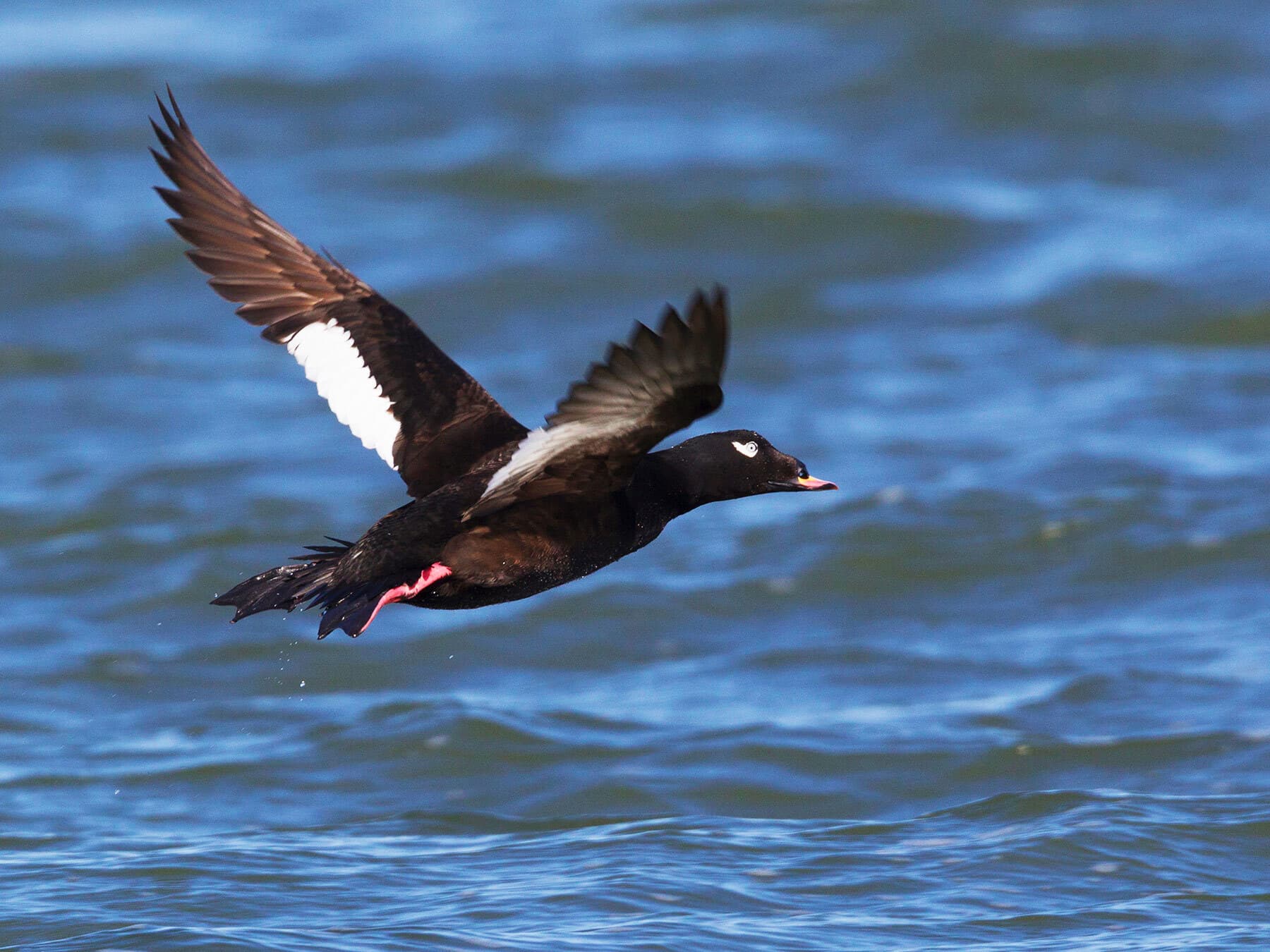
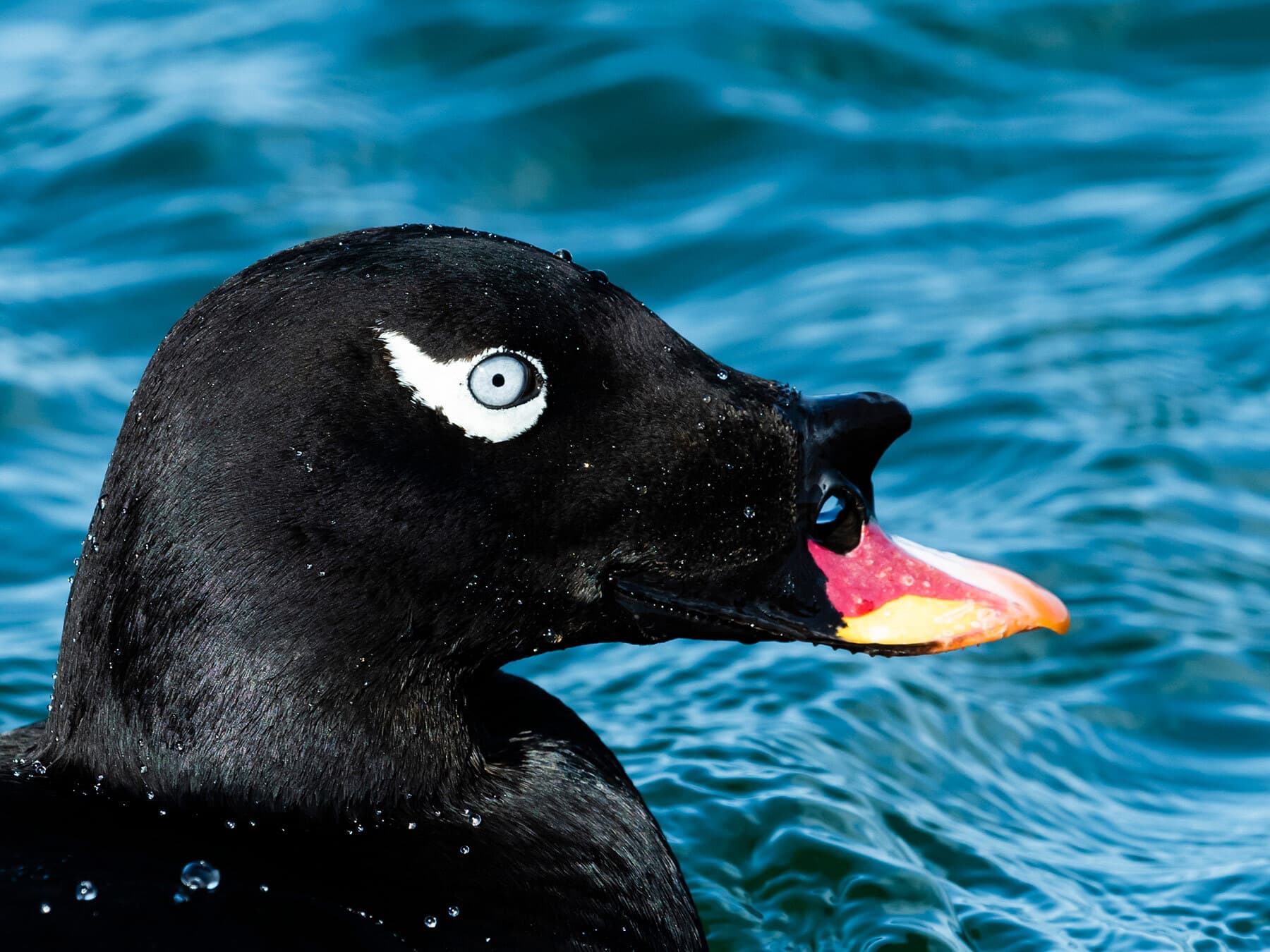
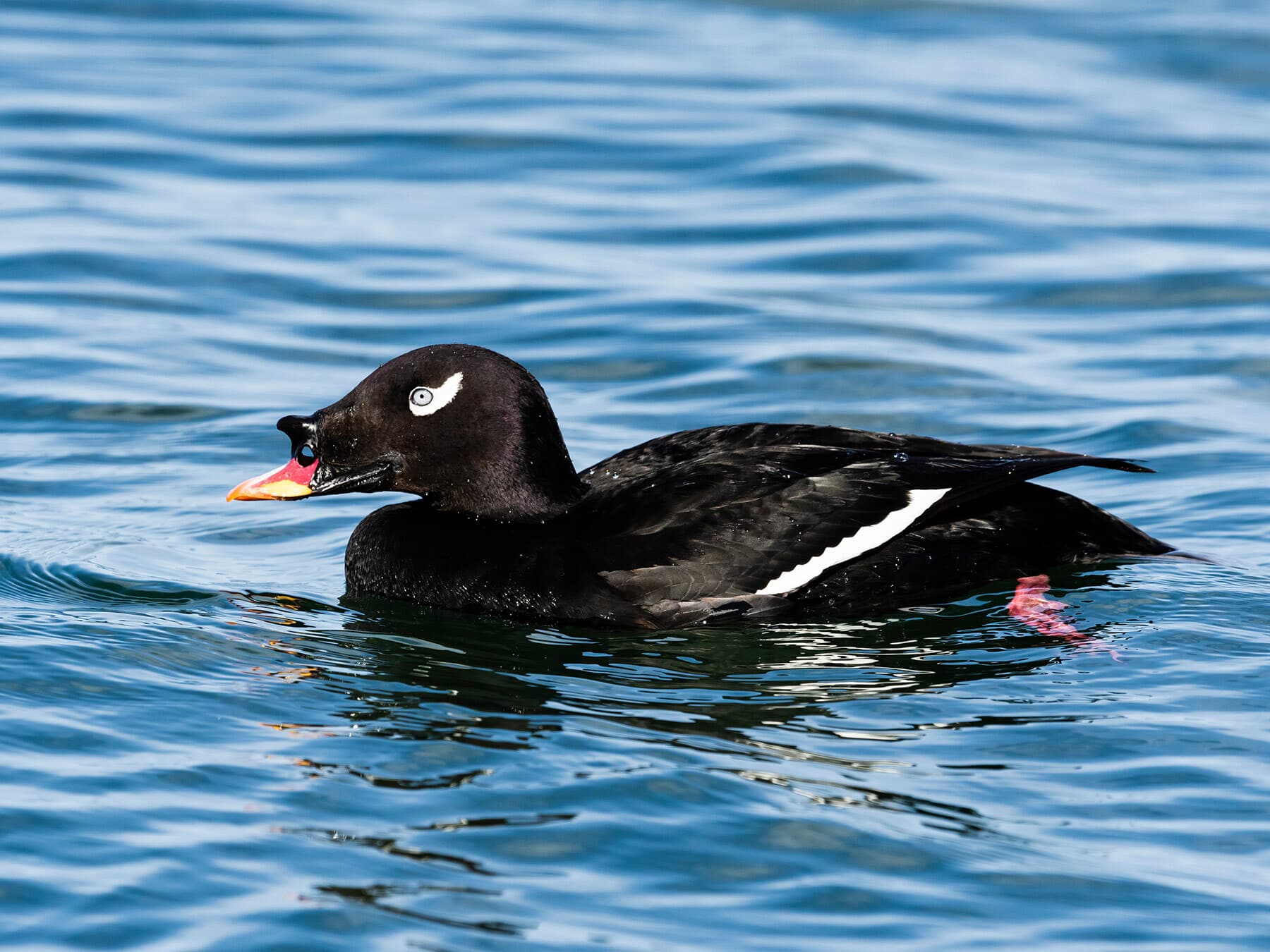
The Velvet Scoter is a large sea duck with a distinctive appearance. Males are predominantly velvety black with a white wing patch and a small white eye crescent. They have a bulbous orange bill with a black base and tip.
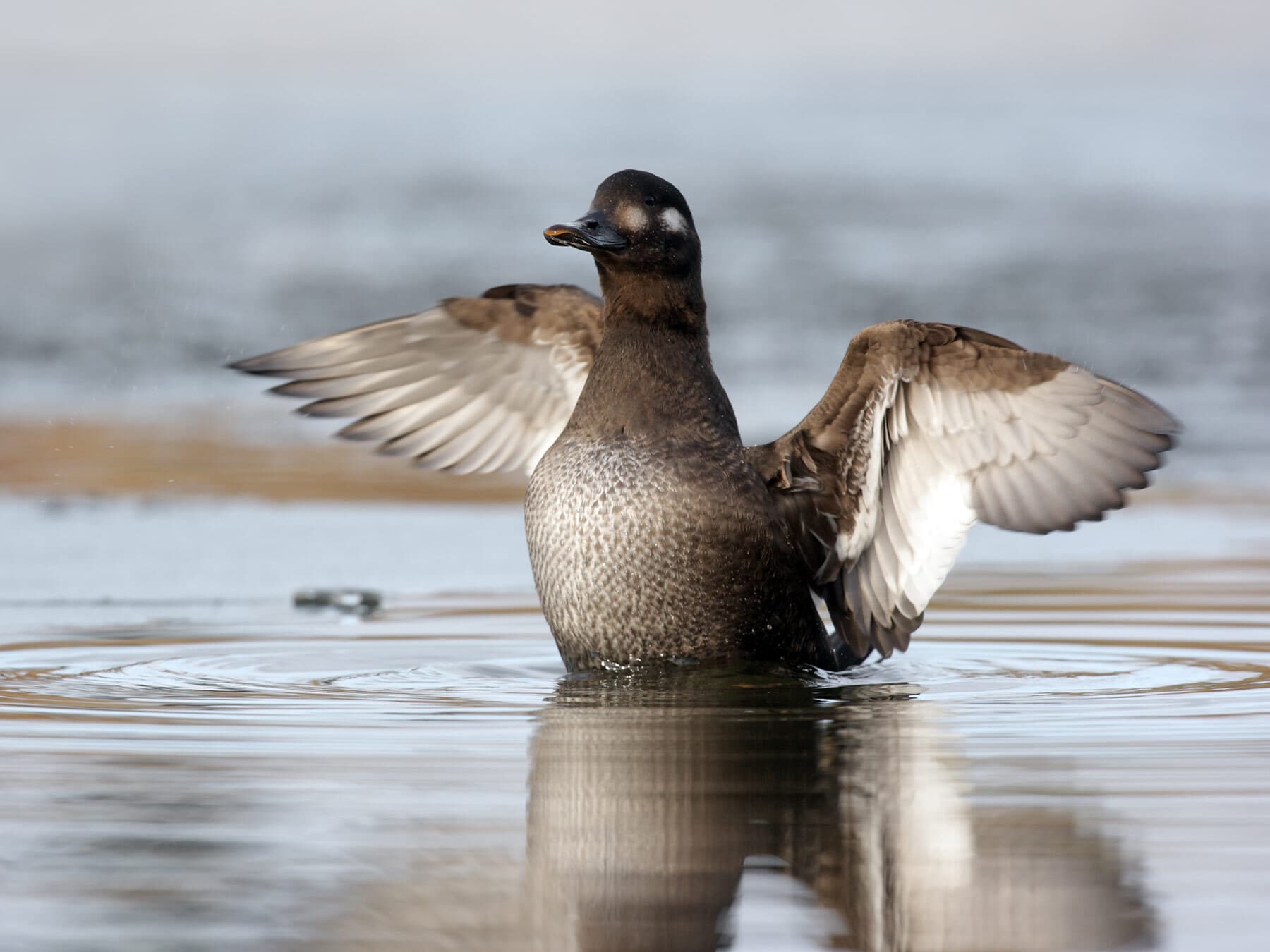
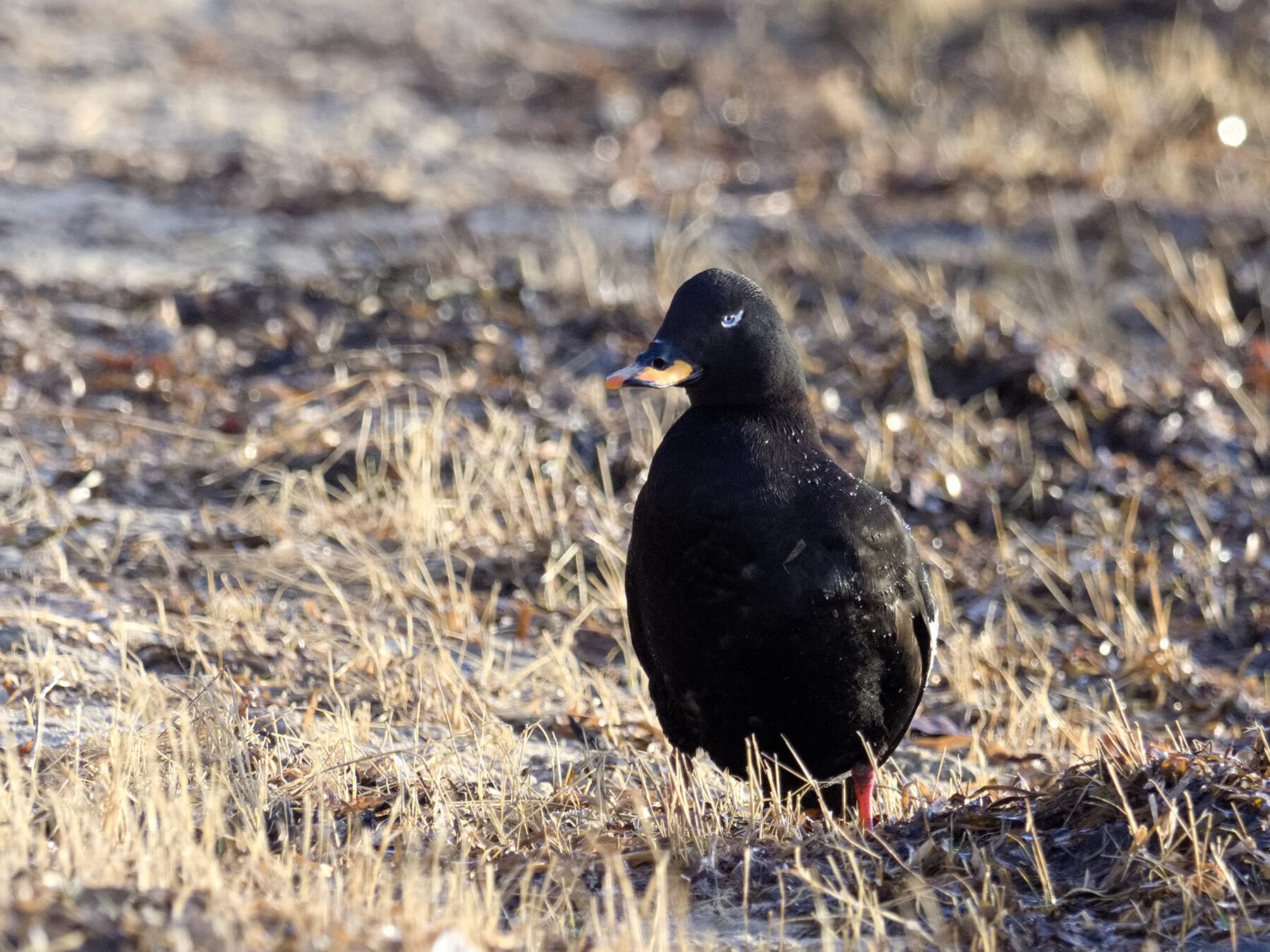
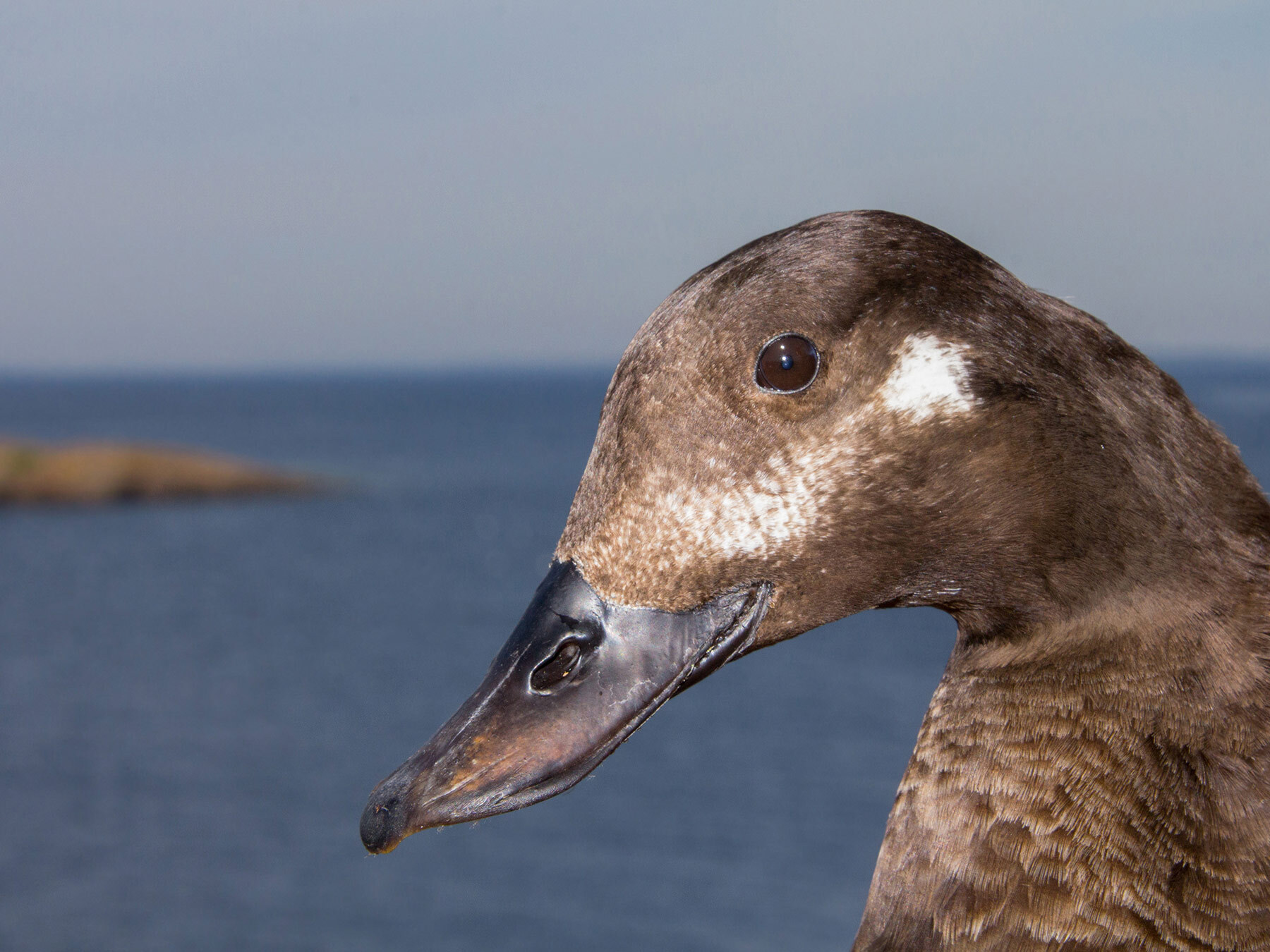
Females are brown with two light patches on the face. Both sexes have red legs and feet, though these are often submerged. Juveniles resemble females but with duller plumage.
Its size
Adults- Length
- 51–58 cm
- Wingspan
- 90–99 cm
- Weight
- 1200–2000 g
Its song and calls
Generally considered a silent bird the drake will issue a ‘vak – vak’ sound, mainly during the breeding season whilst the female can be heard in flight using a, ‘kraaah – kraaah – kra’ call.
When and where to see it
OctoberArriving
Most recorded in October
- 1. East Lothian0.68%
- 2. Moray0.58%
- 3. Fife0.25%
- 4. Angus0.24%
- 5. Northumberland0.16%
Each dot is a county, state or province: the bigger and darker, the larger the bird’s share of that place’s bird records that month. Grey dots: no regular records. The ringed point is the centre of the bird’s records this month; the arrow shows how it moved since last month, and the dashed loop its path through the year. “Arrivals” colours places where it becomes regular this month (orange) or is in its last regular month (grey). GBIF eBird Observation Dataset, 2019–2024. Map data: Natural Earth, US Census Bureau; place centres © OpenStreetMap contributors.
In your area
See when the Velvet Scoter is recorded in your county, state or province.
How often the Velvet Scoter turns up in the UK and Ireland through the year, from birdwatchers' records.
United Kingdom
Winter visitor · all year · most records in November
Ireland
Winter visitor · regularly Nov–Mar · most records in January
Show as a table
| Month | United Kingdom | Ireland |
|---|---|---|
| January | 0.040% (regular) | 0.031% (regular) |
| February | 0.028% (regular) | 0.029% (regular) |
| March | 0.017% (regular) | 0.015% (regular) |
| April | 0.011% (regular) | 0.002% |
| May | 0.007% (regular) | – |
| June | 0.003% (regular) | – |
| July | 0.012% (regular) | – |
| August | 0.013% (regular) | <0.001% |
| September | 0.015% (regular) | – |
| October | 0.026% (regular) | – |
| November | 0.050% (regular) | 0.010% (regular) |
| December | 0.046% (regular) | 0.030% (regular) |
Recorded regularly in
Worldwide: recorded regularly in 35 countries
Countries where it was recorded in at least 3 of the 6 years 2019–2024. Linked countries have their own bird list.
Data: EOD – eBird Observation Dataset (Cornell Lab of Ornithology), accessed via GBIF.org, CC BY 4.0. Records from 2019–2024, aggregated and filtered by Birdfact. How these lists are made
Often breeding in remote tundra or boreal forests, close to fresh water, in Scandinavia and Estonia with much smaller groups also breeding in isolated areas of central Siberia, Kazakhstan and Turkey. They winter in the coastal waters of the North Sea, The Baltic, the sea coasts of Western Europe south as far as the Mediterranean and the Black and Caspian Seas and rarely go ashore.
Signs and Spotting tips
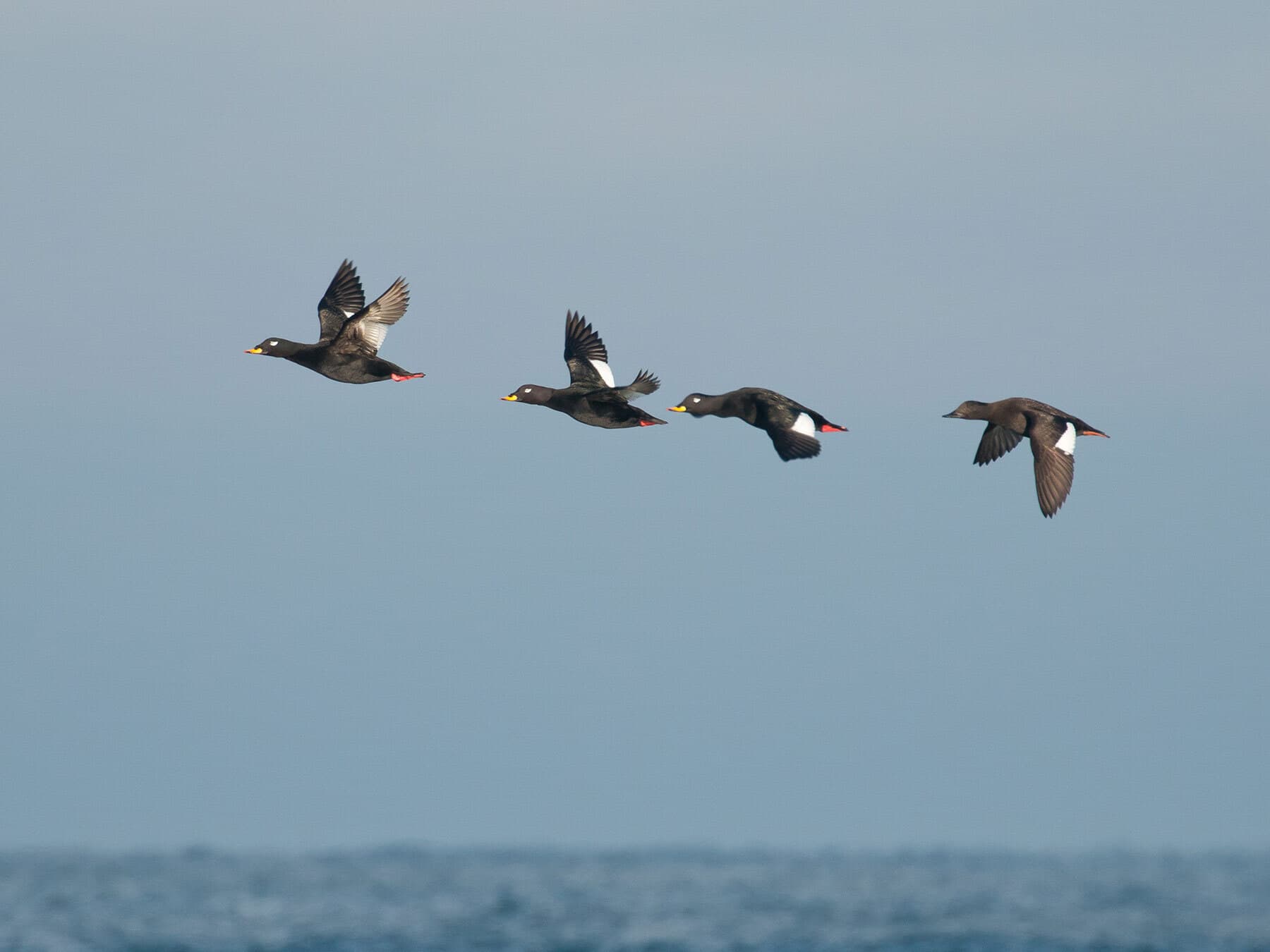
Velvet scoters are sociable birds often spotted flying parallel to the coast in long lines of large flocks or drifting, forming rafts on the sea, engaged in synchronous diving for food, in company with the much smaller and uniformly black, common scoters. In flight they fly fast and low with a strong wingbeat. As with many ducks who have distinguishing speculums, the bright white patch on the upper and lower wing area are an ideal aid to positive identification.
What it eats
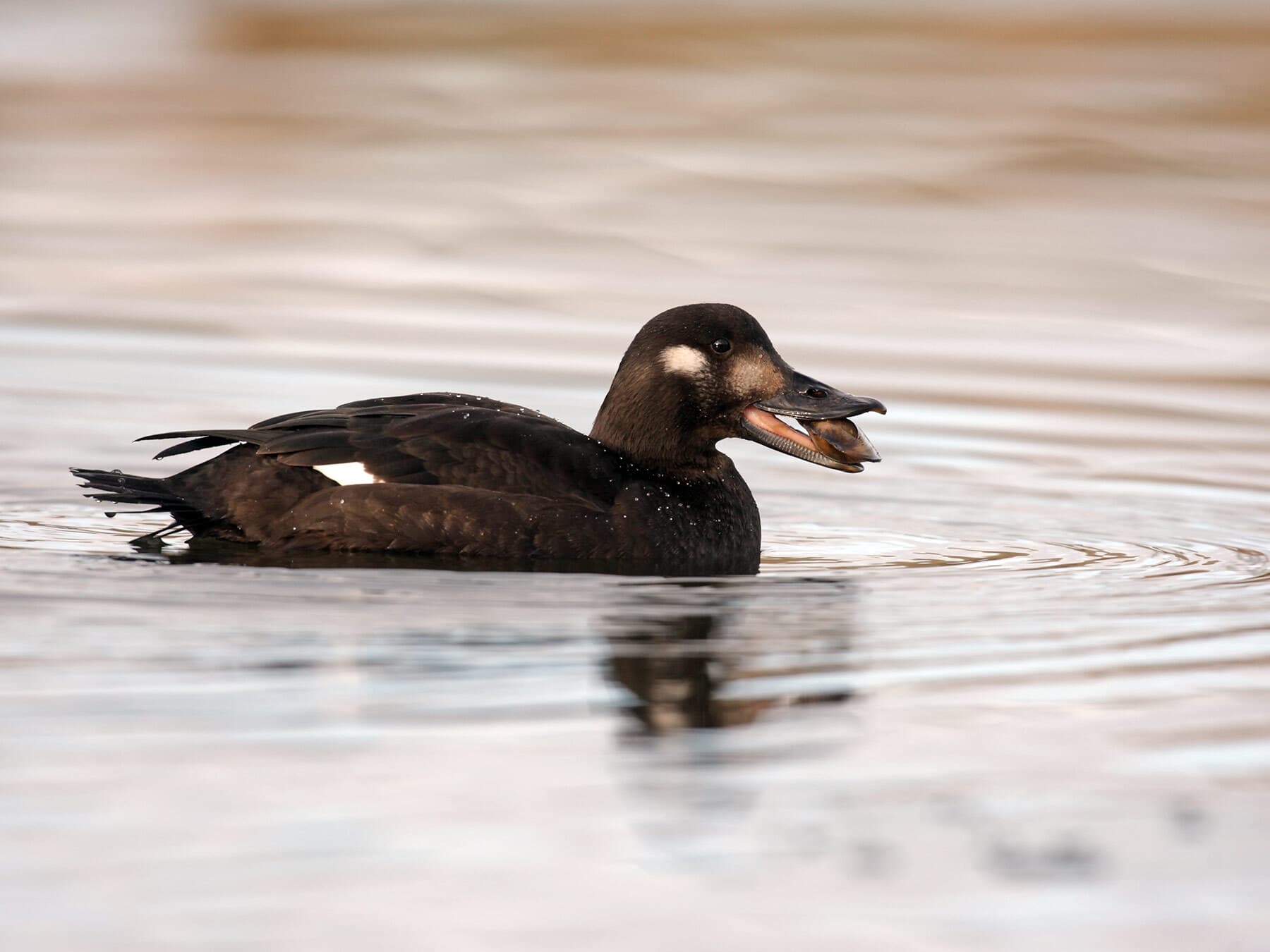
Diving down from the water’s surface in both fresh and salt water the velvet scoter survives on a diet of crustaceans, molluscs and small fish including crabs, marine worms, shellfish and shrimps.
Nesting and breeding
Nests are normally built in ground hollows close to water and are lined with fine foliage or down. Between May to July one clutch of 6 – 8 cream coloured eggs are laid annually and incubated by the female alone for up to twenty nine days. Fledging occurs between fifty and fifty five days after hatching.
Behaviour
Velvet Scoters are highly social, often forming large flocks on the water. They are excellent divers, plunging to depths of up to 30 meters to forage for food.
During courtship, males perform elaborate head-throwing displays accompanied by soft whistling calls.
Lifespan and predators
Life expectancy for the velvet scoter averages between ten to twelve years.
Conservation
The Velvet Scoter is classified as Vulnerable due to population declines across its range. Threats include oil spills, coastal development, and entanglement in fishing nets.
Conservation efforts focus on protecting key wintering and breeding habitats, and reducing marine pollution.
What does a Velvet Scoter look like?
The adult male (drake) is predominantly very dark to black all over apart from startling white secondary flight feathers, seen as a thin white line when the wings are folded and featuring prominently as a broad white wing patch which is obvious in flight. There is also a small white eye patch immediately below the eye. During the summer months the male’s black body assumes a slightly lighter brown tone. The bill is mainly yellow, particularly on the sides but the upper ridge of the bill otherwise known as the culmen, is black and swollen. The cutting edges of the bill are also black. The eyes are a pale greyish blue. Legs and feet of males and females are red in colour with dark grey webs. The adult female (duck) has a dark brown body with a light grey patch below the eye and also on the cheek. The neck is thick and the eyes are brown. The bill is dark and tapers to a long tip. Like the adult male the female has a white speculum (area of secondary flight feathers) clearly noticeable during flight. Juveniles are similar to the female but with larger whitish facial patches and lighter colouration across the breast.
Similar birds
Often mistaken for
More photos
2 photos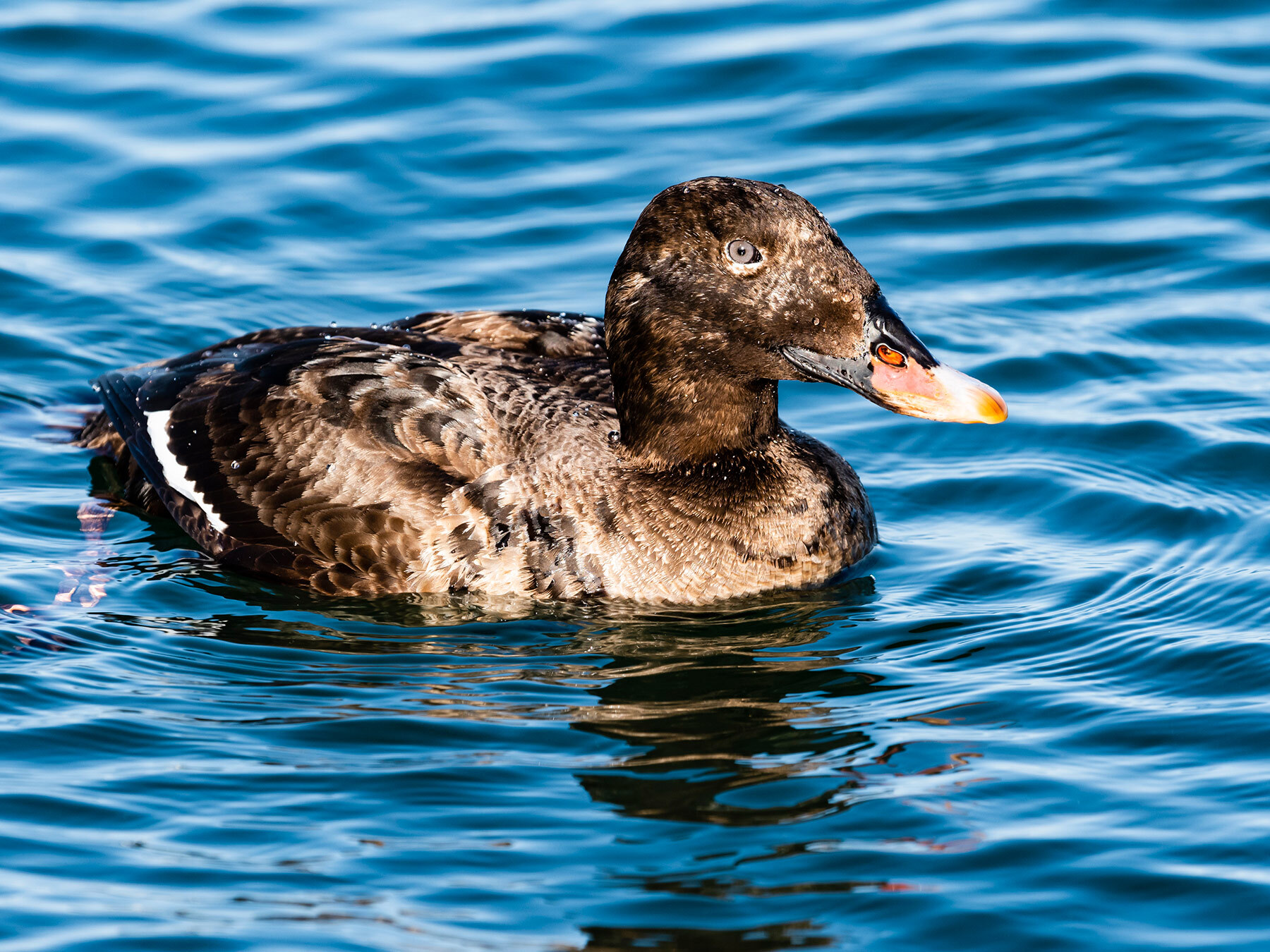
Velvet Scoter guides
1 guidesQuick facts
- Length
- 51–58 cm
- Wingspan
- 90–99 cm
- Weight
- 1200–2000 g
- Lifespan
- 10–12 years · oldest recorded 21.5 years
- Family
- Ducks, Geese & Swans
- Migration
- Long-distance Migrant
- Global status (IUCN)
- Vulnerable
- World population
- 141,000 - 268,000 mature individuals
- Population trend
- Decreasing
- Scientific name
- Melanitta fusca
Sources
4- 1BirdLife International. 2020. Melanitta fusca. The IUCN Red List of Threatened Species 2020: e.T22724836A183801134. Source (opens in a new tab)
- 2Skov et al. (2011)
- 3BirdLife International. 2020. Melanitta fusca. The IUCN Red List of Threatened Species 2020: e.T22724836A183801134. Source (opens in a new tab)
- 4Fransson et al., EURING list of longevity records for European birds (2010) Source (opens in a new tab)

Checked by
Nathan Cope, founder and editor
Nathan founded Birdfact and leads its writers and contributors in the UK, the US and Canada. He has watched and studied birds for more than ten years, and checks every article and species guide before it’s published.