Species Profile
Stilt Sandpiper
Calidris himantopus
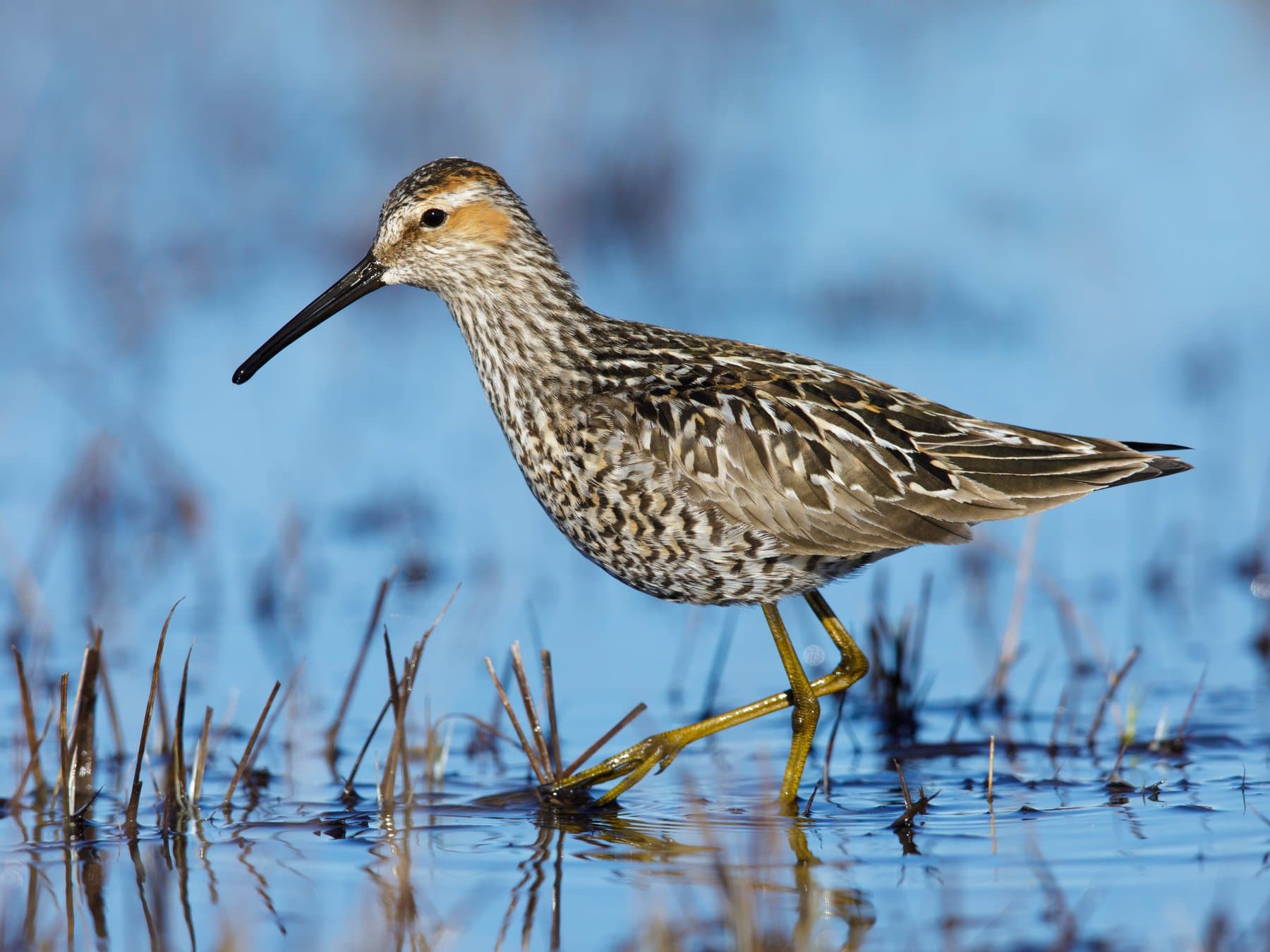
Stilt Sandpiper wading in shallow water, showing its long black beak, mottled brown and white plumage, and yellow legs.
Quick Facts
Conservation
NTNear ThreatenedLifespan
5–9 years
Length
18–23 cm
Weight
50–70 g
Wingspan
37–42 cm
Migration
Long-distance Migrant
A shorebird that looks like a yellowlegs, feeds like a dowitcher, and belongs to neither group, the Stilt Sandpiper is one of North America's most distinctive waders. Its long greenish-yellow legs, drooping bill, and boldly barred breeding plumage set it apart from every other sandpiper on the mudflat — and its habit of wading belly-deep to probe rhythmically into soft mud makes it unmistakable in action.
Think you've spotted a Stilt Sandpiper?
Upload a photo and we'll confirm it instantly
Confirm with a PhotoAppearance
Long greenish-yellow legs, a drooping bill, and a plump belly give the Stilt Sandpiper a subtly hunched, front-heavy silhouette unlike any other North American sandpiper. At 18–23 cm long with a wingspan of 37–42 cm, it sits between a Sanderling and a Lesser Yellowlegs in size, but its proportions are all its own. A long slender neck and a long bill that droops slightly at the tip complete the picture.
In breeding plumage (April–August), adults are unmistakable. Heavily and neatly barred dark brown and white, the underparts are unlike those of any other North American sandpiper. The back is dark brown with darker feather centres, and the head carries a rich chestnut crown and ear patch, a bold white supercilium, and a dark loral stripe running in front of the eye. The bill is black. No other North American sandpiper combines this head pattern with barred underparts.
In non-breeding (winter) plumage, the bird becomes considerably plainer: pale grey above with fine white feather fringes, whitish below with a dusky grey wash on the breast. The bold white supercilium persists year-round and remains the most reliable single field mark. The greenish-yellow legs are constant across all plumages.
Juveniles resemble non-breeding adults in their strong head pattern but show a scaly appearance on the upperparts, where neat pale edges to dark feathers create a more textured look than the smooth grey of winter adults. The underparts are whitish with brownish streaking on the chest, and the back is darker overall.
The sexes are similar in plumage at all seasons and are not reliably distinguished in the field. Females tend to be slightly larger on average.
Identification & Characteristics
Colors
- Primary
- Brown
- Secondary
- White
- Beak
- Black
- Legs
- Green
Markings
Bold white supercilium (year-round); chestnut crown and ear patch with heavily barred underparts in breeding plumage; long drooping bill; long greenish-yellow legs; white rump visible in flight
Tail: Grey tail; white rump patch conspicuous in flight; long legs project well beyond tail tip
Attributes
Understanding Attributes
Rated 0–100 based on research and observation. A score of 50 is average across all bird species. These attributes are relative and don't necessarily indicate superiority.
Habitat & Distribution
The Stilt Sandpiper breeds in a narrow, somewhat interrupted band of low Arctic and subarctic tundra across North America. This band runs from northwestern James Bay (around 55°N) westward and northward to northeastern Alaska near Barrow (71°N), following the treeline-tundra transition, with key breeding concentrations at Churchill and Wapusk National Park in Manitoba, La Pérouse Bay, and Prudhoe Bay in Alaska. On the breeding grounds it favours moist sedge-tundra meadows interspersed with dwarf birch, dwarf willow, and scattered stunted black spruce. Nests are typically placed on raised hummocks or dry ridges surrounded by wet ground.
Outside the breeding season, the species shows a strong and consistent preference for freshwater habitats. Migrants and wintering birds use shallow freshwater marshes, flooded fields and pastures, rainwater pools, ponds, wet agricultural fields, impoundments, and shallow lake margins. In coastal areas it uses lagoons and brackish grass marshes rather than open tidal flats — a preference that distinguishes it from most other sandpipers.
The main migration corridor runs through the central Great Plains (the Central Flyway), passing through Kansas, Nebraska, Iowa, and Minnesota south through Missouri, Illinois, and Indiana. Cheyenne Bottoms in Kansas is a key stopover site. The species is uncommon to rare on the Atlantic Coast and rare on the Pacific Coast. It winters primarily in the interior freshwater wetlands of central South America — Bolivia, southern Peru, southern Brazil, northern Chile, and northern Argentina — with smaller numbers in Florida, Texas, Louisiana, California's Salton Sea, and Mexico.
In the UK and Ireland, the Stilt Sandpiper is a very rare vagrant, subject to BBRC adjudication. The first British record was at Spurn, East Yorkshire on 31 August 1954; a second Spurn record followed in August 2024. Other accepted records come from Minsmere (Suffolk), Norfolk, Hampshire, and Kent. Records are concentrated in autumn (July–October). France has accepted seven records up to 2002, all along the western coast between Ouessant and the Gironde. The species has also reached Japan, Australia, and Taiwan as a vagrant.
Where to See This Bird
Explore regional guides for locations where this bird has been recorded.
Diet
On the breeding grounds, the Stilt Sandpiper's diet is approximately 90% invertebrates. Adult beetles — particularly diving beetles and their larvae — dominate, alongside adult and larval flies (craneflies, midges, mosquitoes), water bugs, water boatmen, small snails, and occasionally small frogs. Birds also forage on dry tundra ground during the breeding season, picking prey from the surface as well as probing into soft substrate.
During migration and winter, the diet broadens to include a wider range of aquatic invertebrates: beetle larvae, fly larvae, marine worms, small molluscs, and small crustaceans. Plant matter becomes considerably more important away from the breeding grounds — seeds of knotweed, river hemp, and plants in the family Asteraceae can make up as much as 30% of the diet during migration. Leaves and roots of aquatic plants are also consumed.
Foraging is primarily tactile. The bird wades into water up to belly depth and probes rhythmically into soft mud, the sensitive bill tip detecting prey by touch. This allows it to feed effectively in turbid water where visual hunting would be impossible, and explains why it feeds at night as readily as during the day. It also hunts visually, picking prey from the water surface, particularly when targeting larger or more mobile items.
The shift from an almost entirely invertebrate diet in summer to one that includes significant plant material in autumn reflects the seasonal availability of seeds at stopover sites. It also reflects the energetic demands of fuelling long migratory flights across the Caribbean.
Behaviour
The Stilt Sandpiper's most distinctive behaviour is its feeding action: it wades slowly through shallow water, often up to its belly, and probes rhythmically and vertically into soft mud with a characteristic "sewing machine" or "oil rig" motion. It thrusts the bill and head downward repeatedly, sometimes submerging the entire head. This tactile foraging style closely resembles that of dowitchers, and the two species frequently associate together on migration and in winter, sharing the same shallow pools and feeding in the same manner.
Because it forages largely by touch rather than sight, the Stilt Sandpiper feeds at night as well as during the day — an unusual trait among shorebirds that allows it to exploit feeding opportunities around the clock at stopover sites.
Outside the breeding season, Stilt Sandpipers are loosely gregarious, gathering in groups of up to several tens of individuals, often mixed with dowitchers, Lesser Yellowlegs, and other shorebirds on freshwater pools. They are not strongly territorial away from the breeding grounds. On the breeding tundra, males are highly territorial and vocal, performing elaborate aerial courtship and territorial displays.
One of the species' most ecologically distinctive traits is its strong preference for freshwater habitats over tidal mudflats — even in coastal areas, it seeks out lagoons, ponds, and flooded fields rather than open tidal flats. This sets it apart from most of its relatives and means it is more reliably found in the interior of North America than on the coasts.
Calls & Sounds
For most of the year, the Stilt Sandpiper passes almost unheard — but on the Arctic breeding grounds, the male calls incessantly from the air throughout the long summer day. The contrast could hardly be greater: a bird that migrates in near-silence becomes one of the most vocal presences on the tundra once it reaches its nesting territory.
The most commonly heard call away from the breeding grounds is a low, soft "tu-tu" or "tew" note — similar in character to the call of the Lesser Yellowlegs but noticeably softer and less strident. Some observers describe it as a flat "toff." Xeno-canto recordings also document a mild rolling "trrrr" and various soft contact calls given within flocks. When flushed, birds may give a slightly sharper version of the basic call.
On the breeding grounds, the male is a very different proposition. During the aerial courtship and territorial display, he calls incessantly — a guttural, continuous vocalisation described as a series of musical, low "twew" notes interspersed with coarse calls and whines, delivered during the spectacular plummeting display flight. Pairs on the breeding grounds also exchange a variety of interaction calls during nest relief and chick-tending.
The low, unobtrusive quality of the call means that Stilt Sandpipers are often detected visually before they are heard — particularly on migration, where a group may be feeding silently in a flooded field with no audible indication of their presence.
Flight
In flight, the Stilt Sandpiper has a distinctive silhouette: a hump-backed profile with the head held slightly low, long legs trailing well beyond the tail tip, and a relatively long, narrow wing. The wings are plain — only a faint pale stripe is visible, with no bold wingbar — which immediately distinguishes it from many similar-sized shorebirds such as the Dunlin or Pectoral Sandpiper. The rump is white and the tail grey, creating a clean white patch above the tail that is visible from a considerable distance.
The underwings show grey and white. The long legs projecting beyond the tail are a reliable feature at any distance, giving the bird a more attenuated rear end than most sandpipers of comparable size. The overall impression in flight is of something intermediate between a dowitcher and a yellowlegs — longer-legged than the former, plainer-winged than the latter.
Flight is direct and purposeful on migration, with measured wingbeats rather than the erratic, twisting flight of smaller waders. Migration is conducted in groups of up to several tens of individuals, in stages of several hundred kilometres, with non-stop flights both day and night. Flight speed has been measured at 64–72 km/h. During the male's breeding display, flight becomes highly acrobatic: he raises his wings in a deep "V" over his back and plummets toward the ground while singing and rocking from side to side.
During autumn migration, when juveniles follow adults, the route spreads out and some birds stray to the Atlantic and Pacific coasts. The species is a rare vagrant to western Europe, Japan, and Australia, presumably as a result of birds being displaced from their normal routes.
Nesting & Breeding
Males arrive on the Arctic breeding grounds a few days ahead of females in late May to early June and immediately begin establishing territories. Laying typically starts in the first half of June. The male makes several scrapes in the tundra — usually on a dry low ridge, raised hummock, or top of a sedge hummock, often surrounded by water or wet ground — and the female selects one as the nest site.
The nest is a shallow depression, averaging about 10.4 cm across and 3 cm deep, lined with willow and birch leaves, grasses, sedges, cotton grass, horsetail, mosses, and lichens.
Clutch size is typically 4 eggs (range 2–5), described as light green to olive green, heavily dotted with dark brown. Both parents share incubation duties over approximately 19–21 days: the female incubates at night, the male during the day. Nests are usually at least 100 m apart; in prime habitat at Churchill in the 1960s, average internest distance was 300–400 m.
Chicks are precocial and leave the nest within a day of hatching, finding all their own food from the start. Both parents initially tend and defend the brood, but the female typically departs when the chicks are only 2–3 days old. The male remains until the chicks are 10–14 days old, then also departs before the young can fly well. Young fledge at approximately 17–18 days. Each pair raises only one brood per season, and the species does not generally breed until two years old.
The mating system is monogamous, and some pairs may mate for life. Breeding site fidelity is high: studies at Churchill found that up to 50% of pairs at a given location return to breed in consecutive years. Established pairs with high site fidelity may dispense with courtship displays entirely, going straight to nest preparation on arrival.
Lifespan
The typical lifespan of a Stilt Sandpiper in the wild falls between 5 and 9 years, though individuals regularly exceed this. The oldest recorded individual was at least 11 years and 1 month old when recaptured and rereleased during banding operations in Texas, placing it among the longest-lived small shorebirds on record.
Annual survival rates are not well documented for this species, but the demands of long-distance migration — including the overwater crossing of the Caribbean — represent the most significant mortality risk outside the breeding season. Collision with power lines during migration is a documented cause of death. On the breeding grounds, nest predation and habitat degradation (particularly from Snow Geese) reduce productivity, and the species does not breed until two years old, meaning young birds must survive two full migration cycles before contributing to the population.
The high breeding site fidelity documented at Churchill — with up to 50% of pairs returning in consecutive years — suggests that experienced adults have relatively high annual survival once they reach breeding age. This is consistent with the life-history strategy of a long-distance migrant that invests heavily in each breeding attempt.
Conservation
The Stilt Sandpiper is currently listed as Near Threatened on the IUCN Red List (2024 assessment), with a global population estimated at approximately 1.2 million mature individuals. The Canadian population alone is estimated at 500,000–1,000,000 adults, giving Canada an exceptionally high responsibility for the species' global survival.
The population trend is declining. The 2025 State of the Birds report (USA) lists the Stilt Sandpiper as an Orange Alert Tipping Point species. This designation means it has lost more than 50% of its population over the past 50 years and has shown accelerated declines within the past decade. Partners in Flight rates it 15 out of 20 on the Continental Concern Score. The most dramatic documented decline occurred at Churchill, Manitoba: breeding density fell from 12–16 pairs per 100 ha in the 1960s to just 2–4 pairs per 100 ha in the 1990s — a reduction of roughly 90% over 30 years. However, populations in Alberta and at Prudhoe Bay, Alaska appear to be increasing, suggesting a possible westward shift in breeding distribution rather than a uniform collapse.
The primary threat on the breeding grounds is habitat degradation caused by overabundant Snow Geese and Canada Geese, which graze heavily on grasses, sedges, and rhizomes, destroying tundra structure. At Churchill, hatching success fell from 91% of nests in the 1960s to 68% in 1992–1996, directly linked to goose-driven habitat loss.
Beyond the goose problem, several further pressures compound the decline. Warming temperatures are drying fens and driving shrub and tree encroachment through isostatic rebound, shifting prey availability on the breeding grounds. Petroleum and gas development threatens key breeding areas in Alaska, while on migration and wintering grounds the main risks are loss and drainage of freshwater wetlands in South America and hunting in the Caribbean. Collision with power lines is an additional documented mortality cause. The species is listed as a USFWS Bird of Conservation Concern. No specific management plans are currently in place.
Population
Estimated: Approximately 1.2 million mature individuals
Trend: Decreasing
Decreasing. Listed as an Orange Alert Tipping Point species in the 2025 State of the Birds report (USA), indicating more than 50% population loss over the past 50 years with accelerating recent declines. Breeding density at Churchill, Manitoba fell ~90% between the 1960s and 1990s.
Elevation
Sea level to low Arctic tundra; winters at low elevations in South American interior wetlands
Additional Details
- Family:
- Scolopacidae (Sandpipers & Snipes)
- Predators:
- Arctic foxes, raptors (Peregrine Falcon, Merlin), and corvids (ravens, crows) are the main predators of eggs and chicks on the breeding grounds. Adults are taken by falcons and hawks during migration.
Identification Tips
Start with the legs: long, greenish-yellow, and immediately visible at distance, they lift the bird noticeably higher than a Dunlin or Pectoral Sandpiper. Add a drooping bill tip and a plump belly and you have a distinctive hunched, front-heavy silhouette unlike any other sandpiper. The bill droops where a yellowlegs' bill is straight.
In breeding plumage (April–August), identification is straightforward: the combination of chestnut cheek, bold white supercilium, and heavily barred underparts is unique among North American shorebirds.
Non-breeding and juvenile birds require more care. Focus on the persistent bold white supercilium (present year-round), the long drooping bill, and the greenish-yellow legs. Juveniles show a scaly, textured upperpart pattern with neat pale feather edges.
The most common confusion species are the two dowitchers (Short-billed and Long-billed), which share the sewing-machine feeding action. Dowitchers have shorter, greenish-grey legs, a straight bill, and a bold white wedge up the back visible in flight — the Stilt Sandpiper's back is plain. Lesser Yellowlegs shares the long legs and upright stance but has a straight bill, yellow (not greenish-yellow) legs, and spotted rather than barred underparts in breeding plumage.
In flight, look for the plain wings (no wingbar), white rump, grey tail, and long legs projecting well beyond the tail tip. The hump-backed silhouette is distinctive. The call — a low, soft "tew" — is quieter and less carrying than a yellowlegs' sharp whistle.
Courtship & Display
The male's courtship display is built around a deep-V wing posture and a plummeting dive that sets it apart from the more horizontal display flights typical of other Calidris-group sandpipers. He pursues the female in the air, flies ahead of her, then raises his wings sharply over his back and plummets toward the ground while singing continuously and rocking from side to side. A lower-altitude display — shallow wingbeats while circling the female — may alternate with the plummeting dive.
Males arrive on the breeding grounds a few days before females and begin displaying immediately, calling incessantly from the air throughout the long Arctic day. The display song is a guttural, continuous vocalisation: a series of musical, low "twew" notes interspersed with coarse calls and whines, delivered at full volume during the aerial display. This performance serves simultaneously as courtship to the female and territorial advertisement to rival males.
For details of nest construction, clutch size, incubation, and breeding site fidelity, see the nesting and breeding section above.
Birdwatching Tips
In North America, the best time to find Stilt Sandpipers is during autumn migration, which runs from late June through early September. Adults move first — failed breeders from late June, successful females through July, adult males through late July — with juveniles following from late July into September. Spring migration through the central Great Plains peaks in April and early May. Cheyenne Bottoms Wildlife Area in Kansas is arguably the single best site in the world for the species, regularly hosting hundreds of birds; other reliable sites include the Rainwater Basin in Nebraska and flooded fields throughout Iowa, Minnesota, and Missouri.
Look for Stilt Sandpipers in shallow freshwater pools and flooded fields rather than on tidal mudflats. The feeding action is the clincher: a bird wading belly-deep and probing rhythmically is almost certainly a Stilt Sandpiper or a dowitcher. Check the leg colour — greenish-yellow legs immediately separate it from the two dowitcher species, which have greenish-grey legs.
Breeding-plumaged birds (April–August) are straightforward: the combination of chestnut cheek, bold white supercilium, and heavily barred underparts is unique among North American shorebirds. Non-breeding and juvenile birds require more care — focus on the persistent white supercilium, the long drooping bill, and the greenish-yellow legs. Flushed birds reveal plain wings with no wingbar, a white rump, grey tail, and long legs projecting well beyond the tail tip.
In the UK, any autumn shorebird with long greenish-yellow legs, a drooping bill, and a bold supercilium should be scrutinised carefully. Most records fall between late July and October, with coastal wetlands in East Anglia and Yorkshire the most likely locations. Given that only a handful of records exist for Britain, a confirmed sighting would be a major event.
Did You Know?
- Hunters in the 19th and early 20th centuries called the Stilt Sandpiper the "Bastard Yellowlegs" — its long legs and upright stance resembled a yellowlegs, yet it was clearly different, feeding like a dowitcher and intermediate in size between the two. Heavy market hunting caused severe population declines before legal protection allowed numbers to recover.
- A long-term study at Churchill, Manitoba found that among first-time pairs, the longest-billed females and the shortest-billed males tended to pair off first — an unusual pattern of assortative mating by bill length that has rarely been documented in shorebirds. Established pairs with high site fidelity sometimes skip courtship displays entirely, going straight to nest preparation on arrival.
- After staging on the Gulf Coast in autumn, Stilt Sandpipers make a long overwater flight across the Caribbean to northern South America, where many pause to moult their flight feathers before continuing to inland wintering grounds in Bolivia, Brazil, and Argentina. The oldest known individual survived at least 11 years of such annual journeys — remarkable endurance for a small shorebird.
Records & Accolades
Longest Recorded Age
11 years, 1 month
The oldest known Stilt Sandpiper was recaptured during banding operations in Texas, having survived at least 11 years of annual migrations across thousands of kilometres.
Steepest Local Decline
~90% in 30 years
Breeding density at Churchill, Manitoba collapsed from 12–16 pairs per 100 ha in the 1960s to just 2–4 pairs per 100 ha by the 1990s, largely due to Snow Goose habitat destruction.
Migration Flight Speed
64–72 km/h
Measured flight speed during migration, during which birds make long overwater crossings of the Caribbean day and night to reach South American wintering grounds.
Community Photos
Be the first to share a photo of the Stilt Sandpiper
Upload a PhotoIdentify Any Bird Instantly
- Upload a photo from your phone or camera
- Get an instant AI identification
- Ask follow-up questions about the bird
Monthly Birds in Your Area
- Personalised for your location
- Seasonal tips and garden advice
- Updated every month with new species