


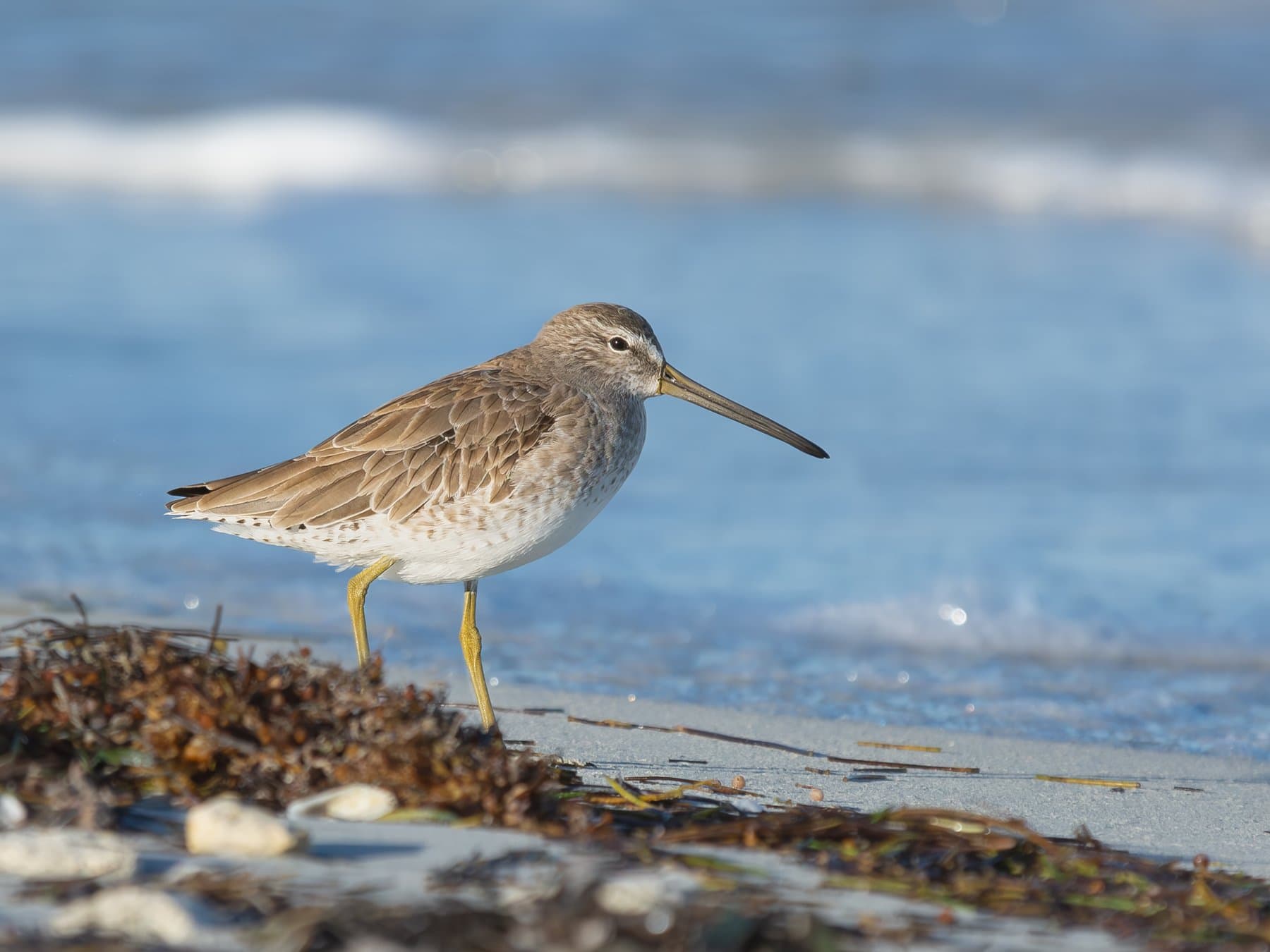
Short-billed Dowitcher
Limnodromus griseus
By the Birdfact teamChecked by Nathan Cope
Despite its name, the Short-billed Dowitcher carries a bill that dwarfs most shorebirds — it is only "short" by comparison to its close relative, the Long-billed Dowitcher. A stocky, long-distance migrant of North American coasts and mudflats, this species drives its bill into soft mud with a rapid, mechanical pumping action that has earned it the nickname "the sewing machine of the shorebird world," travelling up to 15,000 km between its boreal breeding grounds and South American wintering coasts.
On this page13 sections
How to recognise it
The Short-billed Dowitcher is a medium-sized, chunky shorebird built around its most conspicuous feature: a long, straight, dark-grey bill roughly twice the length of its head, measuring 51–68 mm. The body is stocky with a small, rounded head, and the pale yellowish-green legs are moderately long. At rest, the wingtip reaches or slightly exceeds the tail tip. In flight, a distinctive white wedge-shaped patch blazes up the back and rump — one of the most reliable field marks at any distance.
Breeding adults are striking. The mantle and scapulars are mottled black, brown, and gold, with black-centred feathers edged in pale rusty cinnamon. The neck and breast flush pale chestnut-orange, the crown is dark brown with pale flecks, and a pale chestnut supercilium frames a dark loral stripe running from the bill to behind the eye. The tail shows brown and white barring, and the white underwing coverts carry faint brown bars.
The three subspecies differ meaningfully in breeding plumage. L. g. griseus (eastern) has an orange-blotched chest with dense black spotting and a white belly. L. g. hendersoni (central) shows a reddish belly extending to the undertail-coverts, with broader rufous-buff feather edges and sparsely spotted breast sides. L. g. caurinus (western) is the largest subspecies, with pinkish-orange extending over the belly, heavily barred flanks, and a densely spotted breast. None of the three combines the reddish belly and barred flanks simultaneously — a feature that, when present together, points to Long-billed Dowitcher.
In non-breeding plumage, the bird becomes largely grey-brown above with paler fringes and whitish below. The throat and upper breast carry a faint grey wash with fine darker spots, and the supercilium turns whitish. Juveniles are the brightest of all: the back feathers have broad buffy-chestnut edges, and the tertials are boldly barred brown and buff in a pattern birders call "tiger-striped." The breast is buffy with darker speckling. This vivid juvenile plumage is one of the most reliable features for separating Short-billed from Long-billed Dowitcher in the field.
Not sure it’s a Short-billed Dowitcher? Check your photo: Birdfact names the bird and shows the look-alike side by side.
Its size
Adults- Length
- 23–32 cm
- Wingspan
- 45–56 cm
- Weight
- 65–155 g
Its song and calls
The Short-billed Dowitcher's most useful call is a rapid, mellow tu-tu-tu — typically three or more notes delivered in quick succession when the bird is flushed or takes flight. The tone is lower-pitched and softer than the call of the Long-billed Dowitcher, which gives a single, sharp, high-pitched keek (though Long-billed will sometimes string several keek notes together). This difference in call quality is the single most reliable way to separate the two species in the field, particularly for birds in non-breeding or juvenile plumage where visual differences are subtle. The Short-billed's call has been compared to the flight call of the Ruddy Turnstone.
A key behavioural contrast reinforces the vocal difference: Short-billed Dowitchers tend to be silent while feeding in flocks, whereas Long-billed Dowitchers call frequently and continuously. A quietly feeding dowitcher flock is a useful pointer toward Short-billed.
The breeding song is a prolonged, grating, bubbly series of repeated cha notes ending in a buzzing sound. Males deliver this song during aerial display flights over their territories, flying on quivering wings across hundreds of metres of boreal wetland. They also sing from perches in small spruce or willow trees. The song is rarely heard away from the breeding grounds and is not a useful identification tool for most birders.
Males and females do not differ noticeably in call quality or frequency. Juveniles give the same tu-tu-tu call as adults. The species is generally quiet on the wintering grounds, with calls given mainly when birds are disturbed or taking flight.
Heard one and not sure? Let the bird song identifier listen.
When and where to see it
OctoberLeaving
Most recorded in October
- 1. Delaware0.19%
- 2. Mississippi0.18%
- 3. Florida0.12%
- 4. New Jersey0.12%
- 5. South Carolina0.10%
Each dot is a county, state or province: the bigger and darker, the larger the bird’s share of that place’s bird records that month. Grey dots: no regular records. The ringed point is the centre of the bird’s records this month; the arrow shows how it moved since last month, and the dashed loop its path through the year. “Arrivals” colours places where it becomes regular this month (orange) or is in its last regular month (grey). GBIF eBird Observation Dataset, 2019–2024. Map data: Natural Earth, US Census Bureau; place centres © OpenStreetMap contributors.
In your area
See when the Short-billed Dowitcher is recorded in your county, state or province.
How often the Short-billed Dowitcher turns up in the United States and Canada through the year, from birdwatchers' records.
United States
Summer visitor · all year · most records in August
Canada
Summer visitor · regularly May–Oct · most records in August
Show as a table
| Month | United States | Canada |
|---|---|---|
| January | 0.027% (regular) | <0.001% |
| February | 0.023% (regular) | <0.001% |
| March | 0.022% (regular) | <0.001% |
| April | 0.043% (regular) | 0.006% |
| May | 0.053% (regular) | 0.047% (regular) |
| June | 0.017% (regular) | 0.012% (regular) |
| July | 0.10% (regular) | 0.080% (regular) |
| August | 0.15% (regular) | 0.17% (regular) |
| September | 0.072% (regular) | 0.084% (regular) |
| October | 0.036% (regular) | 0.009% (regular) |
| November | 0.028% (regular) | 0.001% |
| December | 0.023% (regular) | <0.001% |
Worldwide: recorded regularly in 46 countries
Countries where it was recorded in at least 3 of the 6 years 2019–2024. Linked countries have their own bird list.
North America (36)
- Anguilla
- Antigua & Barbuda
- Aruba
- Bahamas
- Barbados
- Belize
- Bermuda
- British Virgin Islands
- Canada
- Caribbean Netherlands
- Cayman Islands
- Costa Rica
- Cuba
- Curaçao
- Dominican Republic
- El Salvador
- Grenada
- Guadeloupe
- Guatemala
- Honduras
- Jamaica
- Martinique
- Mexico
- Montserrat
- Nicaragua
- Panama
- Puerto Rico
- St Kitts & Nevis
- St Lucia
- St Martin
- St Pierre & Miquelon
- St Vincent & the Grenadines
- Trinidad & Tobago
- Turks & Caicos Islands
- United States
- US Virgin Islands
Data: EOD – eBird Observation Dataset (Cornell Lab of Ornithology), accessed via GBIF.org, CC BY 4.0. Records from 2019–2024, aggregated and filtered by Birdfact. How these lists are made
Tips for seeing it
Coastal mudflats and tidal estuaries are the best places to find Short-billed Dowitchers outside the breeding season. In the United States, Delaware Bay in late April and early May offers the spectacle of thousands of birds feeding on horseshoe crab eggs alongside Red Knots and Ruddy Turnstones. On the Pacific coast, Grays Harbor and Willapa Bay in Washington State peak in late April. Along the Atlantic and Gulf coasts, birds are present from July through April, with southbound adults arriving as early as late June — making this one of the earliest fall migrants of any North American shorebird.
The most reliable identification feature separating Short-billed from Long-billed Dowitcher is the call: Short-billed gives a mellow, rapid tu-tu-tu in a series of three or more notes, while Long-billed gives a single, high-pitched keek. Flush a dowitcher gently and listen carefully. In juvenile plumage (August–September), look for the "tiger-striped" tertials — boldly barred brown and buff — which are far brighter and more patterned than the plain, internally-marked tertials of juvenile Long-billed. In winter plumage, the two species are notoriously difficult to separate on appearance alone.
In the UK, any dowitcher should be scrutinised carefully. Short-billed is the rarer of the two species and has only been accepted four times since the 1970s. Juveniles arriving in September offer the best chance of identification, as the tiger-striped tertials and mellow call are both diagnostic. Check coastal wetlands and estuaries in southwest England and Scotland, where most accepted records have originated.
When watching feeding flocks, note that Short-billed Dowitchers are typically silent while probing — if the dowitchers in front of you are calling constantly, Long-billed is more likely. Also watch for the characteristic sewing-machine feeding action: rapid, vertical bill-pumping with the body rocking forward as the bird walks slowly through shallow water.
What it eats
On the breeding grounds, Short-billed Dowitchers eat almost entirely insects and their larvae — beetles, flies, mosquitoes, midges, and crane flies — along with spiders and snails. Some prey is gleaned from plant stems or picked from the water's surface rather than probed for, reflecting the drier, more vegetated character of the boreal breeding habitat.
During migration and on the wintering grounds, the diet shifts decisively to marine invertebrates: polychaete worms, small molluscs including clams, crustaceans such as fiddler crabs, shrimp, isopods, and amphipods. Plant material — seeds of grasses, bulrushes, and pondweeds — forms a minor but consistent part of the diet year-round.
The most celebrated feeding event in the species' calendar occurs each spring at Delaware Bay, New Jersey, where Short-billed Dowitchers join over a million shorebirds of six species to gorge on the eggs of horseshoe crabs (Limulus polyphemus). Horseshoe crabs lay their eggs on beaches in synchrony with spring high tides, creating a brief but extraordinarily rich food source. The birds must double their body weight in roughly two weeks to fuel the final push to Arctic breeding grounds. Declines in horseshoe crab populations — driven by overharvesting for bait and biomedical use — have been directly linked to declining shorebird numbers at this stopover.
The bill tip's Herbst corpuscles allow the bird to feed effectively in turbid water and at night, when visual cues are useless. Flocks feed with little aggression, and individuals show no consistent dominance hierarchy at food patches — a contrast to many other shorebird species where larger birds displace smaller ones.
Nesting and breeding
The breeding season runs from late May to July. Males arrive on the breeding grounds slightly ahead of females and immediately re-establish territories from previous years, launching into energetic song-flights on quivering wings. Display flights are wide-ranging, covering hundreds of metres, and males also sing from perches in small spruce trees. Occasional territorial disputes involve the defending male lowering his head and bill, raising his tail, and issuing low warning calls.
Once paired — and pairs are thought to be monogamous, with some carrying over from previous years — the female selects the nest site, probably from several options offered by the male. The male forms the nest bowl himself, pressing his belly into heavy sedge, moss, or grass to create a shallow depression roughly 11.5 cm across and 5 cm deep. He lines it with feathers, dry grasses, and twigs. Nests are typically well hidden by surrounding vegetation.
The clutch is four eggs, occasionally three. Eggs are light greenish-brown to olive-green with brown spotting concentrated at the large end — sometimes described as pebble-coloured. Both adults incubate for approximately 21 days, with a structured division of labour: females typically brood during the day, males at night. Chicks are precocial; downy young leave the nest within hours of hatching, can walk immediately, and can swim as soon as they are dry. They find all their own food from the start.
The female departs the breeding grounds shortly after hatching — sometimes even before the last egg pips — leaving the male to lead chicks to feeding areas and alert them to predators until they fledge. Only one brood is raised per season. The nesting biology of this species was exceptionally difficult to document: the first nest was not discovered until 1906, and that record was initially misattributed to the Long-billed Dowitcher. The nesting grounds of the eastern subspecies L. g. griseus were not located until the late 1950s–1970s, making it one of the last North American shorebirds to have its breeding biology fully described.
Behaviour
In flight, the Short-billed Dowitcher is immediately recognisable by the bold white wedge that extends from the lower back up through the rump — a feature shared with the Long-billed Dowitcher but distinctive among shorebirds of similar size. The wings are long and pointed, and the flight is direct and fairly fast, with steady, rather stiff wingbeats that give the bird a slightly mechanical quality compared to the more fluid flight of larger waders.
Flocks fly in loose, shifting formations rather than the tight, synchronised murmurations of smaller sandpipers. When flushed from a mudflat, birds typically rise steeply and call immediately — the tu-tu-tu call is often the first clue to the species' identity before the bird is even properly seen. At migration stopover sites, large flocks may wheel and circle before settling back onto the mud.
The white rump patch is visible from considerable distance and is the first feature to catch the eye when a bird takes flight from among mixed shorebird flocks. The tail shows brown and white barring, visible at close range in flight. The underwing is white with faint brown barring on the coverts and axillaries, giving a pale impression from below.
During breeding display flights, males fly on quivering, bowed wings across wide circuits of their territory, calling continuously — a very different flight style from the direct, purposeful travel flight. The display flight covers hundreds of metres and is the primary means by which males advertise territory and attract mates on the boreal breeding grounds.
Lifespan and predators
The maximum recorded lifespan for a Short-billed Dowitcher is nearly 14 years, documented through banding records. Typical wild birds live considerably shorter lives — most individuals probably survive 5–10 years, with annual survival rates shaped by the hazards of long-distance migration, hunting pressure on the wintering grounds, and predation at all stages of the annual cycle.
Like most long-distance migratory shorebirds, Short-billed Dowitchers face their highest mortality risk during migration, when birds must cross large expanses of ocean or unfamiliar terrain while in energetically depleted condition. The round trip between boreal breeding grounds and South American wintering coasts can exceed 15,000 km, placing enormous physiological demands on the bird each year.
Hunting on the wintering grounds in the Caribbean and northern South America — currently unregulated in parts of the range — is identified as the greatest single threat to the hendersoni/griseus populations and likely depresses adult survival rates significantly. Predation by raptors and mammals affects all age classes, with eggs and precocial chicks particularly vulnerable on the breeding grounds. First-year birds may remain near the wintering grounds during their first summer rather than attempting the full northward migration, which may improve their survival through that energetically demanding period.
Compared to the closely related Long-billed Dowitcher, lifespan data are similar, reflecting the shared life-history strategy of medium-sized, long-distance migratory shorebirds in the family Scolopacidae.
Conservation
The Short-billed Dowitcher is assessed as Vulnerable on the IUCN Red List (2016 assessment), with a global population estimated at 150,000–320,000 mature individuals. The 2025 State of the Birds report lists it as an Orange Alert Tipping Point species — meaning it has lost more than 50% of its population over the past 50 years and has shown accelerated declines within the past decade. Data from the International Shorebird Survey document three-generation declines approaching 60% for the combined hendersoni/griseus populations. The western caurinus subspecies is undergoing steep declines on its Alaskan breeding grounds, with monitoring suggesting losses exceeding 50% over three generations.
In November 2024, Canada's Committee on the Status of Endangered Wildlife in Canada (COSEWIC) designated caurinus as Endangered and the combined hendersoni/griseus population as Threatened — the most up-to-date formal conservation assessment for the species. In the United States, the Short-billed Dowitcher is listed as a Bird of Conservation Concern by the U.S. Fish & Wildlife Service and appears on the Partners in Flight watch list.
The greatest identified threat to the hendersoni/griseus populations is unregulated sport and subsistence hunting on the wintering grounds in the Caribbean and northern South America. Loss and degradation of stopover and wintering habitat through coastal development, sea level rise, and dredging compounds the pressure. Unlike many threatened shorebirds that breed on open tundra, Short-billed Dowitchers nest at the edges of boreal forests, making them vulnerable to commercial logging and forest fragmentation — threats that do not affect tundra-nesting species. Climate change and increasing forest fire frequency are altering breeding habitat further.
The decline of horseshoe crab populations at Delaware Bay — driven by overharvesting — reduces the availability of a critical spring refuelling resource. Disturbance by dogs and recreational users at stopover sites, pesticide use, and plastic ingestion round out the threat profile. Conservation efforts focus on habitat protection at key stopover sites, hunting regulation advocacy in the Caribbean, and horseshoe crab management on Delaware Bay.
Subspecies Guide
Three subspecies of Short-billed Dowitcher are recognised, each with a distinct breeding range, migration route, and wintering area — and each subtly different in appearance during the breeding season.
L. g. griseus (eastern subspecies) breeds from James Bay and southwestern Hudson Bay east through central Quebec to western Labrador. It is the smallest of the three. In breeding plumage, the chest is orange-blotched with dense black spotting, and the belly is white — the palest-bellied subspecies. It migrates along the Atlantic coast and winters from the southern United States through the West Indies to Brazil. This is the subspecies most likely to be encountered in New Jersey, Massachusetts, and other Atlantic coastal states, and the one behind the handful of accepted UK and Irish vagrant records.
L. g. hendersoni (central subspecies) breeds across north-central Canada from central Alberta to western Manitoba. In breeding plumage, it is the richest-coloured: the reddish belly extends to the undertail-coverts, the upperpart feathers have broader rufous-buff edges, and the breast sides are only sparsely spotted. It migrates through the Great Plains and along the Atlantic coast, wintering from the southeastern United States to Panama.
L. g. caurinus (western subspecies) breeds in southern Alaska, southern Yukon, and northwestern British Columbia, and is the largest subspecies. Breeding birds show pinkish-orange extending over the belly, heavily barred flanks, and a densely spotted breast. It migrates along the Pacific coast, wintering from California to Peru and the Galápagos Islands. This subspecies is now designated Endangered by COSEWIC (2024), reflecting steep declines on its Alaskan breeding grounds.
Identification Vs Long Billed
Separating Short-billed from Long-billed Dowitcher (Limnodromus scolopaceus) is one of the classic identification challenges in North American birding — and, on the rare occasions either species turns up in Europe, one of the most demanding problems in Western Palearctic birding. The two species were not formally recognised as distinct until 1950, and in non-breeding plumage they can be virtually identical in the field.
Call is the most reliable separator at any time of year. Short-billed gives a mellow, rapid tu-tu-tu in a series of three or more notes; Long-billed gives a single, sharp, high-pitched keek. Short-billed is also typically silent while feeding in flocks; Long-billed calls frequently. Flush a dowitcher and listen before you look.
Juvenile plumage (August–September) offers the best visual separation. Short-billed juveniles have "tiger-striped" tertials — boldly barred brown and buff — and a bright buffy-orange wash to the breast. Long-billed juveniles have plain, dark-centred tertials with narrow pale fringes and a greyer, less warm breast. The difference is striking in good light.
Bill length is unreliable. Despite the species' names, female Short-billeds can have bills as long as male Long-billeds. Only a small percentage of individuals can be identified to species by bill length alone. Breeding plumage offers some help: a bird combining a reddish belly with heavily barred flanks is a Long-billed; no subspecies of Short-billed shows this combination. Habitat preference provides a useful supporting clue — Short-billed strongly favours saltwater and brackish habitats; Long-billed prefers freshwater. A dowitcher on a coastal mudflat is more likely Short-billed; one on a freshwater marsh is more likely Long-billed.
Quick facts
- Length
- 23–32 cm
- Wingspan
- 45–56 cm
- Weight
- 65–155 g
- Lifespan
- 5–10 years · oldest recorded 14 years
- Family
- Sandpipers & Snipes
- Migration
- Long-distance Migrant
- Global status (IUCN)
- Vulnerable
- World population
- 150,000–320,000 mature individuals
- Population trend
- Decreasing. The 2025 State of the Birds report lists the Short-billed Dowitcher as an Orange Alert Tipping Point species, having lost more than 50% of its population in the past 50 years. Three-generation declines approach 60% for the hendersoni/griseus populations. The caurinus subspecies is undergoing declines exceeding 50% over three generations on its Alaskan breeding grounds.
- Scientific name
- Limnodromus griseus
Sources
18- 1Short-billed dowitcher - Wikipedia Source (opens in a new tab)
- 2Short-billed Dowitcher Overview - Cornell Lab of Ornithology (All About Birds) Source (opens in a new tab)
- 3Short-billed Dowitcher Life History - Cornell Lab of Ornithology (All About Birds) Source (opens in a new tab)
- 4Short-billed Dowitcher - BirdLife International DataZone Source (opens in a new tab)
- 5Short-billed Dowitcher Summary - BirdLife International DataZone Source (opens in a new tab)
- 6Short-billed Dowitcher - Audubon Field Guide Source (opens in a new tab)
- 7Short-billed Dowitcher - Massachusetts Division of Fisheries and Wildlife Source (opens in a new tab)
- 8COSEWIC Assessment and Status Report on the Short-billed Dowitcher 2024 - Canada.ca (2024) Source (opens in a new tab)
- 9Short-billed Dowitcher - NWT Species at Risk Source (opens in a new tab)
- 10Short-billed Dowitcher - Conserve Wildlife Foundation of NJ Source (opens in a new tab)
- 11Short-billed Dowitcher - BirdWeb (Seattle Audubon Society) Source (opens in a new tab)
- 12Short-billed Dowitcher - NH Audubon State of the Birds Source (opens in a new tab)
- 13Short-billed Dowitcher - Oiseaux-Birds.com Source (opens in a new tab)
- 14Short-billed Dowitcher - Smithsonian's National Zoo Source (opens in a new tab)
- 15Short-billed Dowitcher - BTO BirdFacts Source (opens in a new tab)
- 16Short-billed Dowitcher - U.S. Fish & Wildlife Service Source (opens in a new tab)
- 17Short-billed Dowitcher - eBird (Cornell Lab) Source (opens in a new tab)
- 18Short-billed Dowitcher in Northeast Scotland: new to Britain - British Birds Source (opens in a new tab)

Checked by
Nathan Cope, founder and editor
Nathan founded Birdfact and leads its writers and contributors in the UK, the US and Canada. He has watched and studied birds for more than ten years, and checks every article and species guide before it’s published.