


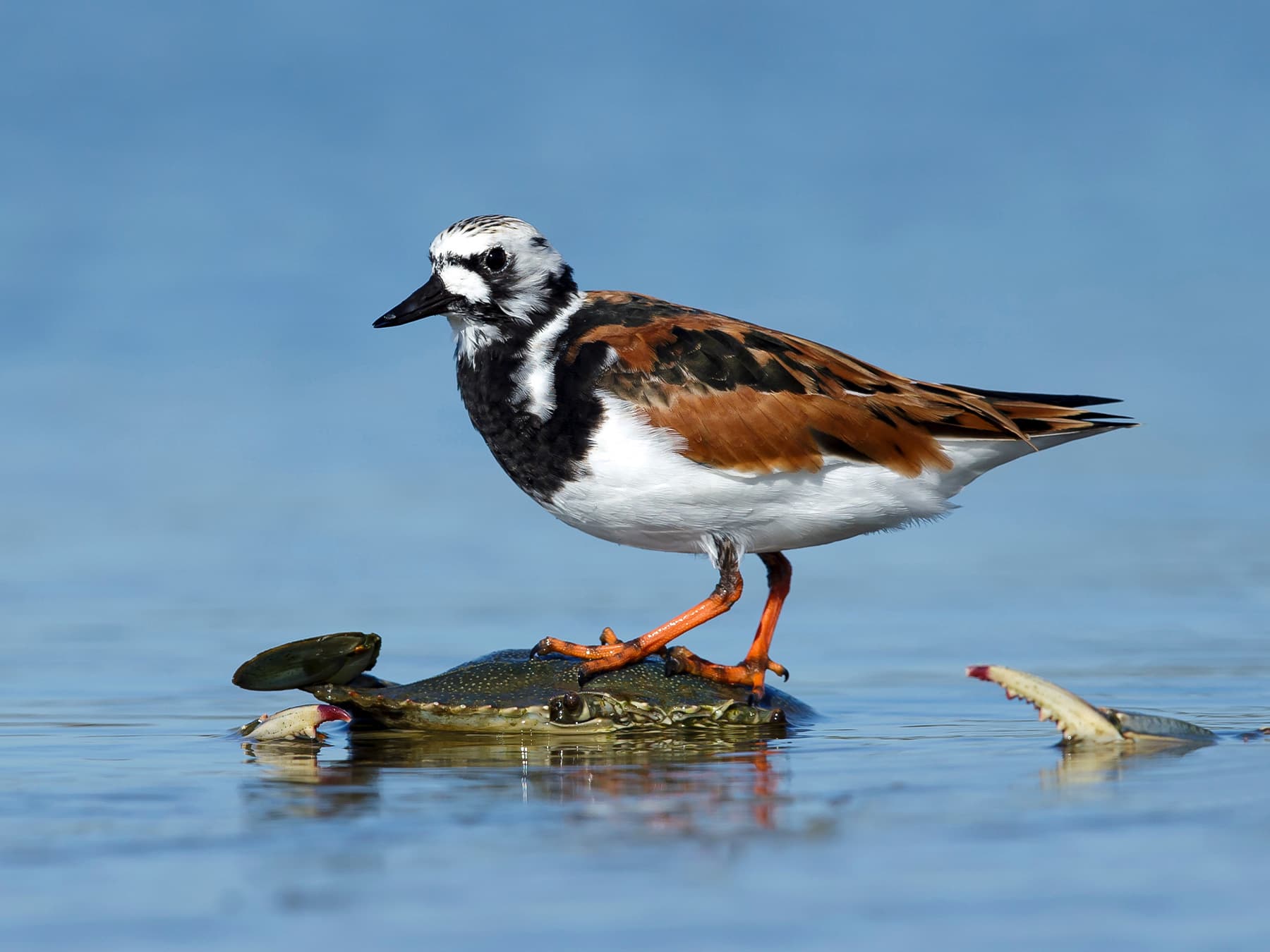
Ruddy Turnstone
Turnstone · Arenaria interpres
By the Birdfact teamChecked by Nathan Cope
On this page13 sections
How to recognise it
What do Ruddy Turnstones look like?
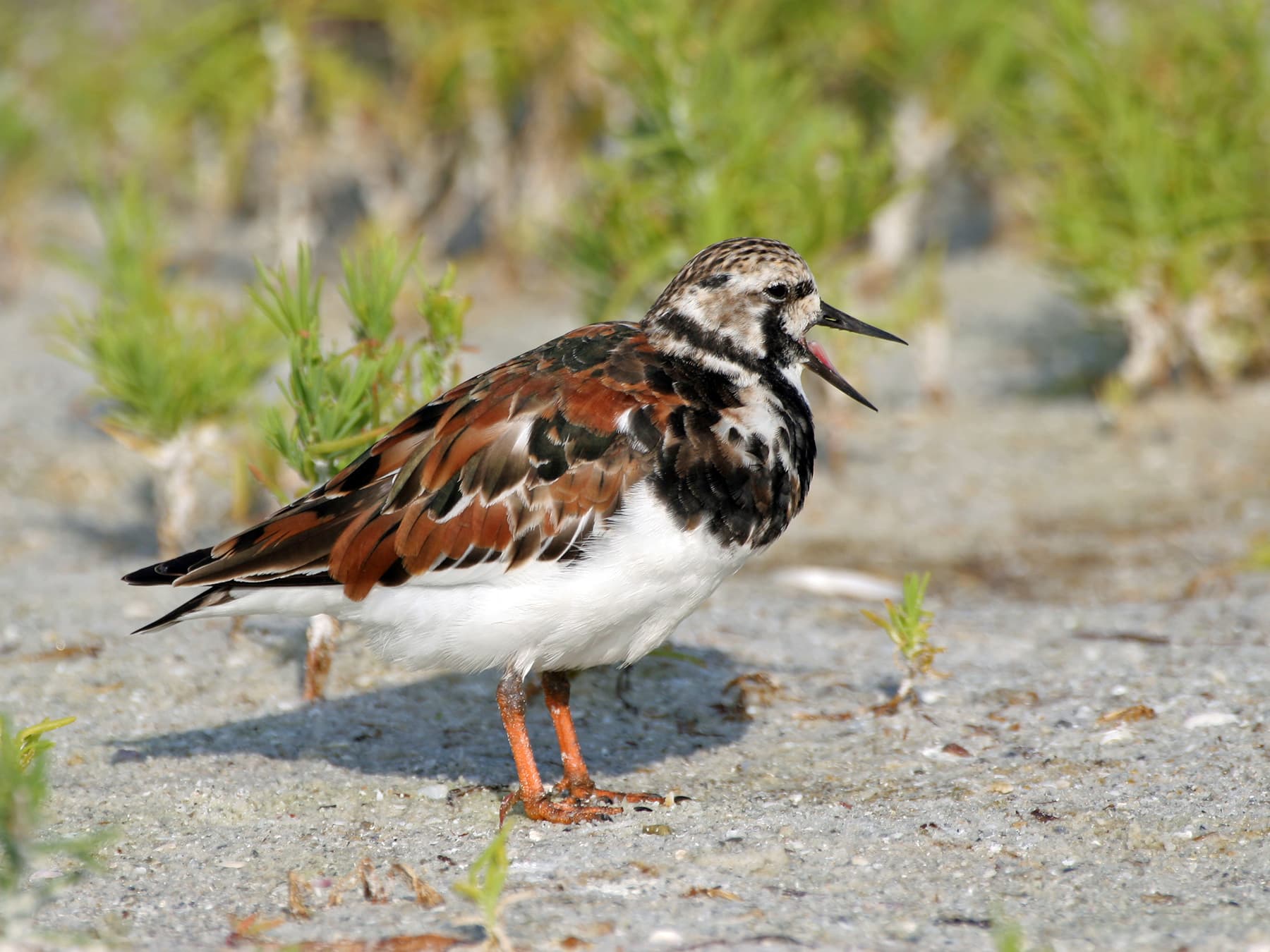
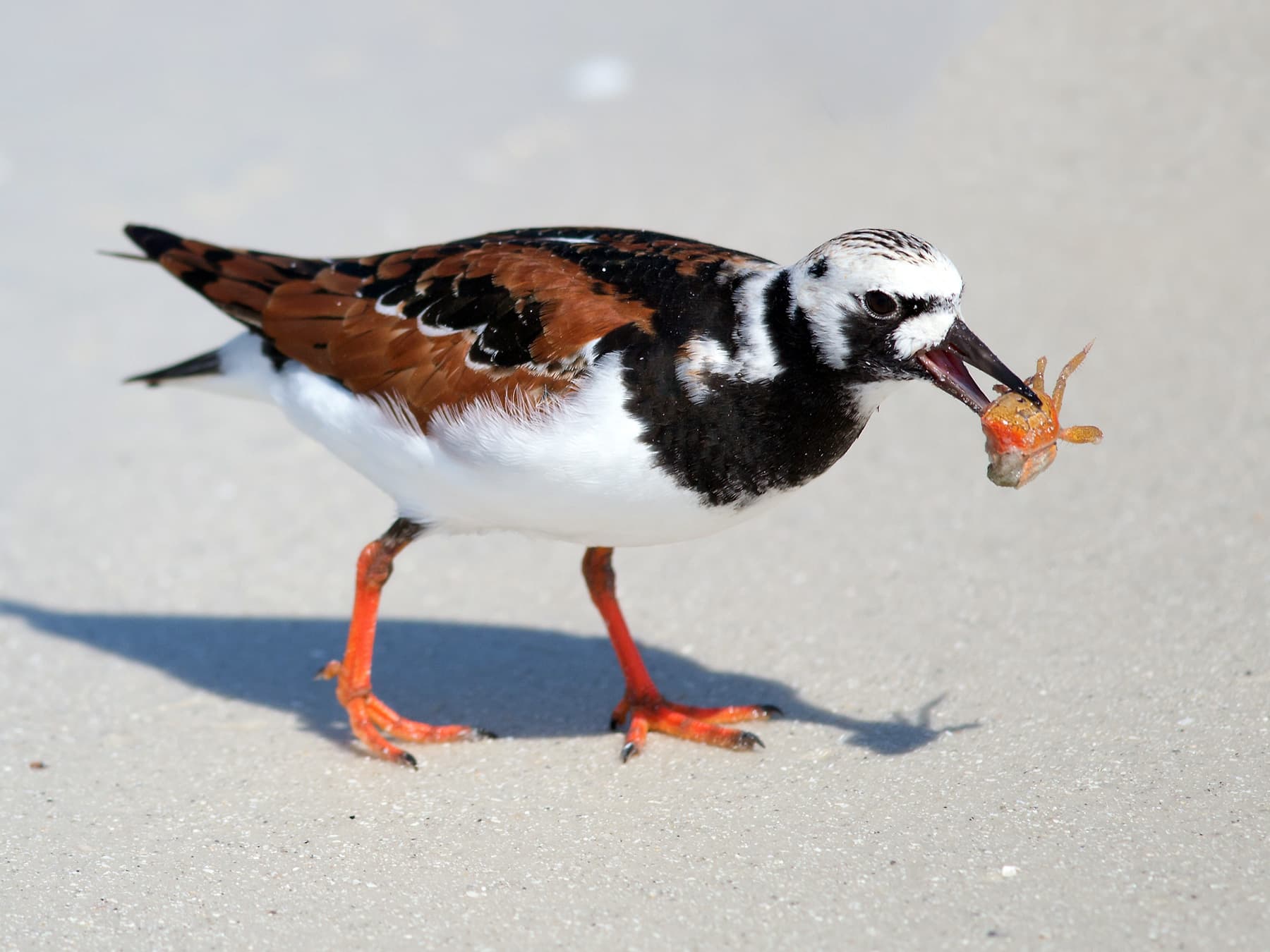
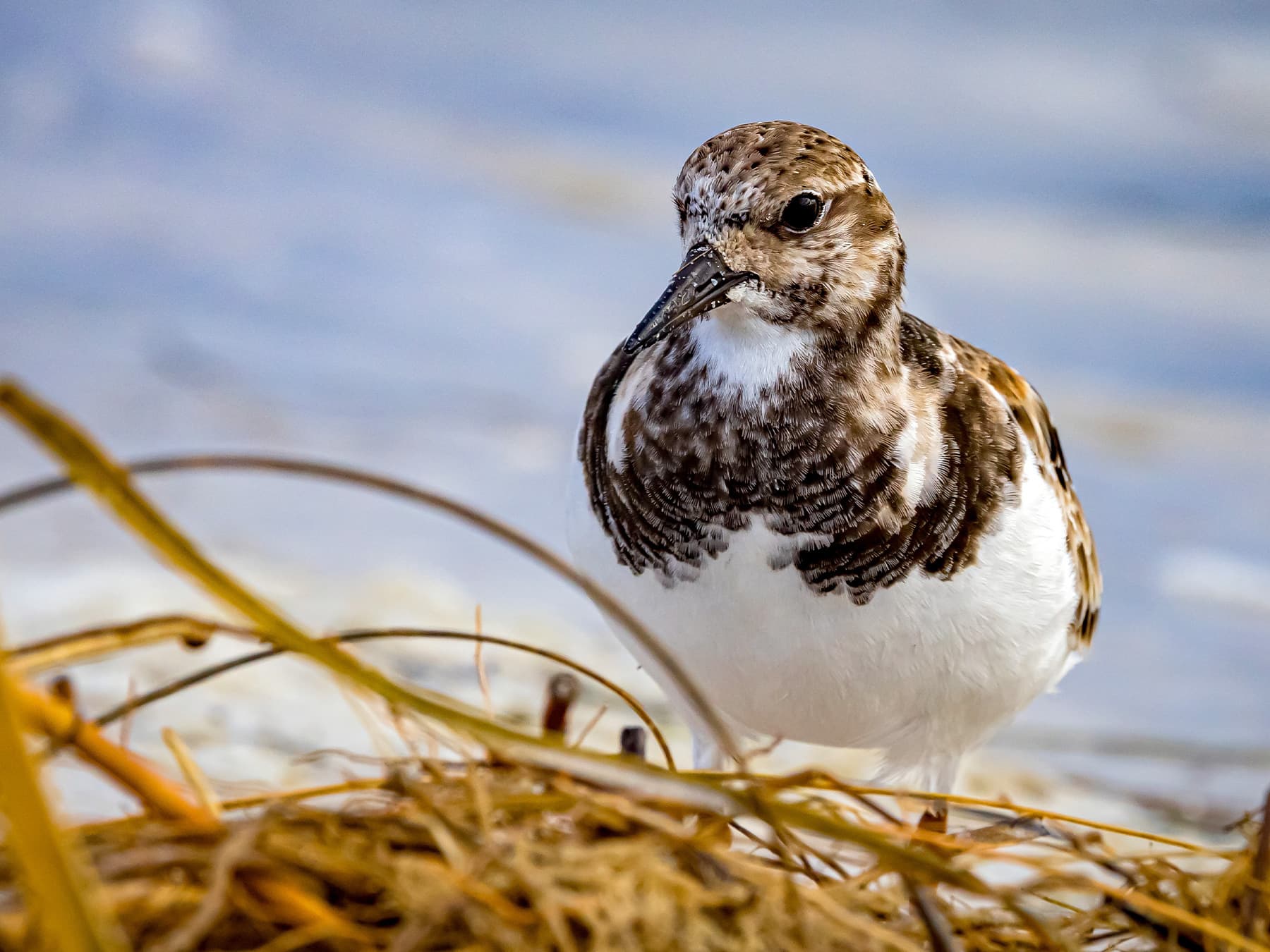
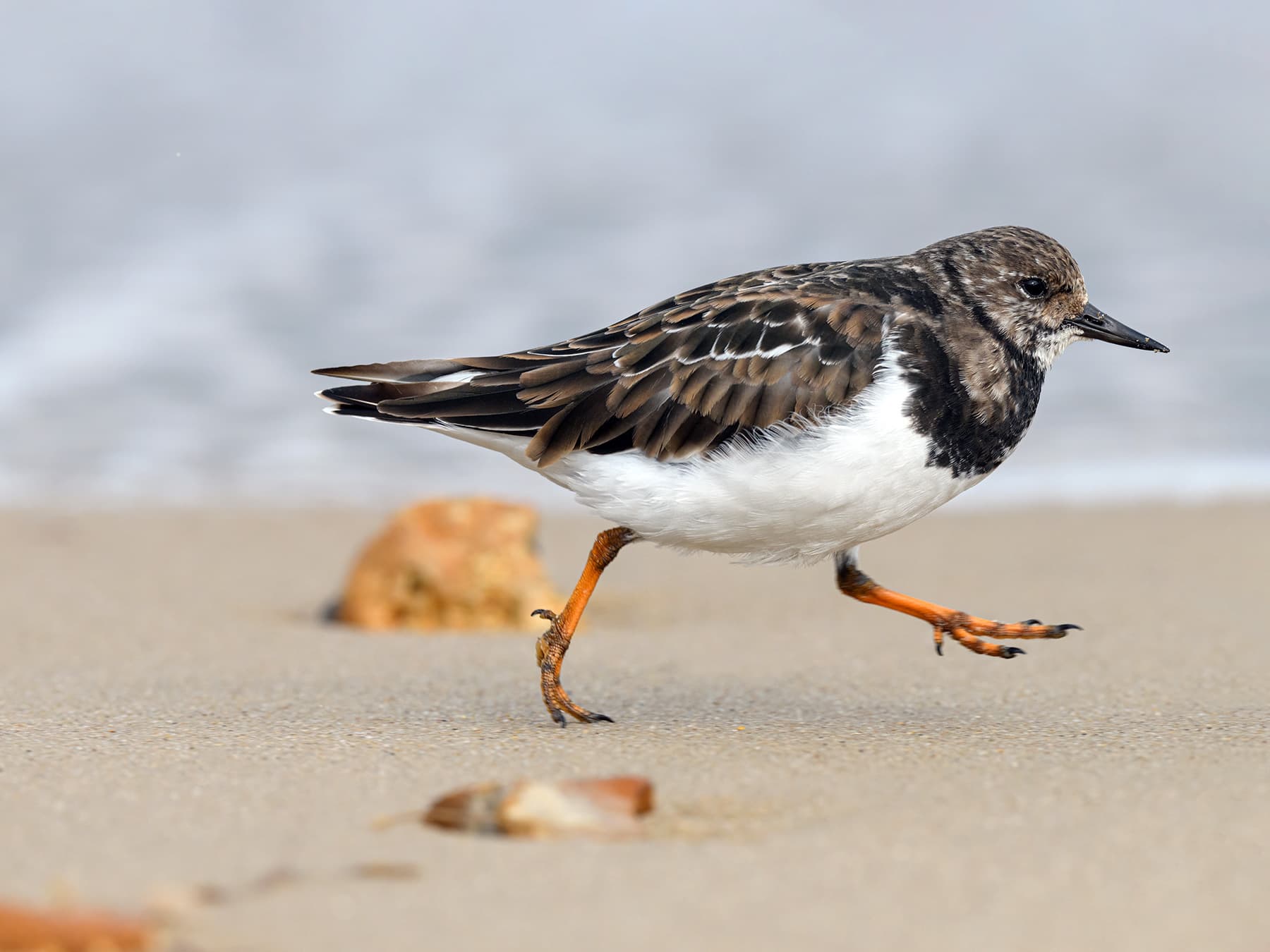
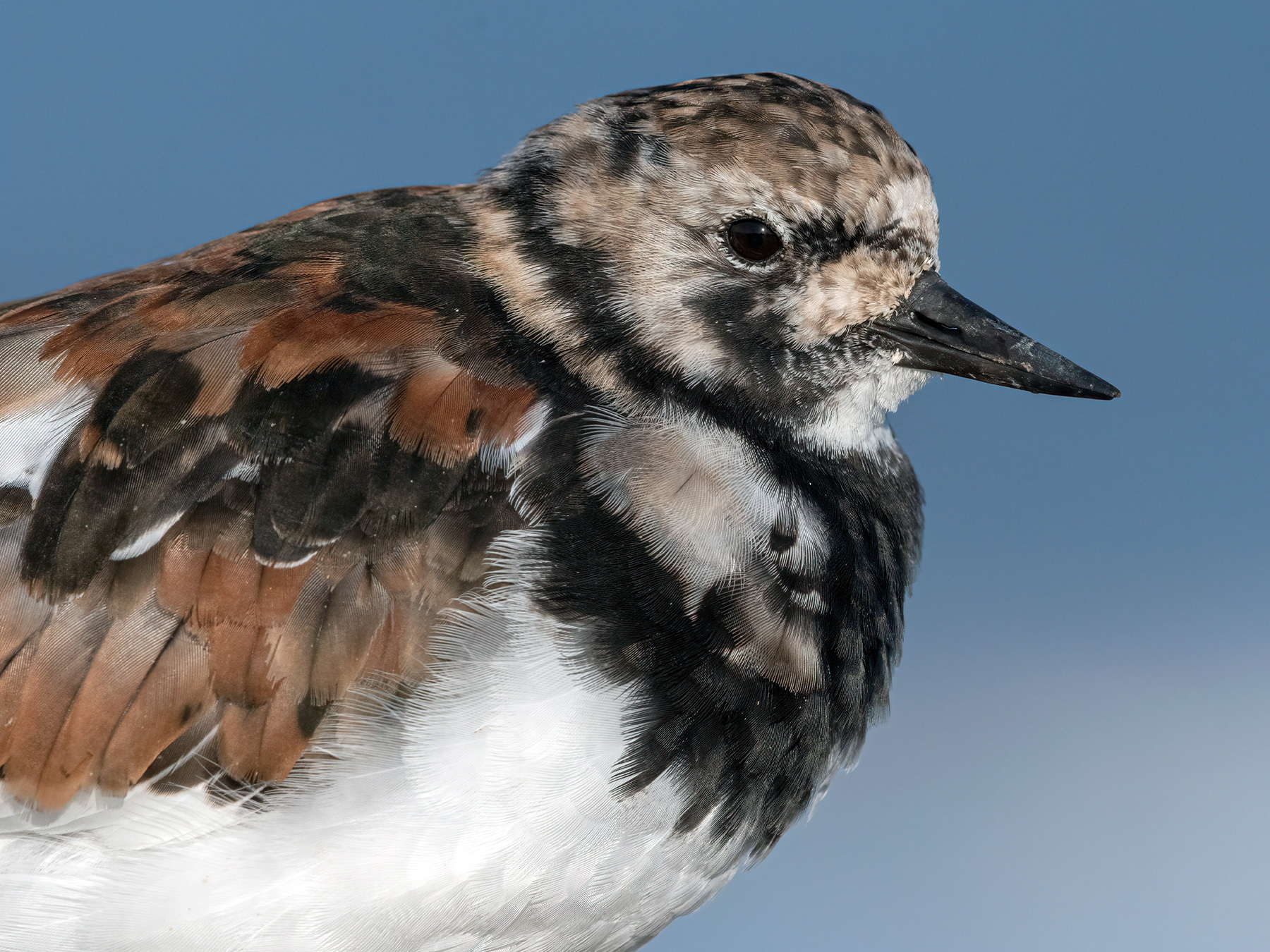
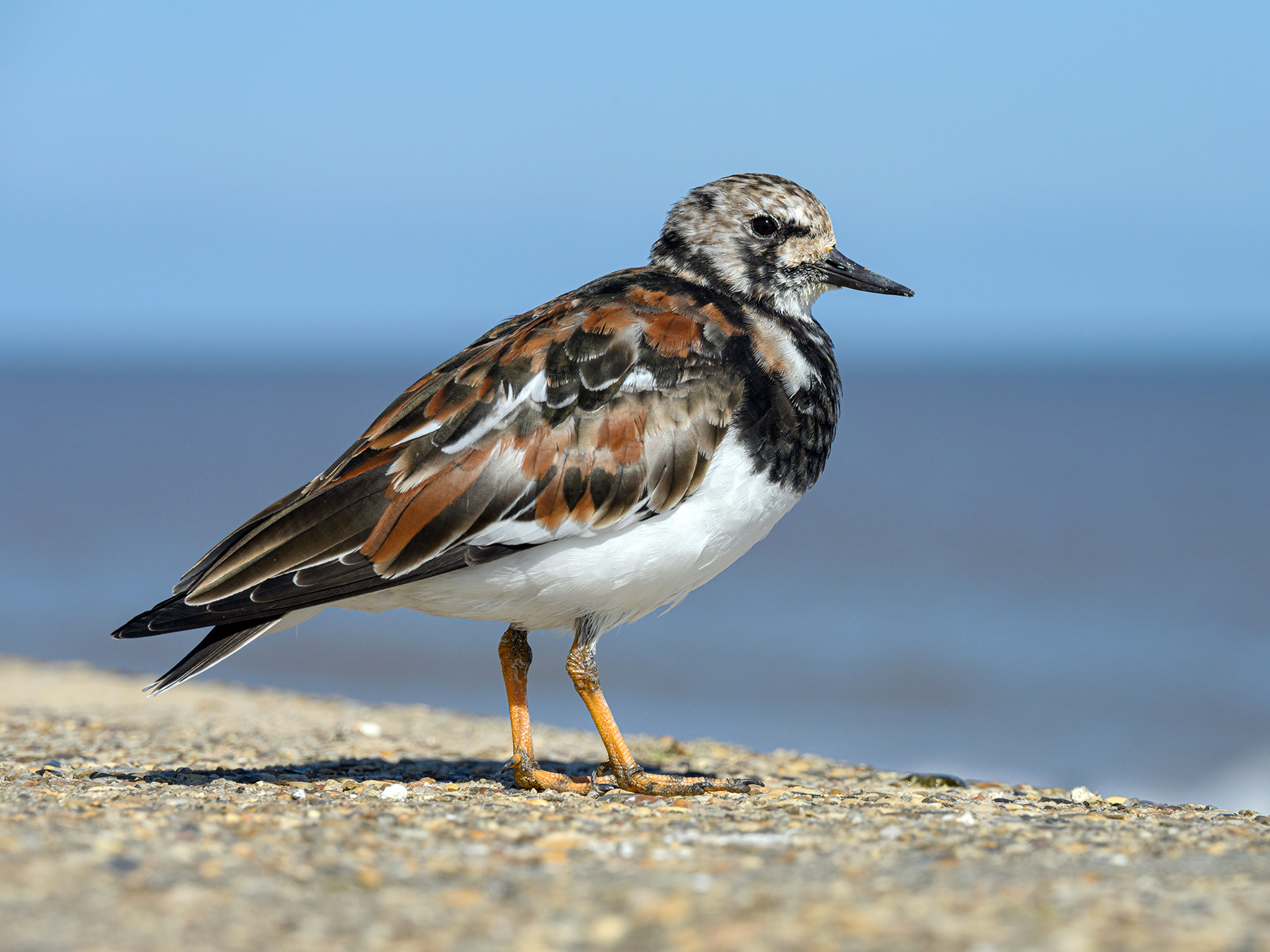
Ruddy Turnstones are chunky, short-legged shorebirds with robust orange legs and a thick and slightly upcurved blackish bill. In breeding plumage, both sexes have white underparts, a black and white head, a thick black chest bar, and reddish brown plumage on the back and upper wings.
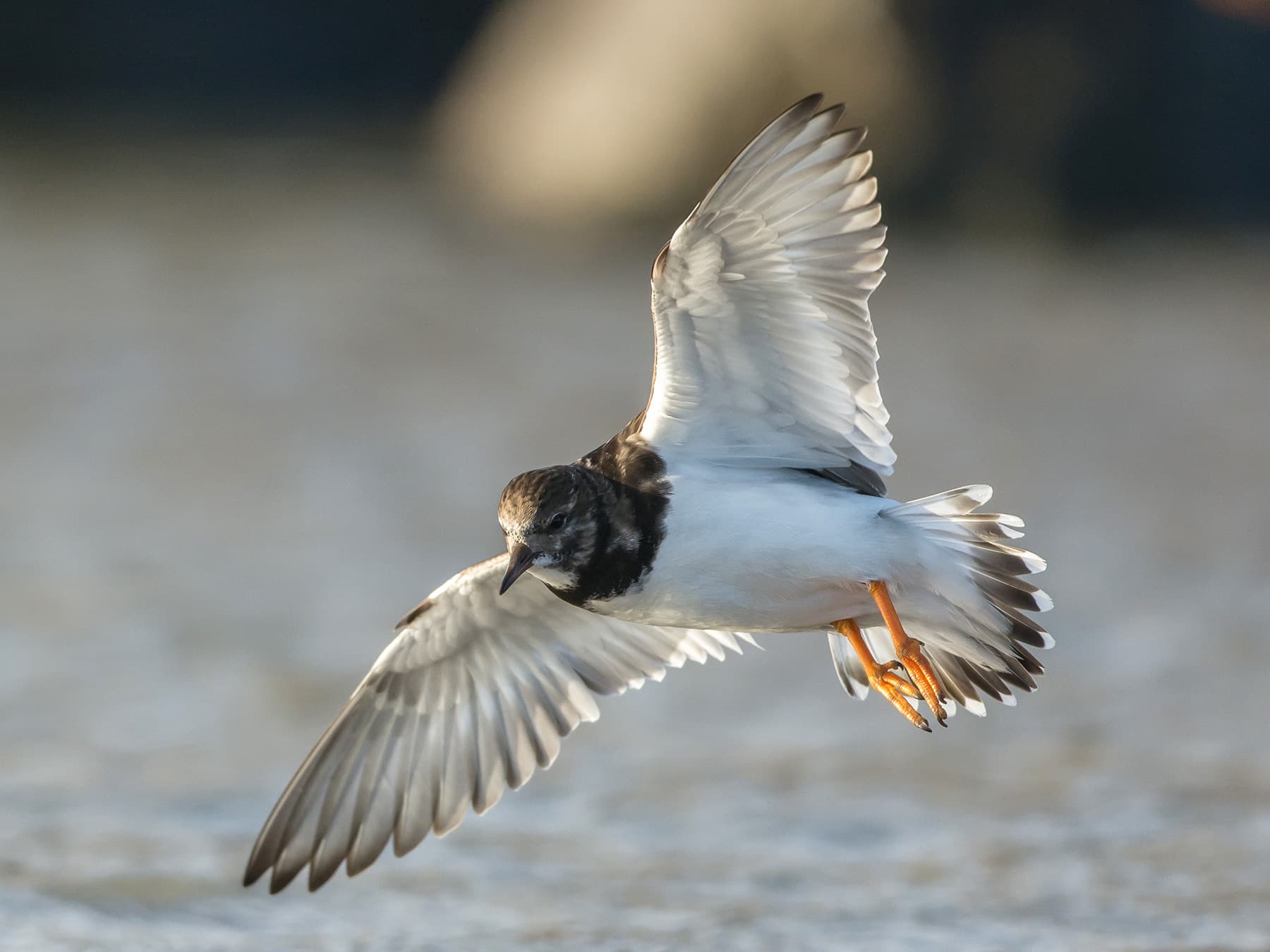
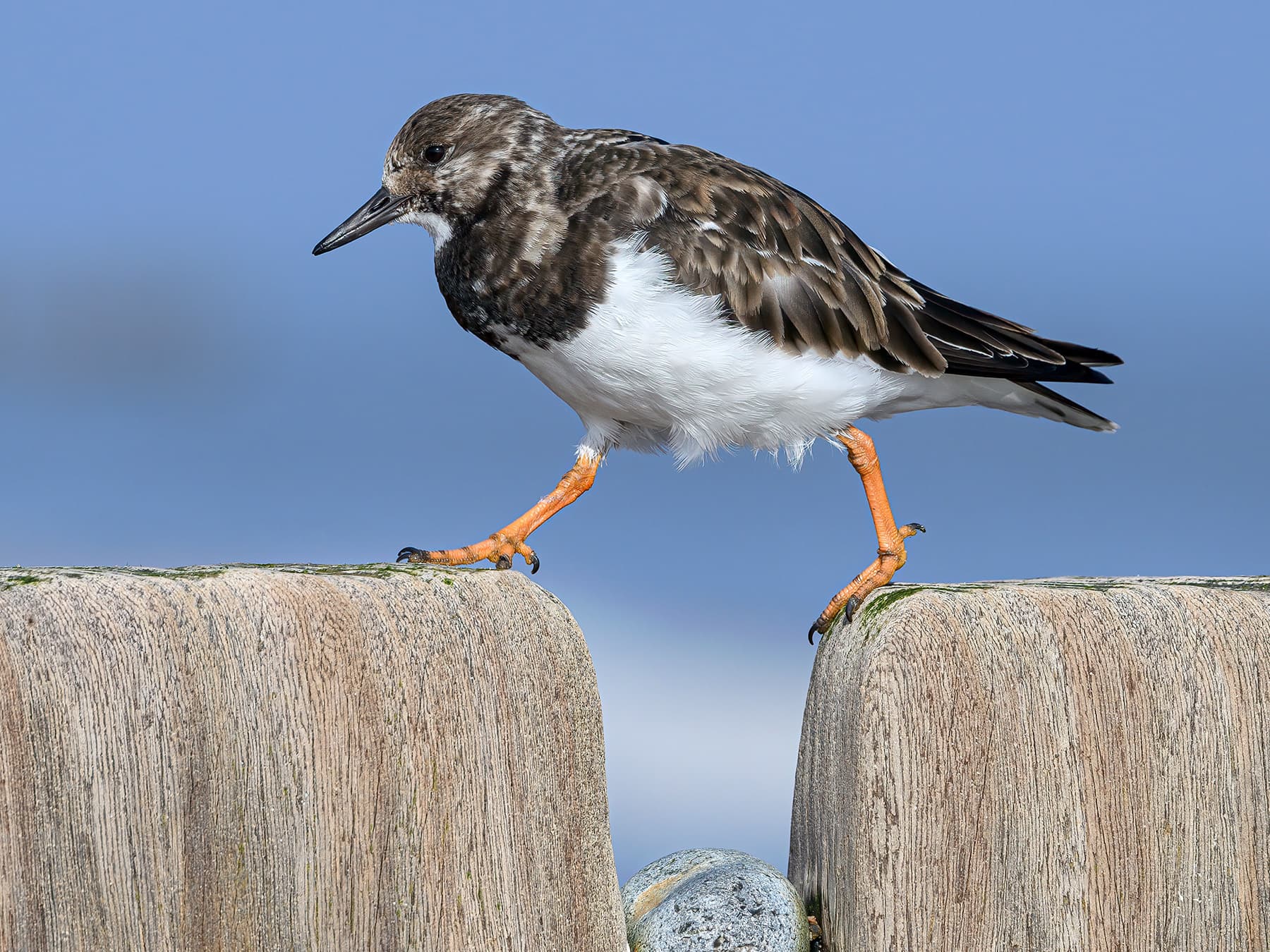
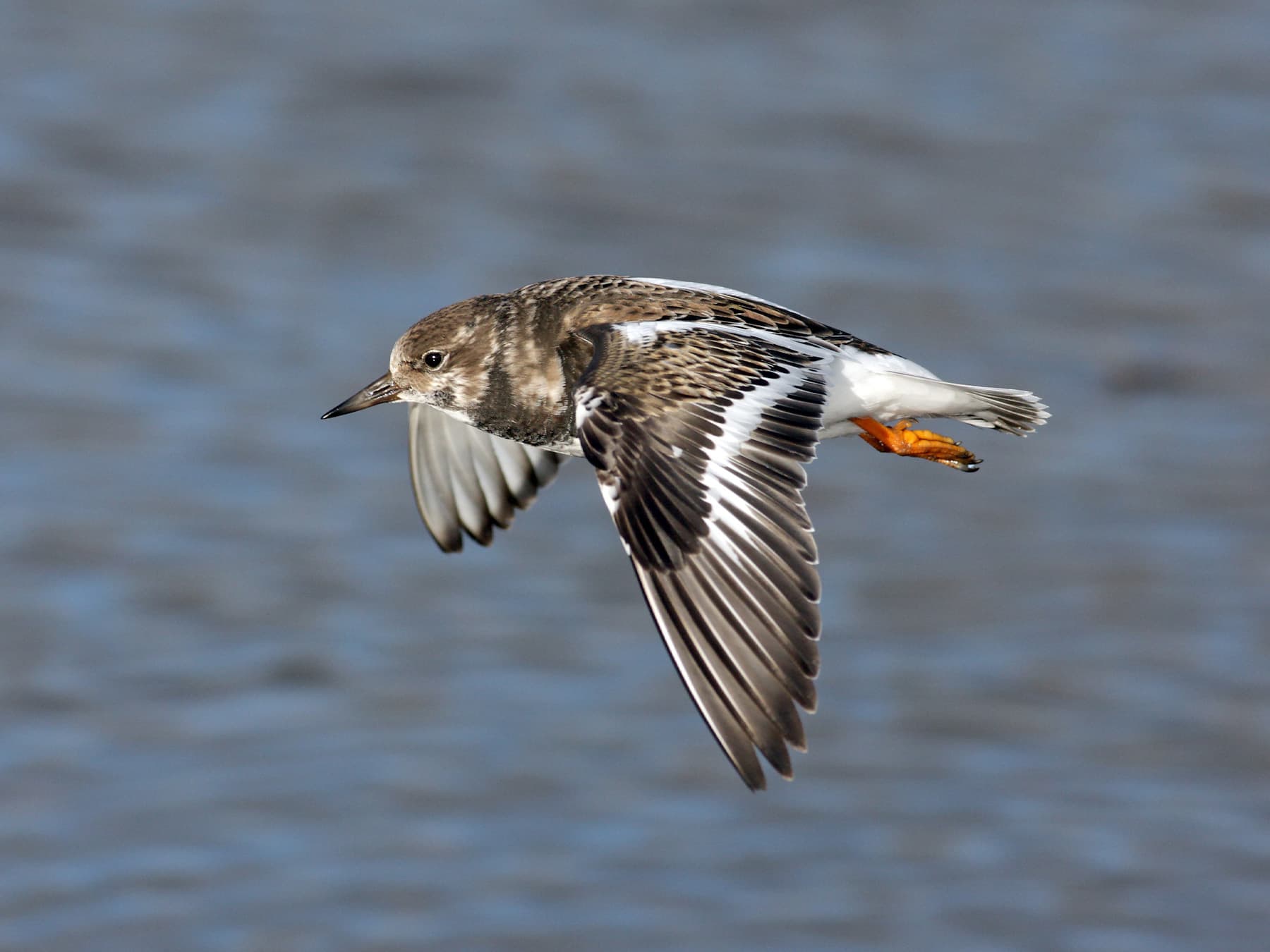
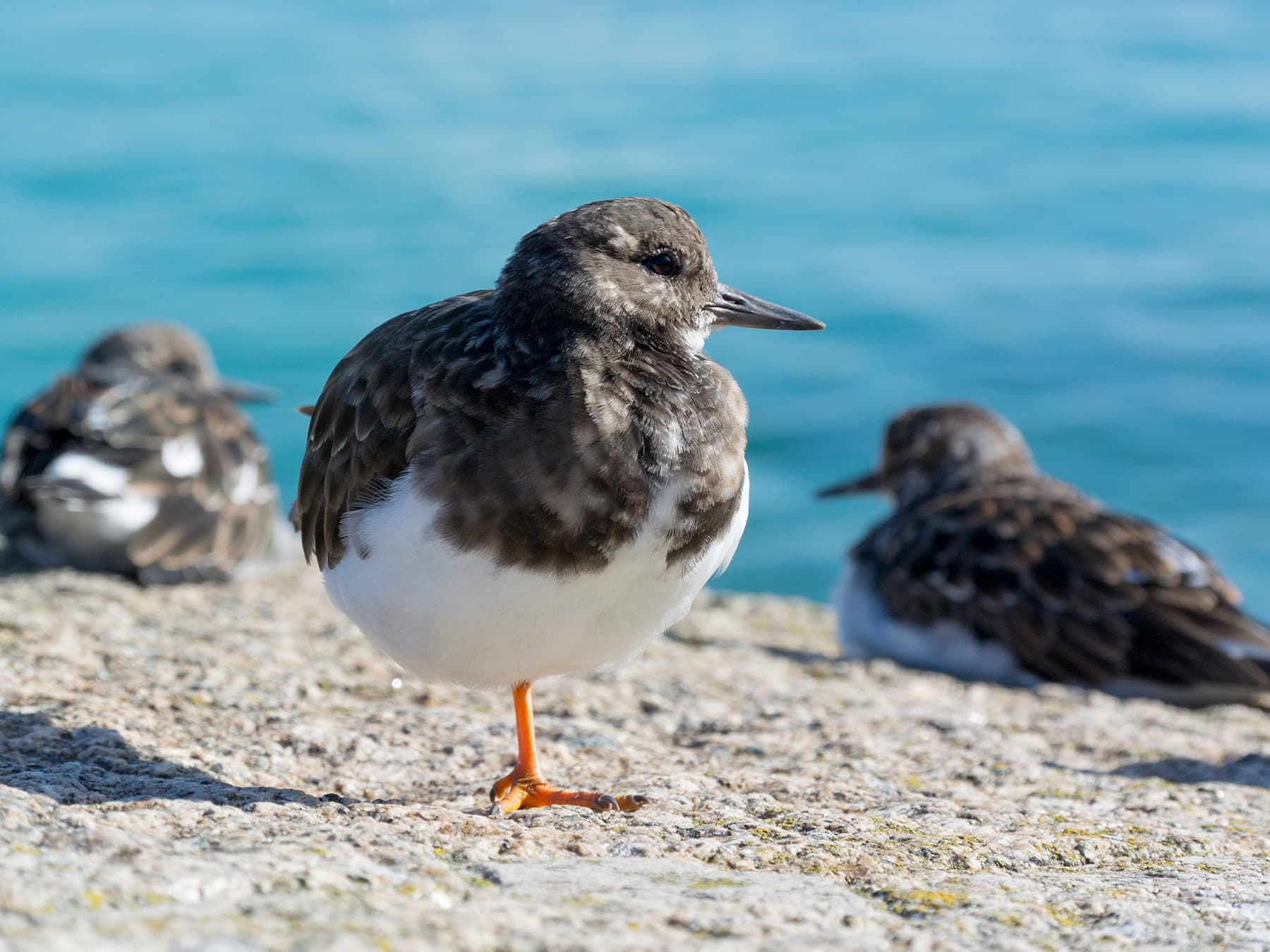
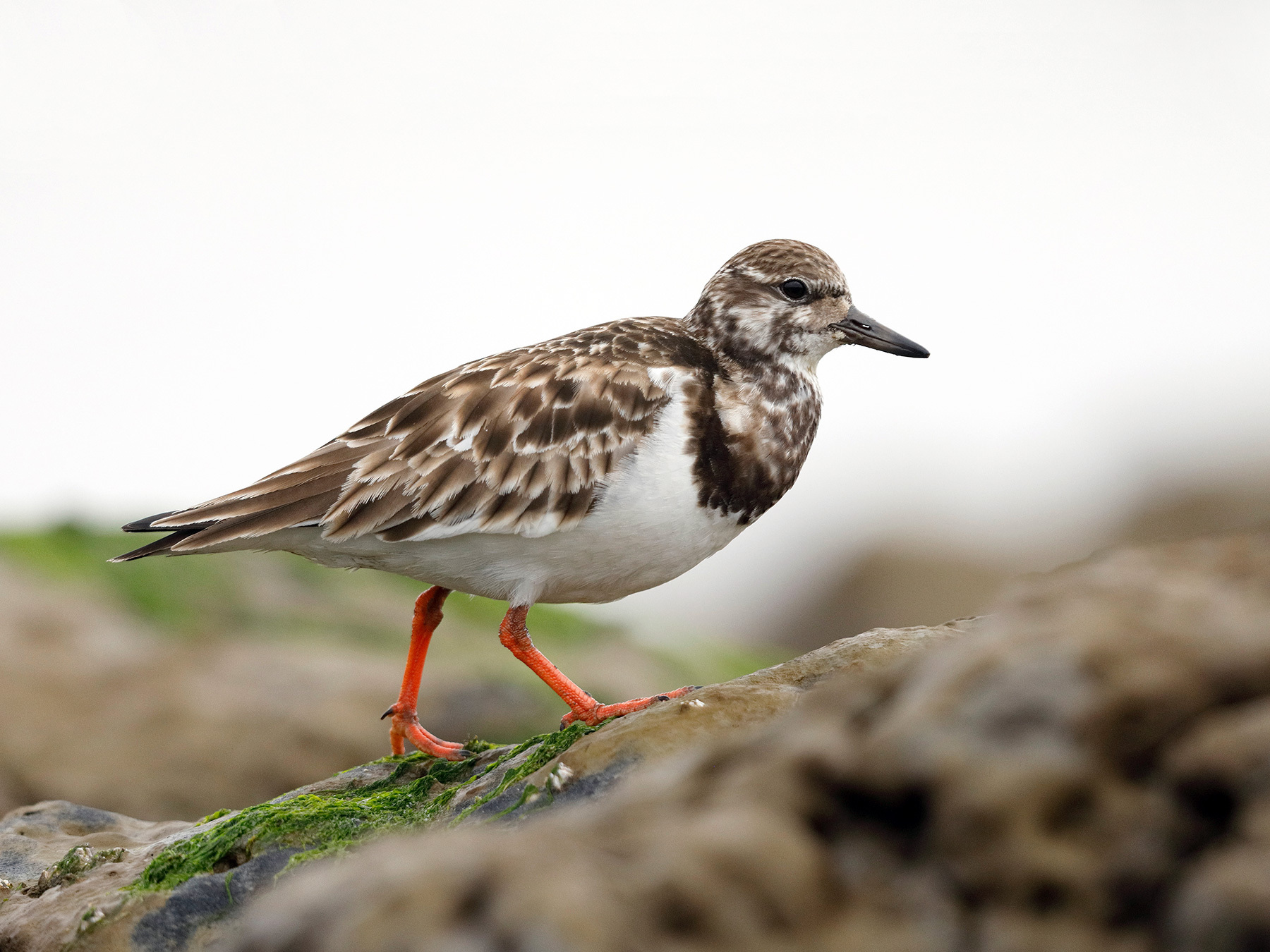
Their non-breeding plumage is similar, although they have duller brown upperparts and brownish heads with paler streaks on their face. Ruddy Turnstones are striking in flight, showing bold and contrasting white stripes on the upperwings, down the center of the back, and across the rump.
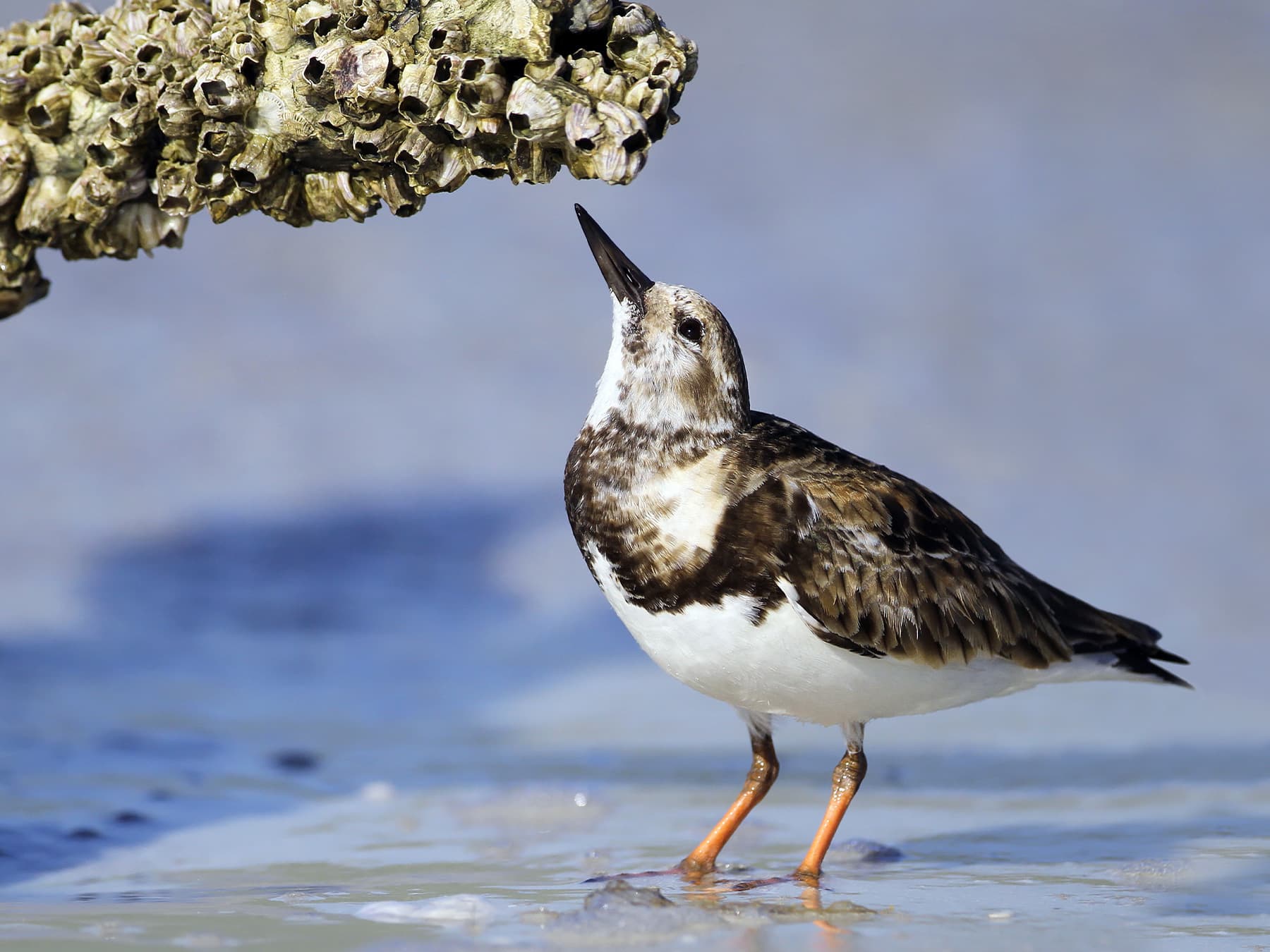
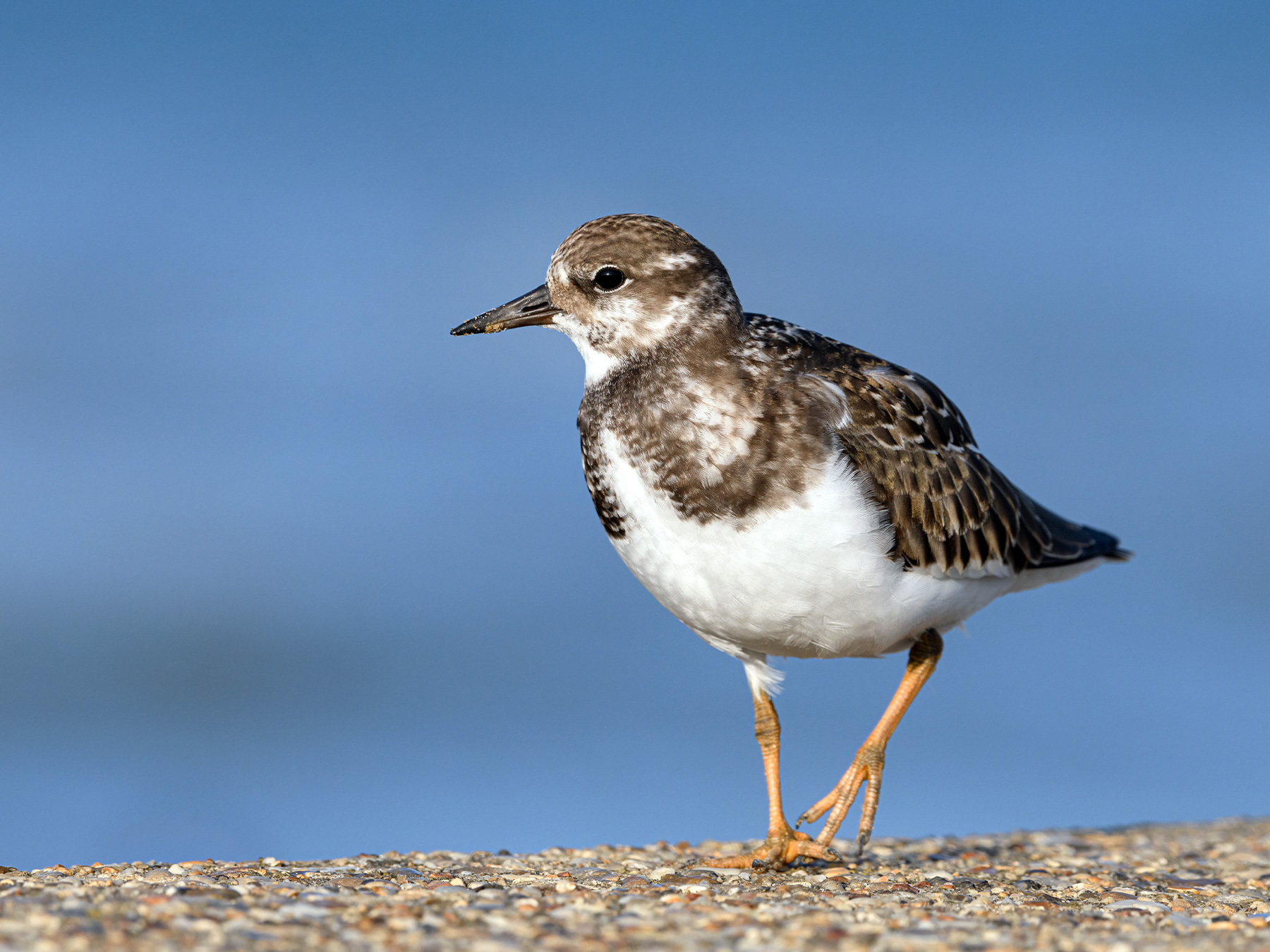
Juveniles are similar to non-breeding adults, although they appear paler above, with some white plumage on the back, breast, and head.
How big are Ruddy Turnstones?
Ruddy Turnstones are small but robust shorebirds. Males and females have similar measurements in most respects.
Length
Adult Ruddy Turnstones measure approximately eight to ten inches or 21 to 26 centimeters in total length.
Weight
These birds weigh about three to seven ounces or 85 to 200 grams. Birds that make long, non-stop flights put on a lot of fat before migration, which explains the species’ sizeable weight range.
Wingspan
Adults have a 20 to 22½ inch (50 - 57 cm) wingspan, and females tend to have longer wings.
Its size
Adults- Length
- 21–24 cm
- Wingspan
- 43–49 cm
- Weight
- 85–150 g
Its song and calls
What sound does a Ruddy Turnstone make?
Ruddy Turnstones are vocal birds that produce a chattering ‘kitititi’ call in flight or when foraging in groups. Alarmed birds also make sharp, irregular alarm calls when they notice a predator.
- Call0:00 / 0:19
Recorded in Normandie, France · May 2023
When and where to see it
OctoberIn season
Most recorded in October
- 1. Derry2.4%
- 2. Shetland Islands2.0%
- 3. Orkney Islands1.7%
- 4. Pembrokeshire1.5%
- 5. Moray1.4%
Each dot is a county, state or province: the bigger and darker, the larger the bird’s share of that place’s bird records that month. Grey dots: no regular records. The ringed point is the centre of the bird’s records this month; the arrow shows how it moved since last month, and the dashed loop its path through the year. “Arrivals” colours places where it becomes regular this month (orange) or is in its last regular month (grey). GBIF eBird Observation Dataset, 2019–2024. Map data: Natural Earth, US Census Bureau; place centres © OpenStreetMap contributors.
In your area
See when the Ruddy Turnstone is recorded in your county, state or province.
How often the Ruddy Turnstone turns up in the UK, Ireland, the United States and Canada through the year, from birdwatchers' records.
United Kingdom
Resident · all year · most records in October
Ireland
Winter visitor · all year · most records in September
United States
Resident · all year · most records in August
Canada
Summer visitor · regularly May–Oct · most records in August
Show as a table
| Month | United Kingdom | Ireland | United States | Canada |
|---|---|---|---|---|
| January | 0.33% (regular) | 0.90% (regular) | 0.086% (regular) | 0.002% |
| February | 0.27% (regular) | 0.84% (regular) | 0.072% (regular) | <0.001% |
| March | 0.20% (regular) | 0.63% (regular) | 0.052% (regular) | <0.001% |
| April | 0.14% (regular) | 0.41% (regular) | 0.054% (regular) | 0.001% |
| May | 0.15% (regular) | 0.21% (regular) | 0.062% (regular) | 0.046% (regular) |
| June | 0.062% (regular) | 0.11% (regular) | 0.027% (regular) | 0.017% (regular) |
| July | 0.14% (regular) | 0.20% (regular) | 0.037% (regular) | 0.026% (regular) |
| August | 0.35% (regular) | 0.78% (regular) | 0.13% (regular) | 0.14% (regular) |
| September | 0.39% (regular) | 1.0% (regular) | 0.079% (regular) | 0.098% (regular) |
| October | 0.41% (regular) | 0.90% (regular) | 0.066% (regular) | 0.024% (regular) |
| November | 0.35% (regular) | 0.94% (regular) | 0.083% (regular) | 0.004% |
| December | 0.32% (regular) | 0.93% (regular) | 0.078% (regular) | 0.002% |
Recorded regularly in
Worldwide: recorded regularly in 182 countries
Countries where it was recorded in at least 3 of the 6 years 2019–2024. Linked countries have their own bird list.
Europe (41)
- Åland Islands
- Albania
- Austria
- Belarus
- Belgium
- Bulgaria
- Croatia
- Czechia
- Denmark
- Estonia
- Faroe Islands
- Finland
- France
- Germany
- Gibraltar
- Greece
- Guernsey
- Hungary
- Iceland
- Ireland
- Isle of Man
- Italy
- Jersey
- Latvia
- Lithuania
- Montenegro
- Netherlands
- Norway
- Poland
- Portugal
- Romania
- Russia
- Serbia
- Slovakia
- Slovenia
- Spain
- Svalbard & Jan Mayen
- Sweden
- Switzerland
- Ukraine
- United Kingdom
Africa (29)
- Algeria
- Angola
- Cape Verde
- Djibouti
- Egypt
- Gabon
- Gambia
- Ghana
- Guinea
- Guinea-Bissau
- Kenya
- Madagascar
- Mauritania
- Mauritius
- Mayotte
- Morocco
- Mozambique
- Namibia
- Réunion
- Senegal
- Seychelles
- Sierra Leone
- Somalia
- South Africa
- Tanzania
- Tunisia
- Uganda
- Western Sahara
- Zambia
Asia (39)
- Armenia
- Azerbaijan
- Bahrain
- Bangladesh
- British Indian Ocean Territory
- Cambodia
- China
- Cyprus
- Georgia
- Hong Kong SAR China
- India
- Indonesia
- Iran
- Israel
- Japan
- Kazakhstan
- Kuwait
- Kyrgyzstan
- Lebanon
- Macao SAR China
- Malaysia
- Maldives
- Mongolia
- Myanmar (Burma)
- Oman
- Pakistan
- Philippines
- Qatar
- Saudi Arabia
- Singapore
- South Korea
- Sri Lanka
- Taiwan
- Thailand
- Turkey
- United Arab Emirates
- Uzbekistan
- Vietnam
- Yemen
North America (41)
- Anguilla
- Antigua & Barbuda
- Aruba
- Bahamas
- Barbados
- Belize
- Bermuda
- British Virgin Islands
- Canada
- Caribbean Netherlands
- Cayman Islands
- Costa Rica
- Cuba
- Curaçao
- Dominica
- Dominican Republic
- El Salvador
- Greenland
- Grenada
- Guadeloupe
- Guatemala
- Haiti
- Honduras
- Jamaica
- Martinique
- Mexico
- Montserrat
- Nicaragua
- Panama
- Puerto Rico
- Sint Maarten
- St Barthélemy
- St Kitts & Nevis
- St Lucia
- St Martin
- St Pierre & Miquelon
- St Vincent & the Grenadines
- Trinidad & Tobago
- Turks & Caicos Islands
- United States
- US Virgin Islands
South America (11)
Oceania (20)
- American Samoa
- Australia
- Cocos (Keeling) Islands
- Fiji
- French Polynesia
- Guam
- Kiribati
- Marshall Islands
- Micronesia
- New Caledonia
- New Zealand
- Norfolk Island
- Northern Mariana Islands
- Palau
- Papua New Guinea
- Samoa
- Solomon Islands
- Tonga
- US Outlying Islands
- Vanuatu
Antarctica (1)
- French Southern Territories
Data: EOD – eBird Observation Dataset (Cornell Lab of Ornithology), accessed via GBIF.org, CC BY 4.0. Records from 2019–2024, aggregated and filtered by Birdfact. How these lists are made
What is the habitat of a Ruddy Turnstone?
Ruddy Turnstones are most common along rocky and stony coastal shorelines, although they also forage along sandy beaches and estuaries. These birds rarely venture inland unless breeding, when they inhibit tundra habitats in the Arctic. However, they will visit freshwater habitats on migration.
What is the range of a Ruddy Turnstone?
Ruddy Turnstones have an extensive global distribution, with a circumpolar breeding range along the northernmost regions of North America, Greenland, Europe, and Russia.
Their overwintering range is even larger, including most of the United States coastline (including Hawaii) and the shores of Mexico, Central America, and most of South America. In the Old World, they overwinter around the coastlines of Africa, the United Kindom and Western Europe, Southern Asia from Saudi Arabia to Oceania, and around Australia and New Zealand.
Where do Ruddy Turnstones live?
Ruddy Turnstones spend most of their lives near the seashore, usually just above or below the high tide mark. They switch to tundra habitats, sometimes far from the coast in the nesting season.
How rare are Ruddy Turnstones?
Ruddy Turnstones are not rare, although they are limited to the intertidal zone for most of the year, and their abundance varies with the seasons. The global population is estimated at 300,000 to 500,000 individuals, with about half of them breeding in North America.
Where can you see Ruddy Turnstones in the US?
Look out for Ruddy Turnstones along rocky shores around the entire coastline of the Lower 48 States. They overwinter from northern California to Mexico and from the Gulf Coast to New England. Alaskan birdwatchers can spot breeding birds along the northwest and northern coastline.
Where can you see Ruddy Turnstones in Canada?
Ruddy Turnstones are a widespread breeding and overwintering shorebird in Canada. They breed in the far north in the Yukon, Northwest Territories, and Nunavut but can be seen in more accessible areas around Vancouver (uncommon) in British Columbia and the Gulf of St.Lawrence in Quebec.
Where can you see Turnstones in the UK?
Ruddy Turnstones can be seen on rocky shores and other tidal habitats around the entire coastline of the United Kingdom. These common waders can be seen virtually throughout the year, although they are most numerous in the winter.
Migration
Do Ruddy Turnstones migrate?
Ruddy Turnstones are highly migratory. Some populations migrate relatively short distances, while others fly thousands of miles between nesting and wintering grounds, even covering impressive distances of over 1500 miles (2500km) without rest.
Are Ruddy Turnstones native to North America?
Ruddy Turnstones are native breeding and non-breeding shorebirds that spend the summer in Canada and Alaska but overwinter around the United States, Mexican, and Central American coastlines.
Are Ruddy Turnstones native to the UK?
Ruddy Turnstones are native non-breeding winter visitors to the United Kingdom coastline.
Tips for seeing it
- Look for Ruddy Turnstones along rocky coastlines and beaches
- Observe their distinctive foraging behavior of flipping over objects
- Listen for their rapid, staccato calls, especially during flight
- In the UK and US, watch for them during spring and fall migrations along coastal areas
What it eats
What do Ruddy Turnstones eat?
Ruddy Turnstones have different diets between their breeding and non-breeding habitats. When nesting on the tundra, these birds focus on flies and other small invertebrates but also forage for berries and other plant matter.
Overwintering Ruddy Turnstones have a varied diet that includes small marine invertebrates like crustaceans, worms, and mollusks that they find under stones and debris or by probing the sand and mud. They also eat small fish when available and will scavenge on carrion and even human food scraps.
What do Ruddy Turnstone chicks eat?
Ruddy Turnstone chicks eat emerging midges and other small insects that are common in marshy habitats. The young birds feed themselves, although they rely on their parents to lead them to rich hunting grounds.
Nesting and breeding
Where do Ruddy Turnstones nest?
Ruddy Turnstones breed in the Arctic regions of North America, Europe, and Asia. They are ground-nesting birds, and the female chooses a new site each year. The nest is a shallow scrape among low vegetation, often near water.
When do Ruddy Turnstones nest?
Ruddy Turnstones arrive on their northern breeding grounds between late May and early June and lay their eggs soon after. The eggs hatch after about 22 days, and the precocial hatchlings leave the nest within a day of the last egg hatching. However, the young will remain with their parents for another three weeks or so as they learn to fend for themselves.
What do Ruddy Turnstone eggs look like?
Ruddy Turnstones lay two to five (usually four) heavily blotched and speckled olive-brown eggs, each measuring about 41 millimeters long and 29 millimeters at their widest.
Do Ruddy Turnstones mate for life?
Ruddy Turnstones show high fidelity to their partners and nest sites year after year, and many pairs will mate for life. They form a close pair bond and spend almost all their time within close distance of each other when nesting.
Behaviour
Are Ruddy Turnstones aggressive?
Ruddy Turnstones are fairly aggressive in the nesting season when territorial males aggressively guard their partner against neighbors and unmated males. They are gregarious in the non-breeding season, although foraging birds will call out and threaten other birds that approach too closely.
Where do Ruddy Turnstones sleep at night?
In the winter, Ruddy Turnstones sleep on the ground near the high tide mark of rocky shores, mudflats, and sandy beaches. They gather in groups of five to several thousand individuals, often mixed with other shorebird species. They continue to sleep in small groups after arriving on breeding grounds but become territorial when nesting begins.
Lifespan and predators
How long do Ruddy Turnstones live?
Ruddy Turnstones have an average lifespan of six to nine years, although banding studies have shown that they can live for at least twenty years.
What are the predators of Ruddy Turnstones?
Ruddy Turnstones are most vulnerable to the following avian predators:
- Peregrine Falcon
- Merlin
- Eurasian Sparrowhawk
- Parasitic Jaeger
- Long-tailed Jaeger
- Common Raven
- Larger Gulls
Are Ruddy Turnstones protected?
Ruddy Turnstones are protected by the Migratory Bird Treaty Act in the United States and the Migratory Birds Convention Act in Canada. They are also protected by the Wildlife and Countryside Act in the United Kingdom.
Are Ruddy Turnstones endangered?
Although declining, the Ruddy Turnstone is not globally threatened and is ranked as a ‘Least Concern’ species on the IUCN Red List.
Are Ruddy Turnstones protected?
Ruddy Turnstones are protected by the Migratory Bird Treaty Act in the United States and the Migratory Birds Convention Act in Canada. They are also protected by the Wildlife and Countryside Act in the United Kingdom.
Are Ruddy Turnstones endangered?
Although declining, the Ruddy Turnstone is not globally threatened and is ranked as a ‘Least Concern’ species on the IUCN Red List.
Conservation
While currently listed as Least Concern, Ruddy Turnstones face threats from habitat loss due to coastal development and climate change.
Conservation efforts focus on protecting key stopover sites along their migration routes and preserving breeding grounds in the Arctic.
More photos
5 photos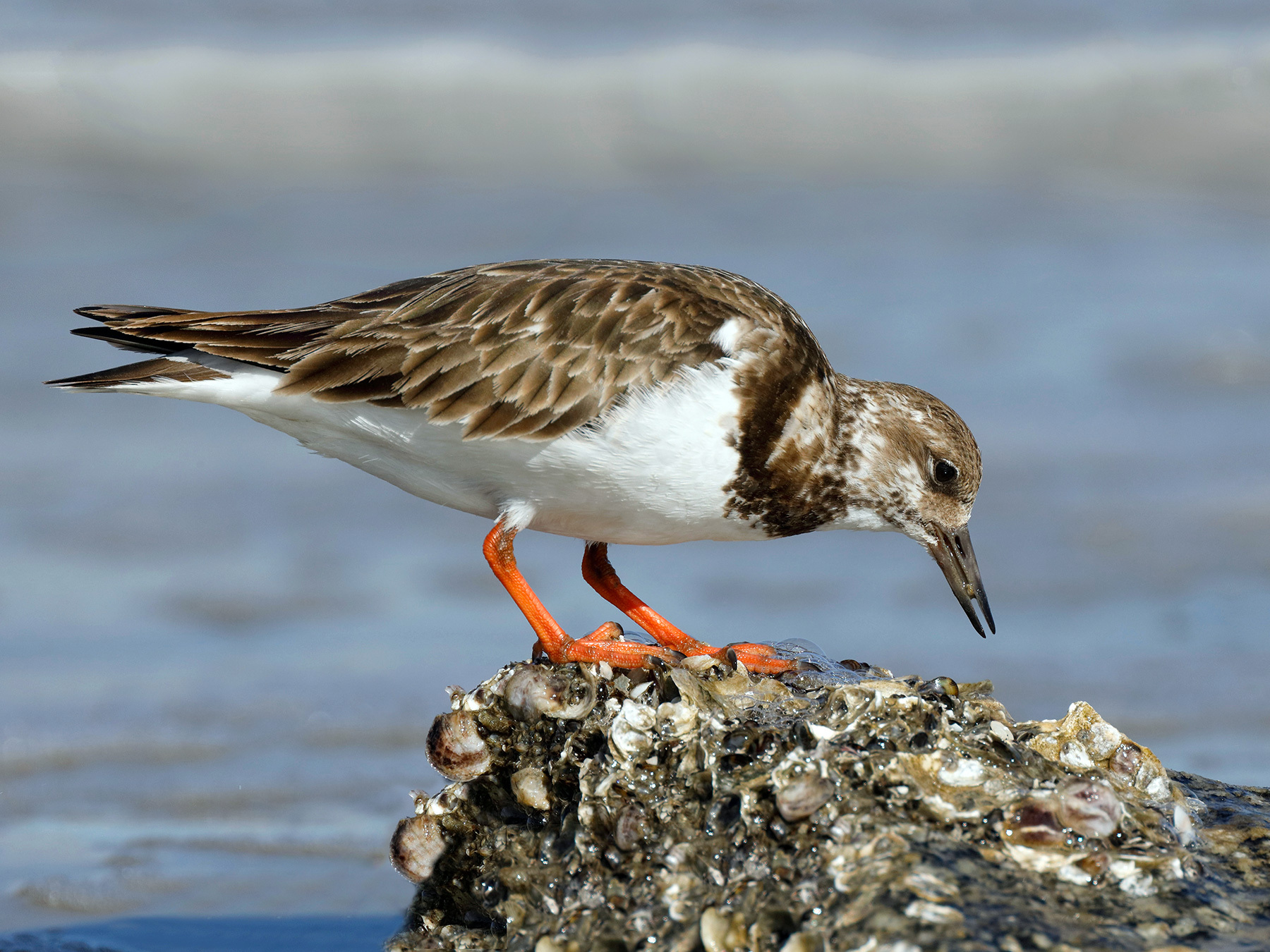
Quick facts
- Length
- 21–24 cm
- Wingspan
- 43–49 cm
- Weight
- 85–150 g
- Lifespan
- 6–9 years · oldest recorded 22.3 years
- Family
- Sandpipers & Snipes
- Migration
- Long-distance Migrant
- Global status (IUCN)
- Least Concern
- World population
- 460,000 - 730,000 individuals
- Population trend
- Decreasing
- Also called
- Turnstone
- Scientific name
- Arenaria interpres
Questions
4Is a Black Turnstone the same as a Ruddy Turnstone?
The Black Turnstone (Arenaria melanocephala) is one of only two known Turnstone species. It is endemic (restricted) to the west coast of North America, from Alaska to Mexico. They are not the same species as the Ruddy Turnstone (A. interpres), which is visibly different and has a much larger distribution.
Why is it called Ruddy Turnstone?
The Ruddy Turnstone’s name describes its ruddy (reddish) plumage and its habit of flipping small stones in search of prey.
Is a Ruddy Turnstone a plover?
Despite a similar appearance, Ruddy Turnstones are not closely related to Plovers. Turnstones are from the Arenaria genus of the Scolopacidae family, while Plovers are from various genera of the Charadriidae family.
Is the Ruddy Turnstone a carnivore?
Ruddy Turnstones are technically omnivores because they eat some plant material, although invertebrates form the bulk of their diet.
Sources
4- 1BirdLife International. 2019. Arenaria interpres. The IUCN Red List of Threatened Species 2019: e.T22693336A154669637. Source (opens in a new tab)
- 2Wetlands International (2015)
- 3Wetlands International (2015)
- 4Robinson and Clark, The Online Ringing Report: Bird ringing in Britain & Ireland in 2011 (2012) Source (opens in a new tab)

Checked by
Nathan Cope, founder and editor
Nathan founded Birdfact and leads its writers and contributors in the UK, the US and Canada. He has watched and studied birds for more than ten years, and checks every article and species guide before it’s published.