
Long-billed Dowitcher
Limnodromus scolopaceus
By the Birdfact teamChecked by Nathan Cope
A stocky Arctic shorebird with a bill nearly twice the length of its head, the Long-billed Dowitcher is best identified not by sight but by sound — its sharp, piercing keek! call cuts through the noise of a busy wetland and instantly separates it from its near-identical relative, the Short-billed Dowitcher. Watch one feeding and you'll see its bill pumping in and out of the mud in a relentless sewing-machine motion, driven by touch-sensitive receptors so acute the bird can hunt in complete darkness.
On this page13 sections
How to recognise it
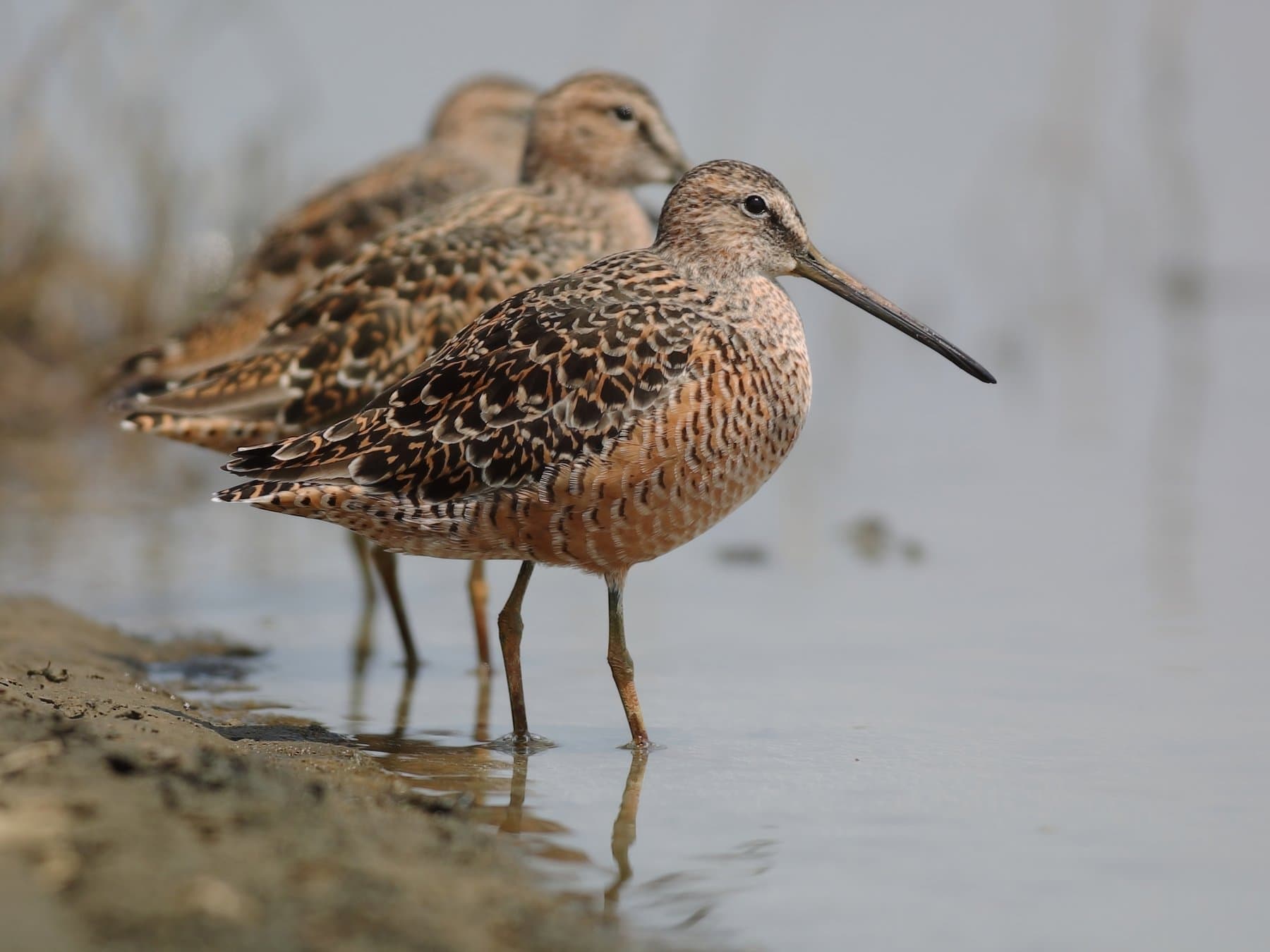
The Long-billed Dowitcher is a medium-sized, stocky shorebird — roughly the size of a Redshank — built low to the ground with a long, straight bill that measures 62–72 mm and accounts for nearly half the bird's total length. That bill is black, becoming yellowish-olive towards the base, and is one of the most immediately striking features of the species. The legs are also yellowish-olive. In all plumages, a clean whitish supercilium (eyebrow stripe) contrasts with a dark loral stripe that runs from the bill through and past the eye.
In breeding plumage, worn from approximately May to late August, adults are richly coloured. The neck, chest, and belly flush a deep rufous-orange, and the breast is marked with black bars — a key distinction from the Short-billed Dowitcher, which shows spots rather than bars. The crown and back are a complex mix of black, brown, and buff, while the flanks show white barring when the plumage is fresh. As feathers wear through summer, the barring on the breast may fade, leaving a uniform dark reddish hue.
Non-breeding (winter) plumage is a study in restraint: the upperparts turn plain dark grey, the breast becomes a washed-out grey-brown, and the belly fades to white. This drab winter dress is almost indistinguishable from that of the Short-billed Dowitcher in the field — voice becomes the only reliable separator. Juveniles show a warm buff wash to the neck and breast, with dark-centred, buff-fringed feathers on the upperparts giving a scaly appearance.
The sexes are almost identical in plumage. Females are generally heavier and have longer wings and bills, with bill length at the upper end of the species' range — though male bills often overlap in length with those of Short-billed Dowitchers, making the species' common name somewhat misleading. In flight, a large white rump patch extending up the back to the middle of the spine is immediately diagnostic.
Not sure it’s a Long-billed Dowitcher? Check your photo: Birdfact names the bird and shows the look-alike side by side.
Its size
Adults- Length
- 27–30 cm
- Wingspan
- 47–49 cm
- Weight
- 88–130 g
Its song and calls
The Long-billed Dowitcher's most important call — and its most reliable field mark — is a high, sharp keek!, a single piercing note quite unlike the lower-pitched, mellower tu-tu-tu of the Short-billed Dowitcher. This call is given both in flight and on the ground, and may be repeated as an accelerating double or triple series: keek-keek-keek. It carries well across open wetlands and is typically the first indication that a dowitcher is present. Experienced birders often identify the species by ear before they've raised their binoculars.
A second, less common call is a soft tu, given one to eight times in sequence. This quieter note is more easily confused with Short-billed Dowitcher calls and should not be used as a sole identification criterion.
The breeding song is described as pee-witch-er (sometimes rendered as pee-wit-er), delivered by the male during his hovering song flight over the breeding territory. During courtship, two or three males call loudly while pursuing a female in aerial display. Outside the breeding season, the species is generally silent on the ground except when alarmed — but feeding flocks are a notable exception, twittering almost continuously while probing. This constant flock chatter is itself a behavioural field mark: Short-billed Dowitcher flocks are typically silent while feeding. The sexes do not differ noticeably in voice.
Heard one and not sure? Let the bird song identifier listen.
When and where to see it
OctoberIn season
Most recorded in October
- 1. Flintshireunder 0.1%
- 2. Wexfordunder 0.1%
- 3. East Sussexunder 0.1%
- 4. Conwyunder 0.1%
- 5. Norfolkunder 0.1%
Each dot is a county, state or province: the bigger and darker, the larger the bird’s share of that place’s bird records that month. Grey dots: no regular records. The ringed point is the centre of the bird’s records this month; the arrow shows how it moved since last month, and the dashed loop its path through the year. “Arrivals” colours places where it becomes regular this month (orange) or is in its last regular month (grey). GBIF eBird Observation Dataset, 2019–2024. Map data: Natural Earth, US Census Bureau; place centres © OpenStreetMap contributors.
In your area
See when the Long-billed Dowitcher is recorded in your county, state or province.
How often the Long-billed Dowitcher turns up in the UK, Ireland, the United States and Canada through the year, from birdwatchers' records.
United Kingdom
Winter visitor · regularly Jul–May · most records in October
Ireland
Passage migrant · regularly Nov · most records in March
United States
Resident · all year · most records in October
Canada
Winter visitor · regularly Jul–May · most records in October
Show as a table
| Month | United Kingdom | Ireland | United States | Canada |
|---|---|---|---|---|
| January | 0.004% (regular) | 0.022% | 0.062% (regular) | 0.014% (regular) |
| February | 0.007% (regular) | 0.003% | 0.055% (regular) | 0.011% (regular) |
| March | 0.006% (regular) | 0.022% | 0.057% (regular) | 0.007% (regular) |
| April | 0.005% (regular) | 0.006% | 0.081% (regular) | 0.008% (regular) |
| May | 0.002% (regular) | <0.001% | 0.038% (regular) | 0.036% (regular) |
| June | <0.001% | – | 0.007% (regular) | 0.002% |
| July | 0.007% (regular) | 0.004% | 0.049% (regular) | 0.052% (regular) |
| August | 0.006% (regular) | 0.004% | 0.088% (regular) | 0.062% (regular) |
| September | 0.005% (regular) | 0.011% | 0.074% (regular) | 0.087% (regular) |
| October | 0.012% (regular) | 0.006% | 0.100% (regular) | 0.098% (regular) |
| November | 0.006% (regular) | 0.008% (regular) | 0.088% (regular) | 0.031% (regular) |
| December | 0.003% (regular) | 0.013% | 0.062% (regular) | 0.012% (regular) |
Recorded regularly in
Worldwide: recorded regularly in 32 countries
Countries where it was recorded in at least 3 of the 6 years 2019–2024. Linked countries have their own bird list.
North America (16)
- Bahamas
- Barbados
- Belize
- Bermuda
- Canada
- Cayman Islands
- Costa Rica
- Cuba
- El Salvador
- Guatemala
- Honduras
- Mexico
- Nicaragua
- Panama
- Puerto Rico
- United States
Oceania (1)
- US Outlying Islands
Data: EOD – eBird Observation Dataset (Cornell Lab of Ornithology), accessed via GBIF.org, CC BY 4.0. Records from 2019–2024, aggregated and filtered by Birdfact. How these lists are made
Tips for seeing it
Separating Long-billed from Short-billed Dowitcher is one of shorebird watching's classic challenges — and voice is the answer. The Long-billed gives a high, sharp keek!, sometimes doubled or tripled into a rapid series; the Short-billed gives a lower, softer tu-tu-tu. Learn these calls and the identification problem largely solves itself. In the UK, this distinction is academic for most birders: any dowitcher you find is almost certainly a Long-billed, since Short-billed remains an extreme rarity with fewer than five accepted British records.
In North America, look for Long-billed Dowitchers in freshwater habitats rather than open tidal flats — they strongly prefer flooded fields, freshwater impoundments, and the upper reaches of estuaries over sandy or open saltwater mudflats. In breeding plumage, the black bars (not spots) on the breast are diagnostic, but in winter the two species are essentially identical in the field without a call.
In the UK, September and October are the peak months for vagrant Long-billed Dowitchers. Coastal freshwater pools and scrapes at well-watched reserves — particularly in Norfolk, Lincolnshire, and Cornwall — are the most productive sites. Most birds are juveniles, showing a warm buff wash to the neck and a scaly pattern on the upperparts. Watch for the sewing-machine feeding action and listen for the keek call. Feeding flocks twitter almost constantly, which is itself a useful clue: Short-billed Dowitcher flocks are generally silent while feeding.
In flight, look for the large white rump patch extending up the back — a feature shared with the Short-billed but useful for confirming the genus. The trailing edge of the wing shows a pale bar. Birds often call on take-off, giving the best opportunity to hear the diagnostic keek.
What it eats
The Long-billed Dowitcher's diet shifts markedly across the annual cycle, tracking the availability of different prey types at each stage of the year. On the breeding grounds in the Arctic, the diet is dominated by chironomid (midge) larvae — the most abundant invertebrate in wet tundra — supplemented by larvae of other insects including beetles and caterpillars, earthworms, small crustaceans, and occasional plant matter and seeds.
As birds move coastward in late summer in preparation for migration, the diet transitions towards marine prey: polychaete worms, small amphipods, and molluscs, particularly small bivalves. During migration and winter, the menu broadens further to include amethyst gem clams, Baltic macoma clams, overbite clams, copepods, marine worms, and a range of crustaceans. At times, birds may feed heavily on seeds of grasses, bulrushes, and pondweeds — a plant-based component of the diet that is often overlooked.
All foraging is by the characteristic sewing-machine probing motion, with the bill driven repeatedly into soft mud or shallow water. The Herbst corpuscles packed into the bill tip allow the bird to detect prey entirely by touch, without needing to see or smell it. This tactile sensitivity is so refined that the bird can discriminate between different prey types while its bill is buried in opaque mud — a capability that makes it an efficient forager even in turbid water or complete darkness. Long-billed Dowitchers are regularly observed feeding through the night, particularly during the non-breeding season.
Nesting and breeding
Breeding begins when birds arrive on the Arctic tundra as the snow melts, typically in late May or early June. The nest is placed on the ground, usually near water, often on or at the base of a raised tussock or hummock in wet sedge meadow or marsh vegetation. The nest itself is a deep cup set in a depression in marsh grasses or moss, lined with grasses, sedges, and small leaves; the base of the cup is often damp. The interior measures approximately 11.4 cm across and 5.6 cm deep.
The clutch is typically four eggs — oval to pear-shaped, light olive-greenish or bluish, and heavily splotched with varying shades of brown, with markings densest at the large end and underlying marks of dark grey. Eggs measure approximately 4.2–4.3 cm long by 2.9–3.1 cm wide. Both sexes share incubation initially, but the later stages are handled mostly or entirely by the male. The incubation period is 20–22 days.
Chicks are precocial and leave the nest within a day of the last egg hatching. They are not fed by their parents and find all their own food from the outset. The female reportedly departs around the time the eggs hatch, leaving the male to tend the young until they are close to fledging at approximately 20–30 days. Each pair raises a single brood per year.
Courtship is driven by the male's song flight: he hovers approximately 15 metres above his territory on trembling, raised wings while delivering the "pee-witch-er" breeding song. The appearance of a female triggers aerial pursuit by two or three singing males, who fly with speed and agility. Despite this territorial display, pairs from neighbouring territories often feed together on shared ponds without conflict.
Behaviour
In flight, the Long-billed Dowitcher is immediately recognisable by a large, bold white rump patch that extends up the back to the middle of the spine — a feature visible from a considerable distance and shared with the Short-billed Dowitcher, making it a useful genus-level field mark. The wings show a pale trailing edge, and the long bill projects well forward, giving the bird a front-heavy silhouette quite unlike most other waders.
The wingbeat is fairly rapid and direct for a bird of this size, with little of the erratic jinking typical of smaller sandpipers. Flocks fly in loose, shifting groups rather than tight formations, and birds frequently call on take-off — providing the best opportunity to hear the diagnostic keek call. The long bill and stocky body create a distinctive shape that, with practice, can be picked out at distance even before plumage details are visible.
During the male's breeding season song flight, the style changes entirely: he hovers approximately 15 metres above his territory on trembling, raised wings, holding position in the air while delivering the pee-witch-er song. This display flight is quite unlike the direct travel flight and is one of the more striking behaviours of the species on the breeding grounds. Migration flights are long and sustained, with birds capable of covering substantial distances between staging areas on their journeys between the Arctic and wintering grounds in the Americas.
Lifespan and predators
The Long-billed Dowitcher is a moderately long-lived shorebird, with a typical lifespan of five to eight years in the wild. The oldest individual on record survived to at least 8 years and 3–4 months, based on ringing data. This longevity is broadly comparable to other medium-sized Scolopacid waders, though it falls short of the exceptional ages recorded in larger shorebirds such as godwits and curlews.
Annual survival rates are not well documented for this species, partly because its remote Arctic breeding grounds make long-term ringing studies difficult. As with most migratory shorebirds, the first year of life — encompassing the first southward migration and first winter — is likely the period of highest mortality. Juveniles must navigate thousands of kilometres of unfamiliar terrain without the benefit of prior experience, and many fail to reach their first breeding season.
Key mortality factors include predation at all stages of the annual cycle, weather events on migration, and the cumulative physiological demands of long-distance travel. The species' current population decline — with more than 50% of individuals lost over the past 50 years — suggests that mortality rates are outpacing recruitment, though the precise demographic mechanisms driving this trend are not yet fully understood. Some first-year birds remain on the wintering grounds through summer without returning to breed, which may reflect a strategy of deferring the costs of migration until body condition is sufficient.
Conservation
The Long-billed Dowitcher is currently listed as Near Threatened on the IUCN Red List (2024 assessment), having been uplisted from Least Concern as evidence of population decline has accumulated. The global population is estimated at approximately 650,000 individuals (Partners in Flight, 2017), with some earlier estimates placing the figure closer to 500,000.
The picture painted by recent monitoring is stark. The 2025 State of the Birds report (USA) designated the Long-billed Dowitcher an Orange Alert Tipping Point species — meaning it has lost more than 50% of its population in the past 50 years, with declines accelerating within the most recent decade. BirdLife International notes a population reduction approaching threatened thresholds, with a suspected decline of approximately 20% over three generations, and projects that the rate of decline will continue at least one generation length into the future (to 2028).
The primary threats are loss and degradation of freshwater wetland habitats — particularly the shallow, temporary wetlands that the species relies on at key points in its annual cycle — along with pollution and environmental contaminants affecting wetland quality. Climate change poses a growing threat to both Arctic breeding grounds and wintering wetlands. Historical over-hunting in the late 19th and early 20th centuries contributed to earlier declines, though legal protection has since allowed some recovery. The drivers of current declines are not fully understood, and targeted research into the species' migratory connectivity and wintering ecology is urgently needed.
Courtship & Display
Courtship on the Arctic breeding grounds is driven primarily by the male's song flight — one of the more striking displays of any shorebird. The male rises to approximately 15 metres above his territory and hovers on trembling, raised wings, holding position in the air while delivering the pee-witch-er song in a sustained performance. This hovering display serves both to attract females and to advertise territorial ownership to rival males.
When a female appears, the dynamic shifts immediately: two or three males break from their hovering displays and pursue her in fast, agile aerial chases, calling loudly throughout. These pursuits can be prolonged and energetic, with males demonstrating flight speed and manoeuvrability. Once a pair bond forms, the male continues to defend the territory through song flight rather than overt aggression — and despite this territorial signalling, neighbouring pairs often feed together on shared ponds without conflict, suggesting that the defended resource is primarily the nest site rather than the foraging area.
After mating, both sexes share incubation duties initially. The female's investment in the breeding attempt decreases as incubation progresses, and she reportedly departs around the time the eggs hatch, leaving the male to brood and tend the precocial chicks until they are close to fledging at 20–30 days. This pattern of female departure before fledging is unusual among shorebirds and means that the male bears the full cost of chick-rearing — a significant investment given the short Arctic summer and the demands of the subsequent southward migration.
Short Billed Vs Long Billed Identification
Separating Long-billed from Short-billed Dowitcher is one of the most discussed identification challenges in North American shorebird watching — and for good reason. In winter plumage, the two species are essentially identical in the field: both are plain grey above, white below, with the same white rump patch, the same supercilium, and the same sewing-machine feeding action. Even experienced observers regularly leave dowitchers unidentified when they fail to call.
Voice is the definitive separator. The Long-billed gives a high, sharp keek! — a single, piercing note. The Short-billed gives a lower, softer, more liquid tu-tu-tu. These calls are genuinely different once learned, and the difference is apparent even on a recording. In breeding plumage, the Long-billed shows black bars on the breast and flanks, while the Short-billed shows spots or chevrons. The Long-billed's belly is also typically more uniformly rufous in fresh breeding plumage, whereas the Short-billed often shows a paler, spotted belly.
Bill length is an unreliable field mark: while female Long-billed Dowitchers do have impressively long bills, male Long-billed bills often overlap in length with those of Short-billed Dowitchers of either sex. Habitat preference offers a supporting clue — Long-billed strongly favours freshwater over saltwater, while Short-billed is more tolerant of tidal flats and saltmarsh. Flock behaviour is also useful: Long-billed flocks twitter constantly while feeding; Short-billed flocks are generally silent. In the UK, the identification question is largely academic — any dowitcher found in Britain is almost certainly a Long-billed, given the extreme rarity of Short-billed in Europe.
Quick facts
- Length
- 27–30 cm
- Wingspan
- 47–49 cm
- Weight
- 88–130 g
- Lifespan
- 5–8 years · oldest recorded 8.3 years
- Family
- Sandpipers & Snipes
- Migration
- Long-distance Migrant
- Global status (IUCN)
- Near Threatened
- World population
- Approximately 650,000 individuals (Partners in Flight, 2017)
- Population trend
- Decreasing. Designated an Orange Alert Tipping Point species by the 2025 State of the Birds report, having lost more than 50% of its population in the past 50 years, with declines accelerating in the most recent decade.
- Scientific name
- Limnodromus scolopaceus
Sources
12- 1Long-billed dowitcher - Wikipedia Source (opens in a new tab)
- 2Long-billed Dowitcher Limnodromus scolopaceus Species Factsheet | BirdLife DataZone Source (opens in a new tab)
- 3Long-billed Dowitcher - eBird Source (opens in a new tab)
- 4Long-billed Dowitcher Life History, All About Birds, Cornell Lab of Ornithology Source (opens in a new tab)
- 5Long-billed Dowitcher Overview, All About Birds, Cornell Lab of Ornithology Source (opens in a new tab)
- 6Long-billed Dowitcher | Audubon Field Guide Source (opens in a new tab)
- 7Long-billed Dowitcher | BTO BirdFacts Source (opens in a new tab)
- 8Long-billed Dowitcher - BirdWeb (Seattle Audubon) Source (opens in a new tab)
- 9Long-billed Dowitcher | NatureSpot Source (opens in a new tab)
- 10Tipping Point Species – State of the Birds 2025 (2025) Source (opens in a new tab)
- 11Bird of the Week: Long-billed Dowitcher – Travis Audubon Source (opens in a new tab)
- 12Long-billed dowitcher - Facts, Diet, Habitat & Pictures on Animalia.bio Source (opens in a new tab)

Checked by
Nathan Cope, founder and editor
Nathan founded Birdfact and leads its writers and contributors in the UK, the US and Canada. He has watched and studied birds for more than ten years, and checks every article and species guide before it’s published.