


Eurasian Skylark
Skylark · Alauda arvensis
By the Birdfact teamChecked by Nathan Cope
On this page14 sections
How to recognise it
The Skylark is a rather non-descript bird, most easily confused with the Woodlark.
What do Skylarks look like?
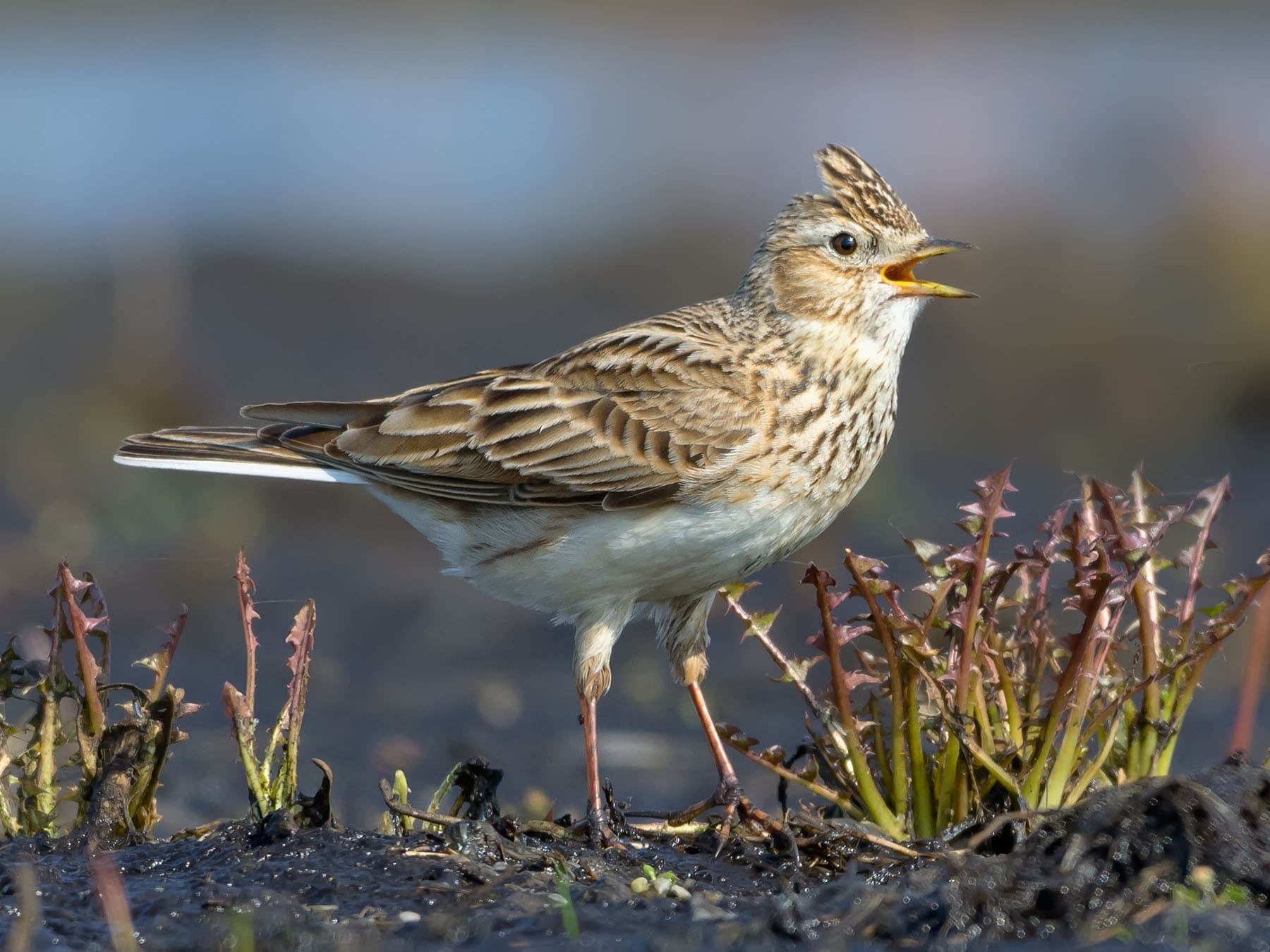
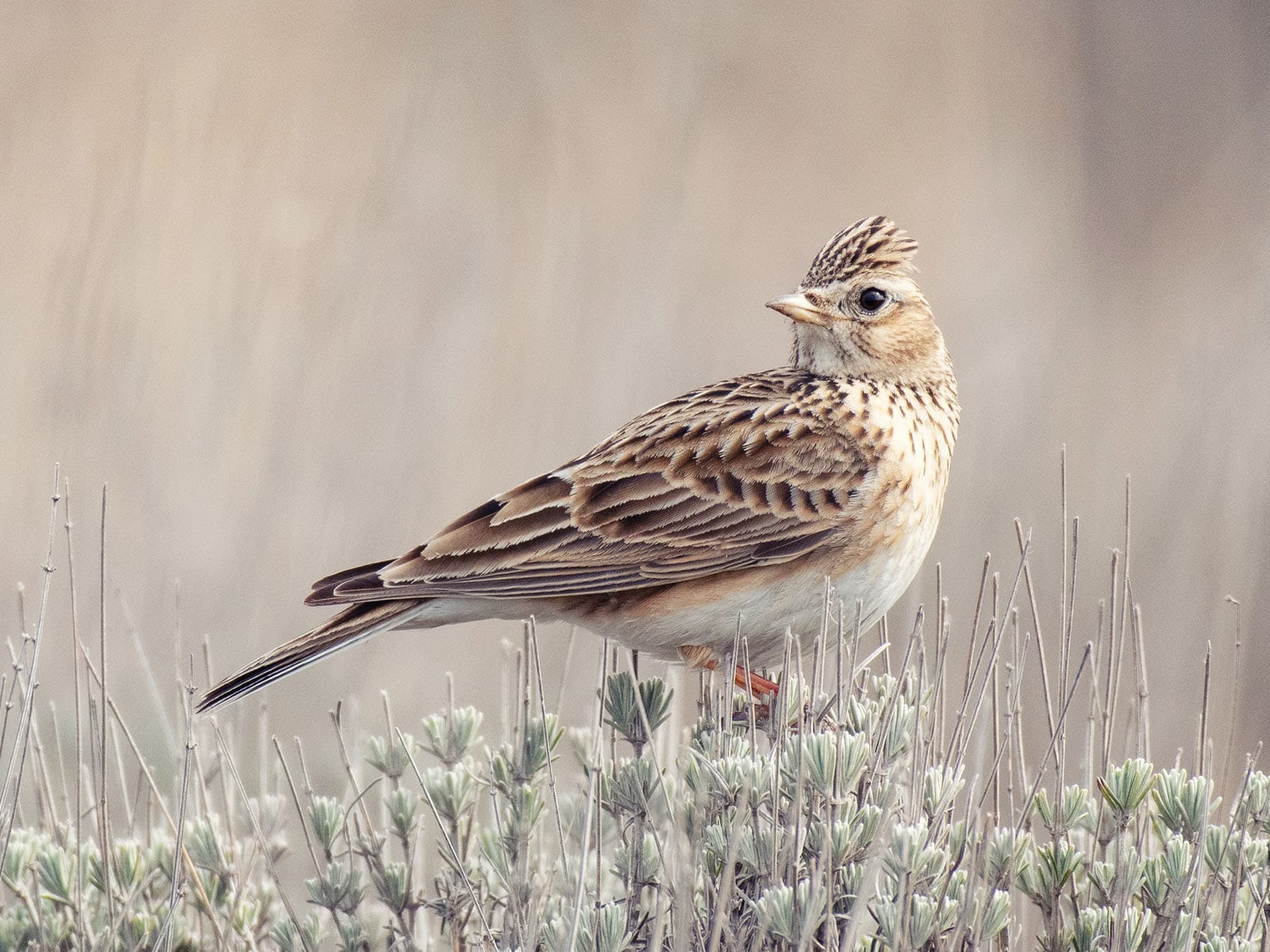
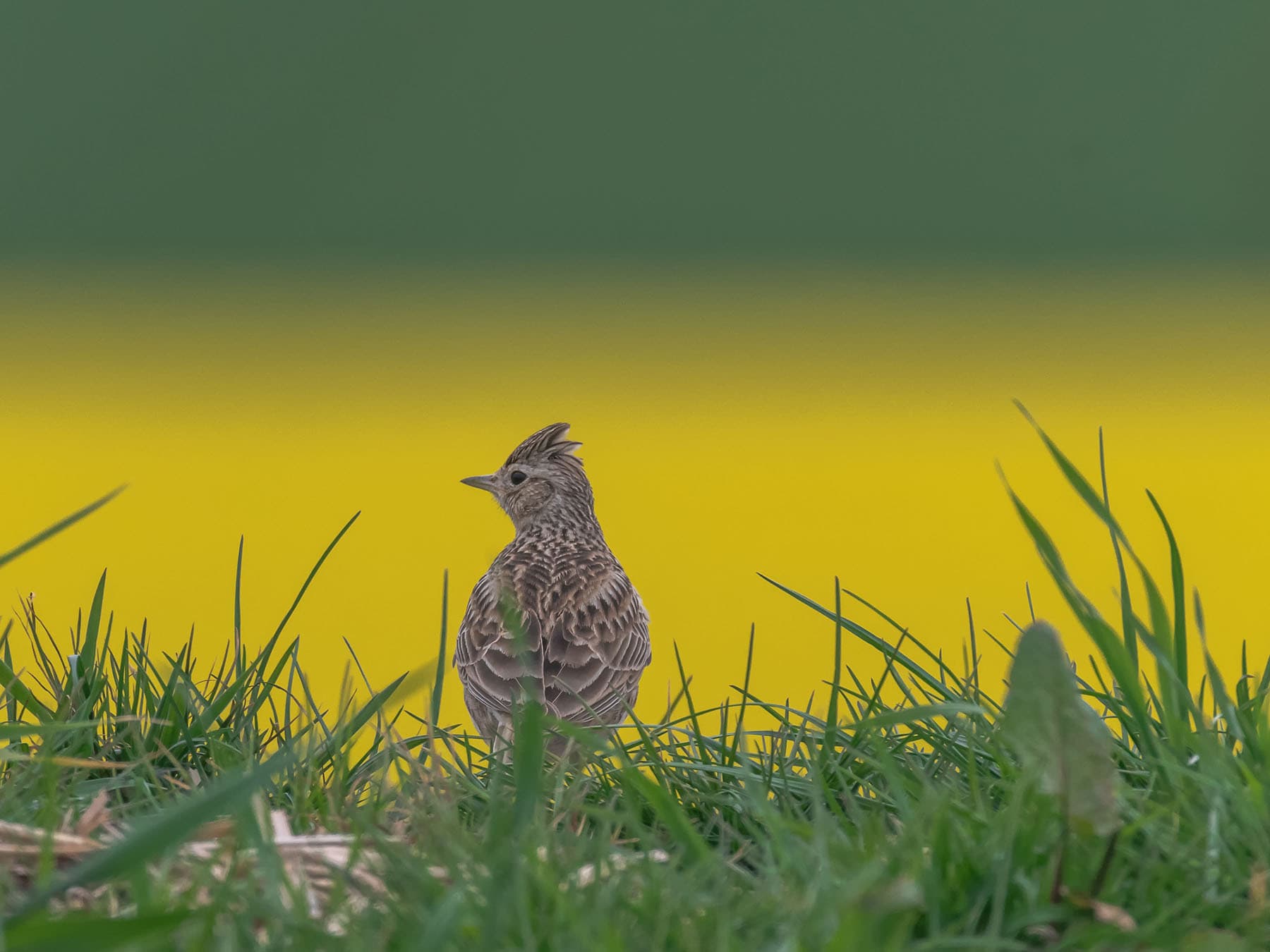
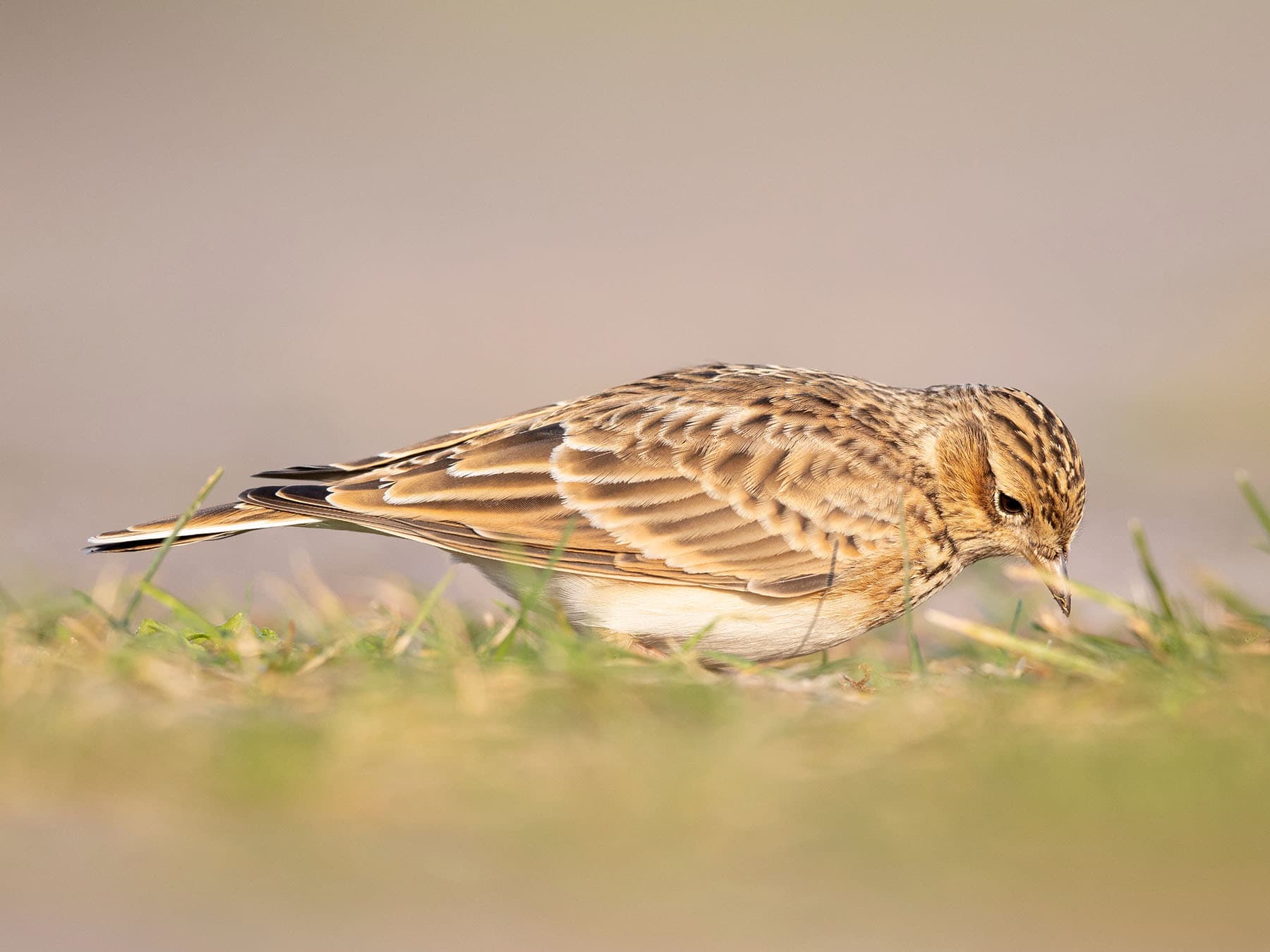
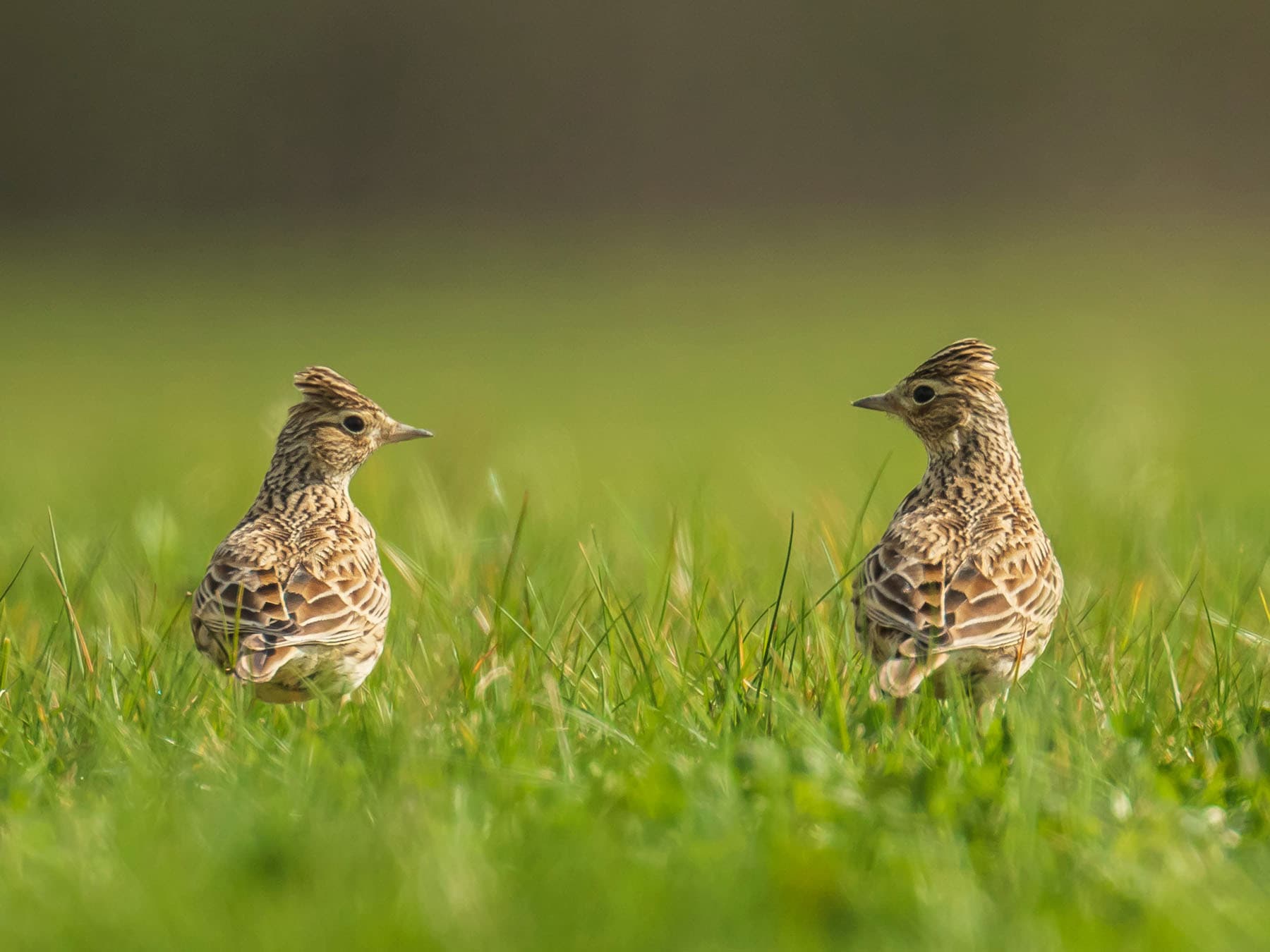
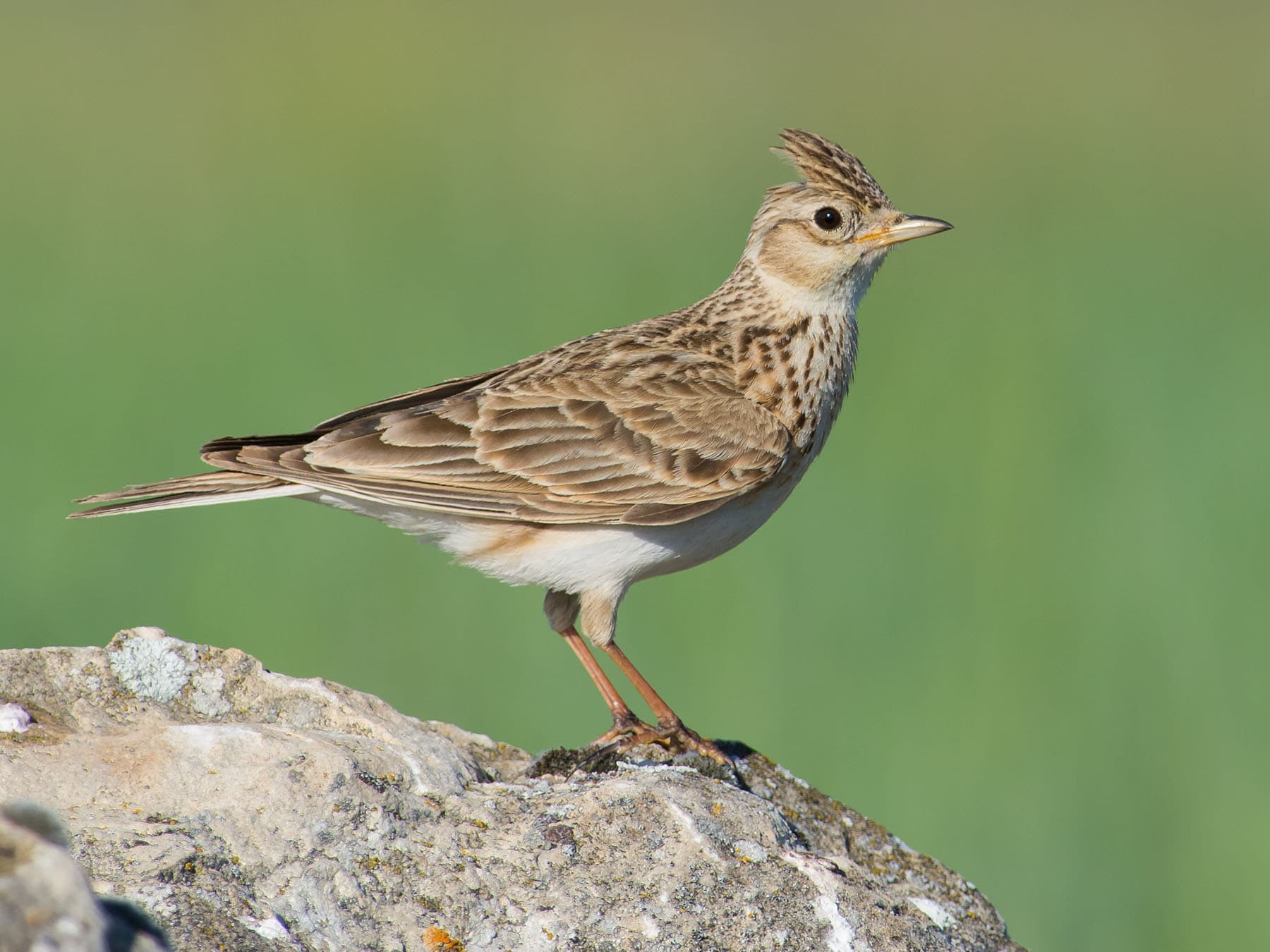
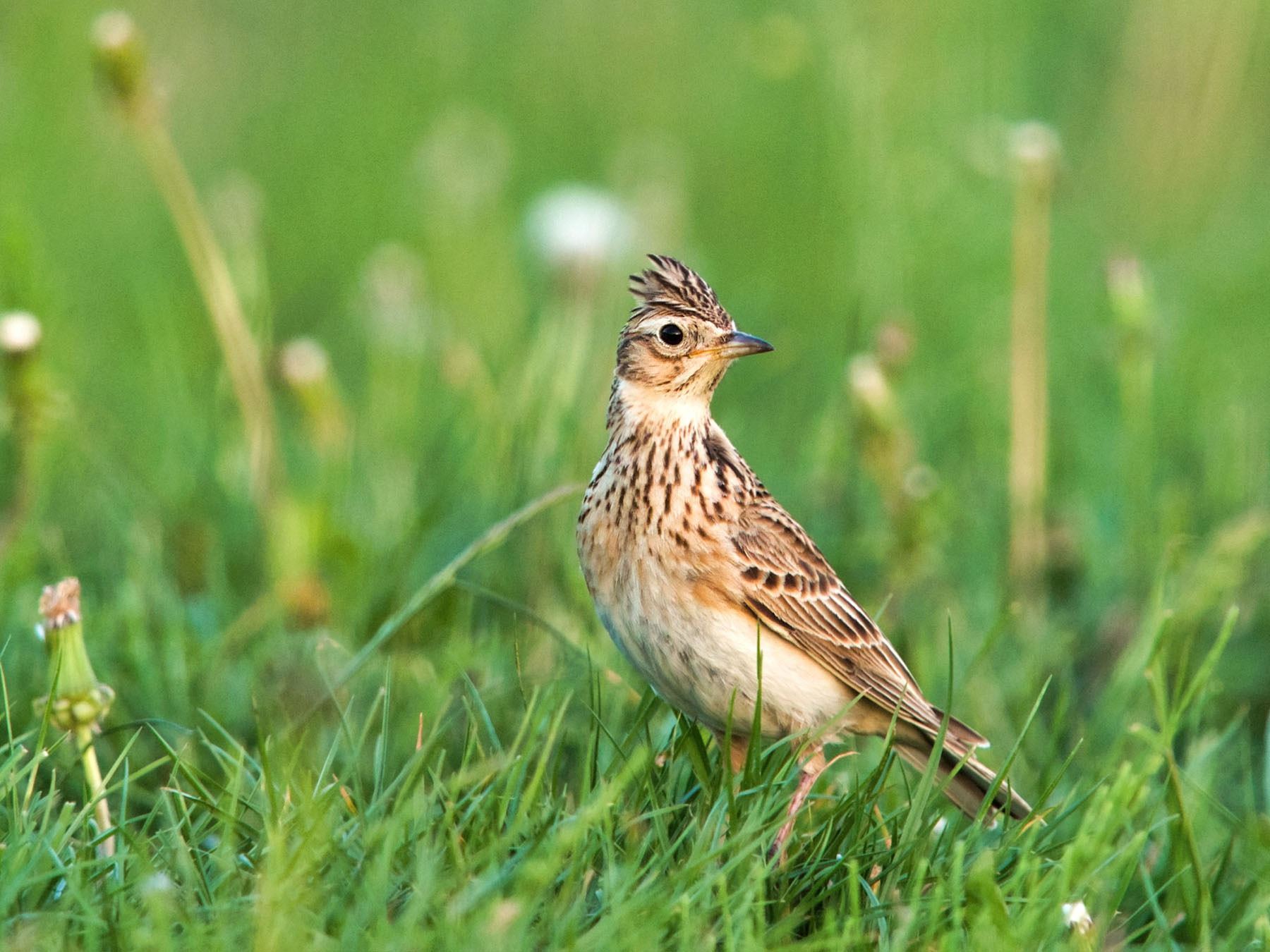
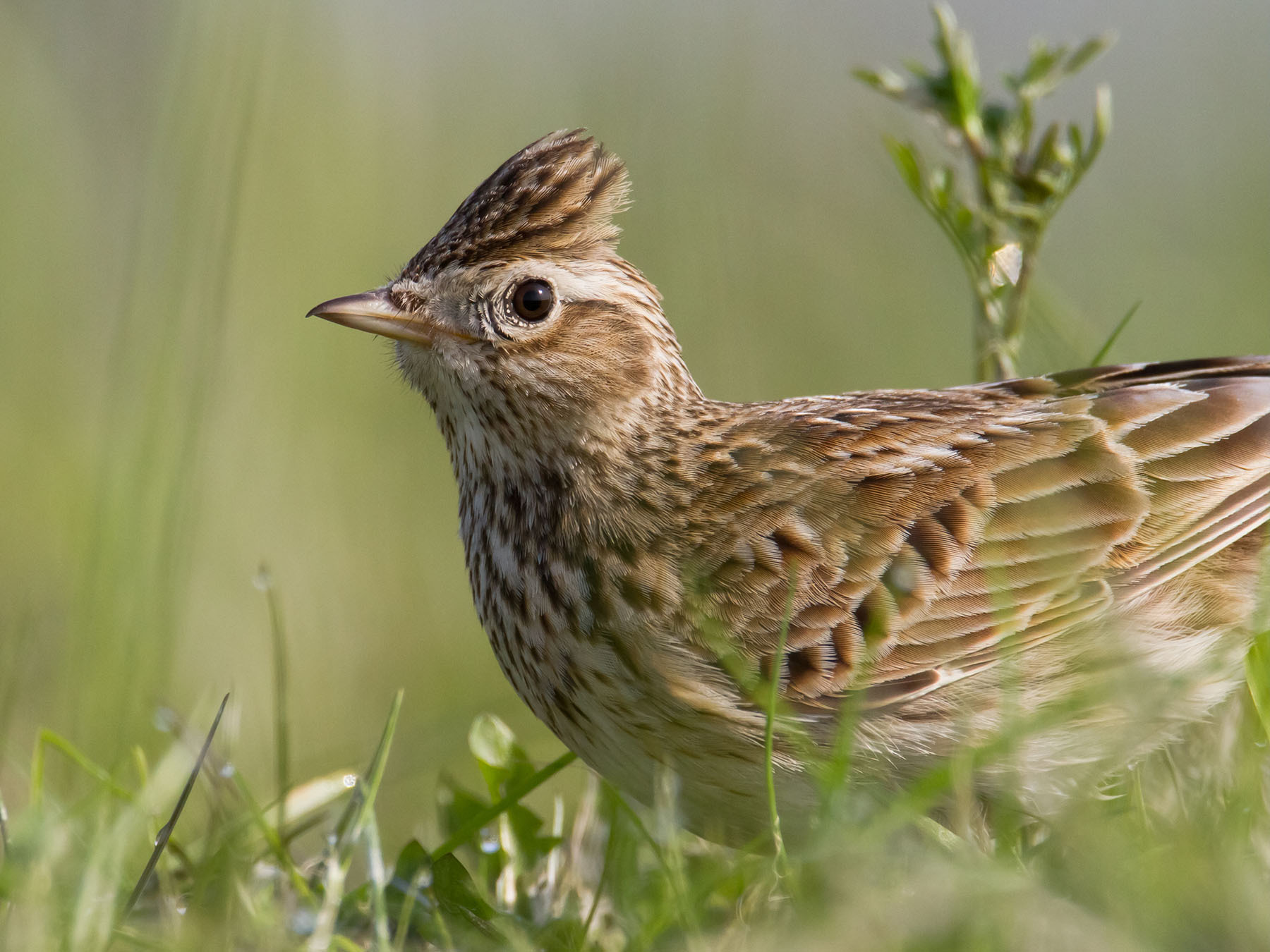
Skylarks are highly camouflaged little birds with brownish upper parts and pale underparts. Their most distinctive features are a prominent head crest that can be raised and lowered, white face markings and eyebrow stripe (supercilium), and white-edged tail feathers.
The chest is streaked, and the belly is uniform cream/buff. Skylarks have large, dark eyes and a pale yellowish bill. Their legs vary from yellow-brown to pinkish, and their hallux (hind toe) is long, with an impressive claw.
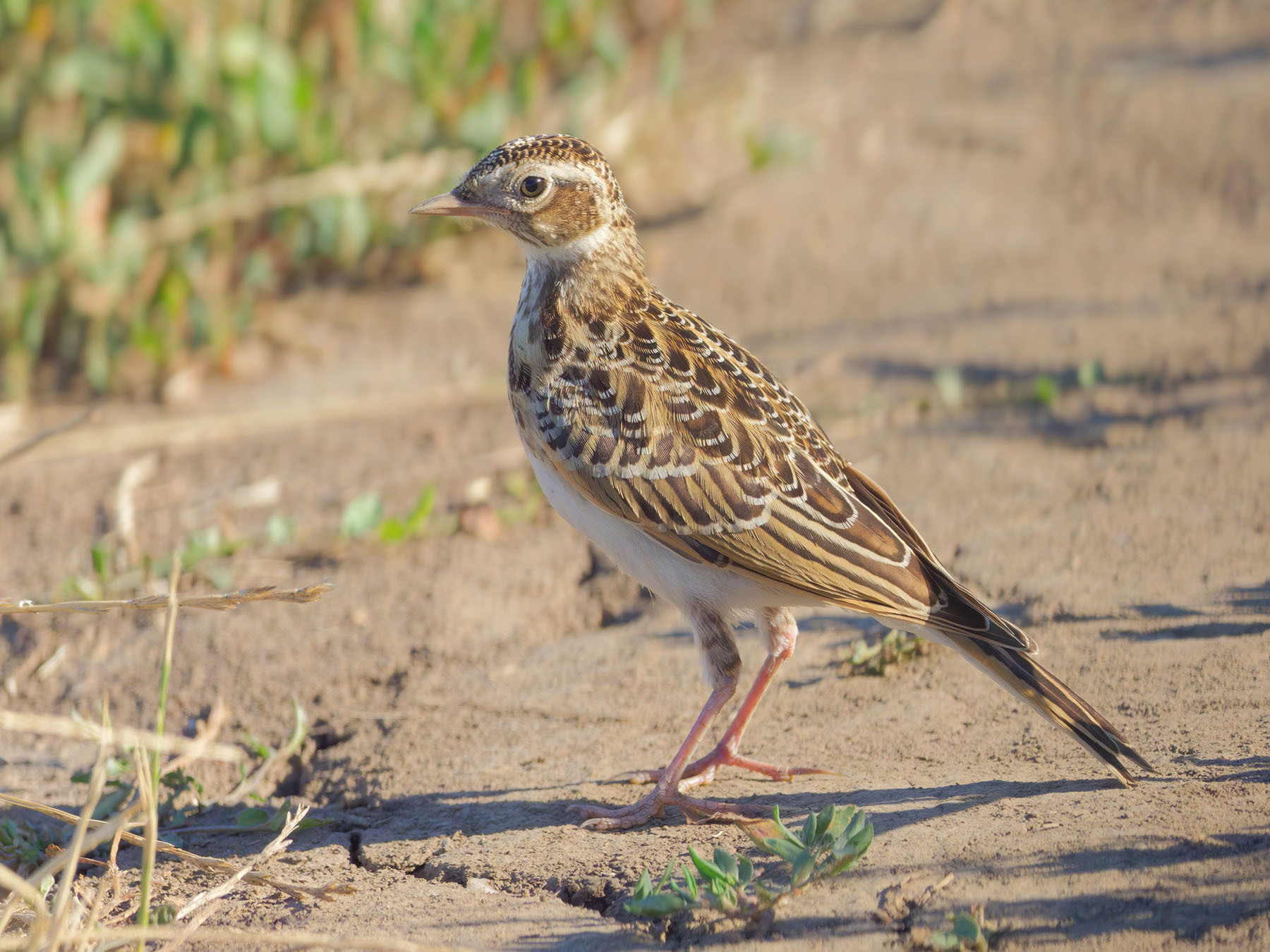
Females are slightly smaller than males but otherwise very difficult to distinguish. Juveniles are similar to adults but have more boldly spotted (not streaked) upperparts and a wider supercilium.
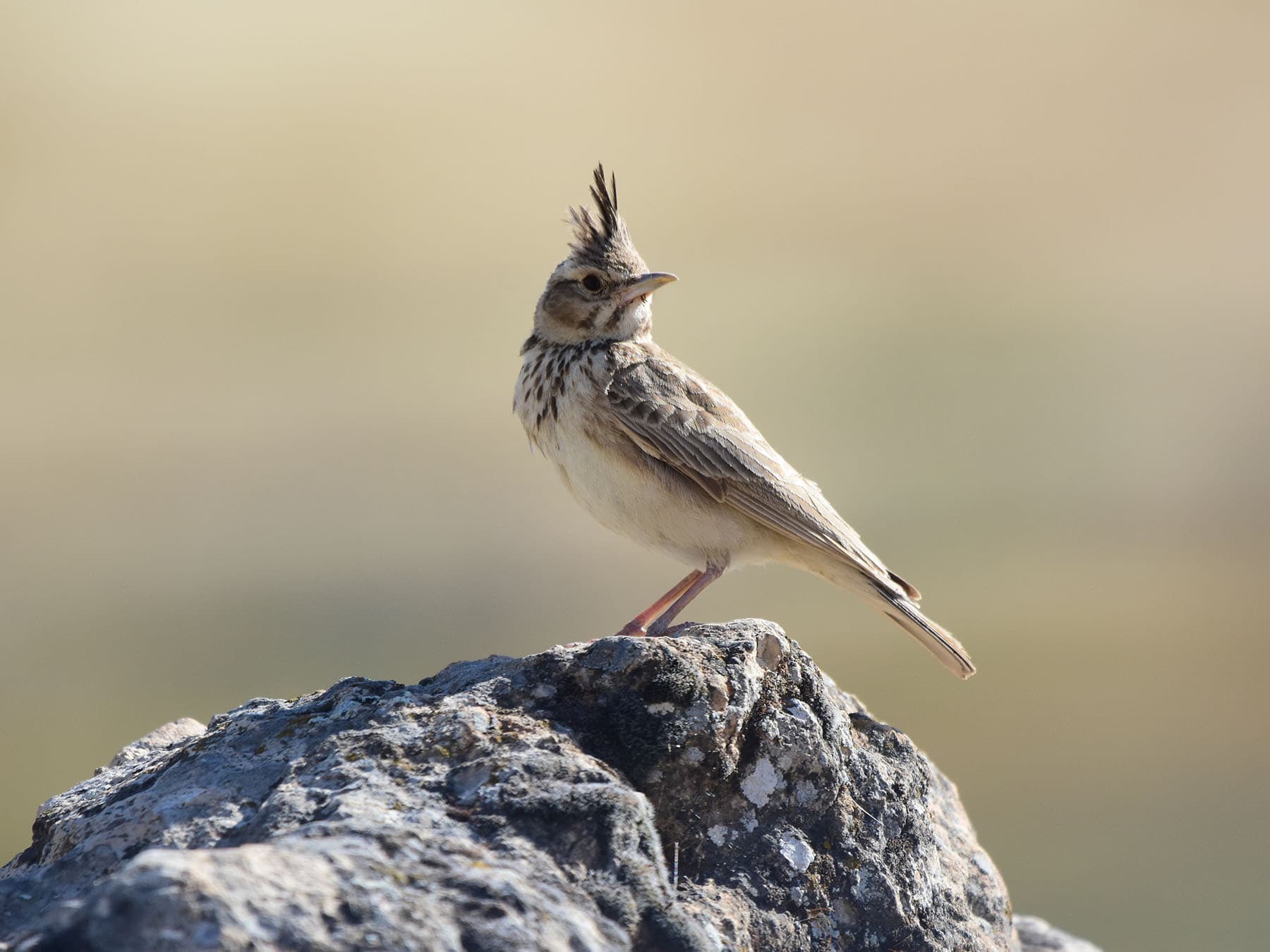
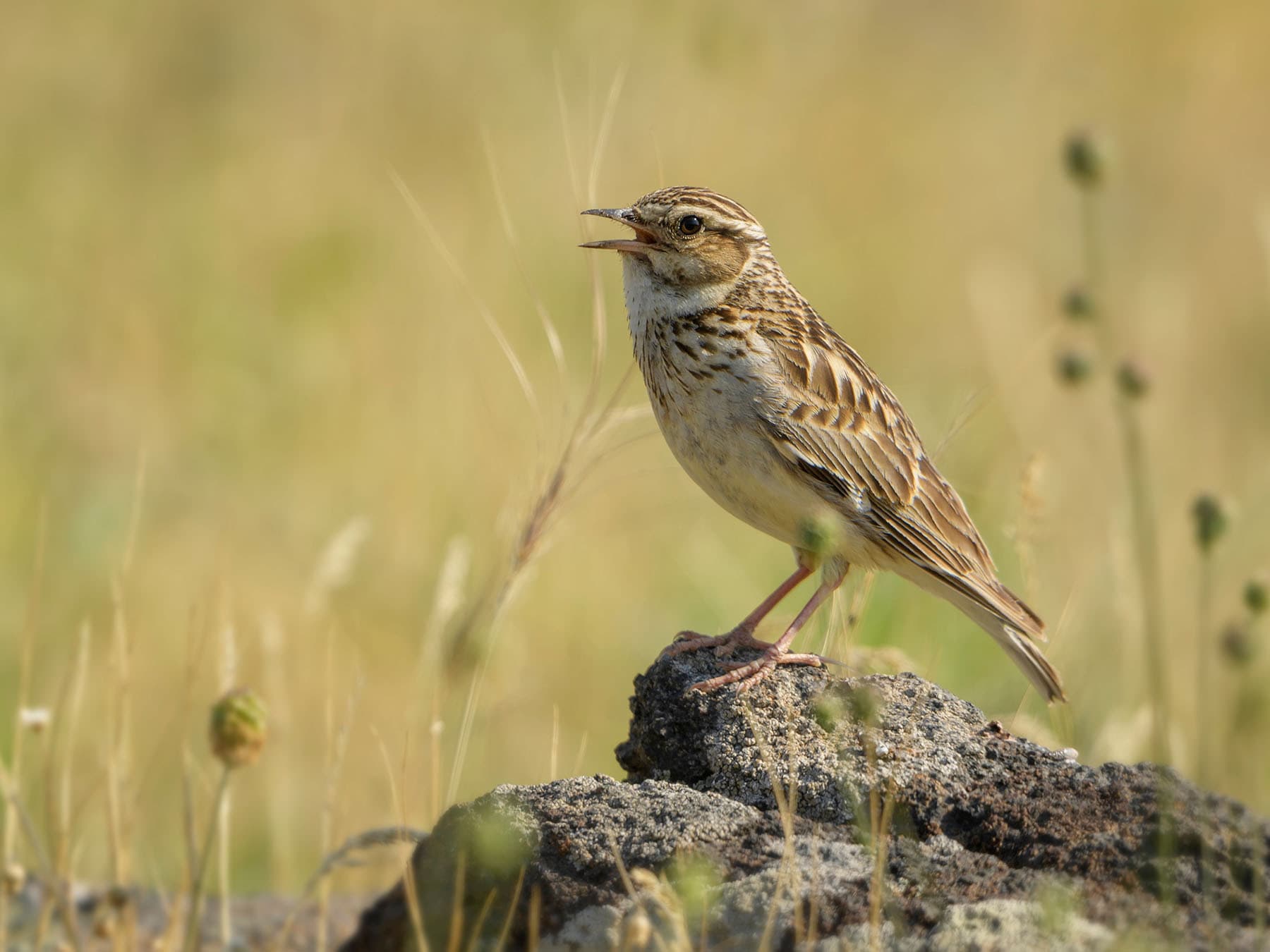
The Skylark can be distinguished from the rarer Woodlark by its larger size and crest. The Woodlark also has a distinctly short tail, most visible in flight.
How big are Skylarks?
Skylarks are medium-sized songbirds, slightly smaller than the Starling.
Length
Their total body length is 17.5-19 centimetres, including a 6-7cm tail, and their bill is about 15mm long.
Weight
Most Skylarks weigh between 33 and 45 grams. Males are slightly heavier on average.
Wingspan
These birds have a wingspan of 30 to 36 centimetres. The average male’s wing length is about a centimetre longer than the female’s.
Its size
Adults- Length
- 16–18 cm
- Wingspan
- 30–36 cm
- Weight
- 30–45 g
Its song and calls
The Skylark is a celebrated songster. Its song is a familiar sound in farmlands across the United Kingdom.
What sound does a Skylark make?
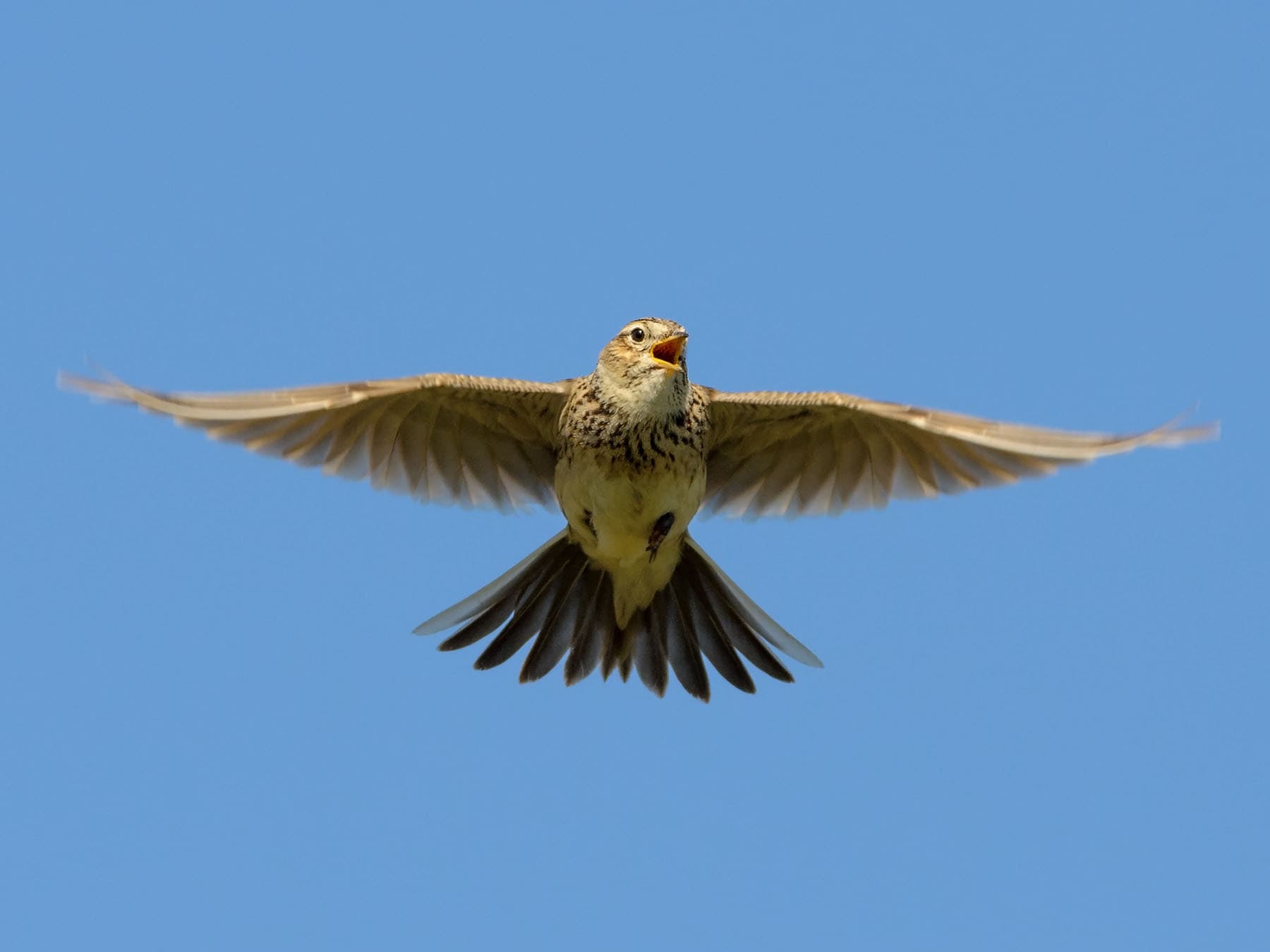
Skylarks are remarkable for their singing stamina. Males can sing continuously for as long as thirty minutes, all while hovering and circling above their territory. The average song in the UK lasts about two minutes and consists of clear warbling notes.
These birds also sing from the ground and while pursuing each other. The female’s song is usually heard during nest building and pairing. Skylarks also produce a variety of short calls, used to maintain contact and express alarm.
What time of year do Skylarks sing?
Skylarks can be heard at any time of the year, although they are most vocal in the spring and summer. They do most of their singing in the morning, with a smaller peak in the late afternoon, and they are most vocal in fine weather conditions.
- Song0:00 / 0:48
Recorded in Pembrokeshire, Wales
Lawrence Shove / The British Library Board · Wikimedia Commons · CC BY-SA 4.0
- Call0:00 / 0:50
Recorded in Hauts-de-France, France · March 2026
When and where to see it
OctoberArriving
Most recorded in October
- 1. South Ayrshire2.8%
- 2. Herefordshire2.1%
- 3. Pembrokeshire2.1%
- 4. Shropshire1.7%
- 5. Bedfordshire1.6%
Each dot is a county, state or province: the bigger and darker, the larger the bird’s share of that place’s bird records that month. Grey dots: no regular records. The ringed point is the centre of the bird’s records this month; the arrow shows how it moved since last month, and the dashed loop its path through the year. “Arrivals” colours places where it becomes regular this month (orange) or is in its last regular month (grey). GBIF eBird Observation Dataset, 2019–2024. Map data: Natural Earth, US Census Bureau; place centres © OpenStreetMap contributors.
In your area
See when the Eurasian Skylark is recorded in your county, state or province.
How often the Eurasian Skylark turns up in the UK, Ireland, the United States and Canada through the year, from birdwatchers' records.
United Kingdom
Resident · all year · most records in June
Ireland
Summer visitor · all year · most records in June
United States
Winter visitor · all year · most records in February
Canada
Summer visitor · regularly Feb–Jul · most records in March
Show as a table
| Month | United Kingdom | Ireland | United States | Canada |
|---|---|---|---|---|
| January | 0.39% (regular) | 0.18% (regular) | 0.003% (regular) | <0.001% |
| February | 0.75% (regular) | 0.32% (regular) | 0.003% (regular) | <0.001% (regular) |
| March | 1.0% (regular) | 0.57% (regular) | 0.003% (regular) | 0.003% (regular) |
| April | 1.1% (regular) | 0.78% (regular) | 0.001% (regular) | <0.001% (regular) |
| May | 1.2% (regular) | 0.95% (regular) | <0.001% (regular) | <0.001% (regular) |
| June | 1.2% (regular) | 1.0% (regular) | 0.001% (regular) | <0.001% (regular) |
| July | 0.77% (regular) | 0.50% (regular) | <0.001% (regular) | <0.001% (regular) |
| August | 0.22% (regular) | 0.18% (regular) | <0.001% (regular) | <0.001% |
| September | 0.39% (regular) | 0.41% (regular) | 0.001% (regular) | <0.001% |
| October | 1.0% (regular) | 0.53% (regular) | 0.003% (regular) | <0.001% |
| November | 0.64% (regular) | 0.28% (regular) | 0.002% (regular) | <0.001% |
| December | 0.36% (regular) | 0.18% (regular) | 0.003% (regular) | <0.001% |
Recorded regularly in
Worldwide: recorded regularly in 83 countries
Countries where it was recorded in at least 3 of the 6 years 2019–2024. Linked countries have their own bird list.
Europe (45)
- Åland Islands
- Albania
- Andorra
- Austria
- Belarus
- Belgium
- Bosnia & Herzegovina
- Bulgaria
- Croatia
- Czechia
- Denmark
- Estonia
- Faroe Islands
- Finland
- France
- Germany
- Greece
- Hungary
- Ireland
- Isle of Man
- Italy
- Jersey
- Kosovo
- Latvia
- Liechtenstein
- Lithuania
- Luxembourg
- Malta
- Moldova
- Montenegro
- Netherlands
- North Macedonia
- Norway
- Poland
- Portugal
- Romania
- Russia
- Serbia
- Slovakia
- Slovenia
- Spain
- Sweden
- Switzerland
- Ukraine
- United Kingdom
Asia (30)
- Armenia
- Azerbaijan
- Bahrain
- China
- Cyprus
- Georgia
- Hong Kong SAR China
- India
- Iran
- Iraq
- Israel
- Japan
- Jordan
- Kazakhstan
- Kuwait
- Kyrgyzstan
- Lebanon
- Mongolia
- Oman
- Pakistan
- Palestinian Territories
- Philippines
- Qatar
- Saudi Arabia
- South Korea
- Taiwan
- Tajikistan
- Turkey
- United Arab Emirates
- Uzbekistan
North America (2)
Oceania (2)
Data: EOD – eBird Observation Dataset (Cornell Lab of Ornithology), accessed via GBIF.org, CC BY 4.0. Records from 2019–2024, aggregated and filtered by Birdfact. How these lists are made
These birds are widespread in the UK. Read this section to learn about the Skylark’s range and habitat preferences.
What is the habitat of a Skylark?
Skylarks are birds of open country with low vegetation and bare earth. They have adapted to altered habitats and are now characteristic farmland species in the United Kingdom. They also frequent heathland, moorland, sand dunes, and grasslands.
What is the range of a Skylark?
Skylarks are widespread in the United Kingdom. They can be seen almost anywhere in suitable habitats, although they are absent from parts of northern Scotland in the summer.
Skylarks occur on five continents, although they are native only to Europe and Asia, and North Africa. They were also successfully introduced to Hawaii, Western Canada, New Zealand, and Australia.
Where do Skylarks live?
Skylarks spend most of their time on the ground, although they are difficult to see among low vegetation. Males spend minutes at a time in flight while displaying.
How rare are Skylarks?
Skylarks are still common despite drastic declines in the 1970s and 1980s. Recent estimates put their population at over 1.5 million.
Where can you see Skylarks in the UK?
Skylarks are most common in moorland in the breeding season but can be seen in arable lands throughout the year. Listen out for singing males in the morning and late afternoon, particularly in the warmer months.
Migration
Do Skylarks migrate?
Skylarks are partial migrants. They are present throughout the year in the United Kingdom, although they undertake local seasonal movements from high to low-lying areas in the winter. Elsewhere the species is highly migratory across most of its Asian range.
Are Skylarks native to the UK?
Skylarks have been introduced to various parts of the world, far from their native range. However, they are a naturally occurring species in the United Kingdom.
Tips for seeing it
- Look for skylarks in open grasslands, farmlands, and heathlands
- The Skylark can be distinguished from the rarer Woodlark by its larger size and crest. The Woodlark also has a distinctly short tail, most visible in flight
- Listen for their distinctive, prolonged song delivered in flight
- Observe their hovering behaviour while singing, which can last for several minutes
- In the UK, watch for them year-round, especially during spring and summer breeding season
What it eats
These omnivorous birds vary their diet somewhat throughout the year. Continue reading to learn more about the Skylark diet.
What do Skylarks eat?
Skylarks feed on grain and the seeds of various weeds throughout the year. Insects like beetles become important in the warmer months. They will also feed on the leaves of food crops like cabbage.
What do Skylark chicks eat?
Skylark mothers feed their chicks within minutes of hatching. Both parents will provide a steady supply of insects for their first week and then gradually introduce seeds and other plant matter.
Nesting and breeding
Skylarks are resident breeding birds in the UK. Nesting occurs from April to August.
Where do Skylarks nest?
Skylarks nest on the ground between low vegetation up to half a meter high. The female builds the nest alone, which consists of a shallow scrape made to the shape of her body. She will add plant material like grass, leaves, and stems, as well as a final lining of fine grasses or hair.
What do Skylark eggs look like?
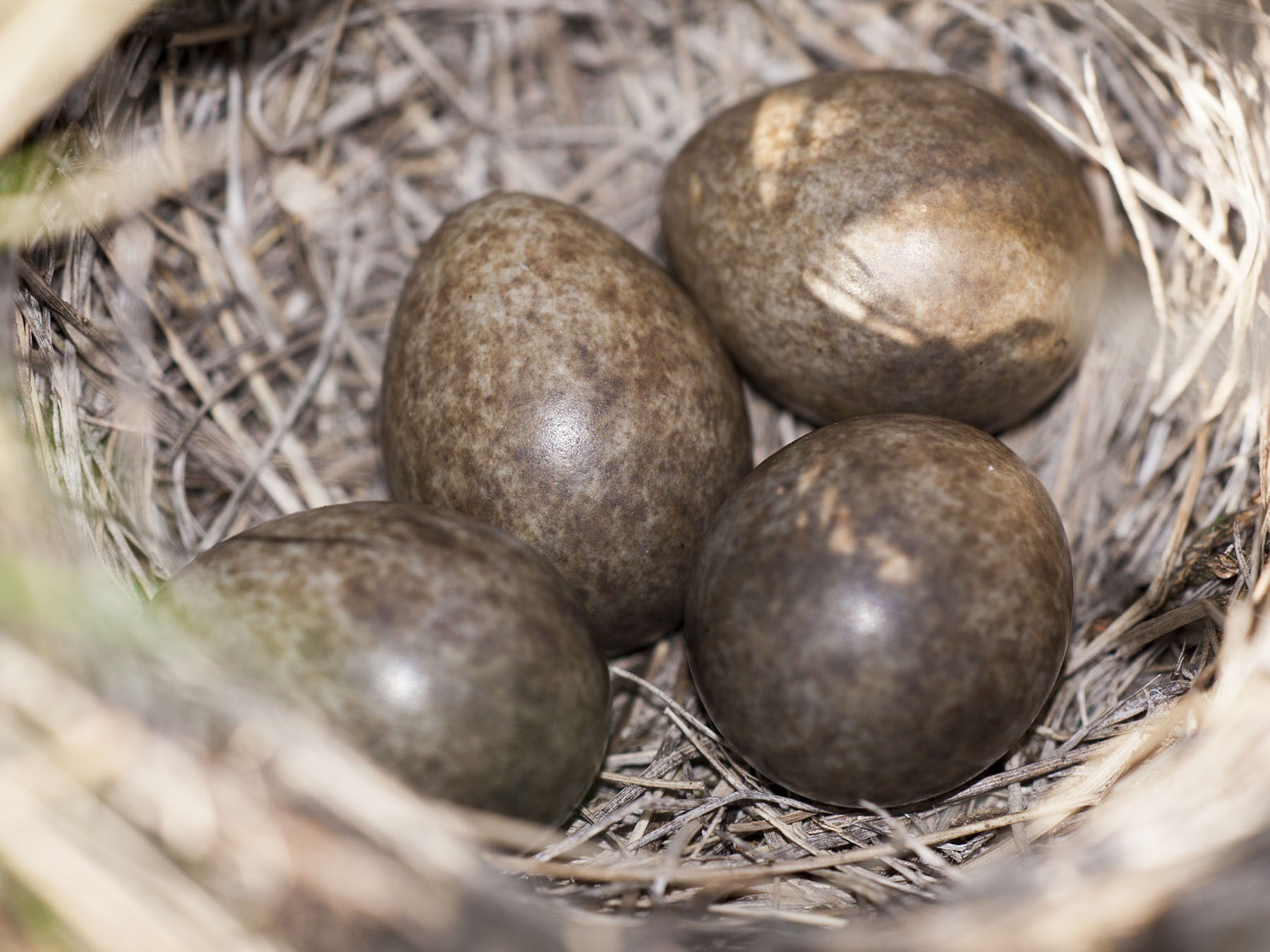
Skylark eggs lay heavily spotted, greyish eggs. The typical clutch consists of three to five eggs, each measuring about 23 millimetres long and 17 millimetres wide.
Do Skylarks mate for life?
Skylarks do not usually mate for life. They typically form a new pair each nesting season, although they are monogamous for that period and may produce up to three broods together.
Behaviour
Skylarks are best known for the male's fantastic flight song display. They are more difficult to observe on the ground where they forage between low vegetation.
Are Skylarks aggressive?
Skylarks can be aggressively territorial in the spring, although they rarely show aggression toward other bird species. They use threatening postures like feather fluffing and crest raising to deter rivals but will also resort to physical attacks when necessary. Physical conflicts rarely result in serious injuries.
Where do Skylarks sleep at night?
Skylarks sleep on the ground. They may sleep lightly during the day but enter deep sleep at night, typically tucking their head under their wings.
Lifespan and predators
Skylarks are fairly short-lived birds that rely on cryptic camouflage to avoid detection.
How long do Skylarks live?
Skylarks can live for eight to ten years, although their average lifespan is closer to two years.
What are the predators of Skylarks?
Fox, Carrion Crow, and Adders are known predators of Skylark eggs and chicks. Adults could be caught by birds of prey like Peregrine Falcons, Merlins, Sparrowhawks, Short-eared Owls, and Barn Owls.
Are Skylarks protected?
Skylarks are protected by the Wildlife and Countryside Act of 1981.
Are Skylarks endangered?
Skylarks are not endangered, despite a decreasing trend in the Global population. They are classed as a ‘Least Concern’ species according to the IUCN, although drastic declines have put them on the United Kingdom’s red list of conservation concern.
Conservation
While listed as Least Concern globally, Eurasian Skylark populations have declined significantly in parts of Europe due to changes in agricultural practices.
Conservation efforts focus on maintaining suitable breeding habitats and promoting skylark-friendly farming methods.
Similar birds
Often mistaken for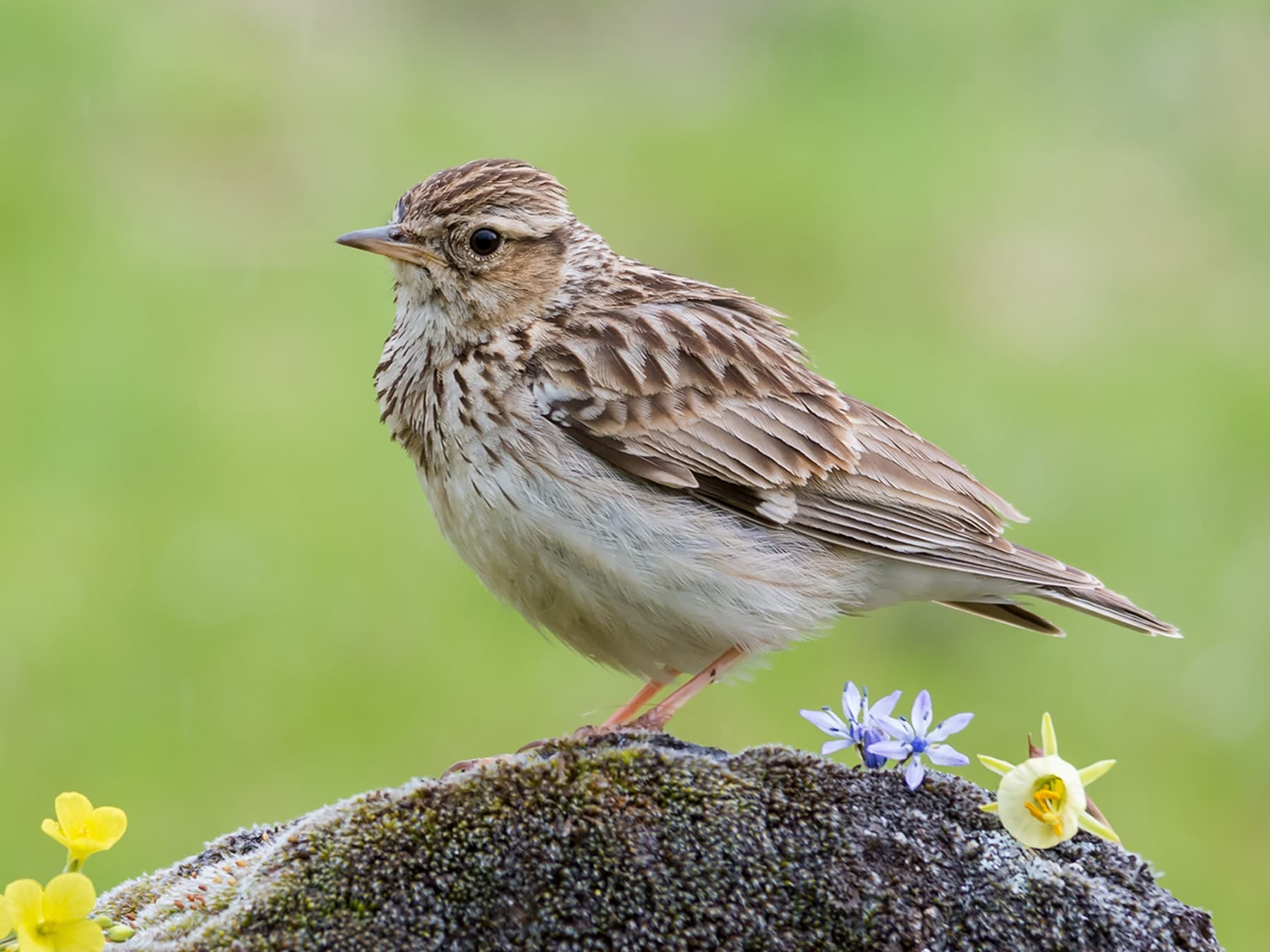
More photos
5 photos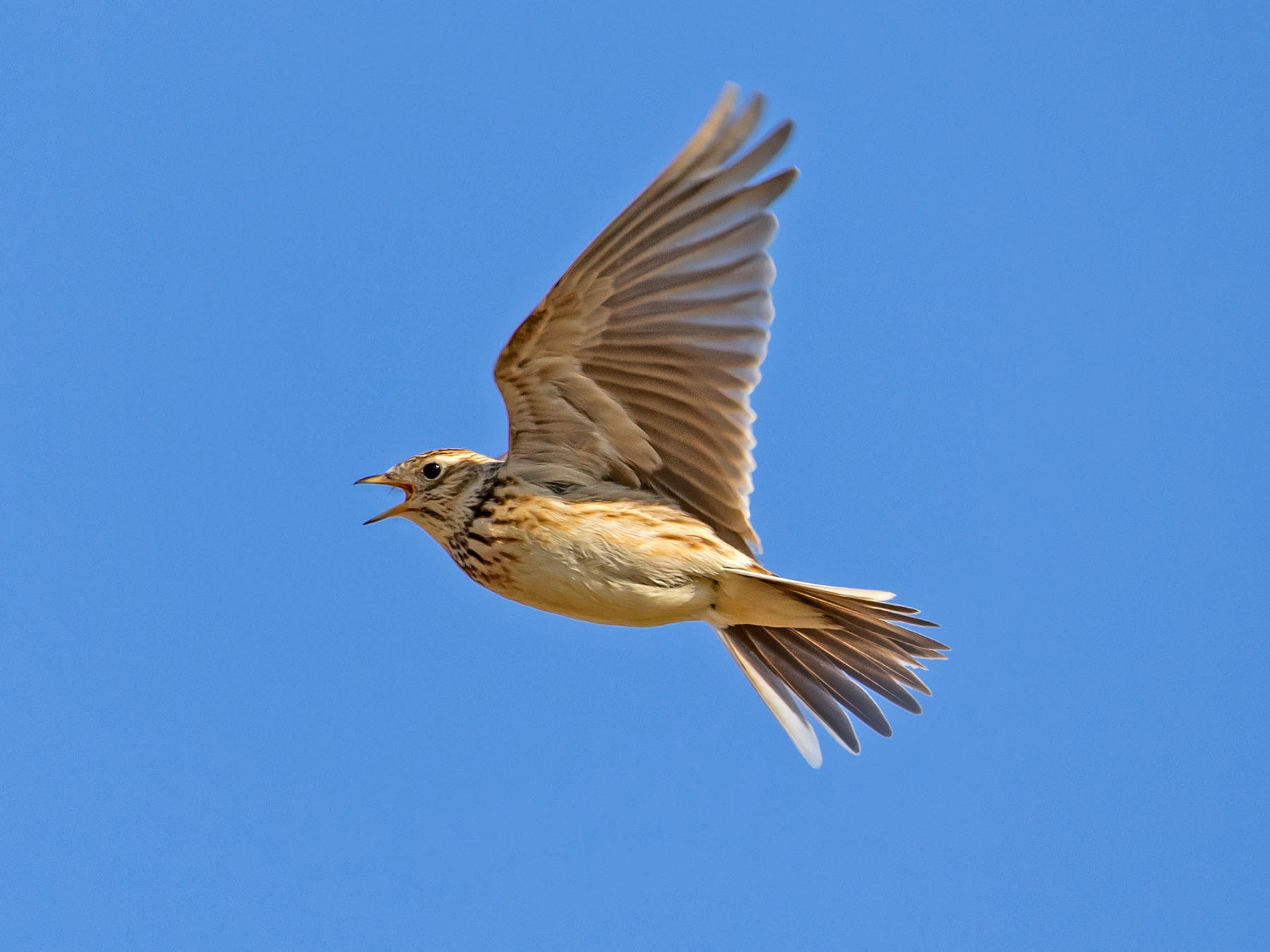
Quick facts
- Length
- 16–18 cm
- Wingspan
- 30–36 cm
- Weight
- 30–45 g
- Lifespan
- 2 years · oldest recorded 10.1 years
- Family
- Larks
- Migration
- Partial migrant
- Global status (IUCN)
- Least Concern
- World population
- 295,600,000 - 526,600,000 mature individuals
- Population trend
- Decreasing
- Also called
- Skylark
- Scientific name
- Alauda arvensis
Questions
2Why are they called Skylarks?
Skylarks take their name for their characteristic flight display where males may ascend to heights of a hundred meters while singing continuously to attract a partner.
Do Skylarks only sing in the air?
Skylarks are best known for singing in the air, although they also sing regularly from the ground. Their ground song is typically quieter and more melodious than the flight song.
Sources
4- 1BirdLife International. 2018. Alauda arvensis. The IUCN Red List of Threatened Species 2018: e.T102998555A132039889. Source (opens in a new tab)
- 2del Hoyo et al. 2004, EBCC 2015
- 3BirdLife International. 2018. Alauda arvensis. The IUCN Red List of Threatened Species 2018: e.T102998555A132039889. Source (opens in a new tab)
- 4Fransson et al., EURING list of longevity records for European birds (2010) Source (opens in a new tab)

Checked by
Nathan Cope, founder and editor
Nathan founded Birdfact and leads its writers and contributors in the UK, the US and Canada. He has watched and studied birds for more than ten years, and checks every article and species guide before it’s published.