


Great Spotted Woodpecker
Greater Spotted Woodpecker · Dendrocopos major
By the Birdfact teamChecked by Nathan Cope
On this page15 sections
How to recognise it
What do Great Spotted Woodpeckers look like?
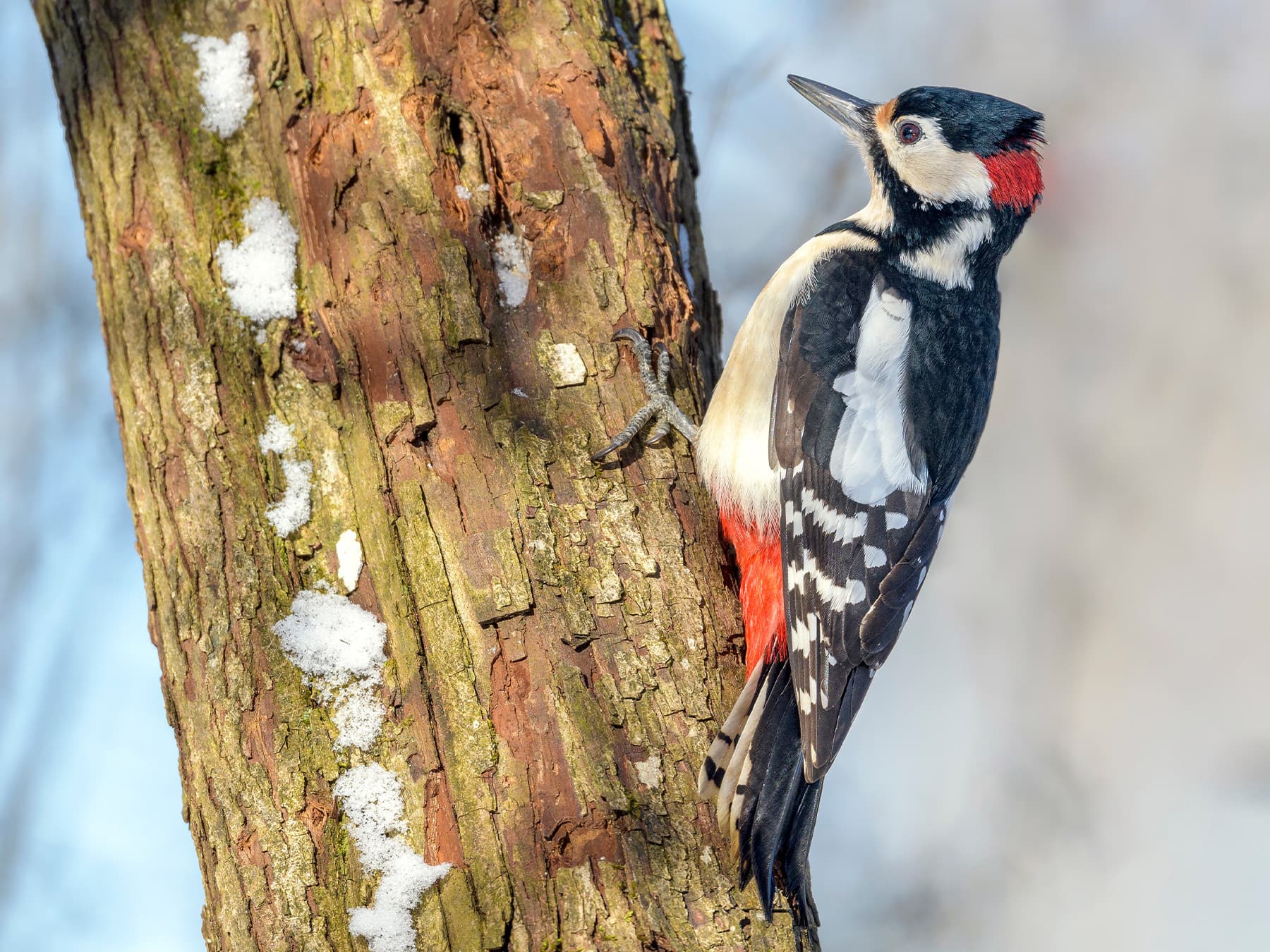
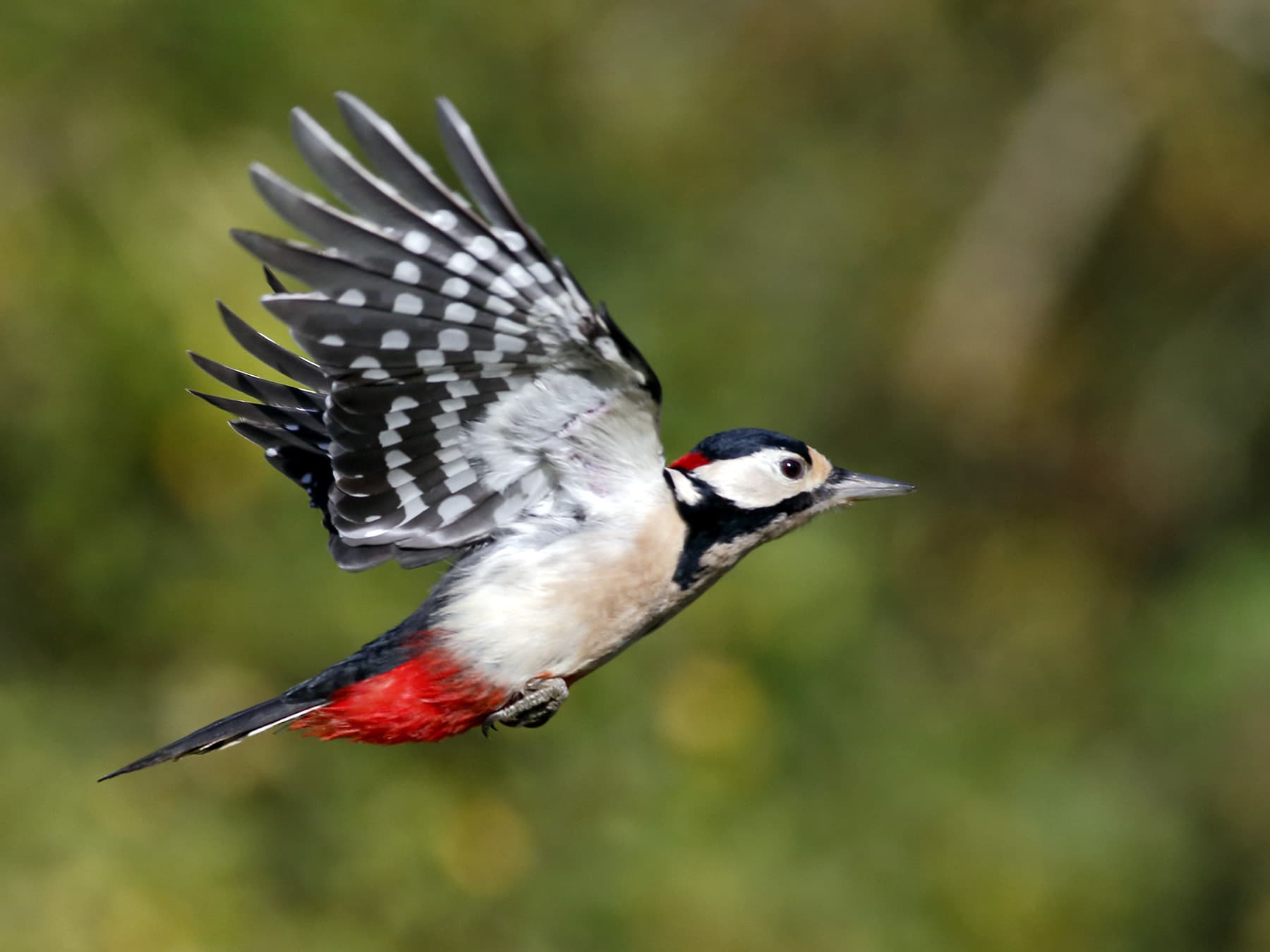
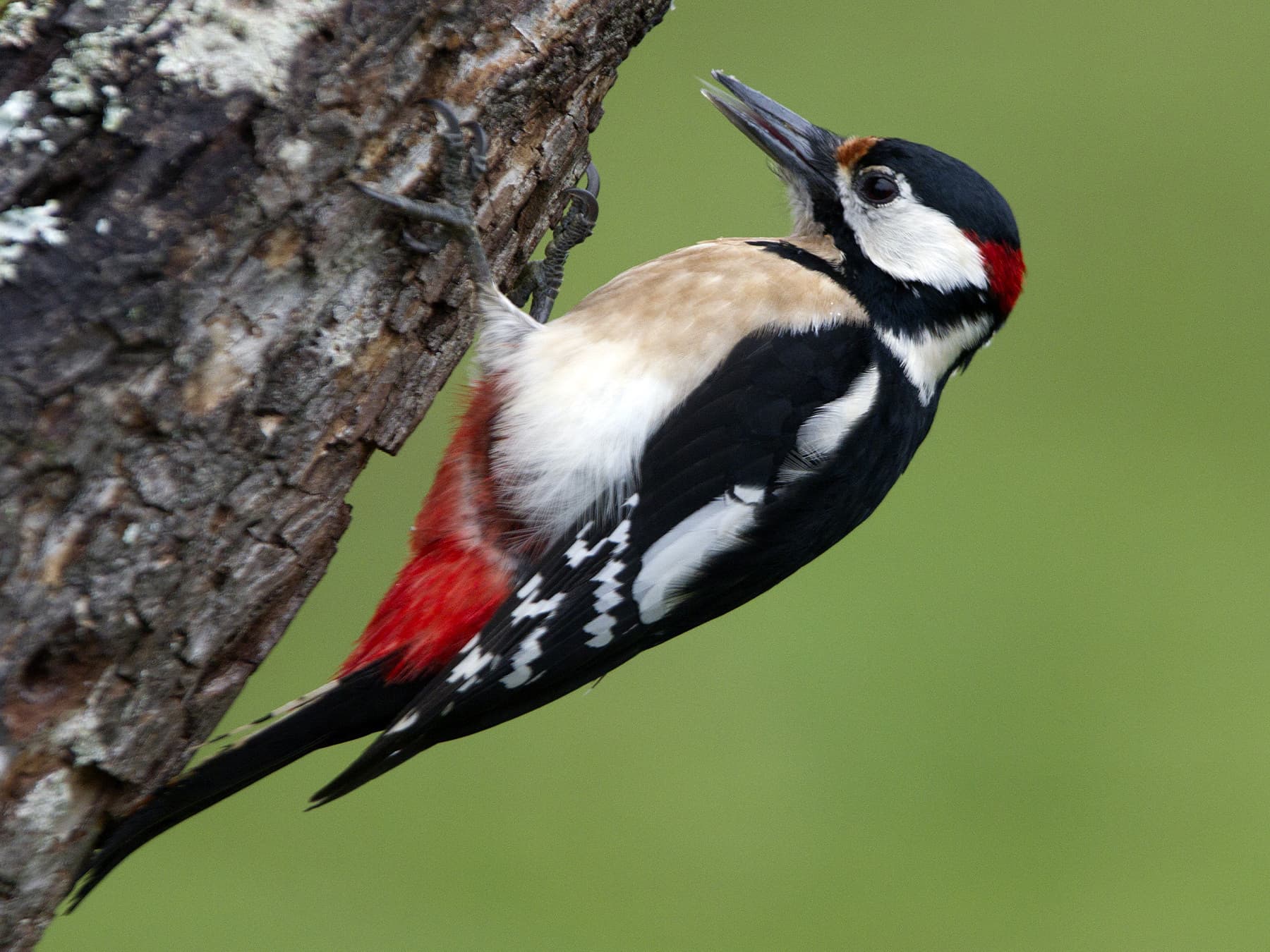
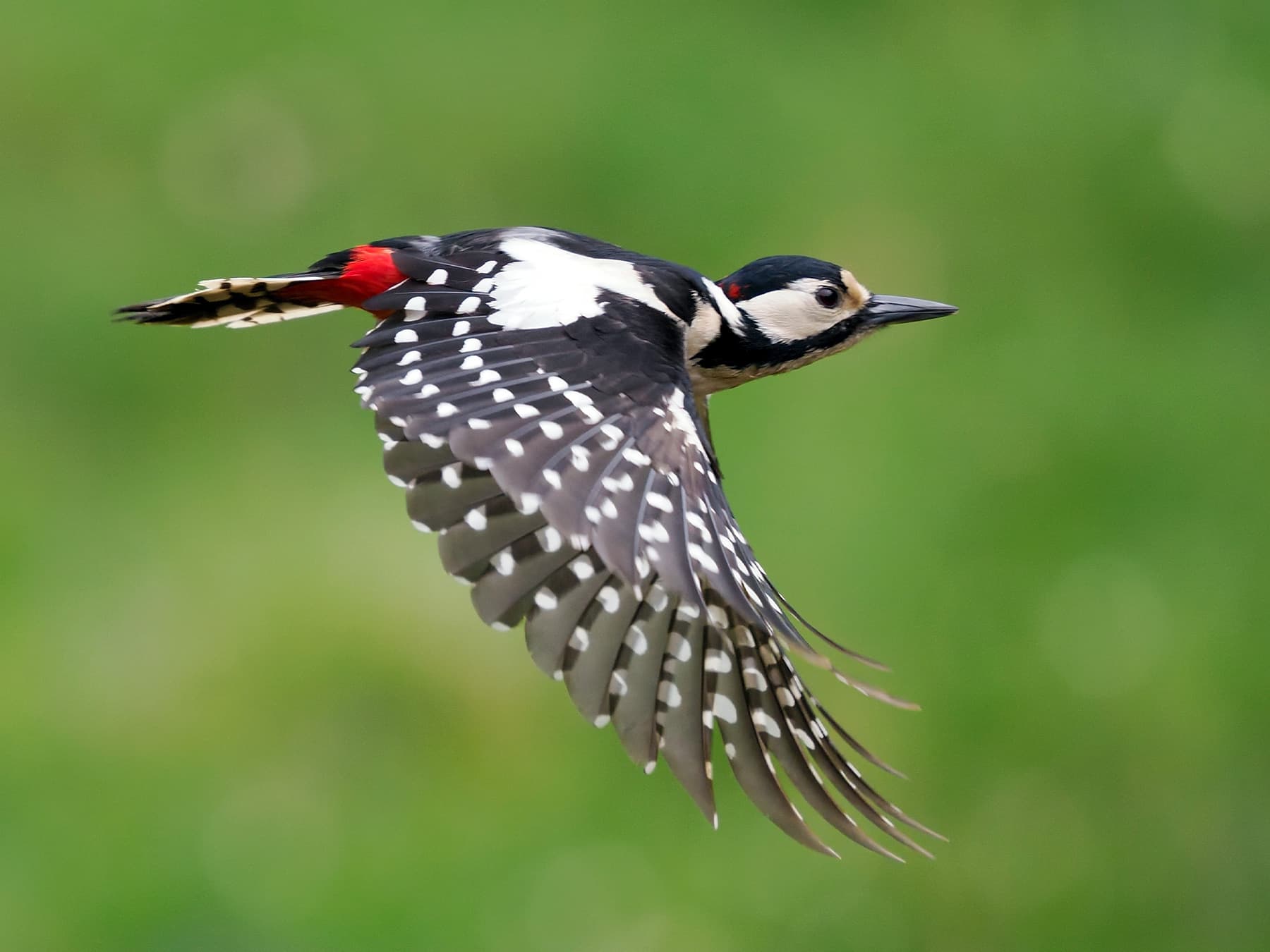
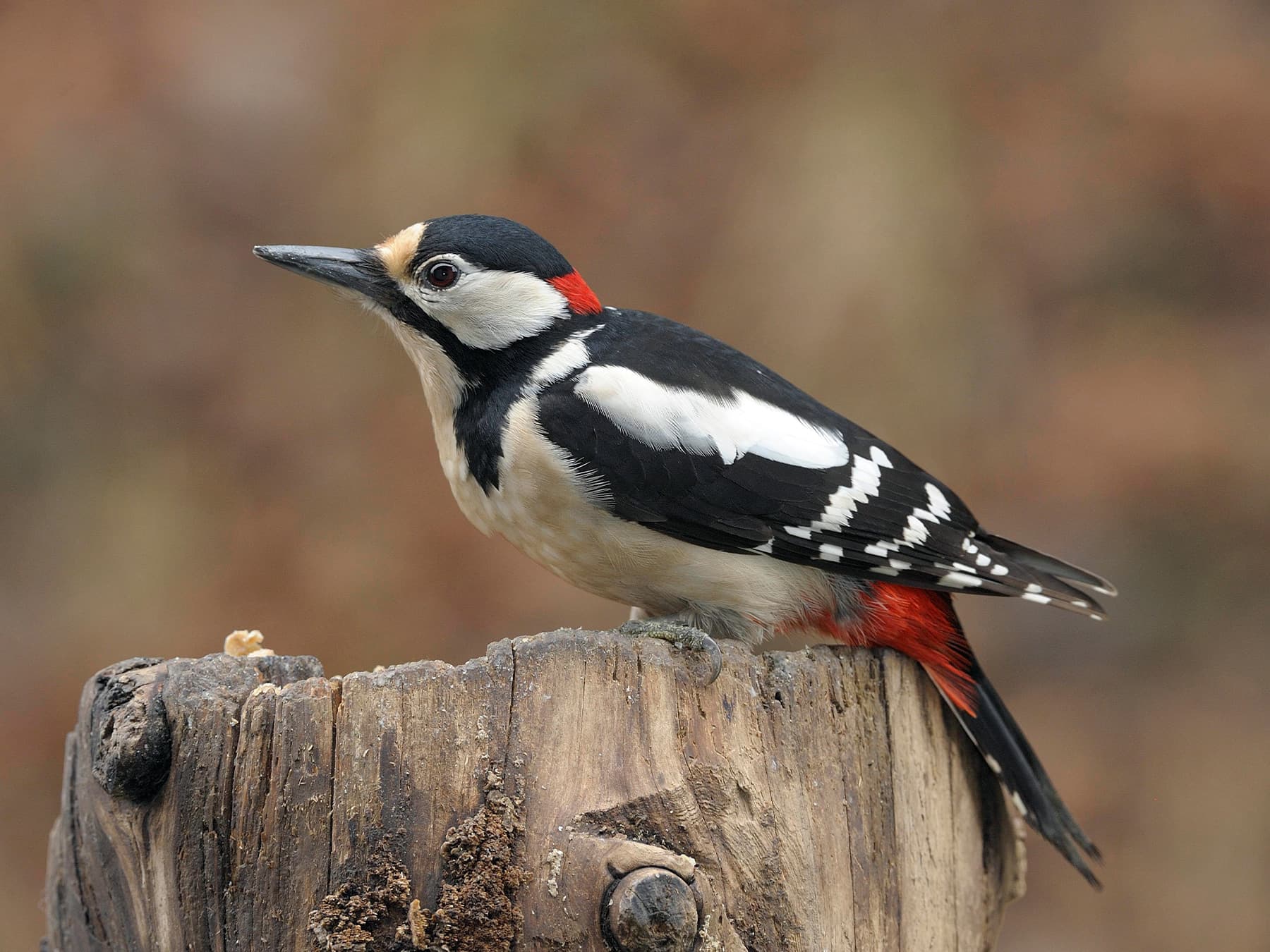
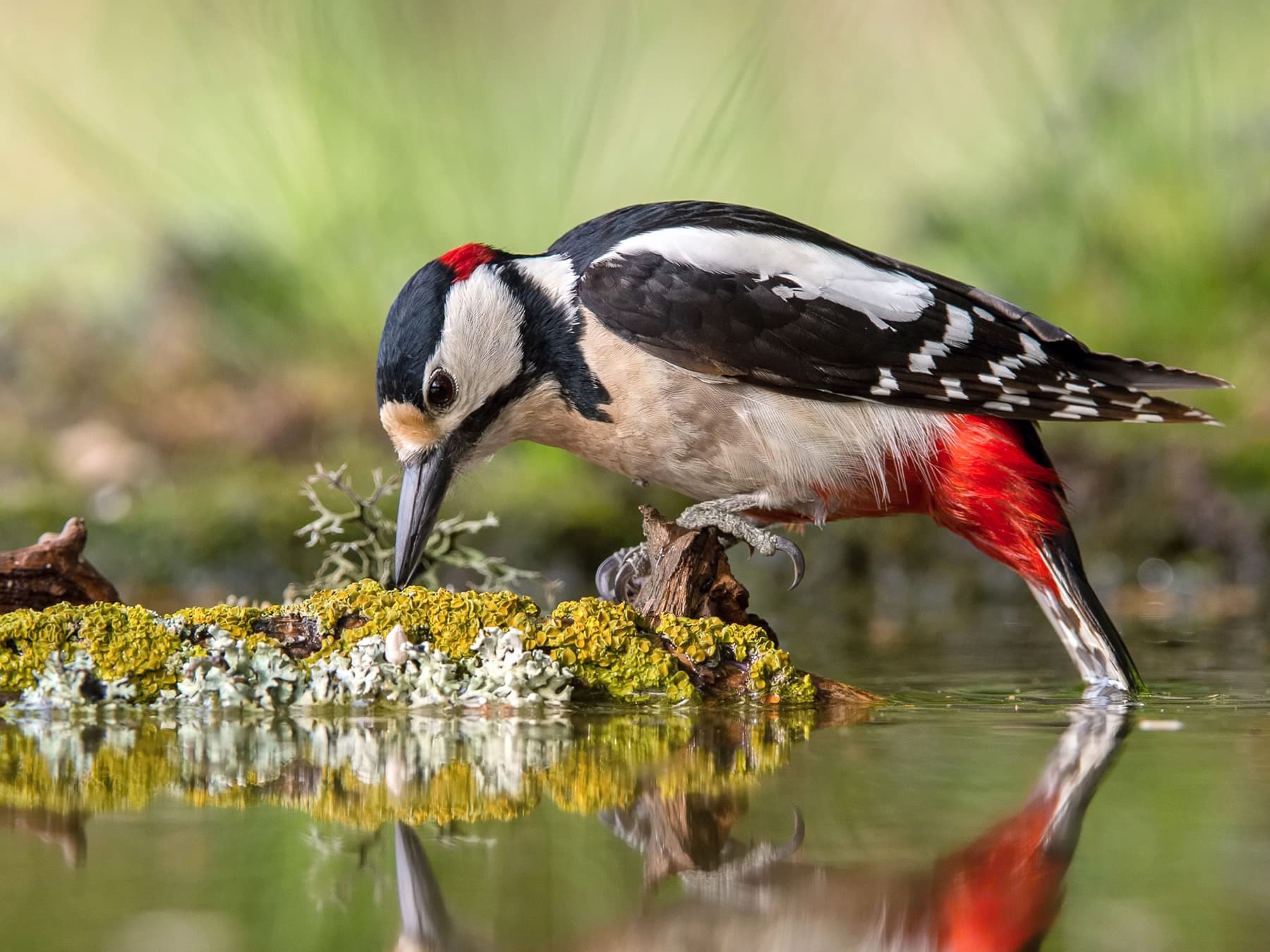
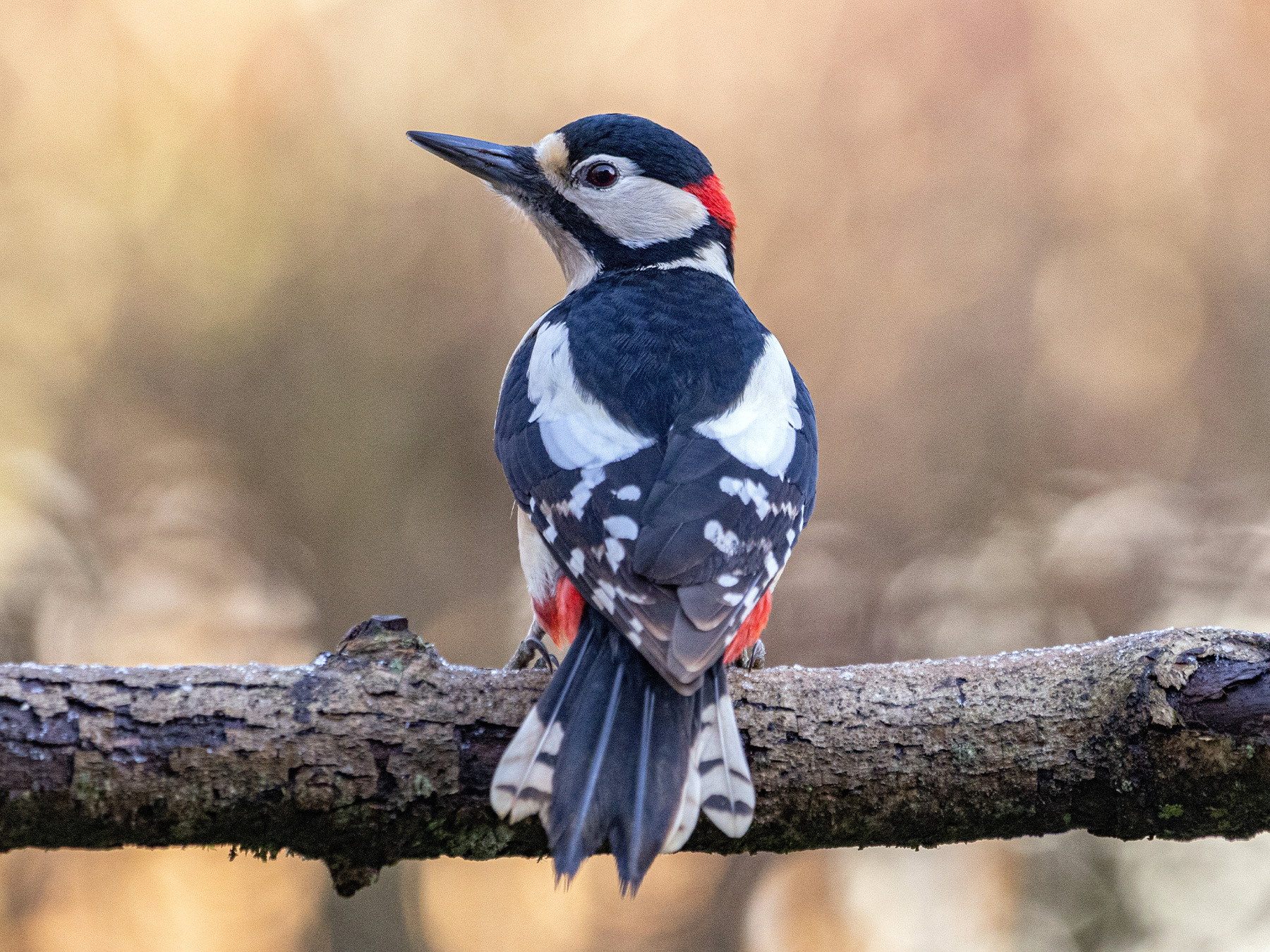
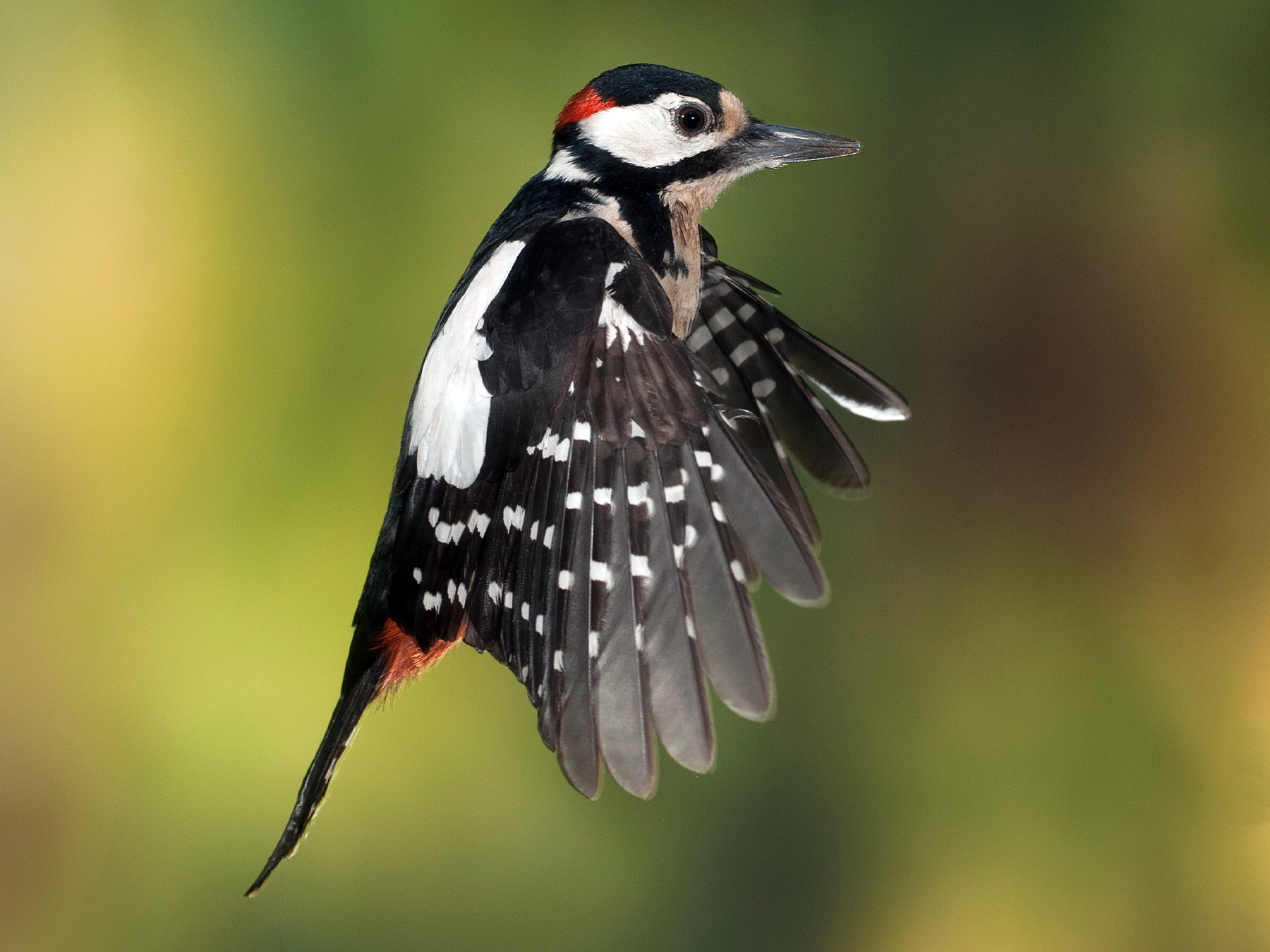
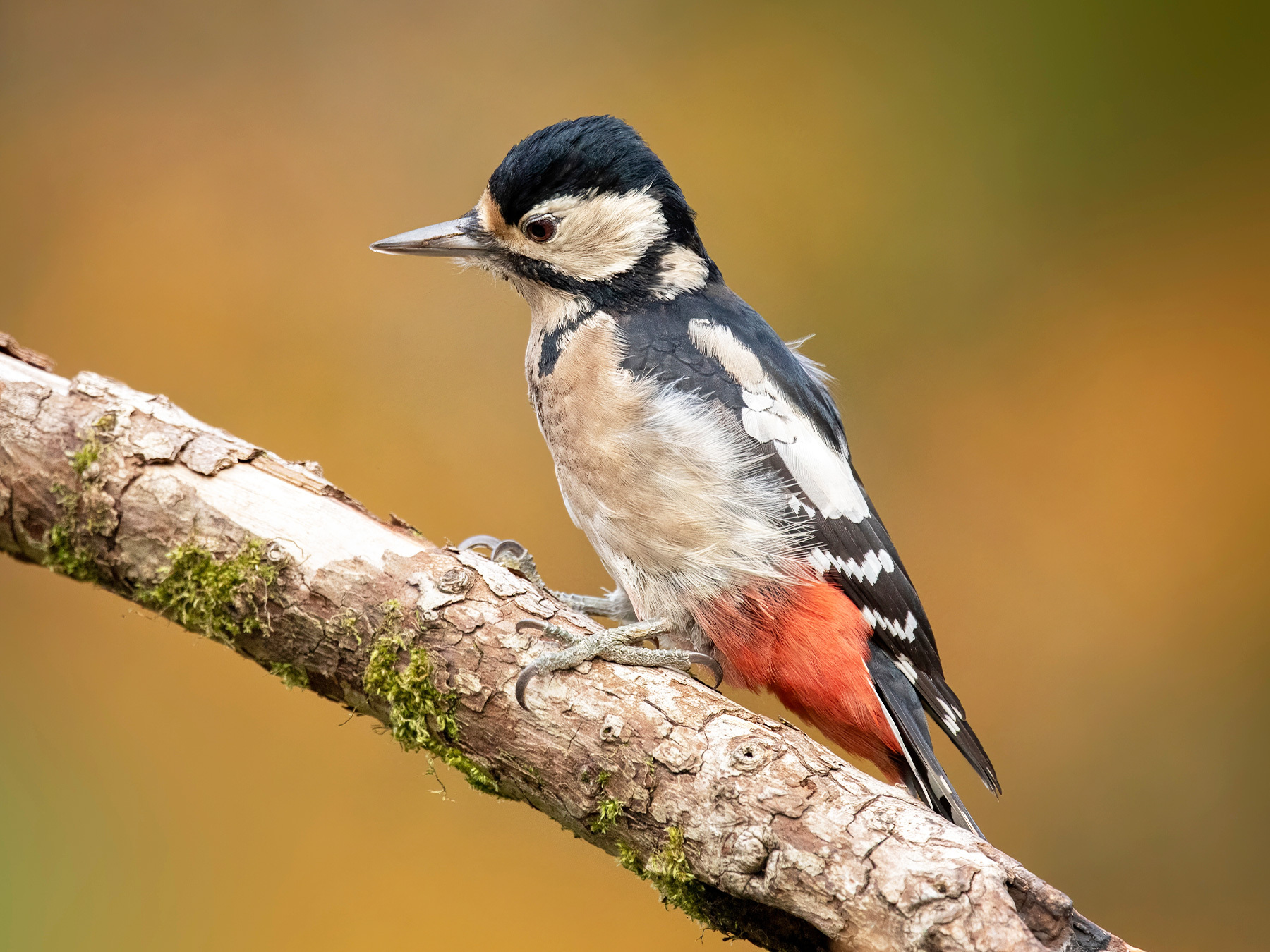
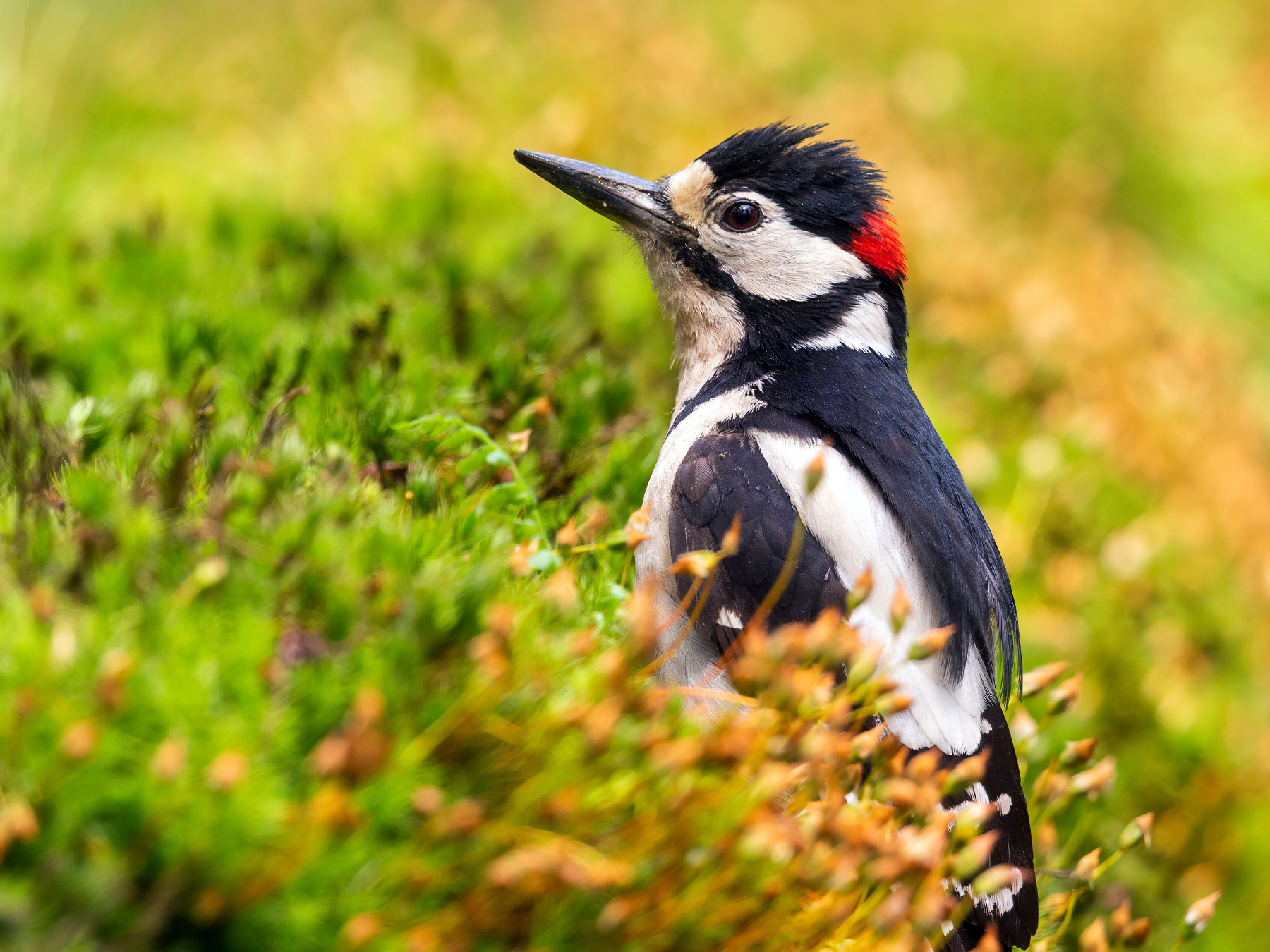
The Great Spotted Woodpecker is a striking bird that is mostly black above and white below. Each wing has a prominent white bar and several white spots. They have a black cap, and black stripes on the side of the head create white cheek and neck patches.
These boldly marked birds also have a patch of red feathers under their tail in addition to their pied plumage. They have a straight black bill and robust legs and feet with two toes facing forward and two facing back.
Males and females look very similar, although they are easily distinguished if the back of the head is visible. Females have all-black crowns, whereas males have a small but distinct red spot.
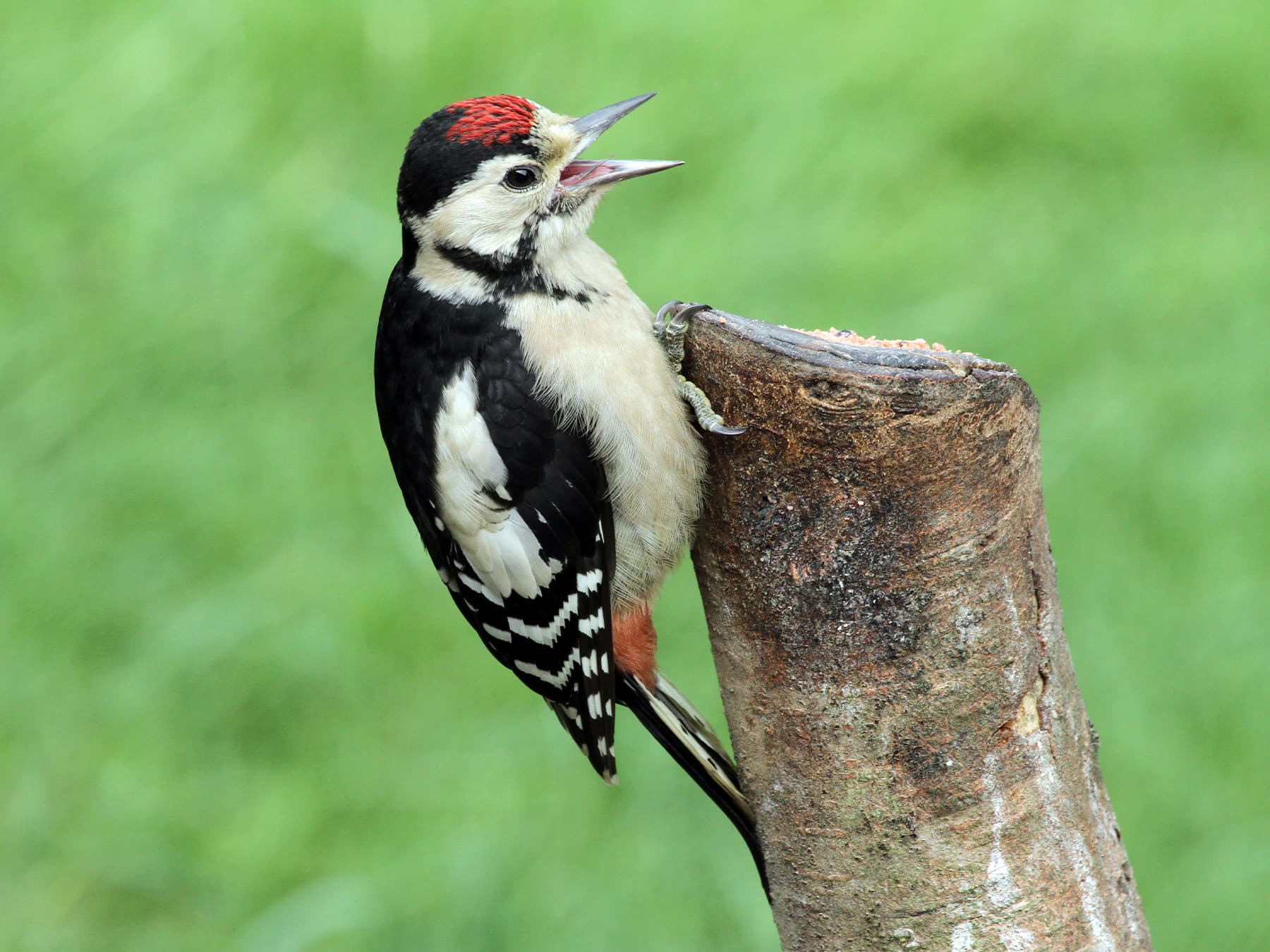
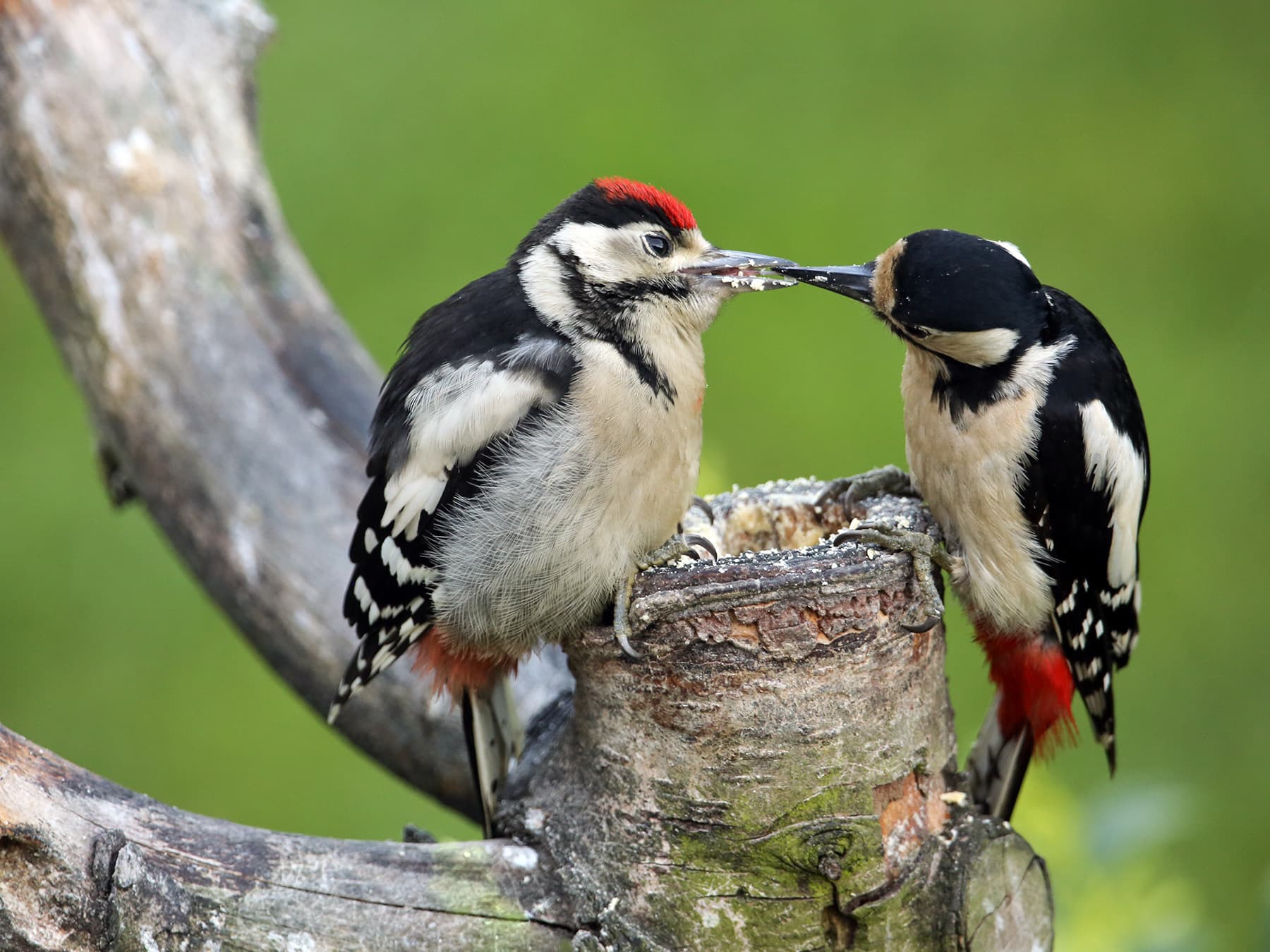
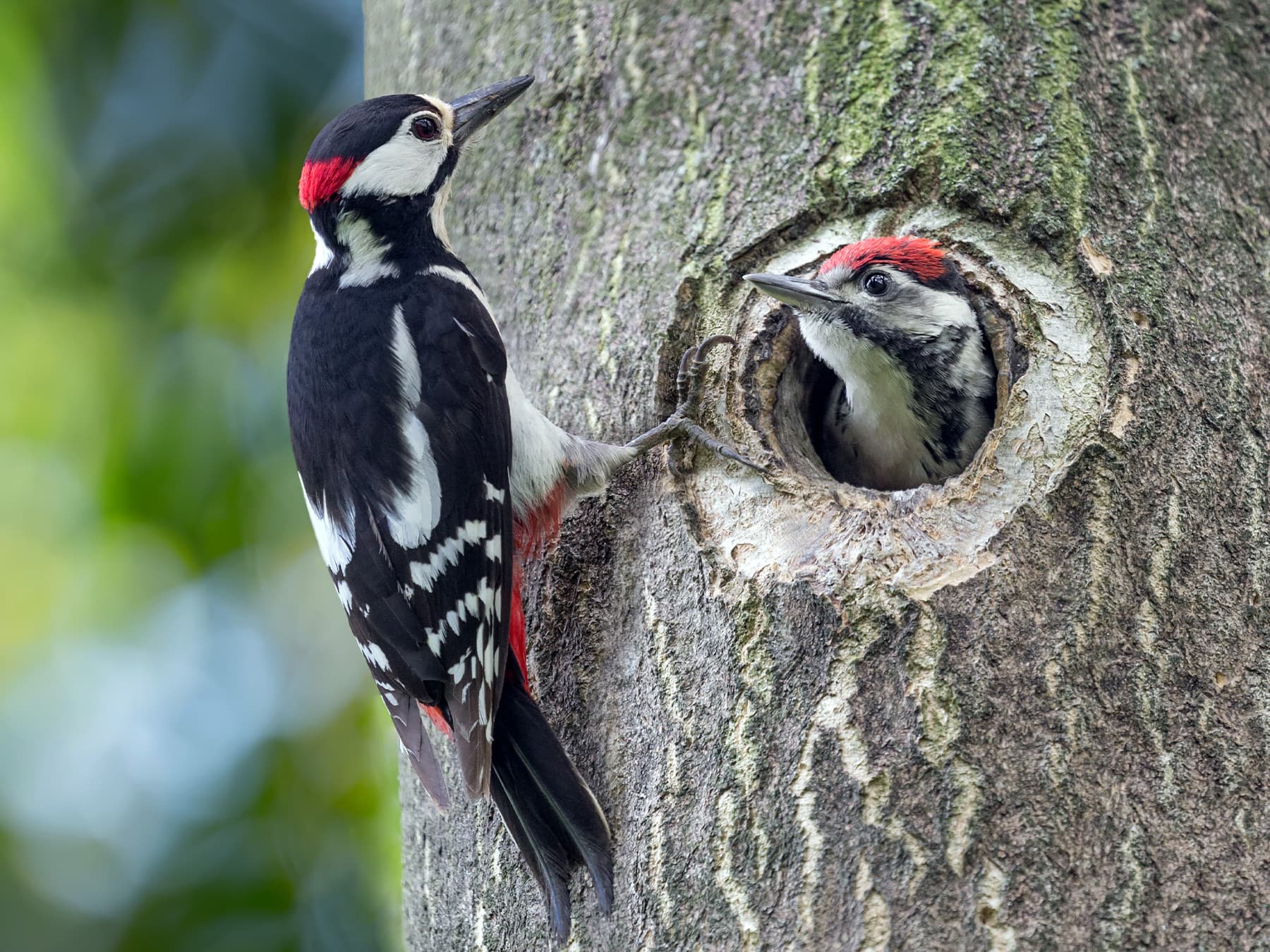
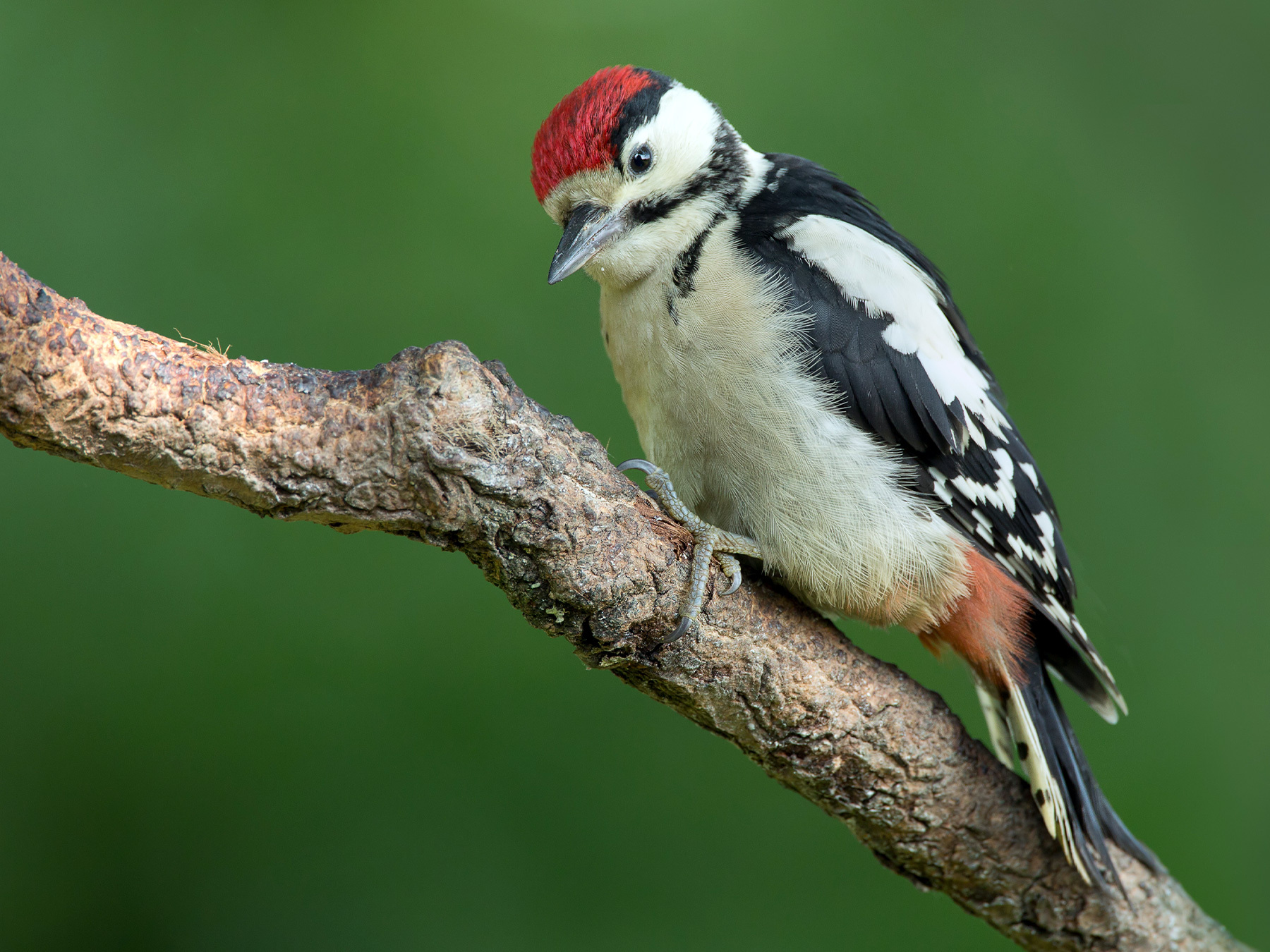
Juvenile Great Spotted Woodpeckers are also distinguished from adults by their head plumage. In young birds, the crown is red from the forehead to the back of the head.
The Great Spotted Woodpecker is most easily confused with the Lesser Spotted Woodpecker, a much smaller and rarer species with similar plumage. They may also resemble the much larger Green Woodpecker in poor light, although that species does not have black and white plumage.
How big are Great Spotted Woodpeckers?
Great Spotted Woodpeckers are medium-sized birds with a similar length and weight to the Starling.
Length
Great Spotted Woodpeckers have a total body length of 20 to 24 centimetres.
Weight
The Western European subspecies have a body weight of 68 to 93 grams. Males are slightly heavier on average.
Wingspan
These birds have a wingspan of 34 to 39 centimetres and an average wing length of just over 13 centimetres.
Its size
Adults- Length
- 23–26 cm
- Wingspan
- 38–44 cm
- Weight
- 70–98 g
Its song and calls
What sound does a Great Spotted Woodpecker make?
The Great Spotted Woodpecker produces a high-pitched ‘Kik’ or ‘Ki-ki-ki’ call and a drawn-out churring call. One of their most distinctive sounds is made by tapping on hollow resonant wood, rather than calling. Males, and occasionally females, also produce a rapid rolling drumming sound that lasts about two seconds.
- Call0:00 / 0:36
Recorded in Hauts-de-France, France · May 2025
- Drumming0:00 / 0:49
Recorded in Normandie, France · April 2024
When and where to see it
OctoberHere all year
Most recorded in October
- 1. Cardiff2.2%
- 2. Surrey1.7%
- 3. Wrexham1.5%
- 4. Wiltshire1.5%
- 5. Shropshire1.4%
Each dot is a county, state or province: the bigger and darker, the larger the bird’s share of that place’s bird records that month. Grey dots: no regular records. The ringed point is the centre of the bird’s records this month; the arrow shows how it moved since last month, and the dashed loop its path through the year. “Arrivals” colours places where it becomes regular this month (orange) or is in its last regular month (grey). GBIF eBird Observation Dataset, 2019–2024. Map data: Natural Earth, US Census Bureau; place centres © OpenStreetMap contributors.
In your area
See when the Great Spotted Woodpecker is recorded in your county, state or province.
How often the Great Spotted Woodpecker turns up in the UK and Ireland through the year, from birdwatchers' records.
United Kingdom
Resident · all year · most records in December
Ireland
Resident · all year · most records in May
Show as a table
| Month | United Kingdom | Ireland |
|---|---|---|
| January | 0.83% (regular) | 0.093% (regular) |
| February | 0.82% (regular) | 0.081% (regular) |
| March | 0.83% (regular) | 0.14% (regular) |
| April | 0.71% (regular) | 0.15% (regular) |
| May | 0.70% (regular) | 0.18% (regular) |
| June | 0.78% (regular) | 0.16% (regular) |
| July | 0.67% (regular) | 0.089% (regular) |
| August | 0.74% (regular) | 0.099% (regular) |
| September | 0.71% (regular) | 0.067% (regular) |
| October | 0.73% (regular) | 0.084% (regular) |
| November | 0.83% (regular) | 0.10% (regular) |
| December | 0.86% (regular) | 0.11% (regular) |
Recorded regularly in
Worldwide: recorded regularly in 60 countries
Countries where it was recorded in at least 3 of the 6 years 2019–2024. Linked countries have their own bird list.
Europe (43)
- Åland Islands
- Albania
- Andorra
- Austria
- Belarus
- Belgium
- Bosnia & Herzegovina
- Bulgaria
- Croatia
- Czechia
- Denmark
- Estonia
- Finland
- France
- Germany
- Greece
- Hungary
- Ireland
- Isle of Man
- Italy
- Jersey
- Kosovo
- Latvia
- Liechtenstein
- Lithuania
- Luxembourg
- Moldova
- Montenegro
- Netherlands
- North Macedonia
- Norway
- Poland
- Portugal
- Romania
- Russia
- Serbia
- Slovakia
- Slovenia
- Spain
- Sweden
- Switzerland
- Ukraine
- United Kingdom
Asia (14)
- Armenia
- Azerbaijan
- China
- Georgia
- Iran
- Japan
- Kazakhstan
- Kyrgyzstan
- Laos
- Mongolia
- Myanmar (Burma)
- South Korea
- Turkey
- Vietnam
Data: EOD – eBird Observation Dataset (Cornell Lab of Ornithology), accessed via GBIF.org, CC BY 4.0. Records from 2019–2024, aggregated and filtered by Birdfact. How these lists are made
What is the habitat of a Great Spotted Woodpecker?
Great Spotted Woodpeckers inhabit a variety of well-wooded habitats, including woodlands, coniferous forests, parks, and gardens. They avoid open, treeless habitats but will make use of smaller copses and avenues.
What is the range of a Great Spotted Woodpecker?
The Great Spotted Woodpecker is widespread in the United Kingdom, although absent from much of northern Scotland. Low numbers occur along the east coast of Northern Ireland and the Republic of Ireland.
They also have an extensive range in the Northern Hemisphere, occurring throughout most of Europe and across Asia to Siberia, Japan, and South East Asia. They are also present in the North African countries of Morrocco, Algeria, and Tunisia.
Where do Great Spotted Woodpeckers live?
Great Spotted Woodpeckers are primarily arboreal, spending most of their time in trees. They are most often seen clambering about on tree trunks, although they often visit bird tables and occasionally descend to feed on the ground.
How rare are Great Spotted Woodpeckers?
Great Spotted Woodpeckers are increasingly common in the United Kingdom. Their population has increased four-fold since the 1960s, and there are now an estimated 130,000 resident breeding pairs.
Where can you see Great Spotted Woodpeckers in the UK?
Great Spotted Woodpeckers are reasonably common in wooded areas and even established gardens across most of the United Kingdom. A visit to mature broad-leaved woodland provides an excellent chance to see these striking birds. They may be located by their loud drumming and calls, although you may hear their soft tapping in settled weather.
Migration
Do Great Spotted Woodpeckers migrate?
Great Spotted Woodpeckers usually remain within the same area throughout the year. Northern European birds occasionally migrate when food sources are scarce, and large numbers may visit the United Kingdom in some years.
Are Great Spotted Woodpeckers native to the UK?
The Great Spotted Woodpecker is native to the United Kingdom. They disappeared from Northern Ireland and the Republic of Ireland centuries ago but have returned without assistance and are making a steady recovery there.
Tips for seeing it
- Listen for their loud, rhythmic drumming on trees
- Look for their undulating flight pattern between trees
- Check bird feeders, especially those with peanuts or suet
- In the UK, visit deciduous or mixed woodlands year-round
What it eats
What do Great Spotted Woodpeckers eat?
Great Spotted Woodpeckers have a varied diet that includes woodboring grubs, beetles, ants, and many other invertebrates. They also feed on the eggs and chicks of other birds, frequently drilling into nest boxes to access the occupants.
These birds also eat plant material like nuts, acorns, fruits, berries, sap, and buds. They often visit bird feeders where they prefer suet and peanuts.
What do Great Spotted Woodpecker chicks eat?
Great Spotted Woodpecker chicks eat insects, fruits, and berries provided by both parents. The young leave the nest after about three weeks but are fed for another week or so.
Nesting and breeding
Where do Great Spotted Woodpeckers nest?
Great Spotted Woodpeckers nest in holes in live or dead trees. The male usually excavates the nest hole anywhere up to 26 meters above the ground, although usually much lower. He will excavate a new nest each year, although some pairs take the easier route and use nest boxes.
When do Great Spotted Woodpeckers nest?
Great Spotted Woodpeckers first breed when they are a year old. Pairs form in the winter but do not lay their eggs until spring or early summer. They produce a single brood each year.
What do Great Spotted Woodpecker eggs look like?
Great Spotted Woodpeckers lay four to eight glossy white eggs, each measuring approximately 26 millimetres long and 20 millimetres wide.
Do Great Spotted Woodpeckers mate for life?
Great Spotted Woodpeckers generally breed with a new partner each year. They are usually monogamous in the nesting season, although females may mate with more than one male.
Behaviour
Are Great Spotted Woodpeckers aggressive?
Great Spotted Woodpeckers are strongly territorial and defend territories of several hectares. Keeping rival males out of their territory may require aggression when loud drumming fails to drive the message home. They can also be quite competitive around food sources and may quarrel among themselves or with other bird species.
Where do Great Spotted Woodpeckers sleep at night?
Great Spotted Woodpeckers roost in holes excavated by themselves or other Woodpeckers. They may also sleep in nest boxes.
Lifespan and predators
How long do Great Spotted Woodpeckers live?
Great Spotted Woodpeckers can live for up to 11 years in the wild, although their average lifespan is much shorter.
What are the predators of Great Spotted Woodpeckers?
Great Spotted Woodpeckers are most vulnerable to the Sparrowhawk and the Goshawk. However, sick or injured individuals could fall prey to a variety of other birds of prey and mammalian carnivores, including domestic cats.
Are Great Spotted Woodpeckers protected?
Great Spotted Woodpeckers are protected in the UK by the Wildlife and Countryside Act 1981.
Are Great Spotted Woodpeckers endangered?
Great Spotted Woodpeckers are not endangered. In fact, these birds are increasing in number and are classified as a ‘Least Concern’ species.
Conservation
While the Great Spotted Woodpecker is currently listed as Least Concern, it faces localised threats from habitat loss and fragmentation.
In many areas, particularly in the UK and parts of Europe, populations have been increasing, possibly due to adaptation to human-modified habitats and increased availability of bird feeders.
Similar birds
Often mistaken for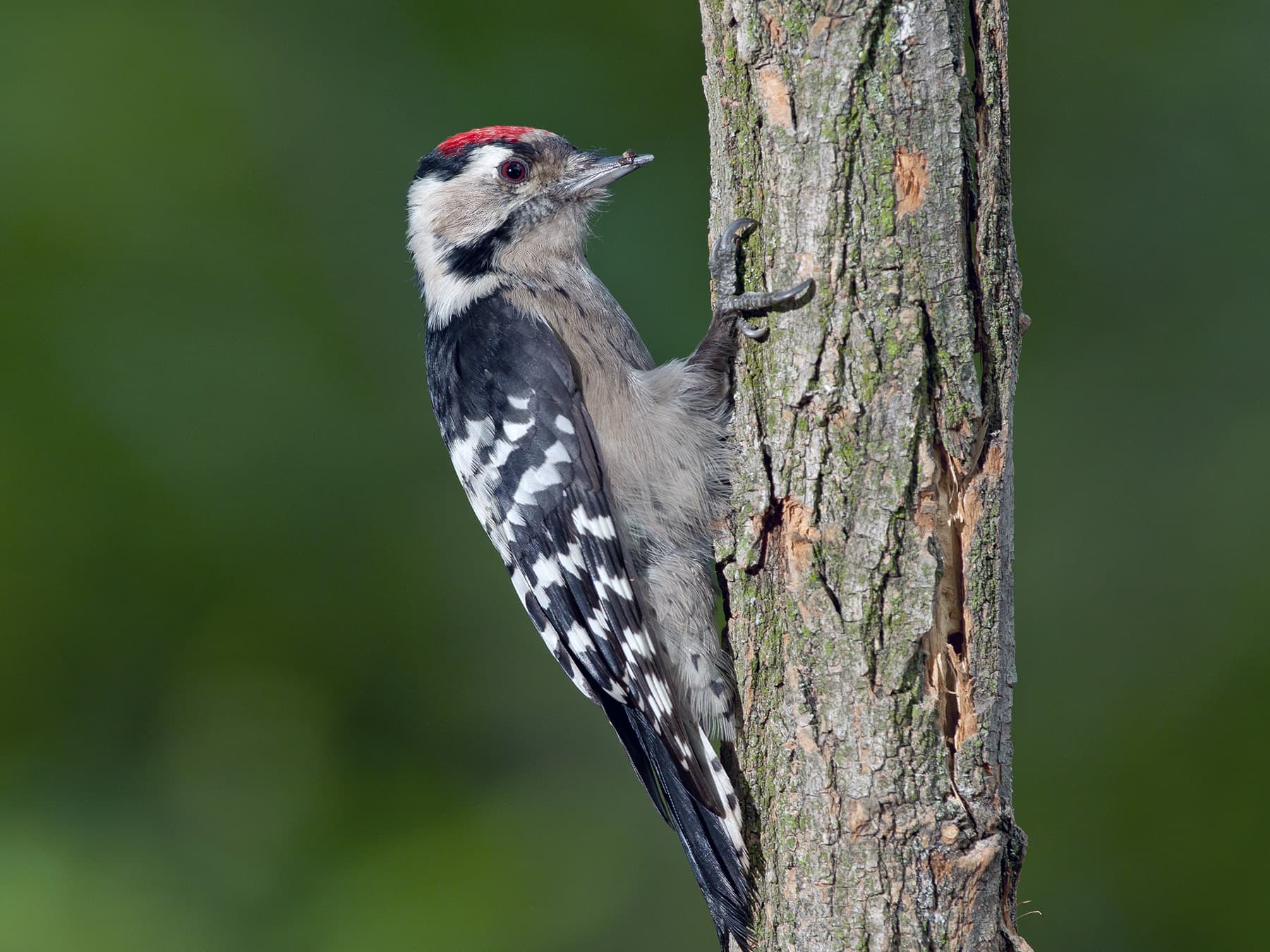
More photos
7 photos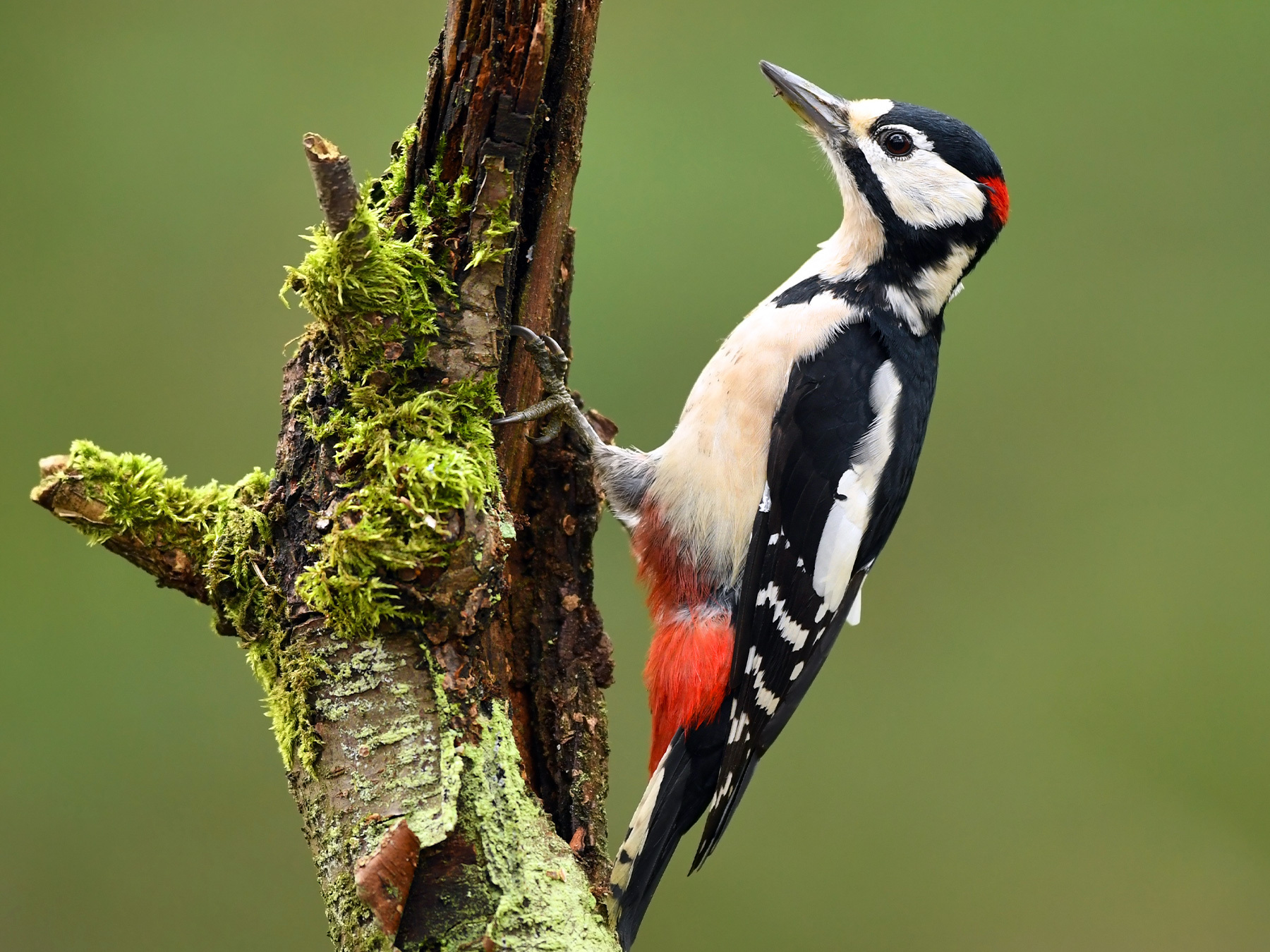
Great Spotted Woodpecker guides
4 guidesQuick facts
- Length
- 23–26 cm
- Wingspan
- 38–44 cm
- Weight
- 70–98 g
- Lifespan
- 10–11 years · oldest recorded 11.8 years
- Family
- Woodpeckers
- Migration
- Resident
- Global status (IUCN)
- Least Concern
- World population
- 73,700,000 - 110,300,000 mature individuals
- Population trend
- Increasing
- Also called
- Greater Spotted Woodpecker
- Scientific name
- Dendrocopos major
Questions
1How to attract Great Spotted Woodpeckers?
The Great Spotted Woodpecker is a beautiful species that many UK birdwatchers would love to see in their own gardens. Fortunately, they have become reasonably common garden birds and can be attracted by providing fat balls and suet, peanuts, and sunflower seeds. They will also forage naturally from old dead wood and trees and appreciate a shallow bird bath for drinking and bathing.
Sources
4- 1BirdLife International. 2016. Dendrocopos major. The IUCN Red List of Threatened Species 2016: e.T22681124A87323054. Source (opens in a new tab)
- 2EBCC (2015)
- 3BirdLife International. 2016. Dendrocopos major. The IUCN Red List of Threatened Species 2016: e.T22681124A87323054. Source (opens in a new tab)
- 4BTO longevity records: maximum age from a ringed bird, 11 years, 10 months, 21 days (set in 2017), BirdFacts: Great Spotted Woodpecker (2017) Source (opens in a new tab)

Checked by
Nathan Cope, founder and editor
Nathan founded Birdfact and leads its writers and contributors in the UK, the US and Canada. He has watched and studied birds for more than ten years, and checks every article and species guide before it’s published.