
Great Crested Grebe
Crested Grebe · Podiceps cristatus
By the Birdfact teamChecked by Nathan Cope
On this page12 sections
How to recognise it
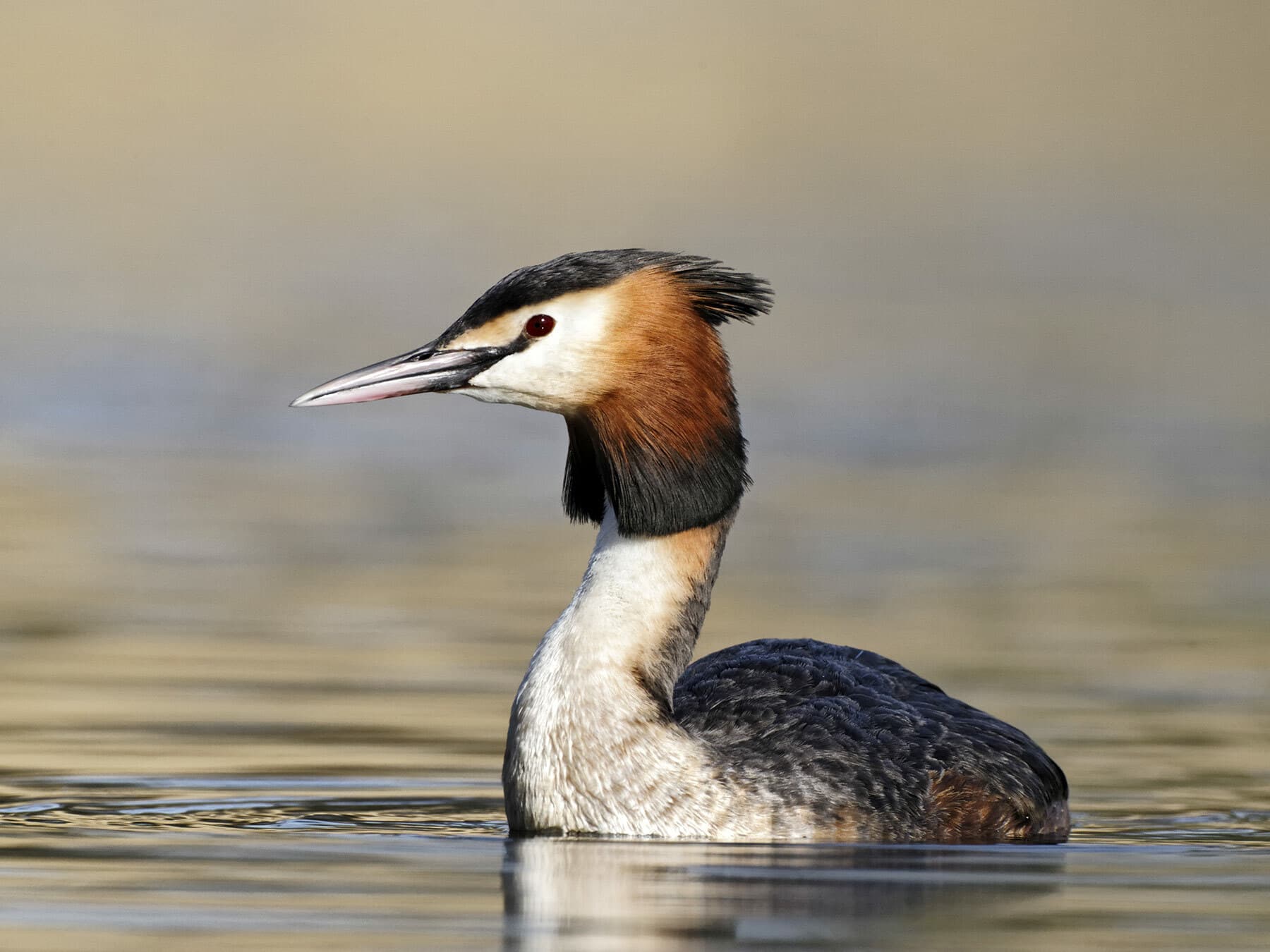
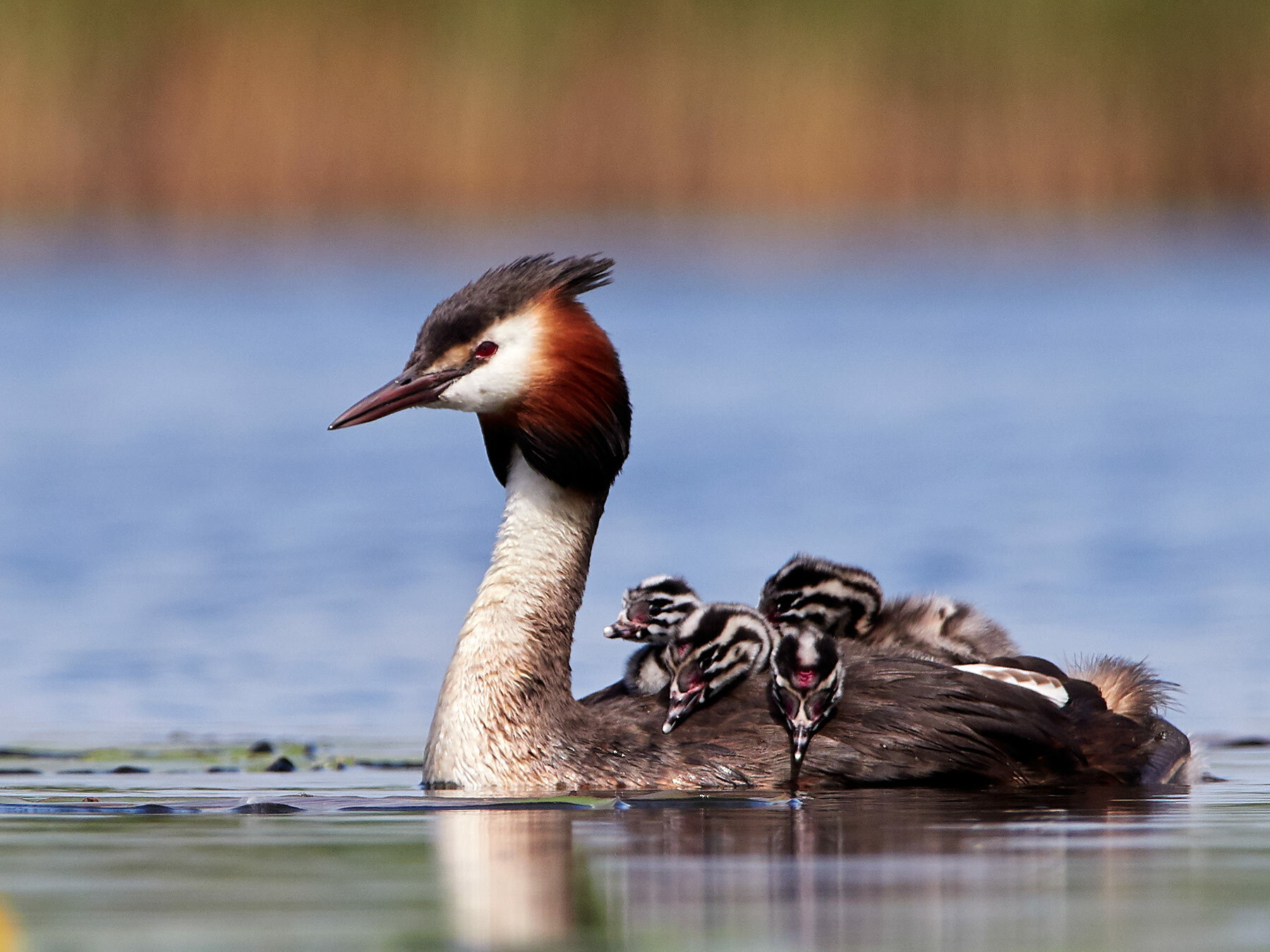
The Great Crested Grebe is a striking waterbird with a slender neck and distinctive black double crest. Its back is brown, contrasting with a bright white front. The face features a black-and-white pattern, complemented by a reddish-orange ruff around the neck during breeding season.
Juveniles lack the crest and have striped heads. Both sexes look similar, with breeding plumage being more vibrant. In winter, the crest reduces, and the ruff becomes less prominent.
Its size
Adults- Length
- 46–51 cm
- Wingspan
- 59–73 cm
- Weight
- 750–1450 g
Its song and calls
During summer months the bird can be heard making loud throaty barking noises which sound very similar to a terrier crossed with a quacking duck! This is often followed by short repeated ‘krrrrrrrrrrr – krrrrrrrrrrr’ sounds. During courtship the displays are often accompanied by ‘mewing’ sounds. Chicks mainly squeak or whistle particularly when begging for food.
- Call0:00 / 0:54
Recorded in Surrey, England
Aubrey John Williams / The British Library Board · Wikimedia Commons · CC BY-SA 4.0
When and where to see it
OctoberHere all year
Most recorded in October
- 1. Blaenau Gwent2.5%
- 2. Rutland1.7%
- 3. Staffordshire1.5%
- 4. Cardiff1.5%
- 5. Berkshire1.4%
Each dot is a county, state or province: the bigger and darker, the larger the bird’s share of that place’s bird records that month. Grey dots: no regular records. The ringed point is the centre of the bird’s records this month; the arrow shows how it moved since last month, and the dashed loop its path through the year. “Arrivals” colours places where it becomes regular this month (orange) or is in its last regular month (grey). GBIF eBird Observation Dataset, 2019–2024. Map data: Natural Earth, US Census Bureau; place centres © OpenStreetMap contributors.
In your area
See when the Great Crested Grebe is recorded in your county, state or province.
How often the Great Crested Grebe turns up in the UK and Ireland through the year, from birdwatchers' records.
United Kingdom
Resident · all year · most records in March
Ireland
Resident · all year · most records in February
Show as a table
| Month | United Kingdom | Ireland |
|---|---|---|
| January | 0.67% (regular) | 0.56% (regular) |
| February | 0.70% (regular) | 0.62% (regular) |
| March | 0.78% (regular) | 0.46% (regular) |
| April | 0.72% (regular) | 0.28% (regular) |
| May | 0.62% (regular) | 0.19% (regular) |
| June | 0.57% (regular) | 0.18% (regular) |
| July | 0.64% (regular) | 0.19% (regular) |
| August | 0.64% (regular) | 0.21% (regular) |
| September | 0.59% (regular) | 0.21% (regular) |
| October | 0.57% (regular) | 0.34% (regular) |
| November | 0.72% (regular) | 0.56% (regular) |
| December | 0.71% (regular) | 0.53% (regular) |
Recorded regularly in
Worldwide: recorded regularly in 84 countries
Countries where it was recorded in at least 3 of the 6 years 2019–2024. Linked countries have their own bird list.
Europe (42)
- Åland Islands
- Albania
- Austria
- Belarus
- Belgium
- Bosnia & Herzegovina
- Bulgaria
- Croatia
- Czechia
- Denmark
- Estonia
- Finland
- France
- Germany
- Greece
- Hungary
- Ireland
- Isle of Man
- Italy
- Jersey
- Kosovo
- Latvia
- Lithuania
- Luxembourg
- Malta
- Moldova
- Montenegro
- Netherlands
- North Macedonia
- Norway
- Poland
- Portugal
- Romania
- Russia
- Serbia
- Slovakia
- Slovenia
- Spain
- Sweden
- Switzerland
- Ukraine
- United Kingdom
Asia (29)
- Armenia
- Azerbaijan
- Bangladesh
- Bhutan
- China
- Cyprus
- Georgia
- Hong Kong SAR China
- India
- Iran
- Iraq
- Israel
- Japan
- Kazakhstan
- Kuwait
- Kyrgyzstan
- Lebanon
- Mongolia
- Myanmar (Burma)
- Nepal
- Pakistan
- Qatar
- Saudi Arabia
- South Korea
- Taiwan
- Tajikistan
- Thailand
- Turkey
- Uzbekistan
Oceania (2)
Data: EOD – eBird Observation Dataset (Cornell Lab of Ornithology), accessed via GBIF.org, CC BY 4.0. Records from 2019–2024, aggregated and filtered by Birdfact. How these lists are made
Although seen to frequent some coastal areas during winter months, great crested grebes prefer reservoirs, lowland lakes, gravel pits and slow moving rivers mainly located in central, eastern and southern England, north Wales and across the lowlands of central Scotland.
Signs and Spotting tips
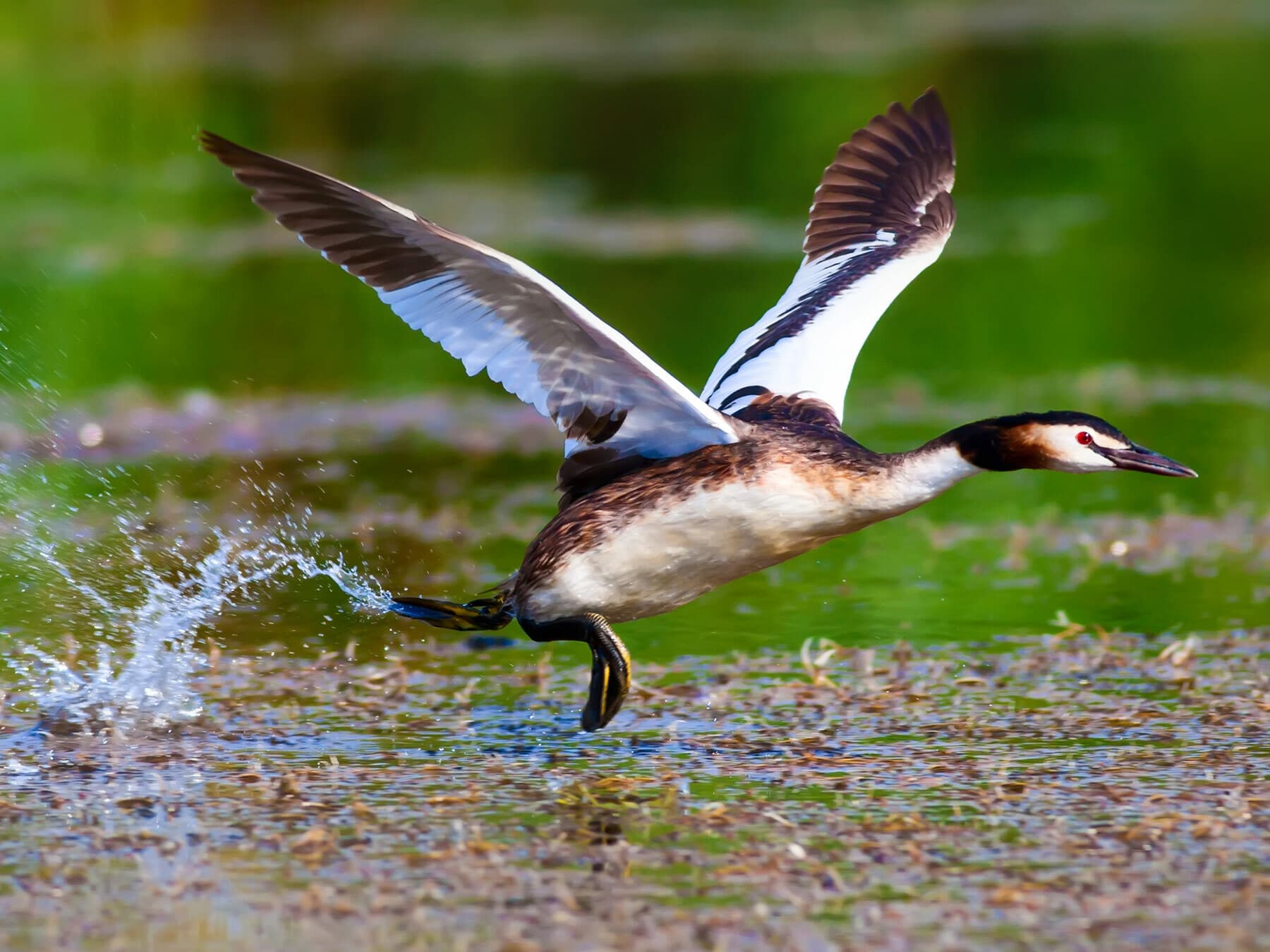
Obviously the best time to view these attractive birds is whilst they are in their summer breeding plumage and more particularly when the are engaged in their elaborate courtship dances. Being a water bird they spend almost all of their lives on the water and are uncomfortable on land being unable to walk properly or support their own weight. If they do venture on to land they are forced to almost drag themselves along being unable to stand upright. This is due to the fact that their legs are set very far back on their body rendering successful balance impossible. Rarely seen in flight, if startled they prefer to dive below the surface in order to escape or avoid predators.
What it eats
The great crested grebe is Europe’s largest member of the grebe family and arguably the most striking. Adult males and females are identical although both share different markings in summer and winter plumage. During the summer the bird is looking its finest with its distinctive black head plume and unique orange ruff below the chin at the top of the neck. The head plume splits in two at the top of the crown like a centre parting and faces backwards. The black head and crown colouration extend over the forehead to meet the top of the bird’s long pinkish grey bill. The face is white as is the front of the neck and the breast. The orange neck ruff is tinged black at its edges and the back and rear of the neck of the bird is a dull browny dark grey as are the markings on the top side of the wing, although there are bright white patches around the area of the scapulars. During the winter months, the ruff disappears to reveal an area of white feathers and white appears over the eye. The back of the bird darkens as does the rear of the neck. When swimming the great crested grebe displays its characteristic long upright slender neck. Juvenile birds have a pale grey upper body with a white breast and a distinctive black and white striped head.
What does a Great Crested Grebe eat?
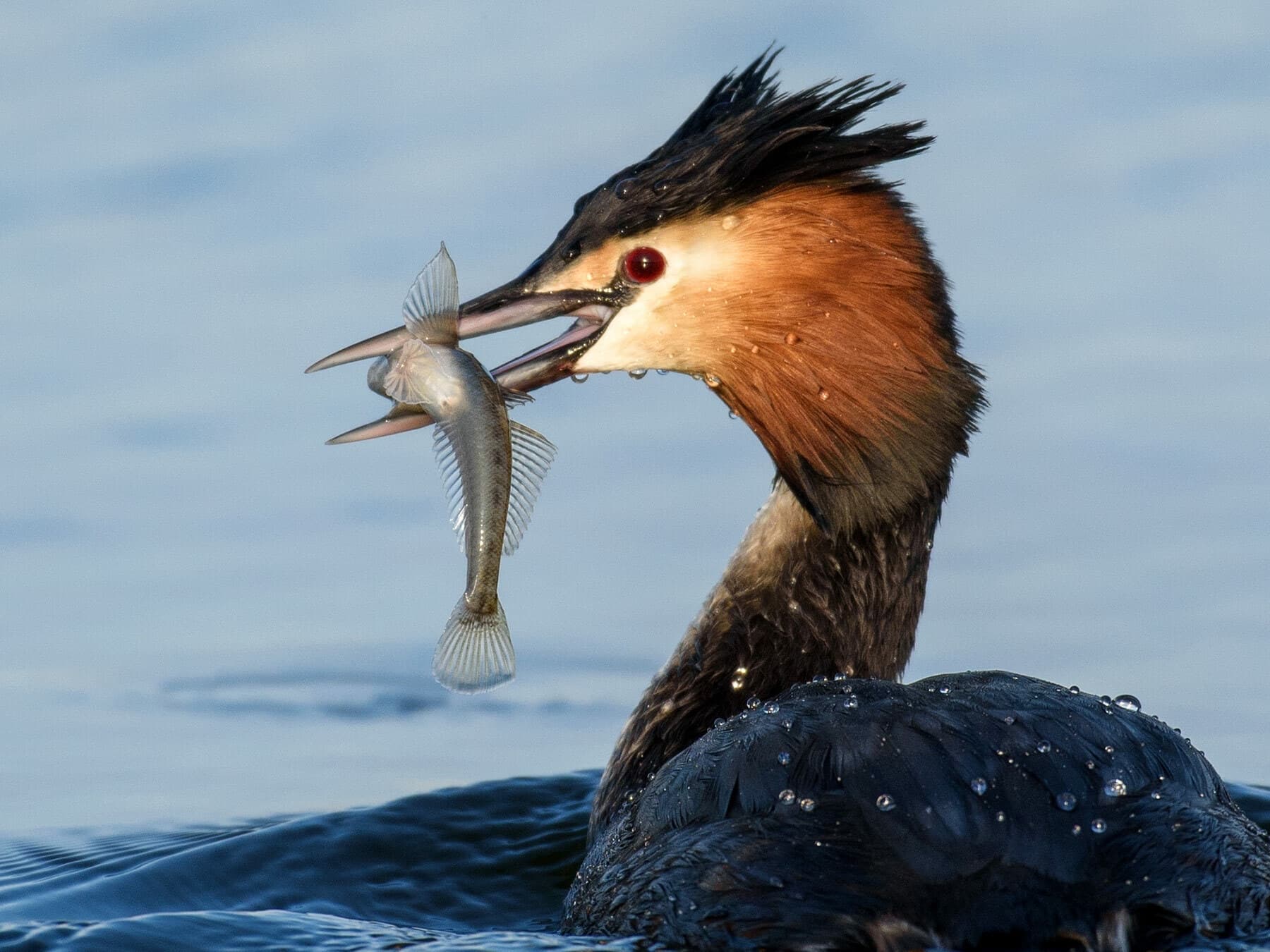
Fish, crustaceans and aquatic invertebrates are all on the menu for the great crested grebe although the diet is mainly fish which are caught as the bird dives completely below the surface to pursue them. They will occasionally feed by just submerging their head although as expert swimmers and divers they will normally disappear completely below the surface and can remain thus for an average of up to 30 seconds.
How does a Great Crested Grebe breed?
Nests are constructed out of aquatic plant material and floated on the surface of the water, often at the water’s edge, anchored to nearby vegetation or built up from the bottom of the lake to stand just above the water level. One brood of 3 – 4 plain creamy white coloured eggs are laid between February to June and incubated for up to a month. Fledging occurs after seventy one to seventy nine days. The parents teach their young to swim and dive and can often be observed swimming with their young being carried on their back.
How long do Great Crested Grebes live for?
The expected lifespan of great crested grebes is between ten to fifteen years, although some ringed specimens have been found to exceed this figure.
Nesting and breeding
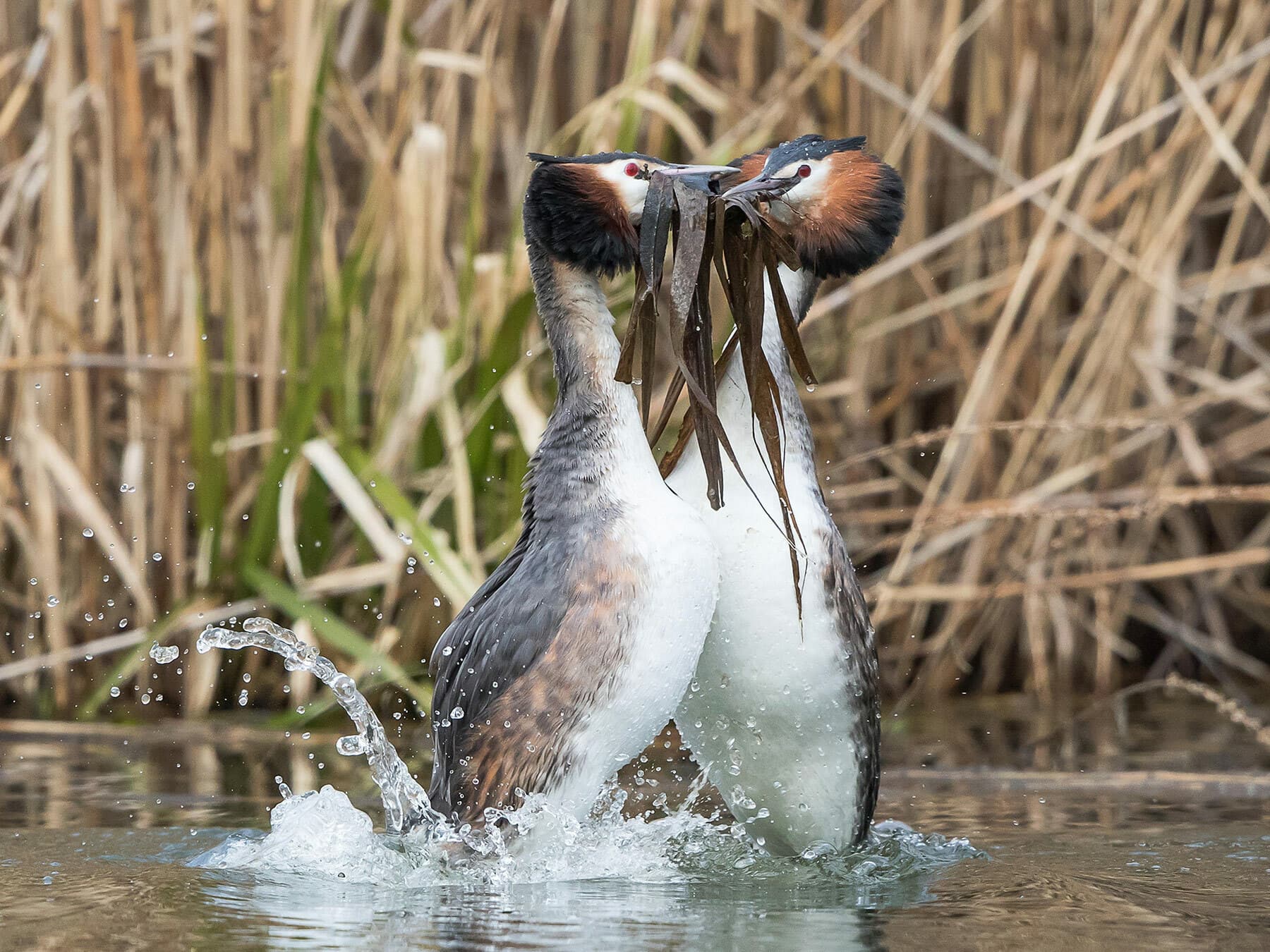
Breeding season for Great Crested Grebes typically begins in spring, with elaborate courtship displays preceding pair formation. These displays include head-shaking, weed-presenting, and the famous 'penguin dance'.
Nests are floating platforms of aquatic vegetation, usually anchored to reeds or submerged branches. Females lay 3-4 chalky blue eggs, which become stained brown over time.
Both parents incubate the eggs for about 27-29 days. The chicks are precocial, often seen riding on their parents' backs. They fledge after 71-79 days but may be fed by their parents for up to 10 weeks.
Behaviour
Great Crested Grebes are excellent swimmers and divers, often seen gliding gracefully across water surfaces. They perform elaborate courtship displays, including the famous 'weed dance' where pairs rise out of the water chest-to-chest, shaking their heads. These birds are generally monogamous and territorial during breeding season.
Conservation
While the Great Crested Grebe is currently listed as Least Concern, it faces threats from habitat loss and water pollution. Conservation efforts focus on protecting wetland habitats and maintaining water quality in lakes and reservoirs. Climate change may also affect their distribution and breeding success in the future.
Similar birds
Often mistaken for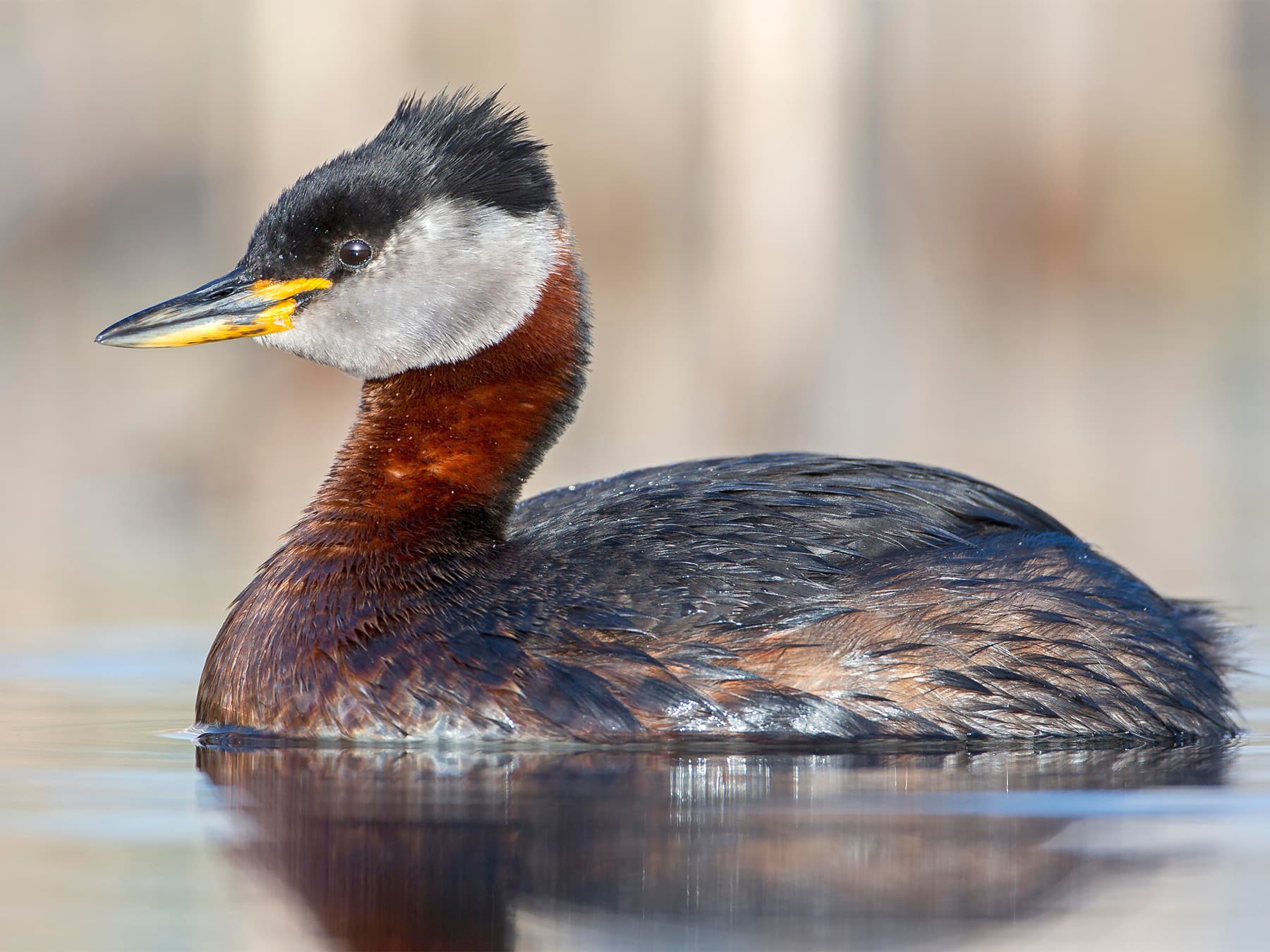
More photos
2 photos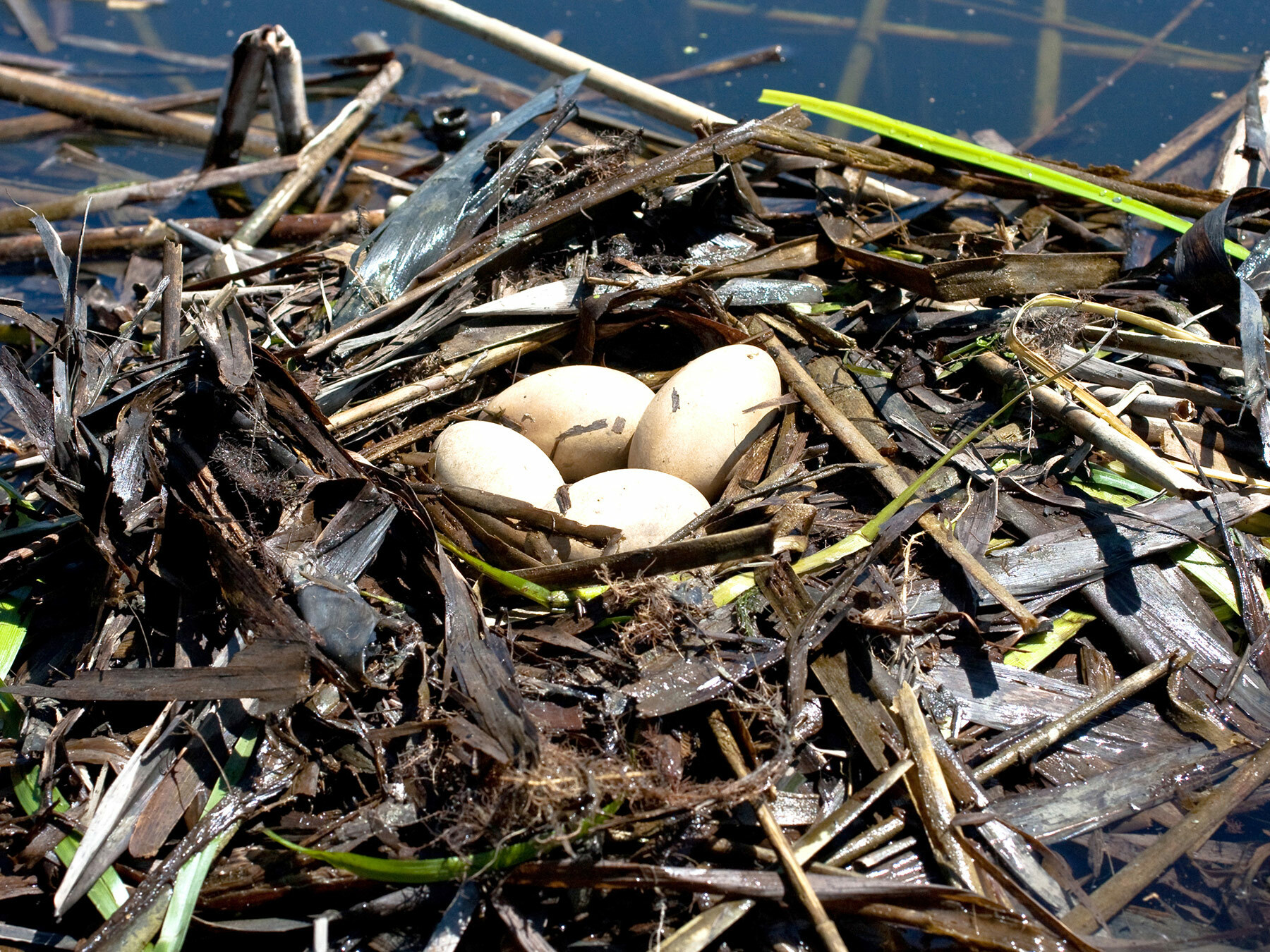
Quick facts
- Length
- 46–51 cm
- Wingspan
- 59–73 cm
- Weight
- 750–1450 g
- Lifespan
- 10–15 years · oldest recorded 11.8 years
- Family
- Grebes
- Migration
- Partial migrant
- Global status (IUCN)
- Least Concern
- World population
- 915,000 - 1,400,000 mature individuals
- Population trend
- Unknown
- Also called
- Crested Grebe
- Scientific name
- Podiceps cristatus
Sources
3- 1BirdLife International. 2019. Podiceps cristatus. The IUCN Red List of Threatened Species 2019: e.T22696602A154250080. Source (opens in a new tab)
- 2Wetlands International (2015)
- 3BTO longevity records: maximum age from a ringed bird, 11 years, 10 months, 5 days (set in 1978), BirdFacts: Great Crested Grebe (1978) Source (opens in a new tab)

Checked by
Nathan Cope, founder and editor
Nathan founded Birdfact and leads its writers and contributors in the UK, the US and Canada. He has watched and studied birds for more than ten years, and checks every article and species guide before it’s published.