


Red-necked Grebe
Holboell's Grebe · Podiceps grisegena
By the Birdfact teamChecked by Nathan Cope
On this page12 sections
How to recognise it
What do Red-necked Grebes look like?
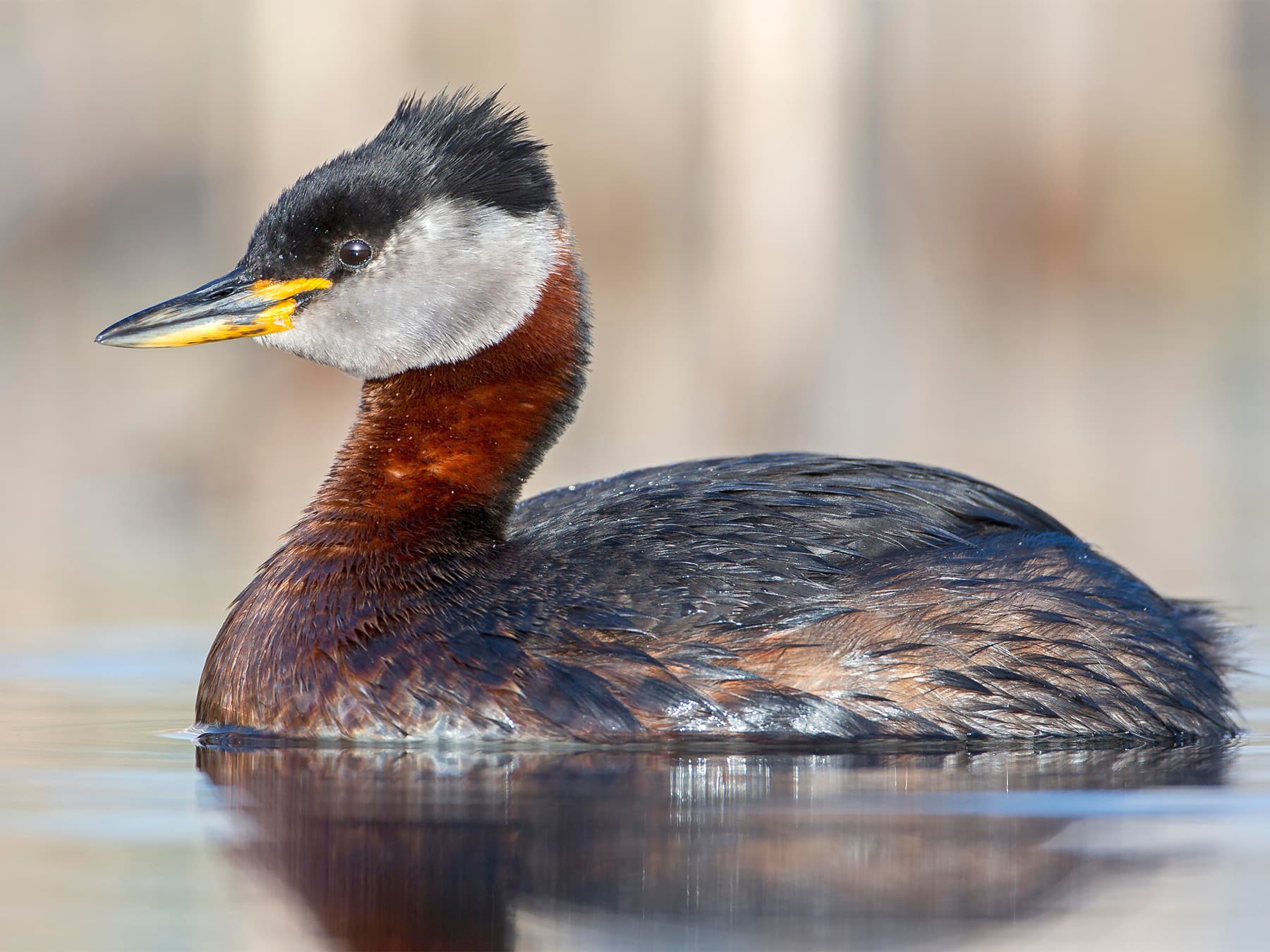
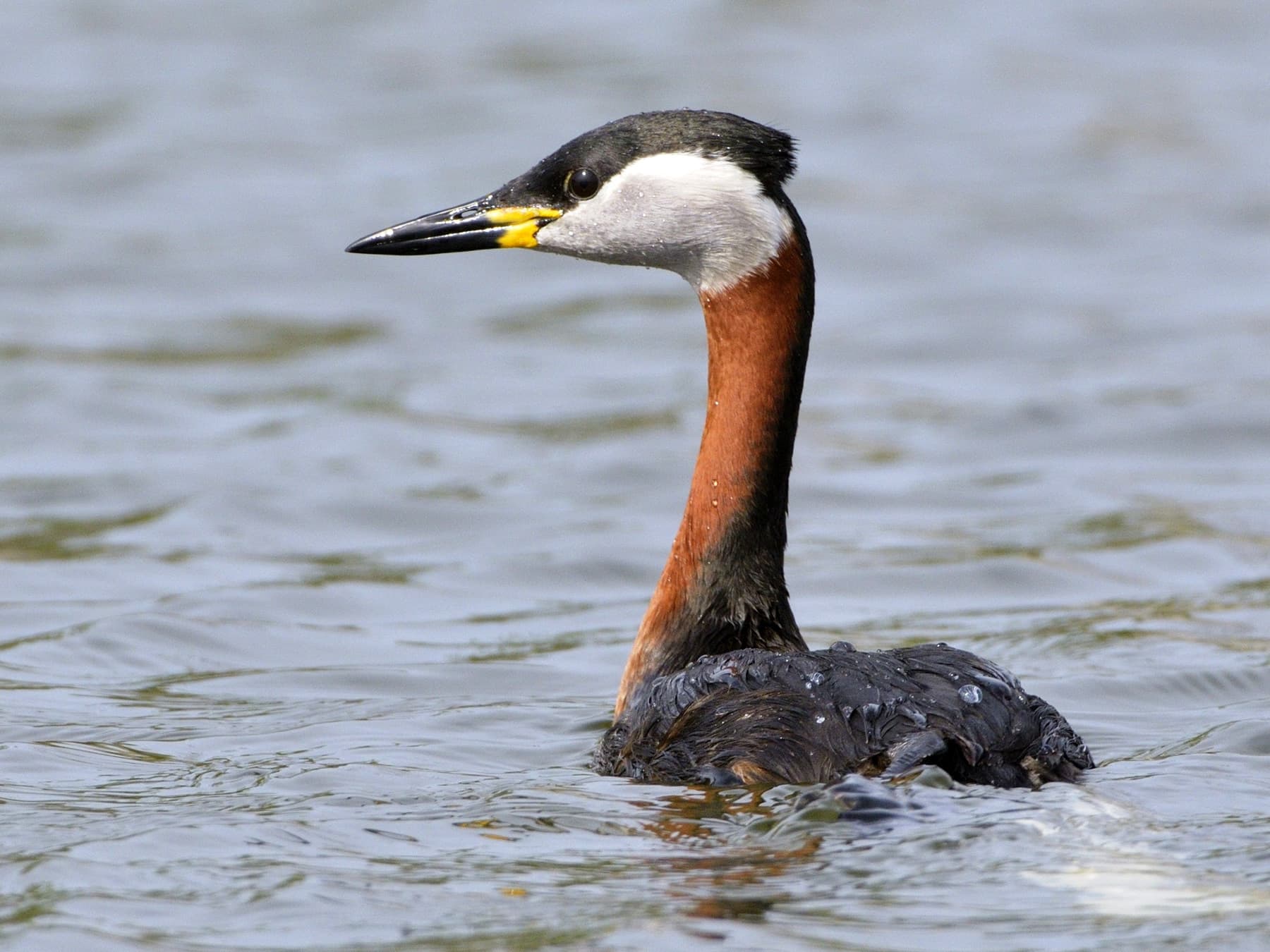
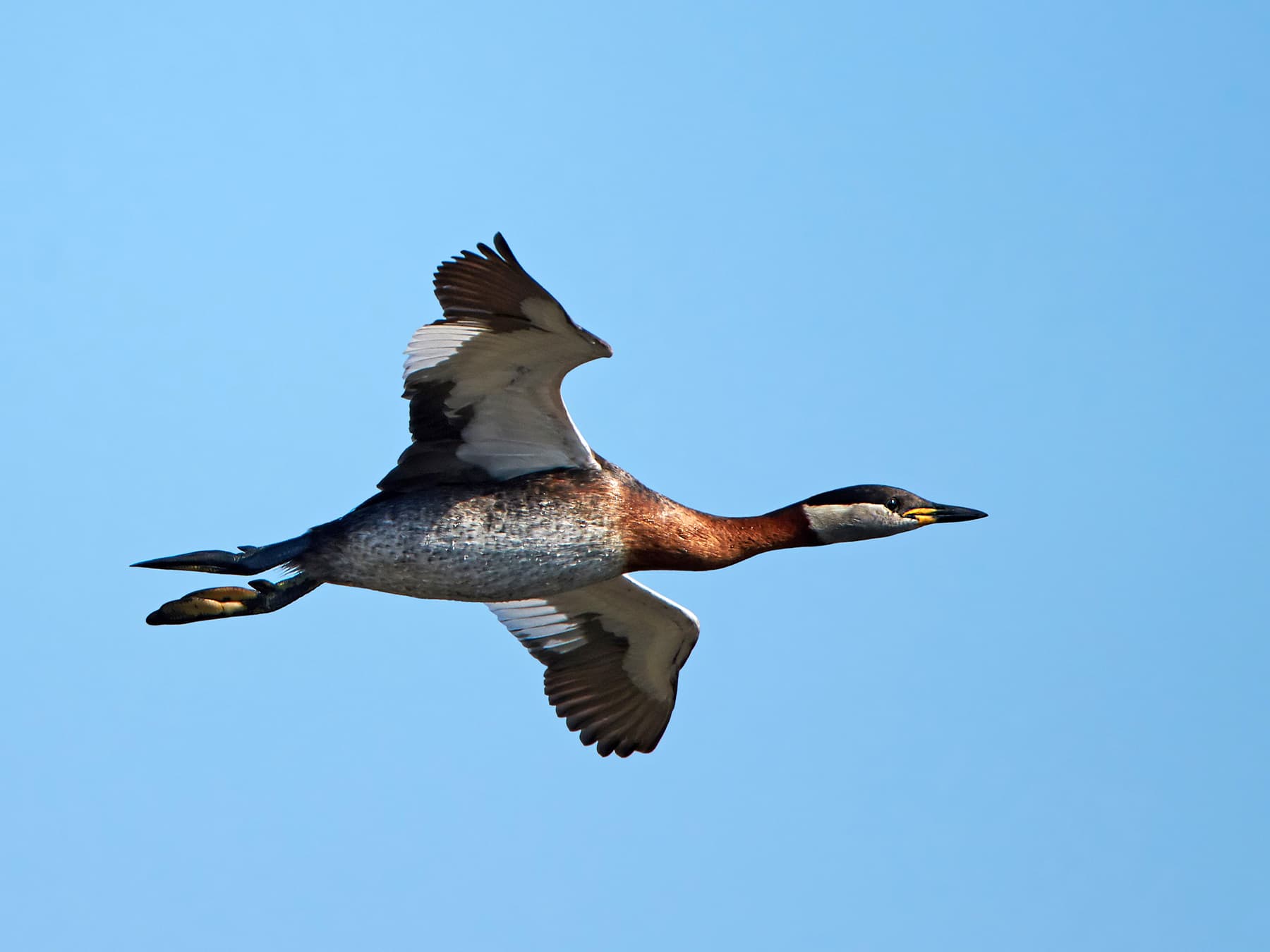
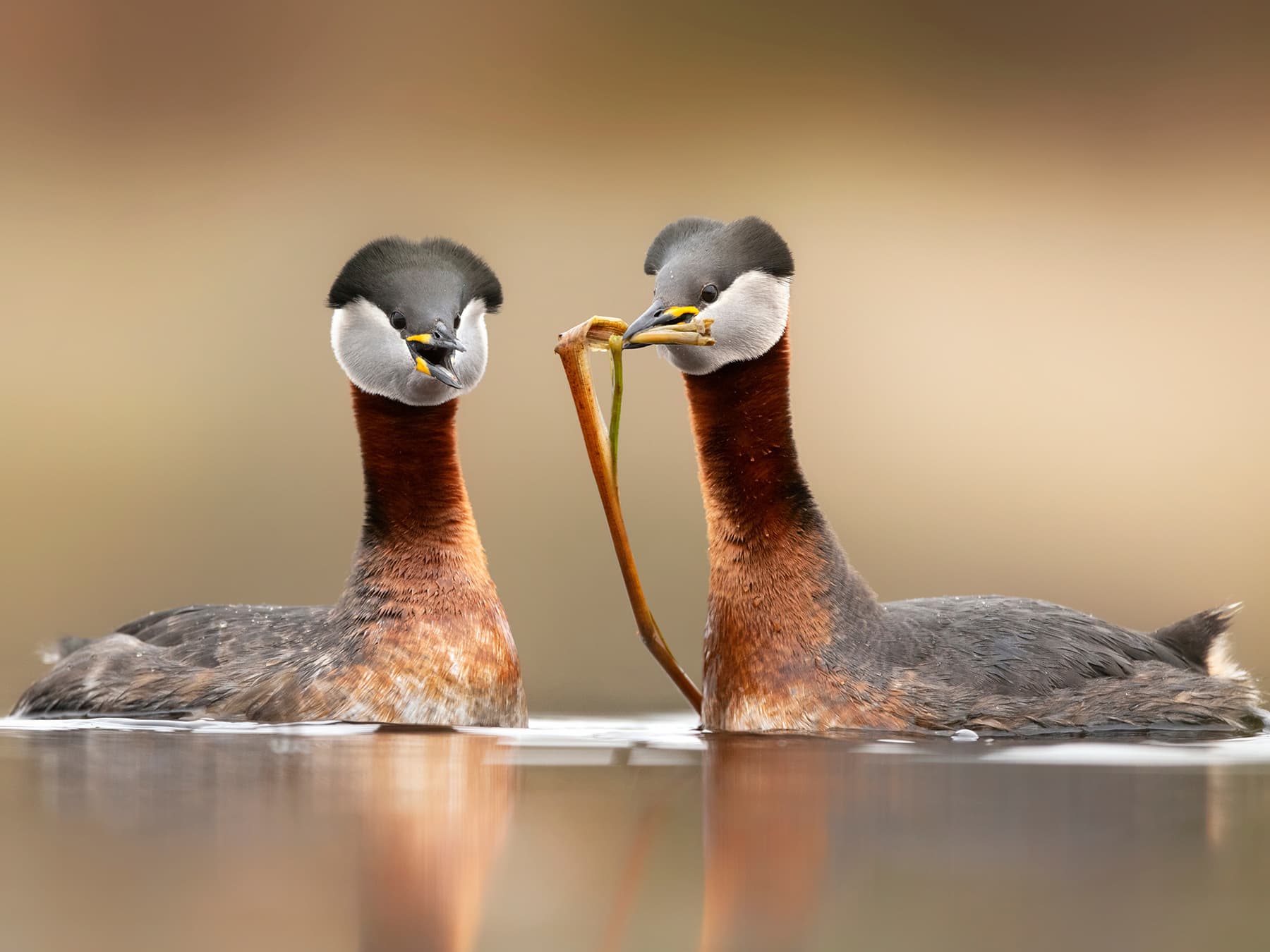
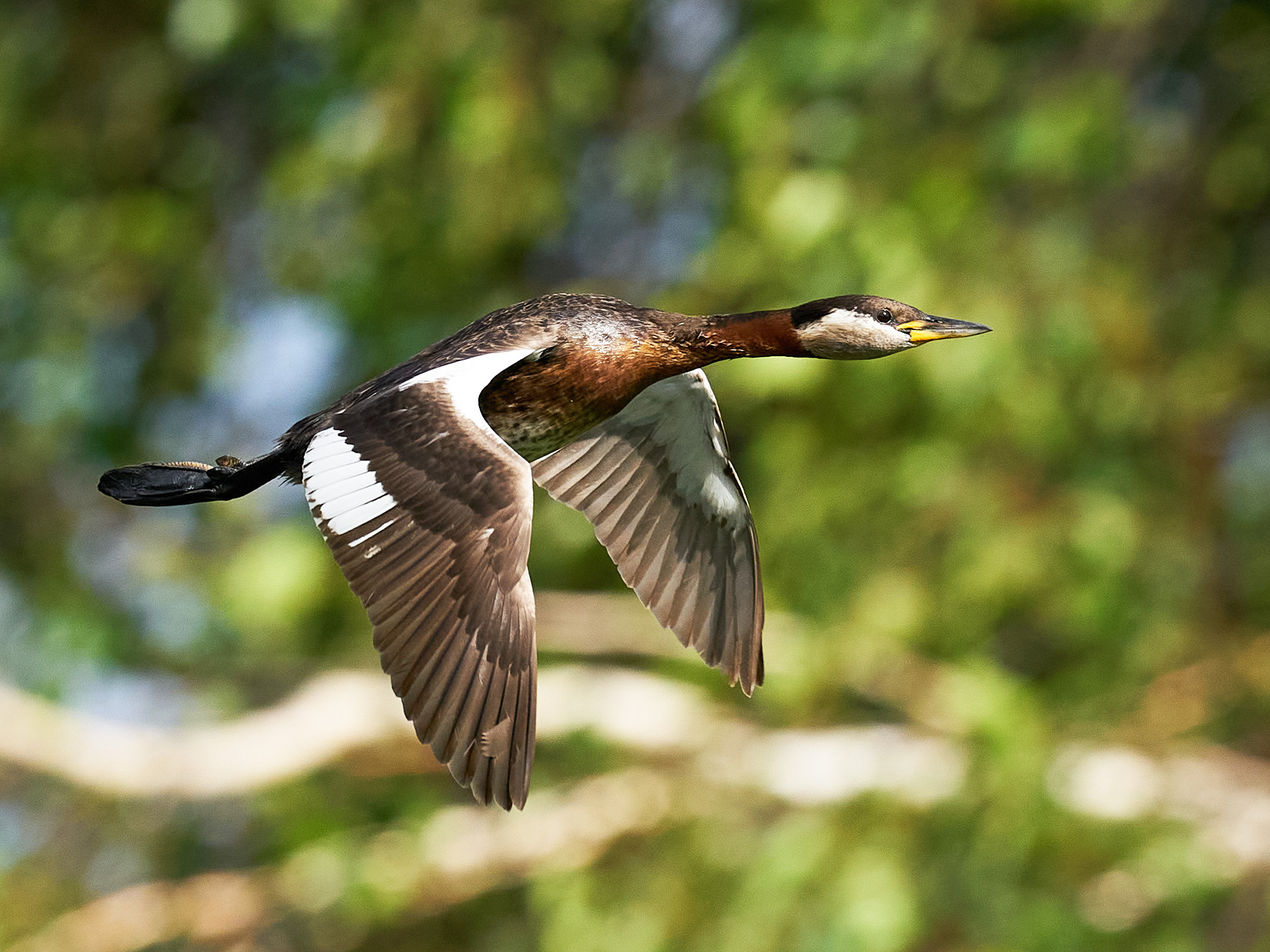
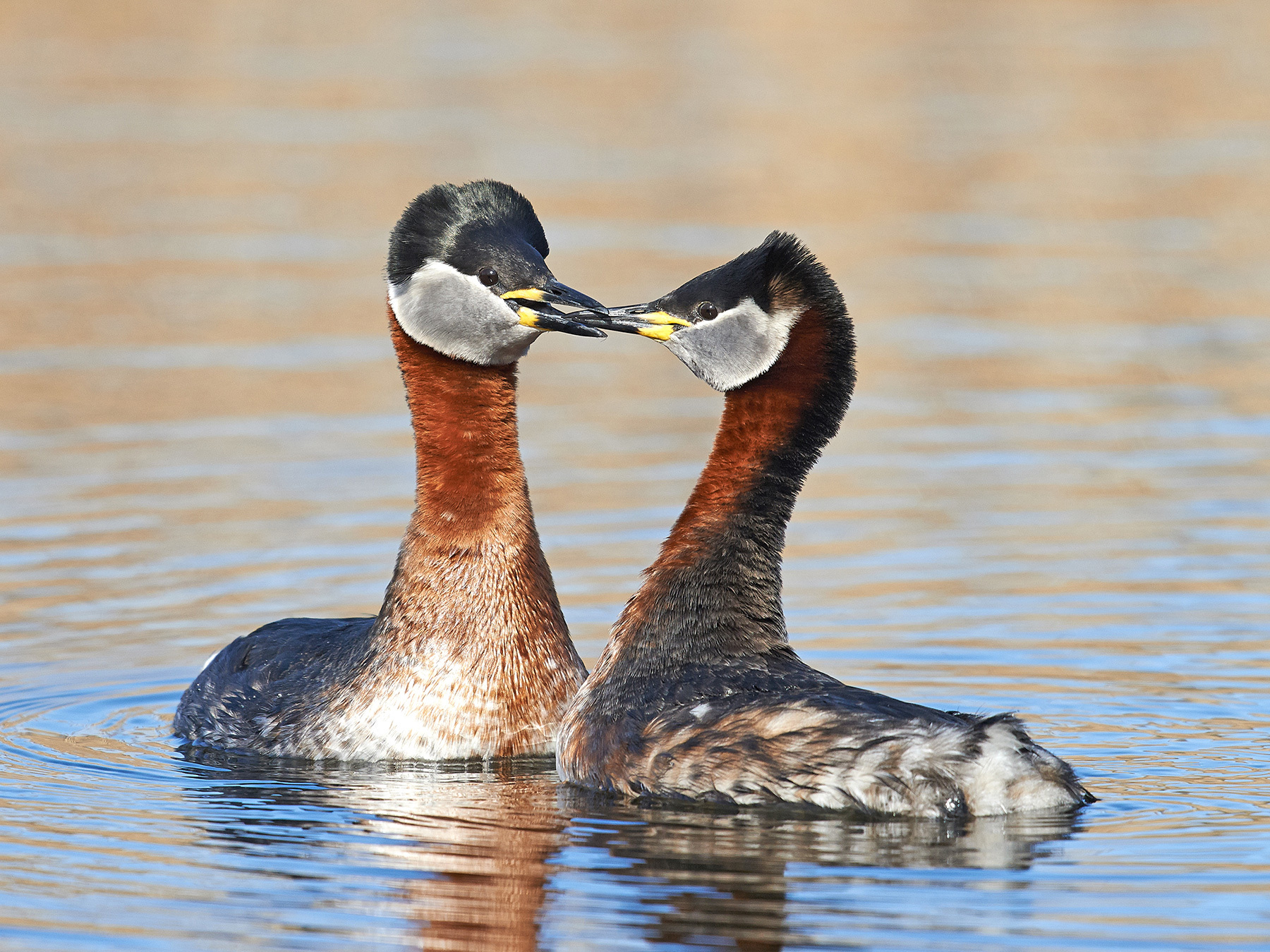
In the breeding season, male red-necked grebes have a distinctive, contrasting plumage, with a black crested cap, and a gray cheek patch extending from under the eye to the throat. The foreneck and upper breast is a deep chestnut red, fading to a paler belly and grayish-white underparts. Their back and wings are a deeper charcoal-brown, with some white on the wings and undertail.
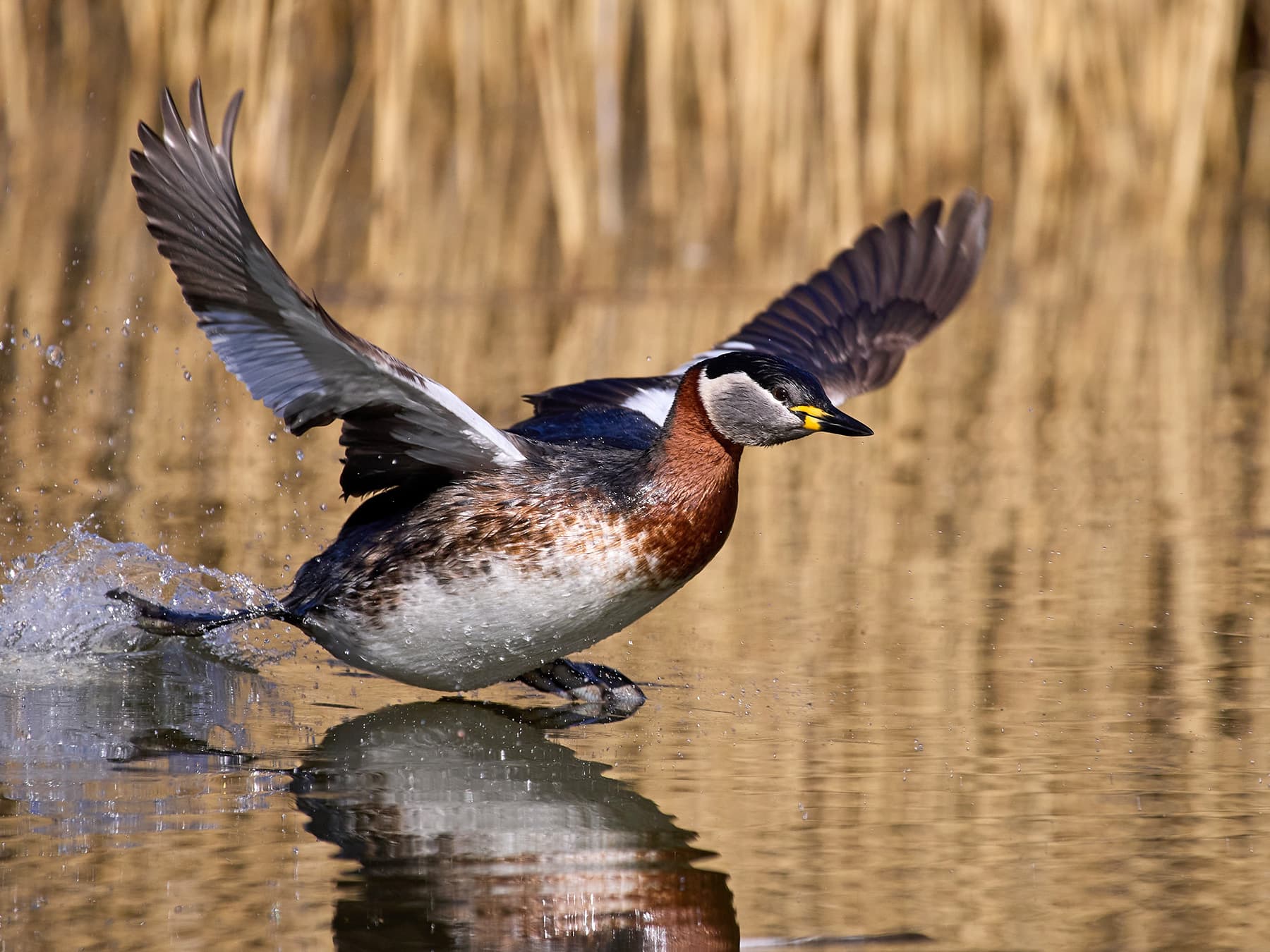
Eyes are brown and the bill is long and pointed, with a black base and yellow edges. Their legs – positioned towards the rear of the body, which makes walking on land rather cumbersome – are black.
In winter, males lose their distinctive coloring, becoming mainly gray and white, and resemble nonbreeding great crested grebes, although their shorter, thicker necks can tell them apart.
Female red-necked grebes are similar to males but can be told apart by comparing the brightness of their plumage. During the breeding season, females resemble males but their coloring is more subdued, with light brown and gray replacing the more vibrant red and black. Non-breeding females are similar to non-breeding males, with more muted shades of their breeding plumage.
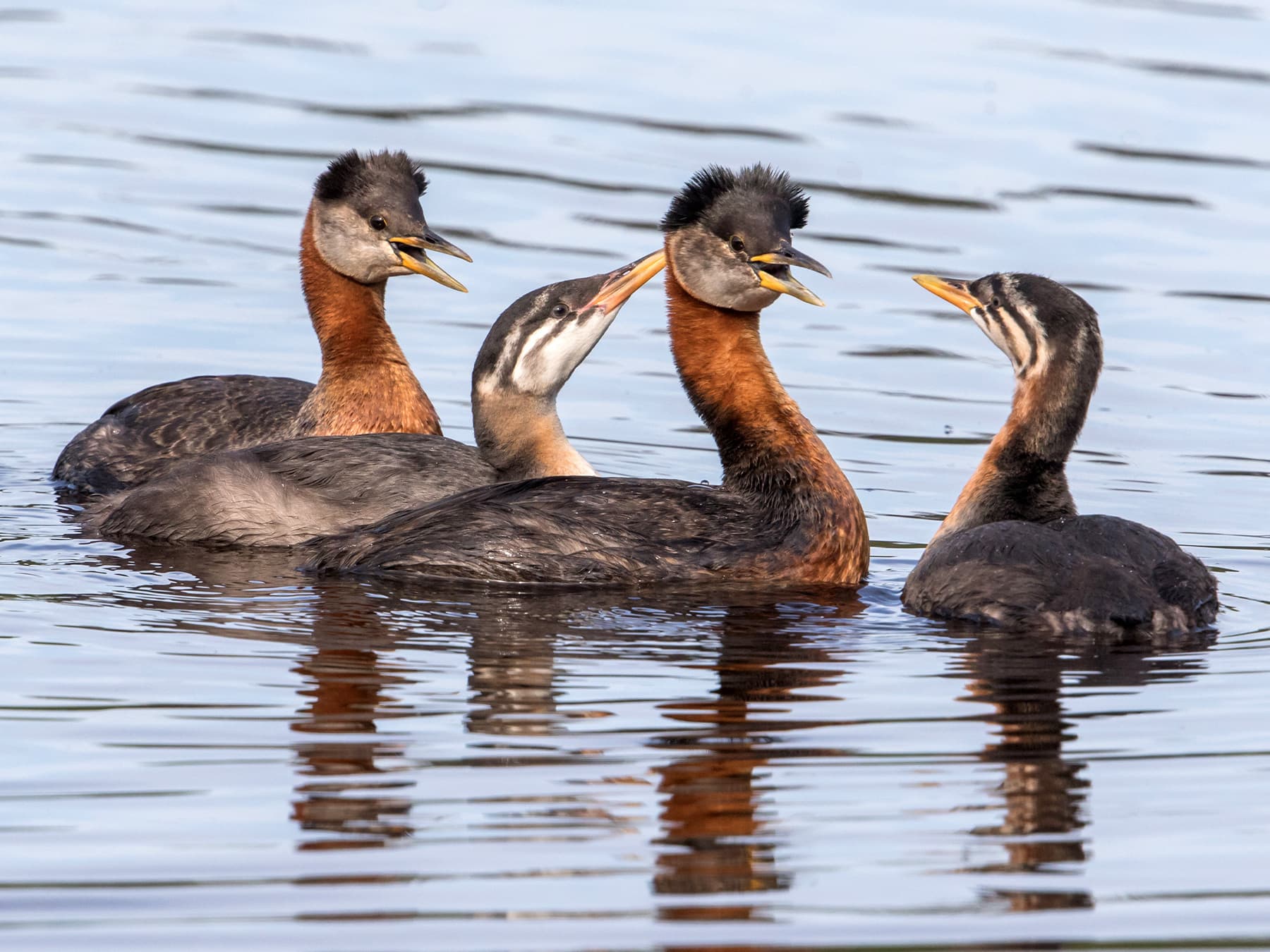
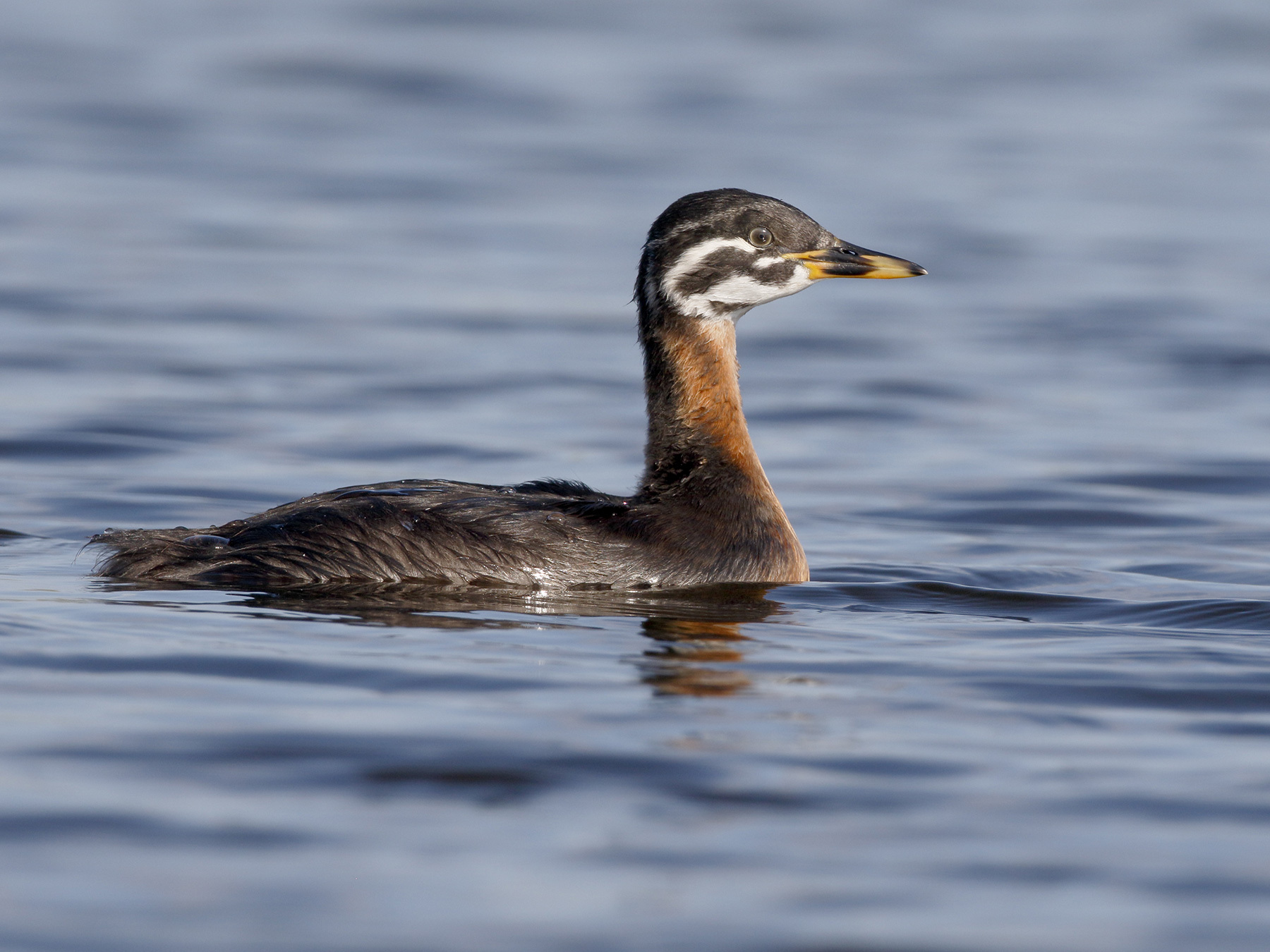
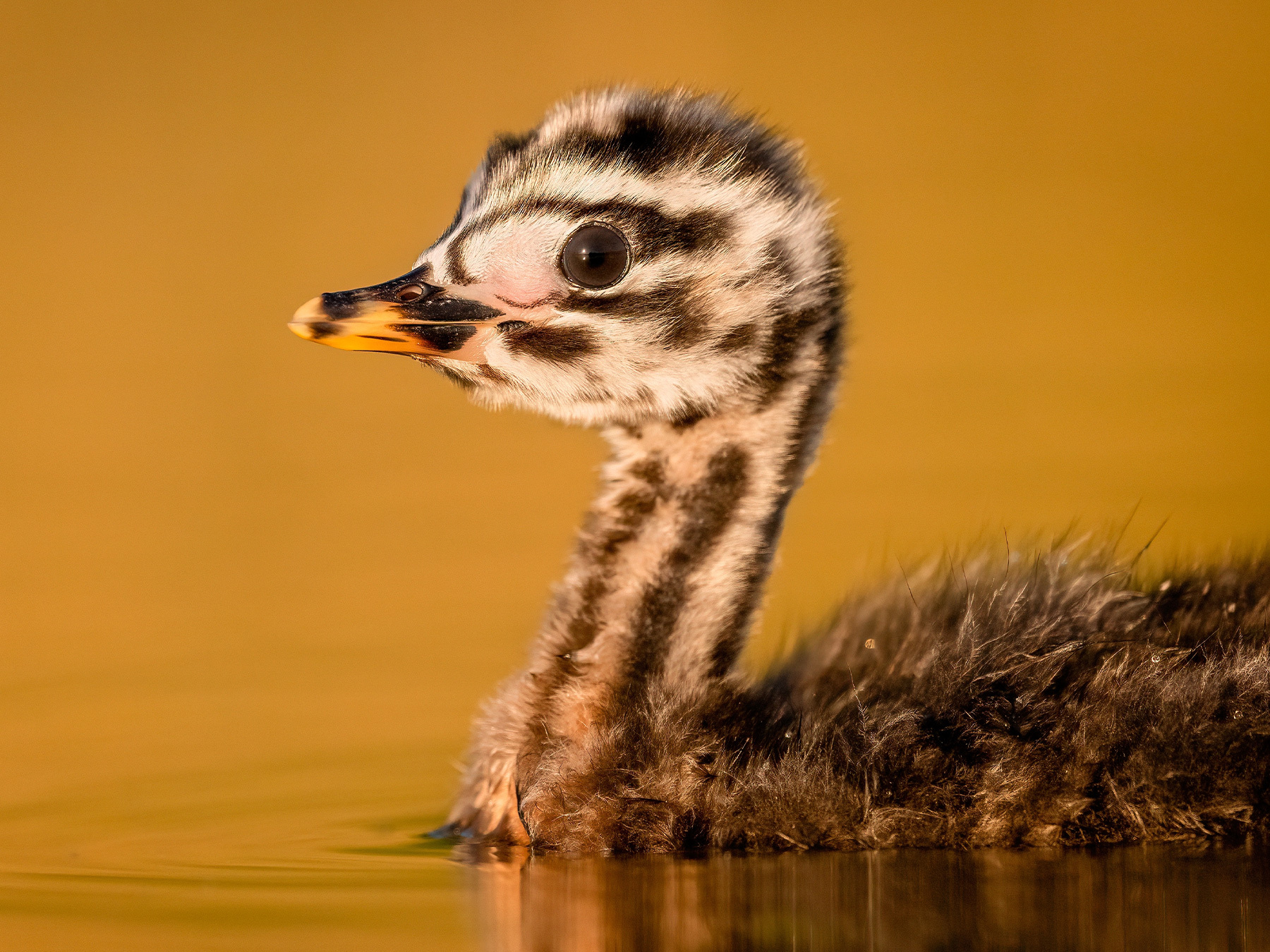
Juvenile red-necked grebes have a reddish-brown foreneck and dark brown upper parts. Their facial markings are distinctive, with two black streaks on an otherwise white face, a pale eyebrow, and a darker brown crown.
How big are Red-necked Grebes?
Male red-necked grebes are commonly slightly larger than females and have longer bills but this is not always the case and cannot be used alone as an accurate method of distinguishing between the sexes.
- Length: 40 cm to 46 cm (15.7 in to 18.1 in)
- Wingspan: 77 cm to 85 cm (30.3 in to 33.5 in)
- Weight: 700 g to 900 g (1.5 lb to 2 lb)
Its size
Adults- Length
- 40–50 cm
- Wingspan
- 77–85 cm
- Weight
- 750–1600 g
Its song and calls
What sound does a Red-necked Grebe make?
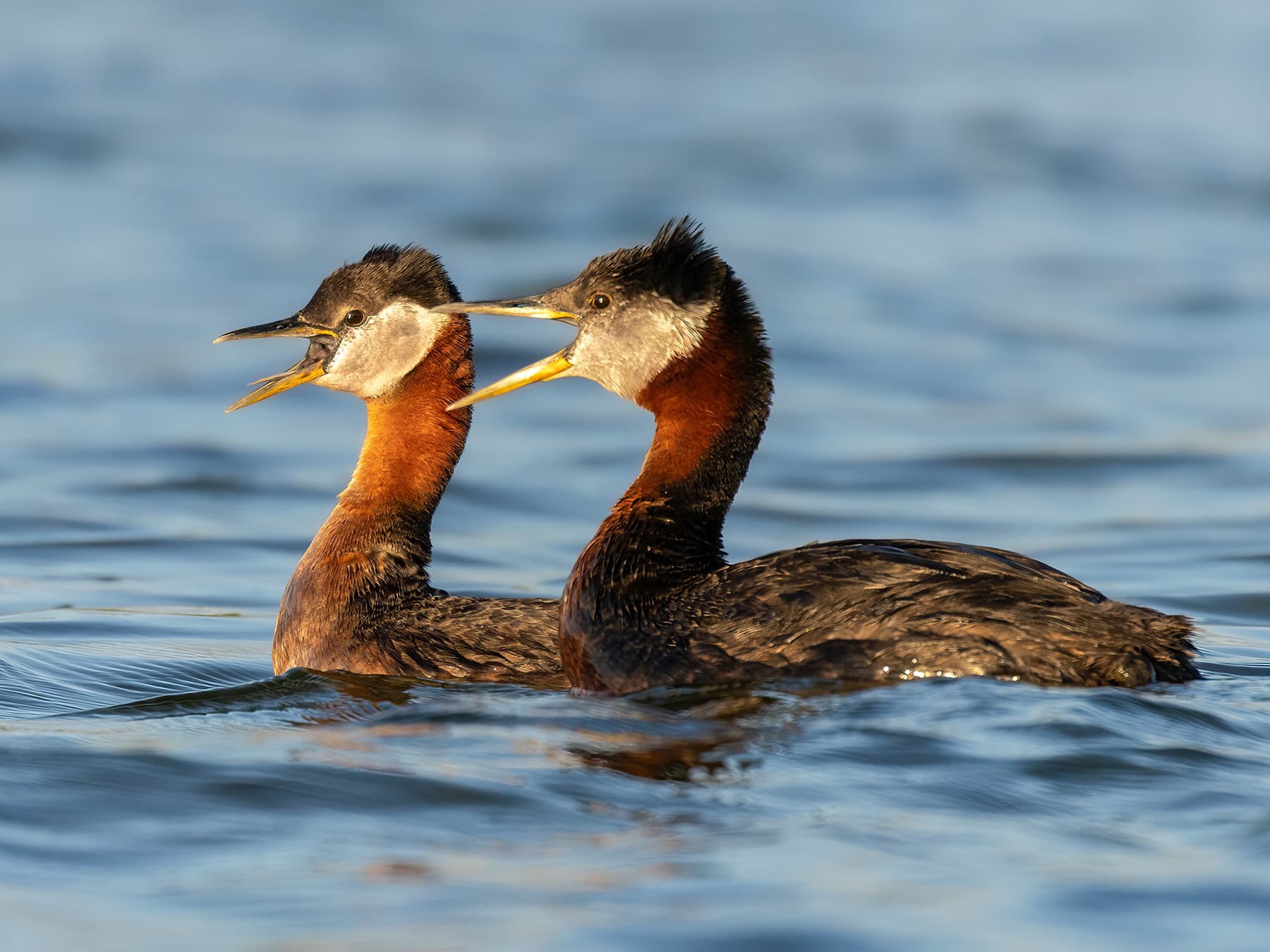
Red-necked grebes are a vocal species, especially during the breeding season. A high-pitched ‘weet, weet, weet’ alarm call is heard when their nest or young are threatened. A mournful moaning sound is used as a contact call, during courtship, and when communicating with a mate.
When and where to see it
OctoberIn season
Most recorded in October
- 1. Glasgow0.17%
- 2. Rutland0.13%
- 3. North Yorkshire0.12%
- 4. West Yorkshire0.12%
- 5. East Lothian0.12%
Each dot is a county, state or province: the bigger and darker, the larger the bird’s share of that place’s bird records that month. Grey dots: no regular records. The ringed point is the centre of the bird’s records this month; the arrow shows how it moved since last month, and the dashed loop its path through the year. “Arrivals” colours places where it becomes regular this month (orange) or is in its last regular month (grey). GBIF eBird Observation Dataset, 2019–2024. Map data: Natural Earth, US Census Bureau; place centres © OpenStreetMap contributors.
In your area
See when the Red-necked Grebe is recorded in your county, state or province.
How often the Red-necked Grebe turns up in the UK, Ireland, the United States and Canada through the year, from birdwatchers' records.
United Kingdom
Winter visitor · regularly Jul–May · most records in November
Ireland
Passage migrant · regularly Jan–Mar · most records in March
United States
Resident · all year · most records in November
Canada
Resident · all year · most records in October
Show as a table
| Month | United Kingdom | Ireland | United States | Canada |
|---|---|---|---|---|
| January | 0.019% (regular) | 0.004% (regular) | 0.045% (regular) | 0.15% (regular) |
| February | 0.013% (regular) | 0.004% | 0.031% (regular) | 0.11% (regular) |
| March | 0.008% (regular) | 0.015% (regular) | 0.026% (regular) | 0.14% (regular) |
| April | 0.005% (regular) | <0.001% | 0.022% (regular) | 0.18% (regular) |
| May | 0.002% (regular) | – | 0.017% (regular) | 0.14% (regular) |
| June | <0.001% | 0.002% | 0.022% (regular) | 0.12% (regular) |
| July | 0.004% (regular) | – | 0.012% (regular) | 0.12% (regular) |
| August | 0.002% (regular) | – | 0.019% (regular) | 0.15% (regular) |
| September | 0.006% (regular) | – | 0.027% (regular) | 0.20% (regular) |
| October | 0.015% (regular) | – | 0.042% (regular) | 0.29% (regular) |
| November | 0.021% (regular) | 0.001% | 0.053% (regular) | 0.28% (regular) |
| December | 0.019% (regular) | – | 0.046% (regular) | 0.18% (regular) |
Recorded regularly in
Worldwide: recorded regularly in 40 countries
Countries where it was recorded in at least 3 of the 6 years 2019–2024. Linked countries have their own bird list.
Data: EOD – eBird Observation Dataset (Cornell Lab of Ornithology), accessed via GBIF.org, CC BY 4.0. Records from 2019–2024, aggregated and filtered by Birdfact. How these lists are made
What is the habitat of a Red-necked Grebe?
During the breeding season, red-necked grebes prefer freshwater habitats, particularly small lakes, marshes, and ponds. Shallow, vegetated wetlands are favored, surrounded by forested land.
Wintering territories are primarily located in coastal bays and estuaries, with deeper water and an abundance of fish. Marine waters are preferred, but inland lakes may also be visited.
What is the range of a Red-necked Grebe?
Three separate breeding ranges of red-necked grebes exist.
In North America, the species breeds in western Canada, the northwest United States, and Alaska. In Asia, red-necked grebes nest in eastern Russia, north-eastern China, and northern Japan. Further into Europe and Central Asia, breeding grounds of the species are located in the Netherlands, Denmark, Germany, Sweden and Finland, the Baltic States, Poland, Belarus, and Ukraine. To the east, the range extends to western Siberia and as far south as Kazakhstan, Bulgaria, and Turkey.
Wintering populations are found in coastal waters from the Aleutian Islands as far south as California, and along the Atlantic coast, occasionally as far south as Florida. In Asia, the seas around Japan and Korea are a winter destination for the populations that breed in far-eastern Russia. European breeding populations of red-necked grebes mostly head to wintering grounds on the North, Black, Mediterranean, and Caspian seas.
Where do Red-necked Grebes live?
North American populations of red-necked grebes are estimated at between 45,000 and 100,000 individuals. The Western European population was thought to be approximately 35,000 pairs, with the highest numbers in Finland, Poland and Germany.
How rare are Red-necked Grebes?
Although they are not considered a particularly rare bird, red-necked grebes are not spotted as commonly as many other waterbirds, and the maximum global population of the species is estimated at 290,000.
In the UK, red-necked grebes are one of the rarest breeding waterbirds with between 1 and 20 breeding pairs each summer. Sightings become marginally more common in winter, with the arrival of around 60 migrants from northern Europe annually.
Where can you see Red-necked Grebes in the US?
Red-necked grebes breed in the interior of Alaska and move coastwards in winter months. The western United States offers good chances of sightings, in particular Yellowstone National Park in Wyoming, Henry’s Lake in Idaho, and several small lakes across Montana. The Great Lakes region is a popular spot for migration stopovers and for winter visitors.
Where can you see Red-necked Grebes in Canada?
More than 70 percent of the North American population of red-necked grebes breed in Canada, primarily in the west of the country, but in winter can be found along both the Atlantic and Pacific coasts. The Great Lakes are a prime spot for both breeding and wintering red-necked grebes, and sightings of large numbers are regularly reported at Lake Ontario.
Where can you see Red-necked Grebes in the UK?
Breeding sites of red-necked grebes are kept secret to avoid potential disturbances, but in the past have been on the Scottish coast and near The Wash estuary. Winter sightings have been made off the eastern coast of the British Isles, particularly in south-east England.
Migration
Do Red-necked Grebes migrate?
Red-necked grebes are relatively short-distance migrants, leaving their freshwater breeding sites to head to marine waters from July onwards. Migration routes largely follow an east-to-west direction rather than north-to-south. Return migration to breeding territories begins in March.
Tips for seeing it
- Look for Red-necked Grebes on large, deep lakes and coastal bays
- Listen for their distinctive loud, wailing calls during breeding season
- Observe their diving behavior, as they often stay submerged for up to 30 seconds, with the ability to stay under 1 minute
- In North America, watch for them during spring and fall migrations on large bodies of water
What it eats
What do Red-necked Grebes eat?
The diet of a red-necked grebe changes throughout the year according to habitat and seasonal availability of prey.
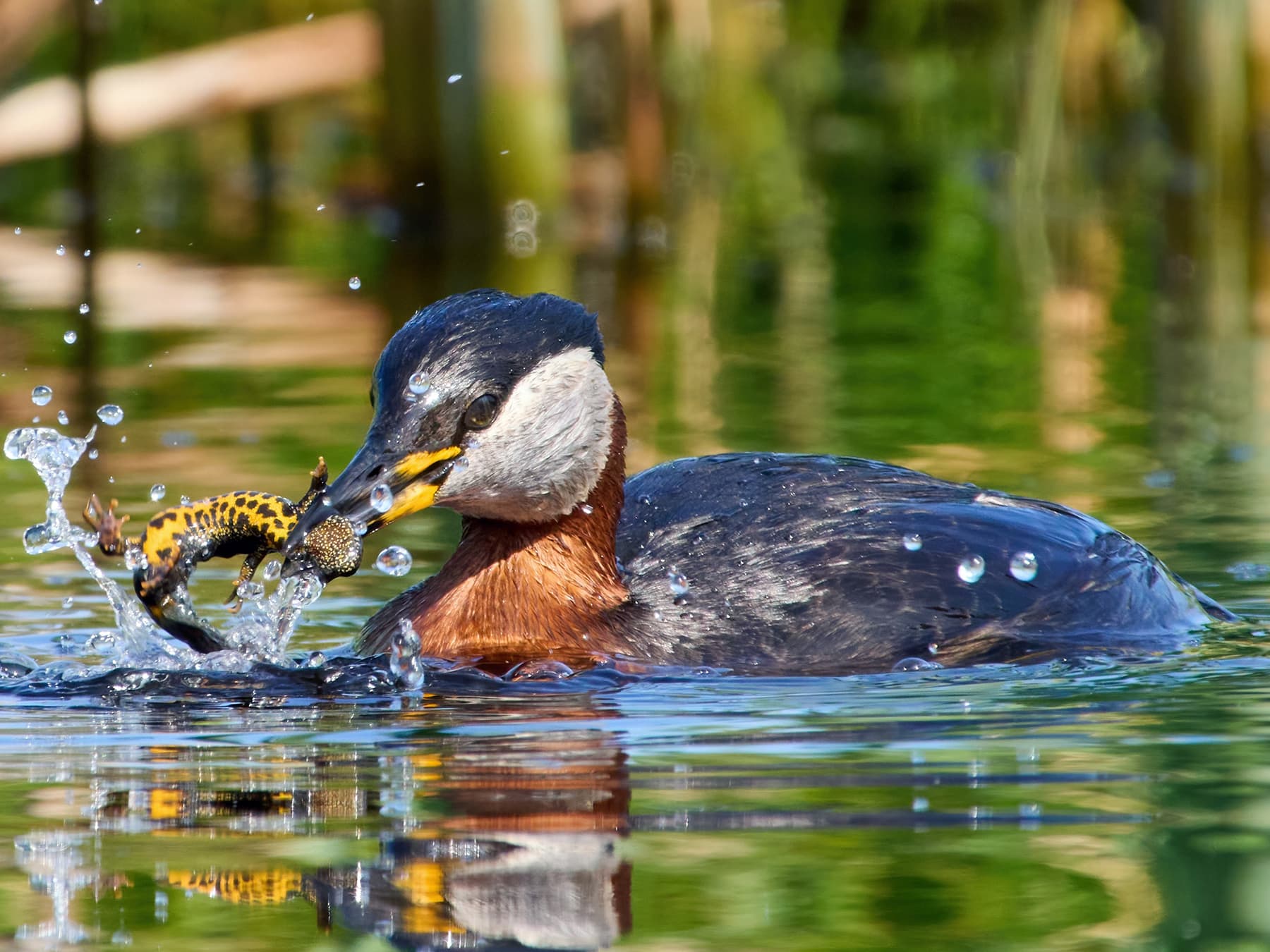
Aquatic insects, crustaceans, and fish are important throughout the year, usually caught underwater. Red-necked grebes are proficient divers and can reach depths of between 2 and 5 m, staying underwater for up to a minute when in pursuit of prey. In the breeding season, larger prey items, including frogs, newts, and salamanders, are taken.
What do Red-necked Grebe chicks eat?
In their early weeks, red-necked grebes’ diet consists mainly of insects and aquatic invertebrates, fed by both parents. Crustaceans and leeches are also particularly important. By six to seven weeks, they gain independence and no longer rely on their parents for food.
Nesting and breeding
Where do Red-necked Grebes nest?
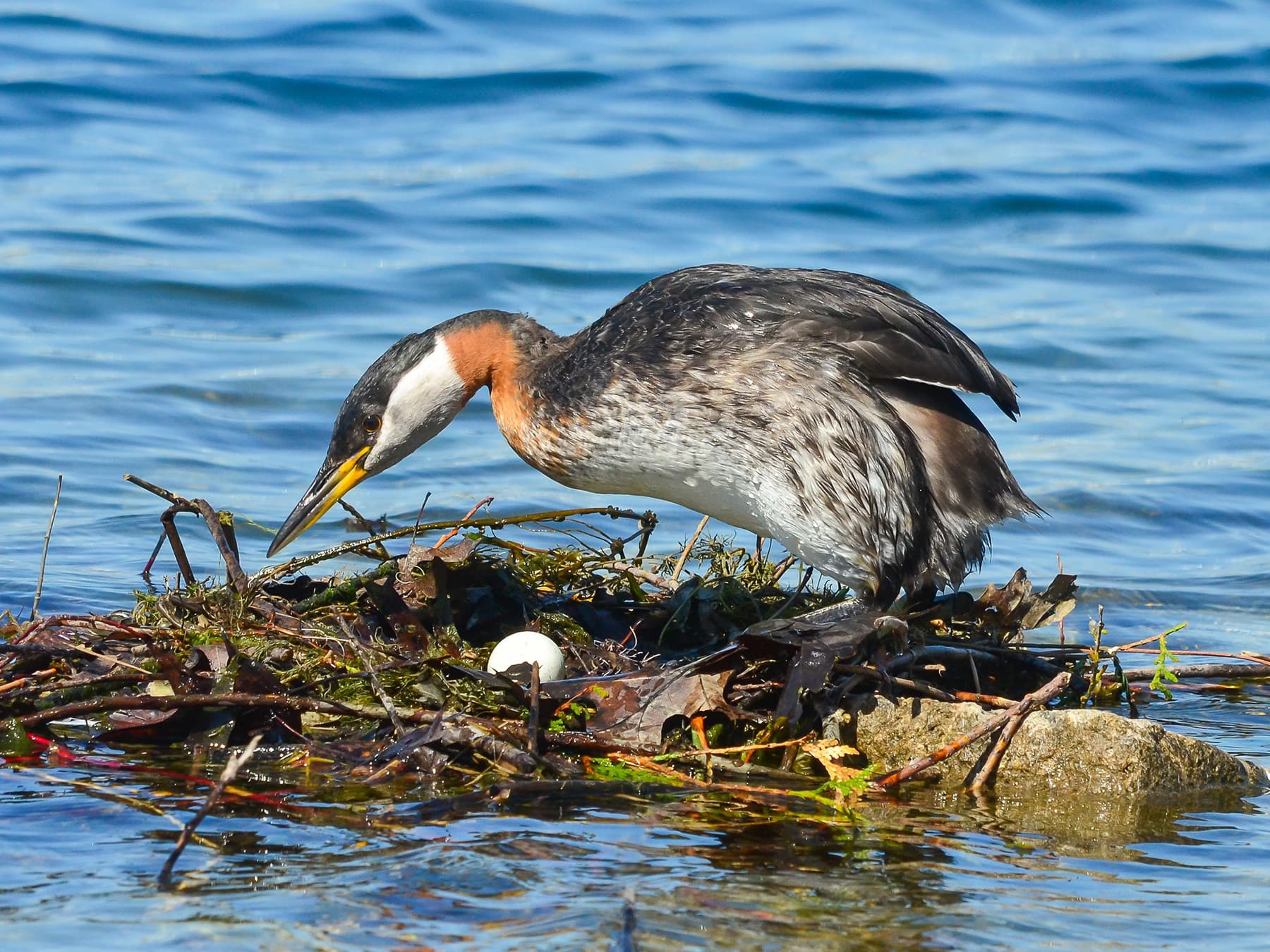
Sheltered spots on shorelines close to open water or floating mats of vegetation on a lake, tethered to aquatic plants or submerged reeds are typical nest sites for red-necked grebes. Males and females construct nests together, using underwater vegetation, bulrushes, and decaying plant matter to form a mound, with an internal depression in which the eggs are laid.
When do Red-necked Grebes nest?
Most red-necked grebes have returned to their breeding grounds by April and May, or earlier in some cases. A period of courtship and association on breeding grounds occurs before nesting begins, with the peak egg-laying period being in May and June. One brood is typical, and second broods may be attempted if an earlier nesting attempt fails.
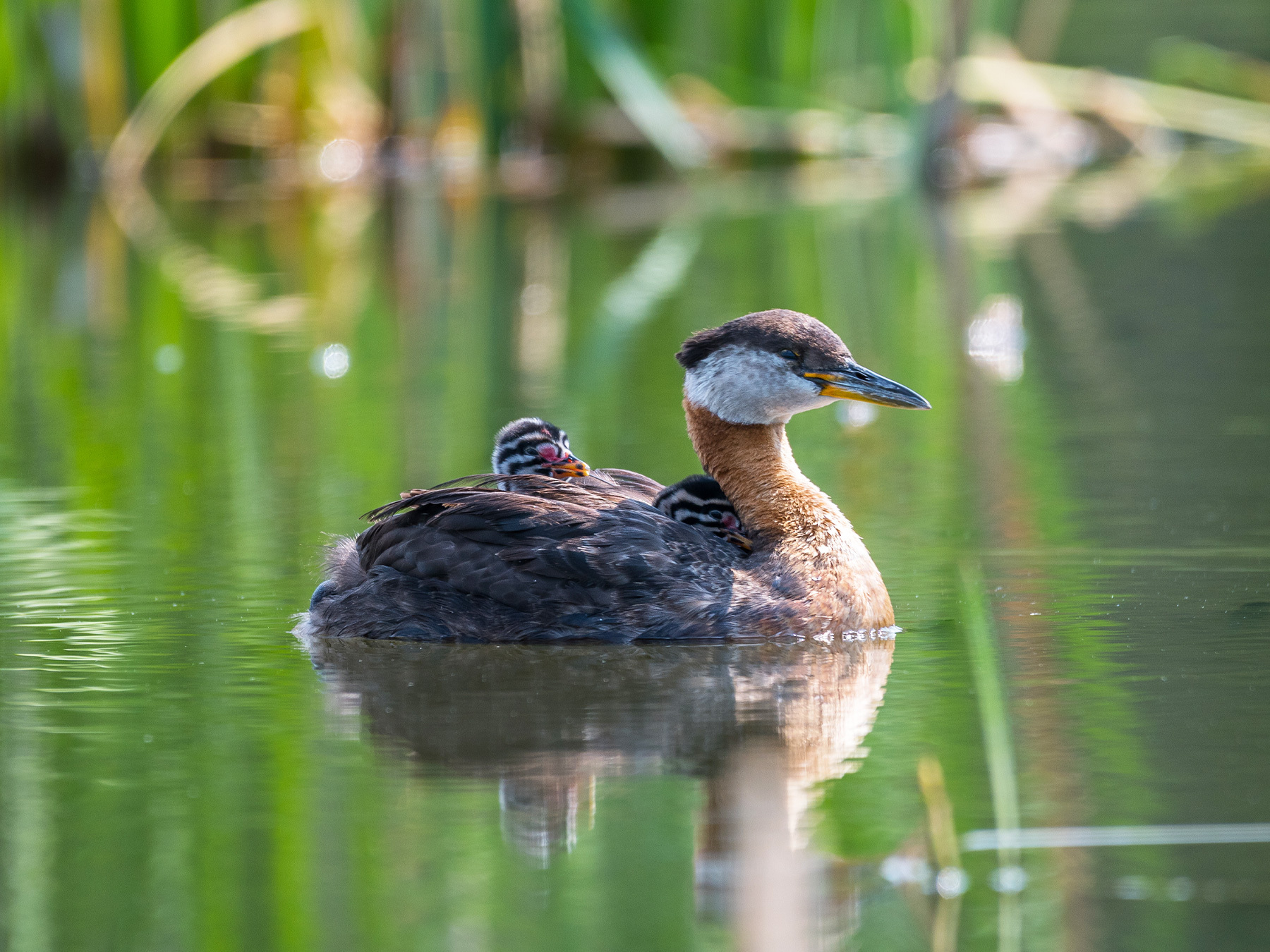
Incubation lasts for between 21 and 33 days, with males and females taking turns to brood the eggs. After hatching, young red-necked grebes spend much of the first two to three weeks nestled between the wings on the back of either parent.
What do Red-necked Grebe eggs look like?
Eggs are elongated, measuring 51 mm by 34 mm (2 in by 1.3 in), and are chalky white in appearance, although maybe pale blue when they are first laid. A typical clutch contains between 3 and 5 eggs.
Do Red-necked Grebes mate for life?
After arrival on nesting grounds in spring, red-necked grebes pair up with their mate following elaborate courtship displays. They remain together for the duration of the breeding season but part ways once breeding is complete and form larger groups ahead of fall migration.
In subsequent years, it’s most usual for new pairs to form, although when both former mates return to the same nesting spot, occasional reports of ‘re-pairings’ have been recorded.
Behaviour
Are Red-necked Grebes aggressive?
Although they are not a naturally aggressive species, defensive behavior will be displayed during the nesting season when a threat is sensed near the nest site.
Where do Red-necked Grebes sleep at night?
Overnight roosting sites are found on the water, where several red-necked grebes may settle together, offering safety in numbers and eliminating the threat of being disturbed by land predators.
Lifespan and predators
How long do Red-necked Grebes live?
On average, the lifespan of a red-necked grebe is between 6 and 9 years. Breeding is possible in one-year-old birds, although is more common from the age of 2.
What are the predators of Red-necked Grebes?
Wetland mammals such as mink and otters are among the main predators of red-necked grebes, particularly during the nesting season. Birds, including gulls, ravens, and birds of prey, may opportunistically raid nests and steal eggs. Large fish, such as northern pike, are a threat to young red-necked grebes in their early weeks on the water.
Are Red-necked Grebes protected?
The Migratory Birds Treaty Act of 1918 in the United States and the Wildlife and Countryside Act, 1981 in the UK both protect red-necked grebes against being killed, injured, traded, or taken into captivity.
Are Red-necked Grebes endangered?
There are no immediate or significant threats against the future survival of red-necked grebes, and they are currently classed as a species of least concern globally. In the UK, they have Red status on the British Birds of Conservation Concern list due to the extremely low breeding numbers there.
Large numbers of red-necked grebes are caught as bycatch annually in the Baltic Sea, and the construction of wind turbines is also an increasing cause of mortality, with the species’ nocturnal migration habits making collisions relatively common.
Conservation
While the Red-necked Grebe is currently listed as Least Concern, it faces threats from habitat loss, oil spills, and entanglement in fishing gear.
Conservation efforts focus on protecting wetland habitats and reducing water pollution to maintain healthy populations.
More photos
6 photos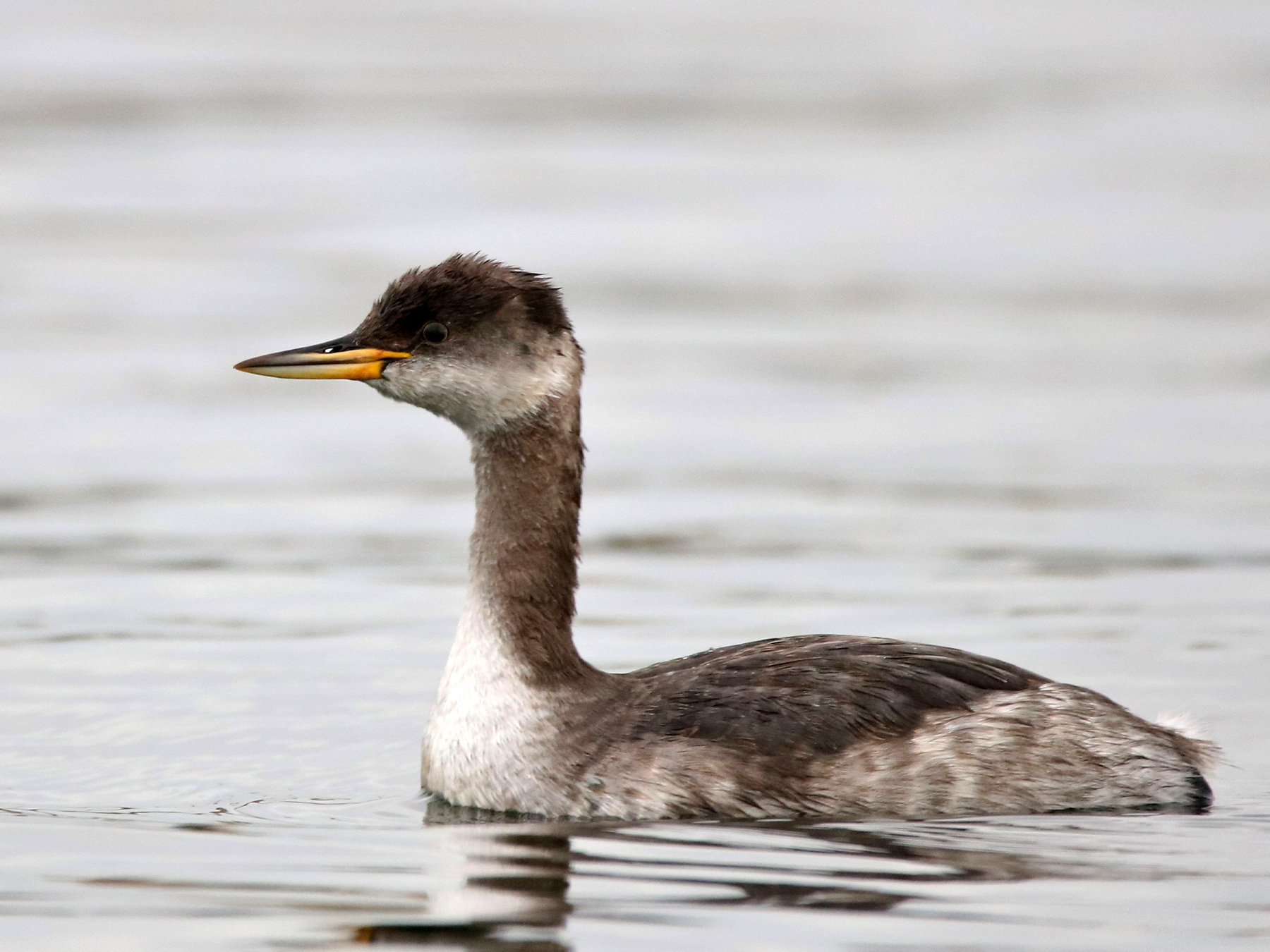
Quick facts
- Length
- 40–50 cm
- Wingspan
- 77–85 cm
- Weight
- 750–1600 g
- Lifespan
- 6–9 years · oldest recorded 11 years
- Family
- Grebes
- Migration
- Long-distance Migrant
- Global status (IUCN)
- Least Concern
- World population
- 190,000 - 290,000 individuals
- Population trend
- Decreasing
- Also called
- Holboell's Grebe
- Scientific name
- Podiceps grisegena
Sources
4- 1BirdLife International. 2018. Podiceps grisegena. The IUCN Red List of Threatened Species 2018: e.T22696599A132582688. Source (opens in a new tab)
- 2Wetlands International (2015)
- 3Wetlands International (2015)
- 4Longevity Records Of North American Birds. Version 2023.1 Source (opens in a new tab)

Checked by
Nathan Cope, founder and editor
Nathan founded Birdfact and leads its writers and contributors in the UK, the US and Canada. He has watched and studied birds for more than ten years, and checks every article and species guide before it’s published.