Species Profile
Fox Sparrow
Passerella iliaca
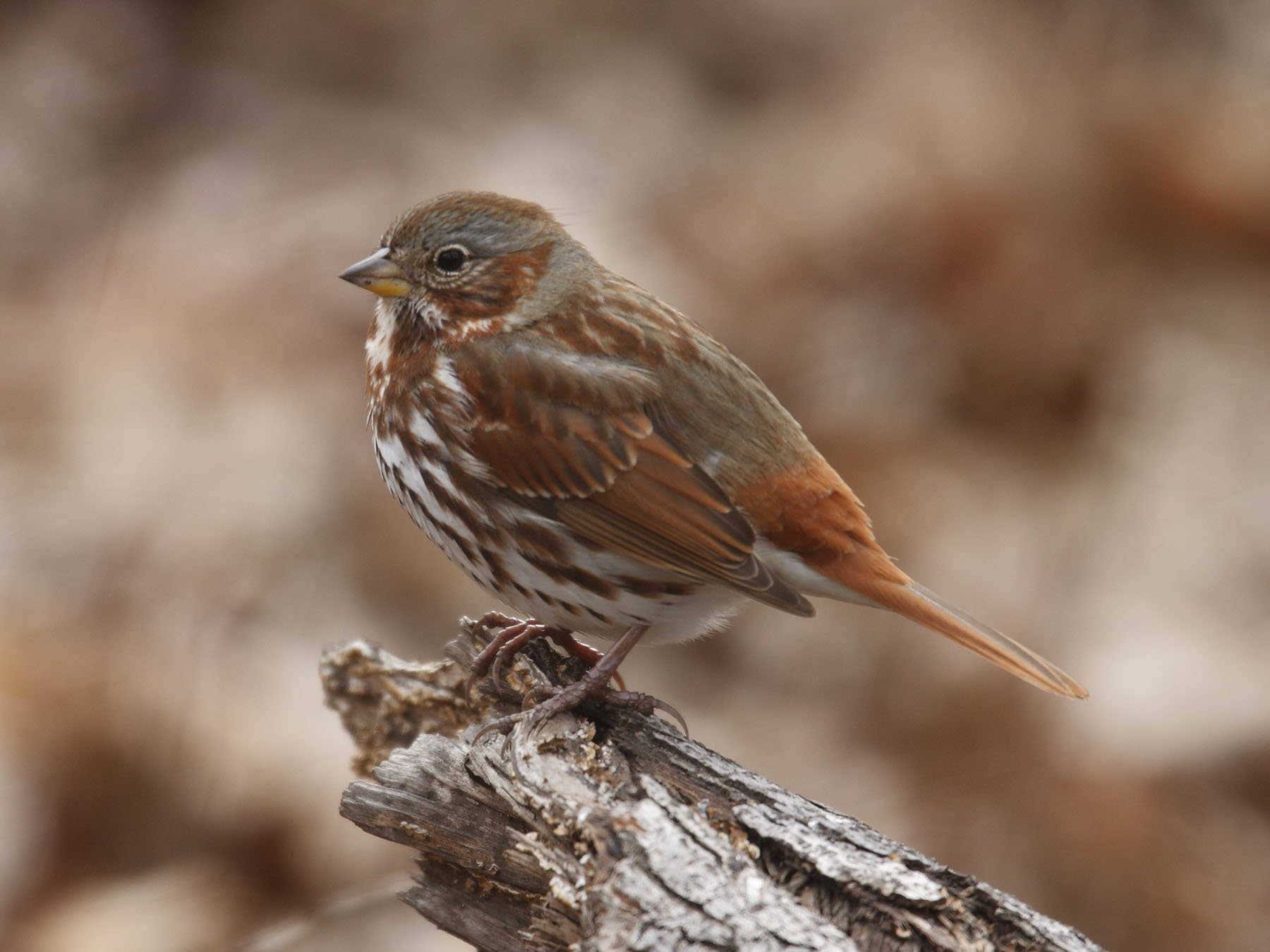
Fox Sparrow perched on a textured branch, showing its brown and white streaked breast, reddish-brown wings, and greyish head.
Quick Facts
Conservation
LCLeast ConcernLifespan
2–6 years
Length
15–19 cm
Weight
26–49 g
Wingspan
26.7–29.9 cm
Migration
Partial migrant
The Fox Sparrow is the largest of North America's native sparrows, built like a small thrush and marked with bold reddish-brown chevrons across a white breast. Its song — a rich, cascading warble of clear whistles and trills — is widely regarded as among the finest of any North American sparrow, yet most people encounter it only as a secretive rustler in dense winter thickets, betrayed by the loud double-scratch of its feet raking through the leaf litter.
Think you've spotted a Fox Sparrow?
Upload a photo and we'll confirm it instantly
Confirm with a PhotoAppearance
At 15–19 cm long and weighing 26–49 g, the Fox Sparrow is noticeably larger and stockier than most sparrows — closer in bulk to a small thrush than to a typical seed-eater. The body is rounded, the head large and domed, and the bill thick-based and conical. One of the most reliable field marks across all forms is the two-toned bill: the lower mandible is distinctively yellow, while the upper mandible is darker grey. The tail is medium-length and slightly notched, and most forms show a reddish rump and tail that is brighter than the back — a flash of colour visible as the bird flushes into cover.
Plumage varies so dramatically across the four main subspecies groups that major taxonomic authorities disagree on whether they represent one species or four. The Red Fox Sparrow (P. i. iliaca group) is the most widespread and familiar form: rich reddish-brown upperparts with grey tones on the head and nape, a white belly, and bold reddish-brown chevron-shaped spots that converge into a central breast spot. The face is plain and unstriped — a useful identification feature — with a grey supercilium and rusty-brown ear coverts.
The Sooty Fox Sparrow (P. i. unalaschcensis group) is the darkest form, with uniform deep chocolate-brown upperparts and heavy dark brown spotting below, sometimes coalescing into large breast patches. The Slate-colored Fox Sparrow (P. i. schistacea group) has a solid grey head and mantle contrasting with bright rufous wings and tail, and black spotting on white underparts. The Thick-billed Fox Sparrow (P. i. megarhyncha group) is similar to the Slate-colored but distinguished by a particularly massive, chunky bill.
Males and females are alike in plumage — the Fox Sparrow is not sexually dimorphic in colour. Males are slightly larger in body size, but the difference is not reliably visible in the field. Juveniles closely resemble adults but show slightly duller upperparts and narrower breast streaks.
Identification & Characteristics
Colors
- Primary
- Rufous
- Secondary
- Grey
- Beak
- Yellow
- Legs
- Pink
Markings
Bold reddish-brown chevron-shaped spots converging at a central breast spot; plain, unstriped face; yellow lower mandible; reddish rump and tail brighter than the back. Plumage varies dramatically across four subspecies groups from bright rufous (Red) to dark chocolate-brown (Sooty) to grey-headed with rufous wings (Slate-colored and Thick-billed).
Tail: Medium-length, slightly notched tail; reddish-rufous in most forms, noticeably brighter than the back — a useful field mark when the bird flushes.
Attributes
Understanding Attributes
Rated 0–100 based on research and observation. A score of 50 is average across all bird species. These attributes are relative and don't necessarily indicate superiority.
Habitat & Distribution
Fox Sparrows breed across a broad arc of northern and western North America, with each subspecies group occupying a distinct habitat niche. The Red group — the most widespread — favours scrubby boreal forest and forest edges containing black spruce, white spruce, balsam fir, tamarack, aspen, birch, willow, and alder, breeding from Alaska east to Newfoundland and the Maritime Provinces of Canada. The Sooty group breeds in deciduous streamside thickets with willow and blackberry along the Pacific coast, from the Aleutian Islands south to northwestern Washington. The Slate-colored group occupies dense riparian thickets of alder, water birch, willows, currants, and rose from central British Columbia south through the Rocky Mountains to Colorado. The Thick-billed group is largely restricted to brushy high-elevation habitat — green-leaf manzanita, mountain whitehorn, and bush chinquapin — in the Sierra Nevada and Cascades of California and Oregon.
In winter, all groups favour dense thickets, chaparral, forest edges, and woodland undergrowth. The Red group winters across eastern North America from southern New England and the Great Lakes south to Florida and Texas. The Sooty group winters along the Pacific Coast from southeastern Alaska to northern Baja California. The Slate-colored group winters in tall chaparral from California to New Mexico, while the Thick-billed group winters in chaparral in southern California.
In the United States, the Fox Sparrow is an uncommon to common winter visitor across much of the East and Pacific Coast, and a breeder in Alaska and western mountain states including Idaho, Montana, Nevada, Utah, Oregon, and California. Canadian birders encounter it as a widespread boreal breeder and a common migrant. The species has been expanding its breeding range southward along the Appalachian spine: the first confirmed nest in Maine was recorded in 1983, New Hampshire followed in 1996, and the range continues to push into Vermont. Mountain Birdwatch data from 2010–2025 shows a regional increase of approximately 1.48% per year in the Northeast.
Vagrant records extend the species' reach far beyond its normal range. Fox Sparrows have been recorded in Greenland, Iceland, Ireland, Germany, and Italy — transatlantic wanderers that ornithologists believe may have rested on ships far from shore before continuing their journey. The species has also been recorded from Bermuda, Mexico, and Saint Pierre and Miquelon.
Where to See This Bird
Explore regional guides for locations where this bird has been recorded.
Illinois
Iowa
Indiana
Kansas
Maryland
New Jersey
North Dakota
Minnesota
Missouri
Alaska
Arkansas
California
District of Columbia
Delaware
Oklahoma
Oregon
Tennessee
Virginia
Washington
Wisconsin
Canada
British Columbia
Manitoba
Newfoundland and Labrador
Northwest Territories
Quebec
Yukon Territory
Diet
Fox Sparrows are omnivorous, with the balance of their diet shifting markedly between seasons. During the breeding season, insects dominate: beetles, fly larvae, caterpillars, ants, bees, and scale insects, supplemented by spiders, millipedes, molluscs, and small snails. Nestlings are fed almost exclusively on insects, which provide the protein needed for rapid growth.
From autumn through winter, the diet shifts towards plant material, with seeds predominating. Favoured seed sources include smartweed (Polygonum/knotweed), grasses, sedges, ragweed, and sorrel. Berries and fruits are also taken when available — strawberry, raspberry, blackberry, serviceberry, pokeweed, red cedar, grape, witch hazel, and cinquefoil all feature in the winter diet. Coastal populations of the Sooty group add a further dimension: they feed on tiny crustaceans and other small marine invertebrates found on beaches, a behaviour rarely documented in other sparrow species.
Foraging is almost entirely on the ground, typically under dense cover. The double-scratch technique — hopping forward and immediately hopping back while dragging both feet through the leaf litter — is the Fox Sparrow's primary tool for uncovering buried food. This vigorous method can expose seeds and invertebrates that other ground-feeders miss entirely. The birds rarely stray more than a few metres from cover while foraging, and will dash back to safety at the first sign of disturbance.
At backyard feeders, Fox Sparrows readily take millet, sunflower seeds, and cracked corn, particularly from ground-level trays or platforms near brush piles. They are most likely to visit feeders during migration and in winter, when natural food sources are less abundant.
Behaviour
Fox Sparrows spend most of their time on or near the ground, moving through dense thickets with a characteristic purposefulness. Their signature foraging move — the "double-scratch" — is one of the most distinctive behaviours of any North American sparrow: the bird hops forward and immediately hops back, simultaneously dragging both feet backwards through the leaf litter to expose buried seeds and invertebrates. The resulting rustle is loud enough to be heard from several metres away, often alerting a birder to a bird that remains completely hidden in the undergrowth. This technique is shared with towhees but is performed with particular vigour by the Fox Sparrow.
Outside the breeding season, Fox Sparrows are generally solitary or loosely associated with mixed flocks of other ground-feeding sparrows and towhees. They rarely venture far from dense cover while foraging, retreating quickly into thickets when disturbed. On the breeding grounds, males establish territories within a single day of arriving — an unusually rapid pace — and pair off with mates within about a week. Territory size can reach up to 2.5 acres.
Males sing to defend territories from concealed perches within the territory rather than from exposed song posts, which makes them harder to locate than many other songbirds. Both parents perform a broken-wing distraction display — dragging one wing along the ground as if injured — to lure predators away from the nest. This behaviour is shared with many ground-nesting birds and can be highly effective at drawing a fox or crow away from eggs or chicks.
During migration, Fox Sparrows travel at night and forage actively during the day, often appearing in gardens and parks that they would not otherwise visit. They can be surprisingly bold at feeders, particularly when dense cover is nearby.
Calls & Sounds
The Fox Sparrow's song is widely regarded as among the finest produced by any North American sparrow. It is a rich, loud, melodious warble of seven or more phrases, typically opening with one or more clear, sweet whistled notes before transitioning into short trills, churrs, or buzzy elements. A representative phrasing has been transcribed as "too-weet-wiew too-weet tuck-soo-weet-wiew." The complete song lasts only a few seconds, but its clarity and volume carry well through dense vegetation. The 19th-century naturalist William Brewster, writing of breeding Fox Sparrows in the Gulf of Saint Lawrence, described it memorably: "At all hours of the day, in every kind of weather late into the brief summer, its voice rises among the evergreen woods filling the air with quivering, delicious melody."
Song quality varies by subspecies group. The Red (northern/eastern) group produces the sweetest, most purely whistled songs. The Sooty, Slate-colored, and Thick-billed groups include harsher buzzy trills and more complex elements interspersed with the whistled notes — still musical, but with a rougher texture. The Missouri Department of Conservation describes the song as "loud and beautiful, with several clear introductory whistles followed by quick trills and buzzes."
Males sing most actively during the breeding season, often from concealed perches within their territory rather than exposed song posts — a habit that makes them harder to locate than many other songbirds. Singing is occasional but not common in winter. During migration, birds travel at night and sing during the day, so a Fox Sparrow in song during October or April is likely a migrant passing through.
The call is a sharp, metallic "chink" or "tschup" — louder than a Lincoln's Sparrow's call and softer than a Brown Thrasher's. Large-billed Pacific subspecies give a sharper "chink" similar to the California Towhee's call. The flight call is a high, rising "seeep," given commonly on the ground and in thickets. An alarm call — a sharp metallic chip — is given near the nest when predators approach.
Flight
In flight, the Fox Sparrow appears noticeably larger and heavier than most sparrows — its stocky body and broad, rounded wings give it a slightly thrush-like silhouette. The wingspan spans 26.7–29.9 cm, broad relative to body length, which gives the bird a buoyant, somewhat undulating flight style typical of many passerines. Flights between cover patches are usually short and low, with the bird dropping quickly back into dense vegetation rather than flying in the open for extended periods.
The reddish rump and tail are often the most visible features as a Fox Sparrow flushes — a warm rufous flash that distinguishes it from the duller tones of most other sparrows. In the Red group, the contrast between the rusty tail and the greyer back is particularly striking. The Sooty group shows less contrast, appearing uniformly dark in flight, while the Slate-colored and Thick-billed groups show the same rufous tail flash against a grey back.
During migration, Fox Sparrows travel at night, making them infrequently observed in sustained flight. Daytime movements between foraging patches are typically brief and direct. The flight call — a high, rising "seeep" — is the most reliable way to detect a Fox Sparrow moving overhead at night during peak migration in October and November. Migrants often descend into dense cover at first light and remain there through the day, foraging quietly in the leaf litter.
Nesting & Breeding
Fox Sparrows are monogamous and solitary breeders. The breeding season runs from mid-May to July, varying by latitude and elevation. Males arrive on the breeding grounds and establish territories within a single day — a remarkably rapid pace — then pair off with mates within about a week. Territory size can reach up to 2.5 acres, defended primarily through song from concealed perches.
Nest sites are on the ground or in low crotches of bushes or trees, rarely more than about 2.4 m (8 ft) above ground. Ground nests are typically placed on grassy hummocks under dense shrub cover, among the roots of upturned stumps, or under conifers. In Newfoundland, nests are frequently tucked under spruce and fir. In western North America, nests are placed under dense chaparral vegetation. The female probably builds the nest alone, typically completing it in 2–3 days — one female was recorded finishing a new nest and laying an egg within a single day.
Nest construction is substantial. The outer wall is built from twigs, strips of bark, shredded wood, rotting wood, broom moss, coarse dry grass, moss, and lichens. The inner cup is lined with fine grass, rootlets, animal hair (from sheep, cows, or dogs), feathers, moss, and occasionally fishing line. Nests built above ground tend to be larger and bulkier, with more twigs in the outer walls.
Clutch size is 2–5 eggs, typically 3–4, with fewer eggs laid towards the southern edge of the breeding range. Eggs are pale bluish-green to pale green or greenish-white, boldly blotched with reddish-brown, and average approximately 2.1–2.4 cm long by 1.6–1.8 cm wide. Incubation is performed by the female alone and lasts 12–14 days (average 13 days). Both parents feed the nestlings, primarily on insects. Young leave the nest 9–11 days after hatching. Most pairs raise a single brood per year, though some attempt two. Both parents will perform a broken-wing distraction display to draw predators away from the nest.
Lifespan
The typical lifespan of a Fox Sparrow in the wild is 2–6 years, consistent with other medium-sized passerines that face significant predation pressure and the physiological demands of long-distance migration. Annual survival rates are not well documented across all subspecies groups, but mortality is highest in the first year of life, before birds reach reproductive maturity at approximately one year of age.
The maximum recorded lifespan is 10 years and 4 months — a bird banded and recaptured in California in 2003, which had remained in the same state throughout its life, suggesting strong site fidelity. The AnAge database records a maximum longevity of 10.3 years for the species. A separate record from the Patuxent Wildlife Research Center documents a bird reaching 9 years and 8 months. Both records are exceptional for a small passerine; by comparison, the closely related Song Sparrow rarely exceeds 11 years in the wild.
Known predators include Sharp-shinned Hawks, Cooper's Hawks, American Kestrels, owls, domestic cats, snakes, and small mammals such as weasels and chipmunks. Both adults and eggs are vulnerable: nest predation is a significant cause of breeding failure, which is why the broken-wing distraction display has evolved as a counter-measure. The species' preference for dense thicket habitats provides some protection from aerial predators, but ground-based predators can locate nests by scent. Many Fox Sparrows breed in remote boreal Canada and Alaska, where predator pressure from humans and domestic animals is lower than in more populated regions.
Conservation
The Fox Sparrow is listed as Least Concern on the IUCN Red List (assessed 2016), with a global breeding population estimated at approximately 35 million by Partners in Flight. North American Breeding Bird Survey data from 1966–2019 shows populations held broadly steady over that period, and Partners in Flight rates the species 10 out of 20 on the Continental Concern Score, indicating low conservation concern. However, BirdLife International lists the overall population trend as decreasing, and some regional declines have been noted in the East.
The picture is not uniform across the range. In the Northeast, Mountain Birdwatch monitoring data from 2010–2025 documents a slight increase of approximately 1.48% per year, linked to a southward breeding range expansion along the Appalachian spine — a trend that appears to be continuing. Climate change projections, however, suggest the southern limit of the breeding range may contract to central Quebec in the long term as boreal habitat shifts northward.
Habitat loss from logging is a primary threat, as Fox Sparrows are particularly vulnerable to the destruction of dense undergrowth and thicket habitats. Paradoxically, both logging operations and forest fires can also create dense shrubby regrowth that serves as suitable breeding habitat, so the relationship between forestry practices and Fox Sparrow populations is complex. Changes to forest fire regimes in the West have likely shifted the species' distribution in ways that are not yet fully understood.
Many Fox Sparrows breed in remote northern Canada and Alaska, providing a meaningful buffer from direct human disturbance during the breeding season. The species is protected under the US Migratory Bird Treaty Act. No targeted conservation programmes are currently considered necessary given the species' large population and broad range.
Population
Estimated: Approximately 35 million (Partners in Flight global breeding population estimate)
Trend: Decreasing
Stable overall with some regional declines in the East; slight increase documented in the Northeast (Mountain Birdwatch 2010–2025, ~1.48% per year). BirdLife International lists the overall trend as decreasing.
Elevation
Sea level to above 3,000 m (breeding); sea level to mid-elevations (wintering)
Additional Details
- Family:
- Passerellidae (New World Sparrows)
- Predators:
- Sharp-shinned Hawk, Cooper's Hawk, American Kestrel, owls, domestic cats, snakes, weasels, chipmunks
- Clutch size:
- 2–5 eggs (typically 3–4)
- Fledging age:
- 9–11 days after hatching
- Territory size:
- Up to 2.5 acres
- Broods per year:
- Usually 1, occasionally 2
- Incubation period:
- 12–14 days (average 13 days), by female only
- Subspecies groups:
- Four: Red (P. i. iliaca), Sooty (P. i. unalaschcensis), Slate-colored (P. i. schistacea), Thick-billed (P. i. megarhyncha)
- Age at first breeding:
- Approximately 1 year
Taxonomy Debate
Few North American birds have generated as much taxonomic argument as the Fox Sparrow. For most of the 20th century it was treated as a single, highly variable species — one of the most variable in North America. Then genetic and morphological studies began to reveal just how deep the differences between the four subspecies groups really are: not just in colour and bill shape, but in song structure, habitat preference, and migratory behaviour. By the early 2000s, the case for splitting the species into four was being made seriously in the ornithological literature.
Today, the split is recognised by the IOC World Bird List and BirdLife International, which treat the Red, Sooty, Slate-colored, and Thick-billed Fox Sparrows as four separate species. The American Ornithological Society (AOS) — the authority for North American taxonomy — and the eBird/Clements checklist currently maintain the single-species treatment, though the AOS has the split under active review. The practical consequence for birders is significant: a Sooty Fox Sparrow seen in California and a Red Fox Sparrow seen in New England may or may not be the same species depending on which checklist you follow.
The case illustrates a broader challenge in modern ornithology: as genetic tools become more powerful, the traditional concept of a "species" — defined by the ability to interbreed — is increasingly supplemented by genetic distance, ecological divergence, and song differences. The Fox Sparrow groups do occasionally come into contact and may hybridise at range boundaries, which complicates the picture further. For now, the bird occupies an unusual position: simultaneously one species and four, depending on who you ask.
Subspecies Groups
The Fox Sparrow's extraordinary plumage variation across its range has made it one of the most taxonomically contested birds in North America. Eighteen or more subspecies are currently recognised, grouped into four distinct clusters that differ in colour, bill size, habitat preference, and song. The IOC World Bird List and BirdLife International now treat these four groups as full species; eBird and the Clements checklist currently maintain them as a single species. The debate is ongoing and unresolved.
The Red Fox Sparrow (P. i. iliaca group, ~5 subspecies) is the most widespread, breeding across the boreal taiga from Alaska to Newfoundland. It is the brightest and most rufous form, with the sweetest, most purely whistled song. The Sooty Fox Sparrow (P. i. unalaschcensis group, ~7 subspecies) breeds along the Pacific coast from the Aleutians to Washington and is the darkest form — a deep chocolate-brown that can look almost blackish in poor light. The Slate-colored Fox Sparrow (P. i. schistacea group, ~3 subspecies) breeds in interior western mountain ranges and is the most cleanly patterned, with a solid grey head and mantle contrasting sharply with rufous wings and tail. The Thick-billed Fox Sparrow (P. i. megarhyncha group, ~3 subspecies) is restricted to the Sierra Nevada and Cascades and is distinguished above all by its disproportionately massive bill — an adaptation thought to be linked to cracking harder seeds at high elevations.
Genetic studies confirm that the four groups are each other's closest relatives within Passerella, but also that they have been diverging for long enough to accumulate substantial differences in morphology, vocalisation, and ecology. Whether that divergence is sufficient to warrant full species status remains a matter of active scientific discussion.
Birdwatching Tips
In the eastern United States, the best time to find a Fox Sparrow is during migration — late October to early November in autumn, and late March to mid-April in spring — when birds move through in numbers and may appear in gardens, parks, and woodland edges that they would not otherwise visit. In winter, check dense thickets, brushy field edges, and well-vegetated suburban gardens from southern New England south to Florida and Texas. Listen for the loud double-scratch rustling from within cover — it often announces the bird before you see it.
On the Pacific Coast, Sooty Fox Sparrows are a reliable winter presence from Washington south to California, favouring blackberry tangles, clearcut regrowth, and chaparral. The Thick-billed and Slate-colored groups winter in chaparral habitats in California and the arid Southwest. In Canada, the species is a common migrant and a widespread boreal breeder; listen for the song in spruce-birch forest edges from May onwards.
Identification is straightforward for the Red group — the bold reddish-brown chevrons on white underparts, plain face, and yellow lower mandible are distinctive. Separating the western groups requires more care: look for the grey head of the Slate-colored and Thick-billed forms, and note the Thick-billed's disproportionately massive bill. The Sooty group's uniform dark brown plumage can suggest a large, dark Song Sparrow, but the Fox Sparrow's larger size, heavier spotting, and plain (unstriped) face are reliable separators.
To attract Fox Sparrows to a garden feeder, place millet or cracked corn on a ground-level tray near a brush pile or dense shrub. They are most likely to visit during migration and in winter. Patience pays — once a Fox Sparrow finds a reliable food source, it will often return to the same spot daily.
Did You Know?
- The Fox Sparrow's "double-scratch" foraging technique — hopping forward and immediately hopping back while dragging both feet through the leaf litter — is so vigorous and distinctive that it has its own name in ornithological literature. You can often hear it as a loud rustling from within dense thickets before you ever see the bird.
- Fox Sparrow fossils dating to the Pleistocene epoch (approximately 11,000 years ago) have been recovered from Pennsylvania, Virginia, and the famous La Brea tar pits in California, demonstrating that this species has inhabited North America since the last Ice Age.
- Vagrant Fox Sparrows have been recorded in Ireland, Iceland, Germany, and Italy — transatlantic wanderers that ornithologists believe may have rested on ships far from shore before continuing their journey across the ocean.
- The oldest recorded Fox Sparrow was at least 10 years and 4 months old when recaptured during banding operations in California in 2003 — in the same state where it had originally been banded, suggesting strong site fidelity across a remarkably long lifespan for a small passerine.
- The Fox Sparrow is the sole member of its genus, Passerella, yet it harbours so much genetic and morphological diversity across its 18+ subspecies that the IOC and BirdLife International now treat the four subspecies groups as four separate species — while eBird/Clements currently maintain them as one.
Records & Accolades
Finest Sparrow Song
7+ phrase warble
Widely regarded as producing one of the richest, most melodious songs of any North American sparrow — praised by naturalists since the 19th century.
Largest Native Sparrow
Up to 19 cm / 49 g
The Fox Sparrow is the largest of North America's native New World sparrows, approaching the size of a small thrush.
Longevity Record
10 years 4 months
The oldest recorded Fox Sparrow was recaptured in California in 2003, at least 10 years and 4 months after it was first banded — exceptional for a small passerine.
Transatlantic Vagrant
Ireland, Iceland, Germany, Italy
Fox Sparrows have crossed the Atlantic to reach Europe, with records from Ireland, Iceland, Germany, and Italy — thought to have rested on ships during their ocean crossing.
Community Photos
Be the first to share a photo of the Fox Sparrow
Upload a PhotoIdentify Any Bird Instantly
- Upload a photo from your phone or camera
- Get an instant AI identification
- Ask follow-up questions about the bird
Monthly Birds in Your Area
- Personalised for your location
- Seasonal tips and garden advice
- Updated every month with new species