


Dunnock
Hedge Sparrow, Hedge Accentor · Prunella modularis
By the Birdfact teamChecked by Nathan Cope
See it in 3D
3D model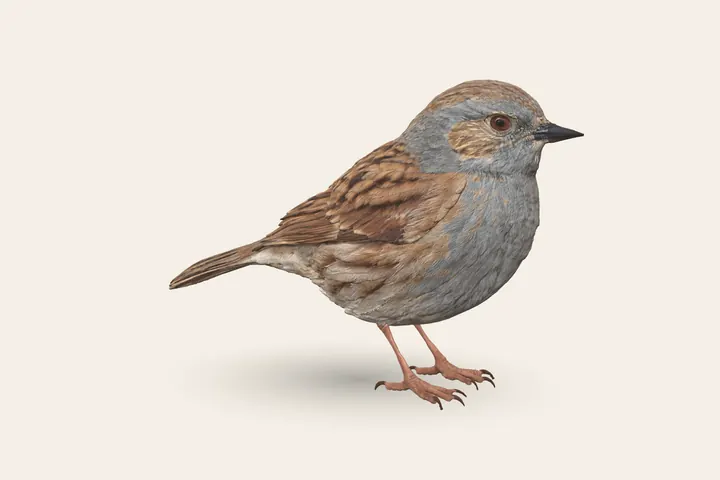 3D model
A Dunnock is 14–14.5 cm (5.5 in) long, bill to tail.
3D model · Adult · Length 14–14.5 cm (5.5 in) · How we make our birds · Report a problem
© 2026 NC Digital Limited (Birdfact). All rights reserved. This 3D model may be viewed on this page and shared by link only. Downloading, extracting, copying or reusing it, or using it to train machine-learning models, is not permitted without our written permission. Using our models
On this page16 sections
How to recognise it
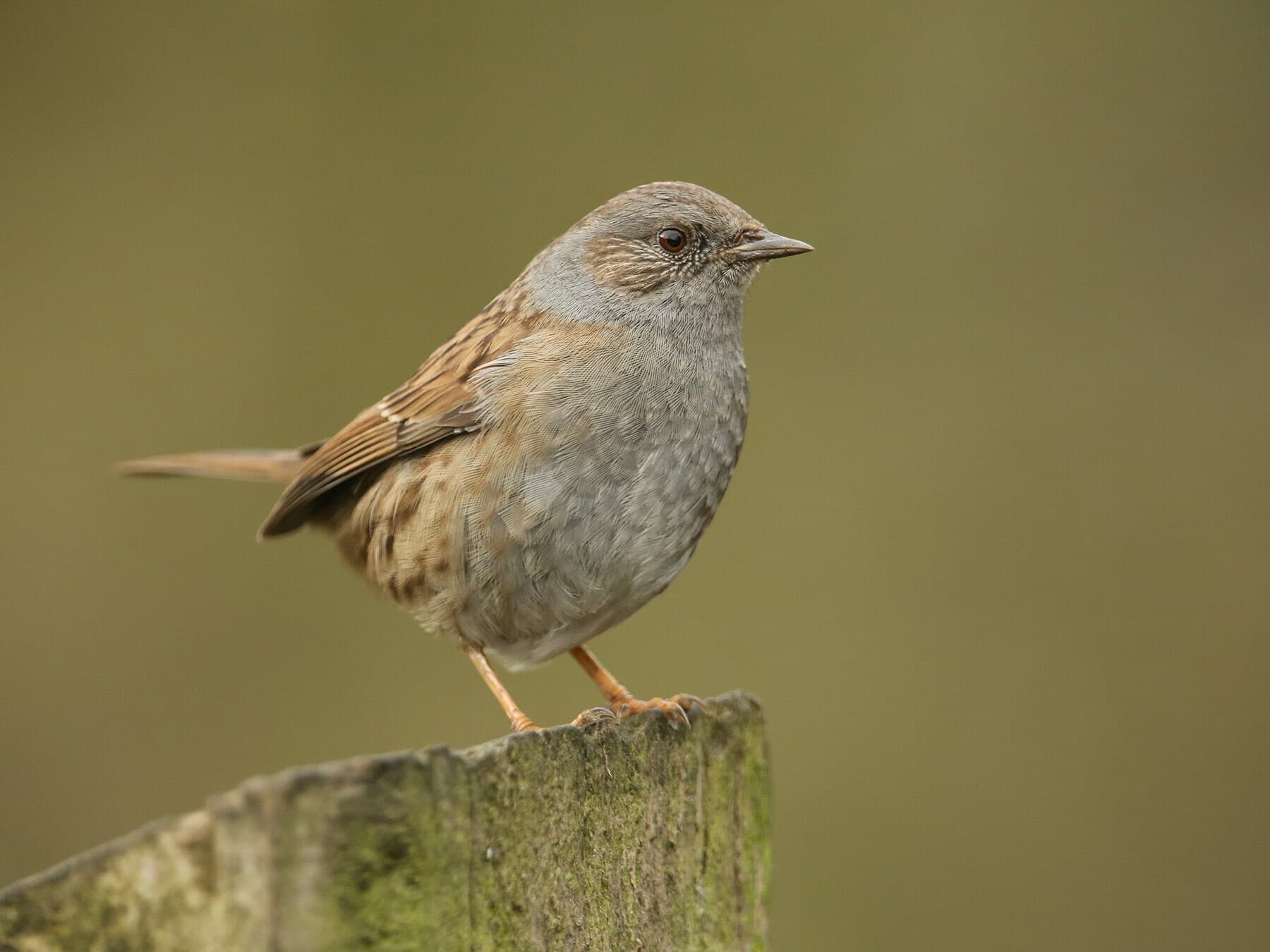
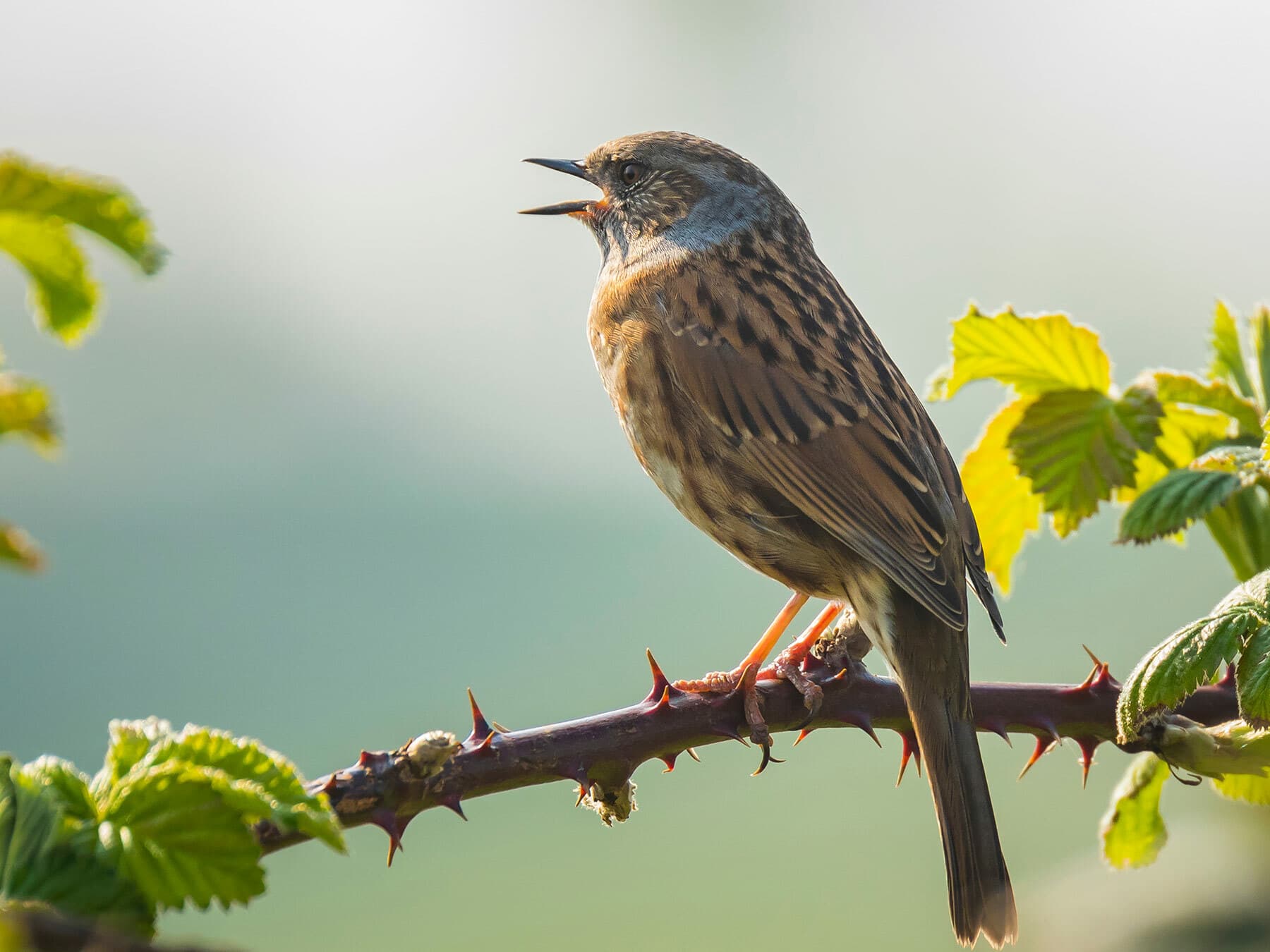
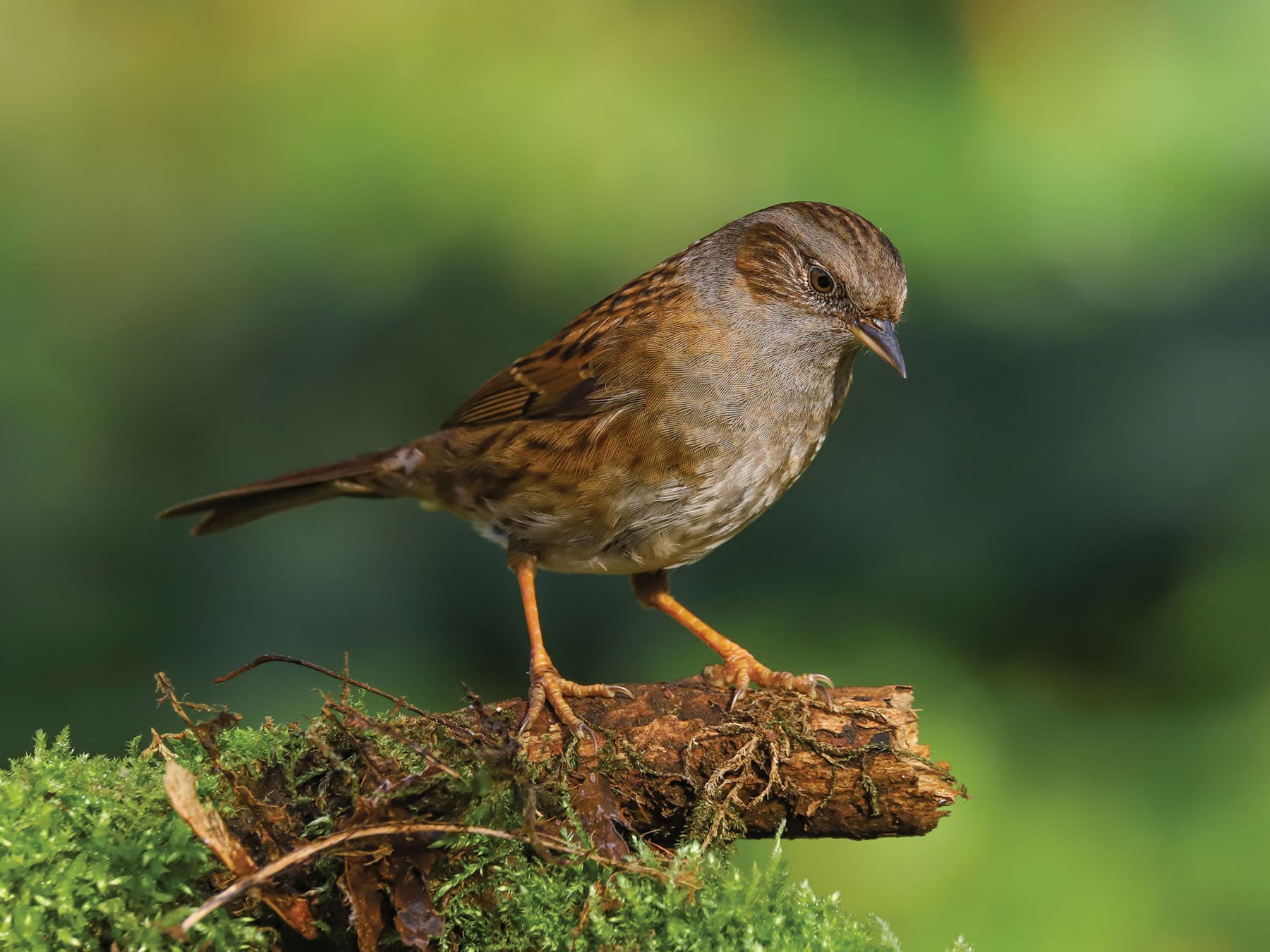
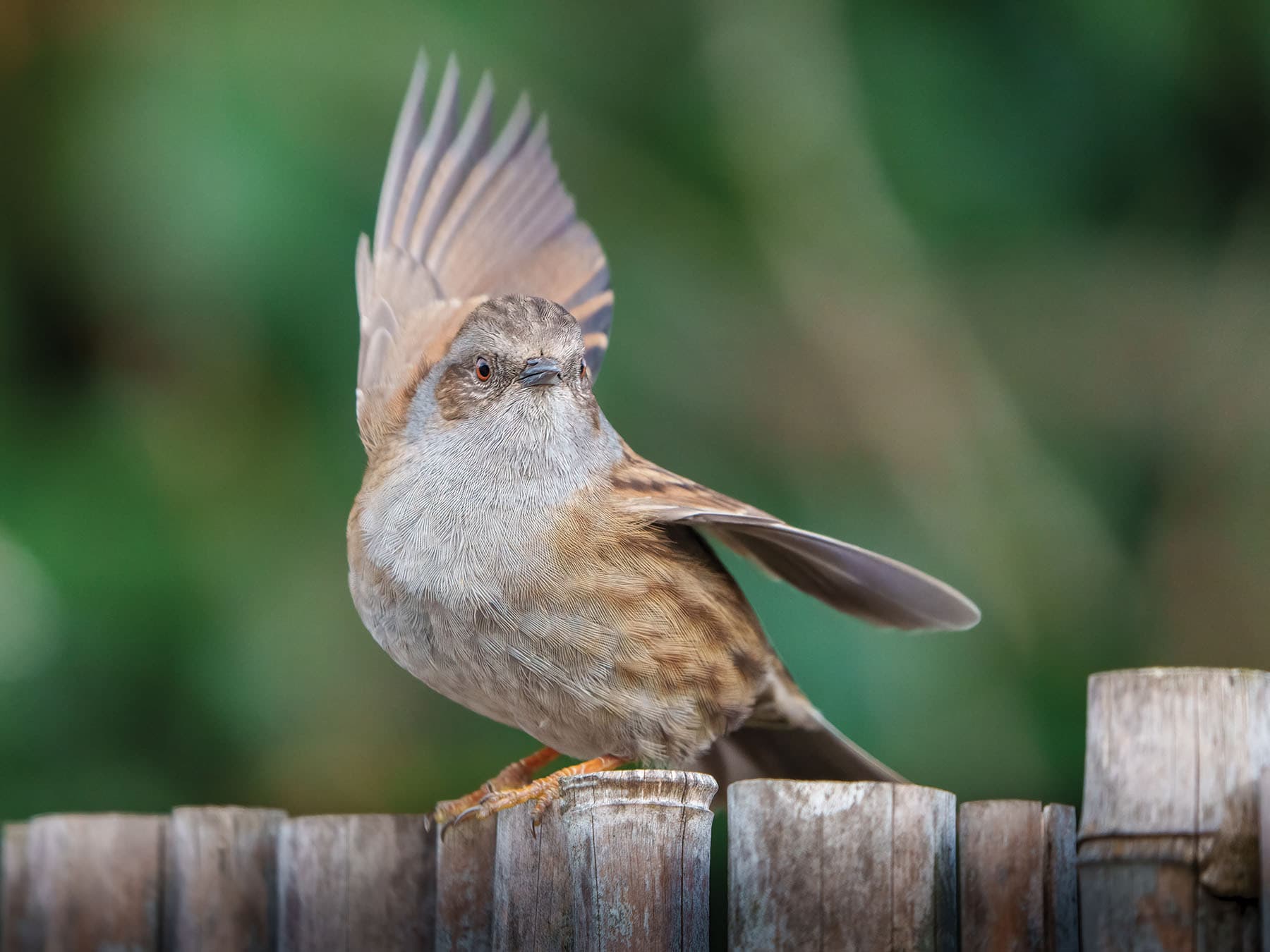
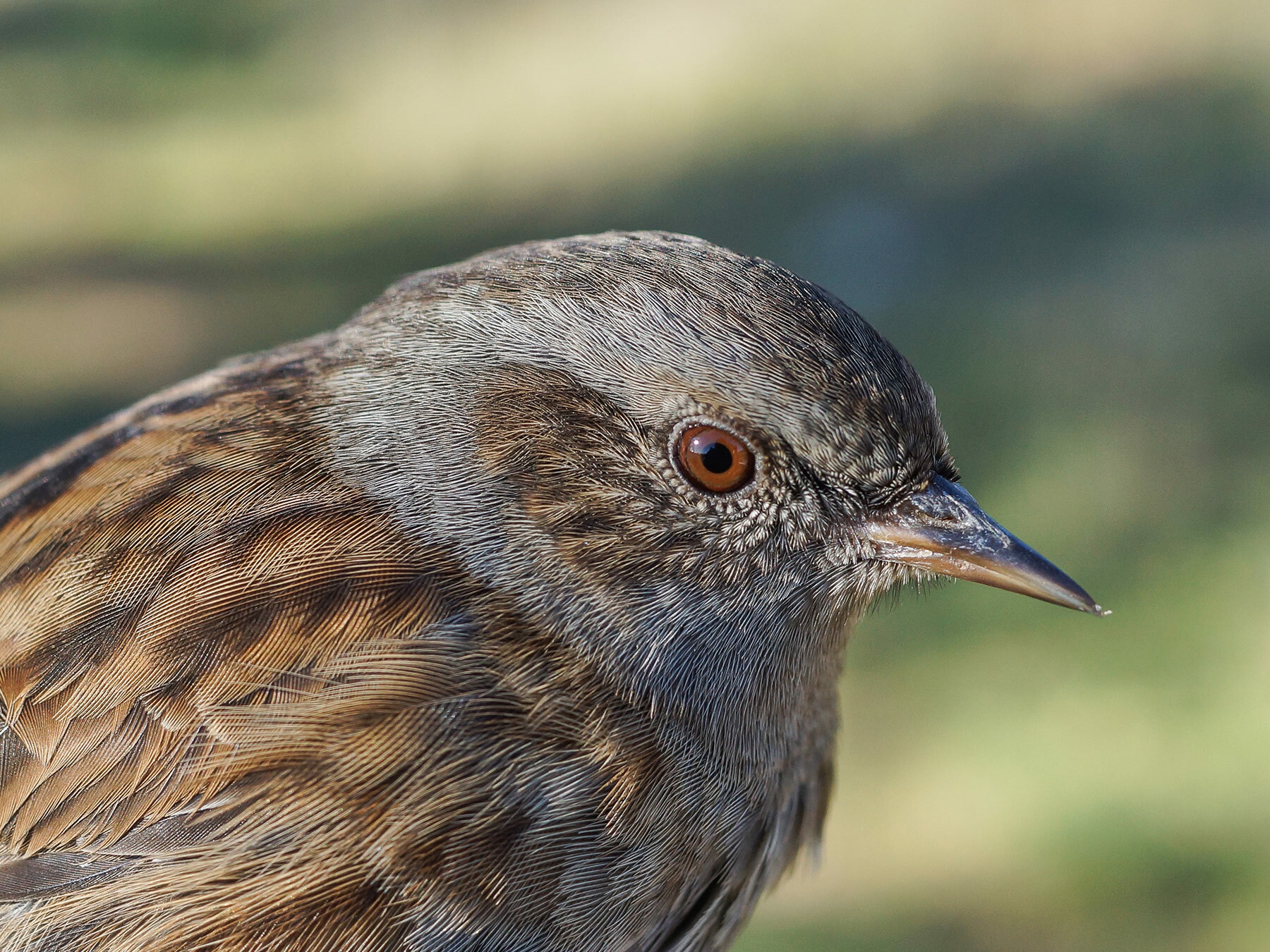
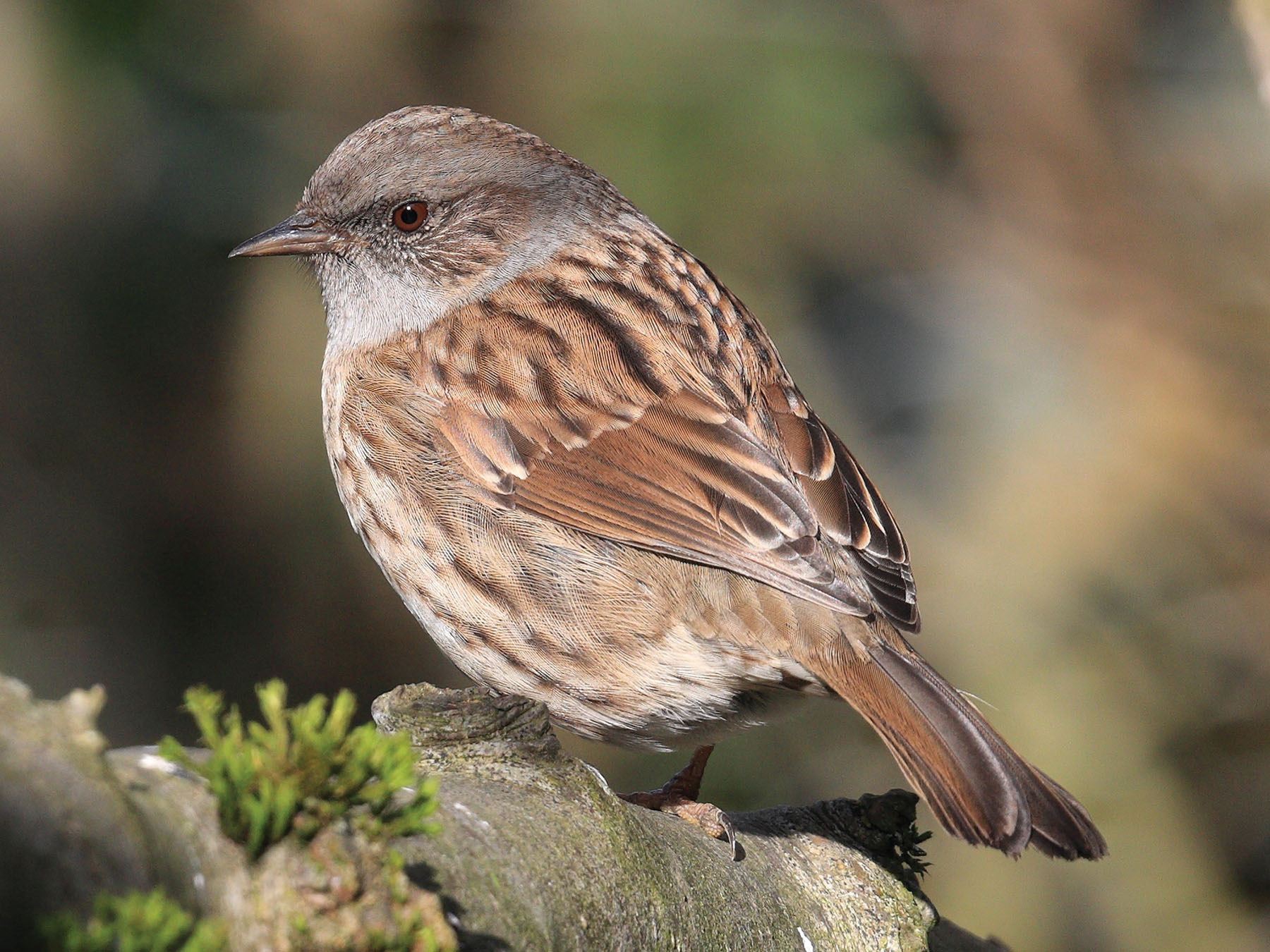
The Dunnock is a small grey-and-brown bird about the size of a House Sparrow: about 14 cm long and about 21 g. Look for a slate-grey face, throat and breast, a brown crown and cheeks, and a warm brown back finely streaked blackish. The flanks are pale brown with dark streaks, and the belly paler. Up close, the bill is thin, pointed and blackish, the eye reddish-brown and the legs pinkish to reddish-brown.1
The bill is the quickest check. A Dunnock's is fine and pointed, suited to insects and small seeds; a sparrow's is short and chunky. Dunnocks behave differently too: they creep and shuffle about low down, alone or in pairs, often flicking their wings, while sparrows hop about in groups.2
BTO measurements of live adults put most between 18.6 and 24 g.3
Male, female and young
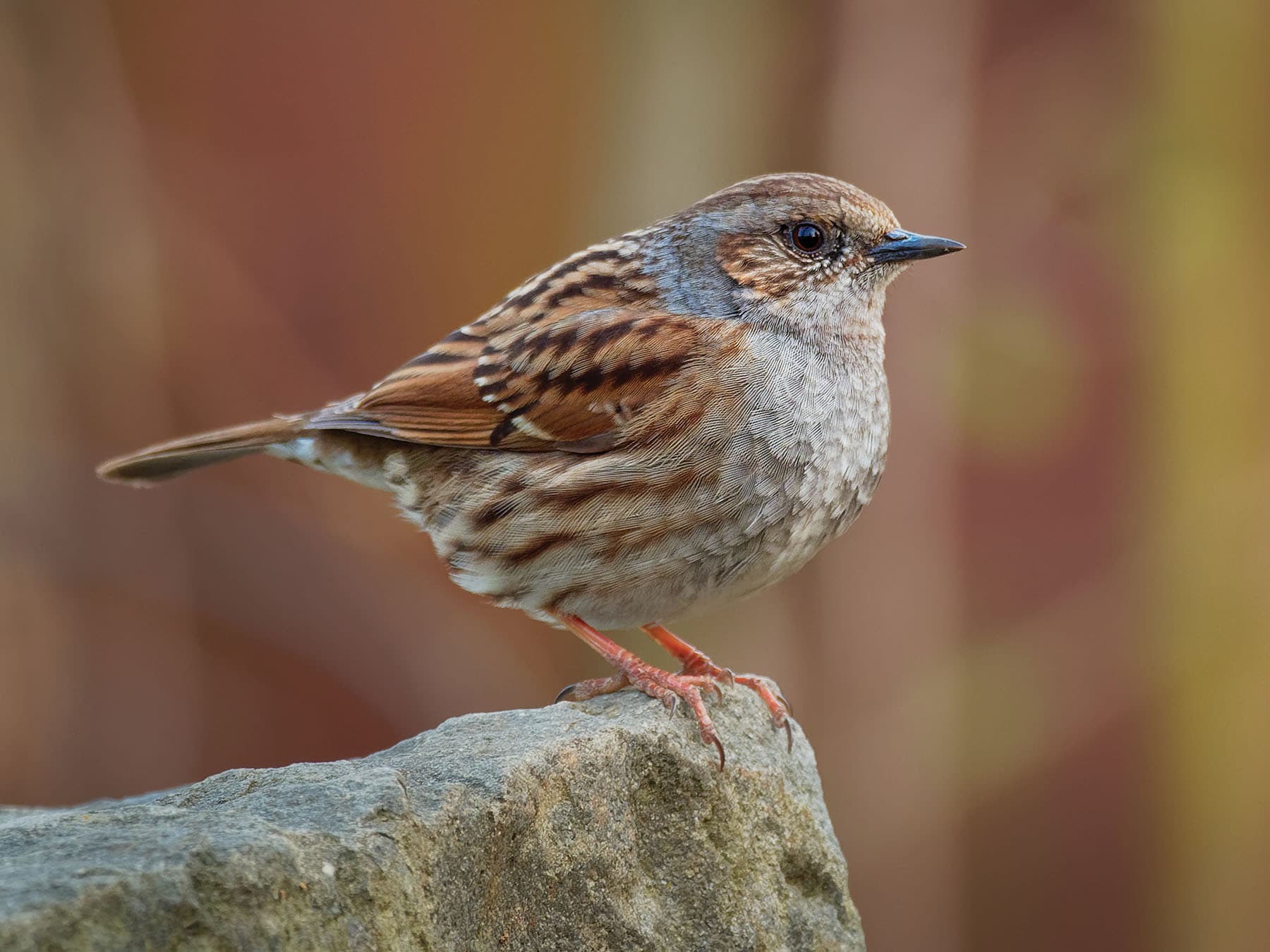
Males and females look the same. A female is a shade less richly coloured, with a browner head and a less heavily streaked back, but the difference is too slight to rely on. In BTO measurements males average slightly longer wings, while both sexes weigh the same. The bird singing from the top of a bush in spring is usually a male.
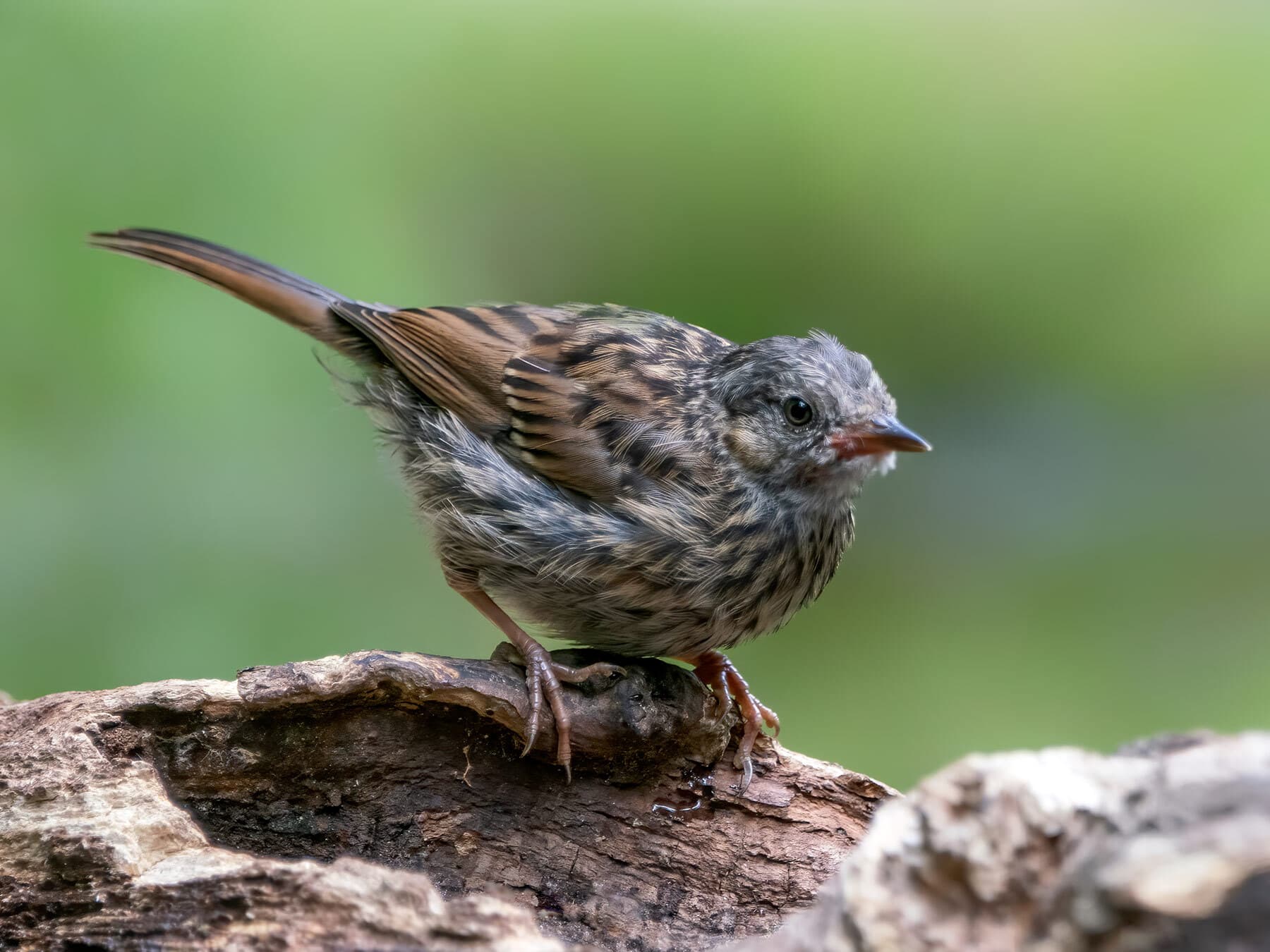
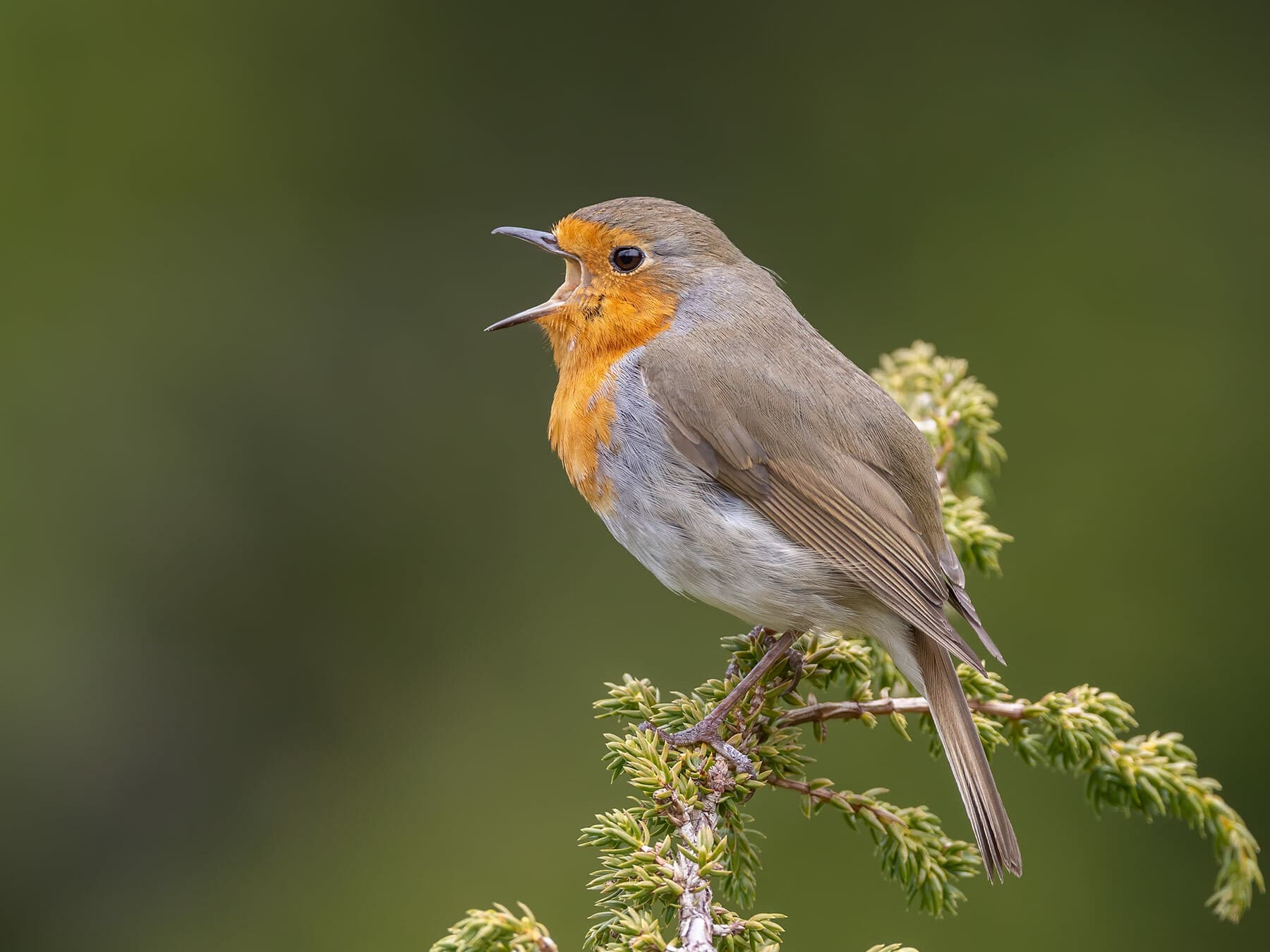
Young Dunnocks are browner and buffer than adults, with little of the grey, and their head and underparts are heavily streaked. A young Robin can look similar, but it is speckly brown all over rather than streaked.4
Identification: similar birds
House Sparrow. The bird most often confused with a Dunnock, especially a female House Sparrow. She has a plain pale chest, a pale stripe behind the eye and a short, chunky bill, and sparrows go about in groups. The likeness gave the Dunnock its old name, hedge sparrow, but it is an accentor: the only one in the UK. Side by side, with photos: Dunnock or House Sparrow?
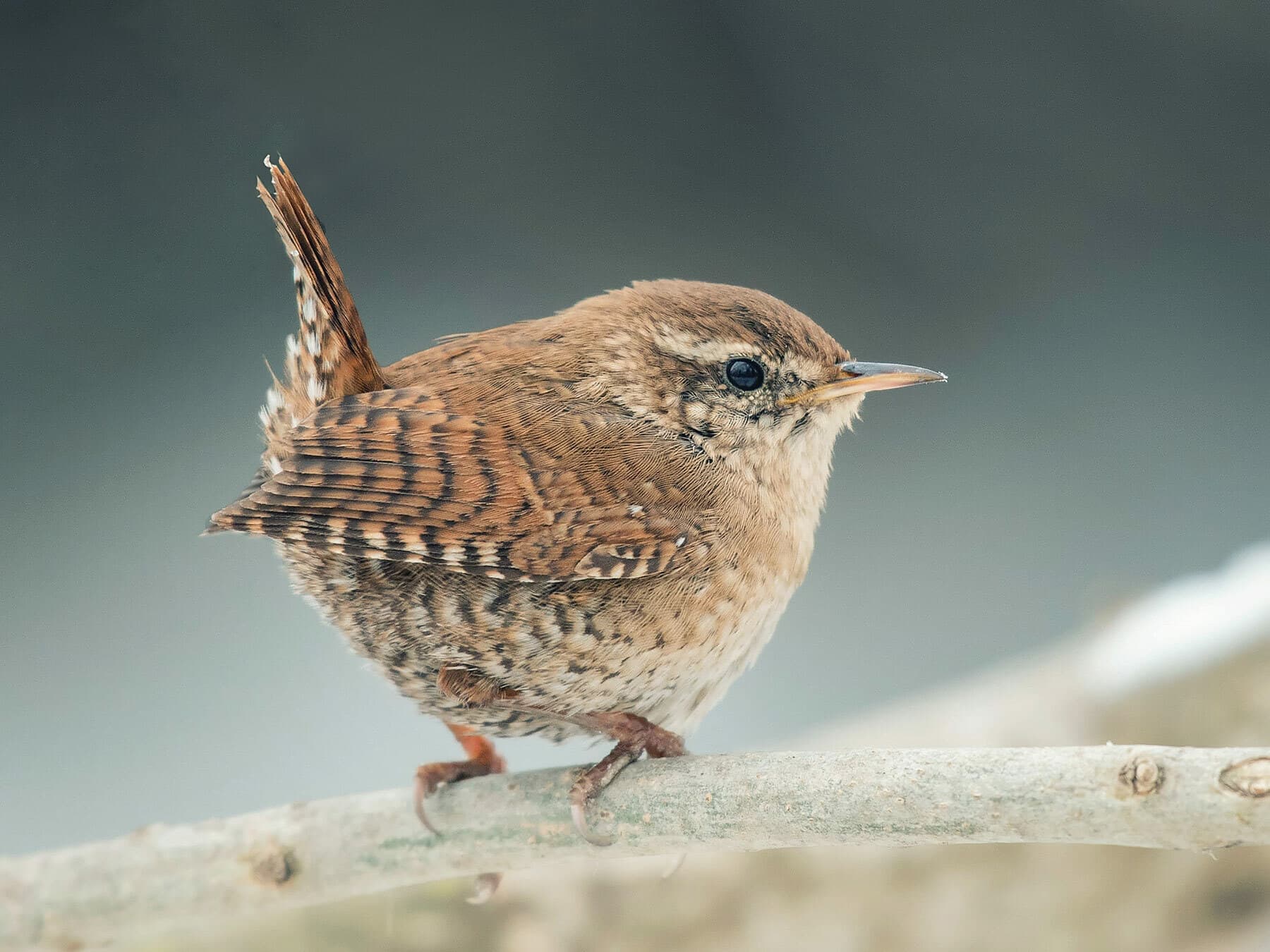
Wren. A Wren is far smaller, 9 to 10 cm, and almost round, with a short tail often cocked up, a pale stripe over the eye and finely barred wings. Its song is very loud and ends in a trill.
Young Robin. A juvenile Robin is speckly brown all over; a young Dunnock is streaked rather than speckled.
Its size
Adults- Length
- 14–14.5 cm
- Wingspan
- 19–21 cm
- Weight
- 19–24 g
Its song and calls
For much of the year Dunnocks are easy to overlook, but males sing from the top of a bush or tree. The song is a short, high, squeaky warble of 2 to 4 seconds, full of trills, and sometimes surprisingly loud. Most singing is in the first half of the year, and Dunnocks are part of the dawn chorus from March to May.
Each male has 10 to 15 phrases that he mixes into different songs, repeating one several times before switching, and neighbouring males share songs, which gives local dialects. Females sometimes sing when attracting a mate, and young birds start singing in their first autumn.
The call is a thin, high "tseep", used to keep in touch outside the breeding season; a louder, higher version is the alarm. Listen to recordings: Dunnock song and calls.
- Song0:00 / 0:18
Recorded in Île-de-France, France · March 2023
- Call0:00 / 0:41
Recorded in Pays de la Loire, France · July 2024
When and where to see it
OctoberArriving
Most recorded in October
- 1. Herefordshire3.3%
- 2. Neath Port Talbot3.2%
- 3. Down3.2%
- 4. Carlow2.7%
- 5. Dundee2.6%
Each dot is a county, state or province: the bigger and darker, the larger the bird’s share of that place’s bird records that month. Grey dots: no regular records. The ringed point is the centre of the bird’s records this month; the arrow shows how it moved since last month, and the dashed loop its path through the year. “Arrivals” colours places where it becomes regular this month (orange) or is in its last regular month (grey). GBIF eBird Observation Dataset, 2019–2024. Map data: Natural Earth, US Census Bureau; place centres © OpenStreetMap contributors.
In your area
See when the Dunnock is recorded in your county, state or province.
How often the Dunnock turns up in the UK and Ireland through the year, from birdwatchers' records.
United Kingdom
Resident · all year · most records in March
Ireland
Resident · all year · most records in April
Show as a table
| Month | United Kingdom | Ireland |
|---|---|---|
| January | 1.8% (regular) | 1.2% (regular) |
| February | 2.1% (regular) | 1.5% (regular) |
| March | 2.2% (regular) | 1.7% (regular) |
| April | 1.9% (regular) | 1.7% (regular) |
| May | 1.6% (regular) | 1.6% (regular) |
| June | 1.6% (regular) | 1.3% (regular) |
| July | 1.4% (regular) | 0.82% (regular) |
| August | 1.1% (regular) | 0.55% (regular) |
| September | 1.3% (regular) | 0.85% (regular) |
| October | 1.6% (regular) | 1.3% (regular) |
| November | 1.7% (regular) | 1.4% (regular) |
| December | 1.9% (regular) | 1.4% (regular) |
Recorded regularly in
Worldwide: recorded regularly in 56 countries
Countries where it was recorded in at least 3 of the 6 years 2019–2024. Linked countries have their own bird list.
Europe (45)
- Åland Islands
- Albania
- Andorra
- Austria
- Belarus
- Belgium
- Bosnia & Herzegovina
- Bulgaria
- Croatia
- Czechia
- Denmark
- Estonia
- Finland
- France
- Germany
- Greece
- Guernsey
- Hungary
- Ireland
- Isle of Man
- Italy
- Jersey
- Kosovo
- Latvia
- Liechtenstein
- Lithuania
- Luxembourg
- Malta
- Moldova
- Montenegro
- Netherlands
- North Macedonia
- Norway
- Poland
- Portugal
- Romania
- Russia
- Serbia
- Slovakia
- Slovenia
- Spain
- Sweden
- Switzerland
- Ukraine
- United Kingdom
Asia (10)
- Armenia
- Azerbaijan
- Cyprus
- Georgia
- Iran
- Israel
- Kazakhstan
- Lebanon
- Palestinian Territories
- Turkey
Oceania (1)
Data: EOD – eBird Observation Dataset (Cornell Lab of Ornithology), accessed via GBIF.org, CC BY 4.0. Records from 2019–2024, aggregated and filtered by Birdfact. How these lists are made
Dunnocks live across Britain and Ireland all year. In the last national atlas they were found in 93% of the UK's 10-km squares in winter, absent only where there are no trees in the Scottish Highlands and from some of the Outer Hebrides and Northern Isles. Numbers are highest in lowland England and in the south and east of Ireland.
What they need is dense, low cover: gardens with shrubs and hedges, parks, hedgerows, scrub and woods with a thick shrub layer. In BTO surveys they are found most often around villages, and they are at home in small town gardens.
That lowland life is unusual. In western Europe, Britain included, Dunnocks live mainly in the lowlands, but further north and east they are birds of mountain scrub and northern forests, up to 2,700 m in north-eastern Türkiye. The move into lowland gardens, hedges and farmland is unique in the accentor family.
Spotting tips
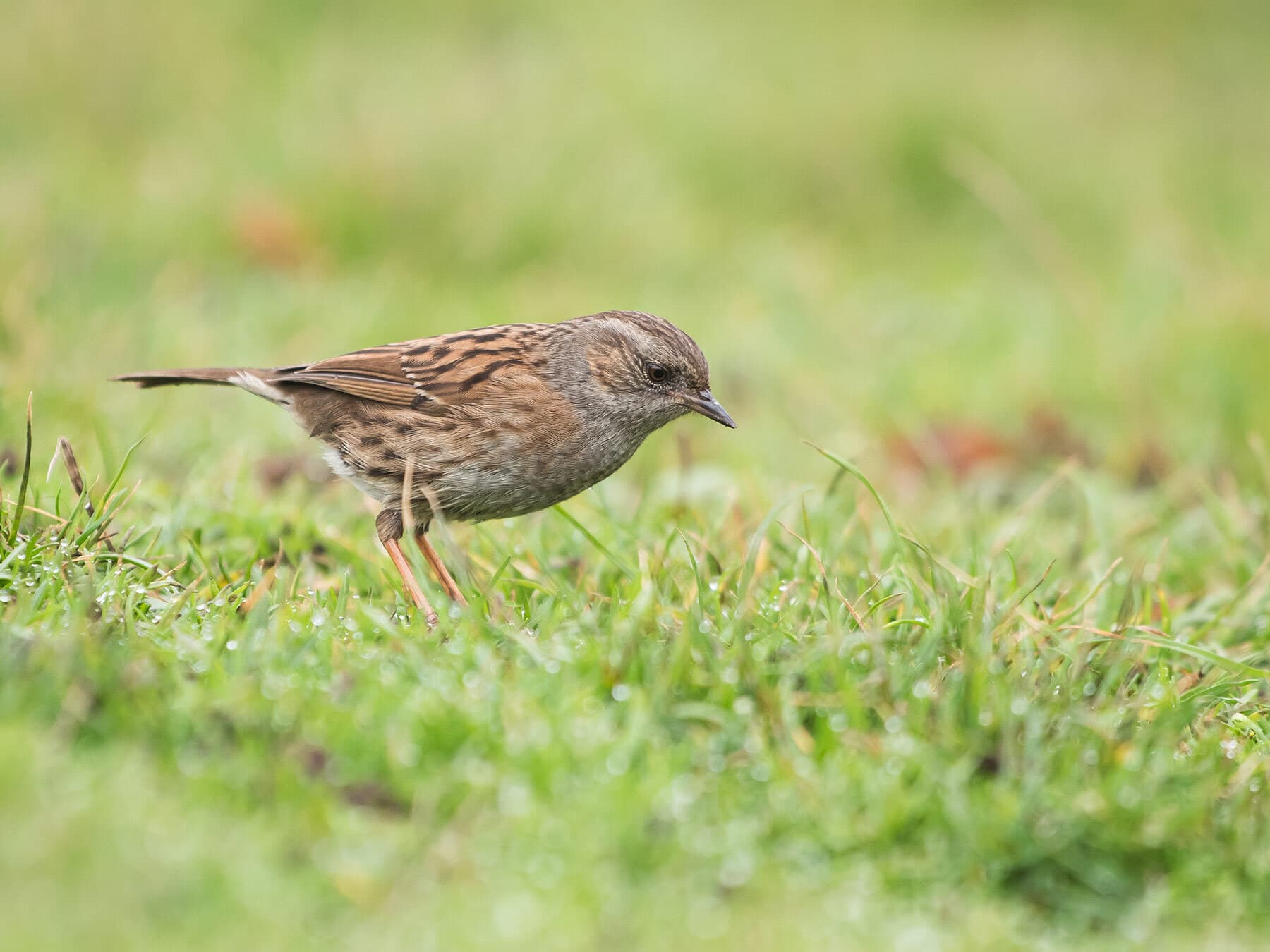
Watch the ground under shrubs and along the edge of a flower bed or hedge: a Dunnock creeps about there like a small brown mouse, flicking its wings. In spring, listen for the squeaky song and check the tops of bushes. Under hanging feeders, it is often the bird picking up spilt seed. After breeding, in late summer and early autumn, Dunnocks skulk more and are harder to see.
Do Dunnocks migrate?
Not in Britain. British, Irish and French Dunnocks are mainly sedentary, and local birds rarely move more than 30 km; the Dunnocks in your garden were very likely born within a few kilometres.5
Further north and east it is different. Dunnocks from Scandinavia, Russia, Poland and northern Germany migrate south-west from August to November, to winter around the Mediterranean, in Türkiye and the Middle East, and return from February to April. A few pass through Britain, turning up on islands such as Fair Isle where Dunnocks do not usually breed. A young bird ringed at Mandal, Norway, on 24 September 2000 was caught on the Isle of May, Fife, three days later, 643 km away.6
What it eats
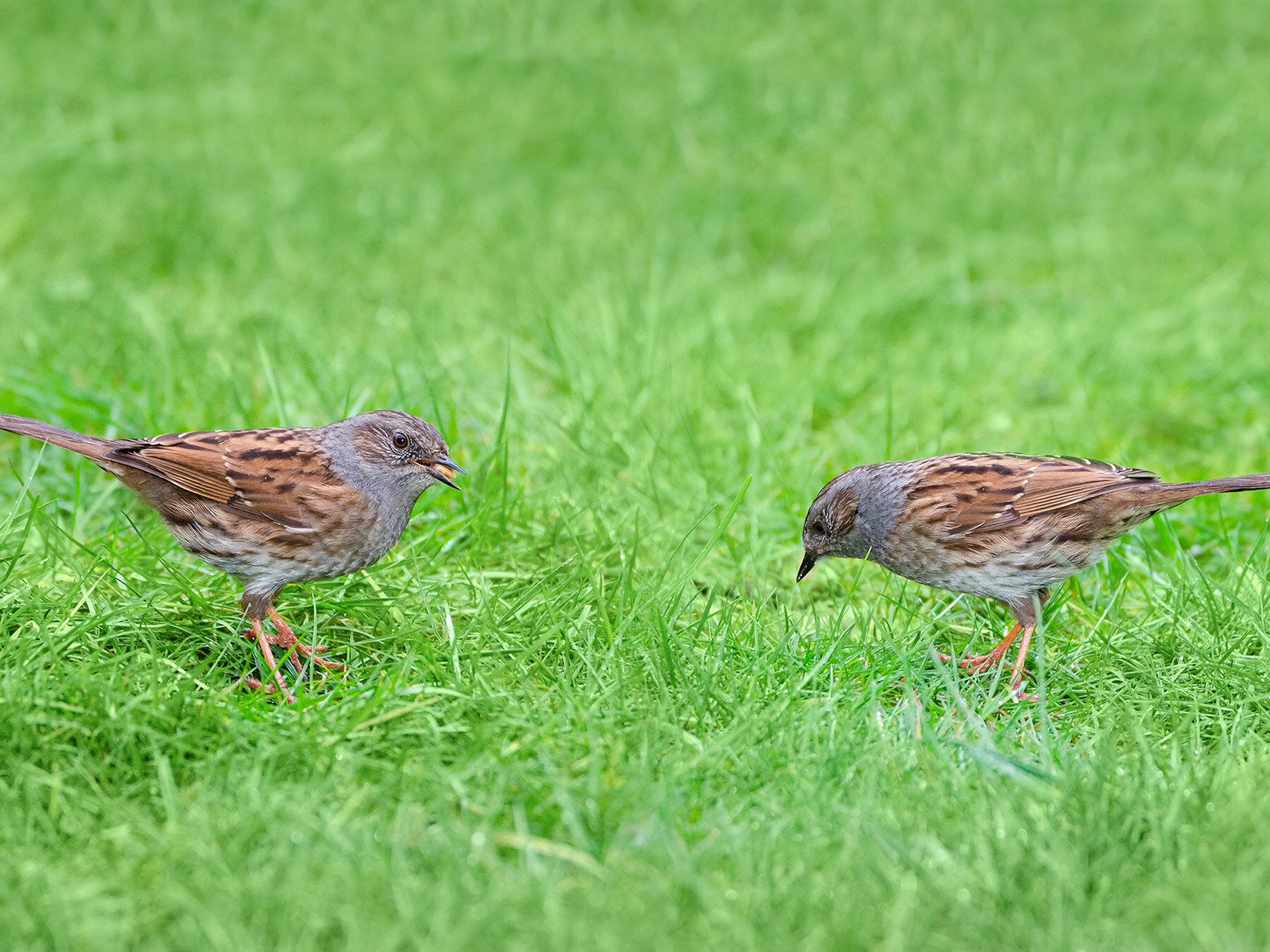
Mostly insects and spiders, picked from the ground. A Dunnock forages under bushes and hedges, hopping and picking, sorting through leaf litter and now and then probing the soil. Beetles and spiders make up much of its diet, with flies, bugs, springtails, caterpillars, small snails and earthworms.
In winter it switches to seeds. In Britain, seeds made up 90% of Dunnock droppings by volume in February; by April, invertebrates have taken over again.1 Nettle, dock, grass and other small weed seeds are typical; in one Shropshire hedgerow study, nettle was the main seed.7 Winter is hard work: in January a Dunnock may spend 94% of its time feeding, against 54% in May.
Feeding them in your garden
Dunnocks visit gardens with feeders, but mostly to pick up what other birds drop; they are timid at feeding stations and rarely feed on raised platforms. The RSPB names small seeds as a food that attracts them.8
Follow the RSPB's current advice: put out seed only from November to April, in hanging feeders rather than on bird tables or trays, and clean them every week. Disease can spread through food lying on the ground under feeders, so clear old seed and droppings from beneath them too.9 Thick shrubs and hedges matter as much as food: they give Dunnocks cover to feed under and places to nest. More: what Dunnocks eat and how to feed them.
Nesting and breeding
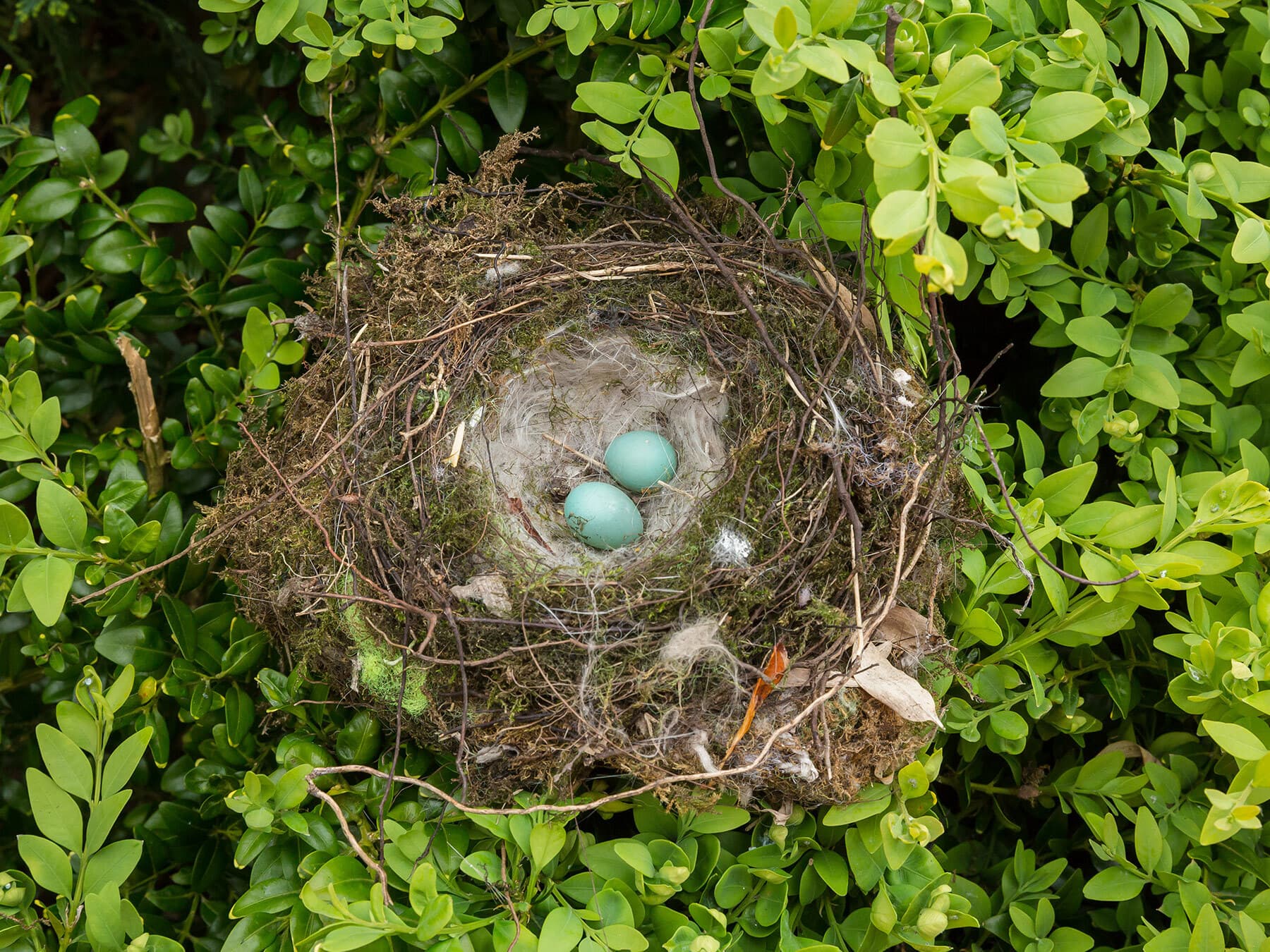
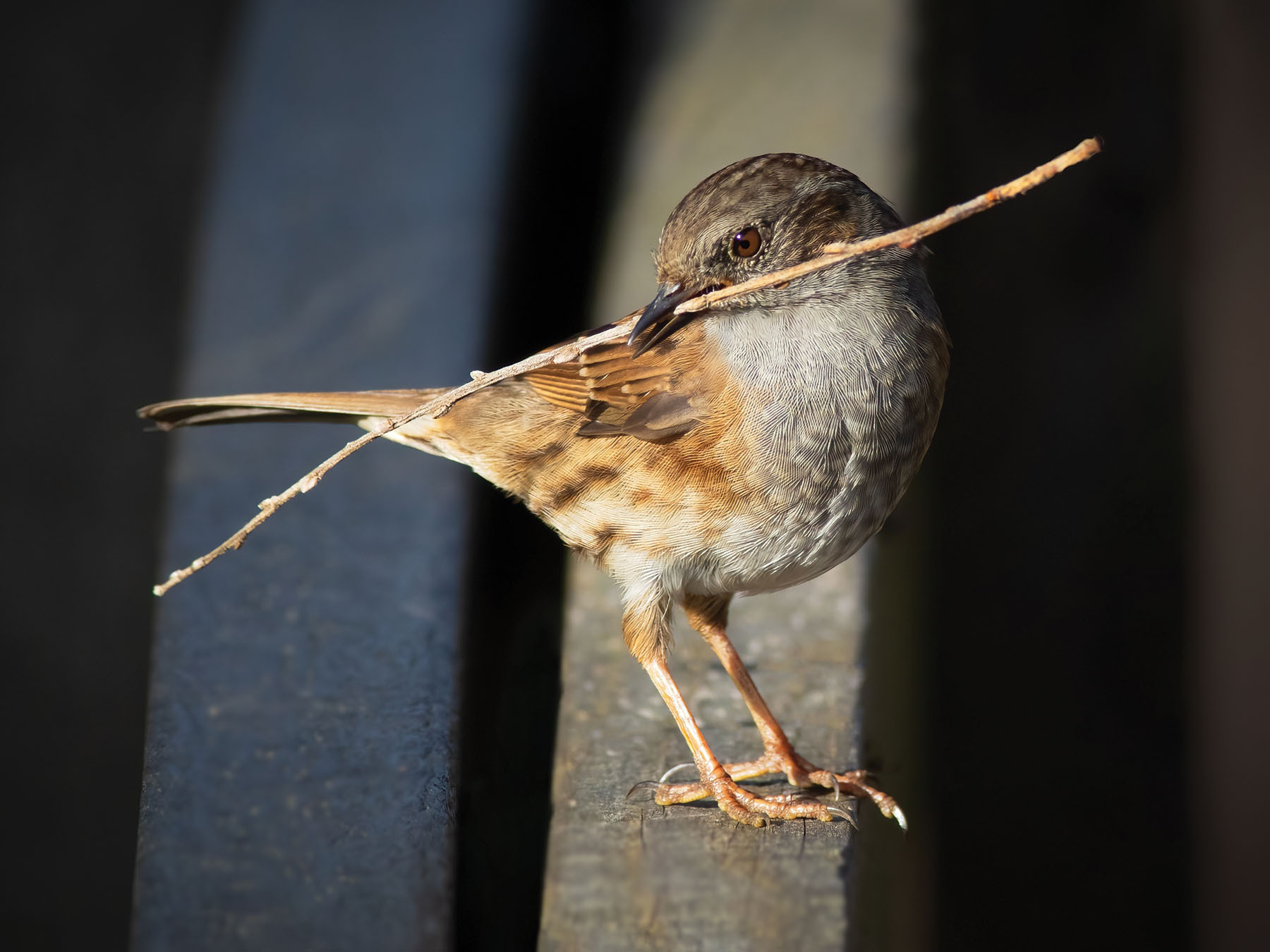
Dunnocks nest low in thick cover: a dense shrub, hedge or bush, sometimes ivy on a wall, between about 0.5 and 3.5 m up. The female builds a cup of twigs, stems, roots, grass and moss, lined with hair or wool, and usually lays 4 or 5 blue eggs.
In Britain the first eggs are laid on 27 April on average, anywhere from early April to mid-June, and most pairs raise two broods, sometimes three. The female incubates for 14 to 15 days, and the chicks leave the nest at 12 to 14.5 days old.
Who feeds the chicks depends on who mated with the female (see behaviour, below). In a long study in Cambridge, 59% of broods were fed by the female and one male, 33% by the female and two males, and 8% by the female alone.
Dunnocks are one of the Cuckoo's main hosts, though only about 2% of UK nests are taken over. A Cuckoo's egg looks nothing like a Dunnock's blue one, yet Dunnocks rarely throw it out, which suggests they are a fairly recent host. More detail: Dunnock nests, eggs and young.
Behaviour
The Dunnock's plain looks hide a mating system that has been studied in great detail. Both males and females hold territories, which is unusual for a songbird, and the arrangements vary. In the Cambridge study, of 254 breeding arrangements, 42% were simple pairs, 30% were one female with two or more males, 24% were groups of two or three males sharing two or three females, and 4% were one male with two or more females.1
Where two males share a territory, one is dominant. He follows the female closely, guarding her for as much as 40 minutes an hour, while the other waits for his chance. The female encourages the second male, and sometimes slips away to mate with him.5
Before mating, the female crouches, quivers and lifts her tail, and the male pecks at her cloaca, sometimes for minutes, until she ejects sperm from earlier matings. It improves his chance of fathering the chicks.
Why mate with both? A male helps feed the chicks in line with his share of the matings, so by mating with both males a female can get both to help. In Cambridge, a successful brood fed by the female and two males produced about 3 fledglings, against 2.4 with one male and 0.8 with the female alone.
Everyday behaviour
Dunnocks flick their wings as they shuffle about; one of their old folk names is Shufflewing. When rival males meet, the flicking becomes a display, with loud calling and chasing.2
Outside the breeding season most Dunnocks keep to themselves, feeding alone, or in small groups where food is plentiful. They are low in the pecking order at feeders, and Robins sometimes turn on them, perhaps because of their similar shape, perhaps as competitors.
Lifespan and predators
A Dunnock that survives to breed typically lives about 2 years, and first breeds at a year old. About 47% of adults survive from one year to the next, and about 35% of young birds survive their first year.3
Predators and other dangers
Nests are the weak point. In the Cambridge study about 30% of nesting attempts were lost to predators, among them cats, crows and mustelids (the weasel family). Hard winters can kill many too, and when food is short the dominant birds, such as adult males, feed first.
Lifespan records
Much longer, occasionally. The record for a Dunnock ringed in Britain and Ireland is 10 years 7 months 23 days: a bird ringed in its first year at Sandwich Bay, Kent, in September 2001 and caught there by a ringer in May 2012.10 The European longevity list, which estimates each bird's age, includes a Danish Dunnock found dead at 20 years 10 months, far older than any other Dunnock on it (the next is 12 years 4 months).11
Conservation
The Dunnock is on the UK Amber List. UK numbers fell substantially from the mid-1970s to the mid-1980s and are 43% lower than in 1967.3 Since 1995 the population has changed little overall (up 5%, not a significant change), but it fell by 14% between 2014 and 2024, and by 17% in England.12
It is far from rare: there were about 2.5 million territories in the UK in 2016, and it is found almost everywhere. The likely causes of the decline are less winter food on farmland, especially in the "hungry gap" of February and March, and in woods the loss of the shrub layer as the canopy closes and deer browse the undergrowth. Worldwide it is of Least Concern.
Similar birds
Often mistaken for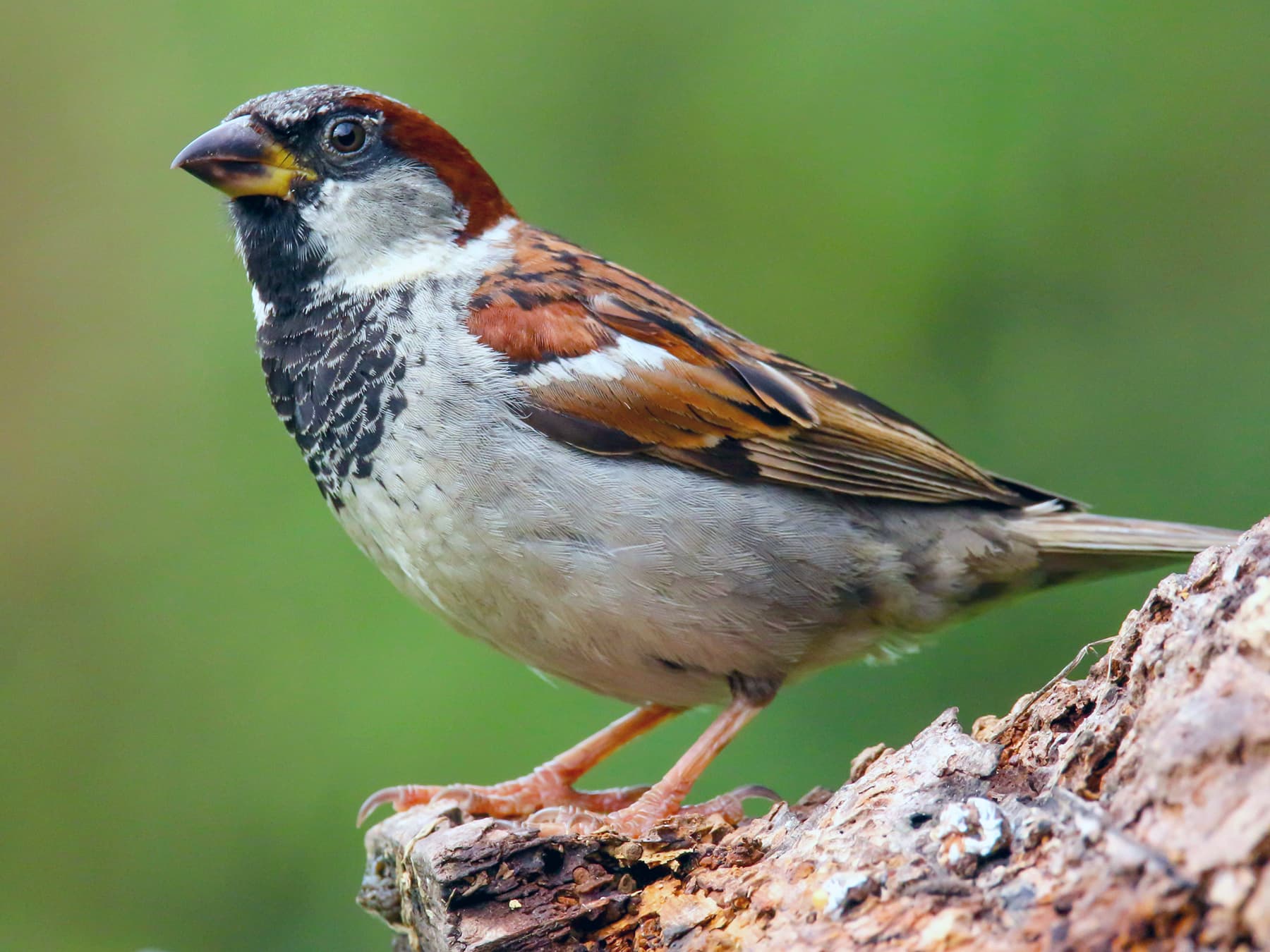
More photos
10 photos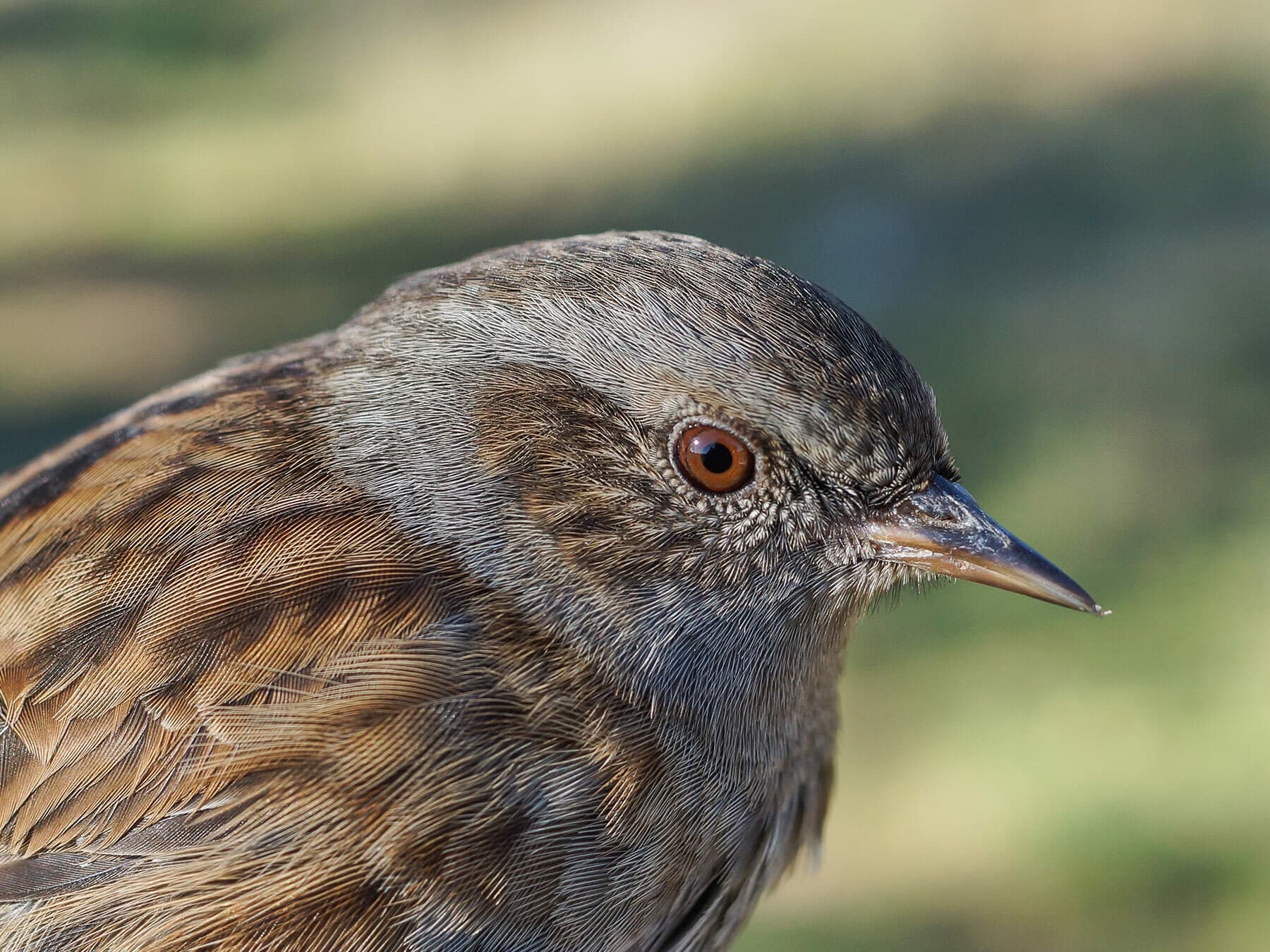 A Dunnock close up: reddish-brown eye, grey face with brown cheeks and a thin, pointed bill
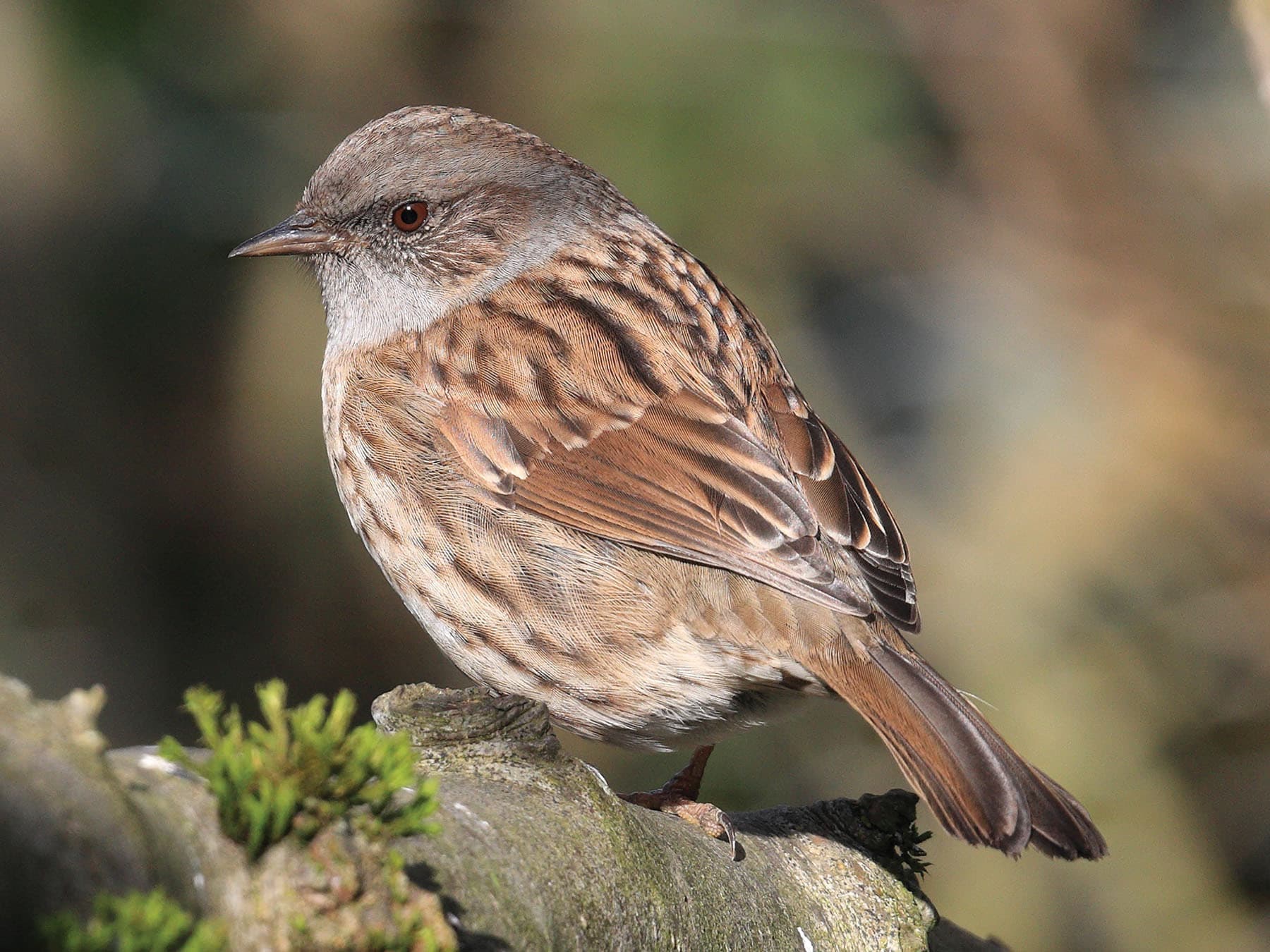 A Dunnock showing its streaked brown back and flanks
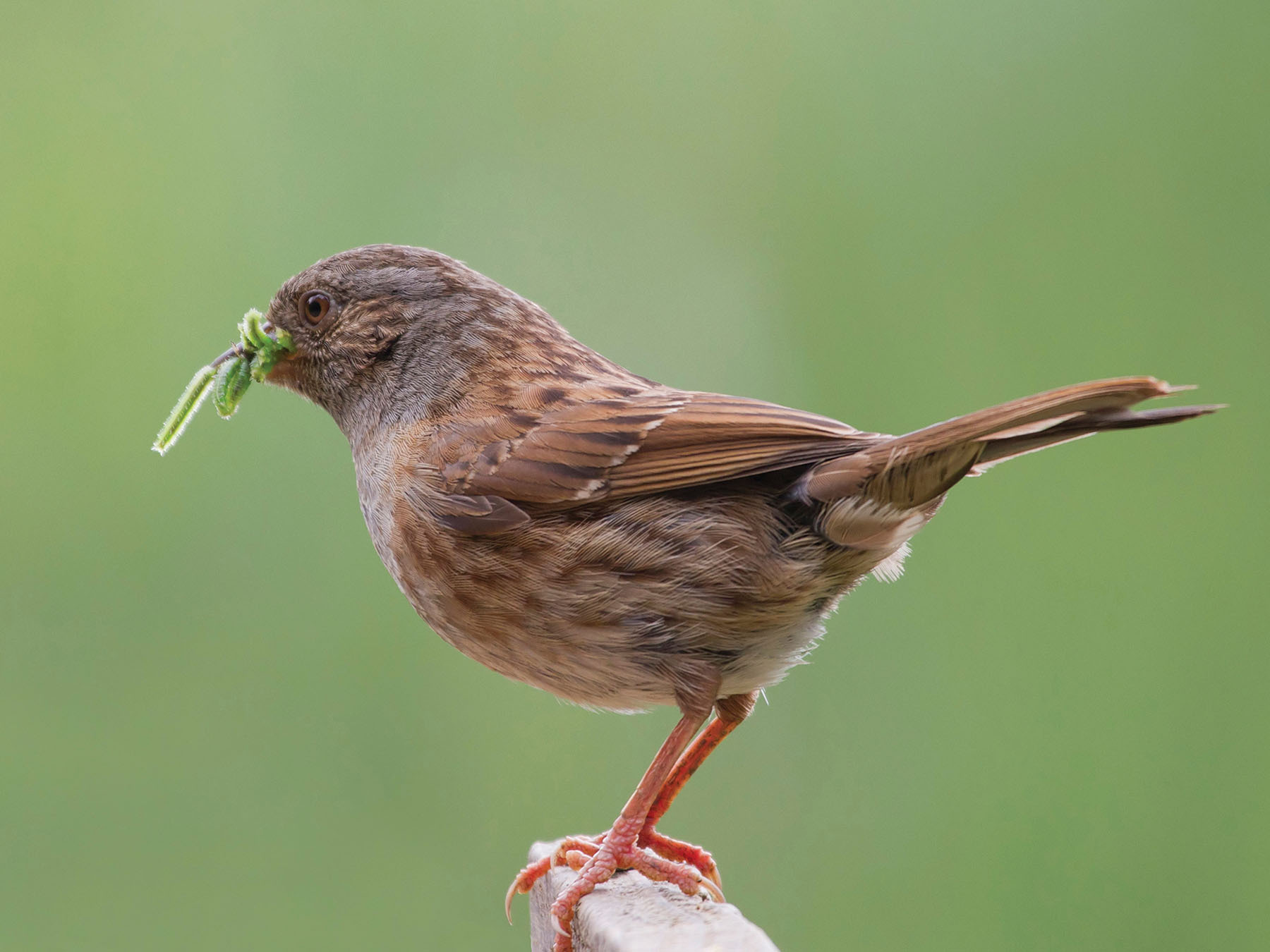
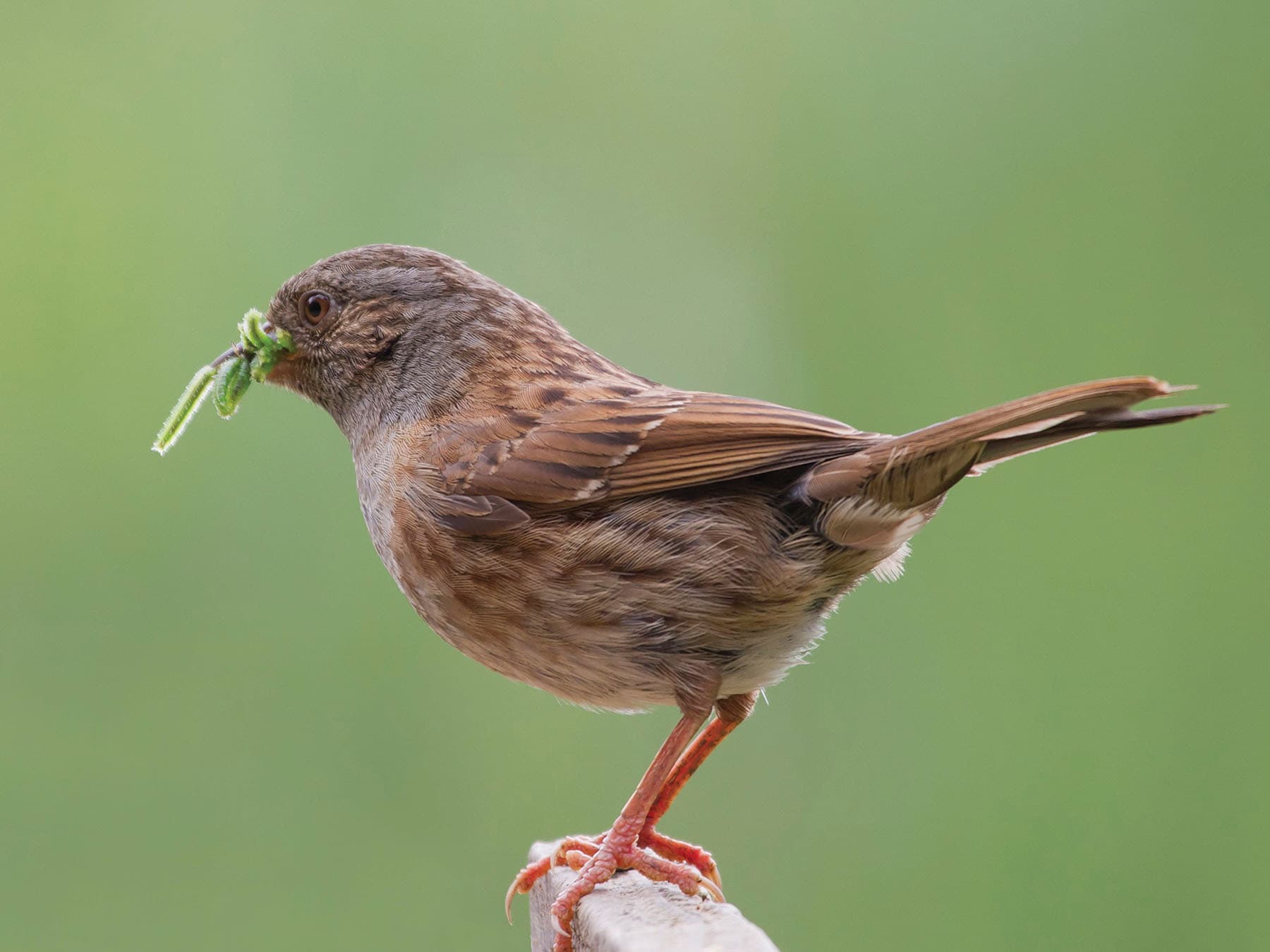 A Dunnock with caterpillars in its bill
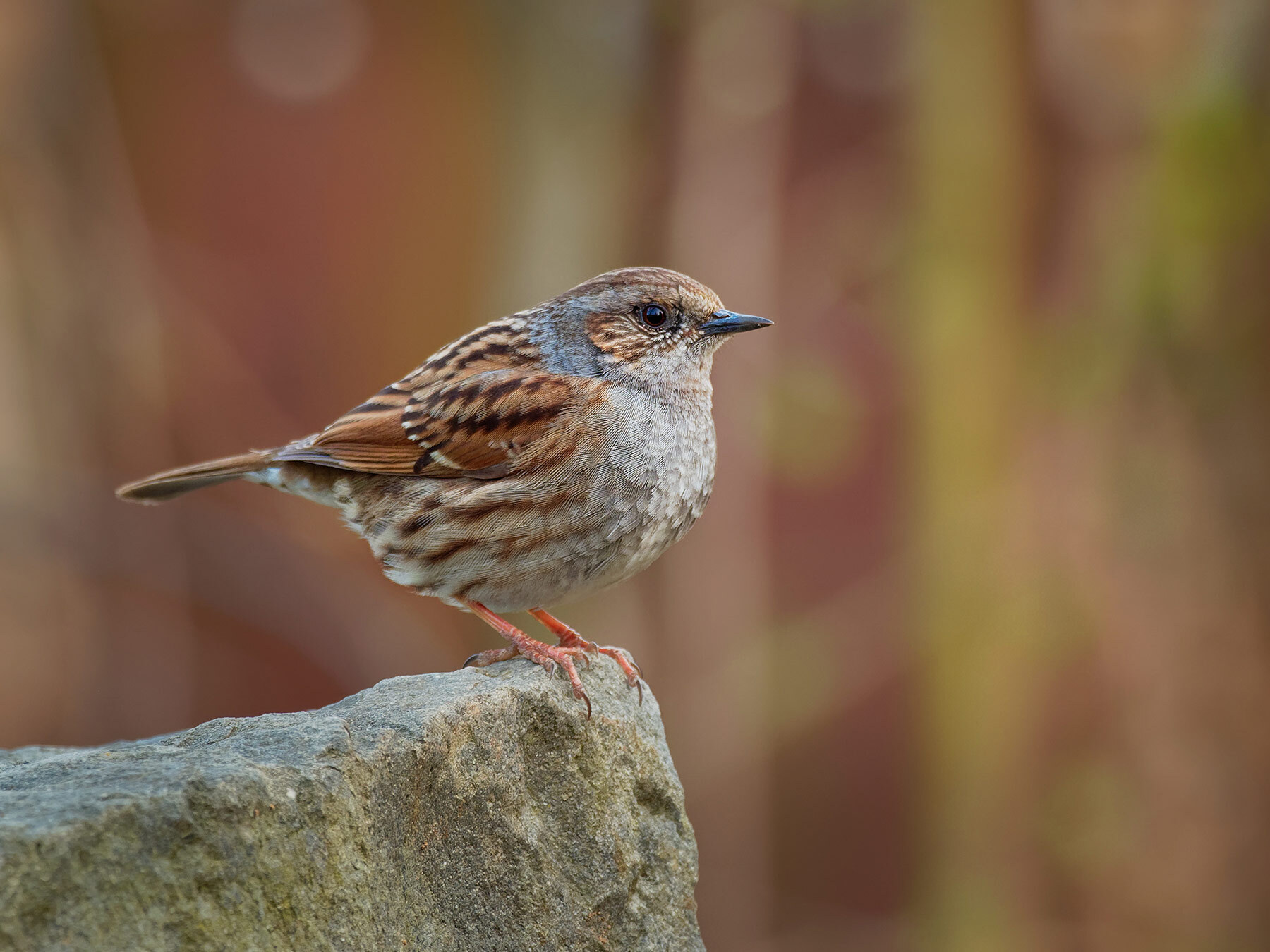
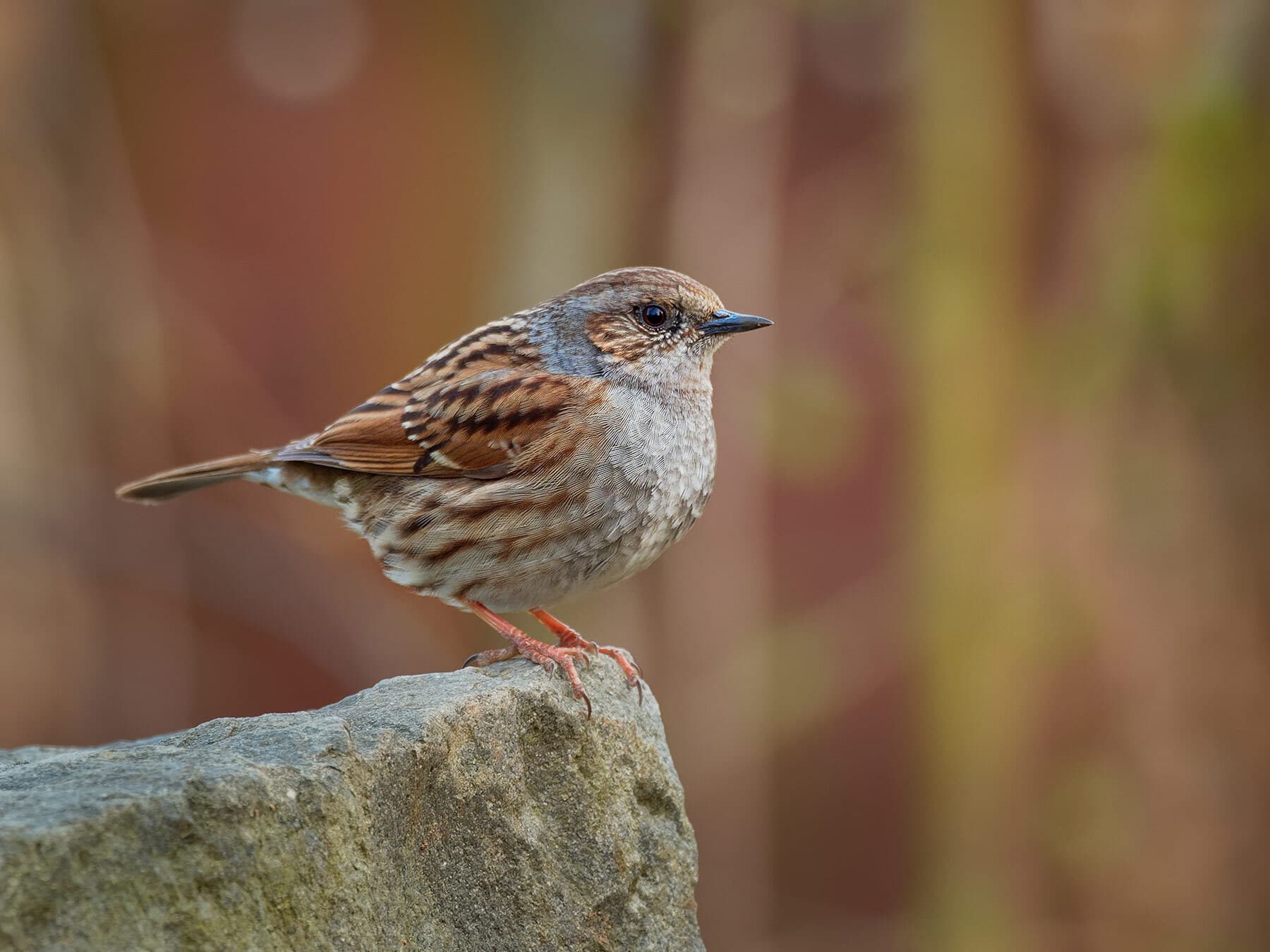 A Dunnock from the side, with pinkish legs
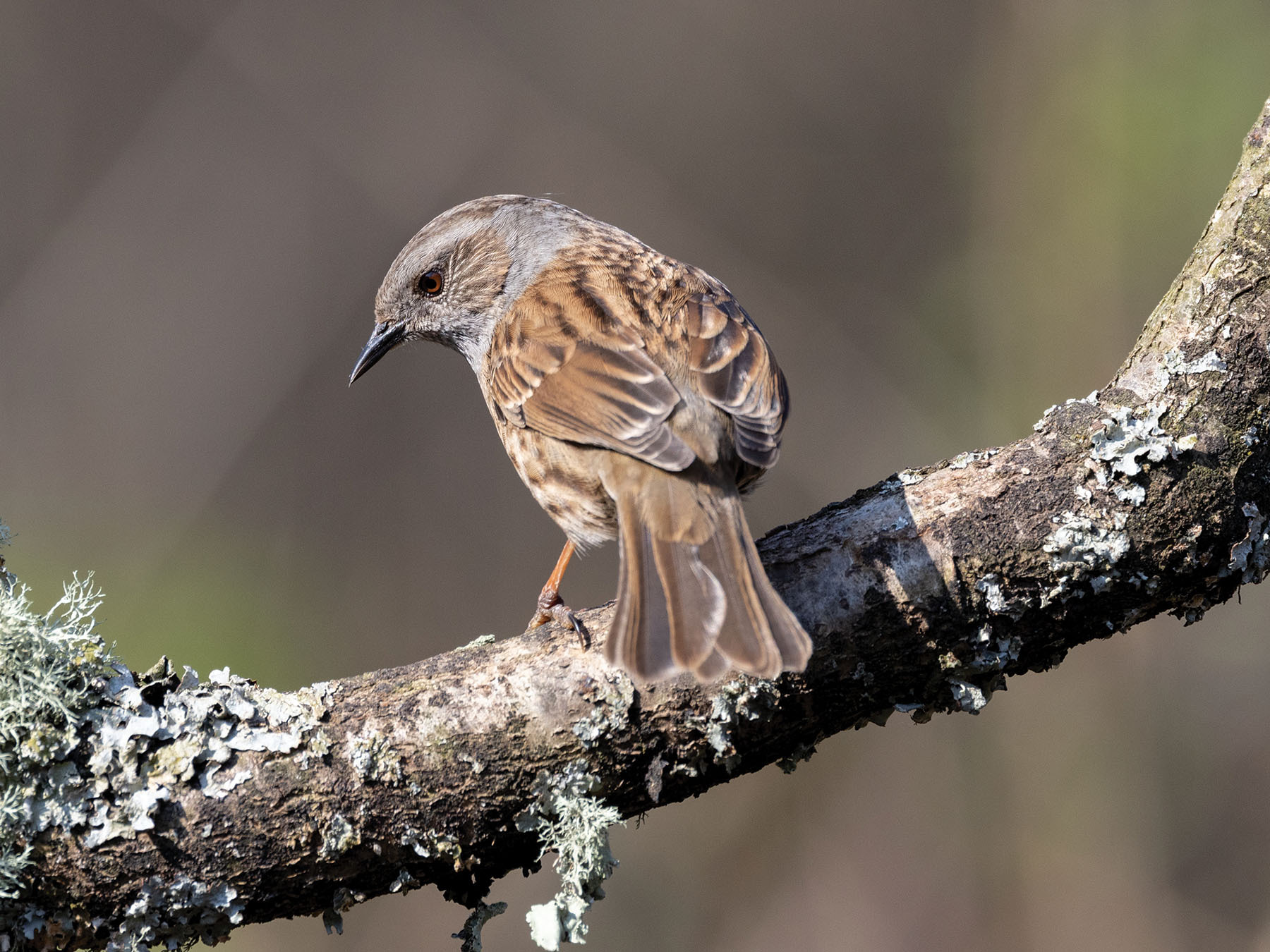
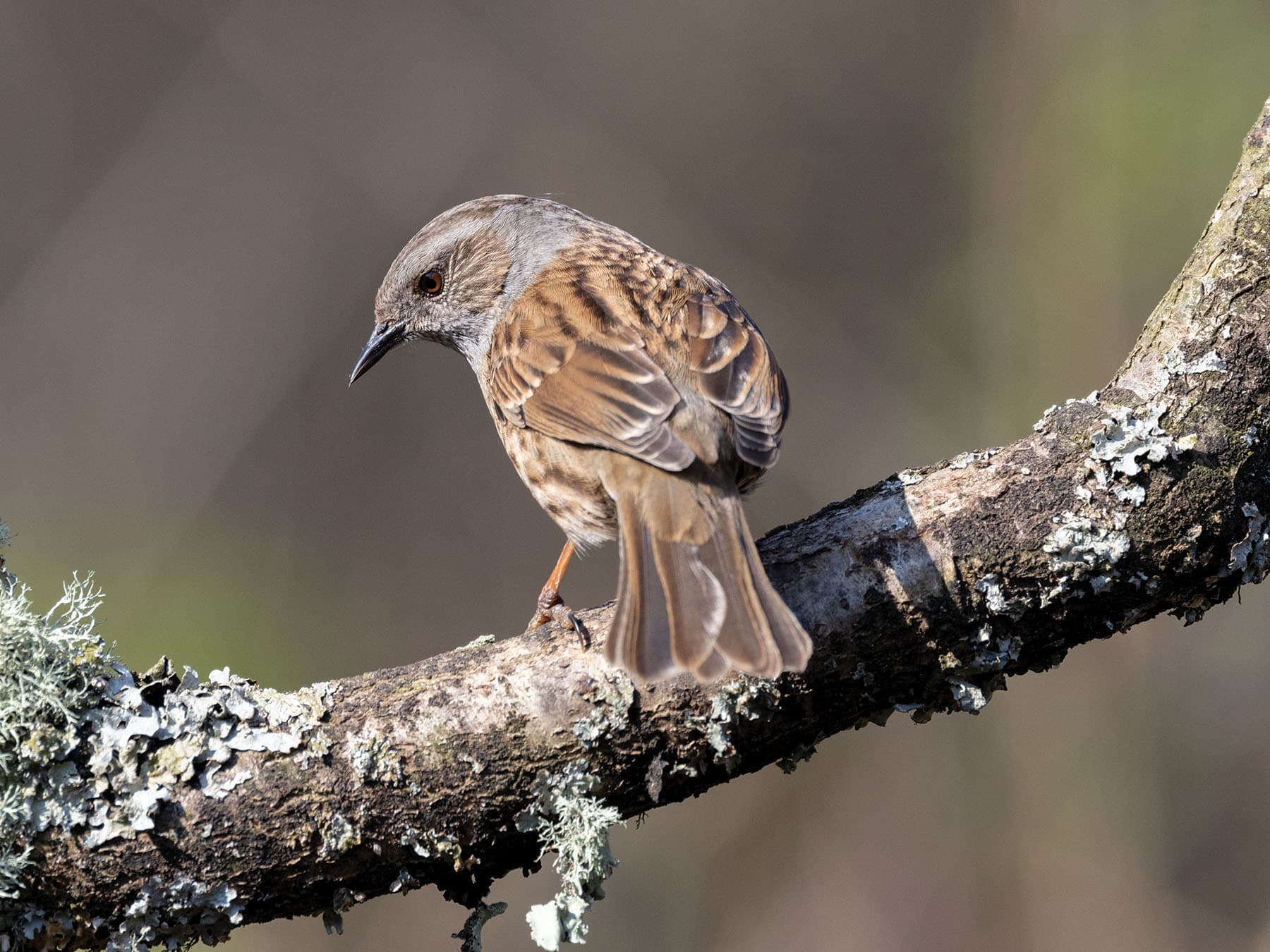 A Dunnock from behind: the back and wings streaked brown and black
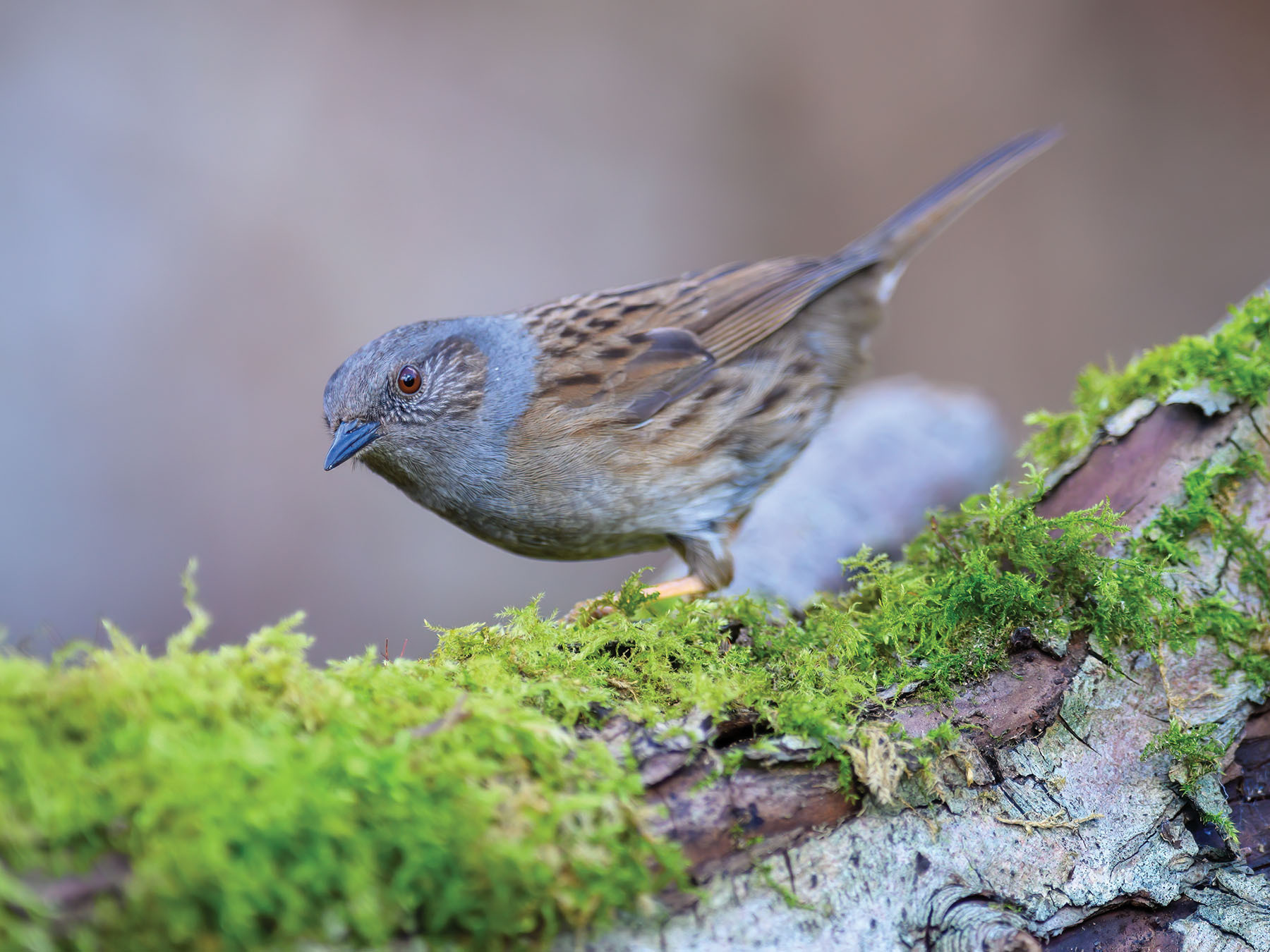
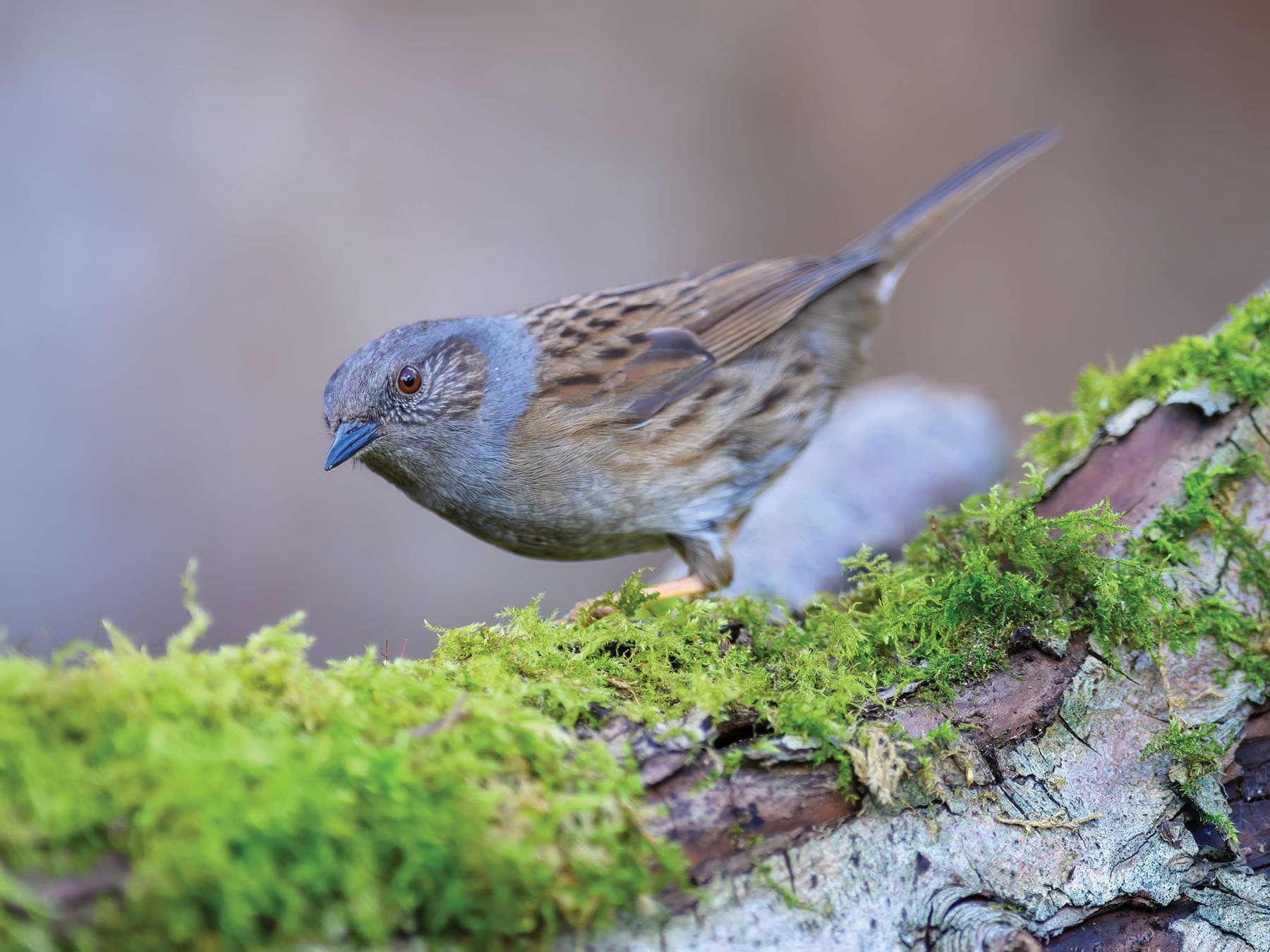 A Dunnock leaning forward on a mossy log
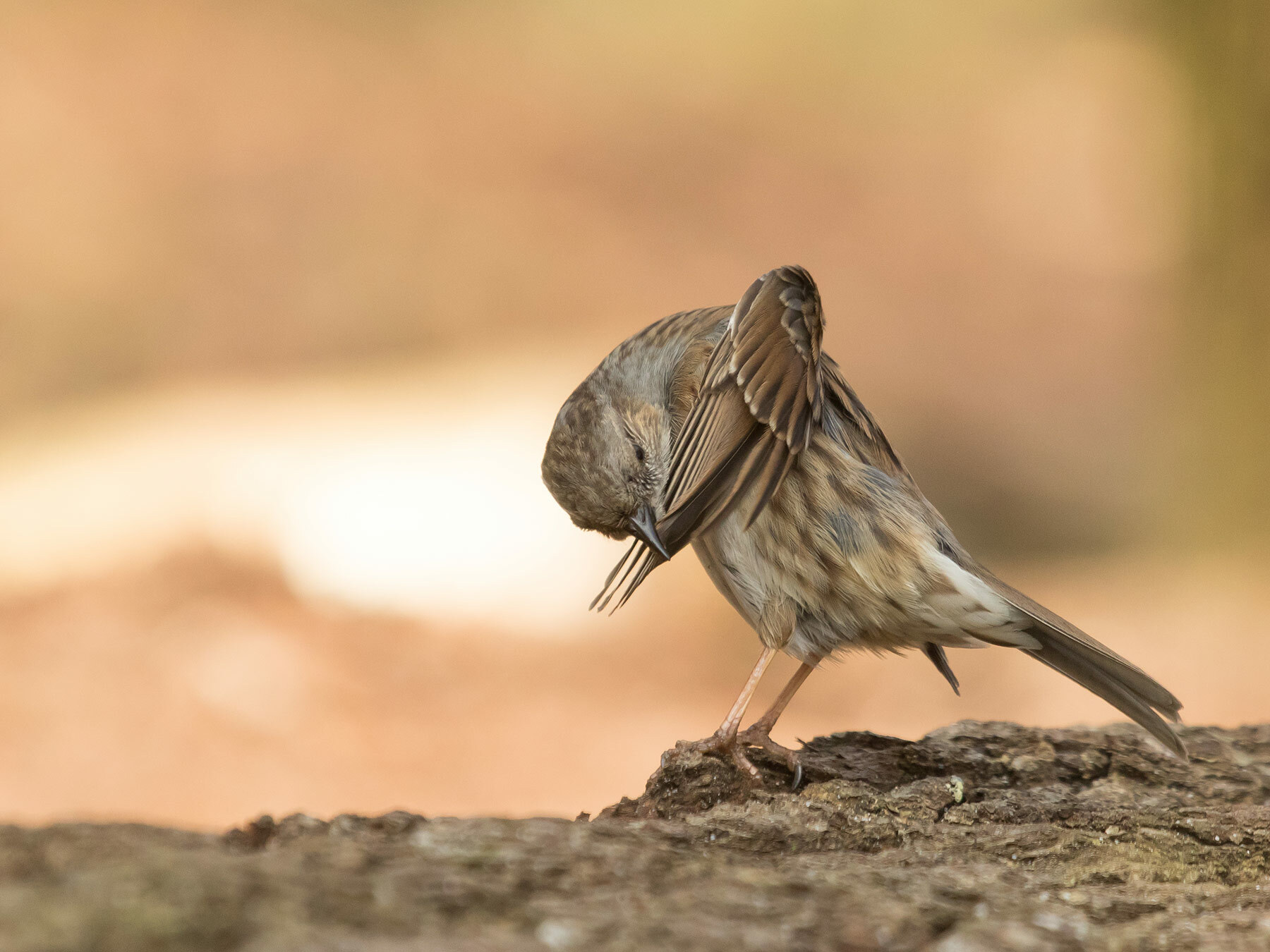
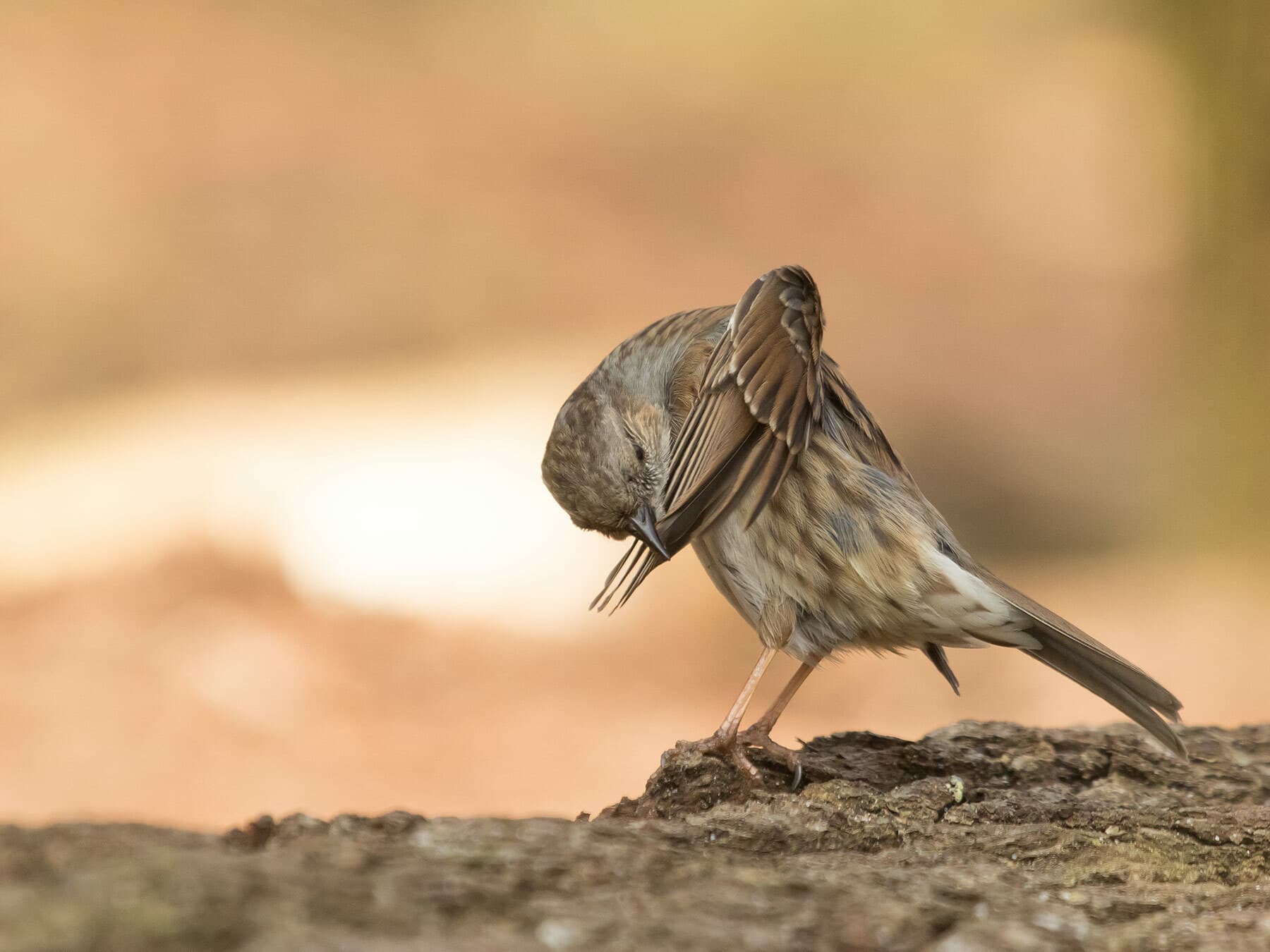 A Dunnock preening
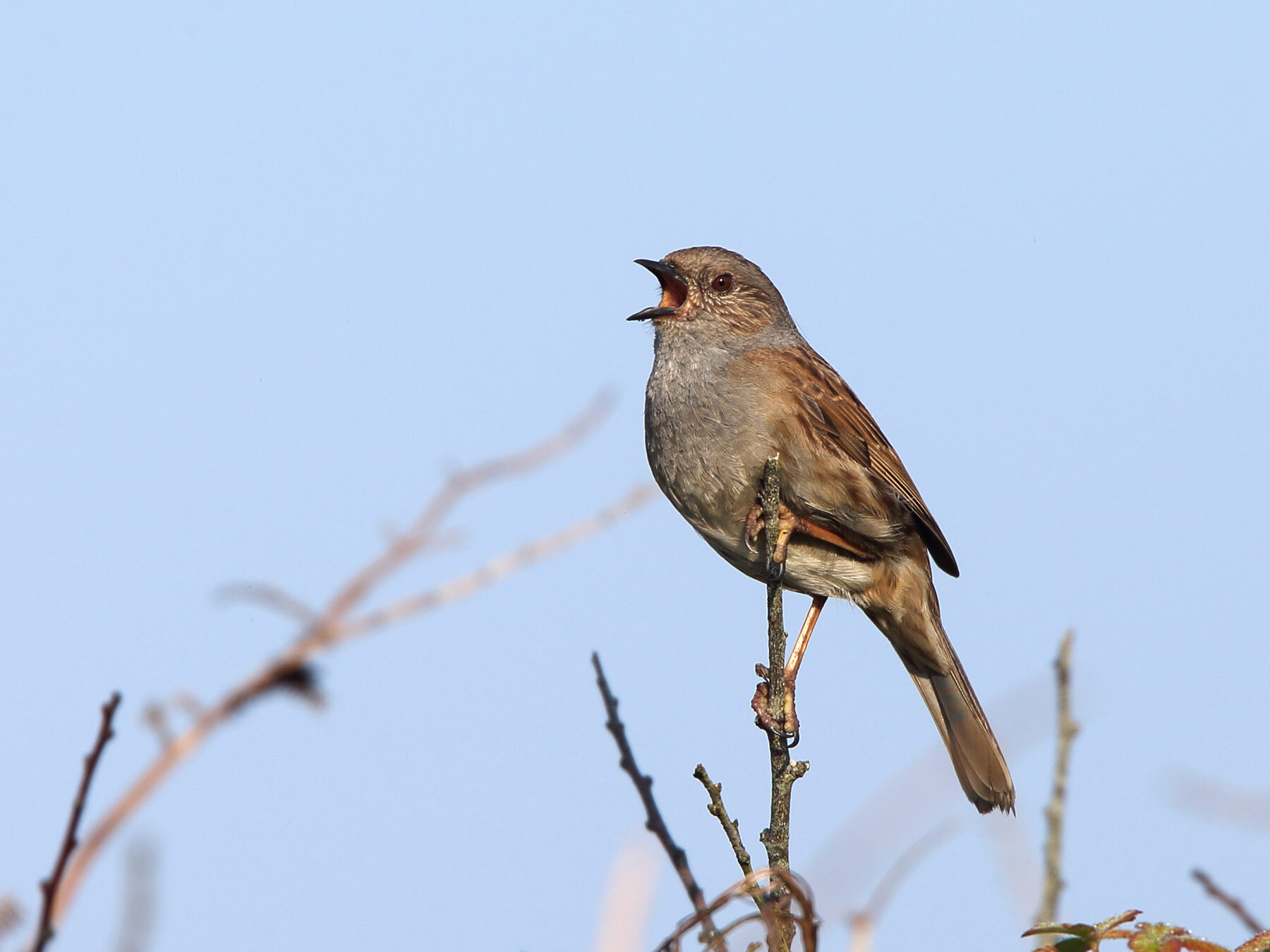
 A Dunnock singing from a bare twig
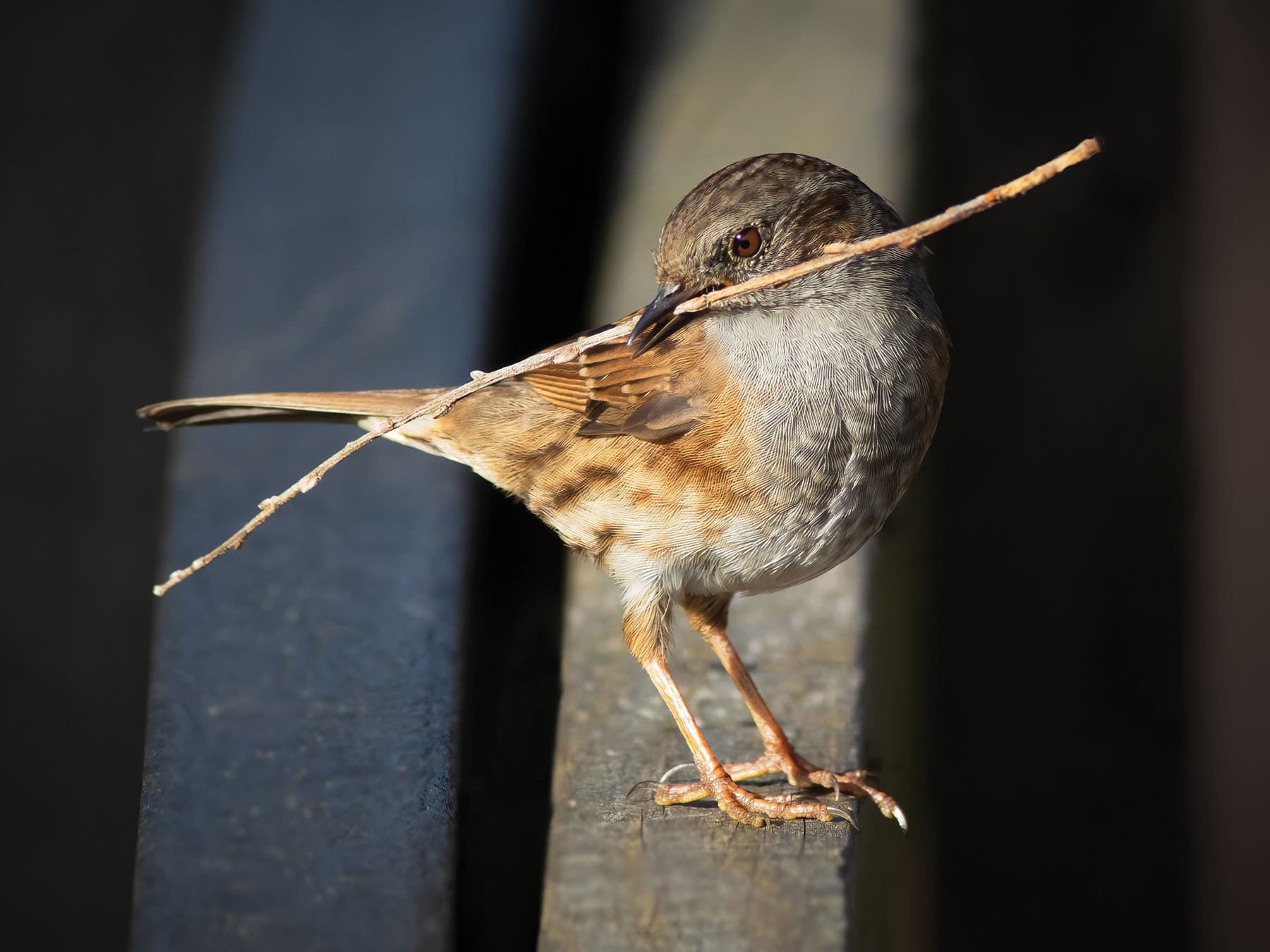 A Dunnock carrying a twig for its nest
 Two Dunnocks feeding on a lawn
Dunnock guides
5 guidesQuick facts
- Length
- 14–14.5 cm
- Wingspan
- 19–21 cm
- Weight
- 19–24 g
- Lifespan
- 2 years · oldest recorded 20.8 years · UK record 10 years 7 months
- Family
- Accentors
- Migration
- Partial migrant
- Global status (IUCN)
- Least Concern
- Population trend
- Down 43% in the UK since 1967, mostly in the 1970s and 1980s; stable since 1995 but down 14% from 2014 to 2024; Amber-listed
- Also called
- Hedge Sparrow, Hedge Accentor
- Scientific name
- Prunella modularis
Questions
8How can you tell a Dunnock from a sparrow?
Look at the bill and the head. A Dunnock has a thin, pointed bill and a grey head and breast; a House Sparrow has a short, chunky bill, and the female a plain pale chest. Dunnocks go about alone or in pairs, sparrows in groups. See Dunnock or House Sparrow?
Is a Dunnock a sparrow?
No. It was long called the hedge sparrow, but it belongs to the accentor family and is the only accentor in the UK. Its name comes from the Old English "dunnoc", the little brown one.
Are Dunnocks rare in the UK?
No. There were about 2.5 million territories in 2016. They are Amber-listed because numbers fell between the 1970s and 1980s. See conservation status.
Why do Dunnocks flick their wings?
They flick them constantly as they shuffle about (an old folk name is Shufflewing); between rival males the flicking becomes a display, with chasing and loud calls. See behaviour.
Why do Robins chase Dunnocks?
Robins are aggressive towards other birds, and Dunnocks get a particularly hard time, perhaps because of their similar shape, perhaps as competitors for food. See behaviour.
Do Dunnocks mate for life?
Not in any simple way. In a long study in Cambridge only 42% of breeding arrangements were simple pairs; the rest involved two or more males or females. See mating behaviour.
What is the difference between a Dunnock and a Wren?
Size and shape: a Wren is far smaller and round, with a cocked tail and a pale stripe over the eye; a Dunnock is sparrow-sized with a grey head and breast.
Do Dunnocks use nest boxes?
Not usually: they build open cups in dense shrubs and hedges, and they are not on the BTO's lists of nest-box birds. See Dunnock nesting.
Sources
15- 1Hatchwell, B., Kirwan, G. M. and Goodman, D. D. (2026). Dunnock (Prunella modularis), version 1.2. Birds of the World (J. del Hoyo, A. Elliott, J. Sargatal, D. A. Christie, E. de Juana, R. Ahmed and B. K. Keeney, editors). Cornell Lab of Ornithology. doi:10.2173/bow.dunnoc1.01.2 (opens in a new tab)
- 2RSPB. Dunnock. RSPB Birds A-Z. Accessed 7 October 2026. Source (opens in a new tab)
- 3BTO. Dunnock (Prunella modularis). BTO BirdFacts. Accessed 7 October 2026. Source (opens in a new tab)
- 4RSPB. Small brown birds and how to identify them. RSPB. Accessed 7 October 2026. Source (opens in a new tab)
- 5Toms, M. (2007). The Dunnock: sex in the shrubbery. Bird Table 50 (BTO Garden BirdWatch), pp. 9-11. Accessed 7 October 2026. Source (opens in a new tab)
- 6Robinson, R. A., Leech, D. I. and Clark, J. A. (2025). Summary of all recoveries for Dunnock (Prunella modularis). The Online Demography Report: bird ringing and nest recording in Britain & Ireland in 2024 (BTO). Accessed 7 October 2026. Source (opens in a new tab)
- 7Bishton, G. (1986). The diet and foraging behaviour of the Dunnock Prunella modularis in a hedgerow habitat. Ibis 128: 526-539. doi:10.1111/j.1474-919x.1986.tb02704.x (opens in a new tab)
- 8RSPB. Feeding birds near you. RSPB. Accessed 7 October 2026. Source (opens in a new tab)
- 9RSPB (2026). Our latest guidance on feeding garden birds. RSPB news. Accessed 7 October 2026. Source (opens in a new tab)
- 10BTO. Longevity records for Britain & Ireland in 2024. BTO Online Ringing and Nest Recording Report. Accessed 7 October 2026. Source (opens in a new tab)
- 11Fransson, T., Kolehmainen, T., Moss, D. and Robinson, R. (2023). EURING list of longevity records for European birds (1 September 2023). EURING. Accessed 7 October 2026. Source (opens in a new tab)
- 12Heywood, J. J. N., Massimino, D., Baker, L., Balmer, D. E. et al. (2026). The Breeding Bird Survey 2025. BTO Research Report 802. British Trust for Ornithology, Thetford. Accessed 7 October 2026. Source (opens in a new tab)
- 13BTO. Nest boxes for birds. BTO, Helping birds. Accessed 7 October 2026. Source (opens in a new tab)
- 14AviList Core Team (2025). AviList: The Global Avian Checklist, v2025b. doi:10.2173/avilist.v2025b (opens in a new tab)
- 15RSPB. Bird food buying guide. RSPB Shop. Accessed 7 October 2026. Source (opens in a new tab)

Checked by
Nathan Cope, founder and editor
Nathan founded Birdfact and leads its writers and contributors in the UK, the US and Canada. He has watched and studied birds for more than ten years, and checks every article and species guide before it’s published.