Species Profile
Dickcissel
Spiza americana
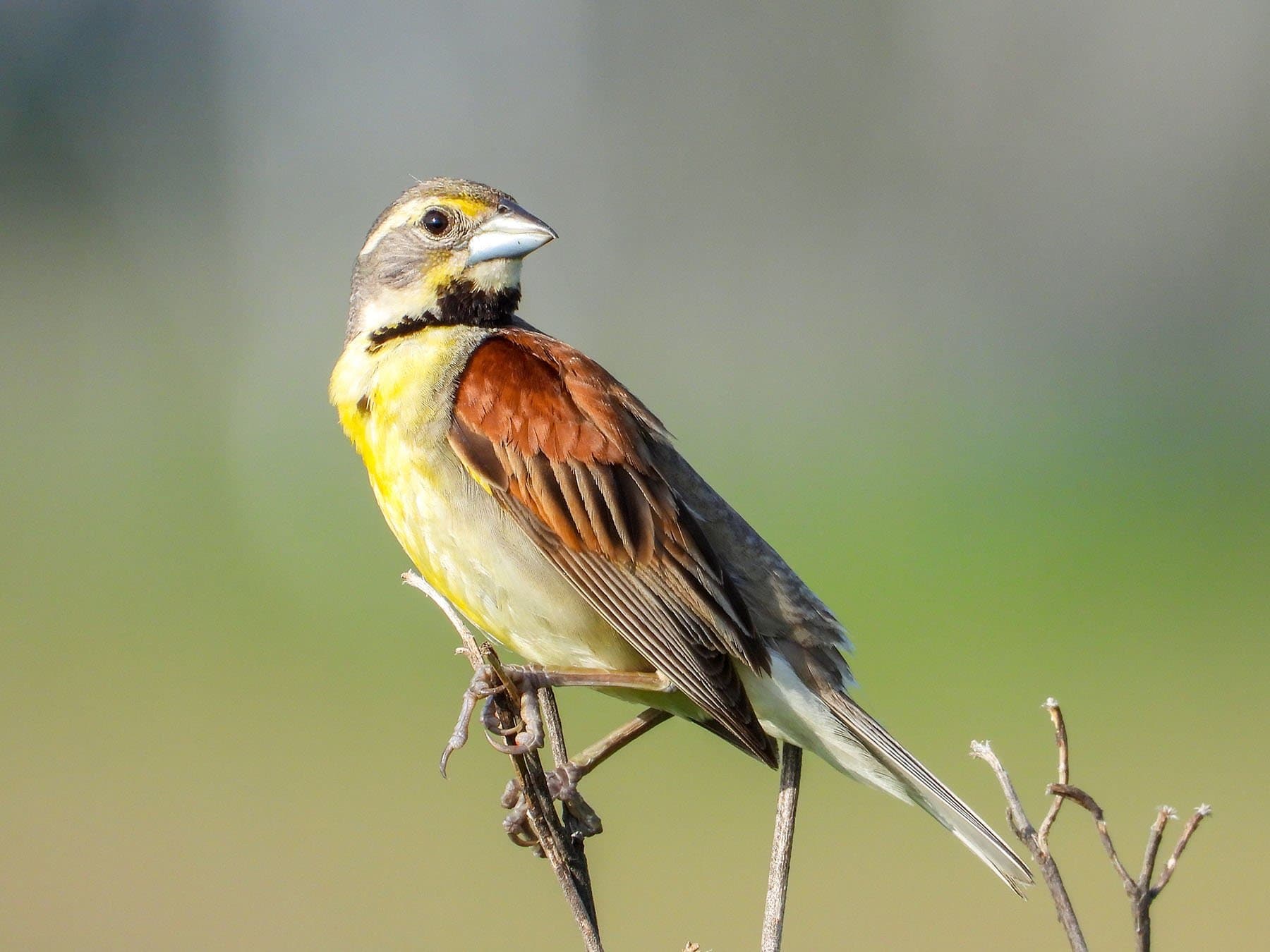
Dickcissel perched on a thin branch, showing yellow underparts, brown back, black throat band, and pale blue beak against a blurred green background.
Quick Facts
Conservation
LCLeast ConcernLifespan
2–4 years
Length
14–16 cm
Weight
26–40 g
Wingspan
25–26 cm
Migration
Long-distance Migrant
Perched on a fence post above a sea of Kansas prairie grass, a male Dickcissel throws his head back and belts out his name — dick-dick-cissel, dick-dick-cissel — over and over, for up to 70% of the daylight hours. This compact, boldly marked songbird of the American Great Plains is part Eastern Meadowlark lookalike, part nomadic wanderer, and part ecological paradox: a grasshopper-devouring ally to Midwestern farmers who becomes a grain-raiding pest on its Venezuelan wintering grounds.
Appearance
Bold black V-shaped bib, bright yellow breast, rich chestnut shoulder — the adult male Dickcissel is one of the most distinctively patterned grassland songbirds in North America, often described as a miniature Eastern Meadowlark. The bird is compact through the chest, with a large conical bill and a relatively short tail. The head is grey, framed by a vivid yellow supercilium and a yellow moustachial streak that brackets a clean grey cheek. The upperparts are grey-brown with dark streaking on the back, and the shoulders carry a rich chestnut-rufous patch that is conspicuous both at rest and in flight.
In non-breeding plumage, males retain the same basic pattern but the black bib is reduced or replaced by a grey wash, and the yellow tones are somewhat duller. The bill is large and pale — noticeably heavier than a typical sparrow's. Legs are pale grey-pink.
Females and immatures are considerably duller and are frequently confused with House Sparrows. The female has brownish cheeks and crown, a pale yellow wash on the breast (far less vivid than the male), a faint yellowish supercilium, and only a trace of chestnut on the shoulder. She lacks the black bib entirely. The flanks are lightly streaked. The best field marks separating her from a House Sparrow are the pale yellow eyebrow, the hint of rufous on the shoulder, and the heavier, more conical bill. Immature birds are browner overall, lacking the cool grey tones of adults; they show a broad pale eyebrow and a neat dark malar stripe, with light streaking on the breast. The species is strongly sexually dimorphic.
Identification & Characteristics
Male Colors
- Primary
- Yellow
- Secondary
- Black
- Beak
- Pale Grey
- Legs
- Blue-grey
Female Colors
- Primary
- Brown
- Secondary
- Yellow
- Beak
- Pale Grey
- Legs
- Blue-grey
Male Markings
Bold black V-shaped bib on lower throat and upper chest; bright yellow breast; rich chestnut-rufous shoulder patch; grey head with vivid yellow supercilium
Tail: Short, dark brown tail with pale edges; relatively short for body size
Female Markings
Pale yellow wash on breast; faint yellowish supercilium; trace of chestnut on shoulder; lacks black bib; lightly streaked flanks; heavier bill than House Sparrow
Tail: Short, dark brown tail with pale edges; similar to male but overall plumage duller
Attributes
Understanding Attributes
Rated 0–100 based on research and observation. A score of 50 is average across all bird species. These attributes are relative and don't necessarily indicate superiority.
Habitat & Distribution
The Dickcissel breeds across the central Great Plains and Midwest of the United States, with the core population concentrated in Kansas, Nebraska, Iowa, Missouri, and Oklahoma — states where it is common to abundant in summer. Approximately 70% of the global population breeds within this core zone. Breeding also extends across a broader peripheral belt through the eastern Midwest and South, including Illinois, Indiana, Ohio, and states as far south as Louisiana and Alabama, as well as parts of the Dakotas and Texas.
Throughout the year, Dickcissels require open grassland. On the breeding grounds, they favour native tallgrass and mixed-grass prairies, restored grasslands, lightly grazed pastures, hayfields, fallow agricultural fields, alfalfa and clover fields, and weedy roadsides. They avoid dense forest and shrubland entirely. Research suggests that larger, more continuous grassland patches support higher nesting densities and better fledging success than fragmented fields.
The species has an erratic and poorly understood range history. In the early 19th century it expanded eastward, establishing breeding populations across New England and the mid-Atlantic states, with records reaching Canada's Maritime Provinces and south to South Carolina. This entire eastern population vanished around 1900. Since the 1920s it has reappeared sporadically in the East, but only in small numbers; in Pennsylvania it is currently listed as endangered as a breeding species. Drought conditions in the Great Plains can trigger dramatic irruptions into peripheral areas — in 2012, Dickcissels were recorded in 86 of Minnesota's 87 counties, only to be largely absent the following year.
The wintering grounds are highly concentrated: the vast majority of the global population converges on the llanos (seasonally flooded grasslands and savannas) of central Venezuela, with smaller numbers in northern Colombia and along the Pacific coast of Central America and Mexico. A small number of individuals overwinter in the northeastern United States, typically joining House Sparrow flocks at garden feeders. During migration, the species uses a broad corridor through Central America and Mexico, with some birds crossing the Gulf of Mexico. Strays regularly reach both coasts of North America in autumn.
Where to See This Bird
Explore regional guides for locations where this bird has been recorded.
Iowa
Illinois
Nebraska
Indiana
Kentucky
Kansas
Missouri
Mississippi
Arkansas
Oklahoma
South Dakota
Texas
Tennessee
Diet
Dickcissels are omnivorous, with a diet that shifts sharply between seasons. During the breeding season, insects dominate: grasshoppers, crickets, caterpillars, beetles, termites, flies, and wasps are all taken, along with spiders. One study in Illinois documented a female delivering 20 grasshoppers per hour to her four 5-day-old nestlings — a feeding rate that illustrates just how heavily the species depends on insect prey during the summer months. Researchers have estimated that Dickcissel predation on grasshoppers reduces pesticide demand in Illinois, though precise figures vary by study.
On migration and through the winter, the diet shifts almost entirely to seeds. Grasses, willows, and buckwheat are favoured, along with cultivated crops — particularly rice and sorghum. Dickcissels can hull and consume upwards of a dozen sorghum seeds per minute, with males slightly faster at shelling than females. This efficiency makes them highly effective foragers in grain-growing regions, but it also brings them into direct conflict with farmers on the Venezuelan wintering grounds, where flocks descending on rice and sorghum crops are regarded as agricultural pests.
Foraging takes place mostly on the ground and in low vegetation. Outside the breeding season, birds almost always feed in flocks, moving through fields in loose, rolling aggregations. They will also perch on grass stems and crop stalks to reach seeds directly. The dual role of the Dickcissel — grasshopper predator on the breeding grounds, grain consumer in winter — makes it one of the more ecologically complex small songbirds in the Americas.
Behaviour
Outside the breeding season, Dickcissels are intensely social birds. Flocks form progressively through late summer, growing from dozens to hundreds and eventually into the thousands before fall departure. On the Venezuelan wintering grounds, these flocks converge into roosts of staggering size — a single roost counted in 1993 held 2.37 million birds. Within these aggregations, birds forage together on the ground and in low vegetation, moving through grasslands and cropfields in coordinated waves.
On the breeding grounds, the social dynamic shifts dramatically. Males arrive roughly a week ahead of females and immediately begin singing from elevated perches — fence posts, barbed wire, weed stalks, shrub tops — to establish and defend territories. A male will spend up to 70% of daylight hours singing during territory establishment, one of the highest singing rates recorded for any North American songbird. Even after nesting begins, singing still occupies 50–60% of his time. The male's role ends there: he plays no part in incubation or chick-rearing, devoting the entire breeding season to territory defence and attracting additional mates.
Dickcissels are ground-foragers for much of the year, walking and hopping through low vegetation. They also perch on grass stems and weed stalks to pluck seeds directly. When flushed, they typically fly a short distance before dropping back into cover. The flight call — a low, electric buzzing fpppt — is often the first sign of a migrating bird passing overhead at night. Brown-headed Cowbirds regularly parasitise Dickcissel nests, and females have been observed abandoning parasitised nests in some populations.
Calls & Sounds
The Dickcissel's common name is onomatopoeic — derived directly from the male's territorial song. The song is a series of sharp, staccato introductory notes followed by a buzzy, almost hissed trill, typically rendered as dick-dick-cissel, dick-dick-ciss-ciss-ciss, or skee-dlees chis chis chis. The Missouri Department of Conservation describes it as a harsh dick-dick-dickcissel. It is delivered persistently from a conspicuous elevated perch and repeated over and over throughout the day — males spend up to 70% of daylight hours singing during territory establishment, and 50–60% even after nesting begins. In peak years, the song seems to emanate from every fence post and weed stalk across the prairie.
The flight call is entirely different from the song, and learning it is key to detecting migrating birds. It is a low, electric, flatulent buzzing — fpppt or bzzzzt — often compared to a whoopee cushion or an electric buzzer. This call is frequently given in flight and is often the first indication of a Dickcissel passing overhead, particularly during nocturnal migration in August and September.
Only males sing the territorial song; females are largely silent. Males sing from late spring into early summer, with singing declining by late summer as the breeding season winds down. Research published in Ornithology (Oxford Academic, 2022) has shown that male Dickcissels learn their songs from neighbouring adult males after dispersal, and that song types show cultural conformity within local neighbourhoods — birds in the same area converge on similar song versions, creating local dialects. Higher site fidelity leads to greater persistence of local song types over time, meaning that the soundscape of a Dickcissel prairie can carry a kind of cultural memory.
Flight
In flight, the Dickcissel appears compact and somewhat heavy-chested, with a slightly undulating action typical of many grassland songbirds. The wings are relatively broad and rounded, and the tail is short. Birds do not sustain long, high flights readily — when flushed from grassland, they typically fly a short distance with rapid wingbeats before dropping back into cover, often calling as they go.
The rufous-chestnut shoulder patch is conspicuous in flight, catching the eye even at distance and providing a reliable identification feature when the bird is airborne. In males, the yellow breast and dark bib are also visible from below. The overall impression in flight is of a chunky, short-tailed bird with warm rufous tones on the wing — quite different from the streaky brown sparrows it shares habitat with.
During migration, Dickcissels travel primarily at night in large flocks, sometimes numbering in the hundreds or thousands. The distinctive electric buzzing flight call (described fully in the Vocalization section) is frequently heard after dark during August and September as flocks move south. In preparation for fall migration, birds assemble progressively larger pre-migratory flocks, which can reach into the thousands before departure. The main migration corridor runs through Central America and Mexico, though some individuals cross the Gulf of Mexico directly. Strays reaching the Atlantic coast — and occasionally the Azores — have presumably drifted east from this corridor on westerly winds.
Nesting & Breeding
Dickcissels are late arrivals on the breeding grounds. The first males appear in May, but most birds do not arrive until early June — among the latest of any North American grassland songbird. Males precede females by roughly a week and begin singing immediately to establish territories. The mating system is polygynous: a single male may attract up to six females, though most have one or two mates, and some fail to attract any at all. Males with territories featuring dense, deep vegetation consistently attract more females. A male will not take a second mate until his first female has begun nesting.
The female alone builds the nest, incubates the eggs, and feeds the young — the male contributes nothing to parental care beyond territory defence. Placed on or near the ground in dense grasses, sedges, or low shrubs, the nest is a bulky open cup woven from weed stems, grasses, and leaves, lined with fine grass, rootlets, and sometimes animal hair. It may occasionally be positioned up to around 1.2 m (4 ft) high in a bush or small tree.
Clutch size is 3–6 eggs, averaging around 4–5. Pale blue and unmarked, they are incubated for 12–13 days. Hatching chicks are nearly naked with sparse white down and entirely helpless; the female feeds them exclusively. Young leave the nest 8–10 days after hatching but cannot fly for several more days. One or two broods may be raised per season. Nests are frequently parasitised by Brown-headed Cowbirds, which is an additional pressure on breeding success. Breeding numbers in any given area can vary wildly from year to year, with large numbers nesting in a field one summer and none the next — a pattern driven by local rainfall and habitat conditions.
Lifespan
Banding records show the oldest known wild Dickcissel reached 8 years of age — yet most individuals live just 2 to 4 years, with many failing to survive their first winter. That gap between record and reality is typical of small migratory songbirds, where annual mortality is high and few birds approach their biological maximum. The AnAge longevity database records a maximum wild longevity of around 4.8 years for the species.
Survival rates are influenced by several factors. On the breeding grounds, nest predation and Brown-headed Cowbird parasitism reduce reproductive success. During migration, the hazards of long-distance travel — weather, collisions, and predation — take a toll. On the wintering grounds in Venezuela, organised persecution of roosting flocks using organophosphate pesticides has caused mass mortality events, and this remains the most significant source of adult mortality for the species.
Compared to other members of the Cardinalidae family, the Dickcissel's lifespan is broadly typical for a small migratory songbird. The closely related Scarlet Tanager has a recorded maximum lifespan of around 12 years. This is considerably longer, likely reflecting differences in body size and the specific mortality pressures each species faces on its wintering grounds.
Conservation
The Dickcissel is classified as Least Concern on the IUCN Red List, with a global population estimated at around 28 million individuals (Partners in Flight, 2017). However, the species has experienced significant long-term declines. From 1966 to 2015, the northern portion of the breeding range saw a greater than 1.5% annual reduction in numbers. Since around 1978, the population has stabilised at roughly two-thirds of its 1966 size, and Partners in Flight estimates an overall 14% decline since 1970. The species scores 11 out of 20 on the Continental Concern Score, placing it in the lower concern tier, but it remains a Partners in Flight North American Landbird Conservation Plan priority grassland species.
The greatest single threat to the Dickcissel operates not on the breeding grounds but in Venezuela. Since the 1960s, roosting flocks have been sprayed at night with organophosphate pesticides by farmers who regard them as agricultural pests of rice and sorghum crops. This has caused massive mortality events. The extreme concentration of the global population in a small wintering area makes the species uniquely vulnerable to any localised catastrophe. A 1993 census counted at least 6 million birds at known Venezuelan roosts, with a single roost holding 2.37 million individuals. Although the proportion of crops eaten by Dickcissels has declined as their population has fallen and agricultural production has expanded, illegal persecution continues.
On the breeding grounds, the main threats are large-scale conversion of native tallgrass prairie to row crops, and early mowing of hayfields before chicks fledge. Brown-headed Cowbird nest parasitism adds further pressure. On the positive side, the USDA Conservation Reserve Program (CRP) has restored substantial grassland habitat across the breeding range, and collaborative efforts between conservation organisations and Venezuelan farmers' associations have worked to develop sustainable management plans that reduce persecution of wintering flocks.
Population
Estimated: Estimated 28 million individuals (Partners in Flight, 2017)
Trend: Decreasing
Declining overall — down an estimated 14% since 1970, with greater than 1.5% annual reductions recorded in the northern breeding range from 1966–2015. Population has broadly stabilised since around 1978 at roughly two-thirds of its 1966 size.
Elevation
Primarily lowland; breeds at low to moderate elevations across the Great Plains. Wintering llanos of Venezuela are largely at low elevation (below 500 m).
Additional Details
- Genus:
- Spiza
- Order:
- Passeriformes
- Family:
- Cardinalidae (Cardinals & Grosbeaks)
- Nest type:
- Bulky open cup of weed stems, grasses, and leaves, lined with fine grass and rootlets
- Predators:
- Nest predators include snakes, raccoons, and ground squirrels; adults taken by raptors including American Kestrel and Cooper's Hawk
- Clutch size:
- 3–6 eggs (average ~4–5)
- Fledging age:
- 8–10 days after hatching
- Mating system:
- Polygynous; males may attract up to 6 females
- Nest placement:
- On or near ground in dense grass or low shrubs; occasionally up to ~1.2 m high
- Egg description:
- Pale blue, unmarked
- Similar species:
- Eastern Meadowlark (larger, longer bill, white outer tail feathers); House Sparrow (female/immature Dickcissel — note heavier bill, yellow supercilium, rufous shoulder); Bobolink (different pattern, longer wings)
- Incubation period:
- 12–13 days
Cultural Significance
The Dickcissel is woven into the fabric of American prairie literature and culture in ways that few other songbirds can match. Willa Cather, whose novels O Pioneers! and My Ántonia are among the defining works of Great Plains literature, described the Dickcissel's song as the quintessential sound of the Nebraska summer. Laura Ingalls Wilder, writing of her childhood on the Kansas and South Dakota prairies, evoked the same persistent, buzzy song as the soundtrack of open grassland life. For generations of Midwesterners, the Dickcissel's call from a fence post is as much a marker of summer as the smell of cut hay.
The Missouri Department of Conservation notes the species' deep cultural roots in the agricultural heartland, where it has long been regarded as a sign of a healthy, productive grassland. Its appetite for grasshoppers made it a valued presence on farms before the widespread adoption of chemical pesticides — a natural ally that has since been largely forgotten as agricultural landscapes have changed.
The species' dual identity — grassland hero in the United States, grain pest in Venezuela — reflects a broader tension in conservation between the interests of different communities sharing a migratory species. Efforts to reconcile these competing perspectives, through dialogue between North American conservationists and Venezuelan farming communities, represent some of the more nuanced international conservation work being done for any North American songbird.
Vagrant Status Uk Europe
The Dickcissel has not yet been recorded in Britain or Ireland, but it is widely regarded by birders and ornithologists as one of the most likely American passerines to make a first crossing. The species' nomadic tendencies, its habit of migrating in large flocks, and its autumn departure corridor along the eastern seaboard of North America all increase the probability of transatlantic vagrancy.
The Azores have become the key indicator of the species' vagrant potential in the eastern Atlantic. By 2020, there had been eight records of nine birds in the archipelago — particularly on Corvo and Flores — since 2009, making the Dickcissel almost as regular there as the Bobolink. There is also a Norwegian record from July 1981. BirdGuides has listed the Dickcissel among the strongest candidates for a future British or Irish first record.
For observers in the UK and Ireland, the best strategy is to check weedy fields, stubble, and areas of rank grassland near western headlands and islands in October and November — the same habitat and timing that produces other American sparrows and grassland birds. The male's yellow breast and black bib are unmistakable, but females and immatures require careful scrutiny: look for the combination of a heavy conical bill, pale yellow supercilium, and a trace of rufous on the shoulder to separate them from the superficially similar House Sparrow. The distinctive electric buzzing flight call, once learned, is the most reliable way to detect a bird in flight.
Birdwatching Tips
In the United States, the best time and place to find Dickcissels is from late May through July in the core Great Plains states — Kansas, Nebraska, Iowa, Missouri, and Oklahoma. Drive slowly along rural roads through open grasslands, hayfields, and alfalfa fields, and listen for the persistent, buzzy dick-dick-cissel song. Males sing from exposed perches — fence posts, barbed wire, and tall weed stalks are favourite spots — and are often surprisingly confiding, allowing close approach while singing.
The species' nomadic tendencies mean that a field full of Dickcissels one year may be empty the next. Checking eBird reports before a visit is strongly recommended, as local abundance can shift dramatically between seasons. In drought years, irruptions into peripheral states like Minnesota can produce exceptional counts. In autumn, listen for the distinctive flight call — a low, flatulent electric buzz, often rendered as fpppt — which frequently reveals migrating birds passing overhead at dusk or after dark.
In the northeastern United States, a small number of Dickcissels overwinter at garden feeders, typically associating with House Sparrow flocks. These birds can be easy to overlook — the female and immature plumages are sparrow-like — so scan any large sparrow flock carefully for the larger, heavier bill, pale yellow eyebrow, and trace of rufous on the shoulder. The male's yellow breast and black bib are usually visible even in worn winter plumage.
For UK and European birders, the Dickcissel has not yet been recorded in Britain or Ireland, but it is considered one of the most likely American passerines to make a first crossing. The Azores — particularly Corvo and Flores — have recorded eight occurrences of nine birds since 2009, making it almost as regular there as Bobolink. There is also a Norwegian record from July 1981. Autumn seawatching and checking weedy fields near the western coasts of Ireland and Britain in October and November offers the best theoretical chance.
Did You Know?
- The entire global Dickcissel population effectively squeezes into one small region of Venezuela each winter. A 1993 census identified at least 6 million birds at known roosts — yet the species is classified as Least Concern, a reminder of how misleading headline population figures can be when a species is so geographically concentrated at a single point in its annual cycle.
- Male Dickcissels are among the most persistent singers of any North American songbird, spending up to 70% of daylight hours singing during territory establishment. The song is so relentless that in peak years it seems to pour from every fence post and weed stalk across the prairie.
- The Dickcissel has been placed in three different bird families by taxonomists over the past two centuries: the New World sparrows (Passerellidae), the orioles and blackbirds (Icteridae), and finally the cardinals (Cardinalidae), where it currently sits as the sole member of its genus Spiza. Uniquely among its closest Cardinalidae relatives — which include the Indigo Bunting and other Passerina buntings — it completely lacks blue structural colouration.
- The Dickcissel's 19th-century eastern range collapse remains one of the most puzzling disappearances in North American ornithology. The species thrived as a breeding bird across New England and the mid-Atlantic states until around 1900, then vanished almost entirely. One leading hypothesis links the collapse to the widespread adoption of the horse-drawn mower, which destroyed nests in hayfields on a scale previously impossible — but no single explanation has been confirmed.
- A female Dickcissel was documented delivering 20 grasshoppers per hour to her four 5-day-old nestlings in an Illinois study — a feeding rate that illustrates why the species is considered a natural pest-control agent on its breeding grounds, even as it is persecuted as a crop pest on its wintering grounds in Venezuela.
Records & Accolades
Marathon Singer
Up to 70% of daylight hours spent singing
Male Dickcissels spend more of their day singing during territory establishment than almost any other North American songbird — still singing for over half the day even after nesting begins.
Mega-Roost
2.37 million birds in a single roost
A 1993 census of Venezuelan wintering roosts counted 2.37 million Dickcissels at a single site — one of the largest aggregations of any songbird species ever recorded.
Taxonomic Wanderer
Placed in 3 different families
Taxonomists have classified the Dickcissel in three separate bird families over the past two centuries before settling on Cardinalidae, where it remains the sole member of its genus Spiza.
Community Photos
Be the first to share a photo of the Dickcissel
Upload a PhotoIdentify Any Bird Instantly
- Upload a photo from your phone or camera
- Get an instant AI identification
- Ask follow-up questions about the bird
Monthly Birds in Your Area
- Personalised for your location
- Seasonal tips and garden advice
- Updated every month with new species