


Black-necked Grebe
Eared Grebe · Podiceps nigricollis
By the Birdfact teamChecked by Nathan Cope
On this page14 sections
How to recognise it
What do Eared Grebes look like?
Eared grebes have two distinct plumages, molting into a basic plumage each winter from their more colorful summer breeding plumage. Males and females are alike in both basic and alternate plumage.
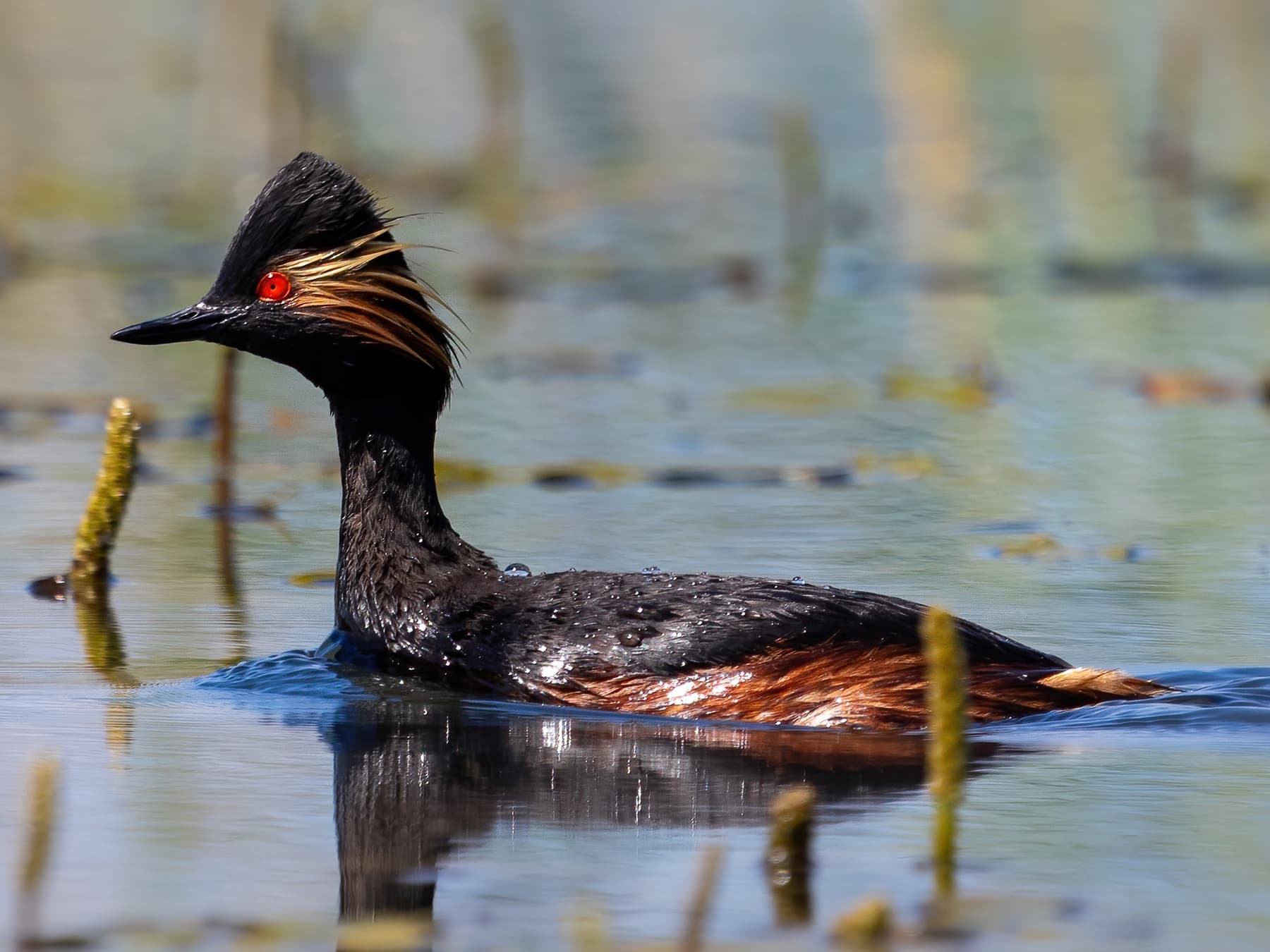
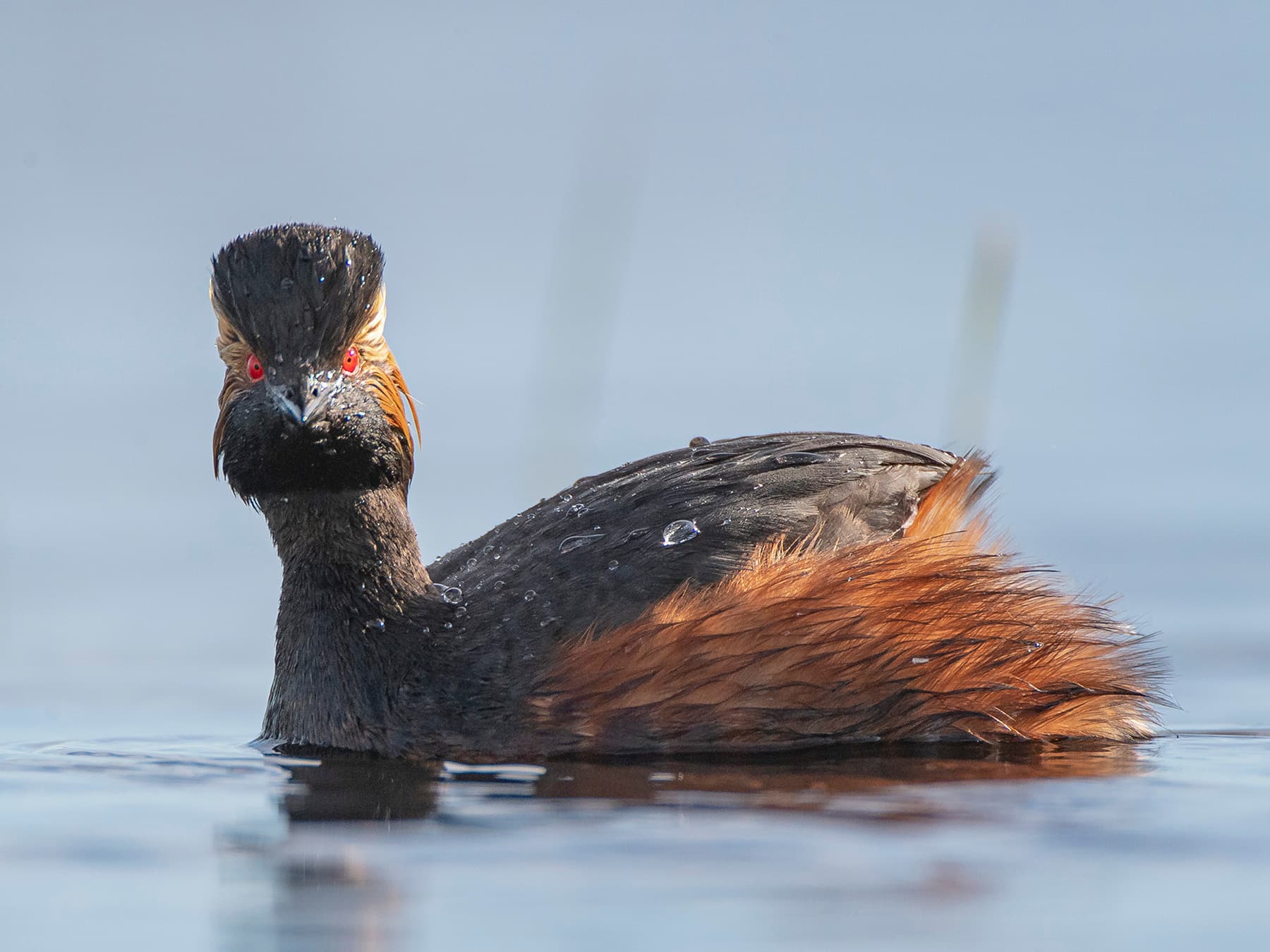
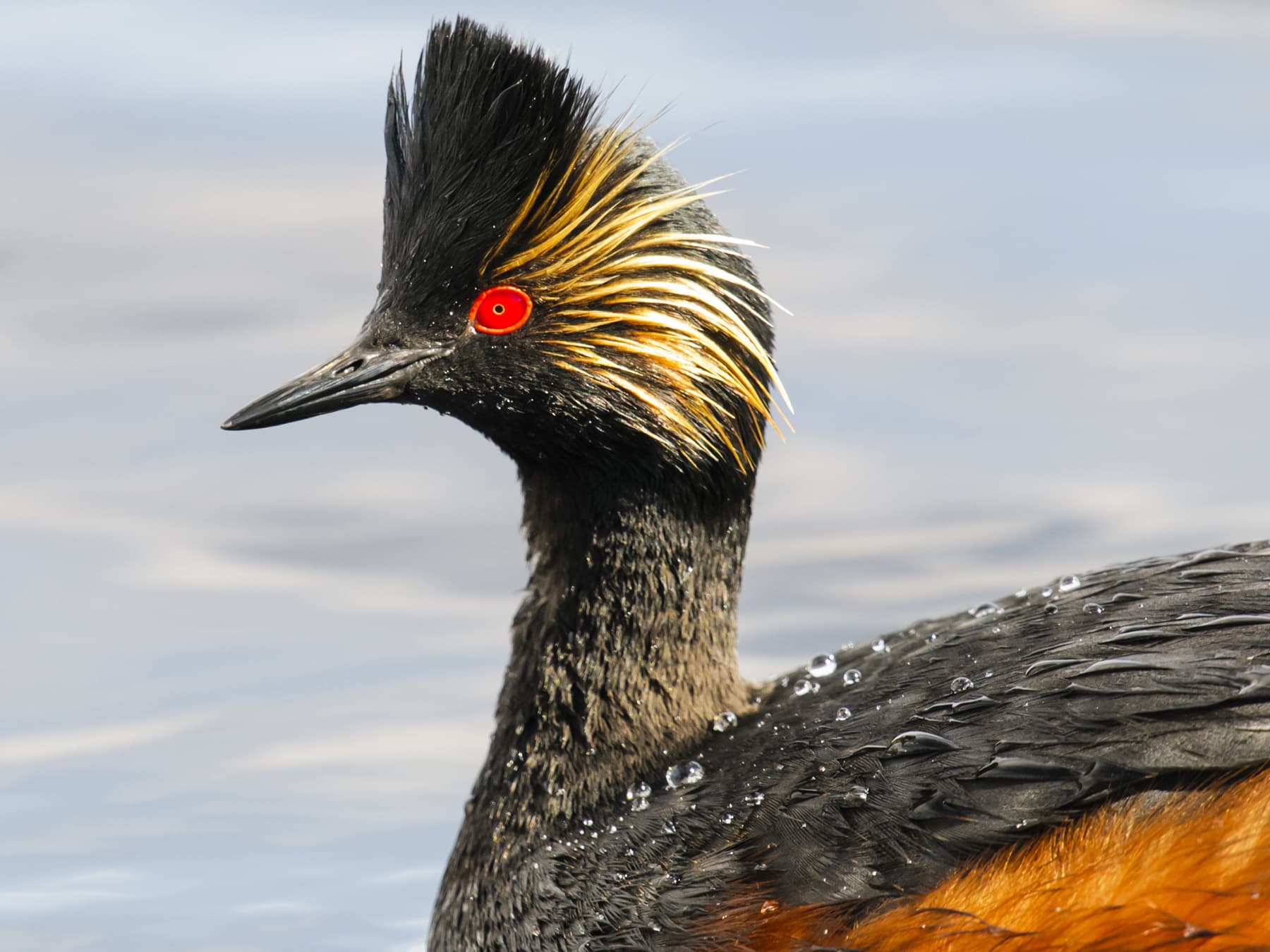
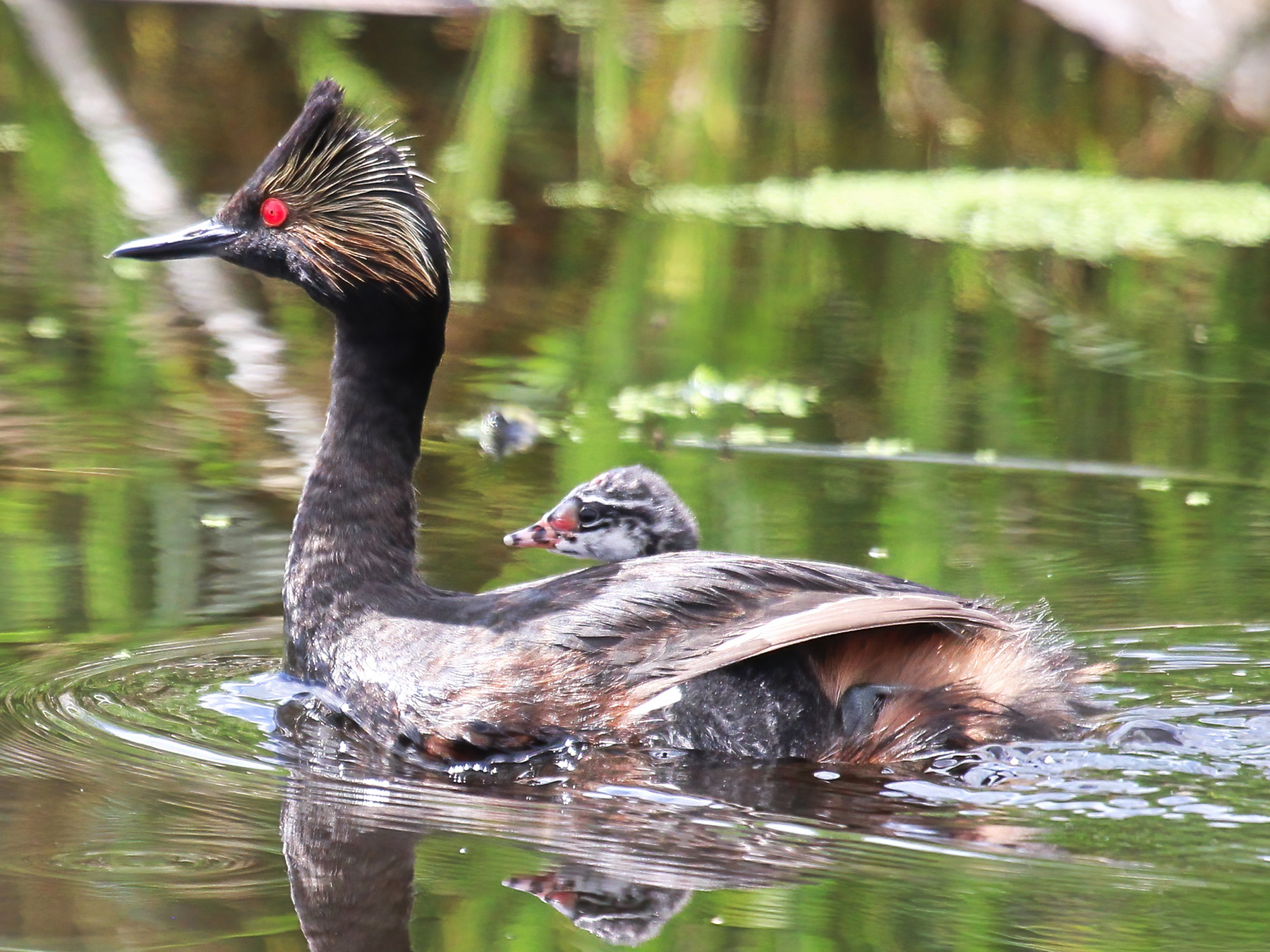
In summer, eared grebes have a distinctive appearance, with a flowing golden ‘ear tuft’ on each side of the face, next to the eyes. Their head is black, with a peaked crown, and their eyes are a vivid shade of red, ringed with orange to the outside and a yellow interior ring.
Their neck, breast and upper back are black, with warm rufous brown flanks. Wings are dark brown, with a white patch that is visible in flight. Legs and feet are dark, with a greenish tinge, and their bill is straight, narrow and light gray.
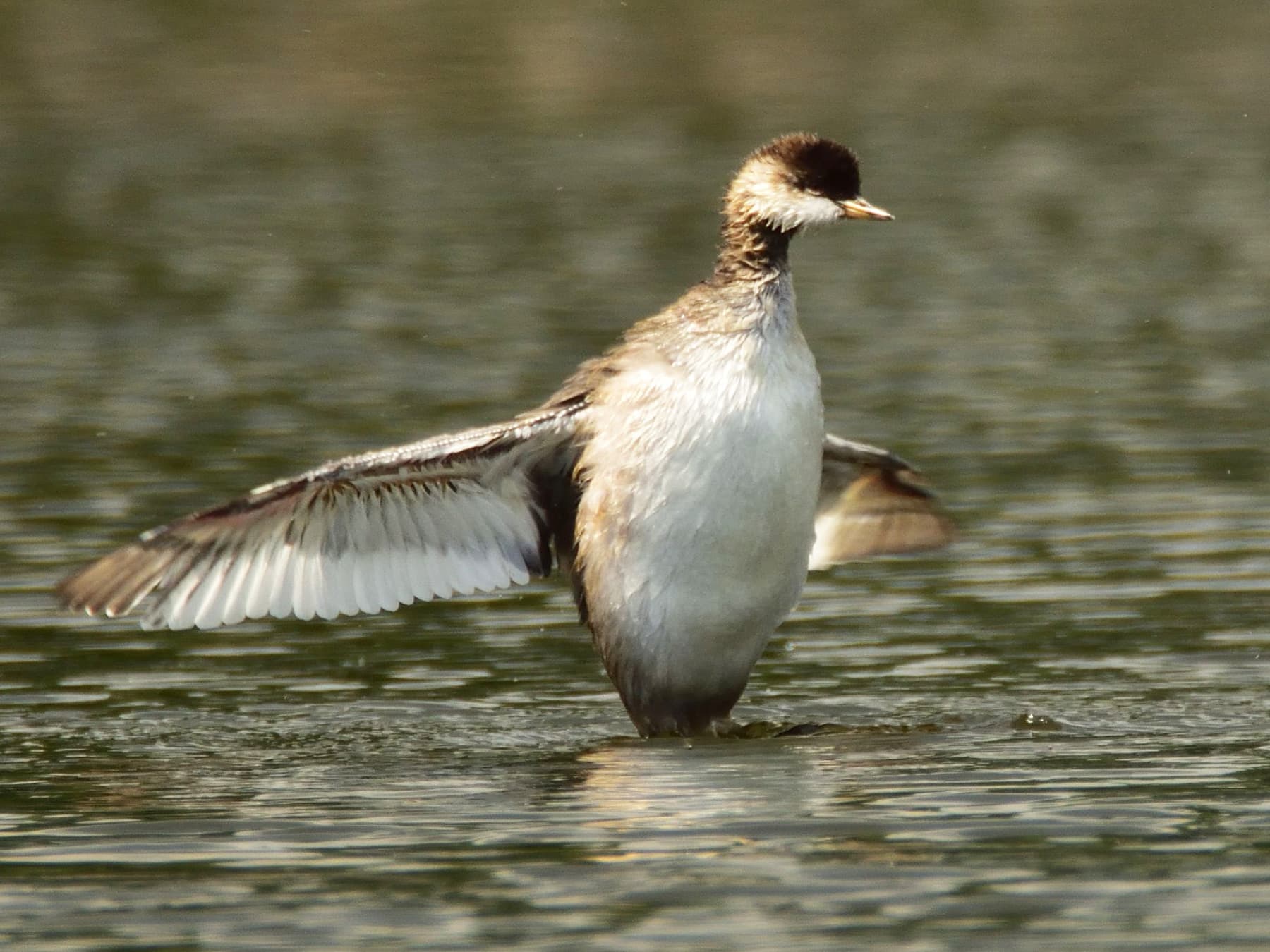
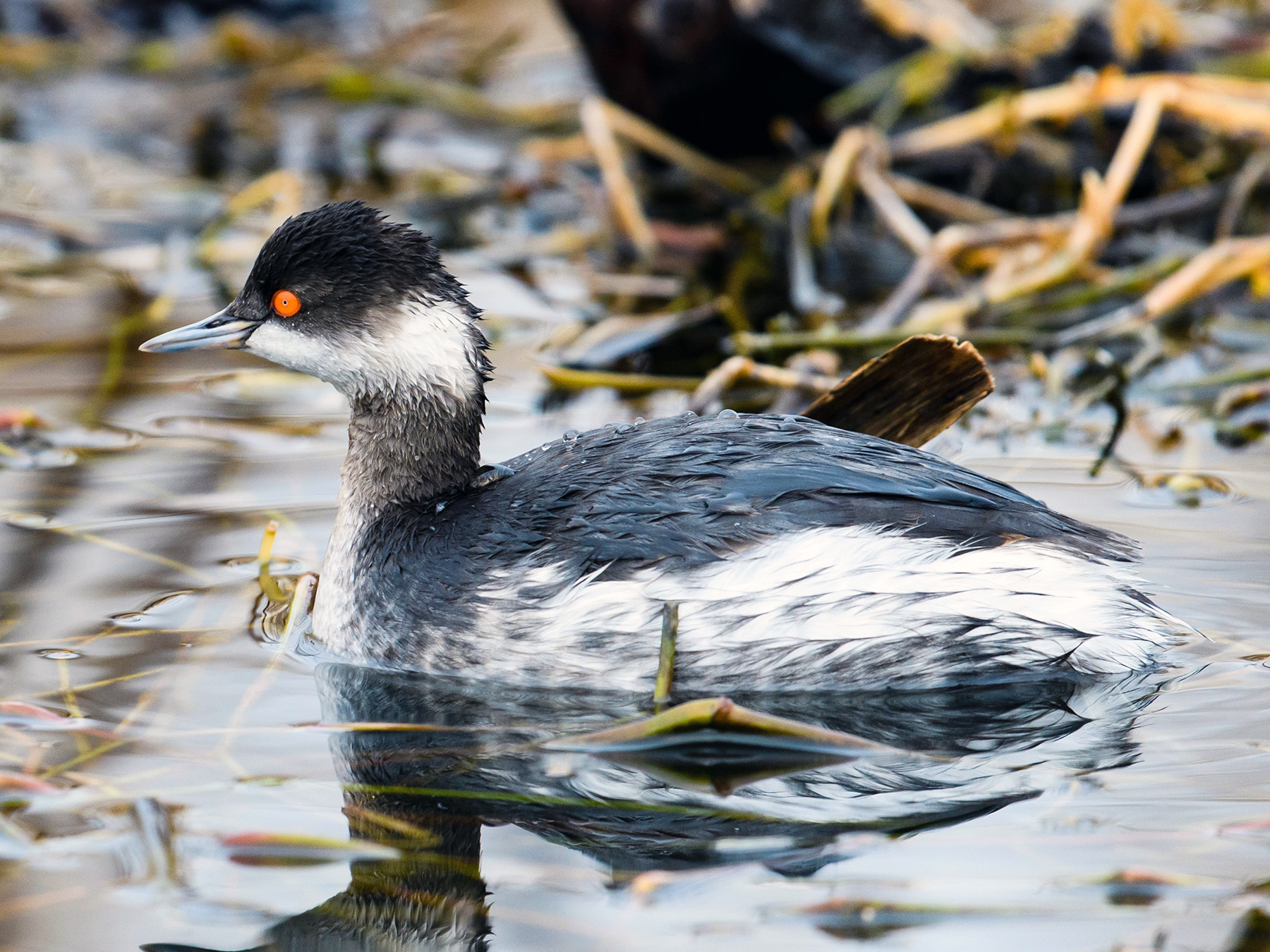
Non-breeding eared grebes lose their striking golden facial plumes and molt into an altogether drabber and more indistinct set of feathers. Their back, nape and upper wings become charcoal-black, while their lower wings and flanks turn a slightly lighter shade of grayish-black. They have a black cap, white patches behind the eyes, a white chin and a whitish breast and belly. Their bill darkens in winter, but their eyes remain dark red.
Juvenile eared grebes resemble non-breeding adults but have a brownish wash and some buff-orange feathering on the sides of their heads and neck.
How big are Eared Grebes?
A small member of the grebe family, the eared grebe is just over half the size of a mallard. There is no difference in size between males and females.
- Length: 28 cm to 34 cm (11 in to 13.4 in)
- Wingspan: 56 cm to 60 cm (22 in to 23.6 in)
- Weight: 250 g to 350 g (.8 oz to 12.3 oz)
Its size
Adults- Length
- 28–34 cm
- Wingspan
- 56–60 cm
- Weight
- 200–450 g
Its song and calls
What sound does an Eared Grebe make?
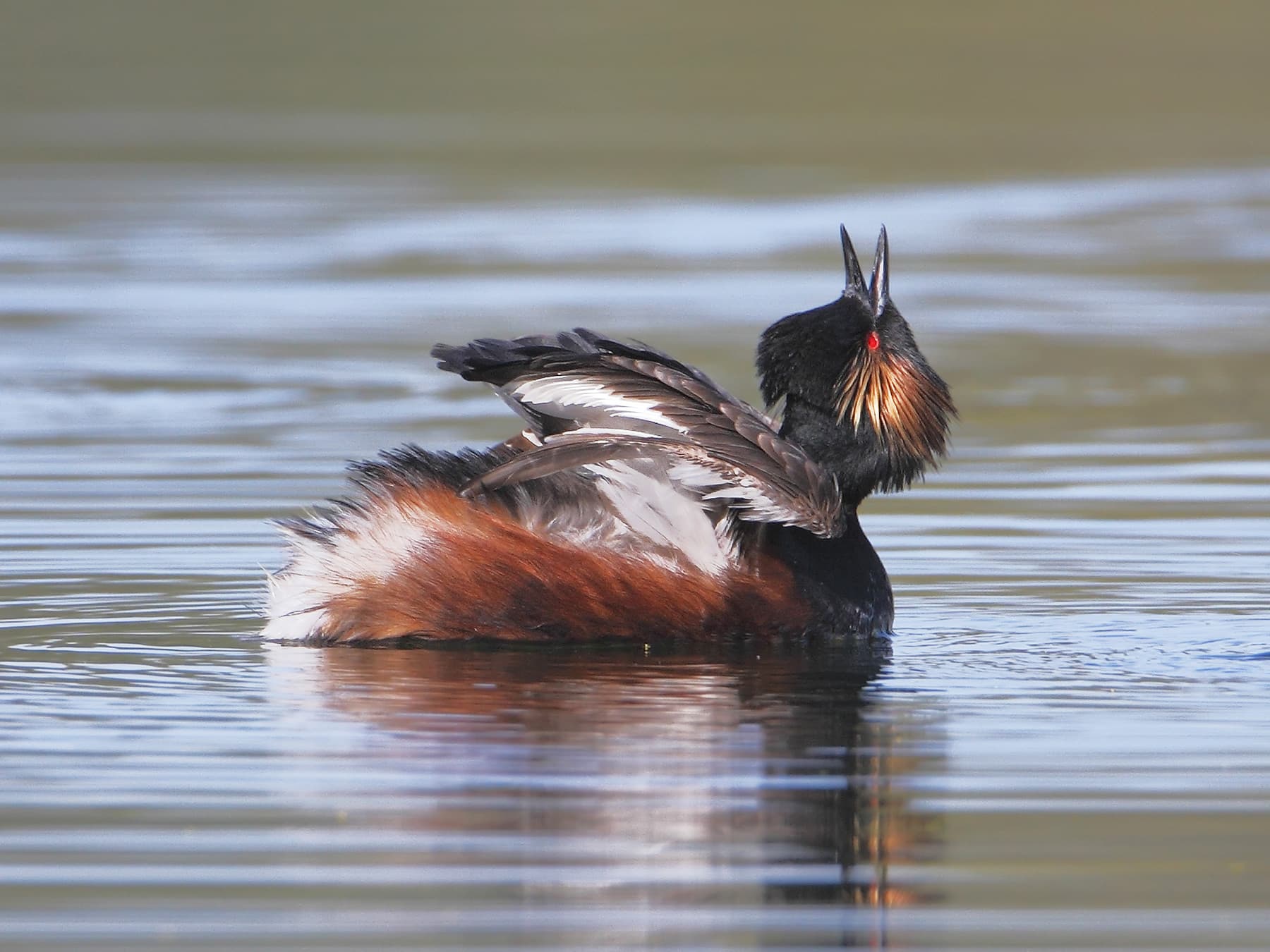
Outside of the breeding season, eared grebes are silent, but when they are attempting to attract a mate or defending a nest, a fast, a range of vocalizations can be heard.
The male’s advertising call is a loud and repetitive ‘poo-ee-chk’ and the female’s response is the same but a softer, higher pitch. A harsh, chattering call is made in response to threats around the nest site, and a sharp alarm call instructs chicks to respond by hiding beneath their parents wing feathers in the early days after hatching.
When and where to see it
OctoberIn season
Most recorded in October
- 1. Rutland0.17%
- 2. Essex0.10%
- 3. Surreyunder 0.1%
- 4. West Yorkshireunder 0.1%
- 5. Dorsetunder 0.1%
Each dot is a county, state or province: the bigger and darker, the larger the bird’s share of that place’s bird records that month. Grey dots: no regular records. The ringed point is the centre of the bird’s records this month; the arrow shows how it moved since last month, and the dashed loop its path through the year. “Arrivals” colours places where it becomes regular this month (orange) or is in its last regular month (grey). GBIF eBird Observation Dataset, 2019–2024. Map data: Natural Earth, US Census Bureau; place centres © OpenStreetMap contributors.
In your area
See when the Black-necked Grebe is recorded in your county, state or province.
How often the Black-necked Grebe turns up in the UK, Ireland, the United States and Canada through the year, from birdwatchers' records.
United Kingdom
Resident · all year · nesting-season records held back
Ireland
Scarce · most records in January
United States
Resident · all year · most records in November
Canada
Summer visitor · regularly Apr–Feb · most records in July
Show as a table
| Month | United Kingdom | Ireland | United States | Canada |
|---|---|---|---|---|
| January | 0.042% (regular) | 0.020% | 0.10% (regular) | 0.010% (regular) |
| February | 0.026% (regular) | 0.017% | 0.080% (regular) | 0.006% (regular) |
| March | 0.033% (regular) | 0.004% | 0.062% (regular) | 0.003% |
| April | held back (protected) | – | 0.067% (regular) | 0.027% (regular) |
| May | held back (protected) | <0.001% | 0.043% (regular) | 0.063% (regular) |
| June | held back (protected) | – | 0.032% (regular) | 0.060% (regular) |
| July | held back (protected) | – | 0.028% (regular) | 0.067% (regular) |
| August | 0.023% (regular) | – | 0.036% (regular) | 0.058% (regular) |
| September | 0.024% (regular) | – | 0.052% (regular) | 0.045% (regular) |
| October | 0.023% (regular) | 0.001% | 0.093% (regular) | 0.038% (regular) |
| November | 0.028% (regular) | 0.006% | 0.13% (regular) | 0.013% (regular) |
| December | 0.032% (regular) | 0.008% | 0.091% (regular) | 0.006% (regular) |
Nesting-season records (April to July) are held back to protect nests, so those months show as present but unmeasured.
Recorded regularly in
Worldwide: recorded regularly in 77 countries
Countries where it was recorded in at least 3 of the 6 years 2019–2024. Linked countries have their own bird list.
Europe (36)
Asia (27)
North America (4)
Data: EOD – eBird Observation Dataset (Cornell Lab of Ornithology), accessed via GBIF.org, CC BY 4.0. Records from 2019–2024, aggregated and filtered by Birdfact. How these lists are made
What is the habitat of an Eared Grebe?
Eared grebes’ preferred habitat varies according to the time of year. During the breeding season, freshwater lakes, ponds, slow-flowing backwaters and shallow marshes with lush vegetation are favored. Sewage farms and algae-rich bodies of water also offer a suitable habitat for breeding and foraging.
Once breeding is complete, molting takes place and during this time, it’s common for eared grebes to temporarily relocate to saline lakes. After molting, eared grebes can mostly be found at reservoirs, coastal estuaries and lagoons and inland saline lakes.
What is the range of an Eared Grebe?
The North American breeding range of eared grebes is concentrated on southwestern and south-central Canada and throughout the west-central United States.
The species is present in areas of California all year round, while along the Mexican border, winter populations gather and further south, across the whole of Mexico, large wintering grounds offer a temporary home to an influx of migratory grebes from further north.
In Europe, the breeding range of black-necked grebes extends from the British Isles and south Scandinavia in the west, through Russia and Central Asia to Western Siberia’s Ob Valley in the east. In winter, the southern limit of the species’ range reaches Morocco, Turkey, Iraq and Afghanistan.
Where do Eared Grebes live?
The vast majority of the global population of eared grebes live in North America, with up to 60,000 individuals reported in summer at California’s Mono Lake, and between 10,000 and 20,000 pairs breeding in British Columbia.
In Europe, estimates indicate around 100,000 black-necked grebes, although these numbers may be inaccurate, with reports of 186,000 individuals at Lake Burdur in southwestern Turkey.
How rare are Eared Grebes?
Eared grebes are thought to be the most common and widespread grebe species, with a population estimated at between 3.9 and 4.2 million birds worldwide.
In the UK, where the species is known as the black-necked grebe, they are far less common, with only around 55 breeding pairs, and 115 overwintering birds recorded each year.
Where can you see Eared Grebes in North America?
It is thought that the vast majority of North America’s breeding eared grebes spend winters on the islands around the Gulf of California, where hundreds of thousands gather after their post-breeding molt.
Where can you see Black-necked Grebes in the UK?
Numbers of black-necked grebes in the UK are relatively low, but do increase slightly in winter months. They are most commonly spotted at reservoirs, flooded gravel pits and estuaries, and Cornwall’s Fal Estuary and Dorset’s Poole Harbour frequently report winter sightings.
Tips for seeing it
- Look for Black-necked Grebes on inland lakes and coastal bays
- Observe their distinctive diving behavior, often disappearing suddenly
- In breeding season, watch for their elaborate courtship displays
- Use a spotting scope for better views, as they often stay far from shore
What it eats
What do Eared Grebes eat?
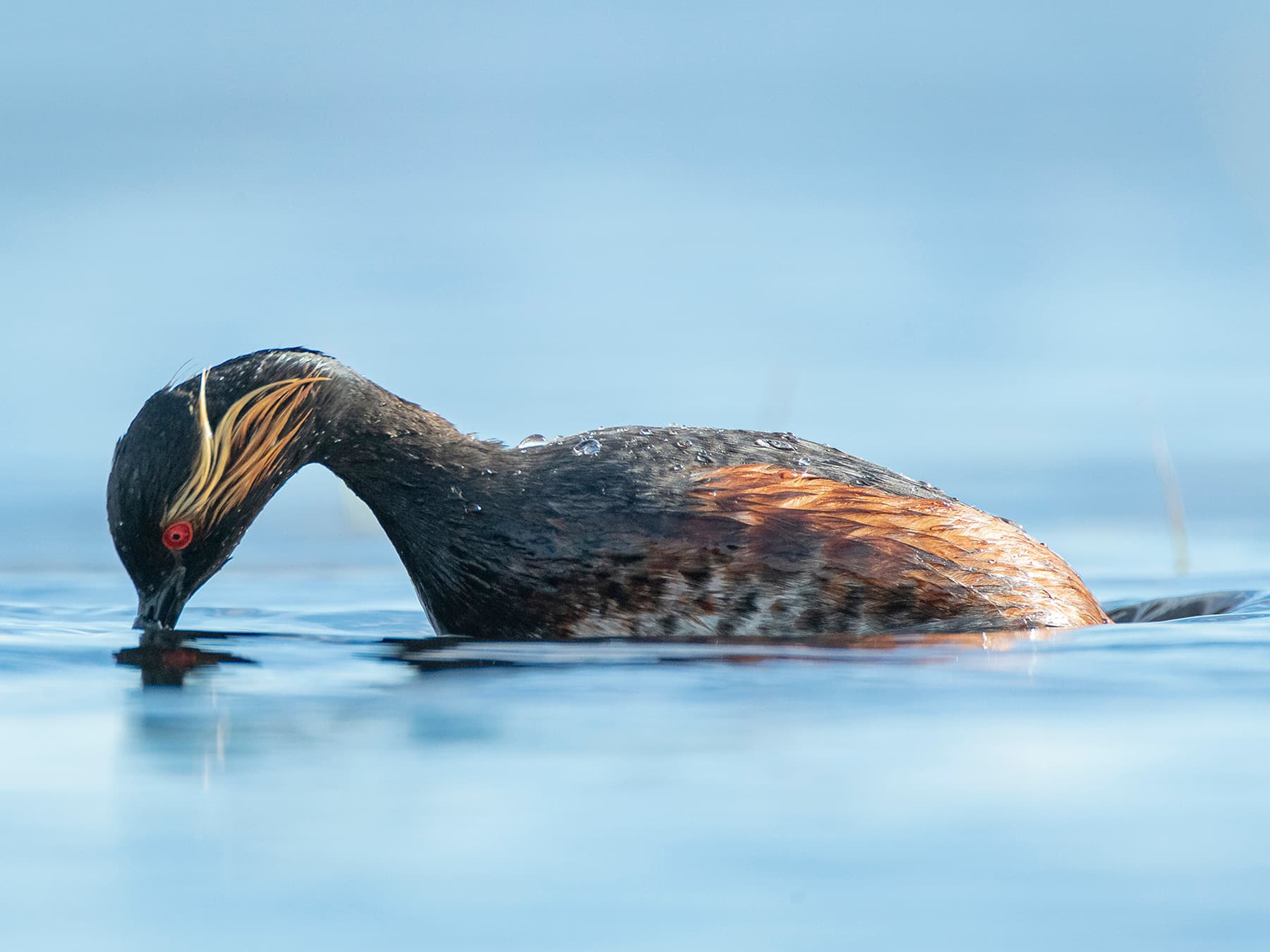
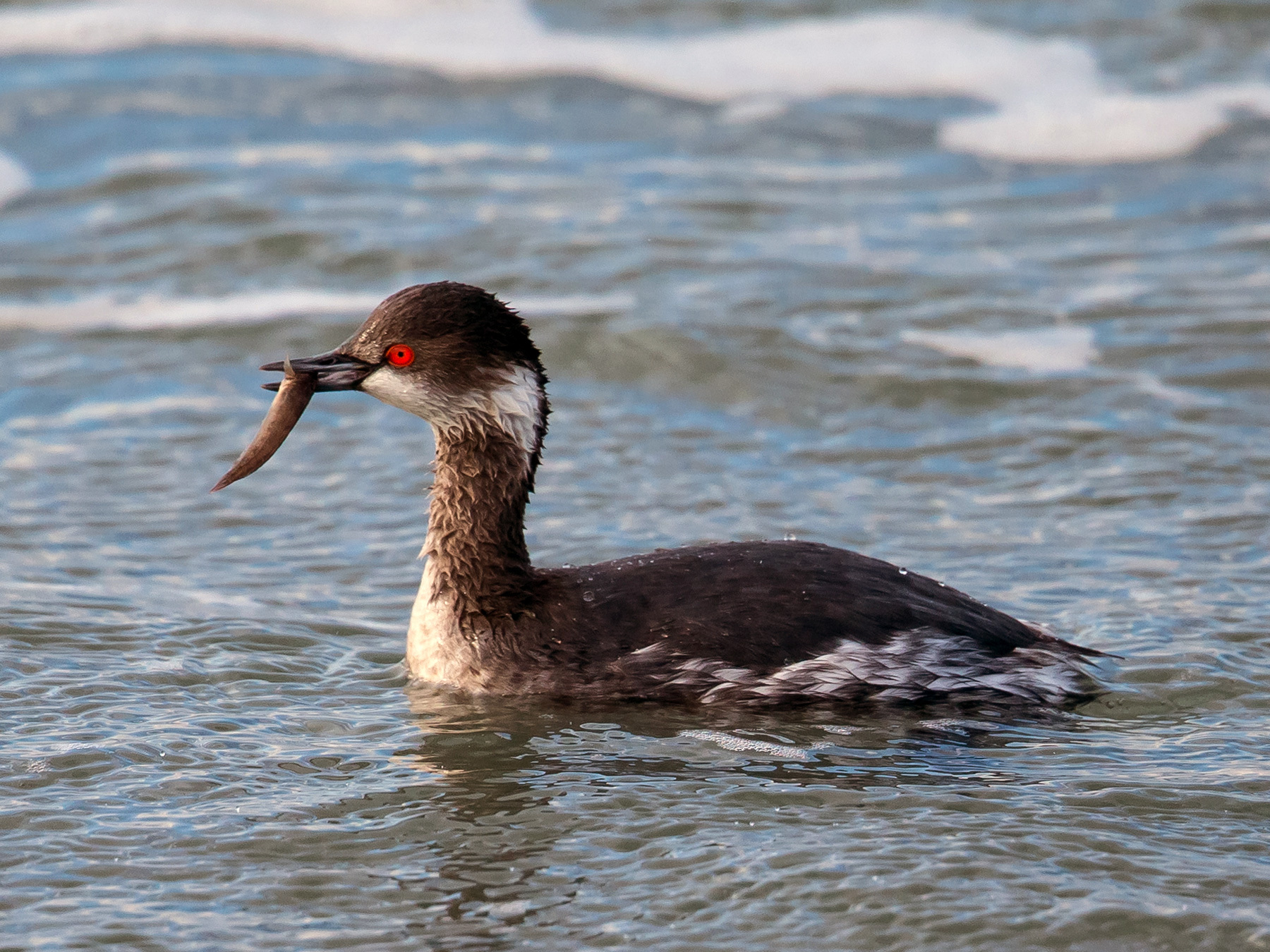
The diet of an eared grebe consists of aquatic creatures, including insects, crustaceans (particularly brine shrimp), larvae, molluscs, tadpoles, and small fish. Prey is caught on short dives below the water’s surface.
What do Eared Grebe chicks eat?
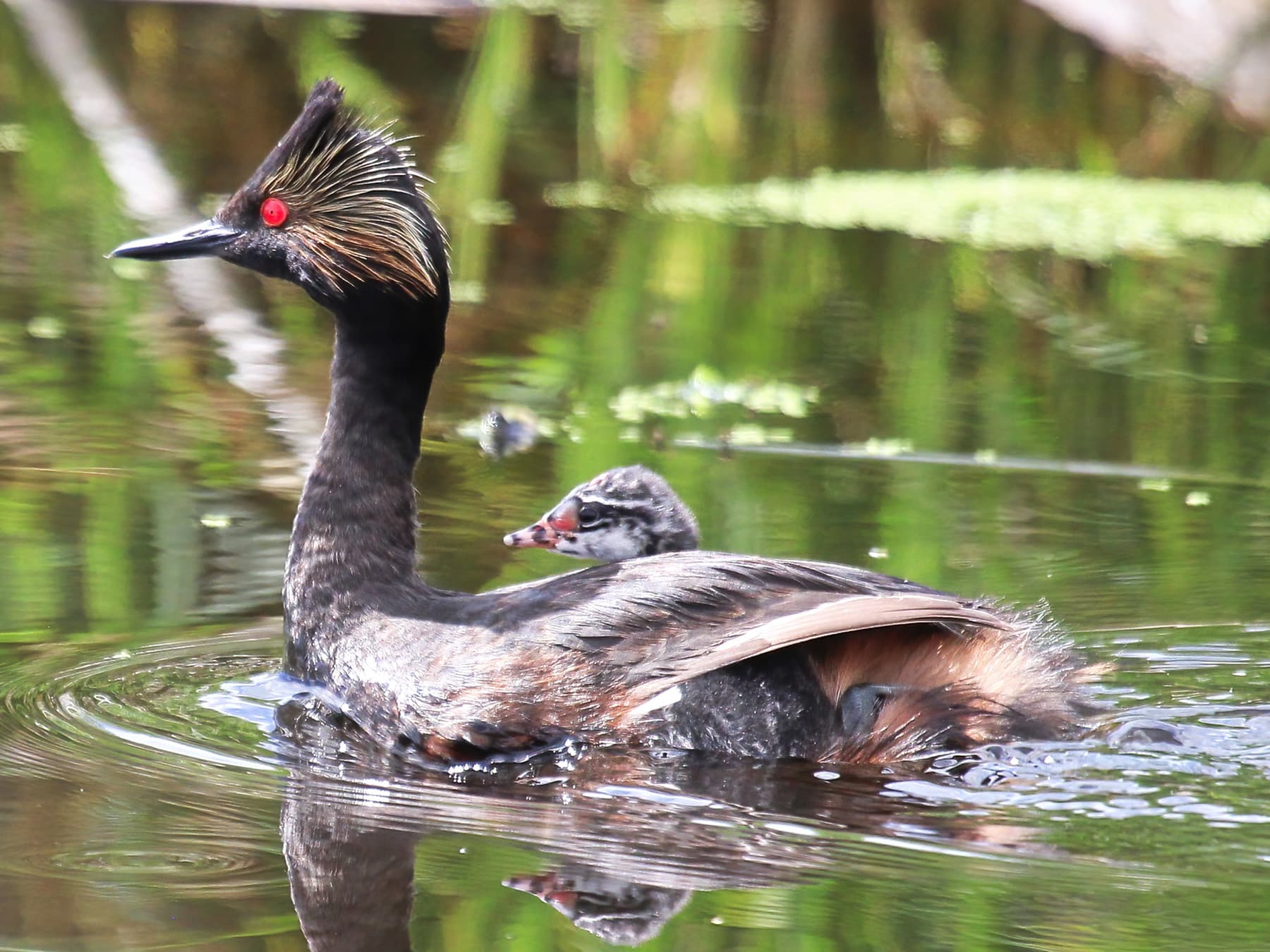
Young eared grebes are fed by their parents one at a time, with the chick riding on one parent’s back while the other adult bird passes food into their bill. Their diet is the same as an adult’s, with larvae and small shrimp being especially common in the early stages.
Nesting and breeding
Where do Eared Grebes nest?
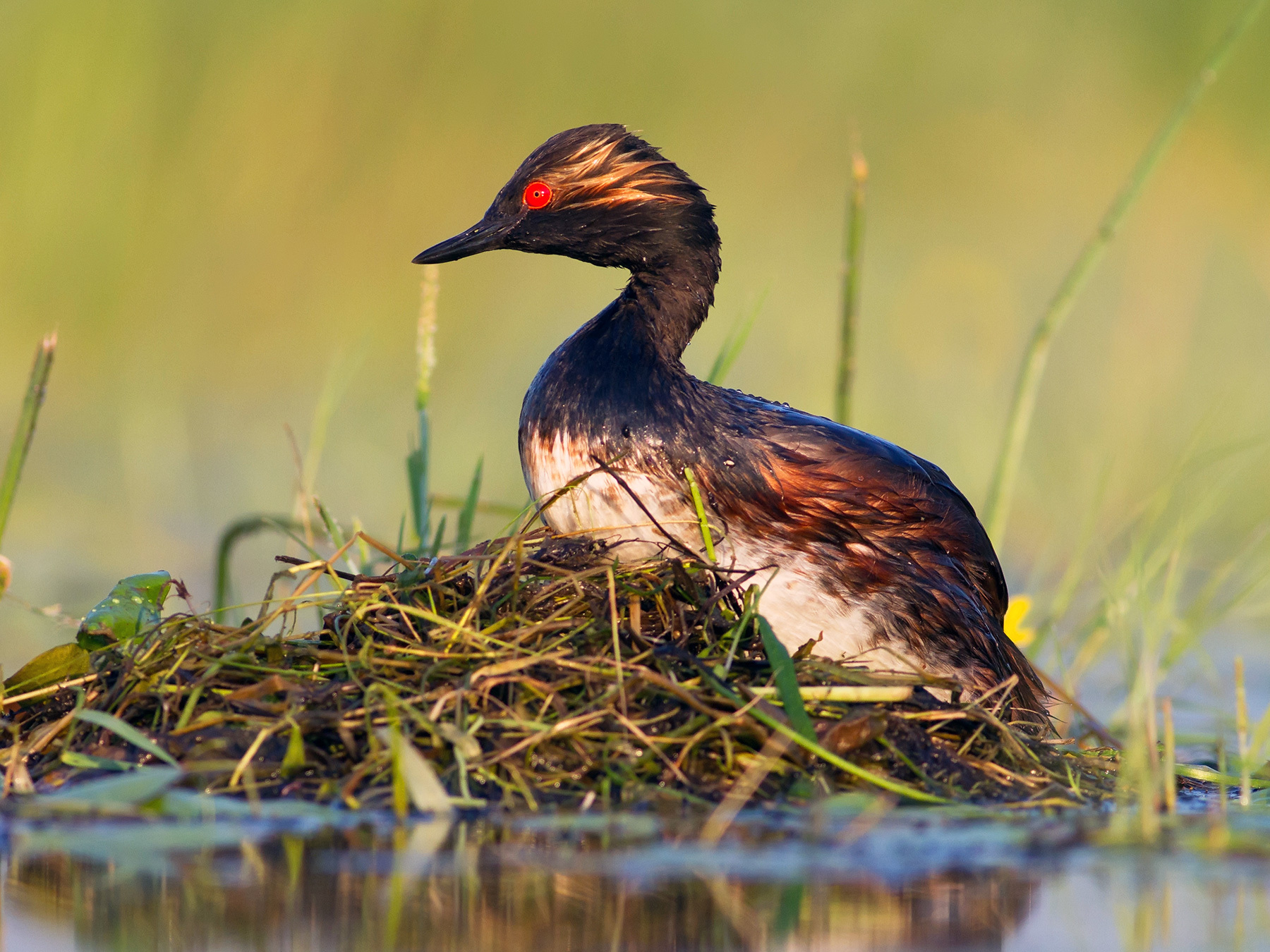
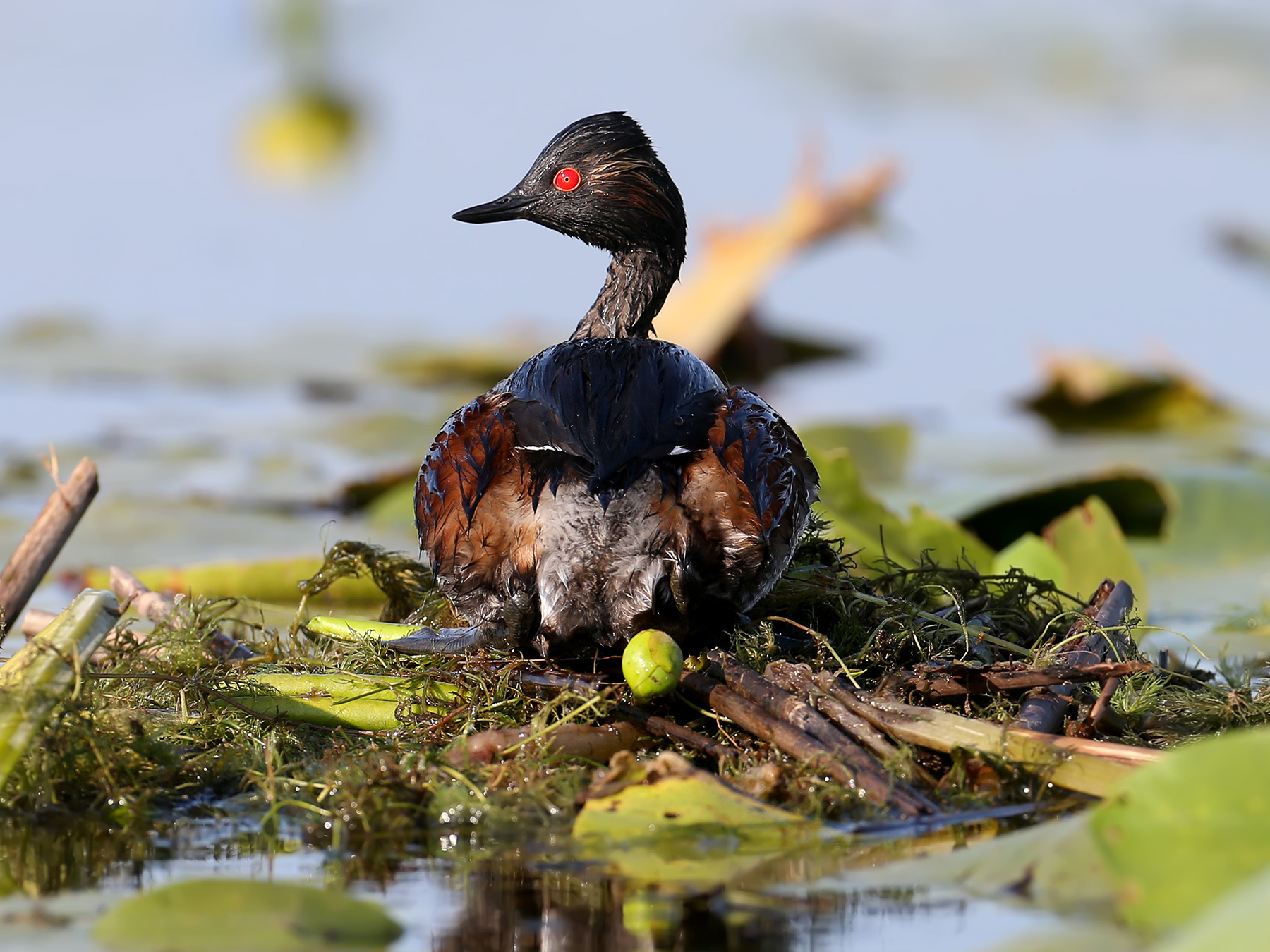
A floating nest platform is constructed by both the male and female, using twigs, and other plant matter and built up from an underwater level to become raised above the water’s surface.
It is anchored to flattened reeds or other aquatic vegetation to ensure it remains in place, and modifications continue after eggs have been laid. An internal flat layer is added to the nest cup, made from wet plant parts.
When do Eared Grebes nest?
The nesting period for eared grebes is typically from late May to early July in both North America and Europe, but can last from April to August in the United States and Canada.
One brood is laid in a season, and the incubation period lasts around 21 days, with both parents taking turns on the nest.
What do Eared Grebe eggs look like?
Eggs laid by eared grebes measure 45 mm by 30 mm (1.8 in by 1.2 in) and are a pale chalky green or blue in colour with no streaks or speckling. A typical clutch consists of three to four eggs.
Do Eared Grebes mate for life?
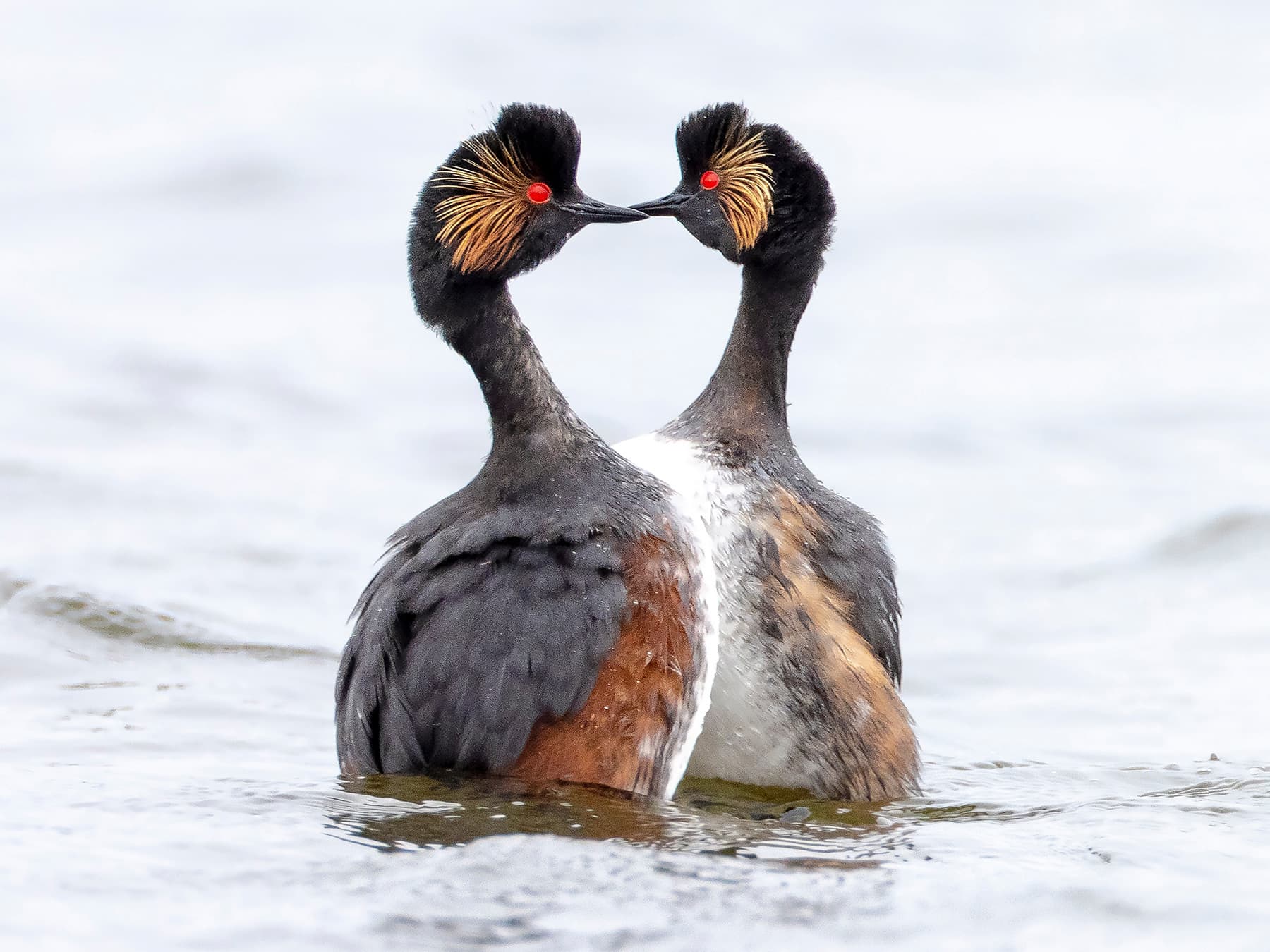
Eared grebes are monogamous for the duration of a single breeding season, raising one brood together. Pairs separate once they have raised their young, and do not reunite in subsequent years.
Behaviour
Do Eared Grebes migrate?
Eared grebes are a largely migratory species, although, in certain parts of their geographical range, populations may remain in the same territories all year round.
In northern North America, eared grebes are breeding residents only, shifting southwards once their young have been raised. However, in parts of California, the species can be seen all year round, while along the Texan border and across much of Mexico, they are strictly winter-only visitors.
Northern Europe and Central Asia’s black-necked grebes are also mainly migratory, usually moving southwards into southern Europe, north Africa and southwestern Asia.
South Africa and Namibia are home to year-round populations of black-necked grebes.
Are Eared Grebes native to North America?
North America is home to the majority of the world’s eared grebe population, with up to 4.1 million birds recorded in 1997.
The species are mostly migratory, and eared grebes that breed in Canada and the northern United States shift southwards, mainly to California and into Mexico once the breeding season ends.
Are Black-necked Grebes native to the UK?
Small numbers of black-necked grebes breed in the UK each year, with around 55 pairs recorded on a yearly basis. These are joined by the arrival of migrating birds from northern Europe during winter months, although numbers remain relatively low.
Lifespan and predators
How long do Eared Grebes live?
From ringing records, the oldest known eared grebe reached 13 years and 10 months, although little data exists due to the previous use of aluminum bands which corrode when exposed to salty water.
First breeding age is also unknown, although it’s suggested that females may reach maturity earlier than males, and breeding is often underway by the second year.
What are the predators of Eared Grebes?
Adult eared grebes are not especially at risk from predation, but accounts tell of mature birds being killed by mink, grey herons, western gulls and great horned owls.
Natural causes, particularly plunging temperatures, are a key factor in many nest failures. Snakes, minks, large fish, and birds of prey commonly raid the nests and eggs of breeding eared grebes, while American coots are known predators of eared grebe chicks and eggs.
Are Eared Grebes protected?
In the United States, eared grebes are included in the Migratory Bird Treaty Act of 1918, which makes it illegal to kill, capture, sell, trade or transport birds of this species.
In the UK, black-necked grebes are protected as Schedule 1 birds under the Wildlife and Countryside Act, 1981, which makes it an offense to damage or destroy their eggs, nests and young, as well as it being illegal to deliberately kill, injure or capture an individual black-necked grebe.
Are Eared Grebes endangered?
Across their global range, eared grebes are considered a species of least concern and are not globally threatened. Global population estimates stand at up to 4.2 million individuals, making the species the most abundant of all grebes.
In the UK, black-necked grebes are rated as an Amber species on the British Birds of Conservation Concern list.
Conservation
While globally listed as Least Concern, Black-necked Grebes face localized threats from habitat loss and pollution.
Conservation efforts focus on protecting wetland habitats and monitoring population trends, particularly in areas where numbers have declined.
Similar birds
Often mistaken for
More photos
9 photos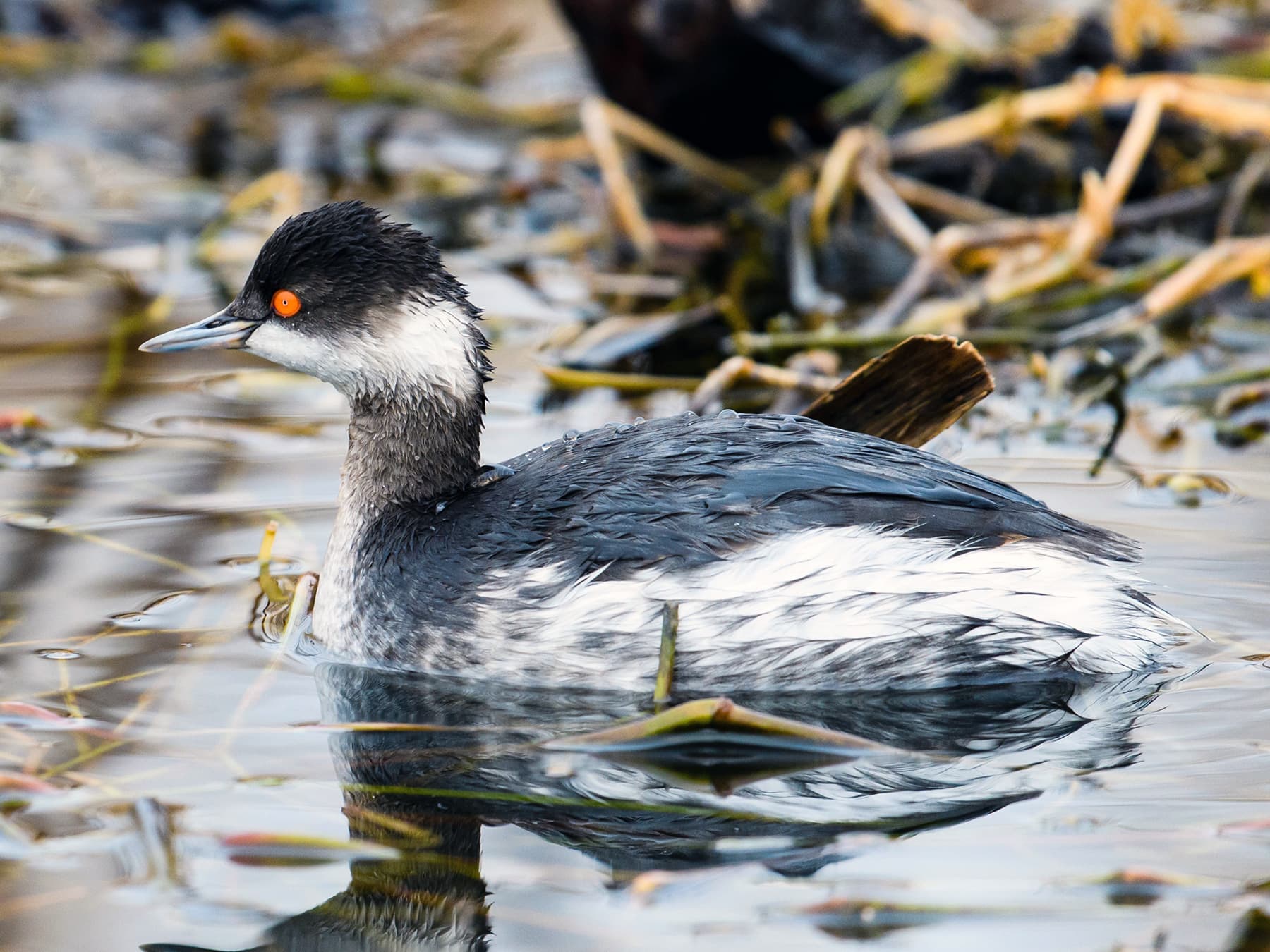 Black-necked Grebe with winter plumage
 Pair of Black-necked Grebes
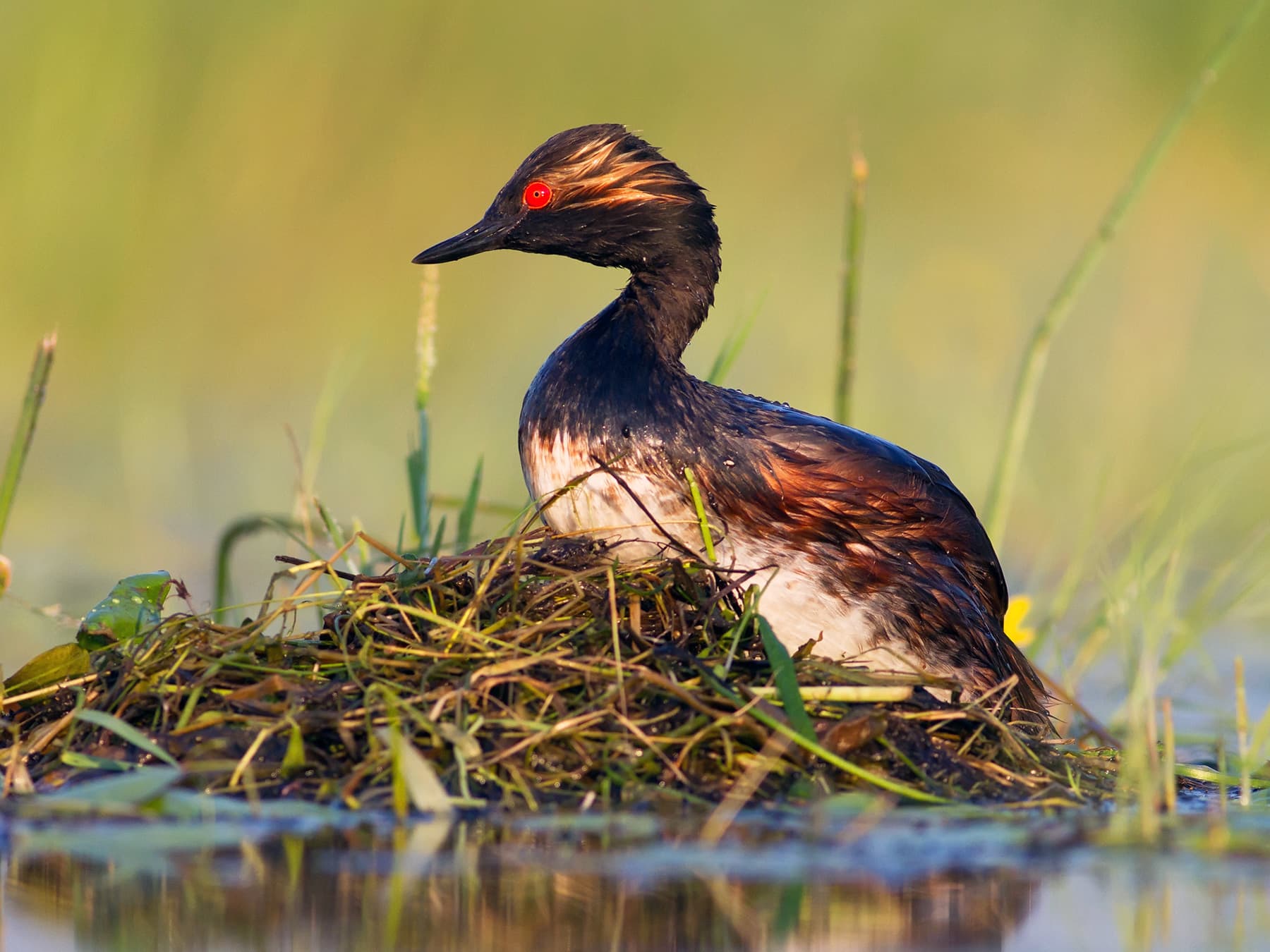 Black-necked Grebe at nest
 Black-necked Grebe with summer plumage
 A young Eared Grebe
 Black-necked Grebe riding on its parent's back
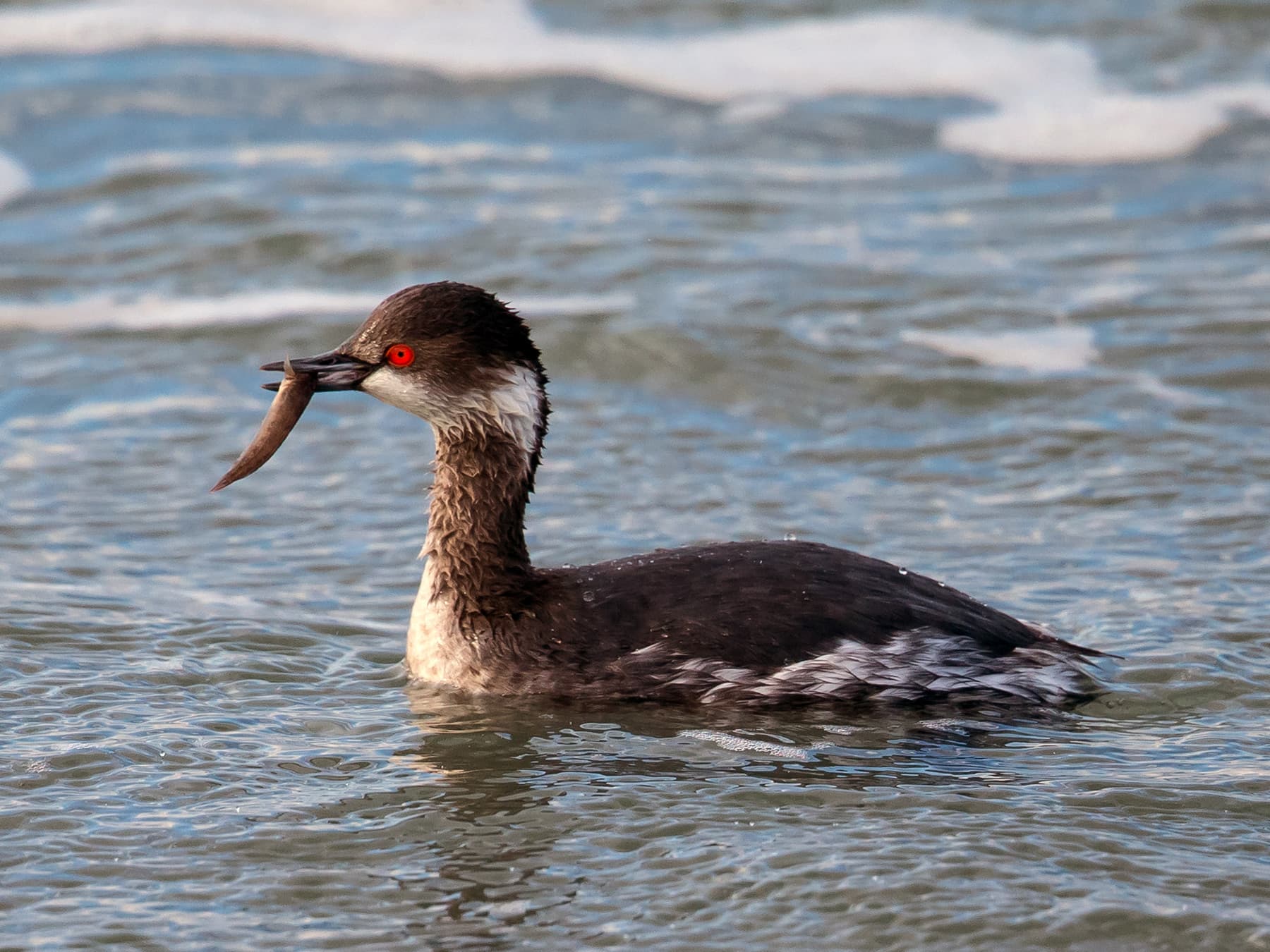 Black-necked Grebe (winter plumage) with fish in its beak
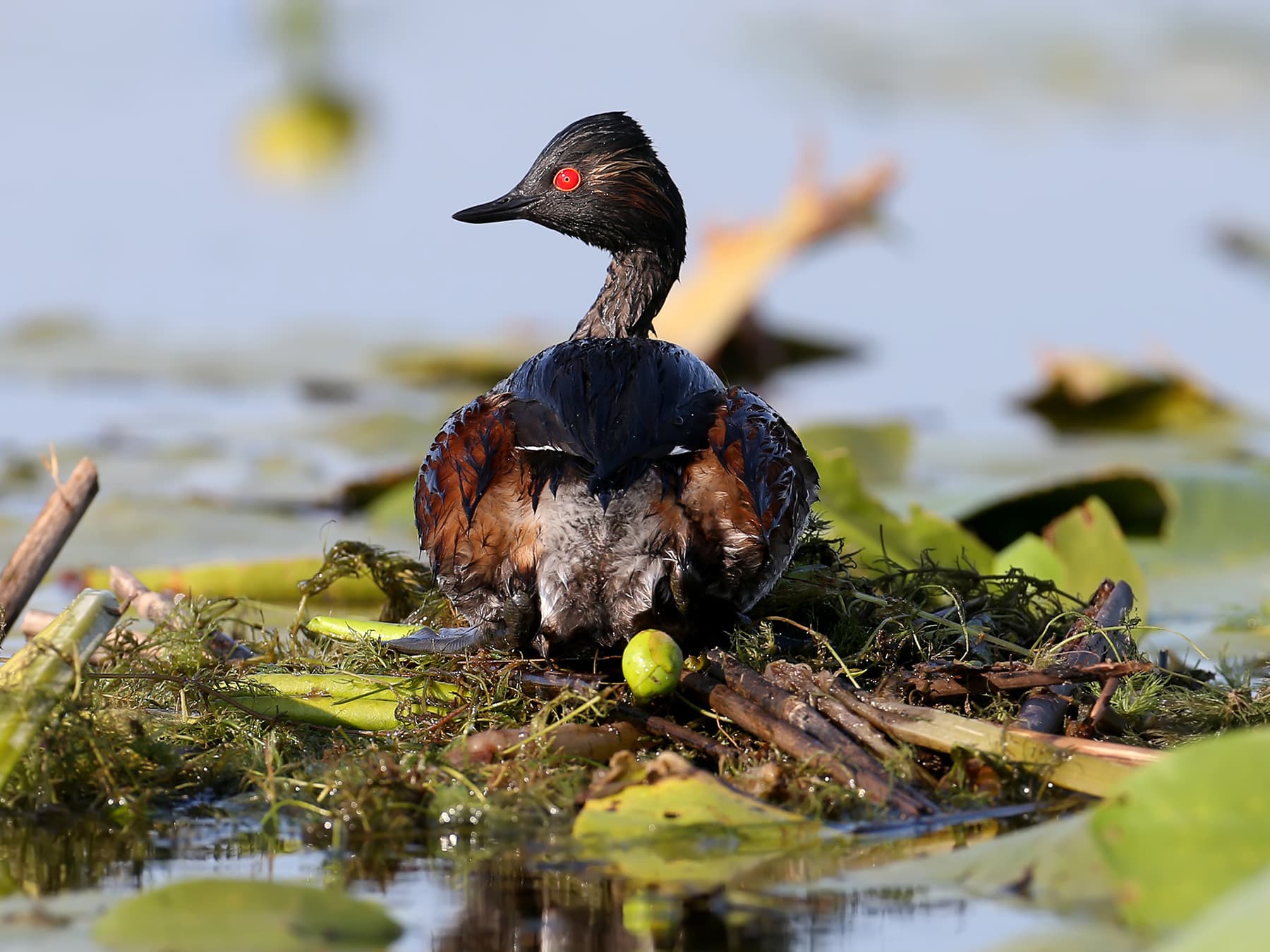 Black-necked Grebe sitting on its nest
 Black-necked Grebe swimming with young




Quick facts
- Length
- 28–34 cm
- Wingspan
- 56–60 cm
- Weight
- 200–450 g
- Lifespan
- 7 years · oldest recorded 13.1 years
- Family
- Grebes
- Migration
- Partial migrant
- Global status (IUCN)
- Least Concern
- World population
- 3,900,000 - 4,200,000 mature individuals
- Population trend
- Unknown
- Also called
- Eared Grebe
- Scientific name
- Podiceps nigricollis
Questions
1What eats Eared Grebe?
Mink, coyotes, tawny owls, herring gulls, yellow-footed gulls and gray herons have been recorded to eat adult eared grebes, while their eggs and young are commonly targeted by other waterbirds, including American coots, as well as by snakes, raccoons, mink, coyotes, and ravens.
Sources
3- 1BirdLife International. 2018. Podiceps nigricollis. The IUCN Red List of Threatened Species 2018: e.T22696610A132584321. Source (opens in a new tab)
- 2Wetlands International (2015)
- 3Fransson et al., EURING list of longevity records for European birds (2010) Source (opens in a new tab)

Checked by
Nathan Cope, founder and editor
Nathan founded Birdfact and leads its writers and contributors in the UK, the US and Canada. He has watched and studied birds for more than ten years, and checks every article and species guide before it’s published.