


Horned Grebe
Slavonian Grebe · Podiceps auritus
By the Birdfact teamChecked by Nathan Cope
On this page12 sections
How to recognise it
What do Horned Grebes look like?
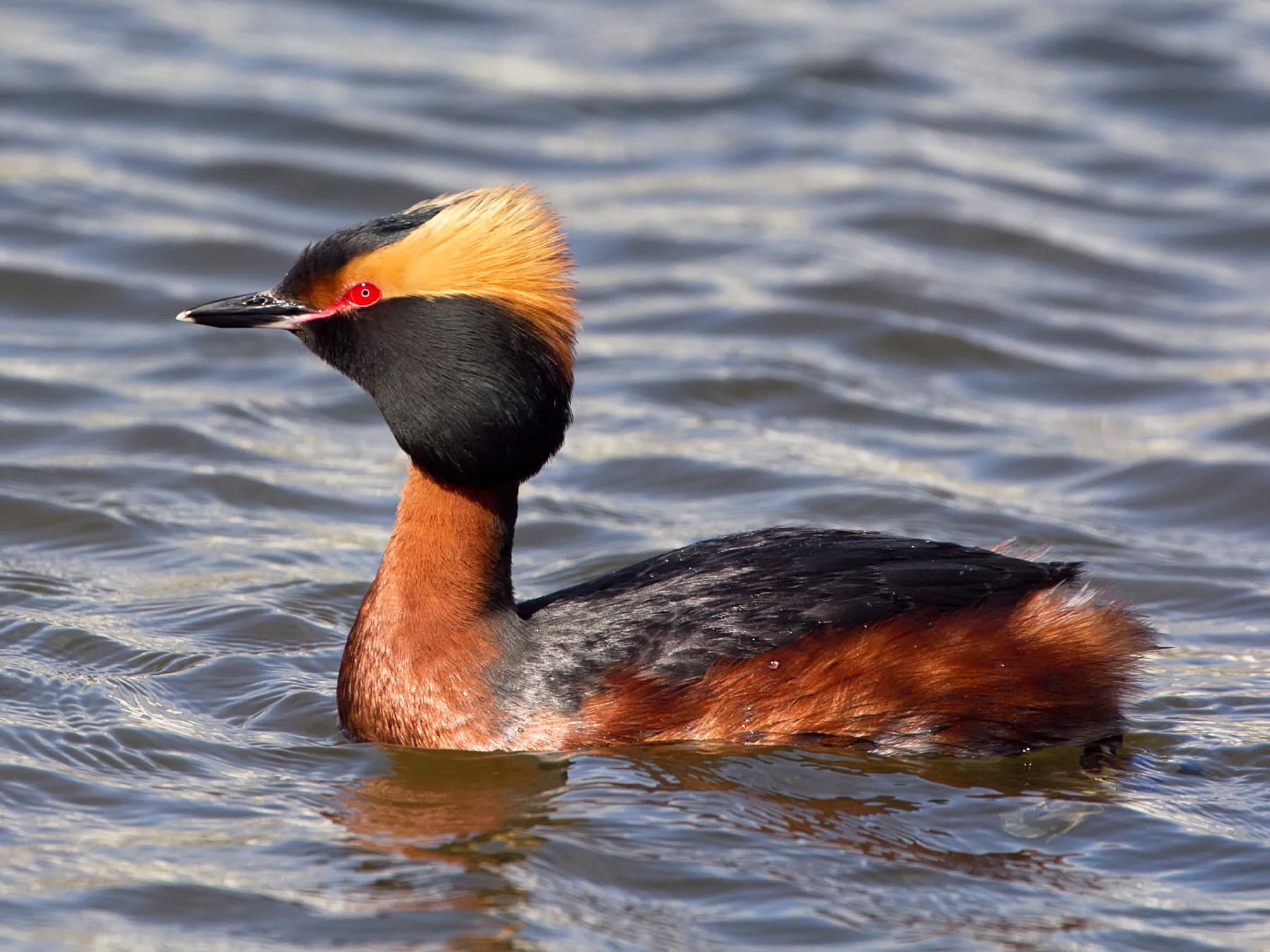
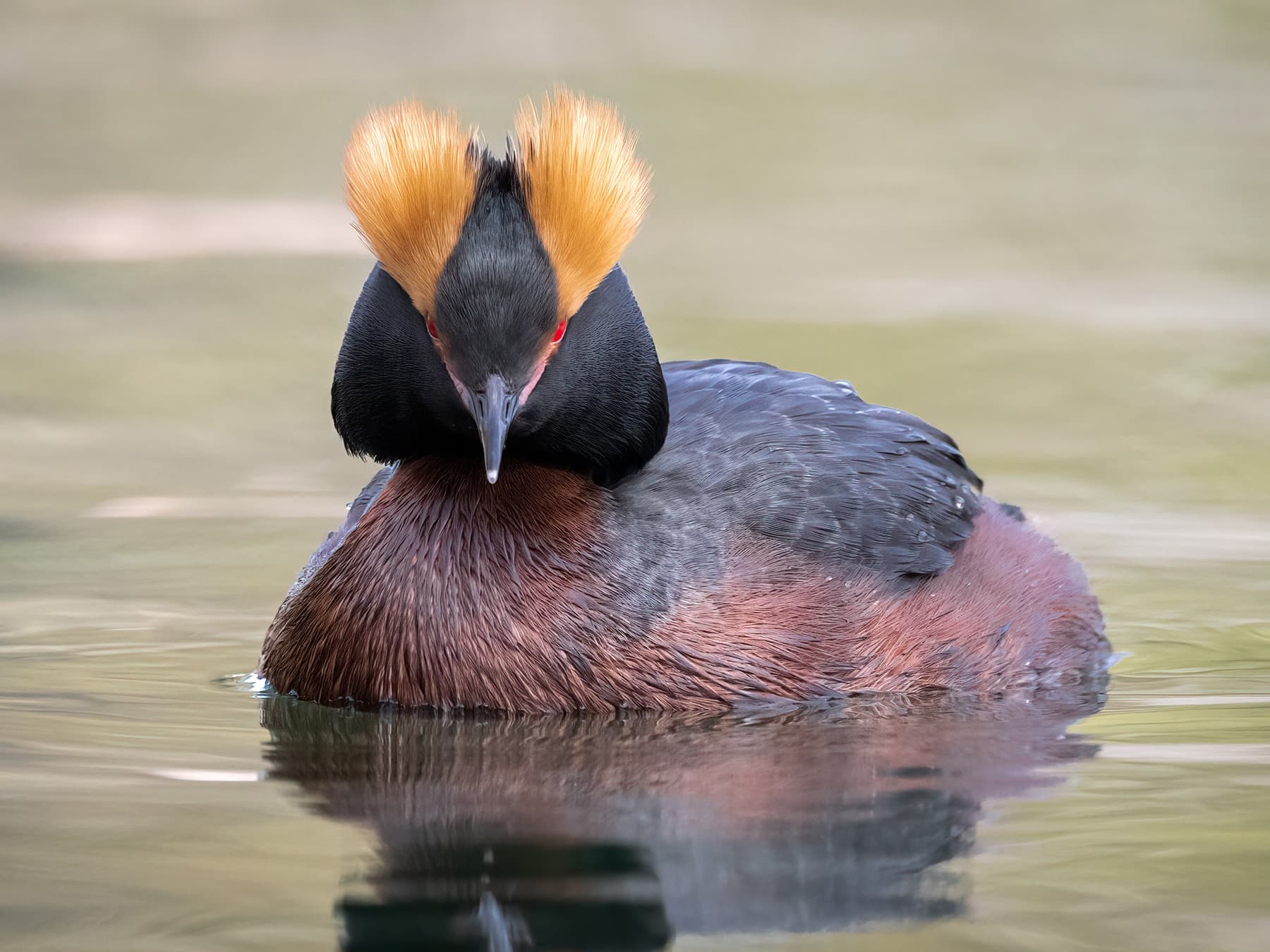
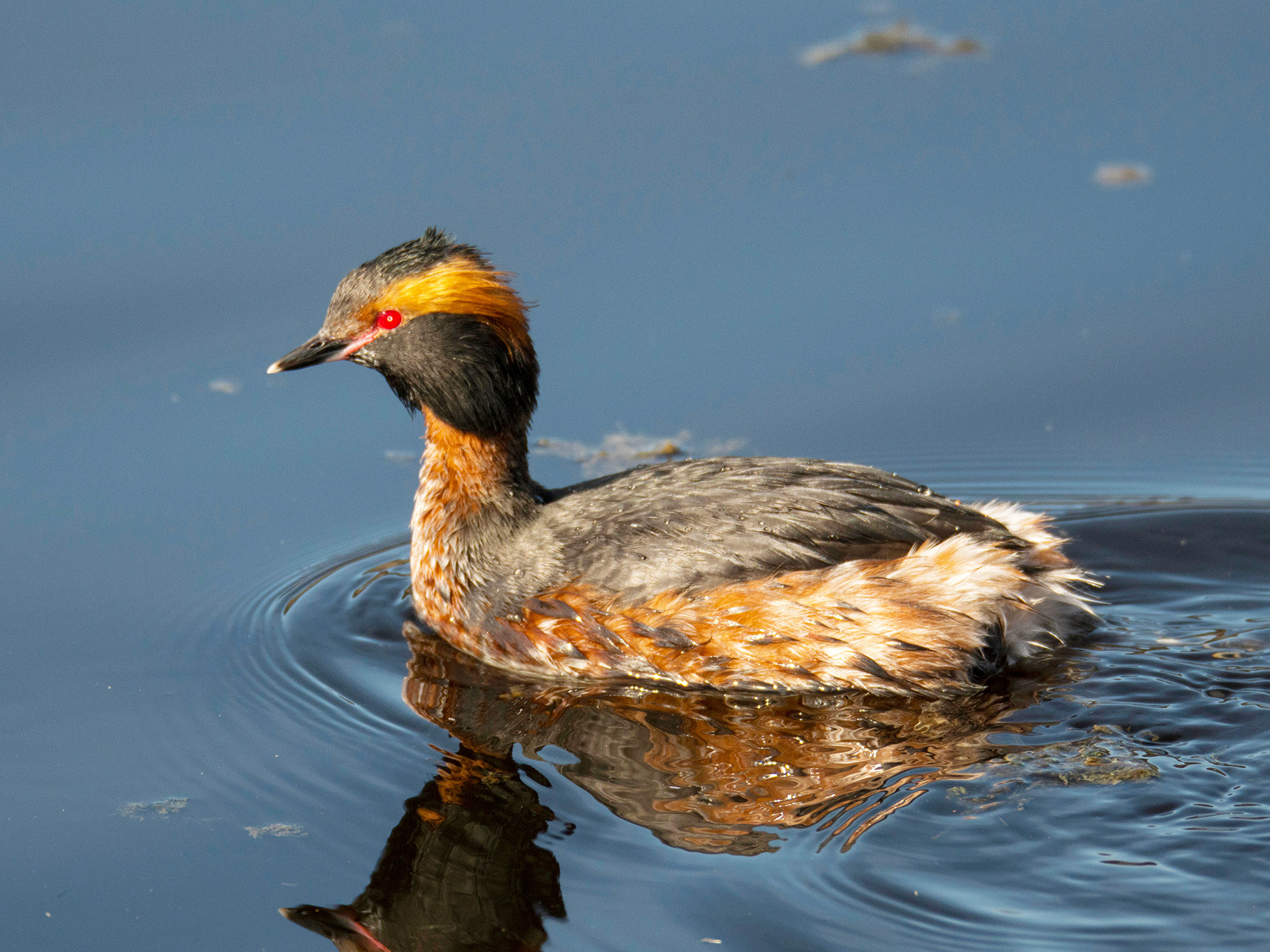
The Horned Grebe is a small waterbird with a fairly long neck and a short, dagger-like bill. When seen out of the water, flying birds show large webbed feet that extend well beyond their short tails. These birds are named for the golden feathers on the side of their head that they can raise to look like horns. However, this feature is only present in the breeding season when they look remarkably different from their winter plumage.
Breeding birds have rufous necks and flanks and dark gray backs. The feathers on the sides and back of the head grow denser, creating a large-headed appearance with a jet-black throat and protruding cheeks. A broad golden streak runs from their bill to the back of the head, and the crown is black.
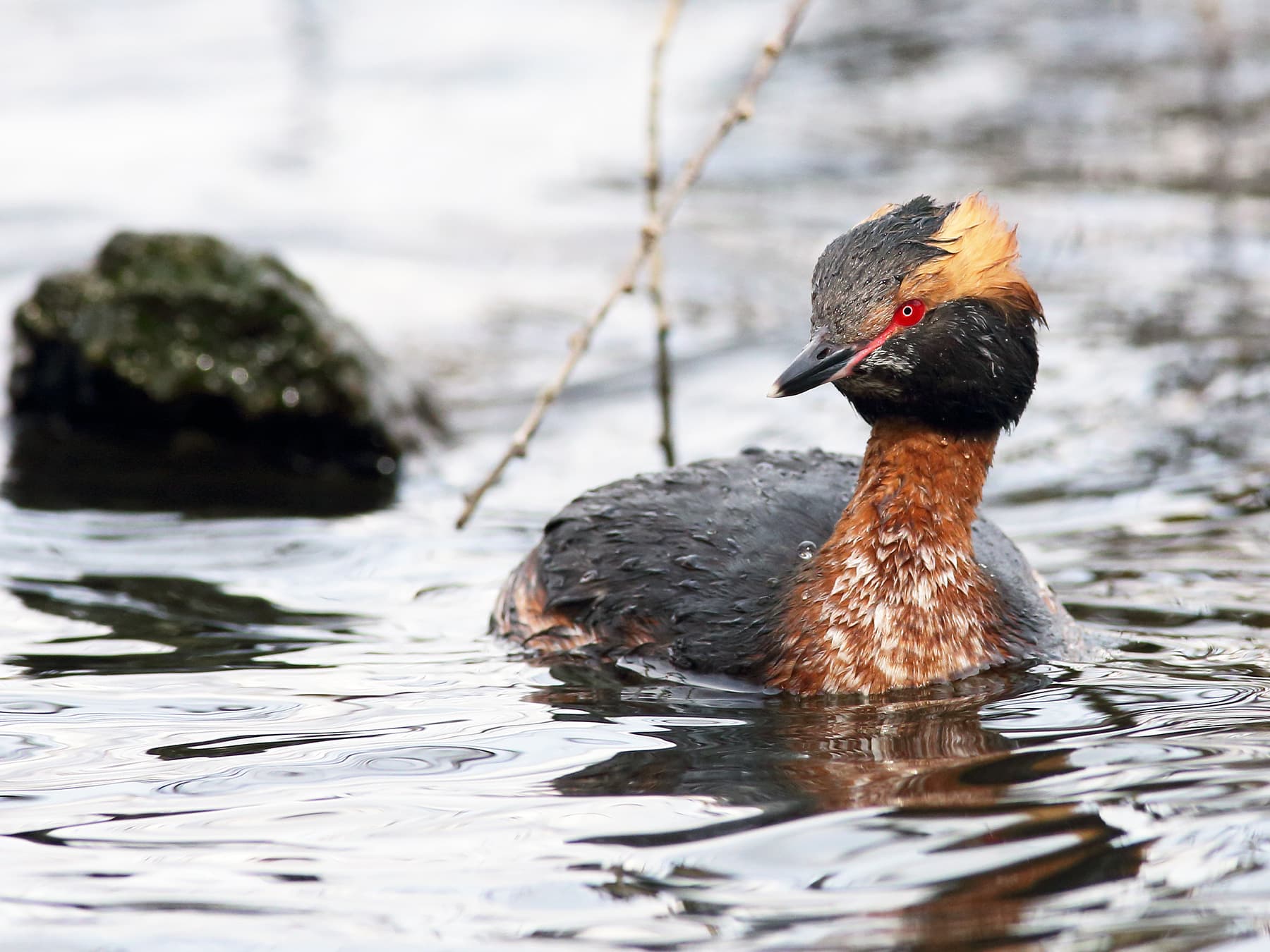
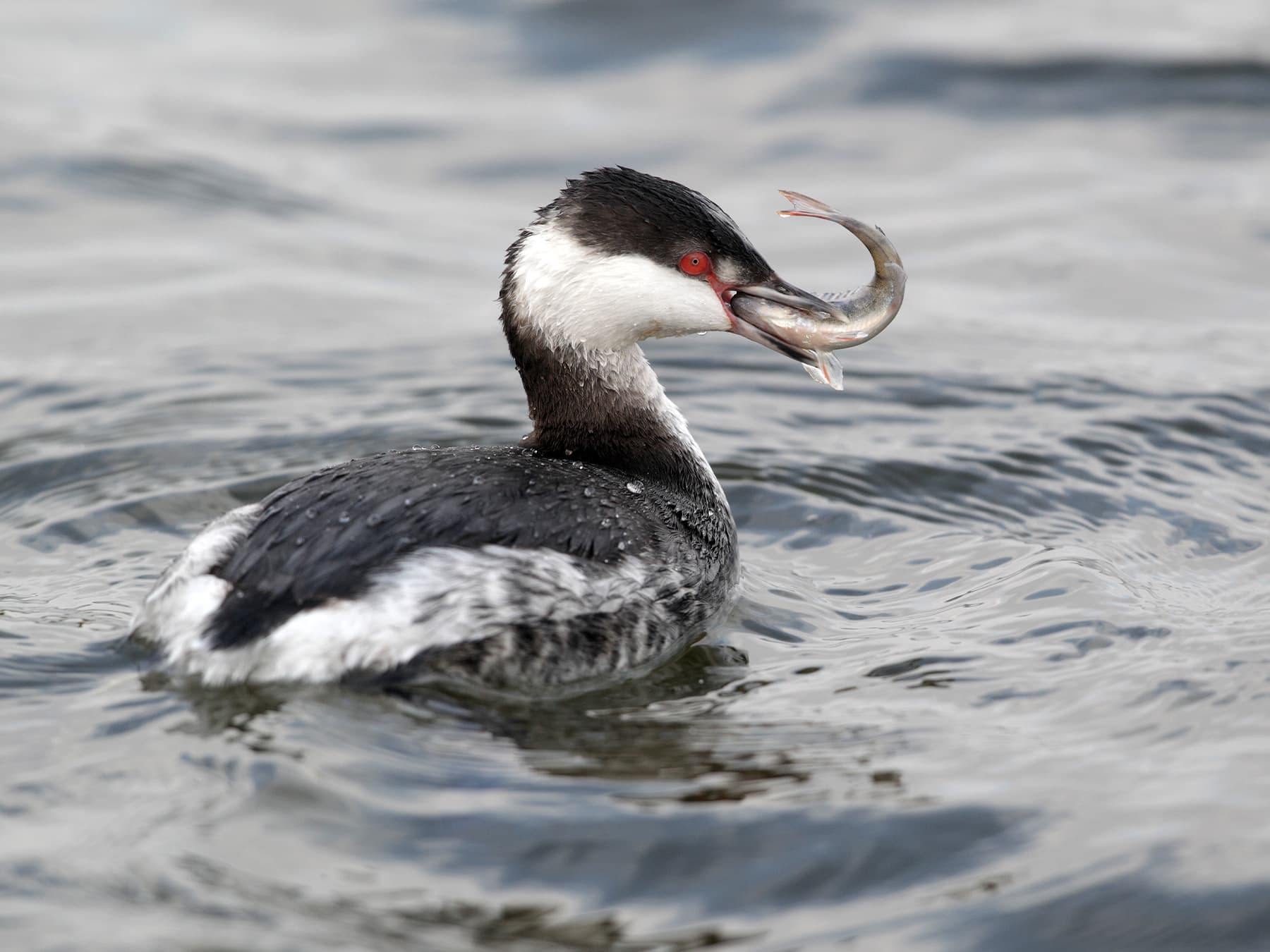
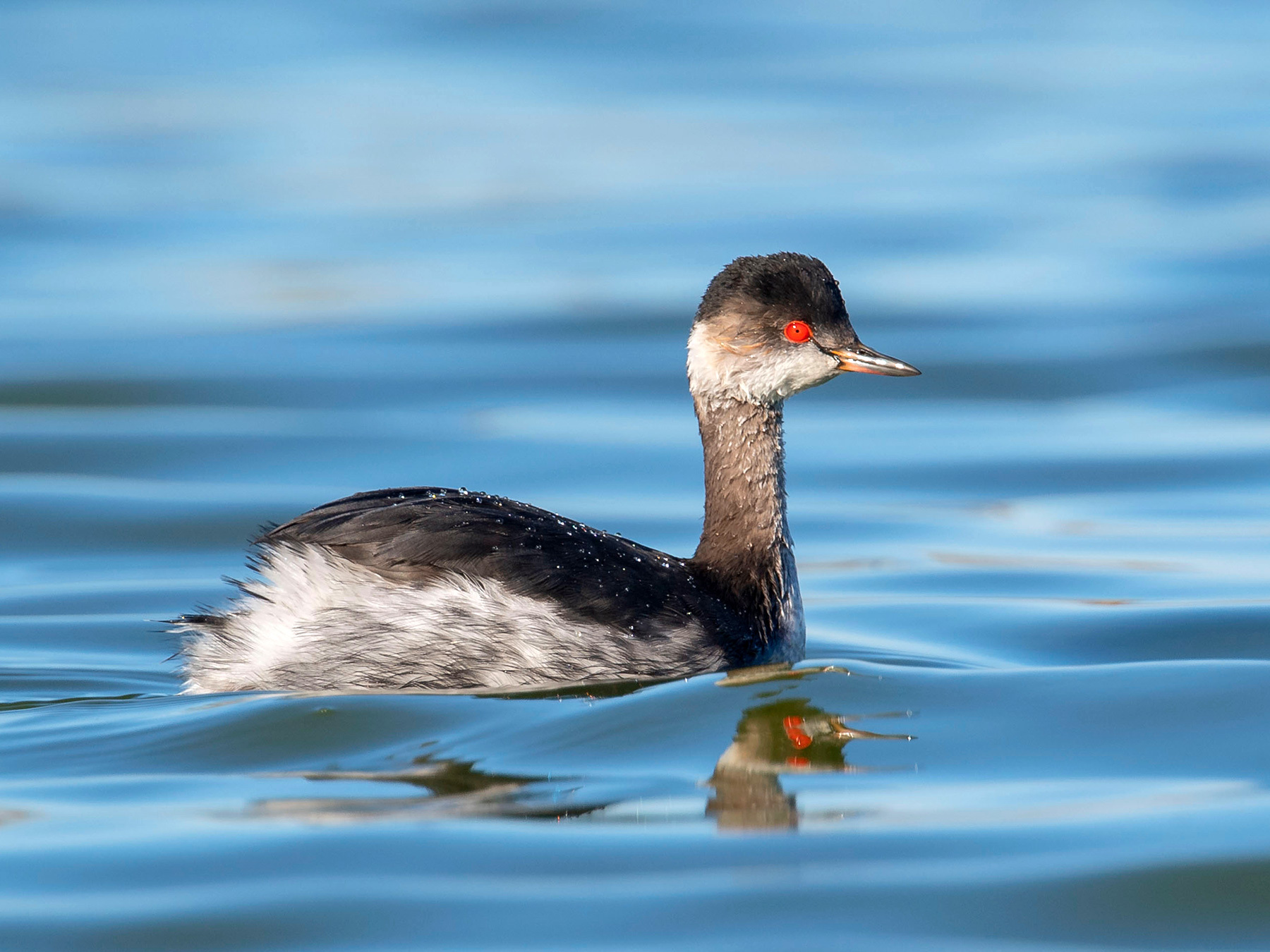
In the non-breeding season, Horned Grebes have a black cap, nape, and back. Their flanks are mottled grayish, and their breast, throat, and cheeks are white. Their eyes are bright red, and their bills are dark with a pale tip.
Females are similar to males, although they are smaller and less colorful in the breeding season. The downy young chicks are dark grey with a red spot behind their bill and a black and white striped head. Older juveniles look similar to non-breeding adults.
Horned Grebes are most easily confused with the similar Eared Grebe or Black-necked Grebe as it is known in Eurasia.
How big are Horned Grebes?
Length
Adult Horned Grebes have a body length of roughly 12 to 15 inches or 31 to 38 centimeters.
Weight
Most birds weigh between 10½ and 20 ounces or 300 to 570 grams, with males typically the larger and heavier sex.
Wingspan
These waterbirds have relatively small, pointed wings and a wingspan of 23.2 to 25.6 inches (59 to 65 cm).
Its size
Adults- Length
- 31–38 cm
- Wingspan
- 55–64 cm
- Weight
- 300–570 g
Its song and calls
What sound does a Horned Grebe make?
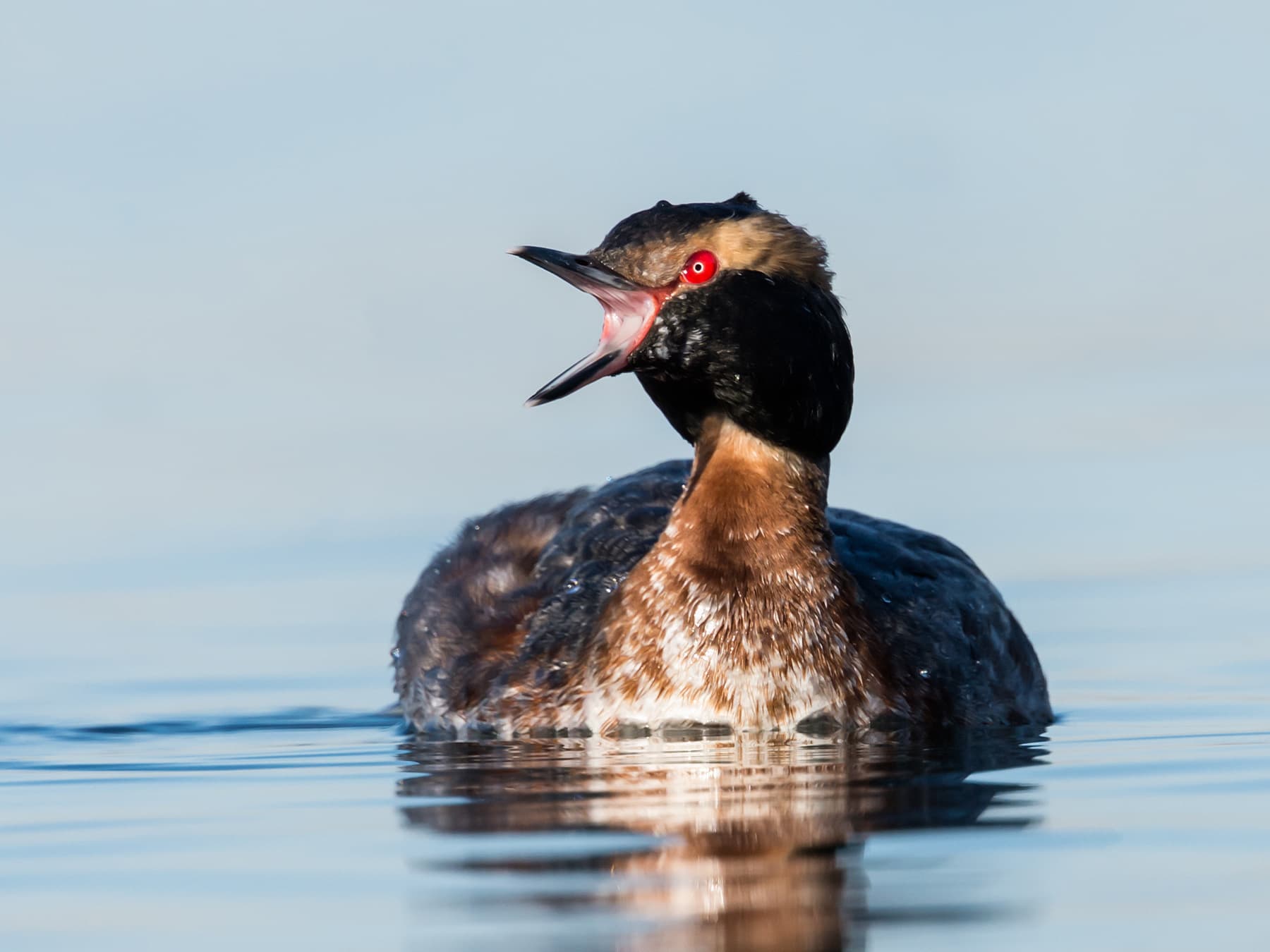
Horned Grebes are most vocal before and during the breeding season when pairing up and defending their territory. They produce an ‘aaaarhh’ advertising call when finding a mate and a high-pitched trilling call after conflict with neighboring pairs and when mating.
When and where to see it
OctoberIn season
Most recorded in October
- 1. East Lothian0.45%
- 2. Highland0.34%
- 3. Moray0.28%
- 4. Argyll and Bute0.27%
- 5. Rutland0.19%
Each dot is a county, state or province: the bigger and darker, the larger the bird’s share of that place’s bird records that month. Grey dots: no regular records. The ringed point is the centre of the bird’s records this month; the arrow shows how it moved since last month, and the dashed loop its path through the year. “Arrivals” colours places where it becomes regular this month (orange) or is in its last regular month (grey). GBIF eBird Observation Dataset, 2019–2024. Map data: Natural Earth, US Census Bureau; place centres © OpenStreetMap contributors.
In your area
See when the Horned Grebe is recorded in your county, state or province.
How often the Horned Grebe turns up in the UK, Ireland, the United States and Canada through the year, from birdwatchers' records.
United Kingdom
Winter visitor · regularly Aug–Apr · most records in December
Ireland
Winter visitor · regularly Sep–Mar · most records in January
United States
Winter visitor · regularly Sep–May · most records in November
Canada
Winter visitor · all year · most records in November
Show as a table
| Month | United Kingdom | Ireland | United States | Canada |
|---|---|---|---|---|
| January | 0.051% (regular) | 0.041% (regular) | 0.18% (regular) | 0.28% (regular) |
| February | 0.036% (regular) | 0.036% (regular) | 0.15% (regular) | 0.20% (regular) |
| March | 0.025% (regular) | 0.023% (regular) | 0.18% (regular) | 0.19% (regular) |
| April | 0.005% (regular) | 0.005% | 0.094% (regular) | 0.20% (regular) |
| May | <0.001% | – | 0.015% (regular) | 0.089% (regular) |
| June | <0.001% | – | 0.005% | 0.039% (regular) |
| July | 0.003% | – | 0.003% | 0.035% (regular) |
| August | 0.004% (regular) | – | 0.007% | 0.034% (regular) |
| September | 0.011% (regular) | 0.004% (regular) | 0.024% (regular) | 0.11% (regular) |
| October | 0.030% (regular) | 0.003% | 0.087% (regular) | 0.30% (regular) |
| November | 0.048% (regular) | 0.030% (regular) | 0.20% (regular) | 0.34% (regular) |
| December | 0.053% (regular) | 0.031% (regular) | 0.17% (regular) | 0.29% (regular) |
Recorded regularly in
Worldwide: recorded regularly in 47 countries
Countries where it was recorded in at least 3 of the 6 years 2019–2024. Linked countries have their own bird list.
Europe (35)
Asia (9)
- Azerbaijan
- China
- Georgia
- Japan
- Kazakhstan
- Kyrgyzstan
- Mongolia
- South Korea
- Turkey
North America (3)
Data: EOD – eBird Observation Dataset (Cornell Lab of Ornithology), accessed via GBIF.org, CC BY 4.0. Records from 2019–2024, aggregated and filtered by Birdfact. How these lists are made
What is the habitat of a Horned Grebe?
Horned Grebes inhabit sheltered coastal waters and large lakes and rivers in the non-breeding season. They live in quiet, well-vegetated shallow ponds and pools in marshes when nesting.
What is the range of a Horned Grebe?
Horned Grebes are widespread in the Northern Hemisphere. In North America, they occur in Alaska, Canada, the Lower 48 States, and Mexico. In Eurasia, these birds live in the United Kingdom and several other European countries, extending west through Russia, Kazakhstan, Mongolia, China, and Japan.
Where do Horned Grebes live?
Horned Grebes are waterbirds that live in both fresh and saltwater habitats. With their legs positioned so far back on their body, these agile divers are very clumsy on land. They are fast in flight but need a good run-up along the water to get airborne.
How rare are Horned Grebes?
Horned Grebes are generally uncommon. They have declined across much of their distribution, and their breeding range has contracted dramatically in many areas. Although increasingly rare, they may be locally common in some parts of their wintering range where large flocks gather. About 80% of the world population lives in North America, and although widespread, they are relatively rare in Europe and Asia.
Where can you see Horned Grebes in the US?
Horned Grebes nest across much of Alaska, but birdwatchers in the north of states like Montana and North Dakota could also spot nesting birds in the spring and summer. Overwintering birds gather in sheltered coastal areas along the West and East Coasts and on inland waterbodies in the Southeast.
They don’t have specific migration routes, so American birdwatchers could spot Horned Grebes in almost any freshwater habitat across the lower 48 during their spring (April) and fall (October) migrations.
Where can you see Horned Grebes in Canada?
Horned Grebes are widespread breeding visitors to the western half of Canada, from Manitoba to British Columbia and north to the Yukon. They overwinter around Vancouver and along the west coast of British Columbia.
Where can you see Slavonian Grebes in the UK?
Despite being a rare species, Slavonian Grebes can be seen in the UK at all times of the year. A small breeding population of less than thirty pairs nests on lochs in the northeast of Scotland each summer.
They are more common in winter when nearly a thousand individuals visit the coast. The highest numbers occur around the Scottish coastline, but birdwatchers can also see these birds along England’s northeast coast and from East Anglia to Cornwall in the southeast and east.
Migration
Do Horned Grebes migrate?
Horned Grebes are highly migratory, moving at night between inland breeding grounds and coastal overwintering areas each year. They often wait for their pond to begin freezing before leaving and time their return as the ice melts on inland water bodies.
How far do Horned Grebes migrate?
Horned Grebes are medium to long-distance migrants. Most fly hundreds of miles while others cover short distances, but few remain in the same area all year.
Where do Horned Grebes migrate to?
In North America, most Horned Grebes nest in Alaska, Western Canada, and the far North of the Lower 48 from Washington to Minnesota. These birds overwinter along the west coast from Alaska to Baja California and the East Coast from Florida to the Gulf of St. Lawrence. They also overwinter inland in the Southeast and along the Gulf Coast to Texas.
In Eurasia, Slavonian Grebes breed in a broad front from Iceland and Scotland in the West to Russia’s Kamchatka Peninsula in the East. These birds migrate to coastal areas around Western, Northern, and Southern Europe, parts of the Middle East, and the coast of China, Japan, and South Korea.
Tips for seeing it
- Look for Horned Grebes on calm lakes and coastal waters
- Observe their distinctive diving behavior, often submerging for 30-40 seconds
- Listen for their high-pitched, trilling calls during breeding season
- In North America, watch for them during spring and fall migrations on inland waters
What it eats
What do Horned Grebes eat?
Horned Grebes are predators that hunt small aquatic and marine creatures. Crustaceans and fish are most important in their winter diet, but breeding birds focus on freshwater invertebrates like beetles, dragonflies, and caddisflies.
What do Horned Grebe chicks eat?
Chicks eat aquatic invertebrates provided by both parents for approximately two weeks.
Nesting and breeding
Where do Horned Grebes nest?
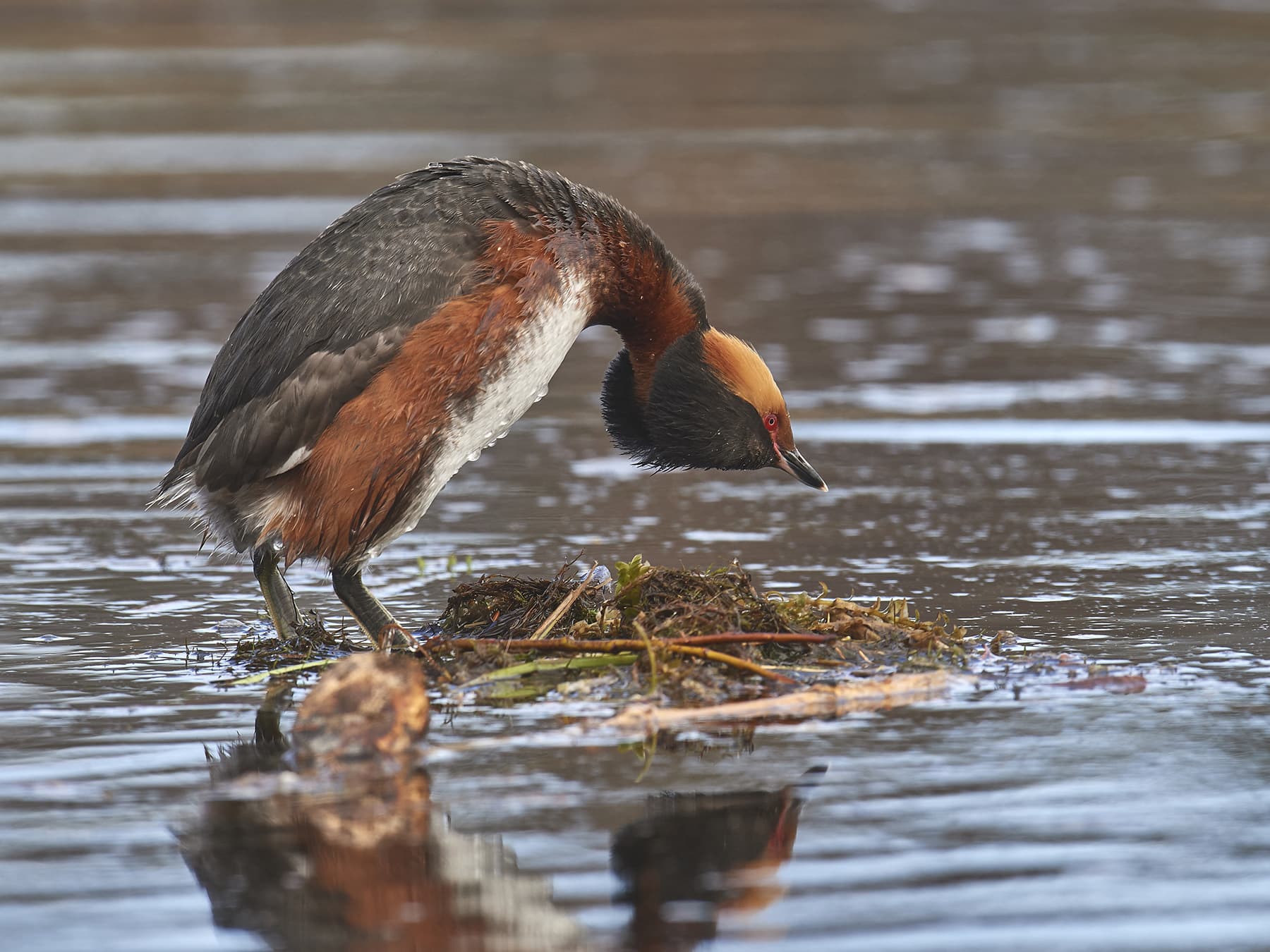
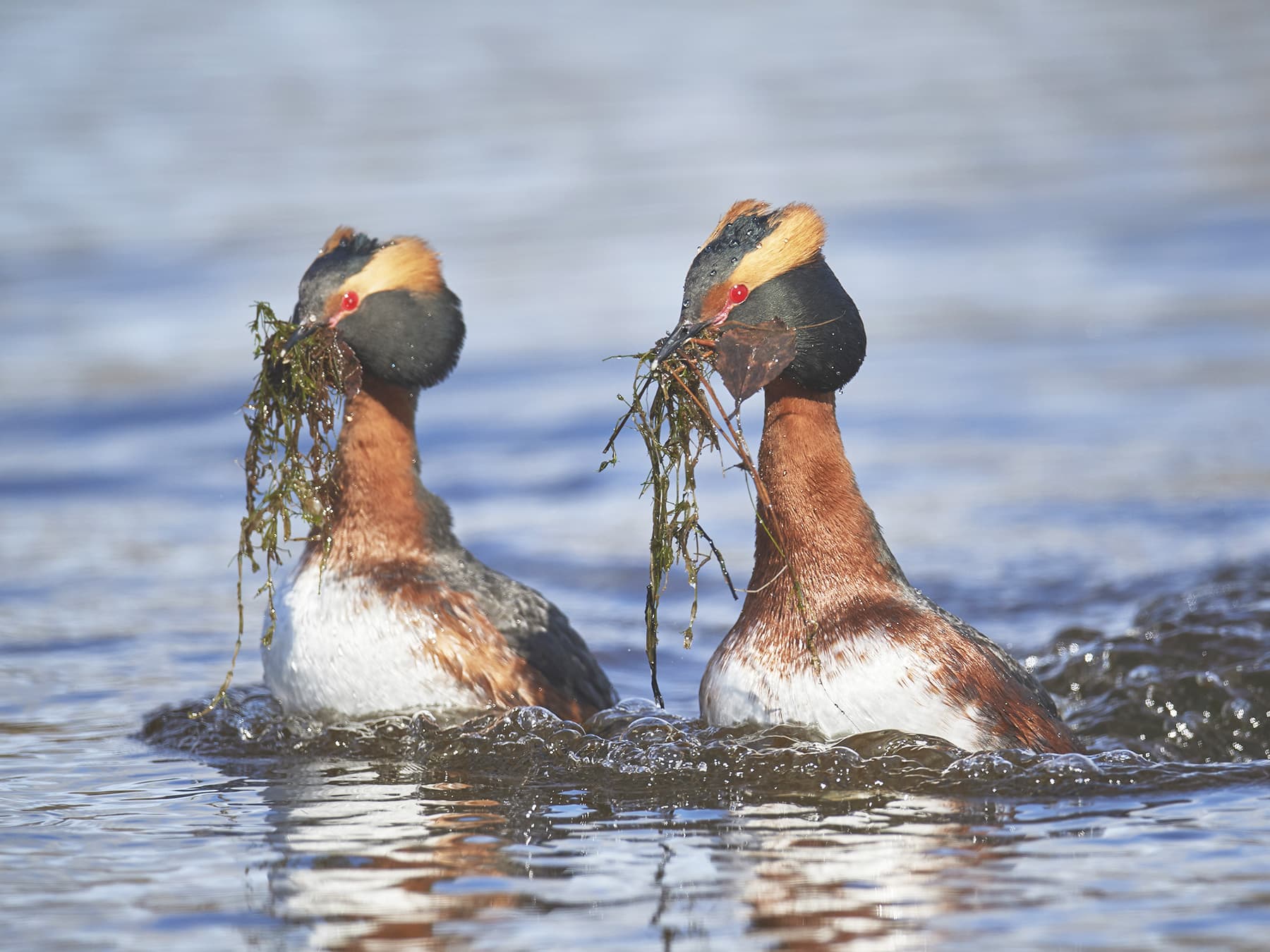
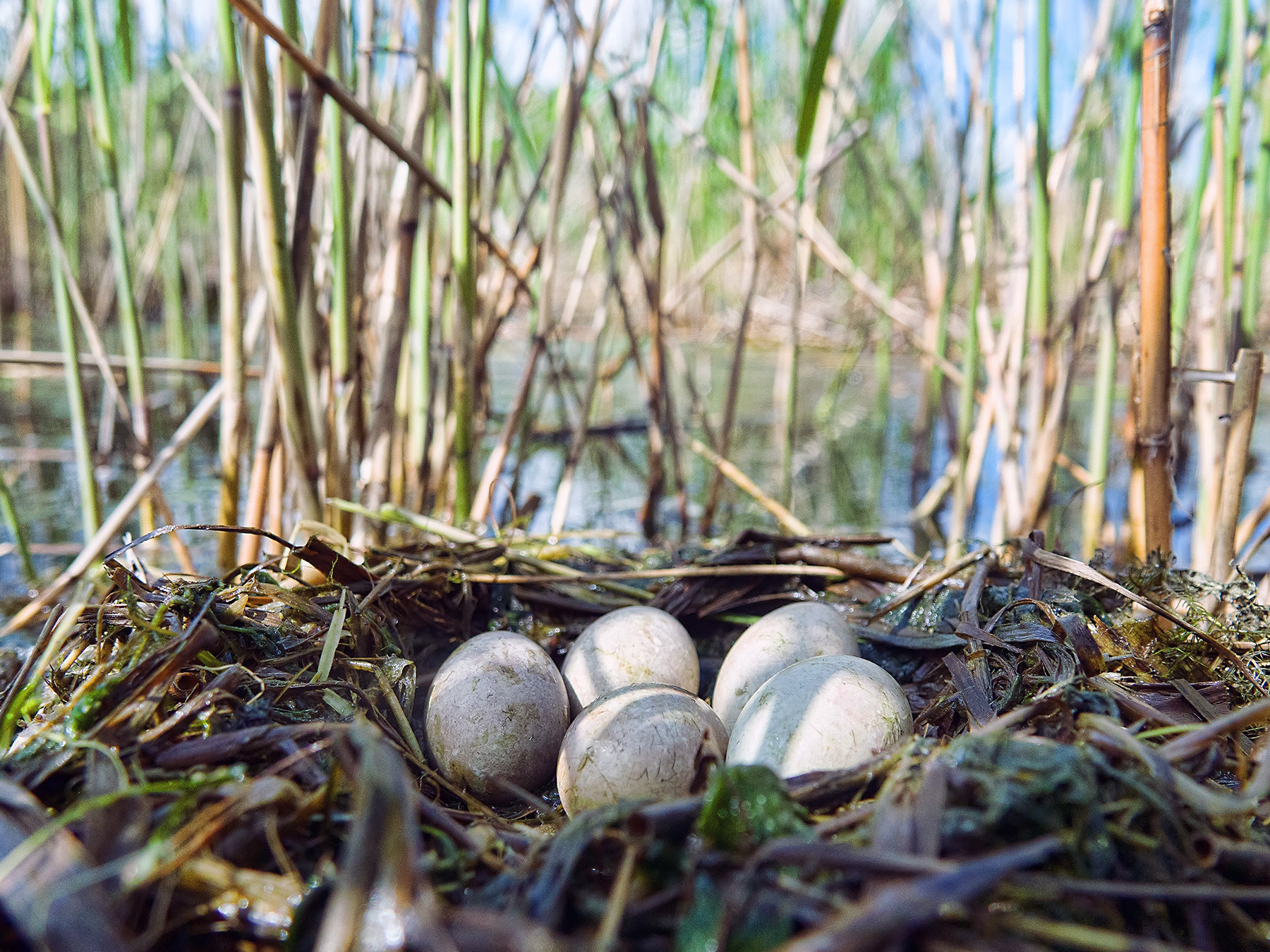
Horned Grebes nest on small ponds, marshes with open water, and quiet lake inlets. Pairs work together to construct a nest that may be built up from the bottom in shallow water, attached to emerging vegetation, or built on top of a rock in the water.
When do Horned Grebes nest?
Horned Grebes have a long nesting period across their range, with egg-laying between April and August, depending on latitude. Their eggs hatch after 22 to 25 days, and the chicks leave the nest soon after. They can swim and dive right away but are carried on their parents’ backs constantly for their first few days, spending more and more time in the water after that.
What do Horned Grebe eggs look like?
Horned Grebes typically lay four to seven chalky white eggs that stain reddish-brown over time. Each egg measures 44 - 45 millimeters long and 30 - 31 millimeters wide.
Do Horned Grebes mate for life?
Horned Grebes are monogamous and form close pair bonds during migration or in the winter before. Some may remain together for more than one nesting season, and long-term pair bonds are possible, although this requires more study.
Behaviour
Are Horned Grebes aggressive?
Horned Grebes can be highly gregarious in the winter and during migration, sometimes forming flocks up to 500-strong. They are more territorial when breeding, however, and males may engage in energetic fights when securing a partner.
Where do Horned Grebes sleep at night?
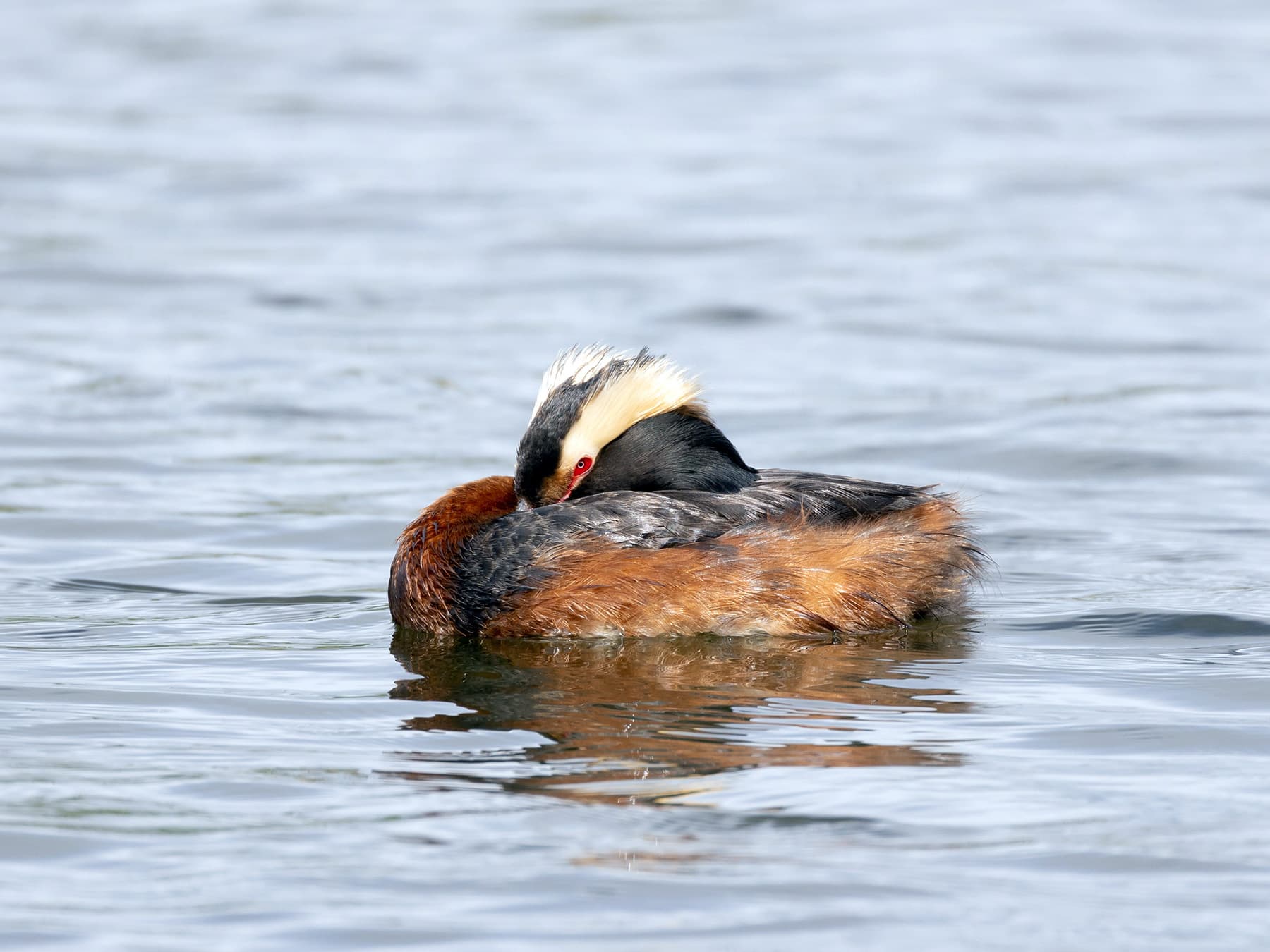
Horned Grebes sleep on the water with their necks laid flat on their back and their heads nestled down and facing forward.
Lifespan and predators
How long do Horned Grebes live?
Horned Grebes have a maximum recorded lifespan of just five years.
What are the predators of Horned Grebes?
Adult Horned Grebes are agile in the water and have few predators, although they are at risk from mammals like Mink when incubating their eggs. Their eggs are vulnerable to various birds and mammals, including Gulls, Corvids (Common Raven, Hooded Crow, etc.) Raccoons, and Mink.
Are Horned Grebes protected?
Horned Grebes are protected by the following acts:
- Migratory Bird Treaty Act 1918 - United States of America
- Migratory Birds Convention Act 1994 - Canada
- Wildlife and Countryside Act 1981 - United Kingdom
Are Horned Grebes endangered?
Horned Grebes are listed as ‘Vulnerable’ on the IUCN Red List, which is just one category away from being officially globally endangered. A small breeding population on Canada’s Magdalen Islands is considered endangered.
Why are Horned Grebes endangered?
Horned Grebes have suffered most from the destruction of their breeding habitat. The primary causes are forestry, climate change, and agricultural and rural development. These diving birds are also vulnerable to entanglement in fishing nets and oil-fouling in marine habitats.
Conservation
The Horned Grebe is classified as Vulnerable due to population declines across its range. Threats include habitat loss, particularly the drainage of wetlands, oil spills, and other forms of water pollution. Climate change also poses a significant threat to their breeding habitats.
More photos
7 photos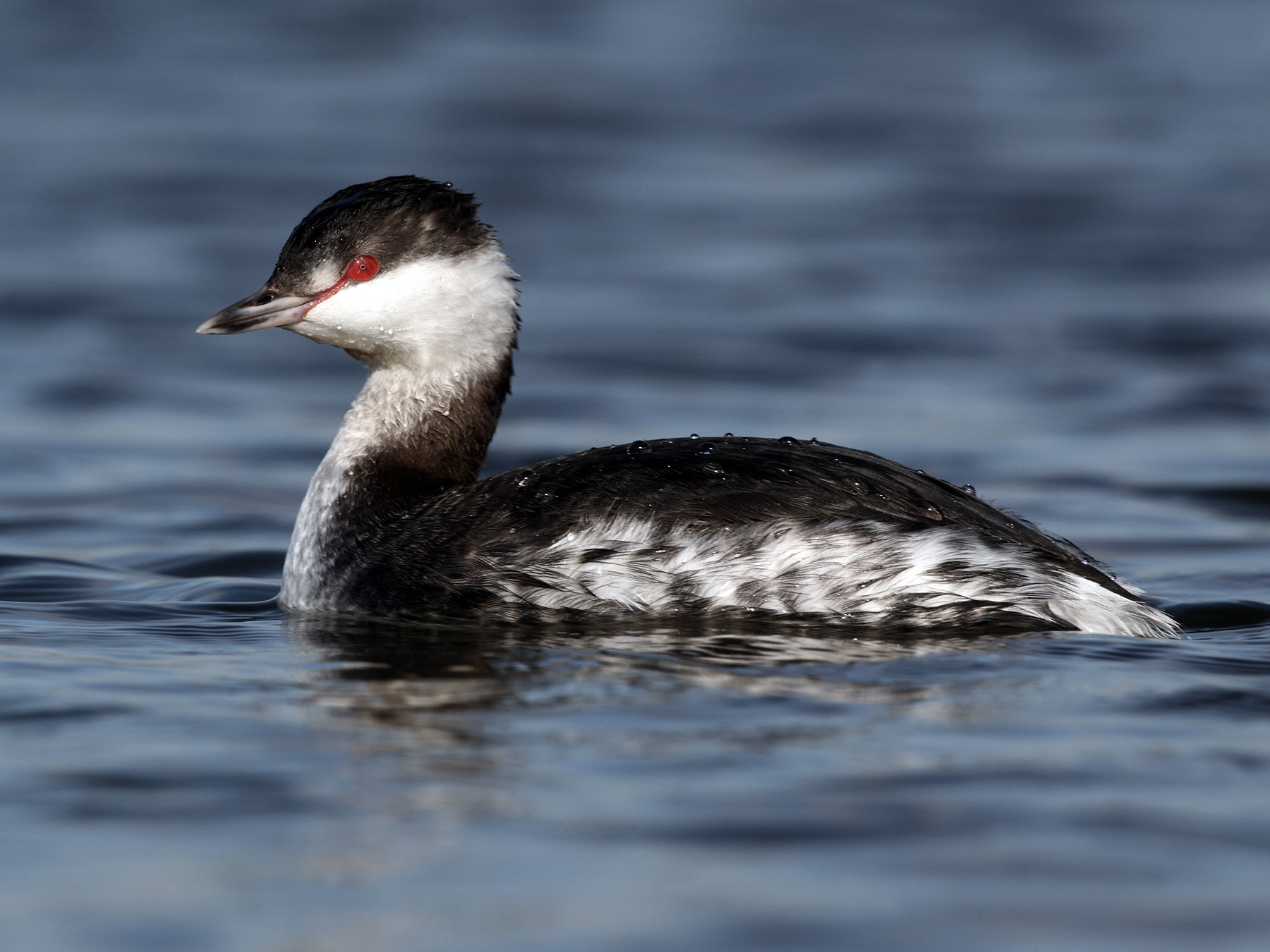



Quick facts
- Length
- 31–38 cm
- Wingspan
- 55–64 cm
- Weight
- 300–570 g
- Lifespan
- 10–15 years
- Family
- Grebes
- Migration
- Long-distance Migrant
- Global status (IUCN)
- Vulnerable
- World population
- 239,000 - 583,000 individuals
- Population trend
- Decreasing
- Also called
- Slavonian Grebe
- Scientific name
- Podiceps auritus
Sources
3- 1BirdLife International. 2018. Podiceps auritus. The IUCN Red List of Threatened Species 2018: e.T22696606A132066871. Source (opens in a new tab)
- 2Wetlands International (2012)
- 3COSEWIC (2009)

Checked by
Nathan Cope, founder and editor
Nathan founded Birdfact and leads its writers and contributors in the UK, the US and Canada. He has watched and studied birds for more than ten years, and checks every article and species guide before it’s published.