


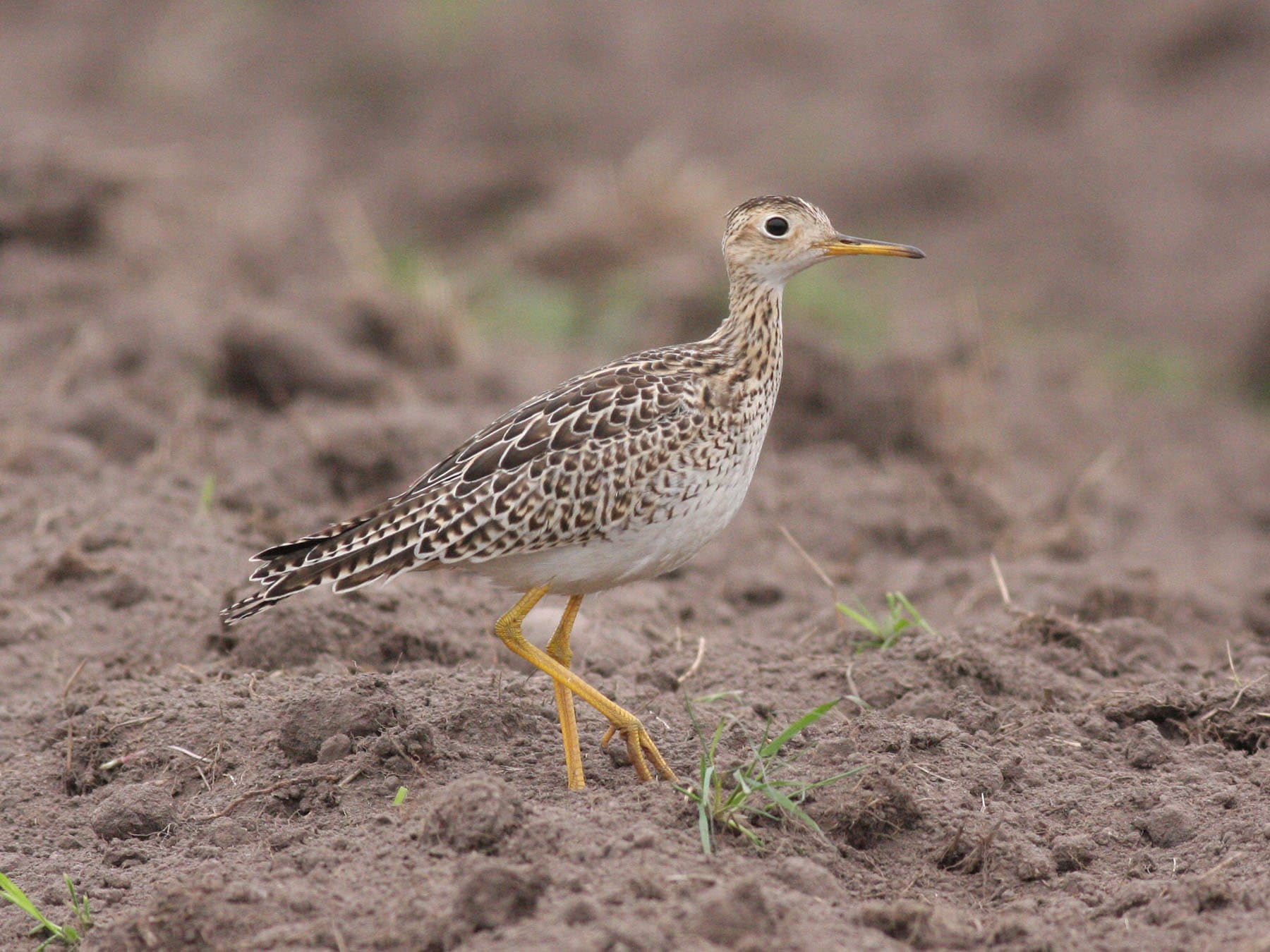
Upland Sandpiper
Bartramia longicauda
By the Birdfact teamChecked by Nathan Cope
A grassland wanderer that looks more like a tiny curlew than a typical sandpiper, the Upland Sandpiper breeds on the open prairies of North America and winters on the pampas of South America — a round trip of roughly 29,800 km each year. Its haunting, rolling wolf-whistle call, drifting across a Kansas meadow at dusk, is one of the most evocative sounds in North American birdwatching.
On this page13 sections
How to recognise it
The Upland Sandpiper carries an unmistakable silhouette — disproportionately small, rounded head perched on a long, slender neck, giving it a dove-like quality that sets it apart from every other shorebird. The large, dark eyes are encircled by a conspicuous white eye-ring, and the bill is short and straight with a yellow base and a black tip. The legs are long and bright yellow. When perched, the tail extends visibly beyond the wingtips — proportionally the longest tail of any sandpiper in the family Scolopacidae.
The upperparts are heavily marbled in golden-brown and blackish, creating a rich camouflage pattern across the back and wings. The neck and upper breast are streaked with dark brown, transitioning to chevron-shaped dark markings on the flanks. The belly and undertail coverts are clean white. In flight, the dark blackish outer primaries contrast sharply with the mottled brown upperparts, and the pale underwing coverts stand out against the darker flight feathers.
The sexes are similar in plumage, though females are slightly larger than males — a reversal of the typical pattern seen in many birds. Juveniles closely resemble adults but show a paler, less distinctly marked head, and the feathers of the upperparts carry prominent pale margins and dark subterminal bars absent in adults. There is no significant seasonal variation in plumage.
One of the most distinctive behaviours linked to appearance is the bird's habit of holding its wings raised vertically above its back for several seconds after landing. This posture is regularly seen on fence posts, telephone poles, and other elevated perches. The species is frequently compared to a miniature Long-billed Curlew, to which it is closely related.
Not sure it’s a Upland Sandpiper? Check your photo: Birdfact names the bird and shows the look-alike side by side.
Its size
Adults- Length
- 28–32 cm
- Wingspan
- 47–51 cm
- Weight
- 97–226 g
Its song and calls
The wolf whistle of the Upland Sandpiper — a long, rolling "whooooleeeee, wheeeloooo-ooooo" — is among the most immediately recognisable sounds on the North American prairie. It begins with a soft, gurgling, water-like trill before rising into that drawn-out, mournful phrase. The sound carries far across open prairie and is given from elevated perches, during song-flight displays, and at night during migration. Once heard, it is essentially unmistakable.
The song-flight display is one of the most dramatic in the shorebird world. The male circles 30–100 m above the ground, sometimes reaching heights of up to 305 m (1,000 ft), delivering the wolf whistle repeatedly for 5–15 minutes before closing its wings and plummeting earthward. Both sexes give the wolf whistle call, including before nesting and as a sexual display during courtship.
The alarm call is entirely different in character: a rapid, mellow "quip-ip-ip-ip" or "kip-ip-ip-ip" — a staccato rattle delivered when disturbed or when a predator approaches the nest. Males also display to females on the ground, lowering the body, cocking the long tail, inflating the throat, and producing a staccato rattle while running toward the female. Young chicks have their own distinct calls, separate from those of adults.
Migrating birds call back and forth in groups at night, and the wolf whistle is frequently heard overhead during nocturnal migration in late summer. The species is largely silent during incubation. The call is sometimes confused with that of the Long-billed Curlew, but the Upland Sandpiper's whistle is longer, richer, and more rolling in quality.
- Call0:00 / 0:34
Recorded in South Dakota, United States · June 2012
Heard one and not sure? Let the bird song identifier listen.
When and where to see it
OctoberMostly absent
Most recorded in October
- 1. Texasunder 0.1%
- 2. Newfoundland and Labradorunder 0.1%
- 3. Alaskaunder 0.1%
- 4. Nova Scotiaunder 0.1%
- 5. Louisianaunder 0.1%
Each dot is a county, state or province: the bigger and darker, the larger the bird’s share of that place’s bird records that month. Grey dots: no regular records. The ringed point is the centre of the bird’s records this month; the arrow shows how it moved since last month, and the dashed loop its path through the year. “Arrivals” colours places where it becomes regular this month (orange) or is in its last regular month (grey). GBIF eBird Observation Dataset, 2019–2024. Map data: Natural Earth, US Census Bureau; place centres © OpenStreetMap contributors.
In your area
See when the Upland Sandpiper is recorded in your county, state or province.
How often the Upland Sandpiper turns up in the United States and Canada through the year, from birdwatchers' records.
United States
Summer visitor · regularly Mar–Sep · most records in August
Canada
Summer visitor · regularly Apr–Aug · most records in June
Show as a table
| Month | United States | Canada |
|---|---|---|
| January | <0.001% | – |
| February | – | – |
| March | 0.003% (regular) | – |
| April | 0.020% (regular) | 0.005% (regular) |
| May | 0.014% (regular) | 0.025% (regular) |
| June | 0.026% (regular) | 0.061% (regular) |
| July | 0.020% (regular) | 0.040% (regular) |
| August | 0.037% (regular) | 0.010% (regular) |
| September | 0.012% (regular) | <0.001% |
| October | <0.001% | <0.001% |
| November | <0.001% | <0.001% |
| December | <0.001% | – |
Worldwide: recorded regularly in 29 countries
Countries where it was recorded in at least 3 of the 6 years 2019–2024. Linked countries have their own bird list.
North America (19)
Data: EOD – eBird Observation Dataset (Cornell Lab of Ornithology), accessed via GBIF.org, CC BY 4.0. Records from 2019–2024, aggregated and filtered by Birdfact. How these lists are made
Tips for seeing it
The Upland Sandpiper is most reliably found in large, open grasslands during the breeding season from late April through July. In the United States, the Flint Hills of Kansas and the Sandhills of Nebraska are among the best locations in the world to find this species — listen for the wolf-whistle call drifting across the prairie at dawn or dusk, and scan fence posts and telephone poles along rural roads for perched birds.
The wing-raising behaviour on landing is one of the most reliable identification cues: no other North American shorebird holds its wings vertically above its back after touching down. The long tail extending beyond the wingtips at rest, the small rounded head, and the large dark eye with white eye-ring are all distinctive at close range. In flight, look for the dark outer primaries contrasting with the mottled brown upperparts.
In the northeastern United States, airports are surprisingly productive — Logan Airport in Boston, JFK in New York, and several New England airfields host breeding pairs. Check with local birding groups before visiting, as access is often restricted. During migration (mid-July through September), birds can appear in agricultural fields, pastures, and occasionally sports fields, particularly after bad weather grounds them.
In the UK, the Upland Sandpiper is a very rare vagrant, most likely to be encountered in Cornwall, the Isles of Scilly, or other southwestern headlands in autumn (September–October). Any sighting should be reported to county bird recorders immediately. The call — a mellow, bubbling "quip-ip-ip-ip" alarm note — is worth learning, as birds often call before they are seen.
The species can be confused with the Buff-breasted Sandpiper in flight, but the Upland Sandpiper's longer neck, longer tail, and distinctive call separate them readily. The resemblance to a small curlew is striking in the field.
What it eats
Roughly 95% of the Upland Sandpiper's diet consists of small invertebrates, with grasshoppers (Orthoptera) and beetles (Coleoptera) forming the bulk of what it eats. The full menu is broad: crickets, weevils, billbugs, cutworms, leaf beetles, click beetles, May beetles, fly larvae (including horsefly, cranefly, and sawfly), moths, ants, and bugs. Non-insect invertebrates taken include centipedes, millipedes, spiders, ticks, snails, and earthworms.
Plant material makes up a small proportion of the diet — seeds of grasses, weeds, and forbs, as well as wheat, rye, and occasional berries. Waste grain is consumed in agricultural fields, particularly during migration. Migrants in the northeastern United States sometimes appear in recently ploughed potato fields to feed on grubs exposed by the machinery.
Foraging is entirely terrestrial — the bird walks briskly through grassland, picking prey from the ground or from low vegetation by sight, and never probes the substrate in the manner of a snipe or woodcock. After recent burns, Upland Sandpipers may gather in numbers to exploit grasshopper concentrations — one of the few situations in which this otherwise solitary forager joins others.
Because the species consumes large quantities of crop-damaging insects — grasshoppers, weevils, and cutworms in particular — it has long been considered beneficial to agriculture. 19th-century farmers actively encouraged its presence on their land, a fact that makes the subsequent market hunting of the species all the more ironic.
Nesting and breeding
Birds arrive on their breeding grounds in late April to early May, often already paired. Nest preparation begins approximately two weeks after arrival. Both sexes help construct the nest — the male initiates the scrape and the female completes it and adds the lining. Nests are shallow scrapes on the ground, typically 10–13 cm in diameter and 4–7 cm deep, lined with dry grasses, leaves, and small twigs. Surrounding vegetation is often arched over the top to conceal the nest from above.
The clutch typically consists of 4 eggs (range 2–7), creamy to pinkish-buff in ground colour and evenly spotted with reddish-brown. Eggs measure approximately 45 × 32.5 mm. Both parents share incubation duties over 21–29 days, averaging 24 days in the Great Plains, starting with the last egg laid. Only one brood is raised per season, and age at first breeding is one year.
Chicks are precocial and downy at hatching, leaving the nest within 24 hours and feeding themselves within a few days. Both parents perform distraction displays to lure predators away from the brood. In most cases, adults remain with the young for about one week after hatching, after which the female typically departs for the wintering grounds before the male. Juveniles take short flights at around 18 days and are fully fledged at approximately 30–31 days.
The mating system is more complex than simple monogamy. Studies have found evidence of two females laying eggs in a single nest, and of multiple males fathering eggs within a single brood — suggesting occasional polygamy and extra-pair fertilisation. Nesting can be loosely colonial, with pairs in a local area often synchronising their nesting stages. Pairs show strong site fidelity, returning to the same area year after year.
Behaviour
In flight, the Upland Sandpiper is immediately recognisable by its long, pointed wings and notably long tail — the tail extension beyond the wingtips is visible even at distance. The wingbeats are stiff and rapid, with a distinctive quality often described as "winnowing" or "fluttering," reminiscent of a Common Snipe but on a larger frame. The bird typically flies with the wingtips angled slightly downward, giving it a bowed-wing appearance that is unlike most other sandpipers.
The dark blackish outer primaries contrast sharply with the mottled brown upperparts, creating a two-toned effect on the upperwing that is useful for identification. The pale underwing coverts contrast with the darker flight feathers below. A sliver of white on the upper wing along the outer primary can be visible at close range but is easily missed.
On migration, Upland Sandpipers travel at night, often in loose groups, calling back and forth. GPS tracking has documented non-stop transoceanic flights exceeding 5,000 km lasting up to 7 days. These routes cross the Gulf of Mexico, the Caribbean Sea, and the vast tropical forests of the Amazon Basin without a single landing. Birds also cross high-elevation Andean terrain during their elliptical migration routes between North and South America.
After landing, the characteristic wing-raising display — both wings held vertically above the back for several seconds — bridges the transition from flight to perch. Courtship flights are among the most dramatic of any shorebird, with the male ascending to heights of up to 305 m (1,000 ft) and circling for up to 15 minutes; the full display is described in the Courtship and Display section.
Lifespan and predators
In 2019, a bird banded as a chick on the Konza Prairie Biological Station in Kansas in 2006 was photographed alive on a fence post barely a mile from its banding site — 13 years and 1 month after banding, and a new species longevity record. The typical lifespan in the wild falls between 5 and 8 years, making that individual a genuine outlier.
Survival rates are influenced by the hazards of long-distance migration — non-stop transoceanic flights of up to 7 days leave little margin for error — as well as predation on the breeding grounds, nest failure from agricultural disturbance, and conditions on the South American wintering grounds. Pesticide use on the pampas may be suppressing survival rates in ways that are difficult to measure from North American monitoring alone.
Compared to other members of the family Scolopacidae, the Upland Sandpiper's lifespan is broadly typical. The Wood Sandpiper has a recorded maximum of around 11.7 years, while larger shorebirds such as the Bar-tailed Godwit have been recorded living beyond 30 years. Strong site fidelity — returning to the same field year after year — means long-lived individuals can be reliably monitored, making longevity records more likely to be detected than in more nomadic species.
Conservation
The Upland Sandpiper is listed as Least Concern on the IUCN Red List (2021), with a global population estimated at 750,000 mature individuals by BirdLife International and Partners in Flight. The global population trend is currently assessed as increasing. The North American Breeding Bird Survey found the population was broadly stable between 1966 and 2015, with a moderate increase in the final decade of that period. The species scores 11 out of 20 on the Partners in Flight Continental Concern Score, indicating low overall conservation concern at the global level.
Regional patterns tell a more complicated story. In the northeastern United States, populations have declined sharply and the species is now listed as endangered in Pennsylvania and Connecticut, threatened in New York, and is a species of conservation concern in nearly two dozen US states and Canadian provinces.
The conversion of native prairies and grasslands to cropland is the primary long-term threat. Pesticide use reduces insect prey availability; early haying destroys active nests; intensive row-cropping eliminates suitable habitat entirely.
The species has a dark history with market hunting. In the late 19th century, tens of thousands were shot annually in Midwestern states and sold at eastern markets — particularly after the decline of the Passenger Pigeon left hunters seeking a new quarry. The Migratory Bird Treaty Act of 1918 ended commercial hunting in the US and Canada, allowing populations to partially recover. On the South American wintering grounds, hunting and insecticide use continue to suppress numbers in ways that are difficult to quantify.
Climate change poses an emerging threat: spring heat waves endanger chicks in the nest, and range shifts are projected as grassland conditions change. Controlled burns benefit the species by creating short-grass conditions and concentrating grasshopper prey. Conservation management at airports — where the species now nests in several northeastern states — has become an unlikely but important tool for maintaining local populations.
Courtship & Display
A male Upland Sandpiper at the peak of display climbs to 305 m above the prairie, circling and delivering the wolf whistle for up to 15 minutes before folding its wings and plummeting back to earth. These aerial song-flights occur throughout the day and into the evening during the breeding season, and the calls carry for considerable distances across open grassland.
On the ground, the male approaches the female with the body lowered, the long tail cocked upward, and the throat inflated, producing a staccato rattle while running toward her. Both sexes give the wolf whistle during courtship, and pairs can be seen calling from fence posts and telephone poles in a kind of duet before nesting begins.
The mating system appears more complex than simple monogamy. Studies have documented two females laying eggs in a single nest, and genetic analysis has revealed multiple males fathering eggs within a single brood — evidence of both egg dumping and extra-pair fertilisation. Nesting is sometimes loosely colonial, with pairs in a local area synchronising their nesting stages, which may facilitate these more complex reproductive arrangements.
Pairs show strong site fidelity, returning to the same territory year after year. This consistency means that established pairs likely reunite on the breeding grounds rather than forming new bonds each season, though this has not been confirmed by long-term individual tracking studies.
Cultural Significance
Every September and October, hundreds of Upland Sandpipers descend on the Ozogoche Lakes in the high Andes of Ecuador — a cluster of glacial lakes at around 3,300 m elevation — and plunge into the icy water, dying of hypothermia. The event, known locally as the "jamiñawin" ("closing of the eyes"), has been documented for generations and draws visitors from across Ecuador. Scientific explanations remain contested: theories include disorientation from volcanic sulfuric steam rising from the lake surface, strong thermal winds causing sudden cold shock, or simple exhaustion during migration. None has been conclusively proven.
For the indigenous Puruhá communities of the surrounding highlands, the event carries deep spiritual significance. The birds are believed to sacrifice themselves to honour the spirits of the lake and to signal the arrival of the rainy season — a moment of agricultural and cosmological importance. The annual gathering of birds is celebrated as a sacred ritual, and the lakes are considered a site of spiritual power. This intersection of ornithology and indigenous cosmology makes the Ozogoche phenomenon one of the most culturally layered events in the natural history of any migratory bird.
In North America, the Upland Sandpiper has a long cultural history. Its wolf-whistle call features in the poetry of Aldo Leopold, who described hearing it as one of the defining sounds of the American prairie. The species was known as the "Upland Plover" until 1973 — a name that reflected its grassland habits and curlew-like appearance — and under that name it became a symbol of the market hunting era, shot in enormous numbers in the late 19th century before legal protection arrived with the Migratory Bird Treaty Act of 1918.
Quick facts
- Length
- 28–32 cm
- Wingspan
- 47–51 cm
- Weight
- 97–226 g
- Lifespan
- 5–8 years · oldest recorded 13.1 years
- Family
- Sandpipers & Snipes
- Migration
- Long-distance Migrant
- Global status (IUCN)
- Least Concern
- World population
- 750,000 mature individuals
- Population trend
- Increasing globally, with a moderate increase recorded in the last decade of the 1966–2015 North American Breeding Bird Survey period. Significant regional declines persist in the northeastern United States and parts of Canada, where the species is listed as endangered or threatened in several states.
- Scientific name
- Bartramia longicauda
Sources
17- 1Upland sandpiper - Wikipedia Source (opens in a new tab)
- 2Upland Sandpiper Overview - All About Birds, Cornell Lab of Ornithology Source (opens in a new tab)
- 3Upland Sandpiper Identification - All About Birds, Cornell Lab of Ornithology Source (opens in a new tab)
- 4Upland Sandpiper Life History - All About Birds, Cornell Lab of Ornithology Source (opens in a new tab)
- 5Upland Sandpiper - BirdLife International DataZone (2021) Source (opens in a new tab)
- 6Upland Sandpiper - U.S. Fish & Wildlife Service Source (opens in a new tab)
- 7Upland Sandpiper - BTO BirdFacts Source (opens in a new tab)
- 8Migration Patterns of Upland Sandpipers in the Western Hemisphere - Frontiers in Ecology and Evolution (2019) Source (opens in a new tab)
- 9Upland Sandpiper - Audubon Field Guide Source (opens in a new tab)
- 10Upland Sandpiper - New York State DEC Source (opens in a new tab)
- 11Upland Sandpiper Fact Sheet - Connecticut DEEP Source (opens in a new tab)
- 12Upland Sandpiper - Pennsylvania Game Commission Source (opens in a new tab)
- 13This Upland Sandpiper Was Banded 13 Years Ago. And It's Still Alive. - The Nature Conservancy (2019) Source (opens in a new tab)
- 14Hundreds of birds in 'collective suicide' at Ecuadorian high-altitude lakes - Euronews (2018) Source (opens in a new tab)
- 15Upland Sandpiper - Texas Breeding Bird Atlas (TAMU) Source (opens in a new tab)
- 16Upland Sandpiper - Cornell Lab Land Trust Bird Conservation Initiative Source (opens in a new tab)
- 17Upland Sandpiper - eBird Source (opens in a new tab)

Checked by
Nathan Cope, founder and editor
Nathan founded Birdfact and leads its writers and contributors in the UK, the US and Canada. He has watched and studied birds for more than ten years, and checks every article and species guide before it’s published.