


Eurasian Tree Sparrow
Tree Sparrow · Passer montanus
By the Birdfact teamChecked by Nathan Cope
On this page15 sections
How to recognise it
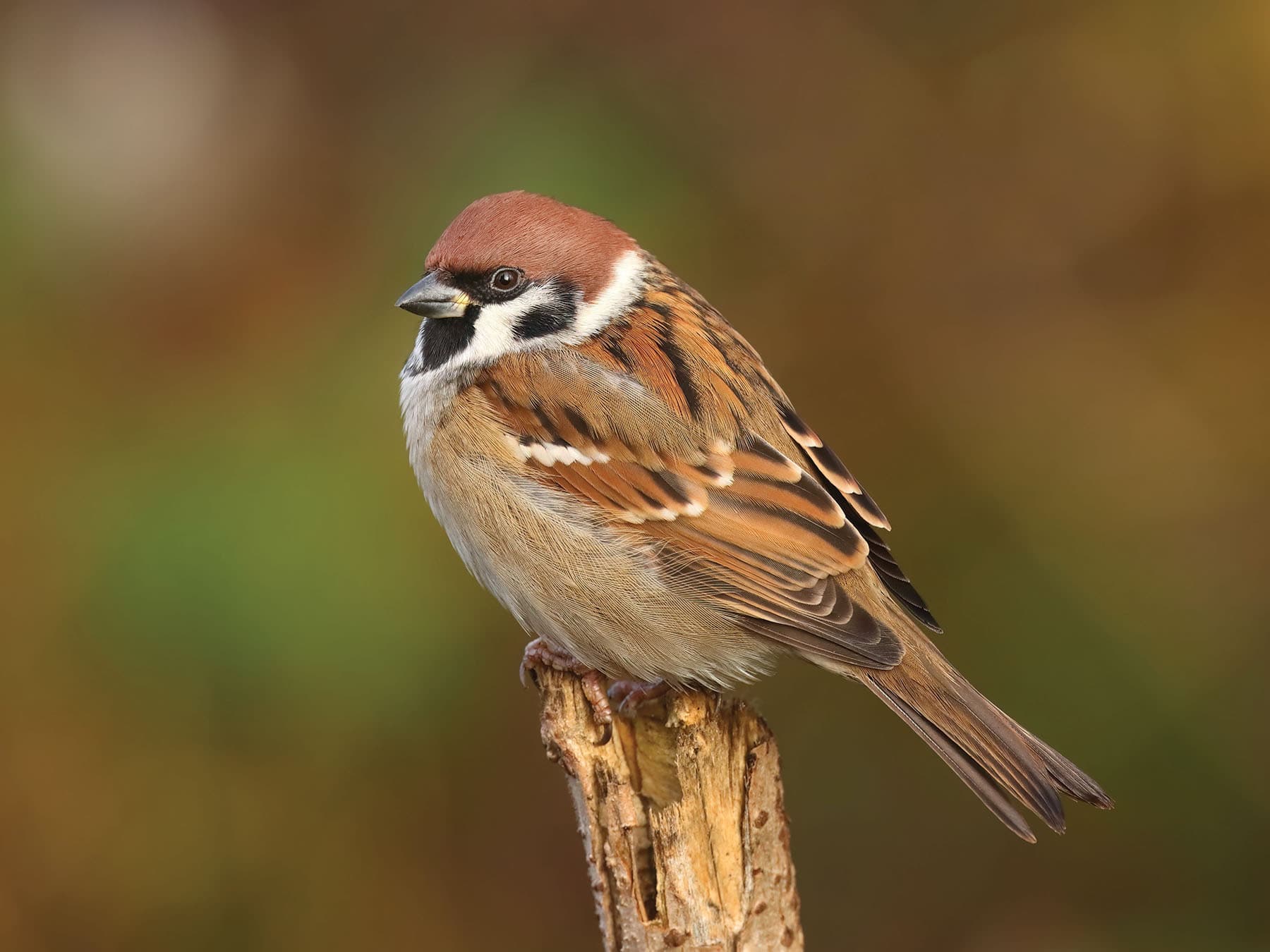
The Eurasian Tree Sparrow is a stout and richly marked species, similar in appearance to the House Sparrow.
What do Tree Sparrows look like?
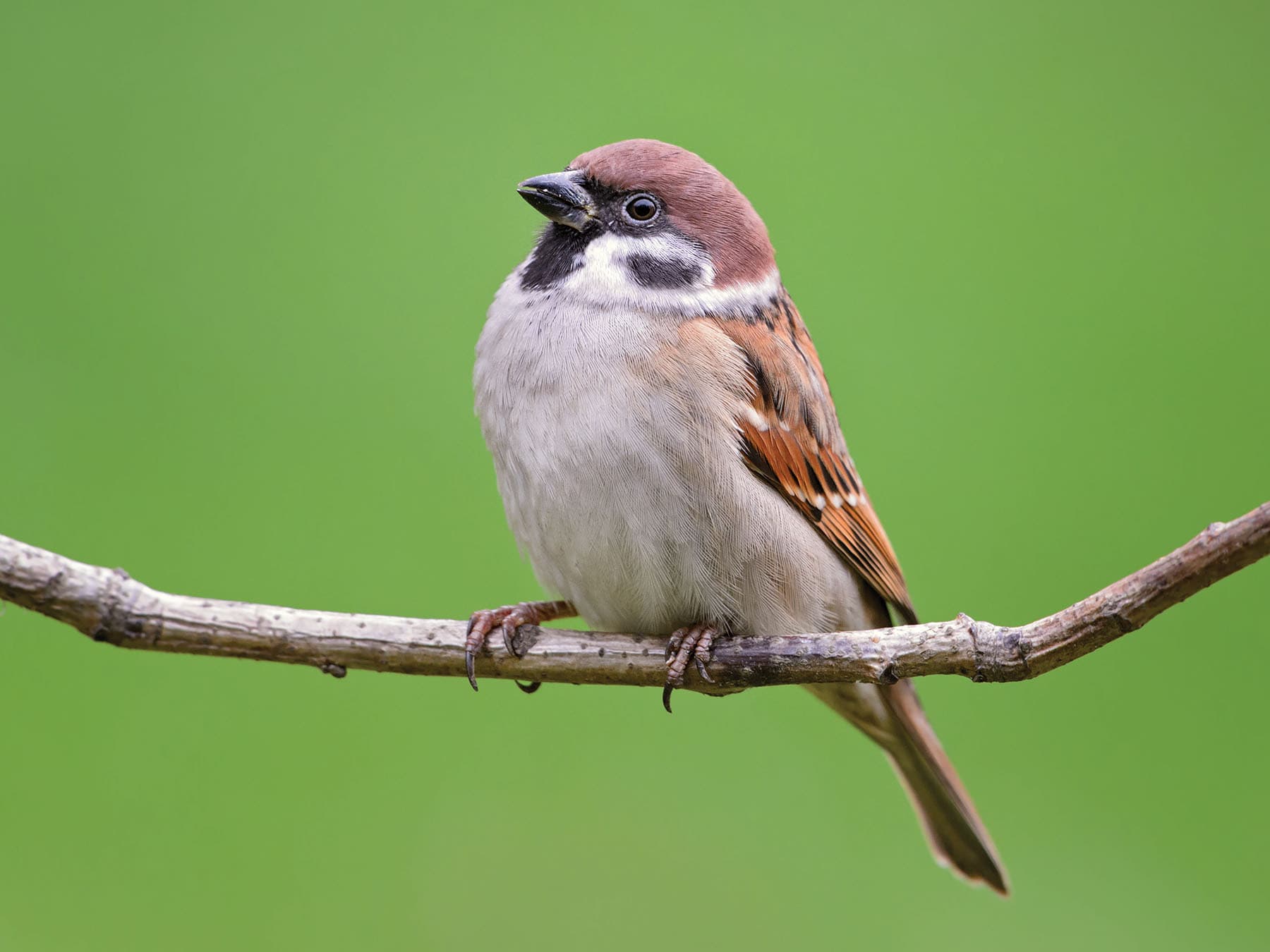
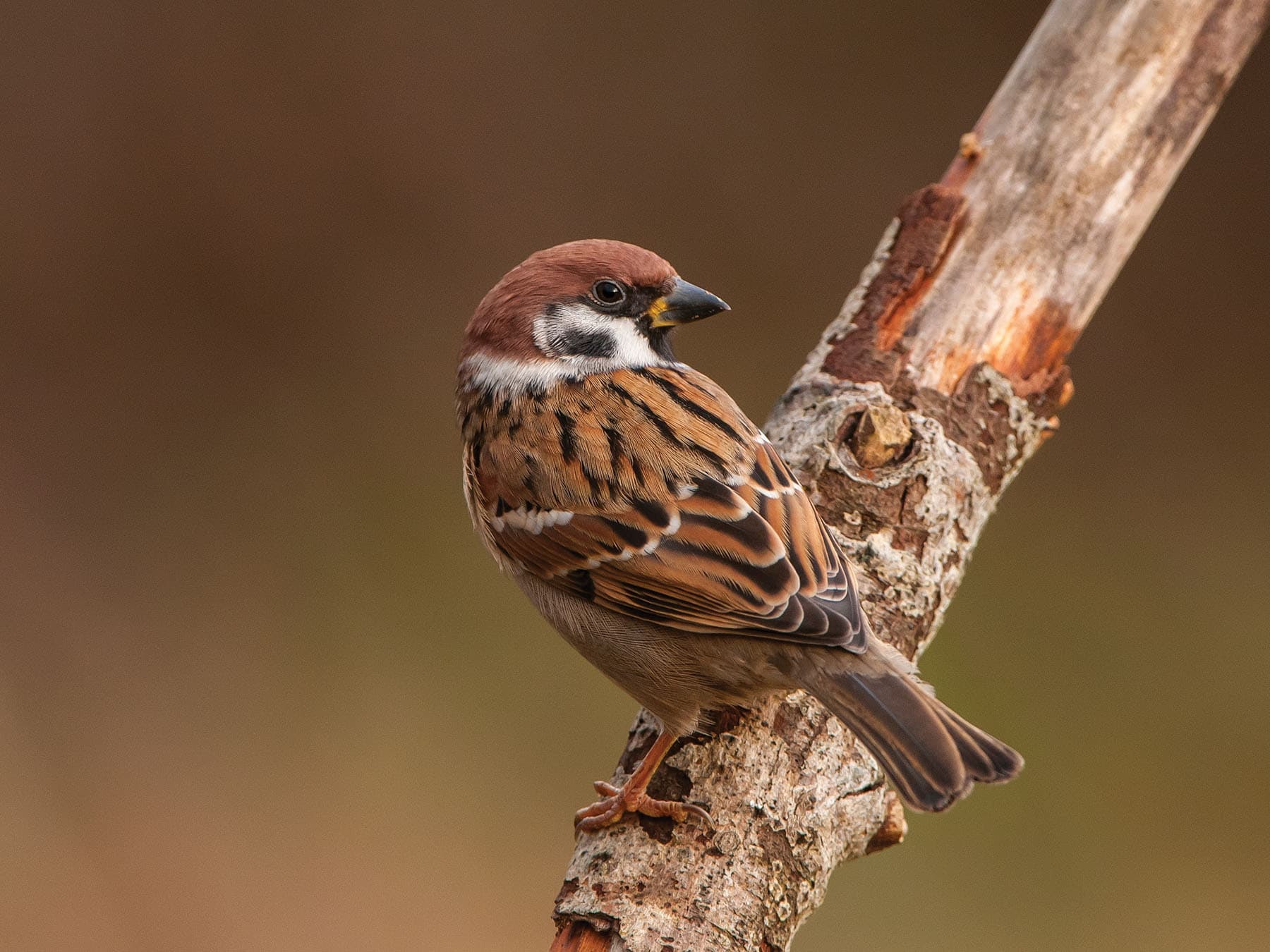
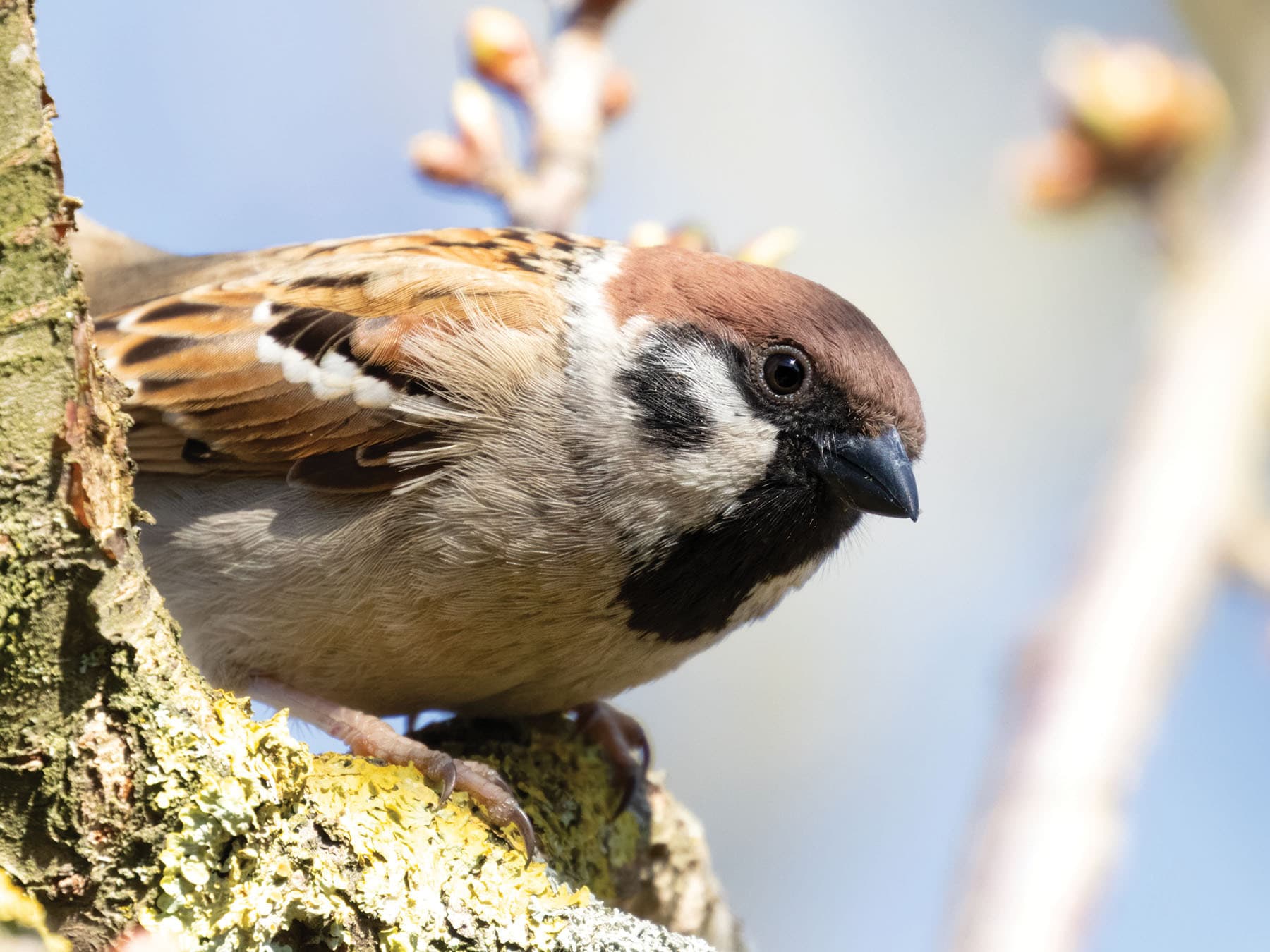
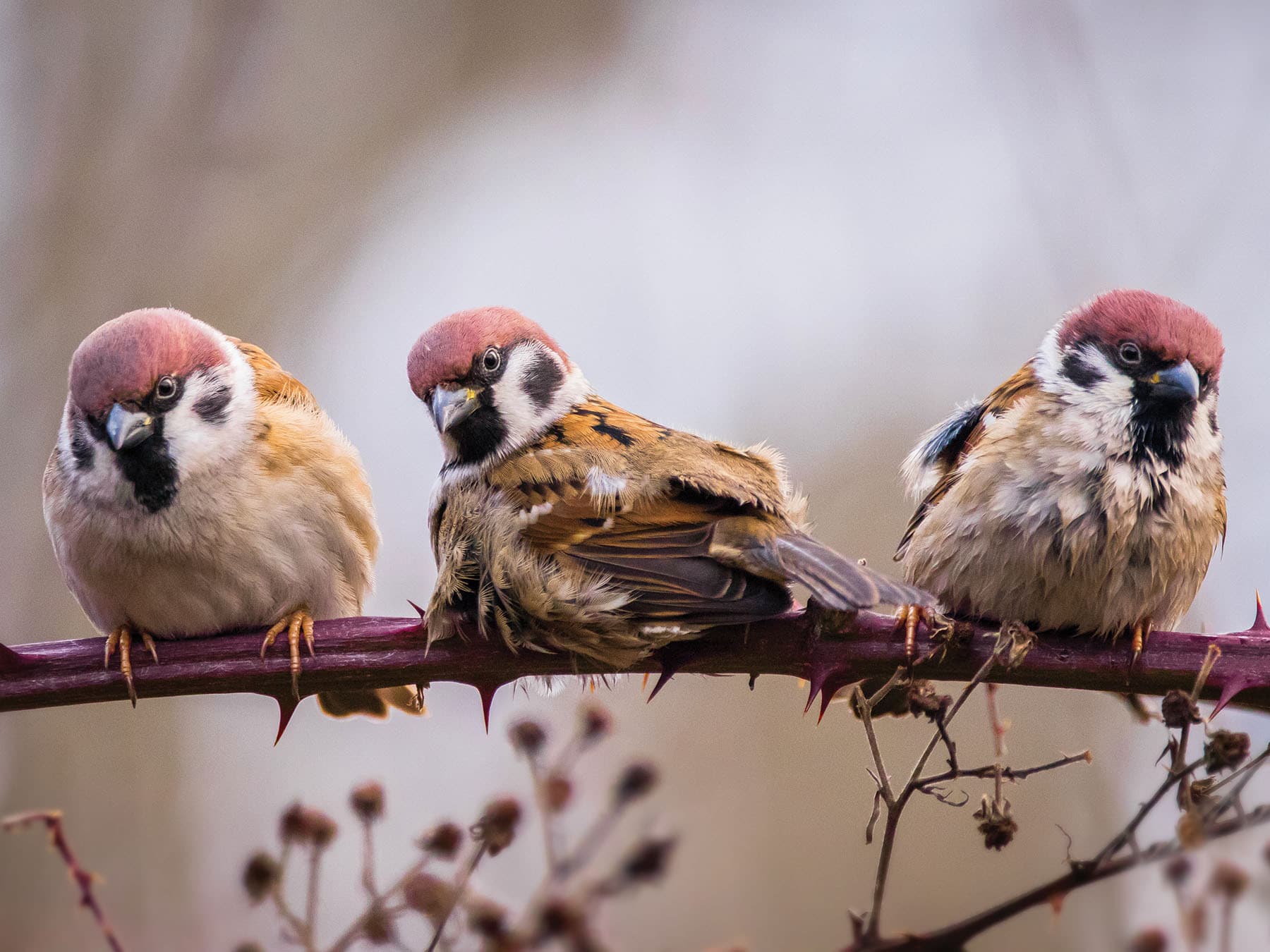
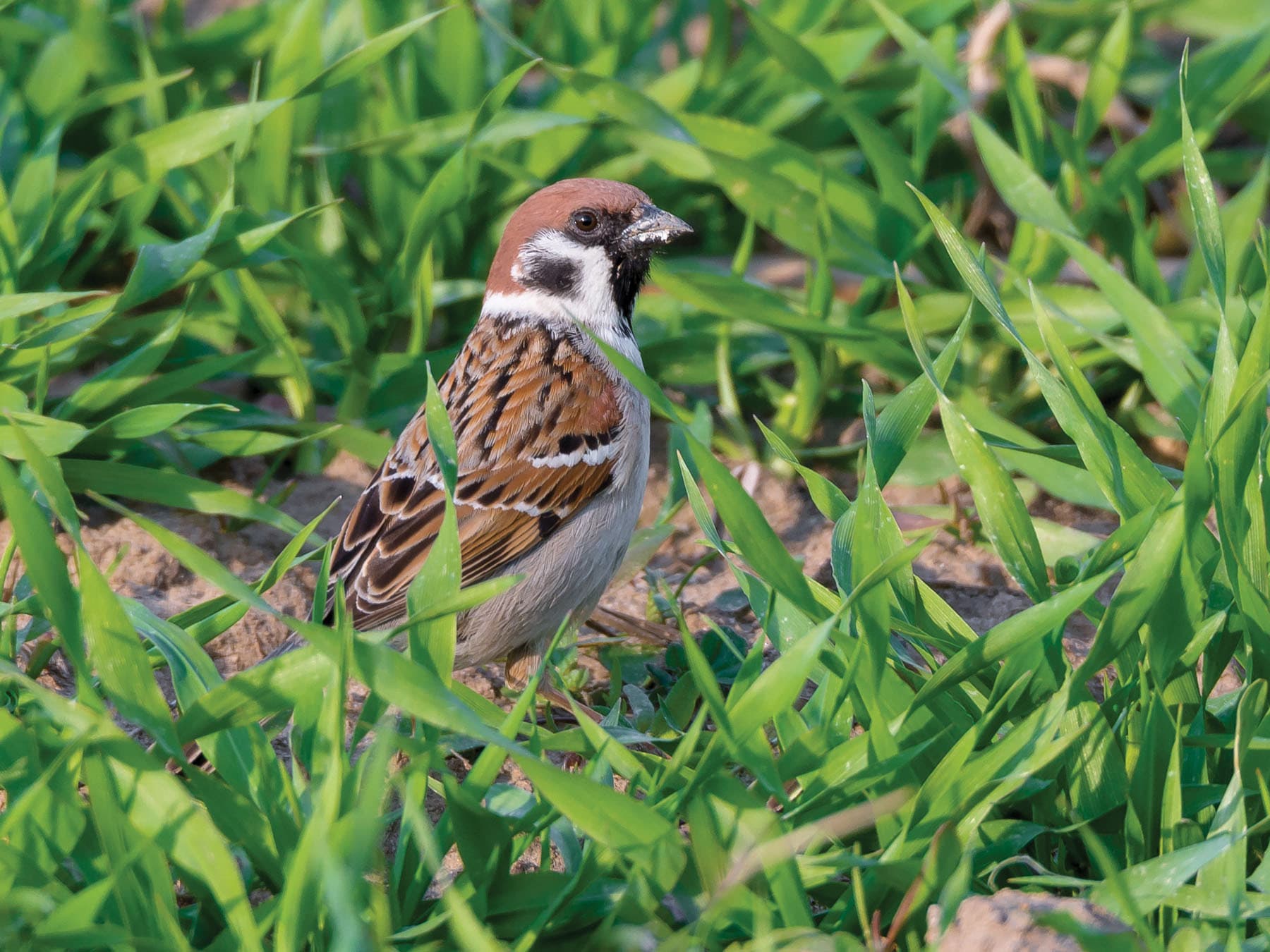
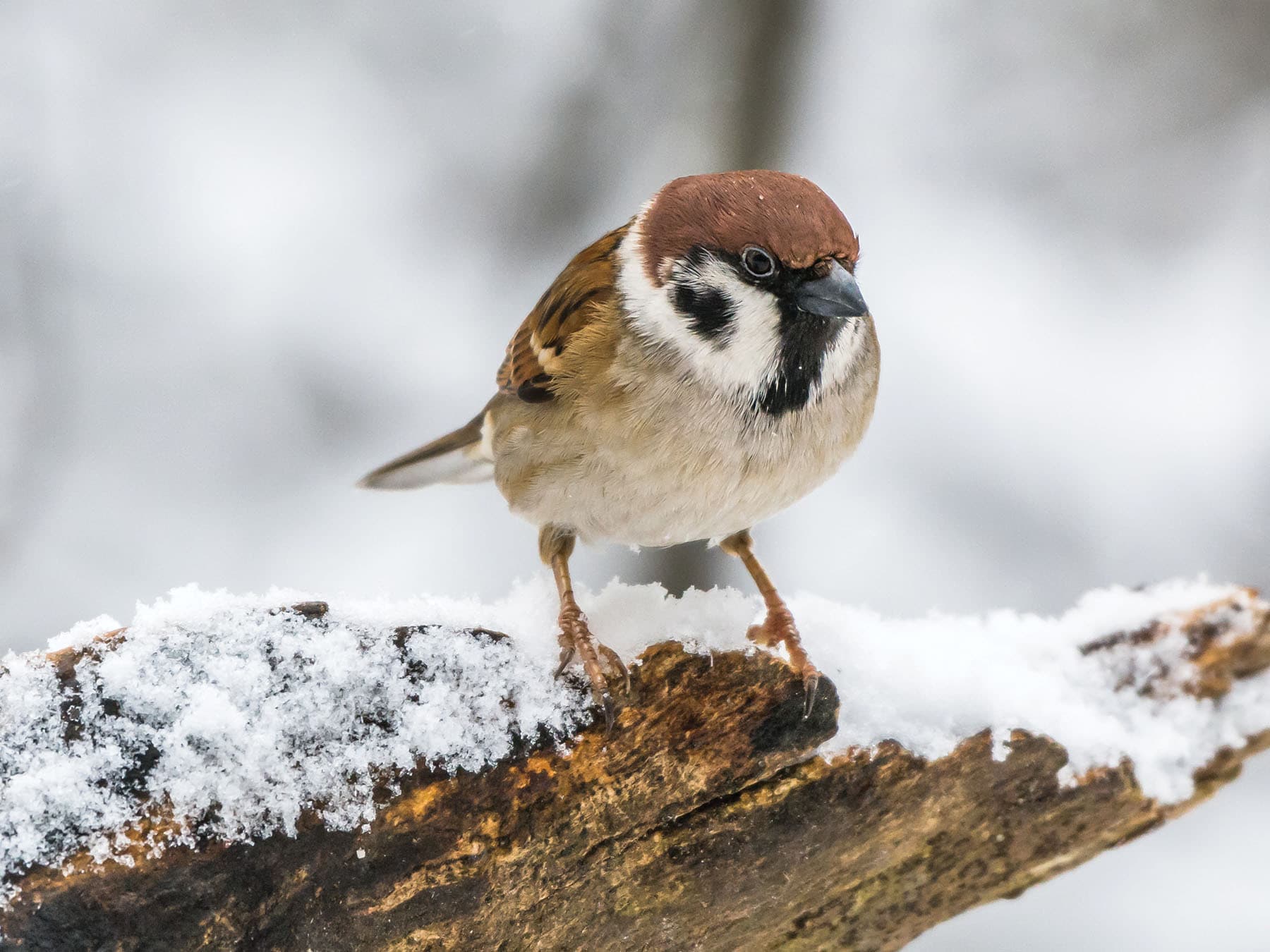
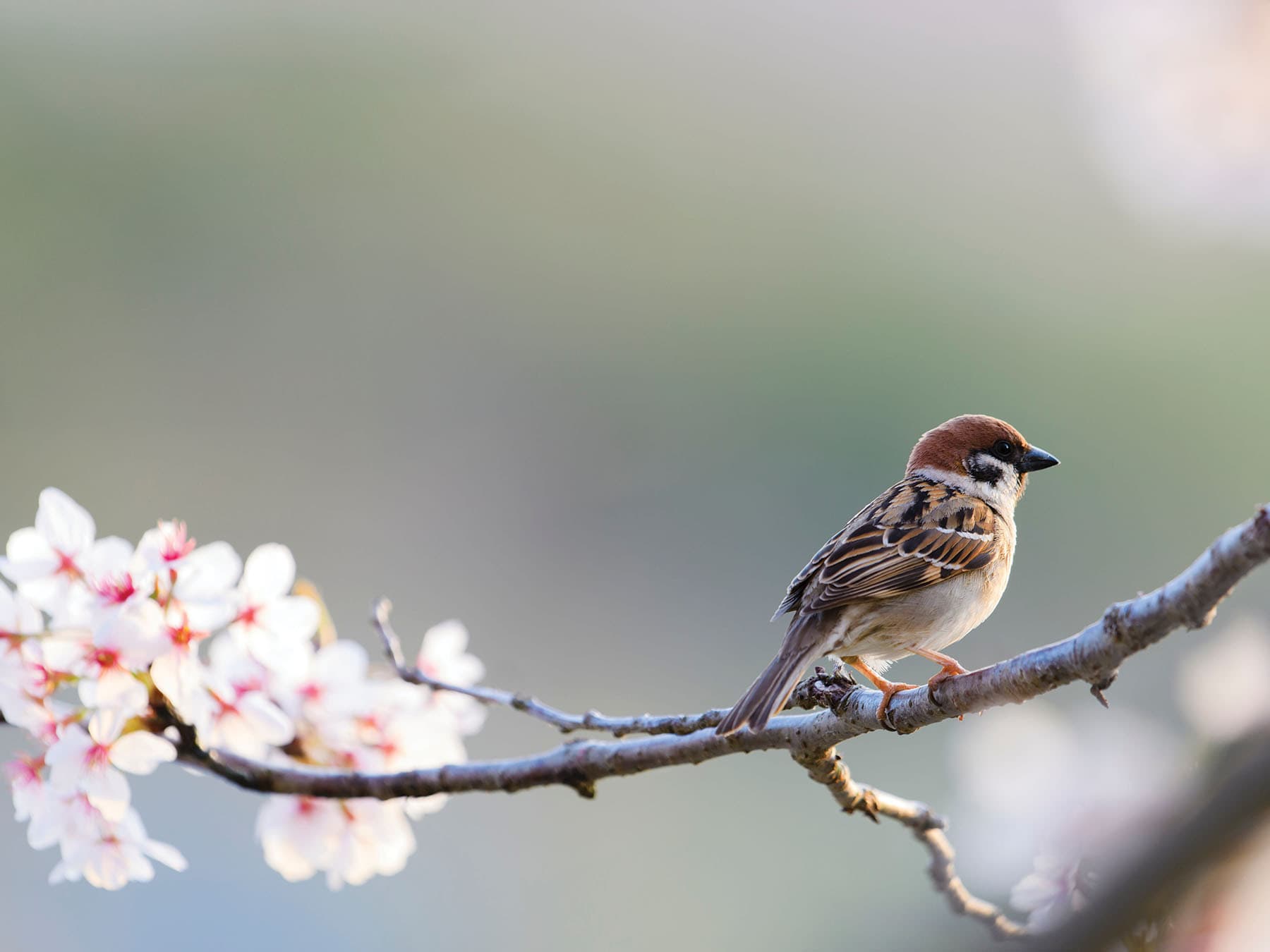
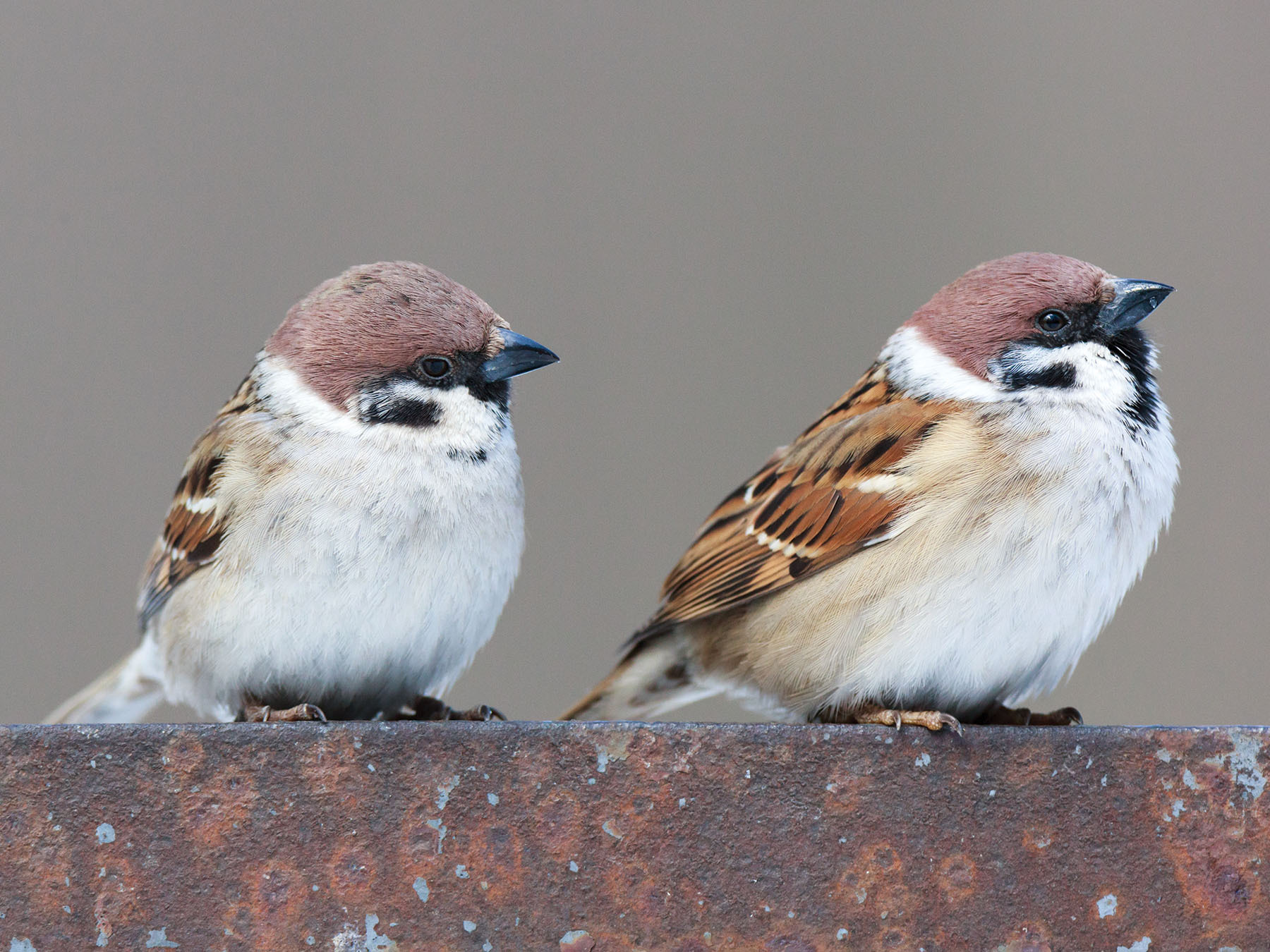
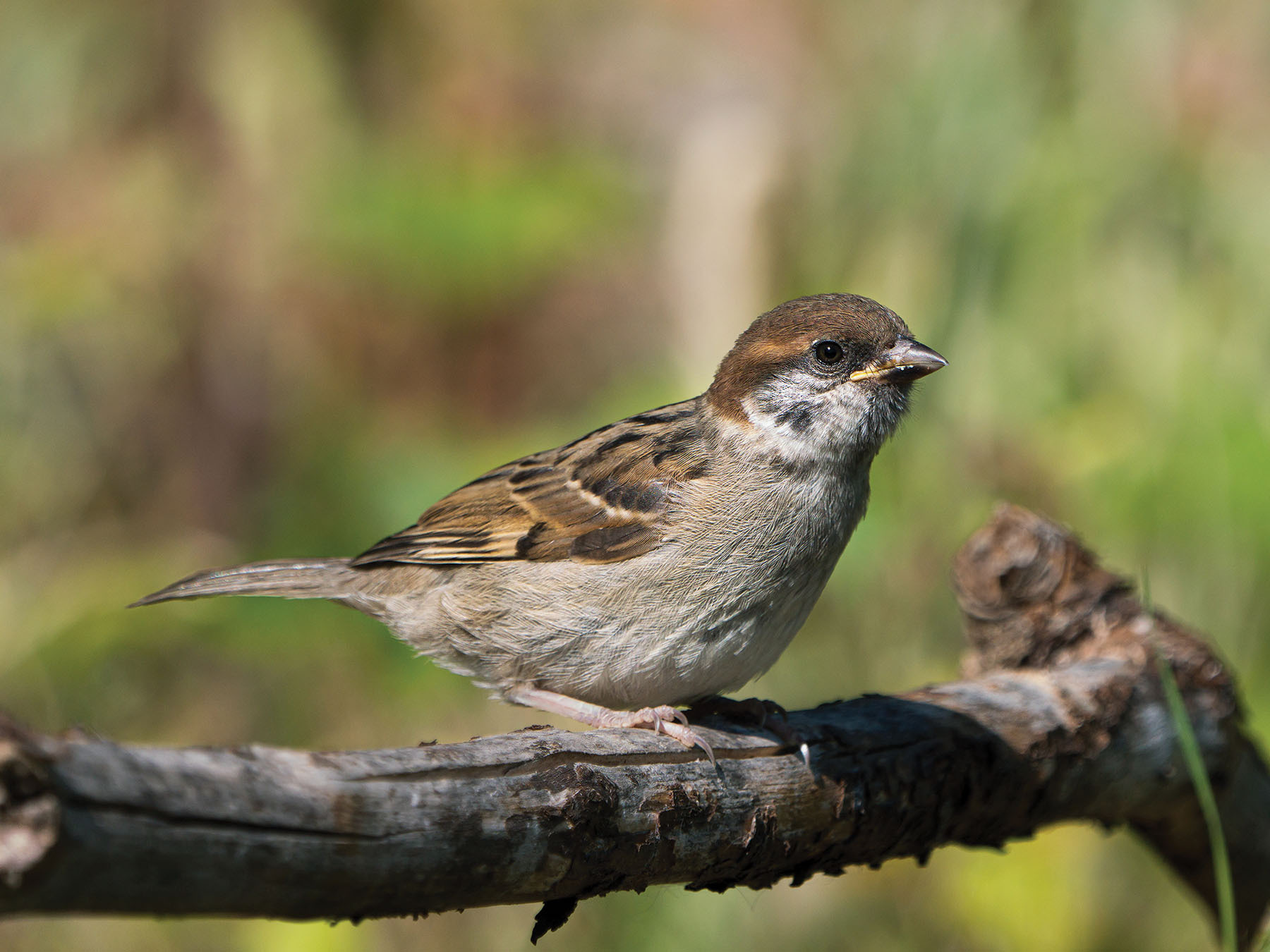
The Tree Sparrow’s most distinctive features are a chestnut brown cap, a black spot on each cheek, and a broad black streak on the throat. The rest of the face is white, and they have a distinct white collar. Their underparts are pale grey, and their wings and backs are richly marked in warm caramel shades with darker streaking.
Male and female Tree Sparrows look alike, and juveniles can be identified by duller plumage and a less defined cheek patch.
These birds are most easily confused with the House Sparrow, although male House Sparrows have grey (not chestnut) crowns and plain white/grey cheeks. Female House Sparrows are easily distinguished by their relatively plain light brown plumage and pale eyebrow stripe.
How big are Tree Sparrows?
Tree Sparrows are small birds, slightly smaller and slimmer than the House Sparrow.
Length
Eurasian Tree Sparrows measure approximately 14 centimetres (5.5 inches) from bill to tail tip.
Weight
They weigh 18 to 28 grams (⅔ - 1 ounce).
Wingspan
Their wingspan is 20 to 22 centimetres (8 inches).
Its size
Adults- Length
- 12.5–14 cm
- Wingspan
- 20–22 cm
- Weight
- 19–25 g
Its song and calls
The Tree Sparrow’s call is similar but higher pitched than the House Sparrow’s. Continue reading to learn more about Tree Sparrow vocalisations.
What sound does a Tree Sparrow make?
Tree Sparrows produce relatively simple songs. Their vocal range is limited to various chirps used to communicate in different situations. Their song consists of longer, more complex strings of chirps to attract a mate, advertise their territory or nest site, and maintain their pair bond.
Other calls include churring, shrieking, and cheeping notes that are used to maintain contact with members of their flock, express alarm or distress, or beg for food.
- Song and calls0:00 / 0:51
Recorded in Corse, France · April 2024
- Call0:00 / 0:34
Recorded in Normandie, France · June 2022
When and where to see it
OctoberArriving
Most recorded in October
- 1. East Riding of Yorkshire1.3%
- 2. Aberdeenshire1.0%
- 3. Scottish Borders1.0%
- 4. Angus0.89%
- 5. Perthshire and Kinross0.88%
Each dot is a county, state or province: the bigger and darker, the larger the bird’s share of that place’s bird records that month. Grey dots: no regular records. The ringed point is the centre of the bird’s records this month; the arrow shows how it moved since last month, and the dashed loop its path through the year. “Arrivals” colours places where it becomes regular this month (orange) or is in its last regular month (grey). GBIF eBird Observation Dataset, 2019–2024. Map data: Natural Earth, US Census Bureau; place centres © OpenStreetMap contributors.
In your area
See when the Eurasian Tree Sparrow is recorded in your county, state or province.
How often the Eurasian Tree Sparrow turns up in the UK, Ireland, the United States and Canada through the year, from birdwatchers' records.
United Kingdom
Resident · all year · most records in October
Ireland
Resident · all year · most records in May
United States
Resident · all year · most records in February
Canada
Passage migrant · regularly Nov–May · most records in November
Show as a table
| Month | United Kingdom | Ireland | United States | Canada |
|---|---|---|---|---|
| January | 0.13% (regular) | 0.028% (regular) | 0.015% (regular) | 0.001% (regular) |
| February | 0.12% (regular) | 0.024% (regular) | 0.017% (regular) | <0.001% |
| March | 0.11% (regular) | 0.024% (regular) | 0.012% (regular) | <0.001% |
| April | 0.10% (regular) | 0.017% (regular) | 0.009% (regular) | <0.001% (regular) |
| May | 0.12% (regular) | 0.033% (regular) | 0.009% (regular) | <0.001% (regular) |
| June | 0.13% (regular) | 0.016% (regular) | 0.009% (regular) | <0.001% |
| July | 0.13% (regular) | 0.030% (regular) | 0.012% (regular) | <0.001% |
| August | 0.091% (regular) | 0.008% (regular) | 0.010% (regular) | <0.001% |
| September | 0.11% (regular) | 0.008% (regular) | 0.007% (regular) | <0.001% |
| October | 0.15% (regular) | 0.025% (regular) | 0.011% (regular) | – |
| November | 0.11% (regular) | 0.031% (regular) | 0.014% (regular) | 0.005% (regular) |
| December | 0.099% (regular) | 0.021% (regular) | 0.014% (regular) | <0.001% (regular) |
Recorded regularly in
Worldwide: recorded regularly in 94 countries
Countries where it was recorded in at least 3 of the 6 years 2019–2024. Linked countries have their own bird list.
Europe (44)
- Åland Islands
- Albania
- Austria
- Belarus
- Belgium
- Bosnia & Herzegovina
- Bulgaria
- Croatia
- Czechia
- Denmark
- Estonia
- Faroe Islands
- Finland
- France
- Germany
- Greece
- Hungary
- Ireland
- Isle of Man
- Italy
- Kosovo
- Latvia
- Liechtenstein
- Lithuania
- Luxembourg
- Malta
- Moldova
- Montenegro
- Netherlands
- North Macedonia
- Norway
- Poland
- Portugal
- Romania
- Russia
- Serbia
- Slovakia
- Slovenia
- Spain
- Sweden
- Switzerland
- Ukraine
- United Kingdom
- Vatican City
Asia (36)
- Afghanistan
- Armenia
- Azerbaijan
- Bangladesh
- Bhutan
- Brunei
- Cambodia
- China
- Cyprus
- Georgia
- Hong Kong SAR China
- India
- Indonesia
- Iran
- Iraq
- Japan
- Kazakhstan
- Kyrgyzstan
- Laos
- Macao SAR China
- Malaysia
- Mongolia
- Myanmar (Burma)
- Nepal
- Pakistan
- Philippines
- Singapore
- South Korea
- Sri Lanka
- Taiwan
- Tajikistan
- Thailand
- Timor-Leste
- Turkey
- Uzbekistan
- Vietnam
North America (2)
Oceania (9)
- Australia
- Christmas Island
- Guam
- Marshall Islands
- Micronesia
- Northern Mariana Islands
- Palau
- Papua New Guinea
- Solomon Islands
Data: EOD – eBird Observation Dataset (Cornell Lab of Ornithology), accessed via GBIF.org, CC BY 4.0. Records from 2019–2024, aggregated and filtered by Birdfact. How these lists are made
What is the habitat of a Tree Sparrow?
Tree Sparrows are less at home in urban and suburban areas than the House Sparrow, preferring farmland, hedgerows, and open woodland habitats.
What is the range of a Tree Sparrow?
The Eurasian Tree Sparrow has an extensive native range in Europe and Asia. They occur from Portugal and the United Kingdom in the west to Japan and the Kamchatka Peninsula in the East. They are absent from most of India but occur throughout Southeast Asia.
Eurasian Tree Sparrows were introduced to parts of Australia and Missouri in the United States. They have not spread widely but persist in breeding populations today.
Where do Tree Sparrows live?
Tree Sparrows live in rural areas in the United Kingdom and the United States, but they are ubiquitous in urban environments in the east of their range. These birds spend most of their time in trees, hedgerows, and shrubs, although they regularly descend to feed on the ground.
How rare are Tree Sparrows?
Tree Sparrows have recovered slightly in the United Kingdom, despite their population being just a fraction of its mid-20th century number. They are generally scarce, although they can be common in parts of northeastern England in the spring and summer months. In the United States, the species is locally common but localised in the Lower Midwest.
Where can you see Tree Sparrows in the UK?
Tree Sparrows have a patchy distribution in the United Kingdom. They are absent from most of the southwest, Wales and upland areas of northern England and Scotland. Look for these birds in farmland with hedgerows or along woodland edges in rural areas of central, northeastern, and southeastern England.
Where can you see Tree Sparrows in the US?
The Eurasian Tree Sparrow population in the United States is mainly confined to the area around St. Louis, Missouri, and adjacent Illinois and Iowa.
Migration
Do Tree Sparrows migrate?
Tree Sparrows occur throughout the year in all but the coldest parts of their range. They are generally sedentary but may undertake local movements outside of the breeding season. Some North Asian breeders move south for the winter.
Are Tree Sparrows native to the UK?
Tree Sparrows are native to the United Kingdom. Their native range includes most of Europe and Asia.
Are Tree Sparrows native to the US?
Tree Sparrows are not native to the United States. About two-dozen individuals from Germany were introduced to St.Louis, Missouri on the 24th of April, 1870, and they have persisted in the region ever since.
Tips for seeing it
- Look for them in open woodlands, farmland edges, and urban parks
- Listen for their chirping calls, especially near nesting sites
- Observe feeders in gardens, where they often visit in small groups
- Check tree cavities and nest boxes during breeding season
- In the UK, distinguish them from the similar House Sparrow by their chestnut crown and black cheek spot
What it eats
What do Tree Sparrows eat?
Tree Sparrows feed primarily on seeds and grains. Cereal crops like wheat, barley, maize, and rye are favoured, although they will feed on various weeds and wild plants. They also eat insects and other invertebrates in the warmer months.
What do baby Tree Sparrows eat?
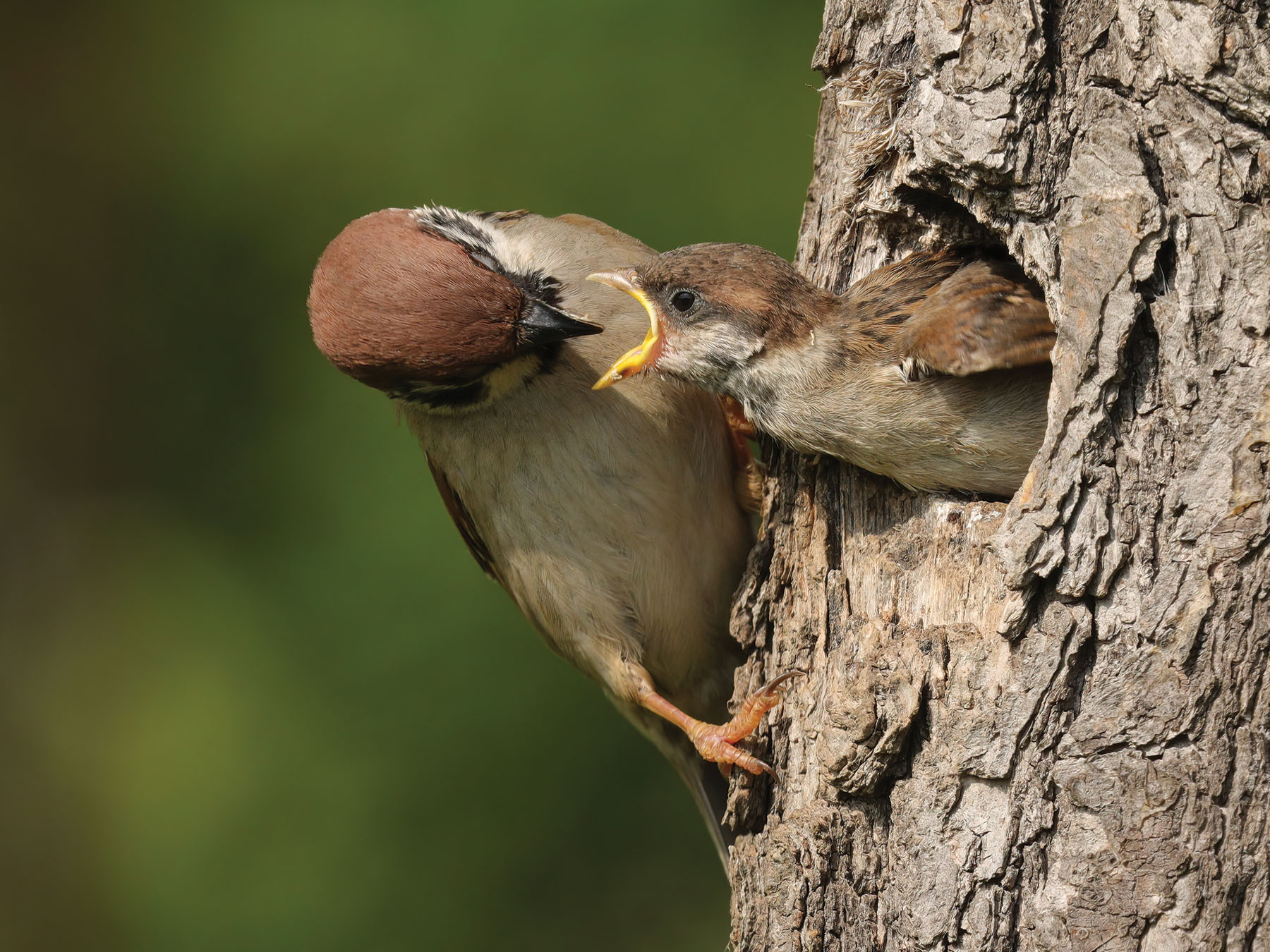
Tree Sparrow chicks eat a variety of small insects like caterpillars, beetles, aphids, and grasshoppers. They also eat a smaller amount of berries and other plant material.
The baby sparrows fledge the nest after about two weeks and may be fed for another two weeks until moving off to join a flock.
Nesting and breeding
Tree Sparrows nest colonially in the spring, producing two or three clutches per season. Continue reading to learn more about Tree Sparrow nesting behaviour.
Where do Tree Sparrows nest?
Tree Sparrows generally nest in natural cavities like tree holes, holes in earth banks and artificial structures like roof eaves and nest boxes. Males select the nest site and display nearby to attract a partner. Pairs then work together to construct a nest over about five days.
What do Tree Sparrow eggs look like?
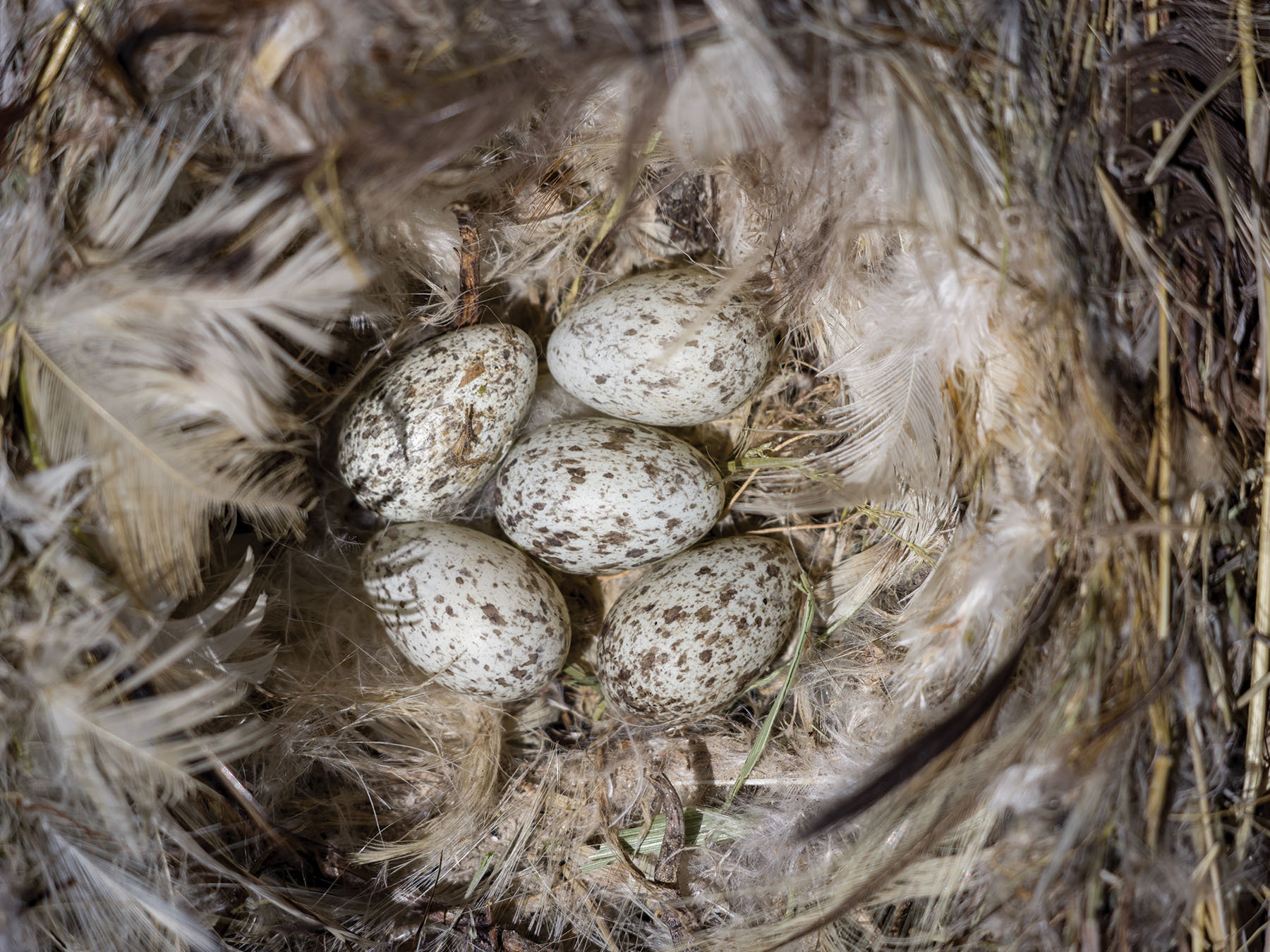
Tree Sparrows usually lay four to six eggs, although clutches of one to ten are possible. Each egg has a whitish ground colour and is marked heavily with dark spots and blotches. Their eggs measure approximately 19 millimetres long and 14 millimetres wide.
Do Tree Sparrows mate for life?
Tree Sparrows form strong pair bonds and generally mate for life. However, they will accept a new mate if a partner is lost.
Behaviour
Are Tree Sparrows aggressive?
Tree Sparrows may act aggressively if other birds approach their nesting territory. They begin with visual displays like rocking, bobbing and gestures with their wings and tails, but will fight with their bills and claws if necessary. They also act aggressively if other Tree Sparrows or birds forage too close to them.
Where do Tree Sparrows sleep at night?
Tree Sparrows roost among the branches of trees and other vegetation in warmer seasons but will use the shelter of buildings or nest cavities in cold weather. They may roost communally in large flocks, sometimes mixed with House Sparrows.
Lifespan and predators
How long do Tree Sparrows live?
Tree Sparrows can live for over twelve years, although their average life expectancy is just two years.
What are the predators of Tree Sparrows?
Adult Tree Sparrows in the UK are most vulnerable to birds of prey like the Sparrowhawk and Kestrel, while Coopers and Sharp-shinned Hawks are likely predators in the United States.
Mammalian predators like domestic cats, weasels, rats, and raccoons are also threats. Their eggs and chicks are vulnerable to additional nest predators like Jays and Common Grackles.
Are Tree Sparrows protected?
Tree Sparrows are protected in the United Kingdom by the Wildlife and Countryside Act of 1981. They are not federally protected in the United States, although they enjoy local protection in the state of Illinois.
Are Tree Sparrows endangered?
Eurasian Tree Sparrows are not endangered. They are classed as a ‘Least Concern’ species on the IUCN red list, although they have declined notably in the west of their range. Tree Sparrows are still on the red list of conservation concern in the United Kingdom after massive declines between the 1970s and 1990s.
Conservation
While listed as Least Concern globally, Eurasian Tree Sparrow populations have declined in parts of Europe due to agricultural intensification and habitat loss.
Conservation efforts focus on maintaining suitable nesting sites and promoting wildlife-friendly farming practices to support their populations.
Similar birds
Often mistaken for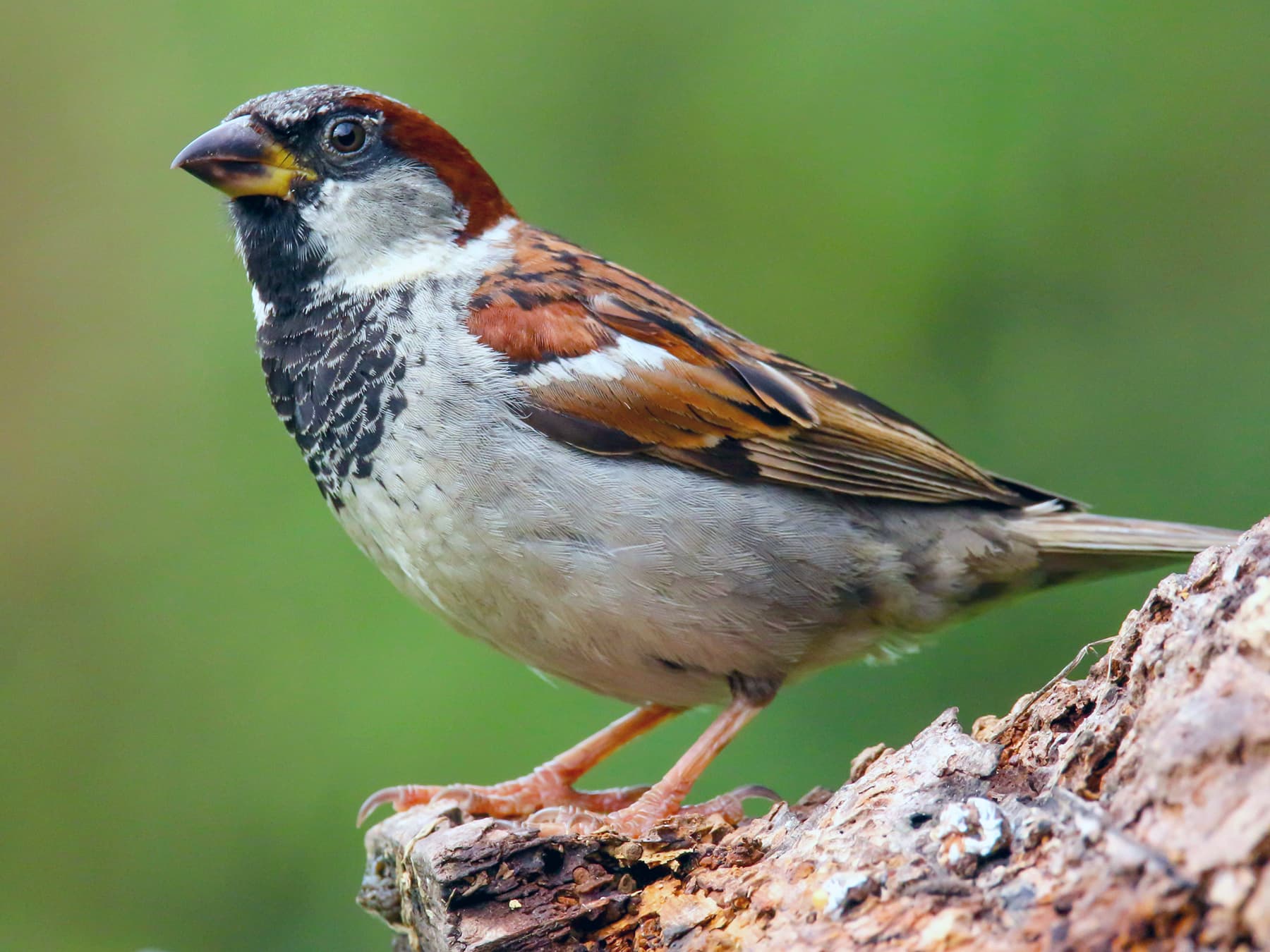
More photos
5 photos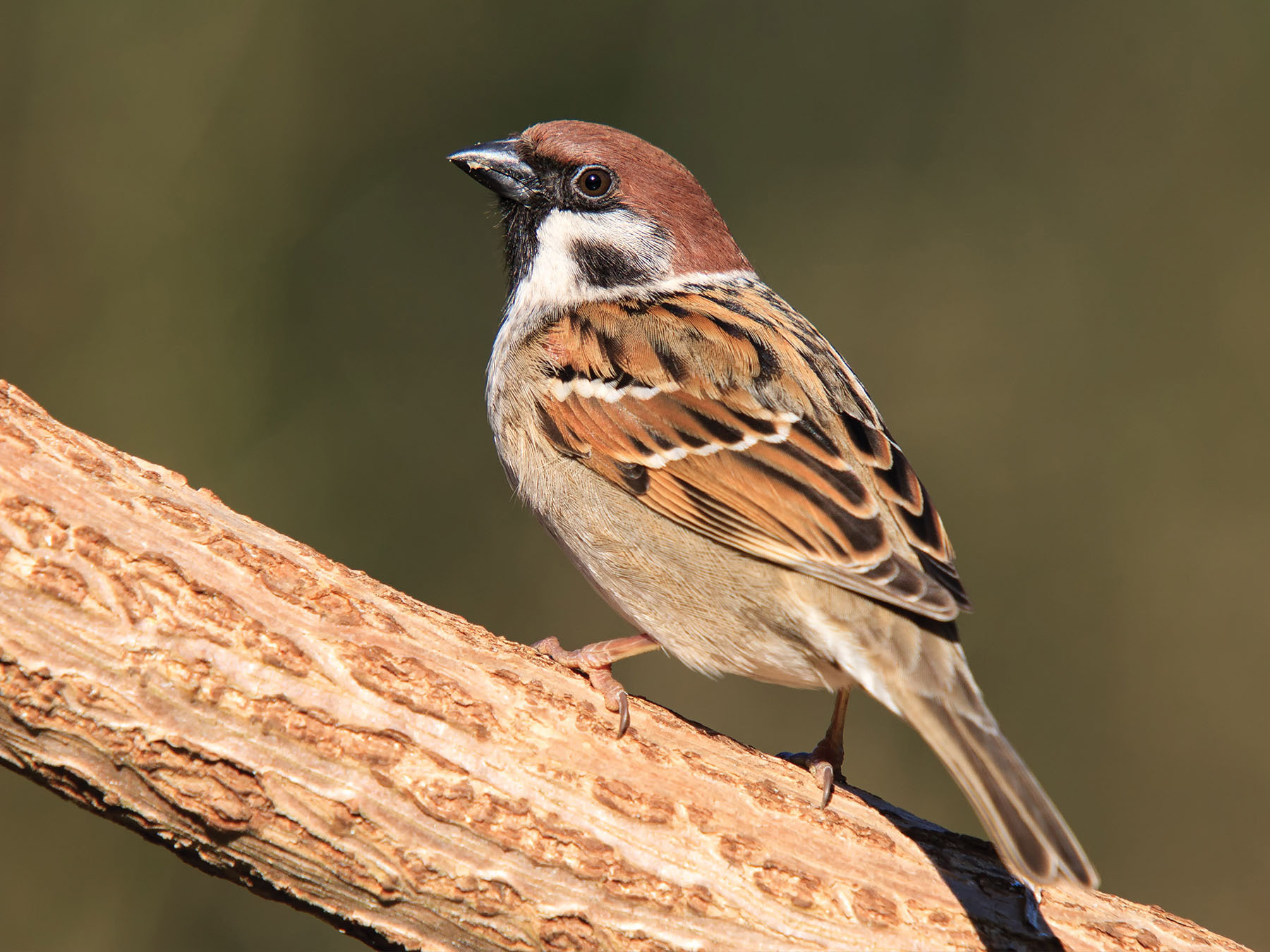
Eurasian Tree Sparrow guides
2 guidesQuick facts
- Length
- 12.5–14 cm
- Wingspan
- 20–22 cm
- Weight
- 19–25 g
- Lifespan
- 2 years · oldest recorded 13.1 years
- Family
- Old World Sparrows
- Migration
- Resident
- Global status (IUCN)
- Least Concern
- World population
- 191,000,000 - 306,000,000 individuals
- Population trend
- Decreasing
- Also called
- Tree Sparrow
- Scientific name
- Passer montanus
Questions
2How to attract Tree Sparrows?
Tree Sparrows rarely visit gardens and are difficult to attract in suburban areas. Farmers and landowners with large properties can attract these birds by setting out nest boxes to encourage a breeding colony and placing bird feeders in hedgerows.
Tree Sparrows show a preference for red millet, and their ideal nest box has an entrance hole with a 28-millimetre diameter and a total depth of about 20 centimetres.
Are Tree Sparrows bad?
Tree Sparrows can damage food crops in some parts of the world and were even the subject of an intensive eradication program in China in the mid-20th century. However, they are not considered destructive in the United Kingdom and have not spread to become invasive and destructive in the USA like their relative, the House Sparrow.
Sources
4- 1BirdLife International. 2017. Passer montanus (amended version of 2017 assessment). The IUCN Red List of Threatened Species 2017: e.T22718270A119216586. Source (opens in a new tab)
- 2EBCC (2015)
- 3BirdLife International. 2017. Passer montanus (amended version of 2017 assessment). The IUCN Red List of Threatened Species 2017: e.T22718270A119216586. Source (opens in a new tab)
- 4Fransson et al., EURING list of longevity records for European birds (2010) Source (opens in a new tab)

Checked by
Nathan Cope, founder and editor
Nathan founded Birdfact and leads its writers and contributors in the UK, the US and Canada. He has watched and studied birds for more than ten years, and checks every article and species guide before it’s published.