


Stonechat
European Stonechat, Common Stonechat · Saxicola rubicola
By the Birdfact teamChecked by Nathan Cope
On this page14 sections
How to recognise it
Stonechats are distinctive birds, although males and females have different appearances. Continue reading to learn more Stonechat identification tips.
What do Stonechats look like?
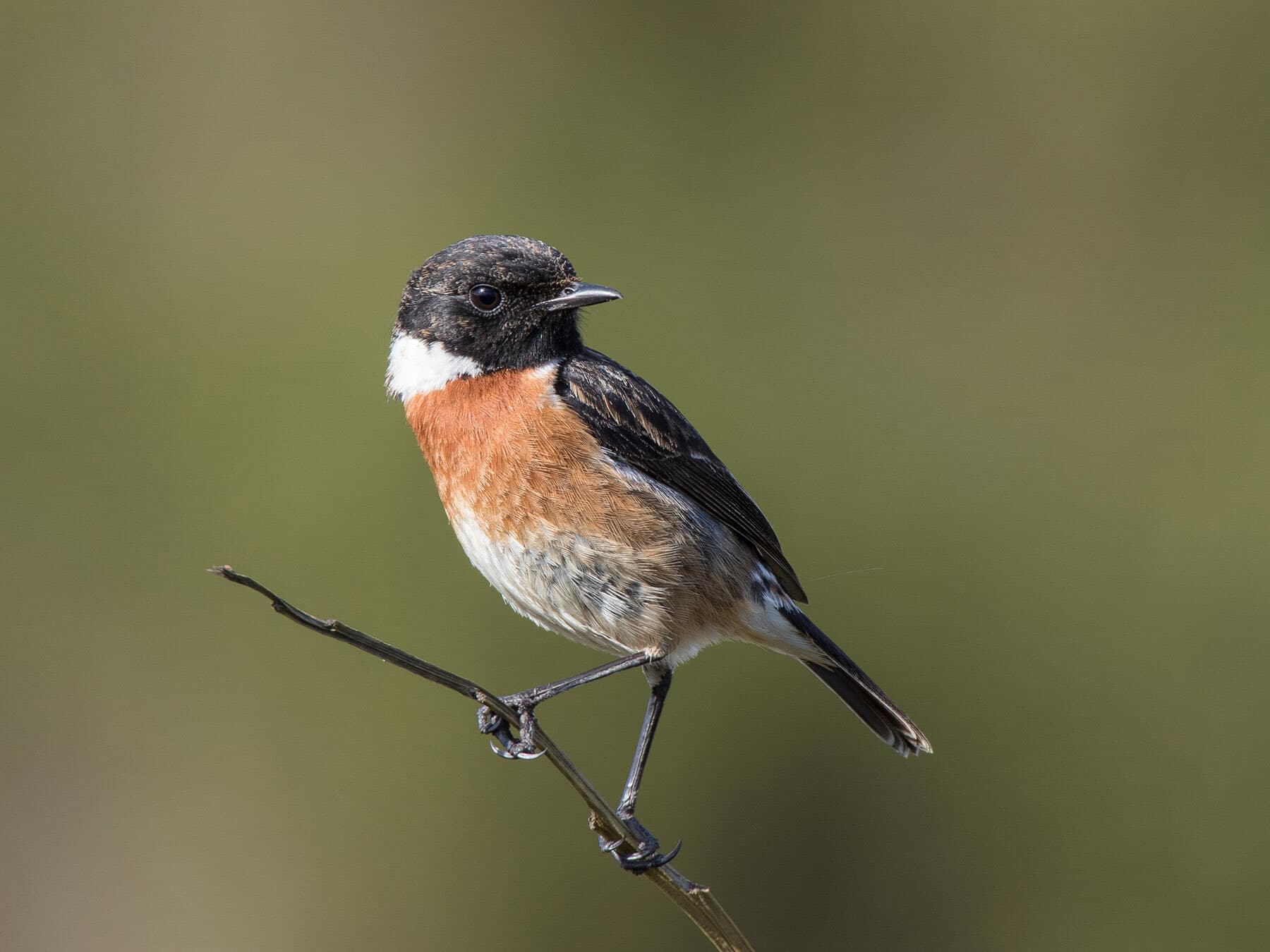
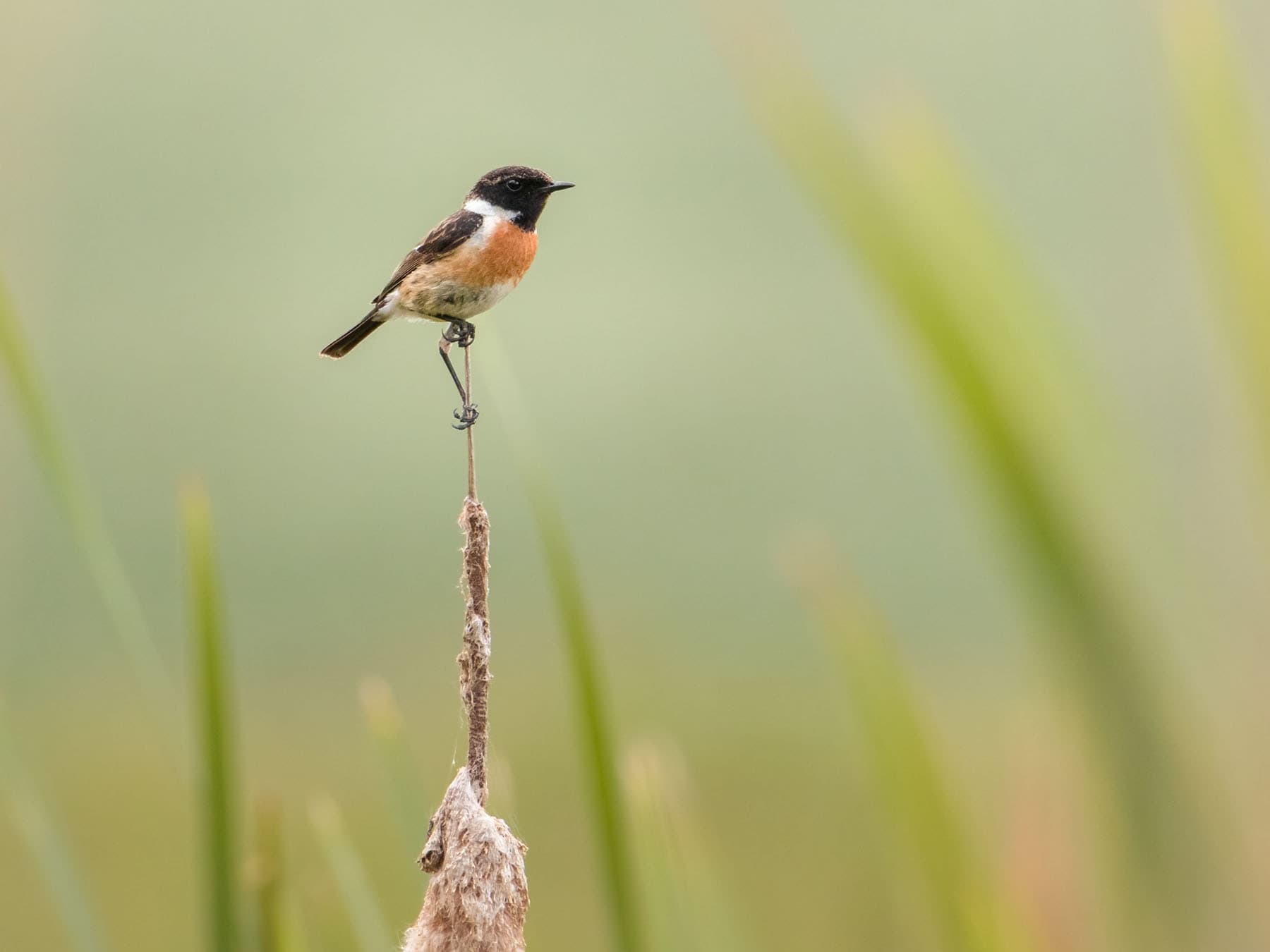
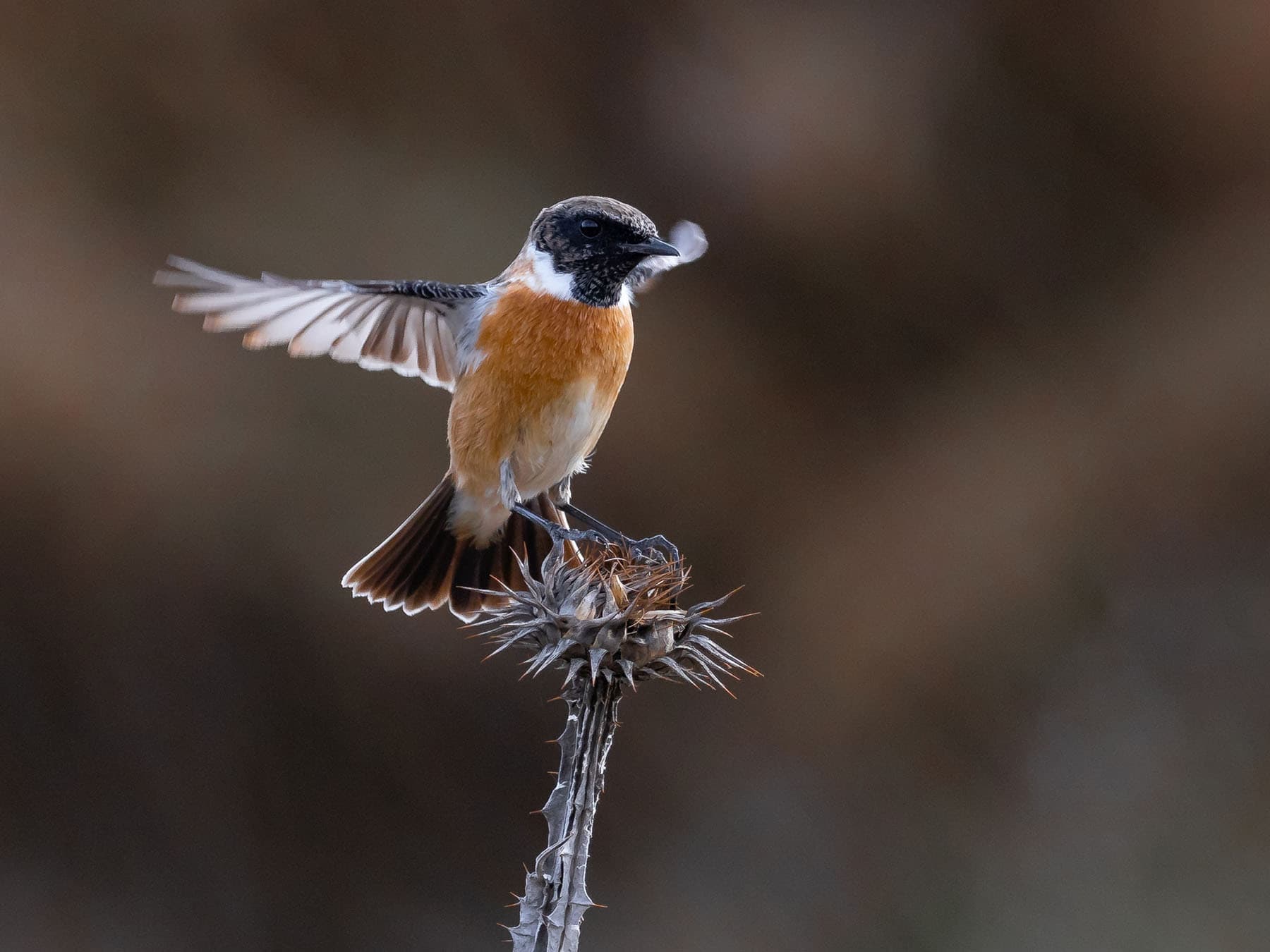
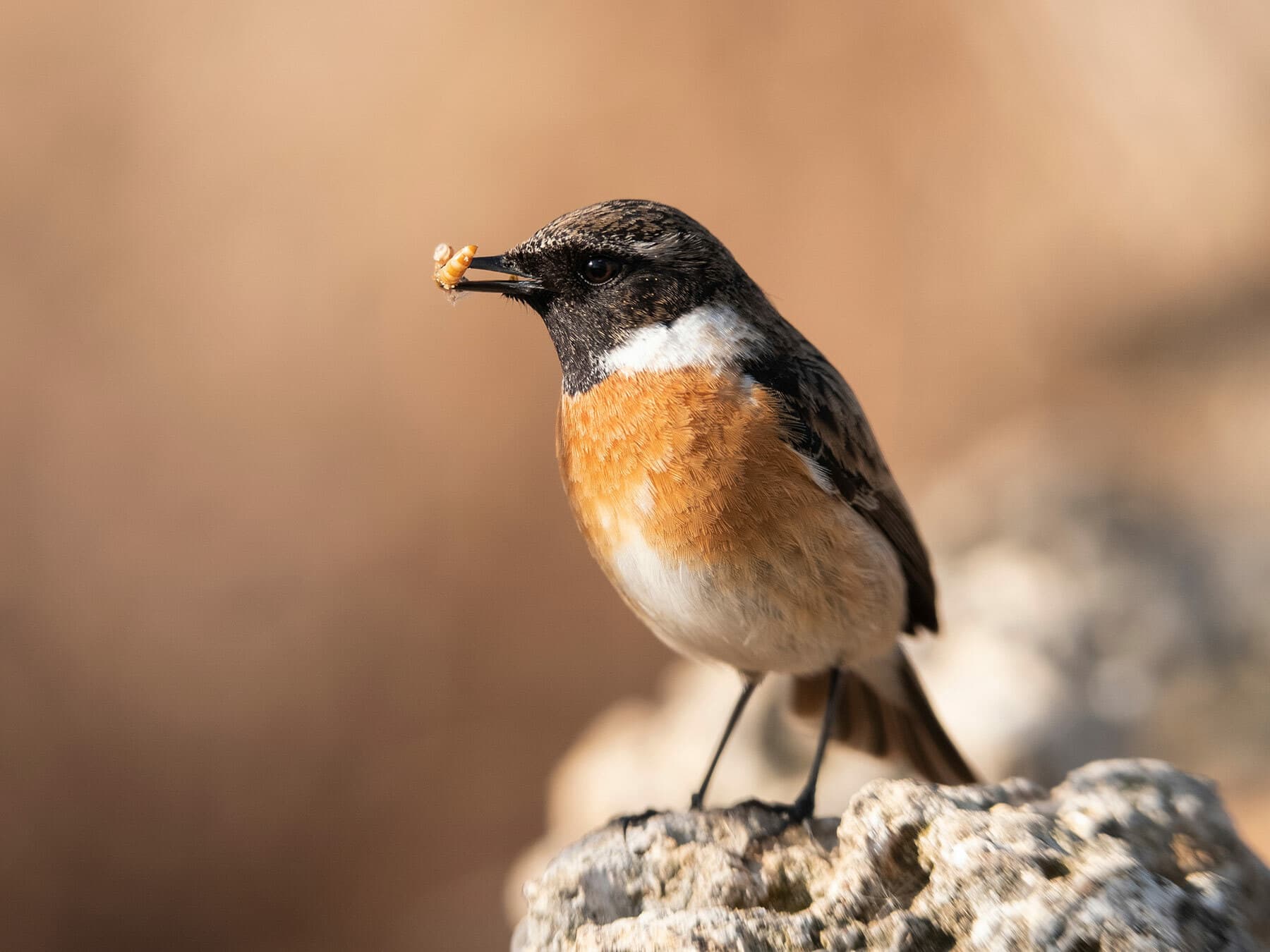
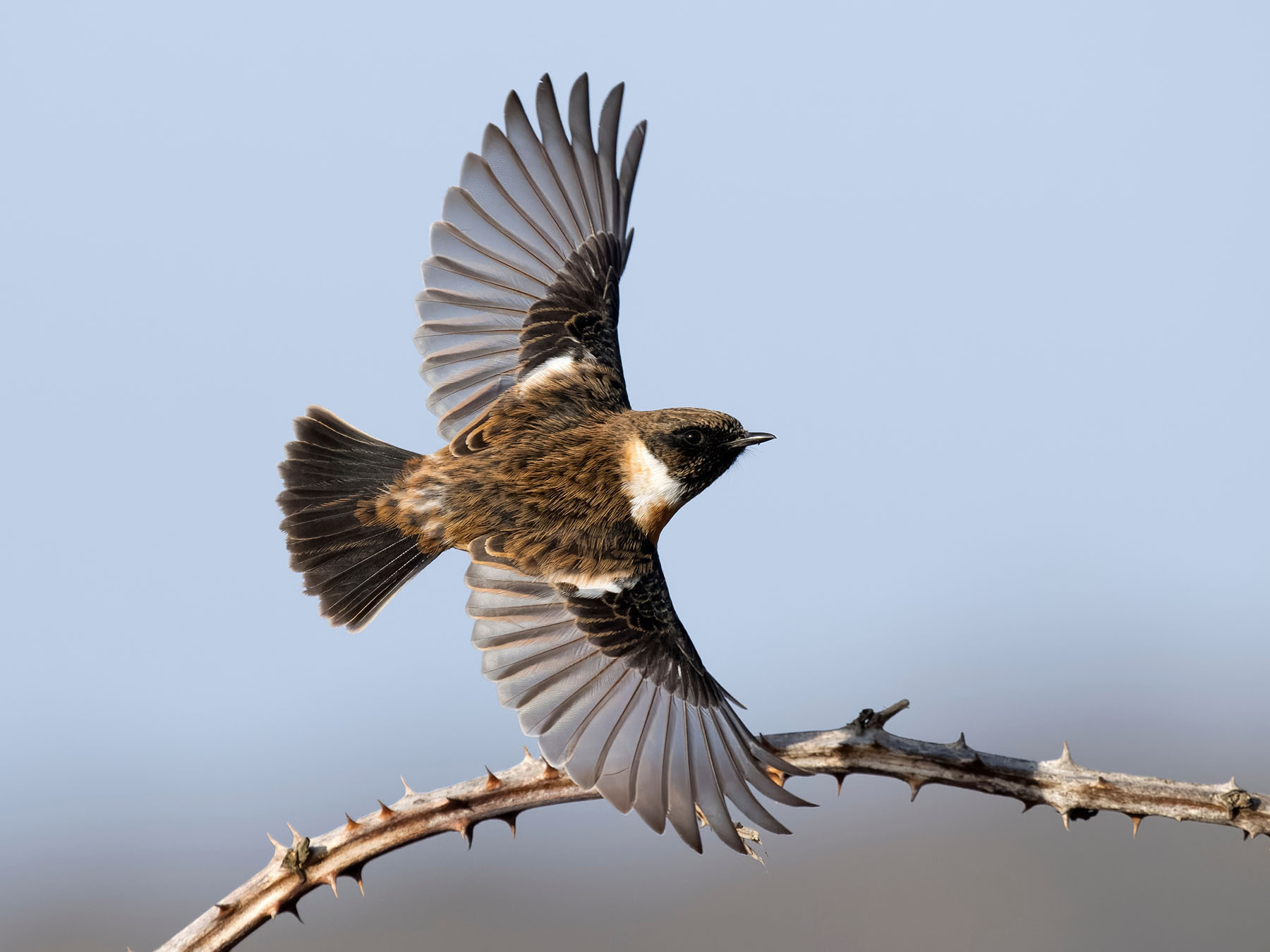
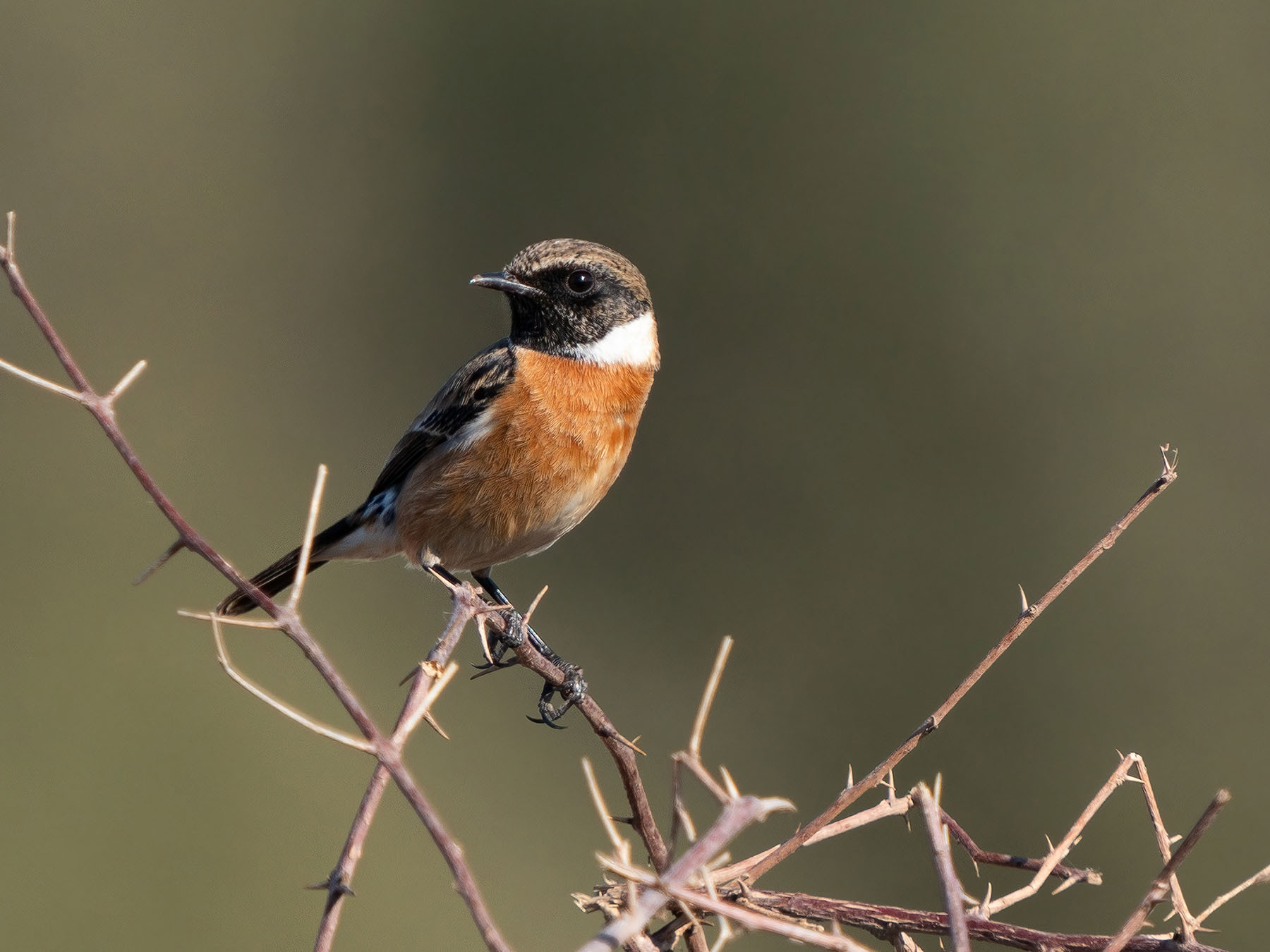
Stonechats are small, robin-like birds. Adult males are striking birds with mottled black backs and black heads linked at the nape. They have rich rufous underparts, and the sides of their necks are white. They have variable amounts of white on the vent and a white patch on each wing.
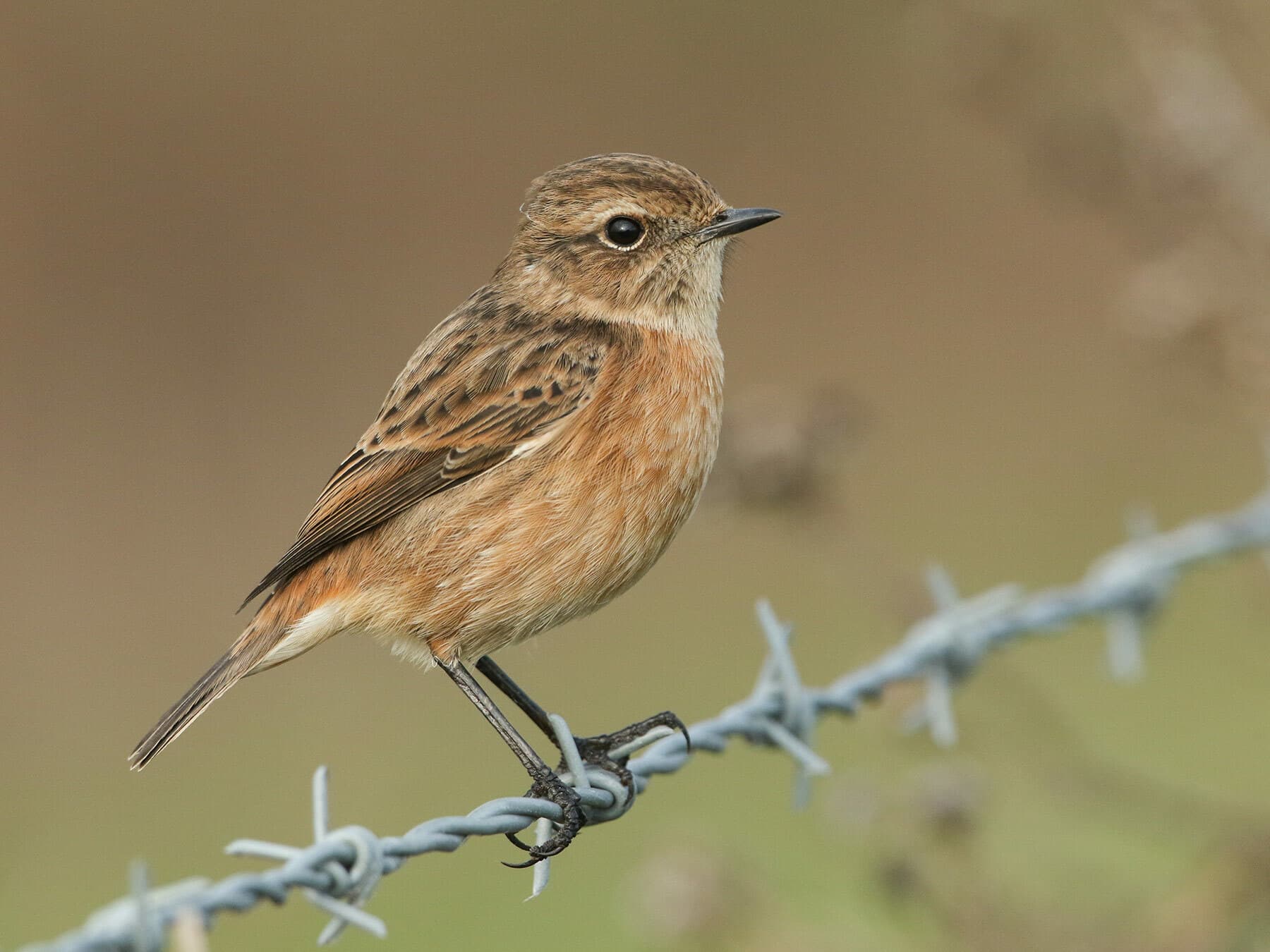
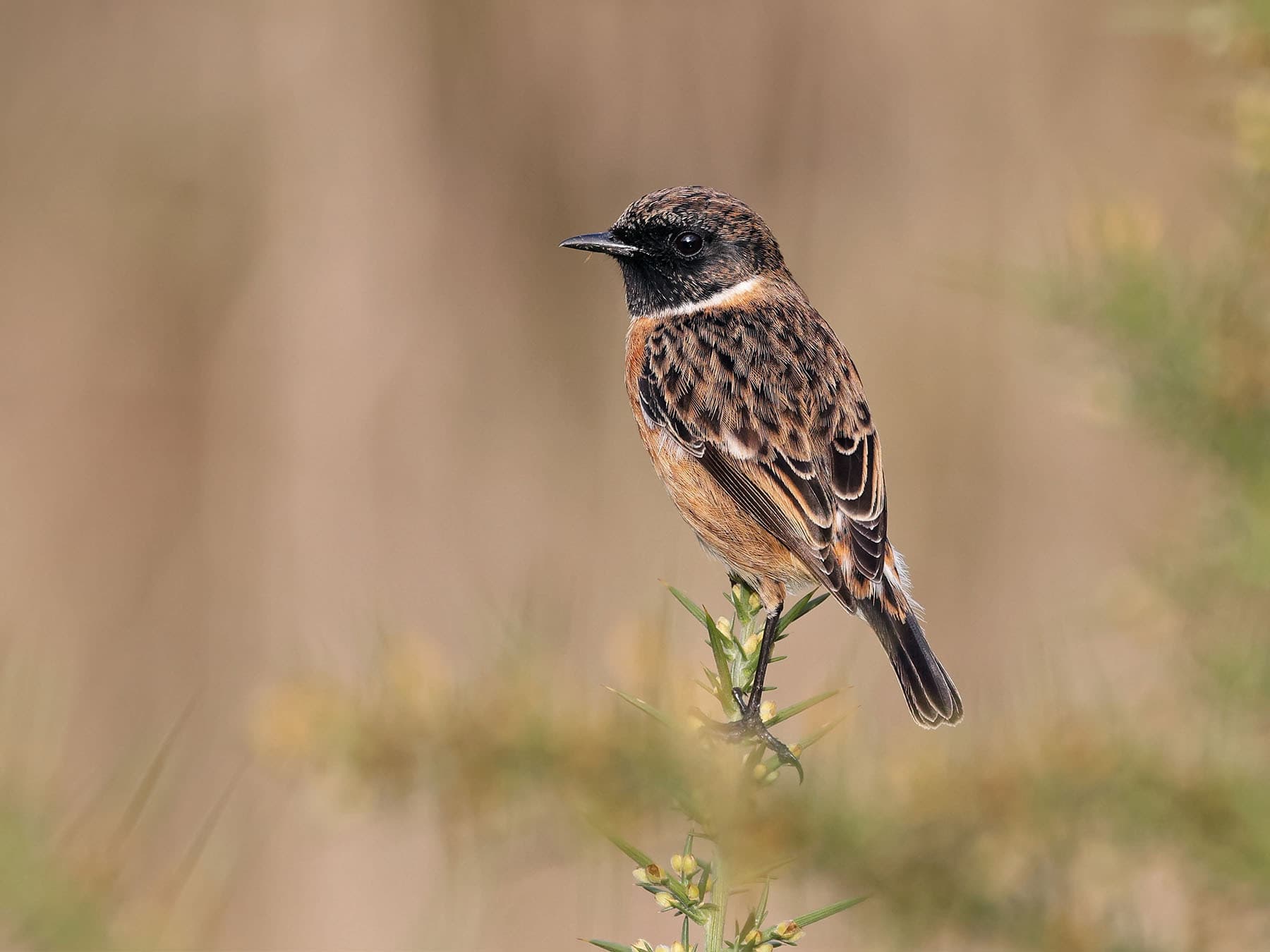
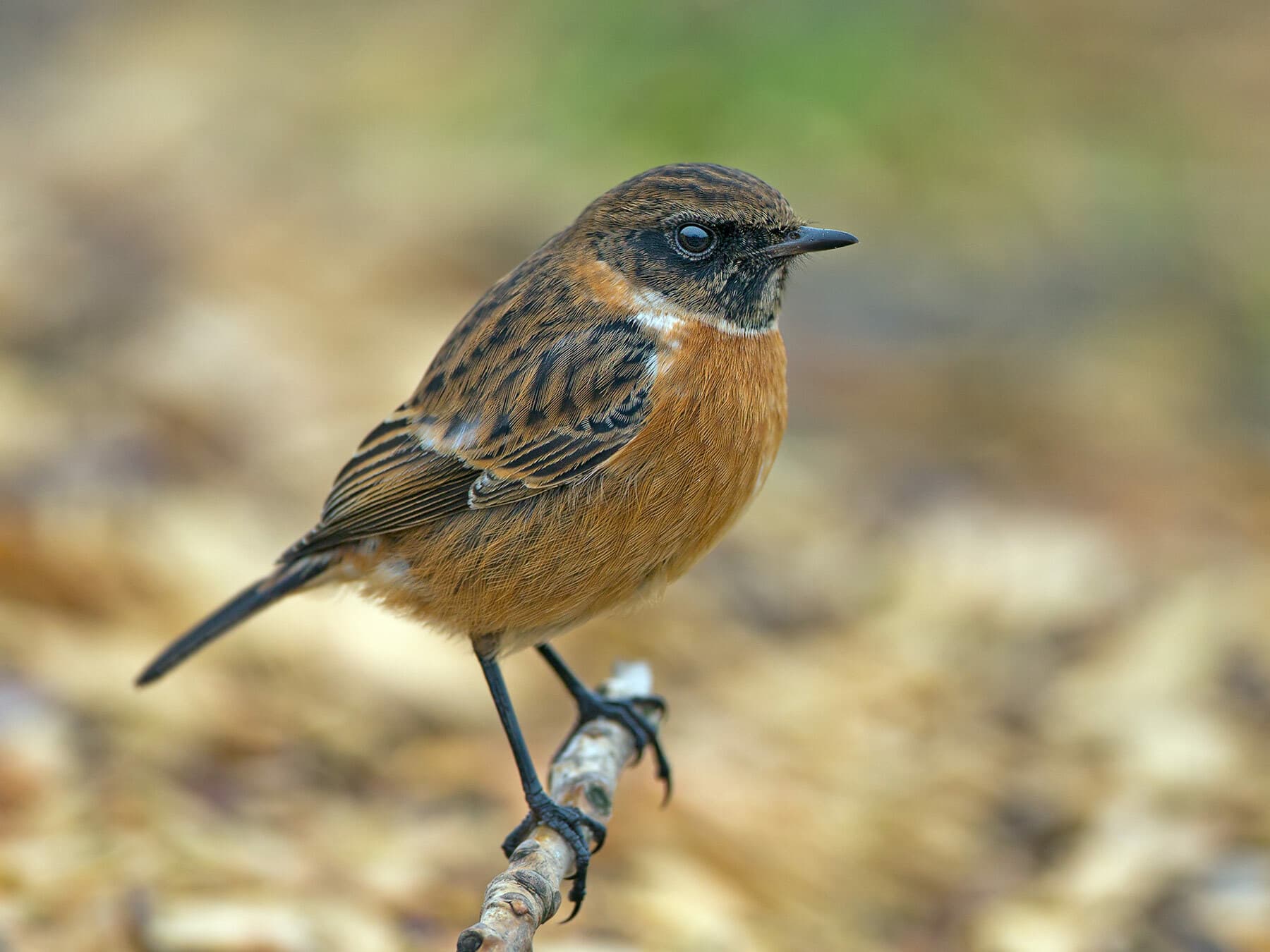
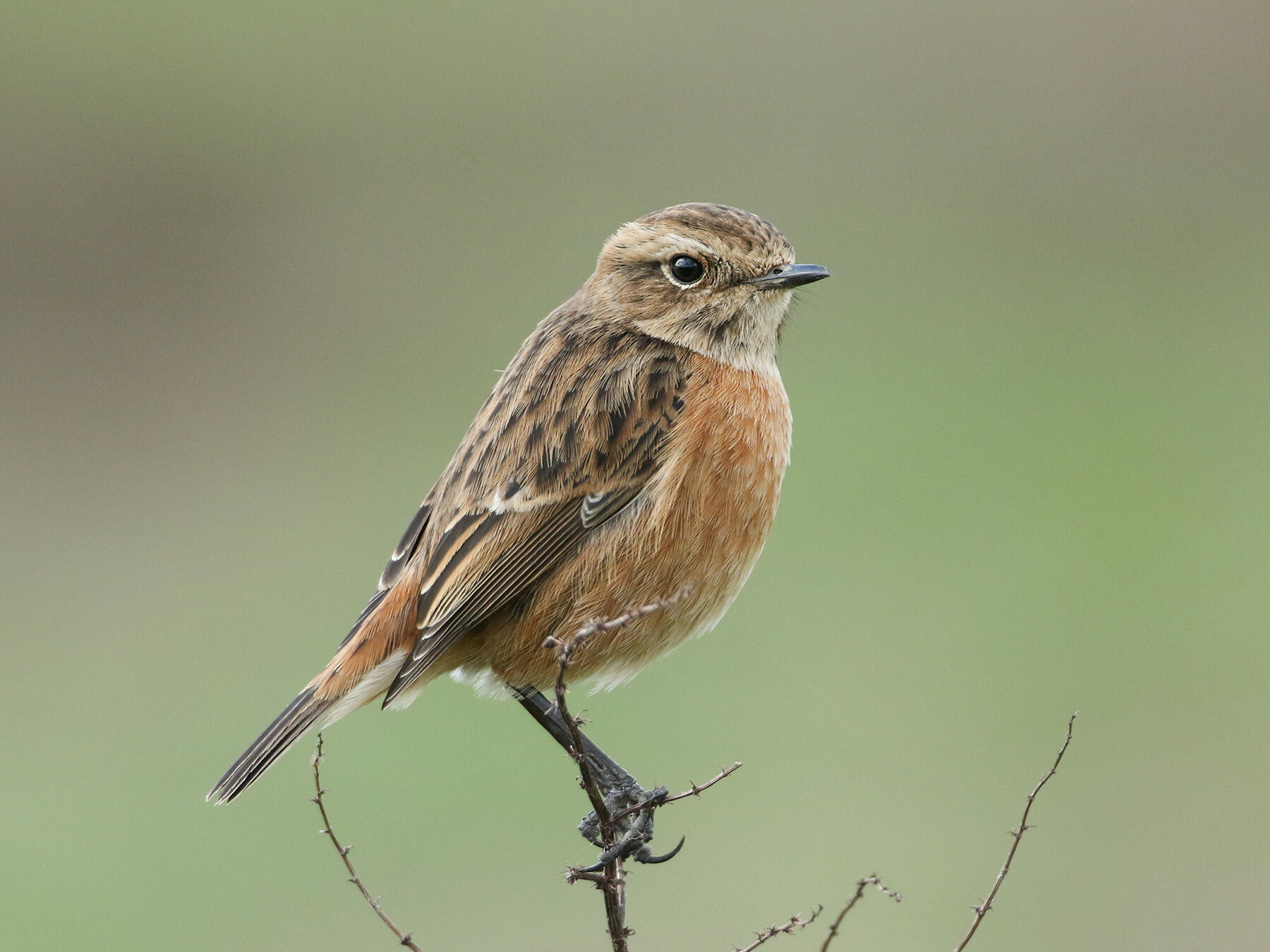
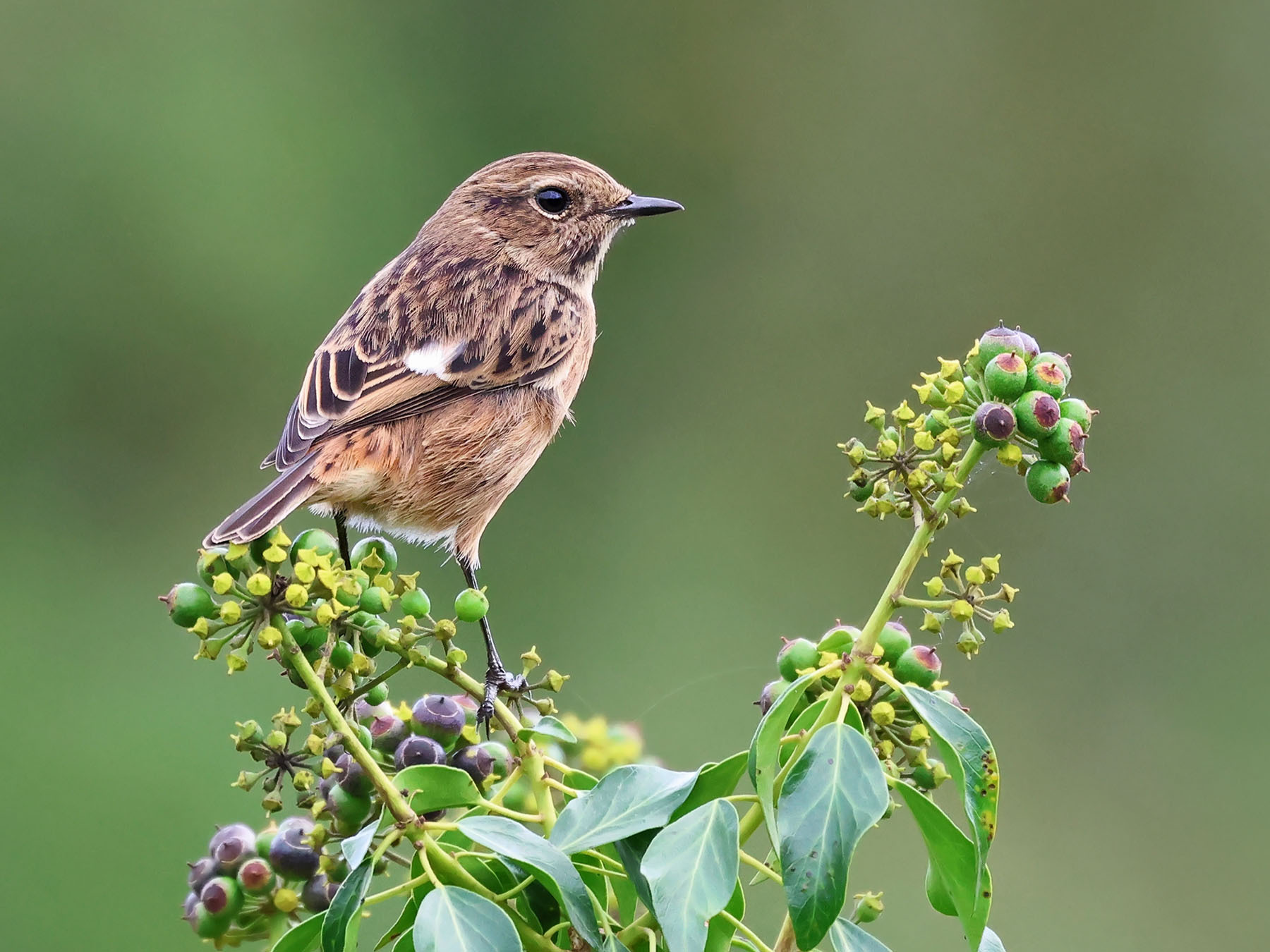
The female Stonechat is less boldly marked. Their breast is a duller orange-brown shade, and they are brownish above with a pale throat.
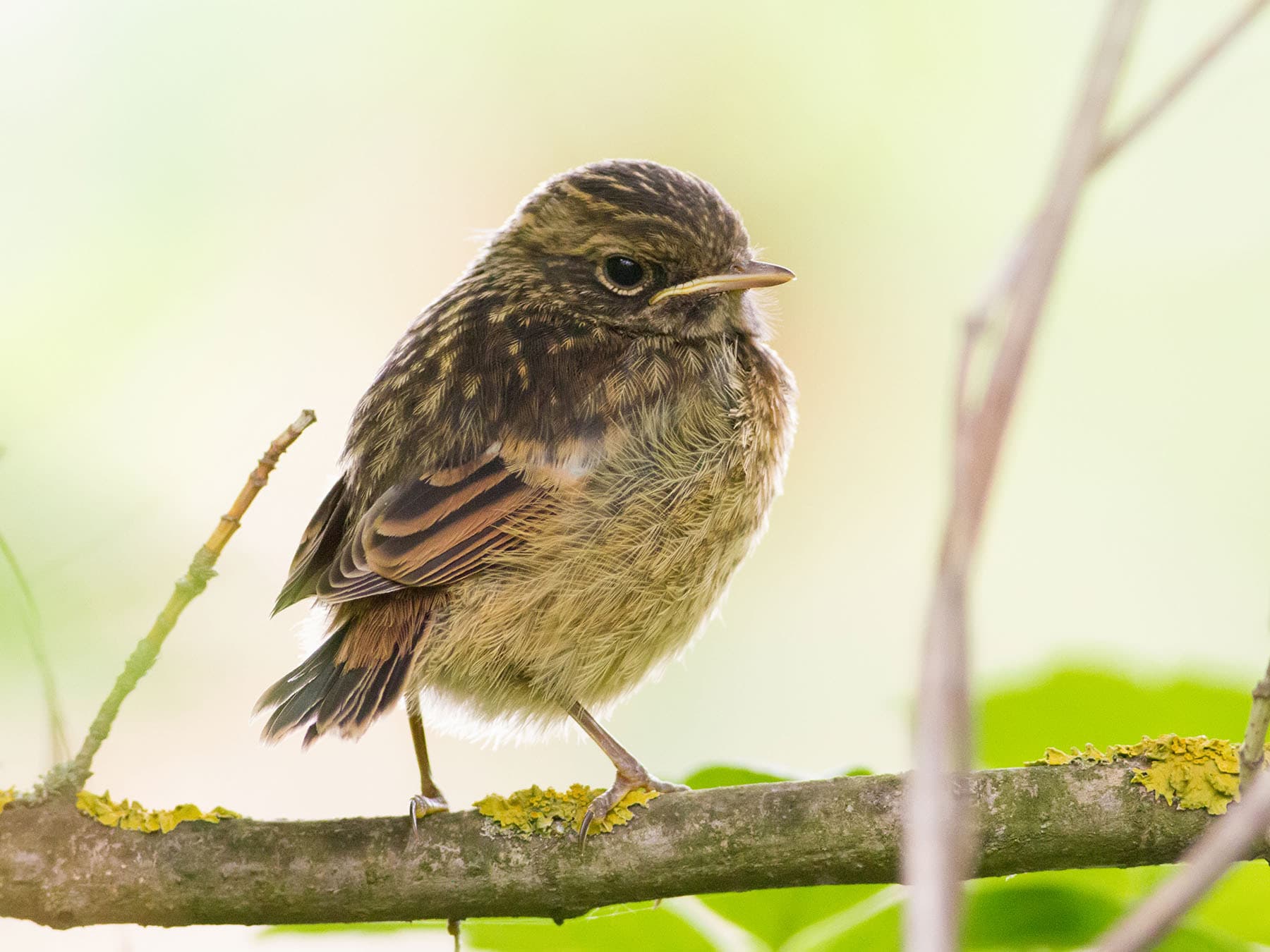
Juvenile Stonechats have dark brown upperparts with paler streaks and a faint eyebrow stripe (supercilium). Their underparts are lighter and include brown streaking on the chest and flanks.
How big are Stonechats?
Stonechats are small, delicately built songbirds. They have a similar body length to the House Sparrow but a much lighter frame.
Length
Stonechats have a body length of 11.5 to 13 centimetres, measured from their tail to their bill.
Weight
Stonechats weigh just 13 to 17 grams.
Wingspan
They have a relatively short wingspan of 18 to 21 centimetres.
Its size
Adults- Length
- 11.5–13 cm
- Wingspan
- 18–21 cm
- Weight
- 13–17 g
Its song and calls
Stonechats take their name from their characteristic calls. Read on to learn more about their vocalisations.
What sound does a Stonechat make?
Male and female Stonechats produce a short, grating call that sounds like two stones tapped together. This characteristic call is interspersed with a high-pitched ‘weet’ note. Male Stonechats also produce a pleasant but weak, high-pitched song.
- Song0:00 / 0:22
Recorded in Normandie, France · March 2024
- Alarm call0:00 / 0:58
Recorded in Andalucía, Spain · July 2018
When and where to see it
OctoberPeak season
Most recorded in October
- 1. Bridgend2.5%
- 2. Pembrokeshire2.4%
- 3. Clare2.1%
- 4. Kerry1.8%
- 5. Cornwall1.7%
Each dot is a county, state or province: the bigger and darker, the larger the bird’s share of that place’s bird records that month. Grey dots: no regular records. The ringed point is the centre of the bird’s records this month; the arrow shows how it moved since last month, and the dashed loop its path through the year. “Arrivals” colours places where it becomes regular this month (orange) or is in its last regular month (grey). GBIF eBird Observation Dataset, 2019–2024. Map data: Natural Earth, US Census Bureau; place centres © OpenStreetMap contributors.
In your area
See when the Stonechat is recorded in your county, state or province.
How often the Stonechat turns up in the UK and Ireland through the year, from birdwatchers' records.
United Kingdom
Resident · all year · most records in October
Ireland
Resident · all year · most records in October
Show as a table
| Month | United Kingdom | Ireland |
|---|---|---|
| January | 0.44% (regular) | 0.68% (regular) |
| February | 0.41% (regular) | 0.65% (regular) |
| March | 0.35% (regular) | 0.77% (regular) |
| April | 0.31% (regular) | 0.85% (regular) |
| May | 0.38% (regular) | 0.93% (regular) |
| June | 0.38% (regular) | 0.96% (regular) |
| July | 0.35% (regular) | 0.96% (regular) |
| August | 0.36% (regular) | 0.77% (regular) |
| September | 0.52% (regular) | 1.0% (regular) |
| October | 0.79% (regular) | 1.2% (regular) |
| November | 0.59% (regular) | 0.97% (regular) |
| December | 0.44% (regular) | 0.75% (regular) |
Recorded regularly in
Worldwide: recorded regularly in 65 countries
Countries where it was recorded in at least 3 of the 6 years 2019–2024. Linked countries have their own bird list.
Europe (44)
- Albania
- Andorra
- Austria
- Belarus
- Belgium
- Bulgaria
- Croatia
- Czechia
- Denmark
- Finland
- France
- Germany
- Gibraltar
- Greece
- Guernsey
- Hungary
- Iceland
- Ireland
- Isle of Man
- Italy
- Jersey
- Kosovo
- Latvia
- Liechtenstein
- Lithuania
- Luxembourg
- Malta
- Moldova
- Montenegro
- Netherlands
- North Macedonia
- Norway
- Poland
- Portugal
- Romania
- Russia
- Serbia
- Slovakia
- Slovenia
- Spain
- Sweden
- Switzerland
- Ukraine
- United Kingdom
Data: EOD – eBird Observation Dataset (Cornell Lab of Ornithology), accessed via GBIF.org, CC BY 4.0. Records from 2019–2024, aggregated and filtered by Birdfact. How these lists are made
European Stonechats are widespread in suitable habitats in the United Kingdom and beyond.
What is the habitat of a Stonechat?
The Stonechat is a bird of open country like heathland, marshland, moorland, and coastal cliffs. These birds require a combination of larger shrubs like gorse and open areas of low vegetation to perch and hunt.
They prefer ‘rough’ ground and generally avoid recently cleared agricultural fields and wooded areas. Overwintering birds usually use low-lying grasslands and other open habitats.
What is the range of a Stonechat?
Stonechats are widespread in the United Kingdom, although their numbers and range fluctuate in some years. They nest primarily in the west, although they disperse eastward in the winter non-breeding season.
Elsewhere, the species has a wide range, including most of Southern and Central Europe, North Africa, and parts of the Middle East.
Where do Stonechats live?
Stonechats are usually seen perched in tall grass and rank vegetation, especially where it borders with shorter grass, scrub or marshland. They will readily use artificial perches like posts, walls, or wire fences.
How rare are Stonechats?
Stonechats are fairly common in the United Kingdom, and their population has increased over the last three decades. The breeding population is estimated at 65,000 pairs, but their numbers fluctuate between mild and cold winters.
Where can you see Stonechats in the UK?
Stonechats are widespread in the UK, although you are unlikely to see these birds in your back garden or elsewhere in suburban areas. Visit open countryside with rough but low vegetation for your best chance at spotting these attractive chats.
Signs and Spotting tips
Stonechats have a habit of sitting on the top of vegetation, such as gorse bushes, and flicking their wings together.
Migration
Stonechats are resident to medium-distance migrants, depending on where they breed.
Do Stonechats migrate?
Stonechats are partially migratory in the UK. They are residents throughout the year in some areas but undertake seasonal movements in others.
The southeast of England sees an influx of Stonechats each winter as many birds migrate from northern and western breeding grounds, while some will migrate south as far as North Africa.
What it eats
Stonechats hunt their prey from a favourite perch by watching for movement and flying down for the catch. They also catch some prey from surrounding vegetation and, occasionally, from the air. Continue reading to learn more about their diet.
What do Stonechats eat?
Stonechats feed primarily on insects, although they include seeds and fruits when live prey is scarce. The following food items are important components of their diet:
- Beetles and their larvae
- Ants
- Grasshoppers
- Earwigs
- Snails
- Earthworms
- Small lizards
- Blackberries
What do Stonechat chicks eat?
Stonechats feed their chicks a variety of insects and other invertebrates. Young chicks require soft-bodied insects at first but can manage the same prey as their parents after a time.
The young birds fledge after about two weeks in the nest, but their parents continue to feed them for a few more days before gaining independence.
Nesting and breeding
Stonechats are fairly prolific breeders, which allows their populations to recover rapidly after harsh winters. They begin nesting as early as March and have up to three broods in good years. Read on to learn more about Stonechat nesting behaviour.
Where do Stonechats nest?
Stonechats nest in suitable habitats across most of the UK, although they avoid much of the southeast of England. They build their nests low in dense bush, either on the ground or up to about a meter high, although most nests are below a foot.
What do Stonechat eggs look like?
Stonechats lay four to six blue-green eggs, each speckled in reddish brown.
Do Stonechats mate for life?
Stonechats do not mate for life, although they are usually monogamous during the breeding season.
Behaviour
Stonechats are active little birds that often flick their tails restlessly. They are not afraid to call out at people from their prominent perches. Continue reading to learn more about Stonechat behaviour.
Are Stonechats aggressive?
Stonechats can be aggressively territorial in both the breeding and non-breeding seasons. Males defend their territory with frequent singing from a prominent position.
Where do Stonechats sleep at night?
Most Stonechats probably roost in the safety and shelter of shrubs like gorse, brambles and larger heather plants.
Lifespan and predators
Stonechats are vulnerable to many small predators, but harsh winters are one of the greatest threats to their survival. Continue reading to learn more about the Stonechat lifespan and conservation status.
How long do Stonechats live?
Stonechats that survive to adulthood have an average lifespan of roughly four to five years. The oldest recorded specimen was from Germany and was found dead at eight years and ten months old.
What are the predators of Stonechats?
Stonechats could fall prey to several small predators like cats, foxes, and birds of prey like Sparrowhawks. Their eggs and young are vulnerable to nest predators like rats and crows, and their nests may be parasitised by the Cuckoo.
Are Stonechats protected?
Stonechats are protected by the Wildlife and Countryside Act of 1981.
Are Stonechats endangered?
Stonechats in the United Kingdom are not endangered. They are on the green list of conservation concern and rated as a ‘Least Concern’ species at an international level.
Conservation
While the Stonechat is listed as Least Concern globally, some local populations have experienced declines due to habitat loss and agricultural intensification.
Conservation efforts focus on maintaining suitable breeding habitats, particularly in areas of heathland and coastal scrub.
Similar birds
Often mistaken for
More photos
5 photos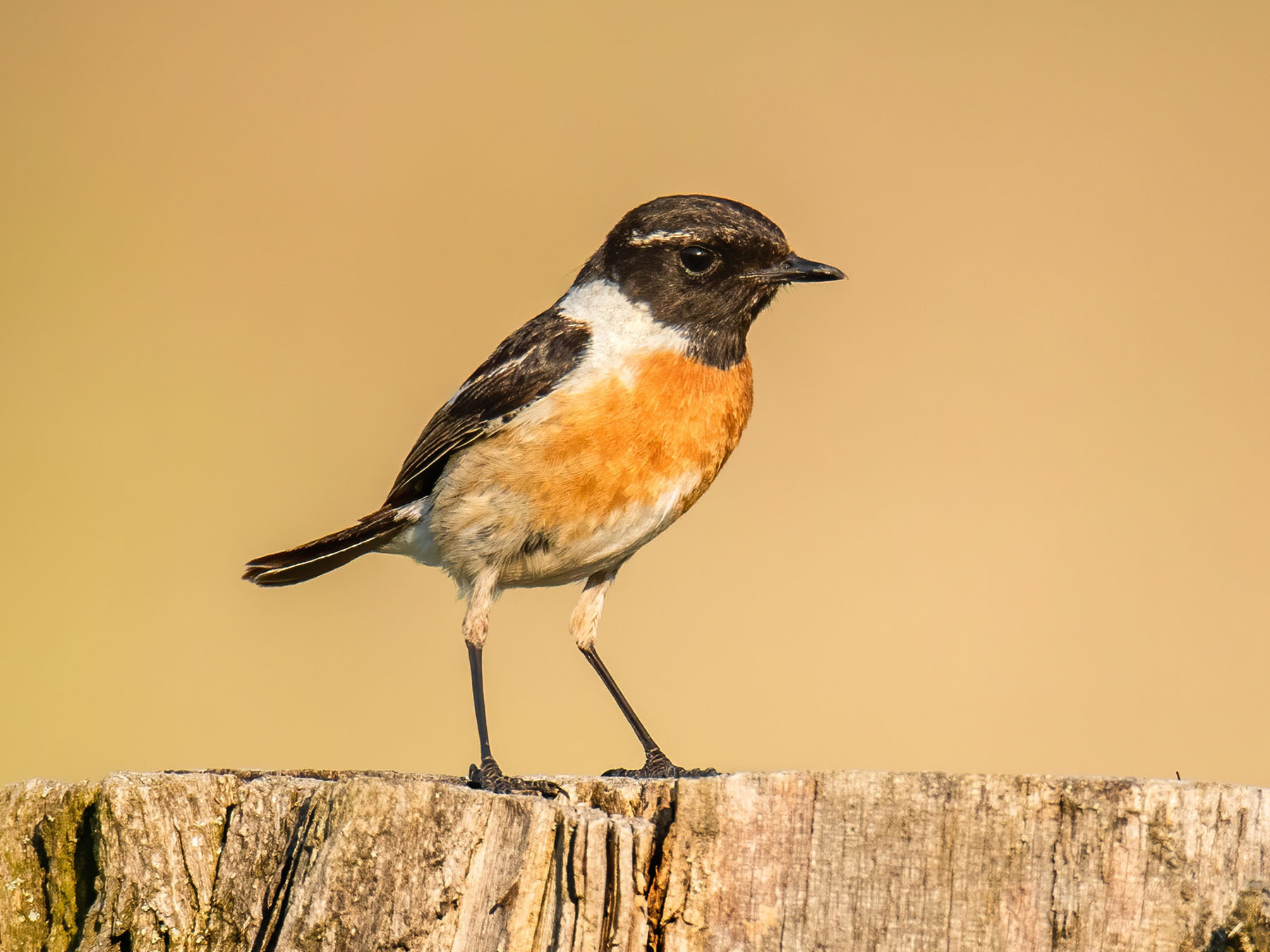
Quick facts
- Length
- 11.5–13 cm
- Wingspan
- 18–21 cm
- Weight
- 13–17 g
- Lifespan
- 4–5 years · oldest recorded 8.8 years
- Family
- Old World Flycatchers
- Migration
- Partial migrant
- Global status (IUCN)
- Least Concern
- World population
- 58,000,000 - 93,000,000 mature individuals
- Population trend
- Stable
- Also called
- European Stonechat, Common Stonechat
- Scientific name
- Saxicola rubicola
Questions
2Why is it called a Stonechat?
Stonechats probably get their name from their characteristic call, which sounds like two stones being tapped together. However, their name is doubly appropriate considering that their scientific name (Saxicola) translates as ‘rock-dweller.’
Do Stonechats winter in the UK?
Some Stonechats leave the United Kingdom in winter to enjoy the warmer weather in Southern Europe and North Africa. However, most remain in the UK all year, often moving to coastal and low-lying areas.
Sources
4- 1BirdLife International. 2020. Saxicola torquatus. The IUCN Red List of Threatened Species 2020: e.T22710184A181614254. Source (opens in a new tab)
- 2EBCC (2015)
- 3BirdLife International. 2020. Saxicola torquatus. The IUCN Red List of Threatened Species 2020: e.T22710184A181614254. Source (opens in a new tab)
- 4Fransson et al., EURING list of longevity records for European birds (2010) Source (opens in a new tab)

Checked by
Nathan Cope, founder and editor
Nathan founded Birdfact and leads its writers and contributors in the UK, the US and Canada. He has watched and studied birds for more than ten years, and checks every article and species guide before it’s published.