


Spotted Flycatcher
Muscicapa striata
By the Birdfact teamChecked by Nathan Cope
On this page14 sections
How to recognise it
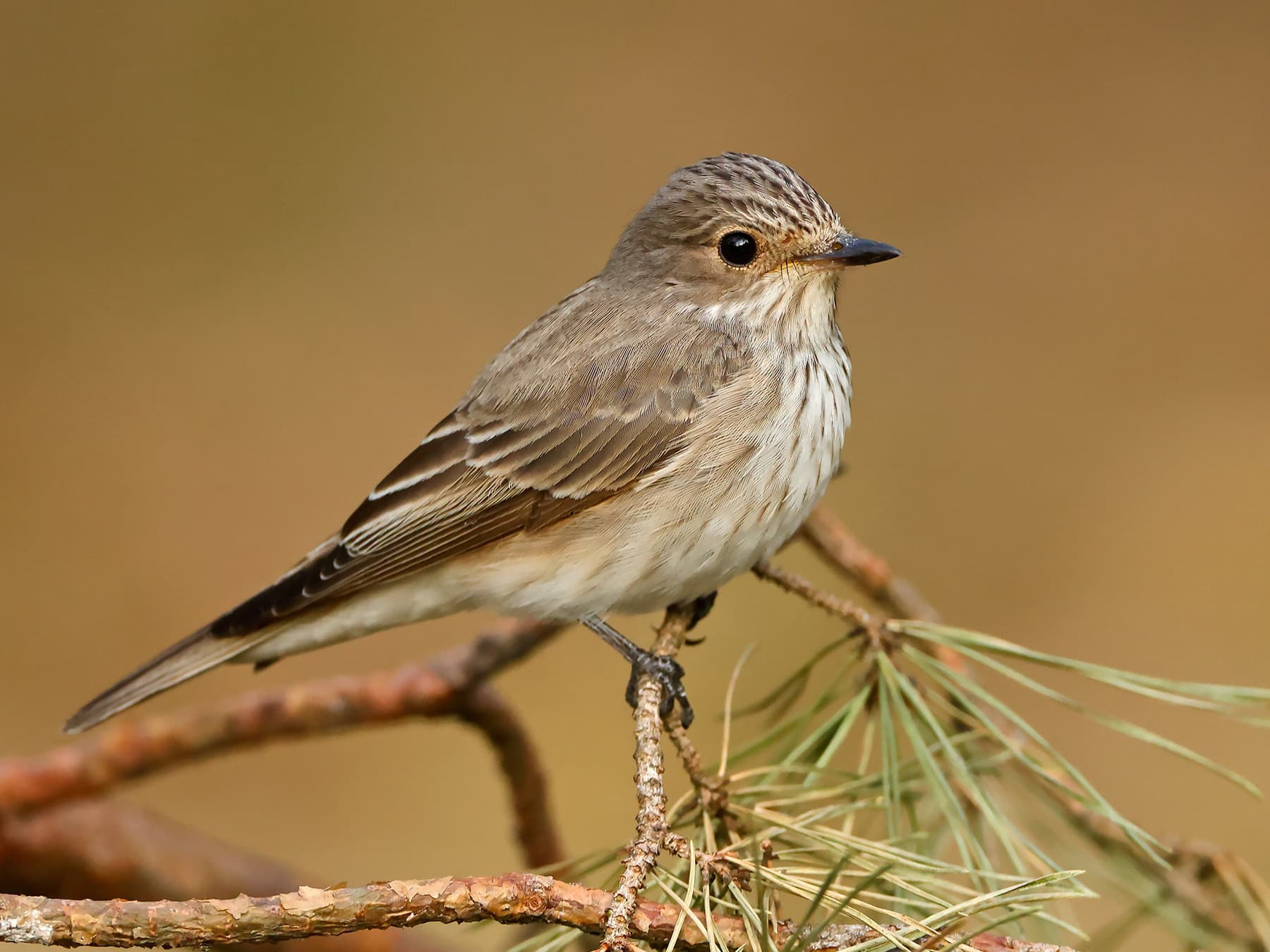
The Spotted Flycatcher is easy to identify despite its rather nondescript plumage.
What do Spotted Flycatchers look like?
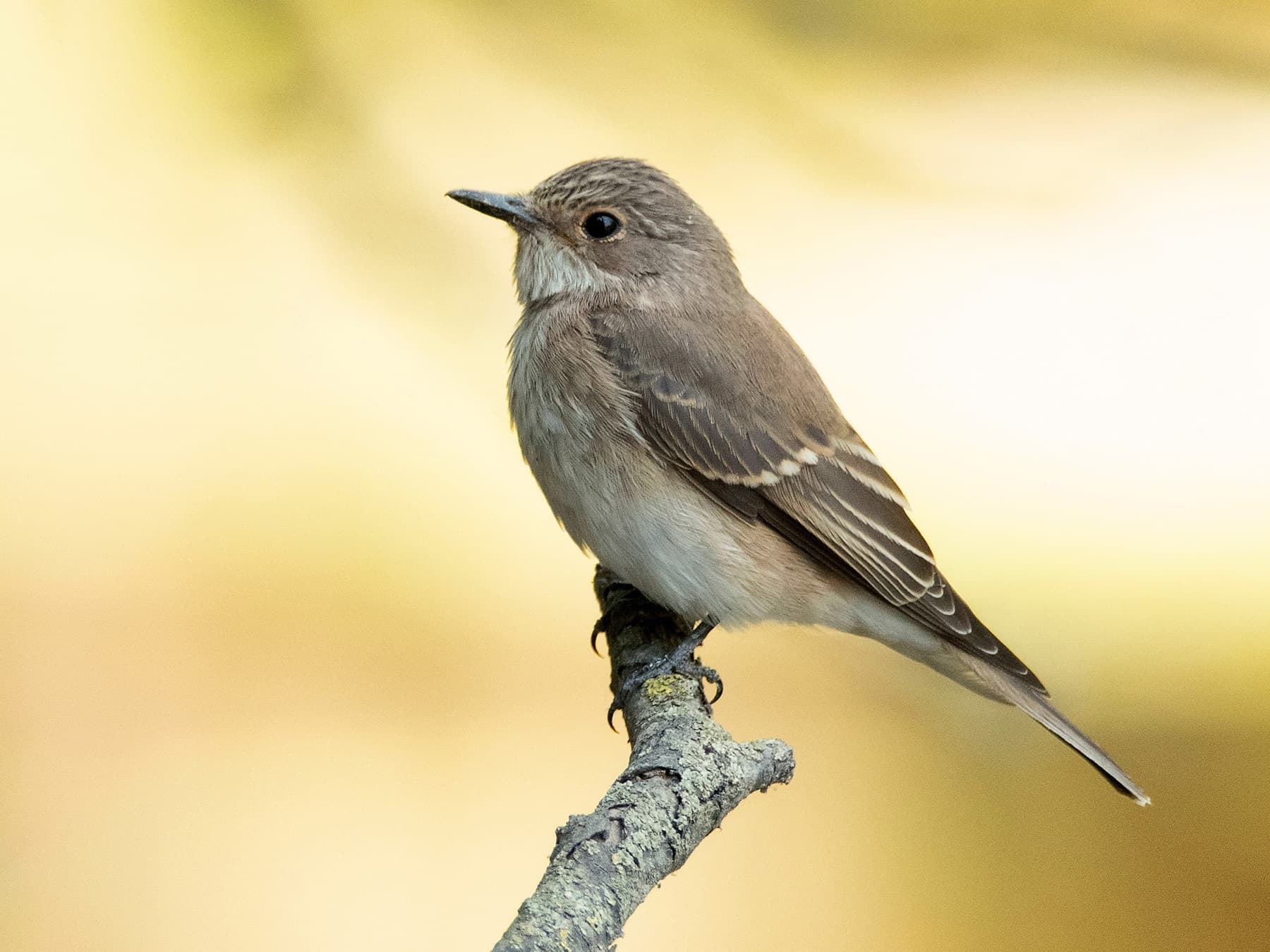
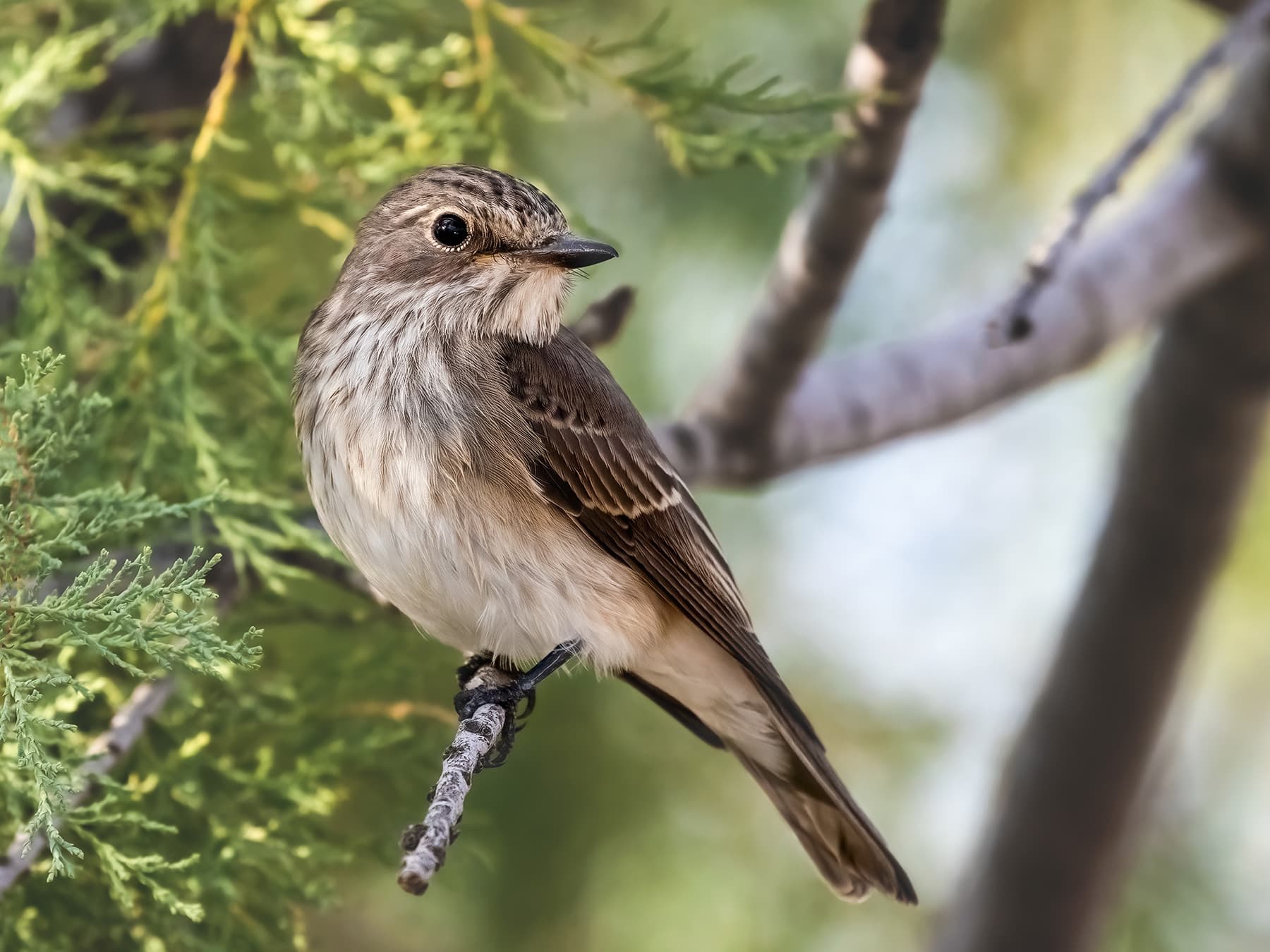
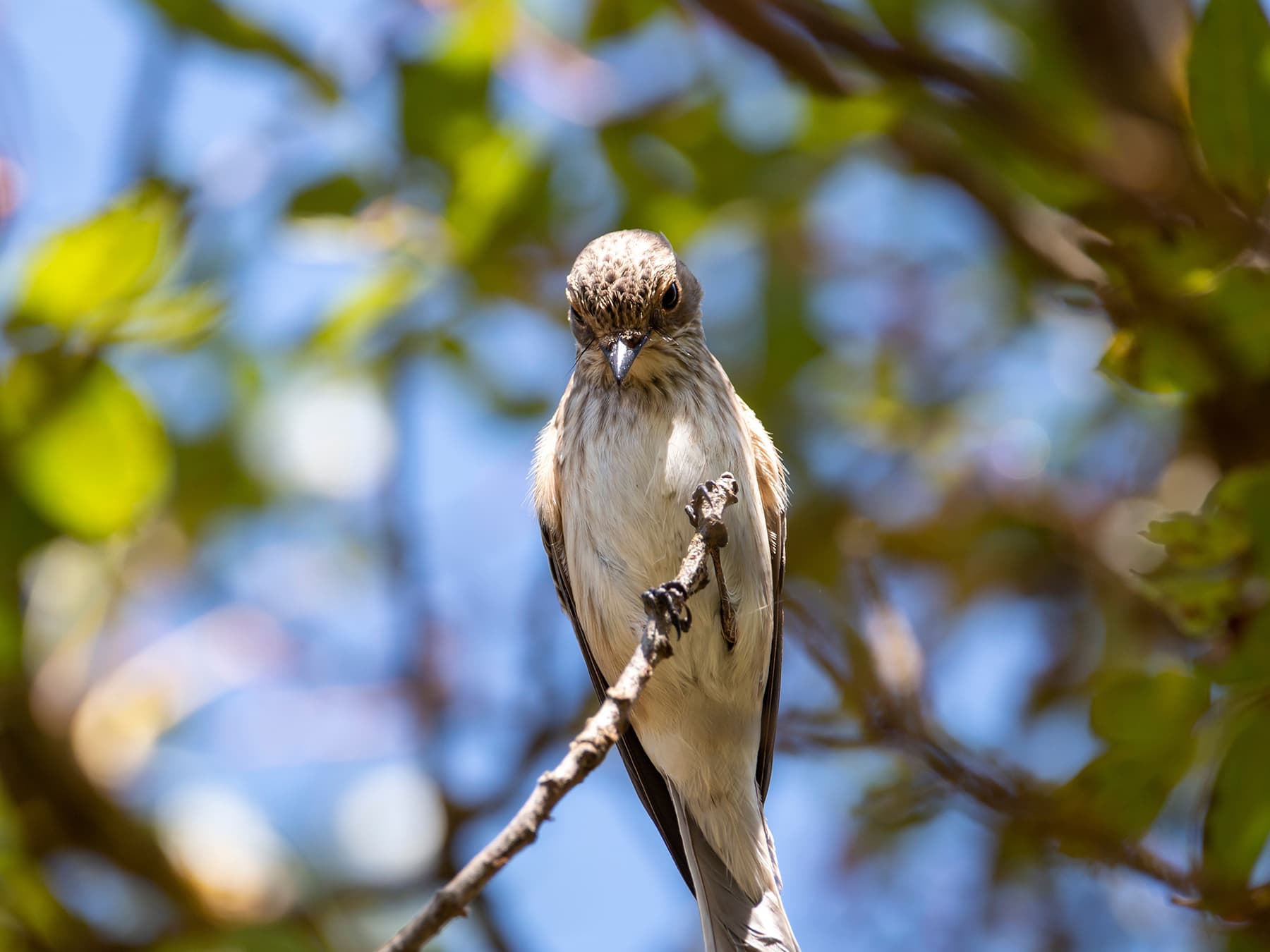
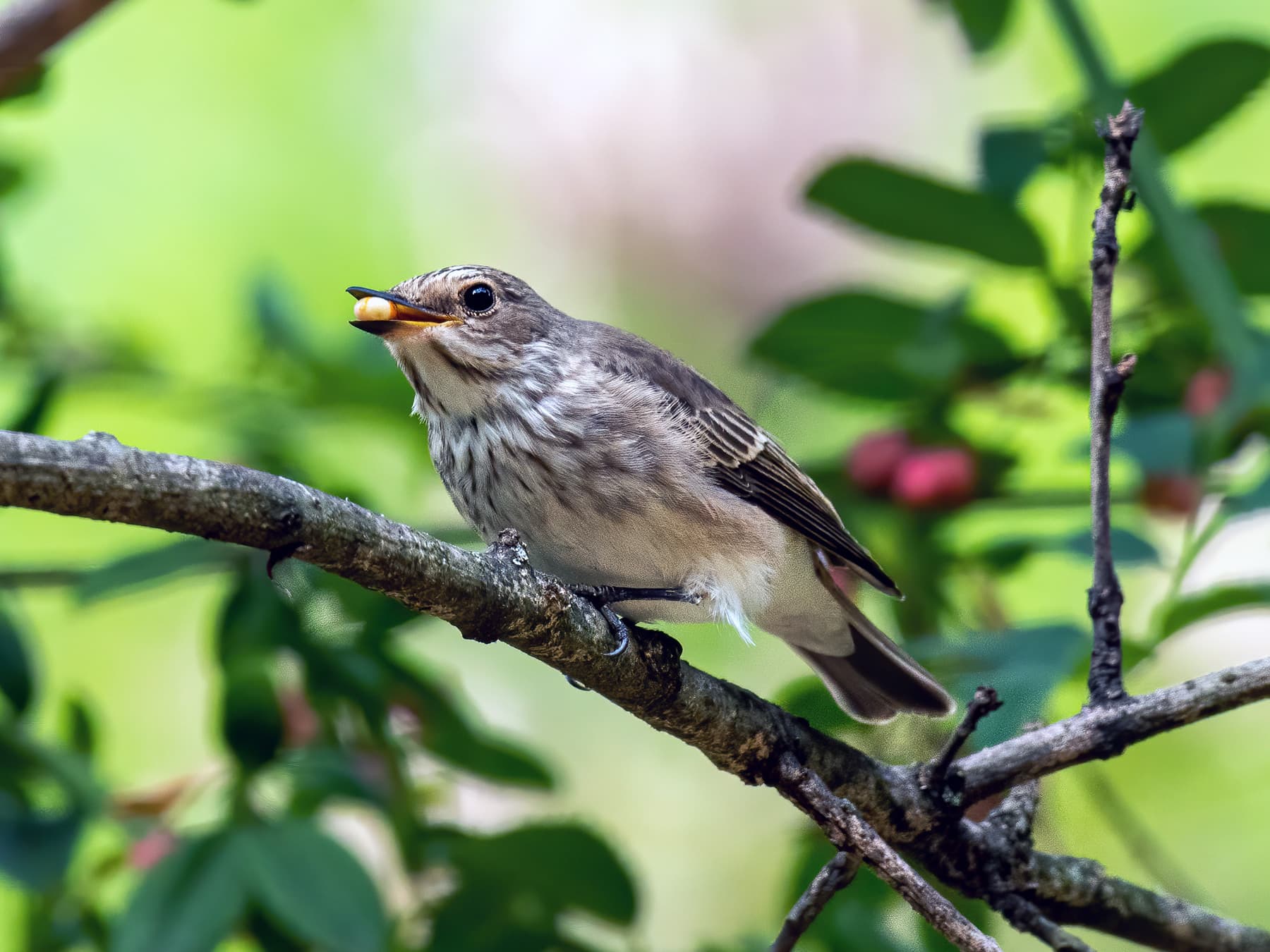
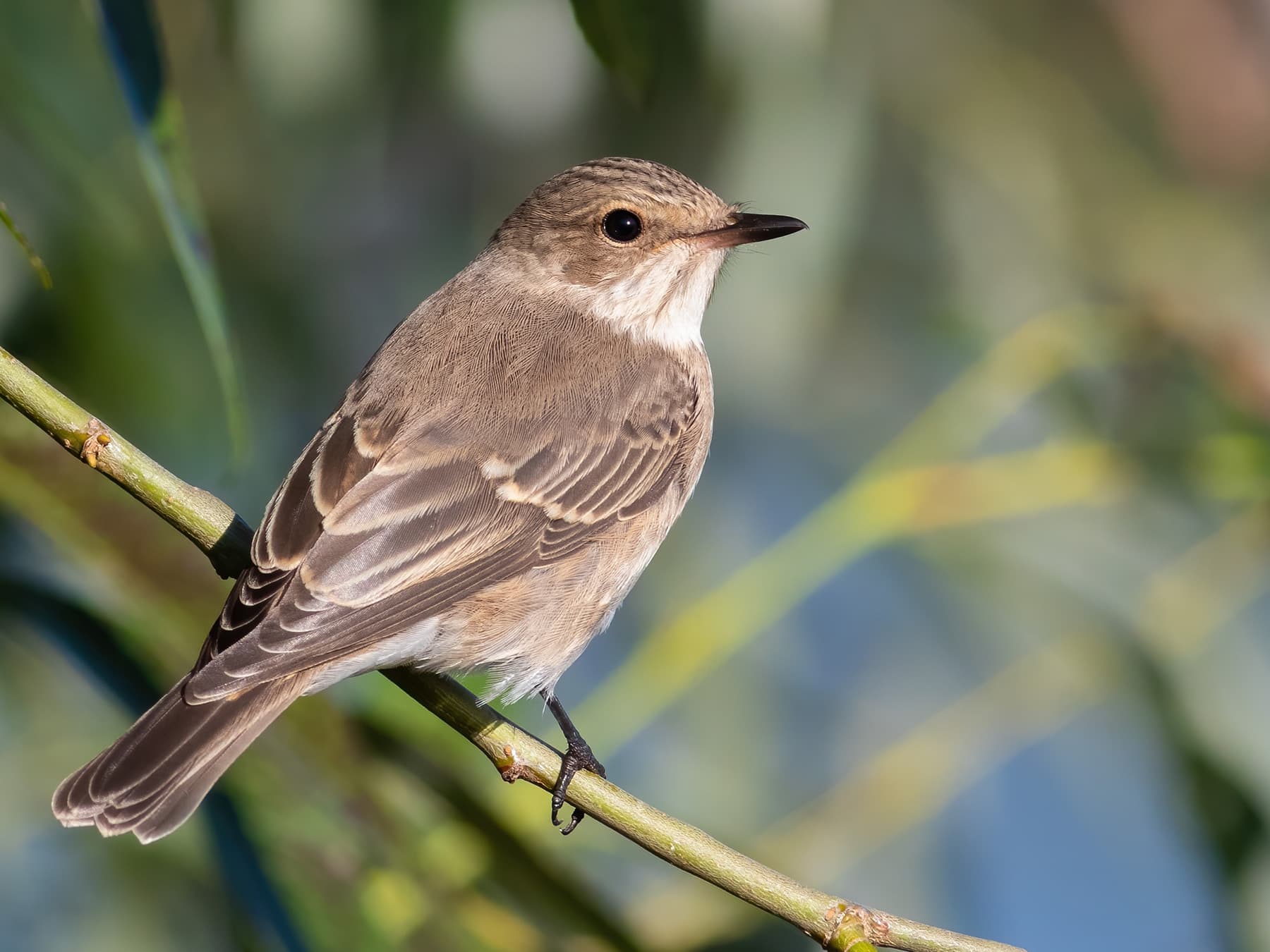
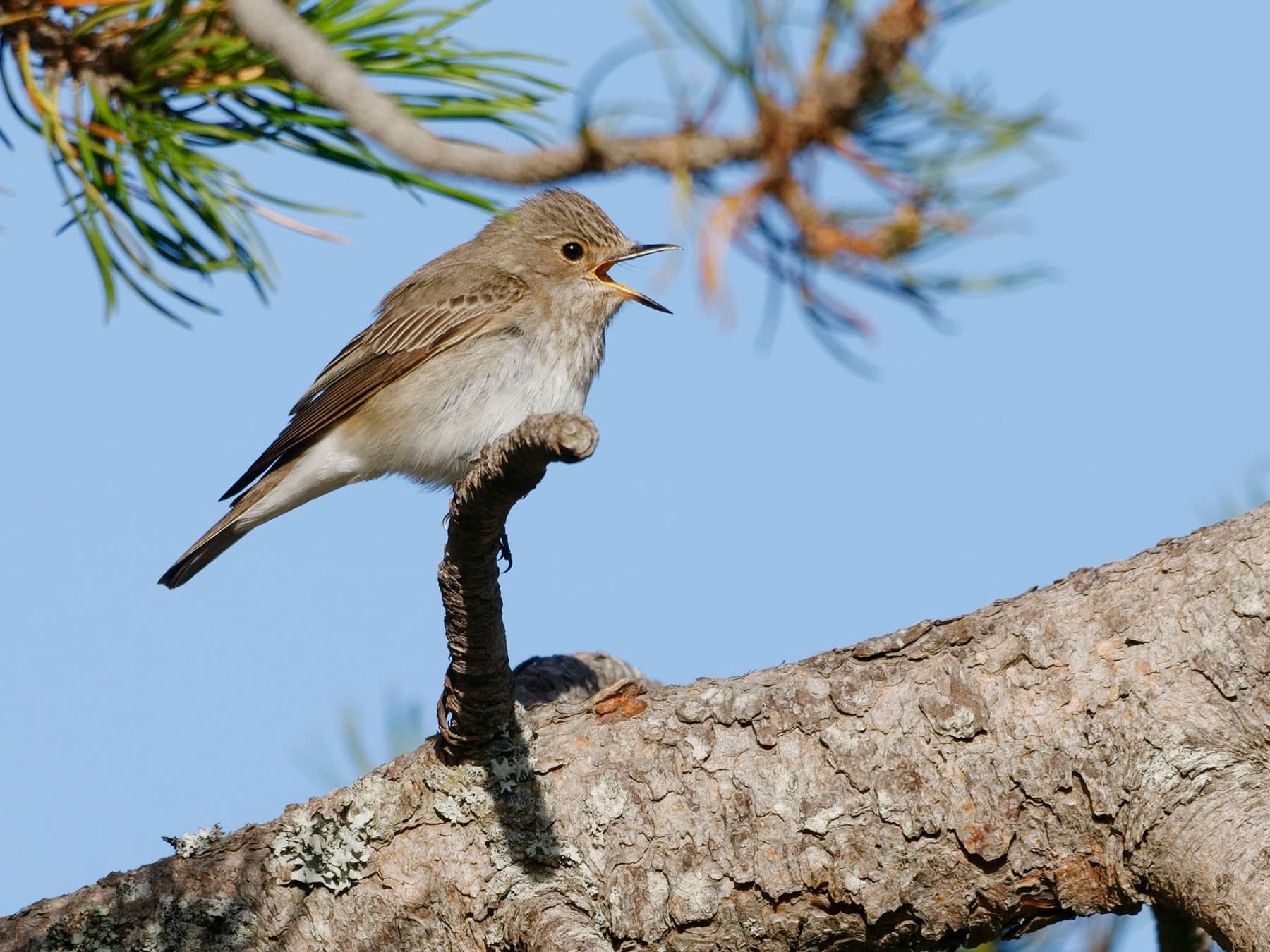
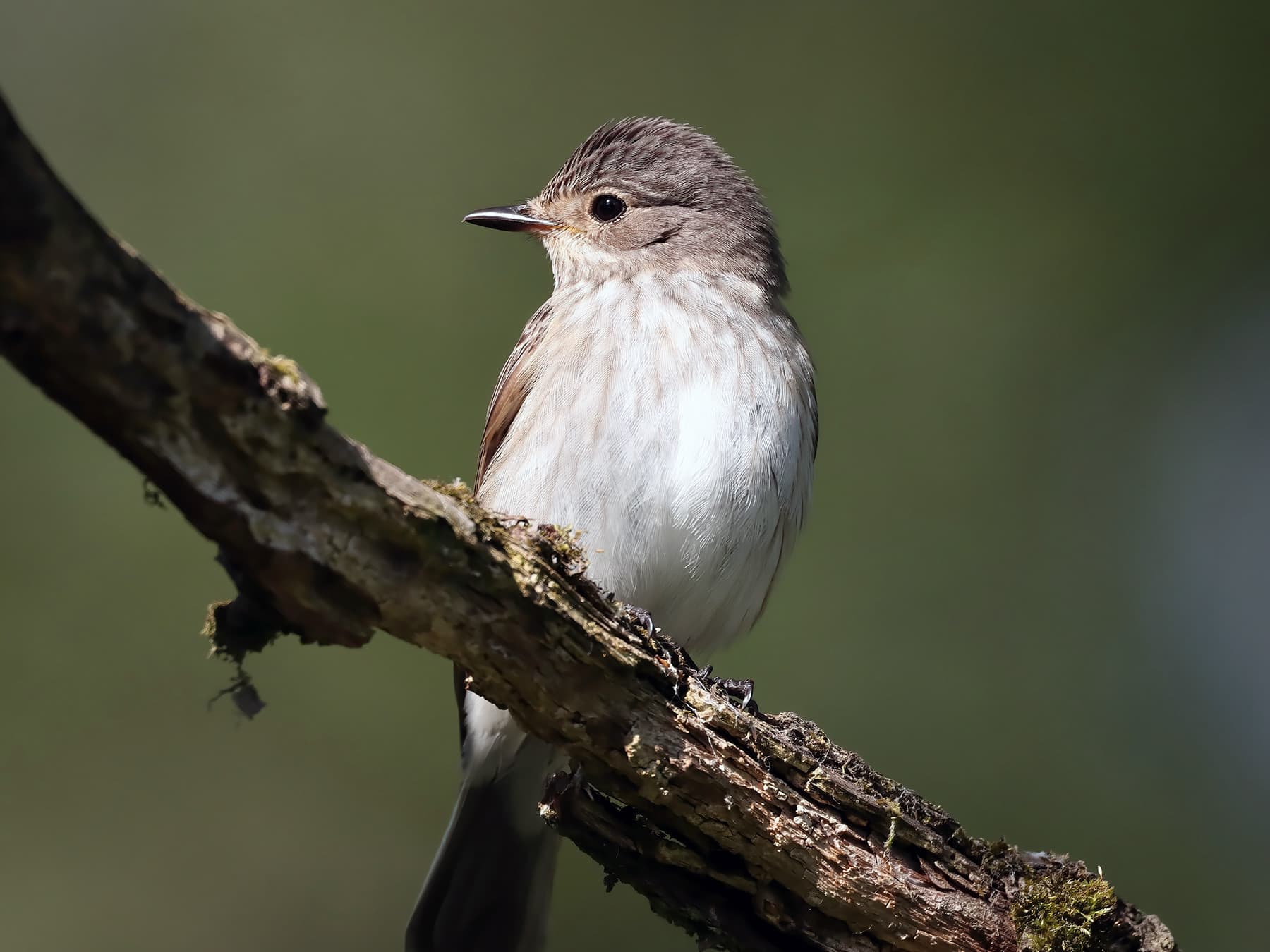
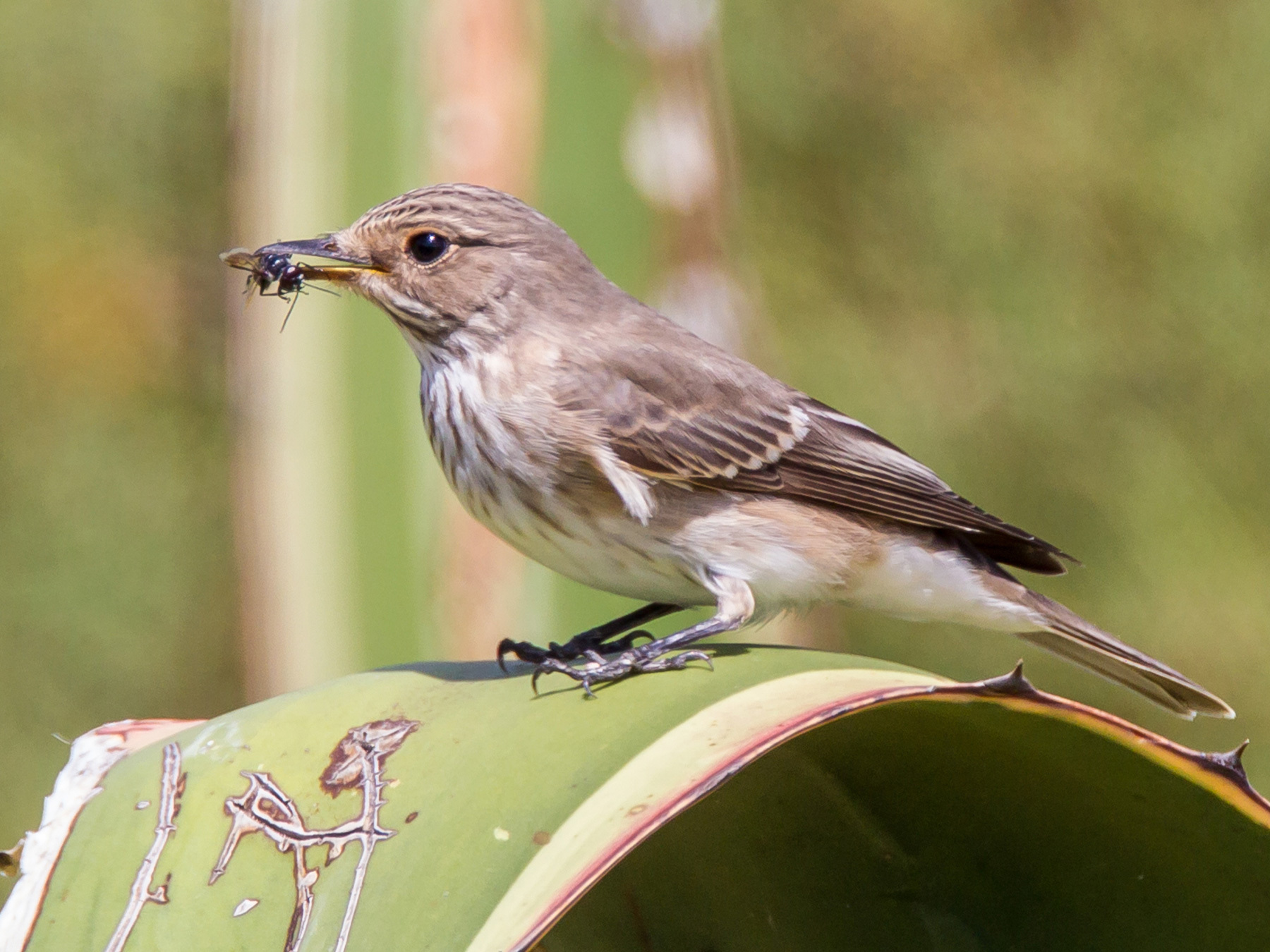
The Spotted Flycatcher is a small bird with uniform grey-brown upper parts and pale, lightly marked underparts. They have a large head, a straight, slender bill and large dark eyes. Their flight feathers have pale edges, creating a somewhat scaled appearance at close range, and their underparts from chin to tail are off-white with faint brown streaking. Sexes are alike.
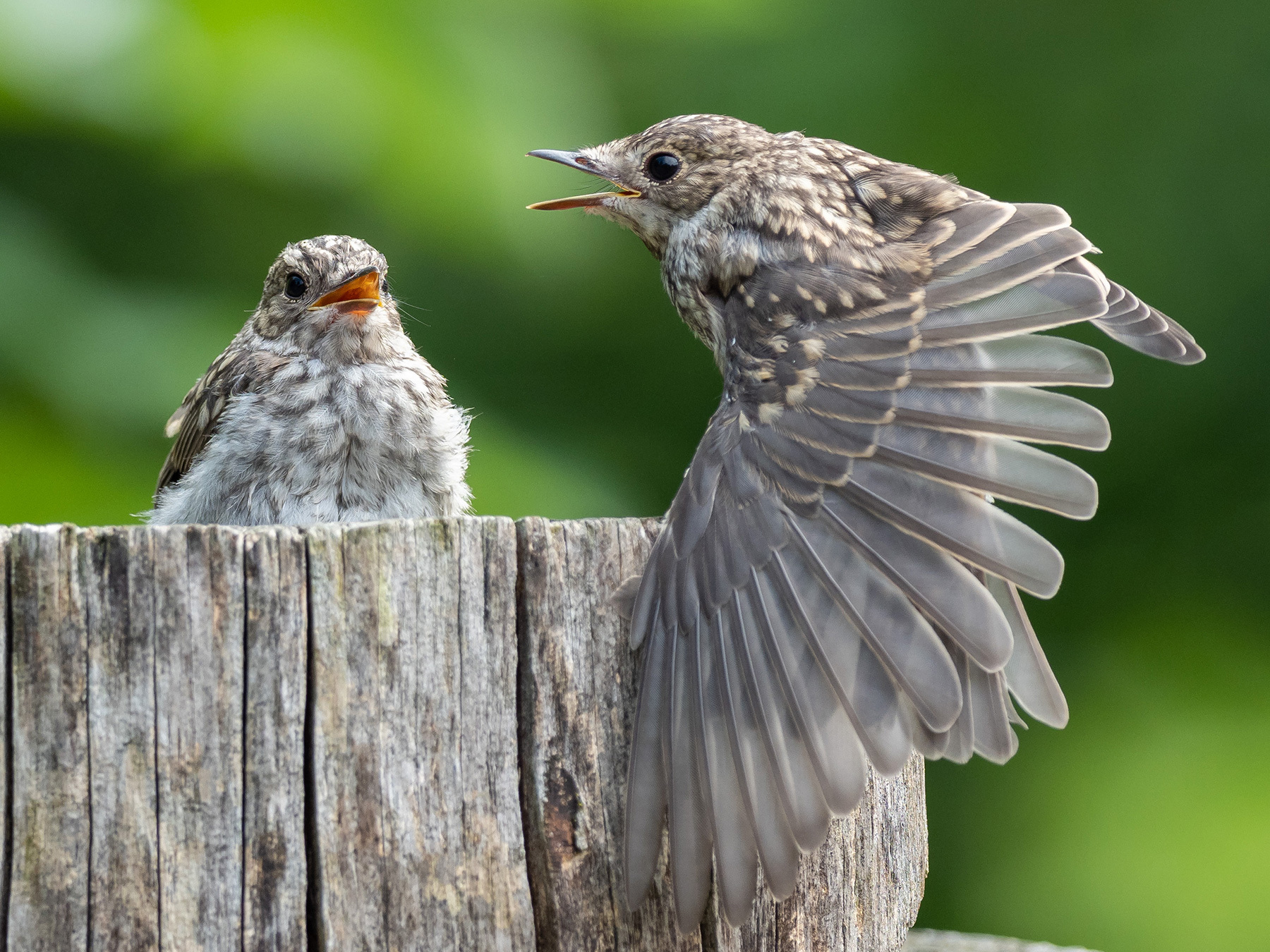
Juveniles are more spotted than their parents. The upper back is conspicuously marked in large pale spots, and the head, wings, and breast are also more patterned than adults.
Spotted Flycatchers are most easily confused with the female Pied Flycatcher, although that species has a prominent white marking on each wing.
How big are Spotted Flycatchers?
Spotted Flycatchers are small birds, very similar in size to the Great Tit.
Length
Adult Spotted Flycatchers have a body length of 13.5 - 14.5 centimetres.
Weight
They weigh 14 to 19 grams but may fatten up to 25 grams before migration.
Wingspan
Adult wingspan is 23 to 25 centimetres.
Its size
Adults- Length
- 14–16 cm
- Wingspan
- 23–25 cm
- Weight
- 14–20 g
Its song and calls
The Spotted Flycatcher’s call is a familiar but unremarkable sound.
What sound does a Spotted Flycatcher make?
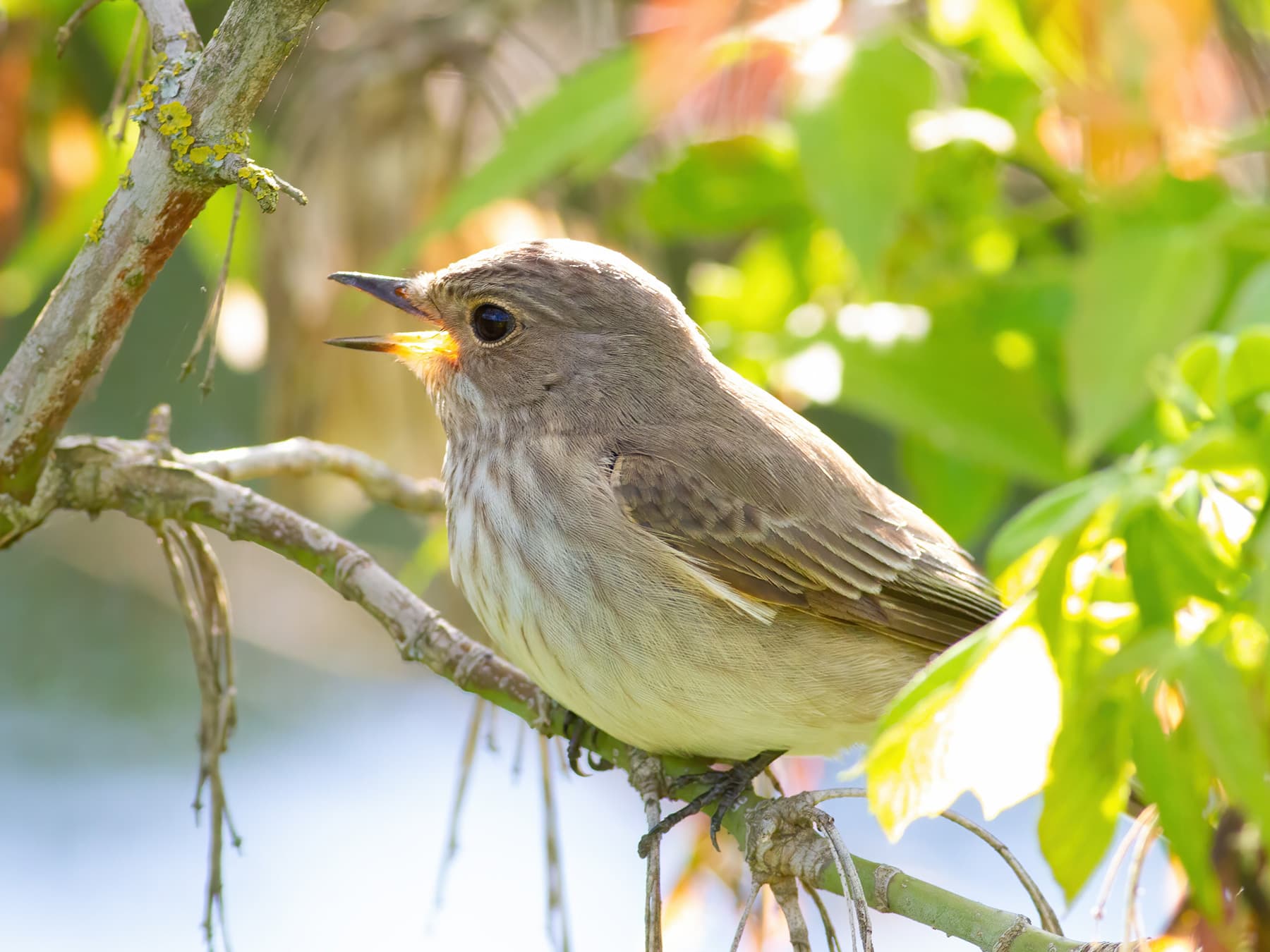
The Spotted Flycatcher’s typical call is a very thin and high-pitched ‘tseeep’, and their song is a collection of shorter high-pitched notes.
- Song and calls0:00 / 0:38
Recorded in Kalmar County, Sweden · May 2024
- Call0:00 / 0:19
Recorded in Normandie, France · September 2021
When and where to see it
OctoberLeaving
Most recorded in October
- 1. Cork0.32%
- 2. Cornwall0.19%
- 3. Waterford0.17%
- 4. Pembrokeshire0.15%
- 5. Shetland Islands0.14%
Each dot is a county, state or province: the bigger and darker, the larger the bird’s share of that place’s bird records that month. Grey dots: no regular records. The ringed point is the centre of the bird’s records this month; the arrow shows how it moved since last month, and the dashed loop its path through the year. “Arrivals” colours places where it becomes regular this month (orange) or is in its last regular month (grey). GBIF eBird Observation Dataset, 2019–2024. Map data: Natural Earth, US Census Bureau; place centres © OpenStreetMap contributors.
In your area
See when the Spotted Flycatcher is recorded in your county, state or province.
How often the Spotted Flycatcher turns up in the UK and Ireland through the year, from birdwatchers' records.
United Kingdom
Summer visitor · regularly May–Oct · most records in August
Ireland
Summer visitor · regularly May–Oct · most records in June
Show as a table
| Month | United Kingdom | Ireland |
|---|---|---|
| January | – | – |
| February | – | – |
| March | <0.001% | – |
| April | 0.002% | 0.003% |
| May | 0.13% (regular) | 0.14% (regular) |
| June | 0.17% (regular) | 0.20% (regular) |
| July | 0.14% (regular) | 0.16% (regular) |
| August | 0.20% (regular) | 0.11% (regular) |
| September | 0.17% (regular) | 0.070% (regular) |
| October | 0.028% (regular) | 0.052% (regular) |
| November | <0.001% | – |
| December | – | – |
Recorded regularly in
Worldwide: recorded regularly in 106 countries
Countries where it was recorded in at least 3 of the 6 years 2019–2024. Linked countries have their own bird list.
Europe (47)
- Åland Islands
- Albania
- Andorra
- Austria
- Belarus
- Belgium
- Bosnia & Herzegovina
- Bulgaria
- Croatia
- Czechia
- Denmark
- Estonia
- Finland
- France
- Germany
- Gibraltar
- Greece
- Guernsey
- Hungary
- Iceland
- Ireland
- Isle of Man
- Italy
- Jersey
- Kosovo
- Latvia
- Liechtenstein
- Lithuania
- Luxembourg
- Malta
- Moldova
- Montenegro
- Netherlands
- North Macedonia
- Norway
- Poland
- Portugal
- Romania
- Russia
- Serbia
- Slovakia
- Slovenia
- Spain
- Sweden
- Switzerland
- Ukraine
- United Kingdom
Africa (34)
Asia (25)
- Armenia
- Azerbaijan
- Bahrain
- China
- Cyprus
- Georgia
- India
- Iran
- Iraq
- Israel
- Jordan
- Kazakhstan
- Kuwait
- Kyrgyzstan
- Lebanon
- Mongolia
- Oman
- Pakistan
- Palestinian Territories
- Qatar
- Saudi Arabia
- Tajikistan
- Turkey
- United Arab Emirates
- Uzbekistan
Data: EOD – eBird Observation Dataset (Cornell Lab of Ornithology), accessed via GBIF.org, CC BY 4.0. Records from 2019–2024, aggregated and filtered by Birdfact. How these lists are made
The Spotted Flycatcher has a wide range, but its hunting technique limits it to specific habitats. Continue reading to learn more about where these birds live.
What is the habitat of a Spotted Flycatcher?
Spotted Flycatchers prefer open woodland habitats where they can perch in trees and fly out into clearings to catch their prey. They do well in human-altered environments with similar vegetation structure and are equally at home in orchards, parks, and gardens.
What is the range of a Spotted Flycatcher?
The Spotted Flycatcher is widely distributed in Europe, Asia, and Africa. They occur across most of the United Kingdom in suitable habitats.
Where do Spotted Flycatchers live?
Spotted Flycatchers spend most of their time perched low in trees. They rarely perch on the ground, although they may descend to capture prey or feed among vegetation in bad weather.
How rare are Spotted Flycatchers?
Spotted Flycatchers were once common breeding visitors to the UK, although the species has declined by over 80% in the last 40 years. The reasons for their decline are not fully understood, although climatic changes and pesticide use may be significant drivers.
Where can you see Spotted Flycatchers in the UK?
Spotted Flycatchers are most common in woodlands and other suitable areas from the south coast of England to Scotland.
Migration
Do Spotted Flycatchers migrate?
Spotted Flycatchers are long-distance migrants that may travel over 4000 miles to reach their overwintering grounds. These birds visit the UK and other parts of their Northern Hemisphere range in the late spring to nest and raise the next generation. They depart in the autumn to spend the non-breeding season in Central and Southern Africa.
Are Spotted Flycatchers native to the UK?
Spotted Flycatchers are native breeding migrants to the United Kingdom.
Tips for seeing it
- Look for Spotted Flycatchers perched on prominent branches in open woodlands or gardens.
- Watch for their characteristic 'fly-catching' behaviour, darting out to catch insects.
- Listen for their soft, high-pitched 'tsee' call, often given from a perch.
- In the UK, observe them in parks and gardens from late spring to early autumn.
What it eats
Watching the Spotted Flycatcher feed is a fascinating birdwatching experience. These aerial hunters may even feed into the night, taking small insects attracted to artificial light.
What do Spotted Flycatchers eat?
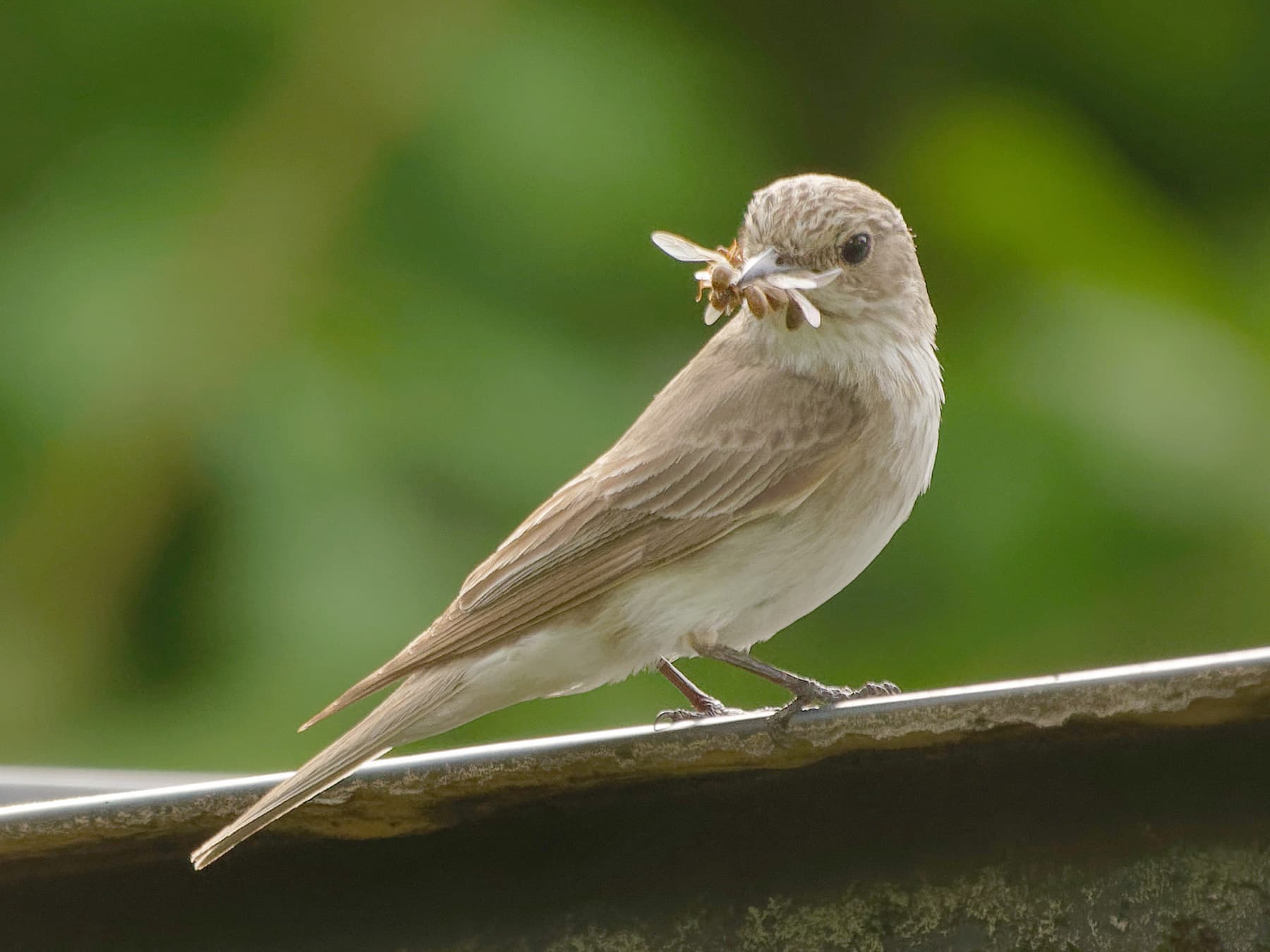
True to their name, Spotted Flycatchers feed predominantly on flies and other flying insects. Bees, wasps, damselflies, flying ants, and moths are all on the menu, although they will also eat crawling insects and invertebrates in poor weather. Fruits and berries are a minor component of their diet.
What do baby Spotted Flycatchers eat?
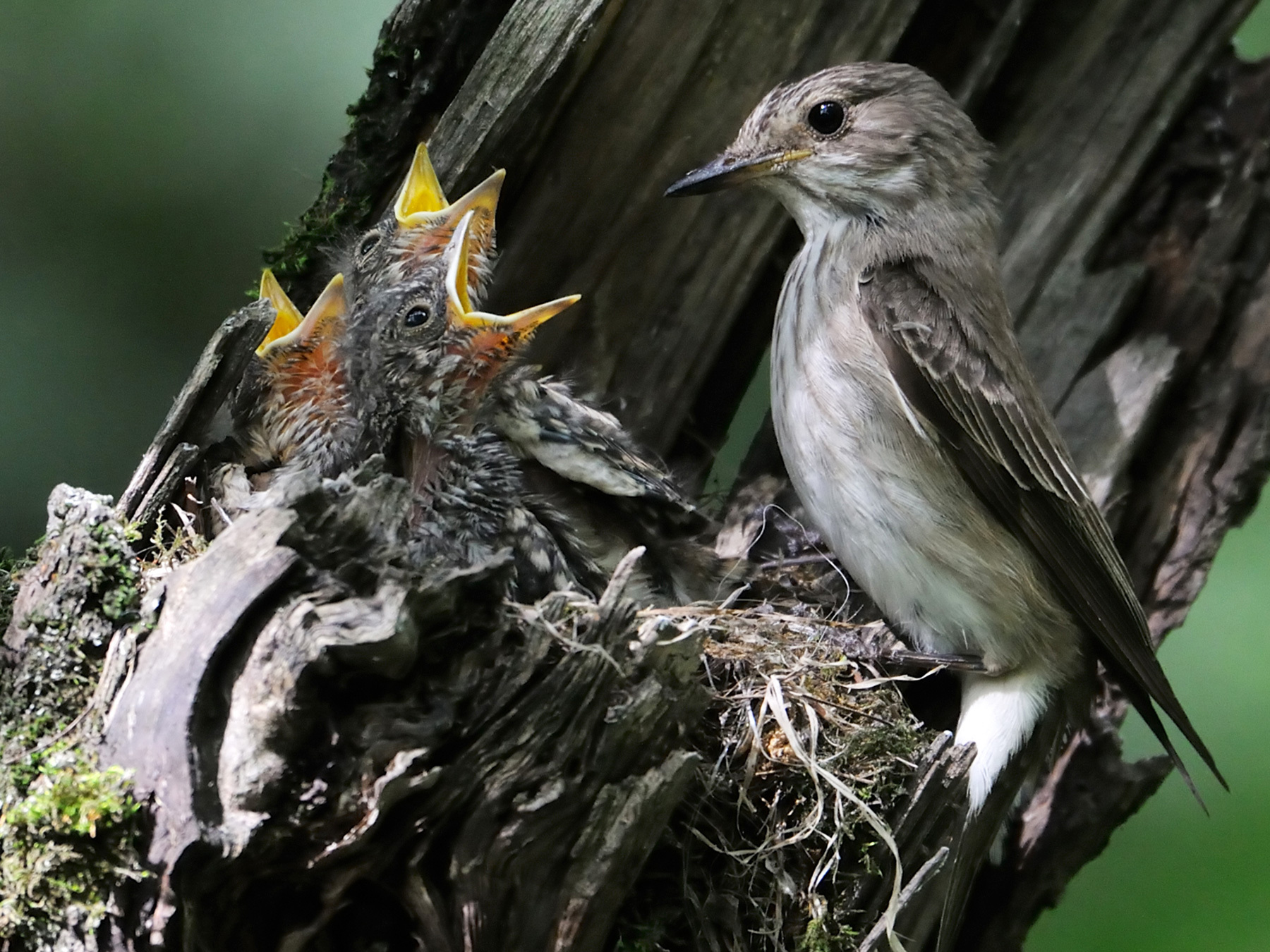
Spotted Flycatcher chicks eat insects provided by both their parents. They fledge after about two weeks in the nest, but their parents will continue to feed them for a further month or so.
Nesting and breeding
Spotted Flycatchers nest in the United Kingdom, often to the delight of birdwatchers when they select gardens to raise their young. These birds are in steep decline, so encouraging and protecting nesting pairs could be important for their recovery in the UK.
Where do Spotted Flycatchers nest?
Spotted Flycatchers build their nests in various natural and artificial sites, usually two to five meters above the ground. Typical locations are against vertical surfaces, on ledges, in creeping and climbing vegetation, and among tree branches.
What do Spotted Flycatcher eggs look like?
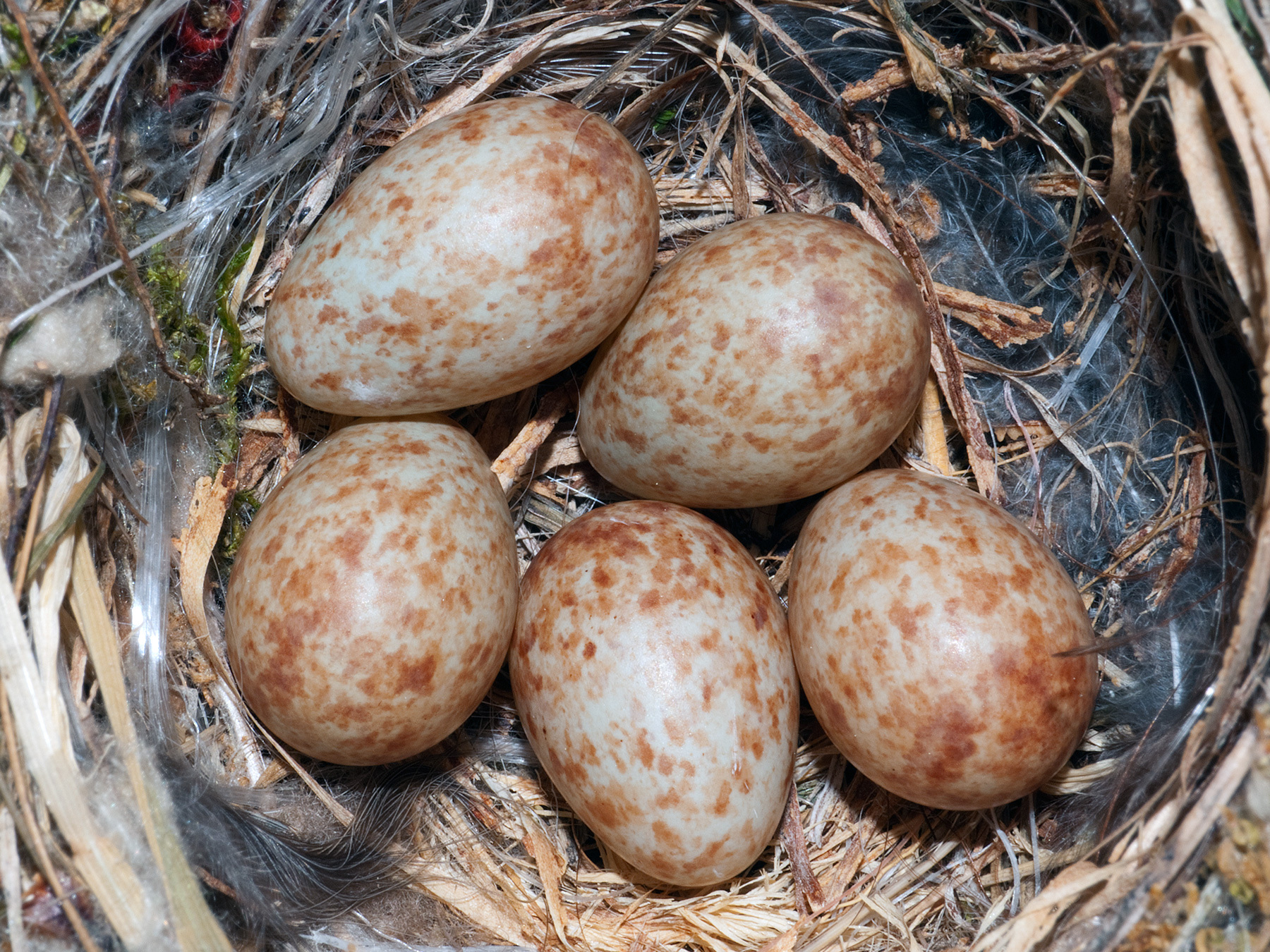
Spotted Flycatcher eggs are whitish with reddish-brown markings. A typical clutch consists of four or five eggs, each measuring approximately 19 millimetres long and 14 millimetres wide.
Do Spotted Flycatchers mate for life?
Spotted Flycatchers are monogamous in the breeding season, and pairs remain together for the second brood.
Behaviour
Most often seen at their hunting perch, these birds fly out to catch prey and return to feed at the same spot throughout the day. Spotted Flycatchers are relatively tame birds that allow close approach, although their unobtrusive habits can make them difficult to detect.
Are Spotted Flycatchers aggressive?
Spotted Flycatchers are confident, although not aggressive, around humans. These birds prefer to advertise their territories with vocalisations rather than physical conflict. However, they may show great courage when confronted with a nest predator much larger than themselves.
Lifespan and predators
How long do Spotted Flycatchers live?
Spotted Flycatchers have a typical lifespan of about two years, although they can live for up to eight years.
What are the predators of Spotted Flycatchers?
Spotted Flycatcher nests are particularly vulnerable to avian predators. A 2005-2006 study on nest predation in Southern England found that the Jay was responsible for more than half of the recorded attacks. However, domestic cats, grey squirrels, Great Spotted Woodpeckers, and other nest predators also take their toll.
Are Spotted Flycatchers protected?
Spotted Flycatchers in the UK are protected by the Wildlife and Countryside Act of 1981.
Are Spotted Flycatchers endangered?
Spotted Flycatchers are not threatened as a species, although they have suffered drastic declines in the United Kingdom and other parts of Europe since the 1960s. They are now placed on the UK’s red list of conservation concern.
Conservation
While listed as Least Concern globally, Spotted Flycatcher populations have declined significantly in parts of Europe, including the UK. Habitat loss, changes in farming practices, and climate change are potential factors.
Conservation efforts focus on maintaining suitable breeding habitats and researching migration patterns.
Similar birds
Often mistaken for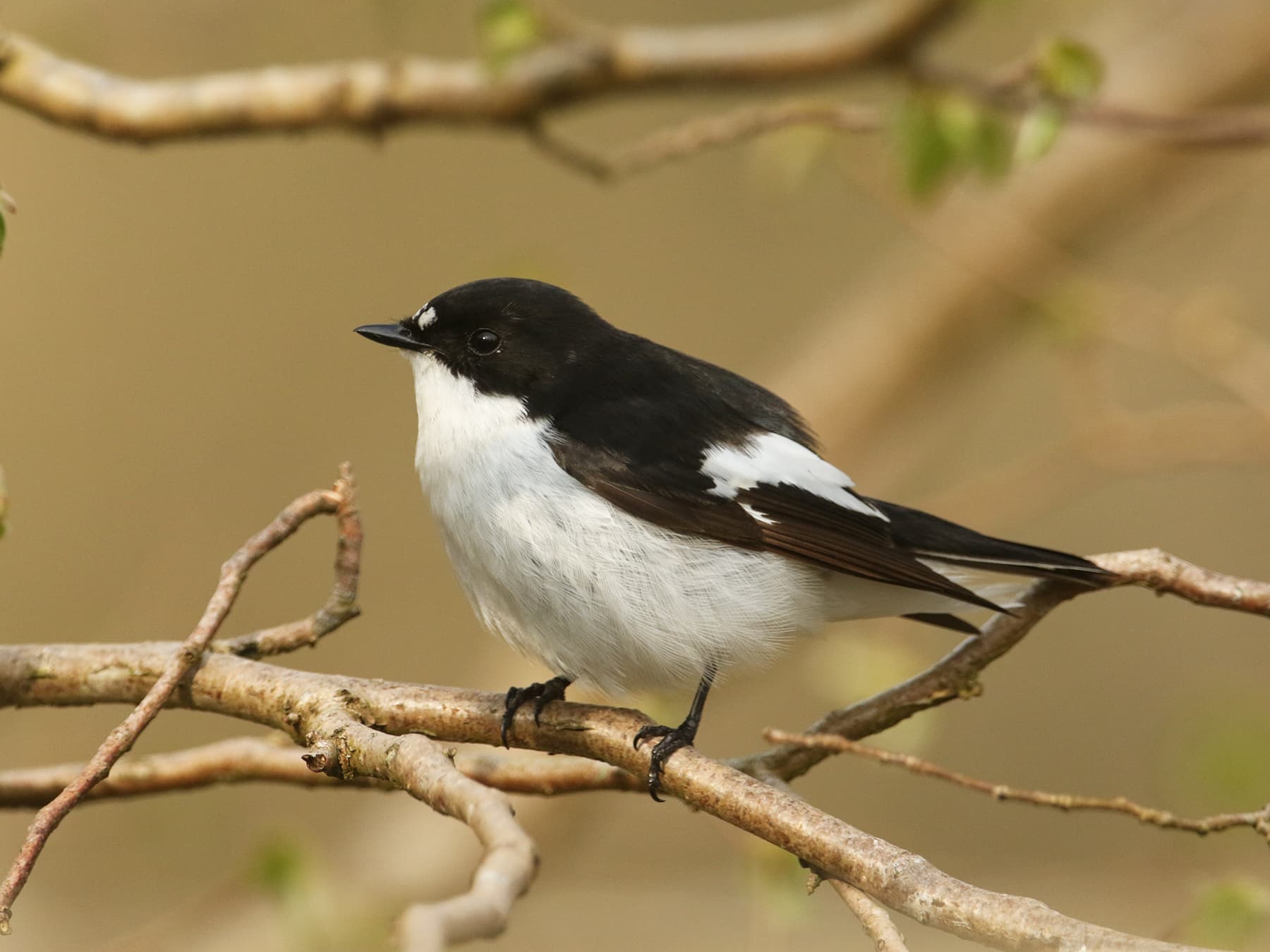
More photos
5 photos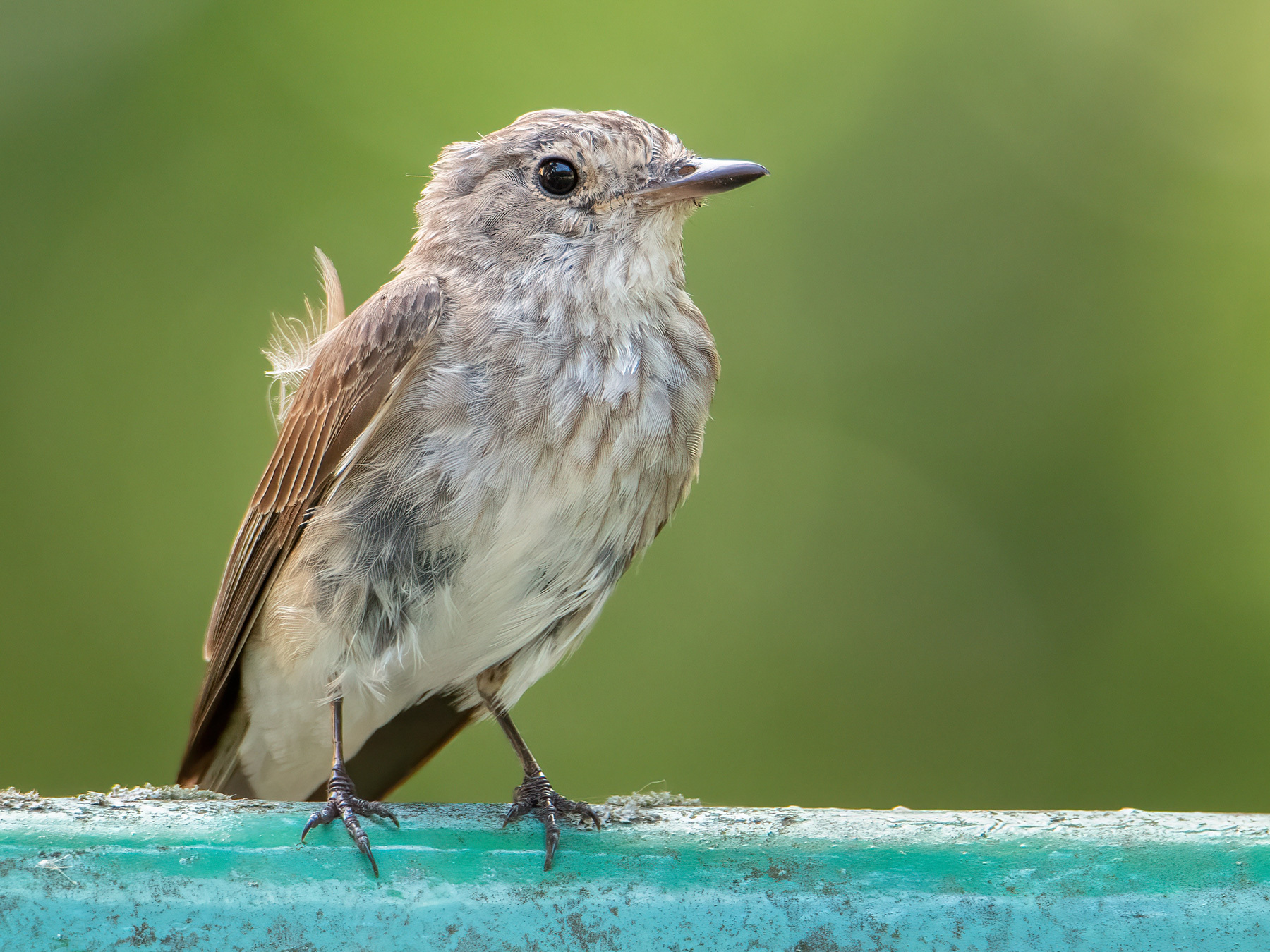
Quick facts
- Length
- 14–16 cm
- Wingspan
- 23–25 cm
- Weight
- 14–20 g
- Lifespan
- 2 years · oldest recorded 11 years
- Family
- Old World Flycatchers
- Migration
- Long-distance Migrant
- Global status (IUCN)
- Least Concern
- World population
- 54,000,000 - 83,000,000 mature individuals
- Population trend
- Decreasing
- Scientific name
- Muscicapa striata
Questions
3Do Spotted Flycatchers hover?
Spotted Flycatchers can hover briefly when catching prey, inspecting potential nest sites, or collecting nesting material. They are not quite as acrobatic as hummingbirds, but they are certainly a very agile species.
Why are they called Spotted Flycatchers?
The Spotted Flycatcher has a rather inaccurate name. These birds are more striped than spotted, although they certainly do catch flies! In their defence, the juveniles do sport spotted plumage.
How to attract Spotted Flycatchers
Spotted Flycatchers have declined significantly in the UK, but bird enthusiasts can still encourage these birds to visit and even breed in their gardens. They do not usually visit bird tables, although a healthy garden with flowering plants will attract pollinating insects and provide a natural food source.
Birdwatchers can also encourage these birds to nest in the garden by installing a nest box. Our gardens may provide a relatively safe environment with fewer predators than natural woodlands, so this practice could undoubtedly benefit these birds in the UK. Open-fronted nest boxes placed a few meters above the ground stand the best chance of attracting a pair.
Sources
4- 1BirdLife International. 2019. Muscicapa striata (amended version of 2018 assessment). The IUCN Red List of Threatened Species 2019: e.T22709192A155605346. Source (opens in a new tab)
- 2EBCC (2015)
- 3BirdLife International. 2019. Muscicapa striata (amended version of 2018 assessment). The IUCN Red List of Threatened Species 2019: e.T22709192A155605346. Source (opens in a new tab)
- 4Fransson et al., EURING list of longevity records for European birds (2010) Source (opens in a new tab)

Checked by
Nathan Cope, founder and editor
Nathan founded Birdfact and leads its writers and contributors in the UK, the US and Canada. He has watched and studied birds for more than ten years, and checks every article and species guide before it’s published.