


Common Shelduck
Shelduck · Tadorna tadorna
By the Birdfact teamChecked by Nathan Cope
On this page14 sections
How to recognise it
What do Shelducks look like?
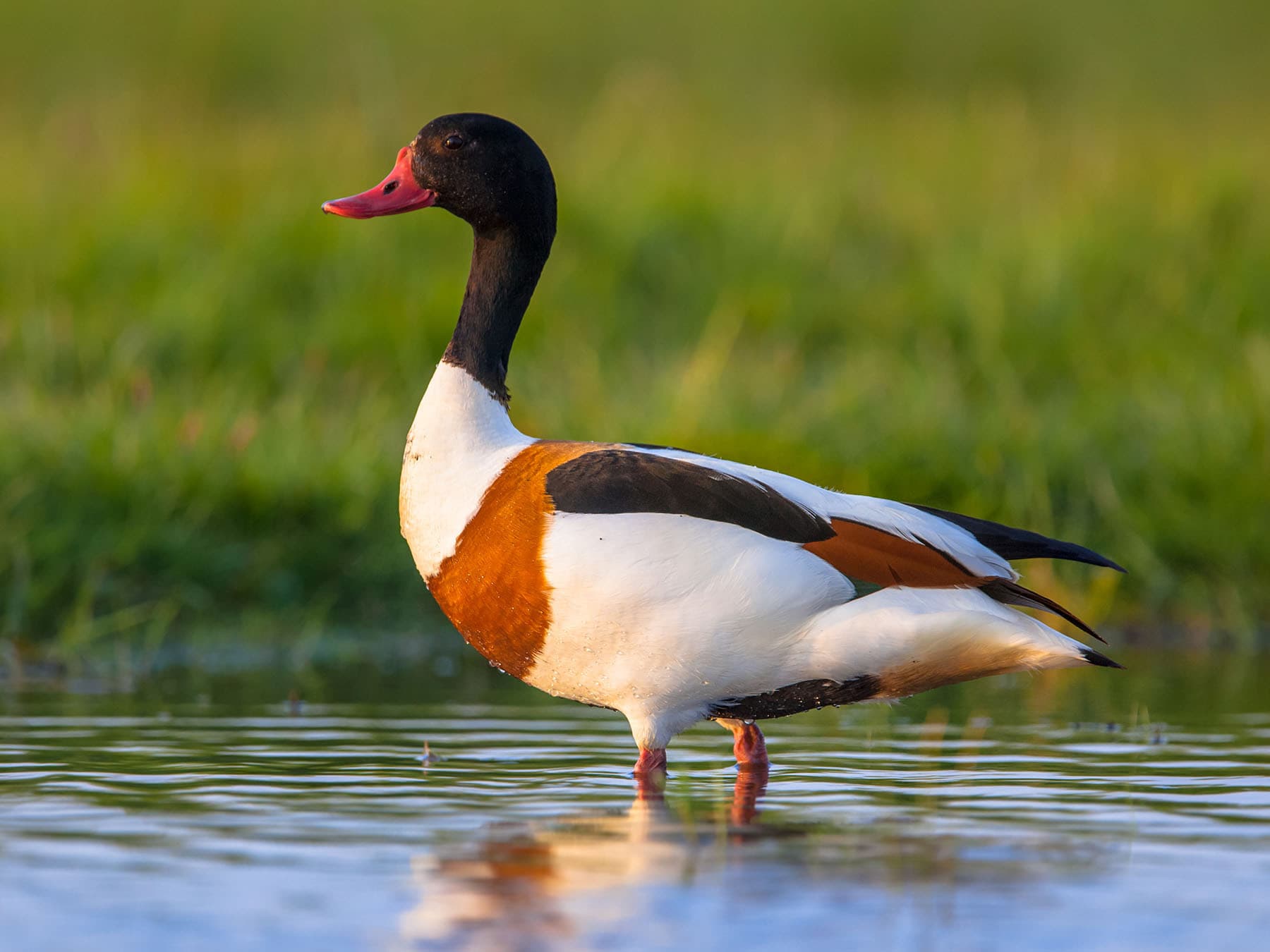
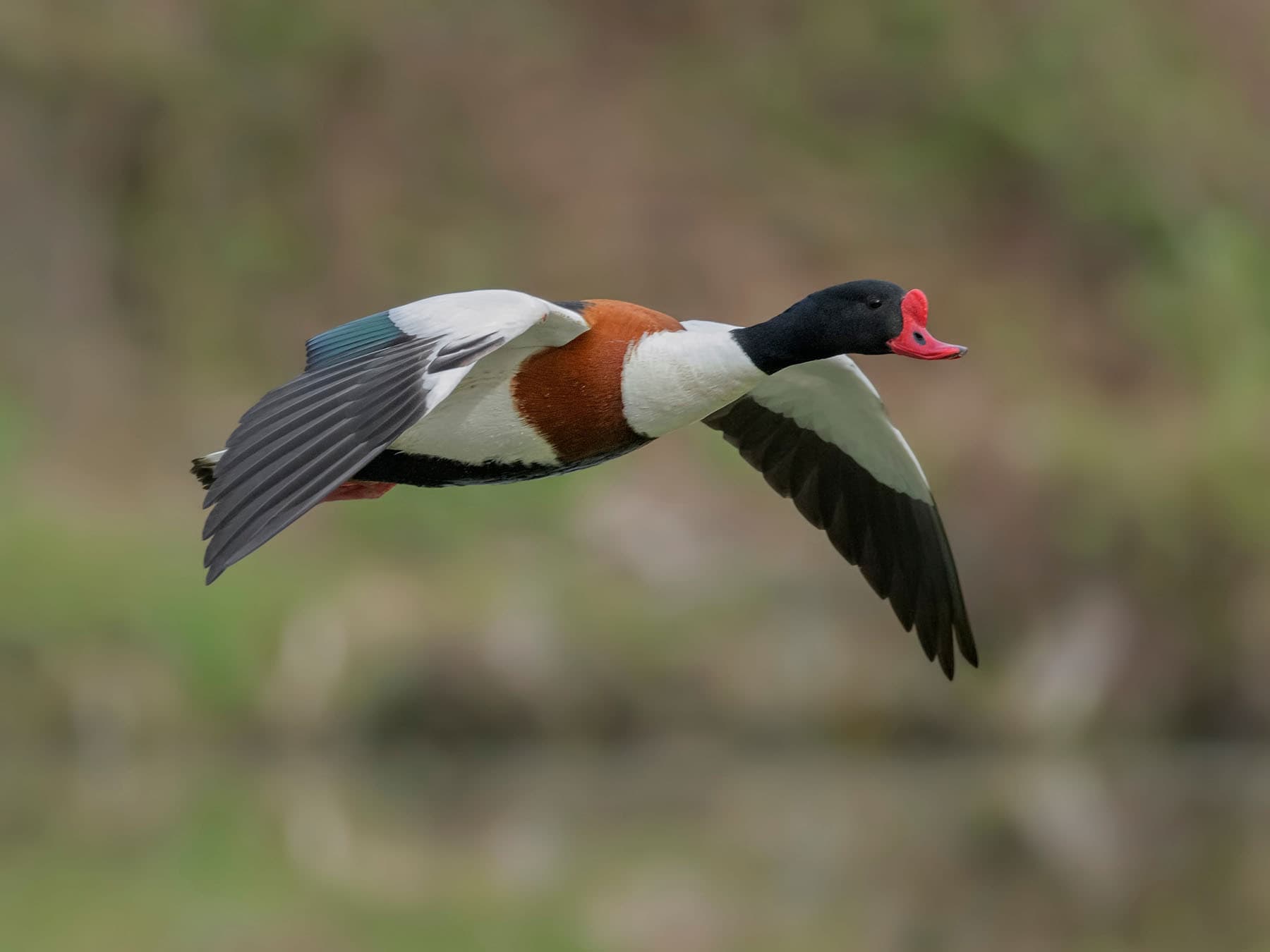
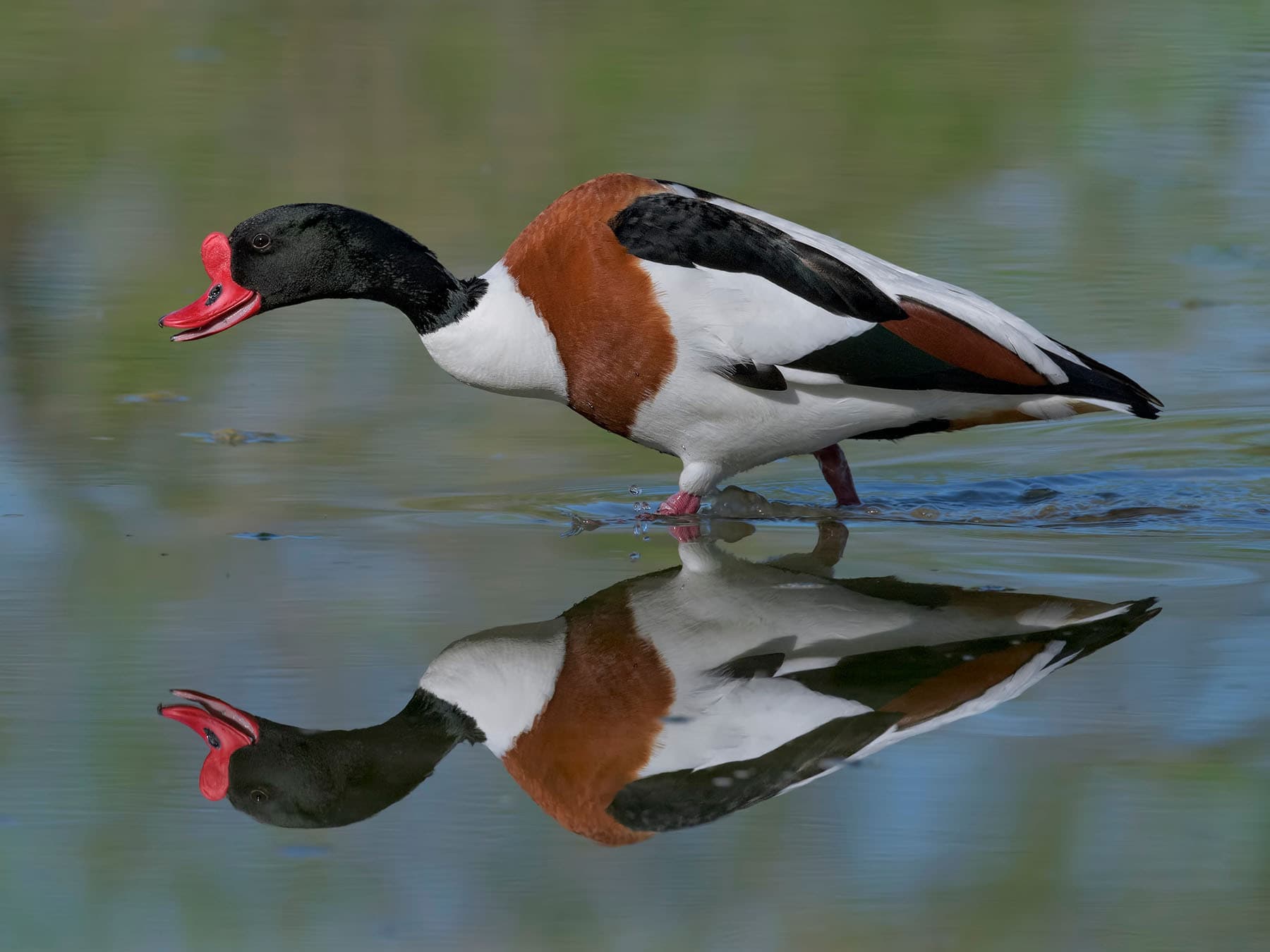
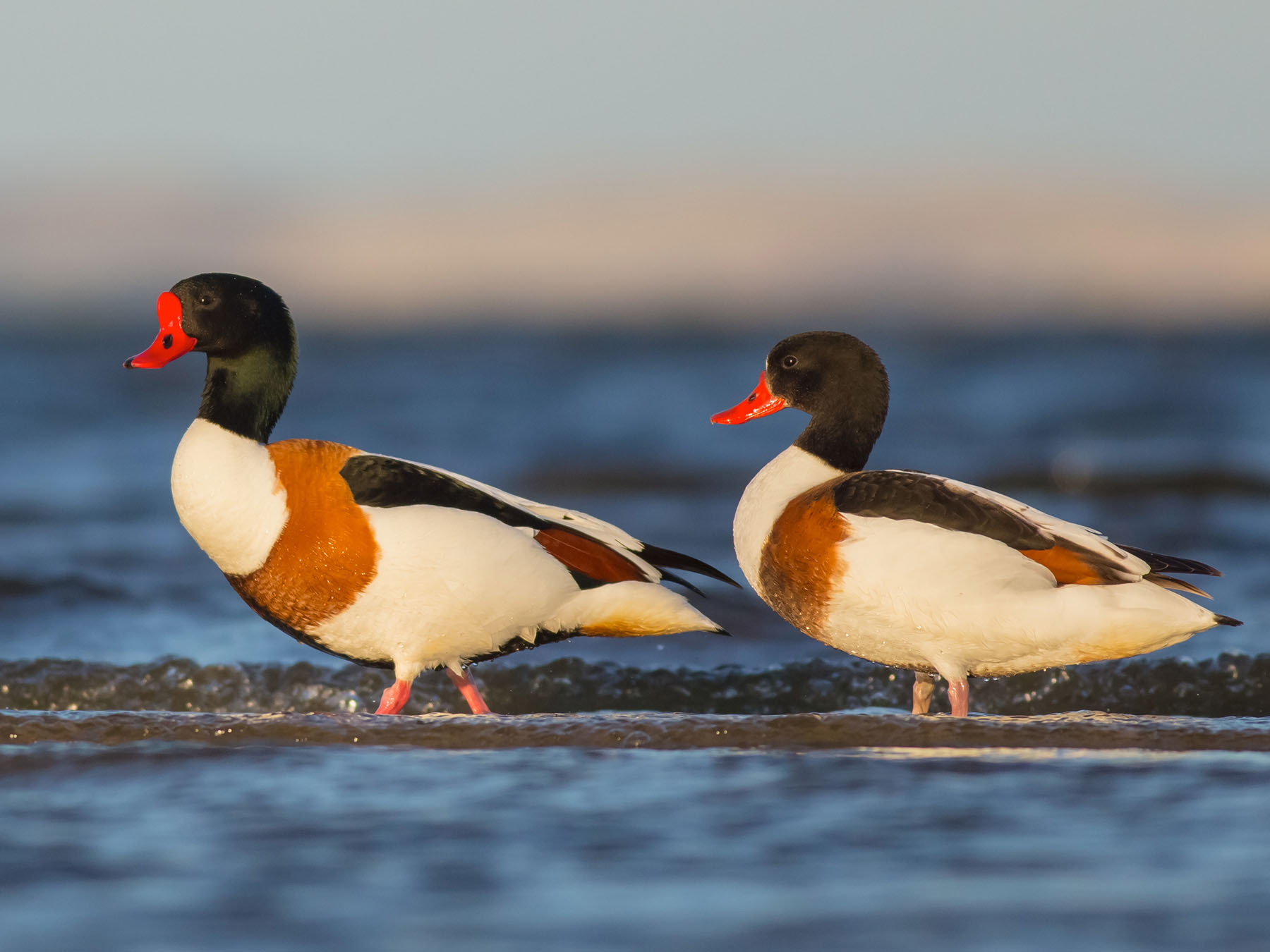
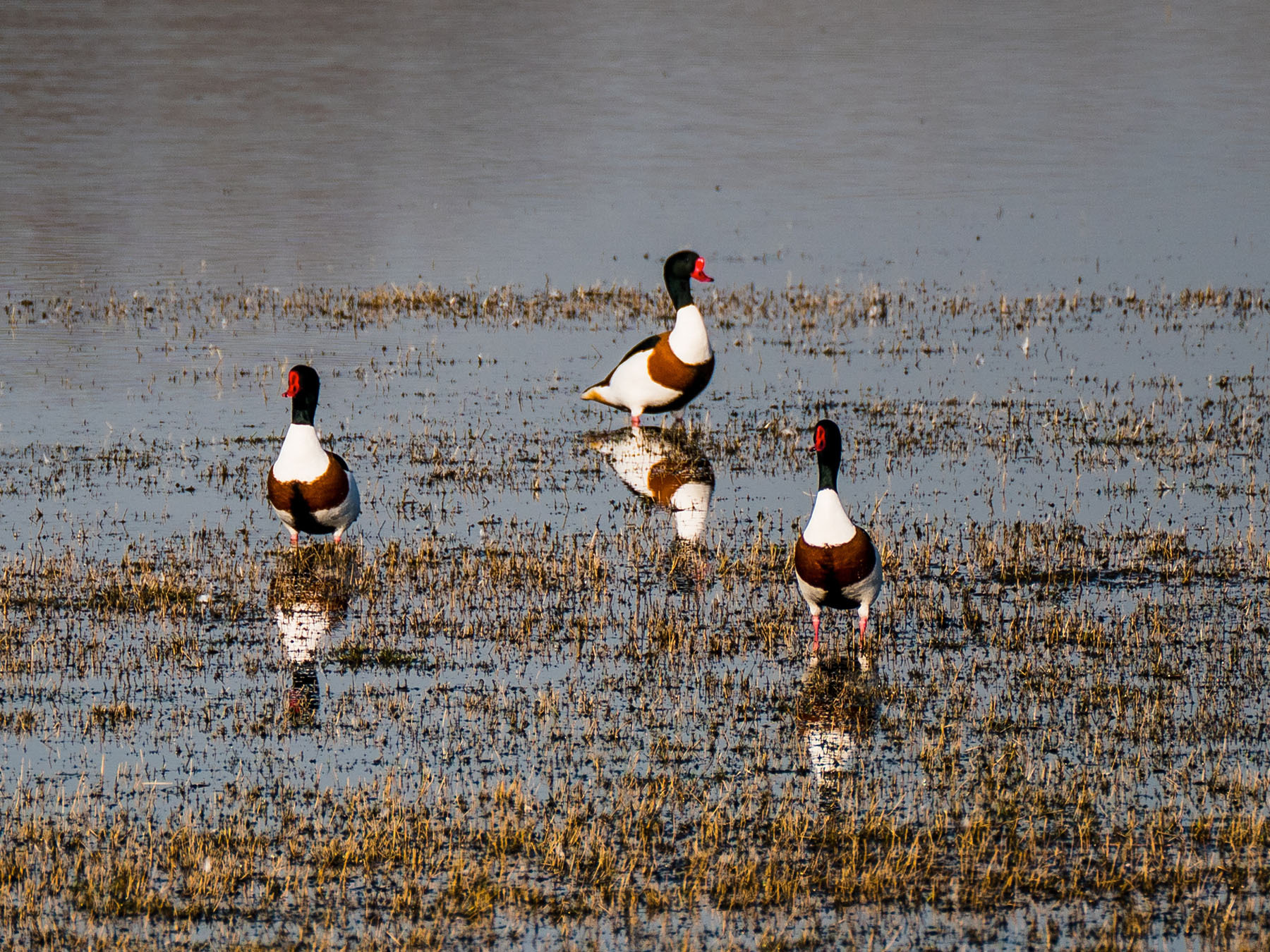
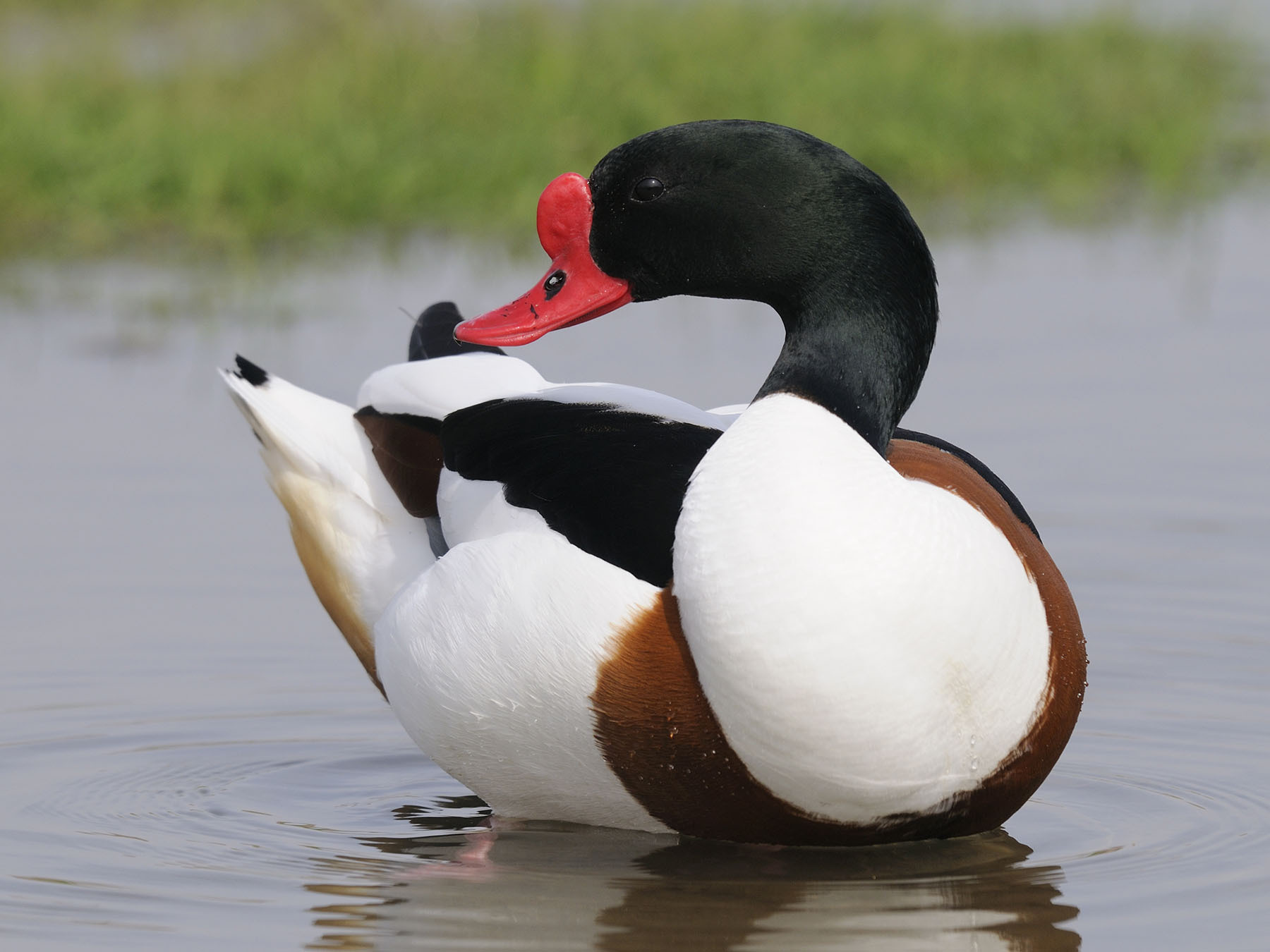
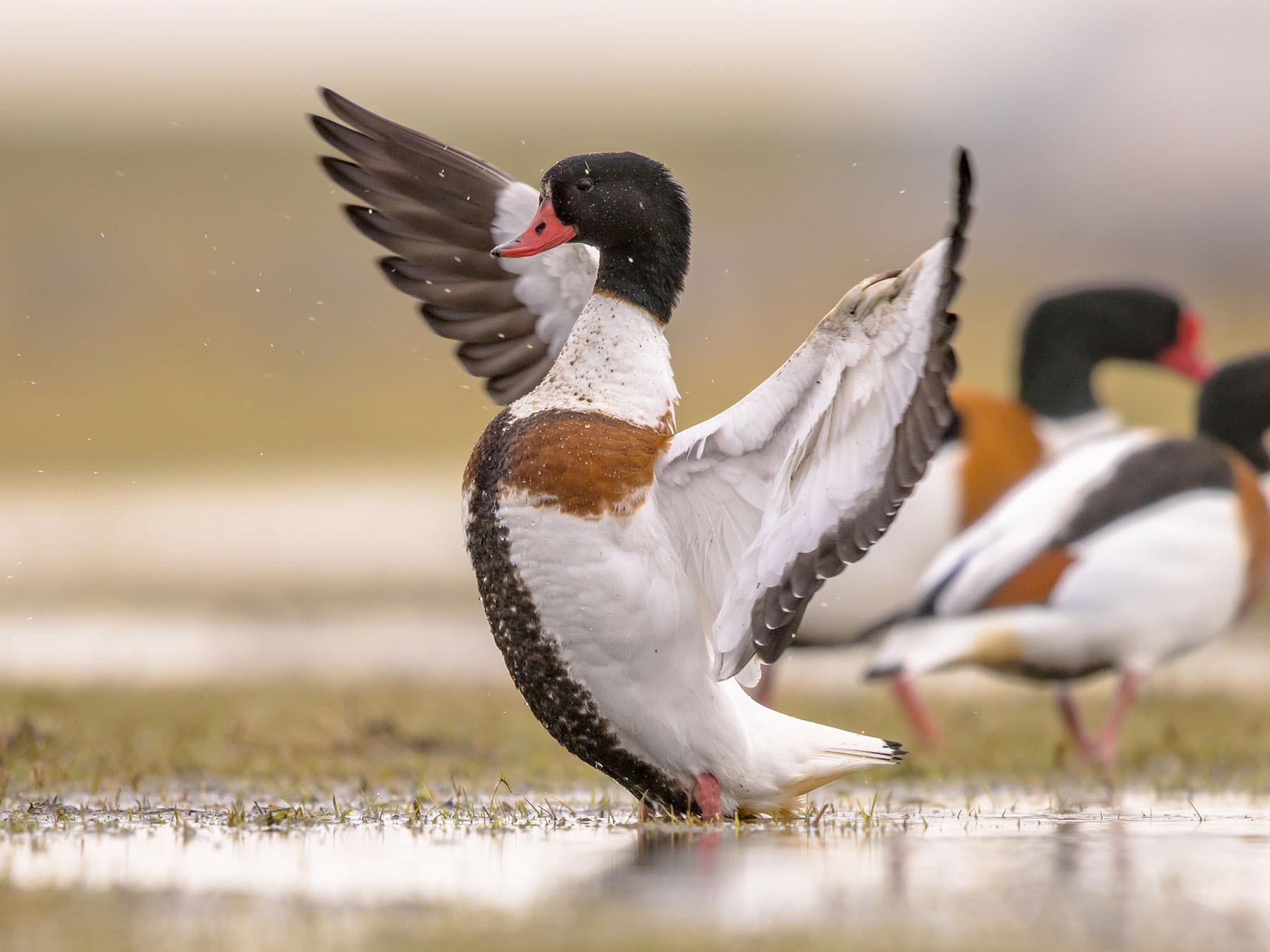
Male shelducks are colourful and distinctive waterbirds. Their plumage is mainly white on their back and wings, and they have a dark green head and neck that looks almost black from a distance.
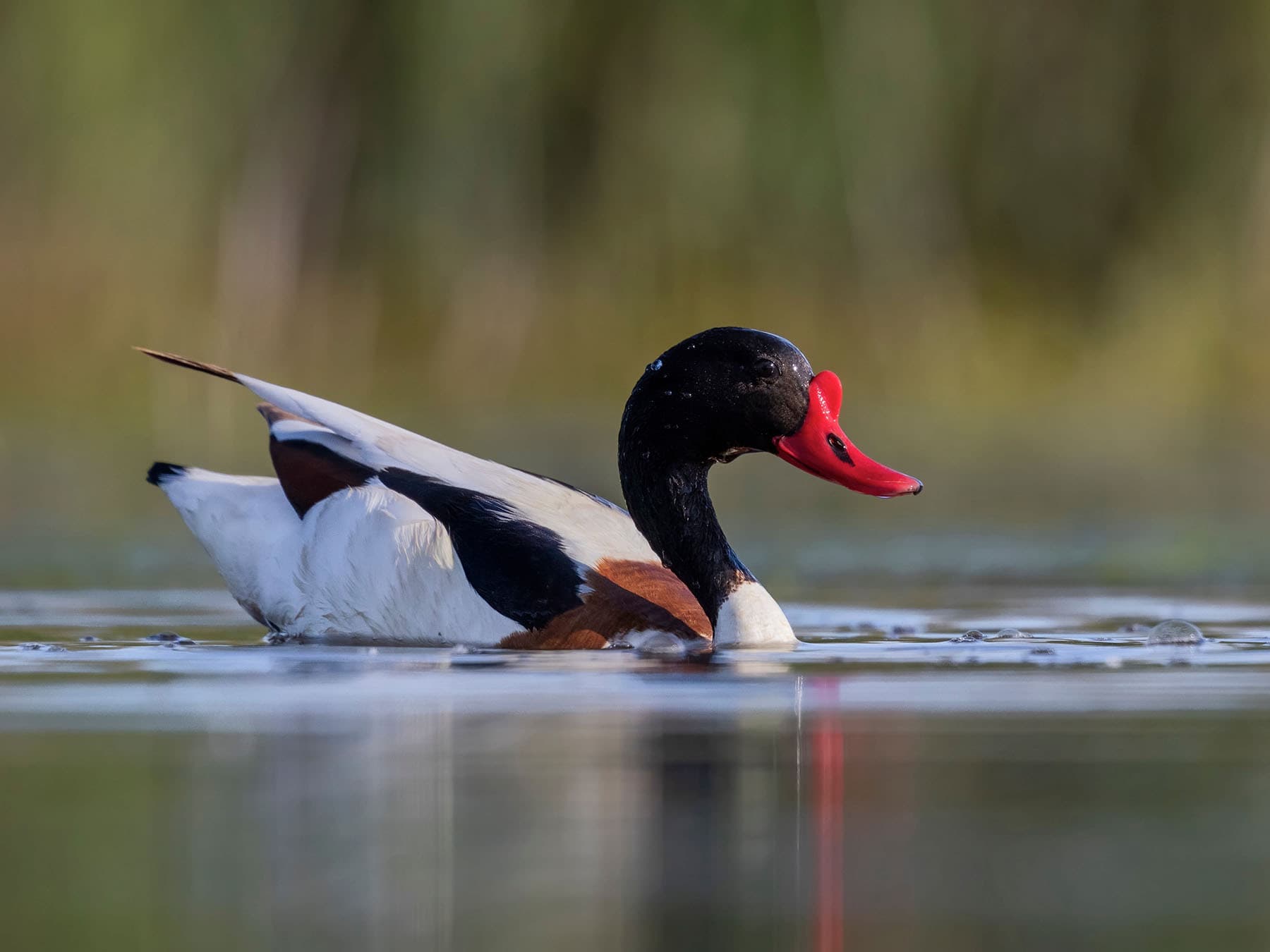
A chestnut band marks the upper belly, and there are black and chestnut wing feathers, as well as green secondary wing feathers that are only visible in flight. The underside of their tail is also a rich chestnut colour. The male shelduck’s bill is scarlet, with a prominent ‘knob’ at the base on the forehead.
Female shelducks have very similar markings to males, and share much of the same coloring. One distinct difference in features allows confident identification between the sexes: the knob on the female’s beak is significantly smaller and less defined than that of the male.
Females also show some white facial markings around the base of the bill in contrast to the solid glossy black-green of the male.
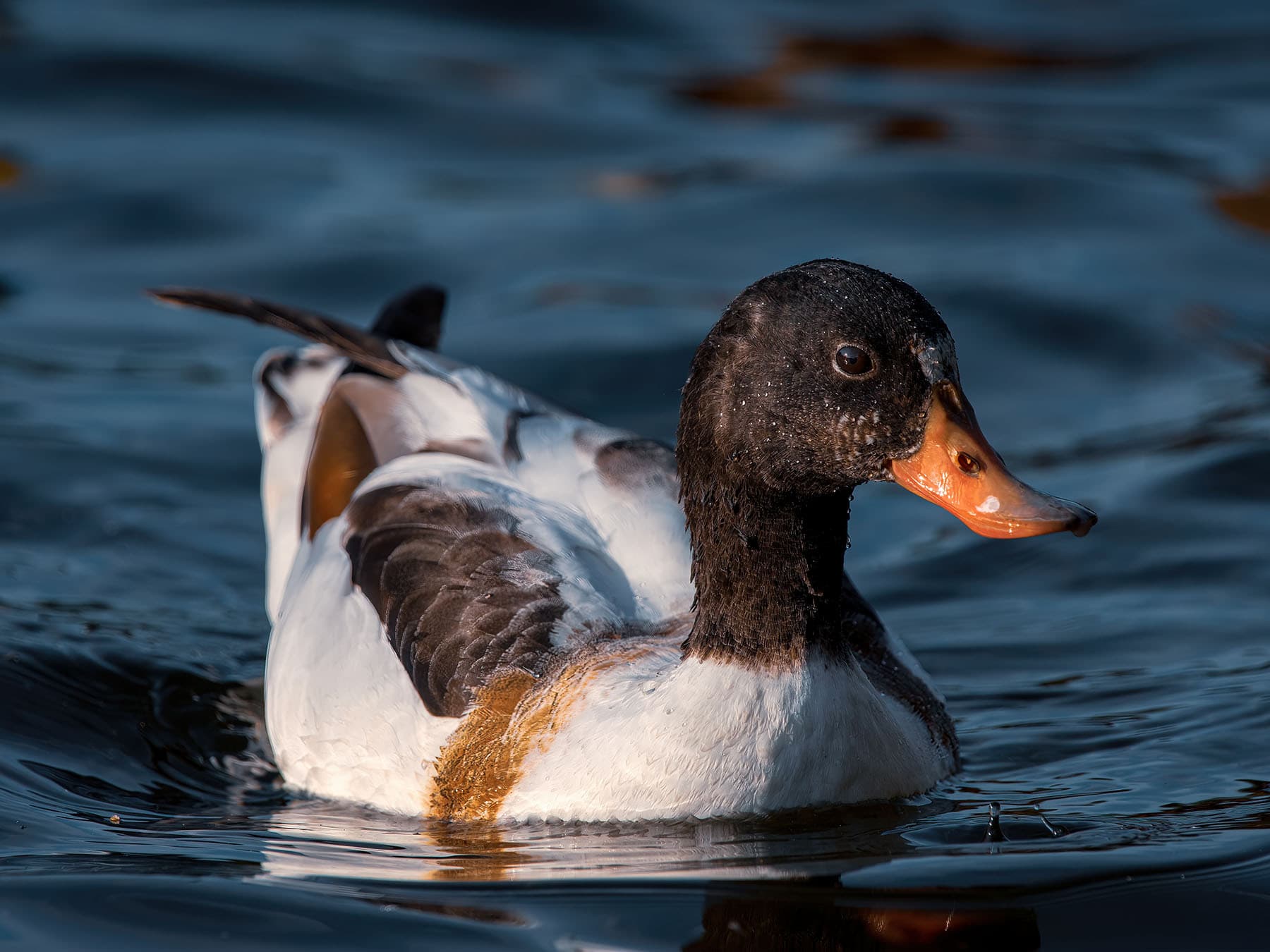
Juvenile shelducks are almost totally unalike in appearance to their parents and they do not acquire their full adult plumage until they reach breeding age in their second year.
In juvenile plumage, shelducks are largely white, with a black-grey cap, and greyish-black patches on their upper back and wings. The bill is pale pink-orange and a faint chestnut breast stripe is not yet complete and barely visible.
How big are Shelducks?
Shelducks are large ducks, significantly bigger than mallards and similar in size to small geese. Males are larger and heavier than females.
- Length: 58 cm to 67 cm (23 in to 26 in)
- Weight: male 830 g to 1500 g (29 oz to 53 oz) female 562 g to 1250 g (20 oz to 44 oz)
- Wingspan: 110 cm to 133 cm (43 in to 52 in)
Its size
Adults- Length
- 58–67 cm
- Wingspan
- 110–130 cm
- Weight
- 800–1400 g
Its song and calls
What sound does a Shelduck make?
Ahead of the breeding season, males make a weak, clear “whee-chew” whistling sound, which is thought to signal danger or threat.
Females make louder, lower-pitched calls, which carry over long distances, as well as rapid-fire honking quacks that sound like “gagagagaga”, often heard in flight.
- Song0:00 / 0:33
Recorded in Friesland, Netherlands · April 2019
- Call0:00 / 0:11
Recorded in Normandie, France · May 2021
When and where to see it
OctoberIn season
Most recorded in October
- 1. Falkirk2.1%
- 2. Stockton-on-Tees1.8%
- 3. Newport1.6%
- 4. Louth1.5%
- 5. Flintshire1.2%
Each dot is a county, state or province: the bigger and darker, the larger the bird’s share of that place’s bird records that month. Grey dots: no regular records. The ringed point is the centre of the bird’s records this month; the arrow shows how it moved since last month, and the dashed loop its path through the year. “Arrivals” colours places where it becomes regular this month (orange) or is in its last regular month (grey). GBIF eBird Observation Dataset, 2019–2024. Map data: Natural Earth, US Census Bureau; place centres © OpenStreetMap contributors.
In your area
See when the Common Shelduck is recorded in your county, state or province.
How often the Common Shelduck turns up in the UK and Ireland through the year, from birdwatchers' records.
United Kingdom
Resident · all year · most records in May
Ireland
Resident · all year · most records in March
Show as a table
| Month | United Kingdom | Ireland |
|---|---|---|
| January | 0.63% (regular) | 0.70% (regular) |
| February | 0.70% (regular) | 0.80% (regular) |
| March | 0.71% (regular) | 0.86% (regular) |
| April | 0.77% (regular) | 0.80% (regular) |
| May | 0.77% (regular) | 0.76% (regular) |
| June | 0.59% (regular) | 0.71% (regular) |
| July | 0.49% (regular) | 0.40% (regular) |
| August | 0.40% (regular) | 0.25% (regular) |
| September | 0.37% (regular) | 0.23% (regular) |
| October | 0.39% (regular) | 0.25% (regular) |
| November | 0.47% (regular) | 0.50% (regular) |
| December | 0.51% (regular) | 0.56% (regular) |
Recorded regularly in
Worldwide: recorded regularly in 75 countries
Countries where it was recorded in at least 3 of the 6 years 2019–2024. Linked countries have their own bird list.
Europe (44)
- Åland Islands
- Albania
- Austria
- Belarus
- Belgium
- Bosnia & Herzegovina
- Bulgaria
- Croatia
- Czechia
- Denmark
- Estonia
- Faroe Islands
- Finland
- France
- Germany
- Greece
- Guernsey
- Hungary
- Iceland
- Ireland
- Isle of Man
- Italy
- Jersey
- Kosovo
- Latvia
- Lithuania
- Malta
- Moldova
- Montenegro
- Netherlands
- North Macedonia
- Norway
- Poland
- Portugal
- Romania
- Russia
- Serbia
- Slovakia
- Slovenia
- Spain
- Sweden
- Switzerland
- Ukraine
- United Kingdom
Africa (5)
Asia (26)
- Armenia
- Azerbaijan
- Bangladesh
- Bhutan
- China
- Cyprus
- Georgia
- Hong Kong SAR China
- India
- Iran
- Israel
- Japan
- Jordan
- Kazakhstan
- Kuwait
- Kyrgyzstan
- Mongolia
- Myanmar (Burma)
- Nepal
- Pakistan
- Saudi Arabia
- South Korea
- Taiwan
- Turkey
- United Arab Emirates
- Uzbekistan
Data: EOD – eBird Observation Dataset (Cornell Lab of Ornithology), accessed via GBIF.org, CC BY 4.0. Records from 2019–2024, aggregated and filtered by Birdfact. How these lists are made
What is the habitat of a Shelduck?
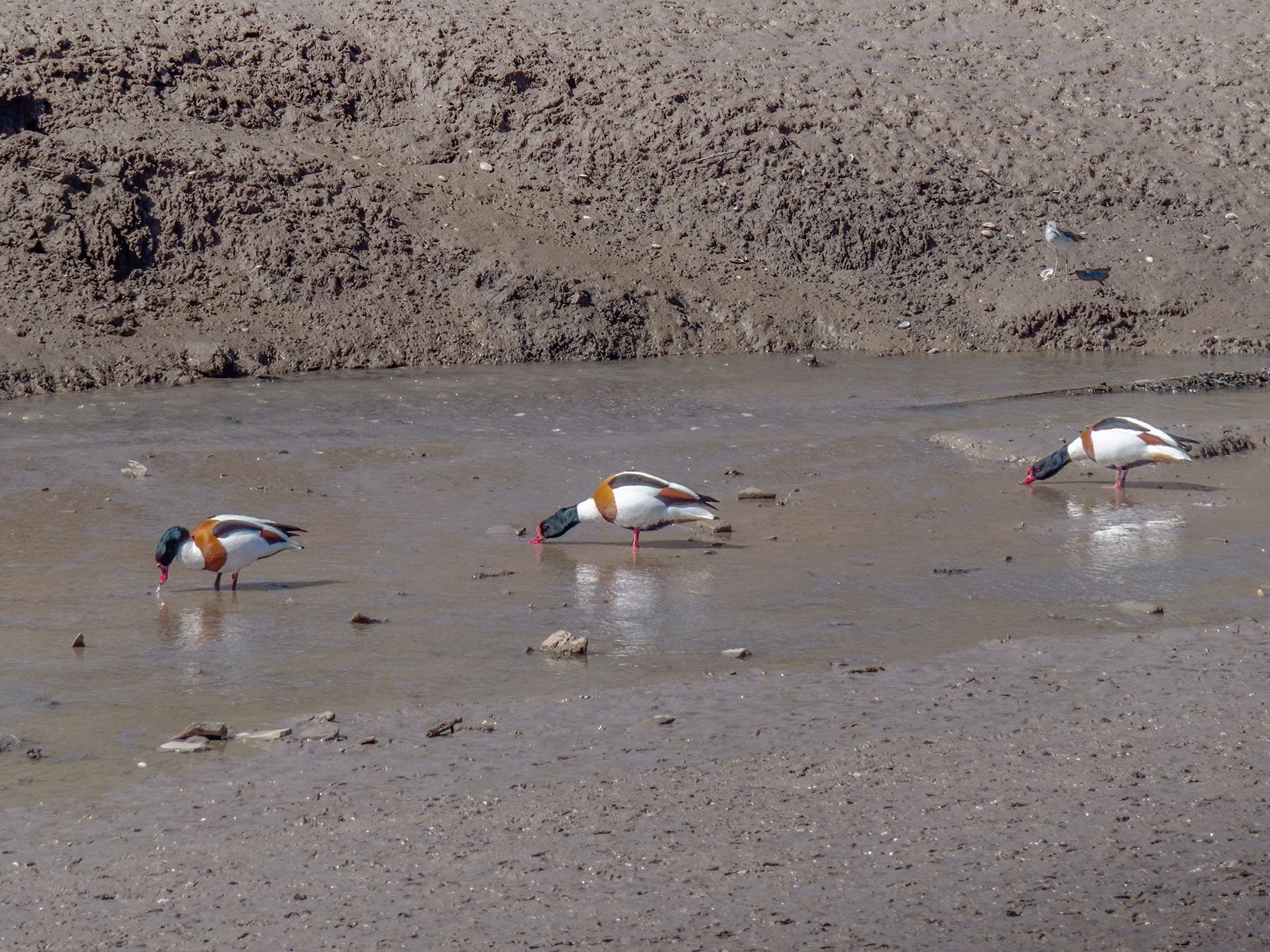
In winter, shelducks are commonly found on muddy estuaries and coastal wetlands, and most often live on salt or brackish water, although will also visit fresh water to drink.
Breeding habitats are found increasingly further inland, with sites such as gravel pits, reservoirs, lakes, and farmlands offering ideal nesting locations.
Shelducks frequently lay their eggs in abandoned rabbit burrows, so rural land with sandy soils can offer a perfect setting.
What is the range of a Shelduck?
Shelducks are found across a wide distribution range encompassing much of Europe and Asia. The species is present from north-west Europe into Central Asia and north-eastern China.
To the south, shelducks breed at scattered locations along the Mediterranean and as far east as Iran and Afghanistan.
In winter, some shelducks migrate as far south as North Africa, and into Iraq, Pakistan, India, Bangladesh and southern China. At the western edge of their winter range, UK wetlands welcome large numbers of migrating shelducks.
Where do Shelducks live?
Shelducks live in coastal areas, and along mudflats and estuaries of major rivers. They are resident all around the coastline of England, Scotland and Wales, including the Scottish islands, and are also recorded around the entire coastline of the island of Ireland.
Shelducks are also increasingly common on inland bodies of water, including gravel pits and reservoirs.
How rare are Shelducks?
Although around 7,850 shelduck pairs breed in Britain, their numbers rise dramatically in winter when resident birds are joined by several thousand migrating birds, bringing the winter population of shelducks to 51,000 birds.
Where can you see Shelducks in the UK?
For almost guaranteed sightings, in winter, head to north-west England, where around 10,000 shelducks can be seen gathering on the muddy estuaries of the Dee and Mersey rivers.
Migration
Do Shelducks migrate?
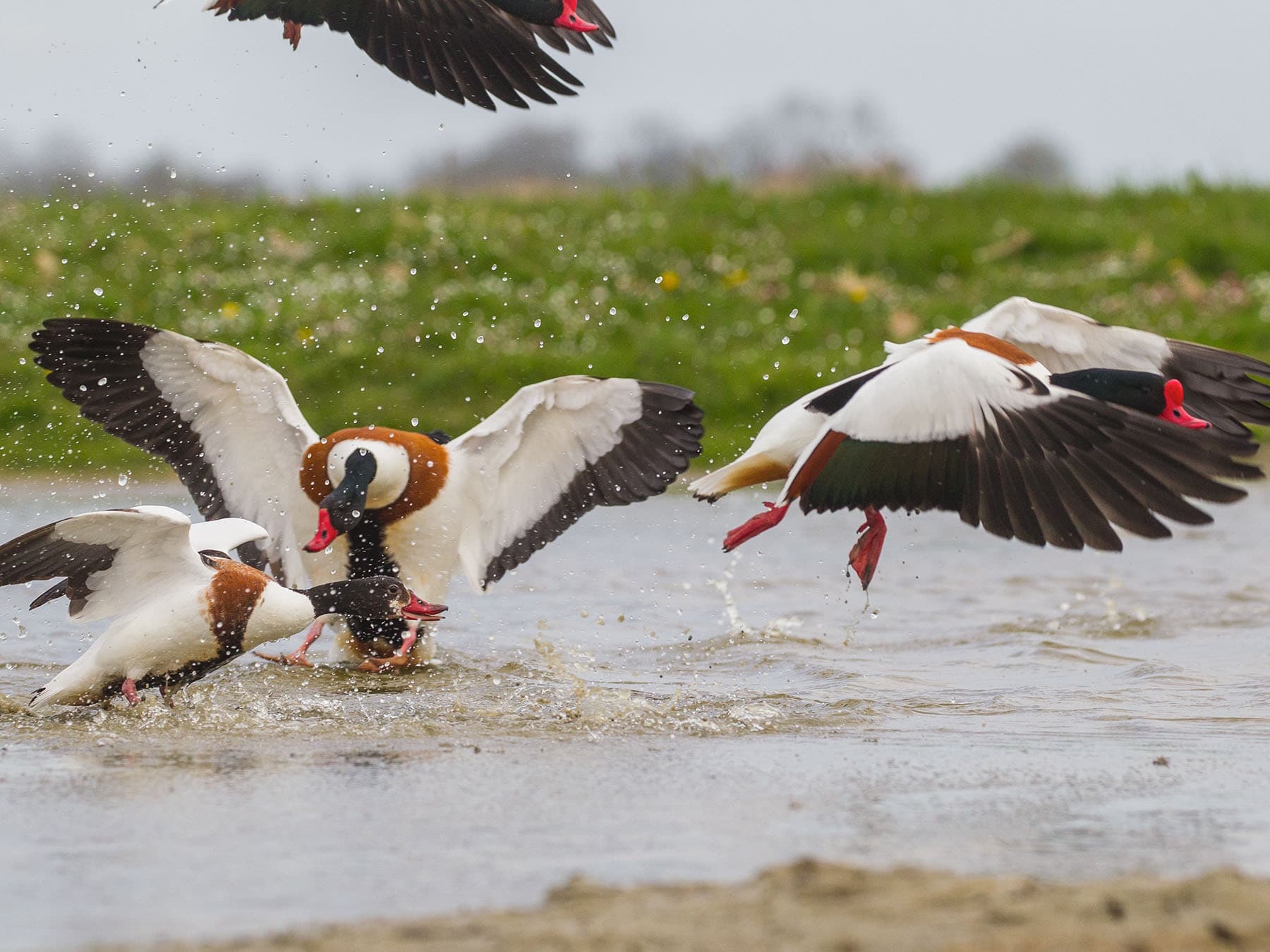
The UK has a resident population of around 7850 breeding pairs. In winter, this number increases to around 51,000 birds in total, with the arrival of migrating birds from across the North Sea.
It’s common for large numbers of shelducks to migrate to moulting grounds in the Heligoland Bight in the Wadden Sea, along the coast of the Netherlands, Germany and Denmark, before returning to Britain to spend the winter there.
Tips for seeing it
- Look for Shelducks in coastal areas, especially estuaries and mudflats
- Listen for their distinctive whistling call, often given in flight
- Observe their unique upright posture when walking on land
- In the UK, visit nature reserves along the east coast for the best viewing opportunities
What it eats
What do Shelducks eat?
Shelducks forage for aquatic invertebrates, including molluscs, insects, and crustaceans, with saltwater snails being a particular favourite. They also eat small fish and frogspawn, worms and algae, and may occasionally take the eggs from coots nesting nearby.
What do Shelducks chicks eat?
Young shelducks are able to swim and dive within hours of hatching, and are able to find food themselves almost immediately, diving underwater to forage for larvae and crustaceans and other aquatic invertebrates.
Nesting and breeding
Where do Shelducks nest?
Shelducks lay their eggs in cavities, such as tree hollows, disused animal burrows and may occasionally use nest boxes.
Occasionally nests are made in more open areas, such as vegetation on islands, and in such cases, grasses and bracken are used to create a rough nest, which is then lined with soft feathers.
What do Shelduck eggs look like?
Eggs laid by shelducks are creamy white in colour, with no markings. Eggs measure between 61 mm and 71 mm (2.4 in to 2.8 in) by 43 mm to 50 mm (1.7 in to 2 in), and weigh 65.5 g to 92.5 g (2.3 oz to 3.3 oz).
Between 3 and 18 eggs are laid, but a typical clutch contains 8 to 10. These are then incubated by the female alone for 28 to 31 days, while the male remains nearby, guarding the site from predators.
Do Shelducks mate for life?
Shelducks form long-term monogamous pairs, but may temporarily part ways on moulting and wintering grounds before reuniting the following spring.
Behaviour
Are Shelducks aggressive?
Far from being aggressive, shelducks are a highly sociable species and gather in vast numbers without any conflict or aggression outside of the breeding season.
When nesting, pairs may choose nest sites within a metre of other pairs, and this can sometimes lead to territorial clashes, but any aggression is generally reserved for other bird species that may approach their nest site.
Lifespan and predators
How long do Shelducks live?
The typical lifespan of a shelduck is around 10 years, with breeding for the first time happening at around 2 years. An individual ringed bird was recorded in 2013 as 19 years of age.
What are the predators of Shelducks?
Predators of young shelducks include foxes, as well as a number of bird species, including crows, skuas, and great black-backed gulls and herring gulls.
Are Shelducks protected?
Shelducks are protected under the Wildlife and Countryside Act, 1981, and cannot be hunted, killed, injured or taken into captivity. Their eggs and nest site are offered protection from damage and destruction.
In addition, shelducks are given wider protection by the Agreement on the Conservation of African-Eurasian Migratory Waterbirds, or African-Eurasian Waterbird Agreement (AEWA) which promotes conservation efforts for wetland birds in Europe and Africa.
Are Shelducks endangered?
Shelducks are not endangered or threatened, and their numbers are relatively stable. However in the UK, shelducks are rated as an Amber species in the UK’s list of Birds of Conservation Concern.
This is due to British wetlands being of international significance for the shelduck population, as they host between 20 and 30 percent of the European population of shelducks.
Conservation
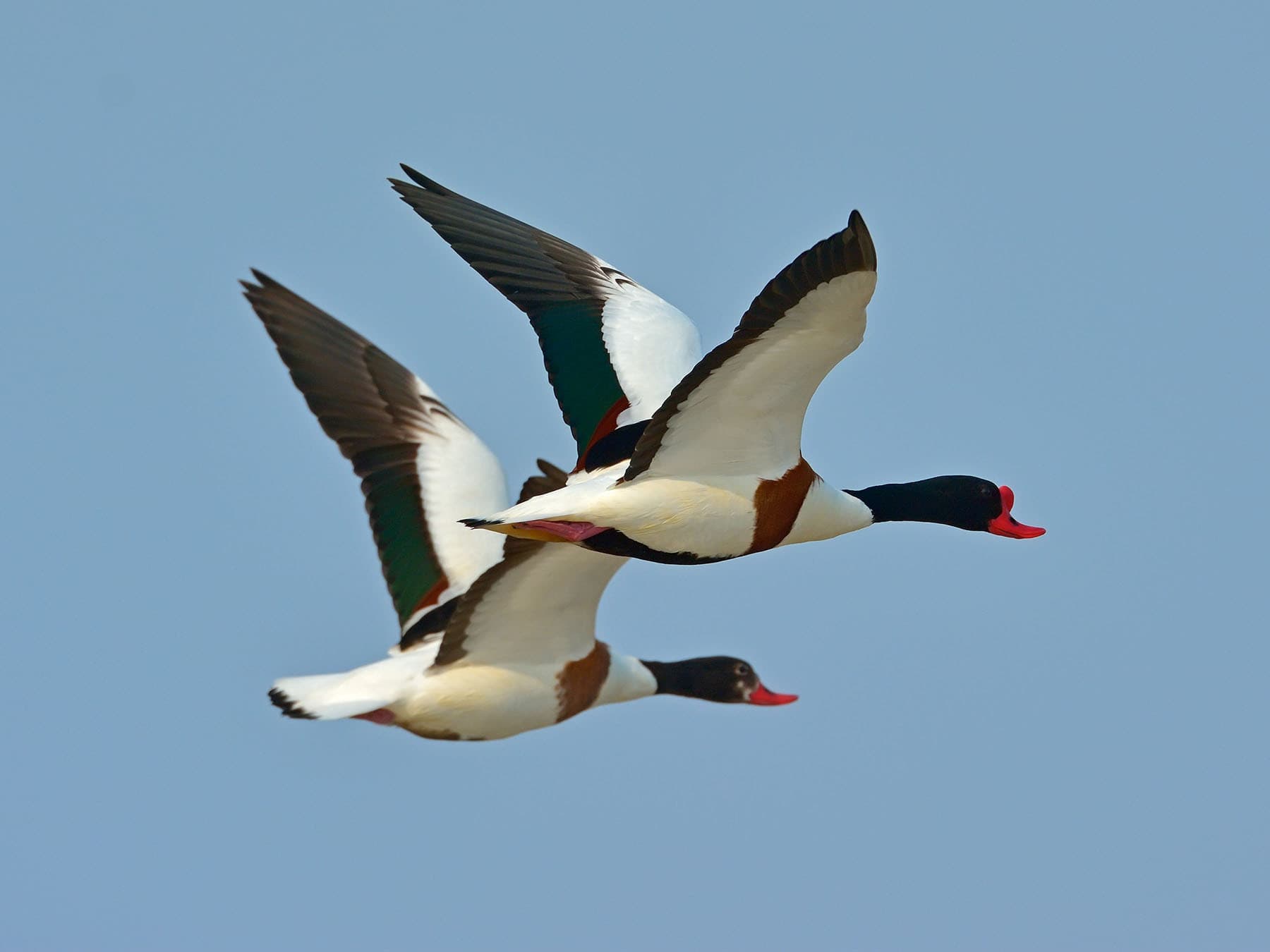
While the Common Shelduck is currently listed as Least Concern, it faces threats from habitat loss due to coastal development and climate change.
Conservation efforts focus on protecting key wetland and coastal areas, particularly in Europe, where significant populations breed and winter.
More photos
5 photos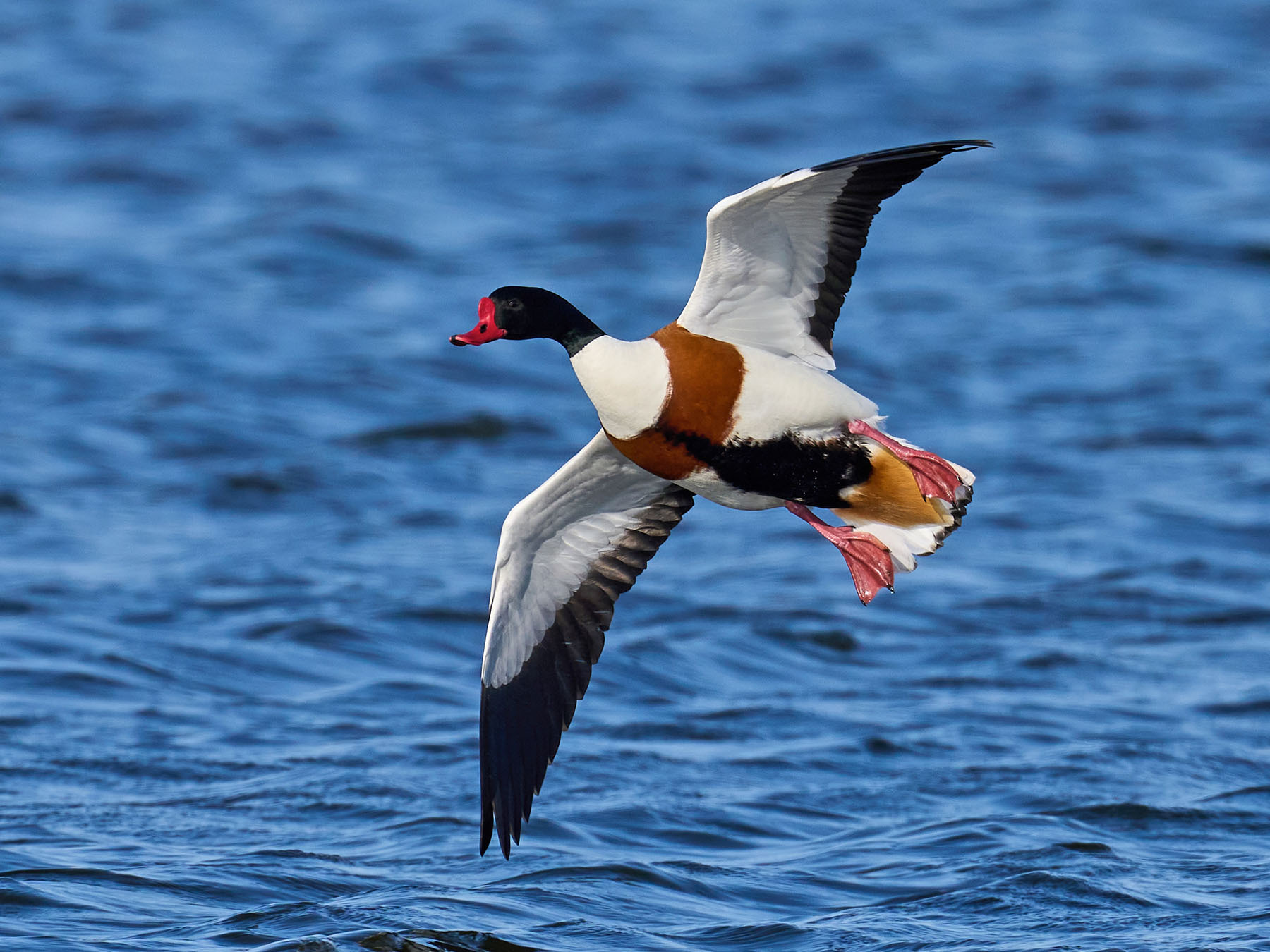
Common Shelduck guides
5 guidesQuick facts
- Length
- 58–67 cm
- Wingspan
- 110–130 cm
- Weight
- 800–1400 g
- Lifespan
- 10 years · oldest recorded 24.8 years
- Family
- Ducks, Geese & Swans
- Migration
- Partial migrant
- Global status (IUCN)
- Least Concern
- World population
- 625,000 - 750,000 individuals
- Population trend
- Increasing
- Also called
- Shelduck
- Scientific name
- Tadorna tadorna
Questions
3Is a Shelduck a duck or a goose?
In terms of size, a shelduck sits between most duck species and smaller geese. It’s officially classed as a duck, and is one of the largest duck species, with some overlap in size with barnacle goose.
Why is it called a Shelduck?
Contrary to what you may first think, the shelduck’s name has nothing to do with shells. It comes from the Old English word ‘sheld’ which means ‘mixed in colour’ or pied.
Can Shelduck fly?
Shelducks can fly, and migrate over long distances to reach moulting and wintering grounds each year.
Sources
4- 1BirdLife International. 2019. Tadorna tadorna. The IUCN Red List of Threatened Species 2019: e.T22680024A154560262. Source (opens in a new tab)
- 2Wetlands International (2015)
- 3Wetlands International (2015)
- 4Fransson et al., EURING list of longevity records for European birds (2010) Source (opens in a new tab)

Checked by
Nathan Cope, founder and editor
Nathan founded Birdfact and leads its writers and contributors in the UK, the US and Canada. He has watched and studied birds for more than ten years, and checks every article and species guide before it’s published.