Species Profile
Semipalmated Plover
Charadrius semipalmatus
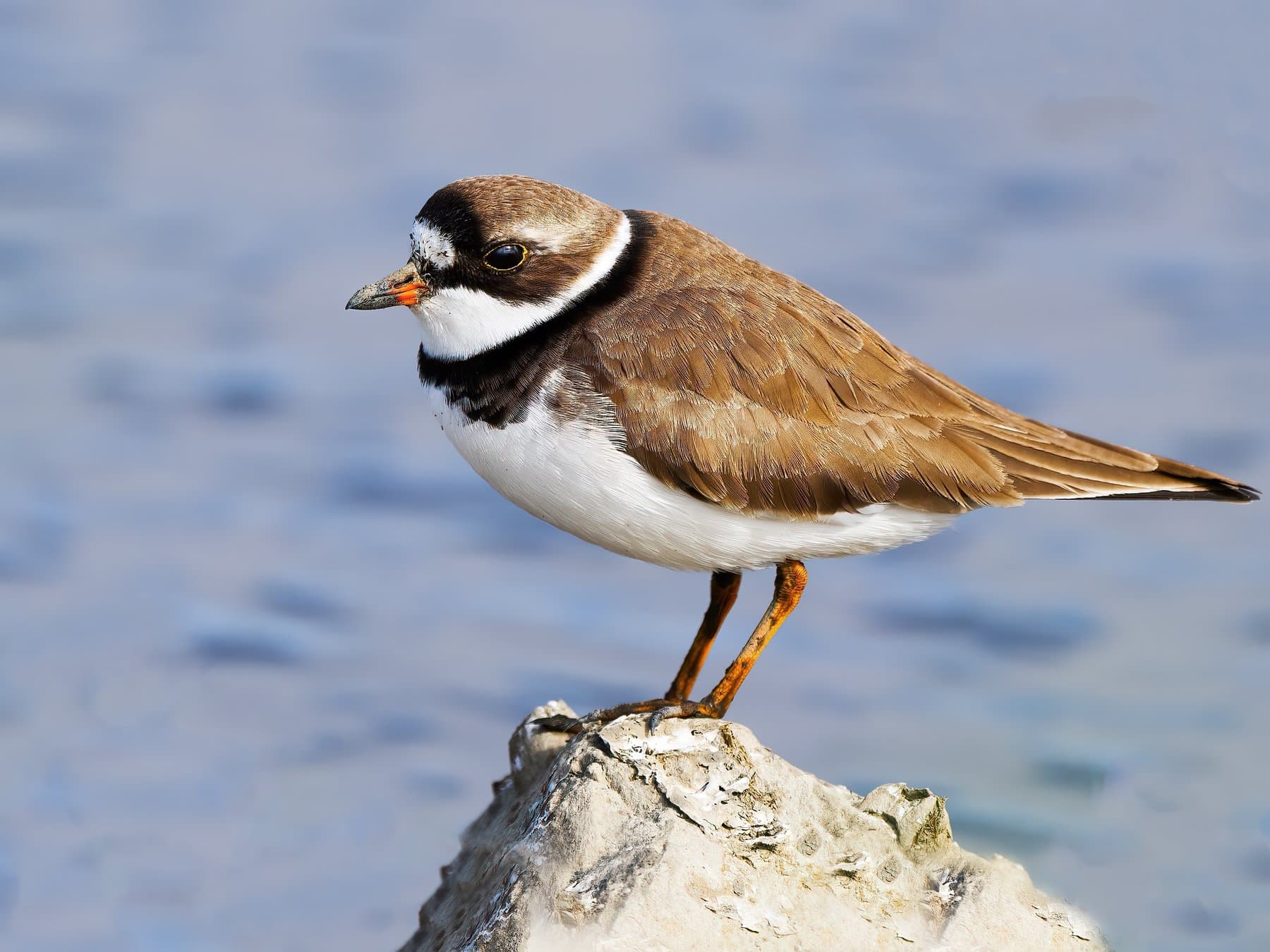
Semipalmated Plover perched on a light-colored rock, showing brown upperparts, white underparts, a black breast band, and orange legs, with a blurred blue background.
Quick Facts
Conservation
LCLeast ConcernLifespan
5–6 years
Length
17–19 cm
Weight
37.6–54.7 g
Wingspan
47–50 cm
Migration
Long-distance Migrant
A single bold black breast band — worn like a necklace against clean white underparts — makes the Semipalmated Plover one of the easiest shorebirds to identify on a crowded mudflat. This compact, round-headed plover breeds across the Arctic and sub-Arctic of North America before undertaking a continent-spanning migration to wintering grounds that stretch as far south as Tierra del Fuego. Its name refers to a subtle but telling feature: partial webbing between all three front toes, invisible at a distance but decisive in the hand.
Think you've spotted a Semipalmated Plover?
Upload a photo and we'll confirm it instantly
Confirm with a PhotoAppearance
The Semipalmated Plover is a small, plump shorebird with a round head, large dark eyes, a short stubby bill, and medium-length legs. Adults measure 17–19 cm in length with a wingspan of 47–50 cm — roughly the size of a starling, but rounder and more compact in build.
In breeding plumage (March–August), the upperparts are a warm medium-brown — often described as the colour of wet sand — while the underparts are clean white. The defining feature is a single, solid breast band encircling the neck. In males this band is jet black; in females it is dark brown. Above the band sits a white collar that extends to the base of the bill. The head pattern is bold: a black mask covers the eyes and forecrown, contrasting with a small white patch just above the bill and a white stripe above the eye. The short bill is orange-yellow at the base with a black tip. Legs are orange to yellow-orange, and the eyes are dark, ringed with a yellow-orange orbital ring.
In non-breeding plumage (September–February), the black on the head and breast band is replaced by brown, and a white supercilium connects with the white forehead patch. The bill becomes duller, with black spreading from the tip toward the base. Males in winter tend to retain blacker heads than females, providing a subtle but useful field mark.
The species' namesake feature — partial webbing (semipalmations) between the toes — is visible at close range. Webbing is present between all three front toes, most conspicuously between the middle and outer toes. This distinguishes it from the very similar Common Ringed Plover (Charadrius hiaticula), which has webbing only between the inner and middle toes. Females are slightly larger and heavier than males, with longer wings, while males have longer toes and bills — an unusual pattern of mixed sexual dimorphism.
Identification & Characteristics
Male Colors
- Primary
- Brown
- Secondary
- White
- Beak
- Orange
- Legs
- Orange
Female Colors
- Primary
- Brown
- Secondary
- White
- Beak
- Black
- Legs
- Yellow
Male Markings
Single bold black breast band; black facial mask; white collar; orange-yellow bill with black tip; orange legs; yellow-orange orbital ring
Tail: Brown with a darker tip and white outer tail feathers; relatively short and square-ended
Female Markings
Breast band and facial mask brown rather than black in breeding plumage; bill shows less orange; slightly larger and heavier than male with longer wings
Tail: Brown with a darker tip and white outer tail feathers; identical to male
Attributes
Understanding Attributes
Rated 0–100 based on research and observation. A score of 50 is average across all bird species. These attributes are relative and don't necessarily indicate superiority.
Habitat & Distribution
On breeding grounds, Semipalmated Plovers favour flat, open terrain with sparse or absent vegetation: gravel bars along rivers and ponds, sandy and shingle shorelines, rocky beaches, wet meadows, fallow croplands, and dry tundra heath. Unlike many tundra-nesting shorebirds, this species avoids dense tundra vegetation, preferring open gravel or sand substrates. Nesting occurs from sea level up to 1,525 m elevation.
The breeding range spans the Arctic and sub-Arctic of North America, from the Alaskan coast and interior east through the Yukon, Northwest Territories, Nunavut, and the northern provinces to Newfoundland and Nova Scotia. The entire global breeding population — estimated at around 200,000 individuals — nests in Alaska and Canada.
During migration, the species is common and widespread across the entire North American continent, both coastally and inland. It passes through all US states, with peak southbound migration in August and spring migration peaking in May. Key staging areas include the Delaware Bayshore, the St. Lawrence River Estuary, and the Bay of Fundy, where birds accumulate fat reserves for long overwater flights. In the UK and Ireland, the species is an extremely rare vagrant, with accepted records from the Isles of Scilly (the first British record, October–November 1978), Cornwall, Devon, Hampshire, and West Sussex. A 2024 record from Portugal was identified entirely from song recordings within a roost of 500+ Common Ringed Plovers.
Wintering birds occupy open coastal habitats from the southern United States — Atlantic coast from Virginia to Florida, Gulf coast from Florida to Texas, Pacific coast from southern California southward — through Mexico, Central America, the Caribbean, and much of South America as far south as Tierra del Fuego and Argentina. The species also winters on the Cape Verde Islands.
Where to See This Bird
Explore regional guides for locations where this bird has been recorded.
Alaska
New Jersey
Massachusetts
Maine
Mississippi
Connecticut
Delaware
Florida
Ohio
New York
South Carolina
Rhode Island
Canada
New Brunswick
Newfoundland and Labrador
Nunavut
Northwest Territories
Quebec
Yukon Territory
Diet
Semipalmated Plovers are opportunistic carnivores whose diet shifts markedly with season and location. On Arctic breeding grounds, insects dominate: larvae of shore flies, soldier flies, and beach flies, along with mosquitoes, grasshoppers, and Ochtebius beetles. Spiders and earthworms are also taken when available.
In coastal and wetland habitats during migration and winter, the diet pivots to marine invertebrates: polychaete worms, amphipods, isopods, copepods, ostracods, small crabs and shrimp, bivalves, and gastropods including coffee bean snails and Odostomia laevigata. On Atlantic beaches, birds exploit horseshoe crab eggs during the spring spawning season — a high-energy food source timed to coincide with northbound migration. The species occasionally takes berries, seeds, and grains from grasslands or cultivated fields.
Foraging follows the classic plover 'run-stop-peck' technique: a short sprint, a pause to scan for prey, then a lunge to snatch surface items or pull worms from their burrows. The bill is small but powerful, capable of hammering hard-shelled prey. One particularly effective technique is 'foot-trembling' — the bird vibrates one foot rapidly on wet sand or mud, disturbing invertebrates and drawing them to the surface. In submerged muddy substrates, birds stir the sediment with their feet to flush buried prey. The species rarely wades more than 2–3 cm deep when foraging, keeping to the shallowest margins of tidal flats and pools.
During the winter period, birds actively accumulate fat reserves in preparation for the energetically demanding spring migration back to Arctic breeding grounds.
Behaviour
Semipalmated Plovers are active, alert birds that spend most of their waking hours foraging along shorelines and mudflats. Outside the breeding season they are sociable, gathering in flocks of 200–600 birds at favoured stopover sites, with unusually large concentrations of up to 4,000 birds reported on the coast of South America. At high tide, when feeding grounds are submerged, flocks roost together on upper beaches and high hummocks in salt marshes.
The species has large eyes relative to its body size, and this is not merely cosmetic — it enables nocturnal foraging, particularly on moonlit nights when invertebrates are active near the sediment surface. This capacity for night feeding gives the plover an advantage at busy coastal stopover sites where daytime competition for food is intense.
On breeding territories, males are vigorously territorial. They perform a distinctive 'butterfly flight' display — slow, exaggerated wingbeats more than 50 m above the ground while giving a constant chu-weep call — to advertise territory boundaries and deter rivals. On the ground, a male confronting an intruder spreads and depresses his tail, slightly opens his wings, and puffs his feathers while calling.
Like many plovers, the Semipalmated employs a broken-wing distraction display near the nest, feigning injury to draw predators away from eggs or chicks. Both parents share incubation duties, rotating every 2–4 hours. The female typically departs the breeding grounds 15–25 days after the chicks hatch, leaving the male as sole guardian until the young fledge. The species is socially monogamous, and pairs may reunite in subsequent seasons.
Calls & Sounds
The Semipalmated Plover's most frequently heard call is a sharp, rising two-note whistle rendered as chu-weep, chu-wit, or tu-wee — a plaintive, disyllabic sound with a rising quality at the end. This call functions as a general contact and mild alarm note, given while foraging, in flight, and when disturbed. eBird describes it as a 'distinctive two-parted chu-weep!' with 'assorted chortles and chuckles'; Audubon notes 'a plaintive 2-note whistle, tu-wee' and also 'a soft, rather musical rattle'.
The territorial song, delivered during the 'butterfly flight' display over breeding territories, consists of a regularly repeated chu-weep call followed by rough trilling and ending with a downslurred yelp. This song is given almost continuously during display flights. On the ground during courtship, males produce a rapid 'chuttering' or sputtering call while chasing females. Alarm calls near the nest are sharper and more urgent than the standard contact call.
The vocal differences from the Common Ringed Plover are now recognised as a reliable — and sometimes the only — identification tool. The Semipalmated's flight call is shorter, distinctly higher-pitched, and more strikingly inflected, with a deep V-shaped dip in the middle visible in sonagrams, giving an almost squeaky, disyllabic quality. The Ringed Plover's default flight call is a more mellow, pure-toned puuuip with a brief upward inflection at the end. In September 2024, Sound Approach researchers identified a Semipalmated Plover within a roost of over 500 Common Ringed Plovers at Salinas de Brito, Portugal, entirely from seven short snatches of its song captured on recording equipment — the bird was never seen. This was the first accepted record for continental Portugal and demonstrated that vagrant Semipalmated Plovers can be detected within large Ringed Plover flocks by vocalisation alone.
Flight
In flight, the Semipalmated Plover shows a clean, direct action typical of small plovers — rapid, shallow wingbeats interspersed with brief glides on slightly bowed wings. The wings are long and pointed, giving the bird a swift, purposeful appearance in the air. The bold single breast band and white collar remain clearly visible in flight, as does the white wing-stripe that runs along the length of the upperwing — a useful feature when birds flush from a mudflat and wheel overhead.
The tail is brown with a darker tip and white outer tail feathers, visible as the bird banks and turns. The white rump is not as prominent as in some related plovers, but the contrast between the brown back and white underparts is striking from below. Flocks in flight tend to move in loose, coordinated groups rather than the tight, synchronised formations of some waders.
During the breeding season, the male's 'butterfly flight' territorial display is unmistakable: slow, exaggerated wingbeats — far deeper and more laboured than normal flight — carried out more than 50 m above the ground while the bird calls continuously. This display is sustained for extended periods and is the primary way territories are advertised and defended against rival males. The contrast between this slow, moth-like display flight and the bird's normally brisk, direct travel flight is striking.
Nesting & Breeding
The breeding season is compressed into less than two months at high latitudes, running from early May to late August. Males arrive on breeding grounds a few days before females and immediately begin establishing territories through aerial display and ground posturing. The 'butterfly flight' — slow, exaggerated wingbeats more than 50 m above the ground accompanied by a continuous chu-weep call — serves both to delineate territory and attract arriving females.
When a female lands, the male chases her with his tail cocked and fanned, giving a rapid 'chuttering' call. The female signals mate acceptance by sitting in a scrape and performing a tail-fanning display. The species is socially monogamous, and pairs may reunite in subsequent seasons. Males guard females closely after pairing to ensure paternity.
The nest is a shallow scrape in dry gravel, pebbles, sand, or very short tundra vegetation, typically near a wetland. The male excavates the scrape using his feet and body, then lines it with nearby materials: leaves, shells, rocks, grass, moss, seaweed, and occasionally glass or charcoal. Scrapes measure approximately 9 cm across and up to 3 cm deep.
The clutch is typically 4 eggs (rarely 3–5), laid at 24–30 hour intervals over approximately 5 days. Eggs are light brown to pale olive-buff, blotched with black, dark brown, sepia, and grey — providing excellent camouflage against gravel substrates. Egg dimensions are approximately 3.24–3.31 cm long by 2.28–2.41 cm wide. Both parents share incubation, rotating every 2–4 hours, for 23–25 days. Chicks are precocial, covered in buff, black, and white down, and leave the nest within hours of hatching. Both parents brood chicks for up to 5 days. The female typically departs 15–25 days after hatching, leaving the male as sole guardian. Chicks fledge at 23–31 days. One brood is raised per season.
Lifespan
The typical lifespan of a Semipalmated Plover in the wild is around 5–6 years, though survival rates vary considerably between age classes. First-year birds face the highest mortality, particularly during their first long-distance migration. About 15% of breeding populations consist of individuals aged 5–6 years, suggesting that a meaningful proportion of birds do reach middle age.
The maximum recorded lifespan is 9 years and 2 months — a bird banded in Massachusetts in 1974 and recaptured at the same location in 1982. This record comes from banding data compiled by the International Wader Study Group and published in the journal Wader Study (Volume 128, Issue 2, 2021). For a small shorebird undertaking annual migrations of thousands of kilometres, this is a notable achievement.
Mortality causes include predation (by falcons, merlins, and larger shorebird predators during migration), starvation during severe weather at stopover sites, collisions with structures, and hunting pressure in parts of South America. Climate-related changes to Arctic breeding habitat and coastal wintering areas represent emerging long-term threats to survival rates. Compared to the Piping Plover, a close relative listed as Near Threatened, the Semipalmated Plover's broader habitat tolerance and larger population give it a more secure demographic outlook.
Conservation
The Semipalmated Plover is assessed as Least Concern on the IUCN Red List (2024), with a global breeding population estimated at approximately 200,000 individuals by Partners in Flight. The species is among the few shorebirds whose numbers appear broadly stable — a relative rarity in a group facing widespread declines globally. Partners in Flight rates it 11 out of 20 on the Continental Concern Score, indicating low conservation concern, though some regional assessments (including NH Audubon) note a slight downward trend.
This stability is partly attributed to the species' dispersed wintering range across multiple countries and habitat types, which reduces its vulnerability to localised catastrophes. Its willingness to nest in disturbed and human-altered landscapes — including gravel roadsides and industrial sites — also provides some resilience.
Current threats include habitat loss along coastlines during migration and wintering, particularly from coastal development; climate change and sea level rise impacting Arctic breeding habitat; subsistence and sport hunting in parts of South America, where hundreds to thousands of birds are killed annually; oil spills and pollution; collisions with structures during migration; and human disturbance at breeding sites, including ATV activity on roadside nesting habitat. Competition with Killdeer (Charadrius vociferus) for nesting habitat has been noted in some areas.
Historically, populations were seriously depleted by unrestricted market hunting in the late 19th century. The species has since recovered well following legal protection, demonstrating that shorebird populations can rebound when direct persecution is removed — a lesson relevant to ongoing conservation efforts in South America.
Population
Estimated: Approximately 200,000 individuals
Trend: Stable
Broadly stable; Partners in Flight rates the species 11/20 on the Continental Concern Score, indicating low conservation concern. Some regional assessments note a slight downward trend.
Elevation
Sea level to 1,525 m on breeding grounds
Additional Details
- Egg size:
- Approximately 3.24–3.31 cm × 2.28–2.41 cm
- Predators:
- Known predators include Peregrine Falcons, Merlins, and other raptors during migration. Ground predators at breeding sites include Arctic foxes, ravens, and gulls, which take eggs and chicks. Both parents employ broken-wing distraction displays to lure predators away from nests.
- Breeding age:
- 1
- Maturity age:
- 1
- Feeding times:
- Diurnal and nocturnal (particularly on moonlit nights)
- Major threats:
- Coastal development; climate change; subsistence hunting in South America; oil spills; collision with structures; human disturbance at breeding sites
- Parental care:
- Both parents share incubation (rotating every 2–4 hours); female typically departs 15–25 days after hatching, leaving male as sole guardian until fledging
- Primary calls:
- Sharp rising two-note whistle: chu-weep or tu-wee
- Social habits:
- Sociable outside breeding season; flocks of 200–600 typical, up to 4,000 on South American wintering grounds
- Feeding habits:
- Run-stop-peck foraging; foot-trembling to disturb invertebrates; occasional nocturnal foraging on moonlit nights
- Breeding season:
- Early May to late August
- Diet variations:
- Insects dominate on breeding grounds; marine invertebrates (polychaetes, amphipods, molluscs) dominate during migration and winter; horseshoe crab eggs exploited during spring migration on Atlantic coast
- Fledging period:
- 23–31 days
- Average lifespan:
- 5–6 years
- Call description:
- Disyllabic chu-weep with a V-shaped dip in the middle; distinctly higher-pitched and more inflected than Common Ringed Plover's mellow puuuip
- Nesting location:
- Shallow scrape in dry gravel, pebbles, sand, or very short tundra vegetation, typically near a wetland
- Number of broods:
- One
- Incubation period:
- 23–25 days
- Nest construction:
- Shallow scrape (approx. 9 cm across, up to 3 cm deep) lined with leaves, shells, rocks, grass, moss, seaweed, and occasionally glass or charcoal
- Migration patterns:
- Long-distance migrant; breeds Arctic/sub-Arctic North America, winters coastal South America to Tierra del Fuego; peak southbound migration August, spring migration May
- Age related changes:
- Black on head and breast band replaced by brown in non-breeding plumage; males retain blacker heads than females in winter
- Prey capture method:
- Run-stop-peck; foot-trembling on wet sediment; bill used to snatch surface prey or pull worms from burrows
- Conservation efforts:
- Protected under the Migratory Bird Treaty Act in North America; key staging areas such as the Delaware Bayshore managed for shorebird conservation
- Territorial behavior:
- Males perform sustained 'butterfly flight' aerial displays and ground posturing to defend territories; chasing and chuttering calls used in mate competition
- Clutch characteristics:
- Typically 4 eggs (rarely 3–5); light brown to pale olive-buff, blotched with black, dark brown, sepia, and grey
- Interaction with other species:
- Competes with Killdeer for nesting habitat in some areas; vagrant birds detected within Common Ringed Plover roosts in Europe by vocalisation
Courtship & Display
Courtship in the Semipalmated Plover is an elaborate, multi-stage process that begins as soon as males arrive on breeding grounds — typically a few days before females. The aerial component is the most conspicuous: the 'butterfly flight', in which the male flies more than 50 m above the tundra on slow, exaggerated wingbeats, calling continuously with a repeated chu-weep that carries far across open ground. This display simultaneously advertises territory to rival males and signals quality to arriving females.
On the ground, the male performs a series of postures: spreading and depressing his tail, slightly opening his wings, and puffing his breast feathers to maximise the visual impact of his black breast band. He also excavates multiple scrapes in the substrate using his feet and body — a behaviour that serves both as nest-site prospecting and as a courtship offering. Females inspect these scrapes and signal mate choice by sitting in one and performing their own tail-fanning display.
Once a female has chosen a mate, the male chases her with his tail cocked and fanned, giving a rapid 'chuttering' call. Copulation follows. After pairing, males guard their mates closely — a behaviour interpreted as mate-guarding to ensure paternity before the female begins laying. The species is socially monogamous, and there is evidence that established pairs may reunite on breeding grounds in subsequent seasons, potentially benefiting from prior experience of nesting together.
Similar Species Comparison
The Semipalmated Plover's closest lookalike is the Common Ringed Plover (Charadrius hiaticula), the default small plover across Europe and a scarce but regular vagrant on North America's Atlantic coast. The two species are so similar that vagrant Semipalmated Plovers in Europe were historically overlooked within Ringed Plover flocks. Several structural and plumage differences are useful at close range: the Semipalmated has a slightly narrower breast band, a marginally smaller and stubbier bill, and — most reliably — more extensive toe webbing (between all three front toes, versus only the inner and middle toes in Ringed Plover). The orbital ring of the Semipalmated tends to be more orange, while the Ringed Plover's is yellower.
Vocally, the two species are straightforwardly different once learned. The Semipalmated's flight call is a sharp, disyllabic chu-weep with a pronounced V-shaped dip in the middle of the note — higher-pitched and more inflected than the Ringed Plover's mellow, single-note puuuip. This difference is now considered the most reliable identification criterion, even allowing detection of vagrants by sound alone within large Ringed Plover roosts.
In North America, the Killdeer (Charadrius vociferus) is superficially similar but is noticeably larger and has two breast bands rather than one. The Wilson's Plover (Charadrius wilsonia) overlaps in winter range and has a single breast band, but is larger, has a much heavier bill, and shows pinkish-grey rather than orange legs. The Piping Plover (Charadrius melodus) is paler overall — sandy rather than brown above — and has a thinner, often incomplete breast band.
Birdwatching Tips
Semipalmated Plovers are among the most reliably encountered shorebirds in North America during migration. The single black breast band on a brown-and-white bird is distinctive and visible at considerable distance through binoculars. In the US, peak southbound migration runs through August, with juveniles following into October; spring migration peaks in May. Coastal mudflats, tidal flats, sandy beaches, and flooded agricultural fields are the most productive habitats. Key sites include the Delaware Bayshore (where birds stage alongside other shorebirds in large numbers), the Bay of Fundy, and the St. Lawrence River Estuary.
The most common confusion species is the Common Ringed Plover, which is the default species in the UK and Europe. In North America, the Semipalmated is far more likely, but vagrant Ringed Plovers do occur on the Atlantic coast. The key differences: Semipalmated has a narrower, more complete breast band, a slightly smaller bill, and — crucially — a distinctly different call. The Semipalmated's flight call is a sharp, rising two-note chu-weep with a deep V-shaped dip in the middle, clearly disyllabic and higher-pitched than the Ringed Plover's more mellow, single-note puuuip. Learning this call difference is the most reliable way to separate the two species, even in poor light.
In the UK, the Semipalmated Plover is an extreme rarity — fewer than ten accepted records — but the 2024 Portugal discovery shows that birds can lurk undetected within Ringed Plover flocks. Birders at large coastal Ringed Plover roosts in autumn are encouraged to record calls: a vagrant Semipalmated may be heard before it is seen. Look for the slightly warmer brown upperparts, the more orange (less yellow) legs, and the orange-based bill.
Did You Know?
- The oldest recorded Semipalmated Plover was at least 9 years and 2 months old when recaptured during banding operations in Massachusetts in 1982 — it had originally been banded in the same state in 1974, making it one of the longest-lived small shorebirds on record.
- At Prudhoe Bay, Alaska, pairs have nested on building rooftops, inside a large open industrial building, and on active gravel runways — demonstrating that this Arctic breeder is surprisingly tolerant of human infrastructure.
- In 2024, a Semipalmated Plover was detected in a roost of 500+ Common Ringed Plovers in Portugal entirely by its song, without ever being seen. Sound Approach researchers identified it from seven short snatches of its distinctive call in recordings — the first accepted record for continental Portugal and a landmark moment for European vagrant detection.
- The first British record, in October 1978 on St Agnes in the Isles of Scilly, was identified by its call before the bird was even properly seen — observers noted a plaintive, disyllabic che-wee unlike any Ringed Plover call, which led to the identification. The bird stayed until the second week of November.
- Semipalmated Plovers and their chicks can swim short distances across water channels while foraging — an unusual ability for a ground-nesting shorebird. Chicks swim to follow parents to small islets on shallow lakes within days of hatching.
Records & Accolades
Longest Migration
Alaska to Tierra del Fuego
Breeds in Arctic Alaska and Canada, then migrates to the southern tip of South America — one of the longest annual journeys of any small plover.
Identified by Sound
First continental Portugal record, 2024
In 2024, a Semipalmated Plover was detected within a roost of 500+ Common Ringed Plovers in Portugal entirely from seven snatches of its distinctive call — never seen, only heard.
Urban Nester
Prudhoe Bay, Alaska
Pairs at Prudhoe Bay have nested on building rooftops, inside open industrial buildings, and on active gravel runways — among the most urbanised nesting sites of any Arctic shorebird.
Longevity Record
9 years 2 months
The oldest known individual was recaptured in Massachusetts in 1982, having been banded in the same state in 1974 — a remarkable lifespan for a small long-distance migrant.
Community Photos
Be the first to share a photo of the Semipalmated Plover
Upload a PhotoIdentify Any Bird Instantly
- Upload a photo from your phone or camera
- Get an instant AI identification
- Ask follow-up questions about the bird
Monthly Birds in Your Area
- Personalised for your location
- Seasonal tips and garden advice
- Updated every month with new species